


Posted: 3/19/04
RANGE WRITER:
Western author Elmer Kelton
Elmer Kelton is the author of more than 40 novels, including his latest, “Texas Vendetta,” now on bookstore shelves. He is the winner of seven Spur awards from the Western Writers of America and has had three of his novels appear in Reader's Digest Condensed Books. Four have won Western Heritage Awards from the National Cowboy Hall of Fame. He has been honored by the Texas Institute of Letters, the Western Literature Association, the National Cowboy Symposium in Lubbock and the Larry McMurtry Center for Arts and Humanities at Midwestern State University in Wichita Falls. He received honorary doctorates from Hardin-Simmons University in Abilene and Texas Tech University in Lubbock.
A native of Crane, Kelton attended the University of Texas, earning a bachelor's degree in journalism. He spent 15 years as farm and ranch writer-editor for the San Angelo Standard-Times, five years as editor of Sheep and Goat Raiser Magazine and 22 years as associate editor of Livestock Weekly, from which he retired in 1990.
He and his wife, Ann, have two grown sons and a daughter, four grandchildren and five great-grandchildren. They live in San Angelo.
Q.
Did you read much as a young boy?
I read everything I could get my hands on as a kid. I was a worry to my dad because every time he looked around I was reading something. I read everything, no matter what it was about. I loved books and magazines. I loved stories–western stories, adventure stories, anything like that. I remember reading “The Wizard of Oz” when I was in about the third grade, but I particularly loved stories about cowboys and horses. I was a voracious reader.
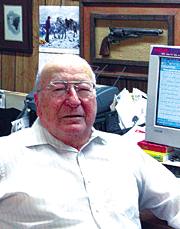 |
| Elmer Kelton |
Q.
Who were your favorite authors?
As a youngster, the ones who influenced me toward what I do now, at that period of my life, were J. Frank Dobie, Will James and Zane Grey. Each of them had different but somewhat the same basic material. But then I read western pulp magazines and got to know by name some of the old western pulp writers and got to meet some of them as I grew older. Those three, Dobie, James and Grey, were probably No. 1, but I read the adventure novels by Robert Louis Stevenson and Rudyard Kipling.
Q.
When did you first think about becoming a writer?
I started making up stories of my own by the time I was 8 or 9 years old, and I think from that point on, I knew pretty much, in some way or another, that is what I wanted to do.
Q.
You grew up on a ranch. What was your life like? What was your routine?
I don't know that we had a routine. At the time, my dad was the ranch foreman for the McElroy Ranch at Crane, I was the oldest of four boys.
We all went to school, but when school was out in the summer, Dad always had something for us to do. We spent a lot of time on horseback working cattle and spent a lot of time doing menial things such as digging postholes, fixing fence and pulling sucker rods out of windmills. That's the part of life that never gets in the books. It was just whatever dad wanted us to do, and he tried to keep us busy. He was a hard worker himself, and he wanted us to know how to work, and we grew up with a Christian work ethic. Even now, if I'm not doing anything, I've always got a little guilt feeling. I owe that to my dad, I guess. Anyway, it was a fun life in its way, although some of it was hard work. I was always a little ashamed of my cowboy abilities, because I just wasn't as good at it as some of them were. I compensated for it by reading and took a lot of vicarious pleasure out of the stories.
Q.
You have written more than 40 novels. What is the most difficult part of the job?
I guess the most difficult part is to make yourself sit down and work at it. Of course, you have to come up with a story, and often it's hard to come up with a good workable plot to build your story around. I try to tell my stories through the characters, but I have to have plot for them to work with–a problem or obstacle or whatever it is to be worked out to tell a story. You have to have some problem or obstacle or you don't have a story.
So working that out can be tough sometimes. I'm working on one now where I am going back to a character I've used before, and I'm already up to 100 pages, and I still don't know where I'm going with it yet. I don't have a clearly formulated plot outline in my head, but I trust the character to take care of me. He'll lead me through it.
Q.
What do you like most about writing novels?
Finishing one. It's not hard physical work, although you often feel physically drained after you've stayed with it for hours at a time. It's mostly mental work, but it certainly can sap your strength. Getting the feeling that you've done a good day's work, that you've gotten several good pages on paper, or, any more, on the computer. There's a lot of satisfaction after you're done, though it's hard work while you're doing it. Robert Louis Stevenson once said he hated to write but loved having written, and there's a lot of truth in that.
Q.
How do you deal with writer's block?
I usually try to analyze what is the matter with me. I think that most of the time writer's block is a subconscious thing that happens when you either haven't thought it out too well or you've tried to make something happen in the story that doesn't really quite fit. At some subconconscious level, I think that stops you, and when you finally trace it back and analyze where you've gone wrong and fix it, the block disappears.
Q.
How much time do you spend writing?
I don't know. I don't quantify it. On days when I am home, I try to spend the better part of the day at it, five or six hours, although I may be doing other things, too. … It's hard to try to do a specific number of pages a day, because some days it just flows and other days it's like pulling teeth, word by word, and you feel good if you get a couple of decent pages together. I don't set myself a quota, although I do set myself a deadline for finishing a project. Right now, I'm trying to do a book a year. As long as I feel I'm meeting that goal, I don't stress myself over it.
Q.
You are doing a book a year, and you said you had about 100 pages on another. Are you thinking about others as you write this new one?
Not at this moment. In the past I would be working on one and thinking about the next couple or three. Now, as I get older, I'm taking them a book at a time. And my family and my agent have been after me to do my memoirs, so I probably will do that next after I finish this book.
I'm getting up on 78 now, and I don't know how many more books are left.
Q.
Did you work for a newspaper to make a living so you could write novels, or did you write novels so you could afford to work for a newspaper?
I think either one applies to some degree. The newspaper work was for a living. I enjoyed it and specialized in agriculture for 42 years, but the biggest part of the time it subsidized my novel writing. It paid the freight, for the groceries, for the house, so I didn't have to depend on my books for a living. It freed me to write the kind of books I wanted to write because life didn't depend on whether I sold that book or not.
Having a steady job was a liberating influence for me as a writer, but my overall ambition was always to be a fiction writer. As it turned out, my journalism career gave me the background for a lot of the books I've written. … I've always felt the two careers complemented each other.
Q.
Where do you get the idea for a novel?
That's hard to answer. Sometimes it's from a story I hear or some story I've read out of history. I usually try to pick a period of history when there is change and a natural conflict because of that change. There's always a natural conflict when you come into a period of intense change, because you have people who are trying to promote the change and those who are trying to hold the status quo. I have tried to write about just about every major period of Texas history.
Q.
How many of the characters from your life on the ranch and later show up in your novels?
Quite a few. They may not come directly, but I try to borrow from people I've known and known about. Charlie Flagg in “The Time It Never Rained” was a composite of a bunch of ranchers I knew, including my father. Hewey Calloway in “The Good Old Boys” was a composite of a number of cowboys I knew when I was growing up. Those are probably my two strongest characters I've written about. Other characters come from various places. … I try not to take some real person and set him in a book as he is, but I borrow things from people and use them.
Q.
Why do you think books about the West have such broad appeal?
I think part of it is there is a mystique about that frontier period in our history. … That frontier experience, the westward movement goes back to something in a person's family history, some way or another, so there is a relationship, and you think in some sense this is about your forebears.
In another sense, readers perceive it as a simpler time when good was good, bad was bad, black was black, white was white, and you didn't have all these shades of gray to contend with. You have the feeling, although it probably isn't necessarily true, that people were more independent and not little cogs in a big wheel. It's sort of an escape for people. It serves a function, like the old myths in Europe served in their time. … I guess people need myths to tell them who they are.
Q.
What role has religious faith played in your life?
It hasn't been No. 1, but it has always been an underlying factor in my life and the way I view things. My people on both sides of my family over the years tended to be Baptists. My mother became a Methodist and brought us up Methodist. It's been a factor in guiding my outlook on life, right and wrong. … When I went off to service in World War II, I found myself at 18 in a front-line infantry company in Germany, and I thought about it a lot at that time. I kept a little Bible in my pack, and just before I shipped out for overseas, I was at Camp Howse in Gainesville and went to a little Methodist church. They gave me a prayer book, and in the back were a bunch of hymns. One that they sang was “Just as I Am.” I memorized it, and during the time I was on the front line with a knot of fear in my stomach, that hymn and prayer book pulled me through it.
Three or four years ago, I had a heart attack and was told I had to have bypass surgery. I felt real peaceful about it. I said whatever the Lord wants for me, that's what will be and went into it with total calm and peace. That faith was there.
Interview by Toby Druin









We seek to connect God’s story and God’s people around the world. To learn more about God’s story, click here.
Send comments and feedback to Eric Black, our editor. For comments to be published, please specify “letter to the editor.” Maximum length for publication is 300 words.