Christian illusionist uses stunts to present gospel message_110804

Posted: 11/05/04

Christian illusionist uses stunts to present gospel message

By Leann Callaway

Special to the Baptist Standard

BAYTOWN–When illusionist Jared Hall wants to illustrate how sin separates people from God, he puts on a straitjacket.

“I explain how sin can strap us and keep us in bondage, just like the straight jacket,” he said.

The straitjacket illustration is just one of many escapes, stunts and illusions he performs during his gospel presentations.

Hall was raised in Baytown, where his father is music minister at Second Baptist Church.

Christian illusionist Jared Hall uses a straitjacket to demonstrate the bondage of sin.

His interest in illusions started at age 11. In junior high and high school, he used illusions as a way to entertain his friends.

During his freshman year of high school, Hall met Brock Gill, a Baptist youth evangelist and illusionist. Gill became a mentor to Hall and taught him how to use illusions to glorify God.

After touring with Gill in the summer, Hall returned to school and applied the lessons he learned.

“As I entered my sophomore year, I handled myself differently,” he explained. “I would go to the football games on Friday nights and perform illusions. By halftime, I would have the entire student section watching my illusions, rather than the game. I would use this to my advantage. And once I had their attention, I would share with them the message of Jesus Christ.

“During my junior year of high school, God called me into vocational ministry, and I knew that he was calling me to use illusions to share the message. God took my hobby and transformed it into a unique and awesome ministry. I like to challenge others to use their gifts to glorify God, because if God can use me through card tricks and other weird tricks, then he can use anyone.”

Today, as Hall travels around the country and books more than 100 events a year, he offers three unique shows for all ages. He recently performed at the Texas Baptist Youth Ministry Conclave in Arlington.

He regularly performs at youth camps, Disciple Now weekends, Upward sports award nights, church worship services and evangelistic outreach events.

“My shows are fast-paced, high-energy and high-flying,” he said. “I do things like making a person disappear and making a wooden table float around the stage and even into the audience. I also do crazy, comedic illusions to keep the audience laughing.”

While Hall knows how to slither out of a straitjacket, he realizes he cannot escape tribulations. Last year, he was in St. Louis, Mo., for a show when $6,000 worth of illusion and sound equipment was stolen from his truck.

“Through this experience, God taught me to trust him, no matter what,” he explained. “My show has rebuilt better than the one I was doing at that time.

“I would not be doing this if Jesus were not the center of my ministry. I love getting to tell others about God's power and grace.

“A lot of people at the shows have never been to a church service, but they'll come to an event thinking they're going to be entertained by an illusionist. Many of those same people leave the event knowing Jesus Christ as their Savior.”

News of religion, faith, missions, Bible study and Christian ministry among Texas Baptist churches, in the BGCT, the Southern Baptist Convention ( SBC ) and around the world.


Right to Life researchers critique abortion study_110804

Posted: 11/05/04

Right to Life researchers critique abortion study

By Robert Marus

ABP Washington Bureau

WASHINGTON (ABP)–Scholars associated with the National Right to Life committee point to what they consider as flaws in an evangelical seminary professor's study suggesting that the abortion rate has risen during the Bush administration. But the Baptist professor is standing by his conclusion.

Statistician and ethicist Glen Stassen of Fuller Theological Seminary near Los Angeles used statistics from Minnesota Citizens Concerned for Life and the Guttmacher Institute, as well as an analysis of figures on abortion rates in several states, to conclude that abortions likely increased nationwide by several thousand in 2002.

It also noted that, had the trend of a declining abortion rate–which decreased more than 17 percent between 1990 and 2000–continued under Bush's administration, about 50,000 fewer abortions would have taken place in 2002 than did.

In addition, Stassen tied the increase in abortion rate to economic factors, noting that such jumps in the number of abortions have historically occurred when unemployment was high. Pregnant women are less likely to abort their children if they or the fathers of their children have stable jobs and health-care coverage.

But two researchers for a group that opposes abortion rights and supports Bush's position said Stassen's argument was off the mark. Randall O'Bannon and Laura Hussey of the National Right to Life Educational Trust Fund wrote that “neither his data nor his argument hold up under scrutiny.”

One of their critiques was that Stassen's sample size wasn't large enough.

“Since no national abortion data have been reported since 2000, Stassen looks at abortion figures for 16 states over 2001, 2002, and in some cases, 2003,” O'Bannon and Hussey wrote. “Stassen confidently claims that abortions increased in 11 of those 16 states during the Bush administration and asserts that this reflects a larger national upward trend in abortions. Yet Stassen never demonstrates that his 16 states are representative of the 50 states.”

Stassen defended the sample size by pointing to statistics cited every day in the run-up to the presidential election.

“The political polls include 500 or 1,000 respondents and extrapolate to 50 million voters. I have 16 states out of 50, which is a much greater sample, proportionately,” he said.

O'Bannon and Hussey also noted Stassen had incorrectly cited increases in the 2002 abortion rate in two states–South Dakota and Wisconsin–that actually showed decreases in their abortion rates. They also said newer statistics on the abortion rate in Illinois showed a significant decrease in 2003.

Therefore, O'Bannon and Hussey said: “When one shifts Wisconsin and South Dakota to the decrease column, and adds in Illinois after its dramatic 2003 drop in abortions, Stassen's claim that abortions have increased in 11 out of 16 states now turns into an eight-to-eight tie, with as many states decreasing as increasing. Hardly anything definitive.”

Stassen acknowledged the mistake with the Wisconsin and South Dakota figures but said he did not use the Illinois figures because they were too recent and may be incomplete. He also said the anti-abortion researchers were engaging in the same crime of which they accuse him.

“O'Bannon and Hussey confirm my report that Illinois abortions increased in 2002, but then they report that they found data for Illinois in 2003, in which the number of abortions then decreased,” he wrote. “Yet when they point to Wisconsin's 2002 decrease, they fail to report that in 2003, abortions in Wisconsin actually increased. Such selectivity looks like trying to defend against the truth and support a preconceived notion rather than accepting all the data in a consistent way.”

O'Bannon and Hussey also criticized Stassen's economic argument, contending that his data was insufficient to tie the abortion rate to unemployment figures. They also noted abortion rates and statewide unemployment rates in some of the states Stassen cited in his study don't correlate the way he claims they do nationally.

“Illinois' abortions dropped substantially between 2002 and 2003, in spite of its unemployment rate being stuck at 6.7 percent, among the worst in the nation,” they wrote. “Ohio's unemployment rate rose considerably relative to most other states, but abortions there declined. If the economic determinism Stassen assumes was valid, those state results would be reversed.”

But Stassen said studying the nationwide analysis over the past 30 years of abortion rates and unemployment rates confirms his assertions. He also cited other statistics–such as the fact that African-American and Hispanic women experience higher rates of unemployment and higher abortion rates than do white women.

O'Bannon and Hussey also accused Stassen of being dishonest by presenting himself as “consistently pro-life” in the original op-ed piece.

“Stassen presents himself as someone sympathetic to the pro-life cause who was shocked and saddened to find out that our pro-life president's policies were not having the pro-life effects he anticipated,” they said. “But this persona that he adopts is somewhat misleading as well.”

In 1977, they noted, Stassen was one of several Christian professors who signed “A Call to Concern,” a document that they say “expressed support for the Roe vs. Wade decision and affirmed that 'abortion in some instances may be the most loving act possible.'”

Stassen said the 1977 statement did not, in fact, support the controversial 1973 Supreme Court decision legalizing abortion.

“I signed a statement supporting academic freedom for Christian ethicists and moral theologians who take varieties of positions on these issues, and who were under pressure in some schools,” he said. “I do not appreciate the personal attack.”

News of religion, faith, missions, Bible study and Christian ministry among Texas Baptist churches, in the BGCT, the Southern Baptist Convention ( SBC ) and around the world.


Faith sustains military couples seeking to adopt_110804

Posted: 11/05/04

Faith sustains military couples seeking to adopt

By Felicia Fuller

Buckner News Service

The Bible says it's the substance of things hoped for and the evidence of things not seen. It sustained U.S. Army Chaplain Lance Fadeley as he witnessed to soldiers amid death and devastation in Iraq. It sustained his wife, Shauna, as she read the headlines home alone in Texas.

And it sustains them now as they plan for the future in the face of uncertainty.

“Faith is at the center of everything we do,” said Lance Fadelay, a 12-year Army veteran and former Baptist pastor. “We have about $500 in savings, but I'm not worried. One of my favorite sayings is 'Jehovah Jirah,' which is 'God will provide' in Hebrew.”

U.S. Army Chaplain Lance Fadeley and his wife, Shauna, pray for a miracle. The couple long to adopt internationally through Buckner. But with limited resources and his impending redeployment to Iraq, the obstacles are great.

The Fadeleys, childless since they married 10 years ago, are trusting God for provision to adopt a little girl from China before his redeployment to the Middle East. To date, they've invested more than $2,000 of their own resources but need an additional $14,000, not including overseas travel expenses. It would be money well spent, the couple said, as they seek to save “at least one young life” from certain destruction.

“We heard that girls in orphanages are not treated the best” in China, she said. “They're prevented from having children … leave the orphanage at 16 … don't have schooling … turn to prostitution. That just broke my husband's heart. We just feel like we could give her a great opportunity to be in a loving home and go to school. And when she's 16, we're still going to love her.”

Although they've considered adoption for many years, the couple didn't officially begin the process until a chance conversation during his first tour in Iraq. He'd been planning to conduct a marriage retreat when he returned home on 30-day leave, so he asked his deputy division captain for site suggestions and was referred to Camp Buckner Hill Country Retreat.

“I looked it up on the Internet from my barrack,” he said. “But the website I went to had nothing to do with land Buckner owns in Marble Falls. It was all about adoption. And it was a place in Dallas. So I sent an e-mail and said: 'Hey, my name is Lance. I'm in Iraq. I live in Killeen. My wife's named Shauna. And we want to adopt a girl from China. Can you help us out?'”

That was last fall.

“Right now, we're working on getting documents notarized and certified to complete our dossier for delivery to the Department of State,” he said. “We trust that everything will be in order soon.”

The couple credits Christ and the generosity of others with what they term little miracles along the way. The Army and Air Force have agreed to allow the Fadeleys to fly standby to China on a military jet to help curtail costs. And on March 12, during Fadeley's final chaplain service in Iraq, members of his battalion collected $458 while he wasn't looking as a sign of solidarity.

Among those who gave was a young soldier Fadeley baptized in the Tigris River after weeks of consoling and praying him through a painful breakup with his wife.

Asked to characterize the importance of that moment, Fadeley says: “We've lived here (in Killeen) for two years, and a mortar round hasn't landed in our little yard. I don't get shot at when I walk out my front door, but that's a daily occurrence in Iraq.

“Experiences like that make soldiers think more about eternal matters … about family matters.”

Lt. Col. Fred Leinweber is a man accustomed to making things happen. But this Texas Army National Guardsman concedes some things are out of his control.

“Our way is not always (God's) way,” he says. “You just have to have faith.”
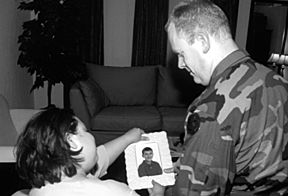
Lt. Col. Fred Leinweber and his wife, Tabetha, have endured years of fertility problems and now believe God has called them to adopt Dimitry, whom they hosted for the 2004 Buckner Angels from Abroad program.

For most of their seven-year marriage, Leinweber and his wife, Tabetha, have struggled in vain to conceive a child. They've tried it all–five surgeries, high-dose hormones, even natural remedies but most of all, prayer.

“My body can't take anymore assault,” said Mrs. Leinweber, 37. “Besides, you don't have to give birth to a child to be a parent.”

It took a shy 12-year-old boy from Russia to teach her that.

Dimitry, affectionately called Dima, visited the Leinwebers for two weeks this summer as part of the Buckner Angels from Abroad program. Accompanied by directors and caretakers from two children's homes in St. Petersburg, 18 orphans toured Texas to raise awareness about the trove of older children available for adoption in Russia.

The Leinwebers were among 14 Dallas families who served as hosts.

“We sort of stumbled upon the opportunity,” she recalled. “In December last year, we started talking about adoption, so we went on the Internet and found names (of agencies). Then we came to Buckner, but when I pulled up the homepage, there was all this information about the angels program.”

The couple talked about it and decided it would be a good experience, a sort of litmus test of life as full-time parents. Little did they know what began as an experiment would change their lives like nothing else.

“It was tough the first four days. I was on the phone a lot crying, 'I don't know what to do with Dima,'” she said. “He was very introverted; I think he was scared, and he missed his friends.”

After a play date with other host program participants and a few rounds of ping-pong with Leinweber, Dima slowly shed his cool exterior, and a lively little boy emerged.

“He showed his personality more toward the latter half of the visit,” he remembered. “We formed a bond, and we perceived that he also was connecting with us.”

The day Dima left, his prospective mother said she felt an aching in her heart–the kind of longing a mother feels when she's separated from her child. In just 15 days, Dima and the Leinwebers had gone from strangers distanced by language to kindred souls bound by love.

“He's our kid. He is the child we've been praying for, and we've got to get him home,” she said, near tears.

A marketing professional, Mrs. Leinweber has dedicated a website to the cause, aptly titled www.bringdimahome.com. After years of desperately trying to conceive, the Leinwebers are on a new quest to adopt. But resources are limited and, with recent developments, time is short. Just two months ago, they learned Dima soon would be transferred to an orphanage for teenagers, making adoption unlikely.

With the clock ticking, the couple contacted Buckner International Adoption, completed their preliminary paperwork and participated in a home study. Now they're appealing to friends, family, the Christian community–and even talk show host Oprah Winfrey–to help them raise the remaining $27,000 in expenses. A friend of a friend referred the family to a producer at Harpo Studios in Chicago, where “The Oprah Winfrey Show” is taped. They hope the doyenne of daytime talk will air their story and help generate support.

“We're turning over every rock and deploying viral marketing to get the word out and drive people to the website,” said Leinweber, who works in civilian life as a project manager for a pharmaceutical services provider. “We're also passing out fliers that say, 'Help me find my way home' with little footprints and Dima's picture. … You do what you have to do for your family.”

For information on ways to help these families, call Mary Ann Hamby at Buckner International Adoption, (214) 381-1552, ext. 226.

News of religion, faith, missions, Bible study and Christian ministry among Texas Baptist churches, in the BGCT, the Southern Baptist Convention ( SBC ) and around the world.


Mothers who place babies with Buckner find help at retreat_110804

Posted: 11/05/04

Mothers who place babies with Buckner find help at retreat

By Felicia Fuller

Buckner News Service

ROYSE CITY–Open adoption lifts the veil of secrecy once associated with placement, but Mayra Marquez, 21, says the process is no less painful–even 19 months after the ink has dried.

“There've been a lot of ups and downs. Right now, I'm in my valley,” she said. “It's a lot of struggle–a lot of hard work–but much love and thought went into my decision.”

Marquez was among nine young women from across Texas who gathered at Sabine Creek Ranch in Royse City recently for the fourth annual birthmothers retreat, sponsored by Buckner Adoption and Maternity Services.

Grief recovery and personal empowerment were the focus of a birthmothers retreat sponsored by Buckner Adoption and Maternity Services

Four facilitators from Buck-ner led workshops on making peace with the past, developing healthy coping skills, enriching interpersonal relationships and turning past failure into future successes. The retreat is offered free of charge to birthmothers who have placed or will place their child with Buckner.

“A lot of women who place are not able to grieve appropriately,” said Courtney Warren, community relations coordinator for Buckner Adoption and Maternity Services.

“Society in general has a difficult time understanding the grief of a decision that was, after all, a voluntary one. The retreat provides a weekend away from distractions during which birthmothers and prospective birthmothers can be together to share and normalize their feelings. It is so important for them to build bonds with other birthmothers, while at the same time they are getting valuable information from our clinicians about handling issues in a healthy way.”

At seven months pregnant, Cara Blackmon, 25, traveled from Houston for the event. She said it provided a venue for her to vent her feelings and glean wisdom from other women.

Before the closing devotion on the final day, she shared that during moments of resolve, she considers adoption the best decision “knowing that I might not be able to provide everything I want to give him like the security of having two loving parents.”

She expressed trepidation when expressing her feelings for her unborn son.

“I do love him very much and, sometimes, think maybe I should try to raise him on my own,” she said.

“One of the things I question is whether my child would grow up and think I didn't love him enough to try. I know, however, that this is in his best interest. Through open adoption, I can always be there if he needs me.”

Counseling is helping Blackmon sort through her feelings and weigh the consequences of her decision.

“It's easy to get caught up in your emotions when you're pregnant. I'm trying to realistically look at things and not judge myself and be convicted by guilt. The retreat has been great. Communication is crucial to getting through this.”

This was the second time Marquez attended the retreat. She said she returned for the camaraderie, counseling and re-affirmation that she made the best decision.

With no support from her baby's father and little money saved from her job at a pizza restaurant, Marquez says she was unprepared financially and emotionally to be a parent. “There's no way I could afford at least $12,000 a year for a baby,” she explained. “I felt that somebody who was not able to have children would be better blessed than I would.”

In her seventh month of pregnancy, after researching adoption agencies throughout Texas, Marquez contacted Buckner for placement.

“They told me all their families were Christian and carefully screened, so I was excited about that,” she said. Marquez purposefully picked a large brood– a couple with three children, including two adopted.

Over the next several weeks, she attended counseling sessions and meetings with the family, including one at the obstetrician's office.

“They got to see the ultrasound,” she recalled. “I fell in love with them. They were awesome, very understanding, and they were not quick to judge. They were interested in how I was going to be afterward and how involved I wanted to be.”

Today, Marquez enjoys frequent contact with the family, even traveling from Odessa to North Richland Hills to witness her birth son's first haircut.

“They all came to my hometown for his first birthday,” she said, beaming.

Though she's pleased with the arrangement and confident in her decision, Marquez acknowledged she still mourns the loss of motherhood.

“We have to put on a facade because it helps strengthen us for awhile,” she said. “Then we can go behind closed doors and cry our eyes out.

“But when you have your quiet time and you hear the voice of God saying, 'It's OK to break down and it's OK to have regrets, but think of the blessing you're giving someone else,' you know this was his will.”

News of religion, faith, missions, Bible study and Christian ministry among Texas Baptist churches, in the BGCT, the Southern Baptist Convention ( SBC ) and around the world.


Chaplain offers exercises to help ministers relate to effects of aging_110804

Posted: 11/05/04

Chaplain offers exercises to help
ministers relate to effects of aging

Effective senior adult ministry requires an understanding of what it means to grow older.

At a recent Baptist General Convention of Texas-sponsored pastoral caregivers retreat, Judy Collins, a chaplain in the Baylor Health Care System, suggested the following exercises to become more familiar with the effects of aging:

Judy Collins

bluebull Write while wearing loose-fitting garden gloves to simulate difficulty with hands.

bluebull Read with tinted plastic wrap around your head to get a feel for trouble reading.
bluebull Listen with cotton balls in your ears to get a feel for being hearing impaired.

bluebull Walk with rocks in shoes to know how it feels to have corns.

Collins reminded ministers to keep senior adults in mind when preparing materials. Literature needs to be presented in large, clear fonts. And speaking more slowly, rather than louder, is helpful, she said.

News of religion, faith, missions, Bible study and Christian ministry among Texas Baptist churches, in the BGCT, the Southern Baptist Convention ( SBC ) and around the world.


Senior adults reveal spiritual needs through stories with deep meaning, chaplain says_110804

Posted: 11/05/04

Senior adults reveal spiritual needs through
stories with deep meaning, chaplain says

By John Hall

Texas Baptist Communications

BURNET–Grandpa's stories about his war experience may be tales of spiritual battle more than combat between men. Older people naturally speak of spiritual matters through stories, Mike Mullender, a chaplain in the Baylor Health Care System, told a recent chaplaincy reteat sponsored by the Baptist General Convention of Texas.

The tales they tell may not contain overtly spiritual language, but many have deeper personal meanings, he said. The stories give ministers an insight into the person.

“The thing to remember when you hear those stories over and over is, 'What does that tell you about that person?'” Mullender said.

Older people's inclination to want to talk about spiritual matters can be helpful to ministers, he added.

The door typically is open to discuss their faith, Mullender said. Many are wrestling with religious issues and are looking for someone to speak with.

“If we have the ears to hear, we can enter into so many conversations,” he said.

News of religion, faith, missions, Bible study and Christian ministry among Texas Baptist churches, in the BGCT, the Southern Baptist Convention ( SBC ) and around the world.


Around the State_110804

Posted: 11/05/04

Around the State

Among the chaplains endorsed by the Cooperative Baptist Fellowship in October were Pam Foster, a hospice chaplain in Fort Worth; Debbie Kubo, a hospice chaplain in Dallas; and Doug Cobb, a chaplain at Scott and White Memorial Hospital in Temple.

bluebull The Hardin-Simmons University Alumni Association has elected Ronnie Kidd to remain as president of its board of directors in 2005. Other board members are Andrea Howey, Larry Moss, Karen Johnson, Erin Maddox, Karen Gurganus, Debbie Young, Deborah Ashmore, Ann Scargall, Pat Kelley, Billy Bob Neff, Janis Altom, Vance Cooksey, Dean Taggart, Donald Tittle, Dorothy Kiser, Debbie Harruff, Bee Shakleford and Fred Ewing.

bluebull Joe Welsh, pastor of View Church in Abilene, has been elected moderator of Abilene Association. Jim McCurley, pastor of Potosi Church in Abilene, was elected first vice moderator, and Lee Fuller, pastor of Wylie Church in Abilene, selected to be second vice moderator. David Cason, pastor of Broadview Church in Abilene, will head the evangelism/missions team; Mike Woodard, pastor of Southwest Park Church in Abilene, will lead the strengthening existing churches team; and Monroe Levrets, a member of Wylie Church, is stewardship team leader.

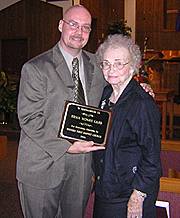
Erma Liles' gift enabled First Church in Weinert to purchase chair lifts to enable elderly and disabled members of the congregation to have access to the church's fellowship hall, which is located upstairs. The congregation thanked Liles for her gift at a dedication service. She is pictured with pastor J.C. Baker.

bluebull Margie Thomas was the featured artist during the University of Mary Hardin-Baylor's homecoming activities. Her exhibit will be on view through Dec. 13 on the second floor of Townsend Memorial Library.

bluebull Youth throughout the state are being sought by the Fellowship of Baptist Educators as corresponders with Chinese students in grades 7-12 who are learning English. Sunday school classes and Acteen and Challenger groups are encouraged to request letters from Chinese students that the American youth will answer. Requests for letters should include the name and mailing and e-mail address of the group leader; the number of letters needed; name of the church or group; and a promise that every letter will be answered. Many Christians use this activity to share their faith with Chinese students. Letters will arrive from China in December and be sent to requesting groups in late January. To obtain letters, contact John Carter at j-fcarter-@juno.com by Jan. 15.

bluebull The Baylor Alumni Association presented four Outstanding Young Alumni Awards. Chosen were Jodi Arnold, Dub Oliver, Jim Springfield and Wendi Foy Green.

bluebull Thirty-three men were named to the Circle of Honor by the Hispanic Baptist Convocation of the Laity. Included were Robert Arrubla, Fort Worth; E.B. Brooks, Dallas; Ray Carrillo, Tyler; Larry Cepeda, Dallas; Bob Dixon, Dallas; Alfonso Flores, San Antonio; Guadalupe Fonseca, San Antonio; Ciro Garcia, Austin; Joel Garcia, Bandera; Roberto Garcia, Fort Worth; Santiago Garcia, San Antonio; Raymond Gonzales, Dallas; Josue Grijalva, San Antonio; Damon Hollings-worth, Spicewood; Elmin Howell, Rockwall; Rodrigo Jimenez, Garland; Herman Martinez, Waxahachie; Larry Naranjo, Lubbock; Richard Palma, Carrollton; Carlos Paredes, Dallas; Gus Reyes Sr., Dallas; Manuel Rios, San Antonio; Rolando Rodarte, San Antonio; Isaac Rodriguez, Corpus Christi; Manuel Rodriguez, San Antonio; Noah Rodriguez, San Antonio; Raymond Rodriguez; Dallas; Rudy Sanchez, Dallas; Orville Scott, Grand Saline; Ben Silva, Dallas; J.V. Thomas, Shepherd; Isaac Torres, Kingsville; and David Vivero, Dallas.

Deaths

bluebull Myron Roe, 94, Oct. 10. He was a charter member of Colonial Hill Church in Snyder and served as music director. He was preceded in death by his wife, Verna Lee; and their children, Jerry Roe and Rosie Floyd.

bluebull Mary Gregory, 74, Oct. 12 in Anson. She was the wife of retired minister Rowland Gregory. They served at Second Church in Garland, Lake Highlands Church in Dallas, First Church in Odessa, University Church in Abilene, Proctor Street Church in Port Arthur and Southside Church in Wichita Falls. She also helped to launch several preschools and kindergartens in Texas and Colorado. For nine years, she was a children's/preschool specialist for the Colorado Baptist General Convention. She is survived by her husband of 56 years; son, Steven; and sister, Kathy Barnes.

bluebull Carol Norton, 62, Oct. 29 in Dallas. Norton had been director of missions for Grayson Association since 1997. He previously had been pastor at Foote Church in McKinney, North McKinney Church in McKinney, First Church in Quitman and First Church in Denison. He was preceded in death by his son, Josh. He is survived by his wife of 41 years, Pam; daughter, Piper Carlile; son, Matt; sister, Nila Kremenak; brother, Dee; and four grandchildren.

Anniversaries

bluebull David Howard, 10th, as associate pastor for music and education at Baylor Church in Ennis, Nov. 6.

bluebull Mike Lawson, fifth, as pastor of First Church in Sherman, Nov. 8.

bluebull First Church in Mont Belvieu, 75th, Nov. 14. A catered lunch will follow the morning service. Jake Porter is pastor.

bluebull Dennis Keen, 20th, as pastor of West End Church in Industry.

bluebull Dale Hill, 10th, as pastor of Grand Parkway Church in Sugar Land.

Retiring

bluebull Joe Trull, pastor of the Church at Driftwood since 1997. He was professor of Christian ethics at New Orleans Baptist Seminary from 1985 to 1999 after serving as pastor at First Church in El Paso, Calvary Church in Garland and Crestview Church in Austin. He will continue as editor of Christian Ethics Today, as an adjunctive teacher at Baylor University and leader of ethics conferences.

Ordained

bluebull Joe Cameron to the ministry at Lone Oak Church in Harleton.

bluebull Tim Doremus to the ministry at Purmela Church in Purmela.

bluebull Daryl Marwitz, Joe Lee and Bassel Leach as deacons at First Church in Evant.

Revival

bluebull Black Creek Church, Centerville; Nov. 7-10; evangelist, Tom Fields; pastor, Norman Diehl.

News of religion, faith, missions, Bible study and Christian ministry among Texas Baptist churches, in the BGCT, the Southern Baptist Convention ( SBC ) and around the world.


BaptistWay Bible Series for Nov. 14: Commended by Christ, committed to the Corinthians_110804

Posted: 11/05/04

BaptistWay Bible Series for Nov. 14

Commended by Christ, committed to the Corinthians

2 Corinthians 10:1-18

By Todd Still

Truett Seminary, Waco

None of the Apostle Paul's epistles would be a good choice for someone seeking to do a little light biblical reading. From early on, it has been recognized that “There are some things in (his letters that are) hard to understand” (2 Peter 3:16).

What is true of Paul's writings in general especially is true of 2 Corinthians. This particular letter demands a good deal from its readers. Not only are there passages difficult to comprehend, but also a number of shifts in subject matter that make the letter hard to follow.

We already have encountered major transitions at 2:14; 6:14; 7:2, 5; and 8:1 respectively. So abrupt are certain transitions that not a few scholars have suggested that 2 Corinthians is a compilation of two or more letters Paul wrote to the church in Corinth over a period of time.

As we begin the third and final unit of our study of 2 Corinthians, we come to yet another topic. At the outset of chapter 10, Paul commences a defense of his ministry against those whom he sarcastically dubs “superlative apostles” (11:5; 12:11).

This robust counter-attack continues well into chapter 12. There we come to the final major division in the epistle, 12:14-13:10. We will consider that portion of the letter in two weeks' time; however, in this lesson we will focus our attention on chapter 10.

The apostle begins his apology with respect to his ministry with a personal appeal to the Corinthians. With meekness and gentleness, Paul, who has been accused of being humble when present but bold when absent, entreats his converts to come to his defense so that when he returns to Corinth he will not have to oppose his detractors.

In addition to denouncing Paul as “more smoke than fire,” the apostle's adversaries were contending he was living “according to the flesh” and not according to the Spirit (vv. 1-2).

A fuller, though by no means complete, picture of Paul's opponents in Corinth will emerge as we work our way through chapters 10-12. For now, it will suffice to suggest these so-called “super-apostles” were likely Jewish Christian missionaries who came to Corinth after Paul had left the city and were seeking in his absence to cast aspersions upon his apostolic character and conduct.

While Paul acknowledges that he, of course, lives “in the flesh” (Greek, “en sarki”), he flatly denies that he “wages war” (a metaphor Paul employs here to refer to his apostolic ministry) “according to the flesh” (Greek, “kata sarki”). On the contrary, Paul contends that he readies himself for service not with “fleshly” (Greek, “sarkika”) weapons but with divine empowerment (10:3-4).

In 10:5-6, Paul reveals his strategy for conducting his ministry of weakness in the face of criticism by those who fancy themselves strong in faith. To begin, he seeks to destroy their strongholds and obstacles–their arguments, pride and “knowledge.” In addition, he takes every thought captive (theirs and his?) to the obedience of Christ. Lastly, he prepares to deal with disobedience. He stands ready to respond to the (undefined) disobedience of his opponents at such a time when his converts prove themselves obedient to the gospel they had received from Paul.

Abandoning military meta-phors, the apostle turns in verse 7 to enjoin the Corinthians to pay attention to what is right in front of them, namely, the very people who are tearing Paul down in order to build themselves up. In doing so, Paul implies his critics are not building up the church he had worked so hard to establish; rather, they are tearing it down (10:7-8; 12:9; 13:10).

Paul appears to be aware of at least some of the criticisms his opponents were lodging against him. In addition to the contention the apostle was bold when absent but humble when present (v. 1), Paul indicates his critics were suggesting he was trying to frighten the Corinthians with his letters and were saying, “His letters are weighty and strong, but his bodily presence is weak, and his speech is contemptible” (vv. 9-10). The apostle denies the suggestion that he is seeking to intimidate his converts (v. 9); moreover, he throws down the gauntlet before his opponents in verse 11 when he writes, “Let such people understand that what we say by letter when absent, we will also do when present.”

It also is possible that Paul's adversaries accused him of arrogant authoritarianism (v. 8). The apostle does not seek to deny that he “boasts in the Lord” with respect to his Corinthian ministry, nor does he abdicate the authority and responsibility he considers to be divinely and duly his in regards to the church (vv. 13, 15-17).

He does, however, criticize his opponents for judging themselves by themselves. Their self-congratulatory attitude, Paul maintains, displays a lack of understanding on their part (v. 12). Moreover, by poaching on Paul's preserves, claiming the Corinth-ians as their own “field” and taking credit for others' labors, the “super-apostles” have in Paul's view overstepped their boundaries and have gone beyond their limits (vv. 13-16). For Paul, it was important that it was he who initially brought the gospel to the Corinthians (vv. 13-14), and it was no fleeting concern of his that the congregation recognize that these spiritual “Johnny come latelys” were not the only ones who belonged to Christ (v. 7).

Some readers of this portion of 2 Corinthians might regard Paul on the defensive to be offensive. Truth be told, he is just warming up! Even if one views Paul's tact and tone at this point in the letter to be over the top, at least two things should be borne in mind. First, Paul cared deeply for his converts in Corinth and wanted to see them flourish, not flounder, in the faith. Additionally, the apostle recognized that in the final analysis what matters is divine, not self, commendation. Christians of all generations would do well to work toward and to wait for the Lord's “well done.”

Discussion question

bluebull What principles can be gleaned from Paul's handling of this adversarial situation?

News of religion, faith, missions, Bible study and Christian ministry among Texas Baptist churches, in the BGCT, the Southern Baptist Convention ( SBC ) and around the world.


Baptist Briefs_110804

Posted: 11/05/04

Baptist Briefs

Hankins named Louisiana executive director. David Hankins, vice president for Cooperative Program for the Southern Baptist Convention Executive Committee, was elected executive director of the Louisiana Baptist Convention. The former pastor of Trinity Baptist Church in Lake Charles, La., will begin his new duties Jan. 1 as director-elect and will assume full duties Feb. 1 after Executive Director Dean Doster retires Jan. 31. Hankins served the Lake Charles church 10 years before becoming vice president for convention policy for the SBC Executive Committee in January 1996. In that capacity, he guided the process of restructuring the convention and its agencies, adopted by the SBC in 1995. He assumed his present post with the Executive Committee in 1998 and directs the development and promotion of Cooperative Program ministries and giving. Born in Alameda, Calif., Hankins, 54, grew up in Texas and received his undergraduate degree at Dallas Baptist University. He received both master of divinity and doctor of philosophy degrees from Southwestern Baptist Theological Seminary in Fort Worth.

Move afoot to nix N.C. giving options. North Carolina Baptists expect a motion from the floor of their state convention that will propose scrapping optional funding plans in the Baptist State Convention of North Carolina's budget. The move would eliminate funding of causes popular among moderate Baptists in the state and strengthen ties to the Southern Baptist Convention. Ted Stone of Durham, N.C., announced he will make a motion at the annual meeting "to restore the single-giving plan of the traditional Cooperative Program as the sole method of doing missions together." Jim Royston, the executive director of the North Carolina state convention, said Stone's proposal could cost the convention $1.5 million. Currently churches giving to the state convention can choose one of four giving plans, making it possible for churches to direct funds to a variety of causes, including the Baptist World Alliance and the Cooperative Baptist Fellowship. Stone's proposal would eliminate three of the giving options, leaving only a plan in which the state convention would keep 65 percent of the money and sends 35 percent to the Southern Baptist Convention.

BJC names communications director. The Baptist Joint Committee in Washington, D.C., has named Jeff Huett director of communications. Huett, 26, joined the BJC staff in 2001 as associate communications director. He succeeds Larry Chesser, who left the religious liberty agency in May to pursue business interests in Arkansas. Huett has served as acting communications director since then. Executive Director Brent Walker praised Huett as "bright, hardworking and with judgment beyond his years." A native of Montgomery, Ala., Huett graduated from Baylor University with a degree in journalism and business, and he earned a master's degree in media and public affairs from George Washington University, where he was named a Larry King Scholar. At Baylor, Huett was the editor-in-chief of the Baylor Lariat student newspaper. As an undergraduate, he completed internships at Associated Baptist Press in Jacksonville, Fla., and Buckner Baptist Benevolences in Dallas. Huett is a member of Columbia Baptist Church in Falls Church, Va.

Conference focuses on missions calling. Antiphony, a student conference focused on vocational calling and global missions sponsored by Cooperative Baptist Fellowship Global Missions and The Samuel Project, will be held in Birmingham, Ala., Dec. 29 to Jan. 2. Worship leaders include Colleen Burroughs, executive vice president of Passport; Julie Pennington-Russell, pastor of Calvary Baptist Church in Waco; recording artist Ken Medema; and the Dramatic Vagabonds. The cost starts at $150 and includes conference fees and lodging. Online registration is available at www.antiphonyonline.org. Registration deadline is Nov. 15. Deposits are refundable until Dec. 1.

News of religion, faith, missions, Bible study and Christian ministry among Texas Baptist churches, in the BGCT, the Southern Baptist Convention ( SBC ) and around the world.


Former NAMB chaplaincy director transfers his endorsement to BGCT_110804

Former NAMB chaplaincy director
transfers his endorsement to BGCT

By John Hall

Texas Baptist Communications

Bob Vickers, former director of the chaplaincy evangelism for the Southern Baptist Convention North American Mission Board, has transferred his endorsement to the Baptist General Convention of Texas.

Vickers, who is now associate pastor of First Baptist Church in Roswell, Ga., indicated the move was a personal decision “of the heart,” saying he feels more connected to the Baptist General Convention of Texas than the SBC.

Vickers, who also is chaplain for a local high school football team, once was stationed at Fort Sam Houston in San Antonio. He has attended the BGCT chaplaincy retreat the past two years.

"I like the way that the BGCT says we have our arms wide open to receiving women who are called to ministry and all others. That inclusiveness is something I whole-heartedly agree with."
—Chaplain Bob Vickers

The transfer of endorsement is not meant as a political move, he added. For years, Texas Baptist chaplains “have been dear friends, have reached out to us, have been supportive of us,” Vickers said.

“I just really like the way the BGCT does chaplaincy business,” he said.

“I am in total agreement with the way BGCT supports their chaplains. I think that's the way it should be done.”

The chaplain added that he is in theological accord with the BGCT.

“I like the inclusiveness. I like the way that the BGCT says we have our arms wide open to receiving women who are called to ministry and all others. That inclusiveness is something I whole-heartedly agree with.”

Vickers, who continues to have a strong following among military chaplains, left the mission board in 2002. One report indicated he had resigned, but others said he was terminated for not enforcing the board's stance against ordained female chaplains strongly enough.

Endorsement by a religious group is required in most chaplaincy positions. It serves as a source of accountability and training.

Bobby Smith, director of the BGCT office of chaplaincy relations, said he is grateful to have Vickers in the family of Texas Baptist chaplains. He praised Vickers for his years of service and said he looks forward to ministering with him.

“This is a huge affirmation for us that a person the whole world of chaplaincy values believes we have a ministry program of relationship and worth,” he said.

News of religion, faith, missions, Bible study and Christian ministry among Texas Baptist churches, in the BGCT, the Southern Baptist Convention ( SBC ) and around the world.


ANOTHER VIEW: Marketplace impacts global missions_110804

Posted: 11/05/04

ANOTHER VIEW:
Marketplace impacts global missions

By Kyle B. Usrey

If we believe our Lord is truly sovereign over all, then he is Lord of the marketplace, as well.

For many Christians, the very idea of God's involvement in the free enterprise system is anathema. After all, didn't Jesus run the moneychangers from the temple? Don't many of the parables deal with oppression of the poor? How can wealth creation actually be part of the gospel?

For decades, pastors have used business people in their congregations as cash cows, grateful for the money they contribute to the true “holy” callings. They admonish Christians in business to beware filthy lucre of the market while exalting them to be salt and light in the nasty, brutish world of globalization. Yet the message most Christians in business receive is that they are second-rate, flawed and worse, compromised by their professions. Nothing could be further from the truth.

Kyle B. Usrey

Globalization and missions in the 21st century disprove these biases against business. Jesus, a carpenter, was part of the marketplace himself. In fact, mission organizations are finding business is the preferred platform for sending missionaries into closed countries. And missions organizations are finding that a business platform has to be legitimate and not a ruse. Otherwise, the duplicity of sending missionaries unprepared to compete in the rough-and-tumble business world of a foreign climate can destroy any ministry's effectiveness.

Baptists historically have integrated their faith, refusing to segment God into niches of their lives. The ultimate integration of faith involves business as missions–both home and abroad–through Christian micro-enterprise development, called CMED, and Christian community development, or CCD. The Bible begins with mankind in a garden and ends with the fulfillment of God's kingdom in a city. In cities, Christians and Christians alone can truly make a difference through CMED and CCD.

Through CMED and CCD, Christians harness market forces within capitalism to solve social problems for God's kingdom purposes. CMED entails holistic investment in poor entrepreneurs, overlooked by traditional financiers but gifted to transform market opportunities into job creation with just a small amount of money. About 10 percent of every society is truly entrepreneurial. And entrepreneurs and small businesses, not multinational corporations, create the most jobs.

Mission organizations are finding business is the preferred platform for sending missionaries into closed countries.

People like David Bussau, in Sydney, Australia, with an organization based out of the Philippines, have spread the “social wealth gospel” through CMED in the poorest urban reaches of the world for more than 25 years. His organizations have financed more than 2 million entrepreneurs in the Two-Thirds World and lifted 10 million people out of poverty during the last five years.

Based on his success in more than 60 countries, Bussau was invited by the North Korean government to invest his entrepreneurial focus in one of the last bastions of communism. Conversations with militant radicals and terrorists in Southeast Asia have led him and others to believe many of the youth recruited for such organizations would lay down their weapons if they only had meaningful jobs–jobs that can be created in an entrepreneurial micro-enterprise environment. Nowhere else could outreach like this have such a dramatic impact to reduce isolation, oppression and violence.

Christian community development involves similar market intervention–asset-based development that provides seed money to transform poverty-laden neighborhoods so markets can take over and yield socially transformed integrated model communities.

The issue that Christians face in CCD is how to transform neighborhoods without gentrifying them, without merely relocating the poor as a result of the economic turn-around that was jump-started by Christian business and community leaders. Chief CCD practitioners have had enormous impact for Christ in their communities–from John Perkins and Wayne Gordon in Chicago, to Robert Lupton in Atlanta and Mack McArter in Shreveport. Even a few business schools in Christian colleges and some smaller cities are applying these principles in curriculum and through churches to spread the whole gospel to the whole world through the whole body of Christ.

So, lives are transformed through both the social gospel and the salvation gospel of the New Testament. And new research reveals the historic and modern nature of the “marketplace” is expansive, involving government and education, as well.

Soon, the Apostle Paul's statement in Ephesians 1:18-19a can be realized: “Pray also that the eyes of your heart may be enlightened in order that you may know the hope to which he has called you, the riches of his glorious inheritance in the saints, and his incomparably great power for us who believe.”

Such enlightenment may reveal the harvest fields are ripe, because Christians in business, government and education act collaboratively in ways that can only be seen as faith-based and God-led.

Kyle B. Usrey is dean of the School of Global Commerce and Management at Whitworth College in Spokane, Wash., and a former faculty member at Hardin-Simmons University in Abilene.

News of religion, faith, missions, Bible study and Christian ministry among Texas Baptist churches, in the BGCT, the Southern Baptist Convention ( SBC ) and around the world.


Co-workers should be honored, not manipulated, chaplaincy director says_110804

Posted: 11/05/04

Co-workers should be honored, not
manipulated, chaplaincy director says

By John Hall

Texas Baptist Communications

BURNET–Co-workers are not pawns to be manipulated on the way to a promotion but teammates to honor while working toward a common goal, said the Baylor Health Care System's chaplaincy director.

Mark Grace, director of pastoral care and counseling at Baylor, believes a working environment where supervisors include employees in decisions and concentrate on worker development is a happier, more productive workplace.

Mark Grace, chaplaincy director at Baylor Health Care System, reminds Texas Baptist chaplains about the importance of servant leadership in the workplace.

Speaking largely from Robert Greenleaf's servant leadership books, Grace told participants at a Baptist General Convention of Texas-sponsored retreat for chaplains that supervisors need to be willing to listen to people who work with them.

That creates a workplace where each person feels valued. People have choices in all areas of their life and want them at work, too.

When all workers have input, they are more willing to commit to the same principles, Grace said. The quality of ministry and ethical behavior will increase. Clients will not be viewed as a way to make money but as avenues for service.

“Humans are not the capital,” Grace said. “Humans are the reasons institutions exist.”

Because they feel valued, employees will begin rallying around each other, Grace added. A sense of community will form. Workers will be involved in each others' personal development, he added. They will support a manager who is open and honest, even when he or she must take a stand.

Grace reminded the chaplains that institutions are not compared to each other, but judged on how well staff members serve their clients.

An improved workplace leads to improved ministry, he asserted.

“How this is put to us at Baylor (Health Care System) is we are not compared to Methodist” Medical Center, he said.

“We are compared to Disneyland or somewhere their needs were best met.”

News of religion, faith, missions, Bible study and Christian ministry among Texas Baptist churches, in the BGCT, the Southern Baptist Convention ( SBC ) and around the world.