Frances leaves indelible mark on Florida church_92004

Posted: 9/17/04

Frances leaves indelible mark on Florida church

By Barbara Denman

Florida Baptist Convention

MELBOURNE, Fla. (BP)–While most people evacuated Cocoa Beach, Dave Guise decided to ride out Hurricane Frances' onslaught inside First Baptist Church, thinking he could help protect the structure in the event of fire or other danger.

The steeple of First Baptist Church of Cocoa Beach, Fla., was severed by Hurricane Frances and speared the roof of the sanctuary, coming to rest in the balcony. No one was injured. (ABP/Greg Warner Photo)

Guise spent most of the night crouched in a hallway at the bottom of the stairs leading to the sanctuary. At 1 a.m., as the massive building creaked and groaned under the relentless winds, a thunderous crash drew Guise to the church sanctuary, where the massive steeple broke off from its foundation and plunged through the roof to rest on the church's balcony.

Two days after the storm, he admitted: “It was very scary. I don't think I will ever do that again. I'd think I'd rather fight a war than to have to endure that.”

The beckoning Cocoa Beach steeple was a landmark in the community, said Deacon Don Johnson. Pilots from nearby Patrick Air Force Base are said to line up for the runway using the steeple as a navigational tool–so much so, he said, base officials offered to repair the bell tower light when it burned out one time.

Three dozen members from First Baptist Church of Melbourne survived Frances' seemingly endless march through their community by barricading themselves in the 4-year-old concrete block building, beginning about 1 p.m. on Friday. They joined members of the church's Haitian mission, and everyone shared food they had brought–shrimp, scallops, linguine and clams, said Pastor Larry Bazer.

When the storm ended and the church escaped unscathed except for the loss of power, the congregation gathered for what the pastor called a “catacomb service,” much like the early New Testament church, reported church member Billie Norczyk.

The congregation's first-century Christian mindset continued even as the community sought restoration after the storm. When the church got back its electrical power on Labor Day, the congregation housed displaced families from the community as well as members whose homes had no power.

Bazer and other church members spent Labor Day going throughout the community, using chainsaws to remove fallen limbs and trees and patching roofs.

News of religion, faith, missions, Bible study and Christian ministry among Texas Baptist churches, in the BGCT, the Southern Baptist Convention ( SBC ) and around the world.


Evangelist wins souls by offering chance to win motorcycle_92004

Posted: 9/17/04

Evangelist wins souls by offering chance to win motorcycle

By Sherri Brown

Baptist Press

BRISTOL, Tenn. (BP)–In the shadow of the Bristol Motor Speedway, just across from a booth selling Dale Jr. T-shirts and down from a fried Oreo stand, Ronnie Hill was making his pitch. “Get your free chance to win a Harley! All you gotta do is listen to me for 10 minutes.”

Like a carnival caller, Hill beckoned: “Bring your beer, I don't care. … Come on, boys, get on in here and win you a Harley!”

Hill, a Fort Worth-based evangelist, came to the races not to cheer on his favorite driver but to talk about Jesus to anyone among the 200,000 race fans who would listen.

Fort Worth-based evangelist Ronnie Hill (cup in hand) talks with race fans at the Sharpie 500 race. Hill gave away a Harley-Davidson motorcycle at the end of the three-day event. (Sherri Brown Photo)

“I'm an evangelist. I want to preach to lost people,” he said. “I get so frustrated preaching in churches to five or 10 lost people.”

At Bristol, Hill found more than a handful of lost people. During the three-day Sharpie 500 race, standing in front of a Harley-Davidson Sportster 883, he preached a 10-minute salvation message 21 times to about 1,800 people. More than 750 of them indicated they had prayed for salvation for the first time. Most of those were middle-aged adults. Hill will send a letter to everyone who made a profession of faith, encouraging them to find a church home in their communities.

On the day before the race began, drivers lined State Street–the dividing line between Bristol, Va., and Bristol, Tenn.–to sign autographs and greet fans.

Hill and a group of volunteers–situated in a parking lot just down from NASCAR driver Rusty Wallace–passed out tickets “for a free chance at winning a Harley.” On the hour, Hill preached his message–a brief, pull-no-punches NASCAR version of the gospel.

At the conclusion of his short sermon, Hill asked everyone to fill out the ticket with a name, address and phone number. If they prayed the prayer of salvation for the first time, they were to check the box at the bottom. He assured them that checking the box would not give them a better chance at winning the motorcycle.

The rest of the weekend, Hill partnered with Raceway Ministries, a group that sets up at all of the NASCAR races. Located at one of the main entrances to the speedway, volunteers distributed 40,000 tickets for a chance to win the Harley.

Janis Horn, a 56-year-old Christian from Monee, Ill., won the motorcycle and drove it home from Tennessee.

Hill originally had scheduled a revival for the weekend of the races, but the pastor who invited him canceled.

“There wasn't enough time to schedule another revival. I was telling a friend of mine from Bristol about it, and he said to come on up and he'd get tickets to the races. I told him if I came to the races, I was coming to witness,” Hill said.

And that's what he decided to do. Hill knew the NASCAR audience. He knew the majority of fans would be spiritually lost people. He also knew it would take something dramatic to convince them to stop and listen to his message. A Harley-Davidson motorcycle would do it.

Working with the Sherman-based Plyler Family Evangelism Foundation, Hill bought the $12,000 Harley and arranged to have it shipped to Bristol.

“NASCAR fans are big on name brands. I knew if we bought a Honda, they'd never look at it,” Hill said.

Along with the Harley, Hill wrote and designed a color gospel tract and a ticket that would attract the crowds.

David Plyler of the Plyler Foundation believed Hill was on the right track.

“Ronnie meets people on their level. He draws people to the message. The message is simple. It's not a feel-good message; it's an honest presentation of the gospel,” Plyler said.

News of religion, faith, missions, Bible study and Christian ministry among Texas Baptist churches, in the BGCT, the Southern Baptist Convention ( SBC ) and around the world.


Congressman outed by gay-rights website_92004

Posted: 9/17/04

Congressman outed by gay-rights website

By Robert Marus

ABP Washington Bureau

NEW YORK (ABP)–Rep. Ed Schrock (R-Va.), one of Congress' staunchest opponents of gay rights, has declined to seek re-election to a third term in the House after a website claimed he solicited sex with men on a gay telephone-rendezvous service.

Schrock, a layman in an Indpendent Baptist church, shocked many of his fellow Republicans in New York City for the Republican National Convention when his office said he would not seek re-election.

The Virginia Beach-based representative referred to unspecified “allegations” that “will not allow my campaign to focus on the real issues facing our nation and region.”

While Schrock and his spokespeople have not elaborated further on those allegations, his announcement came less than two weeks after he became the latest subject of a controversial “outing” campaign against Capitol Hill personalities by a Washington gay-rights activist.

Schrock is the first member of Congress to be targeted in the campaign.

For several weeks, gay-rights activist Mike Rogers had been posting the names of gay aides to members of Congress who support a proposed constitutional amendment to ban same-sex marriage.

Even many gay-rights leaders have criticized the campaign as mean-spirited, but Rogers has defended his project by saying he simply is exposing hypocrites.

Schrock is a co-sponsor of the proposed Federal Marriage Amendment to ban same-sex marriage.

He also voted for the Marriage Protection Act, which passed the House earlier this year. That bill would strip federal courts of the ability to overrule part of the Defense of Marriage Act, a 1996 law that defines marriage, for federal purposes, exclusively in heterosexual terms.

The conservative Christian Coalition gave Schrock a 92 percent approval rating in its 2003 voters' guide.

In the 2001-2002 session of Congress–the last term for which figures are available–the gay-advocacy group Human Rights Campaign gave Schrock a score of zero percent in his support for gay-rights issues.

Schrock, a Vietnam veteran, also is on record supporting reinstatement of the military's ban on homosexuals. He opposed former President Bill Clinton's so-called “don't ask, don't tell” policy requiring military officials not to conduct investigations into the sexual orientation of servicemen and women.

In his original Internet accusation about Schrock's sex life, Rogers said Schrock “has made a habit of rendezvousing with gay men” on “an interactive telephone service on which men place ads and respond to those ads to meet each other.”

After Schrock announced his resignation, Rogers posted a downloadable audio file of one of the sexually explicit phone messages alleged to be Schrock's. Rogers has declined to say what proof he has that the voice on the message is Schrock's. Several media reports have quoted Virginia Republican officials as acknowledging Rogers' allegations as the reason the congressman is stepping down.

News of religion, faith, missions, Bible study and Christian ministry among Texas Baptist churches, in the BGCT, the Southern Baptist Convention ( SBC ) and around the world.


Most Protestant ministers lack understanding of other faiths_92004

Posted: 9/17/04

American Protestant ministers unfamiliar with other faiths

NASHVILLE, Tenn. (BP)–Protestant ministers in the United States often have some familiarity with the core beliefs of Islam but little familiarity with faiths such as Hinduism, Buddhism, Scientology or Wicca, a recent study revealed.

Protestant clergy tend to be most familiar with Roman Catholicism and Judaism among non-Protestant faith groups, the study found.

Ellison Research, a marketing research firm in Phoenix, conducted the poll for LifeWay Christian Resources' Facts & Trends magazine.

Ellison reported large numbers of Protestant clergy have little familiarity with the core beliefs of numerous non-Protestant religious groups.

Protestant ministers were asked to rate how familiar they are with the core beliefs of 13 religious groups, using a scale of 1 for not at all familiar to 5 for extremely familiar.

Not one of the 13 groups has a majority of Protestant ministers claiming to be extremely familiar with its core beliefs, Ellison found.

The groups most likely to be extremely familiar to Protestant ministers are Roman Catholicism at 41 percent, Judaism at 33 percent, Mormonism at 21 percent and Jehovah's Witnesses at 21 percent.

If the top two levels of familiarity on the survey scale–ratings of 5 and 4–are grouped together, 85 percent of all Protestant clergy claim to be relatively familiar with the core beliefs of the Roman Catholic Church, and 80 percent are familiar with the core doctrines of Judaism.

This decreases to 61 percent for Mormonism and 60 percent for Jehovah's Witnesses, Ellison said.

These still are the only four faith groups with which a majority of Protestant ministers are relatively familiar.

Forty-seven percent are familiar with the core beliefs of Islam, 43 percent with New Age beliefs, 31 percent with Satanism, 28 percent with Buddhism, 27 percent with Hinduism, 15 percent with Scientology, 13 percent with Wicca, 13 percent with Baha'i and just 5 percent with Sikhism.

On the other end of the scale, if the two lowest responses–1 and 2–are combined, large numbers of Protestant clergy have little or no familiarity with the beliefs of Buddhism at 33 percent, Hinduism at 35 percent, Satanism at 45 percent, Scientology at 54 percent, Baha'i at 66 percent, Wicca at 67 percent or Sikhism at 85 percent.

Familiarity with different faith groups does not vary much by different areas of the country, but there are some differences denominationally.

On average, of five major denominational groups examined separately in the study findings, Methodists are the least likely to be familiar with the beliefs of other faith groups.

Methodist ministers' familiarity with Islam, Jehovah's Witnesses, Satanism and New Age beliefs is particularly low, the study revealed.

Ministers in Pentecostal and charismatic denominations also tend to be less familiar than average with other belief systems. Pentecostal clergy have a relatively high level of familiarity with Satanism compared to other denominations but are average or below average on the other faith groups.

Pentecostal ministers are especially likely to be unfamiliar with the core beliefs of Islam, Hinduism and Judaism, the study showed.

Lutherans, on the other hand, tend to feel more familiar with non-Protestant groups than do pastors from other denominations. Baptists tend to be about average in their familiarity with non-Protestant faiths.

Ellison Research said its sample of 700 Protestant ministers included only those who are actively leading churches.

The study's total sample is accurate to within plus or minus 3.6 percentage points at the 95 percent confidence level with a 50 percent response distribution.

The study was conducted in all 50 states, using a representative sample of pastors from all Protestant denominations.

Respondents' geography, church size and denomination were tracked for appropriate representation and accuracy.

More complete data on the study, including denominational detail, is available at www.ellisonresearch.com/PastorStudy.htm.

News of religion, faith, missions, Bible study and Christian ministry among Texas Baptist churches, in the BGCT, the Southern Baptist Convention ( SBC ) and around the world.


Texas Baptists connected by family ties to churches in Minnesota-Wisconsin Convention_92004

Posted: 9/17/04

Texas Baptists connected by family ties to
churches in Minnesota-Wisconsin Convention

By John Hall

Texas Baptist Communications

Like one family member helping another, the Baptist General Convention of Texas is nurturing ministry through its longstanding partnership with the Minnesota-Wisconsin Baptist Convention.

“We are the child of the Southern Baptist Convention and the Baptist General Convention of Texas,” said Leo Endel, executive director of the Minnesota-Wisconsin Baptist Convention. “It's almost like family–your lives are always connected. We hope that the connection remains strong.”

Texas Baptists were integral in launching Baptist ministry in Minnesota and Wisconsin 50 years ago, as Texas pastors and laypeople moved north to start the initial Baptist churches in the region.

Ties between the two regions have remained solid through the years. Minnesota-Wisconsin staff members regularly speak with BGCT Executive Board staff members. BGCT leaders facilitate conferences for Minnesota and Wisconsin pastors yearly. Texas Baptist congregations take mission trips to help their northern counterparts.

Texas Baptists also support the Minnesota-Wisconsin Baptist Convention through the Mary Hill Davis Offering for Texas Missions. This year, $100,000 is allocated to be sent northward.

The funds support a pastors' conference, a pastors' and wives' conference and church-starting efforts. The Rochester, Minn.-based convention started eight churches last year, including Vietnamese, Hmong and Hispanic congregations. The group also is strengthening work among Hispanics.

Mary Hill Davis funds provide some programming money for Woman's Missionary Union in the region.

About 150 churches now comprise the convention, thanks in part to Texas Baptists, Endel said.

“The role that Texas Baptists continue to play is the partnership in church planting,” Endel said. “That continues to be a lifeline for us. It allows us to put church planters on the field.”

The initial Texas Baptist-started congregations now are revisioning their ministries as they become more connected to the Minnesota-Wisconsin culture, Endel said. The ministries are led by natives who are contextualizing the work to the region.

The churches “have lots of challenges, but they're making the transition to native leaders,” Endel said.

Area Baptists still have much work to do in a region where more than 60 percent of the population is connected to a religious institution, but less than 5 percent of people are evangelical Christians, he said.

More Baptist churches are needed, Endel continued. Some Baptist congregations are the only evangelical presence within two hours' drive.

"Much of our region is very religious, but they do not have a personal relationship with Jesus," Endel said.

News of religion, faith, missions, Bible study and Christian ministry among Texas Baptist churches, in the BGCT, the Southern Baptist Convention ( SBC ) and around the world.


Offering enables Texas Baptists to wrap arms around state_92004

Posted: 9/17/04

Offering enables Texas Baptists to wrap arms around state

By John Hall

Texas Baptist Communications

Texas Baptists can put their arms lovingly around the state by cooperatively putting their hearts behind the Mary Hill Davis Offering for Texas Missions, a state missions leader insists.

Together, Texas believers can accomplish more than they can by working independently, said Carolyn Porterfield, executive director of Woman's Missionary Union of Texas. That is the principle behind the $5 million in allocations earmarked for the 2004 Mary Hill Davis Offering.

“These allocations show missions can be accomplished more effectively if we do it together,” Porterfield said.

“A church in the Panhandle can touch the inner city of Houston by being a partner in the gospel. A church in the Rio Grande Valley can touch the Red River.

“An African-American church can come alongside a Cambodian church, and it strengthens the work of both. And the more we know and understand, the more we will pray and give of ourselves and our resources.”

Mary Hill Davis funds touch nearly every aspect of the Baptist General Convention of Texas' ministry.

Mega-associations–Union, Dallas, Tarrant, San Antonio, El Paso, Austin and Rio Grande Valley–are set to receive $200,000.

Another $270,000 is marked for special mission projects, strategic transitioning, leadership training and ethnic summer camps through Baptist associations statewide.

The offering directly serves churches as well. Bivocational and smaller-membership congregations will be helped by $55,000 tapped for efforts to strengthen their ministries.

The Mary Hill Davis Offering earmarks $150,000 to a small-church matching grant fund, facilitated by the BGCT Church Facilities Center. Congregations older than five years that serve fewer than 100 in worship can apply for up to $5,000 in matching funds for construction projects.

This grant inspires congregations to take on construction and remodeling ventures because the more money members raise, the more the BGCT grant will match, said Keith Crouch, director of the Church Facilities Center.

“This is a huge boost for smaller-membership congregations attempting a project in order to be better equipped for their ministries,” he said.

Community ministry programs such as outreach for at-risk youth, community transformation and family and inmate reintegration are to receive $180,000.

Offering funds impact the lives of women through Texas WMU, whose operating budget comes from the offering. The money supports the staff and provides some programming dollars for leadership development, mission awareness and ministry among various cultures.

Christian Women's Job Corps, a ministry to teach low-income women life skills in a Christian context, is allocated $30,000.

Ethnic ministries also benefit from Mary Hill Davis. Funds have been set aside to support ethnic youth and singles ministry, camps and cross-cultural outreach.

“Texas is a diverse state, and it takes diverse ministries to reach people,” Porterfield said.

“This year's allocations represent ministries that help equip God's people to understand and be involved in his mission. They represent ministries focused on connecting local churches as they grow in their missions outreach.”

The allocations recognize the importance of each Texas Baptist in God's kingdom, Porterfield added. Following the offering's theme–“Plant … Water … Harvest”–each believer is a part of furthering God's work.

“This year's theme is wonderful because it speaks to the role that all of us can play, because 'God has assigned to each his task,'” she said.

“One plants. Another waters. And another may reap the harvest, but it is God who makes it all grow. We are laborers in the harvest, and it takes lots of folks to work in the fields that are ripe for harvest.”

News of religion, faith, missions, Bible study and Christian ministry among Texas Baptist churches, in the BGCT, the Southern Baptist Convention ( SBC ) and around the world.


LifeWay Explore the Bible Series for Sept. 26: Resisting temptation requires God’s assistance_92004

Posted: 9/17/04

LifeWay Explore the Bible Series for Sept. 26

Resisting temptation requires God's assistance

Luke 4:1-44

By Pakon Chan

Chinese Baptist Church, Arlington

When Jesus was about to begin his ministry, he was led by the Holy Spirit to go through some spiritual disciplines in the wilderness. Jesus was wholly God and wholly man. As a human being, Jesus went to the wilderness to prepare himself for his mission and ministry.

There is an interesting parallel between Moses and Jesus. Moses fled into the wilderness for 40 years in which he was prepared for the great mission of leading his people out of the bondage of slavery in Egypt. Likewise, Jesus was led and stayed in the desert for 40 days to prepare himself for spiritual warfare.

Oftentimes, we mistakenly think spiritual discipline is enjoyable and beautiful. We may sit in a comfortable room, read the Bible and dream of how to be a strong Christian or how to win a spiritual battle. It is not wrong to enjoy our devotional time; however, spiritual discipline is more than just feeling good in our relationship with God.

study3

Spirituality many times comes from a difficult battle with temptations. The first step in spiritual discipline is to have a quiet time. This should include reading the Bible and praying. The real challenge is in the struggle with temptations and sins. We can meet God in the darkest valley of our life, and it is God's promise of victory (Psalm 23:4).

Jesus as a human being went through the darkest valley with victory in his spiritual tests for the ministry.

Jesus understands us

Jesus is the only high priest who is able to sympathize with our weaknesses, for he “has been tempted in every way, just as we are–yet was without sin” (Hebrews 4:15). Only a person who has experienced grief can comfort others in grief. Our Lord understands us because he was tempted.

We struggle very hard with daily temptations. We have more failures than victories. Our Lord Jesus knows that, and he knows our every situation. The Bible tells us he sympathizes with us. This means Jesus does not condemn us while we are struggling with temptations. He wants to help us, and all we need to do is to go to his throne of grace to seek help (Hebrews 4:16).

Jesus overcame temptations

It is more important that Jesus was not only tempted in every way, but that he did not sin. Jesus overcame all temptations, so his encouragement and help are powerful.

We all are tempted by our lusts, Satan and the world. We are able to sympathize with each other. However, we cannot save each other nor are we able to overcome temptations by our own power. Only Jesus can save us, because even though he was tempted in every way, he did not sin. He has the power to overcome temptations. It is Jesus' power of overcoming temptations that gives us confidence that we can go to him for help.

Satan is the greatest deceiver. He will use every means to deceive us. He uses lusts, selfish desires, money, power and fame to deceive and tempt us. Most of all, he twists the meaning of biblical verses and uses them to deceive us. Jesus knew the motivation and the tricks of the Evil One and used God's word to correct the misused ideas of the Scripture by Satan.

Knowing half of the truth sometimes is even more dangerous. Nothing will be worse than abusing the Scripture with incomplete understanding. Jesus has set a very good example in fighting against the temptation of abusing Scripture to satisfy our selfish desires. He accomplished this using his complete understanding of the Scripture.

We can resist temptations

Jesus loves us, and he does not want to condemn us while we still are struggling with temptations. Jesus wants to help us to overcome all temptations. There are several things that we can do to help us resist temptations. They are:

bluebull Know that Jesus understands us and sympathizes with us.

bluebull Come to his throne of grace to receive mercy and help.
bluebull Have confidence in his love and power.

bluebull Study God's word diligently.

bluebull Use God's word to resist temptation.

bluebull Trust the Holy Spirit for he is interceding for us (Romans 8:26-27).

It is not possible to avoid temptation, no matter how spiritual we are. Temptation can be beneficial to us if we can overcome it. It also can serve as a passage to spirituality. We can pray to the Holy Spirit and ask him to lead us through the passage from temptation into spirituality.

Discussion questions

bluebull Are you afraid to come to Jesus when you are in temptation?

bluebull What kind of confidence do you have in Jesus when you come to his throne for mercy and help?

News of religion, faith, missions, Bible study and Christian ministry among Texas Baptist churches, in the BGCT, the Southern Baptist Convention ( SBC ) and around the world.


LifeWay Explore the Bible Series for Oct. 3: Jesus still calls people to drop, kneel & follow_92

Posted: 9/17/04

LifeWay Explore the Bible Series for Oct. 3

Jesus still calls people to drop, kneel & follow

Luke 5:1-39

By Pakon Chan

Chinese Baptist Church, Arlington

The two following events occurred by a lake called Gennesaret. This lake also was known as the Sea of Galilee and the Sea of Tiberias. It was approximately 680 feet below sea level which created a tropical climate. As a result of this climate, the land west of the lake was very fertile and produced rich agricultural products.

Jesus could preach in any setting. In chapter 4, Luke tells us Jesus was preaching in the synagogues. Then in chapter 5, he was preaching on the lake and using the boat as his pulpit. Jesus shared the Good News anytime and to anyone who crowded around to listen to him.

A calling to catch men

This chapter begins with a tremendous need. “People were crowding around him and listening to the word of God” (5:1). There may never be an “ideal” place to preach, but Jesus grabbed every opportunity to share the gospel. If we wait for an ideal opportunity and the most favorable time to share the gospel with people, we may never do anything. Christians always should be prepared to share the gospel. If we are prepared, we will be able to see needs around us. People need to listen to God's word. Many people are crowding around us and waiting to hear the gospel. That is why it is important that we are prepared, so we can see their needs and minister to them.

Jesus accepted Simon's boat and asked him to place it near the shore. Many Christians may be willing to give to the gospel ministry. It is very important to give generously to help in the promotion of ministry. This was Simon's contribution to spreading the Word. He provided the boat, which was the pulpit Jesus used to preach the good news to the crowd.

study3

After preaching, Jesus told Simon to let down the nets for a catch (5:4). Why did Jesus want to perform a miracle here at this time? There were many reasons, but one was to assure Simon he would be cared for if he responded to Jesus' call to be a “men catcher.”

It is human nature to worry about how we would support our daily needs if we respond to God's call into ministry, but he reassures us by this example. It was not the right time to go fishing because they had tried all night without catching anything. And as professional fishermen, they knew it was going to be fruitless effort to fish at that time (5:5). But to their surprise, the nets began to break for such a large number of fish (5:6).

Simon was scared of what he saw and realized Jesus was the most powerful Master. Then, Jesus turned to Simon, and said, “Don't be afraid; from now on you will catch men (5:10).” Upon hearing Jesus' calling, Simon made a wise and courageous decision to leave everything and follow this powerful Master.

Calling the sick and sinners

Luke lists two separate callings in this chapter. After calling Simon to follow him, Jesus called Levi, the tax collector, to follow him at the tax booth. In verse 31, it tells the nature of the calling Jesus gave Levi. Jesus answered the accusation coming from the Pharisees and the teachers of the law, saying: “It is not the healthy who need a doctor, but the sick. I have not come to call the righteous, but sinners to repentance” (5:31). This calling is for repentance and to reconcile with God.

Jesus did not come for the righteous; and in fact, there is not even one righteous person on earth in God's eyes. Paul points out, “For all have sinned and fall short of the glory of God” (Romans 3:23). We all are sinners, and have spiritual sickness in our lives. Jesus is the Savior and the Almighty Doctor. He called Levi, and still is calling people to repent and to be healed by his merciful hand.

Even though Levi was rich with earthly wealth, he was sick and poor in his spiritual life. When he heard of Jesus' calling, he responded immediately by leaving everything and following Jesus (5:28). We may have a lot of money, but we have no sense of security. Money cannot buy us a genuine and happy relationship. That was exactly what Levi had in his life. He knew spiritually, so he grabbed this opportunity when he saw Jesus.

Your response

Simon left everything and followed Jesus when he heard the calling. He changed his career to become a fisherman of men. Many Christians responded to God's calling by changing their lifestyles or careers. We can no longer keep going our own way and focusing on our own interests if we really want to respond to God's calling.

Levi also left everything and got out of his tax booth to follow Jesus when he heard the calling. If still you indulge in sins, Jesus calls you to get out of it, leave all the sinful bondages behind and follow him. He wants to heal your spiritual sickness and gives the wealth you can never get from the world.

Discussion questions

bluebull If God calls you to be a full- time minister, will you answer him without any reservation?

bluebull What worries you about responding to his call to you?

bluebull Do you realize that Jesus is calling you to get out of your sins and follow him?

News of religion, faith, missions, Bible study and Christian ministry among Texas Baptist churches, in the BGCT, the Southern Baptist Convention ( SBC ) and around the world.


LifeWay Family Bible Series for Sept. 26: God encourages us by allowing us to know him_92004

Posted: 9/17/04

LifeWay Family Bible Series for Sept. 26

God encourages us by allowing us to know him

Revelation 1:1-20

By Angela Hamm

First Baptist Church, Lewisville

We conclude this month's theme of Knowing God Better with a lesson of hope and encouragement. At one time or another, believers in Jesus Christ need hope and encouragement which comes from knowing God. Today, we will look at a passage from the book of Revelation which will reaffirm and remind us of Jesus who was, Jesus who is, and Jesus who is to come.

John the Apostle is the author of Revelation. John also wrote the Gospel of John and three epistles called 1, 2 and 3 John. John wrote Revelation sometime between A.D. 95-96, during the reign of Titus Flavius Domitian. Domitian was threatened and angered with John's public testimony of Jesus; therefore, John was exiled to the Isle of Patmos–a rocky, barren island on the Aegean Sea.

study3

While John was on Patmos, he received a vision, a revelation with instructions for him to write the seven churches in the Roman Province of Asia in Asia Minor. The message to these churches involved words of encouragement, instruction, hope and warning.

The foundation

John begins by reminding his readers of their foundation, God the Father. God is the source and foundation of all truth. John emphasizes this foundational truth by stating, “Grace and peace to you from him who is, and who was and who is to come.” God does not change. He is the God of the present, the past and the future.

The foundation which John is forming is strengthened by the presence of God the Holy Spirit. The Holy Spirit is described as the seven spirits who are before God's throne.

John completes the foundation by giving a rich description of both the person and work of Jesus Christ. John confirms all Jesus has done and continues to do. “He is the faithful witness” refers to Jesus' earthly life; “he is the firstborn of the dead” points to Jesus' death and resurrection; “he is the ruler of the kings of the earth” refers to Jesus' future reign over all things; “he loves us” is a reminder of Jesus' love which is continuous and forever; “he has freed us from our sins” points to a completed act; and “he has made us to be a kingdom and priests to serve God” affirms we are true children of God through Jesus. As priests, we have unlimited access to God through Jesus.

This section closes with a picture of Jesus as the Eternal One who will come again. Jesus is the Alpha and Omega, the first and last letters of the Greek alphabet. Jesus, like God the Father, is the Lord of the present, the Lord of the past and the Lord of the future.

The assurance

This section of Scripture reveals Jesus Christ as the Lord of glory. John sees a different Jesus than he saw when Jesus walked this earth ministering to the needs of others. Jesus' appearance is totally different from the one who was wounded, crushed and crucified.

John now sees a glorified Jesus. Jesus was dressed in a robe reaching down to his feet with a golden sash around his chest. His head and hair were white. His eyes were a blazing fire. Jesus' feet were like bronze glowing in a furnace. His voice was like the sound of rushing waters. Jesus held seven stars in his right hand. A sharp double- edged sword came out of his mouth. Jesus' face was shining like the sun in all its brilliance. John sees a vision of Jesus in all of his glorious majesty and power. This is a Savior who is holy, righteous, glorious and has authority.

The Lord Jesus reassured John by teaching him and speaking to him. The words “do not be afraid” are a wonderful encouragement for any believer of Jesus Christ. Believers do not need to fear life because Jesus is the Living One. Believers do not need to fear death because Jesus has conquered death by his resurrection. Believers do not need to fear eternity because Jesus holds the keys to death and Hades. Keys are a symbol of authority. Since Jesus holds the keys, he has authority over death and the place of the dead. Jesus is the eternal one. He is the beginning of all things, and the ending of all things. Everything is under his control.

A word of encouragement

Believers can be encouraged by knowing God. We are to be encouraged because the past, the present and the future are in God's hands. Nothing takes God by surprise–no situation, trial, heartache or death. God's word tells us he will work anything that happens to us for our good (Romans 8:28) because his primary work is for Christ to be fully developed in our lives (Galatians 4:19). We need to be encouraged by remembering God's purposes will prevail.

Discussion questions

bluebull With the understanding nothing takes God by surprise, what do you need to release to God?

bluebull This week, who in your life needs to hear the gospel so they will not fear eternity?

News of religion, faith, missions, Bible study and Christian ministry among Texas Baptist churches, in the BGCT, the Southern Baptist Convention ( SBC ) and around the world.


LifeWay Family Bible Series for Oct. 3: Showing love to others can bring about change_92004

Posted: 9/17/04

LifeWay Family Bible Series for Oct. 3

Showing love to others can bring about change

Luke 7:36-50

By Angela Hamm

First Baptist Church, Lewisville

This month's Bible study theme is Looking for Change. The responsibility of the Christian is to be willing to be changed and to be in a position where God's ways can be the believer's ways.

Winston Churchill said, “To improve is to change. To be perfect is to change often.” By nature, individuals resist change. Change seems to shake one's comfort zone as it moves from the familiar to the unfamiliar. Yet for Christians, God calls us to the process of transformation. Change is a matter of being intentional with living a life which reflects Christlikeness. As we will see in this month's study, true change comes as Jesus Christ works his inner work in a believer's life.

Background

Some people have thought this passage in Luke is the same scene found in Matthew 26:6-13, Mark 14:3-9 and John 12:1-8. Although the stories are similar, their differences are distinct. Three characters dominate the scene in this narrative: Simon the Pharisee, a sinful woman and Jesus. In this passage, Luke is showing us what happens when God's love invades a person's life.

The story

Jesus was invited to dinner at the home of a Pharisee named Simon. While Jesus was reclining at the table, a sinful woman entered Simon's home. She brought a bottle of perfume and stood at the feet of Jesus weeping. She used her tears to wet the feet of Jesus and dried his feet with her hair and then poured the perfume on the feet of Jesus.

study3

When the Pharisee saw Jesus was allowing the sinful woman to wash his feet, he said to his other guests, “If this man were a prophet, he would know who is touching him and what kind of woman she is–that she is a sinner.” He was offended and embarrassed by what was going on.

Simon knew what kind of woman she was, so as he judges her, he also judges Jesus. Simon thought, “If this man really were a prophet, he would know this is a sinful woman.”

Knowing Simon's thought, Jesus tells him a parable. By telling the parable to Simon, Jesus was in essence saying, “Simon, you really don't know what it is like to be forgiven the same way this woman has.”

Simon the Pharisee

In understanding this story, it's helpful to understand the etiquette and culture of Jesus' day. When a guest entered a house three things always were done: the guest was given a kiss of peace, cool water was poured on the guest's feet to cleanse them and a pinch of sweet-smelling incense was burned or a drop of fragrant oil was placed on the guest's head.

When Jesus arrived at the Pharisees' home, he received nothing. Simon does not give him a greeting, no cool water for his feet, and no anointing for his head. It is Simon who does not show Jesus hospitality. It is Simon the Pharisee who has not accepted or appreciated the love and forgiveness of Jesus.

The sinful woman

A woman enters the room because she wants to see Jesus. She must have heard he is a friend of sinners. She enters the room and goes directly to Jesus. The woman stood behind Jesus at his feet weeping, she began to wet his feet with her tears. Then she wiped her tears with her hair, kissed them and poured perfume on them.

The woman provided everything Simon failed to do for Jesus. She kisses Jesus' feet, she washes Jesus' feet, and she provides a fragrant aroma which fills the room. The woman says nothing in this narrative–a time when actions really do speak louder than words.

It is apparent the woman really knew Jesus. She had crossed the bridge of faith and experienced a changed life. Her extreme love for Jesus was proof she had been forgiven, cleansed and restored. She had discovered her deepest need, and it had transformed her life.

A changed life

The Christian life is a journey of transformation into the likeness of Christ. A good measurement of evaluating the transformational process is for individuals to evaluate how they are growing in their love for God and in their love for people.

Ken Gire makes this observation: “So it's the end of the day, and each of us is lying in our bed, reflecting. Have I loved well? Has love been the beating heart pulsing though all my activities? Can it be heard in all my conversations? Seen in my eyes? Felt when other people are in my presence? Was the truth I spoke today spoken in love? Were the decisions I made today based on love? Were my reactions? My devotions? Have I loved well?”

Christians can proceed through all the motions of spiritual life–worship, Bible study, daily devotions, journal entries, service and giving–yet without love, all of these things are meaningless in relation to spiritual transformation.

Discussion questions

bluebull What are three steps can you take this week to grow in your love for God and for people?

bluebull Is love the foundation of your spiritual life? How do you know?

News of religion, faith, missions, Bible study and Christian ministry among Texas Baptist churches, in the BGCT, the Southern Baptist Convention ( SBC ) and around the world.


FamilyNet slashes budget; lays off 19 staff_92004

Posted: 9/17/04

FamilyNet slashes budget; lays off 19 staff

By Ken Camp

Managing Editor

FORT WORTH–Nineteen FamilyNet employees learned Sept. 9 their jobs were eliminated as part of a major cost-cutting measure that reduces the broadcasting network's annual operating budget from $8.5 million to $4 million.

The layoff reduces the workforce in Fort Worth from 66 to 47 employees at FamilyNet, a not-for-profit subsidiary of the Southern Baptist Convention's North American Mission Board.

“The financial cuts we have implemented will result in a very lean network but one that will be able to live within its revenues and have the opportunity to expand both distribution and programming as revenues grow,” said Randy Singer, special assistant to mission board's president.

Salaries and benefits account for $2.5 million in savings, and the remaining $2 million in budget reductions come primarily from cutting contract workers, freelancers and promotional expenses, said Marty King, director of convention relations at the board.

Responsibilities for tasks previously performed by people who lost their jobs will be reassigned to remaining employees, transferred to mission board staff in Alpharetta, Ga., or eliminated altogether.

While the cuts were “across the board” at the network, King noted in particular that production of radio programming and television documentaries “are not a part of the core programming focus.”

For now, supervision of those tasks has been transferred from FamilyNet to the mission board, and their future has not yet been determined, he said.

Affected staff at FamilyNet received severance packages based on prior job responsibilities and length of service.

FamilyNet is a 24-hour television network that airs more than 50 hours of original programs each week to a potential audience of more than 32 million households.

The network operates from facilities that previously housed the Southern Baptist Radio & Television Commission, which was eliminated in an SBC reorganization.

About two years ago, the mission board announced it was reorganizing FamilyNet to allow the network greater organizational independence and to make it more accountable for its own future.

The board committed to subsidize the network $9 million with the objective of it becoming self-sustaining in three years.

Singer noted the network “has made dramatic advances this past year in programming and increasing cable subscribing homes, but the projected advertising revenues have not kept up with expenses.”

The mission board “cannot provide additional help to FamilyNet beyond the amounts specified in the three-year business plan at a time when NAMB is unable to fill missionary positions in the field,” he continued.

“As a result, it was necessary to reduce expenses for FamilyNet for the remainder of 2004 and into 2005, resulting in a sound financial basis from which to expand.

“These difficult changes will help FamilyNet be in the black financially next year for the first time in its history.”

The layoff reduces the FamilyNet workforce in Fort Worth from 66 to 47 employees.

News of religion, faith, missions, Bible study and Christian ministry among Texas Baptist churches, in the BGCT, the Southern Baptist Convention ( SBC ) and around the world.


Students urged to examine, obey God’s calling to ministry_92004

Posted: 9/17/04

The Smith Band from Houston leads worship during Focus.

Students urged to examine, obey God's calling to ministry

By Laura Cadena

Texas Baptist Communications

FORT WORTH–Vocational ministry demands a clear sense of calling, a willingness to prepare and tenacious obedience, Pastor Dennis Wiles told a Texas Baptist collegiate conference.

Wiles, pastor of First Baptist Church in Arlington, told participants at Focus–a conference sponsored by the Baptist General Convention of Texas–he did not want to be a pastor when he enrolled in seminary, and it took time for God's call to become clear to him.

“The calling of God is diverse, because we are diverse,” he said. “In the Bible, people's callings are different; and once you determine your calling, you need to be obedient to that calling.”

Wiles noted that “every (church) member is a minister. You don't have to be in full-time vocational ministry to be a minister. But I believe God singles out men and women to specific calls in the ministry.”

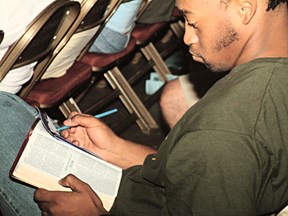
Gabriel Lawrence of West Texas A&M University takes notes during Focus.

In ministry, there are times when ministers feel alone, Wiles said. He urged students to rethink going into full-time vocational ministry if they can't be “tenacious” in their call, because vocational ministry is “difficult, yet it's wonderful.”

Wiles encouraged students who sense a calling into full-time ministry to embrace their unique gifts and find ways to develop their gifts.

Students who sense a call to ministry should get involved in the church body and use their gifts, he advised.

“Others in the church family often see something in you before you see it,” he said.

“The church is a dream team because everyone works differently. There is no one with less value because the calling of God is different for everyone.”

Wiles advised students preparing for ministry not to neglect their own spiritual nurturing.

Once in ministry, students should “pay attention to your core, conform to the will of God in your life, and take care of your core because the only person that can take care of your core is you.”

Ministry is not always easy, he noted.

“When you begin to face the challenges, remember you are a pilgrim on the journey,” Wiles said.

The church is full of people, and people can hurt their leaders, he acknowledged.

Challenges test a minister's character but passing those tests provides the confidence to face the next challenge, Wiles said. The most important aspect of ministry, he said, is to “live your commitment.”

News of religion, faith, missions, Bible study and Christian ministry among Texas Baptist churches, in the BGCT, the Southern Baptist Convention ( SBC ) and around the world.