




Posted: 9/15/06
| President Bush and First Lady Laura Bush lay a wreath at the site of the World Trade Center in New York during a ceremony to commemorate the fifth anniversary of the Sept. 11, 2001 attacks. (Photo by Keith Bedford/REUTERS) |
No sweeping revival, but impact
of 9/11 still felt in churches
By John Hall
Texas Baptist Communications
The Sept. 11, 2001, terrorist attacks upon the United States didn’t produce the widespread revival some Christian leaders predicted, but commentators believe the events of that day continue to affect church ministry.
Five years after the attacks on New York City and Washington D.C., the spike in worship attendance that occurred after Sept. 11 appears to be an anomaly. Within a month of the attacks, worship attendance had returned to pre-Sept. 11 levels in most places as people returned to their respective routines.
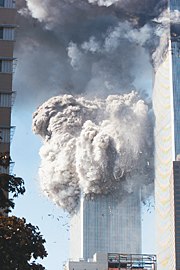 |
| World Trade Center towers collapsing in New York City after the Sept. 11, 2001, terrorist attack. (Reuters Photo)
• Read the Standard's coverage in our Sept. 17, 2001, issue of Baptist response to the crisis. |
But many churches have changed because society changed, Christian leaders said. Sept. 11 marks the day many Americans lost the sense of security they held close. Since then, church leaders have continued trying to help people make sense of the uncertainty and danger they felt that day.
“Reinhold Niebuhr once described America as a gadget-filled paradise suspended in a hell of international insecurity,” said Martin Marty, author and former professor at the University of Chicago Divinity School. “On 9/11 the suspension cord was cut, and we were dropping into the insecurity most humans had always known and that we could keep at a distance.”
A new uncertain world challenged believers to rethink what it means to be a Christian in contemporary society and how to carry out the mission of the Church effectively, said Bill Tillman, Hardin-Simmons University’s T.B. Maston Chair of Christian Ethics.
“It probably forced us to think about Christianity and Christ’s following in ways we should have been thinking about them anyway,” said Terry York, associate professor of Christian ministry and church music at Baylor University’s Truett Theological Seminary.
The resulting discussion has covered a wide variety of topics from missions to preaching to the relationship between Christianity and democracy. Though Christians are taking diverse stances, especially in regard to politics, some commonalities can be noted such as a strengthened fundamentalist movement, an increased interest in Muslim culture and a willingness to address political and social issues.
In the years since 9/11, Christians were drawn to fundamentalist theological movements because they offer clear answers, Tillman said. Fundamentalists provide a worldview with identifiable evil and good, as well as a purpose for each person’s life. These factors are crucial in a culture where security has been lost.
“I think the episode of 9/11 and afterward helped the fundamentalists because their response is a heavy-handed response,” Tillman said. “It gave rise to a hard-line expression of the gospel.”
This rightward theological sway expressed itself politically through a stronger voice for the right, though recently a number of Christians are making efforts to represent a Christian left in politics and other Christians are trying not to be identified too strongly with either political party.
In another result of 9/11, pastors continue to speak about Islam regularly, and many churches have studied it in small groups or Sunday School classes, said Joseph Holloway, professor of religion at East Texas Baptist University.
| 9/11 Five Years Later • For American Muslims, everything changed on 9/11 • Differentiate 'Muslim' from 'terrorist' scholars say • No sweeping revival, but impact of 9/11 still felt in churches • Negative perceptions of Muslims persist, panel says • Who's Who in Islam: major groups • Christian presence in Holy Land small and getting smaller • Islam built on five pillars of worship & five pillars of faith • Poll shows some prejudice against Muslims • Children of Abraham: Muslims view God, church & state through different lenses |
Christians seem to want to know more about the Muslim world, believing the Sept. 11 perpetrators acted upon their fundamentalist Islamic beliefs, Holloway said. If Christians can better understand this culture, they believe they can change it by sharing the gospel in the culture. As a result, mission work in “closed” countries—particularly Muslim-governed nations—is on the rise.
“I think it’s obvious a heightened interest in the Muslim parts of the world – nations that are predominantly Muslim – has come to our attention,” Holloway said. “As a consequence, there is more of a concern to meet the needs that are crying out in those parts of the world.”
Islam is just one of the issues Christian leaders are discussing post-Sept. 11. According to a recent study by the Pew Forum on Religion and Public Life, clergy are speaking out on a variety of topics.
More than 90 percent of regular worship service attendees polled had heard clergy speak about poverty and hunger issues. Nearly 60 percent have heard clergy speak about abortion. Fifty-three percent have heard a clergyperson speak about the situation in Iraq.
Events of 9/11 “pushed us into areas we could speak tangibly about,” Tillman said.
York noted these are not the only effects on faith of 9/11, as the long-term consequences still is being determined. Christians are grappling with basic questions of their faith. How they work through those issues will decide what impact the terrorist attacks ultimately have.
“We’re only five years away from 9/11,” he said. “In the history of our country, that’s like five minutes. In the history of the world, that’s like five seconds. I’m still trying to figure this out myself.”







We seek to connect God’s story and God’s people around the world. To learn more about God’s story, click here.
Send comments and feedback to Eric Black, our editor. For comments to be published, please specify “letter to the editor.” Maximum length for publication is 300 words.