


Posted: 3/28/08
ANALYSIS:
Living in the gray with the Man in Black
By Cathleen Falsani
Religion News Service
CHICAGO (RNS)—It has been suggested, on more than one occasion, that if another face were to be added to the quartet of Washington, Jefferson, Roosevelt and Lincoln on Mount Rushmore, it should be Johnny Cash.
The Man in Black would have my vote.
You’d be hard-pressed to name someone more quintessentially American, more representative of the spirit and soul of our nation, than J.R. Cash.
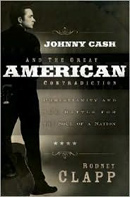
In his new book, Johnny Cash and the Great American Contradiction: Christianity and the Battle for the Soul of a Nation, author Rodney Clapp makes a persuasive argument that Cash—in his life and his music—is emblematic of America’s spirituality.
Clapp’s book, a scholarly if slim volume at only 159 pages, is one of the best examinations of American spirituality and culture I’ve read in a very long time. Clapp also is the author of Border Crossings: Christian Trespasses on Popular Culture and Tortured Wonders: Christian Spirituality for People Not Angels.
Using Cash as a lens through which to view contemporary religiosity, culture and politics, Clapp paints a resonant picture of a society built upon, and entirely mystified by, paradox.
He defines America’s contradiction as the “simultaneous embrace of holiness and hedonism, its pining love of tradition as it carries on a headlong romantic affair with progress, its extreme individualism coursing beside a gigantic, gaping yearning for community, and its insistence on innocence at the same time it revels in violence.”
“All of those are characteristics of the American personality,” Clapp said in an interview. “And it just so happens that Johnny Cash profoundly struggled with all of those things and embodied all of them.”
 |
In life and in song, Cash took on defining moral issues of our time—racism, war, abandonment of the disenfranchised. Each time, he picked the right side. Each time, he chose love over hate, reaching out over turning away, faith over certainty. His was a prophetic voice, and even now, nearly five years after his death, Cash’s words ring as true as ever.
“I do think that in the U.S. right now, we have forgotten and largely ignored a big part of our heritage, which is a big concern for the underdog, the person who is down and out. It’s described on the Statue of Liberty. Give me your poor, your needy, etc. We’re so far from that right now. And Cash was somebody who wouldn’t let us forget,” Clapp said.
“Pay attention to his life and who he was and his music. … He was honest. He was non-sentimental. And too often, I think, especially for churched people, for Christians, there is a tendency to if not cover over, ignore our brokenness, our faults, our sin, to act as if we’re beyond that at least when we’re acting like church people.”
Call it moral ambiguity, spiritual ambivalence or simply hypocrisy, we as a people— Americans and Christian Americans in particular—are so very uncomfortable with what we see as inconsistencies between word and deed. It makes us nervous when someone publicly proclaims their faith and then makes a very public mistake. Or two. Or a dozen.
We respond with anger, skepticism, all-or-nothing judgmentalism and fear. I know when those are my responses, and the first place I should be examining is my own soul. Usually, what I’m horrified by most in others is what I’m struggling against desperately in my own life.
Cash was a straight shooter; that is part of his enduring and broad appeal. As far as I can tell, he never doubted—at least not in any deep or enduring way—the Christian faith he had from childhood. But at the same time, he never pretended for a second he didn’t battle violence, drug and alcohol addiction, infidelity and despair.
“He didn’t brag about these things, but his persona and his music was very honest and nonsentimental,” Clapp said. “That goes against the grain of religious America but does so in a constructive way: We need to be more honest.”
None of us does the right thing all the time. We’re not all good or all bad. We’re something in between.
Even The Man in Black dwelt in the gray.
Cathleen Falsani is a columnist for the Chicago Sun-Times and author of The God Factor: Inside the Spiritual Lives of Public People.







We seek to connect God’s story and God’s people around the world. To learn more about God’s story, click here.
Send comments and feedback to Eric Black, our editor. For comments to be published, please specify “letter to the editor.” Maximum length for publication is 300 words.