Christians called to make culture; let God handle transformation

Andy Crouch feels uncomfortable when Christians talk about transforming culture or making an impact on society. But he strongly believes churches should do far more to encourage Christians to make culture—right where they live.

“I’m all for cultural transformation—in fact, I believe it’s a very good phrase for what God seeks to do in every human culture. But transformation is surely out of the reach of any human being’s activity or agency. It really is something only God can do in any lasting and deep way,” said Crouch, an author and documentary filmmaker.

Andy Crouch


“People who study culture carefully always come away impressed by how much more culture has transformed and shaped us than we will ever transform or shape it. Still, beginning with our original creation and call in the garden (of Eden), we human beings have always been culture makers. We cultivate and create in our specific cultural contexts, and in those local places we can do a lot of wonderful things. But transformation is not up to us; it’s up to God, which is actually tremendously freeing.”

Crouch, editorial director for the Christian Vision Project at Christianity Today International, has written a book on the subject—Culture Making: Recovering our Creative Calling—due for release by InterVarsity Press this summer.

When it comes to creativity, Christians have made their mark in literature of all kinds—from popular fiction to acclaimed work such as Marilynne Robinson’s Pulitzer Prize-winning novel, Gilead, he said.

“Music is the other place where Christians have been successfully offering up innovative cultural goods for at least a generation now,” he added. From American Idol contestants singing contemporary Christian music selections to classically trained musicians performing works by Christian composers such as John Tavener and James MacMillan, Christian influence permeates music, he noted.

“We’ve always been a people of the word, so it makes sense that there would be a strong Christian presence in literature. We value music in worship, so Christians have done well in that area,” Crouch said. “Where we have not been represented as much are in areas the church has either avoided or viewed with suspicion—film, dance and the visual arts.”

In part, he sees the plethora of Christian musicians compared to the dearth of Christian graphic artists as a simple matter of supply and demand. “With the decline of public arts and music education, the church has become the last significant reservoir of amateur expression in music. It’s the place where young musicians are given a chance to develop,” Crouch said.

While nearly all churches encourage musical involvement because it’s an essential part of worship, churches often fail to encourage other creative expressions because they are not viewed as useful, he added, asking, “Do we only value what the church needs?”


But some Christian groups have developed to nurture aspiring artists. The Act One program trains screenwriters and producers in Hollywood, and the New York Center for Arts and Media Studies trains young artists in Manhattan, Crouch noted.

“The visual art world is stunningly insular and hostile to professions of faith, but Christians are doing serious, good work and will be better represented there in years to come,” he said. “It just takes time.”

Christians have made inroads into the movie industry but not much in television for one simple reason, Crouch noted—market economics.

“One advantage movies have over television is they can be much more narrowly targeted, and they are driven by consumer demand without the intermediation of advertisers,” he said. “So, movies tend to be produced successfully for much tighter niches than TV—and Christian consumers are certainly a large enough niche to be of interest to Hollywood.”

Crouch firmly rejects the idea Christians have to break through into high-impact major media markets in order to influence culture in a big way.

“I really resist the word ‘impact.’ Impact is high-energy and almost by definition short-lived. And human cultures are designed to resist impact—to change only slowly and organically,” he said.

“I also resist the idea that we should let the world define for us what is big. Certainly, some Christians are called to live and work in major media markets or in various kinds of cultural epicenters. … But to seek to have an impact there is almost always not only to miss our Christian calling, but to distort our cultural calling as well.

“The great good news of God’s redemptive story is that we all can be part of it, in whatever location we are called to be. The question of where we are called to make culture is a matter of just that—calling, not of strategy for cultural impact. And all of us are called to cultivate and create somewhere.”


Pass the Popcorn: Christians struggle with best approach to engage culture

If Christians don’t learn to engage the popular culture that surrounds them, they will drown in it, experts insist.

Christians tend to hear the words ‘popular culture’ and react as if spitting something yucky from their mouths,” said David Dark, author of Everyday Apocalypse: The Sacred Revealed in Radiohead, The Simpsons and Other Pop Culture Icons and The Gospel According to America.

Instead of hiding from culture, Christians can use it as a learning tool.


But popular simply means “of the people,” he said. “It is never something we exist objectively from. It’s like the air we breathe, the language we use. … If we’re thinking, ‘Now we’re going to engage pop culture,’ it’s too late. We’re already soaking in it.”

Jeffrey Overstreet, contributing editor for Seattle Pacific University’s Response magazine, freelance movie reviewer, and author of Through a Screen Darkly and Auralia’s Colors, agreed.

“We are born into a pop culture,” he said, describing that culture as the very temporary, disposable details of a particular time and place.

Overstreet didn’t always see the importance of connection to culture. He grew up in a family that encouraged him to avoid pop culture and “steer clear of anything that did not have a clear connection to church,” he said. Rock music was questionable, and theaters were “dens of sin, contaminated by culture.”

Under the guidance of teachers, he realized complete separation from culture wasn’t the model Christ set.

“He was to be found at the corner pub, surrounded by messed-up people,” he said. “He was there among them, but he was different. He was compassionate.

Jeffrey Overstreet


“The more I look at it, in order to have a meaningful influence on society, we need to live fully engaged lives. How do we do that without hearing the stories told? Without listening to the music played?”

If Christians aren’t engaged in culture, they will not change the world or impact society, said Greg Fiebig, associate professor of communication and theater at Indiana Wesleyan University and former theater director at Southwest Baptist University in Bolivar, Mo. “We’re not going to do it. Period.”

He said Christians, especially in Christian academia, tend to live in a bubble. “People isolate themselves,” he said. “There is nothing wrong with isolating ourselves—Jesus did—but if we don’t know how to exist in the larger culture when we emerge, we have failed.”

Instead of hiding from culture, Christians can use it as a learning tool, Fiebig said.

“When I show someone a movie or present a show, I’m telling a story that needs to be told,” he said. “Jesus spoke of loving and caring for people where they were. The last thing he did was judge people. It is harder for us to judge when we are willing to listen to their story.”

Part of the learning experience is realizing that Christians don’t have a monopoly on the truth, Dark said.

“We are learners of Christianity,” he said. “It’s weird the way we talk, as if truth is something we have over other people. That’s no way to talk about faith—as if it is property. … When we view our faith as a bragging right or a secret password, I don’t know how we think others will be attracted to that.”

Instead, that type of view cuts Christians off from their neighbors, Overstreet said. “We need to see and understand our neighbors,” he said. If Christians only pay attention to items of culture that affirm their own worldview, “we don’t understand what the world looks like to them.”

Christ went to the woman at the well and began asking her questions, he said. He didn’t simply bombard her with the gospel.

He added that people know when they are being marketed. “So much of Christian art is just advertising for Jesus,” he said. “If we just keep shouting, we shouldn’t be surprised when people react like we are salesmen.”

He recalled driving under an overpass where someone had spray-painted in big letters, “Jesus is the answer.” Underneath, in a different color, another person had responded, “Yes, but what’s the question?”

Christians shouldn’t be handing out answers to questions that haven’t been asked, he said. Instead, pop culture can be used to kindle questions.

David Dark


Engaging culture will, no doubt, lead to viewing, reading or listening to objectionable content.

“As a Christian, I believe it can be insightful to critique movies for what they might have to say about important aspects of our lives,” said David Thomas, associate professor of rhetoric, emeritus, at the University of Richmond and freelance writer for Christian Ethics Today.

“I’m less interested in whether a movie contains language that offends me, or has scenes that depict sex or violence, than I am in determining whether the stories and characters ring true and in what the characters’ moral and ethical choices lead to.”

“Christians tend to believe that films have the power to single-handedly disrupt or uproot a person’s spiritual development if they contain corrupting elements,” said Chad Johnston, production assistant for Allen Press in Lawrence, Kan., and adjunct online instructor in communication and film at Drury University in Springfield, Mo.

“I do think people should be discerning about what they watch, but throwing out the baby with the bathwater—and sometimes the bathtub—is a flawed method of encountering and dealing with media.”
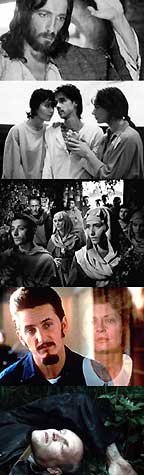
From artsandfaith.com


He compares watching films to meeting people. When meeting a person, it is easy to dismiss him or her due to a simple disagreement, but perhaps at the expense of a potential relationship or opportunity for growth, he said.

“It always surprises me that Christians will dismiss an R-rated film, yet read R-rated books in the Bible, like Judges,” he said.

“I tend to think that life is R-rated and should not be experienced without a Parent—i.e., our heavenly Father. After all, how can we handle the tougher realities of life being as fragile as we are? So I recommend that if you are hesitant to watch a particular film, you should ask yourself why, and perhaps do some research. If you are still uncomfortable with seeing it, or you simply feel it is bankrupt of any value spiritually, by all means avoid it.”

“To think of a human story as objectionable is not fair,” Dark observed. “If all we do is count bad words or feel offended, we are not relating to the world we are called to love or the world God so loved.”

But that does not mean anything goes, he emphasized.

“I wouldn’t say anyone needs to walk into dangerous places,” Overstreet said. “Each person needs to know their own strengths and weaknesses. But a lot of R-rated films are profound movies.”

The importance lies in knowing how to interpret films, which may be difficult for those who have never studied literature or other arts, Overstreet said.

Fiebig added that the American culture has lost a lot of ability for interpretation because of the tendency to be individualistic. “Movies are not meant to be seen in the privacy of your own home,” he said. “They should be communal, with time for discussion.”

Dark agreed that too much “privatization” has occurred. Typically, he said, Christians will watch, listen or read, but pretend the stories aren’t important to them when they step into church. “We are not living out loud to one another,” he said.

When Christians view things in isolation, they often miss the redeeming value, he said. “When we live isolated lives, we often hold wrongly applied guilt, as if our enjoyment is somehow separate from our relationship with God.”

Thomas’ church tries to break through the isolation by offering courses in faith and culture. He worked with Pastor Doug Gebhard in Rockingham, N.C., to design a liturgical film class that accompanied the seasons of Lent and Advent.

“The movies we chose had a Lenten or an Advent theme,” Gebhard said. “David explained rhetorical devices in the film—plot, symbolism, etc.—while I pointed out theological themes—suffering, sacrifice, redemption.”

Gebhard has led other classes that reached beyond film.
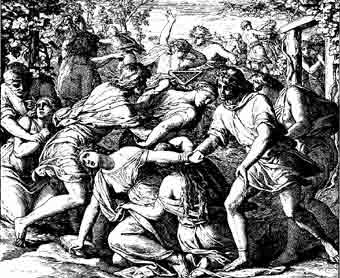
An R-rated scene from the Book of Judges: The Benjamites take wives.


“I hoped to prod people of faith to look at movies, listen to music, read novels with a lens of faith,” he said. “What spiritual messages can you see in Star Wars? The Matrix? Ironman? Where is Christ found in Springsteen’s anthems? U2’s music?”

Johnston also partnered with a friend to lead a film class, called Sanctuary of the Cinema, at University Heights Baptist Church in Springfield, Mo., where he lived until last year when he moved to Lawrence to begin a Ph.D. program in film at the University of Kansas.

“Our goal was to explore films through the interpretive lens of Christian spirituality—to see the light of God in the light of the silver screen,” he said.

The class met in the upstairs college Sunday school class, which featured comfortable chairs and couches and a projector to watch films on a large smartboard screen.

Sanctuary of the Cinema was advertised at local college campuses, coffee shops and an independent movie theater. As a result, the class was a diverse group. “Some of them were churchgoers, and others were a bit leery about the whole thing being set in a church,” Johnston said.

The group watched independent, art and foreign films together, then discussed the film, using questions from a faith perspective to help guide discussion.

Despite differences among the class members, “we all bonded because of the beauty of cinema,” Johnston said. “I think it’s because cinema is capable of reminding us all of what we share, rather than how we differ. Narrative cinema tells the sorts of stories that are common to all of us, and we therefore feel like we have a share in what’s happening onscreen.”
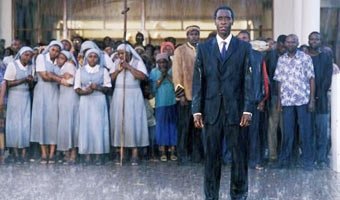
A scene from Hotel Rwanda.

And ultimately, that viewing can lead to Christ. “I have come to see the silver screen as a window overlooking a theologically charged world,” Johnston said. “As I look through this window, I find that I am better able to understand who God is, who I am, and how I relate to God and others. It is not a substitute for the Bible, but rather a supplement to it.”

A starting place for finding films to use in discussion is the Arts and Faith Top 100 Spiritually Significant films list, published at www.artsandfaith.com/t100. The list is compiled by voting members of the website, including Overstreet, and is updated each year. The website also features discussion groups on film, music, literature, visual art, theater and dance, and television and radio.

Fiebig helps lead a film festival at Indiana Weslyan University. Last year, the first year of the festival, they decided to screen Hotel Rwanda, a film depicting the true story of Paul Resesabagina, a hotel manager who helped house over a thousand Tutsi refugees during the Rwandan genocide.

A student from Uganda, who had lost family members during the struggle, attended the screening.

He began the discussion after the film by announcing he could not stay, due to the fresh emotions the film conjured, but he asked the other students to pray for Rwanda and Uganda.

“It was an amazing moment,” Fiebig said. “In a room full of college students, you could hear a pin drop. A Hollywood film became a worship service.”


Faith Digest: Does ET need Jesus?

Does ET need Jesus? Vatican astronomer says, ‘no.’ Intelligent life may exist on other planets and has no need of redemption through Jesus Christ, the director of the Vatican Observatory said. “Just as a multiplicity of creatures exists on the Earth, so there could be other creatures, even intelligent ones, created by God,” Jose Gabriel Funes was quoted in the official Vatican newspaper, L’Osservatore Romano. According to Funes, such creatures may never have fallen into sin, and so they have no need of salvation through Christ. “It is not a given that they have need of redemption,” he said. “They may have remained in full friendship with their Creator.”


Casting Crowns singer reaps Dove Awards. Casting Crowns lead singer Mark Hall and his group reaped a total of seven Dove Awards at the annual Gospel Music Association ceremony. Among his four individual awards, Hall was honored for co-writing the Song of the Year, “East to West.” Casting Crowns was honored three times, including as Group of the Year. TobyMac was named Artist of the Year, a title he claimed in 1996 as a member of dcTalk. His latest solo album, Portable Sounds, debuted at No. 10 on Billboard’s Top 200 albums chart. He was honored in two other categories for his work on that album.


Hotel offers variety of spiritual texts. Overnight guests at one Nashville, Tenn., hotel who crave religious reading material may turn to something other than a Gideon Bible. The Hotel Preston recently started offering a “spiritual menu” to its guests, including the Quran, the Bhagavad Gita and additional versions of the Bible other than the Gideon-provided King James Version. Five hotels in the Portland, Ore.-based Provenance chain have introduced the new offerings in the last few months, with the Nashville property starting them most recently. Researchers for the American Hotel & Lodging Association noted in 1998, 79 percent of hotels surveyed said they provided religious reading material in guest rooms; that figure jumped to 95 percent in 2006.


U.S. visit boosts Pope’s approval ratings. After Pope Benedict XVI’s first papal visit to the United States, six of 10 Americans now report favorable views of the pontiff, a modest bump from pre-trip opinions, according to new polls. Before his April 15-20 visit to Washington, D.C., and New York, the German-born pope was largely unknown in the United States three years after his election. In March, more than 80 percent of Americans said they heard little or nothing about him, according to a survey conducted by the Pew Research Center for People & the Press and the Pew Forum on Religion & Public Life. After Benedict met with President Bush, celebrated public Masses before huge crowds and repeatedly spoke of the pain and shame caused by his church’s sexual abuse scandal, 61 percent of Americans say they hold a favorable or very favorable view of the pope, up from 52 percent before the trip. More than half of Americans now say the pope does an excellent or good job of promoting relations with other faiths, up from 39 percent in March.


Evangelicals state desire to be defined by theology, not politics

WASHINGTON (RNS)—Evangelical Christians should be defined by their theology—not their politics—to avoid becoming “useful idiots” of a political party, a group of Christian leaders said in their recently released document, “An Evangelical Manifesto.”

The manifesto reflects the frustration of some within a movement that claims about one in four Americans over how they are perceived by others and who can speak for them.

The 19-page document declares evangelicals err when they try to politicize faith and use Christian beliefs for political purposes.

“That way faith loses its independence, the church becomes ‘the regime at prayer,’ Christians become ‘useful idiots’ for one political party or another, and the Christian faith becomes an ideology in its purest form,” the document reads.

The statement, however, resists calls to privatize or personalize the faith, saying there is an important place for evangelical voices in the public square.

“Called to an allegiance higher than party, ideology and nationality, we evangelicals see it our duty to engage with politics, but our equal duty never to be completely equated with any party, partisan ideology, economic system or nationality,” the document says.

The manifesto, which at times upbraids evangelicals for contributing to their own image problems, comes about six months after a poll showed many young people grade Christianity as being judgmental and hypocritical. Drafters of the new document said they knew other evangelicals who were “ashamed” or “reluctant” to describe themselves as evangelical.

A nine-member steering committee spent three years working on the manifesto. The document’s initial 75 signers are evangelical leaders from major coalitions, educational institutions and denominations.

They include National Association of Evangelicals President Leith Anderson; best-selling author and megachurch pastor Max Lucado of San Antonio; Bob Roberts, pastor of NorthWood Church in Keller; David Gushee, Christian ethics professor at Mercer University; Jim Wallis, founder and editor of Sojourners magazine; Mark Bailey, president of Dallas Theological Seminary; Bob Buford, founder of the Leadership Network; and Frank Wright, president of the National Religious Broadcasters.

Critics note some key names—including conservative evangelical leaders such as Focus on the Family founder James Dobson and Southern Baptist public policy executive Richard Land—are missing from the statement.

John Huffman, pastor of St. Andrew’s Presbyterian Church in Newport Beach, Calif., said the statement’s steering committee had conversations with Dobson, but his board recommended he not sign it. Dobson spokesman Gary Schneeberger confirmed this.

Land, president of the Southern Baptist Ethics & Religious Liberty Commission, said he had not seen the statement before it was released, but he later released a statement explaining why he would not sign it.

Charter signers of the document said it is intended to explain evangelicals to those outside their fold, as well as challenge evangelicals to better represent their faith.

“We are troubled by the fact that the confusions and corruptions surrounding the term ‘evangelical’ have grown so deep that the character of what it means has been obscured and its importance lost,” the manifesto reads. “Many people outside the movement now doubt that ‘evangelical’ is ever positive, and many inside now wonder whether the term any longer serves a useful purpose.”

The statement calls for a reaffirmation of evangelical identity—including the importance of sharing the belief that Jesus is the only Savior of mankind. It expresses concern that “a generation of culture warring” has created a backlash against religion in public life.


Songwriter Dottie Rambo dies in bus crash in Missouri

WASHINGTON (RNS)—Gospel singer and songwriter Joyce “Dottie” Rambo died in a tour bus accident May 11 in Missouri.

Rambo, 74, was in a tour bus that struck an embankment near Mount Vernon, Mo., after running off the highway, the Associated Press reported.

Joyce “Dottie” Rambo


The Nashville, Tenn., resident published more than 2,500 songs including “We Shall Behold Him,” which was named the 1982 Gospel Music Association’s song of the year.

Others of her tunes, which have been performed by various artists, include “I Go to the Rock,” “Behold the Lamb,” “I Will Glory in the Cross” and “He Looked Beyond My Fault (and Saw my Need).” Musical luminaries such as Elvis Presley, Whitney Houston, Sandi Patty and Dolly Parton recorded her songs.

“We have lost one of the truly great poets, but her voice will only be amplified by death,” fellow gospel songwriter Gloria Gaither wrote on the website she shares with musician-husband Bill Gaither. “Songs of Dottie Rambo will more insistently than ever speak to the experiences of life bringing hope, counsel, encourgement and perspective.”

Rambo, a Grammy-winning artist, wrote her first song at age 8 in her native Kentucky and started singing and traveling from church to church at age 12. Eventually, she was a staple on Christian television, including The Dottie Rambo Magazine on the Trinity Broadcasting Network in the 1980s.


TBM responds to Myanmar cyclone

Posted: 5/13/08

TBM responds to Myanmar cyclone

By John Hall

Texas Baptist Communications

Texas Baptist Men sent a rapid-response team to Bangkok, Thailand, in response to a devastating cyclone that hit Myanmar.

The seven-person team left the United States May 11. The team hopes to enter Myanmar—also known as Burma—as soon as possible to assess needs. Once in Myanmar, the relief volunteers will look for opportunities for follow-up teams to meet needs in the country.

 TBM team leader Dick Talley plans to stream another live video report Thursday at 8 a.m. Central Time on their progress from their staging area in Bangkok, Thailand. Watch it live on the BGCT website.

“We try to go wherever doors open and see how we can minister to people in need,” said Mickey Lenamon, Texas Baptist Men associate executive director. “That’s what Texas Baptist Men has been doing for 40 years.”

Official counts indicate nearly 23,000 people are dead following a cyclone that hit Myanmar. Another 42,000 people are missing. Some observers expect those totals to rise further as more information becomes available.

TBM responded to a request for help from Saddleback Church in Lake Forest, Calif., and The Fellowship of the Woodlands near Houston.

Baptists from Australia, Hungary and the United States also are currently in Bangkok, Thailand, awaiting visa application approval to enter Myanmar.

 To support TBM disaster relief efforts, visit http://texasbaptistmen.org/dnn/donate_asp_1.html.

To give through the Baptist General Convention of Texas Disaster Response Fund, visit http://texasbaptistmen.org/dnn/donate_asp_1.html.

News of religion, faith, missions, Bible study and Christian ministry among Baptist churches, in Texas, the BGCT, the nation and around the world.


Faith Digest

Panel cites 11 religious freedom offenders. A federal watchdog panel announced 11 countries should be named “countries of particular concern” for their records on religious freedom, including three not currently on the State Department’s list. The U.S. Commission on International Religious Freedom urged the inclusion of Vietnam—removed from the State Department’s list in 2006—along with Pakistan and Turkmenistan. The other countries recommended for the designation of “countries of particular concern” are Burma, China, Eritrea, Iran, North Korea, Saudi Arabia, Sudan and Uzbekistan, which have been on the State Department’s list since 2006. The commission also cited countries on its “Watch List” that require monitoring because of religious freedom violations permitted or implemented by the governments—Afghanistan, Bangladesh, Belarus, Cuba, Egypt, Indonesia and Nigeria.

Have a Bible question? Ask a Pole. Americans are more likely than Europeans to own and read a Bible, but Poles are most likely to have a basic knowledge of Scripture, according to a Vatican report. The statistics are among preliminary findings of a study of Bible reading in the United States and eight European countries conducted by an Italian market research firm in preparation for an international synod of Catholic bishops. More than 90 percent of American households contain at least one copy of the Bible, the highest level among the countries studied, according to the study. Three out of four Americans had read at least one passage of Scripture over the previous year, compared to only one out of four Spaniards, who ranked last in that respect. Not surprisingly, exposure paid off in familiarity with the book. When asked seven basic questions about the Bible’s contents and authorship, 17 percent of Americans were able to answer all correctly, compared to an average of 15 percent in all the countries studied. But Poles took the prize for biblical knowledge, with 20 percent earning perfect scores on the test. The lowest rank went to the Russians, only 7 percent of whom were able to answer all the questions right.

Televangelist Copeland seeks IRS review. Kenneth Copeland Ministries, one of the ministries that has refused to cooperate fully with a financial investigation by Sen. Charles Grassley, R-Iowa, has invited the Internal Revenue Service to conduct an inquiry of its own instead. Grassley’s office reported four of the six ministries he has been investigating are cooperating with requests to provide him with financial information. Creflo Dollar Ministries in College Park, Ga., has refused to submit financial records. Grassley, the panel’s top-ranking Republican, and committee Chairman Sen. Max Baucus, D-Mont., had asked ministries that weren’t cooperating fully to submit materials by March 31. Jill Gerber, a spokeswoman for the Senate Finance Committee, said both Copeland’s and Dollar’s ministries continue to decline to send the requested information. “As for the Copeland request for an audit from the IRS, Sen. Grassley has always said that the IRS enforces existing law, while Congress evaluates the adequacy of existing law,” she said. “The two functions are completely different.”

Hotel offers variety of spiritual texts. Overnight guests at one Nashville, Tenn., hotel who crave religious reading material may turn to something other than a Gideon Bible. The Hotel Preston recently started offering a “spiritual menu” to its guests, including the Quran, the Bhagavad Gita and additional versions of the Bible other than the Gideon-provided King James Version. Five boutique hotels in the Portland, Ore.-based Provenance chain have introduced the new offerings in the last few months, with the Nashville property starting them most recently. Researchers for the American Hotel & Lodging Association have found an increasing percentage of hotels provide religious materials in their rooms. In 1998, 79 percent of hotels surveyed said they carried such materials; that figured jumped to 95 percent in 2006.

Casting Crowns singer reaps Dove Awards. Casting Crowns lead singer Mark Hall and his group reaped a total of seven Dove Awards at the annual Gospel Music Association ceremony. Among his four individual awards, Hall was honored for co-writing the Song of the Year, “East to West.” Casting Crowns was honored three times, including as Group of the Year. TobyMac was named Artist of the Year, a title he claimed in 1996 as a member of dcTalk. His latest solo album, Portable Sounds, debuted at No. 10 on Billboard’s Top 200 albums chart. He was honored in two other categories for his work on that album.


BCFS garners highest praise from children

Posted: 5/09/08

BCFS garners highest praise from children

By Craig Bird

Baptist Child & Family Services

LULING—The Governor’s Division of Emergency Management praised Baptist Child & Family Serives for its role in caring for children taken from a polygamist Fundamentalist Latter-Day Saints ranch in West Texas. But the highest praise came from the people whose opinions matter most—the children themselves.

“You’re nice,” a 6-year-old girl told BCFS Executive Vice President Nanci Gibbons as she walked past her on the playground at the BCFS Youth Ranch at Luling, where 75 children received care.

Gibbons thanked the child, but she asked why she believed she was nice.

“Because your shirt says BCFS,” the girl answered. “It means Best Care for Children.”

“For the children to recognize that the folks in BCFS shirts are there to help and be ‘nice’ is the best compliment we could get,” BCFS President Kevin Dinnin said.

Placing 75 of the 462 children at the Youth Ranch allowed Child Protective Services to keep many sibling groups together. It also kept BCFS in overdrive mode to staff the facility and activate support programs with local school districts. A mobile medical unit also was stationed at the ranch.

The San Antonio-based agency was alerted April 4, just as the operation to remove children from the ranch in Eldorado got under way. Officials told BCFS to be ready to receive 24 children at the Youth Ranch. But the next day, Dinnin was asked if BCFS could supervise sheltering operations in San Angelo “for up to 150 women and children.”

At its peak, the shelters housed 550 women and children. Texas Baptist Men disaster relief, Victim Relief Ministries and volunteers from churches such as First Baptist in Plains served.

As incident commander, Dinnin provided overall command and control of all responding agencies. During the three weeks the shelters operated in San Angelo until the court ordered the children placed in child care facilities across the state, about 1,000 state, county and city personnel and volunteers worked under BCFS supervision as the agency interacted daily on critical incident decisions with various governmental agencies and officials.

BCFS deployed 55 employees, including most of its senior administrative staff, and more than $1 million worth of assets. In addition to two mobile medical clinics and a mobile feeding unit, BCFS provided the communication technology for the operation.

While CPS and the state courts decided about placement of the children, BCFS ministered to emotionally stressed women and children around the clock; accommodated religious practices by providing organic, non-processed meals and acceptable toys and play activities; treated outbreaks of chicken pox and upper respiratory infections; created an alternate phone system when the cable to the shelters and command post accidentally was cut; developed contingency plans for any of the possible court rulings; processed mountains of laundry; and handled all the purchasing.

When the courts ordered the transfer of the children to facilities across the state, BCFS tracked the bus convoys dispatched around the state by global positioning system.

“To categorize the sheltering operations as ‘highly successful’ is a gross understatement,” Dinnin added. ”To quote Chief Colley of the Governor’s Division of Emergency Management, BCFS was ‘the rock star of the San Angelo operation.’ We do appreciate that—but being noted for providing Best Care for Children is the highest compliment possible.”

News of religion, faith, missions, Bible study and Christian ministry among Baptist churches, in Texas, the BGCT, the nation and around the world.


Student worship leader keeps collegiate ties

Posted: 5/09/08

Blake Bollinger said wants his concerts to spark life-changing encounters with God.

Student worship leader keeps collegiate ties

By Leann Callaway

Special to the Baptist Standard

WACO—The Blake Bollinger Band’s roots run deep at Baylor University in Waco.

As a freshman at Baylor in 1999, Bollinger was asked to lead worship for chapel services, which put him in front of thousands of students each week.

Before long, Bollinger began responding to requests for out-of-state engagements. As the tour dates began to pile up and the miles of weekend travel kept increasing, Bollinger and his fellow band members felt pressure to drop out of school and pursue music full-time.

But after many hours of discussion and prayer, the band members decided to finish school and to turn down some offers and concert requests. 

“We all found a way to work our class schedule to always be free on Fridays,” Bollinger said. “This allowed us to play Thursday through Sunday and then drive back through the night for our classes on Monday mornings.”

In August 2007, Bollinger’s newest CD, No Holiday, was released.
www.blakebollinger.com

After graduating from Baylor in December 2003, Bollinger was able to focus on music full-time. Today, he keeps a busy schedule performing concerts and leading worship at events around the country, including youth camps, retreats, conferences and Disciple Now weekends. In addition, Bollinger serves as a worship leader at Second Baptist Church of Houston’s Pearland campus and frequently performs for events at Baylor.

“I’m humbled and grateful for an opportunity to get to spread the Good News through the powerful vehicle of music,” Bollinger said. “Leading worship needs to be taken very seriously. It’s not just playing songs. It’s leading people into the throne room of the Lord. We pray each time before we lead worship that God’s face will be seen and not ours— that we’ll just be a vehicle to lead people in worship.”

Wherever Bollinger performs, his goal is to offer more than a concert. Bollinger desires to provide students and young adults a life-changing encounter, he said.

We can know our destination

Baylor University's Studio Production class produced, shot, and edited this music video for Blake Bollinger's band singing Glitter. Watch video.

“At a lot of the camps and youth events we go to, we see youth struggling and being unsure of where they’re going to spend eternity,” he said. “We want them to be sure of their salvation and a fulfilling life by having a relationship with Christ. The young people of our generation need to know that they can have a hope and a future. We want them to know that there is more to this life than the here and now and the pursuit of self. We can truly know our destination and have a purpose for life on earth.”

In August 2007, Bollinger’s newest CD, No Holiday, was released. All of the songs on the CD are about situations Bollinger either has experienced or watched others experience.

“My goal was to create songs that connect with all people, but are particularly meaningful and relevant to believers,” Bollinger said. “In order to write a song, I have to really be passionate about the subject. I love to write songs that have redemptive qualities; that start with a struggle and end with hope.

Take it All

“I think the last track, ‘Take it All,’ is my favorite. The words of the song really convey my heart to God.  The chorus says, ‘Take it all, take all of me, take it all, take everything, and take it now, I don’t want it back, take all that I have and all I lack, take it all.’ … God gives us gifts to use for his kingdom, but he also allows us to have faults and flaws that leave us totally dependent on him. When we give him the things that we consider weaknesses, he can turn them into something beautiful and complete.”

News of religion, faith, missions, Bible study and Christian ministry among Baptist churches, in Texas, the BGCT, the nation and around the world.


2nd Opinion: The morning of many miracles

Posted: 5/09/08

2nd Opinion:
The morning of many miracles

By Doug Mendenhall

Let’s say God’s in a quirky mood, like when he created the platypus or nudged the Appalachian State football team past Michigan.

Let’s say he decides, for a few hours only, to drastically relax his standards on miracles. For this one morning, the new protocol is boiled down to:

• Requester must believe in God.

• Requester must have honorable motives.

• Request granted.

So at 6 a.m. on this special morning, unannounced, God lets the miracles begin.

At 6:03, the first prayerful soul offers up her daybreak litany of sick and dying friends and acquaintances.

At 6:05, those who are awake feel much better.

At 6:42, those in that first healed generation begin offering prayers of their own. Mostly they give thanks, but some include requests for this healing power to spread—more healings, a couple of saved marriages for friends or relatives, the payment of overdue bills piled up during a long hospital stay.

At 7:15, one of the couples whose marriage was on the rocks awaken at the same time, not on opposite sides of the bed, but cheek by cheek. Ignoring the morning breath, they share their first kiss in a long time and are late getting the kids up for school.

At 8:07, a clerk at the hospital calls to confirm payment of those bills. The clerk is told of the miracle behind the payment.

At 8:10, the clerk summons her faith and prays for a better-paying job to support her aging parents.

At 8:15, she gets a call from an old friend at a bank about a position as a loan officer.

Between 8:15 and 9, the hospital discharges most of its patients as word spreads from room to room about the potent power of prayer.

At 9:02, a bank loan officer arrives for work only to be told she has been replaced. No reason given.

At 9:07, two people die in a collision at the crowded exit from the hospital parking lot.

At 9:11, little Johnny prays that he can be one of the popular kids at school, so that everyone will stop making fun of him.

At 9:15, a single mother prays that the man she’s seeing will finally leave his wife so that her children can have the father they need.

At 9:22, the wife, on her way home from belatedly dropping off the kids at school, picks up her cell phone. It’s her husband. “Hey, sweetie,” she purrs, but he answers curtly: “I want out. I don’t love you anymore.”

By 9:30, the financial power of prayer is being broadly tapped. Loans are being forgiven, bank accounts are filling out of thin air and 401(k) portfolios are growing beyond all reason.

At 10:15, the stock markets begin reacting to news of irregularities in the banking industry.

At 10:19, a third-grader on the playground is sobbing miserably, wondering why little Johnny, his only friend, doesn’t want to play with him today.

At 10:42, the former loan officer, distraught and not knowing where to turn, turns her car off a cliff.

By 10:52, there are no more cliffs, for all of the mountains have been moved one at a time into the sea by rookie believers, just checking to see if it would really work.

At 11 a.m., God does the world a favor. He stops the morning of miracles an hour early.

He cleans up the mess.

He goes back to moving in mysterious ways.

So mysterious that even those who believe firmly that God is at work in the world are seldom certain: Did I just witness a miracle, or was it merely … one of those weird coincidences?

The power is always there if a mountain needs to be moved into the sea, but mostly God keeps a lighter touch on the controls.

Maybe we should pray that he never hands us those controls.

Not even for a single morning.


Doug Mendenhall, author of How Jesus Ended up in the Food Court, serves is a columnist for the Huntsville Times in Huntsville, Ala. His column is distributed by Religion News Service.

News of religion, faith, missions, Bible study and Christian ministry among Baptist churches, in Texas, the BGCT, the nation and around the world.


Services and Resources

Services and Resources

Put our feed on your site

Mobile and PDA access

Bible Study Resources

Contact Us

List of Services

Church newsletter publishing

Advertising rates

2008 Publication Dates

Facts for pastors

Concerned Baptists

Baptist Distinctives

Topical Sitemap

Coverage of BGCT Reorganization

Comparison of BF&M texts

Comparison of BF&M texts in Spanish

Links

These features will soon be moving to our new format:
Archives

Baptist Decision

Impact of 9-11


Got an RSS newsreader? Subscribe to our syndicated headlines here.


Baptism rates follow cycles, Texas Baptist statistician says

Posted: 5/09/08

Baptism rates follow cycles,
Texas Baptist statistician says

By John Hall

Texas Baptist Communications

DALLAS—Dropping baptism statistics tend to refocus Baptists on evangelism, which results in growing God’s kingdom, according to Clay Price, Baptist General Convention of Texas statistician.

Historically, the number of baptisms has risen and declined in a cyclical pattern, Price said. When Baptists see a decrease in baptisms, they typically put more emphasis on outreach and examine ways they can be more effective.

The number of baptisms taking place in Baptist churches was high in the 1950s, promoted highly through the “A Million More in ’54” campaign. Baptisms dropped in the mid-1960s, but rebounded in 1972. They dropped again toward the end of that decade but rose again in the 1980s.

Baptisms dropped in the early 1990s, but increased through the Texas 2000 evangelistic emphasis. Recently-elected BGCT Executive Director Randel Everett was launching Texas Hope 2010, an effort to share the gospel with every non-Christian in Texas by Easter 2010, before the latest statistics were released that indicated baptisms across the Southern Baptist Convention are down.

Having noted the cyclical nature of baptisms statistics, Price said the recent downturn in baptisms by Southern Baptists must be taken seriously. Perhaps the most telling statistic, he said, is that baptisms in churches that consistently report were down 24 percent.

Despite a gap in reporting, LifeWay’s statistics indicate a drop in baptisms for the third year in a row, down to lows not seen since 1970, said Ed Stetzer, LifeWay’s director of research.

Membership decline

The total membership of Southern Baptist churches also has declined.

“For now, Southern Baptists are a denomination in decline. Some of you were born into an SBC church; others of us chose it of our own accord,” Stetzer wrote on his blog. “Either way, it is dear to us all. Our responsibility before God is, then, to urgently consider how we should respond. Yes, most of our response should be personal and lived out in our local churches—this is a local-church issue. But if we are choosing to partner in this network of churches, and the network is faltering, it will also take some joint action.”

Stetzer noted areas that need to be addressed within Southern Baptist life—the lack of young and ethnic leaders, public infighting within the denomination and a need to focus on the gospel, which he noted is the most serious concern.

“The third, and most important, issue is our loss of focus on the gospel,” he wrote.

“I find it difficult to even say such a thing, but, I believe it to be true. We must recover a gospel centrality and cooperate in proclaiming that gospel locally and globally.”

News of religion, faith, missions, Bible study and Christian ministry among Baptist churches, in Texas, the BGCT, the nation and around the world.