EDITORIAL: Race relations, pastors & grace

Posted: 3/28/08

EDITORIAL:
Race relations, pastors & grace

Barack Obama and Jeremiah Wright have raised two issues that are both sensitive and explosive—race in America and the relationship between pastors and churches.

The last time we saw such a clear picture of our U.S. racial divide occurred more than a dozen years ago, when a jury declared O.J. Simpson not guilty. Lately, we’ve seen endless news clips and YouTube loops of Wright’s angry sermons on white racism and Obama’s response. We’ve watched a plethora of pundits tar Obama with Wright’s brush, theorizing the presidential candidate must agree with his former pastor, or else he would have moved his church membership.

knox_new

Sadly, we haven’t heard from many folks who seem willing to learn from what we’re seeing and hearing. Since the presidential nomination hasn’t been wrapped up, we’ve got Democrats bashing Democrats and Republicans exulting over an “October surprise” in March. But few voices have asked how we can parse reason from rhetoric.

Racial relationships are tenuous, and racial reconciliation is hard work. That’s true even under the best of circumstances, which excludes most of what passes for racial relationships in this country.

To look at an example where all the parties are trying hard, consider the Baptist General Convention of Texas and its 27 agencies and institutions. Theologically, we agree all people are created in God’s image, and people of every race are equal before God and among each other. Practically, we have stated this belief in our governing documents. Our vision embraces our diversity, and our values affirm the “worth of all persons.” We stipulate that at least 30 percent of our Executive Board shall be composed of persons of color, and many of our institutions are composed of higher percentages. Relationally, we work at this. We spend time together, look for ways to minister alongside each other, and genuinely not only love but also like each other.

Still, I have watched tension rise in a room as board members, usually minorities, raise racial issues. Anglos wonder, “Must everything be about race?” And minorities muse, “Why can’t they ‘get it’?” When we are at our best, these episodes help us see through each others’ glasses. That’s what we need. Whites must understand the layers of society—economic, educational, cultural, medical and more—through the interpretive lenses of racial-minority experience. And people of color must recognize the dimensions of American history as seen by whites—particularly whites of goodwill, who inherited this scenario, just as their sisters and brothers of color inherited it. I pray our churches and denominations will lead the way.

Speaking of church: It’s hard to comprehend the clamor for Obama to move his membership because his pastor said some ridiculous things from the pulpit.

You are blessed (or you’re not thinking for yourself) if you’ve never disagreed with your pastor. I like what Dallas Morning News columnist Steve Blow said on the subject: “I fully understand the concept of squirming in your church pew. I’m a Southern Baptist.”

The Obama-should-have-fled crowd either (a) doesn’t understand the dynamic of loyalty to a longtime beloved pastor, or (b) they don’t care about that and are intent on making political hay out of pastoral straw.

Think about the pastors who have made an impact on your life. In Obama’s case, the same person led him to faith in Christ, taught him how to live out that faith in a community marked by incredible need, performed his wedding ceremony and baptized his children.

Whatever you think of Obama’s politics, a person of principle doesn’t cut and run on a pastor like that, even when some of the things he says are embarrassing. He cuts him some slack.

In church, we call that grace.

Marv Knox is editor of the Baptist Standard.


News of religion, faith, missions, Bible study and Christian ministry among Baptist churches, in Texas, the BGCT, the nation and around the world.




Faith Digest

Posted: 3/28/08

Faith Digest

ACU freshmen get cool gadgets. Abilene Christian University will be the first university in the nation to provide all incoming freshmen with an Apple iPhone or an iPod touch, according to school officials. ACU, which is affiliated with the Churches of Christ, said 93 percent of students already bring a computer to campus. iPhones or iPods will be distributed beginning this fall and will allow students to receive homework alerts, answer in-class surveys and quizzes, and check their meal and account balances, along with more than a dozen other web applications, said Kevin Roberts, the school’s chief information officer.


Bin Laden targets pope over Muhammad cartoons. A new audio recording by Osama bin Laden accused Pope Benedict XVI of participating in a “new crusade” against Islam, including the publication of cartoons that depict the Prophet Muhammad. “Your publication of these drawings, part of a new crusade in which the pope of the Vatican has a significant role, is a confirmation on your part that the war continues,” bin Laden said in the recording, addressed to “the wise persons of the European Union.” A Vatican spokesman quickly responded, calling bin Laden’s accusation “totally unfounded,” and stressing the pope had condemned the offending images. The drawings in question are evidently the 12 cartoon portrayals of Muhammad published by a Danish newspaper in September 2005, and subsequently reprinted in newspapers in other countries—most recently on the second anniversary of February 2006 violent protests by Muslims that left at least 50 people dead.


Former British PM to teach religion at Yale. Former British Prime Minister Tony Blair has accepted a one-year appointment at Yale University to participate in a course on the connection between religion and globalization. Blair has been appointed as Yale’s Howland Distinguished Fellow during the 2008-09 academic year. He served as British prime minister from 1997 to 2007 and converted from Anglicanism to Roman Catholicism last year. He plans to launch a foundation this year dedicated to improving interfaith relations.


Scot to lead Chicago seminary. Alistair Brown, general director of BMS World Mission, the British Baptist mission agency, has been selected to be the 10th president of Northern Baptist Theological Seminary in Chicago. Brown, a former journalist and pastor, was born near Edinburgh, Scotland. He first worked as a church planter in Livingston, and served more than 10 years as senior pastor at a church in Aberdeen, Scotland.


Polish priest wins Templeton Prize. Michal Heller, a Polish cosmologist and Roman Catholic priest whose commitment to combining the insights of science and religion stretches back to his youth in war-torn Europe, has won the 2008 Templeton Prize. He will receive the $1.6 million award May 7 at Buckingham Palace in London for his work in connecting physics, cosmology, theology and philosophy. Heller, 72, is a professor of philosophy at the Pontifical Academy of Theology in Krakow.


News of religion, faith, missions, Bible study and Christian ministry among Baptist churches, in Texas, the BGCT, the nation and around the world.


Howard Payne students assist community center in Austin

Posted: 3/28/08

Members of the Howard Payne University spring break mission trip team were (left to right) Katy Blackshear, BSM director; Glenn Hopp, professor of English; Emily Touw; Jennifer Brock; Donna Dyer; Rebekah Reed; L J McCulloch; Zach Stallings; Darren McElroy; Chris Beaty; James Griffith and Tyler Malone. (Photo provided by Emily Touw)
See Complete Spring Break Ministry Coverage Here

Howard Payne students assist
community center in Austin

By Kalie Lowrie

Howard Payne University

AUSTIN—Baptist Student Ministries Director Katy Blackshear led 10 Howard Payne University students over spring break to work with the Baptist Community Center Mission in Austin.

Sophomore Jennifer Brock found that there were “many opportunities to serve Christ, you just have to be ready to do anything.”

Howard Payne sophomore Chris Beaty sings songs with children at the Baptist Community Center Mission. (Photo by Jennifer Brock)

Students worked in yards, painted a parsonage, served a noon meal at a local soup kitchen and even organized a car wash to raise money for the mission.

They spent their afternoons playing games, singing songs and sharing the gospel with the children who visit the mission after school. Sophomore L J McCulloch said he felt privileged to “be a part of these children’s lives, if only for a few days.”

On Sunday morning, the group was invited to lead the worship service at Baptist Temple in Austin. Chris Beaty led the worship, Tyler Malone gave his Christian testimony and L.J. McCulloch preached.

Howard Payne University student Rebekah Reed helps hand out bread through the Baptist Community Center Mission. (Photo by Jennifer Brock)

The group also canvassed the surrounding community, praying with families they encountered and telling them about the services available through the mission—including a mother with six children who had just moved to the area and did not know about the mission.

Their final night in Austin, the Howard Payne group organized a family fun night, inviting parents to visit the community center and enjoy a night of dinner and activities with their children.


News of religion, faith, missions, Bible study and Christian ministry among Baptist churches, in Texas, the BGCT, the nation and around the world.


IN BETWEEN: Welcome, all Texas Baptists

Posted: 3/28/08

IN BETWEEN:
Welcome, all Texas Baptists

I want to thank Chairman John Petty, the Baptist General Convention of Texas Executive Board and Texas Baptists for allowing me the privilege to serve you during these three months. Also, I want to thank the Executive Board staff, which in my opinion is the world’s best denominational staff.

March 31 marks the day when Randel Everett begins his ministry as our executive director. He has asked me to serve with him for a few weeks after his arrival, and I am honored to do so.

One discovery I made in these few weeks is the overwhelming need for all Texas Baptist leaders to continue welcoming those who align with the Southern Baptist Convention. I am not speaking of our brothers who have formed another state convention in Texas with SBC in its name. I am speaking of the hundreds of churches who identify with the BGCT and the national SBC and who send their offerings to both organizations.

Yes, it is important to be on guard for those who would lead us away from Baptist distinctives—religious liberty, priesthood of believers, authority of Scripture and the autonomy of the local church. Thankfully, there are those among us who watch carefully so we don’t walk down the path of creedalism.

Yet is it OK for a church that supports what we do as Texas Baptists also to support missionaries serving with the International Mission Board or the North American Mission Board? I believe it is not only OK; it’s commendable.

Yes, there are some Texas churches that identify completely with the Cooperative Baptist Fellowship. That is OK and commendable, as well.

But the overwhelming majority of churches working with the BGCT are what a pastor friend, Danny Dowdy from First Baptist Church in Memphis, uses to describe his church—“we are historically a Southern Baptist church.” I think he means the church is conservative in theology, evangelistic with lost folks and missionary from a kingdom perspective.

There have been some nasty rumors circulating that the nominating committee that recommended Randel Everett as executive director was dominated by “CBF folks.” The truth is that the committee members’ churches gave more than $1.4 million to SBC causes in 2007 ($442,470 Cooperative Program, $708,529 Lottie Moon and $308,287 Annie Armstrong); while their churches gave $193,550 to CBF ($174,800 CP and $18,750 CBF Global Missions Offering). Only two of the churches gave no money to the SBC. (These figures reflect the dollars channeled through the BGCT.)

Bill Pinson was right when he said, “We must be inclusive with all believers as we work among our churches—small and large, black and white, Hispanic and Asian, vocational and bivocational, rich and poor—all of us are on level ground when standing at the cross.”

It is time for us to make sure the welcome mat is out for all who go by the name Southern Baptists. Really, evangelism and missions bind us. Welcome, Texas Baptists and Southern Baptists. Welcome.


News of religion, faith, missions, Bible study and Christian ministry among Baptist churches, in Texas, the BGCT, the nation and around the world.


ANALYSIS: Living in the gray with the Man in Black

Posted: 3/28/08

ANALYSIS:
Living in the gray with the Man in Black

By Cathleen Falsani

Religion News Service

CHICAGO (RNS)—It has been suggested, on more than one occasion, that if another face were to be added to the quartet of Washington, Jefferson, Roosevelt and Lincoln on Mount Rushmore, it should be Johnny Cash.

The Man in Black would have my vote.

You’d be hard-pressed to name someone more quintessentially American, more representative of the spirit and soul of our nation, than J.R. Cash.

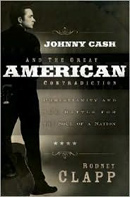
In his new book, Johnny Cash and the Great American Contradiction: Christianity and the Battle for the Soul of a Nation, author Rodney Clapp makes a persuasive argument that Cash—in his life and his music—is emblematic of America’s spirituality.

Clapp’s book, a scholarly if slim volume at only 159 pages, is one of the best examinations of American spirituality and culture I’ve read in a very long time. Clapp also is the author of Border Crossings: Christian Trespasses on Popular Culture and Tortured Wonders: Christian Spirituality for People Not Angels.

Using Cash as a lens through which to view contemporary religiosity, culture and politics, Clapp paints a resonant picture of a society built upon, and entirely mystified by, paradox.

He defines America’s contradiction as the “simultaneous embrace of holiness and hedonism, its pining love of tradition as it carries on a headlong romantic affair with progress, its extreme individualism coursing beside a gigantic, gaping yearning for community, and its insistence on innocence at the same time it revels in violence.”

“All of those are characteristics of the American personality,” Clapp said in an interview. “And it just so happens that Johnny Cash profoundly struggled with all of those things and embodied all of them.”

In life and in song, Cash took on defining moral issues of our time—racism, war, abandonment of the disenfranchised. Each time, he picked the right side. Each time, he chose love over hate, reaching out over turning away, faith over certainty. His was a prophetic voice, and even now, nearly five years after his death, Cash’s words ring as true as ever.

“I do think that in the U.S. right now, we have forgotten and largely ignored a big part of our heritage, which is a big concern for the underdog, the person who is down and out. It’s described on the Statue of Liberty. Give me your poor, your needy, etc. We’re so far from that right now. And Cash was somebody who wouldn’t let us forget,” Clapp said.

“Pay attention to his life and who he was and his music. … He was honest. He was non-sentimental. And too often, I think, especially for churched people, for Christians, there is a tendency to if not cover over, ignore our brokenness, our faults, our sin, to act as if we’re beyond that at least when we’re acting like church people.”

Call it moral ambiguity, spiritual ambivalence or simply hypocrisy, we as a people— Americans and Christian Americans in particular—are so very uncomfortable with what we see as inconsistencies between word and deed. It makes us nervous when someone publicly proclaims their faith and then makes a very public mistake. Or two. Or a dozen.

We respond with anger, skepticism, all-or-nothing judgmentalism and fear. I know when those are my responses, and the first place I should be examining is my own soul. Usually, what I’m horrified by most in others is what I’m struggling against desperately in my own life.

Cash was a straight shooter; that is part of his enduring and broad appeal. As far as I can tell, he never doubted—at least not in any deep or enduring way—the Christian faith he had from childhood. But at the same time, he never pretended for a second he didn’t battle violence, drug and alcohol addiction, infidelity and despair.

“He didn’t brag about these things, but his persona and his music was very honest and nonsentimental,” Clapp said. “That goes against the grain of religious America but does so in a constructive way: We need to be more honest.”

None of us does the right thing all the time. We’re not all good or all bad. We’re something in between.

Even The Man in Black dwelt in the gray.


Cathleen Falsani is a columnist for the Chicago Sun-Times and author of The God Factor: Inside the Spiritual Lives of Public People.


News of religion, faith, missions, Bible study and Christian ministry among Baptist churches, in Texas, the BGCT, the nation and around the world.


Judge dismisses Klouda lawsuit against seminary

Posted: 3/28/08

Judge dismisses Klouda
lawsuit against seminary

By Robert Marus

Associated Baptist Press

FORT WORTH (ABP)—A federal judge has ruled Southwestern Baptist Theological Seminary’s decision to fire a female Hebrew professor was akin to a church’s decision to fire its pastor and therefore outside the purview of the civil courts.

U.S. District Judge John McBryde dismissed all of the complaints in Sheri Klouda’s lawsuit against her alma mater and former employer.

Sheri Klouda

Citing a string of precedents by the U.S. Supreme Court and the Fifth U.S. Circuit Court of Appeals, McBryde wrote, “The courts are prohibited by the First Amendment from involving themselves in ecclesiastical matters, such as disputes concerning theological controversy, church discipline, ecclesiastical government or the conformity of the members of the church to the standard of morals required.”

Klouda’s suit against Southwestern and its president, Paige Patterson, involved such an ecclesiastical matter, the judge determined. It should, therefore, be treated the same way the law would treat an employment dispute between a church and a minister—by avoiding involvement.

“The record establishes as a matter of law that the employment decision made by defendants (Southwestern) concerning plaintiff (Klouda) was ecclesiastical in nature,” McBryde wrote.

“If the court were to allow plaintiff’s claims to go through the normal judicial processes, the procedural entanglements would be far-reaching in their impact upon (the) seminary as a religious organization.”

Klouda filed suit against Southwest-ern a year ago, citing gender discrimination and breach of contract, after leaving the school to take a teaching position at Taylor University in Upland, Ind. Her case was publicized by critics of Patterson, including Southern Baptist bloggers Wade Burleson and Benjamin Cole.

Klouda was hired to teach Hebrew in 2002, under a previous president’s administration.

Patterson became Southwestern’s president in 2003.

According to court documents, he decided women should not teach theology to male ministers-in-training because the Southern Baptist Convention’s confession of faith says the office of pastor is reserved for men.

Nonetheless, according to Klouda, Patterson assured her she was safe in her tenure-track position.

However, in 2004, she was told that she would not be granted tenure.

In 2006, according to Klouda, seminary officials told her she would be terminated at the end of that year.

Among her complaints were that the seminary had violated its promises to her, and there was no clear justification in the Bible or the SBC confession for Patterson’s decision to bar women from Southwestern’s theology faculty.

But McBryde said that was not a decision for the court to second-guess, writing, “Mere inquiry into those areas would be an unconstitutional intrusion into the affairs of the seminary as a religious organization.”

Patterson, in a statement to the Fort Worth Star-Telegram, said McBryde’s decision “has implications for all of our institutions and churches. Americans everywhere may still rejoice in freedom of faith and the ordering of their institutions accordingly.”

In a blog post analyzing the ruling, Burleson said the implications of the ruling, if carried out to their legal conclusion, would bar women from serving as professors at any SBC seminary.

“In the long run, I believe people of the Southern Baptist Convention will realize that there are two ideologies causing tension within our convention,” he wrote.

“One ideology would wish to relegate all women to a position of subordination to men, while the other seeks to acknowledge the biblical view of equality between men and women—with the only official denominational exception to that equality being the prohibition in the (2000 revision of the SBC Baptist Faith & Message statement) for women to serve as ‘senior pastors.’”

Klouda did not return telephone messages requesting comment for this story by press time.

But she reportedly had not decided whether or not she would appeal the decision.


News of religion, faith, missions, Bible study and Christian ministry among Baptist churches, in Texas, the BGCT, the nation and around the world.


Lamar students minister in South Texas

Posted: 3/28/08

Lamar students minister in South Texas

Lamar University students sing in the Escobares town square.
Lamar University student workers paint faces of children during Vacation Bible School in the South Texas town of Escobares.
Young children enjoy a Vacation Bible School at Primera Bautista Iglesia de Escobares led by Lamar University student missionaries.
See Complete Spring Break Ministry Coverage Here


News of religion, faith, missions, Bible study and Christian ministry among Baptist churches, in Texas, the BGCT, the nation and around the world.


Texas Baptist Forum

Posted: 3/28/08

Texas Baptist Forum

Reason to swap

Regarding your editorial on “U.S. faith swapping,” (March 17) illicit affairs are not the only reason to leave a marriage. Sometimes the spouse is overbearing, neglectful and abusive.

Jump to online-only letters below
Letters are welcomed. Send them to marvknox@baptiststandard.com; 250 words maximum.

“Honestly, if we could harness some of the emotion from this and turn it to evangelism and missions, we could see a massive change in our missionary and evangelistic endeavors.”
Frank Page
Southern Baptist Convention president, commenting on the furor after some Southern Baptists—including Page —signed a statement calling for environmental protection (Baptist Press/RNS)

“One day, I have to give an account to God and not to nobody else of what I’ve done in my life. And that’s why I’ve said and shared the stuff with y’all that … I wouldn’t like to share with y’all.”
Andy Pettitte
Yankees pitcher and Baptist Sunday school teacher, telling Congress he used human growth hormone but did not consider it cheating (New York Daily News/RNS)

“Women have two places—in front of the sink and behind the vacuum.”
Micah Armstrong
Evangelist, preaching to University of Alabama students, also saying they will go to hell for drinking, cursing, having pre-marital sex, watching movies or reading Harry Potter books (Associated Press/RNS)

Having come of age spiritually in the midst of the Baptist infighting of the 1980s and 1990s, I, like many of my generation, left an unhealthy Baptist marriage and sought less contentious places of worship.

At Baylor University in the late 1980s, I watched as my professors were abused in photocopied publications passed around campus and at Baptist General Convention of Texas meetings. I attended those meetings, which were as partisan and divisive as mainstream politics.

I graduated from South-western Seminary a few weeks after watching the trustees treat Russell Dilday in a way that should bring shame to even the most corrupt corporate board. I talked to professors at Southwestern who were driven out of their positions by trustees who sent their student interns into class with orders to report on any questionable teaching they heard.

Since graduating from seminary, I have been happy to attend nondenominational churches that are not weighed down by the institutional sicknesses that have plagued the Southern Baptist Convention and the BGCT. Are these churches perfect? No. But I certainly do not feel like I am missing out on anything by not being a part of the denomination in which I was raised.

I know there are some lovely, healthy ponies in the Baptist barn. I just got tired of the piles and piles of manure.

Paul Mastin

Fort Worth


Sign of covenant?

You quite properly report that a large minority of American parents have decided to avoid nontherapeutic circumcision of their newborn sons (March 17). Your article asks, “Are parents cutting out the sign of the covenant?” The answer is, “No, they are following the New Covenant.”

You apparently overlooked the teaching of Scripture, including the council at Jerusalem (Acts 15), at which Paul, Banabas, Peter, James and others decided new Christians should not be required to submit to circumcision.

Circumcision was not included in the requirements set forth in the letter to Gentile believers (Acts 15:22-29). Christians from that day forward have been exempt from the Old Testament Abrahamic covenant of circumcision (Genesis 17:9-14).

Paul said we should not have confidence in the flesh (Philippians 3:3), meaning that cutting off a body part is not the way to salvation. Christians are not supposed to circumcise.

Paul twice warned of the falseness of the claims made for circumcision (Galatians 2;4; Titus 1:10-11). His warning is equally valid today, because many false medical claims are put forward for circumcision. Parents should be skeptical of doctors who advocate circumcision.

The Bible is supposed to be our authority for faith and practice.

Why do American Christians not follow the guidance of the Bible with regard to circumcision?

George Hill

Vice president for bioethics and medical science

Doctors Opposing Circumcision

Seattle, Wash.

Thank you so much for the article on circumcision (March 17). I am a Texan, a Christian, an intactivist—anti-circumcision activist—and the mother of an intact son.

Mandy Ballard

Tyler


Stick to business

I am saddened, embarrassed and confused by the contents of Statement 2, “It is Prudent to Address Global Climate Change” portion of the recently issued A Southern Baptist Declaration on the Environment and Climate Change (March 17).

First, I am saddened because my beloved brethren have been caught up in this economic scam that has been falsely portrayed as science. I suppose that when the tide seems to be flowing one way, some feel that is the only way to swim. History is rife with tragic examples of “consensus opinion” being tragically wrong. 

Secondly, I am embarrassed that, despite disclaimers to the contrary, the ill-advised statement will be assumed to be shared by all of us who claim the name Baptist Christian.

Finally, I am confused about what possible good can ever come from nonscientists taking bold stands on unsettled social issues that are still in the very early stages of research. Many esteemed climate scientists have stated that even they don’t yet know enough to recommend what, if any, action is warranted. 

I humbly ask that we all stick to the business to which we have been called—going and telling about the eternal hope that will survive far beyond the inanities of this wisp of time we call life. To do otherwise takes us from being salt and light to being just more voices howling at the moon, hoping to scare it away.

Jerry Barker

Falfurrias


Silly significance search

I can’t stop laughing over “Indiana Jones would be proud: Prof claims he has found lost Ark of the Covenant” (March 17).

I am trying to imagine why this is a “story,” why you would publish it and could anyone take it seriously? Surely you published this as a “take a look at how silly some have become in their search for significance” article.

The other article on that page, “Oxford researchers get $4 million to study origins of belief in God” makes me want to see if I can get a grant to study what makes people say stuff like, “On the flip side, just because something is natural doesn’t mean it’s true.” Say what? Is that psycho-babble or gobbledygook?

Thanks for the humor; God knows there is little of it in Baptist circles these days.

Besides, everyone knows the Ark of the Covenant is in a warehouse somewhere deep in the bowels of Washington, D.C.

Bill Weaver

North Richland Hills


Out-of-step scientists

Deborah and Loren Haarsma (March 17) apparently believe evolution is God’s way of creating life and evolving it into its present state. If so, they are out of step with the basics of evolutionary theory, which insists evolution happens without purpose and without direction from any outside planner or designer (read God).

As William Provine says in Evolution and the Foundation of Ethics, “Persons who manage to retain religious beliefs while accepting evolutionary biology have to check their brains at the church-house door.”

When I left the University of Texas as a petroleum engineer, I was a confirmed believer in evolution. In nearly 60 years since, my studies have convinced me Darwinism is shown to be wrong by science itself. The fossil record, for instance, shows life has not evolved as Darwin predicted. Instead, new life forms consistently appear in the rocks fully developed, with no transitional stages leading up to them.

I could easily become a theistic evolutionist if I could convince myself evolution is true. I could just rationalize away any troubling Scriptures by remembering the Bible is not a book about science. Unfortunately, evolution is not such good science, either, when challenged with the facts of true science, like paleontology.

Ken Boren

Rowlett


Full of goodness

The Apostle Paul’s writings indicate Paul was a genuine individual who was committed to the Lord Jesus Christ, yet his commitment did not end there. Paul was committed to friends, colleagues and fellow brothers and sisters in Christ.

One statement, found in Romans 15:14, has had a profound impact on me. Paul writes, “I myself am convinced, my brothers, that you yourselves are full of goodness, complete in knowledge and competent to instruct one another.” This statement indicates Paul’s absolute confidence in his fellow believers’ goodness.

I don’t think Paul was describing a goodness that was intrinsic, but rather that which was as a result of a relationship with God through Christ. Pastors should believe in those we lead!

Next, Paul believed their knowledge to be complete, and this drives home a thought of a foundational Baptist belief in each believer having the ability to discern/understand God’s word.

Paul also believed his friends to have the ability to instruct one another. Pastors may get the idea the church “can’t do it without us.” Paul’s confidence indicated a level of belief in his fellow brothers and sisters, and to me this is an amazing statement of leadership.

Leaders must convey trust and confidence in those we lead. 

Bill Adams

Belton


What do you think? Because we affirm the priesthood of all believers, we value the dialogue offered by our readers’ forum. Send letters to Editor Marv Knox by mail: P.O. Box 660267, Dallas 75266-0267; or by e-mail: marvknox@baptiststandard.com. Due to space considerations, maximum length is 250 words, and only one letter per writer per quarter will be published .


News of religion, faith, missions, Bible study and Christian ministry among Baptist churches, in Texas, the BGCT, the nation and around the world.


Sam Houston State teams at Mission Arlington

Posted: 3/28/08

Sam Houston State teams at Mission Arlington

Erika Rangel from Sam Houston State University spends quality time with a little girl at Mission Arlington. Brock Wardlaw from Sam Houston State University gives a boy at Mission Arlington a ride on his shoulders. Zach Massey from Sam Houston State University gives a piggyback ride to an Arlington child.
Michael Bosquez from Sam Houston State University enjoys time with children in Arlington.
Sam Stokes from Sam Houston State University hangs out with a group of children in Arlington.

The Baptist Student Ministries at Sam Houston State University sent 25 volunteers to Mission Arlington. The student missionaries conducted service projects including free garage sales, passing out flyers at apartment complexes, organizing and cleaning, and filling Easter eggs.  Students worked with about 60 children in the afternoon at an apartment complex— singing, praying, playing games and teaching Bible stories. 

See Complete Spring Break Ministry Coverage Here


News of religion, faith, missions, Bible study and Christian ministry among Baptist churches, in Texas, the BGCT, the nation and around the world.


Report: Without changes, selling lottery doesn’t add up

Posted: 3/28/08

Report: Without changes,
selling lottery doesn’t add up

By John Hall

Texas Baptist Communications

AUSTIN—Unless gambling is expanded, selling the lottery will not produce the $14 billion Gov. Rick Perry has estimated, according to a report released by a watchdog group March 26.

Texans for Public Justice reports that documents given to the governor’s office suggest gambling in Texas would need to be expanded in order to generate the kind of income Perry has suggested. The extension of gambling would allow the lottery to show increasing sales, making it more attractive to bidders.

In nonbinding opinions, Texas Attorney Gen. Greg Abbott already has stated some of the proposed gambling expansions are unconstitutional. Among the suggested expansion options are keno, video lottery terminals and Internet gaming.

But Aces Wired, a Dallas company that operates games some say blur legal lines, is pushing the governor to privatize the lottery, the report said.

“Projections that the gambling industry privately submitted to the governor’s office make clear that the state cannot raise a purse of this size unless it resigns itself to the proliferation of more gambling in potentially more-addictive forms,” the report reads. “If Texans oppose such a gambling expansion, then these documents suggest that what they should play with the Texas lottery games is Texas Hold ‘Em.”

Suzii Paynter, director of the Baptist General Convention of Texas Christian Life Commission, said the report is further confirmation additional privatization of the lottery would be a blunder.

“Many of the functions that can be effectively and efficiently privatized have been privatized in Texas,” she said. “To consider an expansion of gambling, adding more games that would bring a lot of negative consequences just to drive up the price, would be a bad idea.”


News of religion, faith, missions, Bible study and Christian ministry among Baptist churches, in Texas, the BGCT, the nation and around the world.


Texas Tidbits

Posted: 3/28/08

Texas Tidbits

Baylor Garland medical team serves in Honduras. Health care professionals from Baylor Medical Center in Garland recently served on a medical mission to Honduras, working with Mission Predisan. Physicians, nurses, pharmacists, translators, anesthesiologists, sterile processing technicians and others who made the trek donated their medical services. At a clinic in Catacamas, the operating room team performed 27 surgeries in three and a half days. Part of the mission team traveled to remote mountain clinics, where they treated 300 patients in three days, working by candlelight in facilities that lacked electricity and plumbing.


Gracewood benefits from matching grants. Children at Heart Ministries has received two matching grants to expand its Gracewood program for single mothers and their children. The Christ Is Our Salvation Foundation will match up to $220,000 for operating expenses related to Gracewood’s expansion, which includes the first residence on a new northwest Houston campus and the conversion of existing offices to a residence at its original campus in southwest Houston. The Leroy and Merle Weir Charitable Trust has made a $275,000 challenge grant toward construction of an additional residence on the northwest campus in Houston.


Baugh Foundation awards $250,000 to Howard Payne. The Eula Mae and John Baugh Foundation of Houston will grant $250,000 to Howard Payne University to support its Paul and Jane Meyer Faith and Life Leadership Center. The center will utilize renovated space in the Phelps Bible Building, the chapel and Mims Auditorium. At the Baugh Foundation’s request, the facility’s multipurpose conference room will be named in honor of Richard and Wanda Jackson. Jackson is founder of the Jackson Center for Evangelism and Encouragement in Brownwood. The conference room will be a central component of the Paul and Jane Meyer Faith and Life Leadership Center, seating about 300 for lectures and 230 for banquets.


HPU Lady Jackets win national championship. Howard Payne University completed an undefeated season and captured its first NCAA Division III women’s basketball national championship by defeating Messiah (Pa.) College, 68-54. The Lady Jackets (33-0) became the first Division III national championship to go undefeated since Washington (Mo.) University in 2000. Howard Payne, which was appearing in the NCAA tournament for the fourth consecutive year, is the first team from the American Southwest Conference to win the national championship.


Lindsay wins book award. Michael Lindsay, assistant professor of sociology at Rice University and a member of West University Baptist Church in Houston, received one of the top honors from Christianity Today magazine in its annual CT Book Awards. Lindsay, who also is assistant director of the Center on Race, Religion and Urban Life, won the Christianity and culture category for Faith in the Halls of Power: How Evangelicals Joined the American Elite. In addition, three Baylor University professors received award of merit honors in the competition. Roger Olson, professor of theology at Truett Theological Seminary, was recognized in the in the apologetics/evangelism category for Questions to All of Your Answers: A Journey from Folk Religion to Examined Faith. Thomas Kidd, associate professor of history, wrote The Great Awakening: The Roots of Evangelical Christianity in Colonial America, which took the second-place honor in history/biography. Rodney Stark, university professor of the social sciences, was honored in theology/ethics for Discovering God: The Origins of the Great Religions and the Evolution of Belief.


Families endow Wayland scholarships. Three families recently have donated funds to create endowed student scholarships at Wayland Baptist University in memory or in honor of loved ones. The family and friends of Donna Sarchet, a former associate professor of business at Wayland who died in July 2005, created a scholarship in her memory. Sarchet served 22 years at the university. The family of Mauriene Smithson Matthews, a former Flying Queen who was a member of the WBU Athletic Hall of Honor, also established an endowed scholarship in her memory. Matthews, who died at age 74 in June 2007, taught school in Plainview 33 years before retiring in 1995. The family of Gerald Thompson created an endowed scholarship in his honor to mark his pending retirement in May. Thompson has been a science professor at Wayland since 1967.


WMU annual meeting slated. The Woman’s Missionary Union of Texas annual meeting is set for April 18-19 at Columbus Avenue Baptist Church in Waco. It will feature Jennifer Kennedy Dean, executive director of The Praying Life Foundation. For more information, visit www.wmutx.org.


News of religion, faith, missions, Bible study and Christian ministry among Baptist churches, in Texas, the BGCT, the nation and around the world.


When the preacher loses his cool, should church members take a hike?

Posted: 3/28/08

When the preacher loses his cool,
should church members take a hike?

By Jim White

Virginia Religious Herald

The now-familiar images of Jeremiah Wright, former pastor of Trinity United Church of Christ in Chicago, calling down God’s wrath on America raise questions for Christians: What place does rage have in the pulpit? And when should worshippers show their displeasure with the pastor’s preaching by leaving the church?

Professors Beth Newman of Baptist Theological Seminary at Richmond and Roger Olson of Baylor University’s Truett Theological Seminary in Waco agree Wright’s anger must be understood within the context of the African-American experiences and worship.

Anger is an appropriate response to injustices experienced and prejudices endured, Newman noted.

“Even God gets angry,” she said. “The Bible says to be angry and sin not.”

Does a 30-second video clip qualify one to pronounce
judgment upon the ministry of another? Regardless of his momentary offenses, should Wright’s comments, so
offensive to many, negate
a lifetime of ministry?
See Related Articles:
• When the preacher loses his cool, should church members take a hike?
Pastor's role in Obama campaign spotlights race, pulpit freedom
Black liberation theology provides the doctrine behind fiery rhetoric
Obama pastor's tough sermons just part of long, prophetic tradition

Newman suggests that although the language Wright used is offensive, she interprets it as Wright’s calling down judgment on the nation that has allowed many of its people to suffer racial injustices and indignities.

White American Christians must struggle to comprehend the depth of humiliation racism creates as well as the rage black liberation theology expresses, Olson noted.

“Black theology is full of righteous indignation or simply black rage. It may be debatable how justified it is, but I can understand it even if I think that at times it crosses the line,” he said.

“The way he (Wright) is saying it is unfamiliar to a lot of people who don’t attend black churches. When you are in the pulpit in a black church, you are expected to be passionate. That’s what he was doing.”

Furthermore, Newman believes different worship expectations constitute one substantive difference between African-American and white churches.

She cites a conversation between Methodist bishop William Willimon and an African-American pastor. Willimon asked the pastor to explain the lengthy worship services.

The pastor responded, “Our people are repeatedly told during the week that they are less than what God created human beings to be. So when they come into worship, we have to set things right and give them the vision they should have of themselves and who they are in God’s story. It takes a long time to do that.”

Should Sen. Barack Obama—or any other worshippers—have left the church after Wright’s sermon? Neither professor thinks so.

“That smacks of a kind of consumer approach,” reasoned New-man. “‘If it doesn’t meet my needs, or if I don’t agree with what is said, why don’t I go somewhere else?’ I think that a part of what it means to be the church together is to be there with each other even during those times we think the other is mistaken. I think one of the things the church in the United States needs to aspire to is the willingness to stay put.”

Each professor emphasized, however, that at times leaving a church is appropriate. How does a person know when to leave? Olson offered this advice: “When you find that you are not able to contribute constructively to the congregation and by your presence to edify others, it is probably time to look elsewhere. I would not leave just because I disagreed with what the pastor said unless it was terribly heretical or blatantly racist or something like that. That raises the question: Was Rev. Wright being racist? I have trouble judging that.”

Perhaps it is precisely that issue that is most theologically troublesome. Does a 30-second video clip qualify one to pronounce judgment upon the ministry of another? Regardless of his momentary offenses, should Wright’s comments, so offensive to many, negate a lifetime of ministry?

While Martin Marty taught at the University of Chicago Divinity School, he and Wright became close friends. He takes strong exception to some of the things Wright has done, but cautions against writing him off. “I’ve been too impressed by the way Wright preaches the Christian gospel to break with him,” Marty asserted.


News of religion, faith, missions, Bible study and Christian ministry among Baptist churches, in Texas, the BGCT, the nation and around the world.