Bible Studies for Life Series for February 10: The message

Posted: 1/29/08

Bible Studies for Life Series for February 10

The message

• Galatians 1:6-9, 11-12; 3:1-9

By Steve Dominy

First Baptist Church, Gatesville

If you are a fan of alliteration you will love February’s lessons: The Motive, The Message, The Messenger, and the Model. These lessons attempt to answer the questions surrounding the gospel; why, what, who, and how. All focus on delivering the gospel to the world and should build on one another to form a coherent whole. Individually the lessons should cause us to examine our perspective and participation in each segment of the church’s mission. Together the lessons should help us to form a foundation for sharing the gospel locally and globally.

Each of Paul’s letters addresses a problem or problems in the local church. Usually it takes a little time to get to the specific problem about which he is writing, but not with Galatians. Paul gets to the heart of the matter in the very first verse, “ – sent not from men nor by man, but by Jesus Christ and God the Father who raised him from the dead…” Paul’s introduction is similar to his other introductions, but he emphasizes the point that there is no authority other than God who has sent him. He follows this with a quick summation of the gospel, “Grace and Peace to you from God our Father and the Lord Jesus Christ, who gave himself for our sins to rescue us from the present evil age…”

It is evident from Paul’s introduction that the problem in the churches in Galatia did not concern the manner in which the gospel was to be lived out, or of church order. The problem in Galatia centered on the gospel itself; would the Galatians trust in Christ for their salvation, or would they abandon the faith? Is Jesus alone sufficient for salvation or is it necessary to trust in Jesus and obey the law? For Paul, the second answer negated the gospel, “…for if righteousness could be gained through the law then Christ died for nothing!” To answer the question of salvation with Christ and the law would be to abandon the gospel altogether.

First and foremost the gospel is centered in Christ. Paul takes this so seriously that he declares that if men or angels preach a gospel other that the all-sufficiency of Christ let them be eternally condemned. The word that Paul uses is anathema which means accursed. In this case he intends it to be understood that those who preach a gospel contrary to the one he preached should be accursed by God. Paul does not use this language lightly, the very heart of the Galatians salvation is at stake and Paul will not abandon them to the folly of this false teaching.

For the gospel to include anything other than the life, death, and resurrection of Christ denies that salvation is solely a work of God. That salvation is wholly at God’s initiative and by God’s power is a consistent teaching throughout the New Testament, it is not unique to Galatians. Paul’s gospel was good news and the primary reason that it was good news was that it did not come from a human agent. Paul says that, “I received it by revelation from Jesus Christ.” I don’t know that anyone other than Paul could make the statements concerning salvation in Galatians with the same authority. In his own life, salvation came literally through Christ on the road to Damascus. There was no human intermediary who lead Paul to Christ. Christ literally came to him, he knows first hand that salvation is purely the work of God in and through Jesus.

Salvation is a gift received by faith. Paul laid out two options before the Galatians: Did you receive the Spirit out of the workings of the law or out of the hearing of faith? Paul makes an important point in this section: The Spirit comes only by the hearing of faith. We come to faith through the work of the Spirit in our lives pointing to the sufficient work of Jesus in his life, death, and resurrection. As we believe the good news of the gospel, the Spirit takes hold of our lives and brings us into a new and powerful relationship with God.

Very few of us would ever claim that anything other than Jesus is necessary for salvation. However, that is not the case after our salvation. Paul makes the point in chapter 3, “After beginning with the Spirit, are you now trying to attain your goal by human effort?” The Christian life begins and ends with faith. Our lives begin with Christ by grace through faith and we live out the whole of our lives by grace through faith. Too often, grace is set aside in the church and we pile expectations upon one another that none of us could ever hope to attain. We seem to expect our salvation to be by grace but to live up to that salvation by our own strength, nothing could be farther from the truth. We are saved by grace and we live our lives by the power of that same grace.

News of religion, faith, missions, Bible study and Christian ministry among Baptist churches, in Texas, the BGCT, the nation and around the world.



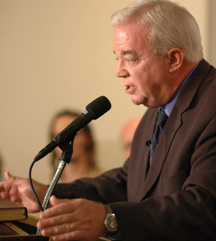
Everett to be nominated as BGCT executive director

Posted: 1/22/08

Everett to be nominated as BGCT executive director

By John Hall

BGCT Communications

DALLAS—The Baptist General Convention of Texas Executive Director Search Committee will nominate Randel Everett to be the convention’s next executive director.

The former president of the John Leland Center for Theological Studies in Arlington, Va., and senior pastor of First Baptist Church in Newport News, Va., will be nominated as the next BGCT executive director during the convention’s next regular executive board meeting Feb. 25-26 in Dallas.

Randel Everett

Current BGCT Executive Director Charles Wade is set to retire Jan. 31. William Jan Daehnert already is serving as interim BGCT executive director.

Ken Hugghins, chairman of the search committee, said Everett met the criteria of an executive director who could lead the convention in this crucial time in which Texas Baptists appear segmented and financial issues recently caused the convention to lay off 29 people.

"As the committee listened to Texas Baptists and talked with excellent leaders and candidates across our state, a description of the kind of leader Texas needs emerged,” Hugghins said. “Randel Everett matches that description and more.  He will communicate across the spectrum of Texas Baptists, the generations of Texas Baptists, the many affinity groups of Texas Baptists and focus the kingdom commitment of Texas Baptist churches, institutions, and convention servants."

Under Everett’s leadership, the Leland Center was accredited by the Association of Theological Schools and grew to serve about 200 students in more than 12 countries.

Prior to serving at the Leland Center and First Baptist Church, Everett, 56, was pastor of Columbia Baptist Church in Falls Church, Va. for five years. The congregation is one of the largest Baptist churches in the Washington, D.C., area with more than 3,000 members. It regularly is one of the top giving churches to the Baptist General Association of Virginia. It started five churches that serve different non-English speaking groups.

Everett, who was born in Arkansas and grew up in Fort Worth, also served as senior pastor of First Baptist Church in Pensacola, Fla., 1992-1996. The congregation of more than 5,000 members became involved in the Baptist World Alliance under his leadership.

Everett was pastor of First Baptist Church in Benton, Ark., 1984-1988.

Everett has pastored three Texas Baptist churches – University Baptist Church in Fort Worth, Inglewood Baptist Church in Grand Prairie and First Baptist Church in Gonzales. He also served as assistant minister of missions at First Baptist Church in Dallas.                         

Everett earned a doctoral degree from Southwestern Baptist Theological Seminary, a master’s degree from Southwestern Seminary and a bachelor’s degree from Ouachita Baptist University. He also holds an honorary doctorate from the University of Richmond.

The executive director nominee has extensive denominational experience, having served in Baptist associations, state conventions and with the Baptist World Alliance. He was chairman of the BWA’s education and evangelism commission 2000-2005 and served in several other capacities with the BWA.

He was moderator of Peninsula Baptist Association, a member of the National Ministry Partners Study Committee for the Baptist General Association of Virginia, a member of the Virginia association’s budget committee, a trustee at Florida Baptist College and president of the Arkansas Baptist State Convention Executive Board.         

Everett served as a member of the BGCT Executive Board 1978-1979.

He has been a guest chaplain for the U.S. Senate and House of Representatives, a teacher at the Pentagon Bible study. He also has led more than 30 evangelism conferences.

News of religion, faith, missions, Bible study and Christian ministry among Baptist churches, in Texas, the BGCT, the nation and around the world.



Bible Studies for Life Series for February 3: Breakthrough in confidence

Posted: 1/25/08

Bible Studies for Life Series for February 3

The motive

• Luke 15:1-2, 11-24

By Steve Dominy

First Baptist Church, Gatesville

Why bother? That is the question posed to us today. Why bother trying to witness? Why bother telling someone about Jesus?

It is a question that at first might offend us. “Well, because without Jesus they will spend an eternity separated from God in hell!” And we would be right, but if we look at our situation more closely, I would bet that “Why bother?” is a question we need to take seriously.

When was the last time you led someone to the Lord? How many people are you praying for who don’t know Christ? If we can’t immediately answer those questions then we need to take the question, “Why bother?” very seriously.

Jesus makes the point very clear in Luke 15. In each parable, he raises the stakes a little higher. In the first parable, he asks, “Which of you would not leave the 99 sheep and go after the lost sheep when you found it?” If Jesus had given them the opportunity to answer, the Pharisees and the teachers of the law would probably have replied, “No, I might look for a little bit, but I wouldn’t put any great effort into it.” Why would they, they have 99 others to look after, what is going to happen to them? Besides, one sheep doesn’t matter than much to them.

In the next parable, Jesus raises the stakes a little more. “Suppose a woman has 10 silver coins and loses one. Doesn’t she light a lamp, sweep the house and search carefully until she finds it?” The Pharisees and the teachers of the law would probably answer in the same negative fashion. They might look for a little while, but one coin is not going to break them, there is more where that came from. It is not like 10 coins are all that they have, they will make more money.

Finally Jesus goes all in. “There was a man who had two sons.” You can replace sheep and coins, you can’t replace sons. You can recover from losing one percent of your herd, or ten percent of your bank account, but your children, that is another matter altogether.

You know the story, the youngest son took his inheritance and squandered it on wine, women and song. When the money was gone he found a job feeding pigs, there would have been few jobs worse for a Jew than feeding pigs. Then the son, “came to his senses,” and returned, vowing to beg his father to let him be a hired hand. But the father saw him coming and ran to him, restoring him to his full status as his son

But Jesus wont’ let it rest at that, the father wants both sons, he won’t settle for the loss of either. The older son is furious that the father will even speak to the younger son after all he has done. At the same time, he is furious because the younger son has been given everything, and he is afraid there will be nothing left for him. The father absolutely is as steadfast in refusing to let the older son go as he was in searching for the younger son.

So we return to the question, “Why bother?” The most obvious answer to the question is because it matters to God. Each parable illustrates the joy of God over one sinner who repents. All we have to do to answer this question is to look at the lengths to which God has gone to redeem his people. It is the story of the whole Bible, the crux of which is God’s incarnation in Jesus, his life, death and resurrection on our behalf. Why bother? Because our salvation matters enough that God would send his only son to die for us.

The second answer to the question is we bother because people matter. We only put effort into those things that matter, those things that are of nominal importance receive little, if any, of our attention. God has declared we are worth his effort and his love. People matter, regardless of their race, plight or gender.

Each of us has been the son who squandered his inheritance and was eagerly welcomed back into the family. We know the incredible grace God has lavished on us and the absolute joy that comes from that grace. The problem comes when we start to think we have achieved something outside of God’s grace. That is when we become the older brother and would deny God’s grace to those whom we don’t deem worthy. Our salvation and everything that comes from it is purely by the grace of God.

Karl Barth made the statement, “has not the work of this divine messenger and ambassador (Christ) actually ceased in the blind alley of the church as an institution of salvation for those who belong to it?” If the only people to whom we offer salvation are those that we know, then we have ceased doing the work of Christ.

Why bother? Because this is the work of Christ in this world. If we claim the name of Christ as his people then we must be a part of his work in his world else we bring the name into disrepute.

News of religion, faith, missions, Bible study and Christian ministry among Baptist churches, in Texas, the BGCT, the nation and around the world.


Explore the Bible Series for February 3: Do you care about others?

Posted:1/25/08

Explore the Bible Series for February 3

Do you care about others?

• Genesis 18:20-26, 19:12-16

By Donald Raney

First Baptist Church, Petersburg

In his work titled The Apology, the early church leader Tertullian sought to defend the beliefs and practices of the young church to the rulers of the Roman Empire. According to Tertullian, one of the most often expressed comments about the church by those outside the church was, “Look at how much they love each other.”

Acts 2:42-47 also indicates the early church was characterized by genuine care and concern for one another among the members. Throughout its history, the church has excelled in caring for its members. When one member is in need, the whole body rallies to meet the need.

Often, however, this same level of care is not extended to those outside the church. Believers know the unbelieving world needs to hear the gospel and will contribute money toward that end. Without explicitly saying it, church members have asked that unbelievers change before extending their full caring acceptance.

But the Bible teaches that God desires that Christians do more to reflect God’s compassion to all people. Jesus taught us to love even our enemies and pray for those who persecute us (Matthew 5:43-48). As we look at Abraham’s experience with Sodom and Gomorrah, we can learn how to truly care for others.


Acknowledge the reality of God’s judgment (Genesis 18:20-21)

In Genesis 18, Abraham demonstrated hospitality toward three guests whom he somehow recognized as messengers sent by God. During their time together, the visitors reassured Abraham that God’s promise of a son would be fulfilled within the following year.

Before they parted from Abraham, they told him God was planning to punish the cities of Sodom and Gomorrah for the seriousness of their sin. God had heard the cries of the victims of their oppression and injustice and had come to aid the innocent and test the guilty.

Many people over the years, and particularly today, do not like to think about God in terms of wrath and judgment. They question how a God of infinite love and compassion could possibly punish or condemn people he created. Many churches, either explicitly or by their silence on the subject, also seem to deny the reality of divine judgment.

Yet the Bible is clear that God’s holiness cannot allow sin within his creation to go unpunished, and God’s judgment on sinful humanity does not diminish his love for those guilty of sin. If we are to truly care for those beyond the walls of the church, we must first recognize that anyone who has not surrendered his or her life to God lives under divine condemnation and will be judged. We must remember the fact that each of us at one time stood in that position and allow that knowledge to motivate us to lead them to salvation.


Offer intercessory prayers (Genesis 18:22-26)

The Bible states that as soon as the visitors left, Abraham began to pray to God on behalf of the people of Sodom and Gomorrah. He began to plead with God to turn from his anger and spare the cities. The urgency of his prayers may be reflected in his bargaining with God concerning what it would take for God to refrain from his judgment.

How often do people within the church today look at the sin of various groups within the light of God’s judgment and say they are getting what they deserve. Far from praying that God might remove the judgment, the attitude seems to be a desire for God to hasten his judgment on “them.”

Yet time after time, the Bible indicates God does not enjoy or even desire to punish anyone. The fact that God expresses a willingness to spare all of the people if as few as ten righteous ones could be found demonstrates this. 2 Peter 3:9 clearly states that God desires that no one should perish under judgment, but all should come to repentance.

It is good for believers to pray for God to meet the practical needs of fellow believers. Yet we should never forget to also pray for the salvation of those outside the church regardless of who they are. It is a vital part of what it means to genuinely care for them.


Observe God’s compassion (Genesis 19:12-16)

When the divine messengers had arrived in Sodom and confirmed the wickedness of the people, they pronounced God’s judgment on the cities. They then informed Lot and his family about the impending destruction and gave them instructions on how to escape.

One of the common threads that runs throughout the Bible is the continuing existence of a remnant of faithful people within the larger sinful community. Just as God must punish the community for its sin, God always promises to protect and rescue those who remain faithful. This does not mean that they will completely escape the effects of the judgment.

Lot’s daughters left the city as widows because their husbands refused to believe. Yet the faithful know that their lives are in the hands of a God who loves them and is more than able to protect and sustain them. As each believer is faithful to genuinely care for others and pray for their physical and spiritual needs, we will have our own faith reassured and our relationship to God strengthened as we witness the ways God answers those prayers by pouring his wealth of compassion into their lives.

News of religion, faith, missions, Bible study and Christian ministry among Baptist churches, in Texas, the BGCT, the nation and around the world.


Buckner explores needs in Mexico

Posted: 1/25/08

A girl at a Zapoteco village in a Oaxaca mountain makes corn tortillas by hand. The people in this community live in one-bedroom aluminum homes with dirt floors. (Photos by Russ Dilday/Buckner)

Buckner explores needs in Mexico

By Analiz González

Buckner International

MEXICO CITY—Observers of Mexico say it’s hard to speak of the country in absolute terms. Its needs are as varied as the multiple versions of “Mexican food” people eat in the United States.

Mexico has hundreds of people-groups with dozens of languages, lifestyles and dialects. In the cities, adults often crowd into forsaken rooms in overpopulated barrios.

Dexton Shores, director of ministry development in Mexico and the Border, speaks with a child in Oaxaca. Shores is identifying needs in Mexico for future church missions and ministry opportunities.

At least 1 million homeless children live in Mexico City, often raising each other on the streets. Mexico City is the largest city in the Americas—15 million people accounted for, and probably many more.

Dexton Shores, Buckner International’s director of ministry development in Mexico and the border, recently returned from an exploratory trip to discover mission opportunities in the country. One of the biggest problems he discovered is hunger.

Twenty-year-old Saul Martinez from Iglesia Bautista Horeb in Mexico City has coordinated a ministry to feed children the past three years. He hands them a bowl with rice or soup—something simple. As a boy, he went there to get food himself.

“Most of the people who live in this area are not originally from Mexico City,” Martinez said. “They don’t have steady salaries, and sometimes they have to go away to find work, and they leave their kids alone and with no food.”

Some women trek 30 minutes for the free meal with babies tied around their backs in pieces of cloth and other children walking by their side. Some children go alone.

Yanina Briseño de Gutiérrez, wife of Pastor Gilberto Gutiérrez, is the driving force behind Iglesia Bautista Horeb’s efforts to serve the women and children in Mexico City. She and her husband have dreams of one day creating a school to educate the street children and stop the cycle of early death, HIV and crime.

Many of the street kids are children of inmates. Mothers in prison can raise their children behind bars until their babies turn 6. After that, either they go to live with a relative or are left to find their own means of survival.

Children participate in an after-school program in a community center by the Oaxaca landfill. Most children attending the center come from families that live off the city dump by picking out cardboard and aluminum from the trash, anything that they can sell.

In Mexico, people accused of crimes are guilty until proven innocent, explained Jorge Quezada, who leads a ministry through Horeb to teach rondallas, or ethnic music, to prison inmates. Suspects are thrown into prison, often for as long as a year, while they await their trials.

The first Mexican ministry Buckner has supported is a gothic church plant and counseling center called Comunidad Subterránea, or “Subterranean Community.” This ministry has pulled drug users and satanic worshipers out of occults and addictions and into lives of freedom.

Leticia Hernandez and Laura Chavez, two young women who were raised in traditional Baptist churches, launched the ministry. They were part of an evangelism team, and as they went out and shared the gospel with teens clad in black and smelling of narcotics, they found their words rejected. So, they changed their approach.

They live by 1 Corinthians 9:22, which says, “I have become all things to all men so that by all possible means I might save some.” So they’ve taken on black garb and tuned into Christian rock.

In the process, they’ve grown in number, enlisting drug addicts and witches to the army of God through Christian heavy metal and testimonies they can identify with. They’re also providing counseling to get them on their feet and away from their old habits.

“We accept anyone who is rejected by the churches,” Hernandez said. “We tell them to come as they are and that God will clean them up after they decide to follow him.”

Buckner helps support this ministry by paying the rent of the building used for counseling and worship.

A young boy from a Zapoteco community plays outside his home. The infant mortality rate among the Zapoteco community is 25 percent.

Buckner plans to expand its ministry into another part of Mexico—the outskirts of Oaxaca City, where an indigenous group lives in a community called Cumbre, which means “peak of the mountain,” because they’re closer to the sun than the surrounding villages.

These people make tortillas by hand, grinding, mixing and cooking inside smoke-filled aluminum huts that are also their bedroom and living room, and everything. They die at an early age, and their children often don’t live to age 2 because of poor living conditions.

They are called Zapotecos—one of the many indigenous groups in the state of Oaxaca. Although the Zapotecos knows Spanish, there are dozens of languages and dialects spoken in the state of Oaxaca alone.

The Zapotecos have been abandoned by the government and often are denied basic voting rights, said Jaime García-Merino of Iglesia Bautista Esperanza. “They have little to no say in politics and are poorly educated. And for this group, there is no church in the area.”

Buckner plans to send volunteer mission groups to work with the Zapotecos and help build water filters that would stop the parasite problem among the children. Missionaries also would provide job-skill training and build green houses.

Mission groups also will have opportunities to work in other ministries in Mexico, such as the Mefiboset Shelter in Oaxaca. Mefiboset was started by Alfredo and Nidia Lopez, who live in a small apartment by a child rehabilitation center where infants and babies are treated for birth defects.

The Lopez family has a disabled child of their own—Pablito. Due to the treatments Pablito underwent at the center, they realized a lot of the people taking their children in for therapy have no place to stay.

So, the Lopez couple and their two boys began renting an apartment where they take in guests free of charge. While they stay in their home, Nidia works with the guests at putting together meals. And she sells handmade jewelry so she can buy food for her guests.

Another ministry Buckner wants to help is a community center by the Oaxaca landfill in the Guillermo Guardado Colonia. Most of the children attending the community center come from families that live off of the city dump. They pick out cardboard and aluminum from the trash—anything that they can sell.

The community center serves 100 and 120 children through a collaboration between Misión Maranata and Compassion International. Compassion International provides financial support for physical, spiritual and social needs. But the group doesn’t aid in construction, so the children are crammed into a tight, uncomfortable space.

They have only one restroom available, and children sometimes soil themselves when they have to wait in line for too long. The ministry’s only vehicle is more than 20 years old and barely fits the 10-12 church volunteers who ride into the center together. Buckner missionaries will be needed to provide parenting classes, teach Vacation Bible School and help improve living conditions with house repair projects.

For information about missions opportunities in Mexico, visit www.ItsYourMission.com or call (877) 7ORPHAN.


News of religion, faith, missions, Bible study and Christian ministry among Baptist churches, in Texas, the BGCT, the nation and around the world.


On 35th anniversary of Roe v. Wade, both sides celebrate decline of abortion

Posted: 1/25/08

On 35th anniversary of Roe v. Wade,
both sides celebrate decline of abortion

By Robert Marus

Associated Baptist Press

WASHINGTON (ABP)—As abortion-rights supporters and pro-life activists marked the 35th anniversary of the decision that legalized the procedure nationwide, new statistics show fewer women are choosing abortion.

A new study, released just days before the Jan. 22 anniversary of the 1973 Roe v. Wade decision, showed the United States’ abortion rate is at its lowest in more than 30 years.

It also showed that the overall number of abortions nationwide is down more than 25 percent from its peak in 1990.

Tens of thousands of anti-abortion protestors gather on the National Mall for the annual March for Life to mark 35 years since the U.S. Supreme Court legalized abortion. (RNS photo by Greg Trotter)

Thousands of anti-abortion protesters marched through cold temperatures down the National Mall and up Capitol Hill to the Supreme Court’s building to mark the anniversary.

They were met by abortion-rights supporters who celebrated the court’s decision that state governments cannot impose undue burdens on a woman’s right to terminate her pregnancy.

Abortion opponents heard a recording from President Bush, who said he was “heartened by the news that the number of abortions is declining, but the most recent data reports that more than one in five pregnancies end in abortion. America is better than this, so we will continue to work for a culture of life.”

The numbers came from the Guttmacher Institute, which is affiliated with the abortion provider Planned Parenthood but is generally regarded by those on both sides of the abortion debate as the authority on reproductive-health statistics.

The study, released Jan. 17, showed that in 2005 (the most recent year for which complete statistics are available), there were 19.4 abortions per 1,000 U.S. women of childbearing age. That is a dramatic decrease since the rate’s 1981 peak of 29.3.

Researchers at the institute found there were 1.2 million abortions in 2005, about a 25 percent decline from the all-time high of 1.5 million in 1990.

The data also showed that abortions are increasingly done earlier, and a much larger percentage of them are done pharmaceutically, using the abortion pill known as RU-486, mifepristone, or by its brand name, Mifeprex.

The same day as the study, Nancy Keenan, president of NARAL Pro-Choice America, delivered a speech at the University of Texas as part of commemorations of the Roe v. Wade anniversary.

In the speech, she said people in the abortion-rights community should not cede moral high ground to their opponents or shy away from rhetoric about supporting women who choose not to abort.

“We also believe that if we could prevent unintended pregnancy, then we could therefore reduce the need for abortion,” she said. “So, we stand for the teaching of honest, realistic sex education.

“We stand for the right to choose contraception, including the morning-after pill. And we stand with women who choose to continue their pregnancies, hoping that a compassionate society will support them in the responsibilities of raising a child.”


News of religion, faith, missions, Bible study and Christian ministry among Baptist churches, in Texas, the BGCT, the nation and around the world.


Christian voters broadening political agenda, evangelical panelists say

Posted: 1/25/08

Richard Cizik, vice president of governmental affairs for the National Association of Evangelicals.

Christian voters broadening political
agenda, evangelical panelists say

By Robert Marus

Associated Baptist Press

WASHINGTON (ABP)—The Washington auditorium that once hosted a news program famous for back-and-forth arguments between political opponents instead recently featured a very different dialogue—a group of evangelical Christians denouncing the religious and political polarization of the last two presidential campaign cycles.

Panel participants, who ranged from former supporters of President Bush to some of his most vehement Christian critics, addressed the question, “Choosing a president: What do evangelicals really want?”

Jim Wallis, founder of Sojourners/Call to Renewal

They spoke Jan. 23 on the George Washington University stage once used for the CNN show Crossfire.

The discussion validated many pundits observations that Christians in the United States are seeking new ways of adapting Christ’s commands to the political arena. While white evangelicals seem to be broadening their political agenda, evangelicals who are minorities are looking more critically at the Republican Party than in past elections.

“We are no longer single-issue voters, number one, and we’re not going to blindly follow prominent leaders in the Religious Right or otherwise who are telling us what we have to believe,” said Richard Cizik, vice president of governmental affairs for the National Association of Evangelicals.

Cizik, who opposes abortion and gay rights and twice voted for President Bush, is an outspoken proponent for Christians to combat global warming.

“For a lot of the young people I meet, the Religious Right has been replaced by Jesus,” said Jim Wallis, founder of Sojourners/Call to Renewal, an evangelical social-justice group. “Politics is stuck in its polarities—every issue has only two sides, and both sides do it.”

Wallis has been a frequent critic of many of President Bush’s policies, particularly regarding poverty and the Iraq war. He has also criticized Religious Right leaders for their closeness to Bush. His organization co-sponsored the discussion along with Beliefnet, the religion-focused Internet news site.

Such overt identification of evangelical Christians with the Republican Party is dangerous for Christians, one prominent African-American evangelical on the panel said. Harry Jackson, pastor of Hope Christian Church in suburban Washington, was one of only a handful of prominent black pastors to support Bush in both his 2000 and 2004 campaigns.

While Jackson declined to retract those endorsements, saying they were correct “at the time,” he did say that evangelicals’ support of Bush “was fear-based, versus vision- and passion-based.”

Even though he appreciated the moves that white evangelicals began to make 30 years ago to begin to affect the political process, Jackson said pinning their hopes on one party was a dangerous strategy.

“It’s impossible … to be a conscience to the entire nation and to be partisan as well,” Jackson said. “So, at some point we’ve lost our ability to be a conscience to the entire nation.”

Joel Hunter, pastor of an Orlando-area megachurch and a former president of the Christian Coalition, said the discussion reflected American evangelicals’ “forfeiting—at least in the last 50 years—of the agenda of Christ.”

That agenda, he continued, “was always to include the un-included. And I think when Christians got back into the political arena … they did it as a reaction against” the social revolutions of the 1960s.

Hunter said the evangelical political movement fell prey to the “certain seduction in political power that makes us all want to get in one category so that we can push through a particular political agenda.”

But, in politics, your agenda has to mature, he added. “It’s like the middle-school years— you’ve defined yourself by what you hate, what you’re not. But when you grow up, you have to define yourself by who you are, by what you build.”

The results of a Beliefnet poll of evangelicals, announced at the discussion, suggest that their agenda may be broadening beyond hot-button social issues.

It revealed that 41 percent of evangelicals identified themselves as Republicans, 30 percent as Democrats, and the remainder considered themselves independent or were affiliated with third parties.

Respondents also said the most important issue in the election is not abortion or gay rights, but the economy, with 85 percent ranking it either “most important” or “very important.”

In fact, they ranked six other issues above ending abortion on the scale of importance. Ending the Iraq war, caring for the poor, ending torture and cleaning up government all ranked ahead of the abortion issue. Preserving marriage as a heterosexual-only institution ranked even farther down the list, with less than half of respondents ranking it as important.

The poll was not scientific—it asked all Beliefnet readers about what issues they thought were the most important. It then considered results only from respondents who considered themselves evangelical or born-again Christians.

“There is a really interesting conversation going on now in evangelical Christianity,” said Steve Waldman, the founder and editor of Beliefnet, in announcing the survey results. “Although the press has gotten a little bit better at understanding (evangelicals), there is still a lot of stereotyping—people being put in boxes and a lack of awareness.”

One of the reasons for that, several panelists noted, is that when the media talks about “evangelical voters,” they almost always mean white evangelicals. African-American and Latino evangelicals, meanwhile, have always had broader policy agendas than their white counterparts.

“Immigration reform—that’s a moral issue for Latino evangelicals,” said Samuel Rodriguez, president of the National Hispanic Christian Leadership Conference.

“The major difference between Latino evangelicals and white evangelicals is that many white evangelicals take their marching orders from Bishop Rush Limbaugh, Prophet Sean Hannity… and many Latino evangelicals still listen to Matthew, Mark, Luke and John.”


News of religion, faith, missions, Bible study and Christian ministry among Baptist churches, in Texas, the BGCT, the nation and around the world.


Friends of Jesus share good news with their parents

Posted: 1/25/08

Children gather outside the Martínez home to worship after Bible class. (Photos by Russ Dilday/Buckner)

Friends of Jesus share good
news with their parents

By Analiz González

Buckner International

OAXACA, Mexico — In southern Mexico, a group of recent Christian converts meets in a colonia in Oaxaca. And all the new believers are under age 15.

They study the Bible. They worship on the street Fridays and fearlessly invite others to learn about God. They know God changed their lives, and they share their faith with their parents.

Sergio, 9, sits and talks with Marco Antonio Martínez after an Amigos de Jesus meeting. Sergio is an orphan who has bonded with the Martínez family.

“These children come from families of non-converts,” explained Marco Antonio Martínez, who lends his house for the children’s Bible study, called Amigos de Jesus, or Friends of Jesus. “They’ve come here on their own, and they are taking the gospel home with them.

Martínez was hosting a Christian small group for adults in his home, and the children of the members had nothing to do while their parents prayed and talked about God.

So, Noemi García of Iglesia Bautista Esperanza started teaching them Bible stories and worship songs. The children brought friends. Then, those friends brought friends.

“They filled our dining room, bedroom and the hallway and we had nowhere else to put them,” Martínez said. “They started lining up outside the front of the house because there was no more room. We didn’t know what else to do, so we told them to stop coming.”

But they didn’t.

Martínez and his wife were startled when a dozen children knocked on their door the next week at the usual time. “Can you please teach us Bible stories?” one child asked.

Martinez couldn’t turn them away. And the group started growing all over again, with 50 children in faithful attendance. During Bible classes, the children crowd into corners. They sit in tiny plastic chairs or stand in the door frame—wherever there’s room.

“A lot make sacrifices so they can come,” Martínez said. “One time, 7-year-old Rosita came in with sores in her hands. It was because her mom said she could only go to Amigos de Jesus if she finished her chores early, so she hustled to make it. She’s always here at 5 p.m. sharp.”

Rosita, 7, chats with Amigos de Jesus leader Noemi García. Rosita is always punctual for class, Martínez said, even when she has to rush to finish her chores at home.

Sergio, age 9, is one of children who has benefited from this ministry. He lives alone in an aluminum shack across the street from the Martínez home. Women at church donated the clothes he wears.

“My parents died of cancer,” Sergio said calmly. “I like coming here to learn about Jesus. It’s my favorite thing.”

Sergio and the other children also enjoy a snack during Bible study as part of the ministry. They distribute anything they can afford—one tostada each on good days. Usually, the children each get a cookie. When times are rough, the women get together to boil apples to make them tea.

Their funds are low sometimes, and the number of children is growing back to the original number, which was about 70, but Martínez is glad for the help they are able to offer.

“They’ll take whatever we offer them,” Martínez said. “And they’re always grateful.”

Buckner mission opportunities to Oaxaca are being planned so volunteer missionaries can provide Vacation Bible School and activities for children and discipleship classes for adults. For more information, call (877) 7ORPHAN or visit www.ItsYourMission.com.


News of religion, faith, missions, Bible study and Christian ministry among Baptist churches, in Texas, the BGCT, the nation and around the world.


Storylist for 1/21/08 issue

Storylist for week of 1/21/08

TAKE ME TO: Top Story |  Texas |  Opinion |  Baptists |  Faith & Culture |  Book Reviews |  Classifieds  |  Departments  |  Bible Study


Responding to the Luke 4 mandate


Trial date set for suit by dismissed female prof

ENGAGE:The most effective evangelism tool? The one Christians will use

BUA dedicates Piper Village

On the Move

Around the State

Texas Tidbits


Responding to the Luke 4 Mandate
Responding to the Luke 4 mandate

Oklahoma Baptist feels called to minister in global hot spots

Hands-on missions in Africa

Caring for the poor: Whose job is it–church or state?


Baptist Briefs


Rob Bell: Christians shouldn't fear controversy over doctrine

Survey: Unchurched Americans say church is full of hypocrites

Former Klansman reflects on how God's grace redeemed a life of hate

Redeemed Klansman reunites with long-ago victim

Death penalty opponents find new allies among evangelicals

Stop complaining, and life becomes more enjoyable

Faith Digest


Book Reviews


Classified Ads

Cartoon

Around the State

On the Move


EDITORIAL: Countries, conventions need free press

DOWN HOME: Comic's nonmarriage not funny

TOGETHER: Texas Baptists ‘Engage' evangelism

RIGHT or WRONG? 'Baptist' in name

2nd Opinion: Looking for something reliable

Texas Baptist Forum


BaptistWay Bible Series for January 20: Not an easy way

Bible Studies for Life Series for January 20: Breakthrough in justice

Explore the Bible Series for January 20: God wants us to value everyone

Explore the Bible Series for January 27: Do you trust the Lord's promises?

Bible Studies for Life Series for January 27: Breakthrough in confidence


Previously Posted
Ministries continue in Kenya as violence subsides somewhat, but tension remains

Displaced Kenyans in Uganda receive help from Baptist World Aid

Mentors provide hope for at-risk elementary school students

Single mother finds stability & purpose thanks to Gracewood

In the shadows, slavery remains

SBC surveying churches about Cooperative Program

Christians in Kenya administer aid as unrest continues

Racetracks unite in push for slot machines

Baptist Children's Home runaway killed on San Antonio highway

Pinkston named Texas WMU interim director

Wayland classes in Kenya will proceed as scheduled

Huckabee, Obama early victories spotlight religion in 2008 campaign

CBF field personnel safe as violence continues in Kenya

Southern Baptists respond to critical hunger needs in Kenya

Buckner assumes Kenya children's home ministry

Christians killed, churches burned in India

Kenya violence affects Wayland students

Former Valley Baptist Missions/Education Center president arrested

Buckner postpones Kenya trips due to political unrest


See articles from the previous 1/07/08 issue here.


CERI launches child-sponsorship program in Sri Lanka

Posted: 1/24/08

CERI launches child-sponsorship
program in Sri Lanka

By Haley Smith

Baptist Child & Family Services

Three years after a massive tsunami triggered an international outpouring of support for Sri Lanka and opened the door for a Texas Baptist agency to establish that nation’s foster care program, relief funds that had been used to help orphaned children are nearly depleted.

In response, Children’s Emergency Relief International has launched a child-sponsorship program and is appealing for individuals to provide monthly financial support for those orphans.

Sri Lankan orphans like U. Amasha treasure the photos and letters they receive from their CERI sponsors, who make it possible for them to remain in foster care. (CERI Photo)

CERI began work in Sri Lanka soon after the tsunami struck, eventually setting up a foster care program at the request of a government that historically had rejected similar programs.

In 2008, CERI cares for 172 children placed in foster homes in Sri Lanka.

In addition to children orphaned by the tsunami, an increasing number of children have lost parents because of the reignited civil war.

“Until now, CERI—the international arm of Baptist Child & Family Services—has sustained the Sri Lankan foster program primarily with gifts received immediately after the tsunami and has not needed to request individual sponsorship for each child,” CERI Executive Director Dearing Garner explained.

“Unfortunately, with those funds depleting and an increased need due to war and requests from the Sri Lankan government to receive additional children into the program, an emphasis for individual sponsors becomes necessary.”

CERI offers a $50 per month sponsorship for each child, which benefits an orphan and their foster family. The monthly support makes it economically possible for relatives to provide foster care. The money pays for food, clothes and schooling for the sponsored orphan, as well as monthly training for the foster family on parenting, communications, money management, and health and hygiene.

Each child and family in the program is assigned one of 12 case workers in Sri Lanka who then follows the child and foster family to ensure proper care and a loving environment. That includes making sure a small portion of the monthly disbursement goes into a savings account for the child for future education or vocational training.

Sri Lankan sponsors also have the opportunity to write and send photos to their sponsored orphan, as well as receive reports from the child.

“As the need for sponsors for orphans in Sri Lanka grows greater, CERI is looking for God’s people to answer the call,” Garner said.

To find out more about the CERI sponsorship program for Sri Lanka and to begin a sponsorship, visit www.CeriKids.org or call (281) 360-3702.


News of religion, faith, missions, Bible study and Christian ministry among Baptist churches, in Texas, the BGCT, the nation and around the world.


2nd Opinion: What Is God Saying?

Posted: 1/23/08

2nd Opinion: What Is God Saying?

By Mike Midkiff

Pastor, Oak Grove Baptist Church, Marshall

The last two months have been very interesting for me driving around Harrison County. My two sons, Andrew and Ashton, have given me a new nickname. They call me “Crash” because of the three wrecks I have had.

The first “crash” occurred when I was not even in my Blazer. As I was walking into my favorite Chinese restaurant I heard the crunch of metal hitting metal. As I looked back I could see that my Blazer had been hit in the rear by a small pick-up.

As I went to investigate I found no driver in the pick-up. The pick-up had slipped out of gear, rolled down a small hill, and caused over $2,000 in damage. I found the driver and he had insurance. No problem, Blazer fixed and it looked like new.

The second “crash” happened the day after Christmas. After Wednesday night prayer meeting I went to Brookshire’s to buy some needed groceries. As I was two blocks from my home a young man decided to ignore a stop sign. I rammed into the Yukon he was driving.

My Blazer no longer had a front bumper or headlights as the momentum of the Yukon ripped them away finally stopping about 30 feet from impact. I had never been involved in any type of accident like this. The driver ran from the scene and left four passengers behind. He eventually returned and was arrested by the Marshall Police Department. My Blazer was totaled by my insurance company.

The third crash happened the night before I was to return my rent car after I had settled with my insurance company on my Blazer. I was driving home from the second night of our Winter Bible Study. As I was driving west on Highway 154, a dog appeared out of nowhere in the middle of the highway. I swerved trying to miss the dog, but was not successful. The impact caused damaged to the bumper on the right side of the rental car. This completed my accident total with three accidents in only two short months!

When I got home I told my family what had happened. I was perplexed as to why I was having such misfortune. All three accidents could not have been avoided. After I received the nickname “Crash,” my son Andrew asked, “Dad, what is God trying to tell you?”

I have been trying to discover what God is trying to say to me. God speaks through the Holy Spirit, through His Word, through prayer, and even circumstances. As a Christian, I want to discover God’s will for my life.

The three “crashes” have made me realize I am blessed. I am blessed because I was not hurt. I am blessed because my family can still joke with me by calling me “Crash.” I am blessed because I know God is personal and desires a relationship that is eternal through knowing His son, Jesus Christ.

As you reflect on your day, your week, your month, your life, what does God want you to hear from Him? Are you seeking His leadership in your life through reading the Bible, praying, and worshipping with a local body of believers?

Proverbs 3:6 says, “In all your ways acknowledge Him, and He shall direct your paths,” even though there may be crashes and bumps along the road.


Mike Midkiff is pastor of Oak Grove Baptist Church in Marshall and Director of Public Relations at East Texas Baptist University.


News of religion, faith, missions, Bible study and Christian ministry among Baptist churches, in Texas, the BGCT, the nation and around the world.


Huckabee’s role in SBC conflict presaged political balancing act

Posted: 1/21/08

Huckabee’s role in SBC conflict
presaged political balancing act

By Robert Marus

Associated Baptist Press

LITTLE ROCK, Ark. (ABP)—Mike Huckabee’s role in the holy war that divided the Southern Baptist Convention was as delicate a balancing act as the one he’s attempting now in his presidential campaign, balancing grassroots populism and right-wing conservatism.

Moreover, Huckabee’s nuanced role in denominational politics may have something to do with why the former Arkansas governor, despite earning a grassroots following among conservative evangelicals in early primaries, has failed to garner clear support from the Religious Right’s powerbrokers.

Mike Huckabee, shown as a young pastor and as governor of Arkansas speaking to Baptist newspaper editors in 1998. (Right photo by Jim Veneman)

Before entering secular politics, Huckabee served as a highly successful and charismatic pastor. His leadership in reviving two struggling congregations catapulted him to the presidency of the Arkansas Baptist State Convention, by far the state’s largest religious group.

But Huckabee’s 1989-91 leadership of Arkansas Baptists came at the height of the struggle between theological moderates and ultraconservatives for control of the SBC, the nation’s largest Protestant body. After 1991, it became clear that the conservatives had won—at least on the national level. But Huckabee won his first presidency with the support of Baptist moderates.

“He was the moderates’ candidate, (but) I wouldn’t say he was considered a moderate,” said Hal Bass, a professor of political science at Ouachita Baptist University in Arkadelphia, Ark. Bass is a longtime Baptist lay leader who considers himself a moderate.

In the 1989 battle for the Arkansas state convention’s presidency, Huckabee ran against Ronnie Floyd, pastor of a megachurch in the Northwest Arkansas city of Springdale. It was one of the most hyped elections in the group’s history. Floyd had the support of the SBC’s fundamentalist machine, which by then was well on its way to victory on the national level and in many of the other state conventions.

But Huckabee, by all accounts, declined to do the bidding of the fundamentalist party— and beat Floyd handily. However, by all accounts, he was theologically very conservative. In fact, he has since preached in the Springdale church as Floyd’s guest, and Floyd recently endorsed Huckabee’s presidential campaign.

“Certainly, he wasn’t in the trenches fighting on behalf of the conservative resurgence,” Bass said, using the term most often employed by fundamentalist Southern Baptists to denote the struggle. “That wasn’t who he was. That wasn’t the fight he wanted to make.”

Huckabee ran for denominational office using rhetoric that has found an echo in his current presidential campaign, Bass observed. “He is a conservative but isn’t angry about it,” he said.

Greg Kirksey, currently Huckabee’s pastor at the Church at Rock Creek in Little Rock, noted that Huckabee has repeatedly described himself that way on the national campaign trail.

“Even though that’s a great line and sounds like it’s something cute to say, that really is a very accurate summation of” Huckabee’s beliefs, both theological and political, he said. Kirksey is himself a former Arkansas Baptist president, and similarly was elected to that office with the support of moderates.

Bass said the way the candidate governed Arkansas to some extent backs up such rhetoric.

“If you look back at who Huckabee was as a candidate in Arkansas, it wasn’t all this ‘Christian leader’ stuff,” he said, referring to a caption in a television commercial Huckabee ran in Iowa prior to winning that state’s Republican caucus. “He governed much more as a pragmatist, not as an ideologue.”

Although Huckabee appealed strongly to Christian conservatives in his first foray into secular politics—he attempted unsuccessfully to unseat longtime Senator Dale Bumpers in 1992—he toned down such rhetoric for his next race. In 1993, he won a special election for the lieutenant governorship, eventually becoming governor.

As governor, Huckabee devoted much of his political capital with the Democrat-dominated legislature to passing educational reforms and improvements to the state’s infrastructure and social services. While he opposes abortion and expanding gay rights, he spent little time on legislative efforts tied to those issues.

“It seems to me that Huckabee shares with the Religious Right powerbrokers a profound social conservatism,” Bass said.

More recently Huckabee pleased SBC conservatives by withdrawing as a keynote speaker for the Celebration of a New Baptist Covenant, a historic gathering of 10,000 to 20,000 centrist and progressive Baptists in Atlanta Jan. 30-Feb. 1. One of the few Republicans on the original program, Huckabee said he canceled in protest of recent remarks by organizer Jimmy Carter—remarks SBC conservatives said were anti-Israel.

Nonetheless, Huckabee has not created a groundswell of support among evangelicalism’s powerbrokers the way he has its grass roots. While Religious Right leaders have not spoken out publicly against Huckabee, the most influential have also simply not said much to boost him.

Only a handful of prominent SBC leaders have come out in Huckabee’s favor as well. While churches and non-profit religious institutions are not allowed to endorse or campaign for candidates, a handful of Southern Baptist pastors and leaders have offered personal endorsements of their colleague. Among them are former pastor and denominational executive Jimmy Draper and Southeastern Baptist Theological Seminary President Danny Akin.

Perhaps the most obvious omission in Huckabee’s crowd of supporters is Richard Land, the head of the SBC’s social-concerns agency and a conservative veteran of the denomination’s struggle. While he has, in the recent past, spoken glowingly of former Tennessee senator Fred Thompson and negatively of former New York mayor Rudy Giuliani, Land has had little to say about his fellow Southern Baptist’s candidacy.

Attempts to reach Huckabee campaign officials, in the midst of primary-state campaigning, were unsuccessful. However, in a December New York Times Magazine profile, Huckabee expressed frustration over Land’s reluctance.

“Richard Land swoons for Fred Thompson,” he said. “I don’t know what that’s about. For reasons I don’t fully understand, some of these Washington-based people forget why they are there. They make ‘electability’ their criterion. But I am a true soldier for the cause. If my own abandon me on the battlefield, it will have a chilling effect.”

Paul Pressler, a retired Texas judge who is one of the two acknowledged masterminds of the fundamentalist battle plan to wrest the SBC from moderates’ control, has also endorsed Thompson.

Privately, some close to Huckabee and familiar with Southern Baptist politics say that leaders like Land and Pressler simply don’t trust him because he refused to be a loyal foot-soldier during the SBC wars.

Bass said they may have other reasons. “I think he differs from them primarily along the economic front, and I think that reflects some socio-economic factors among the two groups,” he said.

“From my perspective, the SBC reps at the elite level, at the top level, have kind of ridden the wave of rising affluence among Baptists in the South,” Bass said, because many of them represent large, wealthy suburban congregations full of professionals. Huckabee’s last two churches—in Pine Bluff and Texarkana, Ark.—were in depressed parts of one of the nation’s poorest states.

Huckabee himself has touted his roots among the working poor and has embraced populist-style economic rhetoric on the campaign trail. “It strikes me that Huckabee’s roots are much more socio-economically with the blue-collar,” Bass said.

Land and other prominent evangelical leaders may also have other reasons for failing to get behind Huckabee, Bass added.

“It seems to me that … to the extent that Huckabee succeeds among evangelicals as he has so far, he’s very much risked becoming a niche candidate that could conceivably marginalize that evangelical constituency within the Republican Party,” he said. “He could prove to be a divisive force within the traditional Republican coalition. And maybe, just maybe, guys like Land could see that.”

Evangelical leaders who act as intermediaries to non-evangelical politicians could be threatened by one of their own actually becoming a nominee or president, Bass added.

“Richard Land has … status in Republican-coalition circles because it’s presumed he speaks for at least a strong element of Southern Baptists,” he said. “If Mike Huckabee is leading the Republican Party, Richard Land doesn’t have the same clout as if he’s speaking to a Ronald Reagan or a George Bush.”

Land, through an assistant, said he was unable to be interviewed by press time for this story.

Kirksey speculated that some non-Arkansans may simply not know his parishioner well enough.

“I think he was perceived by those who don’t know him outside the state as somebody who must be liberal, somebody who must be the enemy. And the reason I think why Mike beat Ronnie (Floyd) so bad in Arkansas was because people in Arkansas knew he wasn’t some kind of flaming liberal,” he said.

“He fought for a lot of the social issues that we use to identify a person as a conservative,” Kirksey added. “But he has a huge heart of compassion.”

Huckabee has continued to soft-pedal some of his theological conservatism on the secular campaign trail. At a recent GOP debate, he was asked about his public support of a 1998 amendment to the SBC’s doctrinal statement that called for wives to “graciously submit” to their husbands’ leadership.

The former governor responded by first saying that, for anybody who was familiar with his wife, “I don’t think they for one minute think that she’s going to just sit by and let me do whatever I want to. That would be an absolute total misunderstanding of Janet Huckabee.”

But then he gave a theological context for the amendment that, to many observers, appeared as if he were in favor of wives and husbands submitting mutually to each other. “As wives submit themselves to the husbands, the husbands also submit themselves, and it’s not a matter of one being somehow superior over the other. It’s both mutually showing their affection and submission as unto the Lord.”

However, the SBC messengers who approved the amendment explicitly rejected a moderate-backed motion that would have called for such mutual submission.

A Jan. 11 story in Baptist Press, the SBC-controlled denominational news service, interpreted Huckabee’s debate comments as supporting Southern Baptist conservatives’ view of the Scripture passage on which the statement was based. In that interpretation, Ephesians 5:22 calls wives to submit themselves to their husbands and husbands to submit themselves to Christ.

Bill Leonard, a Baptist historian and moderate veteran of the SBC wars, said Huckabee has danced along the conservative-moderate line before. Even though he was the moderate candidate for the Arkansas Baptist presidency in 1989, Leonard noted, he had dropped out of seminary years before to work for Texas evangelist James Robison. Prior to having a change of heart long after Huckabee left his employ, Robison was a rhetorical bomb-thrower for SBC conservatives.

“In some ways he reflects the old SBC—the pastor who wants to have it both ways, who wants to be conservative, but wants to hedge his bets with the principalities and powers of denominational leadership,” said Leonard, the dean of Wake Forest University Divinity School. “So, unlike clear-cut liberal/moderates or clear-cut conservatives/fundamentalists, Huckabee is the politician, even then, who wants to have it both ways. Or, in his words I’m sure, to ‘bridge both groups.’"

Kirksey took a brighter view of Huckabee’s role. Noting that his friend and church member had a close relationship with the late conservative evangelical leader Jerry Falwell, he also said Huckabee shares a broader social agenda with a new generation of Christian leaders like California pastor Rick Warren.

“That’s the neat thing about Mike—he can be a close friend with a Jerry Falwell, and he can be a close friend with somebody extreme on the other side,” he said. “I think the practice of his faith is more in line with the Rick Warren approach. It’s a ministry-driven kind of faith that’s concerned with making a difference in people’s lives.


News of religion, faith, missions, Bible study and Christian ministry among Baptist churches, in Texas, the BGCT, the nation and around the world.