Texas Tidbits

Posted: 10/26/07

Texas Tidbits

Search committee interviews candidates. The committee searching for the next Baptist General Convention of Texas executive director is in the process of interviewing candidates. The committee plans to meet with about 10 candidates, and several interviews have been completed, said Chairman Ken Hugghins. The committee has determined it will fulfill its appointed task of putting forth an executive director nomination and will not suggest the BGCT Executive Board seek an intentional interim executive director, he said. BGCT Executive Director Charles Wade has announced he will retire at the end of January.


BGCT budget workshop planned. David Nabors, chief financial officer and treasurer of the Baptist General Convention of Texas, will lead a workshop about the proposed 2008 budget at 10 a.m., Oct. 29, during the BGCT annual meeting in Amarillo. The workshop is titled “How are We Doing More Together Through the Cooperative Program?” Nabors will talk about the ministries supported through the BGCT Cooperative Program and answer questions regarding the proposed budget. The workshop will be in Room 110 of the Amarillo Civic Center.


DBU schedules preview event. Dallas Baptist University will hold a Patriot Weekend preview event for prospective students and their parents Nov. 10. At the one-day event, high school juniors and seniors and their parents are offered a series of seminars on financial aid options, the admission process, and campus life, as well as fellowship opportunities with other families and DBU faculty. To register or receive more information, contact the undergraduate admissions office at (214) 333-5360 or visit www.dbu.edu/patriotday. Additional preview events are scheduled Feb. 9, Feb. 18 and April 26, 2008.


TBM needs volunteers. Texas Baptist Men has received 22 pallets of medical supplies from the Feed the Children organization.  The supplies are bound for North Korea by the end of December and Nigeria next spring.  TBM needs volunteers at the Dixon Missions Equipping Center in Dallas to help inventory and pack the supplies for shipment. Volunteers can be used every day through the end of November to prepare the first shipment. For more information, contact Shirley Shofner at (214) 828-5359 or (214) 384-3365 or e-mail Rae.Jones@bgct.org.


Howard Payne plans alumni event at BGCT. Howard Payne University will sponsor an alumni dinner in conjunction with the Baptist General Convention of Texas annual meeting. The dinner will be held at 5 p.m., Oct. 29, at Second Baptist Church in Amarillo. Tickets are $10 each. For more information, call (325) 649-8006 or (800) 950-8465, or visit the Howard Payne booth at the BGCT annual meeting.


Spurger announces retirement. Baptist General Convention of Texas Intervention Specialist Sonny Spurger will retire Jan. 1, 2008. Spurger has served Texas Baptists for nine years in the area of minister/church relations, helping congregations prevent and work through crisis situations. He has been focused on preventing clergy sexual misconduct, resolving church conflicts and assisting ministers in transition.


News of religion, faith, missions, Bible study and Christian ministry among Baptist churches, in Texas, the BGCT, the nation and around the world.


TOGETHER: Details about the ’08 budget process

Posted: 10/26/07

TOGETHER:
Details about the ’08 budget process

Baptists love to do our Lord’s work. Generally, we would much rather focus on that work than on the detailed finances that lie behind the work of missions, evangelism and ministry.

This year, in Texas Baptist life, the reality of our financial situation has seized our attention. As messengers prepare to consider the proposed 2008 budget, it is good to share some details about this process.

wademug
Executive Director
BGCT Executive Board

The past few years, we have had to deal with basically a flat rate of growth in Cooperative Program giving. In 2000-01, we lost about $5 million in CP giving as more than 400 churches pulled away from the BGCT. That stabilized in 2002, and CP giving began to grow slightly over the next years.

As we have restructured our staff, there has been a time of transition in which we have moved people to new assignments, emphasized getting our staff into the field and closer to the churches and their concerns, and committed ourselves to be servants of the local churches.

This has not been a simple, straight-ahead path to negotiate. We faced two pressures:

First, to make the best decisions we could in light of priorities and goals for programming and personnel. Our priorities and goals are highlighted in the mission, vision, values and priorities statements adopted by the convention.

Second, the limitations of funding had to be considered. For the past two years, we have accessed funding from our available earnings and allocated funding in excess of what we could do on a continuing basis. This was done with the full knowledge and approval of the Executive Board. It was the appropriate thing to do, but we made it clear to the board and to our staff a year ago that we would not be able to recommend as much extra support for the budget on a continuing basis.

Now the board brings this proposed budget to messengers at the annual meeting for their consideration. They can approve it as presented or change it.

Any messenger can move to amend the budget, and the body will decide whether or not it is a wise amendment. It does not happen often for two reasons: (1) Messengers to previous annual meetings have selected highly competent Texas Baptists to serve on the Executive Board, and these board members deal with the budget in a detailed fashion; and (2) it is hard for a gathering of thousands to deal with the intricacies of a large budget.

As messengers consider this year’s proposed budget, I pray they will remember their board already has agonized over it. Those board members proposed and discussed possible changes but, in the end, approved this proposal because it seemed to be the best approach given current circumstances.

At the annual meeting, as there has been over the past few years, there will be a breakout session where the budget will be discussed and questions answered.

In the end, the convention can vote down the budget, amend the budget and/or approve the budget. I pray for God’s will to be known and done in each messenger’s vote.

We are loved.

Charles Wade is executive director of the Baptist General Convention of Texas Executive Board.

News of religion, faith, missions, Bible study and Christian ministry among Baptist churches, in Texas, the BGCT, the nation and around the world.


Communities feel the squeeze of accelerated church growth

Posted: 10/26/07

Communities feel the squeeze
of accelerated church growth

By Amy Green

Religion News Service

ORLANDO, Fla. (RNS)—Some neighbors complain about too many Wal-Marts or too many strip joints in their midst. In southeast Orlando, it’s too many churches.

About a dozen churches—Baptist, Nazarene, Pentecostal and independent—are located within a few miles of each other on the city’s outskirts, and more are under construction.

Neighbors venturing out Sunday mornings for bagels or errands often find themselves stuck in traffic, heads bowed not in faith but frustration. Some complain the congestion persists all week as religious, youth, sports and other activities draw crowds after work and school, too.

(RNS illustration/Monica Seaberry)

Unmitigated in many places by taxes, zoning and other restrictions, church development can pose a delicate quandary for municipal leaders who want to balance neighbors’ concerns with the valuable services churches provide.

In some places, a concentration of churches—because of their tax-exempt status—strains the economy, according to some municipalities.

Frustrations have grown especially since President Clinton signed the Religious Land Use and Institu-tionalized Persons Act in 2000, said Marci Hamilton, a professor and church-state scholar at Cardozo School of Law at Yeshiva University in New York City.

The law protects religious landowners from many zoning and other restrictions that apply to other developers, she said. Across the country, governments are challenging the law in cases that could eventually reach the Supreme Court. But it will take time, and meanwhile, neighbors are unhappy, she said.

“It’s happening all over the country,” Hamilton said. “I get an e-mail from a new neighborhood daily. It’s unbelievable because of this law what religious entities are willing to impose on residential neighborhoods.”

Religious leaders say they are responding to community growth by providing needed services, such as youth activities and sports facilities.

While religious organizations usually are exempt from property taxes, communities are finding other ways to tap them for revenue, said Chris Hoene, director of policy and research for the National League of Cities. For example, some may tax profit-generating enterprises, such as health care or child care.

Especially in communities that operate on small margins, a small change in the budget can mean a big difference, Hoene said.

“It’s a growing concern, because if you look at the sectors of the economy that are growing, the not-for-profit sector is continually noted as a fast-growing sector,” he said.

Neighbors can feel hamstrung and frustrated by laws and politics they feel encourage religious organizations to develop with little restraint—especially in areas residents had thought would be preserved for agriculture or conservation. Religious organizations sometimes are immune to such restrictions, and neighbors who had moved to open spaces for peace and quiet suddenly find themselves near a megachurch.

And when they turn to county commissioners for relief, elected officials don’t want to look like they don’t support a church.

In Montgomery County, Md., just outside Washington, D.C., leaders in 1980 zoned 93,000 acres—about 140 square miles—as an agricultural reserve. The zoning allowed churches, and there were about 60 scattered in the area, said Royce Hanson, chairman of the county planning board.

But in recent years, neighbors balked as a few megachurches sought to develop in the reserve. Civic leaders moved to curb the growth by rejecting building plans that required separate water and sewer systems.

“Churches, because they produce a level of activity, it was out of character with the rural area,” Hanson said. “Those of us who want to preserve the agricultural reserve believe it was a good solution.”

In Stafford, southwest of Houston, leaders decided the city’s 50 or so existing churches were enough, especially since only 200 acres remained available for development.

Many worshippers don’t actually live in the Houston suburb, Mayor Leonard Scarcella said, and without a city property tax, Stafford’s budget was stretched. Leaders imposed new regulations meant to put anyone who wants to develop in Stafford under stricter review.

“We believe very strongly in God. If you want religion you can get just about anything here,” Scarcella said. “We don’t have 50 of anything else. … We’re looking into ways that we can maintain balance, maintain viability and vitality of our economy.”

In southeast Orlando, the 6,000-member Faith As-sembly of God will pay up to $1 million in impact fees for its new building, Pas-tor Robb Hawks said. The idea that churches don’t shoulder a fair share of development costs is a fallacy, he said.

The church plans to maintain its old property—home to a school, fitness classes and youth programs—and hold worship services at its new site.

Across the street from the new facility, another large church is under construction. Neighbors worry the roads can’t handle the development, but Hawks offers no apology for his church’s growth, saying it reflects Orlando’s growth.

“I find it fascinating that people will move into a housing development and … the first thing they want to do is stop any developments going in around them,” he said.

“People come, and they move into the city. They’ve transplanted themselves possibly from up north and they come looking for community, and where do you find community? … They go looking for a church to not only fulfill their spiritual needs but their social needs, as well.”

News of religion, faith, missions, Bible study and Christian ministry among Baptist churches, in Texas, the BGCT, the nation and around the world.


Where your treasure is…

Posted: 10/26/07

Where your treasure is…

By Ken Camp

Managing Editor

Advocates of Christian education and human care institutions insist their ministries represent the best example of what Texas Baptists can accomplish when they work together. But they fear what budget decisions over the last decade mean for the future of cooperative giving.

Changes in accounting make direct comparisons somewhat difficult. Some institutions and ministries—such as Baptist University of the Americas and chaplaincy—have moved from one funding category to another in recent years.

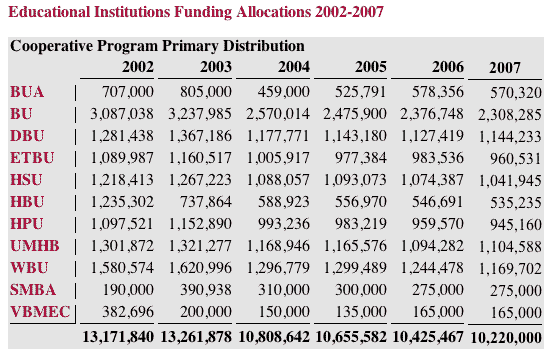
See chart of CP funding of education institutions below

But the trend remains unmistakable. Whether examined in terms of dollars or as a percentage of the total budget, Texas Baptists provide less support for educational and human care institutions through the Cooperative Program budget now than in the past.

The 2008 recommended Cooperative Program budget includes $10.2 million for Christian education, not counting funds specifically for ministerial financial aid and funding for seminaries—down from more than $13.26 million in 2003. Add in support for the seminaries and aid to ministerial students, and the totals drop from $15.2 million in 2003 to a little less than $12.3 million.

The proposed 2008 budget also includes $4,695,000 for human care institutions, compared to a high of $5.69 million in 2000.

Several BGCT Executive Board directors have expressed concern about declining financial support for institutions during budget discussions the last two years. But the trend predates the recent round of cutbacks.

While funds in the annual budget earmarked for training ministers have risen $1.4 million since 1999, other Cooperative Program funding for education has dropped more than $3.8 million, and annual funding for human care institutions declined $921,000 during that same period.

In 1999, support for Christian education and human care institutions represented about 48 percent of the BGCT Cooperative Program budget, but it accounts for 43 percent of the proposed 2008 budget.

Remove theological education from the equation, and the drop in support for institutions appears even more striking—43 percent of the 1999 budget compared to 34 percent of the recommended 2008 budget.

At Baylor University, for example, Cooperative Program support has declined from about $3.2 million in 2003 to the current $2.3 million, not counting ministerial financial assistance. Counting the financial aid for ministerial students, the allocation dropped from $3.6 million to a little bit more than $2.5 million.

While Cooperative Program support provides a small percentage of the operating budget at a large school like Baylor, smaller universities feel the impact even more.

East Texas Baptist University has seen its Cooperative Program support drop from a $1.6 million high in 1999 to $1.2 million, ETBU President Bob Riley noted.

“That kind of significant decrease makes a huge difference in our ability to provide services to students,” Riley said. “It means we buy fewer computers and have less money for faculty. We have to adjust operations.”

Likewise, Hardin-Simmons University has been forced to make significant adjustments as it has seen Cooperative Program support—exclusive of money for Logsdon Seminary—drop from more than $1.26 million to $1 million, said President Craig Turner.

“We have to make up the money somewhere,” he said. “So, the impact ultimately is felt by the students.”

Hardin-Simmons has seen its endowment and similar funds grow to about $122.5 million, and those funds have helped the school offset tuition increases by offering additional scholarship aid. Similarly, ETBU’s $60 million endowment helps generate scholarship aid for students.

But both Turner and Riley pointed to the key difference between Cooperative Program funds and gifts from other donors. Almost always, individual donors designate their gifts, whether to a building campaign, a scholarship or some other specific project.

“Donor gifts usually are restricted. The wonderful thing about the BGCT funds is that we are able to apply them to meet needs wherever they are, when the funds are available,” Riley said.

Turner agreed, noting, “Any fundraiser will tell you that operational dollars are the hardest to raise.”

Consequently, as Cooperative Program funds have become scarcer, each school’s ability to maintain its facilities and to remain current in technology has suffered.

Likewise, human care institutions have felt the impact of the declining Cooperative Program support—none more so than South Texas Children’s Home.

Historically, the children’s home has depended on Cooperative Program funds for 25 percent to 30 percent of its annual operating budget, said Todd Roberson, interim president at South Texas Children’s Home.

In the last few years, the institution has only been able to rely on the Cooperative Program for 15 to 17 percent of its support.

Although Roberson just recently assumed interim duties as president, he has been on staff at the children’s home 15 years, including a long tenure as chief operating officer, and he has witnessed the impact of the declining funds on South Texas Children’s Home.

“It’s just like a household budget. If the money isn’t there, you have to hold off on (building) maintenance, and you can’t spend money on some things that are needed,” he said.

“Our situation is unique in two respects. We’ve never taken on debt, and our board is committed to remaining debt-free. So, it takes that option off the table. The other factor is that we do not take any state or federal funds.”

Most institutions have thrived in spite of declining Cooperative Program dollars. During the same period financial support from the BGCT failed to keep pace with rising costs, Buckner Baptist Benevolences became Buckner International and expanded its ministries far beyond Texas.

In Buckner’s case, fewer dollars from the BGCT did not translate into fewer services to children and families.

On the contrary, Buckner grew significantly, but the BGCT missed the blessing of being a strategic partner in Buckner’s ministry—at least to the degree it had been in the past, said Buckner President Ken Hall.

Within the last five years, the BGCT ceased to be the largest annual donor to Buckner, he noted. Cooperative Program funds represent about 1 percent of Buckner’s annual budget.

A decline in dollars from the Texas Cooperative Program “means we minister to fewer people with BGCT funds in a direct way,” Hall said.

“I hurt for the BGCT. … As God has expanded our opportunities, the BGCT has missed the joy of participation.”


News of religion, faith, missions, Bible study and Christian ministry among Baptist churches, in Texas, the BGCT, the nation and around the world.


Students explore world of opportunities during Mary Hardin-Baylor missions week

Posted: 10/26/07

Students explore world of opportunities
during Mary Hardin-Baylor missions week

By Carol Woodward

University of Mary Hardin-Baylor

BELTON—Students who wanted to know how God could use an accountant or an athlete on the mission field found answers to their questions during Mission Emphasis Week at the University of Mary Hardin-Baylor, Oct. 22-26.

Lori Brown, who serves with Sports Plus in Kenya, told students she asked the same questions when she was in college. She wanted to be involved in missions, but she wondered how or where God could use her.

UMHB student Amanda Foss listens as Twyla Bell describes how children in Tanzania make their own soccer balls out of pieces of material and twine. (Photo/Carol Woodward/UMHB)

“Then I heard about sports in missions, and I was all over that,” she said.

Tom Pate, a junior accounting major from Brenham, said visiting with missionaries on campus helped him see their commitment and how they were using their talents for God.

“Instead of thinking of missions as this giant thing that is beyond what I can do, this is giving me an understanding that God wants to use my gifts,” he said.

Missionaries advised students to use Internet search engines to explore the possibilities of where God may be calling them into service.

“The Internet is a great resource to combine the gifts you have, that soft spot in your heart and needs on the mission field,” Brown said.

She suggested students type in the word “missions” in combination with a word describing their interests—anything from “business missions” or “sports missions” to “juggling missions.”

“Juggling is great for missions because a juggler can draw a crowd in and tell a story at the same time,” she said.

Khang Duong, a marketing major from Houston, started the week unclear where or how he could serve in missions. But hearing missionaries speak during roundtable discussions gave him new hope, he said.

“I’m very interested in sports, and this got my attention,” he said. “I didn’t know there were sports in missions, but it makes sense, because through sporting events, kids come to you. You don’t have to go looking for them.”

John Robinson of Wales challenged students to think beyond traditional missions models.

“The traditional model of being trained and ordained as a missionary does not work as well as people who come with a passion and who are teachable,” he said, urging student to pray for a God-given missions passion.

“Get a world map, and throw a dart. Anywhere it hits land, there is a mission field,” he said.


News of religion, faith, missions, Bible study and Christian ministry among Baptist churches, in Texas, the BGCT, the nation and around the world.


Conservative ‘values voters’ insist on anti-abortion candidate

Posted: 10/26/07

Conservative ‘values voters’
insist on anti-abortion candidate

By Hannah Elliott

Associated Baptist Press

WASHINGTON (ABP)—Voters in a recent straw poll seemed to confirm what many pundits have said all along: Conservative Christians simply will not support a presidential candidate who backs abortion rights.

In the second-largest straw poll of this campaign, 5,775 self-described “values voters” said they will vote for former Massachusetts Gov. Mitt Romney in the 2008 election. Longshot Mike Huckabee, the Southern Baptist minister and former Arkansas governor, came in a close second, only 30 votes behind Romney.

The votes were announced at the second annual Values Voters Summit, sponsored by conservative groups including the Family Research Council and held in Washington. More than 2,500 people attended the event, organizers said.

Noticeably absent from the top vote-getters was Republican Rudy Giuliani, who supports abortion rights. The former mayor of New York regularly leads national GOP polls but has apparently been unable to convince “values voters” of his conservative credentials.

Giuliani placed eighth out of nine candidates, with 1.8 percent of the vote. Other lead names in the poll were Rep. Ron Paul of Texas, with almost 15 percent of the vote, and former Tennessee Sen. Fred Thompson, who received nearly 10 percent of votes. Romney and Huckabee received 27.6 percent and 27.1 percent of the votes, respectively.

All presidential candidates from both parties were listed on the ballot.

At a press conference after Family Research Council President Tony Perkins reiterated that conservative Christians had “drawn a line that we will not cross in supporting a pro-abortion candidate.”

“I would not say that it is an insignificant issue that we have that causes us to disagree,” he said. “It’s not something that can be let go of easily. The life issue is a very fundamental issue.”


News of religion, faith, missions, Bible study and Christian ministry among Baptist churches, in Texas, the BGCT, the nation and around the world.


Yale panelists ask: ‘Is there a theological foundation for political engagement?’

Posted: 10/26/07

Yale panelists ask: ‘Is there a theological
foundation for political engagement?’

By Hannah Elliott

Associated Baptist Press

NEW HAVEN, Conn. (ABP)—Theologians, lawyers, pastors and ethicists shared their views on the theological foundations of political engagement during a recent exchange at Yale Divinity School.

The daylong event, called “Voices & Votes II: Shaping a New Moral Agenda,” was co-sponsored by Sojourners, Christianity Today and The Christian Century.

Greg Boyd

Greg Boyd, pastor of Woodland Hills Church in St. Paul, Minn., began his remarks by noting the main distinction between governmental power and the power of Christian love is how they’re applied—one entity flaunts its power over people, and the other sacrifices its power through love.

The American ideal of life, liberty and happiness is good, but it’s exactly opposite what Christ told his followers, Boyd said. Instead, Jesus urged his disciples to lay down their lives and give up their rights when wronged.

“I think it’s wonderful to debate political issues, and we’re doing that, but the goal of the kingdom is to get people free of what politics fights for—life, liberty and the pursuit of happiness,” Boyd said. “It seems to me that is something the kingdom of God directly speaks against.”

Serene Jones, on the other hand, strongly protested Boyd’s assertion. Christians are called to be happy in Christ, she said.

“I completely disagree that we are not called to be happy as Christians,” said Jones, a theology professor at Yale Divinity School. “We need to take pleasure and joy about who we are in the world.”

Serene Jones

Jones confessed she often finds herself frustrated that more people don’t debate war, torture, homosexuality and abortion in a “distinctly theological mode.” For her, theology has deeply political implications.

“How do we engage in an honest theological discussion about (homosexuality) without thinking in a sustained way about what God’s … relation to our human bodies is?” she asked. It often comes down to how people perceive God, she said.

“Do you primarily have a wrathful God?” she asked. “Or do you have a God of compassion and grace who is primarily smiling or worrying about the world? What a profound thing it would be if that were the starting point for some of our discussions about abortion (and) homosexuality.”

Andy Crouch, who is working on a series of short documentary films about a Christian counterculture, also talked about the meaning of power. If Christians want to discuss politics and religion seriously, they have to evaluate their views on power, he said.

When Christians usually think about power in politics, they often think they don’t have enough, said Crouch, a former campus minister with InterVarsity Christian Fellow-ship. But that isn’t a biblical view—the biblical perspective is one of reversal, he said.

“Jesus goes to the cross with this unbelievable confidence in another power” that comes from above, not from government, Crouch said.

As leader of Sojourners, Jim Wallis has firm beliefs about how Christians should influence political power. Jesus created a new world order, Wallis said, and Christians embody that change.

“God is personal but never private,” he said. “The question is, ‘How is God public?’”

Wallis said that when Christians fight against slavery, social ills or sex trafficking, “that shows God is alive.”

The kingdom of God transforms the world by translating the specifics of injustice, he said.

The church as an institution should be political but not partisan, he insisted.

“The church is the conscience of the state,” Wallis said. “There is a biblical role for the state, just as there is for the church. And they’re not the same.”

Stephen Carter, a professor at Yale Law School, said much the same. Christians should keep “their hands off the levers and simply be the voice crying in the wilderness,” he asserted.

Carter tells his law students never advocate for a law for which they are not willing to kill.

That mindset will keep his students humble, especially in light of new ways they approach politics and world views, he said.

While the baby boomer generation came up with grand plans to change the world through national and international platforms, this generation’s young politicos focus more on grassroots activism, Carter said.

“It’s not just a suspicion of grand plans, it’s an opposition,” he said. “The passion for (large-scale) engagement seems to be weakening.”

Crouch, too, said he does not encounter the political clarity of past generations, and he noted that people “tend to think much more granularly. They think in terms of their neighbor.”

Wallis urged a more national, systematic approach.

“At some point, you can’t keep pulling bodies out of the river and not move up the river at some point to see who’s throwing them in,” he insisted.


News of religion, faith, missions, Bible study and Christian ministry among Baptist churches, in Texas, the BGCT, the nation and around the world.


Separation of church and state great but misunderstood by many, panelists insist

Posted: 10/26/07

Separation of church and state great but
misunderstood by many, panelists insist

By Hannah Elliott

Associated Baptist Press

NEW HAVEN, Conn. (ABP)—The separation of church and state is part of what makes America great, and America is plagued by “total ignorance” about what it means, panelists at a Yale Divinity School event said.

However, not even all the expert panelists agree on how the pesky details of church-state separation work themselves out in real life.

David Saperstein, director of the Religious Action Center of Reform Judaism, joined a megachurch pastor, a political editor, policy experts and theologians to discuss the role of politics and faith in the public sphere.

“The founders began the (list) of our must fundamental rights with the statement that ‘Congress shall make no law’ even ‘respecting’ the establishment of religion,” Saperstein said. “We, the religious community, get enormous benefits out of the fact that this exists.”

Unfortunately, Saperstein said, some people in the Religious Right have deluded Americans into thinking that upholding the separation concept amounts to being anti-religion.

On the contrary, separation of church and state doesn’t mean Americans don’t have religious principles that influence public policy, said Norman Ornstein, a resident scholar at the American Enterprise Institute.

The key is to find the middle ground between an official public religion and no mention of the role of religion in public life, he said.

Seamus Hasson, founder of the Becket Fund for Religious Liberty, said differences of religion and its practice should be treated like race—acknowledge and celebrate differences instead of pretending they’re not there.

For instance, Americans usually celebrate secular but cultural events like St. Patrick’s Day and Black History Month without problems, Hasson said, but he always gets calls from people upset about the religious holidays of Christ-mas or Chanukah.

As pastor of the Vineyard Church of Columbus, Ohio, Richard Nathan said the church has a big role in supporting a healthy understanding of religious freedom.

His concern is not about using public institutions to assert Christian views, he said. He cares more about forming healthy contacts between community leaders and church leaders—partnerships that foster confidence between the two and that neither corrupt religion nor destroy the neutrality of the state.

Amy Sullivan, the political editor for Time magazine, said people in both the Democratic and Republican parties could use some “basic education” about what the separation of church and state means.

“I’m always chagrined when I hear, … ‘I want somebody in office who is of my faith,’” she said. That’s “getting far far away from our Baptist forefathers.”

Sullivan, who was raised Baptist, said the Christian community is getting wiser when it comes to forming alliances with partisan groups.

For instance, she noted, many left-leaning evangelicals want to make sure that Democrats don’t take them for granted during this election like Republicans have, in recent years, taken their conservative brethren for granted.

Eric Sapp, who works to build relationships between the Democratic Party and religious communities, agreed.

“The (Democratic) Party has learned a great deal, and part of that they’ve learned from some of the mistakes made by the Religious Right,” said Sapp, senior partner at Common Good Strategies.

But Ralph Reed, founder of the Christian Coalition, a conservative advocacy group, didn’t let the conjecture about the failed policies of the GOP go on for long.

“Don’t make the mistake of watching the intramural within the (Republican) Party and think that that … they won’t be united in the fall,” Reed said.


News of religion, faith, missions, Bible study and Christian ministry among Baptist churches, in Texas, the BGCT, the nation and around the world.


Cybercolumn by Berry D. Simpson: All my strength

Posted: 10/26/07

CYBER COLUMN:
All my strength

By Berry Simpson

Since last spring, I’ve been walking every day for an hour, instead of running, hoping to let my left knee heal a bit more. My goal was to keep walking until I got my weight down to 190 pounds, and then start running again as a new, lighter, more nimble Berry. Through the hot summer months, I put in lots of miles walking in the neighborhoods around Cowden Park.

I did drop about 10 pounds during the summer, putting me consistently in the “1’s” instead of the “2’s,” so that was good. But my knee felt the same all summer long: it never got better, and it never got worse.

Berry D. Simpson

During a Labor Day backpacking trip into the Guadalupes, I was confronted with the flaw in my plan. Walking had kept my legs strong, and lifting weights kept my upper body strong enough to carry a 68-pound pack up to Pine Top, but walking didn’t do anything for my lungs. On the hike up to Pine Top, I had to stop too often to catch my breath. I was surprised how short-winded I’d become.

So why was I walking so much was the question I couldn’t’ answer. My knee felt the same, and I was losing fitness.

I decided to change strategies and follow marathon coach Jeff Galloway’s advice—mix running with walking breaks to see if I could increase my fitness. What surprised me was how awkward I felt. My legs felt stiff and gangly, as if I hadn’t run since 1978, as if I were starting over. What happened to all the muscle memory? Where did all my training go? I was surprised how hard it’s been to get my groove back.

It reminded me of some thoughts I had while reading a weekly devotional book published by my church. One of the featured verses was Deuteronomy 6:5: “Love the Lord your God with all your heart and with all your soul and with all your strength.”

I don’t know whether the author of Deuteronomy was talking about physical strength, or emotional strength, or intellectual strength. He may have been talking about spiritual gifts and talents as strengths.

I thought I had a grip on loving God with all my heart and all my soul, although I’m not sure I understand the difference between the two, but loving him with all my strength was something I hadn’t thought much about.

Some people are born very strong and stay strong their entire lives. All the rest of us have to work out if we want to be strong. And not only do we have to work out, we have to keep working out if we want to stay strong. Strength fades away if left unattended. I had lost a lot more running strength last summer than I expected. I knew I would lose speed, but I didn’t think I’d lose strength.

To stay strong at anything requires constant attention. And so, maybe loving the Lord with all my strength implies working out to keep my strength up.

Then there are other kinds of strengths—our skills and talents, our intellect, our speaking ability, our social skills, our musical talent, our visions, our tenderness, our compassions, our creativity. It’s the same thing. If we intend to love the Lord our God with all these strengths, we can’t let them die away from disuse or lack of training. We have to keep training to get strong and stay strong. It’s part of loving God.

How sad for someone to spend years serving God in their strengths and loving God with all their strengths, only to reach a point when they slow down and start walking to ease some discomfort, only to find their strength has frittered away. Taking a rest break is OK; lay off too long, and we get stiff and gangly. Is that how we want to love God?

My friend David wrote in the devotional book: “This verse tells us our faith is to be life-oriented, not information-oriented.” We can’t grow our strengths by merely studying and learning more information. We have to work out to get stronger. It does me very little good to read a lot of weight-lifting magazines if I’m not willing to go to the gym and lift weights. It doesn’t help to read marathon-training books if I won’t do any long runs myself. To love the Lord our God with all our strengths means to keep building our strengths stronger and stronger.

Berry Simpson, a Sunday school teacher at First Baptist Church in Midland, is a petroleum engineer, writer, runner and member of the city council in Midland. You can contact him through e-mail at berry@stonefoot.org.


News of religion, faith, missions, Bible study and Christian ministry among Baptist churches, in Texas, the BGCT, the nation and around the world.


BaptistWay Bible Series for November 4: Christ’s love extends to all

Posted: 10/26/07

BaptistWay Bible Series for November 04

Christ’s love extends to all

• Romans 9:1-7; 10:1-13; 11:1-2, 25-32

By Andrew Daugherty

Christ Church, Rockwall

Perhaps you have noticed so far that the weight of the Apostle Paul’s argument in Romans extends the ever-widening circle of God’s salvation story beyond the particular story of Israel. A longer shadow is cast on the notion that God’s righteousness is tailored exclusively to the people of Israel.

Paul repeatedly makes the case for universal salvation in Christ, meaning that God’s righteousness is available to the whole world regardless of ethnic distinctions or nominal association with specific religious practices. Even the physical practice of circumcision, a distinctive religious rite of the Jews, is rendered of no enduring significance if it is not accompanied by faithfulness to Torah.

Paul stresses that circumcision is a spiritual matter of the heart based on whether a person keeps the law’s requirements, not based on whether a person is a Jew or Gentile: “For a person is not a Jew who is one outwardly, nor is true circumcision something external and physical. Rather, a person is a Jew who is one inwardly, and real circumcision is a matter of the heart—it is spiritual and not literal” (2:28-29).

Again, when it comes to keeping the commands of God’s covenant, Paul is radically redefining the notions of inclusion and exclusion, insiders and outsiders. To interpret his view as many commentators have is to at least question the theological significance of their no longer being any distinctions between Jews and gentiles. If these distinctions are truly leveled, then what of the Jewish identity and practice remains in light of the revelation of Christ?

It is no wonder why the question was posed, “What advantage is there to being a Jew” (3:1)? All along, Paul reiterates the reasoning that not all those who are called “children of Abraham” are actually the “seed” of Abraham. This means it is not the children of the flesh who are the children of God, but the children of the promise are counted as descendants (9:8). All people of “Abraham’s seed” then are “the children of God,” not based on the accidents of biology but based on the promise of God’s choice to deliver salvation to the world through Israel.

Notice how passionate Paul becomes now about his relationship to his fellow Jews. At times, he almost sounds defensive. Perhaps he is aware of his growing reputation as a renegade among his people who may be questioning the credibility of his witness. He wants to demonstrate to them his message is trustworthy.

First, he expresses the inward anguish he feels in his heart concerning his own people’s relationship to Jesus the messiah as the fulfillment of Torah. Listen to his dramatic lament again: “For I could wish that I myself were accursed and cut off from Christ for the sake of my own people, my kindred according to the flesh” (9:3). This is an interesting twist in Paul’s presentation, given he has just proclaimed “absolutely nothing will be able to separate us from the love of God in Christ Jesus our Lord” (8:39).

Paul is beside himself that his own people, who had been bearers of the covenants, the giving of the law, the promises and the patriarchs, and the Messiah according to the flesh (9:4-5), could not make these connections to the coming of Jesus, who Paul considered the fulfillment of Torah. What he desires to make known is that Jesus is the new and promised gift of God within the overall salvation story God initiated through the people of Israel.

Without the understanding of the Jewish story, Jesus as messiah is incomprehensible. Paul no more can give up Christ in order to save his people than his people can give up the Torah in order to embrace Jesus as Christ. To be clear, Christ can only be appreciated within the Jewish scheme of salvation and the context of Torah. Perhaps to understand Paul rightly, Jesus is the living, breathing embodiment of the Torah. The goal of the Torah is accomplished in Christ. The righteousness that proceeds from both is God’s righteousness. For Paul, to know Christ is to comprehend the goal of the Torah.

Paul’s personal conflict about the relationship between the coming of Jesus and his fellow Jews is one inherited by the church across time. A partial summary of this conflict is found in the writings of essayist Michael Wyschogrod.

Kendall Soulen summarizes: “Wyschogrod makes clear that Christian claims on behalf of Jesus of Nazareth are problematic from the perspective of Jewish faith. The claim that Jesus was the Messiah is difficult for Jews to accept because Jesus did not perform a key messianic function: he did not usher in the messianic kingdom. More difficult by far, however, is the Christian claim that God was incarnate in Jesus. For a Jew to subscribe to this belief would mean a grave violation of the prohibition against idolatry.”

Nevertheless, Wyschogrod does not think Jews are entitled to dismiss the Christian claim about God’s incarnation in Jesus out of hand. “To reject the incarnation on purportedly a priori grounds would be to impose external constraints on God’s freedom, a notion fundamentally foreign to Judaism.”

Sadly, the Jewish “no” to Jesus as the fulfillment of the Torah has generated devastating historical consequences. The Jewish people have been victimized by anti-Semitism that has resulted in incalculable deaths and the threats of millions of others. Especially troubling is the various ways the Christian story has been used as a weapon of mass destruction against the Jews, including the Nazi’s infamous use of Christian tradition during the Holocaust to murder millions of Jews.

Christians who are eager to be faithful to Christ must learn to be faithful to the history from which Christ came. This at least means engaging our Jewish brothers and sisters in dialogue about our shared holy history, not the least of which are the writings we both deem to be sacred. At the same time, we must help each other honestly understand the distinctions of what makes us different.

If Israel is God’s first love, and if God chose Israel in the mystery of God’s love to be a blessing to the entire world, then we Christians must be vigilant about falling into any traps of a spiritual superiority complex. It wasn’t because Israel was superior to all other peoples that God chose them. God’s divine election of Israel was an unconditional election, rooted in God’s love. Even Paul asks: “Has God rejected his people? By no means! I myself am an Israelite, a descendant of Abraham … God has not rejected his people whom he foreknew.” (11:1-2)

News of religion, faith, missions, Bible study and Christian ministry among Baptist churches, in Texas, the BGCT, the nation and around the world.


Bible Studies for Life Series for November 4: Seeking your Father’s approval

Posted: 10/26/07

Bible Studies for Life Series for November 4

Seeking your Father’s approval

• Matthew 6:1-18

By Steve Dominy

First Baptist Church, Gatesville

Each of us has Scripture passages that are more meaningful to us than others. It should be that way; there are passages that are more pointed in their meaning and application. This is one of those passages.

None of us would deny all Scripture is meaningful, but the Sermon on the Mount and the Lord’s Prayer in particular might be called peaks of Scripture. Entire books have been written on both the Sermon on the Mount and the Lord’s Prayer, so how do we do justice to them in the space we have?

We need to look at Jesus’ focus in all of these sections and find the point Jesus was trying to get across. As we get that point, we can then look deeper in our own study into the implications of Jesus’ focus.

In Matthew 5:20, Jesus says our righteousness must exceed the righteousness of the scribes and Pharisees. In the section of the sermon we study this week, Jesus shows some of what that will mean.

Giving, prayer and fasting were three traditional practices of righteousness in Judaism. These are the most prominent requirements for personal piety in Judaism. Jesus accepted these as central to the life of his disciples, and Jesus does not repudiate them but points us to the correct motivation and attitude in their practice.

Notice that in the beginning of each section, Jesus makes a comparison with “the hypocrites.” Each time, he condemns the method in which they conduct these practices. Concerning giving, he says not to give in order “to be honored by men.” Concerning prayer, Jesus says not to pray in order “to be seen by men.” And concerning fasting, he says not to fast to “show men they are fasting.” In each instance, the motivation for religious action is to be noticed by men. Their observance of religious practice has nothing to do with God and has everything to do with their own egos.

Some have argued Jesus contradicts himself at this point in the Sermon. In Matthew 5:16, Jesus says, “In the same way, let your light shine before men, that they may see your good deeds and praise your Father in heaven.” Yet in Matthew 6:1, Jesus says, “Be careful not to do your ‘acts of righteousness’ before men, to be seen by them.”

If we read these passages in their entirety and in their contexts, there is no contradiction, and we are pointed directly to the point Jesus was making. The righteousness that Jesus calls us to is the righteousness that points people to glorify the Father and not glorify us—the motivation and the purpose are completely different. There may be times when people misplace their focus because of our deeds or giving.

That was the case with Peter and Cornelius in Acts 10. When Peter entered the house, Cornelius fell at his feet, but Peter responded, “Stand up; I am only a man.” Peter went on to point them to Christ and not himself.

None of us is innocent of desiring recognition, even if we are uncomfortable when we receive it. The problem arises when our motivation becomes our own recognition and not God’s. We put ourselves in God’s place and take what is rightfully God’s. Peter had it right when he said, “I am just a man.” Like him, we are human and not God and are not the rightful recipients of honor due God.

In each teaching, Jesus gives us the alternative to inflating our egos—to give in secret, to pray in secret and to fast in secret. It is quite a contrast to the hypocrites who do everything in a very public manner, calling attention to themselves.

This does not mean we should never pray in public. The New Testament makes it very clear that the church prayed together, but it certainly does question our motivation. It is hard to seek the applause and praise of others when we are alone. It is in that solitude that God can deliver us from our desire to impress others, and it is in that solitude that God can deal with us, working to transform us into his people.

In each of the practices Jesus mentions, right motivation and practice honor God and as such are reciprocated by God. Notice that when Jesus speaks of giving and fasting, he repeats the same line, “Your Father, who sees what is done in secret, will reward you.” That statement shows the disciples’ actions are diametrically opposed to the actions of the hypocrites. All of the Lord’s Prayer deals with our dependence on God and our recognition of that dependence. It brings us into a relationship of dependence on God, and an honoring of God and not ourselves. The purpose in our giving, praying and fasting is to please and honor God.

One of the passages God consistently reminds me of in the course of my ministry comes from Galatians 1:10. It follows the same theme of the Sermon on the Mount: “Am I now trying to win the approval of men, or of God? Or am I trying to please men? If I were still trying to please men, I would not be a servant of Christ.”

Jesus’ primary point in all of this is that in our religious practice God be honored. We have heard more than once that “it is not about us.” Our righteousness exceeds that of the scribes and the Pharisees when we seek to honor God in all of our practices.


Discussion questions

• How do we ensure that we are putting God’s honor before our own?

• How should we respond to people who obviously are seeking their own recognition?

News of religion, faith, missions, Bible study and Christian ministry among Baptist churches, in Texas, the BGCT, the nation and around the world.


Explore the Bible Series for November 4: A caring community

Posted:10/26/07

Explore the Bible Series for November 4

A caring community

• Matthew 18:1-35

By Travis Frampton

Hardin-Simmons University, Abilene

Forgiveness is essential for any relationship. Without it, genuine reconciliation is impossible; and without mercy and grace, genuine forgiveness is impossible. Much of our lives are spent either granting forgiveness or asking for it. What is your response to others when they wrong you?

In Matthew 18:15-17, Jesus offers guidance regarding how one should bring a case against a wrongdoer: “If your brother sins against you, go and show him his fault, just between the two of you. If he listens to you, you have won your brother over. But if he will not listen, take one or two others along, so that ‘every matter may be established by the testimony of two or three witnesses.’ If he refuses to listen to them, tell it to the church; and if he refuses to listen even to the church, treat him as you would a pagan or a tax collector.”

This instruction seems fairly clear and straightforward. According to these verses, we must be patient with those people have sinned. If those who have wronged us are persistent in their waywardness and stubbornness, refusing to listen, and nonresponsive to disciplinary measure, then we should treat them as pagans and tax collectors, just like Jesus says.

Unfortunately, this simplistic, reductionist reading of these verses falls short of Matthew’s message. Does Jesus really require his followers to treat wrongdoers as “pagans and tax collectors”? If so, this perspective seems foreign to Jesus’ own ministry.

Doesn’t Jesus say: “Why look at the speck of sawdust in your brother’s eye and pay no attention to the plank in your own eye? How can you say to your brother, ‘Let me take the speck out of your eye,’ when all the time there is a plank in your own eye” (Matthew 7:3-4)? Jesus goes on to tell his followers that the way they judge others will be the way they will be judged. In other words, the measure of judgment one uses for others will be the same measure that will be used against him.

When the Pharisees asked him why he ate with tax collectors and sinners, he said: “It is not the healthy who need a doctor, but the sick. Go and learn what this text means, ‘I require mercy, not sacrifice’” (Matthew 9:9-12).

Matthew, a tax collector by profession, certainly is not treated in a rude or offensive way by Jesus. In fact, he is among the 12 disciples. So what was Jesus intimating when he said wrongdoers that do not acknowledge their sin should be treated like tax collectors and sinners? Certainly he does not mean alienating or shunning the wrongdoer from the community. Based on the way Jesus treats tax collectors and sinners, one might imagine the community inviting them over for a meal and fellowship.

Only by reading passages from the biblical witness out of context do we contrive awkward—even distorted—interpretations of Jesus’ teachings. If we were to continue reading after the account about bringing wrongdoers to justice, we would find the stories that follow elucidate our passage. Jesus states that whatever one binds on earth will be bound in heaven and whatever one looses on earth will be loosed in heaven. To bind means to declare an action unlawful; to loose means to declare an action lawful. This is another way of making the same point he made earlier. The measure you use to judge others on earth will be the same measure used against you in heaven.

In the next passage, Jesus mentions that whenever two or more people “agree about anything you ask for, it will be done for you by my Father in heaven. For where two or three come together in my name, there am I with them” (Matthew 18:19-20).

This passage if read separately, independent of its narrative context, would suggest that whenever two or more people come together, Jesus is present, and God the Father will grant them whatever they ask for. It, however, should not be read as a proof-text for receiving material blessings from God.

Jesus’ statement is made within a narrative about wrongdoing, broken relationships and need for reconciliation. Remember that previously Jesus stated the case about the wrongdoer should be brought before “two or three witnesses.” These verses continue that line of reasoning, for whenever two or more are gathered in Jesus name, he is there among them. One who is without sin is present before sinners, which include both defendant and prosecutor. If two or more people on earth agree about anything they ask for, it will be granted by God in heaven.

This passage ultimately is about people seeking reconciliation with one another. If justice is what is demanded on earth, then justice will be brought to both parties in heaven. If grace is demanded by both parties on earth, then mercy is granted heaven. These verses, like the story of the plank in one’s eye, are more concerned with the one wronged rather than with the wrongdoer.

Again, what is your response to others when they wrong you? Do you place them under judgment and demand justice from them? Or are you merciful? To bring the illustration closer to home, when Jesus is present, do we demand justice for our wrongdoing, or do we ask for his grace and mercy? Typically, in our dealings with others, we act like Pharisees. We look at others through eyes of judgment, while at the same time ask God for mercy upon our souls. Others should get what is coming to them. We, however, prefer grace when judgment comes our way.

But how many times should we forgive others who wrong us? There must be a limit, right? Peter asks this very question in the succeeding verses. Jesus responds to his query saying: “Seventy-times seven!” The question is not so much how many times must we forgive others on earth, but how many times would we like to be forgiven in heaven.

The parable of the unmerciful servant concludes Matthew’s section on forgiving wrongdoers. The parable is about a servant who owes his master a great debt. The servant asks for his master’s patience; and the master, in return, “took pity on him, (and) cancelled the debt and let him go” (Matthew 18:27). But the servant, however, released from his bondage goes home and requires his own servant to repay a debt owed to him, a debt considerably less than what he previously owed to his master. The servant had the man thrown into prison.

When the master heard what had happened, he called the servant in: “You wicked servant, I canceled all that debt of yours because you begged me to. Shouldn’t you have had mercy on your fellow servant just as I had on you?” The master had his servant thrown into prison. The servant, though initially granted mercy, is judged in the same fashion as he judged others.

Jesus concludes by saying: “This is how my heavenly Father will treat each of you unless you forgive your brother from your heart” (Matthew 18:35). We should extend the same grace and mercy to others as has been shown to us.

Forgiveness is the key. Whenever Christ is present, we’re all tax collectors and sinners.


Discussion questions

• How often should we forgive others who have wronged us? Seven? Seventy-times seven?

• How should we treat those who have wronged us?

• How do you want to be treated by those whom you have wronged?

• What is your response to others when they wrong you?

News of religion, faith, missions, Bible study and Christian ministry among Baptist churches, in Texas, the BGCT, the nation and around the world.