Race: The final frontier

Posted: 8/31/07

The Crossing Baptist Church in Mesquite is among a growing—but still relatively small—number of churches learning to incorporate multi-cultural features in its worship services.

Race: The final frontier

By Ken Camp

Managing Editor

When Anglos, Hispanics, African-Americans and Nigerians gather in the same place on Sunday morning, planning worship presents challenges.

“Its a lot more than just a question of hymns or choruses,” said Charlie Brown, pastor of The Crossing Baptist Church in Mesquite.

When people in the pews look at the front of the sanctuary, Brown wants them to see somebody leading in worship—praying, singing, preaching or whatever—to whom they can relate.

He also wants worship services to include elements that reflect the cultures represented in the congregation—and the increasingly diverse community around the church.

Race: The Final Frontier
• Race: The final frontier
Baptists active on both sides in the Little Rock integration battle
Opportunities, challenges confront increasingly multi-ethnic congregation
Minorities are flocking to multi-ethnic campus groups for Christian fellowship
Aging minister recalls price paid for recognizing God's image in all people
BOOKS: When All God's Children Get Together–A Memoir of Race and Baptists

“Theologically, we say that sin is separation. But practically, we don’t do enough to break down separation,” Brown said. “We have to be intentional about it.”

When Brown and others started The Crossing Baptist Church 10 years ago, Anglos comprised all its membership. Now, non-Anglos make up about one-fourth of the congregation.

“We are richer—much richer—for it,” he said.

Brown realizes his congregation still has a long way to go before it becomes “a genuinely multiracial, multi-ethnic church,” but he believes it has the right vision. “We want to reflect the kingdom of God. We want to look like what God’s people look like,” he said.

But in most Ameri-can churches, the observation Martin Luther King Jr. made more than 50 years ago still holds true—11 a.m. on Sunday morning is “the most segregated hour” in the United States.

Some blame the church growth movement for perpetuating Sunday morning separation. Donald McGavran, the longtime senior professor at Fuller Theological Seminary who became known as “father of the church growth movement,” pioneered the homogenous unit principle—the idea that congregations grow when people don’t have to cross racial, linguistic or class barriers.

Bob Perry, congregational health team leader with the Baptist General Convention of Missouri, refuses to lay the responsibility for lack of diversity in churches at the feet of the church growth gurus. He believes McGavran and others “simply stated a theory that is born out of nature and social tendencies.”

But Perry also believes healthy churches put forth the effort needed to reflect the larger communities they serve.

When he served as director of missions in Richmond (Va.) Baptist Association, he realized the association had 15 predominantly African-American churches, about 60 Anglo churches, a handful of other ethnic congregations but not a single truly multiracial, multi-ethnic church.
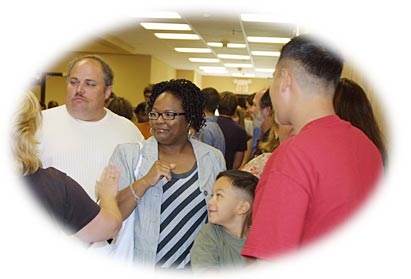
Lanetta Lyles (center) talks with fellow members at The Crossing Baptist Church in Mesquite following Sunday services. From left are Leslie Gillespie, Mark Bevans, Lanetta Lyles, Isaiah and Alex Pinales.

Perry made attempts at the individual level to bridge divisions. He and his wife, Marilyn, joined a black church. He led the association to call its first African-American moderator and include African-American church leaders on associational councils and committees.

“All of this was just taking small steps to try to move in the direction of greater inclusiveness, diversity and unity,” he said. “But I can’t claim that we moved very far in my six years there toward truly integrating a church or creating a multi-ethnic church.”

Perry became convinced worship style remains the dividing line between races, particularly between African-Americans and Anglos.

“I don’t think there are theological barriers to black and whites worshipping together. I don’t think there are sociological barriers that prevent it; we have learned to integrate almost every other institution of society. I think the major holdup has been the varying expectations people have developed about what genuine worship of God looks and feels like,” he said.

“If everyone would be a little flexible, and if the church would make a real effort to accommodate the preferences of those they hope to reach, we will see more multi-ethnic churches.”

Churches that want to bridge barriers of race and culture need flexibility and patience with each other, Brown agreed. Based on his experience at The Crossing Baptist Church, he has become convinced that not only includes issues regarding worship style, but also matters of church governance.

Black members whose previous experience has been limited exclusively to African-American congregations often want to leave decisions about the church to the pastor, he observed.

Some Hispanic members have told Brown any disagreement expressed in church business meetings make them uncomfortable. They are accustomed to reaching a consensus after private conversations rather than openly debating issues and deciding matters by an up-or-down vote, he said.

The Crossing offered a seminar on Baptist polity to help its members understand the importance of congregational governance. In the process, members have grown in their awareness of the varied decision-making processes different cultures follow.

Brown believes one other ingredient is essential in multi-ethnic and multiracial congregations—humility. Church leaders who represent the majority racial or ethnic group in the congregation need to recognize they don’t have all the answers, he stressed.

“We have to stop all the nonsense—the over-under relationships and paternalistic attitudes,” he said.

In relating to Chris-tians from other racial and ethnic backgrounds, Brown said: “I have to recognize their understanding of the kingdom of God may be far greater than mine. They have something to teach us.”


News of religion, faith, missions, Bible study and Christian ministry among Baptist churches, in Texas, the BGCT, the nation and around the world.


BOOKS: When All God’s Chidren Get Together ‘A Memoir of Race and Baptists’

Posted: 8/31/07

BOOKS: 'When All God’s Children Get Together'
A Memoir of Race and Baptists

By Marv Knox

Editor

Baptists can change, and reconciliation is possible, Emmanuel McCall testifies in his new book, When All God’s Children Get Together: A Memoir of Race and Baptists.

McCall’s book provides a travelogue of the journey Baptists in the South took during the past 50 years. It’s a trek that transported them from segregation to repentance, from mutual mistrust to reconciliation.

That journey parallels McCall’s ministry—from when he enrolled as the only African-American student at Southern Baptist Theological Seminary in 1959, to when he stepped down as the Southern Baptist Convention’s race-relations leader in 1991, to his participation in bringing Baptists across the races together to affirm the New Baptist Covenant next year.

McCall recalls poignant moments in his own life that reflect a larger movement of racial awareness and an inch-by-inch march toward harmony. Born and raised in melting-pot Pennsylvania, he never encountered overt racism until he ventured south of the Mason-Dixon Line to attend Simmons College in Louisville, Ky., in 1953. That quiet, eager student couldn’t have known he would spend the rest of his life overcoming racism. His efforts freed blacks and whites alike from bonds of bigotry.

This book pays tribute to the grace and dignity of McCall’s fellow travelers. Like most memoirs, McCall’s names names. But unlike many stories of racism, McCall tells about the heroes—the courageous people who led Southern Baptists toward the light of racial responsiveness and harmony.

They range from his friend Duke McCall, president of Southern Seminary during his student days, to Arthur Rutledge, who created a safe haven at the Home Mission Board, where Emmanuel McCall could become the first African-American elected staff member at any SBC agency in 1968.

McCall’s memoir describes how God’s grace turned calamitous events into stepping-stones toward racial understanding. In 1957, the SBC Executive Committee tried to withdraw a mission study book that highlighted race relations, The Long Bridge. In 1972, the Sunday School Board pulled a student magazine, Becoming, because its cover featured a black young man talking to two white young women. These were tense times, but McCall shows how champions of reconciliation advanced the cause, even in the face of powerful forces.

This book provides a vital resource by chronicling how two Southern Baptist agencies—the Christian Life Commission and the Home Mission Board—advanced the cause of race relations, even when the cultural foundations of the South leaned the other way. It tells about the principled staff members at those agencies, whose personal acts of courage and discipline in time changed the hearts and minds of their fellow Baptists.

Race: The Final Frontier
Race: The final frontier
Baptists active on both sides in the Little Rock integration battle
Opportunities, challenges confront increasingly multi-ethnic congregation
Minorities are flocking to multi-ethnic campus groups for Christian fellowship
Aging minister recalls price paid for recognizing God's image in all people
• BOOKS: When All God's Children Get Together–A Memoir of Race and Baptists

Although the book spans 50 years, it also looks to the future. McCall, a current vice president of the Baptist World Alliance and pastor of The Fellowship Group Baptist Church in East Point, Ga., and immediate past moderator of the Cooperative Baptist Fellowship, is promoting the New Baptist Covenant, a pledge of racial harmony and cooperation to achieve kingdom goals. About 20,000 Baptists of all races are expected to “celebrate” the covenant in Atlanta next January.

Writing When All God’s Children Get Together taught McCall lessons—about Bap-tists and about himself, he said in an e-mail interview.

“I have learned that Baptists can and will change, despite our autonomy and stubbornness,” he noted.

And he also developed “a deeper appreciation for the extent of my commitment to racial reconciliation,” he added. “For a period in my life (when he worked at the Home Mission Board), it was my calling. Even after leaving the HMB, I am still involved in ministries of racial reconciliation.”

Since that time, he has started two predominantly African-American congregations in suburban Atlanta, Christian Fellowship Baptist Church and The Fellowship Group. Both times, the young churches shared facilities with predominantly Anglo congregations in transitional neighborhoods.

Now, his work on behalf of the New Baptist Covenant strengthens racial reconciliation, he said. “I am helping black and white Baptists discover each other and begin learning again how to work together across racial lines.”

Practical as always, McCall pointed out the value of the New Baptist Covenant will not be demonstrated at the Atlanta meeting, no matter how large the gathering.

“The New Baptist Covenant will be successful if local coalitions of Baptists can overcome whatever differences we have, find the common needs to be addressed and join together in challenging the human problems we face,” he explained.

Looking back, McCall said Baptists, particularly in the American South, should learn lessons from the journey they have taken in the past 50 years.

“We should be reminded that the Bible can be twisted to make us believe, accept and defend culture instead of biblical truth,” he warned. “We Baptists are a ‘people of the book,’ but we often have spoken our culture and insecurities instead of God’s truth.

“We must continue to let the Holy Spirit break through our cultural biases to confront us with God through Jesus Christ.”


News of religion, faith, missions, Bible study and Christian ministry among Baptist churches, in Texas, the BGCT, the nation and around the world.


Opportunities, challenges confront increasingly multi-ethnic congregation

Posted: 8/31/07

Opportunities, challenges confront
increasingly multi-ethnic congregation

By Ken Camp

Managing Editor

DALLAS—Soon after Pastor Bruce Troy arrived at Gaston Oaks Baptist Church in Dallas, he challenged a group in the congregation to answer one question: “What would you do if God put 100 people on your doorstep?”

Three years later, Troy observed: “That’s exactly what he’s done. They just don’t speak English.”

Specifically, Gaston Oaks has opened its doors to the growing Karen people group living in several apartment complexes near the church.

Race: The Final Frontier
Race: The final frontier
Baptists active on both sides in the Little Rock integration battle
• Opportunities, challenges confront increasingly multi-ethnic congregation
Minorities are flocking to multi-ethnic campus groups for Christian fellowship
Aging minister recalls price paid for recognizing God's image in all people
BOOKS: When All God's Children Get Together–A Memoir of Race and Baptists

In the last decade, many of the persecuted Karen people of Myanmar—or Burma as it is more commonly known in the West—fled to Thailand. As refugee camps there closed in the last year, a significant number of the Karen people have been relocated to northeast Dallas.

Gaston Oaks provides transportation to the church from the apartment complexes where the Karen have resettled, and volunteers lead English as a Second Language classes for them during the Sunday school hour.

The church also sees an opportunity to meet the needs of many Karen refugees through the Healing Hands Ministries, a medical clinic serving uninsured people in the Lake Highlands area of northeast Dallas. Janna Gardner, a member of Gaston Oaks, serves as the clinic’s executive director, and Gaston Oaks is one of several churches that sponsors the ministry.

In the Sunday morning worship services, Troy’s sermons are translated into Spanish and Karen, and non-English-speaking worshippers listen to an interpreter on headsets. Meanwhile, an Iranian congregation meets elsewhere on the church campus. And an African-American congregation —originally launched by a pastor displaced by Hurricane Katrina to meet the needs of other storm evacuees—also shares the congregation’s facility.

“We’ve been thrust into becoming a truly multicultural church family,” Troy said. As the church has tried to respond to its rapidly changing community, the transition has not always been smooth, he acknowledged.

On any given week, the Karen people make up half of the worshippers in the sanctuary. But Troy readily acknowledges the total number in worship has decreased.

“We’ve lost some folks,” he said, noting a variety of factors contributed to the decline. Even so, Troy believes God will use Gaston Oaks to make a difference in its community, as long as the church seeks to follow God’s mission.

“I don’t particularly like the word ‘missional.’ I can’t find it in the Bible. … We’re just want to become the church that God wants this church to be,” he said. “Sometimes it’s chaotic. We’re in a survival mode. But we know he’s going to take us through it.”


News of religion, faith, missions, Bible study and Christian ministry among Baptist churches, in Texas, the BGCT, the nation and around the world.


Minorities are flocking to multi-ethnic campus groups for Christian fellowship

Posted: 8/31/07

Minorities are flocking to multi-ethnic
campus groups for Christian fellowship

By Matt Kennedy

Associated Baptist Press

DALLAS (ABP)—Anglo students continue to primarily populate college evangelical organizations, but ethnic minority students have started to join them in increasing numbers.

Two of the nation’s largest parachurch campus evangelical organizations, Campus Crusade for Christ and InterVarsity Christian Fellowship/USA, stress building ethnically diverse communities in their mission statements. And recent statistics cited in the San Francisco Chronicle and Christianity Today suggest their goals for diversity slowly are starting to become a reality.

Race: The Final Frontier
Race: The final frontier
Baptists active on both sides in the Little Rock integration battle
Opportunities, challenges confront increasingly multi-ethnic congregation
• Minorities are flocking to multi-ethnic campus groups for Christian fellowship
Aging minister recalls price paid for recognizing God's image in all people
BOOKS: When All God's Children Get Together–A Memoir of Race and Baptists

According to InverVarsity’s annual national field report trends, membership rates have increased for African Americans, Asian Americans and Latino Americans by 3 percent, 16 percent and 22 percent, respectively, over the past five years. In the same time period, Anglo membership declined 9 percent.

Paula Fuller, InterVarsity vice president and director of multi-ethnic ministries, said there is not a direct correlation between the increase in minority membership and the decrease in non-minority membership. But—in a move away from the norm—she said her organization also has focused on the concept of “white identity” lately.

“We’ve started to realize that in order to have a multi-ethnic conversation, our white students and our white staff need to have a strong sense of their own ethnic identity,” Fuller said.

According to AFR trends, African-American InterVarsity membership increased by 48 percent over the past decade, more than any other ethnic group. Fuller said she doesn’t know the exact reason for the spike in African-American membership, but she cited a possible explanation.

“A couple of recent studies show that African-Americans students coming to college tend to be more spiritual on average in terms of regular church attendance, prayer or thinking about spiritual issues,” Fuller said. “That would indicate a higher percentage of them might be more inclined to seek out a Christian group on campus.”

At certain colleges, some national minority groups are the majority in their campus evangelical groups. Asian-American students outnumber all other ethnic groups by a wide margin in campus evangelical groups at the University of California at Berkley and many Ivy League schools, said Rebecca Kim, author of God’s New Whiz Kids.

Kim’s research shows Yale’s chapter of Campus Crusade for Christ is 90 percent Asian-American. And even though Asian-American students account for only 40 percent of UC Berkley’s enrollment, they make up 80 percent of the campus evangelical groups.

Many parachurch organizations, including InterVarsity, have established ethnicity-specific branches to compensate for the lack of diversity within many multi-ethnic ministries.

Tommy Dyo, national director of the Epic Movement, which is Campus Crusade for Christ’s Asian-American ministry, said his organization hasn’t reached its diversity goals because it still hasn’t achieved representative population numbers on a national level. However, he said, he’s seen an attitude shift within the organization that makes reaching the goal seem feasible.

Jim Lundgren, InterVarsity vice president and director of collegiate ministries, said non-Asian minority groups have a majority membership stake in campus evangelical groups at other colleges.

LaFe, or Latino Fellowship, is the national Latino-American ministry of InterVarsity that reaches schools with large Latino-American populations. Orlando Crespo, LaFe national director, said there shouldn’t be a debate between multi-ethnic ministry and ethnic-specific ministry because they go hand-in-hand.


News of religion, faith, missions, Bible study and Christian ministry among Baptist churches, in Texas, the BGCT, the nation and around the world.


Baptists mark centennial of social work education for churches

Posted: 8/31/07

Mallory Homeyer, a student in the Baylor University School of Social Work, ministers to orphans during a mission trip to Guatemala.

Baptists mark centennial of
social work education for churches

By Vicki M. Kabat and Franci Rogers

Baylor University

Looking back, Mallory Homeyer recalls how her desire to help other people was nurtured during her early years at First Baptist Church of Kenedy, where her mother was deeply involved in Woman’s Missionary Union.

“From a young age, the faces of the WMU women in my church were the faces of missions for me,” she said. “I grew up wanting to model my life after them,” she said.

But it wasn’t until Homeyer enrolled at Baylor University in 2002 and discovered its School of Social Work that she discovered her love for God and for helping others could be expressed through a profession she didn’t know existed—church social work.

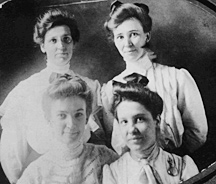
Rena Groover of Pidcock, Ga.; Clemmie Ford of Knoxville, Tenn.; Alice Huey of Bessemer, Ala.; and Ella Jeter of Walters, Okla., were the first women to move into a rented house provided by Southern Baptist Theological Seminary on Nov. 26, 1904. The four had chosen to live together as roommates independently, but the seminary became worried about their safety and urged them to move into a place it rented for them. Three years later, the WMU Training School began as a partnership between Woman’s Missionary Union and Southern Seminary, with the goal to provide a formal education for young women called to serve God. (Southern Baptist Theological Seminary Photo)

“It combined all the things I have a passion for,” said Homeyer, who will serve as an intern at Elkins Lake Baptist Church in Huntsville next spring.

The Baylor School of Social Work’s fall class represents the 100th year of social work education for the church, and it’s a milestone Diana Garland, dean of the School, has made sure students recognize. The school has hosted centennial celebrations throughout the past year, with another planned for the Woman’s Missionary Union National Convention Oct. 17-20 in Little Rock, Ark.

“The role of social work is moving to the heart of the church,” Garland said. “The Greatest Commandment stands on two legs—the love of God and the love of our neighbor. Social work, especially in the church, helps us to know how to love our neighbor.”

The WMU Training School began in 1907 in Louisville, Ky., as a partnership between the WMU and Southern Baptist Theological Seminary, with the goal to provide a formal education for young women called to serve God.

Students came primarily from economically disadvantaged or rural areas, and they depended on the women of WMU to help them with tuition. In 1912, the Baptist Settlement House, later called the Goodwill Center, was established and was the beginning of the field component of social work education.

“Louisville, at that time, had a lot of immigrants who were struggling with poverty, language and culture, who came to the Goodwill Center,” said Laine Scales, professor of social work and author of All That Fits a Woman, a history of the early years of the WMU Training School. “Students would go there to implement and practice what they learned in the classroom. It is where they learned the heart of social work.”

The WMU Training School was renamed the Carver School of Missions and Social Work in the 1950s, and in 1957 it was deeded to the Southern Baptist Convention due to financial difficulties. Its assets were merged with Southern Baptist Theological Seminary, which later dismissed the Carver School faculty and reframed social work as a major within its School of Religious Education.

Anne Davis, a graduate of the last class of Carver, joined the seminary’s faculty in 1970 determined to rebuild what had been lost. Davis called Garland, a young academician and clinician to join her, along with Rob Rogers, today an associate professor at the School of Social Work. They and a few others developed a master’s program.

“At that time, the social work profession was rather allergic to the church, to anything that smacked of faith and ministry,” Garland said. “Social work was considered a mental health profession. In the Baptist world, however, Christian social ministries was recognized as an important mission of the church.”

In 1984, the Carver School of Church Social Work was established with Davis as its first dean. But in 1995, the new president of the seminary, with the backing of its trustees, closed the graduate social work program, stating that social work education was incongruent with conservative theology. Garland, who had been named dean in 1993, was dismissed.

Out of that turmoil, however, the legacy of graduate education in social work for the church re-emerged at Baylor University. Preston Dyer, then chair of the social work program in the sociology department, invited Garland to help him develop a master’s program in social work at Baylor.

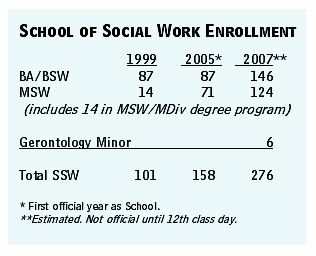
In 1999, the first master of social work class of 14 was enrolled. In fall 2007, that master’s program has mushroomed to 124 students, including 14 in a dual degree offered in conjuction with Baylor’s Truett Theological Seminary. In 2005, the school was ranked in the top 100 graduate schools in U.S. News & World Report. That same year, the school officially became Baylor’s 11th academic unit, with Garland as its inaugural dean.

“Many churches are involved in a wide variety of ministry to people,” Baptist General Convention of Texas Executive Director Charles Wade said. “The more churches do this work, the more they see the need for carefully trained leaders, people who cannot only do social work ministry, but also can equip and train church volunteers to do it in a more effective way.”

Today, the legacy of those pioneering WMU women to provide quality education for young women who felt called to serve God continues at Baylor. WMU Executive Director Wanda Lee is pleased that the tradition has a new home.

“In 1907, the women had a place to call home” at the WMU Training School, she said. “We are grateful that the Baylor School of Social Work is there today to pick up the mantle of what was started 100 years ago.”

Wade values the faith-based, holistic perspective that informs the social work education at Baylor.

“There is social work education offered all over the country, but only at Baylor is the focus on helping train skilled people for working in social ministries as part of the church mission,” he said.

The school’s leaders hope for a new facility to accommodate its growing student enrollment, faculty and staff. A strategic plan, more than two years in development, has been drafted that calls for a doctoral program and increased international education opportunities.

Notably, the school has received more than $6 million in grants since 1999 to conduct research that explores the interrelationships between faith and service and its impact on churches, religiously affiliated organizations and the social work profession.

Social work student Homeyer, whose education is being partially subsidized by WMU scholarships, has found the home and the profession she has longed for since going to WMU meetings as a child with her mother.

“These women probably never realized how they shaped the church,” Homeyer said. “They were willing to be radical and to step out there. And now we need to do the same.”

News of religion, faith, missions, Bible study and Christian ministry among Baptist churches, in Texas, the BGCT, the nation and around the world.


Texas Tidbits

Posted: 8/31/07

Texas Tidbits

TBM offers relief to Erin victims. Texas Baptist Men dispatched two clean-out teams, a shower unit and recovery group to two West Texas towns flooded by the remnants of Tropical Storm Erin. Clean-out teams from Amarillo and Lubbock, a recovery team from Waxahachie and a shower unit from O’Donnell headed to Merkel and Hamlin. The Ellis Christian Disaster Relief Box Unit took 2,000 moving boxes to help flood victims collect the items they would like to save. About 250 homes in Hamlin and 30 in Merkel were affected by flooding that occurred as a result of the remnants of Tropical Storm Erin. Texas Baptist Men disaster relief efforts can be supported by sending a check designated “disaster relief” to Disaster Relief, Texas Baptist Men, 5351 Catron, Dallas 75227 or via credit card by calling (214) 828-5351.


Ethics lecture program endowed at Howard Payne. A gift from Gary and Molli Elliston of Park Cities Baptist Church in Dallas has enabled Howard Payne University to establish a distinguished lecture program focusing on the significance of Christian ethics, beginning in the 2008 spring semester. The Ellistons endowed the Currie-Strickland Distinguished Lecture Series in honor of David Currie, executive director of Texas Baptists Committed, and in memory of Phil Strickland, director of the Texas Baptist Christian Life Commission. “On an annual basis, this lecture will provide a special opportunity to students, faculty and the general public to consider the importance of Christian ethics in the workplace, in the classroom, in ministry, in national and world affairs and in the minds of Christians as they make decisions in their daily lives,” Howard Payne President Lanny Hall said.


Retiree Ministries Retreat slated. Bill Pinson, Baptist General Convention of Texas executive director emeritus, will preach, and Bill Tolar, retired dean of the School of Theology at Southwestern Baptist Theological Seminary, will teach daily Bible studies during the ninth annual Retiree Ministries Retreat at Glorieta Conference Center, Sept. 24-28. Music evangelist Dick Baker of McKinney will lead the music, and retired dentist Bill Hanson of Dallas will be the organist. The retreat is sponsored by the Baptist General Convention of Texas and Glorieta Conference Center. For reservations, contact Glorieta toll-free at (800) 797-4222. For more information, contact Richard Faling at (972) 742-1471.


Hillcrest names new president. Glenn Robinson, a health care system executive from South Carolina has been named president and chief executive officer of Hillcrest Health System by the Waco-based hospital system’s board. Robinson has more than 20 years experience in hospital executive management, most recently as chief executive officer of the Mary Black Health System in Spartanburg, S.C. Previously, he spent seven years as chief executive officer of the Nacogdoches Medical Center and Shelby Regional Medical Center. He also held executive positions at hospitals in Houston and Portland, Oregon. Robinson is a graduate of the University of Alabama and Trinity University in San Antonio. He and his wife, Rhonda, have three children—Josh, Jacob and Sarah Kathryn. They are members of First Baptist Church in Spartanburg, S.C.


News of religion, faith, missions, Bible study and Christian ministry among Baptist churches, in Texas, the BGCT, the nation and around the world.


UMHB ‘Welcome Week’ includes community service

Posted: 8/31/07

UMHB ‘Welcome Week’
includes community service

By Jennifer Sicking

University of Mary Hardin-Baylor

BELTON—Two University of Mary Hardin-Baylor students brushed paint on a stucco stairwell outside of the Temple Public Library, while other team members inside washed windows and dusted bookcases.

Elsewhere, students filled potholes, painted walls, sorted clothes and generally lent a helping hand throughout Belton and Temple.

University of Mary Hardin-Baylor freshmen Mandi Sanders of Austin and Amanda Morgan of Round Rock help sort stuffed animals and wraps at the Children’s Advocacy Center in Belton as part of their community service during the Welcome Week activities at the university.

Although classes had not started, it was part of the university’s Welcome Week for freshmen and transfer students, and it included community service projects. Thirty-four teams of about 375 students spread throughout the communities to help at ministries, nursing homes, and churches for two days, said Kristy Brischke, UMHB director of student organizations.

“I think it’s just a way to get students to know there’s another community out there,” she said. “They’re new to UMHB and that will be their home, but they need to understand there’s another community.”

Students participating in the Welcome Week agreed.

“It’s really good to get involved in the community you’ll be living in for the next however many years you’ll be staying here,” said Carolynn Cox, a freshman from Cypress.

Also, with students participating twice a year in Reaching Out, where students spend a Saturday performing community service, Cox said it was good to get a head start in helping others.

Courtni Habel, a sophomore from Rosebud who was helping with Welcome Week, said the community service also shows the freshmen what is available for ministry opportunities.

“They get a chance to see what they can get plugged into later at churches, the food pantry or Scott & White” Hospital, she said.

Lewis Simms, a freshman from Victoria, said he didn’t come to Welcome Week expecting to perform community service. However, he said he found it allows the students to become more familiar with their new communities.

“It makes it more personal to you,” he said. “You can drive by later and say, I helped paint that stairwell.”

For those people who received assistance, the extra hands helped to lighten the loads, especially with the maintenance division understaffed at the library.

“I think it’s fantastic,” said Dan Johnson, the library’s maintenance technician. “It frees me up to do other stuff. I’m always grateful to have volunteers come and help it be more presentable.”


News of religion, faith, missions, Bible study and Christian ministry among Baptist churches, in Texas, the BGCT, the nation and around the world.


BaptistWay Bible Series for September 9: No excuses, no exceptions

Posted: 8/31/07

BaptistWay Bible Series for September 9

No excuses, no exceptions

• Romans 1:18-32; 2:1-13

By Andrew Daugherty

Christ Church, Rockwall

In the Oscar award-winning film Blood Diamond, the character Benjamin says, “My heart tells me people are good, but reality teaches me something different.”

Set in the African country of Sierra Leone during their 1990’s civil war, Blood Diamond exposes the cruel and dehumanizing business of diamond mining that exploits the gifts of the country’s land at the expense of its people’s lives. The beauty of the African soil is mixed with the blood of the African people by those who seek to profit from the illegal diamond trade. Rebel groups and warlords use these profits to finance conflict and civil wars that result in the displacement and death of millions of human beings.

Watching these rebel leaders in the film brainwash good and innocent children into being ruthless soldiers who maim and kill others at will reflects the alternating potentials for both good and evil that reside within the human heart. That 10-year-old boys are taught and trained to mutilate others by chopping off hands and shooting mothers and children is a graphic example of the Apostle Paul’s indictment of the human family: “… and they exchanged the glory of the immortal God for images resembling a mortal human being or birds or four-footed animals or reptiles” (v. 23).

Such acts of violence are not only crimes against humanity; they are acts of violence against God. Paul indicates that human beings resemble by nature what they worship. Rather than resemble the nature of the Creator who is good, those who become wicked are those who “did not honor him as God or give thanks to him …” (v. 21). Paul suggests this starts by “suppressing the truth” (v. 18). Acts of wickedness like torture or murder or rape arise at least as a by-product of denying the benevolent nature of God whose eternal power and goodness is evident in the things he has made.

In essence, those who oppose God’s goodness do so because they worship someone or something other than God. They live like God is dead, rearranging the created order and substituting the divine agenda with a human one. Some say truth is an early casualty in war. According to Paul, truth is an early casualty when human beings become so sure of themselves they think they are wise but are in fact fools. This denial of the role of the Creator results in the destructive practices of people who assume a job only God can do. This is a role reversal of seismic proportions.


Discussion Questions

• In what ways do you see “suppression of the truth” in our society? What are the consequences?

• Discuss Benjamin’s quote from Blood Diamond in light of Paul’s words to the Romans in 1:23: “My heart tells me people are good, but reality teaches me something different.”

• What are personal ways you experience “role reversals” in your relationship to God?


Romans 1:24-32

C.S. Lewis once said: “There are only two kinds of people in the end: those who say to God, ‘Thy will be done,’ and those to whom God says, in the end, ‘Thy will be done.’”

Three times Paul says, “God gave them up,” which is another way of saying the same thing. Is there a hint of resignation in this phrase? What does it mean that “God gave them up?” Isn’t a good God provoked to act on behalf of human beings who become victims of others’ arrogance, greed, racism, sexual exploitation and homophobia? How is justice to be done in such cases if God in effect says to the perpetrators, “Have it your way?”

Fortunately, this is not Paul’s theological finale. He still is providing a descriptive (rather than prescriptive) account of the human consequences that issue from exchanging “the truth about God for a lie” and worshipping and serving “the creature rather than the Creator” (v. 25). Paul has not yet reached an ultimate solution to the distortion of these roles. Yet in his laundry list of evil (vv. 29-31), Paul minces no words as to the nature of those who practice wickedness: They are full of envy, murder, deceit, they are gossips, haughty, boastful, faithless, heartless and ruthless, just to name a few.

As a general rule, readers of Romans tend to give short shrift to this list compared to Paul’s passing comments about homosexual acts carried out by heterosexual people in 1:26-27. Why is this? Though space will not allow here, perhaps a class would benefit from a conversation about where we recognize ourselves in 1:29-31 along with a respectful theological discussion of 1:26-27.


Romans 2:1-13

As we know, wickedness is not a disembodied evil. It has many faces and many names. As we have witnessed violence on a massive scale in places like Auschwitz, Sierra Leone and even in Iraq, what remains clear is that a good God opposes violence/wickedness in all its forms no matter who is waging the war.

This is to say that there is no country or race or social class or economic standing that exempts a person from God’s judgment. Paul makes clear in the previous passage that all persons who practice the wickedness he describes are subject to divine indictment. There is no person so pious as to be above reproach. Here, Paul rebukes those who would be tempted to “keep up spiritual appearances” in order to condemn others for the same evil acts in which they participate: “Do you imagine whoever you are, that when you judge those who do such things and yet do them yourself, you will escape the judgment of God” (v. 3)?

Yet God is infinitely patient and impartial. Just as judgment applies to all people, so does grace. God longs to restore the rightful roles of Creator and creature. The burden of proof to honor this righteous role is on each creature that is responsible to the Creator. To those who will practice righteousness over against wickedness, God’s justice will be revealed as good news to the world.


Discussion Questions

• What images come to mind when you hear the phrase, “God’s judgment?”

• What do you make of the notion that “what we despise in others is what we despise within ourselves?”

• In what ways do you judge others?

News of religion, faith, missions, Bible study and Christian ministry among Baptist churches, in Texas, the BGCT, the nation and around the world.


Old First Orange parsonage burns

Posted: 8/29/07

Old First Orange parsonage burns

By George Henson

Staff Writer

ORANGE—The parsonage of Old First Orange Baptist Church burned last weekend, destroying the home and its contents, but no one was hurt in the blaze.

Harris, who has been pastor of the church 12 years, said the fire appeared to start in the utility room, but an official cause has not been determined.

The fire was discovered by Harris’ 14-year-old son, Elliott. The youth was having a back-to-school gathering at the house and heard a noise. “He thought he heard someone at the door, but when he opened it no one was there, but he could see the flames coming out of the garage,” Harris said.

One of the family’s cars was totally destroyed, but Harris was able to save the other. It had grown hot enough, however, that much of the exterior plastic had melted and a good deal of the paint had blistered.

The parsonage was insured, but Bailey said the insurance on the contents is not near sufficient to replace what was lost. Even more troubling, he said, was the number of photographs and family mementos that were lost.

The family is looking for temporary housing and staying with friends until a more permanent solution can be secured.

Bailey said the last couple of years have been a trial for his congregation.

“It’s been a journey for us. We lost our sanctuary in (Hurricane) Rita and just dedicated it in May,” he said.

One thing that was not totally destroyed was his son’s Bible. The teenager recently has surrendered to a call to missions and was particularly interested in finding a Bible that is special to him. The Bible was found, soggy, to be sure, but at least whole.

The concern shown for his family and congregation has been gratifying, he said.

“I have cried more from the affirmation and generosity of people reaching out to us than I have over the loss,” he said.

He said a decision on whether or not to replace the parsonage had not been made.

He said that in the small community everyone is aware of the event.

“God is going to be faithful in what I sense he’s already doing—using this as a witness to the community,” he said. “I want the people of this community to see how God’s people come together to meet needs.”

A designated account has been set up at the Golden Triangle Baptist Association offices to receive gifts to help the family replace their belongings. Donations can be mailed to P.O. Box 7728, Beaumont 77726.


News of religion, faith, missions, Bible study and Christian ministry among Baptist churches, in Texas, the BGCT, the nation and around the world.


Bible Studies for Life Series for Sept. 9: Feeling anxious about the future

Posted: 8/29/07

Bible Studies for Life Series for September 9

Feeling anxious about the future

• Daniel 2

By Steve Dominy

First Baptist Church, Gatesville

We noted last week that while the hero of the first chapter is Daniel, the main character of the story is God. All throughout the first chapter, we saw God at work in the circumstances of the story—God delivering Judah to Babylon, God causing an official to show sympathy to Daniel and God giving superior knowledge to Daniel and his friends. God’s sovereignty over the situations of life will be the recurring theme throughout the book of Daniel.

It is true once again in Chapter 2. In light of the direction of the study this week, three areas of the story are most important for us.

The first is Nebuchadnezzar’s dream itself. In chapter 1, we are told that Daniel and his friends were found “10 times better than all the magicians and conjurers.” Many of the methods used by the wise men of Babylon would have been considered against Jewish law, but dreams were a means of divine communication both the Babylonians and Hebrews would have recognized. While Daniel would have been educated in Babylonian means of divination and religion, it is important to note that God did not choose those methods to communicate. God had spoken in dreams previously, specifically Jacob’s dream of the stairway to heaven, and it would not be a method condemned by the Bible. Daniel could interpret this dream without being unfaithful to God.

The second feature we need to pay attention to is the content of the dream. Nebuchadnezzar dreams of a statue with a head made of gold, its breast and arms of silver, its belly and thighs made of bronze, its feet made partly of iron and clay. The dream also includes a vision of a rock being cut out, “but not by human hands.” The rock breaks the feet of the statue, and this imposing statue is reduced to dust and blown away by the winds while the rock grows to fill the entire world.

While there has been a great deal of energy spent on the determination of the kingdoms represented by the statue, we need to make sure our discussion does not distract us from the main point of the passage; all of these kingdoms will pass away, but the kingdom of God endures forever. The statue is made by human hands but the rock is specifically said to be cut, “not by human hands.” Daniel speaks to a people in a time of oppression and exile and encourages them that this present situation is not the end of the story.

Finally, we need to pay attention to Nebuchadnezzar’s response. Nebuchadnezzar responds with the recognition that Daniel’s “God is God of gods and Lord of kings.” Now let’s not make a leap that is too great, Nebuchadnezzar was not converted here. It would have been easy for him to include Yahweh with all of the other gods that he recognized. That does not detract from the fact that the most powerful pagan in the world fell at the feet of a servant and recognized the power of his God. Though Nebuchadnezzar fell at the feet of Daniel, he did so in recognition of the God whom Daniel served.

Throughout Daniel chapter 2, we see God at work. Though the mention is not explicit, it is evident God gave Nebuchadnezzar his dream. It also is made abundantly clear that God revealed to Daniel both the content and interpretation of that dream. The story of Nebuchadnezzar’s dream reinforces the theme of Daniel: The circumstances of life do not determine the faithfulness of God.

There are a multitude of things in our world that can cause us anxiety—the war in Iraq, the threat of terrorist attacks and the fluctuations in the economy. It is easy to get caught up in the goings on of the world and lose perspective on the eternity of God. How many countries have fallen and changed leadership in our lifetime? We have seen the fall of the Berlin wall and the unification of a divided Germany, the fall of the U.S.S.R. into nation-states in that part of the world. We have seen numerous coups in different parts of the world; maybe Nebuchadnezzar’s dream continues to be fulfilled and the kingdoms of this world continue to pass away?

I remember the early ’80s when the United States bombed Libya. For about a month, I was convinced we were going to reinstate the draft and begin world war three. I also remember that Ayatollah Khomeni, Moammar Khadafi and Mikhail Gorbachev were at one point or another considered to be the coming of the antichrist. Yet, none of those things came to pass. Just like my worries about World War III, most of the things we worry about never come to pass. And if they do come to pass, our worry hasn’t done anything about the situation.

The presence and faithfulness of God we see so clearly in Daniel is echoed in the words of Jesus in Luke 12:24-25: “Consider the ravens, for they neither sow nor reap; they have no storeroom nor barn, and yet God feeds them; how much more valuable you are than the birds! And which of you by worrying can add a single hour to his life’s span?”

We don’t know all of the answers to the questions that come. But, the good news is that, no matter what, God has the last word. God and not cancer will have the last word, God and not war will have the last word, God and not death will have the last word. God will have the last word, you can say that out loud, and can count on his faithfulness no matter the circumstances of life.


Discussion questions

• Has God ever chosen to speak to you through a dream?

• How do people often respond to others who say God has communicated with them in this way?

• Are people too skeptical when someone says God has spoken to them regardless of the means?

News of religion, faith, missions, Bible study and Christian ministry among Baptist churches, in Texas, the BGCT, the nation and around the world.


Explore the Bible Series for September 9: God’s sinless son

Posted: 8/29/07

Explore the Bible Series for September 9

God’s sinless son

• Matthew 3:1-4:16

By Travis Frampton

Hardin-Simmons University, Abilene

“A voice of one calling: ‘In the desert prepare the way for the Lord; make straight in the wilderness a highway for our God’” (Isaiah 40:3). Matthew, Mark and Luke each use this well-known verse to introduce John the Baptist and the story of the baptism of Jesus. In order to understand the significance of this verse for Jesus’ baptism and the beginning of his ministry, the words of the voice crying out in Isaiah should receive close attention.

In 587 B.C., the Babylonians, led by King Nebuchadnezzar, destroyed Jerusalem. They besieged the city, demolished the city walls and tore down the temple Solomon had built. The Babylonians captured Zedekiah (Judah’s king), gouged out his eyes, bound him in bronze fetters and led him back to Babylon as a captive. Several of the ruling class and the elite in the city of Jerusalem also were captured and taken into exile. Needless to say, the Babylonians were victorious that day.

The Babylonian exile was an extremely painful formative period for the Jewish people. What would you do if you thought all was well, only to discover the next day the world had been turned upside down? Everything seemed relatively stable before Nebuchadnezzar made an appearance outside the walls of Jerusalem. Most of the Judean citizenry believed God dwelt in the house Solomon built, the Davidic messiah was securely positioned on the throne and all was well.

Then came the exile. Where was God in the midst of such destruction? Isaiah answered this question by insisting God had not deserted his people, but was using the Babylonians to bring judgment upon his people. Israel had committed outrageous crimes against God and humanity, and God was bringing justice. The Jewish people remained enslaved about 50 years. All seemed lost. Hope seemed a word forgotten. Until a voice cried out.


Hope cries out

“Comfort, comfort my people, says your God. Speak tenderly to Jerusalem, and proclaim to her that her hard service has been completed, that her sin has been paid for, that she has received from the Lord’s hand double for all her sins” (Isaiah 40:1-2). This verse proclaims the end of the exilic period. The Persians had conquered the Babylonians, permitting all captives to return home if they desired. Many chose to do so. They set out to “prepare the way for the Lord.” Instead of following the usual roads and byways located along the Fertile Crescent, they envisioned a return to their homeland that would take them directly across the desert from Babylon. Those arriving in Judah initiated plans to rebuild the city, its walls and the Jerusalem temple. It was the beginning of something new.

So what does the exilic background of Isaiah’s day have to do with the New Testament? Matthew’s Gospel announced God beginning something new with the coming of Jesus. A first-century Jewish audience would certainly have known the historical context behind Isaiah’s message. They would have been very familiar with passages about God’s judgment in Isaiah 1-39, about how the Lord was preparing to punish their ancestors for their sins.

They also would have been equally familiar with Zephaniah’s “day of the Lord.” The exile was a day of “wrath, a day of distress and anguish, a day of trouble and ruin, a day of darkness and gloom, a day of clouds and blackness” (Zephaniah 1:15). Utilizing the mighty armies of the Babylonians, God took Israel’s liberty away, made Jerusalem’s people slaves and imprisoned the Jewish messiah. But now—with the coming of Jesus—Matthew, Mark and Luke testified about the commencement of a new day.

Drawing upon the inspiration of Isaiah 40-55, the Gospel writers understood the life of Jesus as one where God was offering hope, life and salvation to both Jew and Gentile. The words from Isaiah, chapter 40, not only applied to the returning exiles from Babylon, but also spoke to those bearing witness to the life of Jesus. Matthew, Mark and Luke, each using the words of Isaiah, were crying out about the good news of God’s grace offered by the one baptized by John in the Jordan: “You who bring good tidings to Jerusalem, lift up your voice with a shout, lift it up, do not be afraid; say to the towns of Judah, ‘Here is your God!’ See, the Sovereign Lord comes with power, and his arm rules for him, and his recompense accompanies him. He tends his flock like a shepherd: He gathers the lambs in his arms and carries them close to his heart; he gently leads those that have young” (Isaiah 40:9-11).


Baptism/wilderness

Baptism and wilderness. As far as Scripture is concerned, the two often go hand-in-hand. Baptism marks a change in one’s identity or character, and usually the wilderness follows. The word “wilderness,” when it appears in the Bible, often is misunderstood as a place of lush, plentiful vegetation. This definition, however, is inadequate because the “wilderness” of the Old Testament and the New Testament is just the opposite. It is desert region where water and vegetation are scarce, a place where sustaining life is difficult, where survival is a constant struggle.

Several obstacles present themselves to travelers crossing the desert. Where does one find food and water? How does one live? In the wilderness, life’s basic necessities become more important, the superfluous loses its attraction, and priorities come into sharper focus. The Christian life offers a transformed and abundant life (baptism) but also is not exempt from trials and temptations (wilderness). The wilderness prepares us; it makes us stronger.

Moses and the Israelites fled from Egypt by way of crossing water into the desert. They wandered in the wilderness 40 years. Under the leadership of Joshua, the Israelites crossed the Jordan to take possession of the Promised Land. Jesus was baptized in the Jordan by John and then immediately led by the spirit into the wilderness, where he was tempted by Satan.

Water is essential. It brings things to life. In the stories about Moses, Joshua and Jesus, passing through water indicated a change of identity. Moses and the Israelites were slaves on one side of the water and a free-wandering people on the other. Joshua and the Israelites were free-wandering people on the east-side of the Jordan and became a nation on the other. Jesus’ baptism marks a similar change; it is only after Jesus “passes through” the water that he is prepared for the wilderness. The baptism initiates the beginning of his ministry: “As soon as Jesus was baptized, he went up out of the water. At that moment heaven was opened, and he saw the Spirit of God descending upon him. And a voice from heaven said, ‘This is my Son, whom I love; with him I am well pleased’ (Matthew 3:16-17).


Establishing the kingdom of God

As the Christ (the Greek word for the Hebrew word “messiah”), Jesus became a new Zedekiah. God’s Davidic king returned to Jerusalem to establish his kingdom. His kingdom, however, did not concern itself with political strength or military might. Instead, his domain was ruled with the most authentic and absolute power—the love of God.

We often look upon love as weak and believe brute strength, physical might and a stubborn will is the only way true power can, or should, be exhibited. Nevertheless, this assumption runs counter to the witness of the Gospels. Their pages record time and again that love is the only force able to turn our world upside down. Only love is able to make saints out of sinners. The kingdom of God is not like our world. In the kingdom of God, neighbors are loved and forgiveness always is granted. In God’s kingdom, the path to the throne is worn down by the hooves of a donkey. There a servant is the Messiah, because there Jesus is king.


Discussion questions

• What does it mean to say that Jesus is king?

• Did you experience the “wilderness” after you became a Christian?

• How does baptism change a believer?

• How does Jesus offer us hope today?

News of religion, faith, missions, Bible study and Christian ministry among Baptist churches, in Texas, the BGCT, the nation and around the world.


Activists urged to focus on future, not fundamentalism

Posted: 8/27/07

Activists urged to focus on
future, not fundamentalism

By Ken Camp

Managing Editor

DALLAS—God has blessed Texas and kept its Baptist state convention free from fundamentalist control largely through the efforts of Texas Baptists Committed, but conditions have changed, Baptist Standard Editor Marv Knox told an assembly of the moderate Baptist group in Dallas.

While fundamentalism could rise again, it no longer presents “the preeminent threat” to the Baptist General Convention of Texas, he stressed.

“Warning against the fundamentalist bogeyman sounds disingenuous,” he said. “Unlike past situations, the BGCT is not well served by defining itself by what it is against. Our future must be defined by what we are for.”

As advocates of freedom, Texas Baptists Committed should “not only allow but also affirm the right of all Texas Baptists to exercise their freedom of relationship,” whether relating to the Cooperative Baptist Fellowship or the Southern Baptist Convention, Knox said.

“The only line we must draw excludes coercion, intimidation and forced participation with any national organization that an individual, church, convention or other group cannot, in conscience, support,” he said.

“If we do cannot learn to forgive, if we cannot bless sisters and brothers who want to work with us while they also work with people with whom we disagree, if we cannot fix our focus on the future, then let’s write our epitaph: ‘Frozen by fundamentalism.’ And close our chapter.”

Knox urged the group to adopt a new role.

“More than any other group, Texas Baptists Committed can help our convention overcome apathy, renew relevancy and restore trust,” Knox said. “Fundamentalism no longer is our greatest threat. Apathy is, and it is choking us.”

Earlier in the day, Dallas Baptist University President Gary Cook offered another recommendation for Texas Baptists Committed—Stop endorsing candidates for BGCT offices.

Cook, who cited his longstanding involvement with Texas Baptists Committed and appreciation for the organization’s role in “protecting” the BGCT from takeover, participated in a panel discussion of presidents from BGCT-affiliated universities. He expressed his intent to vote for Joy Fenner in the state convention president’s race at the BGCT annual meeting in Amarillo.

Texas Baptists Committed has endorsed Fenner, a former missionary and retired executive director-treasurer of Woman’s Missionary Union of Texas, for BGCT president. David Lowrie, pastor of First Baptist Church in Canyon, also has been announced as a nominee for the president’s post, citing his desire to see an “open” election.

But Cook encouraged Texas Baptists Committed to “not continue to endorse candidates in the years ahead” and to not nominate a first vice president with the understanding that person will be president the next year.

“Let’s trust Texas Baptists again,” Cook urged.

Turning from Texas Baptists Committed to the BGCT, Knox suggested a series of steps to take:

Clarify identity. “The BGCT is much larger than the Baptist Building,” he said, acknowledging that many Texas Baptists—and often the Baptist Standard—have used the terms interchangeably. “So, if people don’t like something the executive director does, something the Executive Board proposes or a program the Baptist Building puts on, people who are bothered by it think they are angry and/or annoyed with the BGCT. And that’s just not right.”

Feed strengths. “If you cited one factor that distinguishes the BGCT from every other convention—period—you would name our institutions,” he said. Knox proposed exploring ways to accomplish some Baptist Building-based ministries through institutions and to “figure out how to channel funds to those ministries.”

De-balkanize missions. “Once upon a time, many Texas Baptists anticipated a synergistic organization that merged the strengths of Texas Partnerships and River Ministry and provided time-, cost- and energy-saving infrastructure for churches and institutions. And that never really happened,” he said.

Knox recommended consolidating missions efforts currently scattered across at least a half-dozen groups or organizations, and the suggested closer collaboration with institutions.

Tell the story to everyone. “We must get the Standard in the hands of more Texas Baptists, and we must work closely to help them understand more fully how the BGCT at large is expanding the kingdom of God,” he said. “This would be in the best interest of everyone.”

Rethink resourcing. The BGCT Executive Board staff probably should deploy more congregational strategists across the state “so their caseloads are more manageable,” he said. But the Baptist Building should move beyond the idea that it must produce all the resources churches need.

“Provide incentives for our institutions to equip churches,” Knox said. “Programming and training are their forte. Give them incentives to equip churches as well as they equip their own staffs or students,” he said.

The BGCT also should encourage peer-to-peer training and generate bulk purchasing power to lower the cost of resources produced by other groups so small Texas Baptist churches can afford them, he said.

“Fill niches, but stay out of ditches,” Knox added, building on that theme. “We should give up trying to provide resources just so we can say we provided them,” he said.

Fund priorities. “We must adequately fund our priority endeavors, and we must cut the rest,” he said.

Finish the Executive Board reorganization. “How are Texas Baptists supposed to take reorganization seriously when a ‘streamlining’ results in a larger bureaucracy and more employees?” he asked.

Be the Texas of tomorrow—today. Respond to the demographics of the state, Knox urged, by starting more churches to reach ethnic and racial minorities, providing educational opportunities for racial and ethnic church leaders and modeling multi-racial, multi-ethnic cooperation in all areas of BGCT life.

“What a legacy, if we were known as the people who refused to let Hispanic and African-American children fall through the cracks of our educational system and drop out of school,” he said, citing one example.


News of religion, faith, missions, Bible study and Christian ministry among Baptist churches, in Texas, the BGCT, the nation and around the world.