Hardin-Simmons pulls out of magazine’s ranking race

Posted: 8/28/07

Hardin-Simmons pulls out
of magazine’s ranking race

By Ken Camp

Managing Editor

ABILENE—Hardin-Simmons University has announced it no longer will participate in surveys conducted by U.S. News & World Report for its annual list of “America’s best colleges”—even though it has advanced in the rankings and been named a tier-one school in its division five consecutive years.

The Abilene university joined more than 60 schools nationwide that have disengaged from the magazine’s ranking race.

“Although many feel the U.S. News rankings are the ‘gold standard’ for comparing learning institutions, such rankings systems are not always the best tool for gauging a student’s learning experience,” Hardin-Simmons President Craig Turner said.

“Although HSU continues to advance in the U.S. News rankings, the university is exploring other qualitative comparative evaluation programs.”

Hardin-Simmons ranked No. 34 in the magazine’s “master’s-west” group—a regional category that includes colleges and universities granting primarily undergraduate and master’s degrees but few, if any, doctoral degrees.

U.S. News focuses largely on entrance scores, high school rankings and other criteria for entering students, but it does not seek any evaluation from current students or alumni, Turner noted.

Hardin-Simmons particularly takes issue with the peer evaluation process, since the magazine places it in the western division, but its accreditation and major relationships are to the east, he added.

“West coast institutions are asked to evaluate schools in Texas with whom they have no regular dealings and vice versa,” Turner said.

Leaders of several other Baptist General Convention of Texas-affiliated schools expressed reservations about the U.S. News ranking system, but some have opted for a “wait-and-see” approach for now.

East Texas Baptist University President Bob Riley met with his cabinet to weigh the pros and cons of continuing to provide information to the magazine, according to university spokesman Mike Midkiff. With the input of cabinet members, Riley decided to continue to consider ETBU’s options and to solicit the opinions of the deans of the university’s seven schools, he added.

ETBU ranked No. 12 in the magazine’s “baccalaureate-west” regional division for schools that offer primarily undergraduate liberal-arts programs where fewer than 50 percent of students receive degrees in traditional liberal-arts disciplines.

Howard Payne University President Lanny Hall called the U.S. News rankings “far from perfect,” but he added: “The rankings have brought unprecedented recognition to our university. … While we would like to see improvements in the rankings process, much of the information presented is very valuable to students and parents.”

Howard Payne received a No. 3 ranking in the magazine’s “best value” list, Hall noted.

Howard Payne is “not dissatisfied to the point that we are ready to withdraw from submitting data to the publication,” he added. “We will carefully consider our options. There is always the chance that the process might change between now and next year. If it is improved between now and next spring, we do not want to close the door to future participation.”

Wayland Baptist University President Paul Armes offered a more pointed criticism of the magazine’s rankings—particularly the survey that peer institutions complete.

“The survey lacks validity because so much of it is subjective,” Armes said, who noted he hasn’t filled out the survey on other universities for several years. “The idea that I would know how good an education … (is provided) by any of our regional schools—that I as an outsider could evaluate them accurately—is not realistic.”

Some of the criteria used by the magazine are “somewhat artificial and easily manipulated by statistical gains,” he asserted. Furthermore, most students who attend Wayland choose the school based on the recommendation of trusted friends or relatives, not its ranking in a magazine, he noted.

“In our case, one of the things that is mentioned a lot is the faith component, and that is not mentioned in U.S. News,” Armes said.

Houston Baptist University President Robert Sloan disagreed.

“We are in a competitive marketplace as a university, and we want to share information with parents and students who are in the decision-making process,” Sloan said.

HBU tied with the University of Mary Hardin-Baylor at the No. 48 spot and Dallas Baptist University ranked No. 58 in the magazine’s “master’s-west” group—a regional category that includes colleges and universities granting primarily undergraduate and master’s degrees.

“As a distinctively Christian university, we know that our core values are not measured by the U.S. News & World Report ranking system, but there are criteria which correspond to our values as a student-centered campus,” he added, pointing to information such as average class size, the student-to-faculty ratio and the graduation rate.

“As an institution, we are not modeling ourselves after the criteria,” he said. “We know that measurement is a necessary component in the evaluation process.”

During Sloan’s tenure as president at Baylor University, one of his goals was to help that school achieve recognition as a “top-tier” national university in the U.S. News rankings.

John Barry, vice president for marketing and communications at Baylor, acknowledged, “Ranking systems of any type are quite often flawed in one manner or another.” He particularly noted the subjective nature of the U.S. News academic reputation survey completed by college presidents, chief academic officers and admissions directors.

“While other portions of the assessment are objectively based, the criticism relative to the subjective nature of the academic reputation survey is warranted,” Barry said.

Still, Baylor will continue to provide information “to a wide variety of college guide books, including those produced by U.S. News,” he said. U.S. News ranked Baylor University No. 75 in the “national universities” category this year.


News of religion, faith, missions, Bible study and Christian ministry among Baptist churches, in Texas, the BGCT, the nation and around the world.


Wayland athletes share basketball tips, gospel message in Europe

Posted: 8/24/07

Wayland Baptist University Pioneers basketball player Michal Polanowski is interviewed by members of the media in his home town of Konin, Poland. Polanowski and members of the Pioneers traveled to Europe this summer to work with Athletes in Action. (Photos courtesy of Wayland Baptist University)

Wayland athletes share basketball
tips, gospel message in Europe

By Jonathan Petty

Wayland Baptist University

VILNIUS, Lithuania—Wayland Baptist University’s Pioneers basketball team took time out this summer to spread the gospel—and teach basketball skills—to young people in Lithuania and Poland.

Five Pioneers team members—Danny Storey, Michal Polanowski, Zach TeGrotenhuis, Lee Berend and Jason Griffin—joined Head Coach Robert Davenport and Assistant Coach Quinn Wooldridge in leading a weeklong basketball camp in Vilnius, Lithuania.

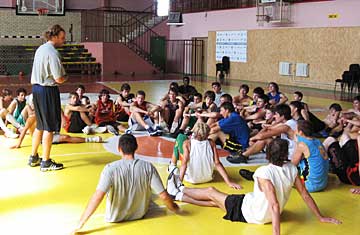
Wayland Baptist University Pioneer Danny Storey of Canyon talks with a group of young men during a basketball camp in Vilnius, Lithuania. Storey and the Pioneers led a weeklong camp in conjunction with Athletes in Action.

The Wayland mission volunteers worked with Athletes in Action. The group usually operates two camps in Vilnius each summer, but usually only coaches participate.

“We kind of personalized the camp for the kids because our players were there,” Davenport said.

The Pioneers spent several days with the campers teaching them the basketball fundamentals and sharing their Christian testimonies.

“It was really neat to watch the relationships between those kids and our kids,” Davenport said. “It’s just like our camps here—the kids get attached to them. There were about 35 kids in the camp, and probably half of them asked us to come back next year.”

Next, the team traveled to team member Polanowski’s hometown, Konin, Poland. Local response to Polanowski surprised the other Pioneers.

“Little did we know that Mike is a legend in his hometown,” Davenport said. “It is a city of about 100,000 people. Mike is the real deal there. We all thought that was pretty neat, and we gave Mike a hard time about it.”

While his teammates enjoyed sightseeing and eating the bountiful meals prepared by his parents, Polanowski was interviewed by local newspapers and television stations. At one point, Polanowski related his Christian testimony in for a video that will by used by Athletes in Action throughout his homeland.

“It was kind of neat to see things like that,” Davenport said. “We see Mike every day, and Mike is a great guy and does good things. But back in his home country, it’s amazing how big he is and how much of an influence he can really have.”

News of religion, faith, missions, Bible study and Christian ministry among Baptist churches, in Texas, the BGCT, the nation and around the world.


Texas Baptist Men offer relief to Erin victims

Posted: 8/24/07

Texas Baptist Men offer
relief to Erin victims

Texas Baptist Men dispatched two clean-out teams, a shower unit and recovery group to two West Texas towns flooded by the remnants of Tropical Storm Erin. Clean-out teams from Amarillo and Lubbock, a recovery team from Waxahachie and a shower unit from O’Donnell headed to Merkel and Hamlin.

The Ellis Christian Disaster Relief Box Unit took 2,000 moving boxes to help flood victims collect the items they would like to save. About 250 homes in Hamlin and 30 in Merkel were affected by flooding that occurred as a result of the remnants of Tropical Storm Erin.

Texas Baptist Men disaster relief efforts can be supported by sending a check designated “disaster relief” to Disaster Relief, Texas Baptist Men, 5351 Catron, Dallas 75227 or via credit card by calling (214) 828-5351.

News of religion, faith, missions, Bible study and Christian ministry among Baptist churches, in Texas, the BGCT, the nation and around the world.


Irving church becomes missions learning lab for students

Posted: 8/24/07

Irving church becomes missions
learning lab for students

By Leann Callaway

Special to the Baptist Standard

IRVING—Oak View Baptist Church in Irving became a learning lab for seven student missionaries this summer.

Five of the workers served two weeks at Oak View before departing for assignments in the Middle East and Canada through the Baptist General Convention of Texas Go Now Missions program.

Student missionaries Melanie Vasquez from Wayland Baptist University, Maria Spellings from East Texas Baptist University and Laura Garcia from Kingwood College are pictured with children at a Kid’s Club. (Photos courtesy of Oak View Baptist Church)

Two students—Laura Garcia from Kingwood College and Melanie Vasquez from Wayland Baptist University—remained at Oak View 11 weeks, helping with the church’s far-reaching missions work. 

“I feel called to help the underprivileged,” Garcia said. “I really want to be part of the hands and feet of Jesus and help those in need—to share the gospel and share Christ’s love. Oak View’s minister of missions, Sergio Matassa, has impacted our lives tremendously. He is an amazing, godly leader and example. He’s a hard worker and has taught us a lot. (He taught us) … to truly obey God and to be a missionary wherever we go—not just a one-time mission trip, but in our lives as Christians, we’re called to share Christ in our everyday surroundings.”

This summer, the student missionaries led Kid’s Clubs at local apartment complexes and volunteered at the Baptist Benevolence Ministries of Irving , where they stocked shelves, distributed food and witnessed to needy families.

They also went on mission trips with Oak View’s student ministry to support church plants in Hutto, near Austin, and in and Covington, La. 

“This was so different from what I expected,” Vasquez said. “I’ve learned a lot about myself and how I want to serve Christ.  Working with other people and preparing for mission trips—it’s been an amazing experience.

“I’ve seen people in a different way and seen that everybody just wants to be loved and needs to know that they are loved.  We had so many opportunities to minister to people who had never heard about Christ before.  So many times, we think about going overseas to share about Christ, but there are people right next door who aren’t saved.”

A young boy draws a picture at a Kid’s Club.  Each Kid's Club was filled with activities such as games, crafts, songs and Bible stories.

Originally, Vasquez planned to spend her summer doing missions work in Russia, and Garcia was considering an assignment in Africa.

“We often get caught up in having a label of missionaries and thinking about foreign missions,” Garcia said. “But Jesus said to make disciples of all nations. I’ve learned about having a missions field wherever we go, not just when crossing a border. …. So often, I feel like I forget about the people in my community, at school, at work; they all need Christ. It’s not just about going overseas. God can use us in our everyday surroundings.

“We have learned a lot this summer—working with the people and seeing the joy of the children. Seeing kids open up and get so excited about hearing about Christ was amazing.  I loved building relationships and working with the kids at the mission locations.

“It was so amazing to see them wake up early on a summer morning to come to a Kid’s Club and to see how much fun they had.  Some of the kids would go to their friends’ apartments to wake them up and would invite them to join us.  Seeing that they wanted to learn more songs and wanted to spend time talking about Christ—it was great seeing how God worked. This experience helped me to learn that I can do that in my neighborhood back home.”


News of religion, faith, missions, Bible study and Christian ministry among Baptist churches, in Texas, the BGCT, the nation and around the world.


Discipline-specific missions help Baylor students apply learning to life

Posted: 8/24/07

Kelsey Simons, a Baylor University nursing student, helps provide a basic medical exam during a mission trip to Mexico. (Photos courtesy of Baylor University)

Discipline-specific missions help
Baylor students apply learning to life

By Ashley Lintelman

Baylor University

About 125 Baylor University students joined faculty and staff in missions projects to meet needs in Armenia, Honduras, Kenya and Mexico.

Coordinated by University Missions, Baylor’s Louise Herrington School of Nursing and Baptist Student Ministries, each trip offered students hands-on learning and mission opportunities. 

A Kenyan student draws a picture of his “Teacher Tiffani.”

“While encouraging students to participate in church-based mission trips, Baylor also is offering discipline-specific missions as an expression of our identity as a Christian university,” said Rebecca Kennedy, director for University Missions at Baylor. “We want to create opportunities for students to understand and utilize their God-given gifts and abilities in serving others and spreading the love of Christ.”

Baylor’s inaugural trip to Armenia focused on laying the groundwork for future missions work that will focus on economic development, as well as evangelism and discipleship.

Walter Bradley led a team of engineering majors who joined students from two other universities to build two low-cost and energy-efficient model homes for low-income families. With the assistance and contacts of local Armenian-American builders, the team met its goals and already has requests for 15 additional homes.

A second Baylor team concentrated on business and leadership development. Marlene Reed, visiting professor in management, taught a leadership development course to Armenian business leaders and has agreed to work with University Missions next year to provide additional leadership for Baylor’s Outdoor Recreation/Tourism team project. Students from that team will work to build partnerships with local business leaders to create a sustainable tourism and outdoor recreation business.

Next summer, Baylor students and team leader Kelli McMahan, assistant director of campus recreation and program director for Outdoor Adventure Living-Learning Center at Baylor, will begin a long-term task of mapping trails for hiking and biking in Armenia.

Maxey Parrish, lecturer in journalism at Baylor, led a general ministry team to Armenia to provide social ministry and evangelism to unchurched villagers throughout the country. The team assisted a missionary and a local church through children’s Bible clubs, community carnivals and manual labor, and its members were part of the first evangelical Christian service to be conducted in the 1,500-year-old village.

“My favorite part of every mission trip I take is seeing my students exposed to situations in which the only way to succeed is to rely on God and see him at work,” Parrish said. “Putting (the trip) in God’s hands and leaving the results to him, you can’t help but experience him in a different way.”

Baylor students have served in Honduras since 2002, beginning with deaf education through the department of communication sciences and disorders. This year, five additional teams from engineering, education, nursing, medical and general ministry participated in the trip.

“Faculty and staff-led teams from various disciplines at Baylor create ways for students to explore what it looks like to serve God by using the skills and expertise from their major and field,” Kennedy said.

“Participating in discipline-specific teams often allows students to have even more to offer as they serve in international settings. Students also greatly benefit from learning and serving alongside professionals in their respective fields, and this experience can help shape a student’s view of their own future of service and ministry.”

Baylor students on the deaf education team worked with students in the only deaf school in Honduras, while team leader Lori Wrzesinski, director of Baylor’s American Sign Language program, focused on teaching English as a Second Language to Honduras’ deaf school teachers. This year Wrzesinski had her first graduating ESL class, Kennedy said.

Another team led by Nancy Pfanner, lecturer in communication sciences and disorders, helped a nonprofit organization in host an annual camp for deaf and hearing-impaired children.

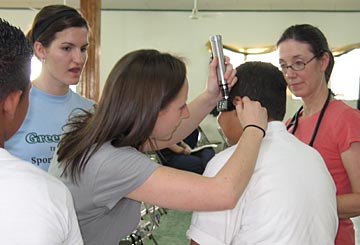
Audrey Koenig (foreground) and Lori Spies (right) provide an ear exam to a patient in Honduras during a Baylor-sponsored mission trip.

The medical and nursing teams provided relief and assistance to local medical clinics. Baylor students gave immunizations to local villagers each day and used medical supplies to meet the needs of impoverished communities.

Nursing students provided health checkups to every child attending the host church’s school in Chuloteca. Students put together seminars on health, hygiene, nutrition and sexually transmitted infections at both public and private schools. A Baylor graduate student led an extensive question-and-answer session specifically for women both at the church and throughout the community.

Other teams included an education and general ministry team led by Baylor education professors Randy Wood and Rick Strot and Baylor BSM director Clif Mouser. Team members taught Bible stories and provided manual labor, health care and ESL training for teachers at a recently established Christian school at a church in a small Honduran village.

Seven Baylor students served with GoNowMissions, a Baptist Student Ministries program that offers students the opportunity to raise money and serve others for either a semester or for a summer. In addition to sponsoring a team to Honduras, the BSM also partnered with Habitat for Humanity to construct houses and provide practical relief to the people of New Orleans.

Meanwhile, a Baylor engineering team led by Brian Thomas, lecturer in engineering at Baylor’s School of Engineering and Computer Science, built a micro-hydro-generator and installed a water purification system in Honduras.

For the third year in a row, 93 Baylor faculty, staff and students traveled to Kenya, the largest number of participants to date.

Led by Randall Bradley, director of Baylor’s Center for Christian Music Studies, and Sharyn Dowd, associate professor of religion, Baylor students used music to reach orphans and neighboring villages, while representatives from University Baptist Church in Waco built partnerships with Kenyan churches to provide social ministry within village communities.

Students from Baylor’s Truett Theological Seminary trained future Kenyan leaders in HIV/AIDS education, evangelism, church leadership and community development, as well as business sustainability. The teams worked with several faith-based organizations in order to accomplish their goals.

Several freshmen and sophomore students provided general ministry to Kenya’s HIV/AIDS victims, orphans and widows. Despite the language barrier, students played games and learned songs with Kenyan children during their lunchtime.

Tiffani Riggers, a graduate assistant for University Missions and a team leader with fellow grad student Marquette Bugg, said Kenyan parents often are too tired to play with and show affection to their children due to long daily struggles to get money to feed their families. Giving individual attention to the children allowed team members to show God’s love by filling that parent-to-child void, she noted.

“Knowing that spiritually we made an impact is awesome, and we had a great reminder that we don’t always see the fruit of our works until we are in heaven,” Riggers said. 

 Also in Kenya, engineering students, faculty and staff continued to provide practical solutions for real-world needs, such as the installation of solar panels in a deaf school with no electricity, the construction of windmills to provide electricity for a school and the designing of a foot bridge to be built over a river in eastern Kenya.

In 2006, Baylor students created a non-profit organization called Omega Kids, which provides resources to Kenyan pastors who minister to orphaned street children. This year, Omega Kids donated money and helped a local pastor purchase land for a dormitory to be built specifically for street children.

Riggers reflected that the time in Kenya showed how much Americans take for granted, “from the amount and type of food that we choose to eat, to the clothes we wear.” Riggers described the desperate need, the incredible joy and indelible hope that the Kenyan people had, even while living in abject poverty. 

“It was a very special time for me, as I felt that our Baylor students were seeing how much they are a part of something bigger than just a mission trip,” Riggers said. “It was wonderful to get to worship God in a Kenyan church with my brothers and sisters and know that even though we may have been speaking different languages, we were worshipping the same God.”

Baylor’s nursing school continued a 30-year tradition of students providing care in Juarez, Mexico. While in Juarez, students set up free clinics inside a local church and offered complete health check-ups to assess the general needs of children and adults. Medication, prayer and health education were often provided. Clinics also are a way for the local church to make life-long contacts with people in their community, helping them to continue to reach those in need.

Another trip was planned in Mexico City, where faculty, staff and students were slated to continue to administer health check-ups to the housing community in Mexico City. 

“It is a practical exercise in servant leadership, improving health care and gaining skills and expertise as nurses,” Spies said.


News of religion, faith, missions, Bible study and Christian ministry among Baptist churches, in Texas, the BGCT, the nation and around the world.


Summer missions moves UMHB students out of ‘comfort zones’

Posted: 8/24/07

Kristin Bauer, a junior early childhood major from San Antonio, learned about fellowship and made some new friends within the church in Wolfenbuttel, Germany, while she ministered among youth in that city. (Photos by Kristin Bauer/UMHB)

Summer missions moves UMHB
students out of ‘comfort zones’

By Jennifer Sicking

University of Mary Hardin-Baylor

BELTON—Summer Caniglia heard stories about missionaries who spent years in Japan and never saw anyone come to faith in Christ. So, she was warned not to expect to see great results during her summer missions internship in Tokyo.

“In Japan, I had expectations that it would be hard—that there would not be any fruit,” she said.

But Caniglia, a University of Mary Hardin-Baylor senior management/Christian ministry major from Houston who served this summer as a missions mobilizer with the International Mission Board guiding short-term teams through the streets of Tokyo, met 20 people who made professions of faith in Christ, saw six baptisms performed and experienced two church starts.

“I learned not to put limitations on God,” she said. “He is mighty to save.”

Caniglia served as a summer missionary through Go Now Missions—a program UMHB Baptist Student Ministry Director Shawn Shannon highly recommends to students.

“Jesus himself lived a life of missions, crossing the greatest cultural divide there ever was, and those of us who follow him are walking in the overall pattern of his life,” she said. “This will lead us out of our comfort zones into dependence on God. I see students grow the most when they participate in one or more of the following—service, leadership and missions.”

Kristen Grogan, a senior business management major from Cedar Hill, wanted to return to Tokyo where she spent part of her Christmas vacation. Instead, she was sent to Boston and thoroughly enjoyed it.

“I loved that during the summer, we were able to experience a variety of ministries in the New England area,” she said. “We were able to work alongside Haitian churches, an Arabic Evangelical church, collegiate church plants and many others.”

During her two months there, she participated in prayer-walking, painting houses, performing yard work, participating in vacation Bible school and backyard Bible clubs and teaching conversational English to international students.

“The Lord allowed me to see that one of the reasons I was there was simply to serve,” she said.

Kristin Bauer, a junior early childhood major from San Antonio, learned about fellowship within the Wolfenbuttel, Germany church while she ministered among youth in that city.

“In Germany, after the fifth grade, the students are separated into different schools by grade,” she said. “It was sad to go to the different schools and see the discrimination and segregation in them. One student at the Hauptschule, the lowest school, asked why we were there and why we cared about them. This was an opportunity to share God’s love with them and to let them know that we care about them and that we’re there for them.”

Relationships Bauer built in Germany have continued after she returned to the United States, including one with a Muslim girl who’s family emigrated there from Turkey.

“At one school, one Turkish girl really wanted a picture with me. As I saw her in the halls during passing periods, we were able to talk and swap e-mails,” she said. “Now, we’ve been e-mailing each other and I can see God’s work in progress. Even though we’re not over there, we are still able to share God with everyone over e-mails.”

Each of the students said they realized that if they are called to go by God, they must go and share the gospel message.

“God has a place for all of us to serve whether at home or abroad. It’s an act of obedience,” Caniglia said. “It’s not a choice. It is what we are told to do.”


News of religion, faith, missions, Bible study and Christian ministry among Baptist churches, in Texas, the BGCT, the nation and around the world.


ETBU students, alum teach summer classes in India

Posted: 8/24/07

Meagan Marshall and Sheryl Breeden share a story with students. Marshall, a graduate of East Texas Baptist University, and Breeden, scheduled to graduate from ETBU in December, spent a month teaching at Adarsh Vidalaya Matriculation School in Kaydam, Tamil Nadu, India. (Photos courtesy of ETBU)

ETBU students, alum teach
summer classes in India

By Jeanie Pinkston

East Texas Baptist University

Some teachers jokingly say the three best things about their profession are June, July and August. An education student from East Texas Baptist University and two ETBU alumni agree with the punch line—but not for the usual reason.

Student Sheryl Breeden and 2006 graduates Megan Marshall and Ashley Causey spent their summer vacation teaching underprivileged children in southern India.

For Breeden, trip provided a first chance to be involved in international missions—and a chance to learn a lesson about the importance of love.

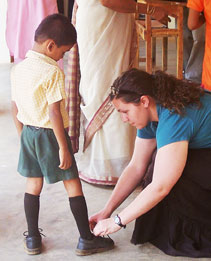
East Texas Baptist University alumni Ashley Causey of Alvin, Texas ties the shoe of a student at Adarsh Vidalaya Matriculation School in Kaydam, Tamil Nadu, India.

“One has to have love when you go to another culture. Without love nothing can be accomplished,” she said. “Love is the same in every language.” 

The India trip marked the second international mission experience for both Marshall and Causey. During the summer 2005, Marshall spent 10 weeks as an International Mission Board volunteer to South Africa, and Causey traveled to China with a group of ETBU students. 

In India, Marshall found it difficult to observe problems and be unable to help.

“I struggled because I felt like we were viewing India through a glass box, seeing many hurts and injustices among the people and having very little ability to do anything about it,” she said.

But Causey believed God taught her an important lesson about focusing on faithfulness rather than observable results. One morning after she arrived in India, she read a passage in the Old Testament book of 2 Kings in which God commanded the Israelites to make a valley full of ditches before they went into battle against the Moabites. Although the people didn’t fully understand, they obeyed, and God eventually used the ditches to help defeat the Moabites. 

The day after she read that Scripture, as she was riding to the school where she served, she noted people digging ditches.

“I think (God) was trying to make sure I got the point—that although my job may not have been glamorous, I was there to (figuratively) dig ditches so that the Lord could use those in times to come to defeat the stronghold Satan has on Southern India,” she explained. 

Although they didn’t see large numbers of people come to faith in Christ during their trip, Causey said, “I saw the foundation laid, and the ditches have been dug for God to do a mighty work in that nation.” 

News of religion, faith, missions, Bible study and Christian ministry among Baptist churches, in Texas, the BGCT, the nation and around the world.


The death of a Lubbock church sparks new life

Posted: 8/24/07

The death of a Lubbock church sparks new life

By Jessica Dooley

Communications Intern

LUBBOCK—As deacons carried a casket out the sanctuary doors, worshippers marked the death of Trinity Baptist Church in Lubbock and the birth of The Family Church @ 34th and Boston.

When Pastor Dan Reynolds arrived at Trinity Baptist Church in June, he and the congregation agreed to start a new church in the declining church’s facilities.

Pallbearers carry away a casket bearing the bylaws for Trinity Baptist Church in Lubbock at a service marking the demise of that church and the birth of The Family Church @ 34th and Boston.

“As a church planter, I told them: ‘We shut down Trinity Baptist Church, and you allow me to do what I need to do. We move into a mission status, partner with the Baptist General Convention of Texas and Lubbock Area Baptist Association and start from scratch building a brand new church’,” Reynolds said.

Reynolds, who has planted churches before, said members were considering shutting down Trinity Baptist Church before they called him. In its prime, the church had 1,000 members in Sunday school; by the time Reynolds came to Trinity, attendance had declined to around 25.

At the funeral, former pastors Bob Utley and George Ray shared eulogies. Gene Hawkins, retired associational director of missions quoted a passage from the Old Testament book of Ecclesiastes, focusing on the theme: “a time to live and a time to die.”

Director of Missions Larry Jones gave the charge for the future of the new church. He preached from a text in the Old Testament book of Haggai: “This new house will be of greater glory than the former house.”

During the service, the church’s constitution and by-laws were placed in the casket, and the deacons of Trinity Baptist Church carried the coffin out of the sanctuary.

“This was a real unique thing—actually a funeral for the church,” Reynolds said. “It was just very encouraging seeing the excitement that the people had about the new start. It is a radical change from who Trinity Baptist has been in the past.”

At the service, 48 charter members agreed to a new convent and signed it. More are expected to sign, as the charter remains open until Oct. 31. The Family Church is also working on partnering with other area churches.

“We have to think outside the box as far as ministry,” Reynolds said. “For one of our renovations, we remodeled our foyer and turned it into a coffee bar. We wanted something that didn’t resemble a church when you walk in.”

Soon, the church plans to install a wall of flat screen monitors, so visitors can sit in the coffee bar and watch the service in a nonthreatening environment.

“It’s really a way of dropping some of those barriers that exist and they can walk into a familiar environment,” Reynolds said.

They also plan to make the coffee shop wireless and open it during the evenings for college students. The church will offer free coffee, Internet and printer use to attract students.

“We want to reach all aspects of the neighborhood that we live in. Free is the key,” Reynolds said.

Because many Lubbock churches are moving to the outskirts of the city, The Family Church wants to focus its ministry in the inner city. Some of the ministries it hopes to launch in the next year include a soup kitchen, clothes closet, computer skills training class, day care center, before/after school programs, and a church planting launching center.

“The church planting [launching] center will be done in cooperation with the Lubbock Baptist Association,” Reynolds said. “There is one wing of this building that can be completely isolated and has its own outside entrance. This section of the building has enough space to sustain an entire congregation up to 100 people.

“It has a room that will be remodeled into a kitchen. There is a fellowship hall, worship center, 12 to 14 classrooms, men’s and women’s restrooms and access to the baptistry when needed. The [church planting] launching center is the most vital part of the entire operation. While here, new churches will be able to witness ongoing, hands on ministry in us and reproduce it in themselves.”

With the death of the old and the birth of the new, the church plans to embrace a less-traditional ministry and hopes to fill its once-overflowing halls.

“The gospel cannot change, but the method must constantly change,” Reynolds said. “That’s the philosophy I have lived by since I’ve gone into ministry.”


News of religion, faith, missions, Bible study and Christian ministry among Baptist churches, in Texas, the BGCT, the nation and around the world.


Cybercolumn by Jinny Henson: Being Jesus to the Uncrustable Generation

Posted: 8/24/07

CYBER COLUMN:
Being Jesus to the Uncrustable Generation

By Jinny Henson

Peanut butter and jelly. The combination of this salty-sweet concoction was first documented in World War II. Soldiers mixed jelly in their peanut butter rations to make swallowing easier. Returning from the war, these heroes brought back victory as well as a taste for these sandwiches.

Then in the late 1960s a combination of kitsch and kitchen hit the market with the culinary triumph: Goober. I never acquired the palette for Goober. The flavors far too prematurely intermingled. Like day-old nachos or wet beach towels in the car. It just never jived in my mouth. Obviously it jazzed someone’s taste buds, as the product born the year before I was remains a staple in grocery stores across the country.

Jinny Henson

Fast-forward three decades. In the year 2000, jelly giant Smuckers rolled out the crustless peanut butter and jelly sandwich, flash frozen for freshness: The Uncrustable. Birthed by a time-strapped culture, Uncrustables are now available in four flavors and dethaw right in your child’s lunch box for convenience. When even more pressed for time, I have found that popping one under each armpit with wrapper intact is a great way to hasten the defrosting process.

From humble, foxholistic beginnings to futuristic perfection, the peanut butter and jelly sandwich, like most institutions in our society, has undergone radical change. How can we who are passionately in love with God and passionately committed to loving people find a clue through the most mundane means of a PB&J? A mere glance at The Uncrustable will give us tremendous insight into how we can translate God’s love and timeless message into a language this generation can bite into.

Speed.

A survey of grocery store shelves is all you need to recognize that time is increasingly the most valuable commodity in postmodern America. Along with the birth of convenience foods, there is an entire section of cleaning products in wipey form. Even the act of spraying the Windex on the window has been streamlined for time efficiency. In a July 2007 Harris Interactive study, 98 percent of parents said it is important or very important to spend quality time with their children, while just about half actually said they spend enough time with their children.

Variety.

A church that offers a variety of activities at numerous times is one way to involve the Uncrustable generation. Also, leveraging time-saving technology instead of being frightened by it is an excellent way to show pertinence to people who view the church as passé or irrelevant. Quality websites that are actually maintained, e-mail reminders, and e-newsletters in addition or instead of printed ones are simple ways to connect.

Fresh.

My husband, John, and I got a flyer for a church that talked about how boring church services can be and how their church was breaking out of the “tired, churchy,” mold. That message may have been compelling 15 years ago, but the “innovative,” message rang stale. The effective church constantly examines what is relevant culturally and what has been done and overdone already. Fresh is a great adjective to describe the quality that God’s Spirit brings to our lives. His Spirit is always ready to do a new thing—in us individually as well as the church corporately. Be open to fresh ideas to express God in a new way.

Hygienically sealed.

Just as we want food protected from microorganisms tainting its safety, parents want the same type of protection for their children. True, parents cannot wrap their children in cellophane (I’ve tried. It never works.), but they do need reassurance that church is a safe place for their children. After a few seasons of, “To Catch a Predator,” you are convinced there is a molester at every keyboard.

Parents need reassurances about security policies in your children’s’ program that will help them relax and be moved by God’s message. When your church has a safety policy—like background checks for all teachers and workers and a security system for checking in children—that shows you are aware of the security risks. Parents want to know their kids are safe in the church, and measures like these go a long way to augment that good rapport.

Weary, time-strapped and looking for ways to make their lives better. These are qualities of this generation. The fields are white for the harvest, and I cannot imagine a more worthwhile place to spend your effort than reaching those people God has for your local body to reach. Go forth with the clues of The Uncrustable sandwich and be pertinent.

Jinny Henson travels the country as a Christian comedienne. John, Maggie Lee and Jack are an endless source of material for her. You can find out more about her at www.jinnyhenson.com


News of religion, faith, missions, Bible study and Christian ministry among Texas Baptist churches, in the BGCT, the Southern Baptist Convention ( SBC ) and around the world.


BaptistWay Bible Series for September2: Connecting the dots

Posted: 8/24/07

BaptistWay Bible Series for September 2

Connecting the dots

• Romans 1: 1-17

By Andrew Daugherty

Christ Church, Rockwall

Biblical scholars have long held the view that Romans is the Apostle Paul’s theological summum bonum (the highest good). Considered his most comprehensive statement on Christian faith, the influence of this letter has pervaded the history of Christian thought from the fourth-century conversion of St. Augustine to Martin Luther’s 16th-century Protestant Reformation movement to Karl Barth’s 20th-century commentary on Romans. The fruit of these characters’ faithful witness to Romans reveals the character of the letter itself: “the gospel of God.”

It is this theme, “the gospel of God,” that concerns Paul’s ministry. Though he unpacks dense theological statements, Paul’s letter to the Romans is first and foremost a call to divine duty more than thrall to dogmatic purity. Before “gospel” ever was associated with “seven steps to salvation” or with particular books of the Bible or even “The Roman Road,” it had to do with the proclamation about Jesus, including his message about the kingdom of God and the content of his character as “the son of God.”

Barth put it well: “Jesus does not give recipes that show the way to God as other teachers of religion do. He is himself the way.” To believe with one’s life is to answer the call to belong to Jesus Christ. Paul’s purpose is to further reveal how true this is by illuminating the meaning of this gospel.


Romans 1:1-7

Typical of first-century letters, Paul begins his letter to the Romans by introducing himself, though taking considerable time (six verses) to do so. Writing to a church he did not establish in a city he had not visited, Paul uses the first six verses as a personal summary statement that could be considered part of his spiritual curriculum vitae. Paul makes clear his credentials as “servant” and “apostle” while drawing connections to the “gospel of God” with “prophets in the holy Scriptures” (v. 2).

That he describes himself as a servant suggests the gospel (euangelion) is something to which Paul belongs; not something that belongs to him. Paul knows God owns the copyright license on the gospel, because it was first and foremost the divine prerogative to promise this gospel “beforehand through his prophets in the holy scriptures” (v. 2). This self-designation as servant situates Paul in the humble but honorary position of Israel’s prophets and roots him firmly in Jesus’ Jewish heritage. This is fundamental to the integrity of “the gospel of God” and crucial to Paul’s agenda in developing an inclusive understanding of Jesus’ resurrection both as the fulfillment of what many Jews had been expecting and the revelation of Jesus’ identity as Messiah.

Even as Paul heralds the gospel to a predominantly non-Jewish audience in Rome as “the apostle to the Gentiles,” he advances God’s gospel that this Jesus is Israel’s Messiah who is Lord of the world. Paul’s ministry, then, is an extension of Israel’s prophetic vision. This vision was not for the sake of Israel only, but it was for the sake of Israel for the sake of the world.

Paul himself is both a benefactor and a bearer of this global gospel. His profound personal experience through which he is called to be an apostle is the basis for his passionate public ministry “to bring about the obedience of faith among all the Gentiles” (v. 5). He carefully crafts his salutation to the Roman Christians to reflect his relationship to Jesus who claimed him on the Damascus road and called him to be an apostle. Therefore, Paul proclaims the message of the One who has claimed him.

Paul’s credibility as an apostle is established on this basis even as he skillfully weaves his own powerful call/conversion story with the impassioned language for “all God’s beloved in Rome” (v. 7) to accept their respective callings to be saints. It is a call issued to all.


Romans 1:8-17

Paul now gets more personal, as he expresses his desire to make a pilgrimage to Rome in order to share faith and fellowship with the Roman church. He speaks from his heart and tells them he prays for them all the time and longs for the day when he can look them in the eyes and share face-to-face the faith they have in common. Though he doesn’t spell out all the details, circumstances have prevented him from meeting them in person.

Paul’s longing to visit the Roman Christians reflects his longing to proclaim the gospel to any and all who would receive his message. Paul makes clear the message he is bound to share is unbounded by whether a person is Jewish or Greek, wise or foolish. Paul is not elitist about who is worthy or unworthy to receive the gospel no matter their race, education or economic standing. The rights and responsibilities of the gospel apply to all who believe.

This equality under the gospel of God gives rise to the climax of the opening section of Paul’s letter. Paul’s trust in “the power of God for the salvation of everyone who believes” (v. 16) overwhelms any shame that could be associated with this gospel. Shame is what the people of God experienced when they were oppressed by their enemies. Whether it was the Egyptians, Babylonians or the Romans, the experience of shame was the experience of inferiority, despair and fear. According to Paul, because this gospel reveals God’s righteousness, there is nothing to be ashamed about.

Likewise, we are prone to be ashamed, too. We can be ashamed of our bodies, our beliefs, our behaviors, or even our families or friends. Sometimes we become ashamed of the negative perceptions this person or that circumstance will bring about. We fear it will reflect poorly on us or will make us look badly. Such calculations about how we are perceived can plague us to the point of paralyzing us.


Discussion question

• In what other ways are we affected by shame on personal and communal levels?

• What might “the gospel of God” reveal about such shame?

• How might “the gospel of God” come to heal such shame?

• In what ways do you think “the gospel of God” is itself shamed?

News of religion, faith, missions, Bible study and Christian ministry among Baptist churches, in Texas, the BGCT, the nation and around the world.


Explore the Bible Series for September 2: God’s unique son

Posted: 8/24/07

Explore the Bible Series for September 2

God’s unique son

• Matthew 1:18-2:3, 7-11

By Travis Frampton

Hardin-Simmons University, Abilene

We have all wondered at some point in our lives what God looks like. Theologians have debated the question, along with the nature and identity of God, for centuries. A couple of years ago, I thought it would be interesting to ask my youngest son, who was then 4 years old, his opinion. Stopped at an intersection waiting for a green light, I looked at him through the rear-view mirror and posed the question.

“What do you think God looks like?”

“Why?” he asked.

“I don’t know. I was just wondering what you thought God looks like.”

“Umm,” he pondered as he peered through the window, up toward the sky.

His squinted eyes and wrinkled brow bore the weight of much thought. While he was thinking, I anticipated he would say that God looked like a gigantic old man, with silvery white hair and a long white beard, who lives in the clouds. His response, however, took me by surprise.

After an extended pause, he replied, “Daddy, that’s easy. God looks like baby Jesus.”

I smiled, and the light turned green.


A child among us

At first, I chuckled to myself about my son’s answer, but after further reflection, I think his reply hit the mark better than I first thought. As a 4-year old, he related to God in human terms and thought of God as someone with whom he could easily identify. “Baby Jesus” made it possible for my son to relate to God, to be able to fathom his own answer about who God is.

Matthew’s Gospel portrays Jesus as both the Son of God and the long-awaited Jewish Messiah. The first two chapters essentially identify these two unique qualities about Jesus that become prominent themes throughout the rest of the Gospel.

We learn from Matthew’s account that Jesus truly is different and separate from the rest of humanity. He is conceived through the Holy Spirit. An angel of the Lord encourages Joseph not to fear, “because what is conceived in (Mary) is from the Holy Spirit” (1:20).

The end of Matthew’s genealogy also suggests Jesus’ birth is special: “Jacob, the husband of Mary, and Mary was the mother of Jesus who is called the Messiah” (1:16). Notice that in the long list of patriarchs, which extends all the way back to Abraham, where each son is begotten by a father, Joseph is an exception in the family tree. He is described as the husband of Mary, not the father of Jesus. Matthew makes it explicitly clear that God is the father of the Christ child—not Joseph. In this way, Jesus is of divine origin: the Son of God.

The baptism, temptation and ministry of Jesus set him apart from other self-proclaimed prophets and messiahs. Jesus’ parables elaborate on the kingdom of God. His crucifixion and death speak of God’s sacrifice and love for us. Jesus’ resurrection attests to God’s power over death. These associations, though extremely important when it comes to the nature and character of God, focus solely on Jesus as a mature adult. We miss an opportunity the New Testament provides for us if we do not also see God incarnate in the baby from Nazareth.


Of humble origin

Matthew’s Gospel not only illustrates the divine nature of Jesus, but it equally emphasizes his humanity. Often, much is made of the second coming of Jesus. Revelation records John’s vision of the Son of God’s return and God’s ultimate victory of good over evil. Several popular Christian fiction books spend much time postulating what the second coming might look like. Some of these accounts can evoke fear from even the most cynical of readers.

If our conversations about Jesus, however, focus only on the image of the Son of God as depicted in Revelation and not on the image of the Son of God as the child of Mary, we’ve lost touch with what is most important to Matthew’s message. We can easily forget that Jesus’ beginnings were of humble origin. We must not lose sight of his humanity. His humanity has made possible our contact with the divine.

According to the witness of Matthew and Luke, Jesus’ “first coming” receives much more attention than any later discussion their Gospels give to the second coming. The “first coming” involves a physical birth through Mary. Mary is intrinsically related to Jesus. She is his mother. In this way, the Son of God is Mary’s son too. Mary is the one who binds Jesus to humanity.

As her son, Jesus first comes into the world as a babe born in Bethlehem. The angel of the Lord again comes to Joseph with another message: “Get up … take the child and his mother and escape to Egypt. Stay there until I tell you, for Herod is going to search for the child to kill him” (2:13). The narrative suggests the child’s vulnerability, his mortality, by implying that Jesus could suffer death if Herod’s plot was successful.

Yet, as God’s son, Jesus is unique from the rest of humanity in that, though he is mortal flesh, he is without sin and is one with God. The angel of the Lord told Joseph to name the child Jesus (a name that means “God is salvation”), “because he will save his people from their sins” (1:21). Jesus offers people relationship with God. Furthermore, as the offspring of both God and Mary, Jesus is—in every sense of the term—the Son of God, both divine and human.


Discussion questions

• What do you think God looks like?

• How does Matthew’s birth narrative portray God?

• How does the story of Mary contribute to your understanding of Jesus?

• What does it mean that Jesus is the Son of God?

News of religion, faith, missions, Bible study and Christian ministry among Baptist churches, in Texas, the BGCT, the nation and around the world.


Bible Studies for Life Series for Sept. 2: Meeting Cultural Challenges

Posted: 8/22/07

Bible Studies for Life Series for September 2

Meeting Cultural Challenges

• Daniel 1:1-21

By Steve Dominy

First Baptist Church, Gatesville

The first chapter of Daniel acts as the introduction to the rest of the book. It introduces the heroes, Daniel, Hananiah, Mishael and Azariah, and how they came to hold high positions in Nebuchadnezzar’s service. The first chapter is also a foreshadowing of the conflict that is to come and the commitment to God that these young men have made.

The structure of Chapter 1 can be broken down into three sections: captivity (1:1-1:17, Daniel’s commitment (1:8-1:16), and God’s blessing (1:17-21).

1:3-5 Beginning with v.3, Nebuchadnezzar orders Aspenaz, one of his high officials, to begin the training program for the exiled youth. The extent of this program was to teach them “the language and literature of the Babylonians.” At surface level, this seems awfully generous of the Babylonians, but we need to read further. V.5 reveals this was training for the king’s service. They were to be saturated in the culture of their enemies. Daniel and his friends would be used for political purposes. They would be used as propaganda and serve either in the king’s court or as his ambassadors back to Judah to win over the hearts and minds of the people there.

The coursework in this training would have included astrology, mathematics and magic for which the city was famous. Daniel became well educated in the ways of Babylon, and as we will see, he excelled and finished at the top of his class.

1:6-7 The extent to which Daniel and his friends accept the reeducation in Babylonian culture is surprising. In these verses we learn that even their names are changed. That seems like a small thing to us, but in the ancient Near East a person’s name often contained the name of one’s deity and was an integral part of a person’s identity. Daniel and his friends names each contain syllables meaning God or Yahweh. But the chief official gave each of them new names containing elements of the Babylonian gods.

1:8-16 The Holiness Code found in Leviticus 11 and Deuteronomy 14 defined patterns of behavior for all covenant people and included regulations about eating. All of the regulations in the Holiness Code were linked to obedience to God in covenant. While there is some argument about whether or not Daniel’s refusal to eat the king’s food was due to his commitment to Jewish dietary laws, it does play at least some factor in Daniel’s decision. While it is probably not the sole reason for Daniel’s decision, the fact that he chooses “not to defile himself with the royal food and wine” gives us some idea that the food laws had some influence on his decision.

There is more at work than just the food laws in this section. As much as most of us would like it, 10 days on a diet doesn’t necessarily make us look “healthier and better nourished than any of the young men who ate the royal food.” Daniel’s commitment to God is evident as is God’s honoring of Daniel’s commitment. The change was not so much a result of the diet as it was God’s honoring Daniel’s commitment.

1:17-21 Because of their obedience in trying circumstances, God blesses Daniel and his four friends both physically and mentally. The young men looked healthier and better nourished than those that ate the royal food. When the four young men entered the king’s service, he found them “ten times better” than any other in his service. While our circumstances will certainly be different than those of Daniel and his friends, the principle is consistent; God blesses those who are faithful to him. Even, and perhaps especially, when our culture is in conflict with our commitment to Christ, God honors those who honor him. Jesus said in Matthew 6:33, “But seek first his kingdom and his righteousness and all these things will be given to you as well.” It would serve us well to pay attention to these lessons from Daniel and our Lord.

The first chapter of Daniel can be a great encouragement to us to strengthen our commitment in the face of trials and temptations. But this chapter also raises some difficult questions. Why did Daniel choose food as his battle? It would seem that accepting the practices of Babylon and allowing his name to be changed to incorporate a foreign God would be less faithful than eating the king’s food. One of the things that we need to remember in our reading of Daniel is that the story is not solely about Daniel.

While Daniel is a hero of the faith the main character of the story is God. Three times in the first chapter we see God acting in the story, God delivered Judah to Babylon, God caused the official to show sympathy to Daniel, God gave knowledge and understanding to the four young men. Since God delivered Judah to Babylon, we might well understand it to be God’s will for these four young men to serve God in trying circumstances. To choose to fight the battle of Babylonian education or name change likely would result in death, or at least exclusion and slavery. The key note in this first chapter is God’s faithfulness in a foreign land and God’s leadership of Daniel and his friends as they circumnavigated the mine fields of unfaithfulness.

News of religion, faith, missions, Bible study and Christian ministry among Baptist churches, in Texas, the BGCT, the nation and around the world.