Dallas Cowboy’s son & other youth score at Camp Exalted

Posted: 8/03/07

Dallas Cowboy’s son & other
youth score at Camp Exalted

By Barbara Bedrick

Texas Baptist Communications

AN MARCOS—Snagging gummy worms immersed in a paper plate full of vanilla and chocolate pudding is not exactly what Eugene Lockhart expected to be doing recently. He had anticipated being on the field at Texas Stadium with his dad, who was leading a Big Brothers Big Sisters of North Texas fundraiser.

Instead, Lockhart joined nearly 250 middle school and high school students and college freshmen for Camp Exalted July 16-20 at San Marcos Baptist Academy.

Eugene Lockhart

Few campers knew at first that he was the son of former Dallas Cowboys linebacker Eugene Lockhart. The younger Lockhart wore the typical urban teenage accoutrements—a baseball cap, expensive fashionable sneakers, baggy shorts and an attitude of invincibility.

Like most of the young people at Camp Exalted, the eighth grader came seeking direction in his life. Lockhart soon learned some valuable lessons.

In the praise and worship services one night, Pastor Blake Wilson of Crossover Bible Fellowship in Houston preached to the young people using video clips from movies like Independence Day while talking about Revelation.

“He talked about the end of the world, and I realized it was time to make a change because I don’t want to go to hell,” Lockhart said. “I wanted more God in my life. I was doing a lot of stuff like sneaking out of the house to hang out with my friends. I used cuss words a lot.”

Through sermons, praise and worship sessions, quiet times and the Christian leadership training classes at Camp Exalted, Lockhart realized he needed to change.

“If someone says a cuss word around me, I’m going to tell them to stop because I’m not going to be around that kind of language,” Lockhart said as he proclaimed he has learned God’s purpose for his life.

“I’m going to be an evangelist and spread God’s word,” Lockhart said as he talked about telling his friends about how “God is good” and how he’s changed.

For freshman camper Desmond Granger, a member of New Providence Baptist Church in Houston, the camp confirmed a decision to serve God. The 15-year-old student wants to be a pastor even as he continues recovering from bone cancer.

Fifteen-year-old sophomore Adeola Olabode, member of United Christian Fellowship in Arlington, plays volleyball and basketball and had drifted away from God because most of the games were on weekends, including Sundays, so there was no time for church.

“It’s been a good experience, and I’ve gotten closer to God,” Olabode said. “I used to complain about crickets in my room, but after watching a video showing how many people still sleep outdoors in Africa, I thank God he allows me to have a roof over my head.”

Camp Exalted is designed to “exalt Christ” and is modeled after the Baptist General Convention of Texas’ Super Sum-mer camps. The Camp Exalted curriculum focuses on developing leadership skills including worship, ministry work, moral purity and family relationships.

The camp, partially funded by the Mary Hill Davis Offering for Texas Missions, also is geared to “providing campers with the tools to impact communities, not just influence them,” according camp Director Joe Fields, youth pastor of Westside Baptist Church in Lewisville.

“We stress skills needed to impact a community because the ramifications are forever,” Fields explained. “We’re teaching students how to navigate what they’re going through in the real world. We want students leaving here to practice the tools and the discipline they’ve learned so they can impact their peers.”

Baptist leaders praised the late president of the African American Fellowship of Texas, Ronald Edwards, for jumpstarting the camp for African-American youth—one of few such camps in Texas. Camp leaders are working to help students get their lives right and to help them examine how to make key decisions in life, in school and in college and careers.

“We understand the importance of impacting young people. It’s important to us … it is growing us. By God’s grace, he has brought us them so we can give back to them,” explained Brenda Suggs, camp instructor and member of Tolivar Chapel in Waco. “We’re taking too much for granted with activities at the church because of lot of important questions aren’t addressed.”

By the time camp ended, there were 72 professions of faith in Christ, three calls into ministry and numerous requests for special prayers and rededications.

“It’s more than chips and Kumbayah,” Fields explained. “We want to impart the knowledge to these young African-American students that you may never meet 50 Cent, but you will meet God someday.”


News of religion, faith, missions, Bible study and Christian ministry among Baptist churches, in Texas, the BGCT, the nation and around the world.


2nd Opinion: Great news at a glad reunion

Posted: 8/03/07

2nd Opinion:
Great news at a glad reunion

By Brad Riza

They all are older now, and most are larger around the middle. Some have less hair, and everyone’s hair is a little lighter than it was then. Still, they made their way to Hideaway, near Tyler, this summer for an unusual military reunion. They weren’t all from the same military unit, not even from the same branch of the service. They were Marines, Air Force, Army and Navy. Some were postal workers, and others were fighter pilots and airlift specialists. Some were police and others chaplains. They weren’t even in Vietnam at the same time. The only thing these people had in common was a connection with Trinity Baptist Church in Saigon.

In the early ’60s, the Southern Baptist Foreign Mission Board endorsed Jim and Mary Humphries to go to Vietnam and pastor an English-speaking church in downtown Saigon. That was their mission—but they did way more than that! They worked with military and embassy personnel for sure, but they also reached out to many Vietnamese families, sharing their friendship and eventually the gospel. They trained and mentored Vietnamese who would be future pastors and leaders.

On a Friday night in July, many of those whose lives were touched by Jim and Mary traveled to their home just like they used to do on Friday nights in Vietnam. And just like in Vietnam, they had a great meal and a wonderful fellowship time. They met others who had been a part of that congregation at a different time. They spoke of ministry and worship and communion. They recalled working with orphans. They sang together, just as they did almost four decades ago.

No one spoke of politics. They did not debate the propriety of the war. They simply celebrated the opportunity to share ministry during a year that they were there—a year they were away from their families when they found a church family to fill that void.

A missionary who now ministers in Vietnam gave a report and praised those who served all those years ago, saying they had laid a foundation for a Vietnamese church that thrives today. Forced underground when South Vietnam fell, the Baptist work in Vietnam survived and has grown. Grace Baptist Church in Saigon, a lineal descendant of Trinity, is the mother church of hundreds of house churches all across Vietnam!

Grace recently was fully recognized by the Communist Vietnamese government. In their application for recognition, Grace had to write a purpose statement. They debated being politically correct and saying they would do social work and teach English and work with orphans. What they decided to say was what was in their heart: “To preach the gospel all across Vietnam, to seek to bring the nation to Christ.” Amazingly, the Communist government granted their application, and while perhaps not realizing the meaning of those words, it said the church’s operations within the country are “limited to their purpose statement.”

Perhaps the worst thing Ho Chi Minh ever did to his Communist movement was press for the unification of North and South Vietnam. His success in the mid ’70s has now opened the entire country to the gospel. What a unique turn of events, and we were all part of that all those years ago. Who would have thought? Who could have thought? Only in the providence of God!


Brad Riza, director of missions for Paluxy Baptist Association, is a retired U.S. Air Force chaplain. He served in Saigon in 1971-72.


News of religion, faith, missions, Bible study and Christian ministry among Baptist churches, in Texas, the BGCT, the nation and around the world.


Discipleship: It’s all about the basics

Posted: 8/03/07

Discipleship: It’s all about the basics

By Rebekah Hardage

Communications Intern

GARLAND—Ron and Cindy Blevins believe teenagers learn the importance of a daily walk with God the same way they learn core subjects at school.

“It’s like a math class. You’ve got to have the basics first,” Blevins explained. The Blevinses have written a youth discipleship program, Course for Life, that focuses on the basics—memorizing Scripture, daily quiet time and mission projects that help the students make their relationship with God a priority.

“The program started based on the need of the students. They didn’t have spiritual depth, and we thought, ‘There’s got to be a better way to do this,’” said Blevins, associate pastor of business at First Baptist Church in Garland.

He and his wife began writing one lesson a week for the program. The curriculum tackles issues not discussed in other programs due to the depth of the topics.

No matter the age, students beginning the program start with “First Mile,” and the program builds from there. Students who complete the “Fourth Mile” will participate in a yearlong mission project of their choice. Some may teach a younger class, while others plan international mission trips.

“This course is designed to deepen their relationship with Christ by showing them how to prioritize their time so there is always room in their calendar for some quiet time each day with the Lord,” said Cheryl Mize, a Course for Life small-group leader.

The program is important to give the students strength to overcome the temptations of young adulthood, Mize said. For instance, the course challenges teens to deepen their walk with God to a level so that even the temptation to skip out on church can be overcome—a strength Mize wishes she had possessed at their age.

Students are gaining strength and a spiritual depth beyond their years, and other people are noticing, Mrs. Blevins explained. Other teens in the youth group look to those in the program as role models, she noted.

Course for Life pushes students to stretch themselves to establish good habits and create a sense of accountability to one another. It also affirms to them there is time every day to spend with God if they make it a priority.

Mrs. Blevins explained a step in completing the third mile is to spend three hours in prayer. “Some of these kids have never spent 10 minutes in prayer,” she said, “but they are ready when the time comes, and many even say they ran out of time.”

The buzz surrounding the program has spread across the country, with churches in South Carolina, Arkansas and Texas participating. The Blevinses love to share with youth pastors, especially those who “catch the vision.”

One of those youth pastors is Ronnie Wilson of Meadowlake Missionary Baptist Church in Conway, Ark.

“We are reaching teens that I was not sure would ever be reached,” he said. “Teens are learning their Bible verses left and right.”


News of religion, faith, missions, Bible study and Christian ministry among Baptist churches, in Texas, the BGCT, the nation and around the world.


DOWN HOME: OK, who’s the owner here?

Posted: 8/03/07

DOWN HOME:
OK, who’s the owner here?

I’m not sure whether Joanna and I own our home, or this house owns us.

(OK, technically, the bank owns our home. But we’re paying down, and if we live to be old enough, we’ll hold the title. Don’t get hung up on the details here.)

Not quite a year ago, we sold the home where we raised our daughters. I loved that place. It was comfortable and suited our family. Even empty, the walls seemed to echo the voices and laughter that provided the soundtrack to our lives for almost 11 years. The rooms fairly buzzed with memories of all the happy times we shared there.

But the commute to work grew more dismal by the day. Too many cars and trucks on too few roads means too long driving to and from work. I began to fantasize about living in a village with only one flashing light.

Jo, ever the logical member of this duo, came up with a brilliant idea: We could move.

True. We no longer worried about uprooting the girls. We were free to roam. Once we ruled out changing churches, we began to house-shop. Eventually, we cut about nine or 10 miles—depending on the route—off my commute, but that little bit cut my driving time by about half.

We quickly fell in love with our new house. And almost immediately, it felt like it’d been our home for years and years.

The other morning, however, I realized several of the things that attracted us to this house have come ’round to bite us. Not literally. Not yet.

This came to mind as I went out to check on “the hole” right beside our foundation.

We like the fact our house is about a block from undeveloped land, home to a dormant power plant and unlikely to be developed. Unfortunately, skunks like undeveloped land, too. And the pest guy thinks one might like our dirt so much he decided to move into the neighborhood.

Speaking of neighborhood, we love all the trees in the blocks surrounding us. But web worms do, too. And since we don’t have a cherry picker (Shouldn’t every family own one?), we’re paying someone to come and “snip” them out of our trees.

We adore the patio. It’s where the roof leaked like a sieve all winter. We got that fixed, but we had to tell our girls their firstborn kids will be indentured to the patio-roofing people.

Oh, I could tell you another story or three about water, but they’re not all that unusual for a house as old as ours.

The good news is we’re fixing every problem as it comes along. Incrementally, our house is getting better and better. And we feel even more and more at home all along.

The even-better news is that every little glitch reminds me we are not what we own, and security is not vested in houses and land. What matters is how faithfully we live there and the joy that springs from our lives in that place.

Marv Knox


News of religion, faith, missions, Bible study and Christian ministry among Baptist churches, in Texas, the BGCT, the nation and around the world.


EDITORIAL: Texas Baptists learn to live at peace

Posted: 8/03/07

EDITORIAL:
Texas Baptists learn to live at peace

Democracy sure is messy. Especially in times of peace.

For years, the Baptist General Convention of Texas faced an ominous threat: Fundamentalists with a theological/political agenda for absolute domination set out to take control of the Southern Baptist world. They succeeded nationally in 1990, and then they set their sights on state conventions. One fundamentalist leader notoriously said their ultimate prizes were the BGCT, Baylor University and the Baptist Standard.

For traditional Texas Baptists living “abroad”—beyond our borders—those years afforded numerous opportunities for embarrassment. The most visible leaders of the fundamentalist movement hailed from Texas, so outsiders associated Texas Baptists with their theo-political excesses. Non-Texans seemed to think the BGCT would fall and become the bastion of Baptist fundamentalism.

knox_new

This left traditional Texas Baptists saying something like this: “The BGCT is not like that. Traditional Texas Baptists are biblical conservatives, but we’re certainly not fundamentalists. We believe in the priesthood of all believers and religious liberty. We champion local-church autonomy. Texas Baptists will resist fundamentalism like nobody else. Our convention will stay strong. When others fall, the BGCT will remain a beacon for liberty and freedom.”

Thanks in large part to a then-new organization called Texas Baptists Committed, we were right. Time after time, as other conventions capitulated, the BGCT withstood the fundamentalist onslaught. Texas Baptists Committed provided the structure, will and discipline to hold on, to resist the seemingly irresistible force that gained control of the national convention and most other state conventions.

Ironically, Texas Baptists Committed faced its greatest challenge not in the heat of battle but at the onset of peace. In a reverse-image of national politics, fundamentalist leaders acknowledged defeat in Texas and went off to start their own convention. Soon, their followers quit attending the BGCT meetings, and threat of takeover ended.

So, what happens to a potent—and valuable—political force when the din of battle falls silent? Some Texas Baptists, who never really wanted to resist fundamentalism or who felt queasy at the thought of resistance, clamored for TBC to dismantle. Others, who deeply appreciated TBC for providing core leadership in resisting fundamentalism, began to question its peacetime role. And even many TBC leaders acknowledged the need to redefine the organization in an era when fundamentalism does not present an imminent danger.

Now we’re up to date: For the first time since TBC began leading Texas Baptists to resist fundamentalism, a non-fundamentalist candidate with a potentially broad base is opposing a TBC-supported candidate for convention president. The broader issue has nothing to do with either candidate’s background and qualifications. It has everything to do with how the BGCT elects leaders and moves forward in a post-fundamentalist era.

Temptation beckons from the extremes: Either the TBC should fold up shop, or anyone who opposes the TBC is not loyal to the BGCT. Neither extreme—which, incidentally, is not the position of the candidates and their close supporters—is accurate. The TBC still has a role to play, and at minimum, it should include educating Texas Baptists regarding their history, heritage and future. And Texas Baptists can thrive with open elections. Multiple viable candidates are good for our convention, and diversity of opinion regarding whom to elect is a distinct Baptist quality that demonstrates healthy openness.

Let’s take the high road: Say good things about the candidates and their supporters. Speak well of each other. Encourage each other as we look to the future. We showed how to win the Baptist “holy war.” Let’s show the world how Baptists of goodwill can wage peace.

Marv Knox is editor of the Baptist Standard.


News of religion, faith, missions, Bible study and Christian ministry among Baptist churches, in Texas, the BGCT, the nation and around the world.


WMU FamilyFEST joins Buckner, BGCT to minister on the border

Posted: 8/03/07

Pablo González, pastor of Iglesia Bautista Antioquia in Juarez, consults with one of the residents in his church’s transitional living home. The mother of three cares for her children during the day while her husband drives workers to and from the maquiladora factories.

WMU FamilyFEST joins Buckner,
BGCT to minister on the border

By Jenny Pope

Buckner International

JUAREZ, Mexico—Jan Burton sat with Pastor Pascual Juarez from Iglesia Bautista Genesis as he told her, through a translator, about the hardships of serving God in a border town. Weeks earlier, thugs burned his trailer to the ground, held him at gunpoint and threatened to kill him and his family.

“He told us that he was not going to leave Juarez until God sent him away,” Burton said.

Burton, a nurse from Athens, Ala., was one of nearly 100 people who devoted a week to serving others recently during the national Woman’s Missionary Union FamilyFest in El Paso and Juarez, Mexico.

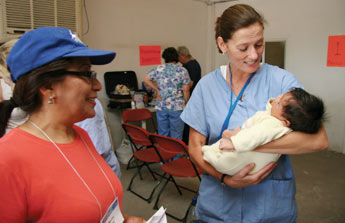
A volunteer nurse provided a routine health checkup to an infant in Juarez, part of a traveling medical clinic during WMU FamilyFEST week along the Texas/Mexico border.

WMU volunteers from more than 15 states partnered with Baptist General Convention of Texas Border/Mexico Missions and Buckner Border Ministries to provide light construction, medical clinics, crafts, haircuts and sports camps to children and families living in some of the poorest colonias—unincorporated communities—straddling the border.

The week of ministry was their 14th since 2001 in an effort to bring families together for missions and encourage others to get involved.

FamilyFest volunteers endured heat and swirling sandstorms in Sparks Colonia in El Paso to minister to families whose average annual income is $12,000. About 20,000 people live in Sparks, where homeowners build their homes brick-by-brick with each paycheck earned, taking an average of seven years to construct their “dream home,” typically a one- or two-bedroom shack.

Ruth Ann Smith sat on the floor scrubbing paint splotches in the middle of newly painted Tierra Prometida church in Sparks.

As a former Girls in Action member and traveling on her 12th WMU FamilyFest mission trip with her husband Owen, Smith said missions is in her blood.

“We just enjoy doing church work,” she said, meticulously scrubbing one white spot before noticing another halfway across the room.

“I can’t do everything, but I can clean the floor. You just do whatever it takes; whatever needs to be done.”

Her daughter and son-in-law, Susan and Dan Foley, made repairs outside as their two sons, Brendan, 16, and Ryan, 14, finished the exterior paint. It was the Foleys’ first mission trip as a family.

“I think it’s good for these kids to be here,” Dan Foley said. “It’s given them a different perspective on life and how to help others.”

A few team members repaired the leaky roof of church member and neighbor Soccoro Sepulveda, while others conducted adult crafts and a sports camp at the Sparks Community Center down the road.

Less than 10 miles away, on the other side of the Rio Grande, volunteers worked alongside pastors and church members in Juarez to provide minor construction, food boxes and routine health checkups at four Baptist churches—Alpha Omega, Nosotros con Dios, Genesis and Antioquia.

With an estimated population of 3.5 million, Juarez has experienced a surge in working-class citizens migrating from the south to labor in one of the many maquiladoras, or factories.

The swelling population and lack of police authority has brought a near-crippling increase in crime, drugs and disease.

Volunteer Bonnie Eaton, an El Paso native, was among the many nurses and two area doctors who checked blood pressure and basic health conditions of Juarez citizens in need of medical care.

A small construction team worked to repair the roof of several families’ homes at Iglesia Bautista Antioquia, located in the impoverished Avelina Gallegos colonia.

The homes are part of Pastor Pablo González’s social ministry Brindando Ayuda al Necesitado (Giving Help to the Needy), a multi-service program to help struggling families get back on their feet.

Each family in the church’s multi-unit home occupies about a six- by six-meter space. They share an open courtyard and one bathroom. Several of the men work in the maquiladoas or as bus drivers.

Mike Boyd, Taylor Johnson, 17, and Kenneth Little, 16, from Birmingham, Ala., have little construction experience.

Even so, it took them just three days to repair the roof covering three family units in the home.

It’s a roof that will last more than eight years, González said.

“It’s more than just work,” Johnson said. “There’s meaning behind it.

“It’s been one of the best experiences of my life.”


News of religion, faith, missions, Bible study and Christian ministry among Baptist churches, in Texas, the BGCT, the nation and around the world.


Faith Digest

Posted: 8/03/07

Faith Digest

Study links religious liberty with prosperity. Religious freedom goes hand-in-hand with economic well-being and freedom of the press—but not necessarily with a secular or religiously oriented government. Those are the some findings of a global survey conducted by the Center for Religious Freedom at the Hudson Institute, a conservative-leaning think tank in Washington, D.C. Researchers named radical Islam the biggest threat to religious freedom. Most of the nations listed as “least religiously free” were states with Muslim extremism, while those with the most religious freedom had Christian roots, according to the report. The countries that scored one on the seven-tier Religious Freedom Index, indicating the greatest religious liberty, were the United States, Ireland, Estonia and Hungary. Countries rated seven, indicating the most religious restriction, were Iran, North Korea, Saudi Arabia and Sudan. As a result of events over the past year, Iraq also sunk to the lowest rank of religious freedom.


Welsh church: ‘Power to the people.’ An aging Anglican church in Wales has come up with a modern way to give—or at least sell—power to the people by marketing its spare electricity to Britain’s National Grid. The power comes from 30 solar panels installed as part of a $1.5 million restoration at the crumbling, Victorian-era St. Joseph’s Church in Cwmaman, in the Cynon Valley. Pastor David Way initially had his doubts, but the church now has discovered that the $66,000 array of panels are producing far more electricity than had been expected or needed. The church now will sell off the surplus.


LA archdiocese pays for sex abuse. The Archdiocese of Los Angeles has reached a landmark $660 million settlement with 508 alleged victims of sexual abuse, the largest such payment thus far in the Catholic clergy sex abuse scandal. Collectively, the sex abuse scandal has cost the U.S. Catholic Church about $2 billion since 1950. Archbishop Roger Mahony said funding for the settlement will be shared by the archdiocese, insurance companies, several religious orders and other parties. The archdiocese is expected to pay $250 million, which Mahony said would require selling “nonessential properties,” not parish properties or schools.


Homosexuality ‘inconsistent’ with God’s will, Mormon booklet says. Mormon officials have issued a new booklet on homosexuality that states same-sex relationships are “inconsistent” with God’s plan, but it says some people may not be able to overcome such attractions. “While many Latter-day Saints, through individual effort, the exercise of faith and reliance upon the enabling power of the Atonement, overcome same-gender attraction in mortality, others may not be free of this challenge in this life,” the new church document reads. If God’s plan is followed, “our bodies, feelings and desires will be perfected in the next life so that every one of God’s children may find joy in a family consisting of a husband, a wife and children,” the booklet states.


News of religion, faith, missions, Bible study and Christian ministry among Baptist churches, in Texas, the BGCT, the nation and around the world.


Baptist volunteers rebuilding lives one house at a time

Posted: 8/03/07

Baptist volunteers rebuilding
lives one house at a time

By Jessica Dooley

Communications Intern

’HANIS—When Mario Reyes woke up on July 20, he expected it to be a Saturday like any other. But when he looked out his window and saw water rushing through a nearby pasture, he knew he had to get out of his house.

Most residents received little or no warning about the overflowing Seco River, so Reyes took it upon himself to inform his neighbors before heading for higher ground.

Texas Baptist Men volunteers serve in D’Hanis, helping the community near Hondo recover from a flood.

Now residents of D’Hanis, a community of about 500 on the outskirts of Hondo, are attempting to rebuild their lives. The Seco River, too narrow to handle the amount of rain it has received, flooded the Brickyard neighborhood, leaving 242 people without a place to sleep.

The American Red Cross transformed Hondo Middle School into a shelter. Meanwhile, First Baptist Church in Hondo called Texas Baptist Men and began working alongside Baptist volunteers from across the state.

“People are in need and are hurting. We are trying to meet those needs because it’s what Jesus would do,” said Ross Chandler, pastor of First Baptist Church in Hondo.

A TBM clean-out unit from Second Baptist Church in LaGrange, the Austin Baptist Association shower and laundry unit, and Victim Relief chaplains have ministered in the area more than a week. Baptist Men from across the state put their lives on hold to help First Baptist Church with its disaster response in D’Hanis.

Baptist General Convention of Texas Congregational Strategist Fred Ater met needs in the area, and the convention made family financial assistance available to flood victims.

“The church could not do it all without the Baptist organizations,” Chandler said. “Baptists all over Texas have helped D’Hanis.”

First, the men remove furniture and cut out sheetrock and carpet damaged by the water. Then they spray a chemical that sanitizes the house and stops mold from growing. Once the chemical dries, residents face the decision of moving back in or moving out.

“We will rebuild. We have to. We have no choice. And in 10 years, we will rebuild again,” Reyes said as he shook his head and looked at his belongings scattered across the front yard. “They want us to relocate and buy us out, but this land was given to us by our grandparents. We have to stay together and be a community, Hispanic or white.”

Cruz Guana does not want to move because he can walk to his job. He works at the brick factory located at the end of his street, which is where the neighborhood derives its name.

Nearly five feet of water swept through Guana’s home, carrying the refrigerator through the house and knocking out the back wall. The family’s belongings were swept away with the current.

Like many residents of the Brickyard, the Guanas continue to sleep in their broken home.

Homeowners are afraid of looters taking what little they have left, so they put a mattress down on the floor and continue to live amid the rubble. One family set up a tent in their living room.

But through the devastation and harsh living conditions, residents still are finding a beacon of hope.

“This is the first time I’ve smiled in a long time,” Luz Aguiñagaz said. “These (Texas Baptist) men have such joy and smiles. What they have been to me and this community is inspiring.

“I have been Catholic all my life, though I haven’t practiced since my husband died in 2003. I am inspired, and I want to see what their church is about. I am going to First Baptist Church Hondo on Sunday,” Aguiñagaz said as tears streamed down her cheeks.

Stories like these are what First Baptist Church and Texas Baptist Men have hoped for. Currently, there is no Baptist church in D’Hanis. Chandler said his church has been looking to establish a presence in the community.

“FBC Hondo cares and could not have shown them that without the Baptist Men mud-out units, chaplains and disaster relief teams,” Chand-ler said.

The next step for First Baptist Church is to help the people in the community rebuild their lives. The congregation is developing a long-range strategy that will assess the needs of residents affected by the flood. From that list, the church will try and figure out a way to meet those needs.

“The Brickyard needs hope,” Chandler said. “And with help, they can find it.”


News of religion, faith, missions, Bible study and Christian ministry among Baptist churches, in Texas, the BGCT, the nation and around the world.


Religion still ‘marginalized’ in foreign policy

Posted: 8/03/07

Religion still ‘marginalized’ in foreign policy

By David Anderson

Religion News Service

WASHINGTON (RNS)—U.S. foreign policy officials have shown an increased understanding of religion’s importance to American diplomacy, but the government’s activities in that area display a “lack of strategic thinking” that hampers efforts abroad, according to a new report.

U.S. officials do not have “a clear set of policy objectives or tactical guidelines for dealing with emerging religious realities,” said the 92-page report from the Center for Strategic and International Studies, a nonpartisan think tank in Washington. “Offices, programs and initiatives are more often happen-stance than coherent.”

The report’s lead author was Liora Danan, a research assistant at the center. Titled “Mixed Blessings: U.S. Government Engagement with Religion in Conflict-Prone Settings,” the report says the government still needs a policy that can encourage broad public discussion and programs sensitive to religious realities.

“To consider all of the roles religion can play in conflict-prone settings, the government must expand beyond a threat-based, Islam-focused analysis of religion and embrace a broader understanding of world religions,” the report says.

While noting the government’s approach to religion in conflict-prone settings has improved in recent years, the report argues international religious freedom—the most visible religious issue in American foreign policy—“remains marginalized.”

“Government efforts have also belatedly and not entirely successfully considered religion’s role in promoting terrorism, while a public diplomacy campaign has scrambled to assure Muslim communities abroad of shared values, without always listening to the different priorities of various communities.”

Among the failures, the report cites “the U.S. government’s underestimation of the potential for sectarian violence in the aftermath of the 2003 Iraqi invasion.”

And, it adds, while policymakers “are now aware of the pervasive sectarian divisions in the area, they remain at a loss about how to respond. … The United States continues to try to contain violence without addressing the differences that lead to bloodshed.”

The report argues that countering the appeal of religiously motivated violence requires a deep understanding of the motivation behind the aggression.

In urging the U.S. government to better inform the public and policymakers about the role of religion in international conflicts, the report lists a host of recommendations, including clearer definitions of the legal parameters for engaging with religious issues, expansion of foreign exchange programs and increased government partnerships with faith-based groups abroad.


News of religion, faith, missions, Bible study and Christian ministry among Baptist churches, in Texas, the BGCT, the nation and around the world.


Burned Iraqi children need medical supplies; chaplain seeks help

Posted: 8/03/07

Burned Iraqi children need
medical supplies; chaplain seeks help

By John Hall

Texas Baptist Communications

DALLAS—A Baptist General Convention of Texas-endorsed Army chaplain is encouraging churches to send medical supplies to support a U.S. military-run medical clinic in Iraq for child burn victims.

Mark Richardson, a military chaplain endorsed by the Baptist General Convention of Texas, boards a plane for Iraq. Richardson has requested medical supplies for a clinic for burned Iraqi children.

Needed: medical supplies include bandages, dressings, medical scissors and hydrogen peroxide.
Here is a complete list of requested items.

Items can be mailed directly to Chap. Mark Richardson, CSC Scania, APO AE 09331. For more information,
call Reba Gram at 888-244-9400 or e-mail Reba.Gram@bgct.org.

U.S. military personnel treat as many as 100 young people a week in South Central Iraq during the winter and 25 a week during the summer. One in five patients is burned as a result of the conflict there. Most of the burns are a result of accidents, since many Iraqis cook with gasoline and heat their homes with diesel heaters.

In the process of working on the burns, doctors also discover and treat other medical issues children have. In extreme cases, children are referred to a nonprofit group that seeks to provide free medical care.

“The burn clinic offers the only medical facility where trained doctors and medics see burn victims and offer sanitary medical treatment,” said Army Chaplain Mark Richardson, who made the request for supplies. “Without the clinic, numerous children each year would contract infections, would be disfigured and some would die of complications from burns.”

Bobby Smith, director of BGCT chaplaincy relations, said Richardson’s request is an opportunity to meet the physical and spiritual needs of Iraqi children.

“Chaplain Richardson’s primary responsibility is to provide pastoral care to United States military personnel and their families, but his ministry heart goes beyond that to try to meet the needs of hurting children in Iraq,” Smith said. “This request empowers Texas Baptists to reach their arms around the globe to help one of their own minister there in a practical way.”


News of religion, faith, missions, Bible study and Christian ministry among Baptist churches, in Texas, the BGCT, the nation and around the world.


Texas Baptist Forum

Posted: 8/03/07

Texas Baptist Forum

Future of missions

Discussion of the need for career missionaries and their role (July 9) contained quotes that show an incomplete view of missions. 

Jump to online-only letters below
Letters are welcomed. Send them to marvknox@baptiststandard.com; 250 words maximum.

“We’ve got to give a very strong message, I speak to the Muslims now, that these martyrs aren’t going to heaven. These sinners are very much going to hell.”
Shahid Malik
British minister of international development and a Muslim, on violence committed in the name of Islam (CNN/RNS)

“Instead of looking at global warming as Jerry Falwell has called it, ‘Satan’s diversion,’ we should see it as a note from God that says: ‘I said to be a steward, my children. Sin has consequence, and if you pollute this earth, there will be a price to pay. But it’s not too late, and with my help you can restore Eden.’”
Richard Cizik
Vice president for governmental affairs of the National Association of Evangelicals, quoted among a dozen people giving “12 Ideas for the Planet” (Newsweek/RNS)

“I can’t think of a religious group he didn’t offend. He even did a cartoon that upset the Episcopalians, and you know how hard it is to upset Episcopalians.”
John Shelton Reed
Longtime friend of the late editorial cartoonist Doug Marlette (The Washington Post/RNS)

To say sending congregational members overseas is cheaper is based on incomplete accounting:  It costs much more because of the proportion of travel costs, but this falls on individuals and does not show up as a budget line item.  Also, to say outsiders should never plant churches overlooks the fact the first congregations in a community, whether defined by barriers of language, religion or distance, will always involve outsiders. Subsequent church multiplication will be done by local believers. 

Serious ministry depends on language abilities, cultural awareness and trust. These are developed over time.  People on a typical mission trip usually are dependent on translators, unable to build relationships with any but a few locals who speak English well. 

It was said that local people, not foreigners, can and should plant churches, and they can do it cheaper.  Doesn’t that also apply to distributing relief goods, construction projects and many of the other things that “mission trips” do? 

Let’s be honest: Too many mission trips have their biggest long-term impact in the lives of those who go, not in the lives of people who were visited. U.S. church members gain understanding of the place they visit, a new burden and vision, but let’s not confuse that with making disciples.

Pete Unseth

Duncanville

Immigration reform

Your well-intended editorial on immigration (July 9) leaves one to believe you support an immigration program that would allow millions of less fortunates into our country, simply because their personal circumstance dictates they must work for sub-standard wages and grovel in the dirt because big business is willing to make this “sacrifice” for them. 

This is the common thread that runs through so-called immigration programs. It has now reached the level of being an untouchable sacred cow. It reminds me of the rock ballad by Meatloaf of the 1980s: “I would do anything for your love, … but I won’t do that!”

Jesus would address this entire program. Not just the part friendly to big business.

P. Guillott Jr.

Beaumont


Bravo! Juan Castro hit the nail on the head about immigration (July 23). 

God has sent these folks to our doorstep so we might sow and gather. We should not and must not concern ourselves with politics, but we must reach out to all with the love of Christ. 

Jesus teaches, “Lift up your eyes and look at the fields, for they are already white for harvest!” When we look at others based on race, national origin and lifestyle (homosexuality), then we lose our ability to witness. 

Everyone, no matter their heritage, needs Jesus. He is the Answer.

Jack Graham

Paris


Children’s church

“Be ye not separate” discourages having a children’s worship service (July 23). I could not disagree more.

I have conducted children’s worship for almost 30 years and have seen children’s lives transformed as they learned to worship by practicing in an atmosphere tailored to their level. I have had the opportunity to lead numerous children to the Lord during children’s worship.

A good children’s worship will contain all the elements of worship, including worship in song, giving, prayer and a sermon followed by an invitation. The sermon, however, could be brought through magic, puppets or even the old-fashioned chalk drawings.

As far as the concern about not “witnessing the rituals of faith,” I always set up a “field day” to adult worship when the church conducts the Lord’s Supper, so children can see what is happening and then ask questions later. I also make sure they witness at least one baptism.

I am currently writing a book about my experiences and how to conduct children’s worship. It looks like it is really needed.

Bill Wissore

Venus

Politics

I have just read the editorial about Christians discussing politics (June 25). I applaud the reader who was making the claim regarding the “slippery slope” of discussing politics in a publication such as the Baptist Standard. I have recognized from almost the first day of Marv Knox’s editorship that his Democratic politics were almost to the point of being blatant. It is certainly possible to write editorials in the Baptist Standard without pushing one’s own political agenda.

I realize the fundamentalists have tried to take over the Republican party and this has made the moderates embrace the Democratic party. While I am far from being a fundamentalist as far as my religion is concerned, I am a conservative politically, and I reject wholeheartedly the claim in the editorial that we need Marv Knox’s political views for informational purposes. It does sound as though you feel that the reader of the Baptist Standard is without knowledge of the facts in our society today to the point that you need to enlighten. Please! I think you would find that most of us are well read. I have many friends who vote the Democratic party, but we don’t try to influence one another politically.

It would be well if Marv Knox realized that the “thoughtful reader” with whom he had the Internet discussions understood more than just how his politics permeate his Baptist Standard writings.

Marjean Kitts

Arlington

Global warming

It is disturbing to see Christian leaders supporting the global warming theory. Much of what we hear from advocates like Al Gore is exaggeration. 

There have been natural swings in global temperature forever, with previous warming followed by ice ages. There was another period of warming 1,000 years ago that led to the inhabitation of Iceland and Greenland and increase of agricultural production. It is not true that all scientists are concerned about this situation.

The National Academy of Science has stated, “A causal linkage between the buildup of greenhouse gases in the atmosphere and observed climate change in the 20th century cannot be unequivocally established.” NASA Administrator Michael Griffin has said, in regard to global warming, that he is “not sure that it is fair to say that it is a problem we must wrestle with.”

Certainly I’m not saying we should not be good stewards of God’s creation, but the Baptist General Convention of Texas should not be spending any of its funds to support what is basically a political situation.

Jeff R. Moore

Fredericksburg

Career missionaries

Having been both a denominationally funded career missionary for 31 years and a volunteer missionary in retirement, count me with those respected mission leaders Rob Nash, Cooperative Baptist Fellowship; Clyde Meador, International Mission Board; Bill Tinsley, WorldconneX; and Ed Stetzer, LifeWay Christian Resources who affirm the necessity of career missionaries to effectively train and equip nationals.

A phone call from the  international director of a mission-sending agency in my other home country interrupted my reading of the July 9 Baptist Standard. After warm greetings, he and I spent time remembering those initial years of the now-large missionary sending agency he leads.  In earlier years—not days—a few committed youth found strength to continue mission outreach efforts through the encouragement, prayers and support of career denominationally supported missionaries. Those missionary efforts birthed then, through years of struggle, now reach literally around the world.

Do career denominationally funded missionaries have a future?  My vote is a resounding “yes.” 

Bettye Ann McQueen

Shreveport, La.

Kimball and pluralism

Hearing “Kimball” and “Carter” used to alarm only opposing Dallas high school teams. Now, however, Kimball and Carter should alarm every Bible-believing Texan.

Wake Forest University’s Charles Kimball, at the Baptist General Convention of Texas’ Christian Life Conference, claimed only common God-roots for Christianity, Islam and Judaism. But, in earlier presentations and interviews, Kimball declared himself a “pluralist” and expressed that “absolutist” claims of Christians do “tremendous harm all over the world.”

President Carter, according to recent reports, has referenced at least two paths to God other than salvation in Jesus. To Carter, a Mormon is a Christian and Judaism is an equally legitimate path.

Charles Kimball and Jimmy Carter aren’t in Texas, so why should Texas Baptists be alarmed? Here’s why: Attendance at its January announcement meeting in Atlanta reveals that the main proponents of Carter’s Celebration of a New Baptist Covenant include Wake Forest’s Divinity School and the BGCT.

Because, as Charles Wade said in response to the Kimball concern, “We Texas Baptists affirm that Jesus is the way, the truth and the life, and that no one comes to the Father except through him,” this incompatibility alarm will only be alleviated by one of two responses—Carter refuting the reports and reporters, or the BGCT rescinding its sponsorship of his new movement. If neither happens, the question begging to be asked will be, “If, and since, it can’t be an ‘authentic Baptist witness,’ what is driving the BGCT’s involvement in Atlanta?”

Chuck Pace

Lake Jackson

More on tongues

After hearing so much about speaking in “unknown tongues,” I feel sure each of us has had this experience, and have perhaps never given it a second thought.

I often find myself unconciously humming a tune, even saying to myself, “ta, tee, ta” etc., which out loud would sound like nonsensical noise, yet to me, in my head, a symphony is playing out in a manner of elation to me.

At times when I feel the Spirit near, I also may find myself doing the same with an old religious hymn—elation to me, but noise to my right mind. Could this be an “unknown tongue”? If so, we are all guilty.

J.W. Daniel

Weatherford

Have we as Christians forgotten whom the Bible is about? The Southern Baptist division over speaking in tongues (June 25) is a ploy straight from the pit of hell to keep us from our mission.

At the Tower of Babel (Genesis 11), God saw that man’s one language was being used for vanity.  Once again, man wanted to be a god.  This is God’s simplest teaching throughout the Bible: “Thou shalt have no other god before Me.”  It was not time for the Savior to come; God confounded their language so they could not communicate. 

Not until the day of Pentecost, when once again the people were in one accord, did our Holy Spirit come!  He restored the ability to speak in other languages and to understand other languages. Acts 2:8 asks, “And how hear we every man in our own tongue, wherein we were born?”  This was God’s doing, in his time, for his purpose, for his glory!  It was time for the world to know its Savior—Jesus Christ!  It was time for believers to spread the gospel: The truth that Jesus Christ, who without sin died for all who had sinned.  Without him there is no way unto the Father! 

Adding to what Christ did on the Cross is saying what he did is not good enough.  The gift of tongues is being used today. It is used to translate the gospel into other languages so that his story can be spread so that others may hear in their own tongue where they were born!  

Rhonda D. Pope

Gilmer


News of religion, faith, missions, Bible study and Christian ministry among Baptist churches, in Texas, the BGCT, the nation and around the world.



Most Muslims worldwide say suicide bombings unjustified

Posted: 8/03/07

Most Muslims worldwide say
suicide bombings unjustified

By Omar Sacirbey

Religion News Service

WASHINGTON (RNS)—George Bush and Osama bin Laden are both losing the battle for Muslim hearts and minds, a new report shows.

The Pew Global Attitudes Project, a 47-nation survey, found that rising prosperity in the Islamic world has helped slash support for terrorism and bin Laden but has not changed minds about the United States, which most Muslims still view as a military threat.

Majorities in 15 of 16 Muslim countries surveyed said suicide bombings rarely or never can be justified, the report said. The Palestinian territories were the exception, where 70 percent of respondents said suicide bombing sometimes or often is justified.

The percentage of Muslims saying suicide bombing is justified fell sharply since 2002 in five of eight countries where the trend could be measured. In Pakistan, for example, 9 percent of Muslims said suicide bombings to defend Islam often or sometimes are justified, compared with 33 percent in 2002.

Bin Laden’s popularity also fell. Between 2003 and 2007 in Jordan, support for the al-Qaeda leader declined from 56 percent to 20 percent. In Lebanon, it decreased from 20 percent to 1 percent.

But America’s image remained “abysmal” in the Muslim world, the report said, with solid majorities in every country saying they saw the United States as a military threat.

The report also found mixed support for Hezbollah and Hamas, and growing worries about the spread of violence between Shiites and Sunnis.


News of religion, faith, missions, Bible study and Christian ministry among Baptist churches, in Texas, the BGCT, the nation and around the world.