Explore the Bible Series for August 5: Zechariah calls us to joy

Posted: 7/19/07

Explore the Bible Series for August 5

Zechariah calls us to joy

• Zechariah 9:1-14:21

By Kathryn Aragon

First Baptist Church, Duncanville

This week’s lesson is a reminder of God’s promises— those available through Jesus’ sacrifice on the cross, as well as those coming on the day we will meet him again. It is a message of hope and a call to live a life of joy.

In the words of Zechariah, “Rejoice greatly, O Daughter of Zion!” (9:9).

Oddly, the call to joy is one of the most misunderstood of God’s callings. How can we be joyful in the midst of life’s difficulties? We must first understand what joy is, and then we must realize how much we have to be thankful for.


Joy vs. happiness

We tend to think of joy as a synonym for happiness. The dictionary defines joy as a feeling of great pleasure or happiness. It then defines happiness as being “characterized by good luck.”

The Bible suggests there is a difference between happiness and joy. Paul, in 1 Thessalonians 5:16, tells us to “be joyful always.” If joy and happiness were the same thing, Paul would be telling us we should be blessed with good luck always. But we know this is not what Paul means. Instead, we are told to be joyful in spite of our circumstances.

Whereas happiness is momentary delight, joy is the steady overflow of a thankful heart. Whereas happiness is delight in our physical circumstances, joy is delight in God and his presence in our lives. Joy doesn’t come from good luck; instead, it springs from faith and hope. Because of this, we can live a life of joy in even the direst of circumstances.


Joy grows out of faith

Real joy grows out of the knowledge of God’s loving presence. Obviously, then, joy is developed in faith. This week’s reading reminds us of the source of our faith, Jesus’ sacrifice on the cross.

Zechariah’s prophecies about Jesus, made approximately 500 years before Jesus’ birth, give credence to our faith. He tells how God generously pours a spirit of grace and supplication over his children, despite our unworthiness (12:10). Then he tells how God purifies us—“On that day a fountain will be opened” to cleanse us from “sin and impurity” (13:1).

Joy cannot exist outside this cleansing. Neither can it flourish without full understanding of the cleansing’s value. But it is far too easy to treat salvation as an event in time, experienced in a moment and remembered only as evidence that we no longer need to fear eternity. This kind of faith will not give rise to joy.

Joy comes from the realization of God’s heartbreak because sin separates us from him. It comes from the understanding that separation from God is nothing less than death, yet God is willing to pay that penalty himself in order to restore us to him. Our greatest source of joy is the reality of our salvation.


Joy grows out of hope

Zechariah rightly calls us “prisoners of hope” (9:12). Faith is the doorway to salvation, but hope is our daily bread. Faith allows us to accept the gift of salvation, but hope gives us courage us to walk in it, regardless of our circumstances.

Hope also can lead us astray, however, if it isn’t anchored in truth. Initially we might be misled by the promises of salvation, taking them as solutions to life’s problems rather than solutions to our eternal problems. Although we are promised many things, we never are promised an easy life.

In fact, Jesus tells his followers: “Do not suppose that I have come to bring peace to the earth. I did not come to bring peace, but a sword. For I have come to turn ‘a man against his father, a daughter against her mother, a daughter-in-law against her mother-in-law’” (Matthew 10:34-35).

God doesn’t intend to be divisive, however. His purpose is two-fold. He wants to strengthen our faith and purify us. He wants us to reflect his glory and be filled with the fruit of his Spirit. God knows an easy life can make us lazy. He also knows our problems teach us to lean on him.

As Helen Keller said, “We could never learn to be brave and patient, if there were only joy in the world.”

Furthermore, our difficulties can have a purifying effect on us, working out such impurities as pride and selfishness—“I will refine them like silver and test them like gold. They will call on my name and I will answer them; I will say, ‘They are my people’ and they will say, ‘the Lord is our God.’” (13:9)


Finding joy in the midst of life

Faith and hope are supposed to be foundational concepts to the Christian life. Why, then, is joy so difficult to grasp? Perhaps we’re looking for it in the wrong places.

First of all, joy is not eternal happiness. Although it can feel like happiness, it may simply be the ability to smile in the midst of calamity. As Mother Teresa said: “Joy is prayer. Joy is strength. Joy is love. Joy is a net of love by which you can catch souls.”

Furthermore, the easy faith we casually talk about, being little more than head-knowledge, is often too shallow to produce joy. The kind of faith that produces joy is heart-knowledge. It isn’t composed of memorized facts and verses. Instead, it has been tested, tried and learned through experience.

And finally, wrong expectations can cause us to miss out on joy altogether. It’s easy to fall into the trap of measuring God’s love by the number and size of our blessings. But God never promised an easy life. He only promised peace and grace to endure the hardships as well as the good times.

So how do we find joy? We must follow Zechariah’s example and focus on the promises of God rather than our present circumstances. Life may be hard. It has its knocks and doesn’t always make sense. But we can rest assured that God has a plan and is in complete control.


Discussion questions

• How does joy differ from happiness?

• Have you ever experienced joy during a time of crisis?

• How can faith and hope inspire joy?

• What do you expect to receive from salvation? Have your expectations been met?
News of religion, faith, missions, Bible study and Christian ministry among Baptist churches, in Texas, the BGCT, the nation and around the world.


Ministry sheds light on international sex trafficking

Posted: 7/27/07

Ministry sheds light on
international sex trafficking

By Whitney Farr

Communications Intern

BANGKOK, Thailand—Lina stood drenched and bleeding in the middle of the street after a woman selling fruit threw a bucket of water on her and proceeded to beat her with a plastic ice cooler.

“She’s not a human being!” the street vendor screamed. “She sells her body!”

Lina felt the pain of the blows and the blood gushing from her hands. She heard the laughter of male onlookers. But she also heard the comforting voice of a Christian woman.

“Lina, I know. I understand about the Uzbek women coming to Bangkok,” said NightLight Director and Founder Annie Dieselberg. “We want to help you.”

Dieselberg has made it her life’s calling to care for women like Lina—victims of Bangkok’s booming international sex trade.

Recently, Asha Sanchu of NightLight Bangkok challenged 450 Baptist delegates from more than 50 countries gathered at the Baptist World Alliance annual meeting to do everything in their power to end sexual slavery.

NightLight Bangkok is a ministry in urban Bangkok that reaches out to women and children working in and around local bars. Located in a neighborhood with a growing sex trade, Nightlight’s vision is to share “the Light of the world” in both word and deed to women and children who live in darkness.

The ministry provides economic and educational opportunities, life-skills training, public awareness and involvement and relational evangelism.

Sex trafficking is not happening only in Thailand. According to a CIA report cited by the New York Times, as many as 50,000 women and children are brought to the United States under false pretenses each year and forced to work as prostitutes, abused laborers or servants.

Trafficking in human beings is now the third-largest moneymaking venture in the world, after illegal weapons and drugs. In fact, the United Nations estimates that the trade nets organized crime more than $12 billion a year.

Voluntarily or involuntarily, these women are victims, representatives of the NightLight ministry insist.

Prostitutes experience repeated sexual assaults, domination, battering and terror, according to a recent study done by NightLight.

The ministry takes its name from Isaiah 9:2—“The people walking in darkness have seen a great light; on those living in the land of the shadow of death a light has dawned.”

The radiance of NightLight is penetrating dark corners of Bangkok, and the ministry reports overwhelming numbers of professions of faith in Christ, representatives of the ministry told the Baptist World Alliance meeting.

Forty people attended the first worship service NightLight sponsored. They included not only women and staff, but also husbands, children and relatives. Seventy-two women had been employed at NightLight making handcrafted jewelry as of June, and new ones are applying for work nearly every day, Dielselbeg said.

NightLight has become well-known in the bars of Bangkok, and women involved in prostitution from all around have come to seek better employment—so much so that NightLight is outgrowing its facility and continually needs more staff members and volunteers.

“One of the new applicants last week was literally trembling and on the verge of tears as she applied (for a job at NightLight making jewelry). She finally broke down crying as she shared how she ended up in the bars and just couldn't handle the thought of going back. Inside I wanted to cry. ‘How can we say no? How could we possibly send her back to the lion's den?’ We couldn't say no and now she is happily learning to make jewelry, and her face is peaceful,” Dieselberg said.

Purchasing NightLight Design jewelry helps provide employment for former sex workers and will help to maintain the company’s registered status as a legally operating company in Thailand.

Jewelry is showcased and may be purchased on the website, www.nightlightbangkok.com . People interested in volunteering with NightLight should contact nightlightbkk@yahoo.com.

“They deserve a good normal life and I feel it is our responsibility, the church’s responsibility to help them. Just because somewhere in their journey of life they made a wrong choice, we can’t keep on degrading them,” Sanchu said.

“Moreover, until they are given a choice, how can we expect them to make the right choice?”


News of religion, faith, missions, Bible study and Christian ministry among Baptist churches, in Texas, the BGCT, the nation and around the world.


Using Bible as his guide, man searches for oil in Israel

Posted: 7/27/07

Using Bible as his guide,
man searches for oil in Israel

By Matt Kennedy

Associated Baptist Press

DALLAS (ABP)—As much of the world continues to wait for signs of peace in Israel, John Brown continues to wait for signs of oil beneath it.

Brown is the chairman and founder of Zion Oil and Gas, Inc., a company searching for significant petroleum deposits in northern Israel. Brown says he believes Scripture points to the discovery of oil in the region.

John Brown says scripture points ot oil located in Israel.

The latest break for the Dallas-based company came June 10, when it received the Asher-Menashe License from the Israeli petroleum commissioner. The license permits Zion to drill across approximately 78,000 acres of land until June 9, 2010. The newly licensed area sits just north of a 98,100-acre stretch of land on which Zion currently drills.

Brown says he is sure Zion Oil will provide an end to his personal “mission by faith,” although its wells haven’t produced any oil yet.

Israel currently uses domestic gas deposits from off-shoring drilling and also depends on foreign oil, importing barrels from Egypt, Russia and the Caspian Region countries.

But for all the political tumult, Brown said Zion Oil doesn’t concern itself with the politics of any particular country. And he welcomes anybody, including Palestinians, interested in investing in the company.

According to a company Web site, Zion Oil wants to make the people of Israel “politically and economically independent.” The state of Israel is “not only a refuge for Jews but is the answer to the prayers of many generations of the Jewish people,” it says.

Brown also has pledged that if his company finds oil, Israel will receive 12.5 percent of gross profits and two charitable trusts that Brown set up—one in Israel and one in the U.S.—will each earn 3 percent of total revenues.

The idea that the Bible has specific directions for finding oil in Israel is a controversial one. With what he sees as a mandate for drilling in such a sensitive region, Brown is used to criticism. Critics decry the improbability of an oil company claiming to have motivations for drilling beyond that of financial gain, but Brown will not be deterred.

Brown’s mission is rooted in a speech he heard soon after he became a Christian. Evangelist James Spillman, now deceased, delivered the sermon, which included many elements in his book The Great Treasure Hunt.

In the presentation, Spillman showed scriptures he said pertained to the discovery of oil in Israel. Then Spillman attempted to connect the scripture to a map of the 12 tribes in Canaan.

Spillman focused on Deuteronomy 33:24 where Moses said, “Let Asher be blessed with children … and let him dip his foot in oil.” Spillman said the tribe of Asher was located in a geographic location shaped like a foot and that the passage referenced to the northern region of the tribe of Manasseh.

Another passage Spillman referenced was Genesis 49:22-26, which mentions “a well,” and “blessings of the deep that crouch beneath” that “shall be on the head of Joseph.” Spillman believed “blessing of the deep” is a reference to oil, and “the head of Joseph” refers to the head-like boundary of ancient Manasseh.

Brown said he was skeptical of Spillman’s message at first, but he began to subscribe to it during his first trip to Israel. There, he said, he realized that God wanted him to look for the oil in what was once the northern region of Manasseh. Since then, Brown has never doubted Spillman’s message.

“I’ll never deny it because that would almost be like saying that Jesus is not my savior,” Brown said. “It’s going to happen. There’s no doubt in my mind—not because I want it to happen, but because God has ordained it.”

Many biblical scholars have a different interpretation of the Deuteronomy passage. John Hilber, associate professor of Old Testament at Dallas Theological Seminary, said there is no doubt the reference to oil in Deuteronomy 33:24 describes olive oil.

And Hibler’s colleague Eugene Merrill, distinguished professor of Old Testament studies, said he hopes Brown finds oil and lots of it. However, he said, it would only be a coincidence and would not change the linguistic interpretation of the passage. He said no one could make shemen, the original Hebrew word referenced in the passage, mean anything but olive oil. The region just below ancient Asher was and is still a land ripe with olive trees, Merrill noted.

Ishwaran Muldliar, assistant professor of Old Testament studies at Southwestern Baptist Theological Seminary, said the phrase “dip his foot in oil,” when used in context, describes fertility and abundance of crops in Israel, not petroleum.

Regarding the Genesis passage, Muldliar said “blessing of the deep,” or tehom in ancient Hebrew, refers to water.

Philip Mandelker distinctly disagrees with Muldiar’s interpretation. Zion Oil’s executive vice president and secretary, Mandelker has said his general familiarity with biblical literature is his guide for interpreting certain texts. He has written a paper refuting the critics.

Mandelker said that in Hebrew, shemen is a generic term used for many types of oil. He said the etymology of the word is such that it could refer to petroleum.

“I can’t say that it definitely means petroleum or rock oil, but I can say that it doesn’t definitely mean olive oil,” Mandelker said.

Dallas Seminary’s Merrill said Mandelker’s use of modern Hebrew does not apply when interpreting the context of the passage. Today’s Hebrew-speaking cultures use ancient words to refer to all kinds of modern things, he said.

Four years after Brown became a Christian, he quit his job in Michigan and moved to Houston to start an oil company. His first wife had divorced him shortly after he became a born-again Christian. John met and married his current wife, Joan Gray, before the move to Houston in 1986.

Brown said what came next were 10 of the hardest years of his life.

“I suffered greatly,” Brown said. “I spent every dollar I had and had no income. Then God showed me what true faith was, and it wasn’t what I was taught.”

The breaking point came while Brown was cleaning toilets for $4 an hour at Houston’s Metropolitan Baptist Church. Brown said he finally realized there was nothing left for him in Houston, so he decided to accept an offer from his son to work at his concrete company in Michigan. Brown sold his couch for gas money to make the drive back to Michigan.

Brown said what happened next was all God’s doing. A newly developed laser screed, or concrete plane, helped M&B Concrete and Construction, Inc., win contracts with major companies like Wal-Mart and K-Mart. In 1995, the company went from earning $60,000 to earning $9.5 million 24 months later.

Despite the new wealth, Brown didn’t buy a house for his new wife, Joan, and himself—God was “calling him” to Israel, he said. Instead, with the funding needed to seek out private investors, he flew overseas to start Zion Oil.

Brown founded Zion Oil in 2000, began deepening an exploratory well in 2005, and listed the company on the American Stock Exchange Jan. 3 of this year. Its initial public offering was $12.5 million—not a huge sum of money, considering the expense involved with operating an oil and gas company.

In the short time Zion Oil has been on the market, its share price has declined fairly steadily, from a high of $14.05 per share Jan. 4 to a low of $4.30 per share June 22. But CEO Richard Rinberg said he’s not concerned about the falling price.

“I don’t care what the short-term price is—I don’t even look at it,” Rinberg said. “I know that if we make the right decisions that we will build value into the company for the long-term. And I know that if we have a bit of success that the share price will eventually go up.”

Rinberg said Zion Oil may get a secondary offering from the market when it requires more money. Right now, it is focusing on drilling in the Permian, which is a deep stratum of the Earth that has yielded some of the best deposits of oil and gas worldwide.

“There have been approximately 420 wells drilled in the [Israeli] land north of Jerusalem,” Rinberg said. “The trouble is that around 410 of those wells were not deep enough.”

Rinberg said it’s much easier and cheaper to drill a shallow oil well, but he thinks it would have been better for those companies to save their money. The area is practically virgin territory, since only 10 or 11 of those wells were drilled to a level where they even had a chance of success, he said.

Now in its seventh year, Zion Oil and Gas will never drill outside of Israel, Brown said.

“God never called us to any place other than Israel, and that’s why we’re there,” Brown said.

Time will tell whether he finds oil, but Brown is certain it will happen. And his determination has made quite an impression on his colleagues.

“The fact that John had the character and determination to take all the criticism and see it through to where we are today is incredible,” Rinberg said. “It’s unbelievable that anyone could take that sort of battering over the years without giving up.”


News of religion, faith, missions, Bible study and Christian ministry among Baptist churches, in Texas, the BGCT, the nation and around the world.


Mission workers jittery over passport backlogs

Posted: 7/27/07

Mission workers jittery over passport backlogs

By Michelle Rindels

Religion News Service

WASHINGTON (RNS)—In the wake of tighter passport restrictions, thousands of jittery missionaries-to-be added something new to their prayer lists—passport delays.

Passport offices have experienced a deluge of applications since new rules went into effect in January that require passports for re-entry after flights from Mexico, Canada, the Caribbean and Bermuda. For churches, delays that can exceed 12 weeks have added more headaches at the height of mission trip season.

Jeremy Horneck was among the stressed. A recent graduate of Maranatha Baptist Bible College in Watertown, Wisc., Horneck learned in April that he landed his dream job—teaching English in the steamy tropics of Saipan, an island in the South Pacific.

Only two months from his June departure date, Horneck assumed he would be able to receive his passport within the normal six-week processing timeframe. This year, however, normal time estimates don’t apply. Between October 2006 and April 2007, the State Department issued 8.6 million passports—more passports than were issued in any single full year before 2003.

Just one week before his flight to Saipan was scheduled to depart, a passport-less Horneck phoned the Passport Information Center to ask about the document’s whereabouts. When it didn’t arrive as promised, he got worried.

A flurry of fruitless calls to the swamped Passport Information Center ensued, followed by urgent calls to his congressman. Four days before he left, he arrived at a Chicago passport office at 5 a.m. Nearly 10 hours later, a relieved Horneck had the little blue booklet in his hands.

“The worst thing would be delaying my trip, which would have cost hundreds of dollars which I didn’t have,” Horneck said. “I knew that God had called me to Saipan, and he would get me there in plenty of time for his work.”

Horneck isn’t alone. Thousands of anxious travelers are keeping the phones ringing at congressional offices.

“Since the rules have been relaxed, it’s been about 25 (calls) a week,” said Andy Stone, a spokesman for Rep. Jerry McNerny (D-Calif.), noting the situation was even more intense before the House voted June 8 to delay the passport stipulation on air travel to Mexico, Canada, the Caribbean and Bermuda.

At Rep. Dennis Cardoza’s (D-Calif.) office, the total number of calls from concerned travelers has exceeded 1,000.

Mission organizations have also been hearing an earful. Lisa Countiss, an administrator for Adventures in Missions, fields calls from anxious parents and travelers that participate in the agency’s numerous trips overseas. This year the number of calls to her office has spiked.

A few mission trip participants were forced to stay home, Countiss said. Some missionaries received their passports just days before their trips. Others chose to fly to passport offices in New Orleans or Chicago, where they stood in line with hundreds of others.

Although the delays have complicated religious travel and increased costs, at least one pastor believes that the obstacles won’t affect the number of missionaries who serve.

John Bowersox, youth pastor at Spanish River Church in Boca Raton, Fla., said it would take more than passport issues to discourage the church’s annual trips to the poor areas of Cancun, Mexico.

The service trips to Cancun are very important to the youth group, he said: “People that go on those trips are by far more connected (with each other) than those that don’t.”

During this year’s service trip, 37 people traveled to minister to children and help construct walls for an open-air church. The church, which has planned such trips for years, is particularly travel-savvy.

Even before the State Department required travelers to carry passports when they went south of the border, Spanish River had that requirement.

Bowersox said the additional $60-$125 cost for a passport is something his teens are prepared for. He believes the new restrictions will have a minimal effect on Spanish River’s ministry—only those teens who are late to apply might run into problems, he said.

While passport lines continue to stretch for blocks, the nightmare ended well for many missionaries. Horneck wrote from Saipan to say the passport situation was resolved—he’s already hard at work teaching English to 20 Korean-speaking students.

“I am so thankful (God) worked everything out so I could get here,” he said.


News of religion, faith, missions, Bible study and Christian ministry among Baptist churches, in Texas, the BGCT, the nation and around the world.


Reformers blog wins endorsement from some SBC leaders

Posted: 7/27/07

Reformers blog wins endorsement
from some SBC leaders

By Hannah Elliott

Associated Baptist Press

NEW YORK (ABP)—In a ringing show of support, several prominent Baptist leaders have publicly endorsed a groundbreaking blog operated by reform-minded pastors within the Southern Baptist Convention.

The endorsers include the presidents of three SBC entities and a college president—Morris Chapman, president of the SBC’s Executive Committee; Thom Rainer, president of LifeWay Christian Resources; Jerry Rankin, president of the SBC’s International Mission Board; and David Dockery, president of Union University.

New blogging site has support from SBC leaders.

All have posted messages of support for SBCOutpost.com. The weblog, previously run by Georgia pastor Marty Duren, relaunched in June as a collaborative site with the goal of becoming the “premier site for Southern Baptist news and commentary.”

Participating writers include several well-known bloggers who recently announced they would quit writing about the SBC on their respective personal weblogs.

All of the bloggers are conservatives and have been involved in efforts to reform the Southern Baptist Convention, which most say has become too narrow and moribund under the leadership of an older generation of biblical inerrantists.

The endorsements from Chapman and Rankin are especially notable. Chapman, the SBC’s chief executive, has repeatedly called for more openness and less bickering among SBC leaders.

And a controversy over new International Mission Board trustee policies triggered the Baptist blogging revolution in 2006. Some of those policies were widely believed to be targeted at Rankin by his own trustees. Blogging by Oklahoma pastor Wade Burleson, an IMB trustee and Rankin supporter, prompted other trustees unsuccessfully to seek to remove Burleson—who is not among the SBCOutpost contributors.

In his statement, Rankin said he appreciated the “vision for the new direction” of the site and called the blog a “significant channel of communication [that] can serve Southern Baptists….”

Rankin also praised “candid exposure of denominational policies and developments” that hold leaders to accountability and integrity.

“Informed people are better equipped to respond appropriately to contemporary issues,” Rankin said. “Most channels of communication are controlled by editors, boards and organizations, but the blogesphere [sic] opens the door to a comprehensive, free flow of ideas that is mutually beneficial to contributors and readers.”

Chapman noted the benefits of “open” writing as well. In his endorsement, he said he is “encouraged” by the SBCOutpost contributors’ stated intentions to “tone down personal criticisms of those who have differing views.” If they achieve that, the site will become a “model of Christian decorum,” he said.

“Whether you agree or disagree with any particular opinion expressed by Outpost bloggers, their open and straightforward style of writing gives insight into their own thinking while often challenging the reader with views that otherwise might remain unspoken and thus unheard,” Chapman said.

Dockery and Rainer also emphasized that the site should be a “positive” outlet and “tool … to open doors of communication.”

The site is noteworthy not because the articles and comments are always right, Dockery said, but because “significant issues are addressed in a well-informed, and often challenging, manner.”

For their part, regular contributors to SBCOutpost.com have said they are pleased with the results of their endeavor, which has received more than 72,500 viewers to date.

“We have enjoyed watching as we have encouraged dialogue from individuals on every inhabited continent on this globe,” they wrote on the blog. “We have been more than satisfied as discussion has occurred in earnest concerning some of the more significant issues which the SBC is facing currently.”

Contributors to the blog include Duren, Benjamin Cole, Alan Cross, Art Rogers, Darren Casper, John Stickley, Micah Fries, Paul Littleton, Sam Storms, Tim Sweatman, and Todd Littleton. Many of them are pastors, while others are laymen or leaders involved in Baptist organizations.


News of religion, faith, missions, Bible study and Christian ministry among Baptist churches, in Texas, the BGCT, the nation and around the world.


Supporters defend seminary homemaking class

Posted: 7/27/07

Supporters defend seminary homemaking class

By Hannah Elliott

Associated Baptist Press

FORT WORTH (ABP)—Recent criticism of a homemaking degree at a Southern Baptist seminary has brought some conservatives out swinging, calling the critics “sanctimonious liberals.”

The tiff emerged after a guest opinion piece by Baptist ethicist Robert Parham appeared in the Atlanta Journal-Constitution. In the essay, Parham criticized a new homemaking course program at Southwestern Baptist Theological Seminary in Fort Worth. Parham is the executive director of the Baptist Center for Ethics.

Parham called the program an “absurd aberration” and said that, while strengthening families by teaching homemaking skills and conflict management is a good thing, the course’s overall emphasis is misplaced.

“What is dangerous about Christian homemaking programs is that they diminish the Christian faith and deceive naïve Christians,” he said. “Water boils, spoons stack in kitchen drawers and sewing machines sew the same way for Christians and non-Christians. For Christians to think otherwise is a frightening split from reality.”

He also cited Texas pastor Benjamin Cole’s blog response to hearing about the venture: “A seminary degree in cookie-baking is about as useful as an M.Div. (master of divinity degree) in automotive repair.”

Cole, a Southern Baptist who has critiqued the seminary’s current administration, has parodied the “Mrs. degree” in several posts on his personal blog, Baptist Blogger (baptistblog.wordpress.com).

On June 28, program supporters shot back. In a scathing radio review, Ingrid Schlueter of the Crosstalk America Christian radio show and Terri Stovall, dean of women’s studies at the seminary, lambasted critics of the homemaking courses.

“How pitiful that we have pastors such as Benjamin Cole willing to sneeringly deride the efforts of Dr. Stovall and others and … attempting to undergird the understanding of young people who are growing into adulthood and who are looking forward to a ministry and a life in a Christian family,” Schleuter said.

Southwestern Seminary President Paige Patterson announced the new program during the Southern Baptist Convention’s annual meeting in San Antonio. It follows such moves as a 1998 addition to the SBC’s confessional statement that said wives should “graciously submit” to their husbands and a 2000 addition that declared female pastors unbiblical.

“It is homemaking for the sake of the church and the ministry and for the sake of our society,” Patterson said, in announcing the program. “If we do not do something to salvage the future of the home, both our denomination and our nation will be destroyed.”

Slated to start this fall, the 23-hour curriculum includes three hours of general homemaking classes; three hours of classes on “the value of a child;” seven class hours in “design and apparel;” seven class hours on nutrition and meal preparation; and a three-hour course on biblical models for the family.

Southwestern isn’t the only SBC school with classes designed to teach women traditional roles. In its Seminary Wives Institute, Southern Baptist Theological Seminary in Louisville, Ky., offers a 13-hour certificate of ministry via classes on marriage, child-rearing and shopping on a budget.

Stovall, in her interview with Schleuter, echoed Patterson’s refrain. The homemaking concentration is grounded in a passage in Titus that she said directs Christians to train women how to be good homemakers.

Working at home is a woman’s most important job, she told Schleuter. And women are “just dying for information and skills to be the very best they can be in their home, because the heart truly is the home,” she added.

In response to Schleuter, Cole said he maintains his initial position that the degree is “frivolous and foolish.”

“The seminary administration has misappropriated Southern Baptists’ Cooperative Program dollars in developing this degree concentration, and they will waste the seminary resources should they continue to pursue it,” Cole said. “Women who follow God’s call to the noble vocation of homemaker do not need courses in sewing and interior design any more than men who follow God’s call to the pastorate need instruction in tying neckties or shining dress shoes.”

Like Cole, Parham said Schleuter’s show confirmed his opinion piece that “questioned the fundamentalist worldview that there is a ‘Christian way’ to cook and clean, shop and make salads.”

“Christian education needs to major on moral values, not to minor on the non-essentials such as using zip lock bags,” he said via email. “It’s OK for men and women to learn about organizing a closet, just don’t claim there is a Christian way to do so.”

For his part, Cole said he had not previously heard of Schleuter’s radio program and learned about the Stovall interview after the fact. He said her message “revealed very clearly that the nature of her anticipated dialogue was as ignorant of the genesis of my critique as it was the substance of my concerns.”

“We ought not complain that we are the laughingstock of the world if we can’t manage to keep a straight face ourselves when talking about such academic nonsense,” he said.


News of religion, faith, missions, Bible study and Christian ministry among Baptist churches, in Texas, the BGCT, the nation and around the world.


Church corruption, financial scandals live on long past Bakkers

Posted: 7/27/07

Church corruption, financial
scandals live on long past Bakkers

By Matt Kennedy

Associated Baptist Press

DALLAS (ABP)—For some, Tammy Faye Messner’s death July 20 stirred fond memories of a joyful Christian TV personality, and for others, painful memories of the sex-and-money scandal that destroyed her former husband’s popular Christian television network. Her death also reminds Christians that financial scandals are still very much alive in the church.

In 1989, Jim Bakker was convicted of 24 counts of fraud and conspiracy and sentenced to 45 years in prison (he served five). Messner—known as Tammy Faye Bakker before her remarriage—was not included in the indictment, which accused Jim Bakker of conspiring to defraud partners of his PTL cable TV network out of $158 million.

The story of how Bakker stole from those he led in Christ’s name captivated the nation’s attention and epitomized a decade of televangelist scandals. Eventually they all faded from the headlines. But, while televangelists are no longer the focus, stories about clergy theft in general have not disappeared.

In fact, 20 percent of American congregations lose money to people entrusted with church finances, according to a 2005 Newsday article.

Last July, two executives from the Baptist Foundation of Arizona were convicted of fraud and racketeering after more than 11,000 investors lost more than $550 million—perhaps the largest case of Christian fraud in American history. William Crotts and Thomas Grabinski were accused of publishing favorable financial statements to retain investments while they shifted bad assets to “off-the-books” companies to hide the foundation’s extensive losses from auditors.

In Kentucky, Larry Davis pleaded guilty to stealing $730,000 from his now-former congregation, First Baptist Church of Cold Spring. The Cincinnati Enquirer reported that as part of the plea agreement, prosecutors dropped three counts of income-tax evasion and two counts of transferring stolen church money across state lines.

• In Washington, D.C., a watchdog group called Citizens for Responsibility and Ethics recently filed two complaints with the IRS against Living Word Christian Center in Minneapolis and its pastor, Mac Hammond. The second complaint was based on documents obtained by the Minnesota Monitor that claim Hammond bought a plane from the church and then leased it back to the church for almost $900,000 a year.

And for over a year, the Kansas City Star has been researching First Family Church, a Southern Baptist Church in Overland Park, Kan., and its pastor Jerry Johnston, after former members of the church expressed concerns about the church’s financial accountability. The Star reported detailed accounts involving nepotism, broken promises, delayed spending and an unexplained land deal.

The worst cases make headlines. But experts say some instances of misappropriation of church funds occur for reasons other than theft and deception.

Dalen Jackson, associate professor of biblical studies at the Baptist Seminary of Kentucky, said many instances of financial misappropriation are unintentional, due instead to laziness or lack of understanding about tax laws.

Steve Clifford is a financial planner who specializes in clergy tax returns. He said that of the more than 10,000 tax returns he’s filed involving clergy, he has found only one misappropriation of funds. And in that case, Clifford said, it was clear the minister was guilty only of being sloppy, not doing wrong.

“Greed is a temptation for anyone but not for most of the pastors I work with,” Clifford said. “Most of them are self-sacrificing.”

Clifford said pastors tend to get in trouble when they focus all their energy on ministering duties. He said the business aspect of managing a church sometimes gets pushed aside because pastors usually don’t have formal training in the areas of sales and finance.

“There is a need for more financial education for pastors and church treasurers,” Clifford said.

Bob Baker, pastor of Calvary Baptist Church in Lexington, Ky., said his church has a system of financial checks and balances. Baker said he doesn’t want any control of church finances—that’s not his area of expertise—so he consults with church staffers hired specifically to deal with areas of finance.

“As pastors, we should set up a financial system where we can be true to God and accountable to members of the congregation,” he said.

Clifford agreed, saying that knowledgeable church members willing to volunteer to help the pastor with financial issues can be helpful, especially in smaller churches that don’t have enough money to pay a treasurer.

Gifts are another area where pastors should tread carefully, experts say. Congregations often feel a close connection with their pastors. But when congregants try to express their appreciation to pastors by giving gifts, it can put a pastor in an uncomfortable position.

According to Clifford, tax regulations state that unsolicited gifts from one person to another out of love and affection are non-taxable, non-reportable and non-deductible. But when the value of such gifts becomes a regular or substantial part of the pastor’s or any employee’s income, then a line has been crossed.

“This is a tough area of ethics to discern,” Clifford said. “It remains an area of subjective judgment with few clearly demarcated lines.”

Gary Fearn, a pastor from Pueblo, Colo., and part-time tax appraiser, said it’s often difficult for pastors to turn down gifts because they don’t want to offend congregants. But many congregants are just trying to practice Jesus’ message to “bear the burden of your brother,” Fearn said.

Don Loomer, pastor of First Baptist Church of Elk Grove, Calif., said he can understand the tension of being presented with a pastoral gift. A congregant once offered him a new car.

“I turned it down,” Loomer said. The “kind of car he was offering was [worth] about as much as the (annual) living standard of the congregation. I didn’t want it to be a hindrance to my ministry.”

Fearn said the best way for pastors to increase accountability with their congregations is to increase the financial transparency of the church, since the practice builds trust and credibility.

Most churches could stand to improve that transparency. For instance, Fearn said, board meetings should be more a matter of public record than of secrecy. Inviting guests to board meetings or publishing transcripts of the discussions can help, Fearn said. And quarterly financial statements should be published and broken down into specific terms so everybody knows exactly where the money goes.

Sometimes, even with all precautions, mismanagement happens in churches. And ultimately, say experts like Baker, all cases involving outright corruption have one thing in common—in the end, everyone losses.

“Whenever a pastor falls I’m saddened because it really hurts all of us,” he said.


News of religion, faith, missions, Bible study and Christian ministry among Baptist churches, in Texas, the BGCT, the nation and around the world.


Baugh family challenge nets about $1.2 million in two weeks for agency

Posted: 7/27/07

Baugh family challenge nets about
$1.2 million in two weeks for agency

By Robert Marus

Associated Baptist Press

WASHINGTON (ABP)—A Texas Baptist family’s spontaneous challenge to jump-start a Baptist Joint Committee for Religious Liberty capital campaign netted the organization nearly $1.2 million dollars in just a couple of weeks.

Brent Walker, executive director of the Washington-based advocacy group, announced in a July 24 e-mail to supporters that a matching-funds challenge from the Baugh family of San Antonio has been wildly successful. In little more than two weeks, donors gave or pledged a total of $688,372 in response. According to Walker, an unnamed benefactor who gave a $200,000 gift requested it not be matched, meaning the challenge raised $1,176,745.46.

With the gift and the original half-million-dollar donation, Walker said, the capital campaign total to date stands at slightly over $2.5 million, or half of the final goal.

The matching-funds challenge started during the BJC’s annual luncheon, held June 29 in conjunction with the Cooperative Baptist Fellowship General Assembly and American Baptist Churches USA Biennial in Washington, D.C. There, Walker noted that the Baugh family had given $500,000 to boost the group’s campaign to build the Center for Religious Liberty on Capitol Hill.

Family representative Babs Baugh then, in a surprise announcement, said her family would match any other pledges or gifts made to the campaign between June 29 and July 15.

The center is part of a capital campaign begun in conjunction with the BJC’s 70th anniversary. It will help purchase, renovate and endow a house on Capitol Hill that will become the organization’s offices. The facility will also contain working space for BJC partner organizations and visiting scholars.

BJC leaders, who advocate for church-state separation, have said they hope such a building will establish a highly visible presence for the Baptist conception of religious freedom near the Capitol. For most of its existence, the organization has rented space in the Washington offices of the Veterans of Foreign Wars.

“I am so moved by the incredible generosity of Babs, the Baugh family and all of you who took up the challenge,” Walker wrote. “The BJC is now closer to having the funds required to build the center … a little over halfway there. Thank you! With the continued support of friends like you, we will surely meet our goal of $5 million dollars.”

Babs Baugh is the daughter of Eula Mae and John Baugh, who founded the Sysco Corporation. Over the years, the Baughs have donated large sums to many Baptist causes, including the BJC, Baylor University, the Cooperative Baptist Fellowship and Associated Baptist Press. John Baugh died in March at age 91.


News of religion, faith, missions, Bible study and Christian ministry among Baptist churches, in Texas, the BGCT, the nation and around the world.


African American Fellowship honors past, looks to future

Posted: 7/27/07

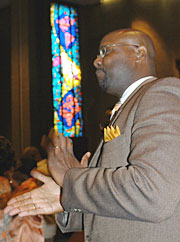
Urging pastors to see the world’s growing problems as “opportunities,” Isadore Edwards, pastor of New Rising Star Missionary Baptist Church in Fort Worth, delivers keynote at African American Fellowship James W. Culp Banquet in Austin.

African American Fellowship
honors past, looks to future

By Barbara Bedrick

Texas Baptist Communications

AUSTIN—As African American Fellowship of Texas members paid tribute to the legacy of the group’s late president and honored the leadership of a statesman, they also were challenged to act by another legendary Texas pastor during the James W. Culp Banquet.

Tears glistened on the faces of Sheila Edwards, sister of the late president Ronald Edwards, and many participants, including Michael Evans, fellowship secretary and pastor of Bethlehem Baptist Church in Mansfield, recalled the legacy of the former pastor of Minnehulla Baptist Church in Goliad.

Nearly 200 pastors and church leaders participated in the 15th annual African American Conference held in Austin. 

“We are blessed by the great memory of a great man,” Evans said as he noted Edwards’ leadership and mission-minded ministry.

Keynote speaker Isadore Edwards, pastor of New Rising Star Missionary Baptist Church in Fort Worth, urged pastors to see the world’s growing problems as opportunities.

“For the church, it’s a great time to be alive,” Edwards said. “Lay the foundation now for future generations.”

Preaching from Joshua 17:14-15, the 81-year-old pastor encouraged African-American leaders to meet life’s challenges.

“If you find the hill country of Ephraim too narrow and confining, climb into the forest and clear ground there,” he said. “If black people are such a powerful people, then get up and stop complaining. Go out there, see those tall timbers and cut them down for yourself.”

Too many young preachers want large congregations, but are not shepherding them, he insisted. Some young pastors, Edwards added, are “fleecing the flock and building a nest for themselves.”

Nothing that God doesn’t want “lethargic” leaders, who say “that’ll do,” Edwards emphasized God wants productive leaders.

“I’m not black by mistake. God gave me potential, preparation and power. So get up. Go up. It’s a high mountain with great trees. Cut it down for yourself,” he said.

Further, Edwards encouraged fellowship and Baptist General Convention of Texas leaders to push past themselves through prayer and power.

Another legendary African-American leader, Marvin Griffin, pastor of Ebenezer Baptist Church in Austin was honored for being a “trailblazer” in ministry and for being a part of the BGCT 38 years.

Jerry Dailey, pastor of Macedonia Missionary Baptist Church in San Antonio, honored Griffin with an award recognizing his long-time leadership. Griffin, who is in his 90s, was unable to attend the banquet.

Called to serve as pastor of Ebenezer Baptist Church in 1969, Griffin led the congregation in a mortgage burning ceremony during the church’s 100th anniversary celebration in November 1975. Later, he initiated a Meals-on-Wheels program for the elderly and started radio, television, tape and bus ministries. 

Under Griffin’s leadership, Ebenezer Baptist recently formed a new partnership involving day care and economic development, including a private developer, the Lilly Endowment, the city of Austin and Nations Bank. A building project in excess of $1 million is underway, according to the church’s web site.

Fellowship leaders also recognized Kenneth Blake, pastor of Westside Baptist Church in Lewisville, and his congregation as the largest giving African-American church to the BGCT Cooperative Program.

In other conference developments, the fellowship announced a new mission focus and named Tyler as the host city for the 2008 16th African American Conference.


News of religion, faith, missions, Bible study and Christian ministry among Baptist churches, in Texas, the BGCT, the nation and around the world.


African American Fellowship elects new officers, casts vision

Posted: 7/27/07

The African American Fellowship of Texas elected (left to right) John Ogletree, pastor of First Metropolitan Church in Houston, as president; Michael Bell, pastor of Greater St. Stephen First Baptist Church in Fort Worth, as vice president; and re-elected Michael Evans, pastor of Bethlehem Baptist Church in Mansfield, as secretary and Marvin Delaney, (not pictured) pastor of South Park Baptist Church in Houston, as treasurer. Steven Young, pastor of New Generation Baptist Church in Tyler was named assistant secretary and Elmo Johnson, pastor of Rose of Sharon Baptist Church in Houston, was named assistant treasurer.

African American Fellowship
elects new officers, casts vision

By Barbara Bedrick

Texas Baptist Communications

AUSTIN—The African American Fellowship of Texas elected a slate of officers during the organization’s 15th annual conference at First Baptist Church in Austin.

Fellowship Vice President John Ogletree, pastor of First Metropolitan Church in Houston, was elected president. Ogletree assumed the president’s post after Ronald Edwards, who was president of the fellowship, died May 31.

Michael Bell, pastor of Greater St. Stephen First Baptist Church in Fort Worth and former president of the Baptist General Convention of Texas, was elected as the fellowship’s vice president. 

The fellowship re-elected Michael Evans, pastor of Bethlehem Baptist Church in Mansfield, as secretary and Marvin Delaney, of South Park Baptist Church in Houston, as treasurer.

The body also elected Steven Young, pastor of New Generation Baptist Church in Tyler, as assistant secretary and Elmo Johnson, pastor of Rose of Sharon Baptist Church in Houston, as assistant treasurer. 

In memory Edwards, the fellowship voted to lend as much support as possible to the former president’s church, Minnehulla Baptist Church in Goliad.

“We plan to provide pastors who will rotate every Sunday to preach and help lead the congregation during this difficult time,” Ogletree said. “We also plan to assist the church in finding a new preacher.

In other action, the group voted to support and be a part of the New Baptist Covenant celebration, scheduled for January 2008 in Atlanta.

Announcing his vision for the year ahead, Ogletree stressed a “focus on making the fellowship a strong viable organization for Texas pastors and serving the needs of churches belonging to the fellowship and the BGCT.” He added that the African-American group wants to secure feedback from the local fellowships in an effort to sharpen African-American leaders. 

The fellowship’s leaders plan to ask veteran pastors to help support pastors of new churches by volunteering to coach and mentor them in their ministries, Ogletree added.  

In other business, the fellowship named Ryan Edwards, nephew of the late president, as the recipient of the Michael Evans Scholarship, a $1,000 college scholarship.  


News of religion, faith, missions, Bible study and Christian ministry among Baptist churches, in Texas, the BGCT, the nation and around the world.


Cybercolumn by Jinny Henson: Optimism’s reward

Posted: 7/27/07

CYBER COLUMN:
Optimism’s reward

By Jinny Henson

The beginning of the journey to Disney—the place where dreams come true—was innocuous. Sunscreen, shorts, our own water bottles and snacks because the tickets cost as much as a compact car. We were set. I had the “unofficial” guide highlighted, which my uptight husband had some issue with since it came from the library. Such a wet blanket that man is. Sheesh.

We arrived at the airport in plenty of time, approached the metal detector and shucked our footwear. I was careful to reign in my sense of humor since a sign blatantly reminds passengers to refrain from making ANY jokes—a thrown-down gauntlet for a comic, I might add. I just want to sing, “gun, gun, gun, gun, gun, gun,” to a Mambo beat whenever I see that thing.

Jinny Henson

Safely inside our connecting flight (this airplane was an older model; it actually had the ashtrays IN the bathroom.) we took off. Due to bad weather in Memphis, our flight was diverted to Little Rock. Hopes dashed, we festered, incarcerated, in the capsule of broken dreams. My husband asked, “Didn’t some airline get sued for holding people on the runway for 17 hours?” He knows just how to reassure the kids. I maternally sweep up the carnage.

“I wish we could just go on one plane and get there,” my 8-year-old innocently expressed. In a Stepford Wives moment, I plastered a patina of calm on my boiling innards and said it wouldn’t be that long and that I would buy him another pack of $2 trail mix from the steward. He was busily distributing more water from an industrial-sized bottled-water jug, which John said he probably just refilled from the airplane faucet. You even had to grab your own cup. We only do it first class.

After 90 minutes, the storm cleared. We were in line to take of for the 20-minute flight to Memphis. As luck would have it, that left just enough time to miss our connecting. Arriving in Tennessee at 5:06, we glanced at the monitor and saw where the flight to Orlando left at 5:00. My cup perpetually half full, I noticed the gate number, and gripped with the adventuresome spirit of Sacagawea, screamed at the family to follow me. We sprinted to the opposite end of the terminal. John lagged behind, convinced that our ship had sailed.

We arrived at the gate, which was empty, the door locked and I could hear the faint echoes of the King lowing “Are you lonesome tonight?”

My optimism is rarely rewarded by life. I should learn by now not to exert myself for the slim chance that something could happen. Not one for regrets, I was certain that we at least had to try. We may have appeared crazy, but if there was the slightest shred of hope that we could get there, we had to attempt it.

This shred-of-hopeness has often led to my deep disappointment. My husband is the rock of Gibraltar. Nothing flusters the man. God did this on purpose. This very moment, he is systematically cutting cantaloupe in perfectly even geometric wedges. I lop the melon into quarters John-Belushi “Samurai Deli” style and sling it on the table. Without him, my kids would most likely view Ding Dongs as a dinner entrée and play in the rain. OK, we still play in the rain, but you get my drift. He is the measured voice of reason that keeps me grounded, helps me focus and has made me a better woman.

But sometimes, unexpectedly, the worm turns and bolsters my naiveté. Out of nowhere, up scurried a ticket agent. She asked for our boarding passes, which of course were in Half-Empty’s pocket 20 gates back. I let out a primal shriek “John,” which shook even the swine on the Memphis BBQ sign down to his pickled feet.

He was as stunned as I was as the stewardess unlocked the door. We were quickly ushered into our flight, which, it turns out, was actually held for us.

Four nights later, after two days of Disney and two at the ACME Marriage Conference (a GREAT combination….any trip to Disney will make you want a divorce—from your entire family,) John and I were seated for the evening banquet with Millard and Linda Fuller. You ever get the feeling that you’ve been seated at the wrong table?

The Fullers founded Habitat for Humanity, which has built homes all over the world. They now build houses through The Fuller Center for Housing. As we watched the Country Music Television’s video of their epic life story of how they have been God’s provision for thousands of downtrodden individuals, I grinned to myself. Perhaps the best things in life—like vision, grace, and optimism—are their own reward.

Jinny Henson travels the country as a Christian comedienne. John, Maggie Lee and Jack are an endless source of material for her. You can find out more about her at www.jinnyhenson.com


News of religion, faith, missions, Bible study and Christian ministry among Texas Baptist churches, in the BGCT, the Southern Baptist Convention ( SBC ) and around the world.


Gay-friendly Baptist groups excluded from New Baptist Covenant event

Posted: 7/26/07

Gay-friendly Baptist groups excluded
from New Baptist Covenant event

By Robert Marus

Associated Baptist Press

FALLS CHURCH, Va. (ABP)—The organization sponsoring an upcoming historic pan-Baptist gathering has told two gay-friendly Baptist groups they cannot participate in an official capacity.

The North American Baptist Fellowship, under whose auspices next year’s “Celebration of a New Baptist Covenant” is being held, has informed the Association of Welcoming and Affirming Baptists and the Baptist Peace Fellowship of North America that they cannot become affiliates of the NABF. Therefore, they cannot be official participants in the event.

“This is not a rejection of either organization or the people in those organization[s],” wrote Alan Stanford, general secretary of the NABF, in an e-mail alerting leaders of the two groups to NABF’s decision. “It is a recognition that we can not hold together the large coalition of Baptists needed to create a new Baptist voice in North America and address the issue of sexual orientation at the same time. We ask for your forbearance and understanding.”

The event is scheduled for early 2008 in Atlanta. It is designed to bring together as many different Baptist denominational bodies in North America as possible, including those of Southern Baptist, American Baptist and African-American Baptist heritage. Organizers—who include former presidents Jimmy Carter and Bill Clinton—have said they hope to unite an ideologically diverse array of Baptists around the common causes of promoting evangelism, fighting poverty and supporting religious freedom.

But Ken Pennings, executive director of the Association of Welcoming and Affirming Baptists, said organizers are ignoring one of the biggest social-justice issues by avoiding the controversial topic of sexuality and the church.

“This sort of thing ought not to go on in Christ’s church,” he said in an e-mail responding to Stanford. “Here we are at a critical juncture when Baptists of all stripes are coming together to take a strong stand for justice for all of God’s children, and the very people in American society being scapegoated and marginalized the most … are not going to be invited to participate.”

To become official sponsors of the celebration, the organizations would have had to become affiliates of the NABF, which is comprised of the denominational bodies in the United States and Canada that belong to the Baptist World Alliance, as well as those groups affiliated with them.

In an interview, Stanford said inviting groups with explicitly pro-gay stances—the Association of Welcoming and Affirming Baptists is made up of congregations open to homosexual members and the Baptist Peace Fellowship counts supporting gay rights as a justice issue—would imply changing the terms of the meeting. That could cause an already fragile coalition to unravel, he said.

“We agreed that we would focus on those things that there was broad agreement about, and there is not broad agreement on this subject,” Stanford said. “So, while everyone thinks that (sexuality) is a topic of grave concern—it is a topic that needs lots of discussion and prayer—it was not a part of the stated agenda from the beginning. And so I think a lot of the North American (Baptist) leaders thought that his would be changing the agreed-upon terms.”

But Pennings said such an attitude betrays the purpose and name of the celebration itself. “This really is more like the Old Covenant than the New Covenant,” he said. “Why would we want to participate in this? There’s nothing new about this; it’s the same old exclusion.”

The criticism of the event from the left is new, but organizers of the celebration have already received extensive criticism from the right. Some leaders of the Southern Baptist Convention—also not invited to participate in an official capacity because it is no longer a member body of the NABF or the BWA—have characterized the event as excluding conservatives. Others have cited Carter and Clinton’s involvement in the event as simply a way to drum up Baptist support for Democrats, even though organizers have also enlisted prominent Baptist Republicans as speakers.

Although the Baptist Peace Fellowship and the Association of Welcoming and Affirming Baptists will not be official participants in the celebration, individual members and participating churches of both groups will. Both Pennings and Evelyn Hanneman, the Peace Fellowship’s interim director, noted that the vast majority of their partner congregations are affiliated with national denominational groups that are member bodies of the NABF and BWA.

“In fact, three Baptist Peace Fellowship members are part of a planning committee” for the celebration, Hanneman said. “So, they’re interested in keeping us off the table for our stance on LGBT (lesbian, gay, bisexual and transgender) issues, and yet we’re already at the table in some ways.”

Hanneman said the Baptist Peace Fellowship would likely try to hold an auxiliary event during the celebration to discuss gay rights and other peace and justice issues.

Pennings said he initially considered recommending that the Association of Welcoming and Affirming Baptists supporters protest the celebration but now thinks the organization will simply encourage its supporters to go to the event and call subtle attention to the issue of sexuality in Baptist life. The association’s leaders likely will “urge our constituency to show up in full strength … and we’ll wear our rainbow stoles and our buttons, and we’ll be a visible witness there,” he said.

Stanford said he hopes all interested in bringing Baptists together will support the covenant celebration, recognizing that “the most significant thing is that we have a vast diversity, especially the Anglo and the African-American groups that have never worked together in any significant way.”


News of religion, faith, missions, Bible study and Christian ministry among Baptist churches, in Texas, the BGCT, the nation and around the world.