Harry Potter, move aside. Christian fantasy has arrived

Posted: 7/20/07

Harry Potter, move aside:
Christian fantasy has arrived.

By Juli Cragg Hilliard

Religion News Service

WASHINGTON (RNS)—Whether their books feature dragons, firefish or sword-wielding soccer moms, writers of Christian fantasy fiction are clamoring for a spot in the marketplace.

Fantasy fiction in general commands a large following and copious real estate in bookstores. But while websites and Christian writing conferences brim with writers working on Christian fantasy, most publishers are just starting to be open to these new books.

The books may carry overt references to Jesus and Scripture—or simply an understated Christian perspective with clean content, positive role models and unambiguous depictions of good and evil in the style of C.S. Lewis or J.R.R. Tolkien.

Writers use the term “Christian speculative fiction” to include fantasy, science fiction or anything other-worldly.

To raise awareness of Christian fantasy and promote his books, Bryan Davis has spoken to 30,000 kids in the last year—including 112 talks in two months, and 12 in one day.

Davis, a father of seven, writes the Oracles of Fire, Dragons in Our Midst and forthcoming Echoes from the Edge series, all for youth audiences.

This month, he and three other authors will try to jump-start interest in Christian fantasy with a nine-day road trip—the Fantastic 4 Fantasy Fiction Tour.

“There’s probably a lot of the Christian community that doesn’t even trust us,” said Davis, who disputes associations with satanic or shadowy influences. He also offers guidelines for choosing fantasy books.

“One of the main things to look for is whether or not the author has a clear delineation of good and evil,” he said.

Another obstacle for Christian fantasy writers, said Jeff Gerke, who writes novels under the pseudonym Jefferson Scott, is that the Christian publishing industry has yet to get behind the genre.

Gerke says plenty of readers and writers of Christian speculative fiction are out there, but the Christian presses mostly target evangelical white women—who don’t tend to be fantasy enthusiasts.

Popular Christian fiction stars Jerry Jenkins and Tim LaHaye (co-authors of the Left Behind series), Frank Peretti (This Present Darkness) and Ted Dekker (Thr3e) command front-table display in bookstores, but their success has created little demand from Christian publishers for writers working on similar themes, Gerke said.

For Christian writers who think mainstream presses might be an option, “it’s a very crowded area, and there’s debate about whether if you write for a secular publisher are you able to be as Christian as you want to be.”

Still, a few new releases include notable offerings.

From Harvest House, George Bryan Polivka’s The Legend of the Firefish and The Hand That Bears the Sword contain overt Christian themes; its hero is a failed seminarian struggling with his faith.

Polivka said his work is not typical fantasy. “In fact, there’s no magic in it. There are lots of movements of God—miracles that happen at just the right moment.”

Sharon Hinck’s The Restorer, first in a Sword of Lyric series aimed at women, is told through the voice of Susan Mitchell, a mother of four who is disenchanted with her ordinary life and wants to be like the biblical Deborah. Then Mitchell is dropped into an alternate world where people think she might be a Restorer, someone “with gifts to defeat our enemies and turn the people’s hearts back to the Verses,” the books says.

The same publisher, Nav-Press, also released Tosca Lee’s Demon: A Memoir. And this months brings DragonFire, the latest in Donita K. Paul’s DragonKeeper Chronicles series.

Ginia Hairston, a vice president for Random House’s WaterBrook division, said, “There is a God-type figure (in Paul’s books) but he is not referred to as God.

“There are evil characters that certainly are not referred to as demons.”

In September, WaterBrook plans to release Auralia’s Colors, first in Jeffrey Overstreet’s The Auralia Thread series.

Davis, the Oracles of Fire author, believes the proliferation of writers working on Christian fantasy serves as a barometer of the supply of readers hungry for it. The power of the fantasy genre, he said, is its ability to create situations for heroism.

“Fantasy opens up the kind of vision,” he said, “to be able to see beyond where we are.”


News of religion, faith, missions, Bible study and Christian ministry among Baptist churches, in Texas, the BGCT, the nation and around the world.


RIGHT or WRONG? No-smoking ordinances

Posted: 7/20/07

RIGHT or WRONG?
No-smoking ordinances

Cities and towns across the country are debating no-smoking ordinances. This seems imbalanced—the wants of some citizens are overruling the rights of others. Where should a Christian come down?

Balancing the rights of individuals against the health and welfare of the public has been hotly contested. Should a veteran who has risked life to defend freedom have the right to smoke in a public place? Increasingly, local governments are saying “No” and writing strict ordinances that prohibit or limit smoking in public spaces. Is this an infringement on freedom that Christians should resist?

The answer is “No.” Smoking bans are reasonable restrictions on individual rights to protect public health. The scientific evidence is clear and unanimous—secondhand smoke can be a killer if an individual is regularly exposed to it. In June 2006, Surgeon General Richard Carmona stated secondhand smoke dramatically increases the risk of heart disease and lung cancer in nonsmokers and can be controlled only by making indoor spaces smoke-free.

“The health effects of secondhand smoke exposure are more pervasive than we previously thought,” Carmona said in the Washington Post. “The scientific evidence is now indisputable: Secondhand smoke is not a mere annoyance. It is a serious health hazard that can lead to disease and premature death in children and nonsmoking adults.”

The surgeon general’s report notes exposure to smoke at home or work increases nonsmokers’ risk of developing heart disease by 25 percent to 30 percent and lung cancer by 20 percent to 30 percent. It especially is dangerous for children living with smokers and causes sudden infant death syndrome, respiratory problems, ear infections and asthma attacks. Because mechanical filtration does not eliminate these risks, the report concludes, “Nonsmokers need protection through the restriction of smoking in public places and workplaces and by a voluntary adherence to policies at home.”

Individuals have the legal right to harm their own health by over-eating, drinking excessively or smoking. But an individual does not have the right to endanger others’ health and safety. A person’s right to free speech is reasonably limited by ordinances that make it illegal to shout “Fire” falsely in a crowded public place where the ensuing stampede could cause injury or death. Smoking bans are based on the same principle. For the waitresses and other employees, and for the public, it is reasonable to limit the rights of an individual to smoke to protect others’ right to healthy public spaces.

For Christians who are called to put the good of others first, as Christ did, and to consider their own bodies the temple of the Holy Spirit, limiting smoking in public places (and voluntarily in the home) is clearly the right thing to do.

Alan Stanford, director of mission advancement

Baptist World Alliance

Falls Church, Va.


Right or Wrong? is sponsored by the T.B. Maston Chair of Christian Ethics at Hardin-Simmons University's Logsdon School of Theology. Send your questions about how to apply your faith to btillman@hsutx.edu.


• The “Comments” function is being reworked for greater security. We're sorry for the inconvenience.


News of religion, faith, missions, Bible study and Christian ministry among Baptist churches, in Texas, the BGCT, the nation and around the world.


Special teachers minister to special friends at West Texas church

Updated: 7/20/07

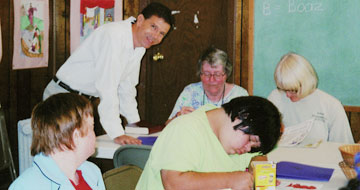
Benny Thompson (center), along with his wife, Martha, leads a Sunday school class for the mentally challenged at Corinth Baptist Church near Cisco.

Special teachers minister to special
friends at West Texas church

By George Henson

Staff Writer

CISCO—Corinth Baptist Church sits almost exactly halfway between Cisco and Eastland on an unpaved road. While it’s quite a way from any town, distance has not stopped the church from reaching arms of love to developmentally challenged adults throughout the region.

Martha Thompson and her husband, Benny, had taught a class of young couples for several years before they started a special friends class for developmentally challenged people five years ago.

A young man with learning disabilities began attending the Sunday school. Since there was no other place for him to go, he was directed to the Thompson’s class. Soon, a couple of more adults with similar difficulties began attending, and they also were brought to the class.

Howard White (standing) helps lead the Sunday school class for the mentally challenged at Corinth Baptist Church near Cisco. He works alongside Martha and Benny Thompson, who started the ministry. (Martha Thompson photos)

Mrs. Thompson began to struggle with the newcomers being in the class, because she knew they did not comprehend the Bible-reading or the discussion. She prayed, “God, I’m trying to teach them, but I don’t know what I’m doing.”

The number of couples in the class continued a decline until it was the Thompsons and one other couple. Mrs. Thompson continued to pray until she said God told her clearly, “You’re trying to teach the wrong people.”

It was at that point that she went to Pastor Benny Hagan and told him she wanted to start a special friends class. Hagan, who has a grandson with special needs, was very receptive to the idea.

“I knew there were a lot of people out there whose needs were not being met,” he said.

Since then, the church has bought a mobile home that was placed behind the church for use by the special friends class. Now the class averages seven and has had as many as 16 in attendance. In addition to the Thompsons, Howard and Letty White lead the class.

Class members range in age from 28 to 74, but their understanding is more basic than that.

“Our bunch, not matter what their age is, except for one, all are about kindergarten or first grade developmentally. We do have one who can read a little bit and is probably at about a third-grade level,” Thompson said.

Because of that, the teachers tell the story each week rather than reading them straight from the Bible, because some of the words are too hard for class members to understand.

The class has been studying the “ABCs of Bible People,” starting with Adam and Eve and ending with Zacchaeus. Each person’s work is being compiled into a book they will take home at the end of the series.

On a typical Sunday, one of the teachers tells the story, using a flannelgraph board or video as a visual aid, followed by a solving a puzzle, coloring a picture or making a craft. Prizes are awarded each month for perfect attendance.

Each class member also has a box of crayons with his or her name on it. “That way they know that each one has something that ties them here,” Thompson said.

Once a month, the flannelgraph board is used to demonstrate the plan of salvation. Thompson said most of the class has heard the presentation enough that they say the words along with the teacher.

To date, seven members of the class have made professions of faith, and three have been baptized, including one person who was 70 years old. The others want to be baptized, but a fear of water has kept them from following through with that desire.

The success of the class rests primarily with the Thompsons and Whites, Hagan said.

“We teach special people, but it takes special teachers, not just anyone could lead this class,” he said. In addition to teaching the class on Sundays, the Thompsons visit Northview Development Center in Eastland, where most of the class lives, each Wednesday.

“Our main purpose is to meet needs, and these people have a lot of needs. It’s a blessing to see these people ministered to, especially when you have a relative that’s been affected by it. It makes it that much more special,” he continued.

He is quick to point out that the class members are accepted and ministered to by the entire church.

“Our people just consider them to be part of the family,” Hagan said.

Members of the congregation buy Christmas gifts for members of the class, and two cookouts are held each year. Also, class members’ birthdays are recognized during Sunday morning worship services.

“We’re giving recognition to them as human beings and persons of worth,” Hagan said.

Benny Thompson said he enjoys his part of the ministry a great deal.

“I know that God don’t make junk, and he loves them just as much as I do,” he said. “And besides, we’re all handicapped in one way or another.”


News of religion, faith, missions, Bible study and Christian ministry among Baptist churches, in Texas, the BGCT, the nation and around the world.


BWA celebrates freedom, promotes reconciliation

Updated: 7/20/07

BWA celebrates freedom,
promotes reconciliation

By Tony Cartledge

N.C. Biblical Recorder

ACCRA, Ghana (ABP)—The twin themes of freedom in Christ and reconciliation that leads to unity echoed throughout the July 2-7 annual gathering of the Baptist World Alliance.

With more than 110 million members, the Alliance is the world’s largest Baptist umbrella organization. Meeting in West Africa, delegates elected Neville Callam—a Jamaican whose ancestors were slaves from West Africa—as the body’s new general secretary. Denton Lotz, who has been general secretary since 1988, will retire later this year.

Neville Callam

Callam is the 102-year-old organization’s first non-white general secretary, as well as the first from somewhere other than the United States or Europe.

Callam said his election shows the alliance has become a worldwide body with a global reach.

“God is working to make out of our cultural plurality as Baptists a wonderful mosaic that models the diversity that enriches and builds up unity, rather than diluting or diminishing it,” he declared.

“There is a home for all Baptists in the BWA. There is no turning back now. Christ our Lord goes before us. He leads the way. … Let us be content to be servants among the servants of God.”

Callam was among several other descendants of slaves who assisted in leading a service of memorial and reconciliation at the Cape Coast Castle, formerly a major center for the slave trade.

BWA’s general council also approved seven resolutions, several of which touched on freedom and reconciliation. In commemorating the 200th anniversary of the first act to officially abolish slavery, delegates acknowledged that as many as 27 million people remain enslaved through human trafficking and pledged to “stand against this ongoing and pervasive evil institution” and “compassionately minister to those trapped by it.”

Baptist World Alliance participants from around the globe gathered this summer in the courtyard of Ghana’s Cape Coast Slave Castle for a service of memory and reconcilation. (Photos/Trennis Henderson of the Western Recorder)

A resolution on Darfur expressed concern about ongoing human rights violations in Sudan, affirmed efforts of the Sudan Interior Church to remain united, and encouraged the development of partnerships with Sudanese Baptists.

A resolution on “Detention and Due Process” urged all governments and non-state actors “to enforce and abide by the basic tenets of human rights as represented in international laws and conventions in the investigation, arrest, interrogation, detention, due process, trial, sentencing, and incarceration of all persons.”

BWA leaders also expressed concern about corruption worldwide and affirmed the work of Baptist World Aid. Delegates passed a recommendation expressing concern “for nations and peoples who are caught in a terrible circle of hatred, violence, injustice, and suffering.” The recommendation encouraged prayer “for justice and mercy upon these troubled nations and peoples.”

Joao and Nora Matwawana, natives of Angola who live in Canada, received the 2007 “Denton and Janice Lotz Human Rights Award.” BWA president David Coffey said the Matwawanas have worked, suffered, and toiled together through many years of promoting reconciliation efforts in Angola, the Democratic Republic of the Congo, Burundi and Canada, where they are involved in prison ministry.

Plenary worship speakers through the week also promoted the themes of freedom and unity.

Steve Asante, pastor of the Asukwa Baptist Church in Kumasi and president of the Ghana Baptist Convention, called for participants to work for oneness in Christ. “The testimony of unity is powerful,” he said.

Asante noted that government leaders from all over Africa were meeting in the same city to work toward greater unity and cooperation among African nations. The conjunction of the meetings was prophetic, Asante said.

“When Baptists work together, we show what we can do,” he said. “If we have a voice, it will only come through our unity, through our oneness.”

Coffey of England drew from Galatians 5 to declare that Christians are free of binding legalism. Being free in Christ does not mean believers live without any boundaries, he said, for “to be truly free is to be truly yoked to Christ and serving one another.”

Legalistic beliefs about worship style, eschatology, or matters such as prayer languages should not be required for full participation in Baptist life, Coffey said.

Paul Msiza of South Africa, president of the All Africa Baptist Fellowship, said God offers “a freedom equal to none other because it brings us all equal before God,” in whom “there is no Jew, Gentile, male or female.”

But Christians are tempted to add to God’s free offer, he said.

“What I see as human nature is that we are uncomfortable about the things we cannot control,” Msiza said. “We want things we can fiddle with. We want to open the free gifts from God and fiddle with them, and we change the gospel by adding and subtracting so many things.”

Sometimes it is a “tendency to prescribe and describe what is good for us,” he said, resulting in a freedom that only men or the powerful can enjoy.

In his closing message, Lotz emphasized reconciliation by recalling the story of Jacob and Esau’s reunion in Genesis 33. Jacob feared that Esau would still bear hatred toward him, but instead, Esau embraced him.

Jacob responded, “To see your face is like seeing the face of God.”

“That’s real reconciliation—when you can look at your neighbor and see the face of God,” Lotz said.

Such reconciliation comes through spending time in prayer and looking into the face of Jesus, he said.

The meeting included a number of forums and workgroups, several of which dealt with poverty, HIV/AIDS, human trafficking, and other issues of freedom and justice.

In business matters, the BWA adopted a 2008 budget of $2.8 million, an increase of nine percent over 2007. Budget officials said growing income from churches and individuals made the increase possible.

Delegates also voted to approve the membership application of the Community of Christian Churches in Africa, which consists mostly of churches in Rwanda, with some also in Uganda and Burundi.

On July 7, participants feted Denton and Janice Lotz with a tribute-laden farewell celebration.


News of religion, faith, missions, Bible study and Christian ministry among Baptist churches, in Texas, the BGCT, the nation and around the world.


Jamaican pastor elected BWA general secretary in historic vote

Updated: 7/20/07

Jamaican pastor elected BWA
general secretary in historic vote

By Trennis Henderson

Kentucky Western Recorder

ACCRA, Ghana (ABP)—Neville Callam, a Jamaican pastor, theologian and author, was unanimously elected July 6 as the first non-white general secretary of the Baptist World Alliance. He is also the 102-year-old alliance’s first leader not from the United States or Europe.

Callam, senior pastor of two congregations in Jamaica, is a former BWA vice president and former president of the Jamaica Baptist Union. Active in BWA for more than 20 years, he currently serves on its implementation task force, which restructures the organization’s work for the future.

New Baptist World Alliance General Secretary Neville Callam speaks at the BWA’s service of memory and reconciliation at Ghana’s Cape Coast Slave Castle.

Denton Lotz, the retiring general secretary, affirmed his “100-percent support” of Callam’s election.

“I think God has blessed you in a wonderful way and has prepared you for this,” Lotz told his successor.

Search committee Chairman John Sundquist said the 13-member committee included representatives from eight nations. He also described Callam as “an articulate Baptist statesman with a global reputation … and a faithful follower of our lord and savior Jesus Christ.”

Citing Callam’s “unusual depth of theological knowledge,” Sundquist said he “is the most seminal theological thinker I have ever met.”

Burchell Taylor, president of the Caribbean Baptist Fellowship, described Callam’s nomination as “part of the mysterious unfolding of God’s own purpose.”

Callam’s election would add a “new, creative dimension … to Baptist world history,” he added.

Responding to his election by the organization’s general council, Callam told council members that the “Baptist world family joyfully declares that the BWA has become a worldwide body with a truly global reach. In this alliance, every member is God’s gift to the membership as a whole. We all belong together.”

Callam also said that God is working “to make a wonderful mosaic that models the diversity that enriches and builds up unity, rather than diluting or diminishing it.”

Callam’s election at the BWA annual gathering in Accra, Ghana, came one day after participants held a service of memory and reconciliation at Ghana’s Cape Coast Slave Castle. The service included moments of remembrance, confession and pardon in honor of the Africans sold into slavery during the trans-Atlantic slave trade.

Noting that “my ancestors were born somewhere on this great continent of Africa,” Callam said, “They were rounded up and shipped to the West Indies, where they endured many years of enslavement. Then God emancipated both them and their oppressors.”

Declaring that his forefathers “encountered God who revealed to them the truth about their humanity and also God’s great love for them,” Callam said “they found full freedom by the grace of the God revealed to us in our lord and savior Jesus Christ.”

Following Callam’s election, BWA President David Coffey led a brief commissioning service.

“When leadership changes, the ministry continues,” Coffey said, comparing the leadership transition from Lotz to Callam with that of Moses and Joshua.

Callam, a specialist in Christian ethics, is a graduate of the University of the West Indies and Harvard Divinity School. He and his wife, Dulcie, are the parents of two adult children.


News of religion, faith, missions, Bible study and Christian ministry among Baptist churches, in Texas, the BGCT, the nation and around the world.


Floods pour in; Baptist love pours out

Updated: 7/20/07

Floods pour in; Baptist love pours out

By Barbara Bedrick

Texas Baptist Communications

WICHITA FALLS—As Texas Baptist Men volunteers cut out soaked sheetrock and carried out a ruined piano, organ and other debris from inside Primera Iglesia Bautista, members continued to worship—at a nearby funeral home.

The temporary church sanctuary has not stopped God from saving lives. Pastor Simon Flores believes holding worship services at the funeral home actually led two mothers to Christ.

First Baptist Church of Eastland member Carol Brittain holds two of the precious memories she saved from recent floods. Water rose 10 feet in her home, but Texas Baptist Men volunteers and the BGCT Disaster Response Team have moved quickly to help.

A recent drive-by shooting claimed the life of one mother’s son. After Flores delivered the eulogy at the funeral service, the mother attended the church’s Sunday worship services at the funeral home and accepted Christ as Savior.

“As the first mother came up to be saved, another mother also stepped forward,” Flores said. Later, he learned “one mother’s son was responsible for the other mother’s son’s death.”

“Both mothers reconciled. God had his hand in this, and he is putting everything together for us,” Flores said.

Arrangements have been made to move the congregation’s worship services to a chapel at First Baptist Church in Wichita Falls. The Baptist General Convention of Texas Disaster Response Team also has surveyed the damaged church structure and is working to help the church with a grant.

For now, TBM clean-out units from the Lubbock Baptist Association, Collin Baptist Association and Paramount Baptist Church in Amarillo have wrapped up their efforts in the Wichita Falls area. They assisted almost 50 families in recovery efforts from flood damage. Volunteers from the Wichita-Archer-Clay Baptist Association feeding unit provided more than 4,000 meals to victims and volunteers.

Responding to other flooding, the BGCT Disaster Response Team delivered small grants for five Gainesville families. Texas Baptist Men volunteers provided more than 13,000 meals before shutting down the feeding unit there.

But TBM volunteers, Baptist churches and BGCT disaster relief teams wrapped their arms around flood-ravaged communities statewide.

When James and Rita Bruton of Leon River Cowboy Church in Eastland saw how heavy floods at Lake Leon devastated their neighbors, they were moved to seek help. The couple turned to their pastor, Paul Howie, who invited the congregation to reach out to neighbors in need.

The response was overwhelming; with about one-third of the congregation getting involved. Thirty-three members helped families pack up their belongings and clean out flood debris.

“God opens doors through relationships,” Howie said. “It was an opportunity for our church to grow in faith—Christians aren’t only in the church but reaching out in the community.”

Church volunteers also worked to help two members whose homes were so badly damaged they will have to be demolished, another church family and dozens of neighbors.

Lyn Hagen had 55 inches of water in his home and initially was discouraged by the recovery job before him. That turned to astonishment as he watched 10 Texas Baptist Men volunteers and church members go to work.   

“God didn’t turn his back on me, even though I’ve turned mine on him before,” Hagen said.

Cisco Baptist Association Director of Missions Genoa Goad worked side-by-side with volunteer teams in Eastland neighborhoods, and then several days later moved the association’s offices because of rain damage. The new office temporarily is located at East Cisco Baptist Church.

Another couple hit hard by the floods, Jenelle and Fred Coyle of Duncanville, were amazed at how quickly TBM volunteers removed water-soaked paneling, swept out water and carried out appliances before sanitizing their home.

“I have always been the one helping others, and I had not needed any help until now,” she said. “I thought TBM volunteers only showed up to cook food after disasters. I never knew they helped clean up after floods. This is overwhelming.”

Recovery could take awhile for many of the Lake Leon victims. Water rose more than 10 feet in Carol Brittain’s Leon Lake home. As her life returns to normal, she said she was “blessed to have the help of TBM volunteers” and the BGCT.

BGCT Congregational Strategist Tim Randolph met with Goad and with Baptist leaders in Eastland from First Baptist Church and Leon River Cowboy Church, assessing damages and providing applications for disaster-response funds.

Brittain, a single mother of two teenagers, applied for the funds and TBM volunteers removed flood damaged walls and floors.

Leading TBM’s Eastland teams, Ernie Rice, directed 20 volunteers from the Second Baptist Church in La Grange and the Gambrell Baptist Association clean-out units. Ellis Baptist Association volunteers delivered 1,500 boxes to Lake Leon Baptist Church and helped homeowners pack their belongings so TBM crews could move in to remove damage and sanitize.

Rice also spent much time training local volunteers for nearly two weeks, including a massive effort July 7 which illustrated how a community of faith comes together to help in a disaster.

“It was a special day for the disaster relief effort in Eastland,” Rice said. “It was fabulous. TBM trained and directed 150 volunteers, including local Baptists, members of other area churches and 25 volunteers from Dyess Air Force Base. … God is good.”

To support the BGCT Disaster Response Team, go to www.bgct.org/disaster, or to help TBM efforts, go to www.texasbaptistmen.org.


News of religion, faith, missions, Bible study and Christian ministry among Baptist churches, in Texas, the BGCT, the nation and around the world.


BaptistWay Bible Series for July 29: Toward a more meaningful life

Posted: 7/19/07

BaptistWay Bible Series for July 29

Toward a more meaningful life

• Ecclesiastes 9:7-10; 12:1-8, 13-14

By Andy Rodgers

Hardin-Simmons University, Abilene

What is the meaning of life? It is a popular question among people of all faiths, cultures and ages. The question has been asked in countless forms of media including everything from movies to comic strips.

Charlie Brown and Lucy even had the discussion once. Lucy asks, “Why do you think we’re put here on earth Charlie Brown?” He replies, “To make others happy.” Lucy responds, “I don’t think I’m making anyone very happy. Of course nobody’s making me very happy either. Somebody’s not doing his job!”

We as Christians ask the same question. However, we are not the first ones to inquire about the meaning of life here on earth. Solomon sought the answer to that same question throughout his prosperous life and writes to us about the answer he discovered.

Some might try to interpret Ecclesiastes 9:7-10 as an excuse to pursue all the pleasures of this world. However, they seem to be missing the recurring theme present throughout the entire book. Solomon constantly reminds us in Ecclesiastes that earthly pleasures do not last and do not satisfy. We often call these “temporal,” because they last only last a time.

Instead, Christians find in this passage the urgency both to be satisfied with what joy God has given us here on Earth and to be diligent with the work we need to do before leaving this life. The passage is both a call to simplicity and a call to service, both of which bring joy and meaning to our life.

Ecclesiastes 12:1-8 declares, “Everything is meaningless!” We all have had those same thoughts at different times in our life. Something happens to us in life, and we understand the futility of pursuing earthly gain and worldly delights. It is in these moments when we choose to simply survive this time on earth, living day to day, or we choose to pursue heavenly rewards and seek the will of God, not man.

When reading this passage of Ecclesiastes, do not forget that Solomon is unaware of the life of Jesus Christ who came speaking of eternal life. Despite this fact, both Solomon and Jesus arrive at the same conclusion—the things of God are far greater than the things of this world.

When we lose focus and only see things through our own eyes, we cannot see this world as God does. We are unable to see things from the eternal and heavenly perspective, and we miss the great things God has for us here on Earth.

Finally, in Ecclesiastes 12:13-14, Solomon dares to give us the answer to the question that has been asked so many times in so many different ways. What is the meaning of life? “Fear God and keep his commandments, for this is the whole duty of man.” Perhaps our response is like so many of the responses we see in movies and television shows that have sought to answer the question in a simple way. “That’s it? That’s the answer?”

If we take a step back from our own personal perspective of life, and attempt to see our life with an eternal or heavenly perspective, we just might understand Solomon’s answer. It seems too simple an answer for such a difficult and complex question. After all, is not life complex and filled with difficulty and paradox? Yes, it is, but we do not have to understand all of life to find out its meaning.

Solomon, filled with wisdom and understanding, did not know everything about life. However, he knew the one who did know everything. So, Solomon does not tell us the difficult and complex answer to all of life’s secrets, but instead assures us we do not need all of life’s answers to find meaning in life. We only need to know the one who has all the answers, who can see everything with an eternal perspective, and we need to be obedient to him. Our obedience to his will is a direct response to how much we trust in God to bring us meaning, pleasure and fulfillment in life.


Discussion question

• In what areas of your life do you find meaning? Pleasure?

• Knowing our time here on earth is short, what are some things you need to be doing in life?

• Describe a time in your life when things seemed meaningless. Was your response to this time in life positive or negative?

• How does Jesus’ message about eternal life affect our perspective of life here on Earth?

• What actions do you need to take that will increase your sense of meaning in life?


Andy Rodgers is a master of arts in family ministry student at Hardin- Simmons University’s Logsdon Seminary. He also is youth minister at First Baptist Church in Eastland.

News of religion, faith, missions, Bible study and Christian ministry among Baptist churches, in Texas, the BGCT, the nation and around the world.


Bible Studies for Life Series for July 29: Agreeing on the basics

Posted: 7/19/07

Bible Studies for Life Series for July 29

Agreeing on the basics

• Acts 15:1-2, 4-5, 12-15, 23-29

By David Harp

First Baptist Church, Stanton

C.S. Lewis, the great English author, wrote, “All the angels look upon you today to see which direction you will choose.”

The early church was exploding with new growth and soon had to meet to make some decisions that would impact all eternity. The year was around A.D. 48. The Jerusalem conference was called together because in the early days only Jews became believers. They were committed to the Jewish traditions and customs. They were Jews who had become Christians.

Then, the Christian faith expanded and grew beyond the ranks of the Jews. In Acts 8, we read about Philip’s experience with the man from Ethiopia. In Acts 10, we read of Peter’s experience with Cornelius. In Acts 13, we learn of the emerging Christian church in Antioch, and the mission trip to Cyprus and Asia.

In each of these cases, not only Jews but also Gentiles were brought into the church. This rapid progress and growth of Gentile believers into the church presented the more conservative Jewish Christians with a serious problem. Before long, more Christians would be Gentiles than Jewish. The Jewish Christians were concerned so many new Gentiles in the church might lead to a weakening of the moral standards of the church. What would the church decide? What would they do? What do we do when we disagree at church?


Acknowledge the conflict (Acts 15:1-2, 4-5)

A serious debate arose in the church at Antioch. Some Jewish believers demanded Gentiles be circumcised in order to be saved. Paul and Barnabas vigorously disagreed, standing firm on the doctrine of salvation by faith in Jesus. Since the disagreement could not be resolved, the church sent Paul and Barnabas to Jerusalem to ask for guidance.

At Jerusalem, they were welcomed and everyone was glad to hear what the Holy Spirit had done among the believers in Antioch. But the conflict grew when the Jewish believers added to their demands by requiring the Gentiles obey the law of Moses.

Conflicts are going to happen—even among believers! When a disagreement threatens a foundational belief such as salvation, the church must address the issue openly and honestly. A good leader will not be afraid to address an issue that threatens to divide the fellowship of the church body.


Evaluate in light of Scripture (Acts 15:12-15)

Peter testified to the leadership of the Holy Spirit in the lives of Cornelius and the Gentiles. The work of the Holy Spirit in their lives mirrored the work at Pentecost. Next, the members of the assembly were captivated by the testimony of the Holy Spirit’s work in Antioch.

No one could deny the powerful work of God in the lives of Gentile believers. James, the brother of Jesus and a leader in the church in Jerusalem, led the church through the process. Based on the testimony of the Holy Spirit through the apostles and Scripture, James judged no Gentile should be kept from coming to God based on some Jewish traditions (Acts 15:19). Literally, “we should not make it difficult for (impose no irksome restrictions on.)” Men and women, boys and girls could come to Jesus all the same way.

The impact of this for our lives is undeniable. Our righteousness with God is through faith and not the compulsive fulfillment of our own idea of what he requires.

This does not mean there are no disciplines for the living out of our faith. What it does mean is that our faith brings us into fellowship with God, who lovingly provides for us all things. We often want others to know or hear our opinion. What we can know as reliable is God’s word.


Identify the non-negotiable truths (Acts 15:23-29)

To give the church in Antioch some reassurance, the council wrote a letter. The council agreed with James’ summary—salvation by faith in Christ alone was a non-negotiable truth. Paul and Barnabas and Judas and Silas are chosen to deliver the letter. The letter significantly disassociates the Jerusalem church from the legalistic teachers and confirms the gospel of grace they had originally heard (v. 28). The letter appeals to the unity of the faith of all the believers—the Jews and the Gentiles.

The letter included four commands, but they were not requirements for salvation. They were written to preserve the fellowship of the church body. They were written so that together the Jewish and the Gentile believers could sit down together in a worship setting and later in a fellowship setting over a meal and enjoy the partnership they shared together in Christ.

The church was experiencing growing pains. When God decides to move we are given the opportunity of partnering with him in the gospel. We must not allow our personal preferences or personalities to get in the way.

I’m glad to report that upon receiving this letter the Christians in Antioch “read it and were glad for its encouraging message” (v. 31).


Discussion questions

• How can we listen to one another and to the Holy Spirit?

• How can we seek to learn from Scripture its teaching on “difficult” subjects?

• What are the essentials of our faith?

• What are some non-essentials that often distract us in our faith walk?

News of religion, faith, missions, Bible study and Christian ministry among Baptist churches, in Texas, the BGCT, the nation and around the world.


Explore the Bible Series for July 29: Zechariah calls us to integrity

Posted: 7/19/07

Explore the Bible Series for July 29

Zechariah calls us to integrity

• Zechariah 7:1-14

By Kathryn Aragon

First Baptist Church, Duncanville

This week’s lesson takes us out of the realm of God’s grace, out of the scope of service and traditions, and reminds us that all these things mean nothing if they aren’t inspired by pure love for God.

It’s easy to be so distracted by the day-to-day activities of Christianity that we fail to include God or consider his words and calling. Like over-eager children, we tell God our plans for today and the coming weeks rather than asking him what his plans for us are. God is telling us to “administer true justice; show mercy and compassion to one another.” He is asking us, in our hearts, not to think evil of each other (7:9-10).

But we’re so busy with our plans, we don’t hear him. Far from pleasing God, our busy-ness brings severe consequences. “‘When I called, they did not listen; so when they called, I would not listen,’ says the Lord Almighty” (v. 13).


Pure motivations can become impure over time

In our results-oriented culture, we can get caught up in activities and, after a while, forget the point of those activities. Initially, we may be drawn to a ministry or act of worship because it gives us a medium for giving back to God, of expressing our thanks for his generosity. But over time, the medium becomes the object rather than the expression.

Today, God asks us to evaluate our motives: “Then the word of the Lord Almighty came to me: ‘Ask all the people of the land and the priests, “When you fasted and mourned in the fifth and seventh months for the past 70 years, was it really for me that you fasted? And when you were eating and drinking, were you not just feasting for yourselves?’” (vv. 4-6).

Although they begin as pure, motives often slip over time, becoming dusty, if not outright sooty. Soon, if we aren’t careful, our motivations revolve around the benefits of serving God instead of God himself. Especially here in the Bible Belt, the benefits of serving God can far outweigh the persecutions. Active membership in church makes us look good. On top of earning God’s favor, we can make friends, build client lists and impress people with our spirituality, knowledge and kind-heartedness.

God wants his children to have pure hearts. “Those who have been given a trust must prove faithful” (1 Corinthians 4:2). Each day and with every act, we must ask ourselves: What’s our objective? But to answer that question, we must understand what our objective should be.


God’s objectives for his children

Because we are, at root, insecure, most of us are looking for approval. If people approve, we feel we are hitting the mark. Yet Jesus teaches that pleasing people is not the same as pleasing God: “If you belonged to the world, it would love you as its own. As it is, you do not belong to the world, but I have chosen you out of the world. That is why the world hates you” (John 15:19).

We are, however, called to remain in Jesus: “I am the vine; you are the branches. If a man remains in me and I in him, he will bear much fruit; apart from me you can do nothing.” (John 15:5). We are also called to obey him—“If you love me, you will obey what I command.” (John 14:15). And, “Why do you call me, ‘Lord, Lord,’ and do not do what I say?” (Luke 6:46).

What is his command? To love God with all our being and to love others. In this way, we become a living testimony to the power of God. It’s a simple command, but anyone who has tried to live it out has quickly discovered how difficult it really is. Love puts others first, and most of us are too busy taking care of ourselves to do that.

It becomes even more difficult if we look at 1 Corinthians 13 to find God’s definition of love. What is love? It is acting toward people with patience, kindness, trust, hope and perseverance. It is refusing to envy, boast or act pridefully, rudely or selfishly. It doesn’t get angry easily, and it doesn’t keep a laundry list of wrongs incurred from others. Instead, it protects others, even if it means death to self.

Most of us agree these are good qualities. Most of us would say we treat others with love. But how many of us protect those who harm us? How many of us keep on trying, even when we’re the only ones trying?


Integrity demands honesty

God’s call today is a call to worship and serve him with integrity. That means we must be honest with ourselves and with him. Typically, when we fall short of God’s commands, we excuse ourselves with a wave of the hand. Justifying ourselves clears us of guilt—at least in our own minds. But God isn’t deceived. He knows our hearts. He knows our motivations. He knows the harder we justify ourselves, the further we have strayed from pure faith.

It’s a slippery slope. Even today, we could choose to refocus our lives on God. But within a short time, we’d be giving excuses for falling short again. What’s the answer? How do we maintain integrity in our walk with God? It takes more than sorrow or shame over the past. It demands more than walking the aisle to rededicate our lives. If we are to worship God with integrity, we’ve got to understand the basics of relating to God.

God isn’t concerned with how we look on the outside. He only cares about our hearts. The purity of our intentions is determined by the purity of our hearts.

God wants to be the center of our universe. He created us to revolve around him. He wants to warm us in the glow of his love. But our inability to grasp this truth causes us to spin out of orbit and lose ourselves in the darkness of this world.

God wants to lavish us with blessings. But he cannot reward impure worship or misplaced service. As we learned last week, we must operate in the Spirit if we are to accomplish God’s plan for our lives. And we must do it God’s way, not ours.

We’ve got to evaluate our intentions. Are we motivated by the rewards of following God rather than God himself? Remember, rewards received on earth won’t be replicated in heaven. We’re told to perform our acts of kindness and worship in secret, not for the approval of others, but for God only. Our acts of worship should not be obvious to people, “but only to your Father, who is unseen; and your Father, who sees what is done in secret, will reward you” (Matthew 6:18).

Zechariah’s call to integrity means serving God with the pure intention of God’s glory. We can’t serve two masters. Either we serve God or ourselves. And our choice colors our eternity. Which will it be?


Discussion questions

• What’s the greatest benefit of your walk with God?

• Would you still seek God if you didn’t receive that benefit anymore?

• How can we balance the need to perform acts of kindness in secret with the attention they tend to receive?

• How can we prevent that attention from distracting us from the purity of our motivation?

News of religion, faith, missions, Bible study and Christian ministry among Baptist churches, in Texas, the BGCT, the nation and around the world.


Storylist for 7/09/07 issue

Storylist for week of 7/09/07

TAKE ME TO: Top Story |  Texas |  Opinion |  Baptists |  Faith & Culture |  Book Reviews |  Classifieds  |  Departments  |  Bible Study


What is the future of missions?


Special Report: The Future of Missions
What is the future of missions?

Churches see themselves as missions-sending entities

Back to the future, as missionaries raise their own financial support

Technology changes the way missionaries work


Music bridges racial and cultural gaps

Free from debt, Breckenridge now free to focus on ministry

Around the State


Joint meeting of American Baptists, CBF models newfound cooperation

Women in ministry report highlights progress & obstacles

Historian urges ‘true Baptists' to reclaim prophetic role

CBF panelists urge Baptists to see ‘humanity' of AIDS crisis

Baptist sex-traffic mission worker urges others to ‘show up' for ministry

Baptist Briefs


Trust level in religion at near-record low

U.S. Hispanic believers prefer ‘Spirit-filled' worship in Spanish

Scholar mulls the possibilities of U.S. relations with Muslims

Truett's famed religious liberty sermon recreated at D.C. event

Faith Digest


Book Reviews


Texas Baptist Forum

Classified Ads

Cartoon

Around the State

On the Move


EDITORIAL: Think about immigration & Jesus

DOWN HOME: A terrific ride for a good, long talk

2nd Opinion: Following Christ: More than ‘Red'

RIGHT or WRONG? Baby shower for unwed mother

Texas Baptist Forum

CYBERCOLUMN BY Berry D. Simpson: Reading all the way through


BaptistWay Bible Series for July 8: Faith and hope when we don't understand

Bible Studies for Life Series for July 8: Finding a place of service

Explore the Bible Series for July 8: Abundant life begins with commitment

BaptistWay Bible Series for July 15: A life going absolutely nowhere

Bible Studies for Life Series for July 15: Sharing Christ with all people

Explore the Bible Series for July 15: Zechariah calls us to repentance


Previously Posted
Truett's famed religious liberty sermon recreated at D.C. event

Baptist sex-traffic mission worker urges others to ‘show up' for ministry

CBF panelists urge Baptists to see ‘humanity' of AIDS crisis

Historian urges ‘true Baptists' to reclaim prophetic role

Women in ministry report highlights progress & obstacles

CBF considers UN campaign to fight poverty, hunger & disease

CBF moderator McCall says God's covenant gives Christians responsibility

CBF leaders endorse New Baptist Covenant

Rockwall prayer advocate feels drawn to West Africa

After years of decline, West Africa missions picks up momentum

Vernon church combines work and worship, putting faith in action

For 60 years: ‘Get in touch with God. Turn your radio on'

Grown-up MK renews French connection

Marketing project benefits UMHB students, Central Texas churches

Kids Hope USA program starts at first Hispanic churches

Special teachers minister to special friends at West Texas church

Hispanic Convention to build homes for retired pastors

Baptist newspapers, ABP create new media venture

California Southern Baptists create competing state convention

KidsHeart volunteers say God worked miracles with Kool-Aid and crafts

Nation's largest African-American religious group tackles AIDS

Arlington pastor resigns from Southwestern Seminary board

Anti-Muslim bias skyrocketed in U.S. in 2006, report claims

Democratic hopefuls respond to queries on faith

Huckabee denounces influence of cash, evolution queries in GOP race

Religion, social issues prominent in GOP debate

Music cuts across language, cultural barriers in Japan

Baptist bloggers calling it quits,


See articles from the previous 6/25/07 issue here.


Football trip focuses more on winning souls than on winning games

Posted: 7/12/07

Howard Payne University’s football team meets with a team from Finland during a trip to Scandinavia.

Football trip focuses more on
winning souls than on winning games

By Abram Choate

Howard Payne University

BROWNWOOD—Howard Payne University’s football team scored big on a recent 10-day trip to Sweden and Finland, but the victories that meant the most didn’t happen on the gridiron.

The Howard Payne Yellow Jackets defeated the Swedish team, Tyresö Royal Crowns, 41-7, and the Finland Junior National Team, 68-0. But what mattered more to the Howard Payne athletes was having opportunities to share their lives and their Christian testimonies with European football players and fans.

Joey Renner carries the ball during one HPU's games in Scandinavia.

The NCAA permits member institutions to take trips to other countries once every three years, giving student-athletes experience outside of what would be a normal playing season. Teams are given extended time to practice for the trip in hopes that their experience will benefit the students-athletes, countries, and opposing teams, as well as further the exposure of the sport.

Howard Payne head football Coach Mike Redwine worked on planning this trip for his team for more than a year. Redwine is no stranger to that part of the world; as a player after college, he played for one of the Finnish teams. Additionally, later, as a coach, he took a group of players from Mid-America Nazarene University to play in Scandinavia.

“During the flight, I heard three of our players sharing their faith with complete strangers,” Redwine said. “This takes courage and a real sensitivity to God’s leading.”

The players stayed with host families for two nights in Sweden and were able to interact with the Swedish families and players. Most players thought that it would be very difficult communicating in Sweden and Finland, but many of the people they came in contact with spoke English or at least understood enough English to be able to communicate with them.

The Howard Payne team also helped instruct the Swedish and Finland players in practice. One of the days between their two games, the Howard Payne players had practice with the Swedish Djurgårdens football team as a service project.  The HPU players led the Swedish players through individual drills. 

“I was so excited watching the way our players took such pride in helping the Swedish players improve their skills,” said Redwine.

There are many things football players in America learn at a young age, and the Swedish and Finland players and coaches were eager to learn as much as they could about American football.

 “My most memorable moment was when the coach from the Swedish team kept thanking me after I helped his right tackle pancake someone,” said James Freeman, Howard Payne offensive lineman,

After the game against the Finland Junior National Team, Redwine talked to the Finland players about Howard Payne University.  HPU player Corbin Young was also able to share his testimony.

The Howard Payne players and staff also spent time in team devotions, with a different player sharing each day. “One of the highlights for me was our team devotionals,” Redwine commented.  “While it really shouldn’t be this way, sometimes we have to go clear around the world to sit down and be still long enough to really reflect and listen to God.  In this case, God spoke through our players and through the natural beauty of Scandinavia.”

Many of the Howard Payne players came back talking about the beauty of Sweden and Finland.  They were particularly impressed with the landscape and the architecture. “I loved the old buildings and architecture,” said Howard Payne player Ryan Robbins. “It is a beautiful place.”

Robbins, the only Howard Payne senior player to make the trip, played very well and was given an opportunity to return to play for the Finland professional team, the Kouvola Indians. Kouvola competes in Division I of the Finland professional league. Robbins spent just one week back in Texas before catching a plane flight back to Finland to start the season with the Indians.

“This is a wonderful opportunity,” said Ryan Robbins. “I am really looking forward to the experience.”


News of religion, faith, missions, Bible study and Christian ministry among Baptist churches, in Texas, the BGCT, the nation and around the world.


Late-in-life parents count their blessings, beginning with their son

Posted: 7/12/07

Late-in-life parents count their
blessings, beginning with their son

By Rebekah Hardage

Communications Intern

GARLAND—Greg and Lisa Ammons couldn’t believe it. After being told 18 years earlier that they were infertile, they learned they finally were going to have a baby.

The couple grew up in Boswell, Okla., and the childhood sweethearts married in 1985. Ammons, now pastor of First Baptist Church in Garland, was in seminary at that time, and it seemed like a good idea to wait before expanding their family.

Greg and Lisa Ammons with son Camden.

When they were finally ready to have children, they had difficulty getting pregnant. After finally finding out children weren’t likely in their future, the couple looked into their options. They considered adoption and fertility treatments, even in-vitro fertilization.

“It just wasn’t for us,” Ammons said. The couple decided to place the matter in God’s hands and trust his plan.

Camden Isaac was born on July 4, 2003. Camden means “freedom” in Old English, in tribute to his birth on the 4th of July. Isaac was drawn from the Old Testament story about how God blessed Abraham and Sara with a child later in life.

Through Camden’s birth and early years, his father felt the urge to share his story and the lessons he was learning.

“For 43 years, I had only known love as a son. Now, I know love as a father, and it made me see my relationship with God in a different way,” he said.

Ammons began to write what he was feeling. “I saw so many pictures of my relationship with God in my relationship with my son.” He decided to share what he had learned with others to let them get a better glimpse at God’s love for them.

The recently released book, Now My Eye Sees You: What My Doctorate Didn’t Teach Me About God, My Son Did, offers a glimpse into the lessons learned by a 43-year-old first-time father. Ammons hopes that the book will offer readers a new perspective on the depth of the love God has for them.

Learning first-hand about a father’s for his child, Ammons said he understands better the love God has for his children. God wants to provide for all of our needs and protect us, sometimes even from ourselves, he said.

Occasional disappointment and frustration with Camden are just like what God feels when his children purposefully disobey him, Ammons said. Ammons noted he sometimes gives Camden instruction to which he responds, “I don’t want to, but I will.”

Ammons’ works to balance his time at the church with time spent with his son. He had a good relationship with his father, and hopes to be able to imitate that relationship with Camden.

“Whether it is reading him a Bible story, teaching him children's songs or any other activity, we want him to know how loved and special he is to both of us and to God,” Ammons said.

The main lesson Ammons has learned about being a father is love.

“I love my son so much and would do anything to meet his needs and take care of him,” he said. “To know that God loves and cares for me even more than I love and care for my son simply astounds me.”


News of religion, faith, missions, Bible study and Christian ministry among Baptist churches, in Texas, the BGCT, the nation and around the world.