Board to consider search committee for new BGCT executive director

Posted: 5/16/07

Board to consider search committee
for new BGCT executive director

By Ken Camp

Managing Editor

The Baptist General Convention of Texas Executive Board will consider at its May 21-22 meeting a proposed 15-member executive director search committee chaired by Ken Hugghins, pastor of Elkins Lake Baptist Church in Huntsville and chairman of the Christian Life Commission.

BGCT President Steve Vernon, First Vice President Joy Fenner, Second Vice President Roberto Rodriguez, Executive Board Chairman Bob Fowler and Vice Chair John Petty named the slate of the proposed committee. Fowler sent a May 16 e-mail to Executive Board directors to notify them of the nominees.

The recommended committee, composed of seven Executive Board directors and eight members from the convention at-large, will be charged with selecting a successor for Executive Director Charles Wade, who has announced plans to retire Jan. 31, 2008.

“I am pleased to advise you that, although we had a list of some alternates, we did not need even one of them, as every one of these folks accepted being nominated to participate in this very significant task in Texas Baptist life,” Fowler wrote. “This process has extended over a month for the five of us, and we have felt your prayerful support. We believe that these good people will serve Texas Baptists very effectively in finding the person God has identified to serve in this pivotal role.”

In addition to Hugghins, who is an Executive Board director, other nominees for the search committee are:

Michael Bell, pastor of Greater St. Stephen First Baptist Church in Fort Worth and immediate past president of the BGCT.

Linda Brian, Executive Board director and layperson from First Baptist Church in Amarillo, a former member of the Christian Education Coordinating Board and the Theological Education Council.

Jerry Carlisle, Executive Board director and pastor of First Baptist Church in Plano, and chair of the education subcommittee of Executive Board’s Institutional Relations Committee.

Stacy Conner, pastor of First Baptist Church in Muleshoe and former second vice president of the BGCT.

Teo Cisneros, pastor of Templo Jerusalem Baptist in Victoria, a Baptist University of the Americas trustee and recent chair of BUA presidential search committee.

Gloria DuBose, Executive Board director and lay person from First Baptist Church in Midland, and a member of the WorldConneX board.

Gary Elliston, layperson from Park Cities Baptist Church in Dallas, a Baylor University regent and former chair of Howard Payne University’s board of trustees.

Elizabeth Hanna, Executive Board director and layperson from Calder Baptist Church in Beaumont, chair of the finance subcommittee of the Executive Board Administration Support Committee.

Mary Humphries, layperson from First Baptist Church in Tyler and a past president of Woman’s Missionary Union of Texas.

Dan Malone, layperson from First Baptist Church in El Paso, member of the Baptist Standard board of directors, and former member of the BGCT Administrative Committee.

John Nguyen, Executive Board director and pastor of Vietnamese Baptist Church in Garland, and president of the Vietnamese Baptist Fellowship of Texas.

Jim Nelson, Executive Board director and layperson from Hyde Park Baptist Church in Austin, and former Executive Board vice chair.

Steve Wells, pastor of South Main Baptist Church in Houston and member of the Truett Theological Seminary Advisory Board.

Dan Wooldridge, pastor of Crestview Baptist Church in Georgetown and immediate past second vice president of the BGCT.

The Executive Board will vote first on the entire slate. If the slate of nominees for the search committee is approved, then Hugghins will be nominated as its chair.

The board also will consider two institutional representatives and two staff representatives who will serve as non-voting ex-officio members of the search committee.

“In a time when the expectations for the work of this committee are so high from so many groups, the five of us believe that these four additional folks, upon your approval next week, will give valuable input on behalf of their respective groups, as well as providing the committee valuable insights and backgrounds from their own experiences.” Fowler wrote in his correspondence to the board.


News of religion, faith, missions, Bible study and Christian ministry among Baptist churches, in Texas, the BGCT, the nation and around the world.


Baylor prof Beckwith becomes Catholic, resigns as head of evangelical society

Posted: 5/11/07

Baylor prof Beckwith becomes Catholic,
resigns as head of evangelical society

By Greg Warner

Associated Baptist Press

WACO (ABP)—Evangelical philosopher Francis Beckwith has become a Roman Catholic and, as a result, has resigned as president—and as a member—of the Evangelical Theological Society.

Beckwith, associate professor of church-state studies at Baylor University, said the decision he made to seek “full communion” with the Roman Catholic Church grew from his desire to find “historical and theological continuity” with the early Christian church.

Francis Beckwith

Beckwith, famous for his arguments against abortion and for the right to teach intelligent design, has been a leading figure in the Evangelical Theological Society, the prominent academic society for conservative Protestants.

But his views on the church and society, which he acknowledged are “Catholic-friendly,” have drawn criticism from some Baptists. He served as associate director of Baylor’s J.M. Dawson Institute of Church-State Studies from 2003 to early 2007, despite protests from descendents of the institute’s namesake, who said Beckwith’s views denied church-state separation. His application for tenure at Baylor was first denied but granted on appeal.

Because Beckwith was a Catholic in his youth, he needed only to go to confession and receive absolution to become Catholic again, he said.

The ETS executive committee issued a response May 8 praising Beckwith but calling his resignation “appropriate” in light of the differing belief systems of evangelicals and Catholics.

“The work of the Evangelical Theological Society as a scholarly forum proceeds on the basis that ‘the Bible alone and the Bible in its entirety, is the word of God written and is therefore inerrant in the autographs,’” the statement said.

The Catholic Church accepts writings of the Apocrypha as authoritative Scripture, ETS said, and “extends the quality of infallibility” to certain doctrines and pronouncements of the pope and the church hierarchy.

“We are grateful for Dr. Beckwith’s past association with ETS, and we pray that God will continue to use his considerable gifts,” the leaders concluded, noting Hassell Bullock of Wheaton College, ETS president-elect, will serve as acting president until new officers are elected.

Beckwith has been a member of the Evangelical Theological Society since 1984. He said his return to Catholicism was unexpected. But in January, he began reading “some of the more sophisticated works on justification by Catholic authors,” as well as writings by the early church fathers.

“I became convinced that the Early Church is more Catholic than Protestant and that the Catholic view of justification, correctly understood, is biblically and historically defensible. Even though I also believe that the Reformed view is biblically and historically defensible, I think the Catholic view has more explanatory power to account for both all the biblical texts on justification as well as the church’s historical understanding of salvation prior to the Reformation all the way back to the ancient church of the first few centuries.

Beckwith is author of more than a dozen books, including To Everyone an Answer: A Case for the Christian Worldview and Law, Darwinism and Public Education.

He holds a doctorate and master’s degree in philosophy from Fordham University, as well as a law degree from Washington University School of Law in St. Louis. Before going to Baylor, he taught philosophy at Princeton University. He is a fellow of the Discovery Institute, chief advocate for teaching intelligent design in public schools.


News of religion, faith, missions, Bible study and Christian ministry among Baptist churches, in Texas, the BGCT, the nation and around the world.


Missionaries return to Tanzania after surviving attack

Posted: 5/14/07

Missionaries return to
Tanzania after surviving attack

By Charlie Warren

Arkansas Baptist Newsmagazine

MOSHI, Tanzania (ABP)—Two Southern Baptist missionaries are returning to Tanzania, where they were attacked with machetes and shot during a vicious robbery in the East African country.

Carl and Kay Garvin, Southern Baptist missionaries who returned to Arkansas after the Feb. 23 attack in a remote village south of Moshi, Tanzania, have recovered remarkably well from the assault. They arrived in Nairobi, Kenya, April 24 for missionary meetings and a prayer retreat before a May 6 return to Tanzania.

The alleged robbers and would-be murderers have been apprehended by Tanzanian authorities, but the Garvins are still reeling from the harrowing evening when they were attacked in a rural inn.

They had just finished working in neighboring churches and were settling down after dinner when two men burst into the building, shouting for everyone to get on the floor. Baptist volunteers traveling with the Garvins ran to their rooms, but when the Garvins retreated to their room, the men tried to break the door.

Carl Garvin braced his back against a bed in the small room with his feet on the door to hold it closed. The door finally broke, collapsing onto Carl Garvin’s head and cutting him deeply. He was partially blinded by blood pouring into his eye. One of the men swung a machete at Garvin, who blocked the blow with his left arm.

“I felt the force of the blow, but I did not feel any pain,” he said. “The man was wild-eyed. He looked demon-possessed to me. He was very much out of control. He never stopped. He just kept constantly swinging. I counted six or seven hits on my body.”

At the same time, another “very calm” man stood in the hallway with a pistol. When the men demanded money, the Garvins gave them a purse and a wallet. But as the first intruder laid down the machete, Kay Garvin picked it up and took a swing at him.

That’s when she was shot by the man in the hall, whom she had not noticed.

“I told Carl, ‘He shot me!’” she said, “I was in disbelief that the man did that. I truly thought I was going to die.”

The bullet entered above her left breast, went through her lung and lodged in her back. It missed her aorta by an inch.

Carl Garvin feared the worst. “I thought I was going to get shot,” he said. “We had seen their faces. I was not afraid, but I was resigned to the fact that the next bullet would be mine.”

But the men took the money and a few possessions and left. Carl Garvin, a military nurse for 34 years and a Vietnam veteran, began treating his wife.

“I had seen gunshot wounds, and I knew that the chest was not a good place to get shot,” he said. “I thought I would lose her. I found it very difficult to say much more than a sentence prayer.”

Just then, volunteers Joe and Cindy Lennon, members of First Baptist Church of Harrison, Ark., and Rudy Dehrens, a member of Grandview First Baptist Church of Berryville, Ark., emerged from their rooms.

Dehrens, a nurse, began treating Kay Garvin. Carl Garvin, who had severely damaged bones in his arm and knee, organized locals to move his wife to a car to drive to the nearest medical facility, in Moshi—a two-hour drive over rough roads.

“All I could do was pray short prayers,” Kay Garvin said. “‘Lord, I love you.’ ‘Lord, thank you for your protection.’”

She said she asked God not to let her die.

“I knew if I went to sleep, I would never wake up,” she said. “I looked out the window. The sky was bright. The stars were beautiful, and I said, ‘Lord, I know you are all around, and I know you’re going to protect me.’ But I still had that fear. For two hours, I did not know if I would make it.”

As she looked at the stars, she said, she started to sing “God is so good,” and the others joined in.

Once on the road, Carl Garvin notified the International Mission Board, their employer, by calling the cell phone of the strategy associate in Nairobi, who happened to be in a meeting with IMB vice presidents. IMB personnel then called the Garvins’ children and started a prayer chain.

When the Garvins and the volunteers arrived at the Moshi medical facility, they immediately met with three missionary doctors and a Muslim doctor the Garvins had befriended.

Meanwhile, the IMB arranged for a medical evacuation plane, equipped with a doctor and a nurse, to fly to the nearby Kilimanjaro airport. Lanterns were placed on the airstrip so it could take off.

The Garvins had to get special permission to leave the country. Finally, 12 hours after the attack, they arrived at a hospital in Nairobi to receive the quality medical treatment they needed.

Carl Garvin now has a steel plate in his arm and can’t drive or lift anything for three months. He may face surgery on his knee in a few years.

Through it all, critics have asked the Garvins how God could let such an attack happen to people apparently serving him. But Carl Garvin calls that “shallow thinking.”

“God was in the room with us,” he said. “God allowed our bodies to be touched, but our lives were preserved. God’s purpose was they could only go so far.”

Plus, he added, God enabled everyone to remain calm throughout the ordeal. God provided a driver to the hospital, protection on the difficult journey to Moshi and comfort to the injured during the trip, he said. Moshi even had electricity that night —an uncommon occurrence at times, he added.

“This is not our story. It is God’s story,” he said. “It is a story of his mercy, his grace, his power, his timing, (and) his miracles. It was miracle after miracle.”

Kay Garvin plans to attest to that power. After her surgery, she held the .38-caliber bullet once embedded in her back. She’d like to keep it for good.

“It was given to me personally, and I want it back,” she joked, adding that she plans to mount it on a necklace and use it as a conversation piece about God.

Indeed, the Garvins firmly believe their return to Africa is necessary as a way to reach more people in Tanzania and encourage other missionaries there. Kay Garvin, for all she’s been through, said she’s excited to go “home.”

“There will be many things we will have to face as we return, but God has seen us through so much already (that) I am sure he will see us through these things also,” she said. “We look forward to see his plan for our life and how he will use us to share the gospel. We want to share what he has done for us, and we want the African people to see what a wonderful God we serve.”

News of religion, faith, missions, Bible study and Christian ministry among Baptist churches, in Texas, the BGCT, the nation and around the world.


RIGHT or WRONG? How to honor your parents

Posted: 5/11/07

RIGHT or WRONG?
How to honor your parents

I’m worried about my elderly mother driving a car, but I hate to take away her independence by taking away her keys. The Bible says to honor your father and mother, and I don’t want her to think I’ve lost respect for her. What should I do?


Your question touches on several significant issues. Just as we are sensitive to our own aging processes, we also are sensitive to the aging of our parents. Our hearts go out to our parents as we recognize they are not capable of doing many of the tasks they enjoyed in the past. It hurts our parents, and it hurts us.

One of those difficult decisions of aging is knowing when it is time to hang up the car keys and let someone else do the driving. The nature of your question leads me to make an assumption that you currently are making a number of decisions for and with your mother. You probably are involved in her medical care, her finances, her property, her legal issues and many other issues. Your involvement is slowly whittling away at her independence, which makes this decision to drive even more challenging. But among all of these issues, your mother’s safety and the safety of others is among your concerns.

Many tools can help in gauging your mother’s driving ability. One is found in Aging Parents and Elder Care (www.aging-parents-and-elder-care.com). Here is a small sample of their tools for evaluation. Does she: “Drive at inappropriate speeds, either too fast or too slow?” “Fail to judge distances between cars correctly?” “Ask passengers to help check if it is clear to pass or turn?”

I believe the intent of your question is, “Am I dishonoring my mother when I take away her driving privileges?” In my opinion, you are not disrespecting or dishonoring your mother by monitoring and perhaps ultimately removing her privilege to drive. In this decision, you are expressing love for your mother and possibly your neighbor. You also are being a responsible member of our society in helping to create a safer environment. Honoring our parents is more than just doing what we are told by our parents.

As I have listened to church members grapple with this issue over the years, I have heard a variety of approaches. One gentleman who promised not to drive pleaded, “Please let me keep my keys in my pocket.” That arrangement has worked very well. I have seen the other extreme, where the car had to be removed because spare keys were stashed away.

Parents may grieve in losing the ability to drive, but they generally understand when the time has come. For many, driving in traffic has become unnerving. Knowing that someone else will be running the errands might be a relief. Sometimes the companionship when getting out is actually welcome. Responsibly monitoring the safety of your mother is a valuable part of honoring her.

Stacy Conner, pastor

First Baptist Church

Muleshoe


Right or Wrong? is sponsored by the T.B. Maston Chair of Christian Ethics at Hardin-Simmons University's Logsdon School of Theology. Send your questions about how to apply your faith to btillman@hsutx.edu.


News of religion, faith, missions, Bible study and Christian ministry among Baptist churches, in Texas, the BGCT, the nation and around the world.


Texas Baptists minister to Cactus tornado victims

Updated: 5/11/07

Texas Baptists minister to Cactus tornado victims

By Barbara Bedrick

Texas Baptist Communications

DUMAS—Clutching his Bible to his chest, Saul Monreal lay on the floor of his trailer home as the April 21 tornado roared through Cactus. He prayed for his life.

Moving to Cactus a month ago for a job with a meat processing plant, Monreal had lived in his new trailer only a few days before the violent storm hit. He didn’t know many people in the community of 2,500 people.

Texas Baptists minister to disaster victims like Saul Monreal who was injured in the Cactus tornado. He lost his home in the storm. (Photos by Barbara Bedrick/BGCT)

“I didn’t know where to go or if there was a shelter, so I stayed in my trailer,” he recalled. “The tornado blew out the windows, and I ran to a bedroom that didn’t have any windows to try for safety.”

As he prayed for his life, his wife and four children were safe at home more than 700 miles away in Durango, Mexico. Glancing up from the floor of his trailer, he realized the tornado had pulled the roof off and ripped out the walls. His home was gone.

“I am alive. It’s a miracle, I think,” Saul said. “I didn’t die because Jesus didn’t want me to.”

Then he remembered “everything started falling from the sky, like metal, wood, metal sheets, 4x4s and 2x2s.”

Frightened, he covered his head with his Bible, but he was knocked unconscious and trapped under a pile of rubble. As firemen and rescue teams searched for victims, they heard his cry, dug him out from under twisted metal sheeting, wood, a washing machine and a refrigerator, and called 9-1-1 for help.

See Related Story:
Commentary: Destruction Hits Villa de Fuente Colonia…again

Monreal, one of 15 people reported injured in the Cactus tornado, suffered head and face injuries and a shattered finger. Doctors stapled his facial injuries and reduced the swelling, then released him to the Dumas Red Cross shelter.

More than 300 families sought refuge at the shelter after the tornado hit as officials evacuated the entire town of Cactus because there was no water, electricity or gas.

The victims survived the harrowing ordeal and found solace in a compassionate collaboration of Texas Baptist church members, Texas Baptist Men volunteers and Red Cross, among others.

Monreal’s injuries were a pressing concern. He lost everything but his “green card, Social Security card and driver’s license.” He had no food, no home, no insurance and no funds for the surgery.  

Texas Baptists partnered with other relief groups to help victims like Monreal get disaster relief. In the first few days, the first responders on the scene including Texas Baptist Men volunteers, many of them from Paramount Baptist Church in Amarillo, prepared 1,500 meals a day. Church members from First Baptist Church in Dumas alternated serving meals and First Baptist Church of O’Donnell brought in their own tractor trailer-size shower unit.

More than five thousand meals were prepared since the tornado hit April 21. Community leaders have been grateful.

“The Texas Baptist Men can cook 40 pounds of pinto beans in 10 minutes,’ said Dumas Mayor Mike Milligan. “They are impressive.”

Milligan is working to secure FEMA trailers for displaced Cactus residents. More than 300 homes, nine businesses and 100 electrical poles were destroyed or heavily damaged, according to emergency management officials.

Four days after the tornadoes hit, Gov. Rick Perry declared Moore and Swisher counties state disaster areas.  FEMA officials began assessing damages in Cactus and Tulia April 25. If damages reach $25 million, the area is eligible to be declared a national disaster area, which means the communities can get federal aid to help residents and businesses rebuild.

Texas Baptist Men volunteers prepare a barbecue meal for tornado victims at the Dumas Community Center.

Many Cactus residents like Monreal spent days and nights at the shelter where Texas Baptists ministered.

Relief workers and victims alike benefited from a shower and laundry unit provided by First Baptist Church in O’Donnell. The church raised $40,000 to purchase a trailer and build and equip their own disaster relief shower unit, which combines showers, bathing supplies and laundry services. The church’s inaugural mission was in Cactus, where they provided hundreds of showers and laundry loads.

Martina Lorenzo, a Guatemalan mother who could not speak English, sought help as she tried to take care of an infant and two other small children. She was at home by herself when the tornado hit.

“The children were crying, and we hurried to get under the bed,” Lorenzo said through an interpreter. “That’s when I started praying.”

Melva and Rex Stokes from O’Donnell were glad to help the hurting in the Panhandle.

“We had one family who lost everything except for their clothes. Most were strewn outside the area where their home had been,” she said. “They picked up every item and arrived carrying five or six trash bags of clothes to wash.”  

Church members worked tirelessly to remove bits of broken glass and twigs from their clothing, scrubbed sections by hand and washed and dried their belongings.  

Five days after the tornado injury, surgeons operated on Monreal’s crushed finger at an Amarillo hospital. He returned to the shelter April 26 and cannot return to work for a month.

But the tornado has caused him to re-examine his faith. 

“It doesn’t matter as long as I’m alive,” he said. “I can do more shoes, more clothing, anything as long as I’m alive. And God’s going to help me fix everything in my life. …

I’m taking the opportunity to serve him and try and be different from now on.”


News of religion, faith, missions, Bible study and Christian ministry among Baptist churches, in Texas, the BGCT, the nation and around the world.


Texas Baptists minister in Piedras Negras

Updated: 5/11/07

Texas Baptists minister in Piedras Negras

By John Hall

Texas Baptist Communications

PIEDRAS NEGRAS, Mexico—Juan Molina can’t remember the last tornado that hit Eagle Pass or Piedras Negras, Mexico, prior to the one that swept through the area last month.

So, when it started to rain April 24, he thought it was another spring shower. Hours later, he was huddled with his pregnant wife and their 1-year-old daughter on the floor of their mobile home watching a tornado peel off the roof of their house.

BGCT Congregational Strategist Noe Trevino, who helped coordinate Texas Baptist disaster response in the area, delivers supplies.

“I thought it was going to be the last day of my life,” Molina said, describing how the storm rocked his home like a ship on the ocean.

Related Story:
Here's how you can help.

Days after the tornado, Molina still could not find his wallet, which had his checkbook and credit cards in it. All his family’s clothing was ruined, and they had nothing to eat.

The Molinas were three of several hundred people staying at an American Red Cross shelter in Eagle Pass, where a Texas Baptist Men shower unit operated and Baptist General Convention of Texas staff members counseled victims and offered family financial assistance.

Across the Rio Grande in Piedras Negras, the situation was grimmer. An eight-square-block area nearly was leveled by a tornado that touched down there. Days after the storm hit, limbs still were strewn everywhere. Large pieces of sheet metal remained imbedded into broken trees. Rubble lay were homes once stood. Windows were either blown out or had holes in them where softball-sized hail came through.

“It looks like a bomb exploded,” said Robert Cepeda, a Baptist General Convention of Texas church starter who, along with BGCT Congregational Strategist Noe Trevino, helped coordinate Texas Baptist disaster response in the area.

In the shadow of what remains of a 200-year-old Catholic church, Texas Baptist Men volunteers were cooking 4,500 meals a day for tornado victims and recovery workers. A constant flow of people came through the tent, creating opportunities for ministry and relationship building for the TBM unit.

“We have been compelled by Christ to serve mankind as demonstrated to us when he was here on earth,” said Ed Alvarado, TBM ethnic coordinator. “We’re just trying to imitate Christ.”

In the community, a TBM chainsaw unit was cutting and clearing limbs for residents. Four Baptist University of the Americas students spent time in the neighborhoods counseling and praying with people. A load of clothes and food from Buckner International was due into Eagle Pass.

“We’re an extension of the local Baptist church,” Alvarado said. “We’re hoping our presence will influence and undergird the local churches in Piedras Negras.”

The BGCT also called in trained counselors to help victims —including friends and family of those affected by the tornadoes—decompress. Many people continued talking about where they were and what they were doing when the storm struck. Sharing their stories helped them process what had happened to them, said Cepeda, a trained counselor. The addition of people trained to help victims will help the recovery process, he noted.

“Just seeing their faces makes your heart melt,” Trevino said.


News of religion, faith, missions, Bible study and Christian ministry among Baptist churches, in Texas, the BGCT, the nation and around the world.


Holy Spirit conference decries lack of Baptist unity

Updated: 5/11/07

Holy Spirit conference
decries lack of Baptist unity

By Hannah Elliott

Associated Baptist Press

ARLINGTON (ABP)—Pentecost and the coming of the Holy Spirit are largely overlooked in Baptist churches, Pastor Dwight McKissic said at his Baptist Conference on the Holy Spirit.

That lack of awareness is Baptists’ loss, said McKissic and many of the 200 others who gathered at Cornerstone Baptist Church in Arlington. The event was scheduled eight months after McKissic triggered a tempest in the Southern Baptist Convention by acknowledging he has practiced a "private prayer language" since his days as a student at Southwestern Baptist Theological Seminary.

While Christians celebrate the blessings of God the Father at Thanksgiving and rejoice in the advent of God the Son at Christmas, most Baptists don’t celebrate or study the “ignored member of the Trinitarian enterprise,” he said.

“The church nullifies and cancels the power of the incarnation when it is not unified,” said McKissic, who led his church to pull out of the Baptist General Convention of Texas six years ago and join the breakaway Southern Baptists of Texas Convention.

“How can we ever find unity again? I suggest to you that we must accept the principle of Pentecost (as a model) for reuniting God’s family by his power.”

Pentecost, the biblical celebration of the coming of the Holy Spirit, brought together a remarkable diversity of Jews and proselytes from all over the Roman Empire, he said, comparing the Holy Spirit to a unifying “wind” that blows through Christians. And while the particular events of the Pentecost won’t be repeated, the principle is the same.

McKissic told listeners, who hailed from Texas, Georgia, Arkansas, Oklahoma and Alabama, that people question the authenticity of the faith when Christians divide over color and “over the question that somebody might speak in tongues in their prayer closet.”

“That’s why we invited everybody,” he said. “This conference is not about indoctrination. It’s about education.”

The first day of the conference featured a pastor’s roundtable discussion of the role of the Holy Spirit in Baptist churches. The meeting was a follow-up session to a December pastors’ meeting McKissic also hosted.

Pastors and other Baptist leaders at that earlier discussion voted unanimously to request Southern Baptist Convention officials to reconsider policies restricting speaking in tongues, including “private prayer languages.”

McKissic, a trustee at Southwestern Seminary, has feuded with fellow trustees over the seminary’s policies on glossolalia. The controversy began in August after McKissic mentioned in a Southwestern chapel service his practice of a private prayer language.

In that sermon, McKissic said he disagreed with the SBC International Mission Board’s 2005 decision to exclude missionary candidates who espouse the practice. Later, seminary trustees threatened to ask the convention to remove McKissic from the board.

The rift eventually became known throughout the Southern Baptist blogosphere, with many younger SBC bloggers criticizing Southwestern trustees and administrators for their treatment of McKissic. Some of the more prominent bloggers, including Alan Cross, Art Rogers, Wade Burleson and Benjamin Cole, attended the April conference.

Cole, the prolific pastor-blogger from Parkview Baptist Church in Arlington, went one step past McKissic’s admonition of Baptists to study the Holy Spirit. During his presentation, he chastened pastors for holding Fourth of July picnics and singing patriotic songs in church while most of their church members “can’t even name the date of Pentecost.”

Baptist hymnals have “six or seven” songs about the Holy Spirit but “many more” in the “God and country” section, he said. It’s part of a national, patriotic identity that has robbed Baptists of their identity in Christ, he added.

“There is nothing worshipful about ‘America the Beautiful,’” he said. “It is an idolatrous song when sung in the midst of the people of God. … Our identity is in Christ. I don’t pledge allegiance to the flag when I gather with the people of God on the Lord’s day.”

Cole, who was later loudly accosted by a man in the audience who took exception to what he characterized as “arrogant” and “unpatriotic” sentiments, said he is not ashamed of being an American citizen, “but that citizenship is so transient that it almost becomes meaningless when I gather with the people of God.”

The Pentecostal paradigm, Cole said, is that God tore down barriers like race and nationality in order for Christians to become known by the name God intended—Christ. Cole, McKissic and event speakers emphasized that despite differing opinions among Baptists on the role of the Holy Spirit, especially when it comes to speaking in a private prayer language, unity should be a common goal.

Peggy Cleveland, a layperson from Pelham, Ala., who attended the conference, said she wants unity as well. Cleveland, who attends a Baptist church but chooses to classify herself simply as a Christian, said she attended the event partly as a skeptic. If McKissic and the others felt the need to hold a conference on the Holy Spirit, that implied there must be something “wrong” with it, she said.

After hearing from McKissic, however, she said she was optimistic about the rest of the conference.

“The Holy Spirit reveals to the individual person … but how will other people know what it reveals to me unless I share it?” she asked. “That’s why the unity is important.”

McKissic too is optimistic.

“I have a dream that the Baptist family will come together—not as black, Hispanic, Asian and white (nor) as tongue-speakers and not-tongue-speakers,” he said. “I have a dream that we will come together as Christians.”


News of religion, faith, missions, Bible study and Christian ministry among Baptist churches, in Texas, the BGCT, the nation and around the world.


ABP board honors three, moves ahead with partnership

Updated: 5/11/07

ABP board honors three,
moves ahead with partnership

By Hannah Elliott & Robert Marus

Associated Baptist Press

DALLAS (ABP)—The board of the nation’s only independent news service for Baptists honored two Baptist communicators and a Dallas congregation for their contributions to the cause of Christian journalism April 27.

Meeting in Dallas, directors of Associated Baptist Press also adopted a final 2007 budget and unanimously agreed to move ahead with a business plan for a strategic partnership between ABP, the Baptist Standard and other Baptist publications.

The news agency gives three honors to individuals and organizations that its directors believe have stood for religious liberty and press freedom. ABP bestowed all three at a banquet, honoring Baptist pioneer W.C. Fields, journalist Ken Camp and Wilshire Baptist Church in Dallas.

Fields, who for 28 years worked as director of the Southern Baptist Convention’s Baptist Press news service, received the 2007 ABP Religious Freedom Award. Marv Knox, editor of the Baptist Standard, called Fields “a leader of integrity” who understood the importance of telling Baptists the complete and accurate story—even when that was not what denominational leaders wanted.

“Freedom has been a central theme and a central concern in Baptist life from the very beginning,” Knox said, adding that Fields “stood in rooms where it was very uncomfortable at times, for all of us.”

Fields, in directing the SBC’s news agency, built it from a loose network of Baptist state newspapers into a daily news service whose journalistic integrity commanded the respect of religious and secular publications alike. Other denominational news agencies have since modeled their operations on the Baptist Press of Fields’ era, Knox noted.

In his acceptance speech, Fields said news outlets must still aim to tell difficult stories, especially in light of a “regional experience out of which Southern Baptists have become part of, this folk faith.”

“One of the greatest threats to true religion, undefiled, in America in our time is this … homegrown religion,” he said. “There is a counterfeit religion in this country that needs replacing with the real thing.”

That folk religion “has frequently done more to canonize prejudice than to wrestle for truth,” Fields continued. And instead of faith acting in “quiet commitment,” it often becomes empty activity out of “institutional loyalty,” he said.

Wilshire Pastor George Mason, who accepted the ABP Founders Award on the congregation’s behalf, said his church was thrilled to be honored on the same night as Fields and Camp.

“Often we have seen that we’ve, in a sense, gone out early and others have followed, and I’m grateful that that is being recognized this night,” he said.

Greg Warner, ABP’s executive editor, also praised the Wilshire congregation as “a pioneer.” In 1997, the church committed $50,000 in support for FaithWorks magazine, which was published for six years by ABP but was discontinued in 2003. It was aimed at younger Baptists and other Christians who wanted news, analysis and theological resources. Wilshire “saw the vision behind that and the need for Baptists to reach out to that group,” he said.

The award, which honors support for ABP’s mission, has previously been given to two other local churches: Park Cities Baptist Church in Dallas and Northminster Baptist Church in Jackson, Miss.

Camp, managing editor of the Baptist Standard, received the ABP Writer’s Award for his ongoing contributions to Baptist journalism. Previously the news director of the Baptist General Convention of Texas, Camp became managing editor of the Standard in 2004.

Each year, ABP carries scores of stories under Camp’s byline. Warner said the award recognizes Camp’s entire body of work, rather than one single achievement.

“Without his contributions, we would be a significantly smaller news organization,” Warner said. “He is our most prolific contributor outside of our staff.”

In two days of meetings leading up to the awards banquet, ABP’s directors approved, without dissent, a draft business plan for its new venture with the Standard. The collaborative effort will enable both organizations and other Baptist publications to coordinate newsgathering efforts, share resources and streamline the distribution of news to readers.

The Standard board of directors will consider the proposal May 15.

Mark Sanders, chairman of an ad hoc ABP board committee on the partnership effort, reported that he was encouraged after a joint meeting April 26 with members of a counterpart committee of the Standard board.

“You know, the work of ABP has always been noble and has always been rewarding, but leaving our meeting today, I don’t think it’s ever been this exciting,” he said. Sanders is a lobbyist from Athens, Ga.

ABP directors also gave final approval to a 2007 budget of $ $551,218. Warner told board members the organization ended the previous fiscal year in good shape.

“We finished 2006 (with) probably our strongest finish ever … with a surplus of $32,000,” he said.

However, Warner noted that receipts for the first quarter of 2007 had been sluggish. The slow giving was partially due, he said, to the departure of the news service’s fundraising officer. Tim Norton resigned as ABP’s development director in February to join the staff of the First Baptist Church of Knoxville, Tenn.

Nonetheless, he added, the agency’s staff had cut operating expenses significantly in recent months through measures such as moving to a virtual-office model. ABP’s employees now operate out of Jacksonville, Fla.; New York and Washington. An Internet telephone system has cut expenses, he said, as has closing ABP’s former headquarters office in Jacksonville, with the two remaining employees at that location moving to home offices.

ABP’s next board meeting is scheduled Sept. 17-18 in Richmond, Va.


News of religion, faith, missions, Bible study and Christian ministry among Baptist churches, in Texas, the BGCT, the nation and around the world.


Tornado blessings astound Tulia couple as Baptists provide relief

Updated: 5/11/07

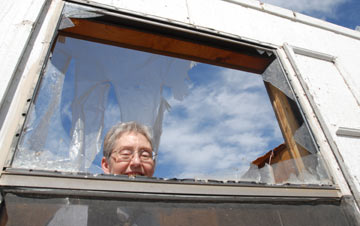
A bulldozer prepares to remove the heavily damaged Ellis family trailer home following a tornado that hit Tulia. (Photos by Barbara Bedrick/BGCT)

Tornado blessings astound Tulia
couple as Baptists provide relief

By Barbara Bedrick

Texas Baptist Communications

TULIA—As Nancy and Kerbow Ellis return to teach at their West Texas classrooms, they do so with a newfound understanding of how their faith overcomes all adversity.

Nancy and Kerbow Ellis insist they’ve been blessed in the aftermath of a tornado that destroyed their home. They are one of four Tulia families to receive BGCT disaster response assistance.

The Tulia couple—both schoolteachers— lost their home to a tornado April 21, but they insist God has blessed them in allowing them to survive the storm and its wrath. They were in Amarillo at a concert instead of at home when the tornado hit.

“We were blessed again because we had heard there might be severe weather. So, we packed up three boxes of photo albums, titles to our trailer home and vehicles, and a laptop computer and put it in the car with us,” Mrs. Ellis said.

Returning to their home that night, the Ellises realized they couldn’t live in it anymore. The roof was gone. Walls were damaged. The twister even moved the trailer home several inches from its foundation. The Ellises prayed.

After a few nights at their son’s apartment in Canyon, the couple returned to Tulia to pick up the pieces. They found refuge in God and his people.

Their church, First Baptist Church of Tulia, and the larger Texas Baptist family proved to be rocks of refuge amid the tornado’s devastation.

“My Bible was gone,” Mrs. Ellis said. “But someone at the church gave me one—a women’s devotional Bible.”

Pastor James Hassell, in collaboration with Baptist General Convention of Texas Church Strategist Charles Davenport, had other plans to help.

Nancy Ellis wears a smile as she trusts in God to help them through the Tulia tornado.

“Pastor James Hassell came over and sat down on the porch Monday while were cleaning up and told us funds were available to help,” she said.   

That meeting stemmed from a phone call with Davenport, who discussed the church’s disaster-related needs with Hassell.

“The situation is tragic, but God will bring good out of it. He always does,” Davenport said.

Offering prayers for the families and churches affected by the tornado, Wayne Shuffield, director of the BGCT missions, evangelism and ministry team, activated his team to move forward with disaster response.

“Our involvement in this is just beginning. We will stay with it until all the people in need are cared for and the job is done,” Shuffield said.

Hassell saw firsthand the impact of Baptists reaching out to help other people in Tulia. He’s grateful the BGCT is meeting people at their point of need.

“Words fail,” Hassell said. “There’s such an overwhelming reaction from seeing how it has all come together so quickly.”

Davenport and Hassell toured the neighborhood to identify those needing immediate assistance. They located four church families, and soon the BGCT provided funds to the congregation.

City Manager Rick Crownover, a member of First Baptist Church in Tulia, stops by to help console the Ellis family as their home is being bulldozed.

“It proves to me that Texas Baptists are unique in how we so like to take care of our own,” Hassell said. “Church members were pleased to see how quickly the BGCT responded in such a stressful situation.”

To help church members and the community cope with their disaster, Bobby Smith, director of BGCT chaplaincy relations, along with trained experts Will Bearden and Susan Edwards, arrived to lead a crisis intervention community forum at First Baptist Church in Tulia.

More than 100 people participated, including the Ellises. One-on-one meetings with affected families were scheduled the next day.

For the Ellis family, the good began outweighing the bad from the tornado. Through it all, they managed to keep smiles firmly planted on their faces. 

“A call from the Red Cross came saying the Rotary Club was trying to secure FEMA trailers for displaced residents,” Mrs. Ellis.

A 35-foot FEMA trailer home would be a “huge blessing,” but it might take weeks.

As a math teacher, Mrs. Ellis understands probabilities and odds. She explained how God, against all odds, worked as they tried to find a Tulia hotel room. There weren’t any.

Despite the “No Vacancy” sign at the hotel, Mrs. Ellis opened the door anyway.

“The motel manager said she had only one room left but there was no electricity in it,” she recalled. “When we went to look at the room, there was another blessing. … The lights came back on, so we took it.”

Storage unit space was sparse in Tulia as well, but the Ellises said, “God has always provided for us, and we rest in that.” They managed to secure the city’s last available storage unit, and at no charge.

Always trusting their faith to guide them, the Tulia couple moved on their path to recovery through funding received from the BGCT disaster response family assistance program.  

“We are very appreciative,” Mrs. Ellis said. “We’re blessed.”  

But seeing their home of 16 years ripped apart at the seams ripped apart their hearts, as well.

Tears came to Mrs. Ellis' eyes as she watched a bulldozer scoop up the damaged structure in which they had raised two sons, shared countless memories and prayed together as a family.

“It was a good ship. It was custom built extra strong to withstand storms, and it had for 16 years,” she recalled. “I remember when our sons would go off to junior high school. We would hug each other and pray before we all left. We prayed for God to protect us from evil and guide us.”

She remembered spending time with her children, helping them with homework at the kitchen table and sharing daily experiences. The family became close-knit because their home was so compact. The family has always trusted God to work things out, she said.

“We have a saying drawn from the Bible —‘Hold loosely to the things of this world’—and we tried to teach the kids that,” she said.

Mrs. Ellis calls God “our rock and our peace” through the disaster.

“Faith does prevail,” she said. “I don’t know how people who don’t have faith do it.”


News of religion, faith, missions, Bible study and Christian ministry among Baptist churches, in Texas, the BGCT, the nation and around the world.


Federal panel decries Iraq’s religious-freedom record

Updated: 5/11/07

Federal panel decries Iraq’s
religious-freedom record

By Robert Marus

ABP Washington Bureau

WASHINGTON (ABP)—For the first time since the United States overthrew Saddam Hussein four years ago, a non-partisan federal panel said May 2 that religious freedom in Iraq is gravely endangered.

The United States Commission on International Religious Freedom, in its annual report to Congress and President Bush’s administration, said the conditions for religious freedom in Iraq are “alarming and deteriorating.”

The panel, also for the first time since the late dictator’s government fell, has placed Iraq on a list one tier below the world’s worst violators of religious freedom.

Without significant improvement in Iraq’s human-rights conditions over the next year, the report added, the commission will bump Iraq up to its most infamous list of human-rights violators. Such a move would place Iraq alongside nations like North Korea and Saudi Arabia, where the State Department says religious freedom is nonexistent.

“Despite ongoing efforts to stabilize the country, successive Iraqi governments have not adequately curbed the growing scope and severity of human-rights abuses,” the commission report said, noting the explosion of sectarian violence between Iraq’s Sunni and Shiite Muslims in the past year.

“Although nonstate actors, particularly the Sunni-dominated insurgency, are responsible for a substantial proportion of the sectarian violence and associated human-rights violations, the Iraqi government also bears responsibility.”

The report cited innumerable reports of “abductions, beatings, extrajudicial executions, torture and rape” perpetrated by para-governmental factions like Shiite militias. Such organizations frequently “operate with impunity and often … complicity” of the U.S.-backed government, the report said.

It continued: “Although many of these militia-related violations reveal the challenges evident in Iraq’s fragmented political system, they nonetheless reflect the Iraqi government’s tolerance—and in some instances commission—of egregious violations of religious freedom.”

The commission also noted other religious minorities in Iraq—including Christians— “continue to suffer pervasive and severe violence and discrimination at the hands of both government and nongovernment actors.”

Nina Shea, one of the panel’s three vice chairs, told reporters the commission was alarmed by the thousands of Iraqi religious minorities who have fled the country in the past few years because of such persecution. Their numbers in the country “are dwindling down to statistical insignificance,” said Shea, director of the Hudson Institute’s Center for Religious Freedom.

The 1998 law that created the commission requires it to report annually on the status of religious liberty worldwide and recommend the State Department name nations that commit or tolerate “severe and egregious” violations of religious freedom as “Countries of Particular Concern.” Administration officials retain ultimate authority to make those designations and impose sanctions they deem appropriate.

In addition, the commission has made a practice of producing a “watch list” of nations in danger of earning CPC status. This year, it added Iraq to the watch list.

Last year, the panel added Afghanistan—another nation struggling to recover from a U.S.-led invasion—to the watch list. It recommended keeping Afghanistan on the watch list.

A footnote in the report noted that at least three members of the nine-member commission considered the Iraqi situation so dire that they voted to recommend that Iraq be added to the CPC list this year. The three—including the panel’s current chair, Felice Gaer—were appointed to the bipartisan panel by Democrats. Republicans appointed most of the other six commissioners.

Asked if there was an ideological division over the Iraq war that precipitated the panel’s split vote on CPC designation, Gaer said, “The commissioners and the commission as a whole consider religious-freedom conditions in Iraq as truly alarming.”

Gaer is the director of the American Jewish Committee’s Blaustein Institute for the Advancement of Human Rights.

Commissioner Richard Land, who is a close Bush ally and has been one of the most outspoken defenders of Bush’s decision to go to war in Iraq, said the division simply reflects disagreement over the extent to which Iraq’s current government can be held accountable for the deteriorating conditions there.

“I think there’s a difference of opinion about how much we can know about how much the government is capable of doing and how much … these are non-state actors or state actors and to what extent the government has the capacity to control non-state actors,” he said. Land is the president of the Southern Baptist Convention’s Ethics and Religious Liberty Commission.

Land also took exception to the characterization that religious freedom in Iraq has become a “disaster” since the U.S. invasion.

“Iraq was a CPC under Saddam Hussein,” he said. “Religious freedom, and every other freedom, was a disaster under Saddam Hussein.”

The commission had recommended CPC status for Iraq every year since 1999, when the panel began its work. The designation arose mainly from Hussein’s suppression of Shiite Muslims while favoring those of his own Sunni faith. However, according to many Middle East experts, Christians and some other religious minorities in Iraq enjoyed more governmental tolerance in Hussein’s Iraq than in many other Middle Eastern locales.

As for its CPC recommendations for 2007, the panel nominated the same 11 nations as last year—Burma, China, Eritrea, Iran, North Korea, Pakistan, Saudi Arabia, Sudan, Turkmenistan, Uzbekistan and Vietnam.

Although the commission has long recommended most of those nations for CPC status, the State Department has not followed that recommendation for Pakistan and Turkmenistan, has been slow to take action against Saudi Arabia and, last year, removed Vietnam from its CPC list.

The religious freedom commission’s report criticized those decisions, noting that religious-freedom violations are widespread in Pakistan and Turkmenistan. The commission also contended that Vietnam has not improved conditions enough to warrant its removal from the CPC list, which happened on the eve of a November 2006 trip that Bush took there.

In addition, the report criticized the Bush administration’s implementation of the CPC recommendations it had made. The law that created the commission and established CPC status requires the government to take sanctions against those countries designated as such. However, part of the law allows the government to cite sanctions already in effect against such nations rather than taking any additional sanctions.

The panel specifically faulted the State Department for continuing a waiver for sanctions against Saudi Arabia while U.S. officials monitor implementation of reforms promised by the kingdom.

State Department spokesperson Leslie Phillips, asked May 2 for the agency’s reaction to the report, said department officials would need more time to analyze it before commenting.

Joining Iraq and Afghanistan on this year’s watch list were Bangladesh, Belarus, Cuba, Egypt, Indonesia and Nigeria.

The report also turned the panel’s attention to Turkey, which received its first official visit from USCIRF commissioners last year and is in the midst of political upheaval over the proper role of religion. The country also has experienced a series of violent attacks by religious radicals against Christians, Jews and other religious minorities in recent years.

Gaer noted that the nation is struggling with how to become a modern, democratic society that is welcoming to religious pluralism.

“For religious-minority communities in Turkey, there are state policies and actions that effectively stop them from sustaining themselves,” she noted. “This has led to the decline and, in some cases, the virtual disappearance of some of these religious minorities on lands that they have inhabited for millennia.”


News of religion, faith, missions, Bible study and Christian ministry among Baptist churches, in Texas, the BGCT, the nation and around the world.


Baptist nurse retraces steps of pioneer missionary in Nigeria

Updated: 5/11/07

The 300 residents of Mission of Mercy Orphanage in Otutulu, Nigeria, enjoy new toothbrushes that were just part of the extensive health evaluation and treatment they received from a CERI volunteer team that included nurse Kerrie Snow. (CERI photo by Kerrie Snow)

Baptist nurse retraces steps of
pioneer missionary in Nigeria

By Craig Bird

Baptist Child & Family Services

OTUTULU, Nigeria—Squinting against the glare of the tropical sun and the dust hanging in the air, Kerrie Snow couldn’t help but imagine it was 125 years earlier. Instead of an Australian-born Baptist nurse from Houston, she was a “wee Scottish woman” known as “the White Ma of Africa.”

“Many years ago, I had the joy of being the missionary story lady for several years during Vacation Bible School,” she explained. “Two summers, I told about how Mary Slessor had to deal with some formidable Nigerian tribal leaders in the late 1880s. I never dreamed that someday I would find myself also going to meet an Eje—which means ‘aggressive and powerful like the hyena’—representing a faith he didn’t share.”

In a face-to-face encounter with a Nigerian tribal chief, Kerrie Snow was thrilled to explain to the Muslim how Christians were assisting the orphans in his area.   (CERI Photo)

Her meeting with the Muslim chief went smoothly, and now he is aware of Children’s Emergency Relief International’s ongoing work at the Ministry of Mercy Orphanage in Otutulu, she noted.

One of the most dramatic episodes of Slessor’s 39-year ministry in Nigeria was when she saved brother/sister twins, who were typically killed at birth, and brought them into her home—only to have a servant betray her by allowing villagers to snatch the boy from her compound and murder him.

Snow’s sorrow was named Adukwu, one of the 300 orphans and disabled children to whom the missions team ministered during her week in Nigeria. The day after returning to Houston, she received an e-mail informing her the 3-month- old boy had died.

“Sadly, he’s not the first from the orphanage to die, and he won’t be the last,” Snow said. “God allowed me the privilege of being part of the end days of his short life. But as a last resort, we took him to the local hospital, where the care was inadequate, to say the least. God’s grace sustained him for six days of his illness, and then his grace took him home.”

The recent trip was Snow’s second with Children’s Emergency Relief International, the overseas arm of Baptist Child & Family Services, but it won’t be her last.

Kerrie Snow trades smiles with one of the babies the Baptist Child & Family Services/ Children's Emergency Relief International team treated at the Mission of Mercy Orphanage in Otutulu, Nigeria. (CERI Photo)

“When people ask why I go to Africa with CERI, my immediate response is, ‘Why wouldn’t I?’” she pointed out. “CERI offers the opportunity to be God’s hands and feet in some desperate situations. God has uniquely gifted each of us to minister and given us the resources to be able to make a difference. God wants people to know him.  How can we not go and tell others? We have so much in material things that most in Africa can only dream of, but we have riches in Christ that we can easily share that will make a difference for eternity.”

The dying face of Adukwu and the welcoming face of the Muslim Eje bookend a host of other memories for Snow.

“We woke each morning to the sound of bleating goats, the starting of a fire to cook the food outside, crying babies and voices lifted in praise as they gathered together for the start of another day,” she said.

“We were able to see all the sick children, assess their nutritional needs, teach hygiene, stock and reorganize the pharmacy/clinic and help out where we could, passing out toothbrushes, toothpaste and sunglasses—the latter being especially helpful for the many albinos who live there. With the generator on for between three and four hours each evening, we could regroup, reflect, plan and pray for the next day.”


News of religion, faith, missions, Bible study and Christian ministry among Baptist churches, in Texas, the BGCT, the nation and around the world.


Abstinence program draws support in Del Rio

Updated: 5/14/07

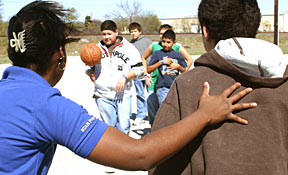
Strong gusty winds at Right Choices for Life's first Family Fun Day in Del Rio complicated but didn’t lower the fun level as these basketball players quickly learned. (Photos by Craig Bird/BCFS)

Abstinence program draws support in Del Rio

By Melissa Gonzales

Baptist Child & Family Services

DEL RIO—In Del Rio, the Right Choices for Life program is redefining “everybody’s doing it”—turning peer pressure into positive influence.

More than 90 percent of the South Texas city’s eighth grade students—720 out of 795—signed up for Right Choices for Life, a Baptist Child & Family Services program geared toward helping teenagers abstain from premarital sex and illegal drugs.

“This isn’t just more homework,” said Aliyah McKinney, program director for Right Choices for Life. “We’re showing them it’s cool to make the right choices.”

Watching someone else get her face painted was just as entertaining as being the person painted at one of the activity booths at Right Choices for Life’s kick-off Family Fun Day in Del Rio.

Since parents must approve their child’s participation, the program obviously is meeting a need in families, too, she added. With more than 500 families actively involved, “it’s safe to say not only kids are getting the message,” she said.

Right Choices for Life stresses the vital role parents play in their children’s decision-making. Parents are provided additional material they can use at home to reinforce and expand classroom instruction.

The San Felipe Del Rio school district welcomed the program with open arms, as did interested parents who organized fundraisers before Right Choices for Life was two months old. Del Rio restaurants donated all the food and beverages for the kick-off parents’ breakfast.

The program pairs an eight-week, in-class right-choices curriculum with monthly “family fun events” which create an environment to strengthen parent-child relationships.

More than 500 adults and middle school students—and their siblings—turned out for the first family fun day.

Aliyah McKinney, program director for the Right Choices for Life emphasis in Del Rio, coordinated substitutions during basketball games—among a lot of other things—at a FamilyFun Day.

The school assignments ended in late April, but the events will continue through the summer.

Next fall, Right Choices for Life will expand to include both seventh and eighth grades.

“On a scale of one-to-10, this is a 10,” said Sandra Hernandez, assistant principal at Del Rio Middle School. Hernandez played a major role in facilitating the program, offered during the 120 minutes of each school day allotted for language arts.

The program almost certainly will reduce dangerous behavior, she noted. Hernandez hopes to see it expanded to include sixth graders.


News of religion, faith, missions, Bible study and Christian ministry among Baptist churches, in Texas, the BGCT, the nation and around the world.