BaptistWay Bible Series for May 13: Inviting all kinds of people to know Christ

Posted: 5/02/07

BaptistWay Bible Series for May 13

Inviting all kinds of people to know Christ

• Acts 16:13-15, 25-34

By Leroy Fenton

Baptist Standard, Dallas

Leadership is crucial and necessary to the body of Christ. Opening doors to other cultures is the work of the bold and courageous. Leaders filled with the Holy Spirit willing to place their lives on the line stand out in a crowd.

The letter from the church in Jerusalem to the church in Antioch, following the settlement of the question of salvation for all by grace through faith, speaks of “our dear friends Barnabas and Paul—men who have risked their lives for the name of our Lord Jesus Christ” (15:25-26).

Cultures are different socially, spiritually, economically, morally, racially, educationally and a thousand other ways. Penetrating and merging cultures are daunting tasks.

Change is embraced with reluctance and suspicion. Spiritual advance can be explosive, disruptive, misunderstood and fearful. Changing perception is difficult on both national and personal levels. Cultures clash with tornado-like force, producing conflict and war. Missionaries face constant risk, rejection, rebuke and resistance, but also reward.

Luke notes the change of leadership, when the messengers from Jerusalem returned home, by changing the name order: “Paul and Barnabas remained in Antioch where they and many others taught and preached the word of the Lord” (15:33-35). Luke acknowledges leadership development in that “many others taught and preached….” A growing number of leaders were being mentored and trained and assuming strategic places of leadership.

I find this fascinating when I think of the hours utilized by the church seeking or waiting for people to assume the most insignificant leadership roles. It seems the New Testament, Holy Spirit-inspired church had the necessary people to push the gospel from the cradle to the nook-and-crannies of the unmarked paths of the world. Christianity was on fire and mobile, creating new structures that worked, finding its groove among the peoples of the world and settling for nothing less than success.

Paul has rested and recovered. His heart and mind are turned again to his task. Having birthed new congregations and established new beachheads, Paul wants to return to see how this new faith is faring and to lend his encouragement should they waver (15:36).

The second missionary journey of Paul began with a serious confrontation. Having a “sharp disagreement” with Barnabas over John Mark, Barnabas and Paul split up. Paul took Silas, a leader in the Jerusalem fellowship, and went “through Syria and Cilicia.” Barnabas took John Mark and went to Cyprus (15:36-41).

At Lystra, Timothy joins Paul and Silas. The strong, profound and clear leadership of the Holy Spirit influenced every decision, preventing them from going into Asia and Bythinia. Paul’s struggle to find the will of God gives us all some consolation. Finding and knowing the will of God can be difficult.

In Paul’s aggressiveness, God had to redirect his energy. God, in his wisdom, saw an open door that would lead to more significant consequences. Paul somehow knew the other doors were closed. Consequently, they found themselves in Troas, near the location of the ancient city of Troy.

Like Peter on the roof top (Acts 10), who saw the vision of the clean and unclean animals and heard the voice of God leading him to Cornelius, Paul saw the vision of a man begging him to “come over to Macedonia and help us” (Acts 16:1-10). Luke reports that “we got ready at once” (v. 10), indicating that he had personally joined the journey. His account of this part of Paul’s missionary history would be as an eye-witness.

Paul was sure and certain of God’s guidance. Certainty in the visionary summon brought immediate response. There is a great lesson to be learned that immediate obedience can bring emphatic results. Crossing the Aegean Sea, some 20 years after Pentecost, the missionaries go eight miles inland from Neapolis to Philippi, the leading city of Macedonia (vv. 11-12), a Roman province. Paul, a Roman citizen, driven onward by the Spirit who empowered his passion, found himself drawing nearer to Rome.


An Open Heart (Acts 16:13-15)

After several days of rest in Philippi, on the Sabbath, Paul and the others sought a place of prayer. There were so few Hebrew worshippers there was no synagogue. When there was no synagogue, Hebrew people would gather near the river for prayer. He found only a few women by the river and he engaged them in conversation and then shared with them the resurrected Christ (v. 13).

Lydia, from Thyatira, listened carefully and became a believer, the first convert in Europe. The first convert was not a man (v. 9) and was not a native Macedonian, but a woman from Asia Minor, simply referred to as “a worshiper of God” (v. 14). She could have been Jewish or a Gentile proselyte to the Jewish faith.

Lydia was possibly so named because Thyatira was a Lydian city. A business woman who sold purple cloth, Lydia is considered reasonably wealthy because of the capital needed to engage in this enterprise. “The Lord opened her heart to respond to Paul’s message” (v. 14), and members of her household were baptized as well (v. 15).

Please note again that “The Lord opened her heart … .” The work of the Holy Spirit is to send someone to witness and to open the sinner’s heart. When she responded in faith, she also opened her home to Paul, allowing him the opportunity to give his full attention to preaching and teaching. Lydia was persuasive in her invitation. Paul has a base from which to work to bring his saving message to Europe. From this tiny church, Paul stepped eagerly into a bigger world. Lydia’s home was a beginning for the European campaign.

Paul, as a Pharisee, is assumed to have prayed the prayer, “I thank God that I am not a Gentile, slave nor a woman.” His experience with Christ and passion for his mission brought him to a more enlightened position where he would declare: “You are all sons of God through faith in Christ Jesus … . There is neither … male nor female, for you are all one in Christ Jesus” (Galatians 3:26-28).

The baptism of a woman, the first in Europe, is a preview of the future of things to come. This was a cosmopolitan experience. God’s Spirit could work in an outdoor sanctuary, in a barbaric community, in the heart of a traveling saleswoman whose home was hundreds of miles away. Paul, a Jew, born as a Roman, essentially homeless, stood on European soil, in a Roman province, to lead a wealthy business woman from Asia Minor to a profound saving faith in Christ Jesus. Only the Holy Spirit could prompt Paul to preach and open the heart of Lydia. Nothing is more noble or more necessary.

As you go, make disciples. Every culture of the world can be breached when God’s message is preached and empowered. Keep in mind, Paul had been rejected many times, and had he not kept on preaching, the door to Europe would not have been opened. The seed has to be planted if there is to be a harvest.


An open jail (Acts 16:25-34)

The diversity may be coincidental to the purpose of this chapter, but note the power of God in the life of an aristocratic woman, a demon-inspired slave girl and a Roman jailer.

Through a series of events brought about by the harassment of a deranged slave girl, Paul and Silas found their first conflict and rejection in European territory. The spirit of the slave girl was to mock the message of salvation preached by Paul and Silas. When Paul cast out her deceptive, captive spirit, the slave girl’s owners, motivated by greed, created an uproar, dragging Paul and Silas before the magistrates with bogus charges. The magistrates had them beaten and thrown into the inner prison with their feet locked in stocks (vv. 16-24).

What a gargantuan turn of events to go from the warm hospitality of Lydia’s home to biligerant rejection by government officials and community for a dungeon cell. Evangelism can bring about persecution.

The outcome, however, was awesome. One of the best-loved and -known stories in Acts is the conversion of the Philippian jailer. The beaten and imprisoned missionaries began to pray and sing hymns to God about midnight (v. 25). Honoring God in desperate times makes the most unholy take note.

The other prisoners were listening when a violent earthquake shook the foundations and the displaced walls released the prison doors and the chains that bound the prisoners fell off (v. 26). Earthquakes were somewhat common in that area, but the timing was miraculous.

The inattentive jailer was jostled awake by the movement of the earth. His fears also were awakened. Assuming the prisoners were free, he reached for his sword to take his life, knowing he could be held responsible by his superiors. Paul’s voice to stop stayed the sword.

Trembling before Paul and Silas, the jailer asked the question of the ages, “What must I do to be saved?” (v. 30). Every catastrophe brings about opportunity for God’s spirit to work.

It is impossible to tell what the jailer had in his mind. My thoughts are these. He had listened to the testimony of Paul and Silas as they sang hymns and praised God, but had dropped off to sleep from weariness of many nights of work. Fear of loss of life from the earthquake and from his superiors brought him face to face with the emptiness of his soul and spirit.

His question was a quest for what Paul and Silas had—joy in times of danger, fearless in the face of their capturers, contentment in prison and security in the depth of the soul. The testimony of their attitude and demeanor brought this pagan man to his knees in faith. The missionaries planted the seed, and God opened the heart through the circumstances of a jail blown open by an unexpected volcano.

How simple the answer: “Believe in the Lord Jesus, and you will be saved—you and your household” (v. 31). After further explanation of the message of the resurrected Christ, the jailer “washed their wounds” and “he and all his family were baptized” (v. 33).

Notice how his changed life changed his hospitality. Like Lydia, the jailer brought the missionaries into his home, fed them and expressed his joy in his new life in Christ. Now he had what Paul and Silas had and was overjoyed from the inside out.


Summary

The Holy Spirit brought faith in Christ to a “worshipper of God” and to a pagan jailer. God can touch the life of the smallest and largest, poorest and richest, worst and the best, in any circumstance or situation, in a worship service or in an earthquake, to the tender heart of a woman or the fearful heart of a man. The gospel is for the world.


Discussion question

• To what extent does your church act on the recognition that the message of Christ is good news for all kinds of people?
News of religion, faith, missions, Bible study and Christian ministry among Baptist churches, in Texas, the BGCT, the nation and around the world.


Bible Studies for Life Series for May13: Accept responsibility for actions

Posted: 5/02/07

Bible Studies for Life Series for May 13

Accept responsibility for actions

• Matthew 7:1-5; James 4:1-3,6-12

By David Harp

First Baptist Church, Stanton

Conflict litters the landscape of our lives. We all seem to face conflict in some form or fashion each day, yet few of us seem to know how to deal with conflict appropriately.

Conflict can come in a simple anonymous form of a telemarketer’s call. You know the scenario. You realize the lady on the other end of the line is just doing her job. She is just so persistent—and annoying. And the calls always seem to interrupt family time at the dinner table.

In recent years, we are hearing more and more about “road rage.” A driver gets angry at another driver; before you know it, tempers flare and full conflict has engulfed a number of people.

How do we properly respond to situations when conflict arises? Can we learn our role as Christ-followers to accept responsibility in light of God’s word for our part in a conflict? Will confession follow our wrongs with a commitment to change sinful attitudes and actions?

One of the most helpful resources in learning to deal properly with conflict comes from Peacemaker Ministries. They offer what is called the 7 A’s of Confession:

As God opens your eyes to see how you have sinned against others, he simultaneously offers you a way to find freedom from your past wrongs. It is called confession.

Many people have never experienced this freedom because they have never learned how to confess their wrongs honestly and unconditionally. Instead, they use words like these: “I’m sorry if I hurt you.” “Let’s just forget the past.” “I suppose I could have done a better job.” “I guess it’s not all your fault.”

These token statements rarely trigger genuine forgiveness and reconciliation. If you really want to make peace, ask God to help you breathe grace by humbly and thoroughly admitting your wrongs. One way to do this is to use the Seven A’s:

• Address everyone involved (all those whom you affected);

• Avoid if, but, and maybe (do not try to excuse your wrongs);

• Admit specifically (both attitudes and actions);

• Acknowledge the hurt (express sorrow for hurting someone);

• Accept the consequences (such as making restitution);

• Alter your behavior (change your attitudes and actions);

• Ask for forgiveness.

(See Matthew 7:3-5; 1 John 1:8-9; Proverbs 28:13)


Evaluate yourself (Matthew 7:1-5)

Our text begins with the command of Jesus “Judge not!” (Matthew 7:5).

The word “judge” can mean to evaluate or analyze. Jesus calls us to move out of the critic’s corner and become more compassionate and caring in our dealings with one another. Jesus becomes the master painter in these verses—creating for all of us a word picture, or visual, to show an extreme situation of judging someone else. One person has a log in his eye and yet he sees, notices and gazes upon his brother who has the smallest speck in his eye.

Before we blame or criticize others, we are to evaluate ourselves and accept responsibility for our part in any conflict. When we have been humbled by the reality of our own sins, we will be able to approach our brother about his sins in humility and gentleness.


Recognize conflict’s source (James 4:1-3)

James opens his teaching with an interrogation. He begins with a first question, “What causes quarrels and fights among you?” (James 4:1). The word “fight” here refers to a battle with weapons, an armed conflict. It is used figuratively to indicate our struggles are spiritual and intensely personal. James identifies our problem of conflicts—selfishness and envy come as a result of our out-of-control desires for worldly pleasures.

We lose all our desire to please and glorify God when we seek to please and gratify ourselves. James points to man’s wisdom versus God’s wisdom.

Unfortunately, conflict even pours into the church. When men and women begin to seek their own way and their own will rather than praying together and seeking the Lord’s will together, conflict can lead to a fractured fellowship. What if the pastor sought the forgiveness of others and confessed his sins? What if those in the church family accepted responsibility and confessed and sought reconciliation?


Submit to God (James 4:6-12)

Our lesson concludes with James using no less than 10 imperatives (commands) in four verses (vv. 7-10). James warned that Christians who speak evil against each other set themselves up as judges and assume a position belonging only to God.

In contrast to a self-sufficient and self-reliant lifestyle, the believer is called to follow in the steps of our servant-leader, Jesus Christ.

The believer must be willing to submit to God’s way. When we repent of worldly desires, motives and actions, God's wisdom will produce peace among his people. We no longer will rationalize our own sinful desires and actions. The world’s standards no longer will be our measurement for success. When we humbly submit to God, he will lift us up. We will evaluate our part in any conflict in the light of God’s word and discover his peace that brings resolution to all conflicts.


Discussion questions

• What are some ways Christians judge others?

• How can we “submit” to God?

• How do we seek worldly wisdom over God’s wisdom?

• What role does prayer play in peacekeeping?

• What should be a Christian’s proper relationship with “the world”?


News of religion, faith, missions, Bible study and Christian ministry among Baptist churches, in Texas, the BGCT, the nation and around the world.


Explore the Bible Series for May 13: Living your beliefs is what counts

Posted: 5/02/07

Explore the Bible Series for May 13

Living your beliefs is what counts

• 2 Peter 1:12-21

By Kathryn Aragon

First Baptist Church, Duncanville

Sometimes we talk about something so much the words begin to lose their meaning. You know, like “freedom” and “Christian love.”

This week’s lesson focuses on another one of those things we talk about without thinking. This week we want to discuss the importance of Bible knowledge.

Bible study, like other Christian disciplines, is much easier to talk about than to do. In the church setting, we tend to pick up the language. We quickly learn the right things to say, and to avoid judgment, we often just say the right thing regardless of what we really think. So Bible study is one of those things we agree is important, yet few of us actually do.

But what does this disparity between words and actions mean? In this case, it means we don’t really believe Bible study is important since, when we really believe something, we’ll do it. In other words, actions speak louder than words. And if we continue to say things we don’t really believe, we must question the belief.

Of course, our words may be wishful thinking. Maybe we’re hoping if we say them often enough, they’ll come true. Or maybe we’re just fooling ourselves. If we say them often enough, no one will see the truth, that we’re afraid to put our words to the test to find out if they really work. Besides, we tell ourselves, no one really notices the disparity between words and actions, right?

Wrong. Even if our pew-mates turn a blind eye to our actions (or lack of them), the world does not. Our Christian nation is becoming increasingly secular. In 1993, 63 percent of Americans said they were Protestants. By 2002, only 52 percent claimed the label. There’s a real need to proclaim the truth of our faith, that Jesus is the way, the truth and the life. However, if we are to be taken seriously, we must not preach empty words. And empty is what they are if we can’t live them.

The truth, however, is most of us don’t really know what we believe. Bill McKibben, in his article “The Christian Paradox,” cites some statistics. “Only 40 percent of Americans can name more than four of the Ten Commandments, and a scant half can cite any of the four authors of the Gospels. Twelve percent believe Joan of Arc was Noah’s wife.”

Yet we still call ourselves a Christian nation, and we in the church call ourselves people of the Bible. If we don’t know what we believe, how can we expect to convince others of what we believe? If we don’t believe the truth is important enough to study and learn, how can we expect others to believe it’s important?


The goal

The goal of Christianity is to be able to stand before God on judgment day. It’s the security we seek when we accept Jesus as savior. Yet most of us don’t give it another thought after rising from our salvation prayer. Paul encourages us to remember it, though: “For we must all appear before the judgment seat of Christ, that each one may receive what is due him for the things done while in the body, whether good or bad” (2 Corinthians 5:10).

We prefer not to think about eternal matters once our salvation is secure, but in this passage, Paul is speaking to believers. Regardless of whether our name is in the Book of Life, we will still answer for our words, actions and attitudes.

But once again, we must ask how we plan to live a life that honors God if we don’t know what God wants. John says we can have confidence on the day of judgment if in this world we are like Jesus (1 John 4:17). Yet we will never be able to achieve Christlikeness if we don’t know what Christ was like.


Telephone is a game, not a study method

I am reminded of a childhood game called telephone. To play, everyone sits in a circle. The first person whispers something in the ear of the person next to him, who in turn whispers the message, exactly as he heard it, in the ear of the person sitting next to him. This continues around the circle until the last person has received the message and announces it to the group.

Ask anyone who has ever played telephone. The message is garbled and nonsensical. It rarely even resembles the original message.

What makes an entertaining party game, however, does not make good Bible instruction. Unless we make Bible reading and meditation a priority, the results are grave. Obviously, without study, we can’t know anything about the Bible or Jesus’ teachings. Since this is not really acceptable in most churches, we must rely on second-hand knowledge. We leave it to others to do the study and share it with us.

Imagine, if you will, how this begins to look. We rely on a Bible scholar in our church to teach us the Bible. That scholar possibly never did more than cursory reading of the Bible himself, but learned about the Bible from a great teacher in his past. This could go on for generations, and it begins to look a bit like the game of telephone. We must wonder if our message is becoming equally garbled.


Return to the Bible

There’s only one solution. We’ve got to return to the Bible. Only first-hand knowledge of the book we call the guidebook will give us what we’re looking for. If we really desire to please God, we must know his heart, learn his precepts and his commands, and commit to obey.

For most required reading, you can get the plot summary from Cliff Notes, but the only way to ace the test is actually to read the book. Similarly, you can let someone tell you about the Bible, but unless you read it yourself, you won’t really grasp the heart of God. Start with the Sermon on the Mount and the book of 1 John. Don’t just read words. Treat it like a treasure hunt, the prize being the breadth and depth of God’s love.

Once we begin to grasp God’s nature and his desires for us, we can better interpret his laws and precepts. It isn’t very difficult, though, because God, in his desire for us to understand, makes it very clear.

When a Pharisee asked Jesus to sum up the law, Jesus answered, “‘Love the Lord your God with all your heart and with all your soul and with all your mind.’ This is the first and greatest commandment. And the second is like it: ‘Love your neighbor as yourself.’ All the Law and the Prophets hang on these two commandments” (Matthew 22:37-40).

Now to find out who our neighbors are, we’ll need to look at the parable of the sheep and the goats. Who are we to love? The poor, the sick, the naked and the hungry. Oh, and let’s not forget our enemies.

Finally, our beliefs don’t amount to anything more than word games unless we’ll actually live by them. In one of his final moments with the disciples before being turned over to the Pharisees, Jesus said, “If you love me, you will obey what I command” (John 14:15).

Indeed, this is one of his final commandments and the one that should pierce us to the heart. After all, how can we obey him if we don’t know him? And how will we know him if we don’t spend time with him and his words?

Of course the words are the easy part. It’s living out the words that becomes hard. Let’s make the commitment to obey him even when it hurts. May we be recognized, not by our speech, but by our actions. And may we live out Jesus’ commands so well the world can’t help but take us seriously.


Discussion questions

• Do you spend time each day reading the Bible and meditating on it?

• If not, when could you fit it in?


News of religion, faith, missions, Bible study and Christian ministry among Baptist churches, in Texas, the BGCT, the nation and around the world.


VA agrees to allow Wiccan symbols as grave markers

Posted: 5/02/07

VA agrees to allow Wiccan
symbols as grave markers

By Robert Marus

ABP Washington Bureau

WASHINGTON (ABP)—After a 10-year struggle, the federal Department of Veterans Affairs has approved placing a pentacle on the grave markers of Wiccan soldiers buried in government cemeteries.

The decision is the result of a settlement—announced April 23 by Americans United for Separation of Church and State—between VA officials and attorneys for an array of Wiccan veterans and their relatives. It brings to an end a battle for recognition of their faith that Wiccan advocates say was prolonged due to government officials’ prejudice.

The settlement ends two lawsuits over the right of Wiccan service members to be buried at VA cemeteries with Wiccan grave markers.

The VA previously had approved 38 other symbols to represent a deceased veteran’s faith on his or her headstone. Most of them are variations on the Christian cross, but they also include the Jewish Star of David, the Islamic star-and-crescent symbol and a whirl that symbolizes atheism.

While the Department of Defense estimates that there are hundreds of Wiccans serving in the armed forces and accommodates them with Wiccan chaplains, VA officials had not yet approved the Wiccan pentacle, also known as a pentagram, for use on headstones in military burial grounds. The symbol is a five-pointed star within a circle.

Wicca is an Earth-focused religion that incorporates aspects of various pre-Christian faiths. While many conservative Christians equate it with witchcraft or Satan worship, Wiccans insist their faith more closely resembles a kind of neo-paganism.

Barry Lynn, director of Americans United, called the settlement in Circle Sanctuary v. Nicholson “a proud day for religious freedom in the United States.” However, he noted that VA documents the plaintiffs’ attorneys reviewed made it appear government officials had intentionally dragged their feet on approving the symbol for fear that it would upset religious conservatives.

“Many people have asked me why the federal government was so stubborn about recognizing the Wiccan symbol,” he said. “I did not want to believe that bias toward Wiccans was the reason, but that appears to have been the case. That’s discouraging, but I’m pleased we were able to put a stop to it.”

While other religious headstone symbols have received VA approval within a few months of initial requests, the Wiccan symbol languished for a decade without approval. Lynn said a comment about Wicca—made by President Bush when he was still campaigning for president—might have influenced the thinking of VA officials.

In a 1999 appearance on ABC’s “Good Morning America” news show, then-Texas Gov. Bush responded to questions about a controversy—active at the time—over Wiccan soldiers being allowed to hold services at the Fort Hood army installation in Texas.

“I don’t think witchcraft is a religion,” Bush reportedly said. “I would hope the military officials would take a second look at the decision they made.”

Americans United officials said they found references to Bush’s opinion on Wicca in internal VA communications on whether to approve the pentacle.

The lawsuit was spurred chiefly by the widow of an American solider killed in Afghanistan. Sgt. Patrick Stewart and four others were killed Sept 25, 2005, when their helicopter was shot down. His widow, Roberta Stewart, petitioned the VA for a Wiccan symbol on her husband’s gravestone.

The department refused, and she filed a lawsuit along with several other Wiccan families and a Wisconsin Wiccan congregation, the Circle Sanctuary.

However, she saw the symbol placed on her husband’s headstone in December, after Nevada state officials arranged for a new stone on Patrick Stewart’s grave at the Northern Nevada Veterans Memorial Cemetery in Fernley. Nevada Gov. Kenny Guinn short-circuited the controversy, getting the state veterans-affairs department to issue Stewart’s gravestone with the pentacle. The Nevada agency asserted jurisdiction in the dispute because it, and not the federal agency, maintains the cemetery.

VA officials were not available for comment by press time for this story. However, the New York Times quoted agency spokesman Matt Burns as saying the department “acted to settle in the interest of the families concerned” as well as “to spare taxpayers the expense of further litigation.”


News of religion, faith, missions, Bible study and Christian ministry among Baptist churches, in Texas, the BGCT, the nation and around the world.


Murders & Islamist candidate worry Turkish Christians

Posted: 5/01/07

Murders & Islamist candidate
worry Turkish Christians

By Robert Marus

Associated Baptist Press

ISTANBUL (ABP)—As Turkish Christians reel from the recent brutal murders of three of their own—allegedly by radical Islamists—many Turks worry the possible election of Turkey’s first devoutly Muslim president could mean more trouble.

As many as a million secularist Turks protested in Istanbul April 29 against the potential election of Abdullah Gul, according to multiple news reports. The protests follow similar ones in Ankara, the nation’s capital, two weeks ago.

They also came less than two weeks after the murders of a German missionary and two Turkish converts to Christianity in a conservative city in eastern Turkey, allegedly at the hands of young Islamists. The victims were reportedly bound and had their throats slit.

Gul received the largest number of votes—but short of the required two-thirds majority—when the Turkish Parliament held its first round of voting in the presidential election April 27.

However, members of the main Turkish opposition party boycotted that poll and have asked the nation’s highest court to declare the election void. The second round of voting is scheduled for May 2.

Gul, who currently is Turkey’s foreign minister, and the nation’s prime minister, Tayyip Erdogan, belong to the AK Party. It was formed from a moderate Islamist party that the government had previously banned. AK enjoys strong support among religious Turks, who tend to be poorer and more rural than the secularist elites centered in Istanbul and other large Turkish cities.

However, the party’s economic reforms have earned the support of many Turkish moderates and business leaders. Gul has spearheaded Turkey’s bid to join the European Union.

AK politicians control the parliament, but Turkish military leaders have threatened to unseat the government if Gul wins. The military has unseated three other governments in the last half-century, including another moderate Islamist government elected in 1997.

Turkey’s population is, according to most estimates, 99 percent Muslim. However, unlike most other majority-Muslim nations, the government has been staunchly secularist since the Turkish Republic’s 1923 founding. Many Turks have criticized Gul and Erdogan, for instance, because their wives wear Islamic headscarves. Under current law, such scarves are banned in Turkish government buildings.

AK Party leaders have condemned the murders of the three Christians, which took place April 18 in the city of Malatya. According to Compass Direct, a news service that tracks persecution of Christians, two victims—Necati Aydin, 36, and Ugur Yuksel, 32, were Turks who converted from Islam to Christianity. The third man, Tillman Geske, 46, was a German citizen.

All three reportedly worked for a small Protestant publishing house that was translating a study Bible into Turkish and were members of the city’s tiny Kurtulus Protestant Church, where Aydin was the pastor. The attacks took place in an office that served both the church and Zirve Publishing.

The Middle East Times, an English-language daily, reported local authorities arrested 10 men in connection with the attack, including the five killers.

In an April 19 press conference televised live on CNN’s Turkish station, the head of the Alliance of Protestant Churches in Turkey said the attacks were “not a surprise” and linked them to anti-Christian propaganda in conservative parts of Turkey.

“Turkey was buried in the darkness of the Middle Ages” by the attacks, said Ihsan Ozbek, who also is pastor of an Ankara church. He compared opposition to Christian missionaries and rumors spread among non-Christian Turks about Christian proselytism to the witch hunts of the last millennium.

A letter about the details of the murders, purportedly from Protestants in the hometown of one of the victims, has spread to Christians around the world via e-mail. It said the perpetrators had done surveillance prior to the murders by posing as potential converts and attending an evangelistic meeting that the Malatya church hosted.

The letter, from “The Protestant Church of Smyrna,” also includes details about gruesome torture that the victims allegedly underwent prior to their deaths. It accused political leaders of fostering suspicion of Christians that led to the murders and linked them with other recent attacks against Turkey’s tiny Christian minority.

Smyrna is the Greek name for Izmir, a large, ancient city on Turkey’s Aegean coast. Aydin’s funeral was held there. According to Compass Direct news service, the funeral had been scheduled for an Anglican church in Izmir, but the letter said it was at Buca Baptist Church in Izmir.

It is unclear if the Baptist congregation was the same as the one in which the letter originated. It was dated April 24 and contained the tagline “reported by Darlene Bocek.”

Jeff Sellers, Compass Direct’s managing editor, said April 30 that his reporters in the region had not been able to confirm the letter’s accuracy or authenticity.

Ancient Smyrna was home to one of the earliest Christian churches.


News of religion, faith, missions, Bible study and Christian ministry among Baptist churches, in Texas, the BGCT, the nation and around the world.


Texas Baptists offer relief to victims of widespread storms

Posted: 4/27/07

Texas Baptist Men responded to help victims of storms that struck across the state in April.

Texas Baptists offer relief to
victims of widespread storms

By Barbara Bedrick

Texas Baptist Communications

From suburban Fort Worth to the Panhandle plains to the Rio Grande, Texas Baptists provided disaster relief after a series of violent storms swept through the state.

High winds, heavy rain and a tornado killed two people and damaged more than 150 homes in Tarrant County April 13, and another storm system followed a similar path 11 days later. Haltom City, just north of Fort Worth, experienced some of the worst damage from the first wave of storms.

The April 13 storm left two churches in shambles, tore roofs off homes and heavily damaged a grocery store. Ruth Gunson and her family, who live near the supermarket, tried to pick up the pieces after a tornado uprooted trees and sent limbs more than five-feet in circumference into her house, leaving two gaping holes in its roof. 

How to give:
By credit card. Call Texas Baptist Men at (214) 828-5350 or the Texas Baptist Missions Foundation toll-free at (800) 558-8263. Or donate online at www.bgct.org/disaster.

By check. Mail a check designated “Disaster Relief” either to Texas Baptist Men, the Texas Baptist Missions Foundation or the Baptist General Convention of Texas Controller’s Office. The mailing address for all three entities is 333 North Washington, Dallas 75246. All funds given through these channels will support Texas Baptist disaster relief ministries. Funds given through the BGCT and the foundation will benefit TBM and other BGCT-related disaster response ministries. Money given through TBM will support TBM disaster relief exclusively.

How to apply for assistance:
Baptist churches and member families in need of financial assistance or volunteer help can contact the Baptist General Convention of Texas toll-free at (888) 244-9400. Applications for family unit financial assistance, church shelter support and other aid are available.

A team of Texas Baptist Men volunteers spent hours strategically working to remove the huge tree limbs from the rooftop of the Gunson’s home and cover the holes. Victim Relief Ministry chaplains assisted with clean-up efforts and provided counseling and pizza for the displaced family. They also counseled other storm victims, including the family who lost a son in the tornado.

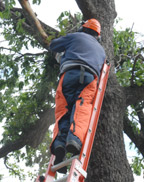
Volunteers from Lake Pointe Church in Rockwall led by Joel Bachman worked atop damaged roofs removing huge tree limbs that dangled precariously. With climbing gear and special protective clothing, Bachman and teammate Ken Hull carefully maneuvered the trees down to the ground safely before sawing the wood into smaller pieces other workers could remove.

In the days that followed, other Texas Baptist Men volunteers from Collin, Dallas and Tarrant Baptist associations arrived to offer relief and recovery.

One week after the Haltom City tornado, more than 450 families in Tulia and Cactus turned to Texas Baptists for help after tornadoes ripped through their communities. TBM volunteers and area Baptist churches provided aid to many who lost their homes, sustained severe property damage or lacked utilities.

For tornado victims in Cactus, a town of about 3,000 people 60 miles north of Amarillo, the struggle was particularly difficult as they tried to cope with the storm’s aftermath. The tornado wiped out the Cactus water tower, destroyed about one-third of the city and knocked out electricity to more than 14,000 in the area, according to disaster relief coordinators.

“We activated the feeding unit at the Top o’ Texas Baptist Association in the Panhandle and the chainsaw team from Paramount Baptist Church in Amarillo to work with victims in Tulia and Cactus,” Smith said. Four TBM volunteers from O’Donnell provided a shower unit, and TBM set up a childcare unit in Cactus.

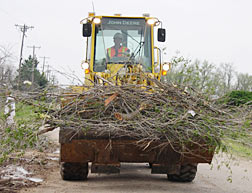
Nearly 30 TBM chainsaw team volunteers helped dig out residents in Tulia, a town of about 5,000 people, south of Amarillo. In the first two days following the tornado, Jeff Roper, TBM incident director, said the chainsaw teams completed 10 jobs including removing dangerous tree limbs and debris from homes and streets.

Since Cactus lost electricity, storm victims traveled about 10 miles away to Dumas where the TBM feeding unit set up adjacent to the Moore County Community Center and served more than 1,500 meals a day. About 300 families stayed at a Red Cross shelter in Dumas, and according to relief coordinators, they could remain there for two to three weeks.

James Hassell, pastor of First Baptist Church in Tulia, was at a Methodist minister’s home next door to his house when the tornado hit. Before huddling in his neighbor’s basement, Hassell witnessed a funnel cloud moving towards his home.

“I saw it spewing debris everywhere, and I got kind of scared,” Hassell recalled. “It looked like it was in the vicinity of our church but … it missed the building by a few blocks.”

Baptist General Convention of Texas Congregational Strategist Charles Davenport visited with Hassell soon after the disaster, and BGCT Disaster Response provided $7,000 to assist at least four church families who either lost their homes or received severe damage from the weekend tornado. All of them were in need of immediate care, Hassell said.

Hassell noted that some victims had home insurance, but all their possessions are gone. Clothes and food were in question for many families.

Haltom City storm victim Ruth Gunson sheds tears as she's comforted by a Victim Relief Ministries chaplain. TMB volunteers helped remove debris at her damaged home.

TBM volunteers worked alongside church members in the kitchen at First Baptist Church in Tulia, cooking and serving meals. As many as 800 people were being served meals every day, Hassell noted.

Disaster relief volunteers also delivered meals to the worst-hit zone in Tulia twice a day for relief workers, law enforcement officers, volunteers and others.

“We’ve been in the damage zone since Saturday night after the tornado rolled through. There is a lot of physical labor and meals to provide,” Hassell explained.

The church also opened up its doors to a group of inmates from nearby prisons. After the inmates worked all day in the clean-up effort, they ate dinner served at the church every night by TBM and church volunteers.

Because the tornadoes were so devastating to the city, First Baptist Church of Tulia was host site for a community forum and support meeting where church members, residents and storm victims could ask questions and share their concerns.

A team of trained counselors equipped to handle crisis intervention serve on the BGCT crisis intervention team and were available to respond to questions and needs. The group of counselors in West Texas, part of Victim Relief Ministries, also held small group counseling sessions.

One Tulia family plans to rebuild after the tornado ripped off their roof.

Texas Baptist Men activated several disaster relief teams April 25 to serve in the wake of a tornado that struck around Eagle Pass and across the Rio Grande in Piedras Negras, Mexico. A tornado along the Texas-Mexico border killed at least 10 people, injured more than 70 and destroyed 20 homes.

The Permian Basin emergency food service team and a survey team from the San Antonio area served in the area, and TBM disaster relief organizers also put together clean-out teams from LaGrange, Kerrville and Pearsall. A chainsaw crew and a shower unit also were dispatched to Piedras Negras.

BGCT staff traveled to the region to provide assistance to Baptist churches and member families. Trained counselors from Buckner International and Four Baptist University of the Americas students worked alongside others to comfort grieving families.

In Piedras Negras, Baptists indicated there is an 8-block wide area that is devastated and some people were trapped under rubble.

A family from Iglesia Bautista Peniel in Eagle Pass—a husband, his pregnant wife and their 1-year-old son—said the roof of their mobile home was “ripped off like the top of a sardine can.”

BGCT Church Starter Robert Cepeda surveyed the devastation, concluding, “It looked like a bomb exploded.”


News of religion, faith, missions, Bible study and Christian ministry among Baptist churches, in Texas, the BGCT, the nation and around the world.


Commentary: Destruction Hits Villa de Fuente Colonia…again

Posted: 4/30/07

Commentary: Destruction Hits
Villa de Fuente Colonia…again

By Dexton Shores

Director, Border/Mexico Missions (River Ministry)

This past week, I attended the Missions Exchange at Truett Seminary and then drove on to Dallas for a meeting with our mission team and World Connex leaders. About 10 p.m. Tuesday night I received an email from one of our pastors in Eagle Pass with the word "Crisis" in the subject line. Bro. Felix Castillo then briefly explained that a tornado had just swept a path of destruction on both sides of the border killing at least seven people.

I called him immediately and learned that a significant area in the Rosita Valley area of Eagle Pass had been hit and that a mobile home had been lifted up and landed on top of the elementary school, killing the entire family inside the mobile home. I then called Pastor Israel Rodriguez on the Mexico side of the border to learn that the same colonia of Villa de Fuente that was devasted by the flooding of the Rio Escondido in 2004 had been hard hit again, wiping out an eight square block area.

In February, a missiion group from Central Baptist in Johnson City, Tenn., helped us to complete a new educational building in Villa de Fuente due to the significant growth the Emanuel Church has experienced since the fllood in 2004. The Emanuel Church was flooded with eight feet of water three years ago, but was completely spared this time. The 200 year old Catholic Church in Villad de Fuente was however, completely destroyed by the tornado.

I spent until 1:30 a.m. that first night and most of the following two days responding to phone calls and coordinating efforts between Texas and Mexico, using up three cell phone batteries in one day! It is amazing how God's children respond to the needs of their fellowman during a time of crisis such as this.

I was finally able to talk to Pastor Daniel Aparicio of the Emanuel Church and this is what he said:

"Thanks brother for helping us again. God took care of us and thanks to Him, and only Him, we are alive! God has manifested Himself in a wonderful way in our lives and we can say that His angels were truly camping around us to protect us. My wife was on her way home from work when the tornado struck and was driving through the plaza area where it hit the worst. Praise God that only the car was damaged by all the falling and flying debris and she only got a broken finger. In my panic to look for her, I got hit on the head by a huge piece of hail, but we are all fine. None of our church members were injured or killed. Some have some roof damage to their homes, but the church building was completely spared."

HERE ARE SOME OF THE NEEDS THAT WE HAVE:

Clothing and under garments. There are families that lost everything they owned.

Personal hygiene items such as shampoo, soap, etc.

Brooms, Shovels, Machetes and tools to cut tree limbs

Canned or prepared food since many do not have a stove or a way to cook their food right now.

Diapers and formula for babies.

Bottled water

Please pray for all the people that lost everything, which is about half of the population of the colonia of Villa de Fuente. May God bless you all and thank you for remember us during this time."

Pastor Daniel Aparacio Herrera, Iglesia Bautista Emanuel

It should be said here that when Hurricane Katrina hit New Orleans that the members of this church remembered how people had ministered to them during the flood of 2004 and they took up an offering of over $500 for Katrina victims that were staying in San Antonio shelters.

This past week has been a visual picture of the wonderful collaboration that can take place between Baptist churches and instututions during such a time of critical needs. BGCT staff members David Tamez, Noe Trevino, and Robert Cepeda were on the ground in the affected area the next day. By the next morning, TBM had responded to my request for a feeding unit and clean out units to be stationed on the Mexico side of the border and the units had arrived within 24 hours after the tornado struck.

Early Thursday morning, the feeding unit, three clean out units, and a chain saw crew were crossing the border with our coordinators, and again the local government officials were amazed and appreciative of all that Texas Baptists are doing. The SBTC feeding unit had also been set up on the Eagle Pass side of the border the day after the tornado struck.

Buckner representative, Jorge Zapata, called me the next morning to see what they could do. I asked him to bring clothing and food to which he immedialy responded. Noe Trevino communicated that counselors were needed for families in shock that had lost it all, some having lost everything for a second time in three years. Buckner, several chaplains from CBF, pastors from San Antonio and other Texas cities along with BUA students have responded to console and counsel affected families.

It has truly been a picture of the Body of Christ dropping all the typical barriers, that sometimes divide us and interfer with us accomplishing God's purpose; so we can truly collaborate together for a Jesus kind of ministry to the 'least of these". I was thinking today how wonderful it would be if we practiced this kind of collaboration all of the time! God's Kingdom would be so much richer.

This morning, I received a call from a border pastor asking about the needs to which his church can respond when they go to Piedras Negras on Monday. He commented that the Monterrey News Channel has given as much as 15 minute reports about all that Texas Baptists are doing to respond to the needs of the storm victims in Piedras Negras.

The reporter said: "these people are not even one of us and yet they are in our country serving thousands of meals to our people". Jesus must be smiling and pleased with the wonderful way His children are representing Him these days in Eagle Pass and Piedras Negras.

To God be all the Glory and may His Kingdom come!


News of religion, faith, missions, Bible study and Christian ministry among Baptist churches, in Texas, the BGCT, the nation and around the world.


Newspapers rethink religion sections

Updated: 4/27/07

Newspapers rethink religion sections

By Hannah Elliott

Associated Baptist Press

NEW YORK (ABP)—The Dallas Morning News recently received the Religion Communicators Council award for the nation’s best religion section. It was the 10th time in 11 years the News had won. Unfortunately for the News, there’s no chance of an 11th title.

In January, the newspaper discontinued the section, citing economic concerns.

It isn’t the only publication deciding to drop sections devoted to religion. The Atlanta Journal-Constitution recently combined religion with its “living” pages, while U.S. News and World Report and the Wichita Eagle in Kansas have cut religion editors and downsized the beat altogether.

It’s not immediately known how many religion reporters and editors have lost their jobs. But the religion cutbacks match an industrywide trend of declining newspaper circulations and increased layoffs. According to the Annual Report on American Journalism, there was a net loss of 600 full-time professional employees at daily newspapers in 2005. And early indications are that 2006 may have been twice as bad.

Christian scholar Martin Marty, a 50-year columnist for The Christian Century magazine, has written about the “dire” economic situation of newspapers, magazines and other print media. In an essay titled “The Decline of Print News,” Marty wrote that the “religion and faith-and-values sections are dying not because there is not enough to report on in ‘religion.’ Religion has seldom been so newsworthy or comment-inducing as it has become in recent decades.”

It’s a lack of advertising and the perception that religion sections are “fluff” that often make them the first casualties of cutbacks.

Some experts believe the decline in newspaper circulation is directly related to the growth of online editions and blogs. Convenience and the ability to sift news in a topic-specific medium have caused previously devoted print subscribers to substitute the Internet for their daily paper. And when you lose print readers, you lose the seed money that funds special sections.

Brad Owens, a journalism professor at Baylor University, described the current status of print media as in a transition rather than a decline. He teaches students “multiple models” of media in order to help them anticipate how the market for professional journalism will change.

Now more than ever, religion tends to be a topic especially covered on the Internet, he said.

“I think religion is a type (of news) where special websites and blogs kind of feed people’s interest more than the traditional model of journalism would,” Owens said. “People of faith are heavy, heavy users of the Internet.”

A negative side of that specialization is that users generally visit the web looking for specific information. That means they may miss more of the subtler or peripheral news they would get in a religion section. Owens doesn’t necessarily lament the demise of the religion section, but he did cite potential side effects.

“When you use the web for information, you tend not to be surprised very much,” Owens said. “You tend to see only things you’re looking for. When I go on the web, I go there for what I need, and I don’t get as many surprises.”

Richard Oppel, editor of the Austin American-Statesman, said termination of a religion section is not the tragedy it’s made out to be. The Statesman covers faith-based news throughout its pages and includes a “faith page” inside the features section on Saturdays.

“I never believed in religion ‘sections,’” Oppel said. “They were a showy response to an obvious reader interest when newspapers were in their salad days. But they were dependent on advertising, and advertising can be thin in that sector. Also, if you are slave to a section, then you deprive the front page of some great stuff.”

In fact, the absence of a strictly “religious” section means faith-based stories must appear throughout all news—a distribution that more closely reflects real life. Like preachers often say, faith isn’t just for Sundays.

Debra Mason, Religion Newswriters Association executive director, echoed the sentiment. In an RNA newsletter, she wrote: “Hundreds of daily newspapers do not and never have had religion sections. Instead, religion news is integrated throughout the paper. We should not confuse religion sections with religion news as a whole.”

The Dallas Morning News has taken the proliferation of faith-based stories to heart. The Jan. 13 cover story in the local section discussed Jewish history in Texas. The newspaper’s religion blog and newsletter continue to grow in popularity.

A potential problem of integrating religious news throughout the paper is that, by default, it could mean only the sensational faith-based stories are covered. And with front-page stories devoted to televangelist scandals and terrorism, some worry that heartwarming features usually reserved for inside pages of the paper will disappear entirely.

Oppel doesn’t share that concern. In his opinion, front-page news doesn’t have to be sensational.

“The rise of Muslims in Austin, trends toward nondenominational suburban churches, and the difficulty of recruiting celibate candidates for the priesthood all are important issues worthy of the front page,” he said.

Oppel edited The Charlotte Observer when it won a Pulitzer Prize for covering the Jim and Tammy Bakker scandal. In that case, any tinge of sensationalism was justified by the outcome, he said.

“We won the Pulitzer Prize for public service for that coverage,” Oppel said. “Was that sensational? In some ways, yes. But remember it put Bakker in the federal pen and stopped him from the fraudulent use of the public airwaves to rake widows of their Social Security checks.”

Oppel said he most definitely believes print newspapers will continue to thrive, even 20 and 30 years from now. And he says he’d rather be in the newspaper business than the magazine business.

Indeed, some magazines have declined sharply in content, while others continue with dependence on wealthy backers. In contrast, Oppel pointed out, newspapers have increased distribution on several platforms. For instance, the Statesman produces its primary website (statesman.com), the entertainment-based austin360.com, seven Austin-area weekly newspapers, the Spanish Ahora Si!, and Glossy for the luxury market.

“We’re very healthy and intend to stay that way,” Oppel said. “Paid circulation may decline. But tell me when magazines, radio and TV ever had ‘paid circulation.’ Readership of newspapers—in print and online—is increasing.”

The bottom line, according to most in the know, is that religion coverage in general isn’t disappearing, and that’s what matters. Owens, for one, is optimistic.

“I’d be more worried if the religion beat reporters go away,” he said. “I’d hate to see any one reporter confined to just one section.”


News of religion, faith, missions, Bible study and Christian ministry among Baptist churches, in Texas, the BGCT, the nation and around the world.


Baptist schools prepare ‘in case the unthinkable occurs’

Updated: 4/27/07

University of Mary-Hardin Baylor students participate in an emergency preparedness drill on campus. The exercise, held just two days after the Virginia Tech shootings, had been scheduled and planned months in advance. (Photos by Randy Yandel/UMHB)

Baptist schools prepare
‘in case the unthinkable occurs’

By Ken Camp

Managing Editor

BELTON—Police cars and fire engines lined the streets on the north side of the University of Mary-Hardin Baylor campus. Paramedics carried students on stretchers and loaded them into ambulances. But it was just a drill—an emergency response exercise planned long before an armed rampage occurred two days earlier at Virginia Tech.

Bell County’s emergency planning committee had scheduled the drill—a simulated hazardous-materials spill on the railroad tracks adjacent to the UMHB campus—months earlier, university spokesperson Carol Woodward said.

UMHB emergency response personnel confer during emergency preparedness drill.

The exercise was part on an ongoing program of training and preparation designed to test the response capabilities of first-responders, Woodward explained.

Last summer, the university provided a training site for about 70 law officers as they dealt with a simulated hostage situation in a women’s dormitory, she added.

University officials considered canceling the drill in light of the Virginia Tech tragedy, but they decided to proceed and concentrate on letting students, parents and people in the surrounding community know that it was not a real emergency.

The school notified students through chapel announcements, e-mail, notices in the college newspaper and posters displayed on campus. They also used radio, television and newspapers in the area to inform non-students about the exercise.

More than 30 students participated in the simulation, role-playing the parts of people exposed to hazardous chemicals. Emergency personnel treated students who feigned breathing difficulties, hosed down people for chemical exposure and took them through a decontamination process before rushing them by ambulance to a local hospital.

University officials met during the drill to review emergency procedures, and after the event, they talked about ways to improve their procedures.

“The greatest challenge is getting the word out to our students, as well as parents,” Woodward said. “We believe the best way to communicate quickly and effectively with students on campus is through their cell phones.”

Haz-mat suits would protect responders against toxic materials.

The school has a database of cell phone numbers for students, as well as home phone numbers for their parents, and university officials are exploring a system that will allow a message to be transmitted simultaneously to a large batch of numbers, she noted.

While few—if any—other Baptist schools held emergency response drills in the days immediately following the Virginia Tech shooting, most reported they had in place plans for dealing with a variety of emergency situations, and those plans are subject to regular review.

President Bill Underwood of Mercer University in Macon, Ga., and Atlanta, noted he met immediately after the Virginia Tech shooting to initiate a complete review of his school’s emergency response plan.

“I have asked that we validate and improve the plan in order to ensure that we are doing everything possible to prevent, and if necessary, effectively respond to campus emergencies,” he said.

Mercer is implementing a wireless cell-phone-based system to provide instant emergency information to students, augmenting the school’s existing Internet, e-mail and call-in communications systems, he added.

Baylor University officials asked themselves, “How prepared are we for such an occurrence?” President John Lilley noted in a message widely circulated to Baylor’s varied constituencies.

Firemen don haz-mat suits during emergency drill at the University of Mary Hardin-Baylor.

“While preventing some an attack with 100 percent certainty is impossible, I want to reassure you that we do have systems in place to respond to emergencies on campus and to minimize harm to our students, staff and faculty,” Lilley said.

“It is impossible to predict when such tragedies will happen, but we are making our best effort to be prepared in case the unthinkable occurs.”

Baylor employs 24 trained and commissioned police officers who conduct crisis simulation training exercises, and the school operates under general rules about closing the campus and has established protocols for handing specific kinds of emergencies, he noted.

The university’s crisis management team—composed of staff and administrators—also conducts crisis simulation drills, and the group was slated to meet to review the Virginia Tech situation to “review our plans for handling such a situation in light of this recent experience,” he said.

“We have an emergency public address system in all residence halls and some academic buildings to communicate public safety information, as necessary,” Lilley added. Baylor also recently installed a dual e-mail and voice-mail emergency notification system.

Even smaller schools, such as East Texas Baptist University in Marshall, have the ability to send emergency e-mail messages to students, faculty and staff in the event of emergencies, ETBU President Bob Riley said.

“If a crisis occurs, you will receive information with directions and actions to take,” he wrote in an e-mail to students soon after the Virginia Tech shooting. “Although unofficial, we know that individual cell phones and text messaging will alert many who have not read an e-mail message.”

Samford University in Birmingham, Ala., had just announced plans for campus safety restructuring, already in process for several weeks, just as news from Virginia Tech began to unfold.

“The plan is to focus on service and security,” said Richard Franklin, Samford’s dean of students. “The new structure and function enhances communications with students, faculty and staff.”

Samford President Andrew Westmoreland stressed his school had taken, and would continue to take, every reasonable step to provide for the safety of students and others on campus.

“I acknowledge that, within a free society, there are limits to our ability to control for every circumstance,” Westmoreland said. “However, we will seek to learn from this horrible tragedy and to enhance the security of the campus.”

Underwood at Mercer struck a similar chord. “In the free and open society that we enjoy, there are clearly some risks associated with those freedoms,” he said. “Our challenge is to reduce that risk as much as possible. Our highest priority is, and always will be, the safety of our students, faculty and staff.”


News of religion, faith, missions, Bible study and Christian ministry among Baptist churches, in Texas, the BGCT, the nation and around the world.


RA boys deliver missions by the ton to Mexico

Updated: 4/27/07

Royal Ambassadors from First Baptist Church in Graham load and deliver 9,000 pounds of food to orphans in Piedras Negras, Mexico.

RA boys deliver missions by the ton to Mexico

By George Henson

Staff Writer

GRAHAM—Maps of the Apostle Paul’s missionary journeys decorate the walls where Hunter Dooley meets for Royal Ambassadors. If someday a map chronicles Hunter’s missionary travels, it will have to start with the trip he took as a 7-year-old from North Texas to an orphanage in Mexico.

He was among eight RA boys and nine adults who collected, transported and delivered 9,000 pounds of food to feed Mexican orphans. About two dozen boys helped prepare for the trek by keeping First Baptist Church in Graham informed of the need and helping load the trailer, but the smaller number made the trip.

“The need in these orphanages along the border is just incredible, and I don’t think people realize how great the need is,” said Jerry Blake, the church’s minister of music and media. He also has directed the church’s missions work along the Rio Grande the last 14 years.

Blake’s history of working in area brought him a call asking if the church would put together a project to help feed children living in orphanages near Piedras Negras, Mexico. Blake took the challenge to the church’s missions committee and Royal Ambassador leaders who formulated the plan. The plan excited the RA boys, who were thrilled at the prospect of being able to help other children.

The RAs presented their Missions by the Ton project to the church, and the congregation enabled the boys to take 9,000 pounds of rice, beans and powdered milk—3,000 pounds of each in 50-pound sacks.

After buying the food, $1,800 remained that was used to buy diapers and other supplies needed by the orphanages, Blake said.

The project was “a little overwhelming when it was first presented to us, but we got it nailed down,” said Royal Ambassador Director Scott Vanarsdall. “The boys didn’t really understand what we were going to be doing at first, but everybody pitched in—not just the eight who went to Mexico, but all the boys.”

After the food was bought, the boys loaded it on a trailer. Even boys who stayed behind in Graham turned out for the early morning venture into missions.

After it was loaded, the boys and their leaders made the seven-hour trip to Cornerstone Children’s Ranch in Quemado, where food was stored until the orphanages could send someone to the U.S. side of the Rio Grande to collect it.

“We couldn’t take the food across to the orphanages,” Marty Auth, a first-year Royal Ambassador leader, explained. “We had to leave it in the states and let the Mexican people come across and get it.”

But before it was accessible to the orphanages, the staples had to be unloaded— a task again reserved for the boys.

“We intentionally had the boys load and unload the food,” Blake said. “We could have had it drop-shipped, but we wanted them to put their hands on it—to have that memory of doing missions. The kids did all the work.”

Jim Perryman, a father of one of the boys and an adult member of the team, agreed. “It would have been much easier to raise the money and ship it down, but the kids wouldn’t have gotten the same meaning from it.”

The Graham group was told that if the orphanages were given all they needed, the 9,000 pounds would last about two weeks. But since the storehouse had to be sure all the area orphanages got something, it would probably last about a month.

The boys also took a foray into Mexico to visit Casa Hogar and several other orphanages around Piedras Negras.

“They saw first-hand what these people go through every day,” Auth said. “You can tell these people are hungry. Not just in the orphanages, but as we drove through the villages, the kids and even the adults came out to beg for food.”

The boys saw images that will stay with them for some time, he said. “They saw how these people lived. They saw the poverty—the shacks with no electricity, running water or sanitation made of cardboard, tin or whatever they can find.”

While the North American Free Trade Agreement has been a boon to some Mexican families, it has also destroyed others, Blake said. “NAFTA brought factory jobs, and men moved their families to the north. But following the money, drug dealers also followed. Now many of those fathers are in prison or dead, leaving their children either in orphanages or with their mothers living in cardboard houses.”

Although he has seen it many times, Blake said the plight of the people in Mexico always affects him.

“I’ve been going down there twice a year for 14 years, and I leave my heart down there every time,” he said.

“The people there just don’t have any hope of things getting any better. They know just across the river is the land of opportunity. Here if you work hard, things get better for you and your family. If you work hard in Mexico, you don’t succeed, you just sweat more.” The boys also noticed the desperation of the orphans and people they passed. Hunter Dooley particularly was struck by what the people had to live in, as was 9-year-old Clayton Hawkins.

“They made their houses out of chicken wire or whatever they could find,” Clayton said.

Thomas Hernandez gave his football to some of the boys in one of the orphanages. “The kids in the orphanages, they have a place to live, but not much else,” the fifth grader explained. “I knew they wouldn’t have much to play with, so I gave them my football.”

It was the hunger that stayed with 8-year-old Garrett Gatlin. “It was sad that people would run after us to ask for food,” he recalled.

That kind of experiential learning was missing from Blake’s mission education as a boy.

“I grew up in RAs learning about missions, but I never had the hands-on experiences until much later,” Blake said.

Images from a mission trip to the orphanages of Mexico may keep these youngsters aware of the need for ministry all their lives, their leaders hope, and may make the maps of their missionary journeys even more complex and numerous than the Apostle Paul’s.


News of religion, faith, missions, Bible study and Christian ministry among Baptist churches, in Texas, the BGCT, the nation and around the world.


Face death with grace and watchfulness, ethicist urges

Updated: 4/27/07

Face death with grace
and watchfulness, ethicist urges

By Marv Knox

Editor

ABILENE—Christians must not abandon people who are dying on the doorstep of medicine, ethicist Allen Verhey pleaded.

Instead, the church should engage in “watchfulness” with the seriously ill and dying, Verhey stressed in the Maston Christian Ethics Lectures at Hardin-Simmons University’s Logsdon Seminary in Abilene.

Ethicist Allen Verhey urges churches to treat the seriously ill and dying with grace and to practice “watchfulness.” He delivered the Maston Christian Ethics Lectures at Hardin-Simmons University’s Logsdon Seminary. (Photo by Dave Coffield/HSU)

To treat the dying with the grace they should receive, Christians must reverse common practice and also bridge chasms between sick people, medicine and faith, said Verhey, professor of Christian ethics at Duke University’s divinity school in Durham, N.C.

“In our culture, dying has become a medical matter, and care for the dying has been assigned to those who are skilled in medicine,” acknowledged Verhey, who has spent more than three decades studying bioethics.

“Modern medicine, moreover, seems thoroughly and deliberately ‘religionless.’ … The practices of piety—and indeed ‘God’—seem to have been pushed to the margins of medical care, retreating more and more as the knowledge and power of medicine advance more and more.”

But those practices, particularly Scripture reading and prayer, should move back to the center of care for the terminally ill, he urged.

Reading Scripture with the ill and dying is important, because Scripture helps Christians remember their past and their context, Verhey said. Scripture is “the story that gives a Christian identity and Christian folk a community.”

Scripture aids and comforts in part because it “acknowledges our mortality” and “our lives evidently end in death,” he said.

“Death makes its power felt in serious or chronic illness and in severe pain, when the body is experienced not only as ‘us,’ but also as ‘the enemy,’” he said. “It makes its power felt in the weakness that robs the sick of the capacity to exercise control of themselves and of their world.”

And although medicine’s resistence to death sometimes is heroic, death inevitably “makes its power felt in a hospital,” Verhey observed.

“Death makes its power felt when the sick or dying are removed and separated from those with whom they share a common life. It makes its power felt when their environment is inhospitable to family and friends. …

“It makes its power felt when the fear of being abandoned is not met by the presence of others who care. And the silence of death makes its power felt in lonely dumbness, when community and communication have failed.”

This power “can push people to the margins of life,” he said. People who are “well” often feel vulnerable and uncomfortable in front of sickness, so they relegate the ill to hospitals, where they are out of sight—and thought.

But since Christians believe physical death is not final, they should face death and tend to the dying with watchfulness, Verhey urged.

Watchfulness is a biblical concept, he said, noting it is “heroic discipleship” in the Gospel of Mark, “patient endurance” in the Revelation, a “call to care for those who are pressed down and crushed by hurt and harm” in the Gospel of Matthew, and an invitation “to rejoice—and to grieve—in hope” in the writings of the Apostle Paul.

“If life and its flourishing are not the greatest goods, neither are death and suffering the ultimate evils,” he insisted, explaining how Christian watchfulness produces twin virtues—courage and patience.

“Death and suffering and the threats of death are not as strong as the promise of God. One need not use all of one’s resources against them. One need only act with integrity in the face of them.”

Terminally ill Christian patients can be compared to martyrs, who bore witness to their faith, even as they faced death, he added.

“Many Christian patients still display the same comfort and the same courage,” he said. “They still bear witness to their hope by their readiness to die but not to kill. They display their comfort and their courage by refusing both offers of assisted suicide and offers of treatment that may prolong their days but only render those days—or months or years—less apt for their tasks of reconciliation with enemies or fellowship with friends or just plain fun with the family.

“Heroic discipleship and its courage liberate patients from the tyrannies of survival or ease.”

Watchfulness forms patience and courage in Christians, Verhey said.

“It forms in Christian community a readiness both to ‘rejoice in hope’ (Romans 12:12) and to mourn, to grieve in hope (1 Thessalonians 4:13). Watchfulness, like Jesus, still blesses ‘those who mourn,’ blesses those aching visionaries who long for God’s future and who weep because it is not yet, still sadly, not yet.”

Watchfulness follows the lead of the Christians commended by Jesus in the 25th chapter of the Gospel of Matthew, Verhey said. These people received Christ’s praise because they fed the hungry, gave water to the thirsty, welcomed strangers, visited prisoners and took care of the sick.

“That parable is eloquent testimony that watchfulness takes the shape of care,” he noted. “And it is an elegant reminder to caregivers that the presence of God is mediated to them through their patients, (and) the sick—in their very weakness and vulnerability, in their hurt and loneliness—represent Christ to the caregiver.”


News of religion, faith, missions, Bible study and Christian ministry among Baptist churches, in Texas, the BGCT, the nation and around the world.


Baptist Briefs

Posted: 4/27/07

Baptist Briefs

Southern Baptists fall short of baptism goal. Southern Baptists failed to meet their goal of baptizing 1 million people in 2006, according to statistics reported by Southern Baptist Convention-affiliated churches. Baptisms for 2006 instead declined by 1.89 percent—364,826 in 2006 versus 371,850 in 2005. The SBC baptism thrust was launched by immediate past-President Bobby Welch at the outset of his two years in office in June 2004.


International Baptists discuss local-church autonomy. Sixty seven Baptist theologians, leaders and pastors from around the world gathered at a Baptist World Alliance symposium at the German Baptist Seminary in Elstal, Berlin, to talk about the theology of the church—particularly issues of local-church autonomy. Participants examined the relationship of the local church to the larger Baptist community of associations, national conventions and unions, regional fellowships and the Baptist World Alliance. At the end of the symposium, participants issued a statement concluding, “For Baptists, the local church is wholly church but not the whole church.”

CBF offers church-starter ‘boot camp’ at Truett. The Cooperative Baptist Fellowship’s New Church Starts Boot Camp will be held July 29-Aug. 3 at Baylor University’s Truett Seminary in Waco. The annual event offers individuals interested in starting churches opportunities for networking, learning about practical resources and assessing their ministerial gifts and calling. American Baptist Churches USA and the Baptist General Convention of Texas also are sponsoring the event. Featured speakers include Tom Johnson, American Baptist new-church planting coordinator; Andre Punch, BGCT congregational strategists director; and Charles Higgs, BGCT director of western-heritage ministries.


Don’t mess with Texas seminary, Patterson suggests. Southwestern Baptist Theological Seminary President Paige Patterson suggested an attack like the Virginia Tech shooting wouldn’t happen at his school because students would overwhelm an attacker—even if they died trying. Patterson told students in an April 18 chapel sermon that if a shooter attacked classes at the Fort Worth school, he was “counting on” male students to respond. “See, all you had to do was have six or eight rush him right at that time, and 32 people wouldn’t have died,” Patterson said. “Now folks, let’s make up our minds. I know we live in America where nobody gets involved in anybody else’s situation. That shall not be the rule here. Does everybody understand? You say, ‘Well, I may be shot.’ Well, yeah, you may. Are you saved? You’re going to heaven. You know, it’s better than earth.”


Palestinian Bible Society building bombed. A bomb severely damaged the Palestinian Bible Society building in Gaza City. The building, located in the city center, housed the Teacher’s Bookshop, Gaza’s only Christian bookstore, according to the Baptist World Alliance. The building also includes a library and a community development center. It is the base for one of the largest relief agencies in the Gaza Strip. Hanna Massad, pastor of Gaza Baptist Church, said the massive explosion occurred around 2 a.m., April 15, causing damage much worse than that caused by a previous explosion, which happened a year ago. His wife, Suhad, directs the Bible Society’s Gaza ministry.


News of religion, faith, missions, Bible study and Christian ministry among Baptist churches, in Texas, the BGCT, the nation and around the world.