On the Move

Posted: 12/15/06

On the Move

Gary Anthony to First Church in Temple as associate pastor of music from Gaston Oaks Church in Dallas, where he was minister of music/administration.

Larry Archer to Sylvester Church in Sylvester as pastor.

Mike Bradford to East Side Church in Rusk as pastor from Fort Phantom Church in Abilene.

Richard Butts to Skyline Church in Lubbock as pastor.

Robert Chambers to Second Church in Abilene as pastor, where he was interim.

Gary Covin has resigned as music minister at First Church in Edna.

Jerry Eckhart has resigned as pastor of Shelton Avenue Church in Breckenridge.

Loren Fast to First Church in Pharr as pastor.

Dean Ferguson to Mesquite Hill Church in Midway as pastor.

Bonita Green to First Church in Poteet as minister of education.

Kevin Hearne to Calvary Church in Cisco as youth minister.

Randy Heddings to Shelton Avenue Church in Breckenridge as pastor.

Todd Hollingsworth to First Church in Celina as youth minister from First Church in Edna.

Butch Horton to Crestview Church in Georgetown as minister to students.

Jerry Kelly to Fitzhugh Church in Austin as interim pastor.

Joe Dan Kendrick to Calvary Church in Abilene as youth minister.

Reuben Lashley to First Church in Pharr as student minister.

Lyn Means to First Church in Jourdanton as pastor from First Church in Paducah.

Jim Mosley to Builders Church in Merkel as pastor.

Cody Nelson to Seventh and Main Church in Bonham as pastor.

Russell Page to First Church in Charlotte as pastor.

Greg Rake to Lytle South Church in Abilene as youth pastor from Ovalo Church in Ovalo, where he was pastor.

Belle Ramey to Crestview Church in Georgetown as minister to middle school students.

Glen Ray to Timbergrove Church in Houston as pastor.

David Rowser to New Home Church in New Home as pastor.

Martin Spencer to First Church in Savoy as minister of worship and administration.

Brad Stewart has resigned as minister of youth at First Church in Rosebud.

Charles Strickland to New Life Church in Greenville as pastor.

Tank Tankersley has resigned as pastor of Harmony Church in Eastland.

Joel Thielepape to Woodlawn Church in Austin as interim pastor.

Shon Wagner to Redbud Church in Lubbock as pastor from First Church in Truth or Consequences, N.M.

Neal Weaver has resigned as education minister at First Church in Eastland.

News of religion, faith, missions, Bible study and Christian ministry among Texas Baptist churches, in the BGCT, the Southern Baptist Convention ( SBC ) and around the world.

Love of reading modeled for children, single moms

Posted: 12/15/06

Love of reading modeled for children, single moms

By Miranda Bradley

Children at Heart Foundation

ROUND ROCK—For the 10th consecutive year, Christmas came a bit early for some Round Rock children, as 21 teachers with the Austin chapter of the Delta Kappa Gamma Society brought cookies, books and the joy of reading to Texas Baptist Children’s Home’s Family Care residents.

“We get to give our time and our books to these kids,” chapter President Shirley Shay said. “It makes for a very special experience.”

Family Care, a ministry to single mothers and their children through Texas Baptist Children’s Home, provides opportunities for women to gain skills in parenting, careers and budgeting. The program currently benefits 53 children and 27 moms in its seven cottages.

A teacher with Delta Kappa Gamma Society poses with a child in the Texas Baptist Children’s Home Family Care program. Twenty-one teachers delivered 100 new books to the children during a Bountiful Book Party, where they mentored reading skills to the parents in the program.

“Most of the parents are just blown away by the generosity these ladies show every year,” said Marian Marley, Family Care case manager. “I can’t tell you how many comments I got from moms who said it was ‘wonderful’ and ‘amazing.’”

The Bountiful Book Party is designed not only to get books into children’s hands, but also to model for mothers the importance of reading to their children.

“We want to demonstrate reading to these moms who may not have the time or the skills to do it effectively,” Shay said. “It’s important to talk about the book with the children and emphasize the words so they learn as they read.”

Along with their combined years of teaching expertise, the volunteers also brought 100 brand-new books from which each child could select two. The rest were donated to a library where all the children could have access to them.

“This is the highlight of my year,” Marley said. “It’s an important relational experience to me.”

In addition to teaching parents how to read to their children, the project also helps foster deeper relationships between all involved.

“We have two cousins who are in different cottages on campus,” Marley remembered. “By the time it was all over, they were reading books to each other. It’s fantastic to see the bonds this type of event can create in people.”

The teachers, likewise, formed bonds with the children.

“My favorite part of the entire day was reading to two twin boys,” Shay said.

“They were so precious and loved books so much. They both wanted to talk about what they read with me. It was definitely something I will always remember.

“When we leave here, we know the kids have a new appreciation for books. It’s a wonderful experience for all of us, knowing we have given them something that can last a lifetime.”

News of religion, faith, missions, Bible study and Christian ministry among Texas Baptist churches, in the BGCT, the Southern Baptist Convention ( SBC ) and around the world.


Shrink stress and save sanity by getting organized

Posted: 12/15/06

Shrink stress and save sanity by getting organized

By Ken Camp

Managing Editor

’Tis the season for anxiety attacks as to-do lists grow longer while days before Christmas grow shorter. But families can reduce holiday stress by following a few simple organizing tips, Christian author Marcia Ramsland said.

“The holidays are as much a matter of organization as they are a matter of the heart,” said Ramsland, author of Simplify Your Life: Get Organized and Stay that Way. “If you do anything in life more than once, organize it and simplify it. That’s especially true at the holidays.”

By organizing, Christians can direct their attention to the meaning behind the holiday and to creating memories with their families rather than wasting time and energy on less-important matters, she insisted.

About 75 percent of holiday stress comes in three areas—buying and giving gifts, sending Christmas cards and decorating, Ramsland noted.

Reduce anxiety by keeping a holiday notebook—a loose-leaf binder with dividers— from one year to the next as a handy reference, she recommended. Create sections designated for gifts, cards, decorating and recipes—as a well as section labeled “successes.”

“In that section, put in pages recording the best thing that happened this Christmas, and keep it from year to year,” she said, suggesting as a recommended heading, “We honored God in our celebration by… .”

Most Christmastime stress centers on buying and giving presents, she noted.

In the gift-giving section of the notebook, list people who regularly receive gifts, gift ideas, a budget, presents purchased and where the wrapped gifts are hidden, she recommended. A downloadable form is available on her website, www.OrganizingPro.com.

To save time and improve efficiency in shopping, Ramsland offers several suggestions:

Follow a theme.

Give everyone on the gift list a distinctive present from the same store, such as a sweater or a music CD that fits a particular person’s tastes or a book related to that person’s interests.

Shop appropriately.

“Recognize if a person is practical or sentimental,” she said. As a clue, consider the kinds of gifts that person typically buys for others. For instance, if someone usually buys power tools or kitchen utensils for others, that person probably would like a practical gift.

Stick with success.

Buyers should keep track of where they find most of their best-received gifts from year to year and shop there first, she said.

Keep track.

“Save your gift lists from year to year and refer back to them,” she suggested.

Calendar craft time.

For people who like to give handmade presents, reduce stress by planning a realistic schedule of how many can be made in the busy days before Christmas—and how many are big projects that need to be started much earlier in the year. If making gifts by hand is priority, put it on the calendar and treat crafting times as appointments to be honored.

Shop for children last.

Children go through phases quickly, and they often change their minds about what toys they want for Christmas—particularly as they see holiday advertisements.

Shop for Jesus first.

“I like for people to put Jesus at the top of their list,” she noted. “Whether it’s a gift of time or a financial gift, pray about it and make it priority.”

Looking ahead to next year, Ramsland recommended shoppers look at Halloween rather than the day after Thanksgiving as the starting date for the present-buying season. If most presents are bought and wrapped before Thanksgiving, that leaves more time for other activities during the weeks immediately before Christmas—and fewer stress-inducing trips to malls when they are the most crowded.

Beyond the narrow issue of shopping for presents, look for ways to simplify the crowded calendar by combining social events, she suggested.

“If you’re going to a Christmas play and church, but you also want to get together with a particular couple, invite them to go out to dinner with you before the program,” she said. “Do a couple of things in one night. By multi-tasking, you free up another night.”

Once the required activities are out of the way, families have time to creatively develop their own traditions. They could be as simple as asking everyone at the Christmas dinnertable to mention one or two things that happened in the last year for which they are thankful, she suggested.

Families can reduce stress considerably simply by not holding themselves up to an impossible standard, she added.

“Check your attitude,” she urged. “Make sure you’re not expecting too much—that you’re not aiming for perfection. It doesn’t have to match what your mother did.”


News of religion, faith, missions, Bible study and Christian ministry among Texas Baptist churches, in the BGCT, the Southern Baptist Convention ( SBC ) and around the world.


Texas Tidbits

Posted: 12/15/06

Texas Tidbits

Baylor receives grant for lupus research. Baylor Research Institute—an affiliate of the Baylor Health Care System—has received a $6.2 million grant that will allow its immunology division to establish a Center for Lupus Research. The grant comes from the National Institute of Arthritis and Musculoskeletal and Skin Diseases. According to the Lupus Foundation of America, about 1.5 million Americans have a form of lupus—90 percent of them women. 


Academy alumni support Gridiron Heroes. Representatives of the San Marcos Academy class of 1976 presented a $1,976 donation to Gridiron Heroes, a Texas-based support and outreach service organization that offers services to young athletes and their families affected by spinal-cord injuries. Eddie Canales founded Gridiron Heroes after his son Chris suffered life-threatening spinal cord injuries in a football game. Both the father and son are San Marcos Academy graduates.


BUA prof joins dialogue with Catholics. Nora Lozano, associate professor of theological studies at Baptist University of the Americas in San Antonio, participated in the first of a series of Baptist/Catholic theological dialogues as part of a Baptist World Alliance team. The dialogue took place Dec. 10-15 at Beeson Divinity School in Birmingham, Ala. BWA General Secretary Denton Lotz and Paul Fiddes, principal of Regents Park College of Oxford University and chairman of the BWA commission on doctrine and inter-church cooperation, led the Baptist team. The BWA General Council in Mexico City this past July approved holding theological conversations with the Vatican. The BWA team is drawn from the six continental federations of Africa, Asia, the Caribbean, Latin America, Europe and North America, and includes special observers. Topics of discussion—slated to continue through 2010—include the authority of Christ in Scripture and tradition, baptism and the Lord’s Supper, and hearing God’s word in the contemporary context.


DBU pays employees to lose. More than 100 Dallas Baptist University employees joined the school’s wellness program this semester, and about half of them weighed in with the campus nurse in hopes of earning a $100 bonus for losing at least 10 pounds. Engaging in a minimum of 30 continuous minutes a day of aerobic exercise or weight training five days a week qualifies participants to earn an additional $100 reward each semester. “The wellness program has been going on for 17 years, but when we added the financial bonus in the summer of 2003, more people started becoming interested,” explained the program’s director, Vivian Castleberry. Even though the cash awards cost the school thousands of dollars a year, the wellness program has saved DBU more because expensive insurance claims have dropped, said Eric Bruntmyer, vice president for financial affairs.


Correction: In the Dec. 4 “Texas Tidbits” column, an item titled “BUA names search committee” incorrectly identified Alfonso Flores. Flores, who was named to the BUA council of advisers, is pastor of First Mexican Baptist Church in San Antonio, not Houston as stated in the print version of that article. Our onlune version has been corrected.


News of religion, faith, missions, Bible study and Christian ministry among Texas Baptist churches, in the BGCT, the Southern Baptist Convention ( SBC ) and around the world.


TOGETHER: Passion grows for being ‘on mission’

Posted: 12/15/06

TOGETHER:
Passion grows for being ‘on mission’

As 2006 draws to a close, I celebrate the growing passion I see in many churches for being “on mission” with God. This passion is exemplified in many ways.

Our cowboy church leaders are responding to God’s blessings in their lives and are starting new churches across Texas. People’s lives are being turned around. Folks who have never been to church or had felt they could never again be “at home” in a church are finding God’s promise of peace and salvation to be real.

wademug
Executive Director
BGCT Executive Board

There are new churches in small towns on the edge of urban sprawl where God is using men and women who never before realized they could be leaders in a church to reach scores of people for Christ. Because of the passion for reaching people that bubbles up in the hearts of so many churches, we are starting 180 churches in Texas this year.

A Hispanic church in Texas is so eager for God to work through them that they started a Vacation Bible School in Guanajuato, Mexico, and now a church is there. They connected with the social needs of the people who live in that area, opened a school, now accredited by the Mexican Board of Education, which is teaching labor skills for an impoverished community. One of their families now lives as missionaries in that community, and other families have caught the vision of missions service.

I also celebrate the impact that some of our Baptist General Convention of Texas organizational changes have had on our work together.

Our new Executive Board completes its first year of service this month. They have faced several challenges—learning new responsibilities, getting acquainted with one another, working with the restructuring of our staff assignments, understanding a new budget process and facing the challenges of a report that revealed misuse of church starting funds. They have stepped forward to help me correct, in a very open and direct manner, the problems that have been identified.

All of us on the BGCT staff are committed to working through this crisis. All the motions passed by the Executive Board Nov. 13 are being addressed. The draft of the new church starting polices and procedures has been mailed to the Executive Board’s Missions and Ministry Committee; and by the time for a vote on these policies in February, members of the Executive Board will know more about church starting philosophy and methods than ever before.

I pledge that I will do everything possible to resolve all of these matters in a spirit of openness, fairness and justice. Furthermore, I am determined to work with everyone to put in place policies and attitudes that will restore to our church starting efforts the highest levels of trust and confidence.

Thank you for your many expressions of concern, support and prayer. Those who would like to use this painful episode as an excuse to undermine the future of our kingdom work through the BGCT are very few and very wrong. The BGCT has faced many critics through the years, but the spirit of our people is very strong and very united, and we know the work God has given us to do in Texas and the world is worth our commitment and our cooperation because we can do more together than we can do divided or alone.

We are all loved.

News of religion, faith, missions, Bible study and Christian ministry among Texas Baptist churches, in the BGCT, the Southern Baptist Convention ( SBC ) and around the world.


Tots compel students to give

Posted: 12/15/06

University of Mary Hardin-Baylor residence dorms competed to give the most to the area Toys for Tots campaign sponsored by the Marine Corps Reserve.

Tots compel students to give

By Jennifer Sicking

University of Mary Hardin-Baylor

BELTON—Melissa Ochs returned from a weekend trip to find bags of toys in her dorm room at the University of Mary Hardin-Baylor.

An anonymous donation, helped push Johnson Hall ahead of other campus residence halls in the “dorm wars” competition to collect toys for the area Toys for Tots campaign by the Marine Corps Reserve.

“The girls were extremely excited,” Ochs, a junior athletic training major from Austin, said of her dormmates.

“When we first announced it, the girls were excited and enthusiastic,” Ochs said. “They wanted to give back to the community, especially when they found out it was going to area children.”

An anonymous donor helped the dorm by giving $50 to a university officer and telling her to “give it to the dorm she liked the best,” Ochs said. The officer presented it to the residence hall, which used it to buy 54 toys.

In the end, Johnson Hall donated 158 toys, while the second-place dorm contributed 80, said Mary Dickson, president of the Sader Sports Medicine Association, which spearheads the university’s toy drive each year. By the end of the “dorm wars” competition Dec. 4, the association had collected more than 500 toys, with 350 from the six residence halls.

For donating the most toys, the women in Johnson Hall received a pizza and snack study party the night before finals began.

While this is the fourth year for the association to lead the Toys for Tots toy drive, Dickson said, it was the first year for a competition between the dorms.

“In the first meeting of the year, we had a brainstorming session to increase the number of participants on campus,” she said.

“We have a room stuffed full (of toys) waiting to be picked up by the Marines,” she said of the result.

Barbie dolls, puzzles, stuffed animals and toy trucks sit in the room waiting to be wrapped and placed under a tree for children on Christmas.

The project helps children who might not have a Christmas present, but it also provides an opportunity for university students to contribute to others.

News of religion, faith, missions, Bible study and Christian ministry among Texas Baptist churches, in the BGCT, the Southern Baptist Convention ( SBC ) and around the world.


Dozen UMHB students share Christmas joy worldwide

Posted: 12/15/06

Dozen UMHB students
share Christmas joy worldwide

By Jennifer Sicking

University of Mary Hardin-Baylor

BELTON—Russia wasn’t Felicia Cano’s first choice for a Christmas vacation destination, but she believes it’s exactly where God wants her to be.

“This trip, for me, is kind of a stretch,” said Cano, a junior business management major from Bay City. “I love Africa. I’ve gone to Africa. But God put Russia on my heart.”

She is among 12 University of Mary Hardin-Baylor students who will spend part of their Christmas break sharing the reason for the season with other people as part Go Now Missions, the Baptist General Convention of Texas student missions program.

Shawn Shannon, director of the UMHB Baptist Student Ministry, said past years have seen the number of student missions volunteers range from eight to 13.

“They are being great stewards of their breaks, one of the advantages of the academic calendar,” she said.

Also, the time of year lends a special poignancy to the mission.

“As one who has never lived in a world without Christ, I care about those who have not had the opportunity to know him and receive and return his love,” Shannon said. “It seems fitting—a way to pay it forward—that students would be on mission this time of year.”

To encourage student involvement, the BSM keeps passport applications on hand to encourage students to be ready in case God calls them to serve, even if that place is different than their anticipations.

Shannon sees much personal growth when the Christmas missionaries return from what can be life-changing experiences.

“Moving out into the unknown throws them into deeper dependence on God,” she said. “They discover more of who God is, who they are and what they are gifted to give. They usually move forward with larger, deeper and wiser hearts. They form new habits of giving and serving others that make it out of their Christmas breaks and into their lifestyles.”

News of religion, faith, missions, Bible study and Christian ministry among Texas Baptist churches, in the BGCT, the Southern Baptist Convention ( SBC ) and around the world.


MORE BLESSED TO GIVE: Compassionate conservatives? Research says, ‘Yes’

Posted: 12/15/06

MORE BLESSED TO GIVE:
Compassionate conservatives? Research says, ‘Yes’

By Frank Brieaddy

Religion News Service

SYRACUSE, N.Y. (RNS)—Syracuse University professor Arthur Brooks may be the newest darling of the religious right in America—and it’s making him nervous. The child of academics, raised in a liberal household and educated in the liberal arts, Brooks has written a book that concludes religious conservatives donate far more money than secular liberals to all sorts of charitable activities, irrespective of income.

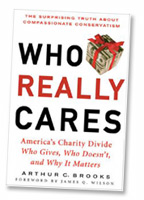
In the book, Who Really Cares: The Surprising Truth About Compassionate Conservatism, he cites extensive data analysis to demonstrate that values advocated by conservatives—from church attendance and two-parent families to the Protestant work ethic and a distaste for government-funded social services—make conservatives more generous than liberals.

“For too long, liberals have been claiming they are the most virtuous members of American society. Although they usually give less to charity, they have nevertheless lambasted conservatives for their callousness in the face of social injustice.”–Arthur Brooks
(Photo by www.fotosearch.com)

When it comes to helping the needy, Brooks writes: “For too long, liberals have been claiming they are the most virtuous members of American society. Although they usually give less to charity, they have nevertheless lambasted conservatives for their callousness in the face of social injustice.”

For the record, Brooks, 42, has been registered in the past as a Democrat, then a Republican, but now lists himself as independent, explaining, “I have no comfortable political home.”

Since 2003, he has been director of nonprofit studies for Syracuse University’s Maxwell School of Citizenship and Public Affairs.

Outside professional circles, he’s best known for his regular op-ed columns in The Wall Street Journal on topics that stray a bit from his philanthropy expertise.

One column noted that people who drink alcohol moderately are more successful and charitable than those—like him—who don’t. Another observed that liberals are having fewer babies than conservatives, which will reduce liberals’ impact on politics over time because children generally mimic their parents.

Brooks is a behavioral economist by training who researches the relationship between what people do—aside from their paid work—why they do it, and its economic impact.

He’s a number cruncher who relied primarily on 10 databases assembled over the past decade, mostly from scientific surveys. The data are adjusted for variables such as age, gender, race and income to draw fine-point conclusions.

His Wall Street Journal pieces are researched, but a little light, he admits. His book, on the other hand, is carefully documented to withstand the scrutiny of other academics, which he said he encourages.

Syracuse University professor Arthur Brooks is a behavioral economist by training who researches the relationship between what people do—aside from their paid work—why they do it, and its economic impact.

The book’s basic findings are that conservatives who practice religion, live in traditional nuclear families and reject the notion that the government should engage in income redistribution are the most generous Americans, by any measure.

In contrast, secular liberals who believe fervently in government entitlement programs give far less to charity. They want everyone’s tax dollars to support charitable causes but are reluctant to write checks to those causes, even when governments don’t provide them with enough money.

Such an attitude, he writes, not only shortchanges the nonprofits but also diminishes the positive fallout of giving, including personal health, wealth and happiness for the donor and overall economic growth.

All of this, he said, he backs up with statistical analysis.

“These are not the sort of conclusions I ever thought I would reach when I started looking at charitable giving in graduate school, 10 years ago,” he writes in the introduction. “I have to admit I probably would have hated what I have to say in this book.”

Still, he says it forcefully, pointing out that liberals give less than conservatives in every way imaginable, including volunteer hours and donated blood.

In an interview, Brooks said he recognizes the need for government entitlement programs, such as welfare. But in the book, he finds fault with all sorts of government social spending, including entitlements.

Repeatedly, he cites and disputes a line from a Ralph Nader speech to the NAACP in 2000: “A society that has more justice is a society that needs less charity.”

Harvey Mansfield, professor of government at Harvard University and 2004 recipient of the National Humanities Medal, does not know Brooks personally but has read the book.

“His main finding is quite startling, that the people who talk the most about caring actually fork over the least,” he said. “But beyond this finding, I thought his analysis was extremely good, especially for an economist. He thinks very well about the reason for this and reflects about politics and morals in a way most economists do their best to avoid.”

Brooks started the book as an academic treatise, then tightened the documentation and punched up the prose when his colleagues and editor convinced him it would sell better and generate more discussion if he did.

To make his point forcefully, Brooks admits he cut out a lot of qualifying information.

“I know I’m going to get yelled at a lot with this book,” he said.

“But when you say something big and new, you’re going to get yelled at.”


Frank Brieaddy writes for The Post-Standard of Syracuse, N.Y.


News of religion, faith, missions, Bible study and Christian ministry among Texas Baptist churches, in the BGCT, the Southern Baptist Convention ( SBC ) and around the world.


Bible Studies for Life Series for December 24: Jesus, God’s greatest gift to his people

Posted: 12/13/06

Bible Studies for Life Series for December 24

Jesus, God’s greatest gift to his people

• Luke 1:26-35; 2:4-7

By Kenneth Lyle

Logsdon School of Theology, Abilene

A colleague recently told me a story that well illustrates the importance of remembering and reflecting on the Christmas story of Jesus’ birth.

Several years ago, my friend took her 3-year-old granddaughter to see a “walk through Bethlehem” presentation at a local church. By her account, the church had done an excellent job of recreating the look, feel and, yes, even the smell of an ancient, Palestinian village complete with shops, homes, artisans, soldiers and animals.

At the end of the “walk,” participants were ushered into the manger scene where Mary, Joseph and a very real baby Jesus shared the small, cave-like space with the anticipated donkey, sheep and goat.

Carol and her granddaughter stood staring at the scene. The 3-year-old was transfixed—gazing intently at the dramatization before her. Soon, the line behind them began to grow, and Carol convinced her reluctant granddaughter it was time to move on.

As they walked out of the church, Carol remembers her granddaughter began to cry. Carol asked her, “What’s wrong?” Her granddaughter’s reply stopped Carol in her tracks and gave me reason for pause as she related the story. Through tear-filled eyes the little girl protested to her grandmother, “I wasn’t finished at the manger!”

For most people in the world, and for some in the church, Christmas is a time for gift giving and receiving, for parties and presents, for visiting with family and friends. While some in the world and most in the church acknowledge the significance of Jesus’ birth as the reason for all this activity, many spend not enough time at the manger. Over the next two weeks, the lessons from Luke’s account of the good news of Jesus’ birth give us the opportunity to spend some time at the manger, reflecting on the significance of Jesus’ birth.

Along with Matthew, Luke’s Gospel provides the marvelous “Christmas” details that make up much of our experience of the Christmas season. While Matthew tells the tale of a star in the sky, wise men from the east, a raging King Herod and an escape to Egypt, Luke relates the story of a government imposed census, a journey to Bethlehem, shepherds in a field and angels heard from on high.

Luke, perhaps more than Matthew, is determined to demonstrate the historical setting and reliability of the story he presents. The consummate historian, Luke goes to great pains to make sure the reader knows precisely when these events take place. Luke tells us of a census commanded by the emperor Augustus, but adds, “This was the first census that took place while Quirinius was governor of Syria” (2:2). Luke’s level of precision lets the reader know that these things happened at a particular time (during the first census, not the presumed second or perhaps even third census ordered by the emperor).

Luke’s concern for historical exactness lies second to his concern for demonstrating how these events fit into God’s plan for the world. In the focal passages, Luke demonstrates God’s role in the events taking place by focusing on the role of angels who function as the messenger force of God.

God sends the angel Gabriel to Mary (1:26-27). Previously, the angel of the Lord appeared to Zechariah (1:11), and subsequently, to the shepherds in the field (2:9). Luke wants the reader to know the events portrayed here are not accidents of history, but rather, a part of God’s plan to save the world.

When Gabriel comes to Mary with his announcement that she will give birth to a son, Luke emphasizes three elements. First, Luke describes Mary as “highly favored” 1:28 and as one who “has found favor with God” (1:30). Clearly, we are to understand that Mary was a good person who had garnered some merit from God; however, her merit is not what sets her apart.

If there is anything special about Mary we find it in her accepting response to God’s grace extended to her. Her reply to God’s great initiative to her comes in 1:38, “May it be to me as you have said.”

Second, Luke tells us the name of the child will be Jesus (1:31). Matthew’s account also provides this detail about the name of the child; however, Matthew provides the explanatory note, “because he will save his people from their sins” (Matthew 1:21). Jesus is the Greek form of the name Joshua, which means, “The Lord saves.” Jesus’ very name constantly reminds us of God’s saving purpose.

Third, Luke reminds the reader of Mary’s virginal status. There is no denying the scandalous circumstances described by both Matthew and Luke surrounding the Jesus’ birth. An engaged couple who have not come together sexually end up pregnant (Matthew 1:18-19). In other times and in other places, this would be the kind of story we would cover up; but the Gospel writers do not cover it up, and in fact, this virginal conception becomes the centerpiece of narrative.

That both Luke and Matthew see fit to include an account of “the virgin birth,” lends veracity and credibility to the claim of Jesus’ unique status as God’s son. Discussions of the virgin birth should focus on the virginal conception of Jesus through the work of the Holy Spirit and not on the mistaken notion that Mary was perpetually a virgin. Mary was a real woman, really married to Joseph and the mother of other children (Mark 3:31-33).

Gabriel’s announcement to Mary also provides information about the child Jesus. The description of Jesus in 1:32-33 focuses on Jesus’ status as God’s son. This child “will be called the Son of the Most High. The Lord God will give him the throne of this father David, and he will reign over the house of Jacob forever; his kingdom will never end.” Luke connects the birth of this child to the history of Israel and to the future of the world. What God has begun comes to the beginning of completion in the birth of this child.

The opening verses of chapter 2 (vv. 1-7) famously describe the lowly circumstances of Jesus’ birth in a manger in Bethlehem. The rejection of this weary family looking for a place to rest foreshadows the rejection of Jesus by his own people.

The power of this narrative should not be underestimated. Many nominal, once-a-year churchgoers will hear and feel this story in the depth of their being. Allow folks to spend some time at the manger, but remind them Jesus did not stay a baby. Jesus, Luke tells us, grew up and found favor with God and the people around him, and he did and said marvelous things. Most importantly, Jesus’ died for the sins of the world, and conquered death by his resurrection.

When we accept God’s gift of grace, when we say as Mary said, “may it be to me as you have said,” we experience the gift of Jesus in our lives. This is the good news that begins with the birth of a baby in a manger in Bethlehem.


Discussion questions

• How do the Gospel writers emphasize the significance and uniqueness of Jesus’ birth?

• Why is it important for Christians to reflect on the story of Jesus’ birth annually?

• How might we take to heart Mary’s words, “May it be to me as you have said”?


News of religion, faith, missions, Bible study and Christian ministry among Texas Baptist churches, in the BGCT, the Southern Baptist Convention ( SBC ) and around the world.


Explore the Bible Series for December 24: Honor the Savior’s birth with worship

Posted: 12/13/06

Explore the Bible Series for December 24

Honor the Savior’s birth with worship

• Matthew 1:18-2:12

By Howard Anderson

Diversified Spiritual Associates, San Antonio

Joseph, the husband of Mary, was a direct descendant of David. Jesus was not the physical son of Joseph. Mary conceived Jesus through the Holy Spirit. Christ is the “Anointed One.”

We honor the Savior’s birth by recognizing him as the King of Kings, who came to provide salvation for all sinners and by inviting him to be king in our lives. Jesus is the reason for the season.


Heeding the angel’s message (Matthew 1:18-25)

In Jewish culture, espousal was a covenant made about a year before the consummation of the marriage. It was during the one-year period of espousal that Mary was found to be pregnant. The fact that Mary was a virgin at this time is clearly implied by the phrase “before they came together” and by the righteous character of Joseph and his desire to divorce Mary when her pregnancy became known (v. 19).

Joseph wanted to divorce Mary on the grounds of infidelity. Joseph could have made the divorce a public matter, or he could have gone through a private ceremony before two witnesses. Being a gracious and “just man,” Joseph decided to keep it private.

“Behold, a virgin shall be with child, and shall bring forth a son, and they shall call his name Emmanuel” is a quotation from Isaiah 7:14. In this verse, the prophet Isaiah consoles King Ahaz of Judah. A coalition of two kings was opposing Ahaz. Isaiah tells Ahaz the plans of his enemies would not succeed. As a sign to Ahaz, a son would be born of a woman, and before that boy reached the age where he could tell right from wrong, the two kings would no longer be a threat to Ahaz.

Matthew makes it clear that Isaiah’s words find their ultimate fulfillment in the virgin birth of Jesus, a sign to people of all ages that God was with them.

Joseph “knew her not” is a Hebrew idiom for cohabitation and fatherhood (Genesis 4:1, 17, 25). He did not know Mary physically until after she gave birth to Jesus. The clear implication of verse 25 is that Mary was a virgin only until the birth of Jesus. The brothers and sisters of Jesus were younger siblings born to Joseph and Mary after Jesus’ birth (Matthew 13:55-56).


Seeking the King (Matthew 2:1-8)

The events of chapter 2 probably took place some months after Jesus’ birth. “Herod the king” is Herod the Great, who reigned over Palestine from 37 B.C. until his death in 4 B.C. Herod’s reign was marked by cruelty and bloodshed. The “wise men” were a priestly hereditary caste who uttered prophecies, explained omens, interpreted dreams and practiced divination (Daniel 2:2, 48; 4:9).

The words “born King of the Jews” would have struck terror and fury into the heart of Herod. “His star in the east” may refer to a star supernaturally introduced into the heavens. The star reappeared to guide the wise men to Christ (Matthew 2:9).

The first mention of the Jewish council—“chief priests”—reveals the Jewish leaders were alerted early to the coming of the Messiah. Their quick recital of Micah 5:2 showed their prophetic astuteness about the messianic prophecies (Matthew 2:6).


Honoring the Savior (Matthew 2:9-12)

The wise men undoubtedly would have been discouraged by their failure to find the King in Jerusalem among the leaders. The reappearance of the star must have brought great joy and encouragement to them.

“Gold” symbolized royalty; “frankincense” was a fragrance; and “myrrh” was the ointment of death. “Being warned of God in a dream” underscores the supernatural character of Christ’s advent. In a revelatory dream the angel told the wise men they should not return to Herod, and they departed for their own country another way.


Discussion question

• How can we best honor the birth of Christ?

News of religion, faith, missions, Bible study and Christian ministry among Texas Baptist churches, in the BGCT, the Southern Baptist Convention ( SBC ) and around the world.


Dine on the sweet bread of life, speakers urge at Congreso_41904

Posted: 4/16/04

Dine on the sweet bread of life, speakers urge at Congreso

By John Hall

Texas Baptist Communications

SAN ANTONIO–Speakers challenged more than 3,700 young people to dine on the “pan dulce” of Jesus–the sweet bread of life–at the Texas Baptist Hispanic Youth and Singles Congreso.

Gregg Matte, founder of Breakaway Ministries in College Station and pastor-elect of First Baptist Church in Houston, encouraged the young people to act on the principles of their faith. God wants to work in amazing ways if Christians will follow him whole-heartedly, he said.

Daniel "Tiny" Dominguez, youth minister at Iglesia Bautista Getsemani in Fort Worth, called on young people at the 40th annual Congreso to see God's blessings and accept his direction for their lives.

God not only will work through believers, but also will shower blessings on them, Matte added.

“It's walking with Jesus,” he said. “It's dining on the sweet bread. It's saying, 'Jesus, I want you to do something through me.' That's living the fabulous life.”

Walking in faith may be “fabulous,” but it often goes unnoticed, he said.

Many times believers will not be recognized for their personal Bible studies, worship or moral stands.

Christians must persevere, Matte urged. Small actions strengthen a believer's spiritual life. A strong spiritual life leads Christians to reach out to non-believers. Those actions are noticed and sometimes lead to opportunities to share the gospel.

Matte reminded the crowd of Baruch, a scribe mentioned in the Old Testament book of Jeremiah. Baruch wrote the words God gave Jeremiah, playing the simple role of a scribe without much fanfare, but he held an integral role in delivering God's message, Matte said. The same small but important roles are lived out by Christians today.

“God calls specific people to strategic locations for significant reasons,” he said. “It's not an accident you live where you live.”

See Related Article:
Time a matter of perspective, minister says

Because their faith often goes unnoticed, some Christians tend to see only bad circumstances around them, overlooking God's blessings, said Daniel “Tiny” Dominguez, youth minister at Iglesia Bautista Getsemani in Fort Worth.

“It's funny how we look at our lives and never see the blessing of God,” Dominguez said during the event, sponsored by the BGCT Center for Strategic Evangelism. He encouraged the audience to examine their lives and faith. He called them to love God and follow his desires.

Greg Matte leads a time of prayer and commitment during the Texas Baptist Hispanic Youth and Singles Congreso in San Antonio. More than 180 people made professions of faith in Christ.

Young people flocked to the altar and filled aisles to commit their lives to Christ following the messages. More than 180 people declared faith in Christ for the first time. More than 200 rededicated themselves to following God. About 135 said they feel called to vocational ministry for the first time.

More than 900 people participated in mission projects throughout San Antonio. Most groups distributed Christian material in neighborhoods. Some led backyard Bible studies. One team painted portions of a church.

Fabian Ramirez, president of the 40th annual Congreso, said the meeting met the needs of the participants. The messages, projects and seminars provided information that the young people can use in their churches.

“Youth are responding to the messages,” Ramirez said. “People are worshipping like they're hungry, and they're being fed.”

The crowd also gave more than $2,200 for college scholarships to assist Hispanic Baptist students.

Scholarship recipients are: Travis Cuellar of Primera Iglesia Bautista in San Antonio; Mariam Haro of Templo Bautista Emmanuel in Fort Worth; Steve Gonzales of La Promesa Baptist Church in San Antonio; Jose Alvarenga of Mission Bautista West End in Houston; Ruth Alonzo of Segunda Iglesia Bautista in San Marcos; Maribel Santamaria of Nueva Esperanza in Houston; Nereida Ceniceros of Mission Nueva Vida in Brownwood.

Also receiving the scholarship are Crystal Amaya of Primera Iglesia Bautista in Weatherford; Amanda Nino of Antioquia Baptist Church; Albert Ruiz of El Pueblo de Dios in Dallas; Jacqueline Sotelo of La Promesa Baptist Church in San Antonio; Angelica Ramos of Iglesia Bautista Grace in Houston; Andy Arango of Iglesia Bautista Getsemani in McAllen.

Others earning scholarships are Yvette Mata of La Promesa Baptist Church of San Antonio; Angel Rodriguez of La Promesa Baptist Church; Shawn Gamiochipi of Iglesia Bautista Hispana Unida in Houston; Anita Molina of Sunny Slope Baptist Church in San Antonio; Amaris Castellon of University Baptist Church in Huntsville; Clara Herrera of Primera Iglesia Bautista in Eldorado; Victor Morales of Iglesia Bautista Ebenezer in Dallas.

Scholarships also were awarded to Brook Burelsmith of Morning Star Baptist Church in Abilene; Rosalinda Vara of Iglesia Bautista Grace in Houston; Maria Torres of Nueva Vida in Greenville; Matthew Gonzales of Primera Iglesia Bautista in Edinburg; John Cantu of Primera Iglesia Bautista in New Braunfels; Maria Hernandez of Iglesia Bautista Nueva Esperanza in Pasadena.

News of religion, faith, missions, Bible study and Christian ministry among Texas Baptist churches, in the BGCT, the Southern Baptist Convention ( SBC ) and around the world.


Group asks SBC to reconsider tongues policy

Posted: 12/08/06

Group asks SBC to reconsider tongues policy

By Hannah Elliott

Associated Baptist Press

ARLINGTON (ABP)—A group of Baptist pastors and church leaders at a Dec. 5 roundtable discussion voted unanimously to ask Southern Baptist Convention officials to reconsider restrictive policies regarding speaking in tongues.

Dwight McKissic

The more than 80 pastors and laypeople who attended the half-day event at Cornerstone Baptist Church in Arlington also agreed to submit a resolution on “partnership and free religious expression” at the next SBC annual convention, to be held June 12-13 in San Antonio.

See Related Articles:
McKissic wants SBC to address 'tongues' in Baptist Faith & Message 9/22/06
Rankin discusses private prayer language 3/03/06
International Mission Board seeks to tie tongues 12/02/05
ANOTHER VIEW: Baptists, Pentecostals stand stronger on common ground 4/02/04

Cornerstone Pastor Dwight McKissic, whose congregation is one of the SBC’s largest predominantly African-American churches, convened the meeting in light of controversy over charismatic worship practices in Southern Baptist life.

Billed as a discussion on “Baptists and the Holy Spirit,” much of the discussion focused on some Southern Baptists’ use of a “private prayer language,” or utterances in personal prayer that are a form of speaking in tongues.

McKissic moderated the discussion along with fellow Arlington pastor Ben Cole; and Oklahoma pastors Wade Burleson and Art Rogers. The group included several black Southern Baptist pastors, many of whom echoed the concerns of the organizers.

Glossolalia—the biblical term for tongues-speaking—has been a touchy subject for Southern Baptists for many years, in part because it has led to discord within many churches. More recently that concern has shifted to include private prayer languages.

Last year, trustees of the SBC’s International Mission Board voted to disqualify missionary candidates who admit to using a private prayer language.

Burleson, an IMB trustee, opposed the new restriction despite the fact that he does not practice any form of glossolalia. His outspoken opposition to the policy, fueled by his popular weblog, caused a national stir among Southern Baptist leaders.

“We Southern Baptist pastors and leaders have met in Arlington in order to model what it means to put aside our differences on secondary issues for the sake of cooperative gospel ministry,” Burleson said. “We desire unity in the essentials, liberty in the non-essentials, and charity in all things.”

Opponents say the prayer-language restriction goes too far in dictating personal worship practices, excludes worthy Southern Baptists from denominational service, and represents an unnecessary and unbiblical narrowing of parameters for cooperation.

In the resolution, the group affirmed their “fundamental Baptist distinctive as advocates of religious liberty, especially as it relates to free expression in the public and private worship of followers of Jesus Christ.”

“We are opposed to any attempt to narrow the parameters of cooperation among Southern Baptist churches to limit the full recognition, participation and partnership among member churches on account of preference for worship styles or acceptance of spiritual practices consistent with the teaching of Holy Scripture,” the document said.

Resolution writers said they deliberately did not mention “tongues” or “private prayer language” in the text in an effort to “get to the root” of the prayer-language debate.

The controversy escalated after McKissic mentioned private prayer language and criticized the IMB policy in an Aug. 29 chapel sermon he delivered at Southwestern Baptist Theological Seminary in Fort Worth.

McKissic noted that he has used a private prayer language since his seminary days at Southwestern in the early 1980s.

After the comments, Southwestern President Paige Patterson decided an electronic version of McKissic’s sermon would not be placed on the seminary’s website, even though doing so is the usual procedure for chapel messages. Patterson has said his rationale for the decision was that most Southern Baptists would not agree with McKissic’s opinions on ecstatic utterances.

For Burleson and his colleagues, though, the issue isn’t about speaking in tongues; it’s spiritual freedom.

"It's not about the public use of speaking in tongues," Cole said. "Our concern is that policies about these private prayer languages have been enacted without a clear rationale. It is no secret that if these polices had been in place over 30 years ago, the current president of the International Mission Board, Jerry Rankin, would not be in place. We don't need fewer missionaries like Jerry Rankin. We need more missionaries like Jerry Rankin."

Rankin has said he has used a private prayer language.

McKissic went so far as to say he would not disagree if SBC boards instituted policies opposed to public glossolalia. It’s the private stuff he’s worried about.

“We’re talking about private devotion,” he said. “We’re talking about private worship. Honestly, I have no problem if the board wants to prohibit public speaking in tongues… but to forbid private speaking (in tongues) is a problem.”

Burleson said although he does not personally speak in a private prayer language, he stands beside McKissic as an “evangelical brother, Southern Baptist leader, and (someone) with whom I and my church will unashamedly cooperate with in ministry for years to come.”

And while many Baptists associate the practice of tongues with Pentecostals and other charismatic groups, a Pentecostal church and a charismatic church are two different things, Burleson said. That’s one reason why Southern Baptist churches that espouse private prayer languages can and should remain Southern Baptist.

“I think the term ‘charismatic’ is relative,” he said. “The word ‘charismatic’ means ‘grace-gifted.’ By that definition, every church in the Southern Baptist Convention is charismatic. … But none of us sitting at this table are Pentecostal,” who believe tongues-speaking should be normative for all Christians.

In other business during the event, pastors voted to ask LifeWay Christian Resources, the SBC’s publishing house, survey Southern Baptists to discover “where Southern Baptists are on the issue of tongues, private prayer languages, and the acceptability of their use within our denomination.”

According to Cole, 85 to 90 percent of the people who attended McKissic’s roundtable are actively engaged in Southern Baptist ministry. He declined to guess whether or not the meeting reflected the opinions of many Southern Baptists, calling instead for the LifeWay survey to produce specific numbers.

Cole did say, however, “the tide is turning. … There are Southern Baptists who feel disenfranchised by the church apparatus.”

And while the Dec. 5 group has no plans to become an organized body, it includes members who are “affiliated by our common concern for the convention,” Cole said.

Cole warned that policies narrowing the parameters of cooperation beyond clear biblical teaching is damaging the SBC.

Such constraints cause the denomination to lose its common mission and evangelistic edge, he said. “We’re trying to do triage on the Southern Baptist Convention.”

The conference was officially called the “Sandy Creek-Charlestonian Baptist Roundtable,” a reference to two early worship traditions that emerged in Baptist life in the American South during the 1700s. Baptists in and around Sandy Creek, N.C., were known for an emotional and demonstrative worship style. Meanwhile, the tradition that developed out of the First Baptist Church of Charleston, S.C., encouraged a much more formal and cerebral approach to worship.

News of religion, faith, missions, Bible study and Christian ministry among Texas Baptist churches, in the BGCT, the Southern Baptist Convention ( SBC ) and around the world.