CBF names Truett as identity partner

Posted: 10/27/06

CBF names Truett as identity partner

By Hannah Elliott

Associated Baptist Press

ATLANTA (ABP)—The Cooperative Baptist Fellowship coordinating council has approved four schools—including Baylor University’s Truett Theological Seminary—as identity partners eligible for significant financial support.

At its annual meeting, coordinating council members unanimously approved Truett Seminary, Mercer University’s McAfee School of Theology, Baptist Theological Seminary at Richmond and the Campbell University Divinity School as identity partners. The relationship allows selected schools to receive high levels of institutional funding, scholarships and initiative support from the Fellowship.

Terry Hamrick, CBF's coordinator for leadership development, said the organization fills a different role in the lives of theological schools than it has in the past. He called the partnerships “more than just an exchange of dollars.”

“One of the things we’ve come to see … is that our role has gone from funding schools to training leaders,” he said. “We are very committed to finding ways to fund and effectively train leaders for the 21st century.”

The council approved nine schools—including Hardin-Simmons University’s Logsdon School of Theology—as leadership partners, which may allow students to apply for CBF leadership scholarships. The Baptist Studies program at Texas Christian University’s Brite Divinity School also was named a leadership partner.

Other schools in that category include the M. Christopher White School of Divinity at Gardner-Webb University, Central Baptist Theological Seminary, the Baptist House of Studies at Duke Divinity School, the Baptist Studies Program at Candler School of Theology, Wake Forest University’s Divinity School; Baptist Seminary of Kentucky and the Baptist Studies Program at Lutheran Theological Southern Seminary.

Baptist University of the Americas and International Baptist Theological Seminary were recognized as global partners of CBF.

Guy Sayles, chair of the leadership development team, said his committee evaluated the nine schools that applied for identity partnership based on geographic location, historical connection with CBF, the number of students at the school, the amount of graduates serving in congregations connected to the Fellowship and the strength of the application.

Sayles, pastor of First Baptist Church in Asheville, N.C., said the decision to form identity partnerships with four schools came after much deliberation. The committee could have chosen up to six schools for the partnership.

“We want the support we have for them and the partnership we share with them to be meaningful,” Sayles said. “In my view, we will still regard all (the) schools as strategic partners with us.”

The changes will be implemented over the next three years. Each partnership will be reevaluated after five years.

In other business, finance committee members reported a budget deficit for the first three months of the financial year starting July 1. The Fellowship reported $2.6 million in receipts against a projected $3.1 million, or 86 percent of the projection for total revenue for the first quarter. And while projected revenue for the year’s total operating budget for initiatives and support functions is $17,050,000, the likely budget will be closer to $15,915,000, officials said.

For the Global Missions fund, the finance committee reported a shortfall of more than one million dollars for the year ending June 30, 2006. Actual receipts of undesignated funds for the mission fund were $5.29 million, although planners had projected a total of $6.32 million.

To counteract the shortfall, the CBF staff has implemented a 90-percent spending plan for the 2006-2007 year. The Fellowship also has money in reserves to ease the deficit, according to the report.

“This is a cause for concern but not panic,” Finance Committee Chairman Doyle Sager said. “The organization is healthy, and we are addressing these challenges head-on.”

In other action, CBF’s Global Missions initiative unanimously approved continued relationships with Buckner Baptist Benevolences and Kentucky Baptist Fellowship in the Together for Hope rural poverty initiative.

The council also unanimously committed to continue partnerships with Associated Baptist Press, Baptist Center for Ethics, Baptist Joint Committee for Religious Liberty, Baptist World Alliance, Baptists Today, Bread for the World, the Center for Congregational Health, the Center for Family and Community Ministries at Baylor University and Passport.

The council’s next meeting will be Feb. 15-16, 2007, in Decatur, Ga.


News of religion, faith, missions, Bible study and Christian ministry among Texas Baptist churches, in the BGCT, the Southern Baptist Convention ( SBC ) and around the world.


Coalition urges end to Darfur genocide

Posted: 10/27/06

Coalition urges end to Darfur genocide

By Hannah Elliott

Associated Baptist Press

DALLAS (ABP)—A politically diverse coalition of 24 evangelical leaders placed full-page ads in leading U.S. newspapers Oct. 18 calling for President Bush and the American public to stop genocide in Darfur.

The leaders—including Texas Baptist pastor Bob Roberts of NorthWood Church in Keller—requested an immediate session with the president to discuss economic sanctions and deployment of United Nations peacekeeping forces to stop the ethnic cleansing in western Sudan.

Since African rebels fought against the Sudanese government in 2003, extreme government repression by its military and a murderous Arab militia have left more than 200,000 people dead in the Darfur region and more than 2.5 million displaced, according to relief groups.

Along with radio ads, the print ads ran in the Washington Post, Washington Times, New York Times and USA Today, plus selected local dailies. The 24 evangelical leaders who signed the ad represent more than 50 million constituents nationwide.

And with leaders from both conservative and progressive organizations on the call could mark a tipping point in ongoing efforts to intervene in Darfur.

When Washington “feels the heat” from so many varied constituents, it will “see the light,” said Richard Land, president of the Southern Baptist Convention’s Ethics and Religious Liberty Commission.

“What we’re seeing is concern, concern, talk, talk, but no action, action. And people are dying,” Land said. “I believe the president does care deeply about this. I see this (request) as helping to strengthen the president’s hand—to enable the president to do what is in his heart to do.”

Other members of the group called Evangelicals for Darfur said the ads demonstrate that modern evangelicals care about more than just domestic issues. Rich Cizik, the vice president for government affairs at the National Association of Evangelicals, said evangelicals are the new internationalists. As such, they are in the best position to voice outrage at the atrocities in Darfur.

“I believe the voice that is needed and is, frankly, the most influential is the evangelical voice,” he said. “I believe, in the political and international arenas, that when evangelicals speak, governments listen. If, frankly, if we fail as evangelicals, I think people die. So it is incumbent on our own community to raise its voice and agree together … on this topic.”

Other panelists who spoke during an Oct. 18 telephone press conference emphasized their commitment to backing Bush and then taking the same message to leaders in China and the European Union. The United States should play a pivotal role in pressuring the government in Khartoum, Sudan, and sending humanitarian relief, they said.

President Bush should do everything in his power to make Darfur a national priority, said Jim Wallis, head of Sojourners and Call to Renewal—the nation’s largest progressive Christian network.

“The U.N. peacekeeping force must be deployed now,” he said. “Whatever is necessary to deploy that force must be done. Those of us who are speaking have not often spoken together on many matters. But because of this we have come together. We cannot let this happen again, yet every day it is happening.”

Part of the trouble in keeping Darfur high in the national conscience is fear. And lack of popular support in the administration and Congress allows Americans to forget the magnitude of the problem, panelists said.

“What I’m afraid is occurring here is an unwillingness to push (the issue) lest we upset a Muslim capital that is led by extremists who will then call in other extremists to attack the ‘crusader’ West,” Cizik said.

According to Land, who called the situation a “profound moral test for the world community,” concerned countries must overcome that fear and defy, if necessary, the Khartoum government.

“Every passing day, Khartoum gets closer to its goal of genocidal ethnic cleansing of Darfur,” he said. “Without a multinational force with the teeth — the military teeth — necessary, this genocide will continue. We cannot say we didn’t know. We know, and knowing, we have a moral imperative to act.”

In addition to Land, Roberts, Wallis and Cizik, other Evangelicals for Darfur include: Rob Bell, founding pastor of Mars Hill Bible Church in Grand Rapids, Mich., author of Velvet Elvis; Charles Blake, pastor of West Angeles Church of God in Christ, founder of Save Africa’s Children; Tony Campolo, Baptist evangelist and international speaker; Luis Cortés Jr., president of Esperanza USA; Wes Granberg-Michaelson, general secretary of Reformed Church in America;

Ted Haggard, president of National Association of Evangelicals; Roberta Hestenes, former president, Eastern University; Joel Hunter, president of Christian Coalition of America; Bill Hybels, pastor of Willow Creek Church, leader of Willow Creek Association; Harry Jackson, president of High Impact Leadership Coalition;

Brian McLaren, author, leader in the emerging church; David Neff, editor and vice president of Christianity Today; Glenn Palmberg, president of Evangelical Covenant Church; Samuel Rodriguez Jr., president of the National Hispanic Christian Leadership Conference; William Shaw, president of the National Baptist Convention, USA; Ron Sider, founder and president of Evangelicals for Social Action; Geoff Tunnicliffe, international director for the World Evangelical Alliance;

Gloria White-Hammond, co-founder of My Sister’s Keeper; Barbara Williams-Skinner, president of the Skinner Leadership Institute; and Lauren Winner, author and visiting professor at Duke Divinity School.


News of religion, faith, missions, Bible study and Christian ministry among Texas Baptist churches, in the BGCT, the Southern Baptist Convention ( SBC ) and around the world.


Brazil mission trip seen as ‘anything but average’

Posted: 10/27/06

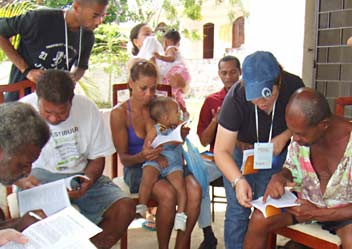
Iroma Applewhite (left), Morris Applewhite (2nd from right) and Ron Hanby (right), all from First Baptist Church in Hale Center, and their Brazilian interpreter present a New Testament to a young mother during a home visit in Brazil. The team of 16 members from churches in Caprock Plains and Lubbock Baptist associations held Bible studies in almost 100 homes in Salvador, Brazil, resulting in about 300 adults making professions of faith in Christ.

Brazil mission trip seen as ‘anything but average'

By John Hall

Texas Baptist Communications

LUBBOCK—Troy Burke describes himself as “kind of average.” He’s a large man, but not overly large. He’s a pharmacist—an interesting-enough profession, but by his own admission it’s hardly one that stands out. But recently, he participated in a mission trip that he described as anything but average.

Burke, a member of Southcrest Baptist Church in Lubbock, was one of 16 people from the Lubbock Area Baptist Association and Caprock Plains Baptist Area who recently shared the gospel with people in homes, on the streets and in churches in Salvador, Brazil, seeing about 350 people profess faith in Christ as Lord for the first time.

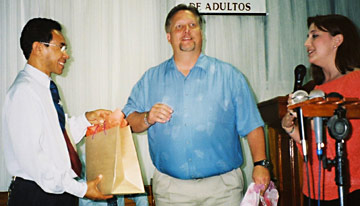
Brazilian Pastor Judson of the Proclamation Baptist Church of Salvador, Brazil, receives an appreciation gift from pharmacist Troy Burke and his wife, Jennifer, both members of Southcrest Baptist Church in Lubbock.

Working with missionaries in the area, the team distributed 1,200 copies of the New Testament and 8,000 written copies of Christian testimonies throughout the city.

Lubbock Area Association Director of Missions Larry Jones and Caprock Area Director of Missions Gene Meacham said the trip-takers stepped into what appears to be the beginnings of a church-starting movement in Brazil. Brazilians are coming to Christ in droves and churches are overflowing. Growing house churches are sprinkled across the landscape.

“It’s like stepping into the New Testament,” Jones said. “Like Paul stepping into Ephesus. But it’s his third mission trip. The people are on fire.”

Burke shared his faith in house churches, in medical clinics, schools and on the street and saw people—some of whom had never heard the gospel before—profess faith in Christ shortly after. He witnessed to drug addicts and prostitutes. He began seeing people in light of their need for Christ.

“I will never ever be the same,” he said. “I know that’s a cliché, but I look at everyone different.”

Once Burke was sharing the gospel with three men on the street and noticed another man slowly getting closer and listening to the conversation. By the time Burke asked if the three men would like to accept Christ, the fourth man was standing right behind them. That man accepted Christ as his savior. And Burke felt he was one of the reasons God had called him to Brazil on this trip.

Southern Baptist Missionary Bridgette McBee (in the baseball cap) demonstrates how to use the New Testament. Each Brazilian who attended a home Bible study received a New Testament.

“I told him, ‘I’ll probably never see you short of heaven, but I’ll be sure to look you up when I get there.’”

The Sunday School teacher said the trip changed his life. He found it difficult to leave Brazil, noting there are many people who still need to hear about Jesus. Weeks later, he still thinks about Brazil.

“I have thought about it and dreamed about it ever since then,” he said.

As a result of the trip, he also sees people who need to hear the gospel in Lubbock as well. He’s more driven to share his faith, already seizing opportunities to talk to his church and the local Kiwanis club about his adventures in Brazil. He wants people to hear the gospel.

And that’s anything but average.

“I don’t feel average anymore because I know what it’s like to be obedient and allow God to lead,” he said.

News of religion, faith, missions, Bible study and Christian ministry among Texas Baptist churches, in the BGCT, the Southern Baptist Convention ( SBC ) and around the world.


From far North to Deep South, DBU volunteers serve

Posted: 10/27/06

Twelve young men from DBU set out on a 14-mile journey to test spirit, soul, and strength.

From far North to Deep South, DBU volunteers serve

By Tim Gingrich

Dallas Baptist University

DALLAS—From the frozen north to the Deep South, Dallas Baptist University students devoted their fall break to missions.

Jason Hatch, director of the Baptist Student Ministry at DBU, led a team of twelve young men to grow spiritually and serve in hands-on missions in Alaska.

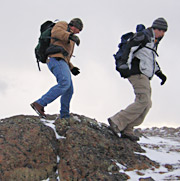
Two DBU students cross a ridge during their journey in Alaska.

“We take a lot of international mission trips, but at home we sometimes switch out of mission mode. One purpose of this trip was to realize you can do missions in the states, too,” Hatch explained.

Much of the 14-mile Alaskan backpacking trip focused on spiritual development, as Hatch led the students in prayer and discussion about the pressures faced by Christian men. Along the way, the student group encountered a family of five living in a makeshift shack after flashfloods destroyed their home.

“They had experienced several weeks of severe rain, and it completely ruined their house and scattered all their possessions,” said DBU sophomore Ryan Towson. Student volunteers immediately went to work collecting debris and cleaning the property.

But what the family needed most was simply a sign of God’s love, he noted.

“Hearing the father, who was himself a new believer, tell that he had prayed for assistance and was convinced that God had not given up on them—that was the most significant part for me,” Towson said.

DBU Student Jordan Summerville maneuvers a bed frame through a construction zone in Bay St. Louis, Mississippi.

The DBU team also volunteered at a foster home for young boys, held evangelistic meetings with two churches, and invited students at the University of Alaska to attend a concert featuring the contemporary Christian band Sonic Flood.

Far to the south, in Bay St. Louis, Mississippi, a 22-member DBU student team joined ongoing reconstruction efforts in the Gulf Coast town.

“The devastation was apparent as soon as we crossed into Bay St. Louis,” reported DBU senior Daniel Nix. “There are still a lot of leaky roofs to patch, doors to be replaced and yard work to be done.”

Partnering with First Baptist Church of Bay St. Louis, the DBU group helped construct a center for aid workers, cleared debris from several yards and carried out numerous home-repair projects.

“I think some people were skeptical about college students’ work ethic,” Nix acknowledged. “But we were able to serve their needs and exceed their expectations.”

In addition to leaving behind repaired roofs, trimmed yards, and finished out homes, DBU students took away life lessons.

"The fall break trip to Bay St. Louis was an excellent time to bond with fellow DBU students through service," said Lauren Robertson. "As a group, we cut through brush, put together bunk beds, ripped out tile flooring and much more. Through these experiences, we gained an experience of a lifetime and an excellent opportunity to serve God."

DBU students furnish a new volunteer center with much needed supplies.

Whether at the foot of Alaska’s majestic mountains or beside the Gulf shore in Mississippi, all the DBU student volunteers came home talking about one unforgettable sight.

“The best part of serving is seeing the faces of those for whom you are working,” Nix said.


Correction: In the original version of this story, Bay St. Louis was incorrectly identified as Bay St. Paul.


News of religion, faith, missions, Bible study and Christian ministry among Texas Baptist churches, in the BGCT, the Southern Baptist Convention ( SBC ) and around the world.


Bible Studies for Life Series for November 5: Live in relationship, not rebellion

Posted: 10/26/06

Bible Studies for Life Series for November 5

Live in relationship, not rebellion

• Isaiah 1:2-4,10-20

By Kenneth Lyle

Logsdon School of Theology, Abilene

The goal of life in the western world is perhaps best expressed in over-used phrases like, “Get the most out of life …,” “Live life to the extreme …,” or “Realize your potential … .” Infomercials, self-help specialists and life coaches all claim to have the secret to living a full and important life.

But the desire to live an abundant life did not come late to the human experience, nor did the call to find abundant life in relationship and service to the living God.

Over the next four weeks, these lessons bid us to listen to the voice of an ancient prophet and heed his summons. The series of lessons, “Invitation to Maximum Living: Isaiah Speaks Today,” focuses on passages from the book of Isaiah that set stark choices before God’s people. The prophet Isaiah powerfully sets before God’s people clear choices—relationship or rebellion; light or darkness; reality or delusion; life or life abundant.

As one of the major prophets, Isaiah (along with Jeremiah and Ezekiel) constitutes a major portion of the Old Testament prophetic literature. The opening verse of the book gives some evidence of the identity and location of the prophet: “The vision concerning Judah and Jerusalem that Isaiah son of Amoz saw during the reigns of Uzziah, Jotham, Ahaz and Hezekiah, kings of Judah” (v. 1).

The historical books of the Old Testament provide information about these kings in Judah (2 Kings 15-20; 2 Chronicles 26-32). The early chapters of Isaiah (1-39) relate primarily to the circumstances surrounding these eighth-century-B.C. kings, and the prophetic word found there speaks to the rollercoaster ride of political and military events facing Judah.

The latter chapters of Isaiah (40-66) reflect the time of the exile, the Persian conquest of Babylon and the return from exile. For this reason, some scholars suggest another prophet or prophets, perhaps disciples of Isaiah (Second Isaiah, Third Isaiah), recorded a further word from God for a subsequent generation.

Regardless of compositional theories, the book of Isaiah represents an ongoing picture of God speaking to God’s people in the midst of their triumph and struggle.


What is lost matters (Isaiah 1:2-4)

The journey through Isaiah begins with the summons to choose relationship over rebellion. The first chapter of Isaiah presents a simulated courtroom experience. The heavens and the earth are called upon to sit in judgment, and the prosecutor-judge, God, voiced through the prophet, lays out the charges against the people.

God’s people have become rebellious children (v. 2). They are a “sinful nation, a people loaded with guilt, a brood of evildoers, children given to corruption” (v. 4). They willingly have turned away from their greatest advantage—a relationship with the living God: “They have forsaken the Lord; they have spurned the Holy One of Israel and turned their backs on him” (v. 4).

At the heart of the charge is the recognition that the essential problem is a lack of knowledge and understanding. Unlike an ox that knows its master or a donkey that recognizes its owner’s trough, God’s people refuse to hear God’s voice (v. 3).

When humanity rebels against God, something important is lost. The special relationship God desires to have with his people is severed—not from God’s side, but from the human side. When humanity turns away from God, it loses the ability to know God or to even understand God. Interestingly, the Apostle Paul reflects on this same truth in his letter to the Romans (1:18-32).


Why I worship matters (Isaiah 1:10-15)

In the subsequent verses, Isaiah continues to voice evidence of Judah’s wounded and desolate condition, the result of their rebellion against God. The crescendo of hardships heaped on the people peaks with the recognition that “unless the Lord Almighty had left us some survivors, we would have become like Sodom, we would have been like Gomorrah” (v. 9).

The shocking and unthinkable comparison of God’s people with the sinful, rebellious and condemned cities of Sodom and Gomorrah becomes a shocking and unthinkable identification of God’s people in verse 10.

Moreover, God’s people are identified with the quintessential rebellious people precisely at the level of their worship of God. What should have set them apart and made them special—their relationship to God expressed in sincere worship—has become the occasion for empty sacrifices (v. 11), “meaningless offerings” (v. 12), “evil assemblies” (v. 13), burdensome feasts (v. 14) and pointless prayers (v. 15).

The passage again invites comparison to Paul’s treatment of sinful rebellion in Romans 1 and 2. Rebellion against God is not just found among the irreverent Gentiles, but also among the Jews who should have known better. God desires and appreciates worship when it is offered in sincere and encompassing ways; however, when worship becomes just another “thing” we do, a duty to check off our list, or worse yet a means of manipulating God, then worship becomes detestable to God. Empty worship matters not to God; God requires more.


How I live matters (Isaiah 1:16-20)

The focal passage ends with a resounding prophetic call to pursue rigorously the things that matter to God. At the heart of the argument is God’s call to renew the broken relationship. In intimate relationship language, God calls out: “Come now, let us reason together … though your sins are like scarlet, they shall be as white as snow; though they are red as crimson, they shall be like wool” (v. 18). It is as if we have moved from the law court scene to the family living room, where God says to the estranged family members, “Come on now—let’s argue this thing out, let’s fix it.” God beseeches his people to “stop doing wrong” (v. 16) and lays before them the things that really matter—doing right, seeking justice, encouraging the oppressed, defending orphans, pleading for widows (v. 17).

God presents two choices—relationship, characterized by willing obedience, or rebellion, evidenced by resistance to God’s will. Relationship leads to blessing; rebellion ends in bitter failure (1:19-20).


Discussion questions

• In what ways do we fail to know God or to understand God? How does knowing God differ from acknowledging God?

• How does our worship of God set us apart and make us different? In what ways might our worship become like the empty worship described by Isaiah?

• How do we as reconciled members of God’s family “learn to do right”? How do we seek justice? Encourage the oppressed? Defend orphans? Plead for widows?


News of religion, faith, missions, Bible study and Christian ministry among Texas Baptist churches, in the BGCT, the Southern Baptist Convention ( SBC ) and around the world.


BaptistWay Bible Series for November 5: God is the only source of true wisdom

Posted: 10/26/06

BaptistWay Bible Series for November 5

God is the only source of true wisdom

• Proverbs 1:7; 3:1-20

By David Wilkinson

Broadway Baptist Church, Fort Worth

Where does one go to find true knowledge and wisdom?

Sages, saints and everyday citizens have asked that question, in one form or another, through the ages.

And through the ages, the Judeo-Christian faith and its holy Scriptures have answered that fundamental question clearly and consistently: True wisdom finds its source in God alone. Or, as Proverbs puts it, “The fear of the Lord is the beginning of knowledge” (1:7).


Guidelines for interpretation

As we begin this brief, four-week excursion into the world of Proverbs, several introductory comments about the purpose and nature of this fascinating book can help guide us.

• The original purpose of Proverbs was to serve as an instructional manual, a kind of textbook for life, used for moral and intellectual training of young men for successful adulthood within Jewish faith and culture, according to theologian R.B.Y. Scott.

• Proverbs is essentially “a collection of collections of wisdom materials” gathered over time, David Hubbard points out in his commentary on the book. The existence of different collections is evident from the way the materials finally were organized as the book of Proverbs.

• Proverbs is composed of two primary types of literature—instructions or admonitions, usually directed to “my son” or “sons,” and poetic speeches in which wisdom is often personified. Both of these are evident in Proverbs 3:1-20.

Both types are composed in the distinctive form of Hebrew poetry. While many of the nuances in the original language are lost or diffused in translation, the poetic device of parallelism, characteristic of Semitic literature, generally is retained in our English translations.

The most prominent form is “synonymous parallelism” in which the second line restates the first, usually with synonyms, as a way of reinforcing the meaning (see 3:1). In “antithetic parallelism,” the second line contrasts the first with its opposite viewpoint, often to emphasize the “two ways” between wise and foolish or right and wrong (see 1:7). The third form, “synthetic parallelism,” uses the second (or sometimes the third) line to complete the sense of the first. The first thought is extended or enhanced by the additional line or lines (see 3:12).

• In seeking to understand Proverbs, it is important to adopt a discipline of reading and interpreting this book on its own terms. While much of Proverbs may sound not only foreign but overly simplistic to our modern ears, it is important to recognize that as wisdom literature, Proverbs “has its own way of looking at life” and, therefore, “its own way of using words,” Hubbard says.

We do well not only to see this book for what it is, but also to keep in mind that the early church chose for good and enduring reasons to retain this collection of wisdom sayings in the canon. These proverbs still have much to teach if approached with open minds and humble hearts, allowing the ancient wisdom to speak their truth to a culture that seldom takes time to listen to the sages of our faith.

• Finally, it is equally important to see Proverbs within its larger biblical context. Proverbs is one voice among many in a complex dialogue that gives texture and depth to biblical faith. As with any book of the Bible, Proverbs ultimately should be studied and interpreted within the larger context of all Scripture and especially in light of the life and teachings of Jesus.

Proverbs contains insights for living gained through generations of experience, but it does not say everything that needs to be said (and heard) about the life of faith. As maxims, the very nature of proverbs leans toward oversimplification. Indeed, in the larger context, some of the proverbs are clarified, challenged and even contradicted by other areas of scripture.


A motto to live by (1:7)

The statement, “The fear of the Lord is the beginning of wisdom,” not only is a motto for the book of Proverbs, but also a kind of motto for life, a “preamble to wise living,” theologian Rolland Schloebb says.

While the etymology of the word translated “fear” certainly contains an element of fear and even terror in the presence of Almighty God, its meaning is better understood as “reverence” or awe. Reverence includes the recognition that God is God, and we are not; that God is the Creator, and we are the created beings. This reverence, as we have seen earlier in the Psalms, includes an awareness that there is more to life than what appears on the surface, that there is a presence and power infinitely greater than ourselves.

The Hebrew word translated “beginning” has an important two-fold meaning of beginning as both a “starting point” and as “chief part.” In this sense, true knowledge or wisdom finds its origin in God and God alone.

This affirmation of faith forces us to confess that too often we neither “fear” God in the sense of fear and reverence nor turn to God as the starting point and source of wisdom for living. The sad truth is that even as believers, we live daily with a kind of “practical atheism.” We don’t hate or despise God; indeed, we claim to love God. Yet we seek knowledge and pursue wisdom without consulting God; we live most of the time as if God doesn’t exist.


The blessings of wisdom (3:1-20)

Chapter 3 consists of three discourses, each beginning with “my son” (vv. 1-10, 11-20, and 21-35). The first section consists of a series of admonitions or commands followed in each case by the reasons for them. The admonition—“do not forget my teaching” (v. 1)—that begins this section emphasizes the critical role of “remembering” for the life of faith (v. 8). Repeatedly in Scripture, we are called to “remember” what is most important. In so doing, we will find wisdom for life.

Verses 5-6, committed to memory by many Christians, speak of a trustful attitude and a way of life rooted in a relationship with God. It is out of this trust in a trustworthy God that we experience the blessings of wisdom described in this section.

Novelist and short story writer Honoré de Balzac, who wrote about everyone and everything related to 19th-century French society, offered the confession that “I am not deep, but I am very wide.” The wisdom of Proverbs can help lead us from shallow living to deeper lives of faith, trust and meaning.


Discussion questions

• In what ways do the introductory guidelines for interpreting Proverbs inform your approach to this book of wisdom?

• Where does our American culture encourage us to turn for wisdom? Do these sources point us toward God or away from God? Why?

• Think of a Christian you would describe as wise, and list the qualities that make that person wise.

News of religion, faith, missions, Bible study and Christian ministry among Texas Baptist churches, in the BGCT, the Southern Baptist Convention ( SBC ) and around the world.


Explore the Bible Series for November 5: Exercise confidence in your relationship with God

Posted: 10/26/06

Explore the Bible Series for November 5

Exercise confidence in your relationship with God

• Hebrews 10:10:19-39

By Howard Anderson

Diversified Spiritual Associates, San Antonio

Christians must exercise confidence in their relationship with God as they worship, study and witness.

The writer of Hebrews gives a summary of the arguments to enter boldly into the presence of God. The warning against apostasy is one of the most serious warnings in Scripture and sets out the punishment for sin. Finally, the writer points out that the Hebrews’ former experiences should stimulate them, and the fear of God’s displeasure should prevent them from going back to Judaism.


Boldness for Christ (Hebrews 10:19-25)

The writer addresses his Jewish brethren with an invitation to leave behind the Levitical system and to appropriate the benefits of the new covenant in Christ. Because of the high-priestly ministry of Christ and his sacrifice, the Hebrews can enter boldly into the presence of God. The Holy Spirit calls for all to come confidently before God’s throne to receive mercy and grace through Jesus Christ (Matthew 27:51).

It is a newly made way and a living way. It is so-called because Christ was newly slain and because he, being the way to God, is alive forevermore (John 14:6). He is now alive within the veil. The witness of the Holy Spirit so fills us with the assurance of the love of God, our Father, that there remains no residue of fear. We are filled with a joyful freedom and confidence to come into the presence of God as children running to a father they trust completely and with whom they share a warm and tender relationship. It is only under the conditions of forgiveness and cleansing that we have such confidence and holiness of God.

The basis of the boldness is the blood of Christ, an obvious allusion to the blood of the sacrificial offering (Hebrews 9:12), where it was stated nothing could be cleansed without the shedding and sprinkling of blood. Now we also are made clean to be in the presence of God in holy worship.


Punishment for sin (Hebrews 10:26-31)

To “sin willfully” is a deliberate intent that is habitual after we have received the knowledge of truth. We renounce Christ as the only sacrifice after we have received him. We despise the gospel after we have received its knowledge. We tread on the Son of God after knowing him. We calculate Christ’s blood, that one time was sacrificed for humanity, as an unholy thing. We blaspheme the Holy Spirit of grace that we have received. We become adversaries after knowing the truth. To “sin willfully” is to reject Christ deliberately. These are not isolated acts.

According to the Mosaic legislation, such acts of deliberate, premeditated sin required exclusion from the congregation of Israel (Numbers 15:30-31) and from its worship (Exodus 21:14). Such sins also excluded the individual from sanctuary in the cities of refuge (Deuteronomy 19:11-13).

“Received the knowledge” denotes specific knowledge, and not general spiritual knowledge (1 Timothy 2:4). Though the knowledge was not defective or incomplete, the application of the knowledge was certainly flawed.

Judas Iscariot is a good example of a disciple who had no lack of knowledge, but lacked faith and became the arch-apostate. Apostates are beyond salvation because they have rejected the only sacrifice that can cleanse them from sin and bring them into God’s presence. To turn away from that sacrifice leaves them with no saving alternative. The sin of the Hebrews was the deliberate rejection of that which they knew to be of Christ.

“Judgment and fiery indignation” ultimately is eternity in the lake of fire (Matthew 13:38-42, 49, 50). The judgment is certain to happen; therefore, it engenders fear. “Adversaries” are the hostile members in the congregation and are the opposition against God and the program of God in salvation.

Rejecting Christ insults the Holy Spirit who worked through him (Matthew 12:31, 32) and who testifies of him (John 15:26). In the end, “the living God” will punish his enemies eternally.


Confidence from past (Hebrews 10:32-39)

“Call to remembrance” carries the idea of carefully thinking back and reconstructing something in one’s mind, not merely remembering. The writer assumes the role of encourager and reminds the Hebrews of their good days of early discipleship, when with a magnificent spirit they endured suffering themselves and identified with those who were suffering. They were marvelous in the midst of many struggles and did not go under.

In verse 34, the emphasis is that the Hebrews had shown care and compassion even if such care implicated them. They accepted with joy the pillaging of their property. The authorities turned their backs on the crime, leaving these victims with every reason to feel annoyed, angry or mistreated; however, they were joyful.

“Now the just shall live by faith.” Faith is the beginning of justification (Romans 5:1). Faith is also the continuation of justification (vv. 38-39). “Draw back” is to withdraw (Galatians 2:12) or keep back (Acts 20:20), which is essential for Christians if the Holy Writ is to have meaning.


Discussion questions

• How does Christ’s sacrifice enable Christians to boldly approach God’s throne?

• How does sin affect that boldness?

News of religion, faith, missions, Bible study and Christian ministry among Texas Baptist churches, in the BGCT, the Southern Baptist Convention ( SBC ) and around the world.


BGCT reorganized but not downsized

Posted: 10/27/06

BGCT reorganized but not downsized

By Ken Camp

Managing Editor

DALLAS—Two years into a major restructuring of the Baptist Building, a focus on streamlined response to churches has not resulted in the significantly downsized organization some outside observers had anticipated.

Senior administrators point to a Baptist General Convention of Texas Executive Board staff who stay in closer contact with churches, respond more rapidly to congregations’ needs, demonstrate greater ethnic diversity—and are slightly larger in number.

According to figures provided by the Baptist Building, BGCT Executive Board staff totaled 281 in 2004 and 284 in 2006, with eight positions open. Those totals do not include Baptist Student Ministry directors, Texas Baptist Men, Woman’s Missionary Union of Texas, Baptist Church Loan Corporation and WorldconneX staff.

Collegiate Ministry employs 67 full-time Baptist Student Ministries directors who are paid exclusively by the BGCT—a number that has remained constant at least the last six years. Total workers currently number 123, including part-time staff, interns and campus missionaries whose salaries are paid in part by associations or other groups.

With 10 congregational strategists—nine full-time and one part-time—in place around the state, the Baptist Building is able to evaluate effectiveness in ways not possible previously, Executive Director Charles Wade said.

“Our congregational strategists are giving feedback about what difference we’re making in local churches,” Wade said. “We’re able to evaluate what we’re doing—not just in terms of how many people show up for a conference, but by checking back later to see what difference we’ve made in churches.”

Chief Operating Officer Ron Gunter noted pastors and associational directors of missions generally have responded positively to the field staff—congregational strategists and seven church starters.

The strategists and church starters work in cooperation with affinity-group leaders for African-American, Hispanic, intercultural, Western-heritage, and bivocational or small-membership churches, he noted.

Gunter also pointed to staff in the BGCT Service Center—seven employees who receive calls for help, information or resources and seven who generate phone contacts with churches—as working closely with the congregational strategists to make sure churches find the help they need.

At the same time, the new research and development office has made strides toward creating new processes to improve effectiveness and ensure accountability, he noted, pointing particularly to the modified zero-based budgeting method implemented this year.

The Baptist Building also has updated its computer systems, implemented church relationship management software and worked toward consolidating and integrating databases previously maintained by individual offices, he added.

“We’re sharing information across the organization. The research and development team manages that information for us and keeps data current and up-to-date,” Gunter said.

Baptist Building leaders acknowledged better understanding of churches’ needs does not automatically translate into improved delivery of services. Increasing the flow of information from churches to the BGCT Executive Board staff can create heightened expectations—and frustration unless the delivery of services to churches keeps pace.

While the staff reorganization has been completed for now, additional changes may take place as new needs are discovered. “I expect to see that we will have a need for more church starters,” Gunter noted.

Staff additions in some areas—such as the Service Center and the congregational strategists—have been offset to some degree by the elimination of a few positions and the consolidation of some functions.

Areas eliminated. The prayer and spiritual development office, ChurchLife Resources (a church health assessment tool and website to help churches find resources) and the City Core Initiative (an urban missions project) were among the areas eliminated. Many of the staff assignments previously performed by missional church strategy and community ministries directors will be divided among other staff within the missions, evangelism and ministry area in the coming year.

Events cancelled. A few events—such as the Epicenter missions conference and the Urban Training Institute—and initiatives like the ChurchLife Plus long-range planning consultations, church health and growth conferences, workshops on preserving church history and a regional church music conference in West Texas also either have been cancelled or will be reformatted.

Programs dropped. Other programs, like the semester-church pilot project—an effort to plant short-term “seed churches” among students on college campuses—simply never got off the ground.

No “Add LIFE” programs to use Sunday school as a platform for church growth and evangelistic outreach will be started in 2007, but the process will continue in churches that already are involved.

Names changed. Some longtime BGCT ministries have been renamed to reflect expanded focus. For instance, River Ministry now is called Border/Mexico Missions be-cause it includes missions in the interior of Mexico as well as the region along the Rio Grande.

The Texas Baptist Leadership Center became the congregational leadership team, and it was elevated in the organizational structure so its director reports to the chief operating officer.

New initiatives started. Other new ministries have been launched, such as the Baptist Immigration Services Network.

Collegiate Ministries started the Collegiate Church Life Network to help churches develop ministries to college students and Abide, a 24-hour prayer retreat for college students.

The congregational leadership area has developed new assessment tools to help ministers recognize their strengths and identify areas where they need improvement, as well as categorize their leadership styles and adapt them to the places where they serve.

• Business as usual. The vast number of BGCT-related programs and events—such as Texas Partnerships, the LifeCall volunteer missions program, Hispanic Evangelism Confer-ence, Youth Evangelism Conference, the Congreso event for Hispanic young adults, the Focus conference for college students, the Restorative Justice Ministry Network, Singing Men of Texas and All-State Choir—continue relatively unchanged.

“Since we have discontinued relatively little, this has required the organization to squeeze the most strategic effectiveness out of every dollar,” Communications Director Ferrell Foster noted.

In the near future, the BGCT Executive Board staff plans to launch regional meetings that may replace some statewide events, Wade noted. “We are learning from the example of Texas WMU,” he said. Texas WMU replaced its annual Texas Leadership Conference with 13 regional Awakening events that drew about 3,400 participants—about four times the number who attended the statewide event at Waco in recent years.

Everything in the organizational structure and every initiative involving staff will be subject to continuing review and evaluation, Wade added. “We will be evaluating everything we do,” he said. “If we find out we are doing things that are not needed any more, we will move resources to areas where we need more people.”

News of religion, faith, missions, Bible study and Christian ministry among Texas Baptist churches, in the BGCT, the Southern Baptist Convention ( SBC ) and around the world.


Book Reviews

Posted: 10/27/06

Book Reviews

To Own a Dragon: Reflections on Growing Up Without a Father by Donald Miller & John MacMurray (NavPress)

It’s always fun to read a Don Miller book, and his latest is no exception. This time, the best-selling Blue Like Jazz author and college speaker teams up with his spiritual mentor, the international nature photographer John MacMurray.

Miller writes in his humorous and transparent style, poetically relating many of the experiences and lessons he missed growing up without an earthly father’s presence and training in life skills. While living with MacMurray’s family, Miller’s friend passed on spiritual insights that shaped his views of God and what it means to be a father.

What are you reading that other Texas Baptists would find helpful? Send suggestions and reviews to books@baptiststandard.com.

Having lost my father, Reggie, to cancer earlier this year, my grief is fresh, and I wasn’t sure how the book would affect me. However, while reading, I developed an even deeper appreciation for the godly influence of my dad, also being grateful that God is my ever-present, ever-loving and perfect Father.

Even though this book is highly recommended for those, especially men, who were raised without fathers, I also recommend it to all who are learning to trust our Heavenly Father.

Greg Bowman, minister to students

First Baptist Church

Duncanville


Welcome to Fred by Brad Whittington (B&H Publishing Group)

As a native of East Texas who pastored two churches within an hour’s drive from the town of Fred, my interest was peaked by a newspaper review of this Christy Award-winning novel.

Mark Cloud, a preacher’s kid, could be any teenager trying to find his place. Like most teens, he believes his destiny is to be found someplace other than where he presently finds himself. The faith of the father influences the son, but a series of events leads Mark to discover and embrace it as his own. The father is a wise man who not only allows his son to ask probing and even skeptical questions, but encourages them.

Whittington’s vivid depictions opened a floodgate of memories and laughter as I reflected upon some of the colorful characters who do, indeed, inhabit the woods of rural East Texas. But more than this, the author captures well the honest struggles of the individual seeking to understand the mysteries of the faith. It was a refreshing break from the formulaic, “easy believism” that seeks to put God in box so you can have your best life now pabulum that seems to dominate Christian publishing today. It’s unfortunate that such an honest and realistic depiction of the journey of faith has to be found in a fictional work.

The two sequels, Living With Fred and Escape From Fred, are a must to complete the journey.

Bobby Dagnel, pastor

First Baptist Church

Lubbock

Driven by Eternity by John Bevere (FaithWords)

Driven by Eternity is an attempt to teach people to “keep sight of the goal that will allow readers to begin laboring for the rewards that endure—for eternity.”

Somehow John Bevere loses that focus and basically condemns to the lake of fire all who would disagree with his theology. His commentary on the Scripture is taken out of context and based on preconceived ideas. His authority to speak seems to come more from what he has heard others say instead of a solid study of the Bible. He quotes other authors and preachers as if they were of supreme authority even talking on occasion of friends who have gone to hell and come back to warn of its torments. His logic is bad, his grammar lacking and his scholarship poor. His attempt at allegory could be matched by any junior-high youth.

If the intention of his commentary is to challenge the reader intellectually, he fails. If his intention of his allegory is to motivate the reader emotionally, he fails.

Butch Strickland, pastor

Independence Baptist Church

Brenham


The Beloved Community: How Faith Shapes Social Justice, From the Civil Rights Movement to Today by Charles Marsh (Basic Books)

As professor of religion at the University of Virginia and director of the Project on Lived Theology, Charles Marsh has demonstrated a unique ability to integrate history and theology with the practical application of the gospel. Marsh leads a fascinating journey through the Civil Rights Movement and the contributions of Martin Luther King Jr. and the African-American church to end segregation as social policy and establish the “Beloved Community,” a term coined by King to describe his vision of community.

Having grown up through this era, I found myself fascinated by the struggle for equality and burdened by the apathy (even antagonism) of “mainstream” churches and denominations for whom church was more about culture than lived faith.

Marsh concludes with current leaders such as John Perkins and his work in the Christian Community Development Association, providing living examples of how the church today is continuing the quest for the “Beloved Community.” This is a must read for church leaders who take community missions seriously and have a vision for community transformation.

Jim Young,

social justice specialist

Baptist General Convention of Texas

Dallas

News of religion, faith, missions, Bible study and Christian ministry among Texas Baptist churches, in the BGCT, the Southern Baptist Convention ( SBC ) and around the world.


Baptist Briefs

Posted: 10/27/06

Baptist Briefs

Benefactors pledge $16 million to seminary. Harold and Dottie Riley of Austin have pledged $16 million for a campaign to build a 3,500-seat chapel on the Southwestern Baptist Theological Seminary campus. Presently, the largest auditorium on campus at the 3,000-student school is the 1,100-seat Truett Auditorium. Since coming to Southwestern as president in 2003, Paige Patterson has made building a new chapel one of his priorities. Two years ago, trustees authorized architects to draw up plans, and a site west of the Smith Center for Leadership Development was selected. Patterson has said no ground will be broken until all funds for the chapel have been committed.


National WMU re-elects Texan as officer. Kathy Hillman of Waco and Kaye Miller of Little Rock, Ark., were elected to serve another year as national officers of Woman’s Missionary Union recently at LifeWay Ridgecrest Conference Center in North Carolina. About 750 members were present at WMU’s 118th annual meeting to re-elect Miller to a second term as president and Hillman to a third term as recording secretary, both by unanimous vote.


Southeastern breaks ground for Patterson building. Trustees at Southeastern Baptist Theological Seminary in their recent annual meeting broke ground for a $6.2 million building named for former seminary President Paige Patterson and his wife, Dorothy. Completion of Patterson Hall—which will house classrooms, faculty offices and a center for faith and culture—is expected in 2008.


Southwestern trustees tie tongues. In a closed-door meeting, Southwestern Baptist Theological Seminary trustees reportedly adopted a statement insisting the seminary will neither endorse charismatic practices—such as a private prayer language—nor hire professors who advocate such practices. Only one trustee was known to have voted against the measure—Dwight McKissic, pastor of Cornerstone Baptist Church in Arlington. Earlier this semester, McKissic preached a chapel sermon at the seminary in which he took issue with the Southern Baptist International Missionary Board policy barring missionary candidates who engage in charismatic practices. The seminary removed the video of McKissic’s sermon from its website.


American Baptists nominate missions leader. Reid Trulson has been nominated to become the next executive director of American Baptist International Ministries, the global missions and ministry arm of American Baptist Churches, USA. Trulson has served more than 20 years in local church ministry and 11 years in international missions—five years as a missionary in Europe and six years as a member of the stateside staff. He served two terms as president of the board of international missions. Trulson’s nomination goes to the American Baptist General Board and International Ministries Board for election Nov. 15.


Baptists in Alaska support the troops. Messengers to the Alaska Baptist Convention approved a $1.9 million budget for 2007 and a resolution offering continued prayer and support for military personnel and their families. The resolution of support will be sent to commanders and chaplains with the 172nd Striker Brigade Combat Team, based at Fort Wainwright, Alaska. Messengers elected as president Gary Cox, pastor of University Baptist Church in Fairbanks; first vice president Charles Worthy, pastor of First Baptist Church in Willow; second vice president Ed Gregory, pastor of First Baptist Church in Anchorage; and recording secretary Colleen Cannon from First Baptist Church in Anchorage.


American Baptists may sell ‘Holy Doughnut.’ Leaders of the American Baptist Churches USA will consider selling the facility jokingly known to some of the denomination’s faithful as the “Holy Doughnut”—the denominational office building near Philadelphia. In its Nov. 14-15 meeting, the denomination’s General Board will take up a recommendation from its own executive committee to begin offering the ABC-USA Mission Center in Valley Forge, Pa., for sale. Last month, the committee unanimously approved a recommendation from an ad hoc panel to sell the center—built in 1962 and known by its humorous nickname because of its circular, modernist design. Cheryl Wade, the denomination’s associate general secretary and treasurer, said the mission center is too large for the denomination’s current needs. The building currently houses the General Board staff, as well as the central staffs for the denomination’s Board of International Ministries and Board of National Ministries. It also houses a satellite office for the denomination’s Missionaries and Ministers Benefit Board and offices for several affiliated ministry organizations.

News of religion, faith, missions, Bible study and Christian ministry among Texas Baptist churches, in the BGCT, the Southern Baptist Convention ( SBC ) and around the world.


Cartoon

Posted: 10/27/06


News of religion, faith, missions, Bible study and Christian ministry among Texas Baptist churches, in the BGCT, the Southern Baptist Convention ( SBC ) and around the world.


2nd Opinion: Political party? Irrelevant question

Posted: 10/27/06

2nd Opinion:
Political party? Irrelevant question

By Taylor Sandlin

It’s political season once again—commercials, road signs, stump speeches.

I remember my first interview with a pastor-search committee during my seminary days. A man asked me, “So, are you a Democrat or a Republican?” I looked out over that group of a dozen people whose political identity I had absolutely no idea about and thought to myself, “This is surely a trap.” I quickly replied, “If I were to become your pastor, my goal would be for you to never find out.” That seemed to satisfy them, although they didn’t offer me the job. My answer, though a little evasive, was born not of convenience, but conviction.

As a pastor, my primary allegiance is to a kingdom not of this world (John 18:36). It’s a kingdom represented by neither the Republican nor Democratic party. Any attempt to combine the kingdom of God with a kingdom of this world does great damage to our message.

Philip Yancey states correctly in his book, The Jesus I Never Knew: “The issues that confront Christians in a secular society must be faced and addressed and legislated, and a democracy gives Christians every right to express themselves. But we dare not invest so much in the kingdom of this world that we neglect our main task of introducing people to a different kind of kingdom, one based solely on God’s grace and forgiveness. … If a century from now all that historians can say about (today’s) evangelicals is that they stood for family values, then we have failed the mission Jesus gave us to accomplish—to communicate God’s reconciling love to sinners.”

Throughout the ages, the possibility of seizing control of the reigns of government for the purposes of the church has stood as a great temptation. But beware: That temptation is always a trap, and far from advancing the kingdom of God, it impedes her advance.

Believe it or not, I want you to pay attention to all the ads, all the signs, all the speeches. Pay attention and vote your conscience. It is important for our country. But it’s important for us to remember that the question, “So, are you a Democrat or a Republican?” will never be asked as a litmus test for membership in our church.

Why not?

Primarily, because such a question is irrelevant for entrance into the kingdom of God.

Taylor Sandlin is pastor of Southland Baptist Church in San Angelo.


News of religion, faith, missions, Bible study and Christian ministry among Texas Baptist churches, in the BGCT, the Southern Baptist Convention ( SBC ) and around the world.