Snapshots of piety in America

Posted: 9/29/06

Snapshots of piety in America

By Hannah Elliott

Associated Baptist Press

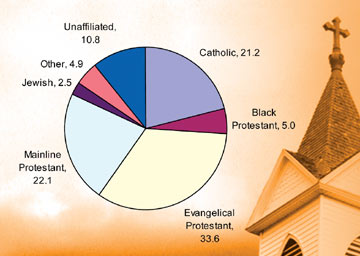
WACO (ABP)—Americans may not be losing their religion after all, according to a new Baylor University study on faith in the United States. The results of the recently released study by Baylor’s sociology department and Institute for Studies of Religion show, among other things:

See Related Articles:
Snapshots of piety in America
Americans hold four views of God, research shows
• View the entire Baylor University Religion Survey report as a pdf file here.

• The majority of people not affiliated with any religion still believe in God, and one-third pray at least occasionally.

• Nearly 11 percent of people who claim no affiliation with a religion attend church at least once a month.

(Photo illustration by David Clanton)

• One out of 10 people with no religious affiliation firmly believes Jesus is the son of God.

The study, called “American Piety in the 21st Century,” is the most extensive of its kind. Funded by the John Templeton Foundation and developed with help from the Gallup Organization, it involved data from 1,721 people who responded to a mailed survey. The questionnaire contained 350 queries, dealing with everything from prayer habits and religious labels to Christian consumer spending and belief in the paranormal.

The survey sheds new, detailed light on America’s religious picture, Baylor President John Lilley said.

Byron Johnson, co-director of the institute and a professor of sociology at Baylor, explained that the report had significance in another way, too. While other noted religious surveys asked general questions—like “Do you believe in God?” and “Do you pray?”—the Baylor report followed those preliminary questions with more probing inquiries.

For example, if respondents answered that they did indeed pray, they also had to detail when they prayed, to whom, why, and the reason for the prayer. In general, the research team aimed to “dig down deep,” Johnson said.

That probing apparently paid off, particularly in the data the survey gathered regarding religious self-identification.

In recent years, other studies have concluded that Americans are becoming more secular, at least when it comes to church attendance and membership in faith communities. From 1988 to 2004, for instance, the number of religious “nones”—people who claim no affiliation with any congregation or religious group—rose from 8 percent to 14 percent, according to one study.

But Kevin Dougherty, a Baylor sociology professor and research fellow at the institute, thinks supposed secularization is mainly a function of how survey questions are asked, rather than a real decline in religious belief or practice.
“A fundamental question for anyone studying religions is, ‘Are Americans losing their religion?’” he said. “The reason why this is such a big question is there is some evidence … that some people in fact are losing their religion. If it is true, it reveals a tremendous amount of secularization occurring in our society.”

Fortunately, that’s probably not the case, he said. In fact, the new study suggests fewer Americans live their lives completely outside of organized religious life than previous survey results have suggested.

That, Dougherty said, is because the Baylor study asked far more detailed questions of respondents than previous studies.

When researchers take the time to ask about people’s religious activity on the local level, only about one in 10 Americans ends up having no connection to a religious community, he noted.

“We found that almost a third of people who said ‘I don’t know my religion’ five questions later gave us the name of a congregation” whose services they attend, the sociology professor said. “There were 10 million Americans over-counted as religious ‘nones.’”

Previous surveys in the area would not have picked up that subtlety, Dougherty said. He added the new results also indicate a larger trend: People are better able to identify with a local place of worship than with a national denomination. For instance, fewer people today think of themselves as Southern Baptists than as members of a particular congregation.

Many survey respondents may not even know the name of the denomination to which their church or synagogue belongs.

Rick Warren is a Southern Baptist preacher. (Warren’s) Saddleback Church is a Southern Baptist church,” Dougherty said, referring to one of the nation’s largest and most prominent congregations, located near Los Angeles. “Do the 20,000 people who worship there every weekend know they are Southern Baptist? For many, probably not.”

For Dougherty and his colleagues, the survey’s bottom line is the discovery that, when religious classifications are dismissed, statistics change. Case in point: 2006 estimates by the highly respected Barna Group list 20 million evangelicals in America. According to the Baylor report, fully a third of Americans are affiliated with evangelical Protestant congregations, even if they don’t exactly identify with evangelicalism as a whole or with an evangelical denomination. Given current population figures, that translates into about 100 million Americans affiliated with evangelical Protestantism.

Denomination just doesn’t mean as much to people today as it has in the past,” Dougherty said.

Such differences could usher in a new methodology for religion surveys—and a more accurate picture of the nation’s still-vibrant religious life.
News of religion, faith, missions, Bible study and Christian ministry among Texas Baptist churches, in the BGCT, the Southern Baptist Convention ( SBC ) and around the world.


Americans hold four views of God, research shows

Posted: 9/29/06

Americans hold four views of God, research shows

By Hannah Elliott

Associated Baptist Press

WACO (ABP)—Americans believe in four different Gods—or at least view God in four distinct ways, a new study from Baylor University revealed.

Researchers from Baylor’s sociology department and Institute for Studies of Religion conducted the survey. Called “American Piety in the 21st Century,” it used survey data from 1,721 American citizens and was the largest such study ever conducted. Its 350 questions asked Americans their thoughts on a gamut of religion-related topics—from piety to politics to the paranormal.

See Related Articles:
Snapshots of piety in America
Americans hold four views of God, research shows
• View the entire Baylor University Religion Survey report as a pdf file here.

Among the survey’s most publicized results was its finding that most non-atheist Americans believe in one of four main views of God’s personality, which the researchers characterized as Authoritarian, Benevolent, Critical or Distant.

Which view of God one ascribes to, the survey found, can determine a lot about that individual’s beliefs—more than other factors commonly studied, such as income, race, location and political affiliation.

Christopher Bader, an assistant professor of sociology at Baylor and research fellow at the institute, said the research team made the report unique by rephrasing some of the routine questions usually asked on religion surveys. Such polls consistently report about nine in 10 Americans believe in God, but Bader and his colleagues thought views of God were complex enough to probe further.

The Baylor survey also asked whether respondents believed God is angry with sin, if he is involved in worldly affairs, if he is concerned with a person’s well-being—and even if they believed he is a “he.”

Then, after asking dozens of probing questions, the team analyzed the responses and placed the results on a continuum. When they saw the answers fell naturally into four general areas on the spectrum, they grouped the responses into the four distinct views of God’s character. According to the report, those perceptions of God significantly influence what people think about issues like gay marriage, divorce, premarital sex and the death penalty.

“What we find is this is terribly important because it can predict all kinds of things about an individual,” said Paul Froese, a Baylor sociology professor and researcher. “It relates to their religious practices. It relates to their ideas about morality. It relates to their political opinions.”

One interesting result, Froese said, was the distribution of each of the four God-types. While Catholics and mainline Protestants were rather evenly distributed across each view of God, African-American Protestants and evangelical Protestants tended more heavily toward the Authoritarian God—at 68 percent and 52 percent, respectively.

The Authoritarian God is characterized by a high level of involvement in daily life and world affairs. People who believe in the Authoritarian God believe he helps them in decision-making and punishes the unfaithful.

On the other hand, the Benevolent God is mainly a positive force in the world, still active in daily life but not condemning of individuals. Catholics were most likely to believe in this view of God, with nearly 30 percent adhering to the Benevolent view.

The Critical God, also a popular one among Black Protestants and mainline Protestants, stays mostly out of world affairs, providing critique of them from afar. People who believe in this God expect to receive judgment in the afterlife, Froese said.

Almost 42 percent of Jewish respondents and 36 percent of those unaffiliated with any specific religion believe in the Distant God. This God is not active in the world and not especially angry, either, according to the report. People who hold this belief tend to think of God as a cosmic force that set nature into motion.

The distribution is significant, Froese said, in that several seemingly random topics dramatically relate to an individual’s perception of God.

Take geography, for instance. According to the report, the region with the most widespread belief in the Authoritarian God—44 percent—is the South. In the Midwest, 29 percent of people believe in a Benevolent God, which is the most of any region. In the East, 22 percent of people believed in a Critical God, and more than 30 percent of people in the West adhere to the Distant God view—more popular there than elsewhere.

Other significant relationships emerged, too. “The higher your income, the less likely you are to think God is angry,” Froese said. “The lower your income, the more likely you are to think God is angry. Gender is another big relationship. Women tend much toward the Benevolent God. Men are more likely to think God is angry.”

Thinking God is angry, however, does not necessarily lead people to a place of worship. According to the report, church attendance has less to do with perception of God and more to do with a relationship with him. Fire and brimstone sermons do little to get people in pews, Froese said.

“What we’re finding is that people are sitting in the pews because they feel personally engaged with God or that God is personally engaged in their lives,” he said. “It’s really the personal relationship with God that brings them around and gets them involved.”

The study also found Americans’ religious self-description often has more to do with their own view of what the ideal religious community is than the self-description of the congregation or denomination to which they actually are connected.

For instance, while nearly half of Americans identify themselves as “Bible-believing,” only 15 percent of the population identifies itself as “evangelical”—and only 2 percent of Americans say that’s the best description for them.

Perhaps most surprisingly, more people in mainline Protestant denominations identify themselves as “evangelical” than people who attend churches or are part of denominations historically viewed as part of evangelical Protestantism.

Kevin Dougherty, a research fellow and sociology professor at Baylor, said the survey results suggest terms that researchers, journalists and political analysts often use interchangeably to describe evangelicals or other religious groups are, in reality, not quite so interchangeable.

“When we asked about people’s religions identities … the overwhelming response, almost half, of Americans say ‘Bible-believing’ captures me,” Dougherty said. “About a quarter say ‘born-again.’ About a quarter say ‘mainline Christian.’ Far less salient were labels such as ‘fundamentalist’ and ‘charismatic.’”

That’s why estimates of the percentage of Americans who are evangelicals vary so widely, Dougherty said. It all depends on who is doing the labeling.

One thing is certain, though, he said. “Faith matters, and people know faith matters.” Baylor officials plan to continue conducting the survey every-other year, inserting new questions about current topics and trends each time.

News of religion, faith, missions, Bible study and Christian ministry among Texas Baptist churches, in the BGCT, the Southern Baptist Convention ( SBC ) and around the world.


Navy chaplain convicted for protest

Posted: 9/29/06

Navy chaplain convicted for protest

By Robert Marus

Associated Baptist Press

NORFOLK, Va. (ABP)—A Navy chaplain who has accused his superiors of violating his religious freedom has been convicted by a court-martial for appearing in uniform at a rally to protest military policy on chaplains.

A military jury in Norfolk, Va., recommended that Lt. Gordon Klingenschmitt be docked $250 a month in pay for the next year and sent a letter of reprimand. The panel convicted him of violating a superior officer’s orders by wearing his uniform at a March 30 press event in front of the White House.

The rally was held to protest Navy rules that forbid chaplains from leading sectarian prayers at events where sailors of multiple faiths are present. Klingenschmitt offered prayers and read Scripture at the event, but changed back into civilian clothes before answering reporters’ questions.

But the commanding officer at Klingenschmitt’s base, Capt. Lloyd Pyle of the Norfolk Naval Station, had earlier ordered him, in writing, “not to wear your uniform for this or for any other media appearance without my express prior permission.” Pyle’s order came shortly after Klingenschmitt spent 18 days last December on a hunger strike in front of the White House to protest the policy on sectarian prayers.

Of the conviction, Klingen-schmitt said he was only “guilty of praying in Jesus’ name,” according to the Norfolk Virginian Pilot. His attorneys claimed he had the right to appear in uniform at the event because he was conducting a bona fide religious service.

But the jury agreed with prosecutors, who argued the evangelical Episcopalian’s uniformed presence at the press conference alone was sufficient to determine he had violated Pyle’s order and military policy.

During the trial’s sentencing phase, character witnesses both for and against Klingenschmitt described him as firm in his beliefs. His wife, Mary Klingenschmitt, said he was “passionate and dedicated” to his Christian faith, according to the Virginian-Pilot.

But the base’s head chaplain, Capt. Norman Holcomb, said he found Klingenschmitt “to be untruthful, unethical, insubordinate, contemptuous of authority … and a totally frustrating independent operator.”

Klingenschmitt, in a press conference following his conviction, vowed to fight the decision to the Supreme Court, if necessary. “I will continue to pray in Jesus’ name, I will continue to worship in public, and I will not be broken,” he said.

The issue of whether military chaplains may offer sectarian prayers at events where personnel of multiple faiths are present has stirred significant controversy in the past two years. The controversy was first sparked by accusations that evangelical Protestant officers and cadets harassed cadets of other faiths at the Air Force Academy in Colorado Springs, Colo.

As Klingenschmitt’s sentence was handed down, legislators were wrangling on Capitol Hill over a provision in a defense-spending bill designed to undercut the Navy and Air Force prayer guidelines.

In May, the House added a provision to the bill that said chaplains “shall have the prerogative to pray according to the dictates of the chaplain’s own conscience, except as must be limited by military necessity, with any such limitation being imposed in the least restrictive manner feasible.” There is no such provision in the version of the bill that passed the Senate.


News of religion, faith, missions, Bible study and Christian ministry among Texas Baptist churches, in the BGCT, the Southern Baptist Convention ( SBC ) and around the world.


Thailand coup’s impact uncertain

Posted: 9/29/06

Thailand coup's impact uncertain

By Ken Camp

Managing Editor

Representatives from three Baptist agencies declined to speculate what long-range impact a coup in Thailand could have on missions in the region, but they confirmed the safety of all field personnel in the country.

Spokesmen for the Southern Baptist International Mission Board, Cooperative Baptist Fellowship Global Missions and American Baptist Churches International Ministries reported all their workers in Thailand had been contacted and were safe as of Sept. 20.

Thailand’s Prime Minister Thaksin Shinawatra was in New York at a United Nations session when military forces entered Bangkok at night and surrounded government buildings with tanks. General Sonthi Boonyaratkalin declared martial law, and the army declared its allegiance to Thailand’s King Bhumibol Adulyadej.

Paul Montacute, director of Baptist World Aid, had just returned from a trip to Thailand with Baptist World Alliance President David Coffey when he heard the reports of tanks rolling through the streets of Bangkok.

At the time of his visit, people in Thailand were “a little apprehensive” about elections in the country, but news of the coup “came as a surprise,” he said.

“Thank God there appears to have been no violence,” he said.

Hours after the bloodless coup, the IMB issued a brief statement: “The International Mission Board is asking Southern Baptists to pray for the people of Thailand after a military group has led an attempted coup against the government’s prime minister. No reports of violence have been reported at this time, and all International Mission Board personnel in Bangkok have been accounted for and are safe. Pray for the continued safety of people living in Thailand, and pray workers will continue to spread the gospel throughout the country.”

Shawn Hendricks with the IMB news office said the mission board’s area director had been in contact with personnel throughout Thailand who reported “business as usual at this point.”

The IMB would not release the number of workers serving in Thailand.

The four families serving with CBF Global Missions in Thailand had been urged to take precautions to ensure their safety, but there was no indication any Baptist workers were endangered, said Jack Snell, director of field personnel. CBF personnel in Thailand work in community development, agricultural and educational ministries, he noted.

“We’ve been in touch with all of them, and they all are safe,” Snell said. “It’s too early to say what the future holds, but we are hopeful. We know very little about what has happened there, but we have every reason to be optimistic because there has been no violence. Our people have reported seeing tanks in the streets, but there have been no threats of violence or any violent demonstrations.”

All of Thailand’s schools—including ones attended by some missionary children—were closed on the day after the coup, but they were expected to reopen the next day, he noted.

“We’ll have to wait and see what the future holds,” Snell said.

American Baptist missionaries reported “everyone is safe, and the situation is calm,” said Stan Murray, area director for Southeast Asia and Japan with American Baptist Churches International Ministries.

“We have 15 International Ministries missionary personnel there, four of whom are out of the country at present. We have currently only three volunteers there, though the number ebbs and flows substantially, with several due to arrive soon,” Murray said.

American Baptist missionaries work under the umbrella of the Thailand Baptist Missionary Fellowship, a group that includes Baptists from seven agencies based in six countries, he explained.

The fellowship has a crisis management team in place that “has encouraged specific ways in which missionaries can exercise prudence and be prepared, should the national situation take a turn for the worse,” he said.

Murray expressed hope conditions would remain calm in Thailand.

“An interesting tidbit is that one of our personnel told us that there are two words used in Thai for coup d’etat, and the one that the Thai news is using is a much softer word than what is normally considered when the expression … is used,” he noted on Sept. 20. “There is no violence to date, and the TV is back on, airports are expected to be functioning normally again as of tomorrow. Banks are still closed, but schools reopen tomorrow as well.”


News of religion, faith, missions, Bible study and Christian ministry among Texas Baptist churches, in the BGCT, the Southern Baptist Convention ( SBC ) and around the world.


Committee approves amendment requiring more financial disclosure

Posted: 9/29/06

Committee approves amendment
requiring more financial disclosure

By Robert Marus & Hannah Elliott

Associated Baptist Press

NASHVILLE (ABP)—The Southern Baptist Convention Executive Committee approved an amendment to governing documents that urges SBC leaders toward greater financial responsibility. Southern Baptist messengers will hear the recommendation at the June 2007 annual meeting in San Antonio.

The move came in the wake of a trustee investigation of North American Mission Board President Bob Reccord. He resigned April 17 amid allegations of financial impropriety and conflicts of interest.

Rumors of lucrative salaries and perks for other SBC agency executives have circulated for years—none verified—partly because the convention does not require disclosure of compensation.

But last June at the SBC annual meeting, Ernest Hallmark, a messenger from Parkview Baptist Church in Arlington, asked the Executive Committee to “conduct an administrative expense analysis of all Southern Baptist agencies and institutions that receive support from the Cooperative Program.”

Hallmark’s motion said the study should evaluate administrative budgets, especially reimbursable expense accounts, travel expenses, housing expenses and the amount of Cooperative Program dollars spent, if any, to maintain the private residences and staff of those entity executives.

With components relating specifically to executive compensation, financial reporting and conflicts of interest, the resulting document calls on trustees to remember their duty of fiscal responsibility and good stewardship. It doesn’t target any one agency for reform.

The recommendation calls for SBC entities to include annual audits signed by the chief executive officer or chief financial officer of the organization. The motion also asks agency boards to avoid appearances of impropriety so as not to diminish a “positive Christian witness.” It requires boards to certify the expenses and perquisites of the president are not excessive.

Along with the certification stipulations, the motion said all corporate expenses should be “reasonable and incurred to accomplish the entity’s … mission statement … ministry assignments and any other responsibilities previously approved by the messengers of the Southern Baptist Convention and still in force.”

The Executive Committee also approved an amendment dealing with the hiatus period between terms of service on SBC boards. It doubled the amount of time, from one year to two years, that a person must wait after rotating off the board of one SBC entity before being eligible for appointment to another entity’s board.

C.J. Bordeaux of North Carolina, chairman of the body’s administrative subcommittee, said the measure was intended as a way to “broaden the tent” of nominees to Southern Baptist boards.

The Executive Committee declined to move forward with most of the motions referred to it from the SBC’s annual meeting, including:

— A motion that the Executive Committee complete a comprehensive study of the make-up and function of the boards of trustees of all SBC agencies. The committee’s staff recommended no official action on the motion, but noted in a subcommittee meeting dealing with the referral that much of the information that the motion called for is already available to Southern Baptists in the SBC Annual and its governing documents, all of which are available online.

— A motion to amend SBC Bylaw 26 to reduce the voting threshold—from a two-thirds majority to a simple majority—for overturning a decision to refer a motion made from the floor of an SBC annual meeting. Several messengers at the convention’s annual meeting attempted to establish internal inquiries into controversies at the denomination’s two missionary-sending agencies—the International Mission Board and the North American Mission Board. However, those motions were referred to the boards themselves.

The convention’s staff recommended killing the motion because “issues involving the internal operations or ministries of the several (convention-related) entities should be sufficiently compelling to sustain the two-thirds vote required to preempt the referrals normally made to the entities involved.”

— A motion attempting to limit the terms of service on the boards of SBC agencies to single seven-year terms. Currently, agency trustees serve terms of four or five years, and are routinely elected to second terms. Several Southern Baptist bloggers disaffected with the denomination’s conservative elite noted, in the months prior to the SBC annual meeting, that many SBC trustees are drawn from a small pool of large-church pastors, their spouses and other family members.

— A motion that the convention instruct its nominating committee to “appoint no less than one pastor or layman under the age of 40 to each of our committees and boards” in order to broaden participation by younger leaders. Many SBC boards—including the Executive Committee—are heavily weighted with members who are male, white and over the age of 50.

Members of the workgroup that first dealt with the referral said such a move could open the floodgates for quota-type systems for underrepresented groups on SBC boards, and should not be mandated. The convention’s staff recommended that the motion be declined so the denomination would not “depart from the long-established and well-accepted selection process for service by Southern Baptists who are well qualified, without regard to their age, gender or ethnicity.”

The committee also declined to act on two motions referred to it dealing with the Cooperative Program, the convention’s unified budget.

One would have required convention officers to come from churches that give at least 10 percent of their undesignated receipts through the program. The Executive Committee accepted the advice of staffers, who said the body had already dealt with the issue in their previous meeting by adopting the report of an ad hoc study committee on the Cooperative Program. It included several measures designed to encourage better giving to the program, but Executive Committee members nixed a portion of the report that had language similar to that of the motion.

The committee also declined to act on a motion that recommended gifts to SBC causes done outside the current Cooperative Program structure—such as designated gifts to SBC causes that bypass state conventions—be counted as Cooperative Program giving. Executive Committee members accepted the staff's recommendation that “the motion is already satisfied by the current definition of total mission expenditures” in the denomination's annual report on giving by churches.

News of religion, faith, missions, Bible study and Christian ministry among Texas Baptist churches, in the BGCT, the Southern Baptist Convention ( SBC ) and around the world.


Father of 19—14 by adoption—speaks with authority

Posted: 9/29/06

Pat Williams, senior vice president of the Orlando Magic NBA team, gathers with his extended international family for a Christmas photo. Fourteen of his 19 children are adopted.

Father of 19—14 by adoption—speaks with authority

By Ken Camp

Managing Editor

When Pat Williams discusses fatherhood, he speaks with the authority experience brings. Williams, senior vice president of the Orlando Magic National Basketball Association team, has 19 children—14 of them adopted.

All 19, who range in age from 21 to 34, are grown and out of their parents’ house now. But Williams insists a father never stops being a father.

“Children need a blessing—they need to be affirmed by their father—and that never changes,” said Williams, a layman at First Baptist Church in Orlando. “Even though they are grown, I think they need that blessing from me more now than ever.”

When he's not helping run the Orlando Magic, Williams is a popular motivational speaker.

Williams and his first wife, Jill, had been married 10 years and already had three biological children when they started adding to their family by international adoption. First, they adopted two sisters from South Korea, and then two Korean brothers. Later, they adopted children from the Philippines, Romania and Brazil.

“There was no program—no plan. As we learned about these kids, we just answered, ‘Yes,’” he said.

Nearly 11 years after the first adoption, Williams’ marriage dissolved, and he spent the next three years as a single father.

“I don’t recommend that to anybody,” he said.

When he remarried, his new bride, Ruth, entered a household with 16 children still at home—good preparation for the doctorate she currently is pursuing in organizational leadership.

“It’s very demanding—very hard,” Williams said, reflecting on the challenges of parenthood. “Of course, there’s the challenge of time. Obviously, it couldn’t be the same with 19 children as it would for any only child. But we made the time. We always tried to be together at breakfast.

“And I did everything I could to be there for all their sporting events. That’s 21 years of Little League baseball. To do that, it means you’ve got to give up some stuff—no golf, no fishing trips. They needed me to be there.”

Williams sees fatherhood as a sacred calling and one of the vital dimensions of manhood, along with character, boldness and leadership.

He writes about these aspects of biblical manhood in a new book, The Warrior Within, drawing his inspiration from a fairly obscure Old Testament character—Asher—whose legacy was tucked away in the middle of a tedious genealogical list in 1 Chronicles.

“Asher had a terrible press agent,” Williams quipped.

Williams discovered Asher about two years ago when he was in Peoria, Ill., to speak at Northwoods Community Church. After the Sunday morning worship service, Pastor Cal Rychener drove him to the airport, but Williams learned his flight to Orlando was delayed due to Hurricane Frances.

As he waited at the ticket counter hoping to catch a flight home, Rychener told Williams if he ended up being marooned in Peoria all week, at least he could be his guest at the Seven-Forty Club—a men’s prayer breakfast and Bible study that meets at 7:40 a.m. on the first Saturday each month.

Williams asked why the group meets at such an odd time, and Rychener explained the men take their cue from 1 Chronicles 7:40. The verse describes the 26,000 descendents of Asher as “heads of families, choice men, brave warriors and outstanding leaders.”

Williams decided the descendents of Asher embodied the key qualities to which godly men should aspire, and that example inspired his book.

His publisher rejected the book’s original working title, Four Secrets of Asher. Williams settled on the warrior metaphor because of his own background in athletics.

“In sports, it’s the ultimate tribute to call someone a warrior,” he said. “It means he’s a gamer. In baseball, he’s a grinder. He shows up every day. You don’t have to push him; he’s self-motivated. He plays hurt. And he never cuts a corner. Those are high words of praise to an athlete.”

Most men want a challenge, and being a godly father is a tough assignment, Williams asserted.

“There’s no question,” he said. “These are tough times to be raising children.”


News of religion, faith, missions, Bible study and Christian ministry among Texas Baptist churches, in the BGCT, the Southern Baptist Convention ( SBC ) and around the world.


Cottagemates reunited at TBCH Reunion after 40 years

Posted: 9/29/06

Neal Green (center) holds a picture taken when he was in the third grade as a resident of Texas Baptist Children's Home. He was reunited with his best friends and cottage family (left to right) Butch Duty, Dan Kinney and Doug Zanders, after 40 years of separation during the 2006 TBCH Alumni Reunion.

Cottagemates reunited at
TBCH Reunion after 40 years

By Miranda Bradley

Children At Heart Foundation

ROUND ROCK—Clutching an old black-and-white photograph securely tucked in a plastic zipper bag, Neal Green got out of his car and set foot on the Texas Baptist Children’s Home grounds for the first time in more than 40 years.

It didn’t take Green long to find exactly what he wanted. And when he did, he burst into tears.

He saw Butch Duty and other former cottagemates from his days at the children’s home for the first time since they lived on campus together. This year’s alumni reunion brought together the two childhood friends, along with two other cottagemates. As boys, they had been inseparable.

Green, who had been removed from an abusive home, cried most nights, remembering his previous experiences. The boys in his cottage, he said, reassured him, comforting him until he was peaceful enough to sleep. “When I met Butch, all of these guys, it was like finding the other part of me,” Green said. “These guys put sunshine into my life.”

As residents, the boys lived in one of many cottages that still stand on the children’s home grounds. Not much has changed since their stay in the 1960s. Even the children, they noted, are basically the same. Each cottage provides a structured environment for children, just as it did back then. Children still adhere to a curfew, and there still are consequences for disobeying campus rules.

“I can remember buffing those hardwood floors” in the cottage as punishment for rule-breaking, said former resident Dan Kinney. “I was so little, I could walk under the handle of the buffer. I certainly don’t think I did a very good job; I bumped into every door in the place.”

Green, Duty and their cottagemates had their share of chores, especially after some of their shenanigans. Duty recalled sinking a bus—accidentally, of course—during a cottage camping trip.

“We were all just goofing around while the bus was parked, you know, pretending we were driving, when we noticed someone heading our way,” he said. “In my rush to get out of the bus, I guess I flipped off the emergency brake, and down the hill it went. Just the taillights were sticking up out of the lake.”

That incident went unpunished because no one would confess to the crime. Four years and two alumni reunions ago, Duty finally came clean. “I figured they couldn’t do much to me now,” he joked.

Another time, the boys accidentally destroyed a hay barn on campus land that had been leased to a cattle-owner. “We had to work for that farmer an entire summer to make up for that one,” Kinney said.

Eventually, the boys went their separate ways, but they never forgot their friends at Texas Baptist Children’s Home.

“We were like family,” Duty said. “It was like having a bunch of brothers. We fought like brothers and loved like brothers.”

Green agreed, saying: “Coming to the home was my first introduction to God. I saw the same parents show up every day, dependable people to rely on, and they helped me set guidelines for myself that I wanted to give to my children. I have been so very blessed, so very blessed.”

News of religion, faith, missions, Bible study and Christian ministry among Texas Baptist churches, in the BGCT, the Southern Baptist Convention ( SBC ) and around the world.


Focus on missions involvement highlights student event

Posted: 9/29/06

Focus on missions involvement highlights student event

By John Hall

Texas Baptist Communications

ARLINGTON—More than 2,500 college students traveled across Texas to learn how they could make a difference on their campuses this year in the name of Christ—and many of them started by making a difference in the Dallas-Fort Worth Metroplex.

More than 1,000 participants in Focus, a Baptist General Convention of Texas-sponsored event for college students, worked to repaint church walls, minister to children and meet physical needs of people in the area.

Amy Swainson (front) and Sacha Towery from Monument Baptist Church paint the walls of a church that meets in an Arlington apartment complex. The project was part of Focus, a BGCT-sponsored event for college students. (Photo by John Hall/BGCT)

January Crumpton, who attended Focus with other students from Navarro College Baptist Student Ministries, said the missions projects are a vital part of the overall Focus learning environment, which also included seminars, messages by Matt Chandler from The Village Church in Highland Village and music by worship leader Charlie Hall.

The group from the Navarro BSM worked with a team from Monument Baptist Church in Deer Park to paint the walls of a church in an apartment complex and ministered to children who attend the congregation’s services.

Holly Clark, who just started at Navarro, said Focus helped her get to know other people involved in the school’s BSM, a sentiment echoed by other college students. Fellowship between students helped them understand there are friends who can help them through tough times, she noted. People grow together while studying the Bible and doing ministry projects together, she added.

“If you’re a new student or even if you’re not, you’re not the only one going through struggles,” Crumpton said. “God is there for you, no matter what.”

Sacha Towery of Monument Baptist Church enjoyed the opportunity to help people, especially the children.

“Being able to help makes me feel proud—makes me feel like I’m doing something, makes me feel like I’m making a difference in the kid’s lives,” she said.

Emily Wilcher, Bible study leader at the apartment church, said the college students strengthened the church’s ministry to a complex that consists of 367 units.

“It’s just like we’re multiplying ourselves—hands and feet,” she said. “We’re doing things that we couldn’t do. (The students) bring energy. It helps us grow the church.”

In addition to hands-on missions involvement, Focus participants also donated about $9,000 to support Go Now Missions, the BGCT student mission program. Focus raised an additional $2,000 for Go Now Missions through a silent auction of items collected by student missionaries this summer.


News of religion, faith, missions, Bible study and Christian ministry among Texas Baptist churches, in the BGCT, the Southern Baptist Convention ( SBC ) and around the world.


Acton School a hot commodity in business education

Posted: 9/29/06

Acton School a hot commodity
in business education

By George Henson

Staff Writer

AUSTIN—The Acton School of Business may be little-known among Texas Baptists, but Hardin-Simmons University’s Austin campus has become a hot commodity in the world of business education.

The Princeton Review rated students in the school’s entrepreneurship program the most competitive in the country and its faculty as the third best in the country each of its first two years.

Forbes Magazine described the program as “an MBA for the real world.”

Jeff Sandefer

Co-founder and Master Teacher Jeff Sandefer appreciates the accolades, but he believes what students discover about themselves sets the program apart.

“We want students who have the intelligence and drive to change the world and the integrity to change it for the better. If we can awaken in each student a sense of their God-given gifts and help them to use these gifts to make a difference, the Acton MBA in entrepreneurship will change the world, one student at a time,” he said.

When the school was founded in 2003, its first major step was earning accreditation. When it came time to find a university partner, a legacy made Hardin-Simmons University Sandefer’s first choice. His great-grandfather was president of the Abilene school from 1909 until 1940, and Jefferson Davis Sandefer’s example made an impact on the great-grandson.

“My great-grandfather found his calling as president of a small college and is buried on the campus he worked so hard to build,” Sandefer wrote for Acton’s website. “On one side of his tombstone, it says: ‘If you would see his monument, look around.’ This reminds me each of us wants to contribute something meaningful with our lives.

“On the other side of the tombstone is inscribed, ‘A good name is rather to be had than great riches.’ This reminds me that leading a good life is even more important than what you contribute.”

His understanding that the legacy a person leaves behind—not the amount of money he or she makes—is the indicator of success has made Acton a unique business school, faculty and staff agreed.

“We ask our students to find a calling in life and not just to find a job,” Acton Director Georgia Spaeth said.

To help students find that calling, the school employs its “Life of Meaning” course and personal counseling.

“Most folks who come back for an MBA are looking for a way to make a difference,” Curriculum Director Steven Tomlinson said.

That goes along with one of the school’s core values: “We believe in building profitable businesses but know that a meaningful life is much more important.”

The MBA in entrepreneurship is unusual in that it is a one-year course of study, but it is intense.

“Our students deserve the ‘most competitive’ ranking because they consider a 90-hour work week routine. Acton is like a Navy Seal boot camp for the next generation of entrepreneurs,” Sandefer said.

Students spend 80 to 90 hours each week thoroughly investigating from all angles problems drawn from more than 300 real-world case studies, selling products door-to-door and building assembly lines.

And that is in addition to the “Life of Meaning” coursework, where students delve into themselves.

“It pulls back a curtain and helps you become clear-eyed about your aspirations,” Tomlinson said. “We try to see how many hard lessons can be learned here in the present so they don’t have to be learned in the future.

“We teach about finding calling by being thoughtful, but also by experiences. We tell our students to test hunches about what they are good at and how they can connect those talents to the challenges facing the world,” he said.

“We are really trying to help them find contentment by looking at their gifts and the needs of the world and find a connection between those two things.”

The case studies and experiential exercises expose students to a variety of real-world scenarios, he said.

“By the time they graduate, they have had a decade worth of experiences,” Tomlinson said.

Helping students find their niche in the world energizes the instructors, he added. “It’s both an art and a ministry; it’s very gratifying.” Students learn the rewards of hard work in tangible ways. They pay for the first of the two semesters, about $17,500. Students who successfully complete the program receive fellowships from entrepreneurs that reimburse them for 100 percent of their tuition.

Later, when the graduates are established in their careers, they are expected to help by contributing to the education of others. Graduates who believe Acton has delivered on its promise to help them not only run a successful business, but also have meaningful lives, are honor-bound to donate part of their future salary until another fellowship is funded.

“Our fellowships are like a money-back guarantee that forces us to deliver what we promise,” Acton Master Teacher Jack Long said.

Nancy Kucinski, assistant professor of management at Hardin-Simmons Univer-sity in Abilene, said the partnership has been mutually beneficial. Several of the HSU business faculty have attended workshops led by Acton faculty to help them hone their skills in the case-study approach to teaching.

“It’s a wonderful relationship,” she said.

News of religion, faith, missions, Bible study and Christian ministry among Texas Baptist churches, in the BGCT, the Southern Baptist Convention ( SBC ) and around the world.


Diplomats need to know religion

Posted: 9/29/06

Diplomats need to know religion

By Kim Lawton

Religion & Ethics NewsWeekly

NEW YORK (RNS)—Former Secretary of State Madeleine Albright is breaking ranks with the conventional wisdom of her profession.

Diplomats traditionally were taught to keep far away from potentially controversial subjects like religion, she said. But now, Albright is making a high-profile plea that religion play a more prominent role both in the making of foreign policy and in the training diplomats receive.

Former Secretary of State Madeleine Albright, seen here at a recent book-signing, says religion should play a greater role in foreign affairs and diplomacy. (RNS photo courtesy of Religion & Ethics NewsWeekly)

“Rather than keeping religion and religious leaders out of things, we need their help,” she told the PBS program Religion & Ethics NewsWeekly.

“In looking at what was going on in the world, it was evident that religion and the force of religion and people’s interpretation of how they saw God really is very much a part of international relations.”

Albright spells out her views in a new book, The Mighty and the Almighty. Specifically, she sees a need for increased study of religion in training the U.S. diplomatic corps.

“Our diplomats are very well trained, and they are very capable,” she said. “But they have not really focused on religion per se as a subject of study.”

More controversially, she also is calling for a more “hands-on” role for religious leaders in diplomacy.

“A secretary of state has economic advisers and arms control advisers and environmental advisers,” she noted. “And so I would advocate having religious advisers that are complementing all the other advisers.”

Religious leaders could be used “prior to negotiations at high levels among different parties” and then afterward to “validate some of the decisions that have been made after negotiators have finished,” she said.

But she acknowledged it can be a delicate balancing act. “It’s a question as to how much you really want religious doctrine to intrude into issues of how the state is run,” she said. “I believe in the separation of church and state. But you cannot separate people from their faith.”

She conceded the Clinton administration didn’t always get religion right. “One issue where we considered a lot of the religious dimensions, but I think made some mistakes, was at Camp David,” she said, describing the efforts to negotiate a Middle East peace agreement between Israel and the Palestinians.

“There were lots of aspects of the Palestinian issue that as a Palestinian leader, Chairman (Yasser) Arafat could make decisions on,” she said. “But when we were asking him to make the decisions about the holy places, the truth is that he did not have a sole understanding or sole responsibility for the holy places.”

In her book, she is critical of how the Bush administration uses religion.

“We are not above the law,” she writes, “nor do we have a divine calling to spread democracy any more than we have a national mission to spread Christianity.”

She further criticizes the way President Bush uses religious rhetoric. She said Bush implies the United States “has God’s blessing for everything. And that God is on our side—rather than the way President Lincoln would have framed it, which is we need to be on God’s side.”

Asked why this is more troubling to her than the way religion similarly was invoked by leaders of the civil rights movement in the 1960s, Albright said there is “a very fine line in terms of when you think God is blessing what you are doing, and you need that validation from God, versus saying that you are really doing God’s work in the particular way that has been stated by some people in the administration.”

Bush has alienated potential allies who disagree with his way of using religion, she asserted. “What was happening was he was making it seem as if picking a fight with us was picking a fight with God,” she said.

But she acknowledged that figuring out the appropriate boundaries between the proper use and the misuse of religion is a complex endeavor.

“We are dealing with the very basic issues of human existence, and everybody comes with a certain amount of their own history—thousands of years of culture and history,” she said. “When you try to answer very complicated questions with black-and- white answers, you can’t do it. And that’s why I think we need to be aware of the grays.”

During her term as head of the State Department, Albright sought to expand relations with American Muslim leaders, including establishing the now traditional State Department-sponsored Iftar meal to break Ramadan fasting.

“We have to understand Islam better,” she said. “I think we all have a tendency to generalize, to focus on the worst part of what is happening under the auspices, so to speak, of Islam. And that’s extremism and some of the violence.”

Albright’s colleagues in the diplomatic community are “a little surprised” at her new focus on religion and international relations. “They really look at me as if I had, you know, ventured into some post-secretary of state mode where I just didn’t understand what was going on.”

She said it won’t be “an easy sell” to get diplomats and other decision makers to look at the role religion plays. “It does complicate things,” she said. But she added: “By not considering the role that religion plays, I think we are being oblivious to a whole dimension of the problem. And we, in many ways, are making it more difficult to solve problems.”

News of religion, faith, missions, Bible study and Christian ministry among Texas Baptist churches, in the BGCT, the Southern Baptist Convention ( SBC ) and around the world.


Around the State

Posted: 9/29/06

Around the State

• Recording artist Randy Travis will bring an inspirational concert to the University of Mary Hardin-Baylor Oct. 7 at 7:30 p.m. Tickets are $30 and can be purchased in advance by calling (254) 295-5444.

• Reid Ryan, founder and CEO of the Round Rock Express and Corpus Christi Hooks minor league baseball clubs, will speak at the Oct. 9 11 a.m. chapel service at the University of Mary Hardin-Baylor.

The Heights Baptist Church in Richardson went offsite for its “Aloha, with Love” Vacation Bible School. The church held its VBS from 6 p.m. to 8 p.m. each evening after the local water park closed for the day. The curriculum was centered on Bible stories with water themes. The church reported an increase in attendance of more than 100 children over last year, and was especially pleased to have reached more older children. Pictured is Matthew McBrayer crossing a water obstacle course.

• Houston Baptist University’s College of Nursing will offer an international sprituality and health conference Oct. 12. Religious traditions and the relationship of these traditions to providing culturally sensitive nursing care to members of a diverse community will be identified. Practices in relation to caring for the ill, birthing and dying process in Muslim, Jewish, Buddhist and Hindu faith traditions will be explained.

• Registration for the Carroll Institute’s Emmanuel term, Sept. 28-Nov. 22, will close Oct. 13. The class schedule is available at www.bhcti.org. A total of 41 classes are offered in teaching churches and online.

• Sam Fogle, vice president for administration and finance at East Texas Baptist University, retired Oct. 1. He will continue as a part-time project manager for the construction of the Ornelas University Center.

• The Cooperative Baptist Fellowship has awarded $5,000 scholarships to 80 students at 11 partner schools. Among the recipients were Dan Bullock, Josh Reglin, Chris St. Clair and Kate Whitney at Hardin-Simmons University’s Logsdon School of Theology, and Josh Brewer, Casondra Brown, Tiffany Combs, Graham Cook, Heather Deal, Jeff Holcomb, Jaime McGloth-lin, Jon Polk, Jon Mark Shil-lington and Emily Womack at Baylor University’s Truett Theological Seminary.

• Students at Howard Payne University came away $20 richer after hearing Bo Pilgrim, chairman of the board and co-founder of Pilgrim’s Pride Corp., speak at chapel. Pilgrim gave each student the money along with the booklet Good News for Modern Man.

• William Holmes has joined Baptist University of the Americas as director of institutional effectiveness and research, and assistant academic dean.

• The Marion M. Harris Endowed Missions Scholarship has been established at Truett Theological Seminary with a gift from the Marion M. Harris Evangelistic Association and other memorial gifts to honor Harris. He died in July at age 86 after 56 years as a pastor and preacher. For 36 years, his daily devotionals, “God’s Word for Today,” played on Marshall radio stations.

Anniversaries

• Baptist Country Chapel in Buchanan Lake Village, fifth, Oct. 8. Refreshments, guest speakers, music and a reflection on the church’s history will follow the morning service. Junior McNew is pastor.

• Greenvine Church in Burton, 145th, Oct. 15. Former Pastor Alan Knuckles will speak in the morning service and Charles Otto will bring the special music. A catered meal will follow. Tickets are $7 for adults or $5 for children under 10. Following the meal, former Pastor Don Mashburn will speak and the gospel singing group Blessed Rock will perform. To make reservations for the meal, send money and names to the church at 5010 FM 2502, Burton 77835. Bob Gregory is pastor.

• Trinity Church in Sweet-water, 50th, Oct. 21-22. Former pastors will host a program Saturday from 4 p.m to 5:30 p.m. A meal will follow in the fellowship hall. After the meal, a video presentation of the church’s history will be shown. Former youth and music ministers will close the program with memories and special music. Sunday morning’s worship service also will incorporate former ministers. A meal will follow. Ward Hayes is pastor.

• First Church in Lewisville, 125th, Oct. 22. A gospel music celebration at 2 p.m. will follow a noon meal. Stephen Hatfield is pastor.

• South Garland Church in Garland, 35th, Nov. 11. A celebration meal will be held at The Atrium in the Granville Fine Arts Center in Garland at 6 p.m. Cynthia Clawson will perform. Tickets for members and former members are $15 until Oct. 20. Beginning Oct. 22, tickets will be open to everyone at $20 each. For ticket and child care information, call (972) 271-5428. Larry Davis is pastor.

• Lanny Tanton, fifth, as pastor of First Church in Dripping Springs, Nov. 16.

Retiring

• David George, as pastor of Immanuel Church in Nashville, Tenn., after 30 years of service. He also was pastor of Willow Point Church in Jack County, as well as churches in Louisiana and Arkansas during his more than 40 years as a pastor. He also has served as pastor in residence at Truett Theological Seminary in Waco.

Death

• Luther Dillard, 82, Sept. 15 in LaGrange. A graduate of Howard Payne University and Southwestern Theological Sem-inary, he was a pastor 56 years. He served First Church in Granger, First Church in Somerville, Herty Church in Lufkin, First Church in Tomball, Pine Burr Church in Beaumont, Taylor’s Valley Church in Taylor’s Valley and County Line Church in Rogers. He is survived by his wife, Faye; daughters, Linda Creighton and Judy Campbell; sons, Dan and Joel; sister, Lois Lisenbe; 11 grandchildren; and 13 great grandchildren.

Events

• First Church in Memphis named O.K. Bowen pastor emeritus Sept. 17. Bowen has the longest tenure of any pastor in the church’s more than 100-year history, serving there 22 years. Daniel Downey is pastor.

• Calder Church in Beau-mont will hold a homecoming celebration Oct. 8 to commemorate 59 years of service to the community. A continental breakfast and historical display will precede Sunday school. A catered lunch will follow the morning service. Make reservations by calling (409) 892-4251. James Fuller is pastor.

Licensed

• Robert Sandy to the ministry at Herty Church in Lufkin.

Ordained

• Jim Hudson to the ministry at First Church in Bayside.

• David Riemenschneider as a deacon at First Church in Woodsboro.

Revivals

• First Church, Mineral Wells; Oct. 8-11; evangelist, Buckner Fanning; music, Tommy Lyons; pastor, Mark Bumpus.

• First Church, Wortham; Oct. 8-11; evangelist, Randy Fair; music, The Fair Family; pastor, Steven Schulte.

• First Church, Celeste; Oct. 8-11; evangelist, Bob Layman; music, Bill and Ivy Jean Sky-Eagle; pastor, James Ralson.

• First Church, Goldthwaite; Oct. 15-18; evangelists, Presnall Wood, Dwaine Green, Tommy Jones, Dale Gore and Dan Connally; pastor, Doug Holtz-claw.

• First Church, Blackwell; Oct. 15-18; evangelist, Kyle Horton; pastor, Aubrey Jones.

News of religion, faith, missions, Bible study and Christian ministry among Texas Baptist churches, in the BGCT, the Southern Baptist Convention ( SBC ) and around the world.


Associational changes take on a variety of forms

Posted: 9/29/06

Associational changes take on a variety of forms

By John Hall

Texas Baptist Communications

“The world is changing. Churches are changing. So, why would Baptist associations be any different?” some observers of Baptist life have asked.

Challenged by population shifts and culture changes, many associations recently have worked through—or are in the process of completing—a revisioning process in an attempt to find the best ways to serve their churches.

Some associations have combined into larger areas, and some areas have divided back into associations. Some associations are focused on networking. Others attempt to provide resources. Still others want to provide counsel for congregations. Some associations attempt to unite behind cultural similarities.

See Related Articles:
• Associational changes take on a variety of forms

Rapid change likely ahead for Baptist associations

“The state is changing,” said Lorenzo Pena, director of the Baptist General Convention of Texas associations team. “Churches are changing. We’re all facing challenges. That leads to changes” in Baptist associations.

Latin American Baptist Association in Southeast Texas offers an example of an affinity-group association, where churches are united by a common cultural identity.

Austin Baptist Association has focused its efforts on church starting, charting a vision for launching congregations in a growing city.

That vision has encouraged larger churches to re-engage in associational activities, said David Smith, Austin Baptist Association director of missions.

Churches are interested in the Austin association because it has a vision larger than any one church can accomplish on its own, Smith noted.

Amarillo Area Baptist Association has found focusing on missions is effective. Director of Missions Bryan Houser attempts to connect churches to mission and ministry opportunities. He also helps facilitate partnerships. As a secondary result, fellowship between church leaders is increasing, he said.

In their efforts to serve churches, associations are working with a variety of groups, gleaning materials they believe to be helpful. Leaders may help churches connect with a variety of Sunday school material, including publications from BaptistWay Press and LifeWay Christian Resources.

Associations recently have added assistance in the form of BGCT congregational strategists and church starters spread across the state.

These convention staff members seek to strengthen churches and many times work with association staff members.

Houser applauded the work of BGCT Congregational Strategist Charles Davenport and BGCT Church Starter John Silva in the Amarillo area. They understand West Texas culture and how to best minister in it, he said.

Smith, whose organization is a Southern Baptist Convention North American Mission Board exemplary association, said the Austin Baptist Association is seeking to expand God’s kingdom. If a group outside the association can help accomplish that goal, he is willing to work with them.

“Come in, and help all you can,” Smith said. “If you can offer something I can’t, blessings on you. I’m not kidding. Anyone that can offer assistance to our churches is very good.”

News of religion, faith, missions, Bible study and Christian ministry among Texas Baptist churches, in the BGCT, the Southern Baptist Convention ( SBC ) and around the world.