Female ex-offenders find ‘Grace’

Posted: 9/29/06

Billy and Jacqueline Thornton provide a transitional home for previously incarcerated women.

Female ex-offenders find ‘Grace’

By Lauren Kirk

Special to the Baptist Standard

SAN ANTONIO—Billy and Jacqueline Thornton may be retired, but their lives have been far from leisurely since they founded Grace House—a transitional residence for previously incarcerated women.

The Thorntons have taught Bible classes at Bexar County Adult Detention Center 15 years. Mrs. Thornton realized the women in her class needed help once they left the facility. Women made professions of faith in Christ and left thinking they had their lives together, but within six months, they would be back in the class because they lacked support, stability and spiritual guidance.
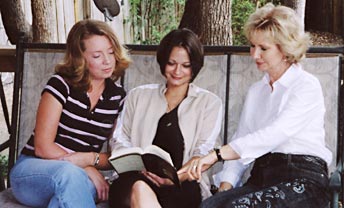
Jacqueline Thornton (right) offers guidance to female ex-offenders at Grace House.

“Some of the women in my class have never entered a church. These are women who have been on the street. They have made bad choices because they don’t know any other way of life,” she said.

The needs they observed inspired the Thorntons to launch Grace House, a faith-based transitional home that helps recently released women overcome their addictive and destructive lifestyles. The Thorntons’ goal is to prepare these women to re-enter everyday life productively and confidently.

The Thorntons’ responsibilities at Grace House include interviewing prospective residents, feeding and clothing them, raising funds and meeting regularly with the ministry’s board of directors.

The women selected for Grace House receive 24-hour supervised care, as well as lodging, meals and clothing. They get formal training in anger management, substance abuse, and job and college preparation.

The women learn life-skills through parenting, nutrition and health classes. They are taught how to handle basic responsibilities such as balancing a checkbook, household shopping and housekeeping.

The women also receive spiritual training. They begin and end each day with devotions, and they participate in Bible studies and discipleship programs such as 40 Days of Purpose, based on The Purpose Driven Life by Rick Warren. Three times a week, they also attend Celebrate Recovery, a Bible-based, Christ-centered recovery ministry.

The women live at Grace House anywhere from six months to a year. The Thorntons have seen women’s lives change dramatically. Many have alcohol or drug addictions, but every one of those women have “made a commitment to the Lord, and they are trying to get their life together,” Mrs. Thornton said.

All of the current Grace House residents are mothers—separated from their children because the children are not allowed to stay in the facility. One resident, who has two children currently living with her parents, told Mrs. Thornton, “I want to be the mother that God intends for me to be.”

The women who have graduated from Grace House are staying off drugs, doing mission work, enrolling in college and earning a living, Mrs. Thornton noted.

One Grace House graduate is going on a mission trip to Brazil with a prison ministry. Another graduate is back in college making a 3.8 grade-point average.

“Our girls’ lives are changed. They tell us they are so grateful for a second chance at life,” Mrs. Thornton said, noting the biblical inspiration for Grace House is Philippians 1:6, “Being confident in this, that he who began a good work in you will carry it on to completion until the day of Christ Jesus.”

“All of these women have had a good work started in them, and they’re hungry for more. Grace House is helping them complete their stability in the Lord.”

News of religion, faith, missions, Bible study and Christian ministry among Texas Baptist churches, in the BGCT, the Southern Baptist Convention ( SBC ) and around the world.


Texas Baptist Forum

Posted: 9/29/06

Texas Baptist Forum

College football on Sunday

Regarding Bruce Parsons’ protest of the recent Sunday evening football contest between Baylor and TCU (Sept. 18): My alma mater, Baylor, and many other church-affiliated institutions nationwide have competed regularly on Sundays for decades in a variety of other intercollegiate sports, including baseball, men’s and women’s basketball, and tennis, among others.

Jump to online-only letters below
Letters are welcomed. Send them to marvknox@baptiststandard.com; 250 words maximum.

“I’m not the Christ. I’m just a donkey the Christ rides on.”

T.D. Jakes
Pastor of The Potter’s House in Dallas (Texas Monthly/RNS)

“This idea that God wants everybody to be wealthy. There is a word for that—baloney. It’s creating a false idol. You don’t measure your self-worth by your net worth. I can show you millions of faithful followers of Christ who live in poverty. Why isn’t everyone in the church a millionaire?”

Rick Warren
Author and pastor of Saddleback Valley Church in California (Time magazine/RNS)

“When we present Jesus as a pro-war, anti-poor, anti-homosexual, anti-environment, pro-nuclear weapons authority figure draped in an American flag, I think we are making a travesty of the portrait of Jesus we find in the gospels.”

Brian McLaren
Leader of the “emerging church” movement and pastor of Cedar Ridge Community Church in Montgomery County, Md. (The Washington Post/RNS)

“Amid a culture inundated with bigness and cellular technology, iPods and TiVo, the technologized megachurch is no longer impressive. In fact, many young Christians come to church to get asylum from this worldliness. Infinitely more than the megachurch’s ‘stuff,’ my generation wants religion. We want everything our parents didn’t, and that seems increasingly to be summed up in the word ‘meaning.’”

Clint Rainey
Student at the University of Texas at Austin

“It is no use saying, ‘We are doing our best.’ You have got to succeed in doing what is necessary.”

Winston Churchill
British orator, author and prime minister during World War II (Thinkexist.com)

The fact a football game on Sunday draws objection says, I think, more about the exalted position football enjoys in our state than it suggests a recent cultural abandonment of a religious tradition surrounding Sunday nights.

Moreover, Baylor football on Sunday is neither recent nor unprecedented. Baylor played Sunday football games seven times between 1900 and 1933, including two games won over our fellow Texas Baptists at Howard Payne University.

Bart McKay

Waco


Islamic fascism

An article declares “Islamic fascist” is an inaccurate label (August 22). But the last paragraph admits the goal of Islamic fundamentalists is establishment of a political system based on rigid Islamic law similar to the nationalistic system established by fascists in the 1930s.

Their goal is establishment “of a totalitarian empire that denies all political and religious freedom.” This is exactly what the fascists did, only theirs was a government based on nationalism rather than religion.

The danger of such an article is it tends to look for the solution by changing who we are rather than appreciating the dangers of religious fanatics who have absolutely no moral equivalence to Christianity’s concept of an individual’s freedom to be responsible directly to God.

We need the awareness and understanding of all the aspects of Islam that the Baptist Standard provides in this issue, but we don’t need to couch our thinking in benign words.

R. Terry Campbell

Jasper, Ga.

Prayer language

First things first:  I have never experienced a Spirit-bestowed private prayer language, nor (to my knowledge) have any of my close Christian friends or associates.

Furthermore, this particular gift is not something that I actively seek to acquire or practice. That being said, I take seriously 1 Corinthians 14:39, which clearly and unequivocally states, “Do not forbid speaking in tongues.”

How ironic that the guardians of Baptist orthodoxy and champions of biblical inerrancy at the Southern Baptist International Mission Board and Southwestern Baptist Theological Seminary are openly disobeying the very Scriptures they claim to hold in such high esteem (Sept. 4).

Louis Johnson

Abilene


First Amendment

The First Amendment establishes that our government shall “make no law respecting the establishment of religion.” Thus, as with all religious rituals and sacraments, government should stay out of the holy matrimony business and leave its celebration to religious organizations. 

Further, government should enforce the constitutional provision that restricts state law from impairing obligations of contract that establish relationships between consenting adults. In ensuring this guarantee, government can establish laws of civil union that protect citizens’ rights to form such relationships.

If gays and lesbians, or others, desire to extend their civil union into sacramental marriage, they can find a body of faith that is willing to sanctify their contractual relationship. If they cannot locate one, their freedom of religion entitles them to start a denomination of their very own. 

Sam Osborne

West Branch, Iowa


Comair Flight 5191

I was disturbed by your editorial about Co-pilot James Polehinke and Comair Flight 5191 (Sept. 18).

How can you judge a man who has suffered various life-threatening injuries for asking: “Why did God do this to me?” You are writing a Christian editorial, and you are judging someone who is barely coherent. These type of actions and judgments are why people are staying away from churches. Instead of judging this man, you should be praying for his recovery.

I flew as a flight attendant at Comair Airlines for three years. Comair is a very respectable airline with the finest training department and pilots in the regional airline industry. The truth in this incident will come out. And, no, I don’t believe God caused the crash. Please cut Polehinke some slack as he recovers from such a horrid incident.

Summer Ratcliffe

Huntington, W.Va.


Lacks Christian charity

Joyce Slaydon’s letter (Aug. 21) forms a different kind of “noxious sewage” of which perhaps she herself is not aware. Her letter lacks Christian charity and humility of spirit, and instead trumpets empty and judgmental emotionalism at the expense of scriptural exegesis and interaction. In short, her disagreeable opinion can simply be dismissed without much concern.

I, for one, appreciate the perspectives offered by Marv Knox. Though I may not always agree, I rejoice to claim him as my brother in Christ.

Byron Smith

Tyler


A new low

The anger and concern the media displayed over a portrayal of Bill Clinton in an ABC docudrama pertaining to 9/11 amazed me.

The second half of the docudrama portrayed President Bush in the same unfavorable manner. Of course, negative portrayals of President Bush are not only acceptable but encouraged by the media in my view.

My absolute outrage is the media’s blind eye toward a movie to be shown in the United States depicting the assassination of a sitting United States president! I am disgusted, I am outraged by the silence regarding the fictional murder of President Bush. I am ashamed to be an American. I fear for what it suggests.

I am sure the terrorists love the movie and the silent approval from the American press. I should be used to this degradation, but this movie is a new low—a low I never believed I would see.

Roberta Larimore Colin

Athens


What do you think? The Baptist Standard values letters to the editor, for they reflect Baptists’ traditional affirmation of the priesthood of believers. Send letters to Editor Marv Knox by mail: P.O. Box 660267, Dallas 75266-0267; or by e-mail: marvknox@baptiststandard.com. Letters are limited to 250 words. Only one letter per writer in a three-month period.

News of religion, faith, missions, Bible study and Christian ministry among Texas Baptist churches, in the BGCT, the Southern Baptist Convention ( SBC ) and around the world.


Pastor’s wife finds her service niche in literacy missions

Posted: 9/29/06

Pastor’s wife finds her service
niche in literacy missions

By Carol Gene Graves

Baylor Center for Literacy

WACO—Despite growing up a pastor’s daughter and becoming a preacher’s wife, Judy Hughes of Emmanuel Baptist Church in Waco never found her niche for Christian service until she discovered literacy ministries.

She found literacy missions 14 years ago, but her passion to share Christ with others while teaching them English continues to grow, she insists.

Judy Hughes of Emmanuel Baptist Church in Waco teaches English to Silvia Hernandez (left) and Juana Loredo. (Photo by Carol Gene Graves/Baylor Center for Literacy)

Maurine Frost, former director and long-time volunteer at the Center for Literacy at Baylor University, challenged Hughes: “Do you know that within a one-mile radius of your church, there are 900 people who do not speak English? Do your own survey if you don’t believe me.”

Hughes and friends walked 36 blocks around the church to find 75 people who did not speak, write or understand any English, and a ministry soon was birthed.

Before long, the church’s programs were attracting Hispanic adults and internationals, along with their children and spouses. The church now offers English-as-a-Second-Language training, graduate equivalency degree preparation and the test of English as a foreign language, which an international student must pass to enroll in a college or university in the United States.

While parents receive ESL instruction, children enjoy 45 minutes of mission stories followed by 45 minutes of homework tutoring. Baylor students from Baptist Student Ministries volunteer to tutor younger students and forge relationships with children.

“It dawned on me that just putting a check in the offering plate is not missions,” Hughes said. “Through literacy missions, I can touch the world from Emmanuel and Waco. … When a student from another country accepts Christ during literacy classes, I am excited. When the student returns to his or her home country, I can know there is someone in that foreign country continuing to spread the gospel because of what I’ve done here.”

Hughes leads a 16-hour workshop to train ESL teachers in the Waco area. She serves as literacy consultant to the Waco Baptist Regional Network and trains ESL trainers throughout Texas and beyond.

News of religion, faith, missions, Bible study and Christian ministry among Texas Baptist churches, in the BGCT, the Southern Baptist Convention ( SBC ) and around the world.


Ministers battle feelings of being alone in the crowd

Posted: 9/29/06

Ministers battle feelings
of being alone in the crowd

By John Hall

Texas Baptist Communications

Worshippers come to hear them speak each Sunday. A steady stream of people visit them during the week. Families invite them to dinner and give them gifts. But for many pastors, ministry is a lonely life.

Even though their primary task is accomplished by relating to people, ministers commonly report difficulty in forming authentic relationships. Because of the nature of their position, many say they feel pressured to present an image of perfection and holiness—an ideal that no one can fulfill.

Ministers cite this expectation as one of the primary reasons many say they have as few as three or four friends, some studies show. They are reluctant to relax their guard to church members and non-members, fearful they might damage the congregation’s image.

Many ministers also express a similar feeling as the reason they don’t relate to other ministers as well—expressing difficulty or trouble could be as a sign of weakness. They fear being looked down upon by other pastors. Pastors also worry about political, theological and relational issues that may arise with their colleagues.

“I think our biggest fear as pastors is sharing who we are and expressing where we are,” said James Kinman, pastor of Central Baptist Church in Kirbyville.

Reggie Thomas, director of the Baptist General Convention of Texas congregational leadership staff, said many ministers offer friendly smiles and conversation, but they have emotional walls behind their outgoing gestures to protect themselves. Although church members may feel they know their ministers, oftentimes few of them actually do.

Pastors are like other people, Thomas said. They have been hurt before and are afraid to let it happen again. They want to be liked by other people and may question whether a congregation will like them if they simply be themselves.

Pair these factors with a 60-hour-a- week work schedule, and ministers have a significant issue, said Paul Kenley, pastor of Grace Fellowship in Lampasas. In extreme cases, ministers can seek connection with others through adultery and pornography.

“It’s probably one of the most unaddressed and devastating problems pastors have,” he said. “It’s kind of like the elephant in the room. They can all see it, but no one wants to acknowledge it. It’s an indication of weakness to do so.”

Some groups have taken note of the situation and are trying to do something about it. BGCT congregational strategists attempt to cultivate relationships with pastors, but they also seek to connect ministers with their peers who have similar interests or personalities as they travel through their areas, expanding personal relationships.

“We take the initiative to build a relationship between us and them, but on a secondary level, we facilitate a relationship between a pastor and them,” said BGCT Congregational Strategist Tim Randolph.

The Coastal Bend Baptist Association has encouraged groups of pastors to meet for several years in learning and fellowship groups. They are facilitated by the pastors and may focus on fellowship, a book or a leadership skill. Ministers bond through the experience.

“They don’t want to miss,” said Mike O’Neil, Coastal Bend Baptist Association director of missions. “They know it’s OK to miss, but they don’t want to miss.”

Josue Valerio, El Paso Baptist Association director of missions, said peer groups have been helpful for his pastors. Some of them spend time together outside structured group meetings.

“The people have to be willing to make a commitment,” Valerio said. “You have to put politics aside. You have to have to put a program or agenda aside. You have to focus on relationships.”

Len Hartley, who leads a weekly meeting of pastors in San Angelo, said ministers can help churches by helping each other through peer groups. They can learn from each others mistakes and offer suggestions. Groups also lead to cooperative ministry.

“It’s not just investing in a person,” he said. “It’s investing in a church.”

Kinman believes the solution to the problem ultimately lies with each pastor. He admitted feeling isolated as a pastor in the past but recently has taken steps to correct that. He meets with a group of about 30 men from his church once a week and shares openly with them as they share with him.

That kind of openness has created relationships, Kinman said. The men care for each other, pray for each other and spend time together outside church. Many of them call Kinman “Pastor Jamie” or simply “Jamie.” They are friends with the pastor, and it is making a difference in the church, he said.

“I believe the Lord is working in that to create a greater ministry through the pastor and the men for this whole community.”

News of religion, faith, missions, Bible study and Christian ministry among Texas Baptist churches, in the BGCT, the Southern Baptist Convention ( SBC ) and around the world.


On the Move

Posted: 9/29/06

On the Move

Justin Gandy has resigned as youth minister at First Church in Breckenridge.

Kris Knippa to First Church in Cranfills Gap as pastor.

Craig Lloyd to Southlake Church in Waxahachie as pastor from North Mesquite Church in Mesquite, where he was youth pastor.

Joshua Lockett to First Church in Valley Mills as youth minister.

Mike Mathis to Brazos River Church in Granbury as pastor.

News of religion, faith, missions, Bible study and Christian ministry among Texas Baptist churches, in the BGCT, the Southern Baptist Convention ( SBC ) and around the world.


Most political rhetoric keeps God-talk light & sunny

Posted: 9/29/06

Most political rhetoric
keeps God-talk light & sunny

By G. Jeffrey MacDonald

Religion News Service

WASHINGTON (RNS)—As Campaign 2006 heats up, politicians are leveraging the power of religious rhetoric while adhering to what’s become the cardinal rule for public religious speech in the 21st century: Never say God gets angry.

After the emergence of so-called “values voters” in 2004, political figures on both the left and right haven’t been shy this year about invoking a Judeo-Christian deity.

Sen. Barack Obama, D-Ill., has helped lead a Democratic recovery of spiritual language by describing, for instance, in a speech this summer how he felt while “kneeling beneath the cross” and explaining, “You need Christ precisely because you have sins to wash away.”

Sen. Barack Obama, D-Ill.

On the GOP side, Ohio gubernatorial candidate Ken Blackwell told a crowd: “Rights are not grants from government. They are gifts from God.”

Yet when describing their faiths and their gods, politicians of all stripes have apparently learned to leave prevalent biblical ideas about divine punishment inside the church or temple. The reason, according to journalism scholars, is simple: Journalists who used to ignore such remarks from public figures now deem them worthy of national coverage—and consequently, public shaming.

Reporters “are saying, ‘I’ve got to warn the public that there are people out there like that,’” said Judith Buddenbaum, a retired journalism professor and author of Reporting News About Religion: An Introduction for Journalists.

Stakes are high in elections, Buddenbaum says, in part because a theology of judgment “plays havoc on any kind of international relations, unless your goal is to get to Armageddon.”

As proven in recent years, one reference to an angry God can make an otherwise humdrum local story go national overnight. New Orleans Mayor Ray Nagin proved the point earlier this year, as he joined Jerry Falwell and Pat Robertson as public figures who have apologized under pressure for linking natural disasters with divine displeasure.

Even relative unknowns, like Alabama state Sen. Hank Erwin, manage to make the national news wires with public gaffes—soon after Hurricane Katrina hit, Erwin suggested sinful behavior “ultimately brings the judgment of God.”

Americans haven’t always been so offended by the idea of divine judgment. The first colonial settlers fasted on “Days of Humiliation” to appease a punitive God whom they thought sent drought in retribution for their sins.

Abraham Lincoln maintained the tradition with a proclamation on April 30, 1863, by asking, “May we not justly fear that the awful calamity of civil war, which now desolates the land, may be but a punishment inflicted upon us for our presumptuous sins … ?”

Market forces help explain the shift, said Carol Pardun, a scholar of religion coverage and director of the journalism program at Middle Tennessee State University. She said reporters increasingly have seized on angry God references over the past 20 years, not because such remarks are more common, but because they trigger strong emotions that sell news.

“Public discourse has changed (in recent years as) the language in newspapers has become more polarizing” in order to keep readers engaged, Pardun said. “Religion, like politics, gets people up in arms,” and sound bytes referring to a “mean God” sell newspapers.

Editorial writers have taken a lead role in deeming certain theologies unacceptable. The Boston Globe, for instance, rapped Nagin for trying to hide behind God’s will.

“If God is intent on wreaking havoc on the Gulf Coast, as Nagin suggested, who could blame the mayor if the response to the disaster was ineffective or if rebuilding plans haven’t advanced very far?” the Globe wrote in an editorial earlier this year. “God, it would seem, is being used as a shield for individual shortcomings. … Those who think they know the divine might better show it by their actions to help others, not by invoking his name as a punishment or excuse.”

Some in religious circles welcome how the secular press has stepped up to police the doctrinal boundaries of public discourse. Among the grateful is Fred Plummer, executive director of the Seattle-based Center for Progressive Christianity.

“It’s dangerous if we don’t ferret this (belief system) out” through widespread coverage when officials or candidates invoke a disapproving God, Plummer said. “Some of these outlandish public policy positions based on religious convictions need to be questioned.”

His example: If the press had revealed James Watt’s apocalyptic beliefs during his tenure as secretary of the interior in the 1980s, the public might have understood why, in Plummer’s opinion, he didn’t promote far-sighted environmental policies.

“His main job was to see that ecological protection was carried out,” Plummer said. “His Christian beliefs were that the world is coming to an end, so why worry about it?”

Some on the religious left, however, say the press as theological watchdog has gone too far. The press has no idea which theologies are dangerous because there is no forum in which they can take the public pulse, according to Madison Shockley, pastor of Pilgrim United Church of Christ in Carlsbad, Calif., and a former candidate for Los Angeles city council.

“The question is this: Where is theology discussed in public?,” Shockley asks. “How do you measure public tolerance for diversity of theological views when there are no public theological exchanges? Most theological exchanges are quite private.”

Some journalism scholars contend the public does have some agreed-upon religious values that the press tries to reflect in coverage of religious remarks. For Ari Goldman, who teaches religion reporting at Columbia University’s Graduate School of Journalism, Americans generally agree “it’s an obscenity for anyone to say they know God’s will.”

In Pardun’s view, the “public conscience” expects a certain degree of safe, predictable and non-offensive values to be expressed in the public square. When it comes to politics and religion, that means a God of love and comfort, but never one of punishment.

That relatively new standard isn’t apt to change again anytime soon—at least not as long as the press is keeping a watchful eye.

People “think they can handle religious diversity” in public discourse, Pardun says. “But they really can’t.”

News of religion, faith, missions, Bible study and Christian ministry among Texas Baptist churches, in the BGCT, the Southern Baptist Convention ( SBC ) and around the world.


Technology links ministers to church members

Posted: 9/29/06

Technology links ministers to church members

By Angela Best

Communications Intern

MARSHALL—Technological innovations leave ministers without excuse for keeping church members informed, said Brian Pearce, minister of youth and recreation at First Baptist Church in Marshall.

Two years ago, Pearce attended a youth ministry conclave where he learned the impact e-mail can have on ministry and its potential for keeping parents and students informed.

“I got back to Marshall and began using my e-mail more than ever before,” Pearce said. “It created an opportunity for information to get out and parents to ask questions via e-mail that I can answer anytime. We no longer have to spend many phone calls missing each other and playing phone tag.”

Not only can e-mail be sent any time of day, but it also allows one to communicate the same message to multiple people at the same time, “meaning we have more time to minister and (spend) less time folding and stuffing envelopes and calling everyone on the Sunday school roll,” Pearce said.

Since many students check their e-mail at school, it also creates the opportunity for students involved in the youth ministry to talk with their school friends about upcoming activities at the church, he added.

But the possibilities do not end there.

Another outlet Pearce uses to reach his youth is through instant messaging. Pearce explained many students spend a lot of time online and often are available and willing to talk.

“Students will ask many questions, have casual conversation and seek counseling through instant messaging,” Pearce said. “Although it is not the best counseling environment, I have found that students will open up and share more with you through a computer than face-to-face.”

In addition to instant messaging, text messaging also has proven useful. With the proliferation of cell phones, text messaging often serves as an effective way to keep in touch with students and parents no matter where they are, as long as they have their cell phone with them, Pearce noted.

“You can also send the same message to many people at one time,” he said. “Students love it.”

Parents, too, have responded positively to text messaging, even though some who are not familiar with the technology have to get their teenager to show them how to see their messages, Pearce added.

“We can send reminders of important meetings or deposit due dates, and they get them quickly,” he said.

The only negative aspect of text messaging is users have to pay for the service. To overcome this problem, Pearce sent an e-mail to parents asking if they wanted to participate, and if so, to send their cell phone number.

With new technology developing every day, Pearce plans to extend his outreach.

“In the future we hope to get into pod casting announcements over iPods and possibly doing daily devotions via iPod or CD,” he said.

“The use of technology is a mighty tool that I would encourage any minister to take advantage of in reaching their congregation.”

News of religion, faith, missions, Bible study and Christian ministry among Texas Baptist churches, in the BGCT, the Southern Baptist Convention ( SBC ) and around the world.


Texas Tidbits

Posted: 9/29/06

Texas Tidbits

Committee seeks resolutions. Messengers to the Baptist General Convention of Texas annual meeting who wish to present resolutions for the consideration of the BGCT Committee on Resolutions are encouraged to submit resolutions in writing prior to the convention, according to Chairman Joseph Parker. The deadline for submitting resolutions at the convention is 5 p.m. on Monday, Nov. 13, but to allow adequate consideration by the committee and because of printing deadlines to include the resolutions in Tuesday’s Annual Meeting Bulletin, Parker encourages early submission. Resolutions must be signed by an elected messenger, with church name included. Proposed resolutions may be submitted to Parker’s attention at David Chapel Baptist Church, 2211 E. Martin Luther King Jr., Austin 78702.

Foundation issues challenge grant. The Mabee Foundation of Tulsa, Okla., recently announced a $1 million challenge grant toward construction of the $16 million Patty and Bo Pilgrim Chapel on the Dallas Baptist University campus. The foundation will provide $1 million if DBU raises the remaining $15 million for chapel construction prior to July 12, 2007. So far, DBU has raised more than two-thirds of the amount needed.

HBU sets inauguration date. Robert Sloan formally will be inaugurated as president of Houston Baptist University at a 2 p.m. ceremony Nov. 28 on the Houston campus. A reception will follow at 4 p.m. HBU trustees elected Sloan Aug. 8 as the school’s third president, succeeding Doug Hodo. Sloan, former chancellor of Baylor University, stepped down as Baylor’s president after 10 years.

Memorials committee seeks names. Each year the Baptist General Convention of Texas recognizes by name at its annual meeting Texas Baptists who have died during the preceding year. The BGCT Memorials Committee asks Texas Baptists to submit the names of people who have died in the last year whose lives made a contribution to their churches and to Texas. Call (214) 828-5348 or e-mail debbie.moody@bgct.org.

Grant allows Baylor to explore economics of religion. Baylor University’s Institute for Studies of Religion has received a $378,862 grant from the John Templeton Foundation. The grant will provide funds for four scholars to investigate the connection between religion and economic growth and the effects of government intervention in religious markets on the practice of religion. The grant also will fund workshops held jointly between the Baylor faculty members and faculty at George Mason University, as well as a survey regarding the religious, educational and financial practices of Americans.

BGCT board chair re-elected. The Baptist General Convention of Texas Executive Board re-elected attorney Bob Fowler of Houston as chair. Directors elected John Petty, pastor of Trinity Baptist Church in Kerrville, as vice chair.

Correction: An article about the pillars of Islam on p. 10 of the Sept. 18 Baptist Standard print edition says that the Ramadan saum (fasting) goes daily from dusk until dawn. In fact, the fasting is from dawn until dusk throughout daylight hours, followed promptly by a full night of feasting. The error was corrected in the article's online version.

News of religion, faith, missions, Bible study and Christian ministry among Texas Baptist churches, in the BGCT, the Southern Baptist Convention ( SBC ) and around the world.


TOGETHER: Real missions makes us more like Jesus

Posted: 9/29/06

TOGETHER:
Real missions makes us more like Jesus

Can missions work ever be wrong? Does some kind of mission activity make God sick at heart? Apparently so.

Jesus spoke seven woes (Matthew 23) upon the Pharisees and other religious scholars and leaders of his day. They were more knowledgeable regarding the Bible than any other people. They were credentialed, admired, but haughty and self-righteous as well. And the second of the seven woes (in this word “woes” is the pathos of God’s heart including wrath and pain, anger and sorrow) is this surprising word: “Woe to you, teachers of the law and Pharisees, you hypocrites! You travel over land and sea to win a single convert, and when he becomes one, you make him twice as much a son of hell as you are” (Matthew 23:15).

wademug
Executive Director
BGCT Executive Board

The Judaism of Jesus’ time was vigorous in its missionary efforts. This mission zeal abated after the destruction of the temple some 30 years after Jesus’ death and resurrection. What is on Jesus’ mind here? Could he mean that when converts are made by men, rather than by the power of God’s Holy Spirit, they still are unconverted?

On one occasion, Billy Graham met a man on a downtown street who clearly was drunk and wasted by his sin. “Oh, Mr. Graham, I am so glad to see you. You converted me in one of your meetings.”

To which, Billy Graham, said somewhat wistfully, “I’m afraid that’s true, man. It’s pretty clear God did not convert you.”

It is a warning that every preacher and missionary should take seriously. Am I trying to convert people to something less than God in Jesus Christ? We are not asking people to be converted to us or to our way of thinking about everything. We are inviting them to allow God to convert them to himself so they can begin to grow into the likeness of Christ.

I am thankful to be a Baptist kind of Christian. I love to teach the Bible, and that almost always leads me to Baptist doctrines. But I often would tell new members in our church that although there are important issues that make some of us decide to be Baptists, the absolutely critical matter is whether one can say with heartfelt commitment, “Jesus is Lord.” When you meet someone who can faithfully confess, “Jesus is Lord,” you have met a brother or a sister (Romans 10:8-9; 8:28-29).

Our Texas Baptist family is committed to missions. If you cut us, we bleed missions, evangelism and ministry. We are committed to starting new churches, to going wherever we can to share the story of Jesus, to inviting people to believe and follow him, and to helping all who believe to grow in Christ. When this growth happens, a person begins to reflect the glory of God and thus to be more like Jesus.

We want to cross any barrier to sharing the good news of Jesus Christ, and we want to join him in telling the story that saves all who believe. We want to be God’s instruments that he can use in drawing others to himself, and we want people to get a good glimpse of Christ when they look at us. But it is never about converting people to us or to our own way. It is about Jesus and his gospel—for only Jesus saves.

We are loved.

Charles Wade is executive director of the Baptist General Convention of Texas.

News of religion, faith, missions, Bible study and Christian ministry among Texas Baptist churches, in the BGCT, the Southern Baptist Convention ( SBC ) and around the world.


UMHB students invest time in neighborhood children

Posted: 9/29/06

Students from the University of Mary Hardin-Baylor teach neighborhood children a biblical story about sowing good seed.

UMHB students invest time
in neighborhood children

By Jennifer Sicking

University of Mary Hardin-Baylor

BELTON—Business management student Felicia Cano sees her Tuesday and Thursday afternoons as an investment.

“It really gives us the opportunity to invest in kids’ lives,” said Cano, a University of Mary Hardin-Baylor junior from Bay City.

“They don’t see love—that anyone cares or is committed most of the time. It gives us a chance to show Christ’s love just by playing with them.”

University of Mary Hardin-Baylor student Allison Daniel helps a neighborhood child on the swings.

Cano and about 20 other University of Mary Hardin-Baylor students spend one hour twice a week playing with children in low-income areas of Belton.

The students team up with Hope for the Hungry, a faith-based international agency.

Ben Ray, who works with the Belton-based organization, said the group focused exclusively on its children homes and missionaries outside the United States for many years, until someone mentioned the unmet needs of local children.

“We’re losing a generation of kids,” Ray said. “They’re not getting the role models growing up. This is a way to reach out to them.”

Twice a week, UMHB students meet at the Baptist Student Ministry wearing red T-shirts proclaiming their mission—“Love kids. Play games. Share Jesus”—before heading to a designated area for ministry.

On a recent Thursday, students knocked on doors in a low-income neighborhood and invited children to play in a nearby park. Soon, about 20 children arrived and joined in a spirited kickball game.

Kat Smith, a freshman Christian ministries major from Fort Worth, sees playing as a way to continue her ministry to children.

“I lived in Mexico for a while, and I interned at an orphanage,” she said. “I loved working with the kids there.”

The Belton ministry offers the kind of personalized attention that allow students to develop meaningful relationships with children, she noted.

“The numbers aren’t too large, so you can get to know the kids,” she said.

Katerina Davila, 11, said she enjoys coming to the park to play with the college students.

“You get to do stuff like kickball,” she said while taking a break from doing cartwheels as she waited her turn to kick the ball. “You get to run and have fun.”

After working off some energy, the children gather in a circle under a shade tree for a drink of cold water and a Bible story. Ray told the children the parable of the farmer sowing seed in his field.

“The seed is the good news that Jesus gives us new life,” Ray said.

While some people, like the ground, reject the seed, others accept the seed by then new life is choked out through rocks or thorns. However, some ground accepts the seed and it grows abundantly.

“When we accept the good news and receive it in, it can change lives,” he said.

The children then spread handfuls of seed on the ground.

Nathan Nipp, a junior history major from Houston, said this is his first year to participate in the ministry.

“Over the summer, I thought I needed to do some sort of outreach,” he said. Upon returning to school, he heard about the ministry and attended a meeting. “I thought this is something I can do.”

Initially, he didn’t see himself as a “kid person,” but involvement in the ministry has given him an opportunity to stretch and grow.

“The more I do this, the more comfortable I get with the kids,” he said. “It’s a good way to get in ministry.”

News of religion, faith, missions, Bible study and Christian ministry among Texas Baptist churches, in the BGCT, the Southern Baptist Convention ( SBC ) and around the world.


Waco church for homeless inspires others

Posted: 9/29/06

About 20 Lexington, Ky.,-area churches, including six congregations in the Kentucky Baptist Convention, have helped conduct services for homeless people inspired by Waco's Church Under The Bridge.

Waco church for homeless inspires others

By Ken Walker

Special to the Baptist Standard

LEXINGTON, Ky.—The Church Under the Bridge in the Lexington, Ky., serves the same type of homeless and low-income people as a Waco congregation that inspired it—even though the Kentucky congregation never has met under a bridge.

Attracting from 200 to 400 people to Sunday afternoon services, the group recently marked its second anniversary.

Jimmy Dorrell, pastor of the original Church Under the Bridge in Waco, was excited to learn that another congregation is using the same name. In addition to the original in Waco, others are in Austin and San Antonio.

“That’s encouraging,” said Dorrell of Mission Waco, an adjunct professor at Baylor University and Truett Theological Seminary. “It’s the multiplication of the church to reach the ones we often exclude. I wish there were hundreds. The model is easy. It just means caring for people.”

About 20 Lexington-area churches, including six congregations in the Kentucky Baptist Convention, have helped conduct services.

“It’s really a neat ministry,” said Brian Harris, a member of Central Baptist Church in nearby Winchester, Ky. “A good percentage are homeless, and another percentage are not totally mentally competent, but all blend together well.”

Coordinator Allison Johnston said its vision is to serve the spiritual, physical and emotional needs of the homeless and marginally housed.

“We believe that the love of Jesus will be seen through our services,” Johnson said.

The inspiration for Lexington’s Church Under the Bridge originated with Stella Kidd, a member of Immanuel Baptist Church in Lexington.

Kidd acknowledges she was alarmed after her daughter, Chrissi Stevens, enrolled at Baylor in 2002 and called later to say she had found a church home. The problem was where the group met—under an Interstate 35 bridge near campus.

“I thought: ‘She’s going to church with all the drunks. This can’t be safe,’” Kidd recalled.

However, after visiting her daughter two months later and attending services, Kidd changed her mind.

“It was overwhelming to see the love of Jesus in action,” Kidd said. “It was wonderful to see people do whatever it takes to take the love of Jesus to people so they can see it.”

After returning to Lexington, Kidd—co-owner of a photo studio—showed pictures of the unconventional church to her office manager. That sparked discussions about how they could start a similar effort.

Those conversations led to the formation of a four-member steering committee. Each discussed their vision with members of their home church and gathered support.

In 2004, the first service was held at a YMCA. It has since shifted a couple times and currently meets on the front lawn of the Episcopal diocese downtown.

When the weather turns cooler this fall, services will move to a nearby elementary school.

The steering committee also recruited various churches to help put on services and serve the meal that follows. The response has demonstrated the project’s appeal.

“I have yet to find a minister who’s come who says, ‘I’m not interested in coming back,’” Kidd said.

Stevens, who visited the church during college breaks, calls the Lexington outreach “really exciting,” saying it enables her mother to put her social work degree to good use.

“She’s been able to meet the needs of the congregation as well as take the love of God to needy people groups,” said Stevens, who graduated in May and is working as a nurse in Columbia, S.C.

The Waco ministry made a long-term impact on Stevens, who said she had never been exposed to ministry to the homeless prior to Church Under the Bridge.

After moving to Dallas to complete her nursing degree, Stevens and her husband, Matthew, became active at Inner City Baptist Church. She said both experiences will be useful when they head overseas to do mission work as part of her husband’s studies for a master of divinity degree.

“In each culture overseas, we’re going to be contextualizing our ministry to meet the needs of those groups,” Stevens said. “God has given us some wonderful exposure in developing those skills.”

Although the services in Lexington feature Baptist-style invitations to accept Christ as Lord and Savior, organizers haven’t tracked conversions.

Still, Kidd knows they have made an impact on many parishioners. She cites one woman who has enrolled in night school and a man with a master’s degree who has left the streets and is helping other homeless people.

Another formerly homeless man also turned his life around.

“He’s serving burgers at McDonald’s, and you’d think he was president of the United States,” Kidd said. “He’s so proud he has a job and his own place to live.”

One of the biggest strides is extending a welcoming hand to people who have been rejected so often they are wary of others, Kidd said.

“God is using a lot of (volunteers) to help these people feel loved,” Kidd said.

News of religion, faith, missions, Bible study and Christian ministry among Texas Baptist churches, in the BGCT, the Southern Baptist Convention ( SBC ) and around the world.


Valley investigation could cost $150,000

Posted: 9/29/06

Valley investigation could cost $150,000

By Ken Camp

Managing Editor

DALLAS—The Baptist General Convention of Texas Executive Board will learn Oct. 31 the results of an investigation into alleged mismanagement of church-starting funds in the Rio Grande Valley—a probe that could cost up to $150,000.

At the board’s Sept. 25-26 meeting, Chairman Bob Fowler of Houston announced a called board meeting from 10 a.m. to 3 p.m. Oct. 31 at the Baptist Building in Dallas. At that time, Brownsville Attorney Diane Dillard will present findings from the five-month investigation she has headed.

See Previous Articles:
Called board meeting focuses on Valley
Executive Board endorses ongoing probe in Rio Grande Valley
Attorney hired to guide church-starting fund investigation
BGCT launches probe of church-planting funds in the Valley

She initially will present her complete report to the Executive Board officers and to the BGCT executive leadership staff Oct. 24.

Directors will not receive findings from the investigation until their called meeting.

“After the (September Executive Board) meeting and because of discussions held with others, (Vice Chairman) Jim Nelson and I have determined that it will be best for us to distribute the summary to board members when they arrive in Dallas for the special called meeting,” Fowler explained.

“This will enable board members to receive the summary and hear the explanation directly from our investigators at the same time and avoid a widespread sharing of this information until that can occur. The board authorized the funding of this investigation and has been assured that its results would be brought to the board first, after an initial presentation to the officers and to Executive Director Charles Wade. We operate as a board and not as individual directors. We need to hear the results together, as a board, whatever those results may be.”

The full printed report will be made available after the called meeting to any director who requests it.

In May, the Executive Board approved $50,000 from contingency funds for the investigation and granted the board’s chair and the BGCT executive director the ability to authorize another $50,000, if needed.

At the time, the attorney and her associates expected to complete their work prior to the board’s September meeting.

“This has proven to be more complex and involved than we or they anticipated,” Fowler told the board, noting the probe has involved two attorneys, a private investigator and a forensic accountant.

In addition to completing numerous interviews, they also have requested 11,000 pages of financial documents from the Baptist Building for review, and billable hours were approaching the $100,000 mark, he noted.

As a result, the board approved a recommendation from its Administration Support Committee authorizing up to an additional $50,000 for the investigation.

The investigation centers on suspicions regarding the large number of cell-group missions reported as church-starts in the lower Rio Grande Valley from 1996 to 2003. Critics allege some church-starts that received financial help from the BGCT never existed except on paper. They assert some individuals may have profited by claiming to start multiple, nonexistent “mystery missions.”

In addition to authorizing additional funds for the investigation, the Executive Board also:

• Approved an additional $350,000 grant to the WorldconneX missions network from the J.K. Wadley Mission Fund.

• Approved up to $300,000 to continue providing a limited number of Baptist Standard subscriptions to leaders of BGCT-affiliated churches.

• Recommended a special agreement that would allow Valley Baptist Health System to elect up to three non-Baptist Christians on its 15-member board of trustees. The agreement is subject to approval by messengers to the BGCT annual meeting, Nov. 13-14 in Dallas.

• Affirmed the decision to retain Grant Thornton to conduct the 2006 financial audit.

• Filled vacancies and approved terms of service members of several councils and committees.

News of religion, faith, missions, Bible study and Christian ministry among Texas Baptist churches, in the BGCT, the Southern Baptist Convention ( SBC ) and around the world.