Explore the Bible Series for October 1: Seek forgiveness and mercy from High Priest

Posted: 9/21/06

Explore the Bible Series for October 1

Seek forgiveness and mercy from High Priest

• Hebrews 4:14-5:10

By Howard Anderson

Diversified Spiritual Associates, San Antonio

In the Old Testament, the high priest was the man appointed to represent the people before God. He dealt with sins and weaknesses by offering necessary sacrifices; however, as a link between God and humanity, the Old Testament priest never was enough. He was a shadow representing the coming perfect intermediary.

Jesus is both God and man and is an adequate link between the Father and us. When we fail and are ashamed, or when we are overwhelmed and desperately need help, we need never draw back. Jesus, human like us, will understand. Moreover, Jesus, God as is the Father, is able to aid. You should see Jesus, our High Priest, and put your trust in him.

Jesus: Perfect high priest (Hebrews 4:14-16)

Jesus, our high priest, is not so lofty or separated that he is incapable of understanding our human situation. Rather, he is one who is very familiar with it, having been tempted at every turn of the road just as we have been. He can laugh and weep with us about life’s foibles and pain because he has been through it all, yet without falling before any of it.

Because we know such a Priest and Prince is on the throne of grace disbursing favor far beyond what we deserve, we can approach without fear or cowering, walking erect and receiving whatever resources we need to live life victoriously, overcoming every obstacle.

The tearing of the veil of the temple signified that the way into God’s presence was now open to all through a new and living way (Matthew 27:51). One whose strength is his graciousness occupies the throne. The Holy Spirit calls for all to come confidently before God’s throne to receive mercy and grace through Jesus Christ in a time of need (2 Corinthians 4:15).


Jesus: Appointed high priest (Hebrews 5:1-6)

In earlier times, the role of priest was unified with that of king or ruler. Melchizedek (5:6) was not only king of the city of Salem, but also priest in that city to the most high God. Later, Moses was instructed by God to appoint Aaron and his sons as the priests. The roles of priest and ruler were thereby separated.

Now in Jesus Christ, the two functions are again united in the Person of the Son—Prophet, Priest and King. This part of the messianic hope, in that a variety of roles would be brought together in the person of the Messiah, is clearly expressed in Psalm 110:2-4.

This reuniting of roles and people is by God’s initiative. The initiative is always with God. We humans may think we have initiated the quest for God and cast out dramatically on our journey to find “truth” and “God.” The truth is that even the desire to strike out in a search is a response to something God already created within us—a hunger for himself.

We are always the respondents to Jesus Christ’s initiative. So in the case of the high priesthood of Christ, the initiative was God’s, first in begetting the Son, and then in appointing him to the high priesthood.

The priesthood is not an office a man or woman takes—it is a privilege and a glory to which they are called. The ministry of God among humanity is neither a job nor a career but a calling. A person should not be able to look back and say, “I chose this work,” but rather, “God chose me and gave me this work to do.”

Jesus’ sonship and his priesthood were both by divine appointment (John 7:28). The two titles are titles of subordination concerning the fulfillment of the program of redemption. Neither office diminishes the eternal deity of Jesus or the equality of the Trinity. Psalm 2 recognizes the Son as both King and Messiah. Jesus is the King-Priest.


Jesus: Obedient high priest (Hebrews 5:7-10)

Jesus learned obedience in the school of suffering and through it became the source of eternal salvation. In Gethsemane, Jesus agonized and wept but committed himself to do the Father’s will in accepting the cup of suffering that would bring his death (Matthew 26:38-46). Anticipating bearing the burden of judgment for sin, Jesus felt its fullest pain and grief (Isaiah 53:3-5, 10). Though he bore the penalty in silence and did not seek to deliver himself from it (Isaiah 53:7), he did cry out from the agony of the fury of God’s wrath poured on his perfectly holy and obedient person (Matthew. 27:46).

Jesus did not need to suffer in order to conquer or correct any disobedience. As the Son of God, he understood obedience completely. He learned obedience for the same reason he bore temptation—to confirm his humanity and experience its suffering to the fullest (Luke 2:52). Jesus’ obedience also was necessary so he could fulfill all righteousness (Matthew 5:13) and thus prove to be the perfect sacrifice to take the place of sinners (1 Peter 3:18).

Because of the perfect righteousness of Jesus Christ and his perfect sacrifice for sin, he became the cause of salvation. True salvation evidences itself in obedience to Jesus Christ, from the initial obedience to the gospel command to repent and believe (Mark 1:15) to a life pattern of obedience to the Word (Romans 6:16).


Discussion questions

• How does Christ serve as our High Priest before God?

• How does knowing Christ intercedes for you affect your life?

News of religion, faith, missions, Bible study and Christian ministry among Texas Baptist churches, in the BGCT, the Southern Baptist Convention ( SBC ) and around the world.


Storylist for 8/21/06 issue


Storylist for week of 8/21/06

TAKE ME TO: Top Story |  Texas |  Opinion |  Baptists |  Faith in Action |  Faith & Culture |  Book Reviews |  Classifieds  |  Departments  |  Bible Study


Farmersville church vandalized; members respond by ‘tagging’ for God

Lebanon Baptists say goodbye to refugees, but ministry continues


MAKING REPAIRS: Auto mission rebuilds engines, troubled lives


MAKING REPAIRS: Auto mission rebuilds engines, troubled lives

Nolen to coordinate Cowboy Fellowship

TBM helps flood victims in El Paso

Former inmate leads popular Bible study at state jail

Humor & honesty help evangelist connect with youth

Around the State

On the Move

Texas Tidbits

Texas Student Mission Trips
Aggie BSM group conducts missions research in Turkey

ETBU World Cup Team shares gospel with soccer fans

BUA students help alumni in churches across the South

Student missionaries discover love transcends cultural barriers

Students start spreading the (good) news in New York

Logsdon students experience Baptist life in Europe

Russia-bound students discover missions in Dallas


Progressive Baptists critique war in Iraq

Baptist Briefs


Wayland dean & chemistry prof on the roll 23 years


War on terror leaves refugees in limbo

Divorce affects faith development

New faith-based initiatives chief named

Artist offers new twist on ancient Christian symbols


Book Reviews


Classified Ads

Cartoon

Around the State

On the Move


EDITORIAL: Just the antidote for social isolation

DOWN HOME: Balls of fire & divining God’s will

TOGETHER: BGCT emphasizes church leadership

RIGHT & WRONG? Social issues vs evangelism

2nd Opinion: Stem-cell stand: Right but doomed

Texas Baptist Forum


BaptistWay Bible Series for August 20: Salvation results in good works

Family Bible Series for August 20: Make a difference in the world

Explore the Bible Series for August 20: Old age has its own rhythms

BaptistWay Bible Series for August 27: The gospel transforms human relationships

Family Bible Series for August 27: Maximize the opportunities God provides

Explore the Bible Series for August 27: The love song of the Old Testament

Previously Posted
Sloan elected as Houston Baptist University president

Sri Lankan violence forces change of venue for volunteers

Faith sustains family through dark days of son’s illness

VBS children fill God’s Penny Pail

South Texas heat? No sweat for KidsHeart volunteers

KidsHeart project makes missions a family affair

VBS shines light in the darkness this summer

Lebanon Baptists say goodbye to refugees, but ministry continues

Wayland student, family fear persecution if they return to Comoros Islands

• See complete list of articles from our 8/07/ 2006 issue here.


For American Muslims, everything changed on 9/11

Posted: 9/15/06

Turkish Muslims worship inside Istanbul's famed Blue Mosque. (BP photo)

For American Muslims,
everything changed on 9/11

By Ken Camp

Managing Editor

DALLAS—Everything changed on 9/11—at least for American Muslims. But whether the change has been for the better or the worse depends on personal perspective and individual experience.

Waco’s Muslim community meets in a nondescript building behind an auto repair shop and a convenience store. The Islamic house of prayer—about 25 miles from President Bush’s Crawford ranch—shares a parking lot with a small Primitive Baptist church. No outside sign identifies the place of worship, but its identity is no secret, said Al Siddiq, president of the Islamic Center of Waco.

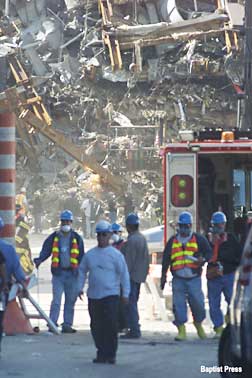
Five years after terrorists attacked the World Trade Center towers in New York, Muslims in the United States assess changes in their relationships with American Christians. This file photo shows rescue workers cutting through steel beams lodged in the ruins of the World Trade Center. (BP File photo by Jim Veneman)

9/11 Five Years Later
• For American Muslims, everything changed on 9/11
Differentiate 'Muslim' from 'terrorist' scholars say
No sweeping revival, but impact of 9/11 still felt in churches
Negative perceptions of Muslims persist, panel says
Who's Who in Islam: major groups
Christian presence in Holy Land small and getting smaller
Islam built on five pillars of worship & five pillars of faith
Poll shows some prejudice against Muslims
Children of Abraham: Muslims view God, church & state through different lenses

Muslims throughout the area know where to meet for prayer, and non-Muslim visitors always are welcome at worship services, explained Siddiq, a Pakistan-born American citizen who has lived in Waco since 1987.

“But we don’t want to draw unnecessary attention to ourselves,” he said.

The FBI has questioned Siddiq five times since Sept. 11, 2001, in response to rumored links to terrorism that all proved completely false.

“I understand security issues. I did intelligence work with the Army,” said Siddiq, who served six years in the U.S. Army and was stationed in Korea with the 101st Airborne Division. “But sometimes, people overreact.”

Even so, Siddiq believes awareness about Islam has increased in the Waco area since the attacks on the World Trade Center towers and the Pentagon.

“I’ve spoken in 52 churches after 9/11,” he said, noting Seventh & James Baptist Church adjacent to the Baylor University campus was the first to invite him. “Overall, the relationship is for the better. It has opened doors.”

The best way to improve relationships between Christian and Muslims in the United States would be for the followers of each religion to be faithful to what each faith teaches about peace, he stressed.

“We each should practice our religion. ‘Turn the other cheek. Love your neighbor as yourself,’” he said, quoting the Christian Scriptures. “If Muslims live by the Quran and Christians put into practice what is in their own Bible, we all would be better people.”

In the 20 years Imam Yusuf Kavakci has led the Dallas Central Mosque in Richardson, he has seen his congregation grow from a few hundred to more than 5,000 who attend the mosque each week. In stark contrast to the simple facility in Waco, the Dallas-area mosque is a large two-story structure with amenities rivaling many North Texas mega-churches, including a medical clinic and an academy.

“We have good relations with our neighbors and our community,” Kavakci said, noting his congregation’s relationship with its religiously pluralistic community has grown stronger since Sept. 11.

“In a positive way, leaders have visited us. Some said: ‘We heard some of the sisters in your community have been harassed verbally for wearing head-coverings when they go out. We will accompany them,’” he said.

Alif Rahman, who teaches an outreach class at the Dallas Central Mosque for the Islamic Association of North Texas, has received numerous invitations to speak in churches since Sept. 11.

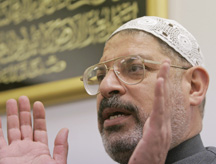
Imam Hamad Ahmad Chebli, leader of the Islamic Society of Central Jersey, leads weekly seminars on the proper way for Muslims to pray. (RNS photo by Tony Kurdzuk/The Star-Ledger)

“The goal is not to proselytize but to give right information,” he said.

Like Kavakci, he expressed appreciation to Christians who reached out to North Texas Muslims to shield them from any retaliation after Sept. 11.

“After 9/11, some Christians came here, literally holding hands and encircling us to say, ‘We are here to protect you and stand with you,’” he recalled.

“We have a great relationship with our community, but at the same time, we hear stories of people who have experienced backlash—men who have been profiled, women with head-coverings who have been verbally attacked.”

Mark Long, director of the Middle Eastern studies program at Baylor University, has heard similar stories from students who either are Muslim or appear to be of Middle Eastern descent.

“Most I know have had some heightened sense of discomfort,” he said. “They feel their bona fide status as American citizens is suspect.”

Long’s colleague in the Baylor University religion department, Chris van Gorder, agrees relationships between Christians and Muslims in the United States have “changed dramatically, mostly for the worse” since the Sept. 11 terrorist attacks.

“A lot of my students have formed their opinions on Islam based on what they hear and see in the media. Once they meet Muslims, they are better able to understand,” said van Gorder, who wrote his dissertation at the Queen’s University of Belfast on Christian-Muslim relations and is author of No God but God: A Path to Muslim-Christian Dialogue on God's Nature.

“American Muslims are not a social threat. Most Muslims in the United States are here for economic reasons. They have a high respect for Christianity as they understand it. And they have a desire to be good neighbors and productive members of the community.”


News of religion, faith, missions, Bible study and Christian ministry among Texas Baptist churches, in the BGCT, the Southern Baptist Convention ( SBC ) and around the world.


Differentiate ‘Muslim’ from ‘terrorist’ scholars say

Posted: 9/15/06

Kashmiri activists belonging to Tehreek-e-Wahdat-e-Islami outfit burn a U.S. flag during a protest against Israeli attacks on Lebanon and the Palestinian territories. Similar images from the Middle East present an unfair characterization of Islam in the minds of Americans, some Muslims in the United States insist. (REUTERS photo by Danish Ismail)

Differentiate 'Muslim'
from 'terrorist' scholars say

By Ken Camp

Managing Editor

DALLAS—Flag-burning radical Muslims represent mainstream American Islam about as accurately as cross-burning Ku Klux Klansmen represent Baptists, a Texas Baptist theology professor believes.

“Most American Muslims are not sympathetic to radical Islam, and they are not interested in being identified with the extremists. They just want to be able to do their jobs, raise their children and be good neighbors,” said Ron Smith, senior professor of theology at Hardin-Simmons University’s Logsdon School of Theology.

“The assumption among many seems to be that radical Islam is characteristic of Muslims as a whole. As Baptists, we would not be happy to be characterized as being associated with the Ku Klux Klan, but there was a time in the South when most members of the Klan probably were identified as Baptists. Let’s not make the same mistake and paint with broad brushes when it comes to Muslims.”

Chris van Gorder, an associate professor in the Baylor University religion department who wrote his dissertation on Christian/Muslim relations, and is author of No God but God: A Path to Muslim-Christian Dialogue on God's Nature, also emphasized the importance of not judging American Muslims by radicals who claim to speak for Islam.

Judging Muslims by the actions of radical fundamentalists is comparable to judging Baptists in the South by the Ku Klux Klan, Hardin-Simmons University Professor Ron Smith says. (1957 File Photo by William Pike/Newhouse News Service)

“It’s true there’s plenty within Islamic fundamentalism and extremism to be alarmed about. It creates a dangerous and hostile situation in our world,” he said “But there’s a world of difference between Islamic extremists and the local Pakistani gas station owner who happens to be Muslim.”

Imam Yusuf Kavakci of the Dallas Central Mosque in Richardson stressed American Muslims should not be judged by radicals in the Middle East—nor should more than 1.2 billion followers of Islam be viewed as speaking with one voice.

“We have nothing like a Pope. We don’t have any one spokesman,” he said. “Confusion and misunderstanding comes from people mixing up what happens in the Middle East with what it means to be Muslim. … Our congregation is mainly Sunni, but we have Shi’a members here. Saddam Hussein said he was Sunni, but we are not that kind of Sunni.”

Islam worldwide has no mechanism for validating any individual or group as legitimately Muslim, Kavakci said.

Consequently, people as widely different as the Shiite cleric Ayatollah Khomeini of Iran and the Sunni Saddam Hussein in Iraq—as well as Hezbollah in Lebanon, which claims to be the “party of God,” and Osama bin Laden of al-Qaida—can claim to speak for Islam.

Alif Raham, who teaches an outreach class about Islam at the Dallas Central Mosque, stressed neither terrorists nor political figures who cloak themselves in Islam truly represent the faith.

9/11 Five Years Later
For American Muslims, everything changed on 9/11
• Differentiate 'Muslim' from 'terrorist' scholars say
No sweeping revival, but impact of 9/11 still felt in churches
Negative perceptions of Muslims persist, panel says
Who's Who in Islam: major groups
Christian presence in Holy Land small and getting smaller
Islam built on five pillars of worship & five pillars of faith
Poll shows some prejudice against Muslims
Children of Abraham: Muslims view God, church & state through different lenses

“People use religion for different political purposes,” he said. “Terrorists act independently of our faith. You cannot equate the whole of our religion with them. They are trying to promote their own cause.”

To equate radical Muslim fundamentalists with mainstream Islam would be like judging all Christians by the Irish Republican Army or by American-bred extremists like Timothy McVeigh, who bombed the Murrah Federal Building in downtown Oklahoma City, said Al Siddiq, president of the Islamic Community of Waco.

“There is no doubt in my mind Islam is a religion of peace,” he said.

A recent declaration against terrorism and religious extremism published by the Islamic Society of North America makes the same point.

“It is unfortunate that both extremists and detractors of Islam who distort the meaning of jihad propagate a false concept of jihad through expressions such as ‘jihadists,’ ‘Islamic terrorism’ or references by terrorists to jihad. Such stereotyping and the use of terms such as ‘Islamic terrorist’ are as unfair as referring to Timothy McVeigh as a ‘Christian terrorist’ or claiming that abortion clinic bombers committed acts of ‘Christian terrorism,’” the statement said.

The Islamic Society’s declaration stresses terrorists act contrary to the teachings of Islam—including its teachings about jihad.

“Jihad is not to be equated with terrorism,” the declaration states, stressing that jihad means “to strive or exert effort.”

But radical fundamentalist Muslims have hijacked the language of jihad and other elements of the Islamic faith for their own purposes, said Mark Long, director of the Middle Eastern studies program at Baylor University.

“Fundamentalists have distorted it and made the religion into something other than a religion of peace,” he said. “Jihad is the effort to conform one’s life to the will of God. But for fundamentalists, jihad is war conducted on the part of God against unbelief, which would be anything that challenges the supremacy of Allah alone.”

Radicals who use and abuse Islam present a genuine threat, said Long, a former Middle East analyst for the U.S. Air Force.

“We must speak out against the violence of Islamic radicals. We are right to take steps to defend ourselves against radicalism and the radicals who have misappropriated the Islamic faith,” he said.

Long, a Southwestern Baptist Theological Seminary graduate who now attends an Episcopal church in Waco, stressed Islam is not inherently a violent religion—any more than Christianity.

“The majority of Muslims make it a religion of peace. They put verses from the Quran into historical context, and they interpret the Quran in context,” he said. “Is Islam a religion of peace? It is what its followers make of it—just like Christianity.”


News of religion, faith, missions, Bible study and Christian ministry among Texas Baptist churches, in the BGCT, the Southern Baptist Convention ( SBC ) and around the world.


Children of Abraham: Muslims view God, church & state through different lenses

Posted: 9/15/06

Munir Akhtar of Kendall Park, N.J., reads in the mosque at the Islamic Society of Central Jersey before evening prayers. (RNS photo by Tony Kurdzuk/The Star-Ledger)

Children of Abraham: Muslims view God,
church & state through different lenses

By Ken Camp

Managing Editor

DALLAS—Christians and Muslims worship the same God; the Father of the Lord Jesus Christ and Allah of the Quran are nothing alike. Jihad means an inner struggle to obey God’s will; jihad means waging holy war on infidels.

Muslims support human rights and religious freedom; Muslims practice oppression and want to impose Islamic law on non-Muslims.

Which views of Islam—the world’s fastest-growing religion—are right?

It all depends, some North Texas Muslim leaders and several Baptist university professors with expertise in Islam agreed.

“I wish all faith groups could see Islam as it is—without mixing what is happening in Iran with Islam, without confusing what is going on between Palestinians and Israel with real Islam and without viewing what is happening in Lebanon with pure Islam,” said Imam Yusef Kavakci of the Dallas Central Mosque in Richardson.

No central authority

Islam claims about 1.2 billion followers in more than 60 countries. Although Islam came into being on the Arabian Peninsula and nine out of 10 Arabs are Muslim, only about 20 percent of Muslims are Arabs. Roughly 85 percent of Muslims are Sunni, and close to 15 percent are Shiite.

Palestinian children attend a prayer during a celebration of the Islamic holiday of Isra Mi'raj in a mosque in the West Bank city of Hebron. The holiday marks what Muslims believe is the Prophet Muhammad’s journey from Mecca to Jerusalem, and it is believed to be followed by his ascension to heaven. (REUTERS photo by Nayef Hashlamoun)

“Within mainstream Sunni Islam, there is no equivalent of the Pope who speaks authoritatively for all Muslims,” said Mark Long, director of the Middle Eastern studies program at Baylor University.

Various mufti—scholars in Islamic law—issue fatwas, comparable to decisions by judges, and pronouncements from Cairo’s prestigious al-Ashur University carry tremendous clout, but they do not have final authority, he noted.

“Muslims are very strong on the idea that there is no intermediary between Allah and the individual,” said Long, a Southwestern Baptist Theological Seminary graduate who now attends an Episcopal church in Waco. “No one has the final authority in Islam. God alone is sovereign.”

In some respects, Islam’s diversity grows out of a polity and belief that roughly parallel Baptist beliefs about local church autonomy, the priesthood of the believer and soul competency, Long noted—a similarity also underscored by Alif Rahman, who teaches an outreach class about Islam at the Dallas Central Mosque in Richardson.

“Islam does not have a strict hierarchy. The community selects a leader—an imam. Each mosque is autonomous, and leaders are elected democratically,” Rahman said. “Every human being can have a direct relationship with God without any human intermediary.”

Common ground, key differences

Ron Smith, senior professor of theology at Hardin-Simmons University’s Logsdon School of Theology, likewise stressed the importance of the certain beliefs Christians and Muslims hold in common.

9/11 Five Years Later
For American Muslims, everything changed on 9/11
Differentiate 'Muslim' from 'terrorist' scholars say
No sweeping revival, but impact of 9/11 still felt in churches
Negative perceptions of Muslims persist, panel says
Who's Who in Islam: major groups
Christian presence in Holy Land small and getting smaller
Islam built on five pillars of worship & five pillars of faith
Poll shows some prejudice against Muslims
• Children of Abraham: Muslims view God, church & state through different lenses

“We worship the same God,” Smith said, noting “Allah” simply is the Arabic word for God and is used that way in Arabic language translations of the Bible.

“There is a different understanding of God in Islam but not a different identity. He is the same God. We have different understandings of God.”

Many Christians are surprised to learn Muslims hold Jesus Christ in high regard as a “true prophet” who was virgin-born, able to perform miracles and lived an exemplary life of holiness. However, Muslims categorically deny the deity of Christ—a crucial difference that cannot be minimized, he noted.

“There is more in common between Islam and Christianity than is widely recognized, but we are different in some important ways,” he said. “I believe Muslims are badly mistaken about some very important things but not about everything.”

Chris van Gorder, an associate professor of religion at Baylor University who wrote his doctoral dissertation on Christian-Muslim relations, and is author of No God but God: A Path to Muslim-Christian Dialogue on God's Nature, believes an essential starting point for any meaningful dialogue between Christians and Muslims is examining what kind of God their faith reveals.

“Both traditions agree that God is one, but they have widely divergent views on how that oneness is expressed,” he said.

“The basic distinction between Islam and Christianity is a difference in the conception of God’s relational nature. … In Christianity, ‘God is love’ and thus participant. In Islam, ‘God is one” and thus beyond the limits of finite comprehension. Christianity calls individuals to enter into covenant relationship with God. Islam calls individuals to worshipfully assume a proper place of obedience before God’s will and revelation.”

Inner struggle or holy war?

In addition to the basic beliefs in the oneness of Allah, the divine origin of the Quran and other agreed-upon Muslim principles, some experts on Islam see jihad as a sixth pillar of the faith. Literally, the word means “to strive, to struggle or to exert effort.” Practically, it has been used in a variety of ways, ranging from an inner jihad against temptation to armed conflict waged against enemies of the faith.

“Jihad is the struggle for righteousness,” van Gorder said. “That may include defending Muslims against attack. It’s not accurate to say Islam is a violent religion.”

Jihad can refer to inward jihad, the struggle against evil temptations and the effort to follow God’s will; social jihad, the ongoing struggle for truth, justice, goodness and charity; or battlefield jihad, sometimes called “the lesser jihad,” according to a statement against terrorism and religious extremism issued by the Islamic Society of North America.

Combative jihad only can be declared for self-defense in the face of unprovoked aggression or to resist oppression, the Islamic Society’s statement notes. And it must be conducted according to strict rules of engagement,

“Several stringent criteria must be met before combative jihad can be initiated,” the statement says. “To begin with, as a ‘hated act,’ war should be undertaken only as a last resort after all other means have failed. Next, jihad cannot be randomly declared by individuals or groups, but rather by a legitimate authority after due consultation. Finally, the intention of Muslims engaging in combative jihad must be pure, not tainted by personal or nationalistic agendas.”

Rules of engagement prohibit the targeting of noncombatants—particularly the elderly, children, women, unarmed civilians and the clergy.

“The rules of jihad are not that dissimilar from just war theory” in Christian thought, Smith of Hardin-Simmons noted.

Human rights & religious liberty

Both critics and defenders of Islam point to history and current events—as well as selected passages from the Quran—to buttress their positions presenting Islam either as an oppressor or defender of religious liberty and human rights.

When Salman Rushdie wrote The Satanic Verses, Ayatollah Khomeini of Iran—a Shiite cleric—declared jihad on him for blasphemy, issuing his death sentence and offering a reward to anyone who killed him.

Christian missions personnel serving in predominantly Muslim nations sometimes have become targets of violence. In recent years, a terrorist killed three Baptist mission workers at a hospital in Yemen, and four Baptist humanitarian aid workers were killed—and another seriously wounded—in a drive-by shooting in Iraq.

Human rights organizations have condemned the mistreatment of women in some Muslim countries. On the other hand, Indonesia, Bangladesh, Pakistan and Turkey all have had women heads of state.

Defenders of Islam note persecuted Jews driven from Spain by Christians in 1492 found a place of refuge in the Muslim Ottoman Empire.

They also point out Muslims grant special protected status to Christians and Jews as “people of the Book” who are allowed to worship with their families and fellow believers—as long as they do not seek to convert other people.

“Let them have their own practices, their own assemblies, their own freedom to worship—don’t impose (Islam) on them. We believe in tolerance. Allowing others to practice their religion is part of the Islamic faith,” Kavakci said.

Separation of church & state

But the Dallas imam emphasized commitment to religious tolerance is grounded in the Islamic faith—not in separation of church and state.

“Separation of church and state is so artificial,” he said, stressing that Islam is a way of life that permeates every aspect of being—individual, family and society.

“Religion cannot be separated. … Islam in its rules and regulations teaches we are to allow others to practice and to live by their own faith. It is enough. We do not need another practice imposed from the outside.”

Rather than dividing church from state, Muslims view the world as being divided into spheres—dar al-Islam, the realm in which people live under God’s law as revealed in the Quran; dar al-harb, the realm of war where people oppose God’s will as revealed in Islam; and dar al-suhl, the realm of truce.

“Countries like the United States which provide for religious freedom are regarded in Islam as falling within the sphere of dar-al suhl, or the abode of peace, and not dar al-harb—the abode of war,” Smith from Hardin-Simmons noted.

“In those countries in which the Islamic community is a majority and Islamic law—Shari’ah—is the law of the land, falling within the sphere of dar al-Islam, the abode of Islam, non-Islamic communities may exist, but their religious freedom is limited.”

The notion is difficult for Christians in America—particularly Baptists who see church-state separation as an essential safeguard for religious liberty—to grasp, he acknowledged.

“We look at the world through very different lenses, standing on different ground,” he said.

Relating to Muslims

In light of the different ways Christians and Muslims view reality, Christians should begin their interaction with Muslims by seeking to understand how Muslims understand God, van Gorder said.

“When Christians have not clearly understood the Muslim concept of God, the result has been murky presentations of Christianity,” he said.

For instance, apart from the mystical Sufi movement within Islam, most Muslims see the distance between God and humanity as a good thing that defines and maintains creation. So, Muslims see as undesirable the offer of a Christian witness who talks about Christ “bridging the gap” between God and sinful humankind and making possible an intimate relationship with God, he noted.

Christians should recognize and affirm the common ground they share with Muslims regarding some ethical and moral issues, as well as the belief in one God.

But that does not mean Christians should back away from the distinctive claims of their faith, he emphasized.

“Muslims expect Christians to be Christians,” he said. “Christians should not be afraid to do evangelism. Muslims expect Christians to share their faith. It’s a duty of Muslims to share their faith, so they understand that. We have to be who we are.”

The key, van Gorder stressed, is speaking Christian truth in love and building genuine friendships with Muslims.

“The example of Jesus should be our guide as we approach Muslims,” he said. “Too often, we focus on labels and categories. Jesus in the Gospels focuses on people—their hurts, their longings and their desires.

“We should focus on relationships and compassionate interaction. We are better able to share Jesus with Muslims when we don’t see them as labels but a people for whom Christ died.”


News of religion, faith, missions, Bible study and Christian ministry among Texas Baptist churches, in the BGCT, the Southern Baptist Convention ( SBC ) and around the world.


RIGHT or WRONG? Three parts of a larger whole?

Posted: 9/15/06

RIGHT or WRONG?
Three parts of a larger whole?

What do you think of the idea that evangelism, spiritual formation and Christian ethics really are not distinct, different matters but three parts of a larger whole?

In the broadest sense, one could say these three areas are just part of the larger whole of the Christian life. However, that would be like saying my brother, my sister and I are just the children of our parents. While the generalization would be true on the surface, it would ignore some very significant differences and individual characteristics.

Evangelism concentrates on the outward expression of our faith with others in an attempt to lead them to a saving knowledge of Jesus Christ. While evangelism can take different forms, it has a relatively narrow focus, which is directly sharing the gospel. Passages such as Matthew 28:18-20 and Acts 1:8 provide the foundation for evangelism.

Spiritual formation, or discipleship, is a more inward, personal process of growth and learning. It focuses on Bible study, prayer, and individual learning and development. Spiritual formation is an educational process in which followers of Christ learn more about their faith, which produces spiritual growth in their lives. A verse often used as a basis of spiritual formation is 2 Timothy 2:15.

Christian ethics is a broader field that emphasizes the totality of living a Christ-like life. 1 John 2:6 reminds us that anyone who claims to be a Christian must act and live as Jesus did. Although this fad has passed, Christian ethics is vitally concerned with the question, “What would Jesus do?”

This incorporates many aspects. Since Jesus boldly shared the gospel, Christian ethics involves evangelism. Since Jesus modeled a pattern of spiritual growth and development, spiritual formation is a part of Christian ethics. But Jesus also fed the hungry, healed the sick, had compassion on the poor and had many other ethical aspects of his life. He went about doing good. In the Sermon on the Mount, he commanded his disciples to be the salt and light of the world. These all are crucial components of Christian ethics. Christian ethics thus provides a large umbrella of Christian development under which many other aspects find a place.

Christian ethics involves both being and doing the Christian life. It emphasizes the process of becoming like Christ in both who we are and what we do. Christian ethics will not let either side of the equation be ignored. It concerns not only our inward development, but also our outward actions.

Christian ethics also is involved in setting the standards for living our lives. It focuses not just on who we are and what we do, but who we ought to be and what we ought to do. It is a constant pull toward the holiness of God. This tension continually leads us to be and do more than we have before. It incorporates standards for both the individual aspects of personal life and the corporate aspects of God’s kingdom as a whole.

Christian ethics forces us to engage the world as Jesus did. In addition to evangelism and spiritual growth, it means social action, personal compassion, taking stands on moral issues, involvement in governmental affairs and more. Specifically, it addresses issues like abortion, world hunger, taxation, divorce, education, gambling and a myriad of other subjects.

If it is something Jesus would be concerned about, Christian ethics addresses it.

Van Christian, pastor

First Baptist Church

Comanche

Right or Wrong? is sponsored by the T.B. Maston Chair of Christian Ethics at Hardin-Simmons University’s Logsdon School of Theology. Send your questions about how to apply your faith to btillman@hsutx.edu.

News of religion, faith, missions, Bible study and Christian ministry among Texas Baptist churches, in the BGCT, the Southern Baptist Convention ( SBC ) and around the world.


No sweeping revival, but impact of 9/11 still felt in churches

Posted: 9/15/06

President Bush and First Lady Laura Bush lay a wreath at the site of the World Trade Center in New York during a ceremony to commemorate the fifth anniversary of the Sept. 11, 2001 attacks. (Photo by Keith Bedford/REUTERS)

No sweeping revival, but impact
of 9/11 still felt in churches

By John Hall

Texas Baptist Communications

The Sept. 11, 2001, terrorist attacks upon the United States didn’t produce the widespread revival some Christian leaders predicted, but commentators believe the events of that day continue to affect church ministry.

Five years after the attacks on New York City and Washington D.C., the spike in worship attendance that occurred after Sept. 11 appears to be an anomaly. Within a month of the attacks, worship attendance had returned to pre-Sept. 11 levels in most places as people returned to their respective routines.

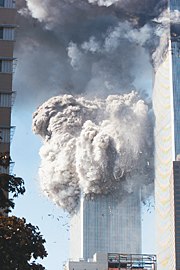
World Trade Center towers collapsing in New York City after the Sept. 11, 2001, terrorist attack. (Reuters Photo)

Read the Standard's coverage in our Sept. 17, 2001, issue of Baptist response to the crisis.

But many churches have changed because society changed, Christian leaders said. Sept. 11 marks the day many Americans lost the sense of security they held close. Since then, church leaders have continued trying to help people make sense of the uncertainty and danger they felt that day.

Reinhold Niebuhr once described America as a gadget-filled paradise suspended in a hell of international insecurity,” said Martin Marty, author and former professor at the University of Chicago Divinity School. “On 9/11 the suspension cord was cut, and we were dropping into the insecurity most humans had always known and that we could keep at a distance.”

A new uncertain world challenged believers to rethink what it means to be a Christian in contemporary society and how to carry out the mission of the Church effectively, said Bill Tillman, Hardin-Simmons University’s T.B. Maston Chair of Christian Ethics.

“It probably forced us to think about Christianity and Christ’s following in ways we should have been thinking about them anyway,” said Terry York, associate professor of Christian ministry and church music at Baylor University’s Truett Theological Seminary.

The resulting discussion has covered a wide variety of topics from missions to preaching to the relationship between Christianity and democracy. Though Christians are taking diverse stances, especially in regard to politics, some commonalities can be noted such as a strengthened fundamentalist movement, an increased interest in Muslim culture and a willingness to address political and social issues.

In the years since 9/11, Christians were drawn to fundamentalist theological movements because they offer clear answers, Tillman said. Fundamentalists provide a worldview with identifiable evil and good, as well as a purpose for each person’s life. These factors are crucial in a culture where security has been lost.

“I think the episode of 9/11 and afterward helped the fundamentalists because their response is a heavy-handed response,” Tillman said. “It gave rise to a hard-line expression of the gospel.”

This rightward theological sway expressed itself politically through a stronger voice for the right, though recently a number of Christians are making efforts to represent a Christian left in politics and other Christians are trying not to be identified too strongly with either political party.

In another result of 9/11, pastors continue to speak about Islam regularly, and many churches have studied it in small groups or Sunday School classes, said Joseph Holloway, professor of religion at East Texas Baptist University.

9/11 Five Years Later
For American Muslims, everything changed on 9/11
Differentiate 'Muslim' from 'terrorist' scholars say
• No sweeping revival, but impact of 9/11 still felt in churches
Negative perceptions of Muslims persist, panel says
Who's Who in Islam: major groups
Christian presence in Holy Land small and getting smaller
Islam built on five pillars of worship & five pillars of faith
Poll shows some prejudice against Muslims
Children of Abraham: Muslims view God, church & state through different lenses

Christians seem to want to know more about the Muslim world, believing the Sept. 11 perpetrators acted upon their fundamentalist Islamic beliefs, Holloway said. If Christians can better understand this culture, they believe they can change it by sharing the gospel in the culture. As a result, mission work in “closed” countries—particularly Muslim-governed nations—is on the rise.

“I think it’s obvious a heightened interest in the Muslim parts of the world – nations that are predominantly Muslim – has come to our attention,” Holloway said. “As a consequence, there is more of a concern to meet the needs that are crying out in those parts of the world.”

Islam is just one of the issues Christian leaders are discussing post-Sept. 11. According to a recent study by the Pew Forum on Religion and Public Life, clergy are speaking out on a variety of topics.

More than 90 percent of regular worship service attendees polled had heard clergy speak about poverty and hunger issues. Nearly 60 percent have heard clergy speak about abortion. Fifty-three percent have heard a clergyperson speak about the situation in Iraq.

Events of 9/11 “pushed us into areas we could speak tangibly about,” Tillman said.

York noted these are not the only effects on faith of 9/11, as the long-term consequences still is being determined. Christians are grappling with basic questions of their faith. How they work through those issues will decide what impact the terrorist attacks ultimately have.

“We’re only five years away from 9/11,” he said. “In the history of our country, that’s like five minutes. In the history of the world, that’s like five seconds. I’m still trying to figure this out myself.”


News of religion, faith, missions, Bible study and Christian ministry among Texas Baptist churches, in the BGCT, the Southern Baptist Convention ( SBC ) and around the world.


Negative perceptions of Muslims persist, panel says

Posted: 9/15/06

Negative perceptions of Muslims persist, panel says

By Hannah Elliott

Associated Baptist Press

SALT LAKE CITY (ABP)—Days before the five-year anniversary of the Sept. 11, 2001, terrorist attacks, a panel of Muslims discussed media-perpetrated misperceptions of Islam and a “climate of negativity” in the United States—particularly concerning the war on terror.

Laila Al-Marayati, an activist with the Muslim Public Affairs Council, said civil liberties ranks as one of the most important topics for Muslims. Non-Muslims not only accept that Muslims will bear the brunt of civil liberty violations, but also expect Muslims to accept it as the price to pay for living in America

Prolonged searches at airports, detainment without explanation, forced closures of charities and deportation are not acceptable, she said.

Listen to audio clips of conversations with
Laila Al-Marayati
Asra Nomani

“The whole question today, five years after 9/11 is, ‘Are we safer?’” Al-Marayati said at the Sept. 8 discussion in Salt Lake City. “It’s still kept at a rhetorical level, but nobody is really challenging a lot of these civil liberty violations that have taken place that have not resulted into any concrete changes that have made America safer.”

Lack of public outrage at this treatment, Al-Marayati said, stems mostly from superficial information and misinformation. A negative perception continues about Islam, and it often is revived on the anniversary of 9/11, she asserted.

The worst of it culminates in the phrase “Islamic fascism,” she said. That term, which President Bush used to describe conspirators in a foiled London bombing plot, creates fear and uncertainty “without a lot of information to balance it,” she said.

“One expression of this negativity is the deliberate perpetuation of the myth that the Muslims have not done enough to condemn 9/11 and to condemn Osama bin Laden and all acts of terrorism,” Al-Marayati said.

9/11 Five Years Later
For American Muslims, everything changed on 9/11
Differentiate 'Muslim' from 'terrorist' scholars say
No sweeping revival, but impact of 9/11 still felt in churches
• Negative perceptions of Muslims persist, panel says
Who's Who in Islam: major groups
Christian presence in Holy Land small and getting smaller
Islam built on five pillars of worship & five pillars of faith
Poll shows some prejudice against Muslims
Children of Abraham: Muslims view God, church & state through different lenses

“The facts are very obvious and very clear—every organization comes out with statements (condemning terrorism) ad nauseam … yet there continues to be this notion that is perpetrated and argued that (we) never said anything. So you’re always put on the defensive, but that questioning remains in the minds of the American people.”

Omar Sacirbey, a correspondent for Religion News Service and former adviser for the Bosnian Mission to the United Nations, said Muslim-Americans and most Muslims worldwide have condemned terrorism, but he still hears from Muslims who ask his advice on how to prove that condemnation to non-Muslims.

One way to demonstrate Islam is not monolithic is to realize facets of it have existed for centuries, Sacirbey said. He’s a Bosnian Muslim, and Muslims populate countries as varied as Indonesia, Egypt, and Turkey.

Plus, Al-Marayati said, the largest group of Muslims—40 percent—is African-American and usually ignored when discussing the faith. So, when asked about their reaction to the bombings, many Muslim-Americans wonder why they should feel any different than other Americans, she said.

“Most of us, we’re Americans, so we don’t have that kind of connection” with Muslim terrorists, she said, adding that it is difficult to reason with “that kind of labeling that somehow we are connected (with the terrorists) and the wishful thinking that somehow we could influence those events and make them not happen.”

In fact, Asra Nomani said, a certain opening of dialogue within the Muslim community has benefited Muslims everywhere, especially those who do not identify with terrorists. Nomani, an Indian-American who worked for years at the Wall Street Journal and wrote Standing Alone In Mecca: An American Woman's Struggle for the Soul of Islam, became the first woman in her West Virginia mosque to insist on the right to pray in the male-only main hall. She stressed that diversity within Islam actually serves non-Muslim Americans as they try to understand the culture and religion.

“There’re a lot of battles within the community that I think American readers are better served hearing and seeing in great detail. … America wants to hear about the debate within Islam and within the Muslim community,” Nomani said.

“They want to know that there are different voices within the community. And I think our Muslim world has benefited. It has actually evolved enough to the point where we can accept that there’s dissent, and there’s conflict, and there are various opinions.”

Both Nomani and Sacirbey mentioned several signs of a new dynamic within Islam—not the least of which are online Islamic dating sites, Islamic myspace.com accounts and Muslim-made T-shirts with edgy slogans on them, like “Product of an arranged marriage” and “I’m not a terrorist, I just look like one.”

What’s more, Sacirbey has even befriended members of an Islamic boy band and a male Islamic hairdresser, who when asked about the difficulty of cutting hair covered by hijabs, said “Islam is less about what you wear and more about how you act.” Hijabs are scarves some Muslim women wear to cover their hair.

“We have heavy-metal Muslims,” Sacirbey said, also mentioning a Muslim punk band. “These are not some dumb punk-rock kids. … They are expressing their faith through music.”

That self-expression and debate about the inner workings of Islam come easier in America, where the “rule of law” protects them. Should that change, however, Muslims will look elsewhere for protection and guidance, said Al-Marayati, an American of Palestinian descent.

Hezbollah is so appealing, she said, “because what they say is what they do. And they don’t make promises they can’t keep. And it is not based on who you know or what you have to pay.”

Muslims “don’t really care where (protection) comes from, but they’re sick of corruption, and what they want is transparency, predictability and accountability on behalf of their government,” she said.


News of religion, faith, missions, Bible study and Christian ministry among Texas Baptist churches, in the BGCT, the Southern Baptist Convention ( SBC ) and around the world.


Higgs will lead BGCT western-heritage ministries

Posted: 9/15/06

Higgs will lead BGCT
western-heritage ministries

By John Hall

Texas Baptist Communications

DALLAS—Charles Higgs, founding pastor of Cowboy Church of Erath County, has been named director of Baptist General Convention of Texas western-heritage ministries.

He will begin serving on a part-time basis Sept. 15 and become a full-time BGCT employee June 1, 2007. Higgs follows Ron Nolen, who recently retired to become coordinator of the Texas Fellowship of Cowboy Churches. The fellowship works closely with the BGCT director of western-heritage ministries.

Stephenville’s Cowboy Church of Erath County has grown to about 300 members in its first 19 months under Higgs’ leadership. He also helped start several other cowboy churches and been pastor of several traditional Baptist churches.

Andre Punch, director of the BGCT affinity group directors and congregational strategists, said Higgs emerged as the ideal person for the position. He was mentored by Nolen and knows western-heritage ministry well.

“His past experience as a pastor at different churches, his administrative and relational skills are of a very, very high quality,” he said. “We felt he was best suited to do the job.”

The pastor has held numerous positions in Baptist associations and the BGCT, including the Red River Valley Baptist Association moderator, chairman of the Erath Baptist Association evangelism committee and member of the BGCT Executive Board. He also currently serves on the board of directors of the Texas Fellowship of Cowboy Churches.

Higgs earned his doctor of ministry degree from Trinity Theological Seminary in 1998. He earned a master’s degree from Dallas Baptist University in and his bachelor’s degree from Independent Bible College.

Higgs and his wife, Nancy, have one daughter and three grandchildren.


News of religion, faith, missions, Bible study and Christian ministry among Texas Baptist churches, in the BGCT, the Southern Baptist Convention ( SBC ) and around the world.


Around the State

Posted: 9/15/06

East Texas Baptist University has received a 2007 Chevrolet Tahoe for use in recruitment, marketing and public relations. The black vehicle featuring the university’s tiger eyes logo was given by ETBU trustee Patty Jones and her husband, Leo, of Tyler. They are members of First Church in Tyler. Vince Blankenship, vice president for enrollment management marketing, said the vehicle will help the staff in their efforts to meet with prospective students. Members of the admissions office pictured with the vehicle (left to right) are Joey Sutton, Dorrie Cook, Jason Soles, Drew Barkley, John Sperry and Melissa Fitts.

Around the State

James King Jr., dean of the College of Business at the University of Mary Hardin-Baylor, will be the guest speaker at the fall convocation service Sept. 22 at 11 a.m.

The Howard Payne University Yellow Jacket Band will be celebrating their 100th anniversary during the school’s homecoming activities Oct. 6-7. Friday, the Kappa Kappa Psi and Tau Beta Sigma fraternities will host a memorial ceremony in the Davidson Music Complex. Also, former band members are invited to perform with current band students at the 10 p.m. pep rally. A continental breakfast honoring the band will be held Saturday at 7 a.m. The homecoming parade will follow at 10 a.m. Former Band Director Greg Barry will be the parade grand marshal. Alumni band members also are invited to play in the finale of the homecoming football game’s halftime show. The game begins at 2 p.m. The centennial band banquet will be at 7 p.m. For more information, call (800) 950-8465.

• Mark Warren has been named director of institutional research and effectiveness at East Texas Baptist University.

• Leigh Jackson has been endorsed as a chaplain with Seton Healthcare Network in Austin by the Cooperative Baptist Fellowship.

• Bruce Muskrat, emeritus missionary to Argentina, has joined the B.H. Carroll Theological Institute as fellow, professor of church music and missions, director of business affairs and treasurer.

The Dunham Family Bible in America Museum at Houston Baptist University has opened its fall schedule with new displays that include “The Story of the English Bible,” Earliest Bibles in America” and “Bibles with Connections.” For more information, call (281) 649-3287.

Dub Oliver, vice president for student life and visiting professor in management at Baylor University, was named the 2006 inductee to the Norman “Moon” Mullins Honor Roll for Distinguished Faculty and Staff. The award signifies leadership, devotion and overall love for Baylor athletics, and recipients are chosen by the Mullins family.

Anniversaries

• Iglesia Manantial in Sugar Land, fifth, July 29.

• Mike Stone, fifth, as pastor of First Church in Crystal City, Sept. 2.

• Danbury Church in Danbury, 70th, Sept. 13-17. Jason Treadaway is pastor.

• First Church in Sutherland Springs, 80th, Sept. 24. For more information, call (830) 947-3333. Frank Pomeroy is pastor.

• J.L. Williams, 50th in the ministry, Sept. 24. He will be honored at First Church in Gainesville with a meal following the morning service. He was licensed to the ministry by Pierce Street Church in Amarillo, which is now Second Church. After graduation from Southwestern Theological Sem-inary, he served 30 years in the Kansas/Nebraska Convention. Since returning to Texas, he has served the Gainesville church as interim pastor and associate pastor.

• Oakridge Church in Denison, 50th, Sept. 24. Sam Garrett is pastor.

• Ben Condray, 10th, as associate pastor of First Church in Midlothian, Sept. 29.

• Oak Grove Church in Harleton, 50th, Oct. 1. The church had its beginnings as a mission meeting under a tree and holding Sunday school classes in cars. Bob Johnson, the mission’s first pastor, will preach. A meal will follow the morning service. Mike Midkiff is pastor.

• Phillip Sitton, 35th, as associate pastor for worship and administration at Shearer Hills Church in San Antonio, Oct. 1.

• Freeman Heights Church in Garland, 50th, Oct. 1. Activities include a 9:15 a.m. breakfast and ministry celebration followed by a 10:30 a.m. worship service with Don Newberry as featured speaker. A catered lunch and afternoon service will follow. For more information, contact larry.fhbc@verizon.net. Larry Venable is pastor.

• First Church in Colorado City, 125th, Oct. 7-8. Saturday afternoon will be a time of fellowship and tours of the church’s facilities. That evening there will be a hamburger supper followed by a song service that will include former staff and members. Former Pastor H.W. Bartlett will speak in the Sunday morning service, and former Pastor Ted Spear will preach. A catered barbecue lunch will follow. For more information, call (325) 728-3442. Jerry Shields is pastor.

• Rosen Heights Church in Fort Worth, 100th, Oct. 8. Former Pastor Forrest Pollock will speak in the morning service. The choir will sing a hymn written by Minister of Music Barry Feriend and Organist Jane Morrison especially for the celebration. A catered lunch will follow. For more information, call (817) 626-3783. Bruce Corley is interim pastor.

• Oak Hills Community Church in Floresville, 10th, Oct. 8. The morning service will feature a video presentation, testimonies and a sermon by Charles Wade, executive director of the Baptist General Convention of Texas. A catered meal will follow. Joel Odom is pastor.

• First Church in Luella, 140th, Oct. 8. Former Pastor Bobby Hawkins will preach during the morning service, followed by a meal. Former Pastor Jerry Creek will preach in an afternoon service. Harvey Patterson is pastor.

• Second Church in Amarillo, 100th, Oct. 15. Former Pastor Charles Jones will preach in the morning service. A catered lunch will follow. Make lunch reservations by visiting www.sbcama.org. Wayne Griffin is pastor.

• Plymouth Park Church in Irving, 50th, Oct. 28-29. A reception will be held Saturday from 1 p.m. to 4 p.m. that will include former staff and members. Sunday will feature a worship service and meal. Participants will include BO Baker, Oral Bowman, Wayne Wood, Walter Draughon, Pres-ton Nix, Jerry Carlisle, Neil Davidson, Cliff McClellan, Bart Young, Cliff Feeler, Carl Rider and others. Youth will celebrate with Al Fike, and children will be entertained by performers from Nana Puddin. For more information, visit www.plymouthpark.org. Ken Branam is pastor.

• Trinity Church in Palacios, 50th, Oct. 29. W.C. Maddox, the church’s first pastor, will preach in the morning service. A lunch at Texas Baptist Encampment will follow. Other former pastors and members will speak of their remembrances of the church. Make reservations for the meal by Oct. 20 by calling (361) 972-3139. Louis Rush is pastor.

• Gregory Gomez, 50th in the ministry. During October, he and his wife will be in Puerto Rico training leaders on the western part of the island.

Retiring

• Duane Kelly, after 20 years as director of missions for Trinity River Association, Oct. 31. He also was pastor of Bethel Church in Marion County, First Church in Avery, Garden Acres Church in Burleson and Second Church in Lake Jackson.

Deaths

• Luis Estrada, 71, Aug. 1 in Corpus Christi. He was pastor of Iglesia Estrella de Belen in Corpus Christi. He is survived by his wife, Manuela; sons, Carlos and Luis; daughter, Alfa Omega Abaunza; sister, Ester Resendiz; brother, Filiberto; nine grandchildren; and four great-grandchildren.

• Ken Lawrence, 71, Aug. 15 in Fort Worth. He was a member of the B.H. Carroll Theological Institute’s commission on teaching, learning and academic administration. He had already evaluated syllabi and examinations and was beginning to evaluate the institute’s administrative documents at the time of his death. An educator and author, he was preceded in death by his brother, Carlton. He is survived by his wife of 48 years, Carol; son, Eric; daughter, Cyrena Allen; sister, Kathleen Sims; and two grandchildren.

Events

The Kiev Symphony Orchestra will perform at First Church in Woodway Oct. 17 at 7 p.m. General admission tickets are $10, student tickets are $7. They can be purchased at the door.

• First Church in Denton will present its annual House of Judgment Oct. 18-Nov. 1. Cost is $5 per person. This presentation is encouraged for youth groups but is not suggested for children younger than sixth grade. Reservations are suggested and can be made by calling (940) 382-2577, ext. 191. For more information, see fbcd.net. Jeff Williams is pastor.

• A free job search workshop will be held from 8 a.m. until 3:30 p.m. Oct. 21 at The Heights Church in Richardson. The workshop will include resume critique and development, effective networking skills, interviewing techniques and more. Pre-registration is suggested due to limited seating. To register, send an e-mail with name, phone and e-mail address to: jobseekers@theheights.org. For more information, call (972) 238-7243.

• Robert Jeffress, pastor of First Church in Wichita Falls, was named the recipient of Vision America’s Daniel Award at this year’s Heroes of the Faith gala.

Revivals

• First Church, Center; Sept. 24-27; evangelist, Lonnie Riley; pastor, Michael Hale.

• Colonial Hills Church, Cedar Hill; Sept. 24-28; evangelist, David Crain; pastor, Billy Johnson.

• Immanuel Church, Paris; Oct. 1-6; evangelist, Jeff Meyers; music, Allen Shoemaker; pastor, Randall Scott.


News of religion, faith, missions, Bible study and Christian ministry among Texas Baptist churches, in the BGCT, the Southern Baptist Convention ( SBC ) and around the world.


Book Reviews

Posted: 9/15/06

Book Reviews

A Touch of Jesus: Stories and Studies of Women in the Life of Jesus by Janet F. Burton (Pleasant Word)

Many authors believe historical fiction to be the most difficult of stories to pen. The writer must mesh character, plot and setting with historically accurate research involving names, clothing, vocabulary, events and physical location. In A Touch of Jesus, Texas pastor’s wife Janet Burton not only tackles historical fiction, she adds a theological dimension by imagining and filling in the blanks in the stories of biblical women touched by Jesus.

From Mary’s cousin Elisabeth, to sisters Mary and Martha and the mothers of the little children blessed by Jesus, to the widow who gave her mites, Burton paints word pictures of significant incidents in their lives.

What are you reading that other Texas Baptists would find helpful? Send suggestions and reviews to books@baptiststandard.com.

But she doesn’t leave the reader there. She offers a behind-the-scenes Bible study surrounding the incident and includes insights gained from her research. Then she adds touch points showing how Christians can reach others in similar circumstances with the touch of Jesus.

If you read a chapter a day, A Touch of Jesus provides 17 meaningful daily devotionals. Also perfect as the basis for a Bible study series, Burton’s book offers a wealth of sermon illustrations, vignettes adaptable for dramatization, devotional thoughts for public presentation and springboards for further study into women important in the life of Jesus.

Kathy Robinson Hillman,

past president

Woman’s Missionary Union of Texas

Waco


God is in the Hard Stuff by Bruce Bickel and Stan Jantz (Barbour Publishing)

In their newest release, Bickel and Jantz tackle some of the really difficult issues of life just about all of us have to grapple with at one time or another.

So much of life these days seems to be lived in the midst of the “hard stuff,” and a search for answers to the hard questions: Why do the innocent suffer? Why doesn’t prayer always seem to work? Why do good marriages go bad? What do you do when your kids turn away from you? How do you cope with cancer? How do you deal with death?

This powerful little book doesn’t attempt to give comprehensive or quick-fix, easy answers, but it does offer an excellent “primer” to point in the right direction in a search for answers. With a two- to three-page treatments of about 40 “hard stuff” issues, Bickel and Jantz provide some remarkably profound words of wisdom that help us see that God is, in fact, right there in the midst of all of the “hard stuff” of life.

I highly recommend this book for its devotional value. Pastors will appreciate it as an excellent sermon-starter idea book. It also would make a great little gift book, especially for someone you know who is struggling with some “hard stuff” in their life right now.

Jim Lemons, pastor

River Oaks Baptist Church

Fort Worth


Perfecting Ourselves to Death: The Pursuit of Excellence and the Perils of Perfectionism by Richard Winter (Intervarsity Press)

Perfecting Ourselves to Death is an overview of concepts Richard Winter refers to as “healthy perfectionism versus unhealthy perfectionism.”

Much of the book reads like a literature review in a doctoral dissertation, providing highlights from various researchers on the subject of perfectionism.

The most substantive and interesting part of this book comes toward the end, when he discusses identity and purpose as they relate to perfectionism. Within this context, he provides a succinct look at the influences of modernism and postmodernism in our society. He follows this with a biblical perspective on these ideas.

Winter wraps up this work with an excellent chapter discussing a healthy pursuit of excellence and perfection from the Christian perspective of grace. He definitely saves the best for last.

Margaret Hunt Rice, executive assistant to the president

University of Houston-Victoria


News of religion, faith, missions, Bible study and Christian ministry among Texas Baptist churches, in the BGCT, the Southern Baptist Convention ( SBC ) and around the world.


Baptist Briefs

Posted: 9/15/06

Baptist Briefs

Association breaks with church over homosexuality. The North Area Baptist Association, a 10-county group of Baptist congregations belonging to the American Baptist Churches-USA, voted 18-3 to break ties with Woodside Church in Flint, Mich., because of its acceptance of homosexuals. Woodside Church decided in May to join the Association of Welcoming and Affirming Baptists, a pro-gay organization with 55 member congregations nationwide.

CBF-affiliated program receives federal grant. Sowing Seeds of Hope, a community and economic development organization affiliated with the Cooperative Baptist Fellowship, has received a $338,000 federal grant for the creation of a self-help housing initiative in depressed Perry County, Ala. The grant will be used to administer loans to low-income families, who will build their own homes. It will fund four employees and a portion of the salary for executive director Frances Ford. Applicants to the program must still qualify for a loan, which comes in addition to the grant. More than 140 applications from local residents already have gained acceptance to the program. Planners expect to build 20 custom-designed homes within two years.


GuideStone Funds mark five years. GuideStone Funds recently celebrated its fifth anniversary as a registered mutual fund company. The investment funds are affiliated with GuideStone Financial Resources of the Southern Baptist Convention. GuideStone Funds launched on Aug. 27, 2001, with total assets of $7 billion; five years later, the opening balance on Aug. 28 was $8.56 billion.


Oklahoma church inducts worker into hall of fame. First Baptist Church of Oklahoma City inducted Lucy Gibson—pastor’s secretary from 1949 to 1981—into its newly created hall of fame on her 90th birthday recently. In addition to her staff responsibilities, she also was a three-time Woman’s Missionary Union president at the church.


Retired Kentucky Baptist leader dies. Franklin Owen, executive secretary of the Kentucky Baptist Convention from 1972 to 1983, died Aug. 30 in Lexington, Ky., at age 93. During Owen’s years as Kentucky Baptists’ executive secretary, convention receipts in-creased nearly 220 percent, indebtedness was eliminated and ministry reserve funds were established. He also led efforts to build Baptist student centers on the campuses of several universities across the state as well as a major addition to the former Baptist Building in Middletown. Before accepting the denominational post, Owen served 18 years as pastor of Calvary Baptist Church in Lexington. He also was pastor of other Kentucky Baptist congregations as well as churches in Missouri, Georgia and Alabama.


Richmond seminary president to retire. Thomas Graves, president of Baptist Theological Seminary at Richmond since 1991, has announced plans to retire next year. Citing health reasons, Graves, 58, will step down July 1, 2007. Graves, who has multiple sclerosis, announced his plans at a called meeting of the seminary’s board of trustees. During Graves’ tenure, the seminary has grown from 32 to 333 students, with 15 full-time faculty and 19 visiting or adjunct professors, and has an annual budget of $3.8 million. Graves grew up in Louisville, Ky., completed his undergraduate education at Vanderbilt University, and received his master of divinity and doctor of philosophy degrees from Southern Baptist Theological Seminary. He also received the master of sacred theology degree from Yale Divinity School. He taught religion at Palm Beach Atlantic College in West Palm Beach, Fla., and was professor of philosophy of religion at Southeastern Baptist Theological Seminary. He served pastorates in Kentucky, Florida and North Carolina. Graves and his wife, Wendy, have two grown daughters.


Global Women picks new leader. Cindy Dawson, a former missionary with the Cooperative Baptist Fellowship, has been elected coordinator of Global Women. Global Women, based in Birmingham, Ala., was founded in 2001 as a way for Christian women to network and mentor younger women through shared learning and service. The group encourages and facilitates involvement in mission and ministry among Christian women worldwide. As missionaries, Dawson and her husband, Frank, served with a Romany ministry team eight years in Moscow. There she managed the office, planned events from London to Siberia, organized an international missionary choir and directed music for Hinkson Christian Academy, a school for children of missionaries. The Dawsons and their two daughters live in Pelham, Ala., where she is minister of music at Crosscreek Baptist Church.

News of religion, faith, missions, Bible study and Christian ministry among Texas Baptist churches, in the BGCT, the Southern Baptist Convention ( SBC ) and around the world.