Christian presence in Holy Land small and getting smaller

Posted: 9/15/06

Christian presence in Holy
Land small and getting smaller

By Steve Chambers

Religion News Service

BETHLEHEM, West Bank—Nakla Qaber, whose Greek Orthodox roots stretch back generations in a West Bank Christian enclave, runs a successful restaurant at a time when most Palestinians are struggling.

But when it came time for his son and three daughters to make their own way in the world, they went off to college in the United States and Canada and never came back.

Muslims Abu Iyad (left) and Abuzayed Odeh watch the news on Al-Jazeera at their Christian friends’ auto body store in Bethlehem. “We share all our life, the good times and bad times,” Iyad said. (RNS photo by Andrew Mills/The Star-Ledger of Newark, N.J.)

“Every time I go to services, I look around and see the number of worshippers declining, Sunday after Sunday,” said Qaber, 63, who lives in Beit Jala, alongside the major Christian city of Bethlehem. “No one wants to leave his country, so this is a miserable thing, but if my sons and daughters stay overseas, someday I will follow them.”

The exodus of Christians from the Holy Land troubles the faithful worldwide. With tensions rising the past five years and economic conditions worsening, some have begun to whisper about a day when the native Christian population disappears entirely.

Now, with armed conflict—or at best an uneasy peace—between Muslims and Jews, Christians once again find themselves caught in the crossfire. The vast majority are Palestinian Arabs living in the West Bank and suffering the same frustrations and dangers as their Muslim neighbors.

Many of them blame the United States for failing to bring peace and stability to the region—thereby allowing a rise in religious fundamentalism that has increased tensions for the descendants of the first Christians.

“Radical Islam does not even like moderate Muslims, so how can it be good for Christians?” said Jack Khazmo, a Syrian Orthodox Christian who edits a pro-Palestinian political magazine called al Bayader Assiyasi. “We Christians belong to this land and to our country, but the rise of radicalism will affect our presence.”

Experts say the Christian population in Israel and the Palestinian territories has fallen steeply in recent years and may number only about 50,000. Since 1948, when Christians were estimated at 20 percent of all Palestinians in the region, their numbers have dropped to roughly 2 percent, according to the Holy Land Christian Ecumenical Foundation, a group based in Bethesda, Md.

9/11 Five Years Later
For American Muslims, everything changed on 9/11
Differentiate 'Muslim' from 'terrorist' scholars say
No sweeping revival, but impact of 9/11 still felt in churches
Negative perceptions of Muslims persist, panel says
Who's Who in Islam: major groups
• Christian presence in Holy Land small and getting smaller
Islam built on five pillars of worship & five pillars of faith
Poll shows some prejudice against Muslims
Children of Abraham: Muslims view God, church & state through different lenses

“There is a concern about losing the Christian presence in the Holy Land,” said Antonios Kireopoulos, associate general secretary for International Affairs and Peace for the New York-based National Council of Churches. “We do not want only to be the caretakers of monuments. But we realize that the tensions and ongoing violence are real.”

Local Christian leaders argue it would be disastrous if the native Christian population disappeared—not just for a people so rooted in the land they are often referred to as “the living stones,” but also for regional stability. Wealthier, better educated and more closely tied to the West than most Palestinian Arabs, these Christians have long been a moderating force in the West Bank.

Still, members of the 15 denominations of Palestinian Christians often complain they feel invisible, even if they are part of much larger churches in the United States and Europe. Conservative Christians in America tend to support Israel, and many pilgrims visit holy sites in Jerusalem without realizing a native Christian population remains.

Even as they struggle, many Christians in the West Bank strive for influence within the Palestinian Authority. A Christian holds one Cabinet post in the Hamas-led government, seven are members of Parliament and others lead cities like Bethlehem and neighboring Beit Jala, which together comprise a historic Christian enclave.

George Sa’adeh, deputy mayor of Bethlehem, said despite occasional tensions between Christians and Muslims, the groups generally are united in calling for more freedom of movement for Palestinians and a reduction in tensions with the Israelis.

“All the people want peace, even Hamas,” he said. “The people are frustrated. We must stop the killing, and I believe the United States has the power to make peace if it wants to make peace.”

Peace and war are not abstract concepts for Sa’adeh, a Greek Orthodox Christian. One day in March 2003, when he was out shopping with his wife and two daughters, Israeli soldiers mistook his car for one carrying two fugitive terrorists.

They riddled it with machine-gun fire, wounding him and his 15-year-old daughter and killing his 12-year-old daughter, Christine.

Sitting in his office overlooking the Basilica of the Nativity, built 17 centuries ago on the site where tradition says Christ was born, Sa’adeh took out a wallet photograph of a smiling Christine and recalled how an Israeli group of bereaved families reached out to comfort him.

“Talking about peace and ending the war takes a lot of faith and courage,” he said. “As Jesus taught us, we must forgive. But when I call for peace, I also call for justice and an end to the (Israeli) occupation.”

Sa’adeh and other Christians need a special pass from the Israeli government to leave the West Bank and visit their churches in Jerusalem.

Nisreen Kunkar, who handles public relations for Beit Jala, has been unable to visit the home of her in-laws in Jerusalem, although she has been married for years.

Such obstructions, a number of Christians said, inflame tensions in the West Bank and help persuade many of their religious brethren to emigrate.

Raji Zeidan, mayor of Beit Jala and a Christian, said one of the most confounding and frustrating things that has happened to his one-square-mile city in decades was the recent construction of a barrier separating Israel from Palestinian-controlled territory in the West Bank.

The 20-foot concrete wall, which the Israeli government began building in 2002 to keep out suicide bombers, snakes through the town, isolating stores, separating children from playgrounds and, most important in Zeidan’s eyes, denying Christians access to their own land.

“Beit Jala is a small town, mostly Christian, and we own most of the undeveloped land,” he said. “That is our only chance to flourish and develop, but now it is under confiscation because of the wall. If you lose all opportunities, what will happen? You will go.”

Steve Chambers writes for The Star-Ledger of Newark, N.J.

News of religion, faith, missions, Bible study and Christian ministry among Texas Baptist churches, in the BGCT, the Southern Baptist Convention ( SBC ) and around the world.


Poll shows some prejudice against Muslims

Posted: 9/15/06

In the Muslim village of Jalah,Egypt, the local imam, Haliz Muhammed Fazar (center), and village leaders gather on a porch to meet visitors and discuss the Quran. (BP photo courtesy of IMB)
9/11 Five Years Later
For American Muslims, everything changed on 9/11
Differentiate 'Muslim' from 'terrorist' scholars say
No sweeping revival, but impact of 9/11 still felt in churches
Negative perceptions of Muslims persist, panel says
Who's Who in Islam: major groups
Christian presence in Holy Land small and getting smaller
Islam built on five pillars of worship & five pillars of faith
• Poll shows some prejudice against Muslims
Children of Abraham: Muslims view God, church & state through different lenses

Poll shows some
prejudice against Muslims

By Adelle M. Banks

Religion News Service

WASHINGTON (RNS)—Four Americans out of 10 acknowledge having some prejudice against Muslims, but those with Muslim acquaintances are more likely to show favorable attitudes, a recent USA Today/Gallup Poll shows.

Thirty-nine percent of Americans asked to honestly assess themselves said they have at least some feelings of prejudice against Muslims while 59 percent said they did not.

Respondents were divided fairly evenly about whether Muslims are respectful of other religions, with 47 percent agreeing and 40 percent disagreeing. There was clear disagreement about whether Muslims are too extreme in their religious beliefs, with 44 percent saying yes and 46 percent saying no.

A substantial minority—39 percent—of Americans favors more strict security measures for Muslims than other U.S. citizens, such as requiring Muslims to carry a special ID; 59 percent said they would oppose such a requirement. Forty-one percent favored Muslims undergoing more intensive security checks at U.S. airports, while 57 percent opposed such action.

When comparing feelings based on whether respondents personally know a Muslim, pollsters found dramatic differences. Forty-one percent said they personally knew a Muslim.

Nearly a quarter of those who said they know a Muslim—24 percent—favored a special ID for Muslims; 50 percent who do not know someone of that faith favored the special ID. Ten percent of those who know a Muslim said they would not want a Muslim as a neighbor, compared to 31 percent of those who did not know one.


News of religion, faith, missions, Bible study and Christian ministry among Texas Baptist churches, in the BGCT, the Southern Baptist Convention ( SBC ) and around the world.


Group critiques prosperity gospel

Posted: 9/15/06

Group critiques prosperity gospel

By Hannah Elliott

Associated Baptist Press

DALLAS (ABP)— Media promotion of a so-called prosperity gospel is deluging modern-day churches—and driving them into error, former Southern Baptist Convention President Jimmy Allen told the nation’s largest African-American Baptist group.

“Prosperity gospel is now a problem because we’ve learned to study the market, and now the marketplace is dictating the message,” said Allen, who led in the formation of the Cooperative Baptist Fellowship.

Allen spoke as part of the National Baptist Convention USA’s 126th annual meeting, in a forum designed to answer the question, “What do we preach?” Claiming more than 7.5 million members, the convention is the nation’s largest historically African-Ameri-can denomination.

See Related Articles:
• Group critiques prosperity gospel
National Baptist leader asserts nation, church abandoning ideals

As part of a panel including social activist James Earl Massey and several prominent pastors, Allen set the tone for the discussion, referencing the prevalence and persistence of Christian media in contributing to the creation of so-called “seeker-sensitive” mega-churches. “The marketing studies are so precise and so constant that they figure out what you want,” Allen said. “We have folks who are looking at that and saying, ‘Now if this is what they want, then I’ll give it to them.’ And so we find ourselves with seeker churches. The fact is that we build to match the market.”

William Shaw, president of the National Baptist Convention USA since 1999, also broached the subject of churches tailoring themselves to match demographics. He prefaced Allen’s remarks by correlating the prosperity gospel with the development of seeker churches.

Shaw defined prosperity gospel as a belief system focused on health, wealth and faith—“a contemporary form of uplift theology” and “a capitalistic devotion to personal privilege.”

Shaw disparaged the consumer-centric message of the movement, saying television preachers increasingly have established themselves as religious persuaders across lines of color, race and class. The theological message of the gospel must be founded in biblical truth, not emotional experiences, he said. Shaw is the pastor of White Rock Baptist Church in Philadelphia, Penn.

“The devil has long since concluded that he’s not really going to be able to defeat the Lord in open matters of conflict … so he infiltrates from the inside,” he said. “Our people have been misfed and misled.”

Massey, who spoke after Allen, related the exponential numerical growth of many seeker churches to a lack of biblical doctrine or “a great neglect of the centralities of the Christian faith,” he said.

The neglect comes from forgetting the apostolic doctrines taught in the Bible, Massey said. And when doctrines are slighted, he said, “emotion becomes a primary concern and a controlling force.”

“There is a proper, biblical pattern for church growth,” Massey said. “We should preach what the apostles preached and taught. And the basis for their apostolic teaching is the New Testament.”

Massey also said African-American religious life is faced with several challenges, including a rise in using pop music for worship, a rejection of church tradition and a diminishing interest in “doctrinal constraints.”

But the Bible shows Christians how they can overcome the struggle, he said. To that end, he added, every congregation should be a place of “prescribed learning” to monitor personal experience so that each person is “text-anchored.” When the truth is not preached, the Holy Spirit has no ally to serve its interest, he said.

“Don’t forget Acts 2:24: ‘They continued strongly in the apostles’ doctrine,’” he urged delegates. “That is what we preach.”

News of religion, faith, missions, Bible study and Christian ministry among Texas Baptist churches, in the BGCT, the Southern Baptist Convention ( SBC ) and around the world.


National Baptist leader asserts nation, church abandoning ideals

Posted: 9/15/06

National Baptist leader asserts
nation, church abandoning ideals

By Ken Camp

Managing Editor

DALLAS—Two esteemed institutions—the United States and the church—appear in danger of abandoning the high ideals of their founding documents, the president of the nation’s largest African-American Baptist group said.

“A haunting shade hangs over both our country and the church,” said William Shaw, president of the National Baptist Convention USA, in his message to the group’s annual meeting in Dallas.

See Related Articles:
Group critiques prosperity gospel
• National Baptist leader asserts nation, church abandoning ideals

Each seems captured by forces that “threaten to abandon its core defining and anchoring documents,” he continued. “For our country, it is the Constitution, and for our church, it is the Bible.”

How the U.S. responds to the racial and economic division brought to light by Hurricane Katrina and how it carries out its war on terrorism—particularly conflict in Iraq—either will summon the nation back to the lofty ideals on which it was founded or will drive a wedge that divides its people, said Shaw, who was born in Marshall and has been pastor of White Rock Baptist Church in Philadelphia, Penn., 50 years.

“Hurricane Katrina and the war in Iraq both have within them the possibility of poisoning or purging,” he said.

Shaw commended members of churches in the National Baptist Convention USA for contributing more than $1 million to Katrina relief through the convention—as well as volunteering in rebuilding projects and giving to other relief organizations.

“While much has been done, much remains to be done,” he said. Katrina revealed a deep division in New Orleans based on race and socio-economic status, he said. “The spotlight turned to focus on the gap between the affluent and the poor,” he said.

The mostly low-income 9th Ward needs to be rebuilt with the same urgency—and funding—directed toward rebuilding the city’s business district, Shaw insisted.

“Rehabilitation must not become a tool for removal of the poor from New Orleans—an instrument to reduce the population and thus reduce the political power potential of the poor,” he said. Slow response to urgent needs in southern Louisiana after Hurricane Katrina revealed a distracted government with depleted manpower and dissipated resources, all due to the war in Iraq, Shaw asserted.

“It showed we couldn’t fight a war in Iraq and at the same time handle an emergency at home,” he said. The war was “initiated on false premises of imminent threat and the existence of weapons of mass destruction,” he insisted.

Both the conflict in Iraq and the larger war on terrorism have been waged in ways that violate the Constitution, Shaw asserted.

“We are less secure today, from without and from within,” he said. “We are in danger of giving up the freedoms we say others want to destroy and take away from us.”

Similarly, Shaw said, the church stands dangerously close to giving away its transformational power by abandoning biblical principles.

Churches risk losing their prophetic power when they become beholden to the government for funding programs, he said, referring to faith-based initiatives. “If a source funds you, then the source can control you,” he said.

Shaw particularly warned against preaching a compromised gospel of promised prosperity rather than issuing a call to follow Christ in the self-sacrificial way of the cross.

“Material goods may satisfy, but they do not fulfill,” he said. Shaw labeled as “blasphemy” sermons that entice Christians with “mammon”—material wealth and physical wellbeing—rather than preaching the crucified Christ as both the way of salvation and the example for righteous living.

“Calvary is the way of life to which God summons us,” he said.


News of religion, faith, missions, Bible study and Christian ministry among Texas Baptist churches, in the BGCT, the Southern Baptist Convention ( SBC ) and around the world.


On the Move

Posted: 9/15/06

On the Move

Mark Barefield has resigned as youth minister at First Church in Plains.

Bryan Brunson to Calvary Church in Rosenberg as director of young adult ministries.

Travis Cardwell has resigned as associate pastor of First Church in Liberty to become pastor of a new church in Sugar Land.

Fernando Charles II to Central Church in San Antonio as pastor from Kingsbrough Ridge Church in San Antonio, where he was associate pastor.

Zeke Cruz to Calvary Church in Rosenberg as director of student ministries and outreach.

Nick Demitae to First Church in Eula as minister of youth.

Jeff Fitzhugh to First Church in Corsicana as minister to children.

Omar Garcia to Calvary Church in Rosenberg as assistant director of student ministries.

Jeffrey Lee to Cherry Heights Church in Clyde as youth/ music minister.

Mark Moore to Lawn Church in Lawn as associate pastor.

Danny Ortiz to Central Church in San Antonio as associate pastor.

Paul Saylors to Lakeside Church in Dallas as pastor.

Bob Sharp to Conway Avenue Church in Mission as pastor.

William Tollett has resigned as minister of education/ administration at Northside Church in Corsicana.


News of religion, faith, missions, Bible study and Christian ministry among Texas Baptist churches, in the BGCT, the Southern Baptist Convention ( SBC ) and around the world.


Scrapbooking enables women to pass along their values

Posted: 9/15/06

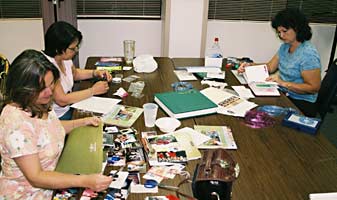
Wendy Jones and her sister, Christi Denney, work on projects during the Scrapbook and Craft Extravaganza at Mobberly Baptist Church.

Scrapbooking enables women
to pass along their values

By Rachel Stallard

Special to the Baptist Standard

LONGVIEW—Jodie Hilburn found a distinctive way to tell her husband she was expecting their third child—through a scrapbook project for his office. Carol Weiss is preparing for her family’s first holiday season without her father this year, after borrowing her mother’s Christmas album. Wendy Jones found a hobby on which she knew her family would not mind her spending time and money.

All three women are proud to call scrapbooking—or cropping—an art form. And many more women consider it a ministry of Christian encouragement and outreach.

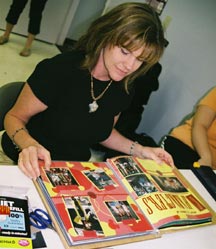
Stacy Pentecost of Macedonia Baptist Church in Longview participates in an Open Crop held once a month at Scrapbooks & Such in Longview. She is finishing a book from her children’s band trip to Disney World.

Mobberly Baptist Church in Longview recently held the first of three “Scrapbook and Craft Extravaganza” nights it has planned for the year. It allowed women to get away from the busyness of their home life, pull out their pictures and create for a couple of hours. But Lesa Floyd, women’s ministry coordinator at the church, saw it as another way for Mobberly to lead women to a life-changing relationship with Jesus Christ.

These kind of events “provide the opportunity for Christian women to get together, fellowship and encourage one another to grow in their relationship with Christ,” Floyd said. “It also gives them the opportunity to invite their unchurched friends who enjoy scrapbooking or other crafts, those who might not ever come to a worship service or Bible study and introduce them to other Christian women.”

Hilburn emphasized that theme during a devotional on “faithbooking” during the event at Mobberly. She explained faithbooking allows a scrapbook creator to document her faith, pass on family values to her children and testify to the praiseworthy deeds of God.

Hilburn also calls faith booking “an act of obedience,” citing Joel 1:3.

“The Bible tells us to ‘tell it to our children, and let our children tell it to their children, and their children to the next generation,’” Hilburn quoted.

Tina Cooper (left), Lesa Floyd (center) and Carol Weiss (right) spread out at a work table during Mobberly’s Scrapbook and Craft Extravaganza night.

Christians who incorporate their faith into scrapbooking can serve as the family historian of faith, said Sandra Joseph, author of Scrapbooking Your Spiritual Journey and The Women’s Ministry Guide to Scrapbooking. She also is co-founder of Reminders of Faith, a Christian-based scrapbooking group.

Joseph said her calling is to inspire women to share their story.

“It really doesn’t matter if the books are beautiful,” she said, adding that the embellishments sometimes get in the way of the message. “It matters if they’re real.”

These “real” books may be humanly flawed, but they serve as an encouragement, Weiss agreed. After recently retiring as director of accounting for a Longview hospital, Weiss is eager to revisit her mother’s hobby, and she sees Mobberly’s meetings as “a good way to get back into it again.”

Taking on her mother’s book is “a way to preserve memories for everybody in the family to enjoy,” she said. “In times when a relative dies, it’s good to have the albums out and around when the family gathers. It helps ease things.”

Jones also had a mother who documented events photographically. However, Jones took on scrapbooking as a hobby as an act of posterity.

“Our mother took pictures of special events, and they ended up in a drawer in a folder,” she acknowledged.

Jones has gathered all the pictures of herself from birth to age 17 and plans to make a book one day. But she also has grander plans.

“I’m doing this so we will all have memories to look through,” she said concerning her husband and two children. “I feel like I’m accomplishing something worthwhile— for myself and for my family.”

Molly Norwood has made a home business out of scrapbooking by becoming a consultant with Close to My Heart, a stamping organization. But even with all of her training and materials, the mother of three boys has learned resourcefulness and stewardship in the face of what some may consider an expensive hobby.

“I keep lids, scraps of paper, clips, everything I can find,” she said. “I am always asking, ‘How can I alter this for scrapbooking?’”

She recently created a photo album out of a breath-mints tin.

Norwood also has found a fellowship of moms by joining Internet swaps, one where other mothers recently created alphabet pages for boys. Through this and her consultant group, she has bonded with other croppers who do not hesitate to share life’s problems through e-mail.

“We are not all Baptists, but we are definitely like-minded,” Norwood said. “It’s really like a sisterhood.”

And it’s a sisterhood Joseph said she foresaw the day she felt called to help women through scrapbooking.

“My desire was always to see small groups of women meeting around a photo,” Joseph said. “I see this as a time for sharing.

“As women, we can become very isolated in our life. We think everybody else has a perfect life, and we’re the only ones who are struggling. When we meet like this, we can see what God is really doing—in the bad times, as well as the good.”

News of religion, faith, missions, Bible study and Christian ministry among Texas Baptist churches, in the BGCT, the Southern Baptist Convention ( SBC ) and around the world.


Texas Tidbits

Posted: 9/15/06

Texas Tidbits

Accreditation extended for UMHB program. The Council for Accreditation of Counseling and Related Educational Programs has extended until 2012 accreditation of the University of Mary Hardin-Baylor’s community counseling program. The program is part of the graduate psychology and counseling department at UMHB, which offers master’s degrees in professional counseling.


BUA provides mentoring program. Baptist University of the Americas has launched a higher-education mentoring program for Hispanic youth and their families living in San Antonio’s South Side. The Sigueme program uses Hispanic university students and BUA staff as mentors and role models for public school students. Key partners in the mentoring initiative include Buckner Baptist Benevolences and Communities in Schools, a national nonprofit group. The program also involves working with South Side churches to promote education through ongoing training for youth pastors, as well as providing seminars for families with prospective college students.


ETBU sponsors preview event. East Texas Baptist University will sponsor Tiger Day Oct. 7—a preview event for prospective high school and transfer students and their families. Sessions for the prospective students include an academic showcase, campus ministry opportunities, admissions information, financial aid options, and separate question-and-answer times for parents and students. The event also includes tours of the campus, lunch and free tickets to the Tiger football game against McMurry University. For more information, or to register, visit the website at www.etbu.edu and click on “Future Students-Visit Us” or call (800) 804-ETBU (3828).


Hearon Scholarship established at DBU. Dallas Baptist University recently established an endowed scholarship in honor of Gary and Paula Hearon. The scholarship will benefit students enrolled in the doctoral program in leadership studies and the master’s program in Christian education, both housed in the Gary Cook Graduate School of Leadership. Hearon served more than two decades as executive director of Dallas Baptist Association and was a DBU trustee nine years. Mrs. Cook has served on the DBU Women’s Auxiliary board. They are members of First Baptist Church in Garland.


Piper endowment established at HPU. Howard Payne University students from Brown and Mills counties will benefit from a new scholarship established in memory of Luther and Cassie Piper, longtime members of Coggin Avenue Baptist Church in Brownwood. Scholarships awarded from Luther and Cassie Piper Endowed Presidential Scholarship are merit-based and will be awarded to outstanding students based on academic achievement, leadership in school or community activities and Christian service.


School Bible studies get failing grade. Roger Paynter, pastor of First Baptist Church in Austin, participated in a Texas Freedom Network news conference, raising concern that Bible classes in many public schools “are being used to promote an agenda rather than to enrich the education of our schoolchildren.” The Texas Freedom Network’s education fund released a report analyzing Bible classes in Texas public schools. The report concluded most Bible courses taught in Texas public schools fail to meet minimal standards for teacher qualifications and academic rigor, are taught as religious and devotional classes that promote one faith perspective over all others and advocate an ideological agenda hostile to religious freedom, science and public education. The report is available here.


News of religion, faith, missions, Bible study and Christian ministry among Texas Baptist churches, in the BGCT, the Southern Baptist Convention ( SBC ) and around the world.


Problems can lead to divine opportunities

Posted: 9/15/06

TOGETHER:
Problems can lead to divine opportunities

Problems can lead to special, unexpected moments. Rosemary broke her arm the other day; and, as we were getting this taken care of, a woman eyed Rosemary’s cast and said, “Oh, you broke your arm, too. I just got two casts off my arms. I broke them both this summer.”

We had a conversation with this woman and her husband that genuinely blessed us, and in a few moments, we discovered they were members of one of our Texas Baptist churches.

wademug
Executive Director
BGCT Executive Board

They told us how much they were enjoying their intentional interim minister and the blessing his preaching and wise counsel were bringing to their fractured fellowship.

The husband is on the transition team charged by the church with helping them process their way to a new future for their congregation.

“It’s hard work, but it’s worth it,” he said.

With tears in her eyes, the woman reported that a mother and daughter sat in front of her one Sunday recently and after church told her that they almost had not come back.

“We came twice, and it seemed that no one in this church liked each other. But we feel a sense of love and fellowship today, and we will be back.” And they have attended the last two Sundays.

Two quick truths: First, it’s as important to love each other in a church as it is to love those who are visitors. People know somehow when they are in the presence of people who care about each other. Most people want to be part of that kind of fellowship.

Second, the intentional interim ministry sponsored by the BGCT Congregational Leadership Team is making a quiet but profound difference in churches across our state.

“I never thought I would see the day that the people in our church would agree on anything important,” the man said. “But I have!”

And, of course, you know what I said. “That ministry is your Cooperative Program dollars at work.” Our cooperative giving helps us to bless others and makes us open to receive blessing when we need it.

He replied, “You know, I don’t think I really understood that until what we are going through now.”

On another front, I was in a meeting the other day and a pastor from West Texas told of the blessing his young people received this summer on a mission trip to Mexico. They had spent the week building a house and helping with activities for the teenagers. The Mexican Baptist pastor showed the Jesus video and extended an invitation for people to receive Christ as their Savior and Lord. Several of the Mexican youth stepped forward to give their lives to Christ.

“Our kids were blown away,” my friend said. “They had never seen anything quite like that. They are different because now they see that they had a big part in helping some other young people be saved.”

Experiences like that happen when churches get involved in missions. The BGCT’s Texas Partnerships office, Texas Baptist Men, Woman’s Missionary Union and WorldconneX can help churches find strategic places to serve. These groups can help open doors for hands-on, participative mission ministries.

When we go where people are broken and lost, we see the “proof of the pudding” that Jesus saves. As we share our faith, we become part of first-hand testimonies of these people from around the world. We are loved.


Charles Wade is executive director of the Baptist General Convention of Texas Executive Board.

News of religion, faith, missions, Bible study and Christian ministry among Texas Baptist churches, in the BGCT, the Southern Baptist Convention ( SBC ) and around the world.


Transitional home provides refuge for teenaged girls

Posted: 9/15/06

Celeste, 18, turned herself into the courts at age 15 in order to receive an education. Now, she is studying to be a lawyer and lives at the Buckner Transitional Girls' Home in Guatemala City.

Transitional home provides
refuge for teenaged girls

By Jenny Pope

Buckner Baptist Benevolences

It’s a bright, golden-colored refuge that rests among the hectic streets of Guatemala City. A bus stop sits across the way, and hatchback cars and colorful buses whirl by on their way to outlying territories. Outside it’s noisy, dusty and fast-paced.

See Related Articles:
Buckner brings hope to orphans in Guatemala
• Transitional home provides refuge for teenaged girls

But inside the home is drastically different. It’s airy, open and calm. A plant-lined atrium greets guests upon entry; bedrooms line the walls with photos, stuffed animals and posters of celebrities; there’s a cozy living room with several couches and a TV; and fresh laundry flaps in the cool air outside an open kitchen.

The home is a refuge for the seven girls inside, not only from the streets of Guatemala, but also from the torment of their pasts.

Gaby, 14, tried to commit suicide at age 6 after losing her mother as an infant. She is one of the seven girls who lives at the Buckner Transitional Girls  Home in Guatemala City.

Each girl has different story—abuse, gangs, drugs, abandonment, forced prostitution. But all have the same hope for their future—success. And for the first time in their lives, they finally have a fighting chance.

Buckner Orphan Care International opened the Tran-sitional Girl’s Home in January through a partnership with Guatemalan businesswoman Isabel de Bosch, owner of a popular food chain. The home seeks to provide a place for teenaged girls to prepare for their future after life in an orphanage, and allows each girl to go to private school and receive specialized tutoring.

“This is a home for true orphans, but also for talented, beautiful girls with potential,” said Leslie Chace, Buckner Orphan Care International director of Latin American ministries. “The Lord brought us the resources and by a miracle, the house has been transformed.”

Celeste, 18, is studying to be a lawyer. But when she was 15 years old, she turned herself over to a judge to be admitted to the government orphanages. It was her only hope to receive an education, she said.

“I never went a day without my mom hitting me,” Celeste began, explaining that her mother made her drop out of school in the sixth grade to help support the family. “Even when I didn’t do anything to deserve it, she would hit me with machetes, milk crates, and even bit me sometimes. She said if I told anyone about the abuse, she would send me to a juvenile detention center. And I was always too afraid that she would hit me more.”

Buckner’s Transitional Girls’ Home in Guatemala City offers safe haven for teenage girls escaping life on the streets and the torments of their past.

So Celeste remained silent until the fateful day, Oct. 4, 2003—her brother’s birthday—when she fled her home after yet another unexplained episode of abuse.

“I didn’t even have shoes on when I ran out of the house,” Celeste said, with teary eyes. “I was bruised all over, wearing a long skirt and a long-sleeved shirt to cover the bruises. I was just so anxious to get out of there, so I ran away.”

Celeste went to court five times, she said, but “nobody in my family wanted to take me in because my mom told them I was bad, a rebel. I knew I couldn’t go back home because my mom wouldn’t let me study. So I told the judge I would rather go to an orphanage.”

Celeste spent nearly three years at Manchen Girl’s Home in Antigua, where caregivers and Buckner staff say she was always “a good girl.”

“I learned really fast that the best thing to do was to be obedient,” she said. “I would help the staff by talking to the other girls and try to keep them from running away. Then, because I was doing well in school, I was eventually able to come here” to the transitional home.

Gaby, 14, loves to play soccer and draw. She hopes to teach or design cars one day. But when Gaby was only 6 years old, she contemplated suicide.

“My mom died when I was a year old,” she begins, explaining that since her father was placed in prison for her mother’s death, she and her siblings were shuffled from aunt to aunt most of her childhood.

“I remember one day when they took me to a community grave where my mother was buried,” she said.

“Her grave was all the way up at the top, so a man helped me climb up there to see her. Once I got to the top, all I could think was ‘I’m going to jump so I can be with my mother in heaven.’”

When Gaby was 12 years old, she began drinking and dating a gang member. Then she ran away from home. When she returned four days later, her aunt decided to place her at Manchen.

“I had a hard time” at Manchen, she said. “A lot of the girls wanted to beat me up. But one day I met an American mission team and they told me about God. They said that I was pretty because God made me that way. That was when I found God.”

Gaby started to perform better in school. She passed the fifth and sixth grade and anxiously waited to complete the seventh grade because her aunt promised that was when she would return for her.

“I kept waiting, but she never came,” Gaby said.

“So I ran away to Guatemala City and wandered the streets. I met a group of girls who would steal things and live on the streets, but I didn’t want to become like them. So I called Buckner.”

From there, Buckner worked to place Gaby into the transitional home where she has “changed a lot,” said Ada Ramirez, Buckner follow-up staff member in Guatemala.

“Gaby has a very strong character, and in the beginning she was very aggressive with me. But she has calmed down. I guess she really just needed some attention,” she said.

Though both Celeste and Gaby share turbulent pasts and deep scars, they have remained unhardened.

“Since I came to know God, I have felt more peaceful because I know that God loves me and is watching out for me,” Gaby said.

“I can finally trust God,” Celeste said. “I believe in him. I know that because I have gone through so much, God will bless me with many things. And he has. I have a house, food, friends, education—I don’t lack anything. If all goes well, I will go to college and have a career because people were here to help me.”


News of religion, faith, missions, Bible study and Christian ministry among Texas Baptist churches, in the BGCT, the Southern Baptist Convention ( SBC ) and around the world.


Called board meeting focuses on Valley

Posted: 9/15/06

Called board meeting focuses on Valley

By Ferrell Foster

Texas Baptist Communications

DALLAS—Baptist General Convention of Texas Executive Board officers expect to call a special board meeting by the end of October to consider the results of an investigation into the use of church-starting money in the Rio Grande Valley.

Jim Nelson of Austin, vice chairman of the board, said the complexity of the investigation made it impossible for investigators to finish the task by the regular Sept. 25-26 board meeting.

“We had hoped to have the report ready for the regular Executive Board meeting, but the volume of material to be studied and the large number of personal interviews to be conducted has pushed back the completion date,” Nelson said.

Board Chairman Bob Fowler of Houston and Nelson have monitored the work of the investigators, led by Diane Dillard of Brownsville, since they began June 1. Fowler was out of the country and unavailable for comment.

Given the expected size of the final report, an executive summary will be sent to all board members as soon as it is completed, Nelson said. The full report will be available to any member of the Executive Board who requests it.

The investigation began after allegations surfaced regarding possible mishandling of BGCT church-starting funds. Suspicions surrounded the large number of church-starts in the lower Rio Grande Valley from 1999 to 2005 and how BGCT funds were used in the effort.

Investigators are interviewing people and studying documents requested from the BGCT and from Rio Grande Valley Baptist Association, Nelson said. Interviews are being conducted in both English and Spanish, as needed. A fraud-certified forensic accountant also has been hired to assist in the investigation.

“This has been a very time-consuming process,” Nelson said. “Our investigators have worked extremely hard to gather and evaluate a large volume of data in a short amount of time.”

At the Executive Board’s regular Sept. 25-26 meeting, directors will be asked to authorize additional funding to complete the investigation. At this time, Nelson said he does not know the specific amount needed, but a figure will be determined before the meeting.

“In order to do this right and to ensure we will have a trustworthy conclusion to this investigation, we felt it important that we pursue every reasonable opportunity to gather information,” Nelson said. “The cost has been high, but it is critically important that we understand what actually happened, as best we can determine.

“Even though we don’t have the power to compel people to answer questions, we have been grateful and pleased that so many folks have been willing to help us in the process.”


News of religion, faith, missions, Bible study and Christian ministry among Texas Baptist churches, in the BGCT, the Southern Baptist Convention ( SBC ) and around the world.


Cyberbullies harass, humiliate peers

Posted: 9/15/06

Cyberbullies harass, humiliate peers

By David Briggs

Religion News Service

WASHINGTON (RNS)—Beware the wrath of a dumped boyfriend or girlfriend spreading rumors about a former partner on MySpace. Pity the middle-school student whose clothes, popularity or appearance becomes the object of derision in public chat rooms frequented by classmates.

These days, teenagers and their parents don’t have to look out just for sexual predators online. Some of their peers are turning into cyberbullies, using sites such as MySpace and Facebook to harass and humiliate classmates.

Religious groups and schools are responding to the explosive popularity of blogs by prohibiting access to MySpace, Xanga, Facebook and other social networking sites, and asking young people to let their faith guide them in cyberspace as they would on the playground or in the classroom.

Three years ago, there was no MySpace. Now the site and others like it have become part of kids’ lives. Young people use the social networking sites to talk, share photos and post personal journal entries on their pages or in chat rooms that can be specific to their schools.

At their best, blogs can help young people develop their voices as writers, enabling them to share their feelings and the challenges they face, say teenagers and adults who monitor these sites. The conversations and experiences also can help others through an often-tumultuous stage in life.

But these sites can cause real problems. In addition to sexual predators searching out potential victims, cyberbullying has become a growing concern.

That’s where Grace comes in—Grace Doe of Grace Notes, the teenage protagonist of the first book in author Dandi Daley Mackall’s new four-part fiction series, Blog On. Mackall, from West Salem, Ohio, developed the series with Zondervan, a Christian publisher, as a fun way to encourage young girls to use the Internet in positive ways.

Mackall, who often visits schools to find out what youth are talking about, said one young girl received 350 hate e-mails because of false information posted about her online.

Young people deal with cyberbullying in different ways. Some try to ignore the insults and bar people who post offensive remarks from their sites. By staying cloaked in anonymity, online combatants are less likely to learn how to forgive after a fight, Mackall said.

Fortunately, there is a flip side to cyberbullying, Mackall said.

“It’s easier to stand up for yourself or your friends in cyberspace,” she said.

In Grace Notes, Mackall’s main character is a shy person who considers herself invisible in school. But she finds it rewarding to share her experiences online. As the book goes on, Grace finds herself constantly having to revise the stereotypes of classmates she refers to in her blog as “Bouncy, Perky Girl” and “New Girl.”

Once Grace begins to know these people, and the anger they feel at her judgments from afar, she realizes both that her blogging can hurt others and that people are more complex than the boxes adolescents can use to classify one another.


News of religion, faith, missions, Bible study and Christian ministry among Texas Baptist churches, in the BGCT, the Southern Baptist Convention ( SBC ) and around the world.


Predators make Web risky for teens

Posted: 9/15/06

Predators make Web risky for teens

By George Henson

Staff Writer

DALLAS—Most teenagers don’t need a warning about the predators waiting on the Internet. That thrill is what drives some riskier behaviors, a Dallas assistant district attorney said. And that makes parents’ role in keeping children safe even more important.

Some teens may think flirting and sexual innuendo on the Internet is a safe risk, like riding a thrill ride at an amusement park, but that is a false assumption, said Brooke Robb, an assistant district attorney who specializes in prosecuting Internet crimes against children. She spoke to a group of youth ministers from Dallas Baptist Association churches.

“If they are at home, they feel safe,” Robb said. “But we have to educate our kids to know that if you are online, you might as well open your door and shout it to the world.”

About 30 million children use the Internet. Of those, one in four children has had unwanted exposure to sexual pictures on the Internet. One in five has experienced sexual solicitation. One in 17 has been threatened or harassed, and one in 33 has been the subject of aggressive sexual solicitation, Robb reported.

Of children who receive an invitation to engage in sexual activity, 70 percent are at home, and 22 percent are at someone else’s home. Sixty-five percent of those sexual solicitations come while in Internet chat rooms and 24 percent through instant messaging.

Social networking websites like MySpace are too new a phenomenon to have been factored into the research and are new areas for concern, she added.

While the easy solution seems to be to keep children totally off the Internet, school assignments and peer pressure make that increasingly difficult.

Parents need to be aware, however, that it is hard to be on the Internet and not be open to some level of risk, she said. Robb, using a scenario available for viewing at www.netsmartz.org, demonstrated how easy it is to gather information on children and teens—even those who try to remain anonymous.

The girl in the online demonstration does not include her real name, location or gender. But in a matter of minutes, an Internet savvy individual still could find a lot of information about her including the names of parents and sibling, where she went to school, telephone number and address.

“For even a kid who is relatively careful, the Internet can be a dangerous place,” Robb said. “Kids who are going to be on the Internet are going to be at risk, because they will be giving some personal information.”

In general, online victims share a set of common characteristics—low self-esteem, lack of parental oversight and isolation from a peer group, she said.

Children and youth are the “ideal victims” for predators, Robb said, because they are naturally curious, are led easily by adults, have a need for attention and affection, feel a need to defy parents, have low self-esteem and are not likely to report to parents or law enforcement. “If they say, ‘Someone sexually solicited me on the Internet,’ what is the reaction of most parents? No more Internet. So, they don’t tell,” she said.

Statistics show that only 25 percent of children and teens who are sexually solicited tell a parent and only 10 percent of cases are reported to law enforcement, she noted.

“And not reporting puts them in an even more vulnerable position emotionally,” she said.

About 99 percent of Internet predators are male, 97 percent act alone and 86 percent are 25 years old or older, Robb reported. And only 10 percent have a prior arrest for a sexual offense against minors.

“If law enforcement does not know they are predators, how can we expect our kids to?” she asked.

The most important thing for parents to do is establish ground rules for Internet use, she said. Sit down with your child and establish what sites can be visited, what online activities are allowed, who they can talk to, how long they will be online and where they can use the computer, she suggested.

Most youth who become victims spend hours online each day with little or no supervision. For that reason, she recommends the computer only be used in a common room where the child knows someone probably will pass by.

Also, parents should let their child know they want to discuss anything that happens that makes them feel scared or uncomfortable.

For some parents, they may want to prepare themselves beforehand for that type of conversation. Stay calm, and encourage them to confide in you, Robb suggested.

One of the key things a parent can do is to stay informed about the Internet. Know about filters, blockers and rating applications, and monitoring software. Go into a chat room and learn the terminology used. Ask your children to show you where they go on the Internet.

Also, be aware children are quick to find ways around filtering and monitoring software, and there is no substitute for a physical presence, Robb stressed.


News of religion, faith, missions, Bible study and Christian ministry among Texas Baptist churches, in the BGCT, the Southern Baptist Convention ( SBC ) and around the world.