U.S. allies violate human rights

Posted: 5/12/06

U.S. allies violate human rights

By Robert Marus

ABP Washington Bureau

WASHINGTON (ABP)—Several U.S. allies remain among the world’s most egregious violators of human rights, a nonpartisan federal panel reported.

In addition, the U.S. Commission on International Religious Freedom said, two nations whose oppressive governments U.S. forces have helped overthrow since 2001—Iraq and Afghanistan—are in danger of joining that infamous list.

Commission members made public their 2006 annual report and recommendations during a press conference in Washington. The 1998 law that created the panel requires it to report annually on the status of religious liberty worldwide and recommend the State Department name nations that commit or tolerate severe and egregious violations of religious freedom as countries of particular concern. Administration officials retain ultimate authority to make those designations and impose appropriate sanctions.

Commissioners recommended the same 11 nations for that status as they did last year—Burma, China, Eritrea, Iran, North Korea, Pakistan, Saudi Arabia, Sudan, Turkmenistan, Uzbekistan and Vietnam.

Although the commission has long recommended country of particular concern status for those nations, the State Department has failed to follow that recommendation for Pakistan, Turkmenistan and Uzbekistan and has been slow to take action against Saudi Arabia.

In September—a year after the State Department declared oil-rich Saudi Arabia a county of particulasr concern—Secretary of State Condoleezza Rice placed a 180-day waiver on implementing any sanctions against the Saudi government.

“This waiver expired in late March 2006,” said Nina Shea, the commission’s vice chair and director of Freedom House’s Center for Religious Freedom.

“As of today, no action with regard to Saudi Arabia has been announced by the U.S. government. … Since religious freedom conditions in Saudi Arabia have not substantially improved in the last year, the U.S. government should not hesitate in taking significant action.”

Shea said Saudi Arabia has not shown significant improvement on religious freedom since the State Department’s 2004 country of particular concern designation.

The Saudi government bans public worship by religious groups of any sort other than those following the state-sanctioned version of Sunni Islam.

Shea said government officials occasionally raid even private Christian worship services, which are supposed to be legal.

In Pakistan, the panel’s 250-page report said, “Sectarian and religiously motivated violence persists, … and the government’s response to this problem, though improved, continues to be insufficient and not fully effective.”

The commission also called special attention to the situations in Iraq and Afghanistan.

“In these two countries, where the United States is directly engaged in political reconstruction, the universal right to religious freedom is imperiled,” wrote Michael Cromartie, the commission’s chairman, in a letter to Rice accompanying the report.

He noted several recent incidents in which Afghan citizens were charged with crimes—some carrying the death penalty—for contradicting Islam. Cromartie also noted lawless conditions in Iraq have led to regular sectarian violence between Sunni and Shiite Muslims, as well as an atmosphere of fear that is causing many Christians and other religious minorities to flee the country in “an exodus that may mean the end of the presence in Iraq of ancient Christian and other communities that have lived on those same lands for 2,000 years,” he said.

Commissioner Preeta Bansal, a human-rights attorney, told re-porters the new Afghan consti-tution, the makeup of the nation’s judiciary, and the government’s inability to impose order in large parts of the country outside Kabul have combined to worsen the situation there.

The full report is available on the commission’s website at www.uscirf.gov.
News of religion, faith, missions, Bible study and Christian ministry among Texas Baptist churches, in the BGCT, the Southern Baptist Convention ( SBC ) and around the world.


Baptist foster care continues in troubled Sri Lanka

Posted: 5/12/06

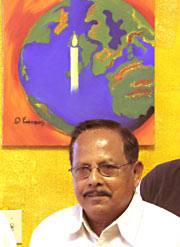
This mural on the side of a building that was breached by the tsunami seems to speak of the confused lostness of Sri Lanka's children after the trauma of the disaster. (BCFC photo by Craig Bird)

Baptist foster care continues in troubled Sri Lanka

By Craig Bird

Baptist Child & Family Services

BATTICALOA, Sri Lanka—As the threat of full-fledged civil war grows in Sri Lanka, a Texas Baptist agency cares for a growing number of orphans on the boundary of the fraying ceasefire line.

A foster program developed by Children’s Emergency Relief International, the overseas arm of Baptist Child & Family Services, has placed 96 orphans with 48 families, with another 600 children on the waiting list.

The ministry has added about 20 children a month for the past three or four months, said Basil Fonseka, national program director.

“Our goal is to have 200 children enrolled by December—maybe 300 if the resources are there,” he said.

Basil Fonseka,director of the CERI foster program for orphans in Sri Lanka, visited BCFS programs in San Antonio in April. Here he tours the Preparation for Adult Living program that works with young adults who have aged out of the Texas foster care system. (BCFS photo by Marla Rushing)

Those projections were made before the already-unraveling ceasefire between the government and the Tamil Tiger separatists was strained by a suicide bombing, fire fights at sea and at border checkpoints, and cancellation of the latest round of peace talks.

In two decades, about 60,000 people have died in fighting between the Singhalese-dominated central government and the ethnic Tamils, who have waged a war for autonomy. If total warfare returns to the northeastern part of the country, “we can’t begin to imagine what will happen to the children,” Fonseka added. “They already suffer under the triple blows of poverty, war and the tsunami,”

A female suicide bomber, dressed as a pregnant woman, detonated explosives at an army hospital in Colombo April 25 as the commander of the Sri Lankan army arrived. The blast killed eight people and wounded 27 others, including the general, who was critically injured, the Asian Tribune reported.

In response, the government launched air and artillery attacks on Tamil Tiger bases in the eastern province just north of Batticaloa where the Children’s Emergency Relief International program is based. An estimated 12 people—including civilians —died and between 15,000 and 40,000 refugees fled the area. A gun battle erupted at a checkpoint along the ceasefire zone April 29. At least two earlier sea battles were fought off the eastern coast of the country. Violence has increased steadily since early December, ending two years of tense—but generally peaceful—ceasefire.

International observers, including Hu-man Rights Watch and the Sri Lanka Monitoring Mission—the group trying to broker the peace talks, have condemned both sides.

Meanwhile, Children’s Emergency Relief International staff continue their work in Batticaloa, putting together the nation’s first foster program. The coastal town, which straddles the ceasefire line, is where Texas Baptists concentrated their relief efforts immediately after the tsunami.

One part of the CERI foster program for orphans is the use of art therapy to help orphans express the feelings left over from the tsunami. This young man draws of seeing people washed from vehicles and drowned. (BCFC photo by Craig Bird)

“The government and the people know we are all Christians and that this work is funded mostly by Christians in America. But they also know we are not using this as a way to proselytize. In our own way, we are contributing to building relationships and trust among different ethnic and religious groups and aiding national peace efforts,” Fonseka explained.

Foster parents’ monthly meetings with staff serve as a linchpin of the program. More than 95 percent participate, Fonseka noted, “even though most of the families live five or 10 miles from our office and have to walk or bicycle to come.” Local government officials also attend.

The meetings focus on training foster parents in such diverse areas as financial management, nutrition and health care.

Foster parents, all relatives of the orphans, frequently come to the Children’s Emergency Relief International staff for prayer—especially for physical problems, he added. Every-other month, the children join their foster parents at the meetings.

Four case workers make regular visits to each home, providing more training and making sure the children are cared for properly.

Children’s Emergency Relief Inter-national provides $30 a month per child.

“Since all of our families are below the poverty line—and in Sri Lanka that is defined as $1 a day per family—you can see what a difference it makes to the grandmother or aunt or uncle that has taken in these orphans,” Fonseka said. “That money provides food security and clothing and ensures school fees will be paid.”

Not only do foster parents have to turn in receipts each month before receiving the allotment; they also are required to place a certain percentage into a savings account. Children’s Emergency Relief International will organize the families into groups of 12 that can combine their savings for capital to set up small enterprises to produce things they couldn’t produce individually. Children’s Emergency Relief International will provide training and help find markets for the products.

Another project links the foster families with volunteers to build houses. “Most of our families are living in shacks or rented rooms,” Fonseka explained.

“For $1,000, we can build a two-room house and hire some of the foster parents as part of the construction crew. Other families will be expected to volunteer their labor, since others will volunteer when it is their turn,” he said.

Fonseka spent 10 days in Texas in late April, learning how Baptist Child & Family Services operates its foster program and speaking in churches.

A Wednesday night session with a prayer group at First Baptist Church in San Antonio resulted in a commitment to support the Children’s Emergency Relief International effort with constant and focused prayer. Pastor Don Guthrie also organized an impromptu love offering that brought in $700.

Fonseka immediately suggested it go toward building a house for an elderly woman raising her two orphaned grandchildren in a tiny mud-walled room.

“All we need is another $300,” he later told Marla Rushing, Children’s Emergency Relief International director for Southeast Asia.

The following Sunday, after a short talk at First Baptist Church in Corpus Christi, Fonseka and Rushing were visiting with members when a young boy stepped through the crowd, put a pile of bills into Fonseka’s hand, said, “My dad said go give this to you,” and disappeared.

“Nobody knew who he was, but when we counted it, there was $300 there,” Rushing recalled, pointing out the specific need was not mentioned publically.

“I was amazed, but Basil wasn’t. He just said, ‘I knew God would provide.’ So when he assures me that God is going to give us the $50,000 we need to keep this program going and growing, I have to believe him.”

Rushing will lead a group of volunteers to Sri Lanka in August and organize future trips. Fonseka said volunteers should plan to spend a minimum of two weeks.

“Part of the time could be spent building houses, but we need English teachers for the children, too, and we want the volunteers to have time to develop relationships with the Christian churches in Batticaloa.

Finally, we want them to spend time in the foster homes to get a firsthand experience of what God is letting CERI do.”

Information about Children’s Emer-gency Relief International’s Sri Lanka program is available at ww.bcfs.net or by calling Rushing at (210) 832-5999.

In addition to mission trips, sponsorships for Sri Lanka orphans also are available.

News of religion, faith, missions, Bible study and Christian ministry among Texas Baptist churches, in the BGCT, the Southern Baptist Convention ( SBC ) and around the world.


Feeding the hungry disarms terrorists, author insists

Posted: 5/12/06

Tony Hall, former United States congressman and United Nations ambassador, visits children in Africa. Hall has traveled to 120 nations to learn about hunger and poverty.

Feeding the hungry disarms
terrorists, author insists

By Ken Camp

Managing Editor

Humanitarian aid is the most potent weapon the United States can deploy against terrorism, veteran congressman Tony Hall believes.

Providing food for one’s enemies not only fulfills a basic teaching of Jesus Christ; it’s also good foreign policy, said Hall, an evangelical Christian who served 12 terms in the U.S. House of Representatives and recently completed more than three years as ambassador to the United Nations Agencies for Food & Agriculture in Rome.

“When we feed hungry people—and help them solve other problems—we create goodwill that can last for generations, cement alliances and make us safer in an often-dangerous world,” he writes in his new book, Changing the Face of Hunger.

“To fight terrorists who label us the enemy of the poor and the oppressed, we must make clear that we are the poor and oppressed’s best friend.”

The world does not lack the food necessary to eliminate chronic hunger; it lacks the political and spiritual will to bring about change, he said in an interview.

“We grow enough food to feed everybody,” said Hall, a three-time nominee for the Nobel Peace Prize.

“We need more political will and more spiritual will. We need more people of faith involved.”

In 1993,when Congress eliminated the House Select Committee on Hunger—which Hall had co-founded and chaired—he went on a highly publicized 22-day fast to raise awareness and express his solidarity with the world’s hungry people.

Hall traces his intense commitment to justice for the poor and food for the hungry to an admonition by Mother Teresa of Calcutta and a question by a Christian mentor who helped disciple him.

When Hall asked Mother Teresa how she could hope to make any impact on the world’s vast problems, she said, “You do the thing that is in front of you.”

And when Hall met in a small group of Christians in Washing-ton, D.C., about two years after his conversion, one of them asked him, “Tony, don’t you think it’s time you brought God into your workplace?”

Hall initially resisted. “I didn’t want to be seen as a politician who wears his religion on his sleeve,” he explained.

But witnessing firsthand the pressing needs of hungry people in the United States and around the globe fueled Hall’s passion for justice.

He visited famine-stricken Ethiopia, investigated human rights abuses in Romania, traveled to North Korea six times to witness hunger in a Communist country closed to most American officials, and brokered a deal with Mu’ammar al-Gadhafi so food from the United States could be trucked through Libya and delivered to refugees in Sudan and Chad.

Hall, an Ohio Democrat, bridged partisan politics to build alliances with colleagues such as Frank Wolf, a conservative Virginia Republican, who shared his concern for human rights and global security.

“We can put aside partisan differences by concentrating on the things we agree upon,” he said.

“It’s hard to demonize others when you spend time together, pray together and really get to know them.”

Hall remains convinced issues of hunger and poverty can be a place where most people of goodwill can find common ground if they see for themselves the needs of hungry people—whether in a refugee camp on the other side of the world or at a homeless shelter in their own community.

“I’ve traveled to 120 nations,” he said “And I take people with me to show them, to educate them.

“I’ve taken politicians and businessmen to see the good and the bad—programs that work and programs that don’t work.”

People of different faiths and different political philosophies recognize compassion as a virtue, he stressed.

By approaching the problem from different perspectives, they offer a variety of solutions—governmental aid, personal charity, small loans to benefit micro-enterprise, literacy programs and health care education to improve standards of living.

“Some of the most effective programs are public/private partnerships between government and business,” he said.

Christians, in particular, have a responsibility to meet human needs and become advocates for poor and hungry people, he said, noting the Bible includes more than 2,000 verses concerning the poor.

“If each of us just did the thing that is in front of us, that would take care of half the problems in the world,” he said.

News of religion, faith, missions, Bible study and Christian ministry among Texas Baptist churches, in the BGCT, the Southern Baptist Convention ( SBC ) and around the world.


Law mandates training for camp workers

Posted: 5/12/06

Law mandates training for camp workers

By George Henson

Staff Writer

Churches throughout Texas are required to make extra preparations for summer camps this year, as a new state law outlining training for adults who work with children and teen-agers goes into effect June 1.

The new law requires every adult—paid or volunteer—who is in contact with children at camp to undergo training focused on sexual abuse and child molestation. At the end of the training, each adult worker must take a written test to demonstrate understanding of the material.

State law already requires criminal background checks of adults who have contact with children at camp. A sex- offender background check also is required. The checks can be done by going to the website https://records.txdps.state.tx.us/. The fee for criminal background checks is a little more than $3 each. Sex offender background checks are free.

The Texas Baptist Camp Managers Association and the staff of the Baptist General Convention of Texas worked together to develop curriculum to meet state requirements for the training, including a test. The curriculum is available on a DVD distributed by camp managers to churches that will attend camp this summer.

The curriculum is mandated to include “the definition and effects of sexual abuse and child molestation; the typical behavior and methods of operation of child molesters and sex offenders that put children at risk; the warning signs and symptoms associated with sexual abuse or child molestation, recognition of signs and symptoms and recommended methods of intervening and reporting suspected abuse; and the recommended rules and procedures for youth camps to implement to address, reduce, prevent and report suspected sexual abuse and child molestation.”

All workers 18 years old or older are required to complete the training.

Tom Leamon, director of Camp Chaparral Baptist Assembly in Iowa Park and president of the Texas Baptist Camp Managers Association, said the new law has its pros and cons.

“It’s good in one sense, because anything that goes toward safeguarding the well-being of our children is positive, but it is going to be a burden in implementation,” he said.

As the licensed party, the camps are responsible for making sure workers complete the training stipulated in the law.

The camps will be required to ask churches for documentation on all volunteer workers at the time they arrive and keep those records on file.

Since it sometimes happens that the planned adult worker cannot attend and a last-minute substitute has to be found, Leamon said Camp Chaparral will be prepared to lead a course for anyone who could not receive the training before arrival. Churches should check to see if on-site training will be available at the camp they plan to attend, Leamon advised.

Currently, training is not required for camps such as Super Summer held on college or university campuses. Some officials believe this immunity for colleges and universities will be lost in the next legislative session.

The intent of the law is positive, Leamon said in a statement posted on the camp’s website.

“The best way to deter abuse from happening at our camps is to develop an environment that puts the offender, rather than the child, at risk. An adequate screening process, proper supervision and accountability will discourage this type of offender.”

News of religion, faith, missions, Bible study and Christian ministry among Texas Baptist churches, in the BGCT, the Southern Baptist Convention ( SBC ) and around the world.


Attorney will guide BGCT church-starting investigation

Posted: 5/12/06

Attorney will guide BGCT
church-starting investigation

By Ken Camp

Managing Editor

DALLAS—An attorney will guide an investigation into alleged mishandling of Baptist General Convention of Texas church-starting funds in the Rio Grande Valley.

BGCT Executive Director Charles Wade has asked officers of the Executive Board and the state convention to engage an attorney to head the probe. The investigation focuses on how church-starting funds were used from 1996 to 2003 in Rio Grande Valley Baptist Association and what is now The Borderlands Baptist Association.

The amount of money in question is unknown at this point but will be determined early in the investigation, Wade said.

At the same time, a BGCT Executive Board standing committee has been asked to deal with a request that the board conduct its own investigation into the matter. Palo Pinto Baptist Association’s executive committee unanimously adopted a resolution requesting the board’s involvement.

Executive Board Chair Bob Fowler of Houston has assigned the matter to the Church Missions and Ministries Committee, chaired by Robert Cepeda of Los Fresnos. The committee will bring a report to the full Executive Board, either recommending or not recommending board action, Fowler said.

Suspicions surround the large number of cell-group missions reported as church-starts in the lower Rio Grande Valley from 1996 to 2003. Critics allege some church-starts that received financial assistance from the BGCT never existed, and some individuals profited by claiming to start multiple, nonexistent “mystery missions.”

In 1996, the BGCT Annual listed 92 churches and 38 missions in Rio Grande Valley Baptist Association.

By 2003, the Annual reported 105 churches and 240 missions in the association. Of those 240 missions, 151 listed as their sponsors six of the 10 churches that formed The Borderlands Baptist Association the following year. Listing as a mission in the BGCT Annual does not necessarily mean a congregation received BGCT funding.

Questions about improprieties regarding church-starting funds in the Rio Grande Valley initially surfaced about five years ago.

“Dr. Wade consulted with BGCT staff and concluded at that time that there was no need for an investigation,” a statement issued by the BGCT said.

“In December 2005, new information came to Dr. Wade’s attention that prompted another round of internal investigation. He and other BGCT executive leaders then determined that an independent, outside investigation was needed.”

In an interview, Wade explained he made two or three trips to the Valley when the questions first arose specifically to “get to the bottom” of the allegations, and he received what he believed were reasonable answers from trusted sources.

But last year, after the BGCT annual meeting in Austin, allegations “kept bubbling up,” Wade said. In addition to renewed concerns expressed by Texas Baptists in the Valley, questions raised by Mexican Baptist leaders about some church-starting practices prompted his desire for further inquiry.

Initially, Wade enlisted Mike Steiger, an accountant from Arlington and former partner in a global management consulting firm, to conduct a financial investigation. Steiger offered his services as a volunteer, the statement issued by the BGCT communications office said.

But Steiger and convention officials concluded “the timeframe and the complexity of the issues pointed to the need to engage legal counsel to guide the effort,” the BGCT statement said.

Fowler and Executive Board Vice Chair Jim Nelson of Austin, together with BGCT President Michael Bell of Fort Worth, First Vice President Steve Vernon of Levelland and Second Vice President Dan Wooldridge of Georgetown, will engage an attorney to guide the investigation.

The officers are considering several lawyers, and they will make their decision prior to the May 22-23 Executive Board meeting, Fowler said.

“I’d like to think it will be a two- to three-month process, but we can’t be certain at this point,” he said of the investigation. Fowler anticipates the probe will be completed in time for the Executive Board to receive a report at its Sept. 25-26 meeting.

The investigation will be funded out of reserve or contingency funds, Fowler said. Money will have to be allocated by the Executive Board unless there is enough contingency funding in the budget, he added.

Having convention and Executive Board officers hire an attorney to guide the investigation is “a step in the right direction,” said David Montoya, pastor of Calvary Baptist Church in Mineral Wells, who has used his Internet blog to lead the call for a probe. But Montoya still would prefer to see the process led by an Executive Board-elected committee.

“It seems to me that it is still being managed by a few rather than being openly dealt with,” he said. “We need complete openness now. This has been managed for damage control for too long. Texas Baptists deserve answers.”

The BGCT normally funds church-starts through a cooperative agreement between the convention, an association of churches and a sponsoring congregation. The BGCT’s emphasis on church-starting dates back to the 1980s and the Mission Texas long-range plan. It has continued in recent years, with Texas Baptists starting 191 congregations last year and setting a goal of 250 new churches this year.

“Texas Baptists place a high value on starting new churches, and the BGCT directs millions of dollars into the most strategic locations around the state,” Wade said. “We take very seriously this missions and financial responsibility. That is why we want to investigate this and determine how the money was used.

“The BGCT has always functioned in a transparent financial environment, resulting in a high level of confidence in the integrity of the organization and its leaders. We are committed to making sure this continues.”

News of religion, faith, missions, Bible study and Christian ministry among Texas Baptist churches, in the BGCT, the Southern Baptist Convention ( SBC ) and around the world.


Bible reading on rise, survey reveals

Posted: 5/12/06

Bible reading on rise, survey reveals

By Nate Herpich

Religion News Service

WASHINGTON (RNS)—A survey shows the percentage of Americans who say they regularly read the Bible continues to increase.

The survey, conducted by the Barna Group, found 47 percent of respondents said they open the Bible on a weekly basis, up from just 31 percent in 1995 and 40 percent six years ago.

The survey also polled respondents on six other religious behaviors, including church attendance and attending small groups like Bible studies.

Forty-seven percent said they attend church on a weekly basis, up from 37 percent a decade ago, while 23 percent said they attend small- group functions affiliated with church.

Twenty-seven percent of those asked said they volunteer through church, while 24 percent said they attend Sunday school, up from 17 percent in 1996.

Increased participation in all of these religious behaviors at the same time marks the findings as unusual, said survey director George Barna.

“The intriguing possibility is that with most of our key behavioral measures showing increases at the same time, there is the possibility that this may herald a holistic, lasting commitment to engagement with God and the Christian faith,” he said.

The Barna report was based on data taken from 1,003 adults nationwide, interviewed by telephone. The Barna Group is a private, for-profit corporation in Ventura, Calif., that conducts research on spiritual development.

News of religion, faith, missions, Bible study and Christian ministry among Texas Baptist churches, in the BGCT, the Southern Baptist Convention ( SBC ) and around the world.


Book Reviews

Posted: 5/12/06

Book Reviews

Finding Our Way Home: Turning Back to What Matters Most by Mark R. McMinn (Josey-Bass)

Finding Our Way Home is inspirational and thought-provoking. From a very personal perspective, McMinn discusses our God-created desire for both adventure and “home”—that secure place in which we are fully known and loved.

These two forces are evident in our human relationships and in our relationship with God.

They sometimes are guided by God, but at other times controlled by our sinful selves. When we allow these desires to take us away from God and each other, there is a longing that draws us back to God and to wholeness with others. God pursues us actively, moving toward us with redemptive love, encouraging us to change direction.

What are you reading that other Texas Baptists would find helpful? Send suggestions and reviews to books@baptiststandard.com.

McMinn provides an excellent discussion of the “redemptive language of turning back” found in the ideologies of psychology, theology and spirituality. Additionally, he gives a beautiful commentary on the incarnation as God’s ultimate provision for “finding our way home.”

This book is worth reading more than once.

Margaret Hunt Rice, executive director

of student services and regional outreach

University of Houston-Victoria


Seventeen Roadblocks on the Highway of Life: And How to Move Around Them by Brian Harbour (Smyth & Helwys)

Last summer, our family traveled to our favorite vacation getaway—Pagosa Springs, Colo. But along the way, we were confronted with a roadblock. We waited on the side of the road for two hours while pavers paved and workers worked. Roadblocks are not something any of us look forward to, but we all face them from time to time.

Brian Harbour has written a new book that addresses this theme, Seventeen Roadblocks on the Highway of Life: And How to Move Around Them, which I highly recommend.

According to John 10:10, Jesus came to give us life—not just an ordinary life, but an extraordinary, abundant life.

This life Jesus offers is marked by joy, peace, confidence, security and fulfillment. Unfortunately, many Christians do not live up to our privileges. We don’t experience the abundant life offered by Jesus.

Why not? The simple answer is that so often we face roadblocks that prevent us from moving down the road to abundant living.

Harbour identifies 17 roadblocks and offers strategies to navigate around these roadblocks.

Harbour offers a wealth of illustrations and quotes for any pastor who wishes to preach about any of these roadblocks. For the Christian who wants to move around these roadblocks, this book provides Scriptures, models and strategies to help.

David Harp, pastor

First Baptist Church

Stanton

Holy Blood, Holy Grail: The Secret History of Jesus, The Shocking Legacy of the Grail by Michael Baigent, Richard Leigh and Henry Lincoln (Dell)

As a pastor, I found reading Holy Blood, Holy Grail to be a difficult task on many levels. The hypothesis of the book was deeply disturbing.

The authors set out to prove that the historic search for the Holy Grail would actually lead to the discovery that Jesus married Mary Magdalene.

As a result of this theoretical marriage, Jesus had children, and his lineage continues in Europe. This “holy blood” secret had to be hidden from the Catholic Church because of its threats to the foundations of orthodox Christia-nity.

It was obvious from reading this book that Dan Brown used the hypothesis of Holy Blood, Holy Grail for background information for his best-selling novel The DaVinci Code.

But to me, Holy Blood, Holy Grail read more like historical fiction than scholarly research.

If you plan to read the book, it might be helpful to begin your reading with “Part Three: The Bloodline.”

Otherwise, you may find yourself lost and confused in the early details.

When you read how the authors dealt with the New Testament, you will understand how they came up with such a bizarre hypothesis for the book.

David Lowrie, pastor

First Baptist Church

Canyon

News of religion, faith, missions, Bible study and Christian ministry among Texas Baptist churches, in the BGCT, the Southern Baptist Convention ( SBC ) and around the world.


Baptist Briefs

Posted: 5/12/06

Baptist Briefs

Alliance pledges to confront racism. At its annual convocation in Birmingham, Ala., the Alliance of Baptists pledged to remake itself into “an anti-racist organization.” While the three-day meeting focused primarily on confronting racism and working toward reconciliation, the estimated 500 participants also agreed to consider a boycott of oil giant Exxon-Mobil, saying the high price of oil and gas deepens worldwide poverty, and dependence on fossil fuels threatens creation. A resolution called on the company to invest significantly in cheaper and less hazardous energy sources. During the annual business session, members were told the Alliance surpassed its goal for the annual missions offering last year. But for the second year in a row, it finished the year with a deficit, which was paid out of reserves. The organization already has a $16,000 deficit for 2006, against an annual operating budget of $374,000. Members elected Jim Hopkins, pastor of Lakeshore Avenue Baptist Church in Oakland, Calif., as Alliance president for the coming year. Kristy Arnesen Pullen, a laywoman from Reston, Va., was elected vice president. Amy Jacks Dean, co-pastor of Park Road Baptist Church in Charlotte, N.C., was elected secretary.


CBF plans conference for chaplains & counselors. The Cooperative Baptist Fellowship will sponsor a conference for chaplains and pastoral counselors June 21 at the Omni Hotel at CNN Center in Atlanta. The event, featuring Central Baptist Theological Seminary President Molly Marshall, is scheduled prior to the CBF General Assembly June 22-23 at the Georgia World Congress Center in Atlanta. A luncheon for chaplains and pastoral counselors on June 23 at the Omni Hotel will feature a presentation on contemplative prayer by Loyd Allen, professor of church history and spiritual formation at Mercer University’s McAfee School of Theology. Both events require advance registration. To register, contact Jen Van Camp at (770) 220-1645, jvancamp@thefellowship.info or George Pickle at (770) 220-1617, gpickle@thefellowship.info.


Mercer strengthens Baptist ties. Mercer University trustees voted to amend the school’s charter to require that Baptists comprise no less than half the governing board and adopted a bylaw provision stipulating university presidents be Baptist. The trustee actions followed a formal separation initiated by the Georgia Baptist Convention last November and several public pronouncements by university leaders—including President-elect Bill Underwood—calling for a clear Baptist identity.


NAMB chair appoints two committees. Barry Holcomb, chairman of the North American Mission Board’s trustees, has announced appointment of two committees—a presidential search committee and an executive-level policy committee. The search committee, made necessary by the resignation of NAMB President Bob Reccord, will be chaired by Terry Fox, pastor of Immanuel Baptist Church in Wichita, Kan., and co-chaired by David Crump of Broken Arrow, Okla. Other NAMB trustees serving on the search committee are Bill Curtis of Florence, S.C.; Ellie Ficken of Montgomery, Ala.; Greg Faulls of Owensboro, Ky.; Barbara McCormick of Tigerville, S.C.; Michael Palmer of Salmon, Idaho; Ryan Palmer of Baltimore, Md.; and Jeff Shirley of Rockwall. Larry Thomas, director of missions for the Little Red River Baptist Association in Heber Springs, Ark., will chair the executive-level policy committee, and the vice chairman will be Ron Wilson of Thousand Oaks, Calif. Additional members of the executive-level policy committee are Reva Daniel of Clinton, Miss.; Mack McCarthick of Lovington, N.M.; Tim Patterson of Jacksonville, Fla.; Paul Pope of Bonne Terre, Mo.; David Thompson of Old Hickory, Tenn.; and Rob Rogers of Rincon, Ga. The committee will recommend accountability-focused policies for NAMB’s next executive leader, in keeping with the trustee task force report that led to Reccord’s resignation.


SBC president announces appointments. Southern Baptist Convention President Bobby Welch appointed Byron McWilliams of First Baptist Church in Odessa and Diana Martinez of Primera Iglesia Bautista in Irving to the SBC Committee on Committees. The committee will meet in Greensboro, N.C., just prior to the SBC annual meeting June 13-14 to nominate members of the Committee on Nominations. Welch also named Nathan Lino, pastor of Northeast Houston Baptist Church in Humble; William Moody, pastor of First Baptist Church in Silsbee; and Ryan Rush, pastor of Bannockburn Baptist Church in Austin, to the Tellers Committee.

News of religion, faith, missions, Bible study and Christian ministry among Texas Baptist churches, in the BGCT, the Southern Baptist Convention ( SBC ) and around the world.


Buckner sends shoes to children orphaned by hostage massacre

Posted: 5/12/06

Andrew Knight, director of humanitarian aid for Buckner Orphan Care International, led staff and volunteers in loading shoes for shipment to Beslan April 26 at the Buckner aid warehouse in East Dallas.

Buckner sends shoes to children
orphaned by hostage massacre

By Felicia Fuller

Buckner Benevolences

Many people had not heard of Beslan before Sept. 1, 2004—the day political extremists seized a school in the remote town in North Ossetia, Russia. Three days later, 344 civilians lay dead. Left behind were 35 orphans, ages 8 to 15.

Buckner Orphan Care International recently shipped 15,000 pairs of new shoes to Beslan for distribution to area orphanages and child survivors of the hostage tragedy.

The shoes were among thousands more collected through Buckner’s Shoes for Orphan Souls ministry, which has distributed new footwear to orphan children in 45 countries since its inception in 1999. Buckner works with churches, civic groups and businesses to collect new shoes and socks year-round, but emphasizes the back-to-school month of August.

Taken from Buckner’s existing inventory, the Beslan shipment was loaded for delivery at the organization’s shoe warehouse in East Dallas.

Later this year, on the two-year anniversary of the Sept. 1 school siege, volunteers with Buckner Shoes for Orphan Souls will partner with Peter Deyneka Russian Ministries to distribute the shoes to children in Beslan.

Details about the September Buckner mission trip to Beslan will be made available in the coming months. For general information about Buckner’s international ministries and Shoes for Orphan Souls, visit helporphans.org and shoesfororphansouls.org.

News of religion, faith, missions, Bible study and Christian ministry among Texas Baptist churches, in the BGCT, the Southern Baptist Convention ( SBC ) and around the world.


Carpenter’s Helpers meet neighbors’ needs

Posted: 5/12/06

The Carpenter’s Helpers from First Baptist Church in Wimberley renovate a kitchen for a disabled resident.

Carpenter’s Helpers meet neighbors’ needs

By George Henson

Staff Writer

WIMBERLEY—Gary Henderson had no idea what he was starting. He was simply a handy guy who wanted to help his friends at First Baptist Church in Wimberley by making small home repairs for them.

Then he received a call from his daughter, who wanted him to oversee construction of her home in another state.

While Henderson was no longer on the scene, people in Wimberley still had needs, and other men in the congregation began to take up the chores that had once been his.

Henderson eventually returned, and over the course of several years, the volunteer group—now known as The Carpenter’s Helpers ministry—has grown in number.

Volunteers—including several women—fix leaky faucets, do minor electrical and auto repairs, clean garages and yards, repair fences and gates, change furnace filters and tires, and run a variety of errands.

Word has spread around Wimberley. Now the ministry extends beyond First Baptist, and the group also helps many people who attend other churches or don’t attend any church.

When people who receive help can afford to pay for the materials, they do, Burkland said. People who can’t afford to pay still receive the help they need through a fund set up for the ministry and financed by donations.

Recently, the fund helped pay for a washing machine and air conditioner for a single mother who couldn’t afford them.

“We don’t turn anything down,” said Jack Burkland, who has been a part of the ministry for about three years. “Some of the jobs give us a little aggravation, but we get them done.”

Early this year, David Ditraglia—who is confined to a wheelchair— found himself alone and unable to prepare this own meals after his wife left him. His kitchen was not built for someone in those circumstances—an island made navigating difficult, the cabinets and countertops were too high to reach easily, and it was difficult to get close enough to the stove to cook.

The Carpenter’s Helpers slimmed the island, lowered the countertops and cabinets, and adjusted the stovetop so Ditraglia’s chair would fit under it. That also meant lowering the plumbing and electrical outlets in the kitchen. In addition, the men made repairs to the roof.

Ditraglia expressed gratitude for all they have done.

“One, I’m not a member of the congregation. It impressed me to see good Christian men act like good Christian men. They saw a need, and they are helping me out. Without them, none of this would have been achievable,” he said.

“It’s wonderful to see people who can walk the walk. This has given me so much faith in people and Christianity. I’ve been blessed.”

The men and women involved in the ministry feel just as blessed.

“I love the ministry, but it’s also a lot of fun,” said John Pratt, a retiree from the state attorney general’s office, who also works with a Texas Baptist Men Builders team. “After using my mind for 30 years, I like doing anything with my hands.”

The Carpenter’s Helpers are approaching a particularly busy part of the year—yard-care season. Many of the people they help are senior adults who live on lots of five acres or more. The Carpenter’s Helpers get a crew of five or six on riding mowers and tractors and make it as short a work as possible.

The men are careful, however, not to shortchange the work done by women in their group. While the men were working on Ditraglia’s home, a group of women were at another home painting.

Henderson still is active in the ministry, but now he, too, has plenty of helpers.

News of religion, faith, missions, Bible study and Christian ministry among Texas Baptist churches, in the BGCT, the Southern Baptist Convention ( SBC ) and around the world.


Cartoon

Posted: 5/12/06

“Quick. Let’s get out of here! He’s reloading!”

News of religion, faith, missions, Bible study and Christian ministry among Texas Baptist churches, in the BGCT, the Southern Baptist Convention ( SBC ) and around the world.


Christians called on to counter Da Vinci Code claims

Posted: 5/12/06

Christians called on to
counter Da Vinci Code claims

By Michael Foust

Baptist Press

NASHVILLE, Tenn. (BP)—The Da Vinci Code hits theater screens nationwide May 19, and evangelical author Lee Strobel believes churches must be ready to answer pointed questions about the Christian faith.

The movie, based on a popular Dan Brown novel that has sold more than 40 million copies, casts doubt on a number of key tenets of Christianity, including the deity of Christ and the reliability of the Bible.

The movie’s claims are refuted easily, Strobel says, but Christians first must be equipped.

“This is more than a book and a movie. It’s a cultural phenomenon. It’s a cultural tsunami,” Strobel said.

“If you read the book, the assertions made about Christian history are made in such a way that they certainly come off as being true. People are believing this stuff.”

Strobel and Willow Creek Community Church’s Garry Poole are the coauthors of a book, Exploring the Da Vinci Code and creators of a DVD-driven curriculum, Discussing the Da Vinci Code.

Strobel re-lates the example of one pastor who had a man tell him after reading Brown’s book, “I’ll never step foot in a church again, because now I know the truth.”

Strobel has met people “who have been short-circuited in their faith” because of the book, he said.

But knowledge of the Bible is not sufficient to answer some of the questions the book raises, he said. For instance, The Da Vinci Code casts doubt on how the New Testament itself was compiled and implies other documents were just as worthy of inclusion into the Bible. The book also argues the deity of Christ essentially was invented in the fourth century.

“People think, ‘Well, if you know your Bible, then this book won’t affect you.’ That’s not true, because a lot of the allegations deal with church history,” Strobel said.

“They deal with classic history and ancient history. Consequently, a person can know their Bible but still be confused by the allegations in the book.”

The book is a murder mystery set in modern-day Europe. While searching for the murderer, the story’s two central characters also uncover what is said to be long-held secret—mainly, Jesus was married to Mary Magdalene and many of the claims of Christianity are false. Tom Hanks plays the movie’s lead character.

This is more than a book and a movie. It’s a cultural phenomenon. It’s a cultural tsunami.
–Lee Strobel, evangelical author, on The Da Vinci Code

According to a story synopsis on the movie’s website, the clues from the murder “point to a covert religious organization that will stop at nothing to protect a secret that threatens to overturn 2,000 years of accepted dogma.”

“Dan Brown claims that it’s more than fiction,” Strobel said. “He told Elizabeth Vargas of ABC … that he started out as a skeptic, but after his research he became a believer in the central claim that Jesus and Mary Magdalene were married and had a child.”

But a basic knowledge of church history shows the book’s claims are false:

• There is no evidence—inside or outside the New Testament—that Jesus was married. In fact, the Apostle Paul writes at length about marriage and doesn’t mention Christ, which presumably would have been a good argument for being married if Jesus were married. The Da Vinci Code asserts the person presumed to be the Apostle John in Leonardo Da Vinci’s painting “The Last Supper” actually was Mary Magdalene. But the artist’s own notes and sketches identity the person as John.

• The 27 books of the New Testament were affirmed as Scripture based primarily on their ties to an apostle, as well as their impact on the church and their internal qualities.

The four Gospels were written within 50 years of Christ’s resurrection and accepted by the church as divinely inspired. But the texts The Da Vinci Code promotes in fact are not Christian documents and were rejected by early Christians as heretical.

The Da Vinci Code asserts the church did not embrace Christ’s deity until A.D. 325 at the Council of Nicea.

But the New Testament—all written more than 200 years before Nicea—claims Jesus was God. In addition, the early church fathers, including Ignatius in 105 and Clement in 150, said Jesus was God.

Confusion among Christians over The Da Vinci Code, Strobel said, points to the need of churches to “ground their own people in what they believe and why they believe it.”

“As churches do that, what pastors are finding is that people are fascinated by this stuff,” said Strobel, whose website, www.LeeStrobel.com, includes more than 30 free video clips refuting the book’s major claims.

“I talked to one pastor who said: ‘I feel like I’m getting away with murder. I walk off the platform, and I’ve just taught about church history, and people love it.’ … I think people are hungry for the truth and hungry to know about their history.”

News of religion, faith, missions, Bible study and Christian ministry among Texas Baptist churches, in the BGCT, the Southern Baptist Convention ( SBC ) and around the world.