PanFork Camp geared to grow

Posted: 4/13/06

PanFork Camp geared to grow

By George Henson

Staff Writer

WELLINGTON—PanFork Baptist Camp is working hard to prepare for growth in both the camp and the kingdom of God.

Recognizing that many people make eternal decisions during a week of camp, both prongs of their new approaches are aimed at making the camp more accessible to more people.

One facet of providing for more campers is construction of a worship center that will seat about 200 people.

“It gives our camp more versatility,” explained Richard Laverty, pastor of First Baptist Church in Perryton. He said the worship center makes the camp a fitting site for small conferences that might be swallowed up in the camp’s larger tabernacle. It also enables the encampment to hold simultaneous camps for two groups, such as Girls in Action and Royal Ambassadors.

The new chapel can trace its genesis to when Gem Baptist Church disbanded and gave the camp its building, said Jes Stafford, pastor of Eleventh Street Baptist Church in Shamrock.

Initially, encampment leaders considered moving the church building to the camp’s property, but that was not economically feasible.

“While we were looking at the possibilities, it did open our eyes to what we might be able to accomplish with a building like that to give us a second, smaller worship center,” Stafford said.

Everything possible was salvaged from the church and employed in building the chapel, including the steeple. In the church’s honor, the new building will be called Gem Chapel.

While the inspiration for the building was there, the money wasn’t, Camp Director Jay Hammond acknowledged.

“We built it because we felt like it was the Lord’s leading,” he said. “It’s really been built on faith. We didn’t have the money to finish it when we started it, but God has provided for us all along the way.”

When a local bank offered the camp a $50,000 line of credit for the project, Hammond said he was loathe to take it, but did as a safety net. So far, however, it hasn’t been needed.

“It’s something the Lord has done, and we give him all the glory for it,” Stafford said.

About $25,000 still is to be raised to finish paying for the building, but Hammond remains certain the funds will come in.

He is quick to add, however, that the only reason the amount outstanding is so small is due to the efforts of Texas Baptist Men construction groups. Construction teams spent eight weeks on the building, with some individuals spending even more time, effectively cutting the cost of the building almost in half, Hammond said.

Ken Shaffer, a member of Eleventh Street, was one of the leaders of the TBM construction crew. While he works on camps across the state, the 5,000-square-foot building at PanFork was special to him. “That’s where all three of my boys were saved,” he explained.

A dedication service will be May 5 in conjunction with the beginning of Adult Camp.

With more space, the camp also is starting a “Kids to Camp” scholarship program, Stafford said. “We’re just not sending enough lost kids to camp,” he noted. “Some churches are able to provide scholarships, but some of the smaller churches just can’t afford it. Maybe these scholarships will help to get to camp some of the kids we’ve been missing.”

Hammond echoed the need to get children to camp. “Recognizing the effectiveness of the camp experience, we want every lost kid possible at camp, and we’re trying every way possible to get them there.”

Donors to the scholarship fund can contact Hammond at (806) 447-2627.

News of religion, faith, missions, Bible study and Christian ministry among Texas Baptist churches, in the BGCT, the Southern Baptist Convention ( SBC ) and around the world.


Persecution of Christians not limited to Afghanistan

Posted: 4/13/06

Persecution of Christians not limited to Afghanistan

By Hannah Elliott

Associated Baptist Press

DALLAS (ABP)—As Afghan Adbul Rahman finds safety in Italy after dodging a death sentence for converting from Islam to Christianity, other Christians worldwide continue to face extreme persecution from countrymen who oppose their beliefs.

While Rahman’s case gained national media attention, thousands of others facing similar plights go unnoticed, according to organizations like Voice of the Martyrs, a nondenominational agency devoted to helping persecuted Christians.

Todd Nettleton, director of news services for the Oklahoma-based group, said Rahman’s case gained an unusual amount of media attention partly because of how it emerged. In Rahman’s case, the presiding judge explained the situation on national TV in Afghanistan, which garnered media attention. International protests soon followed.

“From there, it just sort of exploded,” Nettleton said. “It just sort of stuck in everybody’s craw.”

Plus, Nettleton said, the already-tense situation in Afghanistan and presence of U.S. soldiers made Americans especially interested in the outcome of Rahman’s trial.

The new Afghan constitution, drafted since the American invasion in 2001, protects religious freedom. But another section establishes Islam as the supreme law of the land. That ambiguity, coupled with local Afghan leaders wielding additional authority, leaves Christian converts vulnerable.

At least two other Afghan Christian converts have been jailed in recent days, according to Compass Direct, another Christian group that monitors persecution. However, the agency declined to disclose details about the cases.

Although Rahman escaped execution, other Christian converts do not, said Carl Moeller, president of California-based Open Doors.

“In most places where Christians face persecution for their faith, it’s by mobs or their family,” Moeller said. “Honor killing … is a cultural phenomenon. We know of hundreds of Christians who die in this way every year.”

Some persecution goes unpunished—especially in Muslim areas like the Sudan and Saudi Arabia—because of the dishonor families face when a family member converts. To avoid that deep disgrace, non-Christian families or neighbors often take it upon themselves to kill the new Christian, said Moeller.

Although the gravity of Rahman’s ordeal sparked international interest, Afghanistan doesn’t top most organizations’ lists of countries most dangerous for Christians. That distinction goes to such hotspots as North Korea, Saudi Arabia and China, according to private and government organizations.

China, for example, has been designated by the U.S. secretary of state as a “country of particular concern.” In its 2003 annual report, the United States Commission on International Religious Freedom described the Chinese government as “a particularly severe violator of religious freedom. Persons continue to be confined, tortured, imprisoned and subject to other forms of ill treatment on account of their religion or belief.”

Because of famine in North Korea, Christians in China often harbor starving Koreans who cross the border. When newly converted refugees return to North Korea, they face arrest or death. As many as 100,000 Christians are in North Korean labor camps—one-fifth of the estimated Christian population—according to reports.

On a broader scale, experts estimate roughly 200 million Christians worldwide suffer interrogation, arrest or even death for their faith, while 200 million to 400 million more face discrimination and alienation on a regular basis. Besides North Korea, Saudi Arabia and China, most groups list Iran, Afghanistan, Somalia, Vietnam and Yemen as particularly dangerous for Christians.

But just because a nation doesn’t make the top 10 doesn’t mean it’s safe for new converts.

Indonesia remains a dangerous country for Christian converts as well. Open Doors reported more than 600 churches destroyed and more than 20,000 people killed in Muslim-Christian clashes in Indonesia in recent years.

The most recent instance of Indonesian violence toward Christians occurred March 26, as hundreds of Muslims descended on Sunday services at a church building in Gunung Putri, West Java, Voice of the Martyrs reported. The mob forced Pastor Daniel Fekky to cease holding services in the building, which the mob claimed was “misused” according to Indonesian law.

And in Sudan alone, more than 2 million people have died by war, genocide and famine since 1983, Open Doors said. The number includes a large population of Christians, who often are the targets of church bombings, destruction of hospitals and schools, massacres, and murders of church leaders.

In the face of such maltreatment, Moeller said, concerned Christians should pray for their foreign brothers and sisters.

Nettleton agreed. “I think the first thing that we can do is pray. That’s always the first step,” he said. “The next step is to educate yourself.”

Both Nettleton and Moeller encourage Christians to write and call government representatives on behalf of the incarcerated. In some cases, concerned parties can write directly to people who are jailed. Several organizations, including Voice of the Martyrs, publish names and addresses of incarcerated Christians.

Observers say such an outpouring for Rahman made a difference.

“Thousands of people actually sent letters and called the Afghan embassy for the Rahman case,” Nettleton said, “so much so that they actually posted on their website, ‘Yes, we have heard you.’”

News of religion, faith, missions, Bible study and Christian ministry among Texas Baptist churches, in the BGCT, the Southern Baptist Convention ( SBC ) and around the world.


Rwandan genocide survivor finds freedom in forgiveness

Posted: 4/13/06

(Photo by Sebastiao Sagado/AMAZONAS Images/RNS)

Rwandan genocide survivor
finds freedom in forgiveness

By Bob Smietana

Religion News Service

WASHINGTON (RNS)—A line from Christ’s model prayer—“forgive us … as we forgive”—haunted Immaculee Ilibagiza during the Rwandan genocide of 1994.

As she relates in her recently released memoir, Left to Tell, Ilibagiza was a 22-year-old university student visiting her family during the Easter holiday when a plane carrying Rwanda President Juvenal Habyarimana was shot down on April 6, 1994. His death sparked a “pandemic of violence,” Ilibagiza said.

“It was a disease, an epidemic of hate,” she said in an interview, and it took time to realize only forgiveness could bring healing. Ilibagiza’s parents, two of her brothers, and hundreds of her friends and neighbors—all Tutsis—were hacked to death with machetes by armed mobs of Hutus.

She found refuge in the house of a Hutu pastor, who hid Ilibagiza and seven other women in a tiny spare bathroom. A wooden wardrobe, slid in front of the bathroom door to hide the room’s existence, was all that stood between her and certain death.

In that small room, Ilibagiza—overcome with fear, anger and despair—began to recite prayers for hours at a time, asking God to spare her life. But every time she prayed the Lord’s Prayer, she stumbled. How could God ask her to forgive her family’s killers? She hated them with a “murderous passion” and wanted them to pay for what they’d done.

“In the early days of the genocide, if I had been given the opportunity to kill one of the killers, I think I would have,” she acknowledged.

The more she prayed, the more Ilibagiza realized she had been consumed by hatred, and she feared she was becoming just like the people who murdered her family.

“The hatred, it was so heavy,” she said. “When you feel you have to revenge them, to revenge your whole family, (it’s overwhelming). I don’t know how they live with themselves, the people who did this.” She felt as if God was asking her to “pray for the devil.” But the alternative— a life consumed by hate—seemed too much to bear. Out of desperation, and focused on the words of Jesus on the cross—“Forgive them, Father, for they know not what they do”—Ilibagiza began to pray that God would forgive her family’s killers.

“My heart is so heavy that it could crush me,” she wrote in her memoirs. “Touch my heart, Lord, and show me how to forgive.”

Forgiveness, Ilibagiza said, mostly is about letting go.

“If you believe enough to let go of hate—if you can say to God, ‘I am weak, I can’t do it’—that is enough,” she said. “God will do the rest.”

“Forgiveness has saved my life,” she said. “It’s a new life, almost like a resurrection.”

This sense of resurrection sustained her when it seemed that she faced certain death, Ilibagiza said. Several times mobs ransacked the pastor’s house, believing he was hiding Tutsis, but the hidden bathroom never was discovered.

After three months in hiding, and suffering from malnutrition, she and the other women eventually were rescued by French troops.

More suffering awaited Ilibagiza in a refugee camp. She had hoped her brother Damascence had escaped as well, but learned he had been cornered by a gang of thugs and hacked to death with a machete. One of the thugs sliced opened Damascence’s skull to look at his brain because Ilibagiza’s brother had a master’s degree. His killers had laughed about wanting to see inside the brain of a “smart Tutsi.”

Years later, Ilibagiza would visit one of her brother’s killers, a man named Felicien, in jail. The guard who took her to the cell expected her to curse Felicien. Instead, when she saw his face, and saw how a once-handsome young man had become a battered and emaciated prisoner, she took hold of Felicien’s hand and told him she forgave him.

When the guard asked her why, she said, “Forgiveness is all I have to offer.”

Ilibagiza, who now works for the United Nations in New York, visited Rwanda recently to film a documentary, Diary of Immaculee (www.diaryofimmaculee.com). She said she hopes her country “can learn to live again.”

“The people are still brokenhearted,” she said. “The country was broken on so many levels they don’t know where to start. … I feel an urgency to fix whatever I can.”

Ilibagiza said that before the genocide, she was never really sure if God exists. Now she knows, she said, and she believes God loves all people.

“If God is our Father,” she said, “that means he is suffering with us, with both the victims and the killers. Those people who killed in Rwanda are his children. If I am a good sister, I want to pray that they would be released from this evil, rather than cursing them to hell. I want people to hold onto God and to understand how big, how wide and how high God’s love is. It’s much bigger than we can understand.”

News of religion, faith, missions, Bible study and Christian ministry among Texas Baptist churches, in the BGCT, the Southern Baptist Convention ( SBC ) and around the world.


ABP & Standard form strategic alliance

Posted: 4/13/06

ABP & Standard form strategic alliance

JACKSONVILLE, Fla. (ABP)—Associated Baptist Press and the Baptist Standard are creating a “strategic alliance” to improve the quality and efficiency of their news organizations.

The two have cooperated closely for more than a decade, but the new alliance signals shared vision and integrated resources, reported ABP Executive Editor Greg Warner and Standard Editor Marv Knox.

ABP, an independent news service with offices in Washington, D.C., Dallas and Jacksonville, Fla., supplies news and feature stories, primarily about Baptists but also other Christians, to denominational and secular media, as well as directly to subscribers. The Standard, a Dallas-based newspaper affiliated with the Baptist General Convention of Texas, has about 100,000 subscribers to its print edition alone, in addition to wide Internet distribution. Both organizations disseminate their news directly through websites and e-mail.

The new relationship could include some shared operations, coordinated news gathering and dissemination, expanded electronic distribution capabilities, and perhaps other services, Warner and Knox said.

“These days, it’s really clear that those of us in Baptist journalism can strengthen our ministry by working together,” Warner said. “While Associated Baptist Press and the Baptist Standard have been doing this for a long time, we intend to explore other steps we can take to share our load, reduce overlapping efforts and create new ways to distribute information about global Christians.”

“Fast-developing trends impact our ministry every month,” Knox added, citing wireless Internet access, electronic feeds to cell phones, and audio and video podcasts. “But even with these innovations, we’re committed to the traditional print media that remain an important part of our heritage as a free press for Baptists. We believe close collaboration will help us do our jobs better than ever—through a variety of distribution systems.”

Warner noted: “We have only one goal—to provide Baptists and global Christians with better, more reliable news and information.”

“And it’s clear we can do far more when we work together than we can working independently,” said Knox, one of several current or former Baptist editors who serve on the ABP board.

The Standard board approved the concept Feb. 24 and appointed a subcommittee to draft specific recommendations. The ABP board approved the alliance April 7. A joint committee will work out details of the arrangement for approval by both boards.

Already, ABP’s news editor, Hannah Elliott, works out of the Standard’s office in Dallas. Both organizations have agreed to share the expertise of the Standard’s administrative assistant, Beth Campbell, to help coordinate fund-raising efforts.

The boards intend to conduct market research to help them plan their alliance. Warner and Knox predicted the study and implementation process would last about 12 to 18 months.

Associated Baptist Press began in 1990, launched primarily by editors of state Baptist newspapers. In addition to those papers and about 60 secular daily newspapers, ABP subscribers include secular and faith-based media providers, radio and television stations, churches and religious organizations, and about 3,000 individual subscribers.

The Baptist Standard has published continually since 1888 and has been affiliated with the Texas Baptist convention for almost a century. Its readership is primarily in Texas, but the paper also circulates nationally and internationally.

For more than a decade, the Standard has been ABP’s largest outside news provider and user. In 2005, ABP distributed 663 news articles. The Standard wrote more than 70 of them, and the Texas Baptist convention’s news service produced more than 30 others. Ken Camp, the Standard’s managing editor, provided 58 articles to ABP. That total ranked third—behind ABP Washington bureau Chief Robert Marus and Warner—in volume of ABP production.

Last year, the Standard printed 235 ABP stories, about 35 percent of the total. The editors suggested the new alliance, though not a merger, is a logical next step for both organizations that will not only save money but expand the capabilities of each.

“We’re already in a trusted relationship,” Warner said.

“That’s why it fits,” Knox added. “Even though this is a new and unique arrangement, it seems totally natural.”

News of religion, faith, missions, Bible study and Christian ministry among Texas Baptist churches, in the BGCT, the Southern Baptist Convention ( SBC ) and around the world.


Texas Tidbits

Posted: 4/13/06

Texas Tidbits

ETBU business students place in top 20 globally. Students from East Texas Baptist University’s Fred M. Hale School of Business who participated in the GLO-BUS strategic management simulation placed in the top 20 in an overall worldwide ranking. ETBU students operated a digital camera company in head-to-head competition against companies run by other schools. The team’s challenge was to craft and execute a competitive strategy that resulted in a respected brand image, kept their company in contention for global market leadership, and produced good financial performance as measured by earnings per share, return on investment, stock price appreciation and credit rating.


Baylor Horizons project gets Lilly grant. Baylor Horizons, a university project designed to help students, faculty and staff explore the relationship between faith and vocation, has received a $500,000 grant from Lilly Endowment as a follow-up to an earlier $2 million grant in 2000. With matching funds Baylor will provide, the grant will total $1.1 million for the three-year project.


Baylor receives $2.9 million for lupus study. Baylor Research Institute recently received two grants totaling $2.9 million to study lupus, an autoimmune disease that affects more than 1 million people in the United States. Jacques Banchereau, director of the Baylor Institute for Immunology Research, received $1.9 million from the National Institutes of Allergies and Infectious Diseases to study groups of immune system cells—called T cells—to see how they differ in lupus patients and healthy individuals. Virginia Pascual was awarded a $1 million research award from the Alliance for Lupus Research for a project that teams lupus clinicians from throughout North America to validate signatures—altered gene expression patterns—identified in the blood of lupus patients. Dallas-based Baylor Institute for Immunology Research is the immunology research component of Baylor Research Institute, an affiliate of Baylor Health Care System.


Buckner receives $1.5 million foundation grant. Buckner Children & Family Services has received a $1.5 million grant from the Christ is Our Salvation Foundation. The gift, which is being made over a three-year period, will support four programs that provide hands-on volunteer opportunities—new church and community ministry collaborations with churches, humanitarian aid along the Texas/Mexico border, the Kids Hope USA mentoring program for at-risk children and ongoing Buckner ministries in the Vickery Meadows area of Dallas.


Grant to Baylor social work school funds study. Diana Garland, dean of Baylor University’s School of Social Work, and Jon Singletary, director of the school’s Center for Family and Community Ministries, have received two grants totaling more than $76,000 to conduct the first major national study in 20 years of congregation-based early childhood education and family support. The Louisville Institute, a Lilly Endowment program for the study of American religion, has committed $40,896. The A.L. Mailman Family Foundation, which funds projects to improve early childhood education and the well-being of young children and their families, has committed an additional $35,000 to conduct this yearlong research project. This research will be the first step toward developing resources and training to help congregation leaders and early childhood educators, Garland said. The final report, expected in June 2007, will be available on the Center for Family and Community Ministries website at www.family-ministry.org, and it will be followed by publications and workshops for early childhood educators in congregations, she noted.

News of religion, faith, missions, Bible study and Christian ministry among Texas Baptist churches, in the BGCT, the Southern Baptist Convention ( SBC ) and around the world.


TOGETHER: ‘Scandalous’ cross really is good news

Posted: 4/13/06

TOGETHER:
‘Scandalous’ cross really is good news

At this Easter season, we look carefully at the meaning of the cross and resurrection of our Lord Jesus.

I was asked by a friend, “How do Baptists view people of other religions?” While I can’t speak for all Baptists, I shared this perspective out of this Baptist’s heart and mind:

A Christian always must begin from Scripture. When you do, you notice Jesus embraced and affirmed people who often were the most unloved in their communities—a Good Samaritan, the woman at the well, a blind beggar, Zaccheus the tax collector. He had an aversion to religious arrogance and hypocrisy but had an affinity for outcasts.

wademug
Executive Director
BGCT Executive Board

But do all people need to come to faith in Christ Jesus in order to be saved? Is there salvation in some other way?

These questions introduce the “scandal of particularity,” but it’s a scandal that is embedded in Jesus’ words, in his cross and resurrection, and in the preaching of the gospel.

Jesus knew people desire a broad way, but he called us to a narrow way (Matthew 7:13-14). He invited us to follow him, for it is a terrible thing to gain the world and lose one’s soul (Mark 8:34-38). He said he is the way, the truth and the life, and no one comes to the Father except through him (John 14:6). If God knows another way to save people than through his Son, Jesus Christ, then I will not scold him nor try to teach him that it is wrong! But I have no basis upon which to hold out that possibility to people. Rather, I am nailed to the cross in this matter. For Jesus prayed, “Father, if there can be another way … let this cup pass from me” (Matthew 26:39).

Even Christians sometimes are offended by the cross. It is too violent, too bloody, too “in your face,” and it really does make us look like we were really bad if God had to do that in order to save us.

The only gospel I know is that God loves the world and sent his Son so that all who would believe in him may have life everlasting and not perish. It may seem narrow to our world, but to the world in which Jesus lived, it was good news, because it was the first time anyone said: “All the world is welcome to come. Jesus will embrace all of you.”

Isn’t it interesting that in the early church the question was not, “Do Jews need to be saved by Jesus?” The question was, “Can anyone except a Jew be saved by Jesus?” The gospel of Christ spread across the world, welcoming men and women, slave and free, rich and poor. The gospel does bring the reality of judgment to the forefront. After all, if we are not really in need of salvation, if everything is really all right without Jesus, then why did he find it necessary to come to the earth and then to offer himself in sacrifice?

So, how do you approach people of other religions? You respect, you listen, you learn and you also share what you know of God in Jesus Christ. It is God’s Holy Spirit who will work to bring faith, as well as conviction of sin and need, to the heart of another. You must not, you cannot, browbeat them into the kingdom. But you must try the best you can to help them get as good a view of Jesus as you can. And you must know that we do that by both word and life. No one lives so holy that the word of God does not need to be spoken. And no one’s word is much believed if there is not integrity and Christ-likeness in the speaker. As I like to say: Jesus is our best argument. He is the reason I am so glad to be a part of his company.

God loves the world.

Charles Wade is executive director of the Baptist General Convention of Texas.

News of religion, faith, missions, Bible study and Christian ministry among Texas Baptist churches, in the BGCT, the Southern Baptist Convention ( SBC ) and around the world.


Organ donor provides gift of life to fellow minister

Posted: 4/13/06

Organ donor provides
gift of life to fellow minister

By George Henson

Staff Writer

HOUSTON—When Jerry Wooley left Houston earlier this month to take a job in Nashville, he left more than his heart in Texas. He also left behind his kidney, but it went to a good home—within his ministerial colleague Jeff Waldo.

Waldo is associate pastor for discipleship at University Baptist Church in Houston. Wooley, until the end of last month, was education minister at Park Place Baptist Church in Houston. He now is leader of the Vacation Bible School division of Lifeway Christian Resources.

“We had worked on a few associational projects, so we ran into each other from time to time, and I had always thought of him as a likable guy, but we weren’t friends that hung out together or anything like that,” Wooley said.

Jerry Wooley (left) calls his donation of a kidney to his ministerial colleague Jeff Waldo an act of stewardship. While Wooley has now moved to Tennessee, the men plan to celebrate each anniversary of the transplant.

“But I always had a tremendous respect for Jeff. He was such a futuristic thinker, working on these projects together, it seemed that the rest of us were focused on the nuts and bolts of things, while Jeff could see the long-range implications.”

Even months after the Sept. 7 surgery, they have met only once. But they have a standing engagement for Waldo to buy Wooley dinner on the anniversary of the surgery each year, even though now it will be a longer trip.

“At least I can make it,” Waldo said with obvious gratitude.

His ability to make such a trip was not always as certain. About 10 years ago, he began to feel something was not right, but it wasn’t until about five years ago that his ailment was diagnosed as FGS—focal glomerulosclerosis. The disease causes the kidneys to scar for some unknown reason, and as the scarring increases, the ability of the kidney to function decreases.

His disease progressed to the point that in January 2005 he applied for a kidney transplant and was approved as a candidate.

In mid-April of last year, the first donor was approved, and a June 6 surgery date was slated.

In May, however, Waldo’s condition deteriorated. Doctors told him May 13 he needed to start dialysis immediately.

“I had always dreaded the thought of dialysis and told them I was scheduled for transplant surgery June 6. They told me, ‘If we don’t start dialysis next week, you’ll probably be dead by then,’” he recalled.

Just a few days before the surgery, doctors determined the prospective donor might need his kidney in the future, and the surgery was cancelled.

On June 6, Wooley learned of Waldo’s plight. He was in the offices of Union Baptist Association when Karen Campbell, senior church consultant there, mentioned Waldo’s surgery was to have happened that day but had fallen through.

“That was the first I knew that he needed a kidney. I knew that he had medical problems but didn’t know what they were,” Wooley recalled.

He spent the next 24 hours researching kidney disease and the transplant process.

“It wasn’t a matter of finding out whether or not I wanted to do it—I knew almost as soon as she said it that not only that I going to go through the process, but that I was the one—but to find out exactly what I was in for,” he said.

He called the next day to begin the screening process.

While Wooley was certain he would be the donor, Waldo’s reaction was measured.

“I really didn’t think he would be selected. There were already several other people further along in the process, and I thought it would probably be one of them,” he recalled.

Also, Waldo said he didn’t want anyone to feel any responsibility to save his life.

“I didn’t want to put any pressure on anybody, because forking over a kidney is kind of a big deal,” he said.

Already two of Waldo’s close friends had gone through the screening process, only to be told in the end they wouldn’t qualify. Both men had sat in Waldo’s living room in tears apologizing for not being able to give him a kidney.

“I did not want that to happen again,” Waldo said.

To try to minimize the feelings of responsibility, Waldo requested future candidates be given numbers to give them a degree of anonymity.

So, Wooley had Waldo put on the Park Place prayer list June 6. In August, that was changed to “Jeff Waldo and Donor No. 9”—Wooley’s designation.

“For a month, they were praying for Jeff and Donor No. 9, never knowing that it was me,” he said.

As the process went on, Wooley began to feel that same driving compulsion to be the one to make the donation that Waldo had seen in his two friends.

“It’s a real difficult situation showing up in a transplant clinic, waiting in the waiting room and actually going through the door for the testing to begin, but it actually becomes a driving force in your life. You begin to feel, ‘I have to do this,’” Wooley explained.

And the testing came often.

“From June 10 until the day of the surgery, I was at the hospital every week for some sort of testing procedure,” he recalled.

Part of Wooley’s desire to be a donor traces back to sermons by his pastor, James Clark.

“He always preached to us about doing things for the kingdom. I even had a Post-it note stuck on my computer that asked, ‘What are you doing for the kingdom?’

“I really felt that being Jeff’s donor was part of my kingdom responsibility. That was the way I felt about this kidney. It wasn’t mine. It was God’s to allocate as he saw fit. And I believed he wanted me to give it to keep this futuristic thinker alive and working for his kingdom,” Wooley explained.

While the men still don’t get together socially, “there is definitely an attachment there,” Waldo admits, and they talk on the phone regularly.

“This man saved my life. There’s no other way to put it,” Waldo said.

Having received such a grand gift, he can’t help but think of more than 90,000 other people awaiting organs. He particularly wants to make people aware that April is Donate Life Month, an emphasis on organ donation.

“I think it is appropriate that Donate Life and Easter are in the same month,” he wrote on his blog at jeffwaldo.blogspot.com. “Transplant recipients know a little bit about substitutionary atonement. If Jerry had not donated, it would have been a much longer wait for me. Because of his donation, I am able to pursue an almost normal life.”

News of religion, faith, missions, Bible study and Christian ministry among Texas Baptist churches, in the BGCT, the Southern Baptist Convention ( SBC ) and around the world.


Easter play at UMHB

Posted: 4/13/06

Easter play at UMHB

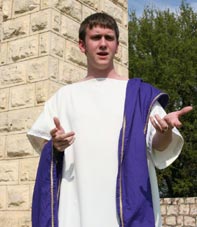
Jesus prays in the Garden of Gethsemane (left) while the disciples sleep in this scene from the 67th annual University of Mary Hardin-Baylor on-campus outdoor Easter pageant. At right, Pilate, portrayed by Mark Leech of Belton, speaks concerning Jesus during the trial.  Jesus is portrayed by UMHB Student Body President David Griffin, a senior finance major from Spring. The pageant is produced, directed, costumed and performed by university students. More than 90 UMHB students, as well as many children from the community, participated. Michon Blair of Rowlett was this year's Easter pageant director. Assistant directors were Mandi Bundrick of Liberty Hill and Kyle Tubbs of Garland.

News of religion, faith, missions, Bible study and Christian ministry among Texas Baptist churches, in the BGCT, the Southern Baptist Convention ( SBC ) and around the world.


Storylist for 4/17/06 issue

Storylist for week of 4/17/06

TAKE ME TO: Top Story |  Texas |  Opinion |  Baptists |  Faith in Action |  Faith & Culture |  Book Reviews |  Classifieds  |  Departments  |  Bible Study


Give it up for Lent


Give it up for Lent

Easter play at UMHB

ABP & Standard form strategic alliance

Hispanics called to pray about immigration

Missouri Baptists link with WorldconneX

Christian Women's Job Corps expands to Mexico

PanFork Camp geared to grow

Casinos not the solution for school financing

Members join pastor on 1,000-mile walk

On the Move

Around the State

Texas Tidbits


Christian Life Commission meeting
Healthcare crisis can be alleviated with church help

Small groups can influence public policy

Listen to the ‘deep cry' of ‘off-pitch' people

Subtle racism exists, researcher says

Global warming poses ‘severe' threat

Previously Posted
Evangelical groups voice support for immigration reform

Jesus' agenda demands justice for immigrants, Reyes says

Encampments shaped life of Sabine Creek manager

Builder finds his life's purpose at Camp Buckner

WMU sets $5.1 million offering goal

Providential connections speed church-planting in Mexico

Carter gathers diverse Baptist leaders


Baptist Briefs


Organ donor provides gift of life to fellow minister


Rwandan genocide survivor finds freedom in forgiveness

Persecution of Christians not limited to Afghanistan

Church group focuses on fighting poverty

Compromise immigration reform legislation stalls in Senate

Judas got a bum rap, scholars say


In this issue: American Theocracy: The Peril and Politics of Radical Religion, Oil, and Borrowed Money in the 21st Century By Kevin Phillips; Frederick Buechner honored.


Cartoon

Classified Ads

Texas Baptist Forum

On the Move


EDITORIAL: Two steps to change Texas for better

DOWN HOME: Season of hope, grass & pin oaks

TOGETHER: 'Scandalous' cross really is good news

2nd Opinion: Biblical Gospels repudiate Judas

RIGHT OR WRONG? Buying a 'replica' watch

Texas Baptist Forum

Cybercolumn by Jeanie Miley: Praying when you don't know what to pray

Cybercolumn by Berry Simpson: Looking through lenses


BaptistWay Bible Series for Easter: Believing in the resurrected Jesus

BaptistWay Bible Series for April 16: God's penetrating gaze reveals the heart

Family Bible Series for April 16: Celebrate the resurrection of Christ

Explore the Bible Series for April 16: Live a life filled with resurrection power

BaptistWay Bible Series for April 23: Beware the green-eyed monster

Family Bible Series for April 23: Preparation for life's mission is essential

Explore the Bible Series for April 23: Effectiveness often necessitates change


See articles from previous issue 4/03/06 here.


Cybercolumn by Berry Simpson: Looking through lenses

Posted: 4/13/06

CYBER COLUMN:
Looking through lenses

By Berry Simpson

Nowadays, one of our favorite fall-back movies—that is, movies on DVD that Cyndi and I watch again and again while doing other things, like grading papers or writing journals or playing Soduko on the internet—is National Treasure. In the movie, the lead character, Ben Gates, uses Benjamin Franklin’s secret spectacles to read treasure clues written on the back of the Declaration of Independence. The specs have several movable lenses, each a different color, and it takes multiple combinations of all the lenses to read every clue. He can’t see all the clues he needs until he looks through every one of the lenses.

Berry D. Simpson

People are like that. In order to know someone well, you have to see them in all their different ways. You have to spend time with them, talking and asking questions and listening to their stories. But even conversation goes only so far. We can all think of people we’ve worked with for years, people we’ve talked with for years, and yet we really don’t know so much about them. Often, we’re surprised to learn they love to paint, or they are trained musicians, or widely known and respected outside their workaday lives. In order to really know someone, you have to be with them in all the things they do. You have to see their lives through every available lens.

For example, if you want to know Cyndi, my loving wife who has dedicated her life to making me a happy man, you’re going to have to talk to her about teaching and computers and multimedia and her family and her children, about God and his peace in her life, and about music. You’ll also need to talk to her about me. But talking will only get you so far; you’ll never know Cyndi well unless you watch her dance, watch her teach dancing, watch her run, watch her race, be in one of her exercise classes. In other words, you’ll have to watch her move. Those are the times when she’s boldest and bravest and takes the biggest risks.

Knowing God is similar.

We can never really know God, or have a deep relationship with God, by using only one lens. We have to see him in all his ways. We have to read his word, over and over, and converse with him in prayer and meditation. We must learn about him from other believers, for each of us in our uniqueness reveals different aspects of God’s character. We must experience him in his world, in creation, in nature, to see his boldness and courage and when he is risky.

One of the ways I have learned to see God is by celebrating the Lord’s Supper—Communion. This particular lens has grown more and more important to me as I’ve gotten older, and especially since I’ve been allowed to help serve as a deacon. In my church, we participate in the Lord’s Supper together, the entire church body, simultaneously, as a public statement that we are in this together and we need the whole body of believers to survive and sustain in this world. To me, it shows the “come be one of us” side of God.

Sometimes, I get to vary the technique a bit and take Communion in a different way. The believers come to the altar one at a time, as individuals, and take the bread and drink alone in contemplation with God. It shows me the “individual nature of salvation” of God.

I also see God through music, especially when I get to play or sing. A few weeks ago, they even let me play my harmonica during Sunday morning worship, and I had a great time. I thought, maybe we need more blues music in church. David certainly saw God by singing blues all through the Psalms.

But mostly, music shows the joyful side of God. Sometimes, singing about his love just lifts my heart up an over the room and opens my eyes to the “isn’t this great” side of God.

I also see God while I am teaching. I don’t really know what I know until I teach it, or until I write about it. So, teaching brings me to the “deep insight” nature of God, a place I don’t get to any other way.

To be honest, I am still working through this multiple-lens idea. I have many God-viewing lenses in my life, such as reading, friends, movies, hiking and solitude, and it’s hard to which are more important.

How about you? What are the lenses through which you see God? Which have become more important recently?

Berry Simpson, a Sunday school teacher at First Baptist Church in Midland, is a petroleum engineer, writer, runner and member of the city council in Midland. You can contact him through e-mail at berry@stonefoot.org.

News of religion, faith, missions, Bible study and Christian ministry among Texas Baptist churches, in the BGCT, the Southern Baptist Convention ( SBC ) and around the world.


RIGHT OR WRONG? Buying a ‘replica’ watch

Posted: 4/13/06

RIGHT OR WRONG?
Buying a 'replica' watch

I received an e-mail from a company that sells “replicas” of famous brand-name watches. They sell a watch for about $200 that would cost many times more if it were the “original.” I’d like to buy one. What do you think?

Some issues are fairly straightforward. A business professor here at East Texas Baptist University tells me businesses lose billions of dollars a year through copyright and trademark infringement. Plain and simple—buying “replicas” of brand-name watches contributes to the worldwide problems of theft and piracy.

“Thou shalt not steal” pretty much covers that.

It often occurs, though, that some issues we raise are only the tip of the moral iceberg. That was so when a man approached Jesus and said, “Teacher, tell my brother to divide the family inheritance with me” (Luke 12:13). Jesus’ response bypasses the obvious issue and targets something evidently more significant: “Beware, and be on your guard against every form of greed; for not even when one has an abundance does his life consist of his possessions” (12:15). While the distribution of family inheritance is important, Jesus is concerned more to challenge the underlying matters of greed and a distorted sense of what life is all about.

It seems to me that the “replica” question is not just about trademark violations. The question betrays confusion about what matters in life and what counts for true fulfillment. We live in a world that measures meaning in terms of what dollars can buy. At the same time, we live in a world that teaches us (through advertising) never to be satisfied. So we buy more stuff. We work more so we can buy more so we can appear to others and ourselves to have lives that are counted as worthwhile. Can Chris-tians fall into this trap?

Sociologist Robert Wuthnow, in his book God and Mammon, speaks of “the ambiguous impact” of religious belief on economic behavior in our society. On the basis of survey data, he concludes: “When we are influenced by our faith, we are more likely to say we feel better about what we do than to do anything differently. We do not look to the churches to tell us what career to pursue or what purchases to make but to tell us that whatever choices we have made are OK. Our spirituality is little more than a therapeutic device. … We have domesticated the sacred and stripped it of authoritative wisdom by looking to it only to make us happy.”

Jesus’ words do not intend to make us happy, but holy, and they challenge both the incontinent heart (“greed” is pleonexia in Greek, which simply means “have more”) as well as the corrupt notion that life can be measured in terms of possessions. To free us from such errors, Jesus reminds us that defining life in terms of accumulation is a dead-end street and is the opposite of the simple life that trusts in God’s provision and puts God’s will first (12:16-31).

I honestly do not know what it is like to run in circles where executive-class clothes, watches and cars are the stuff of everyday life. Maybe Jesus’ words show that world for what it is. To buy a “replica” watch to seek to impress that sort of world is to compound the superficial with the superficial. Perhaps this sounds a bit harsh, but so does Jesus’ double-warning: “Beware, and be on your guard.”

Jeph Holloway, professor of religion

East Texas Baptist University

Marshall

Right or Wrong? is sponsored by the T.B. Maston Chair of Christian Ethics at Hardin-Simmons University’s Logsdon School of Theology. Send your questions about how to apply your faith to btillman@hsutx.edu.

News of religion, faith, missions, Bible study and Christian ministry among Texas Baptist churches, in the BGCT, the Southern Baptist Convention ( SBC ) and around the world.


BaptistWay Bible Series for April 23: Beware the green-eyed monster

Posted: 4/11/06

BaptistWay Bible Series for April 23

Beware the green-eyed monster

• 1 Samuel 18:1-16

By Joseph Matos

Dallas Baptist University, Dallas

Admit it. We have all been jealous of someone at some time. Our best friend gets the girl (or guy). Our coworker gets the big promotion. Our seminary classmate gets the church. Generally our jealousy stems from someone having what we believe rightfully is ours. 1 Samuel 18 describes the jealousy of Saul toward David. How could a king be jealous of a shepherd boy?

What did David have that Saul didn’t?

1 Samuel 16 ended with David finding favor with Saul and being hired to his staff full time. In the next chapter, David defeated the mighty Philistine Goliath. Saul’s favor toward David only grew. But in chapter 18, Saul’s pleasure with David quickly degenerated into jealousy.

The first four verses describe how the friendship between Jonathan and David was forged. Though David would later marry Saul’s daughter, Michal, it is with Jonathan that he became “one in spirit” (v. 1).

Other indicators of Jonathan’s devotion to David include the covenant he made with David, his attitude toward David (“he loved him as himself,” v. 3) and his handing over his robe, tunic, sword, bow and belt (v. 4). This could be interpreted either as Jonathan’s recognizing David as successor to the king or his acknowledgment that David was the greater warrior.

Regardless, one thing is clear; Jonathan accepted David. And in ensuing passages, Jonathan would follow through on his loyalty to David.

Verse 5 appears to suggest Saul had great confidence in David, as well. For he continued to give David responsibilities in the military, and with success after success, Saul continued to advance David in rank. The people, and Saul’s officers, were pleased with this action. But Saul would not always be pleased with David’s success.

When read in the context of David’s continual rise in rank, verse 6 suggests David’s defeat of Goliath was just the beginning of renewed fighting with the Philistines. On one occasion, when the men returned from battle, the women came from around Israel to welcome them. They sang, played instruments and danced in a victory celebration.

A victory over their archenemy should have filled Saul with joy as well. But the lyrics of the song caught his attention. While the song did praise him, David received greater accolades: “Saul has slain his thousands; and David his tens of thousands” (v. 7). Whether the last phrase should be translated as “tens of thousands” or not, the intent is clear: David had been more successful than Saul.

Saul, in his attitudes and actions, displayed his jealously of David. His attitude is recorded in verse 8. Saul became “very angry” with David, and the song “galled” him.

How vivid a portrait this paints! Recalling, therefore, a question posed at the beginning of this lesson, what did David have that Saul didn’t? What led to his jealousy of David? As the song suggests, David enjoyed greater praise from the people than Saul did. This is just as Saul himself interpreted the words (v. 8).

More than that, Saul began to think to himself, if David had won the approval of the people, then there would be nothing else for David to have except the kingdom itself. Little did he know the truth of that statement.

Saul’s actions quickly followed. David had lost his favored status with Saul: “And from that time on Saul kept a jealous eye on David” (v. 9). But Saul did more than just watch David closely.

Despite his military prowess, David still was a servant, and as such he played the harp for Saul whenever he had a bout with the evil spirit from the Lord. In fact, the day after the victory celebration, David played the harp for Saul to ease his torment.

Unlike before, however, Saul was not soothed. Instead, while David played, Saul picked up a spear and threw it at David, intent on pinning him to the wall. He was unsuccessful, twice.

After this, Saul experienced yet another emotion, fear (v. 12), and we learn the reason. David had yet something (actually someone) else that Saul did not: “the Lord.”

Again, Saul sent David into battle. This was not a promotion, though. Saul apparently meant to have David killed in battle. Later in the chapter he set the price for David to marry Michal at 100 dead Philistines (v. 25), thinking David would die trying.

However, Saul’s plan failed, both times. At every turn, David met with success because “the Lord was with him” (v. 14). Saul’s fear grew in proportion to David’s success.

Saul, in his mind anyway, had more reason to fear; now “all Israel and Judah loved David” (v. 16).

The remainder of chapters 18 and 19 detail how Saul acted upon his jealousy toward David. As stated, he would send him to fight the Philistines (vv. 24-28); he ordered others (even Jonathan) to kill David (19:1); and he again tried himself to kill David with the spear (19:9-10).

The Lord, with the aid of Jonathan, Michal and Samuel, foiled his plans each time. Saul was undaunted. He would spend the rest of his life trying to rid himself of David.

Though we experience jealousy at times, may we confess to the Lord and repent. May it certainly never reach the extremes exhibited by Saul. Let us be content where God has placed us and with what God has given us.


Discussion questions

• How do you handle feelings of jealousy toward another?

• What can we do to prevent jealousy from overtaking us?

• What is the cure for jealousy when it does appear?

• Can anything good come from feelings of jealousy?

• What should be the proper response to another’s success?


News of religion, faith, missions, Bible study and Christian ministry among Texas Baptist churches, in the BGCT, the Southern Baptist Convention ( SBC ) and around the world.