Storylist for 3/20/06 issue

Storylist for week of 3/20/06

TAKE ME TO: Top Story |  Around Texas |  Opinion |  Baptists |  Faith in Action |  Faith and Culture |  Book Reviews |  Departments |  Bible Study


Afghan man's plight draws widespread support

Hospice caregivers preserve quality of life even as it runs out

Students help recover mementos and memories from fire scene

IMB trustees reverse decision to remove Burleson

Children's home helps church rebuild after fire

Satellite photos fuel controversy about Noah's ark

Texans named to national Acteens panel

American hostage found dead in Iraq


LAYING ON HANDS: Ordination practices vary widely among Baptists


LAYING ON HANDS: Ordination practices vary widely among Baptists

BWA president offers global perspective on the church

Cultural changes call for fresh expressions

Church: Help families cope

Plane mechanic finds calling at Wayland

Church leaders urged to trust and obey

Chaplain's son needs double-lung transplant

Nehemiah's Vision seeks to rebuild homes

Recent Wayland grad brings ministry training to secular job

ETBU grad shares faith through illusions

On the move

Around the State

Texas Tidbits


Previously Posted
Hispanic Evangelism Conference
Churches can minister through schools, inner-city pastor maintains

Follow Jesus, and evangelism happens

Christian witnessing requires readiness


Epicenter
Church growth does not equal kingdom growth, speaker says

Transformed leaders minister out of spiritual overflow

Spiritual outsourcing not the answer, McNeal says


Graham preaches ‘last evangelistic sermon' in New Orleans

IMB chair urges committee to reconsider

Network hopes to avert clergy shortage

Lotz announces retirement, Kazakhs pull out of BWA

Baptist Briefs

Previously Posted
NAMB trustees ask task force to investigate


Despite disabilities, Dyer feels called to pro fishing circuit


Churches broke tax laws, IRS reports

Kid's TV more violent than prime-time

Faith-based funding figures disputed

Chat rooms provide open window into students' world


Reviewed in this issue: A Year With Dietrich Bonhoeffer, edited by Carla Barnhill


Texas Baptist Forum

Cartoon

Classified Ads


EDITORIAL: Forget holy smoke, what about people?

2nd Opinion: Partisan churches will feel IRS heat

DOWN HOME: A tornado, rain and a prairie set on fire

Texas Baptist Forum

TOGETHER: Pray for courageous servant leadership

Cybercolumn by Jeanie Miley: Being human—in the family of God

Cybercolumn by Berry D. Simpson: Thanks for asking


BaptistWay Bible Series for March 19: Do not forget the Lord's provision for your life

Family Bible Series for March 19: Celebrate when people come to Christ

Explore the Bible Series for March 19: Share the refreshment of Christ with a thirsty world

BaptistWay Bible Series for March 26: Saul's search leads to his being found

Family Bible Series for March 26: Honor Christ through obedience

Explore the Bible Series for March 26: God's warnings are universal


See articles from previous issue 3/06/06 here.


Texans named national Acteens panelists

Posted: 3/31/06

Ashley Nash Kara Fonville

Texans named national Acteens panelists

By Amy Whitfield

Woman’s Missionary Union

BIRMINGHAM, Ala.—Two teenagers from Baptist General Convention of Texas-affiliated churches in Garland have been selected to serve on the national Acteens panel.

Kara Fonville, 17, of Lakeside Baptist Church and Ashley Nash, 18, of Freeman Heights Baptist Church are two of the six panelists chosen this year.

Panelists are selected on the basis of leadership, voluntee-rism, spiritual maturity and commitment to a missions lifestyle through Acteens involvement, said Suzanne Reece, ministry consultant for Women’s Missionary Union’s student resource team. Acteens is a WMU ministry organization for teenage girls in grades 7 to 12.

The national Acteens panelists have demonstrated a high level of service and leadership—not only in their churches, but also in school, where they have earned high marks in both academics and extracurricular activities, she added.

Fonville, also selected as a 2005– 2006 Texas WMU panelist, has participated in several missions projects in the Dallas area but said what meant most to her was helping plan and organize an “extreme home makeover” for a family in need. Five Dallas Baptist Association Acteens groups came together for the event last March.

“Not only was it an amazing experience for us to see how God answered prayer, but I truly believe that what we did changed the lives of this family and impacted this neighborhood for Jesus Christ,” Fonville wrote in her application.

“Acteens has provided me with leadership opportunities that I could not have gained in an everyday setting. I think God has shown me that I can be a good leader.”

Similarly, Nash, who volunteered as a teen staffer at GA camp this past year, said Acteens taught her to be a missionary in everyday life.

“Acteens has taken me out of my comfort zone to reach out to others with the love of Christ,” she wrote.

All of the young women were recommended highly by teachers, pastors and others who witnessed their impact through missions.

As national panelists, the teens have the opportunity to interact with missionaries and national missions leaders, and they often are invited to speak to church, associational or state Acteens and WMU groups.

In June, they will be featured leaders during national WMU’s annual missions celebration in Greensboro, N.C.

This year’s panelists will serve from February to December.

In addition to those Acteens selected to serve as panelists, WMU also selects additional young women as Top Teens to recognize their strong involvement in missions.

Rachel Latham of Travis Avenue Baptist Church in Fort Worth was selected as a Top Teen.

News of religion, faith, missions, Bible study and Christian ministry among Texas Baptist churches, in the BGCT, the Southern Baptist Convention ( SBC ) and around the world.


Hospice a ministry, not just a service, providers say

Posted: 3/31/06

Hospice a ministry, not just a service, providers say

By Karen Brittain

Hendrick Health System

ABILENE—Late one evening shift, registered nurse Kay Kovach sat at her station in the Hendrick Hospice Care inpatient unit, busily charting information and occasionally glancing at her watch.

All was quiet on the unit, with the exception of the all-too-familiar sound of a patient’s wife trying to communicate with him in the room across the hall: “Turn—is that right, Mark? Do you want me to turn you?”

Mark, age 35, was diagnosed with amyotrophic lateral sclerosis 15 months ago. ALS, commonly known as Lou Gehrig’s disease, attacks the muscles and renders the patient a virtual prisoner in his own body.

David Stephenson, director of Hendrick Hospice Care, and nurse Billie King visit with Margie Dawley, whose husband is in the Hendrick Hospice Care inpatient unit. (Photo courtesy of Hendrick Health System)

His disease had progressed rapidly. His routines changed from playing catch or going fishing with his son, Tommy, to racing him in his wheelchair. Now, he was totally helpless, unable to swallow or speak.

Two weeks earlier, Mark’s breathing became difficult, and he needed frequent suctioning. That setback brought him to the Hendrick Hospice Care inpatient unit.

Kovach acknowledged later that she wondered why God would allow a man so young to be taken from his family. But it’s a reality she frequently faces in her job.

One evening early in Mark’s stay, Kovach was startled to see a boy was standing by her—Mark’s 6-year-old son, Tommy—eyeing a small plastic bag lying on the desk with three or four apricots inside.

“I love apricots,” he said.

Kovach assured him she had more than she needed and offered him one.

Taking a seat beside her, the boy quickly ate the apricot. Then, leaning back with a serious look, he said: “You know what? Life isn’t too much fun anymore.”

Kovach quietly closed the chart she was working on and laid down her pen.

“Why isn’t life fun anymore?” she asked.

“Do you know my daddy is going to die?” he asked.

She replied that yes, she knew his father was going to die.

The boy considered her words thoughtfully.

“Kay, do you think we need another apricot?” he finally asked.

Kovach held open the bag for him, and the two sat and ate silently.

In the weeks after that encounter, Tommy visited the nurses’ station often, sharing his greatest fears and heartaches with Kovach—watching his mother cry, thinking about vacations the family would not take together and recounting stories of racing his bicycle against his dad in his wheelchair.

“Kay, I bet you didn’t know wheelchairs can pop wheelies,” he told her.

Kovach relayed Tommy’s stories to the hospice bereavement counselor who began talking with him.

Throughout Mark’s stay in hospice, Kovach kept a box at the nurses’ station, decorated with watercolor painting of an apricot and a card labeled: “Tommy’s Apricot Box.” Hospice staff kept the box filled with a variety of treats and notes to Tommy.

One afternoon, Mark’s father stopped by the nurses’ station, his shoulders drooping more than usual. Tired and heavy, he settled into his grandson’s favorite chair, noticing the box for the first time.

Kovach explained how the box came to be and how the staff used it. With tears rimming his tired eyes, he talked about what it’s like to lose a son, one he considered his best friend, and what it is like seeing his grandson and other family members grieve.

A few nights later, while Kovach again sat filling out charts, an older patient’s son came by to talk about his father’s condition. Adjusting his baseball cap, the 40-something banker settled in Tommy’s nurses’ station chair.

Spying Tommy’s apricot box, he said, “There has to be a story behind that.”

Kovach closed her chart and laid down her pen, once again, ready to listen.

Those are the kind of stories that reinforce the need for hospice care provided in a Christian context, said Bruce Lampert, Hendrick’s director of pastoral care.

“Hospice is not just a service,” Lampert said. “It’s a ministry. And can there be any more appropriate place for ministry to happen than at the bedside of a dying person?”

By creating the hospice inpatient unit, Hendrick provides a comfortable, peaceful, home-like environment for patients and their families. Hospice ensures the end of life occurs with comfort and dignity.

Hendrick Hospice Care’s inpatient unit provides palliative care that focuses on improving the quality of life for patients with advanced and usually life-threatening illness.

The hospice delivers high-quality patient care and pain and symptom management, using a professional team of physicians, nurses, social workers, chaplains, volunteers and support staff.

Established in 1983, Hospice of Abilene joined the Hendrick Health System in 1993 and changed its name to Hendrick Hospice Care in 1997. The inpatient unit opened later that year, the only such facility in the region and one of only two hospice inpatient units among Texas Baptist hospitals.

Hendrick administration improved access to hospice care by converting one unit of the hospital exclusively to hospice inpatient care.

Previously, patients receiving hospice services were spread throughout the hospital.

“Hospice is about quality of life,” Hospice Executive Director David Stephenson said. “The staff and volunteers are here because of the difference hospice makes in the lives of patients and families each and every day.”

News of religion, faith, missions, Bible study and Christian ministry among Texas Baptist churches, in the BGCT, the Southern Baptist Convention ( SBC ) and around the world.


Volunteers help burned-out community reclaim mementos

Posted: 3/31/06

This mailbox is all that is left intact after a grass fire raged through 87-year-old Marie Cook's home. She had lived there her entire life. (Photos by Miranda Bradley)

Volunteers help burned-out
community reclaim mementos

By Miranda Bradley

Texas Baptist Children’s Home

GORMAN—With the help of a walker, 87-year-old Marie Cook watched as children from Texas Baptist Children’s Home sifted through what remained of her house—burned to the ground by a New Year’s Day wildfire.

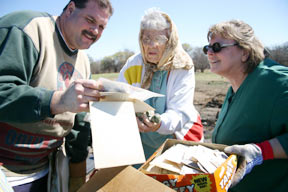
Children’s home residents and staff spent a day of their spring break cleaning up the devastation around the Gorman area, salvaging the few remaining trinkets residents held dear.

“My mom planted that tree,” Cook said, watching as its charred branches were sawed off. “It was over a hundred years old.”

She had spent her entire life in that house. After her mother died, she and her husband raised their large family there. Thousands of memories were made there, and she clung to hope that even a small token of those moments remained.

87-year-old Marie Cook marvels at old photos and letters found unscathed in her deep freeze. They were some of the few tangible objects found at Cook's home, which was demolished by a wildfire in January.

“I found something,” one of the kids shouted. “It’s a necklace.”

Stroking the charred metal, Cook’s eyes filled with tears.

“Eddie gave this to me,” she said, speaking of one of her sons, as she put the locket in her pocket. “These are the things that mean something only to me.”

A thicket of trees parched from drought had surrounded the house. At noon on Jan. 1, high temperatures caused a brush fire that destroyed 60 houses and two churches in the Gorman area.

“It just burned everything in its path,” volunteer Neal Weaver said.

Spanning 35 miles, the inferno cut a swath five miles wide, spurred on by 45-mile-per-hour winds. The Cook home was in its hot spot, 10 miles from where it began, but nobody was inside.

One month before the blaze hit, health concerns caused Cook to be placed temporarily in a nursing home.

“We’re just so thankful she was not home when the fire came,” said Don Cook, one of five sons. “There’s no way she could have gotten out in time.”

Marie Cook has been a long-time supporter of Texas Baptist Children’s Home, sending in what she could each month. Her late husband, Enouch, had been a deacon at New Hope Baptist Church in Gorman, where she was a pianist and Sunday school teacher.

Ashley, a Texas Baptist Children’s Home resident, takes a moment to look at the broken hands of Jesus she uncovered in the rubble that was once Marie Cook's home.

“She is just a beloved woman,” Weaver said. “She taught me stuff about the ministry.”

One of the Texas Baptist Children’ Home volunteers, Ed Rogers, didn’t realize whose house he would be helping with at first.

“I haven’t been here in years,” said Rogers, who was pastor of New Hope Baptist Church in the 1950s. “I used to eat Sunday lunch here.

“This is a wonderful family. It’s awesome how God works in bringing people together again in times when they need each other. My being here was no accident.”

When volunteers sorted through the debris around the Cook house, they found twisted metal forms that once were a refrigerator and freezer. To everyone’s surprise, when they pried open the freezer door, they found a treasure trove of mementos.

Everything inside—old letters, pictures and cards—survived without as much as a scratch.

As volunteers began placing the items into bags for Cook, exclaimed: “I think it’s a figurine! Here’s another piece.”

Before long, an entire porcelain nativity scene was excavated from the dust and soot, un-scathed.

“It’s a miracle,” Cook said. “It’s just a miracle.”

News of religion, faith, missions, Bible study and Christian ministry among Texas Baptist churches, in the BGCT, the Southern Baptist Convention ( SBC ) and around the world.


Wayland executive VP killed in plane crash

Posted: 3/31/06

Wayland executive VP killed in plane crash

By Teresa Young

Wayland Baptist University

PLAINVIEW—Wayland Baptist University Executive Vice President Bill Hardage was killed March 25 in a plane crash in central California.

Hardage, a university employee for close to 40 years, had traveled to Watsonville on a personal trip to pick up a recently purchased Air Coupe plane, reportedly one of his favorites to fly. Details of the accident still are under investigation.

Bill Hardage

An accomplished pilot, Hardage had spent many years as the university’s pilot along with his administrative duties, often shuttling officials to graduation ceremonies at external campuses or to other locations on Wayland business.

Hardage first came to Wayland in 1963, transferring from Hardin-Simmons University to run for Wayland’s new track and field program. After earning his degree in 1965, he moved to Lubbock to coach football and track at Coronado High School, then to Texas Tech University as assistant track coach and physical education instructor. He earned his master’s degree in education there.

Hardage came to Wayland as assistant track and field coach and assistant professor of physical education, serving five years before taking a two-year break to earn a doctorate in education at East Texas State University, now Texas A&M at Commerce. He returned to Wayland to chair the physical education department and to coach track before moving eventually into administrative roles.

In 1979, he became director of special services, taking the reins of the four existing external campuses and helping to start another. Since then, he has been instrumental in expanding Wayland’s reach through adding eight additional external campuses in the United States and another location in Kenya, Africa.

He went on to serve in the academic vice president’s office, the advancement vice presidency, external programs leadership and back to academic and student services and provost. In 2001, he was named vice chancellor, and his title changed to executive vice president when the chancellor’s position was eliminated in 2002 with Wallace Davis’ retirement.

“Words cannot begin to express Wayland’s grief and my sadness over the loss of our gifted executive vice president,” President Paul Armes said. “Bill loved Wayland and contributed to her success as an institution of higher learning in more ways than any of us will ever know. He will be missed greatly by every member of the Wayland family.”

Hardage is survived by his wife, Nell; a son, Tim, of Plainview; and a daughter, Cindy Bessire of Muleshoe, along with their spouses and numerous grandchildren.

News of religion, faith, missions, Bible study and Christian ministry among Texas Baptist churches, in the BGCT, the Southern Baptist Convention ( SBC ) and around the world.


Schmeltekopf served as top aide to two BGCT directors

Posted: 3/31/06

Schmeltekopf served as top
aide to two BGCT directors

By Ken Camp

Managing Editor

FORT WORTH—Texas Baptist denominational leader Ed Schmeltekopf died March 29 after an extended illness related to his longtime battle with Parkinson’s disease.

Schmeltekopf, 73, served nearly two decades as associate executive director of the Baptist General Convention of Texas and a quarter-century as a Texas Baptist pastor. He was elected BGCT first vice president in 1977.

Ed Schmeltekopf

For 19 years and nine months, Schmeltekopf worked as a staff liaison with virtually every major study committee appointed by the BGCT and as a top aide to two executive directors—James Landes and Bill Pinson.

Pinson praised Schmeltekopf as “a devout follower of Jesus Christ and gifted servant-leader … (who) helped to shape for good the lives of thousands” of people.

“Ed combined organizational genius and personal compassion—a rare combination. But, then, he was a rare person,” Pinson said.

“He guided multiple committees, study groups and planning teams of the BGCT that helped the convention and its related churches, associations and institutions set record after record. He supervised some of the most creative aspects of convention life. He had a gift for listening, planning and implementation that enabled diverse groups to move forward in cooperative harmony. Much of the success of the BGCT in the years he served can be attributed to his leadership.”

Schmeltekopf was “a man of real integrity,” said Doris Tinker, executive associate to the BGCT executive director, who worked with Schmeltekopf first when he was a pastor serving on various convention committees and later as a colleague at the Baptist Building.

“Ed Schmeltekopf was a person with great sensitivity to and love for people,” Tinker said. “It was evident in all he did. His gifts and talents were many, and he used them well. His attention to detail made him an invaluable asset in all areas of work with the BGCT.

“He had such a wealth of knowledge about the Lord’s work through the BGCT and Texas Baptist churches and institutions that we referred to him as a ‘walking encyclopedia.’”

BGCT Executive Director Charles Wade recalled Schmeltekopf as a good friend who reached out to him when Wade became pastor of First Baptist Church in Arlington.

“He was an effective administrator—creative and dependable,” Wade said. “He was a calming presence in difficult discussions. He was Christian gentleman who had the respect of every pastor I know. … We are a better people because Ed lived and served among us.”

Schmeltekopf was pastor of First Baptist Church in Burleson 19 years before joining the BGCT Executive Board staff. He served previously at churches in Graham and LaVernia.

Schmeltekopf was a native of Kyle and a graduate of Southwest Texas State University in San Marcos, where he was a record-breaking fullback for the Bobcats, was named to the All-Texas College Team and was inducted into the school’s hall of honor in 1989.

He earned his master of divinity and doctor of ministry degrees from Southwestern Baptist Theological Semi-nary.

Schmeltekopf was a 20-year member of Broadway Baptist Church of Fort Worth.

Survivors include his wife of 50 years, Lilla, of Fort Worth; daughter Cynthia Krause and her husband, David, of Dallas; son Jeff Schmeltekopf, and his wife, Judy, of Fort Worth; five grandchildren; two brothers: Robert Schmeltekopf and his wife Bettye of Kerrville and Donald Schmeltekopf and his wife Judy of Waco; and one sister: Mary Pryal and her husband, Alfred, of Gastonia, N.C. He was preceded in death by his parents, Emil and Ruth Schmeltekopf of Kyle and one brother, James Schmeltekopf of New Braunfels.

News of religion, faith, missions, Bible study and Christian ministry among Texas Baptist churches, in the BGCT, the Southern Baptist Convention ( SBC ) and around the world.


Explore the Bible Series for April 9: Pursue a vigorous righteousness

Posted: 3/30/06

Explore the Bible Series for April 9

Pursue a vigorous righteousness

• Isaiah 32:1-39:8

By James Adair

Baptist University of the Americas, San Antonio

Isaiah 32-39 includes a series of oracles about a future, righteous king of Judah (Isaiah 32-33), an oracle of judgment on Edom (Isaiah 34), a transition to the new themes that will begin in chapter 40 (Isaiah 35) and a historical section dealing with King Hezekiah (Isaiah 36-39). They repeat many of the themes of the earlier chapters, but in chapter 35 they reach new heights of poetic expression and introduce in earnest the theme of exile and return.


Isaiah 32:1-8; 33:17-22

The first large section (chapters 32-33) begins and ends with prophecy concerning a restoration to the throne of Judah a king who would rule in righteousness. The literary technique of beginning and ending a section with the same theme is called an inclusio (Latin for “inclusion”), and it is a common literary device in both the Bible and other ancient writings, whose purpose is to delimit a distinct unit of written material.

These chapters describe both the good and the bad—the blessings of the righteous king’s reign and the villainies of the wicked opposition to the king. The king’s reign is described first as characterized by righteousness and justice. These two words appear in parallel half-verses in verse 1. The rules of interpreting Hebrew poetry (including prophetic oracles like this) suggest the two words have more or less the same meaning.

In English, we sometimes think of righteousness as an inward attitude of commitment to God and justice as the outward manifestation of that commitment. This understanding is not bad in English, but the two Hebrew words used here really mean just about the same thing.

The prophet probably would have been surprised to learn that people make a distinction between one’s inner attitude and one’s outer activities. The prophetic approach to the issue assumes the two are indistinguishable. If, like the fool, one practices ungodliness, lets the hungry starve, deprives the thirsty of drink and ignores the pleas of the needy (vv. 6-7), clearly these deeds are the result of inner unrighteousness. It is impossible, from the point of view of the prophet, to be inwardly righteous and outwardly unjust.


Isaiah 33:13-16

Three monkeys sit next to each other on a log. The first covers his eyes, the second covers his ears and the third covers his mouth. Their names? See-no-evil, hear-no-evil, speak-no-evil.

Many people approach the world’s great problems with an attitude borrowed from these monkeys. As long as their lives are untouched, they don't want to know about the misfortunes of others or the sins of their contemporaries. “It’s not the place of Christians to be involved in the world,” they might say.

A cursory reading of these verses from Isaiah might at first seem to support such a position, but a closer reading shows this prophetic oracle teaches just the opposite. When God threatens to visit the people in judgment, the “sinners in Zion” ask, “Who can dwell with the consuming fire?”

The word translated “dwell” means “to live as a foreigner in the land,” and it reminds us we are all sojourners in this world. Who can survive the consuming fire? Only the righteous, the prophet answers, those who refuse to profit on the misery of others or gain favor through bribery, two sins still quite prevalent in our day.

The righteous also are described as those who “stop their ears from hearing of bloodshed” and who “shut their eyes from looking on evil.” Does this mean it is all right for God’s followers to ignore the misery of others or evil in the world?

On the contrary, these verses mean just the opposite. The prophet says the truly righteous will refuse to participate in unjust schemes and will actively oppose them (implied in the phrase “speak what is right” in verse 15).

It is not enough for God’s people to avoid committing evil ourselves. We also must take a stand for justice on behalf of those who cannot stand effectively for themselves.


Isaiah 35:1-10

Many books of the Old Testament were put together over a long period of time, and in the process, sections were rearranged, modified, added and deleted. At some point in the composition of the book of Isaiah, it is likely chapter 35 came just before chapter 40, for it forms a nice thematic bridge between chapters 1-34 and chapters 40-66. Only later, according to this theory, were chapters 36-39 added as a sort of historical appendix (very close in content to portions of 2 Kings 18-20).

Isaiah 35 describes the rebirth of Israel after exile as a parched land that receives much-needed rain. Just as rain showers can bring forth wildflowers and other vegetation from the dry soil, so would the gentle rain of God’s mercy bring the nation of Judah back to life after a period of suffering.

Not only will the land be healed in this idealized future, but even the common maladies that affect people will be remedied: the blind will see, the deaf will hear and the lame will leap like a deer. The people will see streams in the desert, and desolate wastelands will be converted to marshes full of water. The highway through the land will be so wide and straight even the person with the worst sense of direction can’t get lost.

Moreover, the land will be cleared of dangerous animals like lions or wolves so the redeemed people of God will be able to return to their homeland in absolute safety, singing all the way.

This picture of return from exile is indeed idealized rather than strictly literal, but it uses poetic language well to emphasize the feeling of freedom a returning exile might feel upon being allowed to return to his ancestral homeland.

In 1989, my family and I returned to the United States after spending more than a year in South Africa. Although we very much enjoyed our stay, because we were there during the waning days of apartheid, we also experienced a feeling of oppression (though our oppression was mostly vicarious, experienced through some of our South African friends) hard to describe. When we finally landed at the airport on U.S. soil, I remember the feeling of freedom and joy I felt when I saw the American flag flying.

I imagine the Jews who returned home from Babylonian exile felt a much more intense version of what I felt when they saw their homeland, many of them for the first time in their lives. If so, I don’t think any of the descriptions in this chapter, even though they might be idealized, are exaggerated in any way.


Discussion questions

• How should Christians relate righteousness and justice in their own lives? Does the church do enough to advocate for justice in the modern world?

• How do we draw a distinction from “butting into other people’s business” and taking a stand for what is right? Are there circumstances in which it really is better to keep quiet in the face of wrongdoing, or should we always speak up?

• What are the most intense feelings of joy or elation that you have felt in your life? Does the juxtaposition of sorrow/suffering and joy make the feeling of joy that much more intense?

• How would you evaluate the following words from the poem The Prophet, by Kahlil Gibran? “When you are joyous, look deep into your heart and you shall find it is only that which has given you sorrow that is giving you joy. … [Joy and sorrow] are inseparable.”


News of religion, faith, missions, Bible study and Christian ministry among Texas Baptist churches, in the BGCT, the Southern Baptist Convention ( SBC ) and around the world.


May men want to see ‘house that faith built’ completed

Posted: 3/31/06

Afghan Christian released, finds asylum

By Robert Marus

ABP Washington Bureau

WASHINGTON (ABP)—An Afghan man threatened with execution for converting to Christianity was freed and was granted political asylum in Italy March 29.

Meanwhile, according to an agency that monitors persecution of Christians, at least two other Afghans currently are jailed for similar situations.

On March 26, Afghanistan’s Supreme Court dismissed the government’s case against 41-year-old Abdul Rahman. He had been jailed for violating Islamic law by abandoning that faith.

Muslim clerics in the country called for Rahman’s execution. Hundreds of people protested the court’s decision to release him March 27 in the northern city of Mazar-e-Sharif, uttering cries of “death to Christians!” according to multiple news reports.

Afghan government officials gave conflicting statements March 27 about why they were dropping the charges against Rahman. While court officials cited a lack of evidence, other authorities said they believe he may be mentally unfit to stand trial.

Rahman reportedly also appealed to the United Nations to help him find political asylum, fearing for his safety if he were to stay in Afghanistan.

According to the United States Commission on Cooperation and Security in Europe, Rahman converted to Christianity while working for a Christian aid group in Pakistan more than 14 years ago. He only recently was jailed because his faith emerged in court when Rahman attempted to regain custody of his children.

Since his imprisonment made headlines, groups from multiple faiths, continents and political ideologies have decried the Afghan judicial system for the situation. Conservative Christian groups and impartial human-rights watchdog organizations in the United States first called attention to the situation but have been joined by international human-rights groups, the Council on American-Islamic Relations and the New York Times editorial board.

Responding to pressure from those groups, President Bush and Secretary of State Condoleezza Rice appealed to Afghan President Hamid Karzai to assure Rahman’s safety. But Karzai said he could do nothing without violating the separation of powers between Afghanistan’s executive and judicial branches of government.

The Afghan Constitution, drafted and approved in the wake of the nation’s liberation from the theocratic Taliban regime in 2001, has separate sections protecting religious freedom and establishing Islam as the supreme law of the land. Religious-freedom watchdog groups repeatedly have warned the tension between the two provisions would provide too much leeway to conservative Muslim jurists in cases such as Rahman’s.

Several U.S. organizations issued statements March 26 and 27 heralding Rahman’s release but calling for continued focus on the status of religious freedom in Afghanistan. The Free Muslim Coalition Against Terrorism said it “applauds” the decision to release Rahman but added: “The release of Mr. Rahman must be complemented by constitutional and legislative change to ensure that the freedoms of religion and conscience are preserved, and that no further prosecutions for apostasy can occur again.”

Tony Perkins, president of the Family Research Council, said the case exposes faults in the way the Bush administration is handling the task of nation-building.

“Simply dismissing the charges based upon lack of evidence does not sufficiently address the lack of religious freedom in Afghanistan,” he said. “As the United States continues its work in Afghanistan and Iraq, it is vital that the Bush administration secure a clear understanding of religious freedom from these new governments. Abdul Rahman’s imprisonment has revealed a major fault in our foreign policy.”

Compass Direct, an evangelical Protestant group that monitors persecution of Christians worldwide, reported at least two other Afghan Christians have been jailed in recent days. However, the agency declined to disclose details about the cases.

“Because of the sensitive situation, local sources requested that the location of the jailed converts be withheld,” read a story posted on the organization’s website, www.compassdirect.org.

White House Press Secretary Scott McClellan, asked at the March 28 daily White House press briefing whether the incident had hurt Afghanistan’s image, deflected the question.

“Well, I think it’s important to put in context where Afghanistan is,” he said. “This is a new and emerging democracy. This is a democracy that has enshrined in its constitution certain universal principles of human rights, and we will continue to emphasize the importance of adhering to the universal values that all democracies hold dear, such as freedom of expression and freedom of religion. … But we are pleased that this was resolved in a favorable manner and that he has been released.”

News of religion, faith, missions, Bible study and Christian ministry among Texas Baptist churches, in the BGCT, the Southern Baptist Convention ( SBC ) and around the world.


Around the state

Posted: 3/31/06

Around the state

• The University of Mary Hardin-Baylor social work program and advisory board will present its annual ethics conference April 20 from 8:30 a.m. until 12:30 p.m. The conference is free. Sherry Carroll will present “Do the Right Things, For the Right Reason, In the Right Way.” For more information, call (254) 295-4555.

• Howard Payne University will be the site of the “Best of the Best Books of 2005 for Children and Young Adults” exhibit and workshop April 21 and 22. The exhibit will be open from 10 a.m. to 4 p.m. Friday and 10 a.m. to 2 p.m. Saturday. The workshop will be held from 8:30 a.m. to 4 p.m. Friday, with participants eligible for 7.5 hours continuing professional education credit. A $25 fee covers a meal and handouts. For more information, access the website at ww1.hputx.edu/ hotlit/home.htm.

Trinity Church in Amarillo recently held a birthday celebration for two women in the congregation who both celebrated their 100th birthdays in the same week. Willie Roberts’ (left) birthday coincided with the day of the celebration, March 12. Flora Hurd’s (right) birthday was March 5. Both women were instrumental in the ministry of the church for many years. Roberts worked in the nursery with infants more than 25 years, and Hurd taught a women’s Sunday school class until she no longer was able.

• A reunion for alumni, faculty and staff of Decatur Baptist College will be held April 22 at the Wise County Heritage Museum in Decatur, site of the former administration building of the college. The college, the forerunner of Dallas Baptist University, moved to Dallas in 1965. For reservations or more information, call (214) 333-5601.

• Sophia Young, a 6-foot-1 senior forward for the Baylor University Lady Bears basketball team, has been named an Associated Press first-team All-American. She is the first Baylor basketball player, man or woman, to be so honored. Young finished her college career as the Big 12 Conference all-time leading scorer (2,480 points) and rebounder (1,316). She was named the Big 12 Player of the Year the past two seasons.

• Six people have been chosen as this year’s inductees into the Hardin-Simmons University Hall of Leaders. The inductees are O.C. Pope, pioneer church starter and third president of Simmons College; Francis McBeth, music composer, teacher and HSU graduate; Truett Latimer, HSU graduate elected to the Texas House of Representatives at age 23; Frank Junell, civic and financial leader; Willis Whitfield, developer of the “clean room” for scientific laboratories; and Betty Stephenson, a pioneer for women in medicine.

• Neely Floyd has been crowned Miss East Texas Baptist University. Other honorees included DeAndra Walker, first runner-up; K’Lynn Childress, second runner-up and best talent; and Courtney Warren, Miss Congeniality.

• Sue Weaver has been named director of campus recreation at the University of Mary Hardin-Baylor.

Anniversaries

• Tommy Hood, 10th, as pastor of Lakeshore Drive Church in Weatherford, March 17.

• First Church in Rule, 100th, April 15-16. Saturday’s festivities will begin at 6 p.m. with a light meal in the fellowship hall. Following the meal, there will be a time of congregational singing as well as group and solo music presentations. Easter Sunday, Sunday school will begin at 9:45 a.m. and worship at 11 a.m. After the service, a catered meal provided by the church will be served in the Rule ISD cafeteria. After lunch, a return to the church will be marked by singing, testimonies and remembrances. Those wishing to speak or sing are asked to call (940) 997-2321. Also call if planning to participate in either meal. Josh Stowe is pastor.

Retiring

• Byron Allen Jr., as pastor of Laird Hill Church, near Kilgore. He has served the church 14 years and has been in the ministry 58 years. All five of his children are active in Baptist churches, with his three sons all ministers. He is available to serve as an interim or supply pastor, and can be reached at allenbj@gower.net.

Deaths

• Shirley Ditmore, 72, Nov. 30 in El Paso. She and her family served 30 years with the International Mission Board of the Southern Baptist Conven-tion in Costa Rica, Peru and the Baptist Publishing House in El Paso. She served primariliy through music, teaching many to play the piano so that churches could have music for their worship. She also led a weekly evangelistic service at a women’s prison in Lima, Peru. She was a member of Coronado Church in El Paso. She was preceded in death by her mother, Donna Tibbs, and her daughter, Shellie LeBlanc. She is survived by her father, Newton Tibbs; husband of 50 years, Steve; sons, Steve and Jose; daughter, Susan Beardsley; sisters, Charlotte Stevens and Melinda Allison; and six grandchildren.

Children at The Heights Baptist Church in Richardson recently put together gift bags for the children of women living in area shelters. The children were moved to action after hearing two women from the Compassionate Hearts Ministry, which ministers to homeless women. Benjamin Randall, Jennifer Wise, Shelby Scott and Matthew Johnston are shown decorating the gift bags that were filled with toys and other goodies, as well as notes of encouragement and Scripture verses.

• Grady Kays, 51, Jan. 19 in Olney in an automobile accident. He was pastor of Gibtown Church in Poolville and also an aircraft mechanic. He previously had been pastor of Joplin Church in Jacksboro and Osage Church in McGregor. He was preceded in death by his brother, Coston. He is survived by his wife, Alicia; daughter, Jessica Carter; son, Aaron; and four grandchildren.

• Hollis Yeilding, 92, March 14 in Gatesville. A 1943 Howard Payne University graduate, he was ordained as a minister in 1938 at Coryell Church in Gatesville. He ministered at many churches over the course of 60 years, retiring at Pidcoke Church in Gatesville in 1998. He also served two terms on the Executive Board of the Baptist General Convention of Texas and served as a trustee of Hendrick Memorial Hospital 18 years. He was a member of First Church in Gatesville. He was preceded in death by his brothers, Everett, Ralph and S.L. He is survived by his wife of 69 years, Margaret; daughter, LaNell Spears; sons, Kenneth, Hollis Jr. and David; brothers, Albert and Howard; sisters, Vaun Dean Jennings and Catherine Baker; eight grandchildren; and eight great-grandchildren.

• Martell Hilburn, 72, March 15 in Waco. Her husband, Glenn, was a longtime professor of religion at Baylor University. She was a preschool Sunday school teacher at First Church in Waco many years. A lover of nature, she enjoyed watching and listening to screech owls who returned annually to an owl box in her backyard to lay their eggs and raise their young. She was preceded in death by her daughters, Ellen and Vickie Hilburn. She is survived by her husband of 52 years; sons, Jeffrey and Kelly; and four grandchildren.

Events

• A Bible prophecy conference will be held April 9-12 at Belmont Church in Denison. The conference will begin at 11 a.m. Sunday, proceed at 5 p.m. that evening and will meet at 7 p.m. Monday through Wednes-day. Bob Farber, a Jewish-Christian evangelist from Whitesboro, will be the speaker. The conference theme is “Signs of His Coming” and will cover prophecies Farber sees as being fulfilled in Israel, Europe, Russia, China and the Middle East. For more information, call (903) 815-5425. Grady New-some is pastor.

• First Church in Orange will present an Easter pageant titled “Forever Triumphant” April 12 and 13. The dramatic musical will be held in the church’s family life center, beginning at 6:30 p.m. both dates. John Bickham is minister of worship, and Barry Bradley is pastor.

Licensed

• Fred Sullivan and Darrell Lee to the ministry at Northlake Church in Dallas.

Ordained

• Casey Cockrell to the ministry at First Church in Bruceville.

• Herietti Beraki to the ministry at Gospel Light Eritrean Church in Dallas.

• Jack Graham to the ministry at Immanuel Church in Paris.

• Steve Holland, John Michalak, Herman Ratliff and Louis Vandiver as deacons at First Church in Lott.

• Greg Couk and David Darling as deacons at Good Hope Church in Three Rivers.

• Darrell Modling as a deacon at Zephyr Church in Zephyr.

Revivals

• Immanuel Church, Paris; April 9-12; evangelist, Rick Davis; music, The Attaways; pastor, Randall Scott.

• Belmore Church, San Angelo; April 16-19; evangelist, J.B. Bitner; music, Palmer McCown; interim pastor, Earl Dunn.


News of religion, faith, missions, Bible study and Christian ministry among Texas Baptist churches, in the BGCT, the Southern Baptist Convention ( SBC ) and around the world.


Two suspects jailed in Orange church arson

Posted: 3/31/06

Two suspects jailed in Orange church arson

By Ken Camp

Managing Editor

ORANGE—West Orange authorities jailed two juvenile suspects in connection with the March 5 arson of McDonald Memorial Baptist Church in Orange.

The two teenaged boys allegedly broke through a glass door and set a series of fires inside the church’s sanctuary. Investigators believe the boys had been on a vandalism spree, spray-painting satanic symbols and other graffiti on houses and businesses along the street, before they broke into the church, Pastor Danny Gilliam said.

“The inside of the sanctuary had so much smoke damage that we’ll probably have to tear out everything,” Gilliam said. “They destroyed at least a dozen pews, probably damaged the piano and organ beyond repair and broke out 40 individual panes of stained glass.”

No evidence points to McDonald Memorial as a specific target, he noted.

“It appears they were just coming down the street with their spray-paint cans, and our church was on the corner—the first one they came across,” Gilliam said.

Arsonists appeared to set fire specifically to a large Bible at the front of the sanctuary and attempted to torch the piano, he noted.

“It’s been a headache, and it hurt a lot of our people” to see their worship center desecrated, Gilliam said. “They had to work through some anger, but we’re coming together and moving beyond it. Our people really are starting to pray for these guys who did it.”

The church has not cancelled any services or ministries, he added. Worship services are being held in the gymnasium of the church’s family life center.

Central Baptist Church in Port Arthur allowed McDonald Memorial to borrow padded chairs, First Baptist Church in Orange provided a temporary sound system and the Baptist General Convention of Texas gave the church a grant to buy sound equipment.

“It looks like these boys may have ruined their lives, but they didn’t accomplish anything if they were trying to disrupt our church. We haven’t missed a beat,” Gilliam said.

The church will celebrate its 75th anniversary April 30 as scheduled, and Vacation Bible School will be held as usual this summer, he noted. The fire caused only one serious disruption to the church calendar.

“I had to meet with a bride who has a July wedding scheduled to tell her, ‘Unless you want to get married in the gym wearing tennis shoes, you might want to think about changing locations,’” Gilliam said.

News of religion, faith, missions, Bible study and Christian ministry among Texas Baptist churches, in the BGCT, the Southern Baptist Convention ( SBC ) and around the world.


BGCT designed to meet churches’ wishes

Posted: 3/31/06

BGCT designed to meet churches’ wishes

By Ken Camp

Managing Editor

DALLAS—If a church needs help from the Baptist General Convention of Texas, should a church representative: (a) call the service center at the Baptist Building; (b) contact a regional congregational strategist; or (c) directly phone somebody he or she knows on the BGCT Executive Board staff?

The correct answer: (d) any of the above.

The revamped BGCT organizational structure—with a centralized call center in Dallas, congregational strategists and church starters located around the state and Dallas-based specialists who work primarily in interdisciplinary teams—provides multiple ways churches can access the state convention’s resources, staff leaders insist.

“We want to be available to our churches however they feel most comfortable relating to us,” said David Nabors, BGCT chief financial officer and treasurer.

The new approach may appear confusing to Texas Baptists familiar with the old structure of centers, departments and divisions, all based at the Baptist Building. But the new system grew directly out of desires expressed by Texas Baptists around the state, said BGCT Chief Operating Officer Ron Gunter.

“This is not something we just pulled out of the sky. It’s what churches asked for,” Gunter said.

Over the last two years, the BGCT has worked to bring its organizational structure in line with convention-approved strategic priorities. First, the BGCT dealt with governance issues—changing the bylaws and constitution, reducing the size of its Executive Board by more than half and giving the board greater decision-making authority.

While those matters were being resolved, BGCT Executive Director Charles Wade and his staff conducted listening sessions around the state and brought together focus groups to explore ways to improve the staff structure.

“The consistent messages we heard were: ‘Give us the resources where we are. Decentralize. And get out of Dallas,’” said Chris Liebrum, special assistant to the executive director.

In response, the BGCT has deployed congregational strategists and church starters to nine service areas around the state. Congregational strategists have a broad, general understanding of available resources and are trained as “first-responders” when churches have urgent needs, he explained.

“Congregational strategists are the 911 call,” Liebrum said. “They offer three things to churches. First, they are generalists who have a broad knowledge base. Second, they will be able to get there quicker than somebody based in Dallas. And, in time, they will be ones who will have a personal relationship with the churches in their areas.”

Since laptop computers and cell phones provide remote access to databases and other resources, most field personnel will spend the bulk of their time on the road visiting churches and will not have permanent offices—including field staff who serve the Dallas area.

“Why provide office space for someone who is supposed to be out in the field?” Gunter asked.

While BGCT staff in specialized areas—such as church starting—have served around the state for many years, deployment of generalists has caused some Texas Baptists to question whether the state convention is duplicating a role often performed by associational directors of missions.

“It looks like we are reinventing the wheel,” George Mosier of Dallas wrote in a Baptist Standard letter to the editor, published in February. “We already have area missionaries or directors of missions strategically placed around the state.”

Congregational strategists should neither duplicate nor usurp the role of a director of missions, Gunter ex-plained. They have been urged to build close working relationships with directors of missions in their service areas and let them know of their desire to serve alongside them as a support.

At the same time, everyone involved needs to recognize and respect the autonomy of the state convention and associations and realize each exists to serve churches, he added.

“Our churches have spoken to us and told us this is what they want, and we are going to serve our churches,” Gunter said.

In filling the congregational strategist posts, he added, staff leaders sought to respond to another message delivered in listening sessions—hire field personnel who have recent, hands-on experience in local-church or associational settings and an affinity for congregational life.

At the Baptist Building in Dallas, most personnel serve on an operational team—such as congregational leadership, research and development, or missions, evangelism and ministry—the leader of whom reports directly to Gunter.

The service center—a new office directed by Gus Reyes where staff initiate and respond to general phone calls about available resources—operates 8:30 a.m. to 8:30 p.m. Monday through Thursday and from 8:30 a.m. to 5 p.m. Friday.

“The physical arrangements in the Baptist Building had to be redesigned in response to the reorganization and a need for different space configurations,” Nabors said. “No Cooperative Program dollars were used.”

When the BGCT sold its downtown property in the late 1980s at the height of the real estate boom and built the current Baptist Building when construction costs were low, it enabled administrative staff at that time to create an endowment fund that has continued to fund remodeling needs for more than 15 years, he noted.

Likewise, up-dates in computer systems and other technology have been provided through designated endowment funds —not Cooperative Program money, he added.

And while some staff have retired or moved to other ministries, the current number of BGCT Executive Board employees roughly equals the number of staff prior to the reorganization, Gunter said.

Staff leaders haven’t been surprised some Texas Baptists have asked hard—sometimes critical—questions about the reorganization. Major organizational changes don’t occur painlessly or flawlessly, Liebrum acknowledged.

“We hear the criticisms, and we’re not blind to the challenges some have expressed,” he said.

And while the basic structure is in place now, specific elements will be subject to “constant tweaking” so they can be improved, Gunter added.

“We want to provide what churches asked for,” he said. “We’re here to serve churches.”

News of religion, faith, missions, Bible study and Christian ministry among Texas Baptist churches, in the BGCT, the Southern Baptist Convention ( SBC ) and around the world.


Baptist Briefs

Posted: 3/31/06

Baptist Briefs

No bond for accused church arsonists. The three men charged in the string of 10 church fires in rural Alabama will not seek release on bond from their federal charges, their lawyers said. Matthew Lee Cloyd, 20; Benjamin Moseley, 19; and Russell DeBusk Jr., 19, could have been released on a $50,000 bond with strict conditions. Instead, Moseley’s lawyer said his client’s concern for the affected church members determined his decision to remain in jail. In addition to the federal charges, each man is charged with state arson and burglary charges. If convicted on all state counts, each suspect will face between 15 and 150 years in state prison. As for federal charges, each man faces between seven and 40 years in federal prison.

British Baptists set to select general secretary. The Council of the Baptist Union of Great Britain has nominated Jonathan Edwards as its next general secretary. The nomination followed the retirement announcement of General Secretary David Coffey, president of the Baptist World Alliance, and the Baptist Assembly will vote on it April 28. Edwards, 50, has served as a South West Baptist Association regional minister since 1998 and became a team leader for the group in 2002. Prior to serving with the Church Missionary Society in India, he studied law at St. John’s College, Oxford, and trained for Baptist ministry at Oxford’s Regent’s Park College. Upon approval by the Baptist Assembly of his nomination, Edwards will begin his new position next fall. The fifth-largest Christian denomination in the United Kingdom, the Baptist Union of Great Britain has more than 2,100 churches in England and Wales.

Fort Worth leader nominated for CBF post. Harriet Harral of Fort Worth has been nominated to serve as the next moderator-elect of the Cooperative Baptist Fellowship. Harral, who has served on the Fellowship’s Coordinating Council since 2003 and is current chair of the Council’s personnel committee, will be presented to the General Assembly for a vote as moderator-elect during its annual business session at the Georgia World Congress Center in Atlanta, Ga., in June. Nominations for moderator-elect can be made from the floor of the Assembly. Harral operates The Harral Group, a consulting firm that specializes in organizational effectiveness. A member of CBF of Texas’ coordinating council, she is a member of Broadway Baptist Church in Fort Worth, where she serves as deacon.

Ouachita to explore graduate theology program. Ouachita Baptist University trustees, meeting in executive session March 9, urged the Arkansas university’s administration to explore the feasibility of launching a graduate program in theology. The action came in the form of a joint resolution from the administration and the trustee executive committee and passed by a unanimous vote of trustees.

Saddleback Church marks 20,000 baptisms. Saddleback Church in Lake Forest, Calif., celebrated its 20,000th baptism in its 25-year history in a quiet ceremony March 19. Pastor Rick Warren immersed Mario Soto, a 24-year-old resident of Aliso Viejo, Calif., in an outdoor baptismal pool. Soto, who was among about a dozen adults baptized that day, marked another milestone in life the night before when he became engaged to be married. Saddleback averaged about 1,300 baptisms each year between 1996 and 2004. Last year, the church baptized 2,501 new converts.

Two nominees announced for SBC second VP. Two pastors—one from California and the other from North Carolina—will be nominated for second vice president of the Southern Baptist Convention at the annual meeting, June 13-14 in Greensboro, N.C. Bill Dodson, pastor of Bell City Baptist Church near Farmington, Ky., announced he plans to nominate Wiley Drake, pastor of First Southern Baptist Church in Buena Park, Calif., and Daniel Akin, president of Southeastern Baptist Theological Seminary, said he will nominate J.D. Greear, pastor of the Summit Church in Durham, N.C., for second vice president. Drake has been a regular at the microphones of SBC annual meetings, making motions about various cultural issues—including calling for a boycott of Disney entertainment—and has been an advocate for homeless people. Greear served two years as a missionary in Indonesia.

News of religion, faith, missions, Bible study and Christian ministry among Texas Baptist churches, in the BGCT, the Southern Baptist Convention ( SBC ) and around the world.