Cybercolumn by John Duncan: A priority on service

Posted: 1/13/06

CYBER COLUMN:
A priority on service

By John Duncan

I’m sitting here under the old oak tree, thinking in this warm winter of roses. Shakespeare once opined: “What’s in a name? That which we call a rose by any other name could smell as sweet.” Speaking of sweet, for all University of Texas Longhorn football fans, the hype, the drama, the game is finally over. Texas won the Rose Bowl and the national championship.

What struck me about the game was the intensity, the challenge, the level of competition. In competition, winners and losers emerge. Texas wins. The University of Southern California loses. Vince Young, the quarterback for Texas, works his unbelievable magic, and his Texas Longhorns win the championship. Winning brings smiles. Winning means you have gained control. Winning means you have dominated. As legendary Notre Dame football coach Knute Rockne once said, “Show me a good loser, and I’ll show you a failure.”

John Duncan

The Roman world of the New Testament possessed a powerful energy for domination. Roman emperors delivered pax Romana, Roman peace. Never mind that Roman peace meant total destruction and the rebuilding of a city with roman customs. The Romans did this with a city like Corinth, destroying it and building it anew as a Roman city. If you read the New Testament closely enough, you will find the political struggle in the days of Jesus between Jews and Romans in Jerusalem centered around the desire of the Romans to dominate and change Jewish culture into Roman culture. Politics defined means that the art and science of government makes policy to win control. The Romans were good at it. Jesus wielded powerful words against domination and control, “The greatest among you shall be your servant.”

“Where is he going with this column?” you might ask. One thing I ponder here under the old oak tree from day to day is the state of the church. In life, there are winners and losers. Churches rise in the glory of glowing reports—record baptisms, striking numbers for attendance, building campaigns and sermons served up with style so much that people race home to download a copy on the Internet. Churches also flame out for lack of vision, dissension, poor leadership, fatigue, apathy or lack of volunteers. It is not that hard to forget the cross and the church’s purpose to honor Christ in church life today, whether a church rises or falls. What strikes me, though, is the focus today on power, control and even domination. Reality dictates the necessity of winners and losers. A view to church life necessitates the struggle of churches on the rise and the anguish of churches on the fall. Both pressures can be enormous for pastors, church leaders and the people who form the churches. What is the answer?

More churches would rise higher and fewer churches would fall deeper into despair and more would be done for God’s kingdom if power, domination and control would give way to service.

Fires have burned out of control in our community recently. Wildfires have chewed up land and consumed homes. A local volunteer fire fighter was asked, “What is that makes you want to risk your life as a fire fighter in fighting these fierce fires, windswept fires?”

“I just want to help,” he replied as the sweat and black soot decorated his face. When the church takes up the banner of risk and gives its all to serve Christ for his kingdom and glory, then everyone will win and no one will lose. If service lessens as a priority on churches, they will die, and everyone will lose.

Here under the old oak tree, it seems like spring, 80 degrees in January. Weather forecasters say change comes soon; a north wind waits to push its way south. May a revolution of change sweep the hearts of Christians and churches. May we voice our words in the spirit of volunteerism like that firefighter. May we heed the words of Jesus, “The greatest among you shall be your servant.”


John Duncan is pastor of Lakeside Baptist Church in Granbury, Texas, and the writer of numerous articles in various journals and magazines. You can respond to his column by e-mailing him at jduncan@lakesidebc.org.

News of religion, faith, missions, Bible study and Christian ministry among Texas Baptist churches, in the BGCT, the Southern Baptist Convention ( SBC ) and around the world.


BaptistWay Bible Series for Jan. 29: Story of the prodigal son still offers lessons

Posted: 1/17/06

BaptistWay Bible Series for Jan. 29

Story of the prodigal son still offers lessons

• Luke 15:11-32

By Ronnie Prevost

Logsdon Seminary, Abilene

The story of the prodigal son probably is one of the best known of Jesus’ parables. So familiar is the image of the prodigal son, it’s easy to overlook the depth and breadth of its message. It is a fascinating tale of greed, love, grace and forgiveness. More importantly, it contains a challenge for each of us.

The story of the prodigal son is the last of three parables Jesus told in response to the dismay of the Pharisees and others when they saw Jesus associating with the wrong kind of people (as they saw it).

All three stories have to do with “things” of value and which had been lost—the sheep, the coin and the son. The first two exemplified God’s love by illustrating the determination of the owner to find that which was lost. And both tell of rejoicing when the lost was found. But in each of the first two parables, that which was lost had no true volition of its own. Neither the lost sheep nor the lost coin could realize its “lostness,” nor could it make conscious choices to change that condition.

The younger, prodigal son was different. He was deliberate and determined to gain what he had decided was his. He demanded his inheritance immediately. By the traditions of that day, his request was legitimate. However, it also meant that he would have no further claim —even if the family estate were to grow in value.

Perhaps the young man’s fortune seemed to be much more than what it really was. Though the inheritance certainly was limited, it must have felt like much more as he jingled it in his bag or pocket. That misconception may have been the source of his continuing ill-advised decisions. Gone as far away as possible from home (and the control of his father), his was a life of mishandling what resources he had—his life as well as his material possessions.

After some time, famine took from him what his mishandling may have left. Finally, finding himself in the direst of straits, he did something that neither the sheep nor the coin could do: he “came to his senses” (Luke 15:17), planned his return home (v. 18) and scripted his words of repentance to his father (v. 19). No longer would he demand a possession (“give me” in v. 12). Instead, he would asked to be changed (“make me” in v. 19).

Of course, the father was overjoyed to see his son return. He ran to greet his son and, interrupting the son’s planned apology, restored his son. Then, the father initiated the celebration he may have been planning and hoping for since the day the son had left. The older brother refused to join the festivities.

In excluding himself from the celebration, the older son was as far away from the will of his father as was the younger when in the “distant country.” Neither son was, nor had been, where their father most wanted them to be.

What is important to remember is that the father rejected neither son. When the older refused to even acknowledge the other as his brother (“this son of yours” in v. 30), the father reminded him of something vital. Yes, the one who had returned had not only been a lost son, he also had been a lost brother. That should have doubled their joy.

Certainly the younger son, usually called “the prodigal,” represented the “sinners” Jesus had welcomed. But the main focus of the parable really is the older brother. It is he who represents the Pharisees and the others who resented the celebration Jesus was having with redeemed sinners.

Through this parable, Jesus was trying to show the Pharisees, his disciples and us that God’s grace is for everyone. You see, as Luke tells us in 9:23, Jesus was on his way to the cross. The Bible tells us Jesus’ death on the cross was not for just a few. It was for all. As the Apostle Paul wrote in Galatians 3:26-29, neither social standing, nor amount of wealth (or lack thereof), nor race or ethnicity—nothing of human consequence determines the grace God makes available to us. Just as all are one as sinners (Romans 3:23), so we are one in the grace of Jesus Christ.

As disciples of Jesus, then, we must realize that God’s grace extends to all people. It is not for us and our friends alone. Just as we might insert our names in place of “the world” and “whoever” in John 3:16, so must we understand that we can likewise insert the names of those whom we most despise and those who seem most unworthy of God’s love.

This is our calling: To share and celebrate the good news of God’s grace. We often may wonder what may have been the end of the story of the prodigal son. Did the older brother finally join in? Did he remain an outsider to the party? Do we?

The truth is that Jesus wants us to write the ending. We write the ending of the story every day with our attitudes and actions toward all people.


Discussion questions

• Do you ever think there are people God surely does not love?

• How should God’s grace influence the way we see and treat others?


News of religion, faith, missions, Bible study and Christian ministry among Texas Baptist churches, in the BGCT, the Southern Baptist Convention ( SBC ) and around the world.


Family Bible Series for Jan. 29: God’s plan remains the only one that works

Posted: 1/17/06

Family Bible Series for Jan. 29

God’s plan remains the only one that works

• Genesis 2:18-25; Proverbs 5:15-20; Romans 13:11-14

By Donald Raney

Westlake Chapel, Graham

“We are both consenting adults.” “Everyone is doing it.” “If it feels so good, it can’t be wrong.” “But we really love each other.”

These and other similar sayings have become engraved on the collective popular conscious of most Americans as justifications for all types of sexual activity. Since the sexual and social revolutions of the 1960s, the concept of moral standards, especially in the area of sexuality, has come under gradually increasing attack. As the idea of absolute truth has given way to the philosophy of relativism, morality has become a matter of personal preference and “living in the moment” rather than a principle of life guided by universally applied standards.

This certainly is nothing new in human history. The majority of the world’s great civilizations have experienced a widespread decline in morality shortly before their collapse. Yet from Genesis through the Apostle Paul’s letters, the Bible always has offered the consistent affirmation that morality was a part of God’s original plan for humanity.

Indeed, there is a moral order to all of creation that is based on certain absolutes. It is only through living in line with these guiding principles that one can find real personal fulfillment and satisfaction in this world.


Genesis 2:18-25

God created humans for relationships. He wants us to have a personal relationship with him as well as interpersonal relationships with other people. Each person has an inherent need for companionship, and God specifically has designed various relationships in order to meet that need.

Among individuals, there are perhaps no more significant relationships than those within a family. It is within the family that people learn how to relate to others. It is the family relationships that most influence the kind of people we grow up to become. The family is so important that the Bible records the story of its creation by God.

Genesis 2 tells us that God specially created men and women so that they perfectly complement each other. They are each suitable partners for the other. According to Genesis 1:27, God created humanity in the divine image. Thus it is only when masculine and feminine come together as “one flesh” that God’s image in the world can be demonstrated.

This is the basis for the creation of the institution of marriage and the foundation for the family. The preservation and protection of the divine image also is an important part of God’s limitation of marriage as the only appropriate place for sexual expression.

It is significant to note that the initial immediate result of the first sin in Genesis 3 was an awareness of human sexuality. The first couple realized they were naked and sought to conceal their bodies from one another.

Since then, human sexuality has been perhaps the most difficult aspect of our lives to control. Marriage is God’s design for creating and expanding family relationships and for safe and proper expression of our sexual nature. The resulting relationships then become the means for meeting the relational and emotional needs of all the members of the family.


Proverbs 5:15-20

Ancient Israel’s sages also knew the influence sexual desire exercised in the life of individuals. They also knew God had established marriage as the place where those desires could be met. As mentioned above, within marriage, individuals may fulfill those desires in a way that allows them to participate in the fullness of the divine image.

According to the sage in Proverbs 5, marriage also creates an atmosphere of safety and protection for sexual expression through the mutual commitment each partner has made to the other.

Christians are compelled to honor that commitment by avoiding all sexual activity or exploration outside the bounds of the marriage. Respecting God’s boundaries for sex in marriage fosters health, satisfaction and deeper relationships. Disregarding these boundaries places one’s very life in jeopardy. As one experiences the security that this mutual commitment brings, one can enjoy the true fulfillment and even exhilaration that God intended.

Today, a multitude of tempting messages attack us daily. Billboards and magazines, television shows and commercials, websites and chatrooms all seek to draw us into inappropriate sexual activities outside God’s design.

The words of the sage speak just as loudly today. If you are single, avoid the house of the temptress that you might fully experience the fulfillment of God’s plan. If you are married, set your full desire on your spouse and rejoice in the satisfaction of committed love.


Romans 13:11-14

While sexual purity is God’s design for all humans, Christians have been given a special mandate to live lives of moral purity. We are called to lay aside all improper desires and live in proper relationship with all people. This is one of the ways we let our light shine.

While the world may criticize our actions, they will not be able to deny the fulfillment and satisfaction we experience as we live in accordance to God’s design. In his letter to the Romans, Paul provides us with a further motivation for living morally pure lives. Jesus has promised to return for those who believe in and live for him.

We do not know the time when that return will occur. It could be at any hour. Each Christian should strongly desire to be found pure when Jesus does return. Because of this, we are to maintain our lives in purity and refuse to give in to and satisfy the lusts of the flesh.

Human sexual desire is indeed a difficult animal to tame. God knows it is. God created us to be sexual beings. He created us to enjoy experiencing our sexuality. But God also created a world based on a moral order and placed guidelines for sexual fulfillment within that moral order. Life outside those guidelines leads to guilt, dissatisfaction and possibly physical danger. But as we live within those guidelines, we can experience all of the satisfaction and fulfillment in life that God desires for us.


Discussion questions

• In Genesis 2, God paraded all of the animals before Adam in order to find a suitable mate before the creation of Eve. What do you think was the purpose of this?

• What things do you do to avoid or withstand sexual temptations?

• How would you answer someone who said that what they do in the flesh (short of breaking the law) does not impact their spiritual life?


News of religion, faith, missions, Bible study and Christian ministry among Texas Baptist churches, in the BGCT, the Southern Baptist Convention ( SBC ) and around the world.


Explore the Bible Series for Jan. 29: Accept others, and let God be their judge

Posted: 1/17/06

Explore the Bible Series for Jan. 29

Accept others, and let God be their judge

• Romans 14:1-12

By Trey Turner

Canyon Creek Baptist Church, Temple

I have been interested in what allergies are and how the body responds to allergens. Like so many, I have allergies. My allergies are triggered primarily by meadow grasses. I live in the land of the cedar tree, but I do not have the reaction that some do to cedar pollen.

My daughter has several food allergies, which often come bundled with eczema. Since she was just a few months old, we have learned how to control some environmental factors so that she does not have the terrible and itchy skin “flare up.”

Why all the talk of allergies? Because allergies are illogical. Often the body develops an allergic reaction to things that cannot hurt us. Some people develop a food allergy to chocolate, chicken, peanuts or other things. Some might develop an allergy to perfumes. These things could be around for years, but suddenly the body decides it will send its resources to counteract the nonharmful stimulus. It is hypersensitivity.

In Romans, Paul shines a light on hypersensitive judgment of people. We are to consider others favorably. Consider the judgmental criteria we use. Consider who really is the one who should judge. With humility, one refrains from having a hypersensitive spirituality.


Accept others (Romans 14:1-2)

Ironically, the person whose faith Paul states as being weak is not the one with the problem. Instead, the person in the weaker position is the one who thinks he is “stronger” in his faith.

For example, Paul understands his freedom to eat meat sacrificed to idols. His faith grew because of convictions gained with prayer and reflection so that Paul could now accept the practice he previously would not have accepted. Now Paul is saying: “Roman Christian, do not overcast your personal convictions in matters that are not central to the Christian faith. Accept other people’s faith.”

Christians judge one another today. Because some in Southern Baptist Convention leadership decided there could not be room for Baptists to hold varying viewpoints and still loosely cooperate together, generations are growing up in a divided kingdom looking at churches wondering if “they are with us or with them.”

It is tragic and infuriating to meet people on a mission to divide the body of Christ declaring with both conviction and a scalpel, “If you do not have my viewpoint, you don’t believe the Bible.” Deliberately choose your criteria for fellowship. Accept others.


Avoid criticizing others (Romans 14:3-4)

Paul says to the church, “We are not the other person’s Lord, so do not judge.” Jesus emphasized the same point when in his parable in Matthew 13 he said, “Let the weeds grow. If you try to pull them, some of the wheat may be uprooted as well. At harvest, I will instruct the weeds to be bundled and burned.”

Except for matters of central importance, we hold back condemnation and let our brother’s or sister’s Lord respond to the matter. This is not to mean we are to be unconcerned with correct doctrine, but in the matters of conscience, be gracious and harmonious. Avoid criticism.


Live for the Lord (Romans 14:5-9)

Another reason not to be quick to judge is out of respect for the person’s conviction under the lordship of Christ. Respect for the other person is respect for convictions. Baptists have practiced “soul competency,” recognizing the right and responsibility of the human soul to respond to the Lord’s pursuit and act from obedience to his lordship. No person stands between one person and the Lord. Judgment is reserved for the Lord, recognizing differences between the practices of convictions.


Remember God’s judgment (Romans 14:10-12)

Ultimately, every person will give account of his or her own faith. Paul says, “So why judge our brother?” They are living for the Lord and God is their judge—that gives freedom for cooperation. It frees me to love people and have possible influence in their lives. God will act in due time for ultimate judgment. He will even act in personal discipline, in his own time. Christians can use their time so much more constructively than looking over other believers’ shoulders critically.


Discussion questions

• What would you say is a biblical core conviction people must hold for you to have fellowship with them? After reading Romans 14:1-12 again, does your list need to grow or shrink?

• If it is not worth breaking fellowship over, what can a person do to influence someone who believes differently about a particular doctrine or practice?


News of religion, faith, missions, Bible study and Christian ministry among Texas Baptist churches, in the BGCT, the Southern Baptist Convention ( SBC ) and around the world.


Samford trustees elect Westmoreland as president

Posted: 1/13/06

Samford trustees elect Westmoreland as president

By William Nunnelley

Associated Baptist Press

BIRMINGHAM, Ala. (ABP)—Samford University’s board of trustees unanimously elected Andrew Westmoreland the Alabama Baptist school’s 18th president.

Westmoreland has been president of Ouachita Baptist University in Arkadelphia, Ark., since 1998. He will replace Thomas Corts, who retires May 31 after leading Samford since 1983.

Westmoreland, 48, was recommended to the board by an 18-member presidential search committee after an eight-month national search involving more than 140 applicants.

Trustee Chairman William Stevens introduced Westmoreland at a news conference following his election at a special meeting of the board.

“The board is very confident that Dr. Westmoreland is just the person to lead Samford at this point in the university’s 164-year history,” Stevens said. “He comes to us highly recommended not just by the search committee and the constituent reference panels (who met with Westmoreland in December), but by everyone who was contacted about his ability to lead a great university like Samford.”

Stevens noted that Westmoreland “brings an outstanding record of academic leadership” and that he is a highly effective administrator and “a proven fundraiser.”

The board chairman, who also was a member of the presidential search committee, said that as the committee worked to narrow its focus in the fall, “it became very clear that Dr. Westmoreland was someone deserving of our attention.”

Westmoreland said he accepted the board’s invitation to become Samford’s president “with appreciation for their trust in me…and with a strong sense of excitement for Samford’s future.” He will continue as president of Ouachita for the next four months, but will be involved in some transition plans with Samford before June 1, said Stevens.

“The board has asked President Corts to be available through the summer months to consult with Dr. Westmoreland on transition plans, and he has graciously agreed to help in whatever is needed to make this a smooth transition for everyone and, most importantly, for the university,” said Stevens.

Westmoreland added, “I pledge that the transition between these administrations will be seamless, harmonious and respectful of the fabric of institutional life.”

Prior to being named Ouachita president, Westmoreland served 19 years in various administrative capacities at the Arkansas Baptist institution, including executive vice president and vice president for development.

He directed two campaigns that raised $68.7 million for Ouachita while serving in the development post. During his presidency, Ouachita completed another campaign that raised $62.5 million during 2002-05.

A Batesville, Ark., native, Westmoreland is a 1979 graduate of Ouachita. He earned a master’s degree in political science from the University of Arkansas, Fayetteville, and a doctorate in higher education administration from the University of Arkansas at Little Rock.

As Ouachita’s president, he also taught a course in political science each semester.

Westmoreland’s wife, Jeanna, is dean of the Ouachita School of Education and chair of the Arkansas Board of Education. Their daughter, Riley, is a high school sophomore.

Ouachita enrolls about 1,500 undergraduates compared to Samford’s 4,500 undergraduate and graduate students. U.S. News & World Report ranked Ouachita fifth in the South in its category (regional comprehensive colleges) and Samford third in the South in its category (master’s degree universities).


News of religion, faith, missions, Bible study and Christian ministry among Texas Baptist churches, in the BGCT, the Southern Baptist Convention ( SBC ) and around the world.


Kentucky college off probation

Posted: 1/13/06

Kentucky college off probation

By Trennis Henderson

Kentucky Western Recorder

GEORGETOWN, Ky. (ABP)—One year after being placed on probation by its accrediting association, Georgetown College has been “given a clean bill of health,” President Bill Crouch reported.

The Southern Association of Colleges and Schools placed Georgetown on probation in December 2004 due to financial concerns. SACS’ Commission on Colleges reported at the time that Georgetown failed to demonstrate compliance with the requirement of financial stability.

In 2004, Crouch and other Georgetown officials expressed disappointment with the accrediting agency’s action, noting that the school had already made progress in addressing financial issues.

The 2004 SACS report, which followed a two-year monitoring period, noted that the school “has demonstrated significant recent accomplishments in addressing non-compliance” and had provided evidence to indicate “it will remedy all deficiencies within the 12-month period.”

In the wake of an economic downturn after 9/11, Georgetown’s net assets declined by more than $16.5 million, from $61 million to $44.5 million. Since that time, the school’s net assets have increased to $52.4 million, said James Moak, Georgetown’s chief financial officer. The school’s long-term endowment also has rebounded.

“We’re just glad it’s over with. It took a lot of our time and energy we could have used in other ways,” Crouch said, affirming the school’s efforts to address the accrediting agency’s concerns.

In addition to addressing the probation issue, Georgetown officials spent recent months negotiating with Kentucky Baptist Convention leaders about changing their financial and governance relationship. The plan, approved in November by Kentucky Baptist convention messengers, specifies that Georgetown will elect its own trustees beginning in 2006 and that the state convention will phase out Georgetown’s $1.3 million convention allocation over the next four years.

Citing the school’s successful efforts on both the SACS and state convention fronts, Crouch said, “We’ve had a really fine couple of months.”

Looking to the future, he added, “We think we’re going to have our most successful year ever in terms of enrollment and fund-raising.”


News of religion, faith, missions, Bible study and Christian ministry among Texas Baptist churches, in the BGCT, the Southern Baptist Convention ( SBC ) and around the world.


CBF continues to help South Asia rebuild

Posted: 1/06/06

Through gifts to Cooperative Baptist Fellowship Asian Response, a sewing center opens in the Indian village of Sardu Kadapa, where local teenage girls learn sewing skills that will generate income for themselves and their families.

CBF continues to help South Asia rebuild

By Carla Wynn

Cooperative Baptist Fellowship

SARDU KADAPA, India–Sixty-year-old Ramajayamma believes one person can change a village. For 45 years, she has gone door-to-door sharing Jesus Christ with neighbors in her southern India fishing village. Over the years, her efforts have helped form four churches with more than 1,500 Christians.

But the church buildings–some already weak structures–were damaged in the December 2004 tsunami that killed more than 178,000 people in Southern Asia.

Through the gifts to the Cooperative Baptist Fellowship's Asian Response, four new churches are being built in this fishing community–the first one dedicated on Christmas, nearly one year after the tsunami, said CBF Global Missions field representative Sam Bandela.

The Fellowship also has bought 200 school uniforms for children in the fishing village of Peddamynavani Lanka. After receiving uniforms and Bibles for each family, the entire village celebrated in an event that included local and state government officials.

“It's hard to get smiles off these boys' and girls' faces. During the celebration, these boys and girls were so happy, encouraged and excited, along with their family members,” Bandela said.

Between the CBF and its partner organization World Vision, more than 1,000 uniforms have been purchased for Indian children in the tsunami's aftermath.

Funds from the CBF tsunami offering also opened a sewing center in the village of Sardu Kadapa, where local teenage girls learned skills that will generate income for themselves and their families.

Because training is done in the girls' village, they still can live with their parents, preventing the safety concerns of having to relocate, Bandela said. Three additional sewing centers have been or will soon be opened in other villages.

Teenage girls who do not finish high school only have potential of earning 25 cents per day doing crochet work. With the new sewing skills they learn in the class, these girls will be able to earn around $2 per day by making dresses, more than an average wage for Indian women, Bandela said.

“We are helping them stand on their own feet with this newly acquired skill,” he said.

These projects are part of a holistic approach to missions, meeting a variety of needs in culturally appropriate ways, Bandela explained. And as a result, Christian workers are seeing a spiritual response.

“Many people are interested to know more about Christian faith. Many closed doors and hearts are being opened,” he said.

Other plans in India include buying pushcarts for up to 1,000 women who sell fish in villages. Currently, the women balance the fish supply on their heads as they travel the community selling fish, and carts will be less of a physical strain, Bandela said.

As many as 200 additional families will receive bicycles, which will enable better transportation for fishermen.

In helping meet physical needs, Bandela said, “we can develop a one-on-one, personal relationship to share the gospel.”

These tsunami-affected villages depend on the fishing industry, and as a Christmas gift, CBF provided 400 families in four villages with new fishing nets, Bandela said. Sanitation systems and water development projects also were scheduled.

For more information on the Fellowship's continued response to the Southeast Asian tsunami, visit www.thefellowship.info/disaster/tsunami.

News of religion, faith, missions, Bible study and Christian ministry among Texas Baptist churches, in the BGCT, the Southern Baptist Convention ( SBC ) and around the world.


CBF tsunami relief to continue for two years

Posted: 1/09/06

CBF tsunami relief to continue for two years

By Carla Wynn

Cooperative Baptist Fellowship

ATLANTA (ABP)—On Dec. 26, 2004, in an instant, a roaring wave and a rush of water changed life for coastal residents of South Asia. For some, the water took everything—personal belongings, houses, cities, friends and family. More than 225,000 people lost their lives, and those who survived were left with a profound sense of suffering and loss.

An ocean away, Baptists saw the destruction and responded. Churches took up special offerings. Children gave from their allowances. Others found unique ways to raise relief funds.

In all, more than $2.56 million was contributed to the Cooperative Baptist Fellowship’s Asian response fund, which is aiding in tsunami relief and development projects in South Asia. As of early December, more than $885,600 had been distributed to help in restoration, rebuilding and development, which will continue for another two years.

Here is an update of the work so far:

— In Sri Lanka, the Fellowship is partnering to build a new 77-house village that will house “squatter” families, who lived on borrowed land within 100 meters of the Indian Ocean. When buffer zones were established for post-tsunami construction, these families lost their land. Nearly 50 houses are in some stage of construction. The new village will include a community center with specialized programming, such as day care and skills training.

— The tsunami flooded many wells and destroyed other means of obtaining clean water. Through drilling new wells and constructing water towers, clean water is being made available to communities. Repairs have been made to other water systems damaged by the tsunami. In one area where only 17 percent of water-storage tanks were functional, repairs have restored the system to serve about 3,000 people. The Fellowship has also provided water purification tablets in India and larger purification systems capable of cleaning 600 gallons of water per hour. A new affordable well-drilling technology and method has been introduced by CBF and its partners in Sri Lanka, with the intention of using this in other areas.

— More than 45 schools throughout the tsunami areas have been helped through rebuilding or supplies such as books, clothing and shoes.

— Alternative-energy sources have been developed using solar power and wind power. Some solar power systems are pumping clean water to communities. In another area, a windmill is generating energy for lighting.

— “Livelihood kits” specific to occupations have been provided to get carpenters, fishermen, farmers and mechanics back in business, thus providing an income for their families. The kits “help us to stand back up and not become a generation dependent on handouts,” said one local resident.. These tools are essential … to rebuild our future.” More than 1,300 kits were distributed this fall. The Fellowship has also helped repair or purchase fishing boats to enable fishermen to return to their livelihood. In India, plans include buying push carts for women who sell fish in villages and bicycles that will provide better transportation for fishermen.

— The Fellowship continues to partner with local churches and international groups such as Habitat for Humanity, Mercy Foundation and other relief organizations for new housing projects in all countries affected by the tsunami destruction.

— The rainy season brings further complications, particularly to those living in tents at camps. Some tents continually sit in puddles of water. The Fellowship helped provide wooden floors, which give temporary relief.

— In India, where many churches were damaged or destroyed by the tsunami, the Fellowship is funding new church buildings.

Volunteers helped with construction projects and served in medical clinics that treated thousands of tsunami survivors. The Fellowship’s priorities for relief funds and volunteers include construction of education centers, development of water-treatment systems, economic development through micro-enterprise, home construction or rehabilitation, and medical and dental clinics.

“Because of the outpouring of love and concern from CBF partners and friends, shattered lives are being restored, new hope is being engendered, and those who felt they had no future are slowly embracing courage to face another day,” said Jack Snell, interim CBF global missions coordinator. “We are deeply grateful to all whose on-going support through the Offering for Global Missions enables our personnel to be on the field, and whose generosity has provided resources so we can respond to these devastating needs.”

Needs in the region are still great. Most of the displaced tsunami survivors are still living in tents or other temporary shelters. Rebuilding is a slow process, but the Fellowship has committed to meet long-term needs. The Fellowship will maintain its presence through its partners and field personnel in tsunami-affected areas, officials said.

For more information on the Fellowship's continued response to the Southeast Asian tsunami, visit www.thefellowship.info/disaster/tsunami.


News of religion, faith, missions, Bible study and Christian ministry among Texas Baptist churches, in the BGCT, the Southern Baptist Convention ( SBC ) and around the world.


Baptist Briefs

Posted: 1/06/06

Baptist Briefs

Adams unanimous choice for Illinois Baptist directorship. Illinois native and Southern Baptist missions leader Nate Adams was a search committee's unanimous choice to become the Illinois Baptist State Association's next executive director. The committee will present Adams to the Illinois Baptist executive board at a special called meeting this month. Adams has served the past eight years as vice president of mission mobilization for the North American Mission Board. Prior to joining the mission board, Adams served as corporate vice president of publishing for Christianity Today in Carol Stream, Ill. He has been a bivocational church planter and youth minister in Illinois and interim pastor in Georgia. He has an undergraduate degree in communication from Judson College in Elgin, Ill., and a master's degree in management and human resources from National-Louis University in Evanston. Adams and his wife, Beth, have three sons, Caleb, 17; Noah, 15; and Ethan, 12.

Baptist Health Foundation awards scholarships. Baptist Health Foundation of San Antonio and the former Baptist Health Services Foundation awarded 338 scholarships in 2005 to students at the BHS School of Health Professions. The scholarships totaling $378,744 benefited students enrolled in the school's nursing and allied health educational programs. They were financed through the foundation's unrestricted funds and various donor-restricted funds.

Cooperative Program giving down in 2005. Contributions through the Southern Baptist Convention Cooperative Program totaled $45.4 million in 2005, down 1.8 percent from 2004 receipts, the SBC Executive Committee reported. The total is 95.7 percent of the 2005 budget. Designated gifts in 2005–including disaster relief gifts in the wake of the Gulf Coast hurricanes–totaled close to $10.6 million, up 2 percent over 2004.

Mission board hires Korean church-starter. The Southern Baptist International Mission Board has named Gihwang Shin, a church-starting missionary in Seattle, as mobilization strategist for Korean-American churches. The new position is funded in partnership with Korean Southern Baptist churches. Shin has been an ethnic church-starting strategist in Puget Sound Baptist Association five years.

Midwestern Seminary names new development VP. Midwestern Baptist Theological Seminary has named Marty Harkey as vice president for institutional advancement. Harkey, 47, who previously served as the director of property management and as northwest area manager for the Baptist Foundation of Oklahoma, will oversee alumni affairs and development efforts at the seminary. Previously, he was pastor of First Baptist Church in Crescent, Okla.

SBC ad airs during BCS bowl games. The Southern Baptist Convention produced a television infomercial that ran in targeted markets during prime college football bowl games Jan. 2-4 on ABC-TV. The SBC Executive Committee developed the ad to highlight some national ministries funded through the Cooperative Program. The ad can be seen at www.CaringPeopleSBC.net, a new website that provides more information about the featured Southern Baptist ministries.

British Baptists urge prayer for hostages. A month after four Christian peace workers were taken hostage in Iraq, Baptist Union of Great Britain leaders called Christians to continue praying for them. A group calling itself the Swords of Righteousness Brigade began holding British Baptist Norman Kember and his co-workers Tom Fox, Jim Loney and Harmeet Singh Sooden Nov. 26. The four were working as part of a Christian Peacemakers team in Iraq. Nothing has been heard of them since Dec. 8, a day the captors set to kill the four Westerners if all Iraqi prisoners were not released.

West Virginia Baptist church ground-zero for mining tragedy. Praises turned to tears and anger for families gathered Jan. 4 inside a West Virginia Baptist church building waiting for news of their loved ones trapped after a coal-mine accident. Relatives of the 13 trapped miners had waited in the facilities of Sago Baptist Church near Buckhannon, W.Va., for almost two days since the mine explosion, which trapped the miners on the morning of Jan. 2. In the late-night hours of Jan. 3, those gathered in the church received word that rescuers had discovered 12 of the 13 alive. But their rejoicing gave way to mourning about three hours later, when an executive for the company that owns the mine told them the initial report of survivors had been reported upside down, and 12 of the 13 were dead.

News of religion, faith, missions, Bible study and Christian ministry among Texas Baptist churches, in the BGCT, the Southern Baptist Convention ( SBC ) and around the world.


Right or Wrong? A mosque moving in

Posted: 1/06/06

Right or Wrong?
A mosque moving in

Recently, a new structure went up in our neighborhood–a mosque. Should I fear this development?

Some would say the overall relationship between the world of Islam and the "Christian West" has been one of fear for more than 1,200 years. There have been good reasons for that–from both sides of the relationship. Neither Jihad nor Crusade makes for good neighbors.

Christians in America face some new realities, however. New immigration laws in the 1960s meant a more open-door policy that has brought millions of newcomers to our shores from lands where there has not been a strong Christian presence. Since then, the cultural, ethnic and religious mix of the United States has changed dramatically, now including people from countries with traditional religious backgrounds other than Christianity. This includes many nations from northern Africa around to southern Asia, where Islam is a dominating presence.

Obviously, since 9/11, many Americans, Britons and others see the Muslim world as reason for heightened fear. Could the neighborhood mosque provide cover for a militant Islamic sleeper cell? I wish someone could guarantee that such would never be the case. But while most Muslims are peaceful and law-abiding folk, there certainly could be exceptions. Of course, churches also have bred the likes of Richard Butler of the Aryan Nations and Olympics bomber Eric Rudolph. Both of these men would see their infamous projects as expressions of their Christian faith.

Should we be afraid of our Muslim neighbor, though? I don't think so. But let me suggest that we do need to be afraid of some things. We need to fear:

bluebull Ignorance. Look at how well the Apostle Paul knew his audiences. Whether with Jews in the synagogues, pagans in the streets or philosophers in debate settings, Paul was able to dialogue in ways that showed his acquaintance with the beliefs of others. Christians can better follow Paul's own model if we take the time to learn even the basics of Islamic faith.

Further, we should fear ignorance of our own faith as well. Specifically, a major point of disagreement between Christianity and Islam has to do with the doctrine of God. Muslims believe the doctrine of the Trinity to be blasphemous nonsense. Christians must be better informed about this central feature of our own faith if we are to engage in meaningful dialogue with a Muslim neighbor. And yet many Christians, while they know the Trinity is basic to our faith, will admit they have little confidence in being able to discuss the doctrine in an informed manner. Pastors must help congregations become better informed concerning the significance of this vital doctrine.

bluebull Failure to follow the Golden Rule. Christians appreciate respect for our beliefs from non-Christians; we should provide no less for those whose beliefs differ from our own. While respect does not mean an unwillingness to proclaim truth, it does at least mean we refuse to intimidate, persecute or express bigotry toward those of other beliefs.

One feature of respect, though, often is missing in our context. I believe it is a sign of disrespect for the beliefs of others to refuse to take differences seriously. To assert that "all religions are ultimately saying the same thing" is to reveal a profound ignorance of world religions. Or it is to strip the different world religions of their concrete beliefs by homogenizing them in light of some ideal of what true religion is all about. Such an effort often only infuriates the Muslim who sees in that strategy a demand for cultural assimilation to Western liberalism.

bluebull Cultural assimilation. Quite often, it is virtually impossible to distinguish between the cultural perspectives of Western Christians and the prevailing culture around them. If Christians truly were distinguished by their relationship with and commitment to Christ, perhaps relationships with our Muslim neighbors could be very different.

Jeph Holloway, associate professor of religion

East Texas Baptist University

Right or Wrong? is sponsored by the T.B. Maston Chair of Christian Ethics at Hardin-Simmons University's Logsdon School of Theology. Send your questions about how to apply your faith to btillman@hsutx.edu.

News of religion, faith, missions, Bible study and Christian ministry among Texas Baptist churches, in the BGCT, the Southern Baptist Convention ( SBC ) and around the world.


‘Acts of God’ considered top national/global story

Posted: 1/06/06

TOP TEN: Hurricanes Katrina and Rita–and Baptist response to the disasters– comprised the Baptist Standard's top nation/global story in 2005.

'Acts of God' considered
top national/global story

By Marv Knox

Editor

A couple of “acts of God” trumped all other events to claim the Baptist Standard's No. 1 national/international Baptist story of 2005.

Hurricanes Katrina and Rita wreaked havoc up and down the Gulf Coast late last summer and early fall. In their wake surged a flood of Baptist mercy and compassion, which spread across the Southern lowlands.

See Related Story:
Baylor leadership transition
the top Texas story in 2005

Katrina claimed about 1,000 lives–far less than the 10,000 originally predicted, but far more than such a storm should have claimed. Her winds scattered New Orleans residents from their saturated and swamped city into Baton Rouge and Houston and Jackson, and on to Dallas-Fort Worth, Memphis and Atlanta. Katrina also shredded coastal communities in Mississippi and Alabama. And while Rita didn't do as much damage, she came on the tailwind of her big sister and upended residents of Louisiana and Texas.

Baptists throughout the South and Southwest opened their churches and homes to provide shelter for victims who evacuated both Katrina and Rita. Led by Baptist Men volunteers from Texas and elsewhere, they also worked in evacuation centers, cooked meals, cut down fallen trees, removed debris, cared for children, helped with logistics, and offered prayer–lots and lots of prayer–on behalf of waterlogged survivors.

In the weeks following the storms, Baptists opened their pocketbooks to help hurricane evacuees relocate and settle into new communities, far from home. In many cases, they provided apartments or at least furnished them. They helped evacuees find jobs, secure clothing, settle children into schools, fill out government paperwork and, as much as possible, feel at home in strange neighborhoods and friendly churches.

Many Baptists also gave funds to help decimated churches find and minister to members, begin to repair or replace damaged buildings, and chart unsteady courses into uncertain futures. The Baptist General Convention of Texas provided $1 million to Baptists in Louisiana, Mississippi and Alabama to help churches meet needs in their communities.

And as the year drew to a close and monumental needs remained, Baptists across the region seemed to echo the same refrain: “We're in it for the long haul.”

The Standard's other top 10 Baptist stories include:

2. Federal courts.

Particularly at the national level, Baptists tried to shape the federal judiciary. Baptists populate both sides of the argument over whether the courts have become too “activist” in recent decades. Both sides have a vested interest in the appointment of judges. So, they weighed in when President Bush nominated John Roberts to fill the seat vacated by the death of Chief Justice William Rehnquist at the U.S. Supreme Court, as well as when the president nominated Harriet Miers and then Samuel Alito to replace Sandra Day O'Connor when she retires. Baptist pundits and activists also sought to influence congressional decisions regarding lower-level judges.

3. Tsunami recovery.

The South Asia tsunami killed about 180,000 people, making it one of the greatest natural disasters in history. Christian and humanitarian relief agencies from around the globe poured into the region to care for the wounded and help rebuild communities wiped flat by the surging water. Baptists joined the efforts.
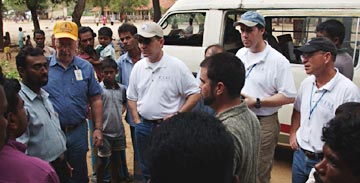
Texas Baptists responded with aid to victims of the tsunami.

Baptist Men volunteers from across the United States, including many Texans, traveled to Sri Lanka to serve the victims. Benevolence agencies rallied to the cause as well, channeling a variety of resources to the neediest people. And since the wall of water impacted one of the world's most Christian-resistant regions, missions agencies sensed the tsunami might soften hearts long hardened to the gospel. They reallocated both personnel and material resources to meet physical needs while they also demonstrated the love of Christ to people who, only days or weeks before, might have killed missionaries for preaching the gospel.

4. BWA centennial.

The Baptist World Alliance celebrated its 100th anniversary in 2005, as Baptists from many of the 211 member conventions and unions traveled to Birmingham, England, for the Baptist World Congress, an event held every five years. The past couple of years have been difficult for the BWA, particularly because the Southern Baptist Convention accused Baptists elsewhere of not being up to its standards of orthodoxy and consequently pulled out of the organization during its 99th year. Fortunately, Baptists elsewhere–such as the Baptist General Convention of Texas, Baptist General Association of Virginia and Cooperative Baptist Fellowship, all in the United States–rallied to the cause. So, despite the SBC's absence, about 13,000 Baptists from around the globe converged on Birmingham for a joyous centennial celebration, marked by who arrived and not by who failed to show up.

5. University transition.

At least six Baptist universities encountered significant change in 2005. In Texas, Baylor University saw the resignation of President Robert Sloan, whose administration had divided regents, faculty and alumni; a period of healing under interim President Bill Under-wood; and the election of John Lilley as the next president by a sur-prising–some would say miraculous–una-nimous vote. Mercer Univer-sity in Macon and Atlanta, Ga., and the fundamentalist-controlled Georgia Baptist Convention parted company, alleviating the GBC of financial obligations and the university of the threat of an SBC-style takeover. At the end of the year, Underwood was elected Mercer's president, to succeed longtime President Kirby Godsey. Also in Georgia, Shorter College lost a court battle to separate from the state convention, which then named a new slate of trustees for the school. In Tennessee, Belmont University attempted to separate from the Tennessee Baptist Convention, a move complicated by a little-known founding provision that the Nashville school's property should revert to the TBC if the school ever left the convention. At year's end, Samford University in Alabama was set to elect Andrew Westmoreland as president, to replace longtime leader Tom Corts. And that move provided implications for yet another school, Ouachita Baptist University in Arkansas, where Westmoreland is president.

6. Flood, race and poverty.

Hurricane Katrina left a mess in New Orleans. At year's end, much of the city remained uninhabitable. And the future of the Crescent City–as well as its former residents, now scattered across much of the country–remained an open question. Also at question is the relationship between race and poverty in America. Of course, geography played a major role in the New Orleans catastrophe. Since urban planners began channeling the Mississippi River generations ago, the city has sunk. So, a hole in a levee naturally means flooding in the city. But this tragedy shined a bright light on several other facts: Years of benign neglect left the levees weak and the city vulnerable. New Orleans already was one of the nation's poorest cities. It also was one of the cities with the largest black population. And when the floods came, the city's poor African-Americans suffered the most. Many Americans, from politicians to pundits to preachers, noted the connection between race, poverty and devastation is too strong to ignore. Figuring out how to remove toxic waste from New Orleans is one thing. Deciding how to treat Americans more fairly is quite another.

7. Warren & the world.

During the past 25 years, Rick Warren's Saddleback Community Church in California has become the largest Southern Baptist congregation and provided one of the major models for church growth. More recently, he wrote The Purpose Driven Life, which has touched hundreds of thousands of people. But in 2005, Warren turned his attention to poverty and AIDS. He said God convinced him he should be a good steward of the affluence and influence his mega-selling book has afforded him. So, he is taking on five “global giants”–spiritual darkness, lack of servant leaders, poverty, disease and ignorance–that affect billions of people. He has crafted a PEACE plan–plant churches, equip servant leaders, assist the poor, care for the sick and educate the next generation–to eliminate poverty, starvation and AIDS, as well as spread the gospel. If churches flock to PEACE in anywhere near the numbers that have adopted Purpose Driven, one can only wonder what 2006 will bring for Warren and the world.

8. Sex & culture.

Last year, Americans thought about sex almost as much in the courtroom and ballot booth as they did in the bedroom. In particular, they thought–and talked and argued–about same-sex marriage. And by and large, proponents of gay marriage won legal battles, while opponents won elections, such as the November referendum in Texas. Meanwhile, homosexual-rights activists and people who minister to gays and lesbians debated: Is the tendency toward homosexuality prompted by nature or nurture? Do homosexuals choose their lifestyle, or are they born that way? And can they choose to change? If anything, the debate will grow louder in '06.

9. Ten Commandments cases.

In two closely divided, carefully nuanced decisions, the U.S. Supreme Court drew a fine line between acceptable and unacceptable presentation of religious text and symbols on public property. By 5-4 votes, with Justice Stephen Breyer casting the swing vote in both cases, the court settled the two most significant church-state cases of its 2004-05 term. In Van Orden v. Perry, the justices ruled placement of a 6-foot-tall stone Ten Commandments monument on the Texas Capitol grounds is constitutional. But in McCreary County v. ACLU of Kentucky, they determined a framed copy of the commandments in a county courthouse is impermissible. While the Texas case provides government officials with precedent for displaying the Ten Commandments, the Kentucky decision warns that such displays must serve a secular purpose or else they're out of constitutional bounds.

10. School curriculum.

In one of the final major court cases of the year, a federal judge ruled the theory of “intelligent design” is not science and cannot be taught as science in public school classrooms. U.S. District Judge John Jones III ruled unconstitutional the Dover, Pa., school district's policy of requiring biology teachers to suggest evolution is “not a fact” and to state that intelligent design–the belief that some life forms are too complex to have evolved naturally and must have been aided by an intelligent designer–is a plausible alternative. While binding only in Dover, the court's decision is expected to warn districts in other parts of the country away from intelligent design. In a parallel debate, Americans argued whether Bible teaching in the nation's schools–such as materials published by the National Council on Bible Curriculum in Public Schools–is a legitimate course of study that is protected by the Constitution or a subterfuge for proselytizing students against their will.

News of religion, faith, missions, Bible study and Christian ministry among Texas Baptist churches, in the BGCT, the Southern Baptist Convention ( SBC ) and around the world.


Mission Arlington building damaged by apparent arson

Posted: 1/06/06

Mission Arlington building
damaged by apparent arson

By Ken Camp

Managing Editor

ARLINGTON–Fires apparently set by an arsonist on Christmas Eve and in the pre-dawn hours on Christmas caused significant damage to a Mission Arlington building.

But by the next day, the community ministry was operating–moving some services usually provided in the fire-damaged building to other facilities and setting up a clothes closet under a tent in an adjoining parking lot.

Rose Zamora, a staff worker at Mission Arlington, accepts donations and assists with cleanup after two fires damaged one of the community ministry's buildings.

Investigators ruled out accidental causes. Although no accelerants were used, the fires apparently were set intentionally. The Fort Worth Star-Telegram reported investigators questioned a "person of interest," but no charges have been filed.

Although some news sources reported the ministry sustained $30,000 in damages, Mission Arlington Executive Director Tillie Burgin said: “I don't know where they got that. I can't imagine that would even begin to cover it.”

Both fires occurred in Mission Arlington's “first house”–the northern-most unit in a long, two-story facility that houses a clothes closet and a childcare facility and that served as the staging area for Christmas donations.

Mission Arlington staff discovered the first fire mid-afternoon Dec. 24.

“It was in a closet where we keep coats and blankets,” Burgin said. “It was put out quickly and caused minimal damage. … We were just praising God it was so contained.”

Sometime after 2 a.m. on Christmas, Burgin received a phone call reporting a second fire in the same facility. It caused significantly more damage.

“The whole inside of the building will have to be redone,” she reported.

Even so, she expressed thanks that the building was unoccupied, the fire didn't spread to adjoining units and the inventory of Christmas toys already had been distributed.

“We had just given 20,000 people toys. There were still some left over, but not much,” she said. “It could have been so much worse. It could have spread to the second, third and fourth houses. Nothing was occupied, and nobody was injured.”

While professionals examined the facility to assess damage, volunteers joined staff in the early stages of cleanup and in receiving year-end donations from the community–including much-needed blankets and coats to replace ones destroyed in the fire.

“We're grateful for the prayers of God's people, and our prayer is that God will be glorified even through these circumstances,” Burgin said. “We teach people all the time how to work through crisis. Now we get to practice what we preach.”

Burgin founded Mission Arlington in 1986 as a ministry of Arlington's First Baptist Church. Mission Arlington now provides ministry to 600,000 people each year and sponsors Bible studies at 254 sites that involve 4,000 people each week.

To contribute financially to Mission Arlington, send a check to 210 W. South St., Arlington 76010 or contribute online at www.missionarlington.org.

News of religion, faith, missions, Bible study and Christian ministry among Texas Baptist churches, in the BGCT, the Southern Baptist Convention ( SBC ) and around the world.