After 80 years, town still known for ‘Monkey Trial’

Posted: 12/02/05

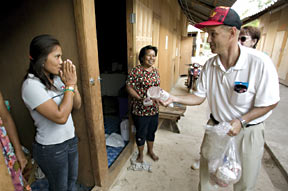
Tom Davis gives a tour of the museum in the basement of the Rhea County Courthouse dedicated to the Scopes "Monkey Trial." Eighty years ago, media coverage of the trial branded Dayton, Tenn., a backwater haven of the Bible Belt, where ignorant Christians gave blind faith precedence over scientific discovery. (Photos by Michael Clancy/RNS)

After 80 years, town still
known for 'Monkey Trial'

By Amy Green

Religion News Service

DAYTON, Tenn. (RNS)–Eighty years ago, media coverage of the Scopes “Monkey Trial” branded this town a backwater haven of the Bible Belt, a place where ignorant Christians gave blind faith precedence over scientific discovery.

It's still ridiculed for its literal biblical beliefs, recently by Comedy Central's The Daily Show, but its residents make no apologies.

Nestled on the Tennessee River, Dayton offers gospel music at McDonald's and other fast-food restaurants. Last year, county commissioners voted to ban homosexuals, only to reverse themselves after a national outcry.

Dayton is a place where residents rallied to raise money to keep Bible stories in their public schools after a lawsuit was filed. It's a Southern town where the first question after an introduction is not “What do you do?” but “What church do you go to?”
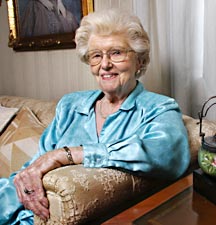
Eloise Reed was 13 years old and sat in the front row for one day of the Scopes "Monkey Trial"' in 1925.

In short, Dayton remains the faith-based city that hosted what was called the trial of the century in 1925, a trial that many call a turning point nationally for evangelical Christians and their beliefs.

Some residents, like 93-year-old Eloise Reed, can still recall details of the trial that made H.L. Mencken a journalistic legend after he called Daytonites “hillbillies,” “yokels,” “morons” and “primates,” among other compliments.

“I was there just a-squirmin' and just mad as I could be,” said Reed, who got a front-row seat at the trial because she was the 13-year-old friend of the sheriff's daughter. “If the story in the Bible was not true, then how could this be true?”

High school biology teacher John Scopes was convicted of breaking state law and teaching evolution. The trial pitted literal belief in the Bible against the then-burgeoning American Civil Liberties Union and Darwin's theory of evolution.

The trial here in the foothills of the Cumberland Plateau drew thousands and shaped how science was taught in classrooms for decades. Dayton's Christians were portrayed as fundamentalist fanatics in the 1960 film Inherit the Wind.

Feeling maligned and misunderstood, fundamentalist and evangelical Christians across the country retreated from broader society to create their own institutions.

“Did Christians pull back from the marketplace of ideas? I kind of think they did,” said Tom Davis, a county commissioner and spokesman for the 750-student Bryan College, a Christian college in Dayton named for William Jennings Bryan, the three-time presidential candidate and fiery prosecutor of Scopes.

Yet after decades of retreat, Christians have stormed back into the public square, helping to elect school boards, governors and even a U.S. president to fight for their values. In some states and communities, they have pushed a battle over evolution back into the classroom and courtroom.

In Dayton, evolution is taught, but creationism is part of the classroom discussion.

“I wouldn't necessarily call it a Christian community,” said Davis. “But we certainly have a respect for our Christian heritage.”

The Scopes “Monkey Trial” was a test of a state law forbidding public school educators from teaching “any theory that denies the story of the divine creation.” Scopes' conviction eventually was overturned and the law repealed.

The trial discouraged educators from teaching evolution for decades, said Eugenie Scott, director of the National Center for Science Education. Even though Scopes was portrayed as a heroic martyr in the press, textbook publishers concluded the best way to avoid controversy was to avoid evolution.

“By 1930, evolution essentially had disappeared from the public school curriculum,” Scott said.

While Davis, the county commissioner and an academic expert on the history of trial, said it contributed to a temporary withdrawal of evangelical Christians from politics, they have returned to leave a significant mark.

A commission vote last year to ban homosexuals from living in Dayton–Davis calls it a misunderstanding–never would have garnered the attention it did had it not been for the stigma of the Scopes trial. Davis said commissioners thought they were voting to ask the county attorney for a resolution addressing gay marriage, which was in the news at the time.

The vote prompted national outcry, the commission rescinded it and the town eventually was host to a “Gay Day” demonstration that drew hundreds.

Davis also blames a misunderstanding for a lawsuit filed three years ago by a parent against the school board in protest of a Bryan College ministry that sent students into public schools to teach Bible stories. The lessons were informative, not proselytizing, Davis said. The board took the case to the 6th U.S. Circuit Court of Appeals using funds raised by churches and residents but gave up the case after a defeat there.

Some residents relish the ongoing media attention as an opportunity to share their faith.

“Dayton is the capital of the culture war,” boasts June Griffin, 66, better known as the “Ten Commandments Lady” for her travels to every Tennessee county urging that the biblical laws be displayed on public property.

But others are sensitive to how they might be perceived by outsiders. They are friendly and warm toward journalists, but wary.

Many pointedly say they seldom talk of the trial. Richard Fisher, superintendent of Dayton's K-8 school, cautiously explains science is taught here according to current state standards, but creationism is not dismissed because so many here believe it.

The town's portrayal on an episode this year of Comedy Central's The Daily Show, a cable TV show mixing humor with the news, made at least a few locals cringe. It was part of a special report titled "Evolution, Schmevolution" and poked fun at some of the town's rural sensibilities.

“It wasn't as bad as it could have been,” Davis said of the episode. “I guess I was expecting worse.”

Some visitors still come in search of history and perhaps an answer to the question: Where did we come from? They visit the historic courthouse, which underwent a $1 million restoration in the late 1970s and today is home to a small museum in the basement with news clippings, photos and other relics of the trial.

The museum gets visitors from across the globe, said Flossie Lowe, 70, who works there. Residents appreciate the business the visitors bring a town where many work at the local furniture manufacturing plant or commute to nearby Chattanooga.

But some “would just like to see it all go away,” said Lowe of the attention the Scopes trial still brings.

News of religion, faith, missions, Bible study and Christian ministry among Texas Baptist churches, in the BGCT, the Southern Baptist Convention ( SBC ) and around the world.


Strickland recognized as advocate for children

Posted: 12/02/05

Strickland recognized as advocate for children

By John Hall

Texas Baptist Communications

DALLAS–The Texas Conference of Churches and Texans Care for Children recently recognized Baptist General Convention of Texas Christian Life Commission Director Phil Strickland for his years of advocating for the betterment of children's lives.

Both groups honored Strickland's efforts to improve the lives of children throughout Texas. He has advocated on behalf of children since he began working with the Texas Baptist public policy and moral concerns agency 38 years ago.

Strickland was one of the leaders in forming the CARE Coalition, which later became Texans Care for Children.

Pete Laney, former speaker of the Texas House of Representatives and current state representative, said Strickland has called lawmakers to look at the plight of children within the state. Texas ranks near the bottom of the nation on most indicators of child well-being.

“Phil has been a regarded voice in the capitol as long as I can remember,” he said. “Phil has always made sure government hears the voices of the people, especially children who have no voice.”

Strickland has led cross-denominational conversations between the BGCT and the Texas Conference of Churches for the past several years, discussing ways they can work together to give children a voice of representation in state government.

The discussions have brought the groups together to speak with “one voice,” said Texas Conference of Churches Executive Director George Bithos. Together, they have raised the awareness level of children's issues throughout the state legislature. Strickland's work in this process “can't be underestimated,” he said.

Suzii Paynter, CLC director of citizenship and public policy, said awareness leads to action. The BGCT and the Texas Conference of Churches helped fight for reform in Child Protective Services, she noted.

BGCT leaders and officials with the Texas Conference of Churches also have focused on immigration and chaplaincy issues.

Bishop Michael Pfeifer of the San Angelo Catholic Diocese said discussions between the conference of churches and the BGCT have built trust between both parties and strengthened the work of each side.

“It's interesting how we've found more and more to work on,” Bithos said. “It's not our differences that separate us. Rather, we have found the necessity to work together.”

News of religion, faith, missions, Bible study and Christian ministry among Texas Baptist churches, in the BGCT, the Southern Baptist Convention ( SBC ) and around the world.


Teens offer needy families reason to give thanks

Posted: 12/02/05

Teens offer needy families
reason to give thanks

By Miranda Bradley

Texas Baptist Children's Home

ROUND ROCK–Teenagers who have discovered hope through a Texas Baptist Children's Home program offered needy families a reason to give thanks.

A group of HOPE teenagers from a Round Rock apartment complex delivered gift baskets to families before Thanksgiving. HOPE–Healthy Opportunities that Protect and Empower–is a community-outreach effort sponsored by Texas Baptist Children's Home that assists at-risk youth and families.

The teens carefully organized baskets they had decorated, and then they loaded them into a van driven by Sarah Eubank, supervisor of the HOPE program.

A Round Rock resident smiles as she thanks HOPE teenagers bringing her Thanksgiving dinner. Healthy Opportunities that Protect and Empower is a community-outreach program through Texas Baptist Children's Home that assists at-risk youth and families. (Photo by Miranda Bradley)

“They really look forward to getting out in the community,” Eubank said.

Their first visit was with Tabatha Montgomery, whose two youngest children suffer from debilitating illness–one from diabetes and the other from leukemia. Doctors' visits require so much of her time, Montgomery eventually lost her job.

She opened the door, her face beaming when she saw a HOPE teenager delivering a large basket filled with a turkey, canned vegetables and other holiday trimmings.

“Thank you,” Montgomery said. “Thank you so much. This is such a blessing!”

Some of the HOPE teens could relate to the Montgomerys' plight. They know firsthand about illness, doctor visits and hospital stays.

“This really shows them that there are other families struggling out there,” Eubank said. “You might not know it by looking at them, but a lot of people have problems.”

HOPE provides assistance through outreach in local apartment communities. Many of its programs center around youth activities.

This past summer, one HOPE group organized a soap drive that yielded two large bags of hygiene products for the Austin Resource Center for the Homeless. When they delivered the items, the teens were invited on a tour of the center.

“They were touched by the fact that their contribution made such a difference in the lives of those who desperately needed it,” Eubank said. “The kids also were impacted by the desperation of some of the people they saw.”

In October, the teens decorated bags and filled them with candy for the smaller children in the complex. For Christmas, they plan to fill stockings with gifts for the children.

“These are really, really good kids,” Eubank said. “They're just like most middle schoolers. They're trying to find out who they are and what they stand for.”

Providing avenues for giving rather than receiving will help shape their personalities in the most positive way, she insisted.

“It will hopefully provide them with a sense of giving to others in need,” Eubank observed. “They have this opportunity to help other families in crisis.

At the beginning of the year, the youth are asked for suggestions for events they might want to pursue. They listed the Thanksgiving deliveries among their top choices.

“It feels good to help people out,” 11-year-old Mariah said.

Melissa, age 14, who has helped with the Thanksgiving deliveries two years in a row, said she looks forward to it.

“For children like these who have troubles of their own, it's a huge deal to step outside themselves and give to others,” Eubank said. “It really comes down to the fact that they aren't just handing out turkeys to these people. They're handing out hope.”

News of religion, faith, missions, Bible study and Christian ministry among Texas Baptist churches, in the BGCT, the Southern Baptist Convention ( SBC ) and around the world.


Texas Tidbits

Posted: 12/02/05

Texas Tidbits

DBU honors two. Dallas Baptist University honored Michael Stuart, a Mesquite dentist, church musician and member of First Baptist Church in Sunnyvale, as 2005 Distinguished Alumnus at its homecoming alumni banquet. Stuart, who completed his undergraduate studies at DBU in 1974, went on to earn a master's degree in church music from Southwestern Baptist Theological Seminary and his doctorate from the Baylor College of Dentistry. His wife, Kathy, is a retired educator and principal. The Stuarts have two daughters and three grandchildren. DBU also honored Jamie Lash, business professor and director of student development, with its 2005 Honorary Alumnus award. Before joining the DBU faculty in 1988, Lash taught at Baylor University. In addition to his responsibilities on the DBU campus, Lash is a frequent speaker at churches and retreats throughout the United States. For six years, he maintained a radio ministry in Washington, D.C., and Dallas. He and his wife, Marcy, live in Grand Prairie and have three children.

ETBU education students form organization. East Texas Baptist University education students have formed a new campus organization–the Future Educators of the World. Newly elected officers are President Sara Thompson, a junior from Marshall; Vice President Lauren Youngblood, a junior from Whitehouse; and Secretary Amy DuBose, a senior from Overton. Brian Nichols, dean of the ETBU School of Education, and Carolyn Dierksen, associate professor of teacher education, will serve as faculty sponsors.

Information desired on evangelist. The archivist at Southeastern Baptist Theological Seminary is seeking information about 20th century Texas Baptist evangelist B.B. Crimm. Crimm lived in Marshall and died in 1950. Anyone who has information about Crimm, including any stories regarding his life and ministry, can contact Jim Lutzweiler at 101 Thornwood Rd., Jamestown, N.C. 27282 or call (919) 761-2249 or (336) 686-2043.

Messengers give to Mary Hill Davis. Texas Baptists gave about $4,500 to the Mary Hill Davis Offering for Texas Missions during the Baptist General Convention of Texas annual meeting in Austin. The missions offering–collected annually in many BGCT-affiliated churches–has a $5 million goal.

Seminary establishes Lake memorial scholarship. Baylor University's Truett Theological Seminary Alumni Association has established the Kyle Lake Memorial Endowed Scholarship Fund at Truett Seminary. Lake–a graduate of both Baylor and Truett–was electrocuted Oct. 30 while performing a baptism at University Baptist Church in Waco, where he was pastor for seven years. Lake's family will set the guidelines for choosing recipients. Donations can be made through the Baylor Development Office at (800) 229-5678, option 4, Kyle Lake Memorial Endowed Scholarship Fund c/o Baylor University, One Bear Place #97050, Waco 76798 or www.baylor.edu/onlinegiving.

UMHB offers Christmas workshop for children. The University of Mary Hardin-Baylor art department will host its ninth annual Christmas workshop from 9:30 a.m. to noon Dec. 10 for children ages 5 and older. Children ages 5 and 6 must be accompanied by an adult. Children will create Christmas ornaments and holiday decorations. In lieu of a tuition fee, children are asked to bring an unwrapped gift–$15 to $20 value–for a child of any age, which will be given to families in Belton. Enrollment for the workshop is limited, and advance registration is required, no later than 5 p.m. Dec. 8. To register, call the art department at (254) 295-4676 or e-mail Helen Kwiatkowski at hkwiatkowski@umhb.edu.

News of religion, faith, missions, Bible study and Christian ministry among Texas Baptist churches, in the BGCT, the Southern Baptist Convention ( SBC ) and around the world.


FDA oversight of cigarettes urged

Posted: 12/02/05

FDA oversight of cigarettes urged

By Bruce Taylor Seeman

Religion News Service

WASHINGTON (RNS)–After being indicted by a grand jury and bounced from his leadership post in Congress, Rep. Tom DeLay, R-Sugar Land, has another distraction–interfaith groups pressuring him to drop his opposition to Food and Drug Administration oversight of cigarette sales, which health experts say could save thousands of American lives.

Religious leaders say they have leaped into the smoking issue for moral reasons. It is wrong, they argue, for tobacco companies to market lethal and addictive products, particularly to youths.

“There's a lot of talk by politicians about family values. But when we're talking about the health of families and children, that's a family value,” said Cynthia Abrams, an addictions and health-care specialist at an agency within the United Methodist Church in Washington, D.C.

Cigarette packs would carry larger warnings about health effects if Congress gave the Food and Drug Ad-ministration oversight over tobacco. This warning, which covers half of a pack of Canadian cigarettes, is one of 16 required by Health Canada, that nation's health agency. (Photo by Melissa Cannarozzi/RNS)

The pressure on DeLay comes from Texas Faith United Against Tobacco–a coalition of Southern Baptists, Methodists, Lutherans, Seventh-day Adventists and others. The group recently sent proclamations to about 200 church leaders, asking them to join the call for DeLay to support FDA oversight.

In March, a related national group, Faith United Against Tobacco, wrote to DeLay, then House majority leader, saying, “We find it incredible that the FDA can ensure the safety of everyday items like macaroni and cheese but has no authority over tobacco, a product that kills over 400,000 Americans every year.”

DeLay, a Baptist who openly professes his faith in political settings, relies heavily on support from the Religious Right. But he also has long-standing relationships with tobacco companies, which have contributed $134,150 to his campaigns since 1990, according to the Center for Responsive Politics, a nonpartisan watchdog group in Washington.

In October, traveling to Houston to answer state money-laundering and conspiracy charges, DeLay flew aboard a jet owned by the tobacco giant R.J. Reynolds, which has contributed to his legal defense fund and opposes FDA oversight.

Ben Porritt, a DeLay spokesman, said the congressman maintains his opposition to FDA oversight and believes the focus should be on enforcing laws against smoking among minors. Asked if faith leaders' support of FDA control might pose a political problem for DeLay, Porritt responded: “Mr. DeLay stands in the corner of the children. He supports the laws on the books and making sure we protect children. That's everybody's goal here.”

About 22 percent of Americans smoke, the Centers for Disease Control and Prevention report. Every day, about 3,900 young people try their first cigarette, and 1,500 become everyday smokers.

Last year, a tax bill containing a provision for FDA control passed the Senate 78-15. Maneuvers by DeLay killed similar legislation in the House. The idea has been reintroduced by its earlier sponsors, both Democrats and Republicans, but the bills are stuck in Senate and House committees.

“We have the majorities in both houses. What we don't have is the leadership support,” said William V. Corr, executive director of the Campaign for Tobacco-Free Kids. Most public health experts embrace the idea of FDA control, arguing that government can confront tobacco's toll only if it is regulated as a drug.

There are proposals to give the FDA power to restrict tobacco advertising and promotions, ban candy-flavored cigarettes, prohibit unproven claims about products' “reduced risks,” and require cigarette makers to disclose more about products' contents and health effects.

Anti-smoking activists say such controls would blunt the marketing muscle of tobacco companies, which currently spend the equivalent of $41 million a day to promote their products. It's an argument increasingly amplified by religious leaders nationwide.

The Mississippi Baptist Con-vention has passed a resolution estimating that 81,600 of the state's children ultimately will die from smoking-related diseases and pledging to encourage “our elected officials to take aggressive actions in reducing smoking in our state.”

And in Illinois, a group called the Faith-Based Coalition United Against Tobacco is preparing to pressure House Speaker Dennis Hastert, R-Ill., to support FDA regulation of tobacco.

News of religion, faith, missions, Bible study and Christian ministry among Texas Baptist churches, in the BGCT, the Southern Baptist Convention ( SBC ) and around the world.


TOGETHER: Make a bigger difference in Texas

Posted: 12/02/05

TOGETHER:
Make a bigger difference in Texas

The latest Texas Almanac came as a birthday present from my brother this past week. This is the sesquicentennial edition–for the first time printed in color! And full of facts.

It documents how Baptists have grown in Texas. There are 4.5 million of us, along with 4.4 million Catholics and 4 million aligned with other religious groups.

But the largest group of all is the “unclaimed.” They are “nonadherents to religion.” In 1990, there were 5.5 million, and now there are 8 million–an increase of almost 50 percent! If these 8 million people constituted one state, it would be the 11th-most-populated state in the nation.

wademug
Executive Director
BGCT Executive Board

Texas continues to grow. Only Nevada, Arizona and Florida grew faster than Texas (6.1 percent) between 2000 and 2003. Growth was concentrated in large suburban and central-city complexes. The fastest-growing areas were in DFW, Houston, Austin, McAllen, Brownsville-Harlingen and Laredo.

We are becoming more diverse. In 1980, our population was roughly two-thirds Anglo. Now, it is 49 percent Anglo, 11 percent African American, 36 percent Hispanic and 4 percent other (primarily Asian).

You can see why I challenged our convention to work with our churches to begin a record 1,500 churches by 2010. We also will partner with other Baptist bodies to start churches around the world where the need is even greater than Texas. But we dare not neglect our Texas mission field.

You will understand when I tell you I woke up in the middle of the night with this question interrupting my sleep: “How can there be so many Baptists in Texas and it make so little difference?” I reread Matthew 25:14-30, where Jesus challenges us to be good stewards of what is placed in our hands. And I trembled at the thought that God has given Texans, and especially Texas Baptists, so much and wondered whether God will be able to say to us, “Well done, good and faithful servant!” Or, “You wicked, lazy servant!”

Does that seem extreme? I cannot escape the thought that to whom much is given, much shall be required.

I call on the churches of our convention to find people who need a church and start one.

The almanac also noted the precarious situation of our children. Twenty-two percent of Texas children do not have health insurance, which is the highest percentage in the nation. It is twice as much as our neighboring states, Oklahoma, Arkansas, Louisiana and New Mexico. For comparison, Minnesota and Wisconsin have a 4 percent noninsurance rate among children. I call on the churches to affirm the children, making sure that your congregation provides a loving and safe environment for all children who can attend your church. And that you see the children you may have overlooked and hear Jesus say, “Let the little children come to me, and do not hinder them.” Build networks with all people of good will in your community to make sure every child has a safe place to sleep, food enough to eat, quality education, medical care when they are sick and an opportunity to know Jesus loves them.

Encourage your elected representatives to look carefully at the educational and medical needs of children in Texas and do what is right. Work to strengthen families so that the divorce rate in Texas will begin to fall and children will be better served.

Together, Texas Baptists can make a bigger difference in Texas than we have.

Let's do.

Charles Wade is executive director of the Baptist General Convention of Texas.

News of religion, faith, missions, Bible study and Christian ministry among Texas Baptist churches, in the BGCT, the Southern Baptist Convention ( SBC ) and around the world.


Wave of hope sweeps Thailand in months after tsunami

Posted: 12/02/05

Wave of hope sweeps Thailand
in months after tsunami

Children play in their "front yards" after the tide comes in to a "Sea Gypsy" village in southern Thailand. Already poor, the village faced starvation when the tsunami of 2004 destroyed their fishing boats. Missionary Mark Caldwell and local Christians brought help and the love of Christ. (Photo courtesy of IMB)

By Erich Bridges

International Mission Board

Sunset paints a glorious reddish glow across the placid water lapping the beach at Khao Lak, Thailand. The view calms the mind, quiets the heart and and packs in the tourists at posh resorts.

At least it used to pack them in, before the tsunami roared ashore last December.

"It's hard to believe an ocean that beautiful could cause so much destruction,” missionary Mark Caldwell said, gazing wistfully toward the horizon.

Caldwell stood within walking distance of the places where at least 1,000 bodies were recovered after the Indian Ocean tsunami thundered north into the Andaman Sea and laid waste to this stretch of Thailand's southern coastline.

Rebuilding continues to move ahead in the beach resort areas. But in the coastal town of Khao Lak, where the torrent destroyed eight of every 10 buildings, recovery proceeds more slowly. Half-buried in the mud surrounding buildings in various stages of collapse or reconstruction, a child's flip-flop pokes out here, a dress there, a lonely mattress lies just beyond. A 40-foot fishing boat perches inside the ruins of one house–200 yards from shore.

This "Sea Gypsy" child on one of southern Thailand's countless islands shows a sure sign of malnutrition with her reddish brown hair. She's also hungry to know the love of Jesus.

Caldwell serves as a Southern Baptist missionary strategy coordinator “on loan” from his work among the 18 million Isaan people of northeastern Thailand. Earlier this year, he and his wife, Helen, had just returned from United States assignment when an urgent call came for them to coordinate tsunami relief ministry in Thailand's southern region for up to six months.

They hadn't even unpacked. The Isaan work demanded attention. The Caldwells hesitated briefly, then accepted the temporary job.

“I've always rooted for the underdog,” he said. “I've always been interested in helping folks who are down and out, and I like to bring people together.”

“Underdog” applies to the Isaan, a historically oppressed people the Caldwells first encountered in their previous assignment planting churches in Bangkok. It definitely applies to many of southern Thailand's tsunami survivors.

In the Khao Lak area, some 5,000 people still live in temporary camps. Most lost their homes–and their livelihoods–to the tsunami. Caldwell and several missionary colleagues have coordinated Baptist volunteer groups delivering food to camp residents. They've provided aid for Thais to rebuild homes and build new fishing boats so they can get back to work. They've committed to rebuild two schools in the region.

But Caldwell also asks: What will it take to see church-planting movements, led by Thai believers, spread across southern Thailand?

When the tsunami hit, one Southern Baptist missionary couple lived in the region–home to 5 million people. Only one Baptist church exists in the six coastal provinces most affected by the tsunami. As in the rest of Thailand, less than 1 percent of the population is Christian. The vast majority of the people see Christianity as a Western religion.

Missionary Mark Caldwell helps deliver fresh meat in one of many camps built for Thais who lost their homes to last year's tsunami.

American volunteers have put a compassionate Christian face on relief efforts.

“But the real goal is to get Thai Christians involved and out front,” Caldwell said. “That breaks down the barrier that to be a Thai, you are a Buddhist.”

Or a Muslim, or an animist, like many of the fishermen who live along the Thai coast.

To that end, Caldwell looks for Thai Christians to aid and encourage, such as Sian Buaket, a pastor in the coastal city of Ranong. Sian had longed for years to reach out to the Mogen people–commonly known as “Sea Gypsies”–living on nearby islands dotting the coastline. But he lacked the opportunity and the resources.

The tsunami provided both.

Volunteers from the Bangkla Baptist Clinic teach Mogen ("Sea Gypsy") children about Jesus while medical workers hold an open-air clinic nearby.

Some of Sian's church youth went out fishing not long after the tsunami. They came upon a Mogen fishing village on an island not far from Ranong and learned of the villagers' plight.

The Mogen people–who are citizens of neither Thailand nor neighboring Myanmar (Burma)–are accustomed to poverty, discrimination and exploitation by criminal “godfathers” in the fishing industry.

When the tsunami came, the Mogen villagers ran to higher ground. They returned to find their long fishing boats on the shore–battered to kindling wood. Local authorities provided a few bags of rice. When villagers appealed for more aid, they were denied. “You're not Thai citizens,” they were told. Without fishing boats or the money to buy new ones, they faced starvation. Some of the villagers went to coastal cities to look for work or beg.

Sian and his people began taking food to the village. Young people began visiting to tell the Mogen children about Jesus. Church members started an open-air school to teach Mogen adults to read. With Caldwell's help–and tsunami aid funds from Baptists in the United States–Sian has helped the villagers buy boats.

“We're better fishermen than the Thai,” a village leader proudly claimed. “We'll survive. We just needed our boats back.”

But they needed something more–Jesus Christ.

The Mogen villagers had long lived with no faith besides animism and a fear of evil spirits. When family members died, they were taken to another island for burial. Loved ones grieved without hope.

That's all changing.

Physician Larry Rodgers examines a child at a medical clinic in an island village off the coast of southern Thailand. It was the first time a doctor had set foot in the village.

“We were like an empty glass; now it is full,” a village leader said. “The tsunami was a tragedy, but for us it brought new hope. If it had never come, we wouldn't know about Jesus.”

On a recent visit, a team of missionaries and Thais from the Bangkla Baptist Clinic–joined by Tennessee Baptist volunteers–arrived in boats packed with medical supplies. It was the first time a doctor had entered the village. The team treated the sick, vaccinated children against diseases, installed a pump to give the village running water and helped Sian's church members share the gospel. Twenty-eight villagers became followers of Christ.

As the team left, tin roofs of village huts glinted like trash can lids in the sun. Sadly, the Mogen people have been cast aside like human refuse for so long. Not anymore.

“They want hope,” Caldwell said. “Who's going to share it with them?”


News of religion, faith, missions, Bible study and Christian ministry among Texas Baptist churches, in the BGCT, the Southern Baptist Convention ( SBC ) and around the world.


Weekend Fest rocks

Posted: 12/02/05

Weekend Fest rocks

About 600 teenagers and others joined in Weekend Fest, a Christian concert featuring Tree63 prior to the Baptist General Convention of Texas annual meeting in Austin. Participants gave more than $400 for mission work through Baptist Student Ministries around the state, and numerous young people made decisions for Christ. The concert also featured several prizes. Woodlawn Baptist Church and Teri Road Baptist Church in Austin each won $500 to help pay for youth mission trips. Melanie Jaramillo of Primera Iglesia Bautista in Austin won a laptop computer, and Belle Ramey, a youth worker at Crestview Baptist Church in Georgetown, won a paid trip to next year's BGCT annual meeting in Dallas.

News of religion, faith, missions, Bible study and Christian ministry among Texas Baptist churches, in the BGCT, the Southern Baptist Convention ( SBC ) and around the world.


Storylist for 11/21/05 issue

Storylist for week of 11/21/05

GO TO SECTIONS:
Around Texas       • Baptists      
Faith In Action

      • Departments      • Opinion       • Bible Study      


Accident changed focus of ETBU athlete Huckaby

Wayland worldwide recruiting effort nets students from Dubai

Tornadoes disrupt Tennessee Baptist meeting

Alabama Baptists urged to lead in racial harmony

Missionary couple helping to reach remote Lencas in Honduras

Kentucky Baptists approve new relationship with college

Tennessee university to elect own trustees


Articles from our 11/21/05 issue:


One family, one mission


BGCT Annual Meeting
Time to 'show up, pay up & speak up,' Bell insists

Resolution reaffirms biblical sexual values but not boycotts

Restructured BGCT designed to offer one-stop shop for Texas

Reyes urges Texas Baptists to share power, resources

Missions Foundation honors four for missions contributions

BWA leader brings more than fraternal greetings to BGCT

Opportunity knocks during CityReach

Prophetic voice absent but still heard at TBC event

Where Have All the Prophets Gone? by Phil Strickland

Hispanic Baptists celebrate family & mission

Work together to accomplish mission, Nguyen urges BGCT


Health Foundation names Elston president

Around the State

On the Move

Texas Tidbits

Previously Posted
BGCT officer elections reflect convention's diversity

BGCT approves sweeping change in governance structure

WMU board cancels Texas Leadership Conference

Texas WMU celebrates 125 years of missions service

Historic Texas Baptist church 'still alive and growing,' pastor reports

Ministers, layman honored at banquet

Varied evangelism methods can be effective, Shuffield says

Worship should unify, not divide, educator insists

Teens illustrate what they need spiritually

BGCT mission and heritage 'not for sale,' Wade insists

Young pastors learn from elders


At long last, Georgians vote to cast out Mercer

Florida signs for marriage

Louisiana veers from recent trends

North Carolina Baptists still may give to Fellowship

Baptist Briefs

Previously Posted
Rogers kept SBC's steering wheel turned to the right


Volunteer uses spiritual gifts in prison


Thanksgiving observances reflect political agendas

Court declines to hear 'In God We Trust' case

Gender testing raises ethical questions

Tiny ceramic shard yields gigantic archaeological find


Cartoon

Classified Ads

Texas Baptist Forum

Around the State

On the Move


EDITORIAL: Texas & the 21st-century Pentecost

DOWN HOME: Do you give thanks for music's aroma

2nd Opinion: Things I learned as a BGCT officer

TOGETHER: Texas Baptists have much work to do

Right or Wrong? Stem Cells (Again)

Texas Baptist Forum

Cyber Column by Jeanie Miley: God is at work


BaptistWay Bible Series for Nov. 20: Wasted potential is a danger all face

Family Bible Series for Nov. 20: Fear of the Lord is the beginning of wisdom

Explore the Bible Series for Nov. 20: When evil closes in, remember God's promises

BaptistWay Bible Series for Nov. 27: Everything is to be subjugated to God's will

Family Bible Series for Nov. 27: Submission to the will of God is an imperative

Explore the Bible Series for Nov. 27: Circumstances can't defeat God's purposes


See articles from previous issue 11/14/05 here.


New court appointee might affect upcoming abortion cases

Posted: 12/02/05

New court appointee might
affect upcoming abortion cases

By Robert Marus

ABP Washington Bureau

WASHINGTON (ABP)—As the Supreme Court took up its first major abortion case in five years Nov. 30, attention focused on the body’s shifting membership and what that might mean for abortion rights in the future.

During oral arguments in Ayotte v. Planned Parenthood of Northern New England, newly installed Chief Justice John Roberts appeared sympathetic to New Hampshire’s efforts to defend a 2003 state law that requires medical personnel to notify parents or guardians 48 hours before their minor daughters can undergo abortion procedures. Lower courts had declared the law unconstitutional.

But the real question over the case lies with someone who isn’t on the court yet—President Bush’s pick to replace retiring Justice Sandra Day O’Connor—and Justice Anthony Kennedy, who could cast the decisive vote in the case if O’Connor leaves before the case is decided.

Bush has chosen a federal appellate judge, Samuel Alito, to replace O’Connor, who generally has been supportive of abortion rights. Writings from Alito’s past as a government lawyer—including one publicized the same day as the arguments—strongly suggest he is not sympathetic to the idea that the Constitution protects a woman’s right to have an abortion.

Although the current case does not directly address that basic right, abortion-rights groups fear it could offer a new anti-abortion majority on the court the chance to chip away at precedents upholding the constitutionality of a woman’s right to choose to terminate her pregnancy.

In 2000, a closely divided Supreme Court said a restriction on a woman’s right to choose an abortion would have to contain an exception for abortions performed to protect a woman’s life or health. The court also has upheld the necessity of such exceptions in other cases following its landmark 1973 Roe v. Wade decision, which legalized abortion nationwide.

In the latest case, an abortion-rights group challenged the New Hampshire law because it does not contain an exception for the health of the minor.

The 1st U.S. Circuit Court of Appeals struck the entire statute down, citing the high court’s 2000 Stenberg v. Carhart decision, as well as other abortion opinions requiring health exceptions in laws restricting abortion rights.

But New Hampshire’s attorney general appealed the circuit court’s ruling, arguing not only that state law already contains sufficient safeguards to protect the health of abortion-seeking minors, but also that the lower courts should not have invalidated the entire law simply because of its lack of an explicit health exception.

Arguing her state’s case before the court, New Hampshire Attorney General Kelly Ayotte repeatedly called “rare” the circumstances under which a minor would need an abortion to protect her health. In such cases, she said, there are sufficient safeguards already in place to ensure that a minor can undergo the procedure.

For instance, the law contains a judicial-bypass feature that allows the girl and her physician to obtain permission for the abortion from a judge if her parents are not reachable or she fears retribution from them if they discovered she was pregnant.

“New Hampshire’s act can be applied to protect a woman’s health,” she told the justices.

But several justices appeared skeptical of that argument, including Kennedy, who wondered aloud how the law can be construed to protect a woman’s health when the narrow majority of state legislators who passed it in 2003 explicitly chose not to include such an exception.

“We need to know what the act says,” Kennedy told Ayotte.

Likewise, Justice Stephen Breyer subjected Ayotte to sharp questioning when she said other provisions of New Hampshire law designed to balance “competing harms” would protect physicians charged with performing emergency abortions on minors.

Breyer raised the hypothetical situation of a young woman in an emergency situation who needs an abortion to protect her health—but some may decide that the harm to the fetus outweighs any potential harm to the mother.

“There are people of good faith on both sides of this argument, so how do we know that that statute is going to do for this particular woman what (an explicit) health exception is going to do?” he asked.

Roberts appeared sympathetic to New Hampshire’s other argument, as echoed by Solicitor General Paul Clement. Clement argued for the law’s constitutionality on behalf of the Bush administration, saying there was no need for the lower federal courts to invalidate the entire statute because of the “one in a thousand” circumstance in which a minor must receive an abortion to protect her health before her parents can be notified and before a judge can grant permission in their stead.

But Jennifer Dalven, who argued the case on behalf of the law’s opponents, said physicians hesitating to consult judges or consider their own legal fates before performing abortions could have dire consequences.

“Delaying appropriate care for even a short period can be catastrophic and can put the teen at risk for liver damage,” sterility, blindness and a host of other significant health consequences, Dalven told the justices. “For some women, every moment is critical.”

Dalven noted that New Hampshire has no system in place for emergency access to judges, and the law also requires magistrates to weigh the evidence and make a reasoned decision before granting permission for the abortion.

“Once a minor arrives in the emergency room, it is too late for her to go to court,” she said.

The justices are likely to render a decision in the case by the time the court ends its 2005-2006 session next summer. If O’Connor has been replaced with Alito by then, the court may choose to re-hear arguments with its new member in place.

If Alito and Roberts vote to uphold the law along with Scalia and Justice Clarence Thomas, while the four justices considered most supportive of abortion rights oppose the law—as some expect—then Kennedy would hold the tie-breaking vote.


News of religion, faith, missions, Bible study and Christian ministry among Texas Baptist churches, in the BGCT, the Southern Baptist Convention ( SBC ) and around the world.


Cybercolumn by Brett Younger: The Great American Christmas Letter

Posted: 12/02/05

Print, cut along the dotted line, and place on your refrigerator.

– – – – – – – – – – – – – – – – – – – – – – – – – – – – – – – – – – – – – –

CYBER COLUMN:
The Great American Christmas Letter

By Brett Younger

Dear Friends, Family & Many Readers of the Baptist Standard Whom I’ve Never Met,

My family is not the kind that writes Christmas letters, but each year I read so many heart-warming epistles from wonderful families that I feel inspired. I have to begin by admitting that none of us are learning to dance, quilt or speak French. I’m sorry to say that we are not earning belts of any color in Tae Kwon Do. I’m embarrassed to confess that we have no new houses, cars, pets or children (and have no desire for any of these). Maybe we should have gone to Disneyworld, but we had a good year.

Graham and Caleb are growing up fast or slow—depending on which parent and which moment you ask. Carol and I enjoy making fun of how other parents brag on their children, but not as much as we enjoy doing so ourselves.

Brett Younger

Caleb, 12 years old, is a sixth grader at William James Middle School. He’s 4’11” and moving up fast. He likes seeing his name in the Baptist Standard. He loves basketball, which rules much of our lives, and has a nice spin move, though he could be better going to his left. Caleb’s Whiz Quiz team is undefeated and outscoring their opponents by 135 a game, but we know that it’s not about winning. He likes to pour tea at the Agape Meal—our church’s weekly meal with the homeless. Eleven pitchers is the record. He’s finally getting to sit in the front seat of the car. We hear he’s playing saxophone in the school band, but haven’t heard him practice.

Graham, 16 years old, is a junior at Paschal High School. He’s 6’0” and we think that’s it. He doesn’t always read the Baptist Standard but knows he should. He plays basketball and particularly seems to enjoy shooting. He knows more physics than the rest of us, though that’s setting the bar pretty low. Graham talks on his cell phone in the backyard a lot. He likes the arguments in his Sunday school class and enjoys working in our church’s clothing room—it’s the closest he comes to shopping. He’s finally getting to sit in the driver’s seat and generously passed down his barely used saxophone to his brother.

Carol is the oldest one in the family, but does not look it (she does have a delightful touch of silver in her hair). She’s still a just-about-perfect 5’5”. She’s given up on keeping her name out of sermons or Baptist Standard cybercolumns. Like the rest of the family, Carol goes to church a lot. She and I preached a tag-team sermon on Abraham and Sarah during a worship service. Everyone said that she did such a great job that I probably won’t ask her to do that again. Carol finally got to a Mary Chapin-Carpenter concert, but Mary didn’t sing This Shirt. We were 200 feet from the stage, so we chose not to yell. Carol lets Graham drive her car and brings joy wherever she goes.

I am 44 and 5’7”—just starting to lose altitude. After almost five years, I still feel privileged to pastor the good people at Broadway Baptist Church—and ignore the rest. If I lived in Fort Worth and wasn’t the pastor, I still would love being a member of Broadway. Most church members don’t know how rare that is. I’m glad that I drive a stick so my son doesn’t borrow my car. I got a book published that my mother said she liked. If I sell two more copies, I can take my family to Wendy’s with the royalties. I framed a letter I got from Bill Moyers, plan to rake the leaves after Christmas and promise to call my parents more.

We wish you and yours a stocking full of good wishes.


Brett Younger is pastor of Broadway Baptist Church in Fort Worth and the author of Who Moved My Pulpit? A Hilarious Look at Ministerial Life, available from Smyth & Helwys (800) 747-3016. You can e-mail him at byounger@broadwaybc.org.


News of religion, faith, missions, Bible study and Christian ministry among Texas Baptist churches, in the BGCT, the Southern Baptist Convention ( SBC ) and around the world.


Right or Wrong? Spare the rod?

Posted: 12/02/05

Right or Wrong?
Spare the rod?

My 5-year-old tends to act out, even in church. One lady, old enough to be my grandmother, told me, “Spare the rod and spoil the child.” What does that mean?

This question demonstrates at least two dynamics at work among us. Both of these move mightily among Baptists. One of these regards what is appropriate behavior in a worship setting. The other relates to parental responsibilities in society.

Consider the worship setting first. I grew up in an era when we became a generation of over-consumers accentuated by the slogans, "Have it your way" (Burger King) and "I love what you do for me" (Toyota). In essence, our over-emphasis upon consumerism created a market-niche concept within ministry. Individuals now shop for churches and choose one based upon that which could most meet personal needs, including our ability to feel good all the time in the setting. We need to remember, though, the church is where we meet and worship the Lord. Yet this worship context is not only filled with joy and gladness. There also can be pain and consternation. Here is where the two dynamics raised by the question interface.

There can certainly be times of discomfort in church. This is true of parents with over-active children who are "sure to do something" during worship. The woman who admonished you has raised the "spare the rod and spoil the child" line to make the situation more comfortable for herself.

A popular way to interpret Proverbs 13:22 (where the statement came from) is spanking is the tried-and-true way to direct a child toward more appropriate behavior. The statement should be understood as a metaphor for a parent implementing care, nurture, discipline and management on behalf of the child until the child can maintain her or his own self-control.

Her linear view of this situation sounds correct, but in essence it is only a symptomatic cure. She thinks spanking the child for his behavior will "solve" the problem. While it may very well prevent him from acting out, it will by no means help him understand the value of worship.

This dilemma can be addressed in two ways: The mother can take sole responsibility for her child and chastise him about his behavior–probably becoming so exasperated that she stops attending. Or the church family can walk with this family through this phase of development. I believe the latter to be most effective. The church can do something. The act of disciplining is truly an act of discipleship, in essence, to bring one under the influence of another for the purpose of aligning with a goal. Athletes discipline their bodies and minds for the task of competition, not merely to endure pain. There is no sense of achievement apart from discipline. Thus, every parent must realize that aligning our children with a standard of life is vital to their developmental and social success.

I believe the aged member's seasoned wisdom is a viable resource to this mother. She could reposition herself to sit with this mother and child, developing an interest in the child. This structural change is sure to yield behavioral consequences. Remember, it is easier to complain about a situation than get involved in it. Jesus stated it best: "Suffer the little children to come unto me and forbid them not." We are not the focus in worship–God is. Worship provides the opportunity to be influenced by the divine presence and repositions us from consumers to participants. Thus, we can honor the divine through becoming aware of the needs of others and realizing "one size" does not fit all!

Kelvin Kelly, pastor

Mount Zion Baptist Church

Abilene

Right or Wrong? is sponsored by the T.B. Maston Chair of Christian Ethics at Hardin-Simmons University's Logsdon School of Theology. Send your questions about how to apply your faith to btillman@hsutx.edu.

News of religion, faith, missions, Bible study and Christian ministry among Texas Baptist churches, in the BGCT, the Southern Baptist Convention ( SBC ) and around the world.