On the Move_72505

Posted: 7/22/05

On the Move

Drew Allen to Calvary Church in Mexia as interim minister to youth/students.

bluebull Jack Boggs has resigned as pastor of First Church in Matador.

bluebull Clay Carter to First Church in Perryton as youth/education minister from McKinney Street Church in Denton, where he was youth minister.

bluebull Bryan Cottrell has resigned as pastor of Mosheim Church in Valley Mills.

bluebull Allan Cox to Holly Brook Church in Hawkins as interim music director.

bluebull James Crittenden to Southmont Church in Denton as business administrator.

bluebull Tim Fatheree to Indian Hills Church in Grand Prairie as youth and singles minister.

bluebull Ken Flowers to Trinity Church in Billings, Mont., as interim pastor.

bluebull Joni Gibson has resigned as discipleship and program pastor at Trinity Church in San Antonio.

bluebull Jena Hairston has resigned as minister of music at First Church in Hearne.

bluebull Darren Ingram has resigned as youth pastor at Sadler Church in Sadler.

bluebull Barry Keldie to Providence Church in Little Elm as pastor from The Village in Highland Village, where he was youth minister.

bluebull Bryan Maine to First Church in Lakeside as pastor.

bluebull Gary Martin to First Church in Poteet as pastor.

bluebull Greg Mathews to Southside Church in Jacksonville, Fla., as minister of youth from Indian Hills Church in Grand Prairie.

bluebull Mike Midkiff to Oak Grove Church in Harleton as pastor.

bluebull Chris Nash to First Church in Hearne as minister of youth.

bluebull Dana Opper to Indian Hills Church in Grand Prairie as children's minister.

bluebull Nicholas Peveto to Flatonia Church in Flatonia as youth and children's pastor.

bluebull Rob Walls to Walnut Springs Church in Walnut Springs as pastor.

News of religion, faith, missions, Bible study and Christian ministry among Texas Baptist churches, in the BGCT, the Southern Baptist Convention ( SBC ) and around the world.


Reyes will not seek second term as BGCT president_72505

Posted: 7/22/05

BGCT President Albert Reyes

Reyes will not seek second
term as BGCT president

By Marv Knox

Editor

Albert Reyes will not seek a second one-year term as president of the Baptist General Convention of Texas.

Reyes will preside over the BGCT annual meeting in Austin Nov. 13-14, but he won't be a nominee for a traditional second term when Texas Baptists elect a new leader.

“It has been nothing less than a joy to serve as president of the Baptist General Convention of Texas this year. It has been an outstanding experience,” Reyes said. He particularly has enjoyed working alongside BGCT Executive Director Charles Wade and the convention's two vice presidents, Michael Bell and Stacy Conner, he added.

Reyes noted this is his second year as a convention officer. He was first vice president last year.

Reyes cited several reasons for his decision.

“I would like to continue the pattern of sharing leadership with other Texas Baptists,” he said. “We have many, many Texas Baptist leaders who could serve that role.”

Last year's president, Ken Hall, stepped down after one term, making room for other leaders. Hall's decision broke a 27-year string of multiple-term presidencies.

In addition, Reyes is satisfied that “we have accomplished what we set out to do in 2004,” he said. Early that year, Hall, Reyes and Second Vice President Dennis Young “sought to speak a prophetic message to the Texas Baptist family … to call us to change and transformation.” They set in motion a process to amend the BGCT constitution and bylaws, adopt new mission/vision statements and reorganize the convention's program staff.

He acknowledged that some constituents expressed concerns about the changes–particularly statewide representation on the BGCT Executive Board, which would be reduced from more than 230 members to 90 members.

“We have responded to the issues,” he said. “I believe we have addressed these to the best of our ability. What I'm hearing is we've answered the questions and responded to the needs.”

The proposed constitutional changes help set the tone for the convention's responsiveness to Texas Baptists and their churches, he said. “We need accountability and responsiveness to the churches,” he explained, asserting the proposed changes will make accountability and responsiveness part of the convention's fabric.

Another reason for Reyes' decision to step down after one year as convention president is the demand on his time as president of Baptist University of the Americas. BUA is involved in purchasing acreage for a new campus, likely to be completed this fall, he noted. He's also helping the school manage growing enrollment, conduct an active fund-raising campaign, develop new educational programs and process an accreditation feasibility study for the Southern Association of Colleges and Schools.

Looking back on his term as BGCT president, Reyes reflected on several key tasks he hoped to lead Texas Baptists in accomplishing:

bluebull “Conclude the governance changes,” which are to be incorporated, pending a second favorable vote on constitutional amendments in November.

He praised Wesley Shotwell, chairman of the committee responsible for revising the BGCT constitution and bylaws, for listening to and addressing Texas Baptists' concerns.

“We've studied the issues, listened and developed the most equitable response,” he said. “What's equally important as the final draft is the way we've acted together as a family” to resolve key issues.

bluebull “Encourage the reorganization of (BGCT) staff and continue the vision we started in 2004.”

“I think our churches really want that,” he said. “Our churches want to be served, listened to, resourced and to be part of something larger than themselves.

“This will require a responsive structure … a repositioned and reorganized staff. I'm hopeful we'll see the fruits of reorganization this year and next.”

bluebull “Refocus our attention on our original impetus for being–missions.”

“We have to make sure we don't get distracted,” he noted. Support for missions comes from many segments of Texas Baptist life, he added.

bluebull “Re-energize our commitment to the Cooperative Program,” the convention's unified budget.

Reyes formed a statewide council to support the Cooperative Program. “A group of pastors has been energized by a greater interest in and commitment to the Cooperative Program. They're leading their churches and encouraging their peers. It's been a joy to witness the excitement generated,” he said, noting the emphasis will spread throughout the convention.

bluebull “Calling out and preparing workers for the field,” highlighted by formation of the BGCT Hispanic Education Task Force. “The group that needs the most help right now is the Hispanic folks in our state,” he said, pointing to Hispanic high school dropout rates as high as 60 percent.

“What would happen if Texas Baptists gained a reputation in the public venue that we don't allow our kids–Anglo, African-American, Hispanic, Asian-American–to drop out?” he asked. “We'd gain stature in our communities. That may come to reality.”

Looking forward, Reyes predicted the changes that have taken place in the past couple of years created an unusual opportunity for advancement.

He cited BGCT church-planting efforts and “bringing the presence of Christ and the gospel message to people,” as well as capitalizing on the global migration of people that has given Texas Baptists the opportunity to engage in missions not only around the world but next door.

Through BGCT missions ventures and institutions, “we have an opportunity to touch in an incarnational, holistic way the needs of the poor, orphans, families,” he said.

If Texas Baptists follow through and reorganize properly, what happens next will shape the BGCT and Texas for decades, Reyes predicted. He explained by noting the BGCT's previous major reorganization occurred more than 40 years ago, and it still impacts the convention.

“We should think about diversity, about looking like our state,” he urged. “Every decision we make, every position created, every structural change will have an impact. We should think about how we staff ourselves so we position ourselves to reach the future.

“Positioning ourselves to serve the churches has got to be central to our reorganization. We have to take on the mindset of servant leadership and say, 'What can we do for you?' Our churches are ready.”

And the BGCT must set strategic priorities, so that it keeps on working together to accomplish its mission, he said.

“Let's get to work. Our missions will be maximized as we increase collaboration. … No church is an island. Together, we can do more than we can ever do apart.”

News of religion, faith, missions, Bible study and Christian ministry among Texas Baptist churches, in the BGCT, the Southern Baptist Convention ( SBC ) and around the world.

Wichita Falls volunteers plant seedlings, gospel seeds in South Africa_72505

Posted: 7/22/05

First Baptist Church in Wichita Falls sent 108 volunteers to South Africa to plant gardens to help fight hunger there.

Wichita Falls volunteers plant seedlings,
gospel seeds in South Africa

By George Henson

Staff Writer

WICHITA FALLS–Members of First Baptist Church in Wichita Falls not only planted seedlings to nourish bodies, but also left seeds of evangelism to transform souls in South Africa.

More than 100 church members journeyed from North Texas to Johannesburg, where they boarded a bus for another four and a half hours to reach White River, South Africa.

With White River as the base of operations, the Texans joined with a California church group to plant 16,458 gardens within a 100-mile radius.

Both groups took the trip to Africa as part of Dream for Africa movement founded by Bruce Wilkinson, author of The Prayer of Jabez. The churches participated in the Never Ending Gardens portion of the program.

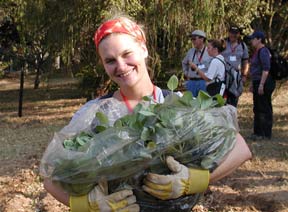
Jennifer Garner of Wichita Falls carries a group of seedlings to the planting beds.First Baptist Church in Wichita Falls sent 108 volunteers to South Africa to plant gardens to help fight the hunger there. (Photos by Eric Garner)

After a day of training, the participants broke into teams of seven to 10 people, who worked with Africans to plant gardens. Some were community gardens, and some were small plots to serve individual families, Minister of Education Walter Gui-llaume reported.

Teams planted gardens with beets, cabbage, lettuce and spinach. Seedlings, not seeds, were planted to expedite the process of getting food to the people. Planting was not done with tilling machines but with hand tools such as picks, hoes and rakes.

“We tried to meet real physical needs while sharing the gospel to meet spiritual needs as well,” Guillaume said. Another facet of the 10-day mission trip was to encourage Christians in the area.

Team members felt an “overwhelming sense of the demonic” in the area, Guillaume said. While he was planting one garden, he could hear the reverberation of drums that villagers told him were part of a witchcraft ritual being held 50 yards away.

Another lasting impression that stayed with Guillaume was the state of the family in Africa.

“There has been a total degeneration of the family unit. The father for the most part is completely absent–he just doesn't exist. He may have died from AIDS, or he may be at the beer hall, but regardless, he wasn't around,” Guillaume said.

AIDS has so ravaged the nation that only children inhabited many of the houses where the teams planted gardens, with no adults living in the huts. Many others contained only children and an elderly woman or man, looked upon as grandparents, whether or not there was any blood relation.

While many studies say that 1 in 4 people are HIV-infected or have AIDS, church leaders in the area believe that 1 in 3 may be a closer approximation, Gui-llaume said.

“We're talking about homes with door frames without doors and window frames without glass –places we wouldn't store our lawn mowers–but are the homes for people,” Guillaume said.

Participants will not soon forget the mission trip, he added.

“It's impacted them in a huge way,” he said. “Many will go back, and others who did not go this time will go when we return. Others will now be supporting financially the missionaries we met there.”

News of religion, faith, missions, Bible study and Christian ministry among Texas Baptist churches, in the BGCT, the Southern Baptist Convention ( SBC ) and around the world.


TOGETHER: Davis Offering makes lasting impact_72505

Posted: 7/22/05

TOGETHER:
Davis Offering makes lasting impact

In a few weeks, the women in your church likely will talk about the Mary Hill Davis Offering for Texas Missions. Every year, Texas Baptists give almost $5 million over and above our regular church budget gifts to make an impact on the needs of Texas. Our WMU leaders have worked especially hard to help Texas Baptists be on the cutting edge of mission advance.

The apartment ministry movement, Rio Grande River Ministry, college scholarships for ethnic students and the surge in church starts in Texas all are trophies for the vision of Texas Baptist women. While continuing to support these efforts, Texas WMU is challenging us with stories about the rise of cowboy churches, about partnership efforts in New England, about training and linking people involved in innovative church plants and responding to the new realities in Texas.

wademug
Executive Director
BGCT Executive Board

When you support our missions offering, you will help prepare training materials to help our church members work directly with at-risk children, youth and families in crisis. Children live near you who do not even know the name of Jesus except as a curse word.

Recently, a kindergarten child discovered her lunch didn't have to come from the dumpster behind the Italian restaurant next to her family's apartment. Because some people in the school cared for her, she got the kind of assistance that is available. Would you know how to help long term with a family in desperate need? That's why WMU is preparing curriculum to help train us to respond to critical needs all about us, including how to access resources.

Did you know that in this state with so much wealth, one of every five children lives in poverty and one in four has no medical insurance? Texas ranks 48th on a list of the best states to raise a child. We are blessed with millions of people who are highly motivated and work very hard, many of them first-generation immigrants. We must learn how to help all our children get the best basic education possible, increase the high school graduation rate substantially and prepare the next generation of leaders for Texas.

One of the ways you can help is to be generous in your giving to the Mary Hill Davis Offering. No gift is too much, and none too small. It all can be translated into putting the heart of Jesus up next to a lonely, frightened, hungry and lost child or even an entire family.

Also, help your church minister to the neediest among us. If not much is being done, don't criticize. Get involved. Our Texas WMU, Texas Baptist Men and BGCT staff can help you get training materials and get connected to activities that will make a present and eternal difference in somebody's life.

We have great BGCT churches. Where God is at work, incredible things are happening. We have grown 3.8 percent in resident membership, 7.7 percent in worship attendance and 2.3 percent in Sunday school attendance. Even though over the past seven years we have lost 830 congregations to another convention–the great majority of those before 2002–we have a net gain of 279 churches since 2000. One of the results is that we have become a younger and a more ethnically diverse convention.

And among the churches related to us, we have increased our missions giving by 14.8 percent. Our Cooperative Program giving is moving back into an upward swing. We are going forward because of the faithfulness of the churches of this convention and the goodness of God to us.

All glory be to God.

News of religion, faith, missions, Bible study and Christian ministry among Texas Baptist churches, in the BGCT, the Southern Baptist Convention ( SBC ) and around the world.


El Paso store offers needy women on-the-job training_72505

Posted: 7/22/05

El Paso store offers needy
women on-the-job training

By Jocelyn Delgado

Communications Intern

EL PASO–A new grocery store opened in El Paso, but it's not in business to make money. Its goal is to provide job training for women seeking to turn their lives around.

The Christian Women's Job Corps of El Paso opened Mi Tiendita Favorita–My Favorite Little Store–to give graduates of its program a practical means to continue their training.

It's the first such store of its kind in the nation operated by Christian Women's Job Corps, a ministry of Woman's Missionary Union. Texas Baptists help support the program through gifts to the Mary Hill Davis Offering for Texas Missions.

Mary HIll Davis Offering for Texas Missions

The store aims to offer products as a full grocery store would. Customers can find a variety of produce, grocery and household goods at lower prices.

Since it's a nonprofit organization, profits go toward maintaining the store.

Last February, Coordinator Paula Jeser brainstormed with Randy Rankin, president of Lee and Beulah Moor Children's Home, to find a way to make sure her graduates got jobs. Although the school offered job training, students rarely continued their education to receive a high school diploma equivalency certificate. In the past year, Jeser only knew of two graduates who had earned a diploma.

For 13 weeks, Jeser tried offering classes to prepare for high school diploma equivalency exams, but students couldn't get beyond the first stage, she said. On average, women come to the program with a third grade education, she said.

Companies wouldn't hire students without a diploma, so Jeser and Rankin found a loophole. Working at the grocery store, women would receive on-the-job training required for employment.

Four months ago, the El Paso Empowerment Zone gave the children's home $150,000. The children's home in turn donated the money to build the 1,200-square-foot store and stock its shelves.

Local retail stores agreed to hire students after they have worked 20 hours a week for a year. One local real estate manager's association approached Jeser with a plan to offer free apartment management training so woman had more options.

During the ribbon-cutting ceremony for the store, Jeser gave graduates butterfly pins to signify their transformation.

The women came in as an egg on a leaf, as they hatched into caterpillars they began to learn, and finally transformed into butterflies, she said.

“Now they're going to spread their wings, and we're going to watch them fly,” she said.

News of religion, faith, missions, Bible study and Christian ministry among Texas Baptist churches, in the BGCT, the Southern Baptist Convention ( SBC ) and around the world.


Lubbock ministry meets needs, changes lives_72505

Posted: 7/22/05

Lubbock ministry meets needs, changes lives

By Jocelyn Delgado

Communications Intern

LUBBOCK–Soon after graduating high school, Tanji Lamar was pregnant and living in an abusive relationship. She always planned to attend college, but after seven years, she thought it never would happen.

Once Tanji Lamar thought she never would go to college. Three months after she entered Christian Women's Job Corps, she graduated with a plan for her future.

Depressed, angry and not knowing what else to do, Lamar decided to follow her stepmother's advice and enroll in Christian Women's Job Corps.

“At first, I didn't want to come, because I felt like a failure,” Lamar said. “I was in a miserable situation.”

She arrived at the Living and Learning Center of My Father's House-Lubbock without an appointment and signed up for Christian Women's Job Corps. Upon graduating from the program in May, Lamar had a plan and enrolled in South Plains College to study medical transcription.

Christian Women's Job Corps is a ministry of Woman's Missionary Union of Texas, supported through gifts to the Mary Hill Davis Offering for Texas Missions. The Baptist General Convention of Texas helped finance the development of the Living and Learning Center of My Father's House-Lubbock, and the BGCT Church Facilities Center designed it.

Lamar benefited from My Father's House-Lubbock's growing ministry. The nonprofit organization recently received enough money to build a black iron security fence around its four-acre complex and add a residential building with 18 two-bedroom apartments.

After raising funds for the fence, the center had twice the amount originally needed. God blessed by providing money, said Shirley Madden, executive director of My Father's House-Lubbock. Now leaders are looking to add a counseling center and equipment for laundering services. A counseling center would cost $45,000 to operate for one year.

“Women that we work with are significantly burdened with their history,” Madden said. The center “would help them heal from a lot of that dysfunction,” she explained.

Recently, My Father's House-Lubbock partnered with Texas Tech University's medical school to begin offering daily triage health care for students and their children.

Aside from attending classes, students help keep the campus running smoothly by working for laundering services, the daycare center and the housekeeping staff.

This three-month vocational school offers classes to prepare women not just for a career but for life.

My Father's House-Lubbock offers communication classes in which women learn how to talk to someone without getting angry or how to establish personal boundaries, said Martha Head, the house's assistant director.

The mission is to help women in need of mental, emotional, spiritual, educational and vocational support, Head said. Students benefit from all the school has to offer free of charge, but it is not just another shelter.

“It's about women who want to change,” Head said.

News of religion, faith, missions, Bible study and Christian ministry among Texas Baptist churches, in the BGCT, the Southern Baptist Convention ( SBC ) and around the world.


Worship–carefully blended or just bland?_72505

Posted: 7/22/05

Worship–carefully blended or just bland?

By Ken Camp

Managing Editor

Like a blank screen on which people project their own ideas, blended worship has become a catchall term that defies easy definition.

Music Minister Chuck Bridwell of Columbus Avenue Baptist Church in Waco attended a conference for worship leaders a couple of years ago. A seminar leader invited a dozen participants to introduce themselves and tell about the worship styles of their churches.

“All of them said their churches had blended worship,” he recalled. “I knew several of them, and I knew how different they were from each other.”

Clell Wright, head of the church music department at Hardin-Simmons University, teaches aspiring church musicians a variety of styles.Photo courtesy of Hardin-Simmons University

Bridwell, who has been at Columbus Avenue six years, describes worship services at his church as “hymn-based blended.” At University Baptist Church in Coral Gables, Fla., where he served 24 years, the blended service leaned more toward praise and worship contemporary music, with one or two hymns included.

Trent Blackley, minister of music at First Baptist Church in Sunnyvale, described the worship services he helps to plan as blended, but he acknowledged they can vary widely from one week to the next.

If members “hang on long enough,” most will be satisfied one Sunday and have “ruffled feathers” another week, he said.

“I try not to pay attention to counting how many hymns or how many choruses are in any given worship service,” Blackley said. He views different musical styles as varied colors on a palette he can use to paint an environment for worship.

“Most of our services have a central theme. I choose from my palette what I think is the best that can be brought to reinforce the message,” he said.

Randall Bradley, church music professor at Baylor University, prefers that kind of intentionality in blended worship to the lowest-common-denominator approach some churches follow.

“There are all kinds of blends. There's the blend where all of the components retain their distinctive qualities, or there's the kind where it's all mellowed out, bland and colorless,” he said.

“It's the difference between a plate of carrots, peas and other vegetables that retain their distinctive colors and flavors, as opposed to what happens when they're mixed together in a bowl of soup.”

Bradley pointed to the need for connecting elements–a subtle theme, a logical progression and a narrative flow–that bring together diverse worship elements into a unified whole.

“Blended can mean woven together carefully with points of connection. It's like a patchwork quilt of distinctive elements, drawn together into a pattern with connections that bring it all together,” he said. The alternative is “blended as in a blender, where it all comes out as mush.”

Clell Wright, head of the church music department at Hardin-Simmons University, doesn't like the “blended worship” label.

“It indicates a watering down of styles and genres. When you blend ingredients into a cake, you mix them and they lose their identity. It carries a negative connotation of trying to appease a certain group,” Wright said.

“Instead, I believe we should celebrate diversity in worship. Realize the body of Christ worldwide is diverse. Different cultural backgrounds, different ethnic backgrounds all are appropriate and can be used in worship.”

Even so, he does not suggest a wholesale, rapid shift from familiar gospel songs or traditional hymns to a worship style that seems totally alien to a congregation.

“We worship God out of the background of who we are. We are shaped by culture. First, we worship God out of that which is familiar to us,” Wright said.

“We have to be comfortable in the language in which we worship God, and music is a language. … The makeup of the congregation should be reflected in the way they worship.”

Each congregation will express worship in its own way, said Tim Studstill, director of the Baptist General Convention of Texas Center for Music and Worship.

“Each congregation has a different language of worship, and there are many different dialects of worship. Many congregations need to be taught a new vocabulary of worship so that they may more fully express their worship to the Lord,” Studstill said.

“This vocabulary consists of contemporary music, great hymns of the faith, new music that is appropriate for a specific congregation and every style in-between.”

To discover the right blend appropriate for a given congregation, a worship leader must know the congregation well, said Bradley, who serves a worship leader at Calvary Baptist Church in Waco in addition to teaching at Baylor.

“All worship planning is pastoral,” he said. “The task is to bring God to people you know and love deeply. … You can't take worship from church A and impose it on church B. Worship planning needs to be within the context of community. It is for these people on this day at this point in history–not just dropped in.”

News of religion, faith, missions, Bible study and Christian ministry among Texas Baptist churches, in the BGCT, the Southern Baptist Convention ( SBC ) and around the world.


Cowboy churches tweak twangy tunes to share Christ_72505

Posted: 7/22/05

The band at Bull Creek Cowboy Church in Lone Oak shares a gospel message delivered to a familiar country tune.Photo by George Henson

Cowboy churches tweak
twangy tunes to share Christ

By George Henson

Staff Writer

LONE OAK–Many western heritage or cowboy churches are taking a page from history and converting the tunes of the barroom for use in the church house.

“That's the nature of the cowboy church–taking Top 40 country songs and tweaking the words to make them have a Christian message. I think hearing the tunes of songs they are comfortable with makes coming to church much more comfortable for some people,” said Tammy Marler, the band leader at Bull Creek Cowboy Church in Lone Oak.

John David Walters, band leader and lay pastor over music at Ranchhouse Cowboy Church in Maypearl, agreed.


Baptist Standard News by the Ranch House Ranch Hands (length 3:13)

“It's really what you'd call standard operating procedure for cowboy churches,” he said. “I've rewritten 10 to 15 songs myself that we use from time to time.”

For example, on a recent Sunday morning at Bull Creek, the church sang a medley of songs that included “Amazing Grace,” “I Saw the Light” and “When the Saints Go Marching In.” Also included, however, was a song called “Cowboys for the Lord” written by band member Bob Ferguson to the tune of “Ghost Riders in the Sky.” The pop tune “Wind Beneath My Wings” also had some words changed to make it a song that glorified God.

Band member Buk Aucoin sang a song by Cross Canadian Ragweed titled “Faith is Believing.”

Walters strays a little more in his rewrites, with Dr. Hook and the Medicine Show's standard “Cover of the Rolling Stone” converted to “Baptist Standard News,” and the tune of the Charlie Daniels Band's “Long-Haired County Boy” rewritten with the words of “Jesus Did It On His Own.” He also has a completely original tune called “Duct Tape and Baling Wire.”

“I grew up kind of bouncing 'round Baptist and Methodist churches, and the music never grabbed me the way the country music did,” Walters said. “But people will be sitting in the pews and say, 'Wait a minute. I know that song or that tune.' And they'll listen to the message it has.”

“We take a lot of beer-drinking songs and use them to communicate the gospel,” he explained.

Marler said the method is historically sound.

“This isn't really anything new; a lot of the hymns were written to the tune of bar songs,” she said.

Another thing that harkens back to history is that the music is led in large part by talented, but untrained, musicians. Not many cowboy churches use pianos or organs but lean heavily on guitars and other stringed instruments.

Marler said it sometimes takes a little longer to prepare a piece for use on Sunday because most of the musicians play by ear.

All are very talented, Marler said, and the effort is made to allow each of the group of about 10 to showcase his or her talents.

While Marler had a contemporary Christian music ministry and sang in numerous churches over the course of 10 years, she admits that being the lead for the group in the cowboy church was a little unnerving.

“I had grown up in Baptist churches and sang primarily in Baptist churches during my ministry, but this was a different kind of church and a different way of doing things. We had a bunch of cowboys who pretty much led out, and I was a little uncomfortable in the beginning, but it's worked out great,” she said.

While cowboy churches have common traits, they also are as individualistic as the people who sit in the chairs.

“Every cowboy church has its own style and its own way of doing things,” she said. “Here at Bull Creek, we are a very diverse group. Some are really cowboy, and some are just small-town people who feel comfortable with this style of worship. My job is to meet everybody's needs and make them as happy as I can.”

Walters said the most important thing is for the music to communicate the gospel of Jesus Christ.

“If the preacher comes down with laryngitis, the people are still going to get a taste of the gospel,” he said.

News of religion, faith, missions, Bible study and Christian ministry among Texas Baptist churches, in the BGCT, the Southern Baptist Convention ( SBC ) and around the world.


Worship styles reflect cultural differences_72505

Posted: 7/22/05

Worship styles reflect cultural differences

By Ken Camp

Managing Editor

WACO–Critics of separate contemporary and traditional worship services maintain they result in distinct congregations meeting under the same steeple, but a Baylor University music professor insists that's not necessarily a bad choice.

“Doing many different styles of worship is similar to doing multicultural worship,” Randall Bradley said.

The cultural differences reflected in worship styles may be as deep as the differences in language and nationality, he suggested.

“When we have a Korean congregation and a Spanish-speaking congregation using the same facility as a predominantly Anglo church, that's applauded as effectively sharing resources,” he observed.

Even so, expediency and efficiency are not the highest goals, he noted.

“There is value in community,” he said. “Ideally, we decide we are going to be together and respect our differences. We allow the different ways people want to worship, with the understanding we'll honor different people's preferences at different times.”

News of religion, faith, missions, Bible study and Christian ministry among Texas Baptist churches, in the BGCT, the Southern Baptist Convention ( SBC ) and around the world.


DBU launches master’s degree program in worship leadership_72505

Posted: 7/22/05

DBU launches master's degree
program in worship leadership

By Jocelyn Delgado

Communications Intern

The difference between a new master of arts in worship leadership at Dallas Baptist University and any other ministry degree is a focus on worship from a theological, pastoral and practical perspective, university officials agreed.

“A lot of degrees include worship as a component of that particular degree, but this particular degree is specifically on worship,” said Bob Brooks, dean of fine arts at DBU.

To provide another option for students called to the ministry, DBU President Gary Cook wanted to add a program focusing on worship. After a couple years, the idea came to life when Cook asked Larry Ashlock to direct the degree program.

“It's practical theological training for students who aren't able to go to seminary,” Ashlock said.

The program is practical in part because the faculty are experienced in the university classroom and on church staffs as worship leaders, he explained.

Students take 42 hours of courses such as biblical servant leadership, systematic theology and the worshipping life. The program is structured to show worship is more than making music. In fact, the program doesn't include any musical training.

“It is not a music degree at all,” Brooks said. “With this particular discipline, people can come from many other disciplines.”

It appeals to a variety of students, with both a general track and pre-doctoral track.

The program is designed to help students working toward diverse worship careers prepare for their calling, Brooks said.

In the midst of that diversity, students can learn how to avoid becoming casualities in worship wars–heated differences over styles and approaches to worship, he added.

“When people really have an understanding of how we go about worship … all those petty controversies seem to go out the window,” Brooks said.

News of religion, faith, missions, Bible study and Christian ministry among Texas Baptist churches, in the BGCT, the Southern Baptist Convention ( SBC ) and around the world.


Culture wars may be deeper church dividers than worship wars_72505

Posted: 7/22/05

Culture wars may be deeper
church dividers than worship wars

By Ken Camp

Managing Editor

WACO–Culture wars threaten to divide churches in ways that make worship wars pale in comparison, but at the same time, they unite some Christians across denominational lines, a Baylor University professor observed.

Rather than dividing over worship style preferences, Terry York sees Christians in the United States splitting into two camps–“those who want to try to re-establish Christendom and those who refuse to wrap the cross in the flag.”

Terry York

While the division began to emerge more than 25 years ago when the Religious Right took shape, it surged and solidified following the Sept. 11, 2001, terrorist attacks on the World Trade Center and the Pentagon, said York, associate professor of Christian ministry and church music at Baylor University and its Truett Theological Seminary.

The urge to rally around the flag as part of corporate worship cuts across denominational differences and draws all kinds of worshippers, he noted.

“Fighting over what songs we sing pales beside the clash of kingdoms, and this is a kingdom clash,” he said.

Ironically, the rush to wed patriotism and worship has led to alliances across denominations and drawn followers from a variety of worship style traditions, he added.

York sees nationalism reflected in musical selections, symbols in a church's sanctuary and in sermons. “If you're not following the lectionary and the Christian calendar, how about letting Fox News tell you what to preach about this Sunday?”

In contrast, other churches reject the nationalistic approach, and they range from traditional Baptist churches to postmodern emergent churches.

The division between the two church models–nationalistic and non-nationalistic–does not fall entirely along partisan political lines, and many Christians who reject the nationalistic approach to worship are fiercely patriotic, said York, an ex-Marine who grew up in a military family.

“If a military officer came in the room, I would stand up. But if Jesus walked in, I would fall down on my face,” he said. “It's all about knowing the difference between what we stand up for and what we bow down to.”

Nationalistic worshippers confuse respect and reverence “because they live next door to each other in the deepest places of our hearts,” York said. “The things we're willing to go to war for and that which we worship are the extremes, and they live close together.”

News of religion, faith, missions, Bible study and Christian ministry among Texas Baptist churches, in the BGCT, the Southern Baptist Convention ( SBC ) and around the world.


Hymns make a comeback, but they might sound different_72505

Posted: 7/22/05

Hymns make a comeback, but
they might sound different

By Ken Camp

Managing Editor

With contemporary Christian recording artists like Jars of Clay and MercyMe's Bart Millard recording hymn collections, some observers of worship trends have asked if hymns are ready to stage a comeback in churches.

Probably, some music ministers and professors of church music agree, but worshippers brought up on the 1956 Baptist Hymnal might not recognize them.

“I don't see a return to the hymnal. I do see a return to hymns,” said Randall Bradley, church music professor at Baylor University.

Randall Bradley

Instead of singing from a book, worshippers follow words projected on a screen, he noted. The setting and arrangement of the hymn tune may be updated, and instruments used may be a guitar and drums instead of organ and piano.

“The churches that are beginning to embrace hymns are the churches where hymns are seen as fresh and new,” said Bradley, who leads worship at Calvary Baptist Church in Waco. “We're seeing hymns reframed and recast. … The resurgence of hymns is in places where they have been absent.”

These include both postmodern emergent churches that are reclaiming ancient hymns from early church history and some churches that have used mostly contemporary praise and worship choruses.

“In the last 20 to 25 years, there was a rejection of history and heritage” in worship, said David Music, church music professor and director of graduate studies in Baylor University's School of Music.

Worship in emergent churches reflects “a return to respect for heritage, but it's much more ancient” than 19th century gospel songs many Baptists of the mid-20th century grew up singing.

Music sees the “ancient-future” worship style of postmodern churches as a healthy sign.

David Music

“It recognizes Jesus wasn't crucified in 1995. There's 2000 years of church history, and we can draw on the complete heritage,” he said. “That's a welcome sign. It's a return to the idea that we are for all time, but at the same time, it recognizes God is still doing something new with and among us.”

Some churches whith contemporary choruses have begun to find a place for hymns, said Clell Wright, head of the church music department at Hardin-Simmons University.

“As pastors want to improve the depth of services, they realize hymn texts are filled with theology,” he said.

At the same time, even in the praise and worship movement, there has been a movement to incorporate hymn texts into new settings, Wright observed.

“Praise and worship itself is doing more with hymn texts,” he said. “There's been a development in praise and worship music, and the texts have gotten much deeper over the last decade.”

Using familiar texts with contemporary instruments and updated arrangements has been one way some churches have bridged generational divides in blended worship, said Trent Blackley, minister of music at First Baptist Church in Sunnyvale.

“We're finding a lot of common ground with that approach,” Blackley said. “It's working really well for us.”

News of religion, faith, missions, Bible study and Christian ministry among Texas Baptist churches, in the BGCT, the Southern Baptist Convention ( SBC ) and around the world.