National champion HPU, opponents join in prayer at center court

Posted: 4/15/08

Players and coaches from Howard Payne University and Hope College (Mich.) join hands to pray the Lord's Prayer at center court in Brownwood Coliseum moments after the HPU Lady Jacket's 53-49 win in the NCAA Division III women's basketball tournament. Of more than 3,800 women's and men's basketball teams at all levels of NCAA, NAIA and other intercollegiate associations in the nation, the Lady Jackets remain the only undefeated team with a 33-0 record. They won the NCAA Division III national championship. (Photo by Jessica Melendrez)

National champion HPU, opponents
join in prayer at center court

By Mike Lee

Howard Payne University

BROWNWOOD—The two teams each carried a 30-0 record. The stakes were high. The intensity was undeniable.

The No. 2-ranked Howard Payne Lady Jackets hosted the No. 1 Hope College (Mich.) Flying Dutch in a physically punishing game that left HPU forward Hope Hohertz with a concussion and center Stacey Blalock with a black eye.

In what would be the closest game all season for the national champion Lady Jackets, Howard Payne rallied for a 53-49 win to earn a berth in the NCAA Division III women’s basketball Final Four. HPU’s players, coaches and fans were ecstatic. Hope’s players, coaches and fans were heartbroken.

But within three minutes of the final horn, every player and coach from both teams stood and held hands in the center of the coliseum floor, reciting the Lord’s Prayer.

“The Hope game was as powerful and emotional as it gets,” said eighth-year HPU head coach Chris Kielsmeier, whose Lady Jackets eventually won the NCAA III championship with a 33-0 record.

“Two good teams laid it all on the line for their universities. One moment, you’re caught up in the intensity of the game. Then a minute later, you’re standing and praying together. That shows the true good in this world.

“The Hope players were disappointed, and I don’t know that any of them said a word. They didn’t have to. It was just the fact that they were standing in the circle and praying with us.”

Kim Hoffman, a senior forward for HPU, said the postgame prayer helps put basketball in perspective.

“When players from the other team pray with us, it makes us feel like one. The Lord and our faith come first. We all know the Lord gave us our talents, and if it wasn’t for him, we couldn’t do the things we do. We always try not to lose sight of that,” Hoffman said.

The postgame prayer has been a tradition after HPU women’s home games since John Nickols became the Lady Jackets’ head coach in 1995. Nickols and his successor, Mike Jones, led an unrehearsed prayer after home games.

“The year after I retired from high school coaching, I spent a year as a volunteer assistant men’s basketball coach at Southwestern Assemblies of God University” in Waxahachie, said Nickols, now an assistant professor of history and political science at HPU. “The head coach, Steve Garippa, did a postgame prayer, and it always stayed in the back of my mind.

“When I came to Howard Payne, I told our women it (postgame prayer) would be something good to represent the university. I’m prouder of starting that than anything I’ve done at the university.”

Although HPU home crowds aren’t praying within the circle, fans are respectful of the postgame prayer. Fans often are celebrating loudly in the moments immediately following a game. When they become aware of what’s taking place on the court, they observe silence and resume their celebration after the Lord’s Prayer.

“If you’re outside the building when a game ends, you would wonder what’s wrong,” Nickols said. “They’re screaming and celebrating, and then it just goes quiet. It’s like a switch going off. Even with the intensity of the Hope game, the fans were quiet during the prayer.”

When Kielsmeier succeeded Jones as HPU’s head coach in 2000, he modified the postgame prayer by joining the players in reciting the Lord’s Prayer. He said this was the first season in which every team to visit the Brownwood Coliseum chose to join HPU’s players and coaches in the postgame prayer.

“Prayer is a very powerful tool in our program,” said Kielsmeier, voted the NCAA III national coach of the year. “We pray before and after every game, and we have a devotional before every home game in the locker room. The Lord’s Prayer is a neat thing because it’s shared with the other team and the fans.”

News of religion, faith, missions, Bible study and Christian ministry among Baptist churches, in Texas, the BGCT, the nation and around the world.


A closer look at BGCT institutions

Posted: 4/16/08

A closer look at BGCT institutions

The Baptist Standard is cooperating with the Texas Development Officers Association in using the Standard's back page to inform, educate, and inspire Texas Baptists about the spectrum of ministry needs and philanthropic tools available to donors. Whenever a Texas Baptist institution publishes an ad on the back page of our print edition, we'll reproduce the full ad on our website and provide a link to resources that donors can take advantage of.


Click to see full-sized ad from 4/14/08n print edition.
Children at Heart Ministries

Based in Round Rock, Texas, this ministry provides a constellation of services for children.

www.childrenatheartministries.org, and Children at Heart Foundation.

News of religion, faith, missions, Bible study and Christian ministry among Baptist churches, in Texas, the BGCT, the nation and around the world.


Books for the Border brings Bibles, books and smiles to Eagle Pass

Posted: 4/18/08

Books for the Border brings Bibles,
books and smiles to Eagle Pass

By Carol Gene Graves

Literacy ConneXus

EAGLE PASS—Lester Meriwether believes every child deserves to grow up in a home with books.

So, when he and 10 other volunteers from Western Hills Baptist Church in Fort Worth traveled to Eagle Pass to work on homes still in need of repairs after a tornado last year, his group also helped build up the ability of those households to nurture learning.

Chris Cobb, pastor of Western Hills Baptist Church in Fort Worth, chats with Carol Prevost of the Cooperative Baptist Fellowship during a family reading fair in Eagle Pass.

Literacy ConneXus, a nonprofit organization Meriwether directs, partnered with Western Hills, First Baptist Church of El Paso and others to sponsor a family reading fair.

“The presence of books in a child’s home makes a significant difference in the development of the child’s capacity to learn,” Meriwether explained.

“Research indicates that children who are read to at an early age develop greater capacity for learning than those who are not. It’s not rocket science; it’s just science. And it’s good common sense, too. The problem is that poverty and other factors limit the access of too many children to the fundamental experience of early literacy.”

The family reading fair aimed to get books into the homes of 16 low-income families in Maverick County. Each family received a bookcase that church volunteers had constructed and painted. To encourage ownership, each child decorated his or her own bookcase with stickers, stamps, and paints and then received seven children’s books and two Bibles to place in it.

When Burt Gilliland, one of the volunteers, was growing up, he was great with a basketball but not with books. He was a well-respected athlete, admired by many on and off the basketball court and the golf course.

But few knew the embarrassment he felt when he had to leave his classmates and trudge down the hall to the “special reading classroom.” Burt had literacy needs that went unmet until he was an adult.

“Because of my background, I was eager to go to Eagle Pass … and share books and Jesus’ love with needy children and their families,” Gilliland said.

In Eagle Pass, AVANCE—a nonprofit program to benefit low-income Hispanic families with young children—was a natural starting point to encourage family literacy.

Twenty-five families are already participating in the AVANCE Parent-Child Educational Program, geared toward low-income families with children 3 years old and younger.

Teresa Sanchez, executive director of AVANCE-Eagle Pass, watched the excitement grow, leading up to the book fair.

“Behind every book, there is a child who is eager to learn, and behind every child is a parent who unselfishly teaches his or her child the love for books,” she said.

Lucia Martinez, a mother of three daughters and one son and a participant in the AVANCE program, knows that reading to her children gives them a good example to follow.

“This new library in our home will encourage us all to read more,” Martinez said. 

Struggling with her English but beaming with joy, Blanca Ramirez, expressed her appreciation for the program. “These books will be a foundation for time spent together as a family for reading. Reading together will give us more unity as a family.” 

Ramirez reads to her almost five-year-old daughter, Regina, who speaks and reads English well. She laughs as she admits that her daughter is quick to correct her, but this helps the mother develop her own literacy skills.

Books for the Border is a collaboration of Literacy ConneXus, churches, and community groups who together can make an impact on Texas children and families trapped in generational poverty because of unmet literacy needs. The initiative focuses on families in Dimmit, Hidalgo, Maverick, Presidio, Starr, Zavala, and Willacy counties.

After consulting with community partners, Meriwether determined that providing books for families living in poverty is a strategic first step for developing family literacy programs, resulting ultimately in lifting families out of poverty.

The Eagle Pass Family Reading Fair served as a demonstration model Meriwether anticipates will be adopted by other churches.

“Our intent is to heighten awareness for those held in poverty throughout our state and that participating churches will return to their own communities with a fresh heart for the poor and illiterate in their own communities and elsewhere,” he said.

News of religion, faith, missions, Bible study and Christian ministry among Baptist churches, in Texas, the BGCT, the nation and around the world.


DBU students plug in for a word from God

Posted: 4/18/08

DBU students plug in for a word from God

By George Henson

Staff Writer

DALLAS—Dallas Baptist University is the first university to try a novel approach to connecting techno-savvy students with the word of God.

About 1,200 audio New Testaments were given to students at chapel on a compact disc recorded in an MP3 format. Students could then either listen to the CDs on their computers or download them to their personal MP3 players.

Worris Levine (left) and Kyle Worley of Dallas Baptist University enjoy listening to the New Testament on an MP3 player.

Faith Comes By Hearing, the provider of the audio version, divided the New International Version New Testaments into 40 28-minute listening segments.

“It’s a cast-your-bread-upon-the-waters-type program,” Bob Garrett, director of DBU’s master of arts in global leadership program, and the faculty coordinator for the audio Bibles said. He said that while no great efforts were made to track how many students took part in the “You’ve Got Time” project, he was sure any who did benefited.

The school’s website also presented a link to a free download of the audio New Testament for those students who were not in chapel when the CD was distributed.

Feedback from students affirmed that for some, it was a meaningful ministry. Distribution day was Ash Wednesday, and “some did it for Lent as an exercise for remembering Jesus during that special time of year,” Garrett reported.

Forty-three students also requested daily e-mail reminders to spur them in their quest to faithfully listen.

A smaller number of students also were provided Biblesticks, a dedicated MP3 device with the New Testament already loaded onto it. About 100 went to students who traveled to Guatemala for a spring break mission trip and another 150 to international students as they used them to improve their English skills. The group that traveled to Guatemala also took 200 of the Biblesticks with the New Testament spoken in Spanish. Faith Comes By Hearing has recordings of Scripture in 288 languages.

Dallas Baptist University offered a free download of the audio New Testament on its website, encouraging students to listen to it for 40 days.
See Related Articles:
• DBU students plug in for a word from God
Plano church benefits from something old, something new

“It was great to see the students use them on the plane to Guatemala and then again on our way home,” Garrett said.

“We thought of this as a new way to insert the Bible into students’ daily lives,” he said. “Hearing Scripture in a chronological way allows Scripture to wash over your life in a simply beautiful way.”

As a personal example, Garrett said he found it particularly meaningful to listen to all four Gospel accounts of Christ’s arrest, trial, crucifixion, burial and resurrection on the days encompassed by Maundy Thursday through Easter. “It was a significant time for me,” he said.

For students, making the Bible accessible in a way they are accustomed to receiving information was an effort to have them delve into it more often.

“They can use this while their jogging or on the treadmill. This gives them a way to reprogram their way of doing things to hear the word of God rather than the latest ‘ya-ya song,’ and that has to be good,” Garrett explained.

Some groups of students have met to listen to the readings and then discuss the Scripture, he noted.

Long-time DBU benefactors Paul and Shirley Piper led the school to the cooperative effort with Faith Comes By Hearing. The Pipers provided the funding for the Biblesticks and brought the concept to the school’s attention.

The tool of an audio Bible is a good match for the students of today, Garrett said.

“There’s a convergence of technology and a renewed spirituality that makes this very attractive,” he said. “Young people may have questions about this church or that church or this leader or that leader, but they also have a yearning to increase their love for the Lord, and this is really a good match to help them with that. I wholly encourage other universities and other student organizations to try this approach.”

Students Libby Barnard of Dallas and Kendra Roberts of Garland found listening to the audio Bibles an asset to their spiritual walk. A spring break trip took Barnard to Israel, along with her MP3 player.

“I would be walking in the Kidron Valley, and in my earphones I would hear someone say, ‘as they walked in the Kidron Valley’ It really made it come alive for me,” she said. “It made it that much more special to not only be in the Holy Land, but also to hear the voices telling the story of Jesus.”

Roberts listened primarily through her laptop computer, often while she was cleaning her room. “Sometimes I get distracted when I’m reading, but the voices make it come alive. I also have realized that I remember much better by hearing it spoken,” she said. The English language recording employs 181 people to render the different characters voices.

Barnard acknowledges that sometimes she would listen rather than read during her quiet times and she questioned, “Am I cheating?”

“Sometimes I do just listen, but I really do think it’s really about spending time with the Lord,” she said. And she has increased her time with Scripture. “I know it’s a hard word, but I think it’s almost addictive.”

“We’re always listening to something,” Barnard added. “So, it’s just a matter of choosing what you’re listening to.”


News of religion, faith, missions, Bible study and Christian ministry among Baptist churches, in Texas, the BGCT, the nation and around the world.


Plano church benefits from something old, something new

Posted: 4/18/08

Plano church benefits from
something old, something new

By George Henson

Staff Writer

PLANO—Prairie Creek Baptist Church in Plano used a pairing of new and old technologies to meet the needs of people its pews and also those in its surrounding neighborhoods. Pastor Bobby Bressman likened the plan to respiration—Bible in, reach out.

Prairie Creek partnered with Faith Comes By Hearing to secure audio New Testaments for the congregation, recorded on CDs in an MP3 format. Church members were challenged to read or listen to the entire New Testament, memorize a promise of God and attend a small group Bible study once a week.

The goal was not for growth in numbers but a growth in spirit, Bressman said—revival in its truest form. At the beginning of the year, members were given small cards folded into tents. If they wanted prayer for revival in their own life, they were asked to write just their initials at the top of the card. If they knew a non-Christian who needed prayer for his or her salvation, they put that person’s initials below the fold.

See Related Articles:
DBU students plug in for a word from God
• Plano church benefits from something old, something new

“We didn’t put any private information on those cards—no names. We didn’t want to take the chance of embarrassing anybody. God already knows their names,” Bressman said.

Twenty days after the kickoff of the Bible reading/listening emphasis, the church began 20 days of calling 5,000 homes in the immediate area of the church. The church received those names from Harvest Unlimited.

Harvest Unlimited is a ministry that supplies churches not only with names and telephone numbers of people living nearby, but also provides training and resources to the congregation to best utilize the numbers.

“It was really great,” Bressman said. “They come in and train your people on how to make effective phone calls and provide the computer programming for tracking the results.”

In addition to making invitations to a “harvest Sunday” meal, callers also invited people with whom they spoke to tell them about any prayer requests they had. A prayer team then prayed for the requests and sent a follow-up card.

Prairie Creek’s experience with the call and prayer centers was tremendous, Bressman said. While make the calls, they spoke with 2,279 adults—41 percent who said they had no church affiliation. Of those unchurched households, 43 percent said they were interested in more information about the church.

“When we spoke to someone who obviously had a relationship with a church, we told them: ‘We don’t want to interrupt your worship at all, but we have a team here that is ready for any prayer requests you might have. Is there something we can pray with you about tonight?” he said.

More than 500 of the people spoken to told the caller of prayer requests the congregation was able to pray and follow up on—about 60 percent of those who attend churches and about half who did not attend churches gave the church things to pray with them about.

“And the interesting thing to me was that it wasn’t ‘pray for the troops in Iraq’ or ‘pray for the president.’ It was, ‘It’s a miracle you called today—my niece was diagnosed with leukemia today,’ or ‘My son died today.’ They were very specific prayer requests,” Bressman explained.

That evening a hand-written note was sent out by a member of the prayer team to let the person know someone had taken the request seriously, he added.

The prayer team also evaluated each request as to how much follow-up was needed.

“If someone told us, ‘Pray I can get these kids down to sleep,’ we did that, but it did not require a follow-up beyond that first evening. But if someone told us that they were searching for a job, we not only sent out that first note, but also maybe three others over a period of time,” Bressman explained.

One lady’s response to the invitation to the harvest dinner was particularly memorable to Bressman. “She told us: ‘I would love to come to the dinner, but someone shot my back door out. I can’t afford to replace it, and I’m afraid to leave my home unguarded.”

When Bressman told the congregation about the call, a collection immediately was taken to replace the door. Included in that collection was a donation by Bressman’s young son, who wanted to contribute what he had. When the pastor took the collection to her, and explained that they wanted to replace her door, she told him she had taken her utility money and replaced it because she was too afraid to wait.

“That’s fine,” Bressman told her. “We’ll pay your utilities.”

When the church received the woman’s utility bills, they totaled the exact amount collected by the offering.

“Without my son’s offering, it would have been short,” Bressman reflected.

The woman has been coming to Prairie Creek ever since, he added.

The church also spent concentrated times of prayer during Sunday services, he noted.

“I would say: ‘If you’re praying for revival, gather over here to the left. If you’re praying for a specific need in your life of the life of someone else, gather over here.’”

During that time, the tent cards were displayed across the front of the sanctuary as a physical reminder of the need for revival and salvation.

In addition to people invited to the harvest meal by the telephone team, the congregation was asked to also invite “just one.”

“We told them: ‘If we can call 5,000 strangers, can’t you call a friend or a neighbor? Can’t you call just one?”

The harvest dinner included those invited by the congregation as well as those on the telephone and prayer teams and the just ones. The dinner drew 145 people.

Also during the 40-day emphasis, 40 registered guests attended the church that averages about 215 in worship.

While the phone lists did come with a fee, Bressman said they would be used again and again in preparation for special events.

“What we’re finding is that a lot of people just need an invitation,” he said.


News of religion, faith, missions, Bible study and Christian ministry among Baptist churches, in Texas, the BGCT, the nation and around the world.


DBU president credits prayer with institutional, personal healing

Posted: 4/18/08

Dallas Baptist University President Gary Cook (3rd from left) and his wife, Sheila (4th from left) pose with children Nicole Cook (left), her husband, David (2nd from left), and son, Mark (right) and David Hasan (2nd from right), who became a Christian during his time as an international student at DBU. In the process, the Cooks adopted him into their family, spending holidays with him and keeping in touch with him.

DBU president credits prayer
with institutional, personal healing

By Ken Camp

Managing Editor

DALLAS—When Gary Cook became president of Dallas Baptist University 20 years ago at age 37, most of his friends counseled him against taking the position. They told him it was a career-killer. Some said the financially troubled school didn’t have a prayer.

So, Cook immediately fixed that. As one of his first official acts, he established an on-campus prayer ministry.

Two decades later, he believes prayer not only brought health to the institution, but also provided healing for his own body when he faced a life-threatening illness.

“When we started the prayer ministry, I never dreamed I would be the recipient of its benefits,” he said, pointing to an outpouring of prayer support after his diagnosis with acute myelogenous leukemia last October. A bone marrow biopsy and subsequent tests five months later confirmed the leukemia is in remission.

In April 1988, Cook took the reins of a school plagued with financial woes and internal struggles. DBU owed $5.7 million and had no line of credit. Its business office normally waited 90 days, after a third notice, before paying bills.

“Prayer made all the difference,” he said. “We pleaded with the Lord to do something miraculous. The truth was, we didn’t have anyone else to turn to.”

Indeed, longtime benefactor Mary Crowley at First Baptist Church in Dallas—who had bailed out DBU previously—was deceased. And another major supporter, Dorothy Bush of Park Cities Baptist Church in Dallas, died just two weeks after Cook assumed the presidency.

Gary Cook believes prayer brought institutional healing to financially troubled Dallas Baptist University after he became the school’s president 20 years ago. And he believes prayer brought physical healing to his own life when he was diagnosed with leukemia last October.

“I knew that only the Lord could help us overcome our problems, and it was only through his blessing that we would be able to survive,” he said.

Cook urged students, faculty and friends of DBU to pray God would provide what was needed—money and students.

“We always had just enough,” he recalled. “It was amazing to see how many times the Lord would provide just enough to allow us to make payroll.”

For the last 19 years, DBU has ended each fiscal year in the black, the school retired its indebtedness after Cook’s third year as president, and the university’s assets have grown from $27.7 million to $75.5 million.

And God answered the prayer to send students to DBU, as well, he noted. DBU had 1,859 students enrolled in fall 1987. The most recent fall semester, enrollment stood at 5,244 students. Graduate school enrollment has grown from 200 to 1,673 students.

When Cook came to the financially troubled school, he made hard cost-cutting decisions, such as eliminating the school’s basketball program and some costly academic majors.

But as DBU’s finances stabilized, the school has launched an honors program and added new degree offerings, including 19 master’s degree programs and two doctoral programs in leadership studies.

Over the last 20 years, the campus also expanded from 200 to 293 acres, and numerous buildings have been added—the Mahler Student Center, the Spence Hall women’s dormitory, the Rogers Baptist Student Ministries Center, the Colonial Village apartment complex and its Ebby Halliday Center, a thriving International Center that serves more than 500 international students, the Sadler Clubhouse for the DBU baseball team and the Williamsburg Village townhouses. Two major construction projects are ongoing—Blackaby Hall and the Patty and Bo Pilgrim Chapel.

Still, Cook sees the most lasting accomplishment of the last 20 years not in bricks and mortar, but in lives shaped for Christian service.

“One of the high points has been seeing faculty and students really buy into the concept of servant leadership,” he said. “The emphasis on producing servant leaders is probably the most significant thing we’ve done since I’ve been here.”

Looking back on his first few years at DBU, Cook acknowledged the challenges the school faced, but he found assurance in the biblical promises that “with God all things are possible” and that God’s plans were “to prosper you and not to harm you … to give you hope and a future.”

His faith in those promises faced a new test last fall when a routine medical exam revealed an aggressive form of leukemia. Cook immediately was hospitalized, received a platelet transfusion and began chemotherapy.

He later found out that when word spread around DBU about his diagnosis, student prayer meetings sprung up all over campus.

“Some stayed up late into the night praying for me,” he said.

Once the DBU prayer network was activated, members not only began praying for Cook personally, but also urged their Sunday school classes, churches, friends and e-mail acquaintances to pray for his healing.

Cook believes God honored their prayers.

“I feel like the Lord has healed me,” he said.

Tests show the leukemia is in remission, and in 90 percent of the cases where this type of leukemia goes into remission, there is no recurrence, he noted. While his white counts remain below normal levels, they continue to inch their way into the healthy range.

Looking ahead, Cook noted goals for the university include increasing student enrollment and expanding off-campus programs for adult learners.

But he also noted the question engraved on the backside of the school’s entrance: “Will you follow me?” Those words, read by every person leaving the campus, have gained new relevance for him in recent months, he noted.

“It means doing what God wants me to do and not what I want to do,” Cook said. “We have our long-range goals. Still, I think it’s entirely possible the Lord may have different plans. I just don’t know what they are yet. But I want to follow him.”

News of religion, faith, missions, Bible study and Christian ministry among Baptist churches, in Texas, the BGCT, the nation and around the world.


Tornado destroys Alvarado church’s meeting place, but worshippers still gather

Posted: 4/18/08

Only the doors were left standing after a tornado touched down in Alvarado, destroying the tent where Cowboy Way Church had been meeting. The congregation met three days after the storm for worship under clear blue skies.

Tornado destroys Alvarado church’s
meeting place, but worshippers still gather

By John Hall

Texas Baptist Communications

ALVARADO—One Sunday, the chairs at Cowboy Way Church were arranged as usual, under the tent where the western-heritage church normally meets.

The next Sunday, Pastor Dan Haby welcomed worshippers to take as seat in “one of the most beautiful sanctuaries God could create”—under clear blue skies.

The church worshipped without walls or roof three days after a tornado destroyed the tent where it met, along with its sound equipment and offices

Chairs were scattered and the tent destroyed when a tornado hit the tent structure used by Cowboy Way Church in Alvarado.

The doors, with frames cemented into place, were the only remnant of what used to be.

“It literally ripped (the tent) in places, tore it up, threw it places, wadded it up like you’ve never seen,” Haby said.

The situation didn’t dampen the congregation’s spirits, he noted.

About 105 people gathered to worship on the Sunday following the tornado. Church members’ spirits were strong, as is their determination to move forward in ministry, Haby added. The church is looking into a variety of rebuilding options.

News of religion, faith, missions, Bible study and Christian ministry among Baptist churches, in Texas, the BGCT, the nation and around the world.


Missouri convention to appeal ruling in suit against agency

Posted: 4/18/08

Missouri convention to appeal
ruling in suit against agency

By Vicki Brown

Associated Baptist Press

JEFFERSON CITY, Mo. (ABP)—The Missouri Baptist Convention has filed notice that it will appeal a judge’s ruling in its case against a formerly affiliated institution.

In a related ruling, Cole County Circuit Court Judge Richard Callahan on April 14 granted a stay in convention litigation against four other entities until the appeal is complete.

Convention attorneys filed a notice of appeal with the Cole County Circuit Court on April 9 to contest Judge Richard Callahan’s March 4 ruling that Windermere Baptist Conference Center acted legally when it changed its articles of incorporation.

The appeal is the latest round in legal action the state convention took against Windermere. The convention sued the center as well as the Baptist Home retirement-home system, Missouri Baptist University, the Word & Way newspaper and the Missouri Baptist Foundation in an effort to force the entities to rescind changes they had made in their corporate charters. The Baptist Home changed its articles of incorporation in 2000 to elect its own trustees. The other four took the same action in 2001. The convention filed suit Aug. 13, 2002.

The March 4 ruling centered on two main aspects of the convention’s contention—corporate membership and a contractual relationship with Windermere. The judge ruled the MBC is not a member of Windermere’s corporation and that no contract exists between the two entities.

“We feel confident that Judge Callahan’s well-reasoned and legally sound judgment of March 4 will be affirmed by the Court of Appeals,” noted Windermere lead attorney Jim Shoemake.

The court will send the notice to the Missouri Court of Appeals for the Western District, based in Kansas City. The legal file for the case must be given to the appeals court within 30 days. MBC attorneys must file their brief 60 days later.

Windermere will have 30 days in which to respond to the MBC appeal, and the convention will have an additional 15 days to reply. Most likely, the case will not be heard until sometime this fall.

The convention plans to ask the appellate court to offer a ruling rather than to return the case to the circuit court.

In 2005, appellate judges sent the case back to Cole County after the MBC appealed Cole County Circuit Judge Thomas Brown’s dismissal of the legal action against the university.

In that decision, Brown ruled the MBC Executive Board and six individuals who filed the original lawsuit against the agencies did not have the legal right to do so. The appeals court overturned that decision. standing and upheld Brown’s decision regarding the six churches.

MBC attorneys filed the motion to stay, or delay, proceedings, except two motions, against the other four pending the appeal outcome.

In the convention’s original motion to stay, attorneys requested Judge Callahan proceed with a motion each against the Foundation and The Home.

The MBC contends the Foundation changed the nature of its corporate status under Missouri statutes without convention approval. The two sides argued that motion on Nov. 20, 2007, but the judge did not rule.

At the April 14 hearing, convention attorneys dropped the request to continue with the two motions. Lawyers for all parties agreed to stay all proceedings pending a decision by the Missouri Court of Appeals for the Western District. The case likely will be heard in the fall.

“There is a benefit to seeing what the court has to say about Windermere…. It’s a way of getting issues narrowed without spending a lot of time and money,” Missouri Baptist Foundation attorney Laurence Tucker said.

News of religion, faith, missions, Bible study and Christian ministry among Baptist churches, in Texas, the BGCT, the nation and around the world.


Buckner honors Lubbock couple for consistent giving

Posted: 4/18/08

Buckner honors Lubbock
couple for consistent giving

One Lubbock couple’s consistent monthly donation added up for a ministry to children and families.

In 1973, Dennis and Ramonda Bingham sent their first $5 check to Buckner Children’s Home and established a giving legacy that lasted 35 years, or 420 months. It’s the longest continuous string of giving ever recorded in the organization’s 129-year history.

Dennis and Ramonda Bingham

Buckner International honored the Binghams, members of Southcrest Baptist Church in Lubbock, as the R.C. Buckner Philanthropists of the Year during the agency’s annual Founder’s Day dinner in Dallas.

“Ramonda and Dennis Bingham represent the essence of faithfulness,” Buckner President Ken Hall said. “Their consistency is a testimony for all of us and it is an encouragement to the ministry of Buckner.”

The Binghams support didn’t stop with monthly donations. The couple has also included Buckner in their estate plans, and they serve as strong advocates for the children’s home throughout the Lubbock community, serving on the advisory board and volunteering in numerous ways.

Their involvement with Buckner pre-dates their 56 years of marriage. Mrs. Bingham grew up giving her toys to the Milam Girl’s Home, which later became Buckner Children’s Home.

When the Binghams had a family of their own—complete with three adopted children— they decided to give back to those children who had no family other than Buckner.

Other Founder’s Day award honorees included First Baptist Church in Knoxville, Tenn., for dedicated church service and ConocoPhillips for dedicated service.

First Baptist Church in Knoxville has cooperated with Buckner through Kids Hope USA mentoring programs, Shoes for Orphan souls drives and a variety of other community ministries and missions projects. Bill Shiell, former pastor of Southland Baptist Church in San Angelo, is pastor of the Knoxville church.

ConocoPhillips was honored for its volunteer service on behalf of Parkway Place in Houston, particularly The Harbor, a facility for residents with Alzheimer’s disease and other forms of memory impairment.


News of religion, faith, missions, Bible study and Christian ministry among Baptist churches, in Texas, the BGCT, the nation and around the world.


Missions conference challenges Christians to ‘Go. Be. Do.’

Posted: 4/17/08

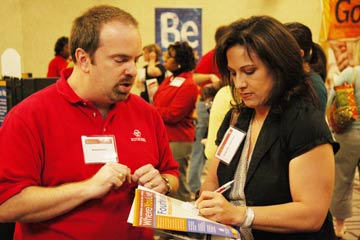
Buckner International mission trip coordinator Jeremy Copeland talks with Dallas Baptist University student Chris Holloway about upcoming mission trips during the “Go. Be. Do.” Global Missions Conference at Park Cities Baptist Church in Dallas. (Photos by Analiz Gonzalez/Buckner)

Missions conference challenges Christians to ‘Go. Be. Do.’

By Analiz González

Buckner International

DALLAS—More than 300 people attended Buckner International’s first-ever “Go. Be. Do.” Global Missions Conference at Park Cities Baptist Church in Dallas.

Dickson Masindano, director of Buckner in Kenya, talks about needs in Africa.

People from around the country gathered to hear Buckner directors from Latvia, Ethiopia, Mexico, Kenya, Russia, Romania, the U.S./Mexico border, Peru and Guatemala. The directors shared personal testimonies, described needs and told conference participants how they can get involved in missions.

“It was a great opportunity to bring people together and tell them how they can get involved in international and local missions,” said Buckner International President Ken Hall.

“Instead of building structures, we need to build people and empower them to go, right now,” he continued. “We don’t need a big infrastructure nearly as badly as we need to go out now and make a difference in broken lives. Just as the New Testament church was built—as they served others—that’s just what Buckner seeks to do.”

Workshops covered topics such as the AIDS epidemic in Africa, medical and dental missions and serving orphan children in Eastern Europe. A session was also offered to Spanish-speaking missionaries.

Greg Eubanks, executive director of Buckner in Southeast Texas, shares information during the conference.

“The conference gave people a chance to learn first-hand what Buckner is doing in other countries,” said Rachel Garton, director of Buckner Shoes for Orphan Souls, a ministry to give shoes to needy children around the world. “It gave people the information they need to decide where they would like to serve.”

“What I really want everyone who attended … to come away with was the word ‘moving,’ because there are millions of people in need of what we have to offer today,” Hall said. “More than 143 million orphans need us to get missional right now.”


News of religion, faith, missions, Bible study and Christian ministry among Baptist churches, in Texas, the BGCT, the nation and around the world.


Richmond seminary budget shortfall leads to faculty layoffs

Posted: 4/16/08

Richmond seminary budget
shortfall leads to faculty layoffs

By Robert Dilday

Religious Herald

RICHMOND, Va. (ABP)—Faced with “worrisome” financial challenges, Baptist Theological Seminary at Richmond will downsize its faculty and staff, the school’s president announced.

Four full-time professors and at least three administrative staff members will be let go in an effort to reduce costs, said seminary President Ron Crawford, who was elected to his position about a year ago. Though he did not release the names of the professors to be dismissed, Crawford said he has communicated with each one, and the school is offering severance packages that exceed a full year’s salary and full personnel benefits.

The 19-year old seminary is burdened with a $6 million debt and faces a significant deficit in its budget this year—about $450,000 out of an overall budget of $3.6 million, Crawford said in a statement distributed to the school’s alumni and supporters.

“Our immediate fiscal challenge is related to the capital campaign that was completed last summer as I became BTSR’s president,” he said. “The campaign included the purchase of two buildings along with two unanticipated financial challenges: significant debt and a payroll that overreaches annual revenues.”

BTSR, which enrolls about 160 students, currently employs 15 full-time professors and about 16 administrative staff, including the president and dean of the faculty. About 14 visiting and adjunct faculty members also teach classes.

The school’s campus is adjacent to Union Theological Seminary, a Presbyterian institution, and the seminary owns buildings that once housed Union’s Presbyterian School of Christian Education.

At a meeting in mid-March, BTSR’s board of trustees asked Crawford to devise a downsizing plan and present it at a called trustee meeting in late April. The president informed the seminary community of the developments at a March 28 meeting of faculty, staff and students.

“Once the downsizing is complete we will be left with a tenured faculty member in each of the disciplines we have traditionally covered, with the exception of one, where a visiting professor will be employed,” said Crawford. “With nine full-time faculty members, at least three visiting professors and other adjunct faculty members, we will continue to have a profoundly strong faculty.”

Crawford also said that the reduced faculty will have less impact on BTSR than it would on most seminaries. The school is part of the Richmond Theological Consortium, which includes Union Seminary and its School of Christian Education, as well as the school of theology at nearby Virginia Union University, a historically African-American Baptist institution. Students in the consortium’s schools may take courses at any of the institutions for no additional cost.

“On the administrative side, we are losing three and a half positions,” Crawford said. “Our idea is to replace full-time support staff with part-time students. We’ll train the students on the business inner-workings of a nonprofit, church environment. It should be a win-win.”

Founded in 1989, BTSR was one of the first institutions established by moderates who began leaving the Southern Baptist Convention in the 1980s and 90s. Though a number of other moderate seminaries and divinity schools have sprouted since then, many former Southern Baptists still retain passion for the first one, and Crawford is counting on that to get BTSR through the financial strain.

“I continue to say, ‘The future of BTSR is very bright, the short-term is worrisome,’” he noted. “BTSR will survive and, eventually, thrive. We fully anticipate going through a few very lean years. We will use the time to restructure and refocus our efforts on responding to the challenge of providing theological education in a 21st century world.”


News of religion, faith, missions, Bible study and Christian ministry among Baptist churches, in Texas, the BGCT, the nation and around the world.


BaptistWay Bible Series for April 27: Drifting toward disaster

Posted: 4/16/08

BaptistWay Bible Series for April 27

Drifting toward disaster

• 2 Kings 14:23-29; 15:8-10, 13-14, 17-30

By Kenneth Jordan

First Baptist Church, Alpine

The air was crisp and clear. Crowds had gathered (a little larger than usual) to watch a modern marvel of engineering. The launch of the Space Shuttle had become routine. NASA was shortening the time between missions. Part of the excitement of this particular mission was the presence of a member of the “Teacher In Space” program.

From the eye of the casual observer, things were progressing normally. The launch had been delayed to allow things to warm up a bit. The countdown resumed—and the Shuttle Challenger lifted off at 11:38 a.m. from the Kennedy Space Center in Florida.

Seventy-three seconds into the flight, the Challenger and the external fuel tank disappeared in a plume of smoke while the solid rocket boosters continued in their now uncontrolled flight. The shuttle had been destroyed.

When the presidential commission began to investigate this sudden disaster, what they found was that it was not sudden at all. A long string of mishaps and bad decisions came together in the necessary sequence to ensure disaster. The loss of the Challenger and her crew continue to be used as a case study for what can go wrong when warning signs are ignored.

The same could be said for the passage in this week’s lesson. For the Jews in exile asking, “How did we get here?” the answer was as close as a good dose of history—if they were willing to remember. The separation of the nation of Israel into the southern and northern kingdoms marked the beginning of the end—as it were.

The prophets had proclaimed a coming judgment. The warning signs of that impending judgment became increasingly frequent. The Northern Kingdom had long struggled with leadership issues. But there was the strong presence of the prophet (namely Elijah and Elisha) to keep the king and therefore the nation on track. As we get to the passages in this week’s lesson, we see the nation taking a turn for the worse.

The first major turn is the passing of Elisha from the scene. His death is recorded in 2 Kings 13:20 without much fanfare. There is no chariot of fire. There is no whirlwind. Perhaps most significant for the northern Kingdom of Israel is that there is no passing on the prophetic mantle, as was the case when Elijah’s time had come to an end.

That is not to say there were no prophets during these later years, but certainly not the central figure to assume the ministry of Elisha. Without a strong voice for God in the king’s presence, the apostasy seems to accelerate rapidly.

The second major turn we find in these verses is the shift in leadership succession. The father-to-son leadership exchange is interrupted by assassination at least four times. The reigns of the kings cease to be long-tenured. Zechariah keeps the job only six months before he is relieved of his duties in a manner that would have made Tony Soprano envious.

This instability in leadership was coupled with a consistent theme from the author: These new kings hadn’t learned from the mistakes of the old kings. Again and again, we find the phrase, “he did not turn away from the sins of Jeroboam son of Nebat.” At its core was the issue of idolatry. Worshipping false gods while claiming allegiance to the Lord (and seeking his blessing).

Sadly, the Northern Kingdom finally got just what their ancestors had asked for: a king just like the rest of the nations (1 Samuel 8:6). The disaster awaiting the Northern Kingdom would catch them by surprise, but like the fate of the Challenger, could have been predicted if anyone was willing to connect the failures of the kings.

News of religion, faith, missions, Bible study and Christian ministry among Baptist churches, in Texas, the BGCT, the nation and around the world.