No more volunteers needed for tsunami relief, but be prepared, leaders say_11005

Posted: 1/11/05

No more volunteers needed for tsunami
relief, but be prepared, leaders say

By John Hall

Texas Baptist Communications

Volunteers are not needed to help yet with the relief effort in South Asia, but they need to be prepared for action.

Relief leaders, including Baptists from around the world, continue assessing needs in the countries affected by a series of seismic sea waves and are beginning to send teams into the region. Though these initial teams are full, more volunteers potentially could be needed.

Texas Baptist Men is sending seven teams to purify water and provide meals. Each team consists of 10 people who will be replaced every two weeks by fresh workers.

The American Red Cross—which also currently has no need for volunteers to work in South Asia—has medical and relief teams in South Asia. More workers will be sent to help in the area.

“At the present time, we are only sending trained and experienced volunteers in,” said Texas Baptist Men Executive Director Leo Smith. “This is essential in the early stages of a disaster, especially in a foreign country.”

But additional volunteers undoubtedly will be needed as both organizations have verbally committed to serving for an extended period of time.

“We don’t know how long it’s going to take,” said Claudia McWhorter, communications and marketing director for the Central Texas Chapter of the American Red Cross.

To be eligible for service, individuals should go through the respective organization’s training. Texas Baptist Men periodically has training workshops around the state, including a large annual event at Latham Springs Baptist Encampment near Aquilla. TBM is holding a special training session to enlist volunteers for this relief effort Jan. 22 at the Robert E. Dixon Mission Equipping Center.

A track also has been added to the Baptist General Convention of Texas evangelism and missions event Epicenter that will help churches understand how they can minister in the countries hit by the tsunamis. Epicenter takes place Jan. 28-29 at the Sheraton Grand Hotel near Dallas-Fort Worth International Airport. Representatives from TBM, WorldconneX and the BGCT Church Missions and Evangelism Section will lead seminars.

These events are where Baptists learn procedures and safety techniques of disaster relief. Training includes how to handle cultural, physical, emotion and spiritual difficulties. After a person is finished with the training, they are added to a list of available disaster relief volunteers.

To find regional TBM training events, call (214) 828-5352.

“The importance of the training is to help you not only in the midst of the disaster, but it also assists you with all the elements you will deal with,” Smith said.

The Red Cross holds training events through its local chapters, which can be found by visiting www.redcross.org/where/where.html. After completing the training, a person who is active in the local chapter becomes eligible for relief service. There are several levels of training before a person is eligible for international relief work.

“People want to do (international relief work),” McWhorter said. “I think it’s wonderful.”

Serving internationally requires updated immunizations and a current passport that is at least six months old. Not having either could prevent a person from action.

Completion of either program does not guarantee immediate service. Both evaluate each person’s skills and experience level and assign that individual to an effort that is deemed appropriate.

Texas Baptist Men tries to give each volunteer an initial experience without the stress of a disaster. Then that person is eligible for service anywhere.

If Texas Baptist Men runs out of available trained workers, it begins to use skilled volunteers who contact the organization. TBM staff members are building that list now in case it is needed for the South Asia relief effort.

News of religion, faith, missions, Bible study and Christian ministry among Texas Baptist churches, in the BGCT, the Southern Baptist Convention ( SBC ) and around the world.


Baylor social work staff stitches gift for orphans_11005

Posted: 12/24/04

Women from Baylor’s School of Social Work sewed gifts for orphans in Ukraine rather than give each other gifts for Christmas.(Photo by Cliff Cheney)

Baylor social work staff stitches gift for orphans

By Julie Carlson

Baylor University

WACO—Some babies and toddlers in the Ukraine soon will have some warm clothes for the winter, thanks to a group of women at Baylor University.

Rather than exchange Christmas presents with faculty in Baylor’s School of Social Work, department staff members put to use their own sewing skills to provide warm overalls to Ukrainian orphans through the program “Aid for Orphans.”

“Several of us struggled with what to give our faculty each year for Christmas,” said Linda Hardwick, administrative associate in the School of Social Work.

“As the faculty numbers grew, our business manager, Jeanie Fitzpatrick, came up with the idea of donating something to a non-profit service organization in honor of the social work faculty and let them know how much we appreciate them. Social workers have a passion for serving others and we felt they would probably appreciate an act of kindness rather than individually wrapped gifts.”

The staff made its first Christmas faculty tribute in 2000 with a donation to Meals on Wheels. Other projects have included purchasing books for Storybook Christmas, which provides books to underprivileged children; providing funds to a Baylor program that helps financially-strapped Baylor students purchase text books; and providing Angel Tree Christmas presents for underprivileged children.

But this was the first year the staff decided to tackle a “hands-on” project. Fitzpatrick recalled an e-mail faculty member Gaynor Yancey had sent earlier in the semester about the needs of orphans in the Ukraine.

“One of their needs was for people to sew little overalls for the babies to wear,” Hardwick said. “The staff got together and discussed about four or five options of what we wanted to do this year—sewing the overalls was one of them. We all voted by email and the Ukraine project was selected.”

“Aid for Orphans provides very specific construction details and the pattern for the overalls,” Fitzpatrick said. “When we got the hang of it, we could sew one overall in about an hour.”

Three staff members sewed, and the others cut patterns and pinned. The staff brought sewing machines to school so they could work during lunch breaks, and some took fabric home to work. All the staff journeyed to the fabric store to buy the needed material. The project was started the first week in December, with 35 overalls sewed by the week before Christmas.

At the department Christmas party, the staff presented the faculty with cards detailing the project and hung the overalls so they could show the fruits of their labor.

“I was overwhelmed with this gift. Nothing they could do would have brought more honor to us, than to know that babies will be cuddled in 35 flannel jumpers lovingly handmade by our staff,” said Diana Garland, professor and chair of the School of Social Work.

“Every time I have gone for a cup of coffee the last few days and ducked under the clothesline where they hung the jumpers for us to see near our little kitchen, I have grinned, seeing their love for us displayed in such a visible way. They spent hours sewing these jumpers, giving up lunch hours and evenings, catching us totally by surprise, and giving us a gift that means so much because it says they know our heart.”

“This has been a very rewarding project and a great shared experience,” Fitzpatrick said. “It was fun to go together to buy the fabric, and those who didn’t sew, still learned something. I think this will give us the courage to try more hands-on projects in future years.”

Aid for Orphans provides assistance to the Antoshka and Kherson orphanages located in the Ukraine cities of Kramatorsk and Kherson. These orphanages are home to about 200 poorly dressed and malnourished babies and toddlers ages newborn to 4 years.

The babies in these Ukraine orphanages are typically dressed in easy-to-change overalls made from flannel, heavy cotton or lightweight denim.

The overalls look like footed one-piece outfits with ties at the shoulders or behind the neck. The overalls are worn with a short or long-sleeve shirt underneath, dependant on the season. To learn more about the project or Aid for Orphans, visit www.aidfororphans.org .

News of religion, faith, missions, Bible study and Christian ministry among Texas Baptist churches, in the BGCT, the Southern Baptist Convention ( SBC ) and around the world.


Texas Baptists join worldwide Tsunami relief response_11005

Posted: 1/07/05

Texas Baptists join worldwide Tsunami relief response

By Ken Camp

Managing Editor

Texas Baptist Men volunteers are joining Baptist World Aid and other humanitarian agencies in what many observers have called the largest international disaster relief effort in history, after a series of earthquake-spawned waves struck 12 countries in South Asia and Northeast Africa the day after Christmas.

Texas Baptist Men became involved in the relief effort after David Beckett, a member of Currey Creek Baptist Church in Boerne who is serving as a missionary in Sri Lanka with Gospel for Asia, asked for help.

Texas Baptist Men planned to send 12 volunteers to Sri Lanka to do water purification. The volunteers will take two water purification units with them, along with parts to build eight more once they are on-site.

See Related Stories:
Texas Baptists join worldwide Tsunami relief response

How to give to tsunami relief

Tsunami Summit planned for Epicenter conference

TBM also planned to send four 10-member emergency food service teams to South Asia—three to Sri Lanka and one to Thailand—as well as help set up a refugee camp in Sumatra, said TBM Executive Director Leo Smith.

Children’s Emergency Relief International—an agency of Baptist Child & Family Services—has been invited to set up child care centers and help establish foster care programs in Sri Lanka.

An Indian child tsunami survivor holds on to a shirt donated by a volunteer organization in Cuddalore, about 112 miles south of Madras, India. (REUTERS Photo by Arko Datta)

Gospel for Asia, whose headquarters is in Carrollton, contacted the San Antonio-based family services agency and asked its personnel to set up five child care shelters in eastern Sri Lanka and to help the Sri Lankan government develop foster care programs and train local people to manage them.

Each emergency care center will house up to 1,000 orphaned children. The tsunami victimized about 30,000 people living in the 60-mile stretch along Sri Lanka’s eastern coast where the centers will be located.

Baptist Child & Family Services initially is sending several children’s home administrators—including Kevin Dinnin, the agency’s president—a physician and a psychologist.

Buckner Baptist Benevolences is making its existing inventory of shoes, socks and other materials available to its ministry partners working in South Asia, including the Cooperative Baptist Fellowship and the Baptist World Alliance, said Jeff Jones, operations director for Buckner Orphan Care International.

Buckner is working closely with its partnering organizations to assess needs and determine additional ways to be involved, he noted.

“We are waiting on a few reports in order to best assess what aid needs to be sent,” Jones said. “It is a given that we will be able to respond through clothing and some limited medical supplies. We will post other needs as they become apparent.”

Buckner also is collecting funds on behalf of the Cooperative Baptist Fellowship and Baptist World Aid, the relief arm of the Baptist World Alliance.

“While our focus is not disaster relief ministry, our hearts were too moved by the scenes of destruction and the human suffering to not respond immediately,” said Buckner President Ken Hall. “Collecting funds for our partner ministries that do have disaster relief made the most sense and will let us coordinate efforts to offer aid to children over the long run.”

The Baptist World Alliance has sent a medical and relief team to South Asia through Baptist World Aid and Hungarian Baptist Aid.

Baptist World Aid allocated an initial $25,000 for relief work. The medical team is using $110,000 in donated medical supplies from Hungarian Baptist Aid.

Paul Montacute, director of Baptist World Aid, said the international body of Baptists grieves with those whose lives have been affected.

“What a tragedy,” he said. “On behalf of the Baptist World Alliance, I express our concern about the current situation in such a wide area of Asia. Be assured of the thoughts and prayers of the world family of Baptists at this time.”

Montacute particularly noted the response of Baptist World Alliance member bodies and their agencies in the affected region, such as the Thailand Baptist Missionary Fellowship and the Union of Indonesian Baptist Churches.

In Sri Lanka, many Baptists are working closely with the National Christian Evangelical Alliance and LEADS, an independent social service organization. Indian Baptists are working with the Evangelical Fellowship of India Committee on Relief.

In a pastoral letter to Baptists in South Asia, Baptist World Alliance General Secretary Denton Lotz and President Billy Kim—who recently retired as pastor of Suwon Central Baptist Church near Seoul, South Korea, after 45 years—expressed grief and long-term support for victims of the natural disaster.

“Your brothers and sisters around the world are in suffering and pain with you due to the destruction brought about by the tsunami earthquake,” the letter stated.
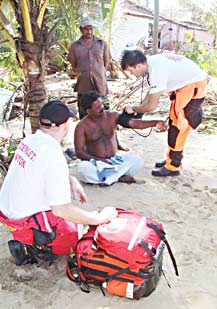
Baptist health workers help a victim of the tsunami that hit Sri Lanka and other Asian nations.

“During this horrific period when the world is shocked and dazed at the great tragedy that has brought loss of life and suffering to millions, your Baptist brothers and sisters have been praying and working for your relief. Millions of people are continuing to pray for you, and in thousands of worship services worldwide, brothers and sisters are calling upon our gracious God to bring relief and comfort to those who have suffered.”

Lotz and Kim pledged Baptist World Aid would work with Baptist unions and conventions, secular organizations and governments to bring help to people in need, saying, “We will not stop until the job is completed.”

Officials continue surveying the massive human and economic casualties in the region, as casualty figures topped 150,000. Governments have pledged more than $2 billion to aid victims in the 12 affected countries, with $350 million coming from the United States. Private donations are pouring in as well. Former presidents George Bush and Bill Clinton are spearheading a fund-raising effort in the United States.

The Baptist General Convention of Texas initially has set aside more than $40,000 to help finance relief efforts in South Asia. The BGCT is working in partnership with several entities also focusing on the region, including the Baptist World Alliance, Cooperative Baptist Fellowship Global Missions, the Southern Baptist International Mission Board, Texas Baptist Men and North Carolina Baptist Men.

Both the Southern Baptist International Mission Board and Cooperative Baptist Fellowship Global Missions reported their personnel in the region escaped immediate harm, but some families were displaced by flooding.

By Jan. 3, the International Mission Board had approved $300,000 in project requests from relief workers on the field, with two-thirds of it earmarked for Sumatra and its hard-hit Aceh province. Funds will pay for food, clean water and purification equipment, blankets, tents, medical supplies and body bags.

The through CBF Global Missions field personnel, the Fellowship has disbursed about $100,000 to the impacted region.

Individuals with ties to Texas Baptist institutions also are involved in the disaster relief effort. Sohani Cooray, a graduate of the Baylor University School of Social Work, was visiting her family in Sri Lanka when the tsunami hit. Cooray, who works in Waco, decided to prolong her stay in South Asia to coordinate the efforts of a group from Antioch Community Church in Waco.

The volunteer team, which includes a nurse and an emergency medical technician, will work with a Methodist in the port city of Galle to provide aid.

WorldconneX, the BGCT-related missions network, has turned the front page of its website—www.worldconnex.org— into a clearinghouse for tsunami response information.

“WorldconneX has identified and contacted credible, verified ministries doing wholistic, gospel-driven relief and development and included links to them on our website,” said network leader Bill Tinsley.

Stan Parks, international liaison for WorldconneX, was scheduled to leave Texas Jan. 7 for a nine-day trip to Indonesia to meet with business leaders, government leaders and Christian leaders. Parks served 10 years as a missionary in Indonesia. He will continue to network with other leaders in Thailand, Sri Lanka, India, the Maldives and Malaysia.

Parks emphasized the greatest needs in the impacted region may be two or three months from now “when most of the world has forgotten these areas, and there is a lot less money and many fewer volunteers, despite the much more expensive and time-consuming task of rebuilding homes, buildings, roads and other infrastructure and of re-economizing—job and business creation—which will be desperately needed.”

For more information, contact WorldconneX at tsunamirelief@worldconnex.org or (214) 421-7999.

News of religion, faith, missions, Bible study and Christian ministry among Texas Baptist churches, in the BGCT, the Southern Baptist Convention ( SBC ) and around the world.


’20-somethings’ follow own path to faith_11005

Posted: 1/07/05

Every Tuesday evening, more than two dozen young Christians gather at a house in Portland, Ore., for dinner, prayer and communion. The group is a part of a growing trend among young people toward a more orthodox form of Christianity.(Photos by Melanie Conner)

'20-somethings' follow own path to faith

By Nancy Haught

Religion News Service

PORTLAND, Ore. (RNS)–In Christianity, the image of the shepherd leading sheep is a powerful one. For generations, the same could be said of parents leading their children to their religion.

But for many young adults, that's beginning to change–and not in the way some might expect.

To be sure, here and across the country, people still practice religion, or don't practice it, the same as their parents. But pastors and scholars are noticing something else happening, too.

Many young adults are moving away from their parents' example, but not toward a more secular life, as was the case for so many baby boomers in the 1960s and 1970s. Instead, they are carving out their own faith, which often is more devout or more active than their parents'.

These young people, especially those from Christian backgrounds, are both joining mainline churches and founding their own new spiritual communities.

In part because their parents tend to be so secular, their impact is especially striking in the Pacific Northwest, the most unchurched part of the country, according to several academic studies.

They vote their consciences, which is not to say they all vote the same way, either as each other or as their parents. They may or may not take part in the “culture wars.” Some of them don't even want to be called Christian, a label they say is as loaded as they come.

Karin Rosain participates in a Bible study about prayer during a young adult Christian gathering.

So what is happening to 20-somethings that is making them turn away from their parents' religious background, or their lack thereof, and declare themselves a different kind of believer?

Ask them, and they're not sure. For starters, they often want a clear-cut idea of moral right and wrong, absolutes that weren't that important to their counterculture-era parents. Talk to pastors, scholars and other observers and you come up with cultural reasons that might be part of it–a turning away from an increasingly technological, anything-goes, consumer-driven society.

“They are longing for a connection to the past in an age where we think history started yesterday with 'me,'” says Paul Metzger, a professor at Multnomah Biblical Seminary, in Portland, Ore. He says young people are finding more comfort in old-style symbols and ceremony than modern mega-churches. “There are many who want to return to Christian roots.”

“They come looking for people of integrity,” says Melinda Wagner, co-pastor of First Immanuel Lutheran Church in Northwest Portland. “They believe that people they meet at work can't be trusted or that they have different values.”

Sometimes it's a mark that, as young adults, they are settling down, she adds. “As one person put it: 'I got engaged. I got a dentist. I joined a church.'”

Colleen Carroll Campbell, who wrote a book about the phenomenon, thinks it has to do with growing up in affluence and still feeling empty, a sort of early midlife crisis that has helped fuel the increasing religiosity in the country. Her book is “The New Faithful: Why Young Adults are Embracing Christian Orthodoxy.”

“A lot of them have seen the best that secular life has to offer,” she says. “Some have been raised without religion and indulged in a whole party lifestyle. Many have already done quite well in their careers and have more money than their parents had.”

Their question, she says, is: Now what?

“This generation wants an integrated Christian faith. They detest compartmentalization,” Campbell says. “They say: 'I don't want my faith to be something I do on Sunday. If it's not something that impacts every part of my life–my school work, my job, who I date, how I vote–if it doesn't transform my life, then it's not worth much.'”

That's where Emily Pearlman, 24, of Gresham, Ore., found herself three years ago. She'd grown up along the Sandy River, in a household where her dad did not welcome religion. She'd visit a church now and then with a friend, but it was in college, at the Catholic University of Portland, that she first studied theology. It opened up to her the work of Jesus.

She defines that work in terms of feeding the hungry, healing the sick, funding insurance coverage for the poor, striving to end war and all its casualties.

A wife, mom and medical receptionist, she is an active member of a church but doesn't like being called a Christian, believing the label has been ruined by those who don't live out their faith.

“I am somebody who follows the mission of Christ daily–and if that makes me a Christian, so be it,” she says. “But being a Christian is more than attending church on Sunday and having a fish decal on your car.”

Josh Butler, 27, had a similar experience. He grew up in Salem-Keizer, Ore., with a mom who took him to a church now and then and a dad who wasn't much interested in religion.

As a boy, Butler nurtured a fascination for the stories of J.R.R. Tolkien and the Bible. He saw God as vague and distant but still devoted to the outcast.

He tried an evangelical church in high school, but by college he thought the faith “closed him off” to others who didn't share it and to the culture at large.

These days, he's a graduate student in theology and a pastor of worship and the arts at Imago Dei Community, a 4-year-old Christian group that's grown from a core of 15 to almost 750 believers.

He says he's found a worshipping community that values art, beauty and even uncertainty. They don't agree on every political point, but they are committed to living in community, even in tension. His challenge, he says, is to “live the essence of the gospel,” realizing that his understanding of it may change over time.

He teaches a Saturday morning class on theology and culture, trying to convince his students the secular world–including popular entertainment–may have something relevant to say, even on religious topics.

For young adults, following their parents lead may still be the most common path to religious faith. But a group of religious free agents are finding their own way. Author Carroll thinks they may end up changing the Christian faith.

Only time will tell who is leading whom.

Nancy Haught writes about religion for The Oregonian in Portland.

News of religion, faith, missions, Bible study and Christian ministry among Texas Baptist churches, in the BGCT, the Southern Baptist Convention ( SBC ) and around the world.


2004 left America seeing red, observers say_11005

Posted: 1/07/05

2004 left America seeing red, observers say

By Kevin Eckstrom

Religion News Service

WASHINGTON (RNS)–Red, color experts say, is a serious color that denotes passion, heat, importance, even danger. Power ties, celebrity carpets and stop signs are all red. Red says, “Stop what you're doing and pay attention.”

So it was with 2004. From the red-state heartland that re-elected President Bush to Mel Gibson's blood-splattered “The Passion of the Christ,” 2004 was very red indeed. The long-suffering Boston Red Sox might even say God was feeling kind of red when he intervened to break the curse and allow them a World Series championship.

Bush's win in the country's crimson center, and Gibson's unexpected success with “The Passion,” were both fueled by conservative and evangelical Christians, who flexed their cultural and political muscles everywhere from the ballot box to the box office in 2004.

Mel Gibson's "The Passion of the Christ" (top) and President Bush's victory over challenger Sen. John Kerry marked what some social observers described as a “red” year. (RNS Photos)

The term “values voters” gained prominence in the American political lexicon. It was, as the San Diego Union-Tribune put it, the year of the “'Passion of the Christ' vote.”

“Evangelicals didn't emerge this election, they arrived,” said Luis Lugo, executive director of the Pew Forum on Religion and Public Life. “They were not on the outside looking in and being courted–they were on the inside in a very real sense.”

Religion played an unprecedented role in the 2004 elections as both camps vied for the hearts and minds of church-going voters. As Bush cemented support among his evangelical base, Sen. John Kerry and the Democrats stumbled to portray his campaign as Catholic faith and social justice in action.

At the same time, Kerry came under blistering criticism from a vocal minority of bishops who threatened to deny him Communion because of his support of abortion rights. Kerry, the first Catholic presidential nominee in 44 years, lost the Catholic vote to Bush, 52 percent to 47 percent.

While Democrats hoped so-called “527” political committees would help carry the race for Kerry, Lugo said ultimately it was the “316s”–evangelicals whose favorite Bible verse is John 3:16–who carried the election for Bush.

Exit polls showed that Bush increased his support among church-going Catholics, Jews, mainline Protestants and conservative blacks, and drew 78 percent of evangelicals, up from 72 percent four years ago.

“At both the grassroots level and the upper reaches of the party, I think you have the evangelical community being fully mainstreamed into American politics,” Lugo said.

What caught so many people off-guard was the prominence of the so-called “values voter,” the one-in-five voters who told exit pollsters that “moral values” were their chief concern, and who went overwhelmingly for Bush. Pollsters did not, however, define what “moral values” meant.

Religious conservatives immediately promised to cash in their electoral chips in Bush's second term, pressing for anti-abortion court nominations, a continued block on embryonic stem cell research and a constitutional ban on gay marriage.

In February, those same voters also showed up in record numbers for Gibson's “The Passion of the Christ,” a bloody, gut-wrenching account of the trial and crucifixion of Jesus. Protests from Jewish groups that the film was anti-Semitic did not stop churches from buying out entire theaters for Gibson's self-funded runaway hit, which finished the year grossing more than $600 million in global ticket sales.

“Evangelicals have historically been suspicious both of Hollywood and Roman Catholicism,” said Randall Balmer, an expert on American evangelicals at Barnard College in New York. “It was an odd sort of cultural alliance that made it such a popular film.”

Homosexuality issues roiled churches and society at large as Massachusetts became the first state in the country to allow gay civil marriage. Two lesbian ministers in the United Methodist Church faced trial for breaking rules that require celibacy–one, Karen Dammann, was acquitted in Washington state while the other, Beth Stroud, was defrocked in Philadelphia.

Conservatives' push for a constitutional amendment to ban gay marriage failed in both the House and Senate, but voters in 13 states adopted state-level amendments to prohibit gay marriage. At the same time, Canada's Supreme Court cleared the way for the government to allow nationwide gay marriage early in 2005.

At the U.S. Supreme Court, an atheist's challenge to the phrase “under God” in the Pledge of Allegiance was dismissed on a technicality. The court said Michael Newdow did not have proper parental standing to mount the challenge on behalf of his school-aged daughter. Newdow has vowed to press the case.

The high court also ruled 7-2 that states may not be forced to provide scholarships to theology students and agreed to take up in 2005 the fiery-hot question of government displays of the 10 Commandments.

Lugo said 2004 will be remembered for shaking up the American religious landscape. It was a year in which traditional labels became less useful, when new and odd bedfellows kept company, when loyalty to one's “values” trumped church, partisan and sometimes racial lines.

In other words, 2005 should be interesting.

“The major fault lines no longer run along denominational lines; they're running through denominations and across denominational lines,” Lugo said. “It's one of those defining moments that tends to define allegiances for the long term.”

News of religion, faith, missions, Bible study and Christian ministry among Texas Baptist churches, in the BGCT, the Southern Baptist Convention ( SBC ) and around the world.


Expressing faith through visual images_11005

Posted: 1/07/05

Artistic images hanging on the walls are designed to help participants enter into a spirit of worship at the Andover Newton Theological School in Newton Center, Mass. Reformed Protestants once considered such images idolatrous, but they are growing in acceptance. (Photo by Judy Medeiros)

Expressing faith through visual images

By G. Jeffrey Macdonald

Religion News Service

CHARLOTTE, N.C. (RNS)–As an evangelical preacher, Bruce Marcey belongs to a sermon-centered spiritual tradition that took root nearly 500 years ago with the Bible, the pulpit and the elimination of all distractions–including art.

Imagine how shocked his forebears might be to see what Marcey does with visual images each week at Warehouse 242, the loft-style church in Charlotte, N.C., where he is pastor. In his view, no worship service is complete until the congregation has pondered not just the word of God proclaimed but also the word of God illustrated through a homegrown photograph, painting or film clip.

“We believe the Reformers missed something big,” says Marcey, a doctoral candidate in visual rhetoric at Regent University in Virginia Beach, Va.

“When we limit the gospel message to the written and spoken text, we short-circuit it. We truncate it. … The soul is moved by more things than the word.”

Marcey's church is not alone. Across the nation, visual images are fast becoming a part of religious life for millions of Reformed Protestant Christians whose tradition has for centuries regarded pictures with great suspicion.

Wariness of the image's power to become an idol or otherwise deceive a lost soul has largely given way to confidence in the power of images to reach souls for the good.

Claiming lineage in the Reformed tradition means tracing a spiritual ancestry through John Calvin, the 16th century Geneva theologian whose “Institutes of the Christian Religion” has endured for centuries as a guiding vision for a church purified Protestant-style.

Through the centuries, splinter groups have made Reformed Protestantism into a vast tent with such American incarnations as Presbyterians, Congregationalists, some Baptists and many nondenominational evangelicals.

Examples of a growing confidence in images span the spectrum of Reformed religious life:

bluebullIn the seminary. At Andover Newton Theological School, which trains future Reformed pastors in Newton, Mass., enrollment in the worship, theology and the arts specialization track jumped from five in 1999 to 46 in 2004.

bluebullOn the overseas mission field. Reformed Protestants and others who once relied on translated Bibles to convert indigenous peoples now routinely introduce Christianity through the "Jesus" film, which so far has seen translation into 858 languages.

bluebullIn small-group ministries. The video-based Alpha Course has attracted more than 1 million North Americans over the past 10 years and currently is offered in more than 5,000 church and home settings, including some Reformed congregations.

Reformed Christians are examining what it means for them to seek God apart from the spoken and written word of Scripture. Answers vary, especially since the craze has touched both conservative evangelicals and liberal mainliners, who sometimes have different agendas for the use of images. But on at least one point, there is agreement: A longstanding hallmark of Reformed tradition is disappearing.

“Generally speaking, there has been a visual impoverishment of architecture and in terms of design across the Protestant spectrum in North America,” said Calvin Schultze, professor of communication at Calvin College and author of “High-Tech Worship? Using Presentational Technologies Wisely.”

“Now we're seeing a widespread acceptance of the visual in worship across the Protestant landscape … and the idea of an austere, pew-lined, wooden-floor sanctuary is disappearing.”

In Calvin's day, Reformers invoked the second commandment's prohibition against graven images as they stormed Roman Catholic churches, smashed statues and whitewashed the fine art on the walls. Among their concerns at the time, according to Schultze, was to thwart a widespread tendency to regard such images as idols or agents of supernatural force.

Although those concerns of the Reformation have faded, others have lingered. Schultze says a number of older Reformed pastors have denounced visuals in worship as “too emotional,” “too people-focused rather than God-focused” and a sign that “worship is becoming entertainment.”

Others hope images might actually enhance the Reformed method. Mike Laird, pastor of the North Shore Chapel, which meets in a Danvers, Mass. movie theater, keeps a library of several thousand images for display on the big screen during worship. And he's been known to play film clips from “When Harry Met Sally” or a Winnie the Pooh episode as a means to introduce his sermon.

“It's a channel for speeding up God's word to get into their hearts,” said Laird, an ordained minister in the Christian Reformed Church. “Our idea is to allow different channels to be open to any person at the service.”

Mainline churches have seen their share of new images, often in the form of carefully crafted banners that bring vibrant color to white-walled sanctuary spaces. At Hope Church in Jamaica Plain, Mass., parishioners use images to tell stories as they create “prayer journals” with their own photographs. In worship, they're apt to soon see such fine art works as Rembrandt's depiction of John the Baptist.

“The sermon is providing commentary on the image, and the image is providing commentary on the sermon,” said Matthew Myer Boulton, assistant professor of preaching and worship at Andover Newton and an associate pastor at Hope Church. “It's not that the Reformed tradition is being lost, but it's being brought into dialogue with other traditions.”

Indeed, Reformed voices across the board have been careful to make sure visuals don't displace the sermon as worship's main event. Schultze takes heart in seeing today's developments occurring in sync with new emphasis on good preaching, which he deems “a resurrection of the visual in the midst of a renewal of presentation of the word.”

In the final analysis, some Reformed preachers argue, what mattered most to Reformers was to make the life-changing word of God as accessible as possible. In the 16th century, more rigorous analysis and fewer imprecise images might have helped convict the masses that what they believed was true. But today, many are willing to bet the opposite approach will be more effective.

“Some folks hear and say: 'OK, that may be true, but I don't care. It doesn't motivate me or encourage me. It's just a block of information,'” Marcey said. “We put up an image (in worship) when it communicates something we're having trouble saying with words. … The Reformers ought to be pleased, because their idea was to take it out of the hands of the elite and put it in the hands of the people. And that's what we're doing.”

News of religion, faith, missions, Bible study and Christian ministry among Texas Baptist churches, in the BGCT, the Southern Baptist Convention ( SBC ) and around the world.


Quilts for Moldova a labor of love for volunteers_11005

Posted: 1/07/05

Quilts for Moldova a labor of love for volunteers

By Craig Bird

Baptist Child & Family Services

SAN ANTONIO–Fran Dunkum, Pam Keith and Lisa Weldon autograph each of the quilts they make for an Eastern European orphanage with a heart instead of their names.

“We decided up front that we wouldn't put any writing or identifying information in the design because that isn't really important,” explained Dunkum, a cardiac nurse at Methodist Hospital in San Antonio and a member of Trinity Baptist Church. “But we made an unbreakable rule that each quilt has to have a plainly visible heart. Those kids know Jesus loves them, but they need to know that somebody else loves them too–and every time they see the heart, they will be reminded of that truth.”

So far, the three women have completed 45 quilts and handed them over to Baptist Child & Family Services for delivery to Moldova. Three more are nearing completion, and they have enough material to make at least another 60.

Lisa Weldon (left) and Pam Keith tie up individual quilts before packing them for shipment to orphans in Moldova. A heart is included on every quilt no matter the design to "show the child that somebody loves them" and is visible on two of the quilts. (Photos by Craig Bird)

And it's not just any material. Those scraps and remnants are the legacy of their friend, Donna Dickey, who taught them all to quilt and who died in mid-2003 after an eight-month battle with cancer.

“She was not able to complete a bridal quilt she was making for one of her daughters, so we asked if we could finish it,” Dunkum recalled. “Then we helped sort through her things. Quilters collect a lot of material, and she had been quilting for 25 years.” Dickey's husband gave each of them four or five large bags of pieces.

Naturally, the trio began discussing the best use of the material.

“Our first project after Donna made us fall in love with quilting had been to make quilts for the children of the New York City firemen who were killed on 9/11,” Dunkum said. “Then, suddenly, she was gone too. But we wanted to do something worthy of her.”

The women also felt a pull to help people outside traditional San Antonio projects. They wanted to find a place where there was great need and limited resources, and their search led them to Moldova.

Baptist Child & Family Services, through its Children's Emergency Relief International outreach, has worked with orphanages in the former Soviet republic several years. The cash-strapped government is hard-pressed to provide even minimal food and shelter. But the quilting trio never had heard of Moldova.

That changed last January, when Marla Rushing, who works with Baptist Child & Family Services' Great Starts program, spoke at Trinity Baptist Church about her recent trip to that country.

“She mentioned that the volunteers carried blankets to sit on in the dorms and that they wound up giving them all away,” Dunkum said. “The typical bedding is World War II vintage, worn thin and badly soiled.”

Fran Dunkum of Trinity Baptist Church in San Antonio prepares to pack a Christmas nativity-design quilt for orphans in Moldova.

By March, the process was under way. And in early December, the first shipment of 45 quilts was completed.

The initial quilts were scheduled to arrive in Moldova Jan. 5, along with 32 short-term volunteers working with Children Emergency Relief International. Most of the team members are from Crossroads Baptist Church in San Antonio. Others are from Trinity Baptist Church in San Antonio, Currey Creek Baptist Church in Boerne, Kingwood Baptist Church in Houston and others from churches in Tennessee and Missouri.

The women quilted independently most of the time because of work schedules. Keith took advantage of times her husband was out of town with his job and “a week waiting for my grandson to be born” to put her quilts together. During one week, she completed six quilts.

Dunkum did much of her work from 2 to 4 a.m. after coming home from her hospital shift. Weldon, Dunkum's daughter, carved out time “after my family was asleep and everything else I needed to do for them was done–after 11 p.m.” On her frequent visits with her mom, she would cut the squares while Dunkum pieced them together.

“Lisa is also our designated 'main pray-er,'” Dunkum said. “Pam and I really rely on her to pray for us to have the time and energy we need to keep going.”

About two-thirds of the first batch of quilts was machine-quilted by 78-year-old Margaret Hiestand, who lives on Lake Buchanan. The San Antonio women heard about her through a quilting magazine and decided to hire some of the work done.

“When I found out they were doing this for an orphanage, I offered to do it for free,” said Hiestand, a member of Buchanan West Baptist Church. “But they wouldn't hear of it since it is how I make my living. But they did let me donate the backing for the 30 quilts I've done so I could be a part of it too.”

Each quilt is unique, varying both in size and design. Some are even hand-tied. “We talked about trying to make them uniform, but we decided that since each child is different it would be OK if the quilt had distinctive personalities too,” Weldon explained. “And we know the Moldovan Christians who run the Children's Emergency Relief International program will give the right quilt to the right child.”

Steve Davis, executive director of Children's Emergency Relief International, has no doubt the children who receive the quilts will value them highly.

“The girls already enjoy doing needlepoint and often give volunteers dollies and other things they've made, so they appreciate the time, energy and love that go into gifts like these quilts. The winters there are bitterly cold, and the quilts will bring physical warmth as well as being constant reminders of the love that American Christians have for them,” he said.

“Beyond actual hugs, I don't know a better way to feel love than to be able to wrap yourself in someone else's love and prayers when you go to bed at night.”

News of religion, faith, missions, Bible study and Christian ministry among Texas Baptist churches, in the BGCT, the Southern Baptist Convention ( SBC ) and around the world.


More young adults waiting longer to get married_11005

Posted: 1/07/05

More young adults waiting longer to get married

By Greg Warner

Associated Baptist Press

WASHINGTON (ABP)–New data from the U.S. Census Bureau confirms young adults are waiting longer to get married. The result may be healthier marriages, some researchers insist.

Since 1970, the average age at which men marry for the first time rose from 25.3 years to 27.1, according to the bureau's Current Population Survey. The average marrying age for women rose from 20.8 to 23.2.

Also, the percentage of men age 30-34 who have never married has quadrupled since 1970, now accounting for about a third of men in the age group.

About one-fourth of women age 30-34 have never married, which is a fourfold increase from the 6 percent of 1970.

Sociologists who viewed the report said young adults are focusing more on their education and jobs than marriage.

An increase in cohabitation also is contributing to the postponement of marriage, they acknowledged.

Two researchers who direct the National Marriage Project at Rutgers University see some encouraging signs in the trends, however.

“There is a common belief that, although a smaller percentage of Americans are now marrying than was the case a few decades ago, those who marry have marriages of higher quality,” said David Popenoe and Barbara Dafoe Whitehead.

“It seems reasonable that if divorce removes poor marriages from the pool of married couples and cohabitation 'trial marriages' deter some bad marriages from forming, the remaining marriages on average should be happier,” the pair wrote in the 2004 study “The State of Our Unions.”

Popenoe and Whitehead, who studied attitudes about marriage among young men age 25-34, found that 80 percent of men view marriage favorably and are good candidates for matrimony.

“The men who are the best 'marriage bets' are those who are more traditional in their family and religious background characteristics and in their attitudes toward marriage,” the researchers said.

Their research showed the prime time for men to search for and marry their “soul mate” occurs roughly during the years between ages 25 and 30, and the meaning of marriage has changed for those men.

“Compared to earlier generations of men, young men today are less likely to equate marriage with becoming an adult,” the researchers said.

Neither do they view marriage primarily as a means to have children.

Instead, the researchers said, young men tend to marry in order to build a life with their “soul mates.”

Other recent studies have shown that Christian men and women are more likely to marry and tend to marry younger than the general population, perhaps because many Christians disapprove of cohabitation.

But Christians also divorce at a higher rate than the general population. According to a 2001 study by the Barna Research Group, 27 percent of born-again Christians have been divorced, compared with 24 percent of adults who are not born-again.

But Popenoe and Whitehead, in an earlier study, said the higher divorce rate among Christians has more to do with education than faith.

“Born-again Christians have a somewhat lower level of education than the population as a whole, and this educational level is very highly associated with divorce–the higher the education level, the lower the divorce rate,” Popenoe said.

“One reason is that people with a higher education level don't marry as young. And the age at marriage is extremely sensitive to the question of divorce–the younger you are when you marry, the higher the divorce rate.”

“There is a common belief that, although a smaller percentage of Americans are now marrying than was the case a few decades ago, those who marry have marriages of higher quality.”

David Popenoe and Barbara Dafoe Whitehead, directors of the National Marriage Project

News of religion, faith, missions, Bible study and Christian ministry among Texas Baptist churches, in the BGCT, the Southern Baptist Convention ( SBC ) and around the world.


Buckner, CBF Volunteers Celebrate With Orphans_11005

Posted: 1/07/05

Oliva Ober of Houston shares a smile with an orphan from the Baptist Children's Center in Nairobi, Kenya. (Photos by Scott Collins)

Buckner, CBF volunteers celebrate with orphans

By Scott Collins

Buckner News Service

NAIROBI, Kenya–Marlene Grant put her arms around Teresia Ngao and helped the little girl cut out figures of Mary, Joseph and baby Jesus.

A smile crossed Teresia's face as each character dropped to the table with the last cut. Grant smiled, too. Together, the Kenyan orphan and the Texas volunteer were telling the Christmas story.

Teresia and 76 other orphans from the Baptist Children's Center in Nairobi were joined by 29 volunteers from across the United States for a “Christmas in Africa” camp sponsored by Buckner Orphan Care International and the Cooperative Baptist Fellowship.

The camp, one of three hosted by Buckner in Kenya in 2004, provided an opportunity for 50 orphans from the children's center and 27 who live in Buckner-sponsored foster homes to interact with the American volunteers. Activities included crafts, recreation and Bible stories.

Volunteer Bob Hefner of Dallas (left) tells the Christmas story during a VBS camp with children from the Baptist Children's Center of Nairobi, Kenya.

The “Christmas in Africa” trip marked the 41st and final international mission excursion sponsored by Buckner in 2004. More than 700 individuals traveled overseas with Buckner during the year. Buckner President Ken Hall and CBF Coordinator Daniel Vestal, along with Global Missions Coordinator Barbara Baldridge also participated in the Kenya Christmas trip.

“It's so encouraging to return here and see how God is using Buckner, CBF and our Kenyan partners to make a difference in the lives of these precious boys and girls,” said Hall.

Dickson Masindano, director of Buckner Africa, said the orphans living at the center “really love the time they spend with the volunteers. It means so much to the children to know that people care enough to come from the United States and spend time with them.”

“We have people from all over the United States here, and they are using their talents and serving God and being faithful to what God has called them to do,” said Eraina Larson, international missions coordinator for Buckner. “The children have come alive with this group.

“I can really see a difference with the kids,” she added. “Even though our teams may have different faces each time, it's the same God working through each of us, and that's who the children are building a relationship with.

“Our hope is that God would use the people on the team and that they would be faithful to use whatever talents God has given them and that they would just be faithful and leave the work up to God” Larson said. “Our hope is that the kids would receive one-on-one attention so that there is someone hugging on them and that through that, our volunteers would be the love of God and not just tell the love of God.”

Beth Wilkinson, a volunteer from Norcross, Ga., puts shoes on a child's feet as part of the "Christmas in Africa" mission trip.

Grant, a member of Tallowood Baptist Church in Houston, said her passion to “serve God” motivated her to join the team. “I absolutely love children, and my heart was calling me to go do this.”

She said the highlight of working with the orphans is the appreciation they show to the Americans and to each other.

“They are so giving and so appreciative,” she said. “They take care of each other and the (Kenyan) workers are so wonderful and loving.”

Grant said she returns to Houston with a commitment to pray for the children and to get others involved.

"I'm going to remember their faces, and I'm going to put their names and their pictures on my refrigerator, and I'm also going to get my Sunday school department to pray for the children."

For volunteer Bob Hefner, who has made several international trips with Buckner along with his wife, Laura, returning to the children's home in Nairobi is a confirmation of the work Buckner, CBF and Kenyan Baptists are doing with the children.

“We have fallen desperately in love with these children,” said Hefner, who is a member of Park Cities Baptist Church in Dallas. “They are literally the most important children I have run across. They are bright, and they are hopeful, and they appreciate where they are and are anxious to succeed. They really want to show appreciation for the help they get and to just grow in their faith. They are extraordinary Christians.”

The Hefners believe the most encouraging aspect of their involvement with the Kenyan project is the progress they are seeing in the lives of the children.

“Today, as a consequence of the kind of gentle care they are getting at the home, we are seeing children walk around looking for ways to nurture the other children and to be of service to the others,” Hefner said.

CBF Coordinator Daniel Vestal participates in a song with the orphan children.

Hefner believes children in Africa “not just deserve our help, but they are exactly the 'least of these.' They are the most perfect example of what I believe Christ called us to do when he talks about helping children and helping the least of these. Some of these kids were found naked at age 3 and 4 and 5, wandering garbage dumps. It's impossible to describe.”

Hefner believes it is important to provide for the material needs of the children by “investing our funds in them, we can help them enormously.” But, he added, it is just as important to “be their servants–clean up after them, hold their hand and dry their tears, give them encouragement and talk to them about their futures. No child in this ministry will be stopped in terms of education because of lack of resources. Every child who comes through this institution will be given the opportunity to go as far as his intellect and his energy and his interests will take him.

“Being a part of that and being able for a few days just to be a servant to one that you owe nothing to is just what God called us to do, and I get a rich blessing out of it.”

Lynn and Sharon Robinson, members of First Baptist Church in Winnsboro, made the Christmas trip along with four other members of their church. They said the love of the orphan children was a “blessing” for them.

“They've got a lot of love,” Mrs. Robinson said. “They are amazing. They really love Jesus. They know the Lord, and they are a blessing to work with. We just wanted to give them something, and what they've done is give us more.”

News of religion, faith, missions, Bible study and Christian ministry among Texas Baptist churches, in the BGCT, the Southern Baptist Convention ( SBC ) and around the world.


Antiphony Conference challenges students with a call to ministry_11005

Posted: 1/07/05

Antiphony Conference challenges
students with a call to ministry

By Carla Wynn

Cooperative Baptist Fellowship

BIRMINGHAM, Ala. (ABP) — For five days, more than 250 college students wrestled with their response to God’s call to minister and the world’s cry for help during the inaugural Antiphony conference at the Wynfrey Hotel in Birmingham, Ala.

The event was sponsored by the Cooperative Baptist Fellowship, Baptist Theological Seminary at Richmond and Passport, a Birmingham-based organization that operates summer camps for youth and children as well as other ministries.

Julie Pennington-Russell, pastor of Calvary Baptist Church in Waco, told students the call to Christ comes above any vocational or ministry calling they might feel.

Julie Pennington-Russell, pastor of Calvary Baptist Church in Waco, listens as Colleen Burroughs of Passport speaks about answering God’s call and the world’s cry.

For students struggling to discern vocational calls, Pennington-Russell said the answer is often not quickly spoken. “The Holy Spirit sometimes takes a long time to say what’s worthwhile,” she said.

During the meeting, students were offered plenty of help in the discernment process. They had their choice of more than 25 different topical discussion sessions, called “chat rooms,” and were assigned to small “D-groups,” or discernment groups, where they grappled together with how to hear God’s call and overcome hurdles that prevent clarity in spiritual direction.

The conference attracted students for a variety of reasons. For some, it was not knowing what life after college graduation would bring. For others, it was a desire to ring in 2005 with friends. The second full day ended with a New Year’s Eve party. Some students came to reunite with former summer-missions teammates, and others came to meet like-minded people.

The missions component of the conference was enough motivation for Brevard College freshman Jakob Giese. “I came to learn about missions, but there’s a lot more here than I was expecting,” he said.

Pennington-Russell and Colleen Burroughs of Passport introduced the idea of an antiphony-style sermon, where ideas about calling were shared through a conversation between the two preachers.

But both women claimed no particular expertise. “I’m no shining call story,” Burroughs said.

Ministry was the last thing the former missionary kid had in mind after returning from Africa to attend college in America. “I really wanted to stick my head in the sand and be done with professional ministry,” Burroughs said. However, meeting her future husband, David, eventually changed her path, leading her to seminary and later to her current position as executive vice president of Passport Inc.

Pennington-Russell stumbled into her calling while attending Golden Gate Baptist Theological Seminary in San Francisco, Calif. Starting as a church’s music minister, she eventually became the church’s pastor.

“Call has come to me by degrees and by open doors,” she said. When hired by Calvary Baptist Church in Waco, she became the first female Baptist pastor in Texas.

In addition to in-house speakers, several people addressed the conference via video web-cams. Paul Brasden, co-pastor of a church start in Frisco, discussed what discerning God’s call has meant to him and the impact that call has had on his life and his family. While the specifics of a call might vary from person to person, being a disciple of Christ is the ultimate call, Basden said.

“He is the mentor. You are the apprentice,” he said. “Let him teach you how to be a kingdom citizen.”

For Carson-Newman College senior Ashleigh Smith, the video testimonies helped ease her anxiety about a future vocation. “Tonight made me feel affirmed that it’s OK not knowing. I think this conference will help me go in the right direction,” she said.

After a day of discussion about God’s call, students were challenged to understand the complexity of human need.

“Before you can respond with love to the world’s cry, you have to be able to identify where it is coming from and why,” said Burroughs, who illuminated a sample of current global needs, including the devastation of domestic violence, prostitution and HIV/AIDS.

Weaving the themes of the conference together, Burroughs said, “The unresolved tension of Antiphony is that God’s call and the world’s cry might actually be the very same sound.”

Students responded in a song by musical guest Ken Medema. “The cry of world will never end,” they sang.

Jesse Loper, one of CBF’s Global Service Corps personnel serving for three years in the inner city of New York, also joined the conference via web-cam to share his experience of the world’s cry. “The needs are overwhelming sometimes … but God equips us and enables us to respond to that (cry) the best we can,” Loper said.

Chat rooms covered topics including poverty, racism and the needs of women around the world. Students could learn about being full-time missionaries or meet people already practically transforming communities in need.

In a chat room concerning Christian mission and health needs, panelists discussed the necessity of ministering holistically. Frances Ford, health-care coordinator of Sowing Seeds of Hope in Perry County, Ala., said many Perry County churches had been unresponsive to their community’s needs, feeling “their concern should be about the soul and spirit.”

Ford said Sowing Seeds of Hope turned churches toward a more holistic approach, an idea that has resonated with April Coates, an Oklahoma State University sophomore. “If I’m going to go into missions, then I can’t just give them Jesus. I have to take care of the whole person,” she said.

Small-group discussion was the conference’s hallmark, allowing everyone a chance to share their ideas, said Graham Ashcraft, a 2004 graduate of Baylor University. “It’s not a lecture. It’s a conversation,” he said. “And it’s encouraging to see other people think the way you do.”

While each person’s call varies, Pennington-Russell told the students, they should aim beyond their expectations. “Jesus’ mission involved setting people free from a life too small. Whatever shape your answer takes, let it have some greatness in it,” she said.

Tom Graves, president of conference co-sponsor Baptist Theological Seminary at Richmond, echoed the challenge to greatness. “Your life needs to count for much. Dream for more, hope for more, expect more,” Graves said during worship Sunday. “Your life can really make a big, miraculous difference.”

News of religion, faith, missions, Bible study and Christian ministry among Texas Baptist churches, in the BGCT, the Southern Baptist Convention ( SBC ) and around the world.


CBF check will help start churches_11005

Posted: 1/07/05

CBF check will
help start churches

Phil Hester (right), director of church planting for the Cooperative Baptist Fellowship, presents a $60,000 to Abe Zabaneh, director of the Baptist General Convention of Texas' Church Multiplication Center. When matched dollar-for-dollar by the BGCT, the funds will help start two Texas Baptist churches–an Anglo congregation in Belton and an English-speaking Hispanic congregation in San Antonio

News of religion, faith, missions, Bible study and Christian ministry among Texas Baptist churches, in the BGCT, the Southern Baptist Convention ( SBC ) and around the world.


Ministry offers peace to people with HIVAIDS_11005

Posted: 1/07/05

Ministry offers peace to people with HIV/AIDS

By Lisa Jones

Cooperative Baptist Fellowship

NEW YORK (ABP)–“Peace be with you,” says Frank Tomaselli as he ends a conversation. But these words are more than a slogan to Tomaselli. They're a way of life.

Growing up in a household where his parents used insulting names instead of encouraging words, Tomaselli eventually began using drugs. As a result, he contracted HIV/AIDS.

Filled with fear about his past, Tomaselli recalled wondering, “How can God forgive me for all the things I've done to support my habit for years?”

Tomaselli found words of hope from a local priest who told him, “If God can forgive the 6 billion people in the world, he can forgive you.”

Four years ago, at a Bible study for an AIDS service organization, Tomaselli met Ronnie Adams, program director of New York City's Rauschenbusch Metro Ministries. Adams, who serves as a Bible teacher and volunteer chaplain for three HIV/AIDS service agencies, recalled the change in Tomaselli.

“He accepted that forgiveness and is a strong leader. He is a more effective missionary to the AIDS community than I am,” said Adams, a missionary of the Cooperative Baptist Fellowship.

Tomaselli wants to share the peace he found with others who have HIV/AIDS.

“I really love speaking about God to people, especially the lost,” said Tomaselli, who sees himself in the people he encounters. “My past is dead. When I see it, I know where I was.”

Tomaselli said his efforts are worthwhile “if I can preach to people with my own disease and they say, 'Wow, if he can do it, I want to be saved.'”

A native New Yorker who describes himself as reading at a second-grade level, Tomaselli learned the Bible by repeatedly listening to audiotapes for a year. Saying he felt like Moses–a man with a message but without the right words–Tomaselli prayed for guidance as he learned the Scriptures and studied devotional guides.

Without money to attend Bible school, Tomaselli enrolled in a correspondence Bible study course. Now, he teaches at Bible studies, filling in when Adams is out of town.

In his role as a volunteer chaplain, Adams visits the three HIV/AIDS agencies and offers spiritual help to some of the city's 100,000 people with HIV/AIDS. After working for Rauschenbusch Metro Ministries for nine years, he said, he has found the HIV/AIDS community is the most open to the gospel and to his ministry of all the work he does.

“It's a remarkable experience seeing folks living with a life-threatening disease and how they continue on with their life and grow in their Christian experience and Christian life and live a life worthy and full in the midst of living with AIDS,” he said.

Adams and other members of the Fellowship's HIV/AIDS Task Group envision having a network of churches ministering to people with HIV/AIDS, matching those congregations with CBF Global Missions field personnel like himself. The network would provide a source of communication, information and support for churches.

News of religion, faith, missions, Bible study and Christian ministry among Texas Baptist churches, in the BGCT, the Southern Baptist Convention ( SBC ) and around the world.