Chaplain offers exercises to help ministers relate to effects of aging_110804

Posted: 11/05/04

Chaplain offers exercises to help
ministers relate to effects of aging

Effective senior adult ministry requires an understanding of what it means to grow older.

At a recent Baptist General Convention of Texas-sponsored pastoral caregivers retreat, Judy Collins, a chaplain in the Baylor Health Care System, suggested the following exercises to become more familiar with the effects of aging:

Judy Collins

bluebull Write while wearing loose-fitting garden gloves to simulate difficulty with hands.

bluebull Read with tinted plastic wrap around your head to get a feel for trouble reading.

bluebull Listen with cotton balls in your ears to get a feel for being hearing impaired.

bluebull Walk with rocks in shoes to know how it feels to have corns.

Collins reminded ministers to keep senior adults in mind when preparing materials. Literature needs to be presented in large, clear fonts. And speaking more slowly, rather than louder, is helpful, she said.

News of religion, faith, missions, Bible study and Christian ministry among Texas Baptist churches, in the BGCT, the Southern Baptist Convention ( SBC ) and around the world.


Senior adults reveal spiritual needs through stories with deep meaning, chaplain says_110804

Posted: 11/05/04

Senior adults reveal spiritual needs through
stories with deep meaning, chaplain says

By John Hall

Texas Baptist Communications

BURNET–Grandpa's stories about his war experience may be tales of spiritual battle more than combat between men. Older people naturally speak of spiritual matters through stories, Mike Mullender, a chaplain in the Baylor Health Care System, told a recent chaplaincy reteat sponsored by the Baptist General Convention of Texas.

The tales they tell may not contain overtly spiritual language, but many have deeper personal meanings, he said. The stories give ministers an insight into the person.

“The thing to remember when you hear those stories over and over is, 'What does that tell you about that person?'” Mullender said.

Older people's inclination to want to talk about spiritual matters can be helpful to ministers, he added.

The door typically is open to discuss their faith, Mullender said. Many are wrestling with religious issues and are looking for someone to speak with.

“If we have the ears to hear, we can enter into so many conversations,” he said.

News of religion, faith, missions, Bible study and Christian ministry among Texas Baptist churches, in the BGCT, the Southern Baptist Convention ( SBC ) and around the world.


Around the State_110804

Posted: 11/05/04

Around the State

Among the chaplains endorsed by the Cooperative Baptist Fellowship in October were Pam Foster, a hospice chaplain in Fort Worth; Debbie Kubo, a hospice chaplain in Dallas; and Doug Cobb, a chaplain at Scott and White Memorial Hospital in Temple.

bluebull The Hardin-Simmons University Alumni Association has elected Ronnie Kidd to remain as president of its board of directors in 2005. Other board members are Andrea Howey, Larry Moss, Karen Johnson, Erin Maddox, Karen Gurganus, Debbie Young, Deborah Ashmore, Ann Scargall, Pat Kelley, Billy Bob Neff, Janis Altom, Vance Cooksey, Dean Taggart, Donald Tittle, Dorothy Kiser, Debbie Harruff, Bee Shakleford and Fred Ewing.

bluebull Joe Welsh, pastor of View Church in Abilene, has been elected moderator of Abilene Association. Jim McCurley, pastor of Potosi Church in Abilene, was elected first vice moderator, and Lee Fuller, pastor of Wylie Church in Abilene, selected to be second vice moderator. David Cason, pastor of Broadview Church in Abilene, will head the evangelism/missions team; Mike Woodard, pastor of Southwest Park Church in Abilene, will lead the strengthening existing churches team; and Monroe Levrets, a member of Wylie Church, is stewardship team leader.

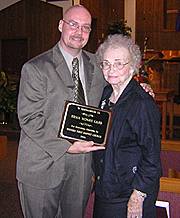
Erma Liles' gift enabled First Church in Weinert to purchase chair lifts to enable elderly and disabled members of the congregation to have access to the church's fellowship hall, which is located upstairs. The congregation thanked Liles for her gift at a dedication service. She is pictured with pastor J.C. Baker.

bluebull Margie Thomas was the featured artist during the University of Mary Hardin-Baylor's homecoming activities. Her exhibit will be on view through Dec. 13 on the second floor of Townsend Memorial Library.

bluebull Youth throughout the state are being sought by the Fellowship of Baptist Educators as corresponders with Chinese students in grades 7-12 who are learning English. Sunday school classes and Acteen and Challenger groups are encouraged to request letters from Chinese students that the American youth will answer. Requests for letters should include the name and mailing and e-mail address of the group leader; the number of letters needed; name of the church or group; and a promise that every letter will be answered. Many Christians use this activity to share their faith with Chinese students. Letters will arrive from China in December and be sent to requesting groups in late January. To obtain letters, contact John Carter at j-fcarter-@juno.com by Jan. 15.

bluebull The Baylor Alumni Association presented four Outstanding Young Alumni Awards. Chosen were Jodi Arnold, Dub Oliver, Jim Springfield and Wendi Foy Green.

bluebull Thirty-three men were named to the Circle of Honor by the Hispanic Baptist Convocation of the Laity. Included were Robert Arrubla, Fort Worth; E.B. Brooks, Dallas; Ray Carrillo, Tyler; Larry Cepeda, Dallas; Bob Dixon, Dallas; Alfonso Flores, San Antonio; Guadalupe Fonseca, San Antonio; Ciro Garcia, Austin; Joel Garcia, Bandera; Roberto Garcia, Fort Worth; Santiago Garcia, San Antonio; Raymond Gonzales, Dallas; Josue Grijalva, San Antonio; Damon Hollings-worth, Spicewood; Elmin Howell, Rockwall; Rodrigo Jimenez, Garland; Herman Martinez, Waxahachie; Larry Naranjo, Lubbock; Richard Palma, Carrollton; Carlos Paredes, Dallas; Gus Reyes Sr., Dallas; Manuel Rios, San Antonio; Rolando Rodarte, San Antonio; Isaac Rodriguez, Corpus Christi; Manuel Rodriguez, San Antonio; Noah Rodriguez, San Antonio; Raymond Rodriguez; Dallas; Rudy Sanchez, Dallas; Orville Scott, Grand Saline; Ben Silva, Dallas; J.V. Thomas, Shepherd; Isaac Torres, Kingsville; and David Vivero, Dallas.

Deaths

bluebull Myron Roe, 94, Oct. 10. He was a charter member of Colonial Hill Church in Snyder and served as music director. He was preceded in death by his wife, Verna Lee; and their children, Jerry Roe and Rosie Floyd.

bluebull Mary Gregory, 74, Oct. 12 in Anson. She was the wife of retired minister Rowland Gregory. They served at Second Church in Garland, Lake Highlands Church in Dallas, First Church in Odessa, University Church in Abilene, Proctor Street Church in Port Arthur and Southside Church in Wichita Falls. She also helped to launch several preschools and kindergartens in Texas and Colorado. For nine years, she was a children's/preschool specialist for the Colorado Baptist General Convention. She is survived by her husband of 56 years; son, Steven; and sister, Kathy Barnes.

bluebull Carol Norton, 62, Oct. 29 in Dallas. Norton had been director of missions for Grayson Association since 1997. He previously had been pastor at Foote Church in McKinney, North McKinney Church in McKinney, First Church in Quitman and First Church in Denison. He was preceded in death by his son, Josh. He is survived by his wife of 41 years, Pam; daughter, Piper Carlile; son, Matt; sister, Nila Kremenak; brother, Dee; and four grandchildren.

Anniversaries

bluebull David Howard, 10th, as associate pastor for music and education at Baylor Church in Ennis, Nov. 6.

bluebull Mike Lawson, fifth, as pastor of First Church in Sherman, Nov. 8.

bluebull First Church in Mont Belvieu, 75th, Nov. 14. A catered lunch will follow the morning service. Jake Porter is pastor.

bluebull Dennis Keen, 20th, as pastor of West End Church in Industry.

bluebull Dale Hill, 10th, as pastor of Grand Parkway Church in Sugar Land.

Retiring

bluebull Joe Trull, pastor of the Church at Driftwood since 1997. He was professor of Christian ethics at New Orleans Baptist Seminary from 1985 to 1999 after serving as pastor at First Church in El Paso, Calvary Church in Garland and Crestview Church in Austin. He will continue as editor of Christian Ethics Today, as an adjunctive teacher at Baylor University and leader of ethics conferences.

Ordained

bluebull Joe Cameron to the ministry at Lone Oak Church in Harleton.

bluebull Tim Doremus to the ministry at Purmela Church in Purmela.

bluebull Daryl Marwitz, Joe Lee and Bassel Leach as deacons at First Church in Evant.

Revival

bluebull Black Creek Church, Centerville; Nov. 7-10; evangelist, Tom Fields; pastor, Norman Diehl.

News of religion, faith, missions, Bible study and Christian ministry among Texas Baptist churches, in the BGCT, the Southern Baptist Convention ( SBC ) and around the world.


BaptistWay Bible Series for Nov. 14: Commended by Christ, committed to the Corinthians_110804

Posted: 11/05/04

BaptistWay Bible Series for Nov. 14

Commended by Christ, committed to the Corinthians

2 Corinthians 10:1-18

By Todd Still

Truett Seminary, Waco

None of the Apostle Paul's epistles would be a good choice for someone seeking to do a little light biblical reading. From early on, it has been recognized that “There are some things in (his letters that are) hard to understand” (2 Peter 3:16).

What is true of Paul's writings in general especially is true of 2 Corinthians. This particular letter demands a good deal from its readers. Not only are there passages difficult to comprehend, but also a number of shifts in subject matter that make the letter hard to follow.

We already have encountered major transitions at 2:14; 6:14; 7:2, 5; and 8:1 respectively. So abrupt are certain transitions that not a few scholars have suggested that 2 Corinthians is a compilation of two or more letters Paul wrote to the church in Corinth over a period of time.

As we begin the third and final unit of our study of 2 Corinthians, we come to yet another topic. At the outset of chapter 10, Paul commences a defense of his ministry against those whom he sarcastically dubs “superlative apostles” (11:5; 12:11).

This robust counter-attack continues well into chapter 12. There we come to the final major division in the epistle, 12:14-13:10. We will consider that portion of the letter in two weeks' time; however, in this lesson we will focus our attention on chapter 10.

The apostle begins his apology with respect to his ministry with a personal appeal to the Corinthians. With meekness and gentleness, Paul, who has been accused of being humble when present but bold when absent, entreats his converts to come to his defense so that when he returns to Corinth he will not have to oppose his detractors.

In addition to denouncing Paul as “more smoke than fire,” the apostle's adversaries were contending he was living “according to the flesh” and not according to the Spirit (vv. 1-2).

A fuller, though by no means complete, picture of Paul's opponents in Corinth will emerge as we work our way through chapters 10-12. For now, it will suffice to suggest these so-called “super-apostles” were likely Jewish Christian missionaries who came to Corinth after Paul had left the city and were seeking in his absence to cast aspersions upon his apostolic character and conduct.

While Paul acknowledges that he, of course, lives “in the flesh” (Greek, “en sarki”), he flatly denies that he “wages war” (a metaphor Paul employs here to refer to his apostolic ministry) “according to the flesh” (Greek, “kata sarki”). On the contrary, Paul contends that he readies himself for service not with “fleshly” (Greek, “sarkika”) weapons but with divine empowerment (10:3-4).

In 10:5-6, Paul reveals his strategy for conducting his ministry of weakness in the face of criticism by those who fancy themselves strong in faith. To begin, he seeks to destroy their strongholds and obstacles–their arguments, pride and “knowledge.” In addition, he takes every thought captive (theirs and his?) to the obedience of Christ. Lastly, he prepares to deal with disobedience. He stands ready to respond to the (undefined) disobedience of his opponents at such a time when his converts prove themselves obedient to the gospel they had received from Paul.

Abandoning military meta-phors, the apostle turns in verse 7 to enjoin the Corinthians to pay attention to what is right in front of them, namely, the very people who are tearing Paul down in order to build themselves up. In doing so, Paul implies his critics are not building up the church he had worked so hard to establish; rather, they are tearing it down (10:7-8; 12:9; 13:10).

Paul appears to be aware of at least some of the criticisms his opponents were lodging against him. In addition to the contention the apostle was bold when absent but humble when present (v. 1), Paul indicates his critics were suggesting he was trying to frighten the Corinthians with his letters and were saying, “His letters are weighty and strong, but his bodily presence is weak, and his speech is contemptible” (vv. 9-10). The apostle denies the suggestion that he is seeking to intimidate his converts (v. 9); moreover, he throws down the gauntlet before his opponents in verse 11 when he writes, “Let such people understand that what we say by letter when absent, we will also do when present.”

It also is possible that Paul's adversaries accused him of arrogant authoritarianism (v. 8). The apostle does not seek to deny that he “boasts in the Lord” with respect to his Corinthian ministry, nor does he abdicate the authority and responsibility he considers to be divinely and duly his in regards to the church (vv. 13, 15-17).

He does, however, criticize his opponents for judging themselves by themselves. Their self-congratulatory attitude, Paul maintains, displays a lack of understanding on their part (v. 12). Moreover, by poaching on Paul's preserves, claiming the Corinth-ians as their own “field” and taking credit for others' labors, the “super-apostles” have in Paul's view overstepped their boundaries and have gone beyond their limits (vv. 13-16). For Paul, it was important that it was he who initially brought the gospel to the Corinthians (vv. 13-14), and it was no fleeting concern of his that the congregation recognize that these spiritual “Johnny come latelys” were not the only ones who belonged to Christ (v. 7).

Some readers of this portion of 2 Corinthians might regard Paul on the defensive to be offensive. Truth be told, he is just warming up! Even if one views Paul's tact and tone at this point in the letter to be over the top, at least two things should be borne in mind. First, Paul cared deeply for his converts in Corinth and wanted to see them flourish, not flounder, in the faith. Additionally, the apostle recognized that in the final analysis what matters is divine, not self, commendation. Christians of all generations would do well to work toward and to wait for the Lord's “well done.”

Discussion question

bluebull What principles can be gleaned from Paul's handling of this adversarial situation?

News of religion, faith, missions, Bible study and Christian ministry among Texas Baptist churches, in the BGCT, the Southern Baptist Convention ( SBC ) and around the world.


Baptist Briefs_110804

Posted: 11/05/04

Baptist Briefs

Hankins named Louisiana executive director. David Hankins, vice president for Cooperative Program for the Southern Baptist Convention Executive Committee, was elected executive director of the Louisiana Baptist Convention. The former pastor of Trinity Baptist Church in Lake Charles, La., will begin his new duties Jan. 1 as director-elect and will assume full duties Feb. 1 after Executive Director Dean Doster retires Jan. 31. Hankins served the Lake Charles church 10 years before becoming vice president for convention policy for the SBC Executive Committee in January 1996. In that capacity, he guided the process of restructuring the convention and its agencies, adopted by the SBC in 1995. He assumed his present post with the Executive Committee in 1998 and directs the development and promotion of Cooperative Program ministries and giving. Born in Alameda, Calif., Hankins, 54, grew up in Texas and received his undergraduate degree at Dallas Baptist University. He received both master of divinity and doctor of philosophy degrees from Southwestern Baptist Theological Seminary in Fort Worth.

Move afoot to nix N.C. giving options. North Carolina Baptists expect a motion from the floor of their state convention that will propose scrapping optional funding plans in the Baptist State Convention of North Carolina's budget. The move would eliminate funding of causes popular among moderate Baptists in the state and strengthen ties to the Southern Baptist Convention. Ted Stone of Durham, N.C., announced he will make a motion at the annual meeting "to restore the single-giving plan of the traditional Cooperative Program as the sole method of doing missions together." Jim Royston, the executive director of the North Carolina state convention, said Stone's proposal could cost the convention $1.5 million. Currently churches giving to the state convention can choose one of four giving plans, making it possible for churches to direct funds to a variety of causes, including the Baptist World Alliance and the Cooperative Baptist Fellowship. Stone's proposal would eliminate three of the giving options, leaving only a plan in which the state convention would keep 65 percent of the money and sends 35 percent to the Southern Baptist Convention.

BJC names communications director. The Baptist Joint Committee in Washington, D.C., has named Jeff Huett director of communications. Huett, 26, joined the BJC staff in 2001 as associate communications director. He succeeds Larry Chesser, who left the religious liberty agency in May to pursue business interests in Arkansas. Huett has served as acting communications director since then. Executive Director Brent Walker praised Huett as "bright, hardworking and with judgment beyond his years." A native of Montgomery, Ala., Huett graduated from Baylor University with a degree in journalism and business, and he earned a master's degree in media and public affairs from George Washington University, where he was named a Larry King Scholar. At Baylor, Huett was the editor-in-chief of the Baylor Lariat student newspaper. As an undergraduate, he completed internships at Associated Baptist Press in Jacksonville, Fla., and Buckner Baptist Benevolences in Dallas. Huett is a member of Columbia Baptist Church in Falls Church, Va.

Conference focuses on missions calling. Antiphony, a student conference focused on vocational calling and global missions sponsored by Cooperative Baptist Fellowship Global Missions and The Samuel Project, will be held in Birmingham, Ala., Dec. 29 to Jan. 2. Worship leaders include Colleen Burroughs, executive vice president of Passport; Julie Pennington-Russell, pastor of Calvary Baptist Church in Waco; recording artist Ken Medema; and the Dramatic Vagabonds. The cost starts at $150 and includes conference fees and lodging. Online registration is available at www.antiphonyonline.org. Registration deadline is Nov. 15. Deposits are refundable until Dec. 1.

News of religion, faith, missions, Bible study and Christian ministry among Texas Baptist churches, in the BGCT, the Southern Baptist Convention ( SBC ) and around the world.


Former NAMB chaplaincy director transfers his endorsement to BGCT_110804

Former NAMB chaplaincy director
transfers his endorsement to BGCT

By John Hall

Texas Baptist Communications

Bob Vickers, former director of the chaplaincy evangelism for the Southern Baptist Convention North American Mission Board, has transferred his endorsement to the Baptist General Convention of Texas.

Vickers, who is now associate pastor of First Baptist Church in Roswell, Ga., indicated the move was a personal decision “of the heart,” saying he feels more connected to the Baptist General Convention of Texas than the SBC.

Vickers, who also is chaplain for a local high school football team, once was stationed at Fort Sam Houston in San Antonio. He has attended the BGCT chaplaincy retreat the past two years.

"I like the way that the BGCT says we have our arms wide open to receiving women who are called to ministry and all others. That inclusiveness is something I whole-heartedly agree with."
—Chaplain Bob Vickers

The transfer of endorsement is not meant as a political move, he added. For years, Texas Baptist chaplains “have been dear friends, have reached out to us, have been supportive of us,” Vickers said.

“I just really like the way the BGCT does chaplaincy business,” he said.

“I am in total agreement with the way BGCT supports their chaplains. I think that's the way it should be done.”

The chaplain added that he is in theological accord with the BGCT.

“I like the inclusiveness. I like the way that the BGCT says we have our arms wide open to receiving women who are called to ministry and all others. That inclusiveness is something I whole-heartedly agree with.”

Vickers, who continues to have a strong following among military chaplains, left the mission board in 2002. One report indicated he had resigned, but others said he was terminated for not enforcing the board's stance against ordained female chaplains strongly enough.

Endorsement by a religious group is required in most chaplaincy positions. It serves as a source of accountability and training.

Bobby Smith, director of the BGCT office of chaplaincy relations, said he is grateful to have Vickers in the family of Texas Baptist chaplains. He praised Vickers for his years of service and said he looks forward to ministering with him.

“This is a huge affirmation for us that a person the whole world of chaplaincy values believes we have a ministry program of relationship and worth,” he said.

News of religion, faith, missions, Bible study and Christian ministry among Texas Baptist churches, in the BGCT, the Southern Baptist Convention ( SBC ) and around the world.


ANOTHER VIEW: Marketplace impacts global missions_110804

Posted: 11/05/04

ANOTHER VIEW:
Marketplace impacts global missions

By Kyle B. Usrey

If we believe our Lord is truly sovereign over all, then he is Lord of the marketplace, as well.

For many Christians, the very idea of God's involvement in the free enterprise system is anathema. After all, didn't Jesus run the moneychangers from the temple? Don't many of the parables deal with oppression of the poor? How can wealth creation actually be part of the gospel?

For decades, pastors have used business people in their congregations as cash cows, grateful for the money they contribute to the true “holy” callings. They admonish Christians in business to beware filthy lucre of the market while exalting them to be salt and light in the nasty, brutish world of globalization. Yet the message most Christians in business receive is that they are second-rate, flawed and worse, compromised by their professions. Nothing could be further from the truth.

Kyle B. Usrey

Globalization and missions in the 21st century disprove these biases against business. Jesus, a carpenter, was part of the marketplace himself. In fact, mission organizations are finding business is the preferred platform for sending missionaries into closed countries. And missions organizations are finding that a business platform has to be legitimate and not a ruse. Otherwise, the duplicity of sending missionaries unprepared to compete in the rough-and-tumble business world of a foreign climate can destroy any ministry's effectiveness.

Baptists historically have integrated their faith, refusing to segment God into niches of their lives. The ultimate integration of faith involves business as missions–both home and abroad–through Christian micro-enterprise development, called CMED, and Christian community development, or CCD. The Bible begins with mankind in a garden and ends with the fulfillment of God's kingdom in a city. In cities, Christians and Christians alone can truly make a difference through CMED and CCD.

Through CMED and CCD, Christians harness market forces within capitalism to solve social problems for God's kingdom purposes. CMED entails holistic investment in poor entrepreneurs, overlooked by traditional financiers but gifted to transform market opportunities into job creation with just a small amount of money. About 10 percent of every society is truly entrepreneurial. And entrepreneurs and small businesses, not multinational corporations, create the most jobs.

Mission organizations are finding business is the preferred platform for sending missionaries into closed countries.

People like David Bussau, in Sydney, Australia, with an organization based out of the Philippines, have spread the “social wealth gospel” through CMED in the poorest urban reaches of the world for more than 25 years. His organizations have financed more than 2 million entrepreneurs in the Two-Thirds World and lifted 10 million people out of poverty during the last five years.

Based on his success in more than 60 countries, Bussau was invited by the North Korean government to invest his entrepreneurial focus in one of the last bastions of communism. Conversations with militant radicals and terrorists in Southeast Asia have led him and others to believe many of the youth recruited for such organizations would lay down their weapons if they only had meaningful jobs–jobs that can be created in an entrepreneurial micro-enterprise environment. Nowhere else could outreach like this have such a dramatic impact to reduce isolation, oppression and violence.

Christian community development involves similar market intervention–asset-based development that provides seed money to transform poverty-laden neighborhoods so markets can take over and yield socially transformed integrated model communities.

The issue that Christians face in CCD is how to transform neighborhoods without gentrifying them, without merely relocating the poor as a result of the economic turn-around that was jump-started by Christian business and community leaders. Chief CCD practitioners have had enormous impact for Christ in their communities–from John Perkins and Wayne Gordon in Chicago, to Robert Lupton in Atlanta and Mack McArter in Shreveport. Even a few business schools in Christian colleges and some smaller cities are applying these principles in curriculum and through churches to spread the whole gospel to the whole world through the whole body of Christ.

So, lives are transformed through both the social gospel and the salvation gospel of the New Testament. And new research reveals the historic and modern nature of the “marketplace” is expansive, involving government and education, as well.

Soon, the Apostle Paul's statement in Ephesians 1:18-19a can be realized: “Pray also that the eyes of your heart may be enlightened in order that you may know the hope to which he has called you, the riches of his glorious inheritance in the saints, and his incomparably great power for us who believe.”

Such enlightenment may reveal the harvest fields are ripe, because Christians in business, government and education act collaboratively in ways that can only be seen as faith-based and God-led.

Kyle B. Usrey is dean of the School of Global Commerce and Management at Whitworth College in Spokane, Wash., and a former faculty member at Hardin-Simmons University in Abilene.

News of religion, faith, missions, Bible study and Christian ministry among Texas Baptist churches, in the BGCT, the Southern Baptist Convention ( SBC ) and around the world.


Co-workers should be honored, not manipulated, chaplaincy director says_110804

Posted: 11/05/04

Co-workers should be honored, not
manipulated, chaplaincy director says

By John Hall

Texas Baptist Communications

BURNET–Co-workers are not pawns to be manipulated on the way to a promotion but teammates to honor while working toward a common goal, said the Baylor Health Care System's chaplaincy director.

Mark Grace, director of pastoral care and counseling at Baylor, believes a working environment where supervisors include employees in decisions and concentrate on worker development is a happier, more productive workplace.

Mark Grace, chaplaincy director at Baylor Health Care System, reminds Texas Baptist chaplains about the importance of servant leadership in the workplace.

Speaking largely from Robert Greenleaf's servant leadership books, Grace told participants at a Baptist General Convention of Texas-sponsored retreat for chaplains that supervisors need to be willing to listen to people who work with them.

That creates a workplace where each person feels valued. People have choices in all areas of their life and want them at work, too.

When all workers have input, they are more willing to commit to the same principles, Grace said. The quality of ministry and ethical behavior will increase. Clients will not be viewed as a way to make money but as avenues for service.

“Humans are not the capital,” Grace said. “Humans are the reasons institutions exist.”

Because they feel valued, employees will begin rallying around each other, Grace added. A sense of community will form. Workers will be involved in each others' personal development, he added. They will support a manager who is open and honest, even when he or she must take a stand.

Grace reminded the chaplains that institutions are not compared to each other, but judged on how well staff members serve their clients.

An improved workplace leads to improved ministry, he asserted.

“How this is put to us at Baylor (Health Care System) is we are not compared to Methodist” Medical Center, he said.

“We are compared to Disneyland or somewhere their needs were best met.”

News of religion, faith, missions, Bible study and Christian ministry among Texas Baptist churches, in the BGCT, the Southern Baptist Convention ( SBC ) and around the world.


STEVE MURDOCK: Demographic guru_110804

Posted: 11/05/04

STEVE MURDOCK: Demographic guru

Texas has become the second most-populous state in the nation and is growing by the minute with great implications for church starting and church growth. No one in the state is more aware of what is happening than the state's demographer, Steve Murdock, who heads the Texas State Data Center and the Institute for Demographic and Socioeconomic Research at the University of Texas-San Antonio. A native of North Dakota, Murdock is a graduate of North Dakota State University and earned master's and doctor of philosophy degrees at the University of Kentucky. He is a member of Phi Beta Kappa. He is the author of 11 books, more than 120 technical articles and book chapters, 125 research reports and monographs and 70 popular articles on the determinants and consequences of demographic, socioeconomic and natural resource changes.

Steve Murdock

Q.

What is the history of the Texas Data Center and the office of the state demographer?

The state data center program started in 1979 in Texas. We have been the primary agency in terms of providing technical support and information since then. We provide direct information through our cells and affiliates to about 50,000 people a year. We provide direct access through our website to another 2.5 million real users, who go to the site and download data from it. In fact, we download about 2.5 gigabytes a day. About 50 percent are public and 50 percent are private users.

Q.

Who are the largest users of your data?

About 50 percent are public, from legislators to state agencies to local cities, towns, communities. On the private side are corporations from across the country. For example, supermarket chains use it to learn where the population is expanding so they can tell where to place their stores. We have a number of nonprofits who use it, such as Little League who use it to discern districts for specific teams in specific cities.

We have a tremendous variety of uses of our data, both in the public and private sectors. Perhaps the major part of our data, in addition to census data, is we do estimates and projections for the state of Texas. We do estimates yearly and biennial projections that are used by virtually all state agencies to do facility, personnel and budgetary planning.

Q

How do you gather the data?

The census data is provided by the Bureau of the Census. But we collect data on annexations of every city and town in Texas. We obtain data, both city and county, on housing and building permits and occupancy permits and data on school enrollment as another way to estimate population. We use factors we have seen as symptomatic of population change, like school enrollment, housing permits, vehicle registrations, births, deaths–a wide variety of factors. We do estimates for all 254 counties and about 1,500 places, towns and cities every year, and every other year we do projections for the state and counties.

Q.

When was the office of the state demographer created?

The office of the state demographer was created recently, but we have been doing the duties of that office for years. In 2001, a bill was introduced by Sen. West of Coleman to create the office. The bill specified the lieutenant governor and speaker of the House would nominate the person, and the governor would make the appointment. Gov. Perry made the appointment. It recognized some things we were already doing and gave it official status. Part of the reason was federal agencies were seeking information and didn't know where to go. By creating the office, it centralized the location and let people know where to go for their information.

Q.

Who was doing the work of your office and the data center before 1979?

No one. There had been no ongoing population projections before 1979.

Q

Why was your office moved from Texas A&M to the University of Texas at San Antonio in January?

They made us a better offer in terms of resources and visibility, and part of it was simply location. We are able to do more with large businesses in a large metropolitan area than we were able to do in Bryan/College Station. Being in a metropolitan area increases our ability to work with the private sector.

Q.

What is your principal assignment?

No one says this is exactly what you are supposed to do, but people depend on us to be able to provide them with the most recent data on demographic matters. They assume they can call us and ask for the most recent data on the number of children, or elderly or total population. We also do the estimates in the projections, which are used for budgetary and other kinds of planning and purposes. Another thing we do is selected policy analysis with demographic data.

Probably most people know of our work about a decade ago called The Texas Challenge and more recently The New Texas Challenge. Everything we do has a demographic component. We don't claim to be economists or something other than what we are. But what we do in the policy work is try to trace what the implications of demographic change are for other other factors for state services, for income levels, for educational levels, etc. We are not policy makers; we are policy informers. We provide information for the policy makers that they can use in their deliberations. Our job is to provide information and let them use it in ways they see fit.

Q

How large is your staff and do you have offices in other areas.

Our direct staff here in San Antonio is about 14 people, the majority of which are supported not by state appropriations but by grants and contracts we have with various entities.

We do have a network of nearly 50 other entities in the state that disseminate information.

Nearly all of the 24 councils of governments, many small business institutes and universities are part of the network.

The idea of the network is to provide access in closer proximity to the users, so that if I am in Lubbock I can go to Texas Tech, our Plains affiliate, and get information and not have to get it from our San Antonio office, although that is much easier today with Internet capabilities. But if they want to sit down and talk to someone about data items, they can do it with someone who is close.

All those entities cooperate with the program at no cost to the state of Texas. Most do it to have access to the information and to serve their clienteles.

Q.

How did you personally get involved in demographics?

I have a bachelor's degree from North Dakota State University. I am originally from North Dakota but I have been in Texas for 27 years. I received a master's and doctor of philosophy degree at the University of Kentucky. When I went to Kentucky, I met a very dynamic professor who was a demographer and helped me begin to see what demography was and what it could do. Like most academics, in terms of their field, I fell in love with my discipline by seeing what it studied, which was intrinsically interesting to me.

And very important for me was the aspect of what it could do and how it could be used by people in the real world, so to speak.

Q.

Give me an example of how demographics affect our lives as Texas citizens.

Lots of different ways. A good example is that the aging of the Baby Boomer population, those born between 1946 and 1964, will create and are creating in the next decade the largest number of elderly people we have ever had.

What that means for any Texan, whether through state or federal programs, is the amount we will be spending for long-term care, for medical care, will increase dramatically.

This is the first generation that is larger than the generation coming up behind it and in a sense is the first generation that will have larger numbers using services than are paying for services. That is clearly a demographic factor that affects not only that generation but generations of others, because as we age, our health needs go up.

Another way is that as the characteristics of the populations change, educational levels change and the need, use and cost of state services change. Demographics, as some people say, is not destiny but is certainly a major determinant in our society.

Q.

Is the study of demographics changing?

Yes and no. There are some basic elements we have always studied, such as the major processes that change population, such as fertility, mortality, migration and immigration. I think what is changing is that demographers are looking at the implications, not just the demographic implications, such as how many will be elderly but what that will mean for health care and Social Security and long-term care needs.

Q.

Is this a growing field?

It is. There are somewhere between 4,000 and 6,000 demographers in the field, but the real growth is in the interface of demography with things like health care. Many hospitals, for instance, have demographers who are helping them look at the area they serve. Many large school districts have demographers on staff helping them discern attendance zones and capital facilities needs. There is substantial growth in marketing firms, because one of things that demographers look at that is an absolute key to many companies is how many people are likely to transition into pension plans. It is a growing area. Demographers are being used more and more by universities, federal and state governments and then across the different dimensions of the private sector.

Q.

How could a church or association or convention of churches use the services your office provides?

A number of such organizations have used us to learn how fast their communities may be growing or changing. Many also use us for long-term planning to look at characteristics of people who might be of their denomination or of the characteristics of the growing population to see if there is a need to reach out to the new groups. They look at the population growth in terms of the services they are providing and if they need to offer new services.

Many churches use us to gauge how well they are doing, in a sense. They look at their churches and our data and see if they are growing like the area or faster or slower than the population growth and if they are offering a full range of services to the overall population or to just segments. If you want to look at the future and growth, you have to look at the characteristics of the growing population and how well you are able to address their spiritual needs.

Q.

Are you a church member and does your church utilize your services?

I am a church member, and I know my church uses data but would not use me directly.

Q.

What role has religious faith played in your life?

I am an average religious person. The key role played through my parents has been in establishing in me honesty and integrity, as well as the need to serve others, to do more in life than assist our own cause and betterment, but also contribute to society and fellow people. My membership is at a Lutheran church. We haven't decided on one in San Antonio.

Interview by Toby Druin

News of religion, faith, missions, Bible study and Christian ministry among Texas Baptist churches, in the BGCT, the Southern Baptist Convention ( SBC ) and around the world.


DOWN HOME: 25th Reunion Blessing recalled_110804

Posted: 11/05/04

DOWN HOME:
25th Reunion: Blessing recalled

Joanna and I recently journeyed back to Hardin-Simmons University in Abilene to celebrate the Class of 1979's 25th homecoming reunion.

I departed with good news and bad news.

Let's get the bad news over with: I must be middle-aged. Most of the time, I can lie to myself and overlook this uncomfortable fact. But at HSU, I kept running into all these middle-aged people who attended class with me 25-plus years ago. Observing longtime friends is like looking into a mirror with really good light. You see stuff you miss most days.

Some of our more optimistic friends tempered the tragedy of this truth by testifying to the joys of aging. A couple already have grandchildren they obviously adore. Even more now live in empty nests, since their children have left home. Ken, a new empty-nester but a joker from way back, described one benefit of absentee children: “We can run around the house naked. But we can't remember why we ever wanted to.”

MARV KNOX
Editor

Now, for the good news. We were an incredibly blessed group of young people who attended that wonderful Baptist school in West Texas a generation ago.

First, Hardin-Simmons blessed us. It was a terrific university back then, and it's even better today.

We recalled professors and administrators who profoundly impacted our lives. The ideas and information we gathered in their classrooms and campus organizations empowered us to succeed in an array of professions.

Beyond that, those profs and staff members strengthened our faith and provided remarkable role models for how we should conduct our lives once we left the happy confines of the Forty Acres. We're better people and stronger Christians because of them.

And that brings me to the other blessing. We blessed each other. Most of us arrived as teenagers and left as young adults. Along the way, we shaped each other–for the good. Some of the best friends I've had in my life are the boys and girls who lived in the dorms, ate in the cafeteria and studied in the library of that lovely campus.

I reveled in the closeness of relationships that remains to this day. It's exhibited in little ways. Like how two of my great friends still call my wife by the name I learned to call her 28 years ago. Like how we practically picked up conversations we started when Roger Staubach was quarterback of the Dallas Cowboys, Gerald Ford was president of the United States and I had hair on the top of my head. Like how we took genuine joy in the details of life spanning a quarter-century.

Sometimes, I wish I could spend a lifetime in the warm embrace of that inviting place. Of course, that's impossible. But I thank God for blessing our lives on that Texas Baptist campus.

News of religion, faith, missions, Bible study and Christian ministry among Texas Baptist churches, in the BGCT, the Southern Baptist Convention ( SBC ) and around the world.


EDITORIAL: ‘Moral values’ should mean more than sexual ethics_110804

Posted: 11/05/04

EDITORIAL:
'Moral values' should mean more than sexual ethics

How do you define “moral values”?

I couldn't help but ponder that question on election night. The national exit poll, shared by major news media, revealed 80 percent of voters who said “moral values” are a primary concern cast their ballots for George W. Bush. As I listened to the pundits and recalled which “moral values” surfaced in the presidential campaign, I came to the same conclusion I reach while viewing too many TV commercials: It's all about sex.

The “moral values” boiled down to two front-line issues and a shadow third–abortion, homosexual “marriage” and a former president's infidelity.

We who seek to pattern our lives after the Great Commandment–loving God–some-times forget the Second Command-ment–love others. But any biblical definition of "moral values" surely embraces both.

Don't misunderstand: These are vital issues. The Baptist General Convention of Texas repeatedly has opposed elective abortion and called for restricting abortion “except to save the life of the mother or in cases of incest or rape.” Texas Baptists have opposed partial-birth abortion and supported laws requiring parental consent before a minor could have an abortion. And we have provided infrastructure to make adoption a viable alternative to abortion. Concerning homosexuality, we have stated, “The homosexual lifestyle is not normal or acceptable in God's sight and is indeed called sin.” We also have stressed the Bible affirms the value and worth of every person, offering hope for all, including homosexuals, in Christ. And we have called on our churches to minister to homosexuals. As for infidelity, well, it's so damaging to individuals and families and churches that we believe it deserves universal condemnation.

You can understand why sex monopolizes the “moral values” radar: Sexual imagery dominates television and movies, billboards and magazines. Abortion is a life-or-death issue. And homosexuality, which millions of Americans wish would just go away, seems to be forced upon our consciousness, both in the media and in the courts.

But (high school boys' imaginations to the contrary) there's more to this world than sex. And every American, particularly every person of faith, who is motivated by “moral values” should press our leaders to act on a wider range of issues. They include, but aren't necessarily limited to:

Poverty. Nothing seems to raise Baptists' hackles like the reminder that poverty is a moral issue. Sure, we can cite extenuating circumstances. People need to take responsibility for their own lives. Deadbeat dads are louses. Some folks abuse “the system.” But we can work to reduce the plague of poverty without embracing socialism or a welfare state. Working families shouldn't be impoverished; shame on our society when they are. No matter how lousy their parents, children shouldn't be malnourished. As a people, we can do better, and we should find more ways to empower poor adults and embrace poor children. Bottom line: Jesus said the way we minister to “the least of these” reflects how we minister to him. No argument, rationalization or equivocation.

bluebull Healthcare. People who argue against improving our healthcare/insurance system consistently say, “I don't want a program like Europe.” We don't have to have socialized medicine to provide more equity, fairness and, yes, grace to our medical system. We all know it's broke and getting worse. We have a “moral” obligation to fix it.

bluebull Environment. You don't have to be a tree-hugger to be alarmed. The planet's air, water and soil all are jeopardized. Playing semantic games won't make it go away. Genesis tells us this world doesn't belong to us. It is God's. We are to be good stewards. Jesus said, “Do unto others as you would have them do unto you.” That goes for future generations, who will curse us if we deplete and pollute their natural resources.

bluebull Debt. Economic theories abound, of course. But they fail the morality test if they enrich us while impoverishing our children and grandchildren. Money is not value-neutral. The Golden Rule applies to the economy, too.

bluebull Nationalism. Patriotism is wonderful; it is a love for one's country born out of gratitude to God. It embraces self-sacrifice, optimism, compassion and altruistic vision. While it aspires to the best for one's country, it does not seek to exalt that country at the expense of others. But nationalism is a perversion of patriotism. It poses as patriotism, but it is selfish and mean. It does not care for others. It seeks to rise by standing on the necks of others. Rather than expressing gratitude to God, it assumes blessings are a divine right, owed by God. Throughout our history, America has been a patriotic country. We're tilting toward nationalism. We don't have to become a patsy or allow global bullies to go unchecked. But we should guard against becoming the bully, the oppressor. We should seek the kind of humility that is affordable precisely because we have been blessed and now are the most powerful nation on Earth.

A lawyer once asked Jesus, “Which is the greatest commandment?” Jesus responded: “'Love the Lord your God will all your heart and with all you soul and with all your mind.' This is the first and greatest commandment. And the second is like it: 'Love your neighbor as yourself.'” Jesus defined “neighbor” not as a fellow believer who attends the same church and votes the same way, but as a sworn enemy, the last person we would be expected to love.

We who seek to pattern our lives after the Great Commandment–loving God–sometimes forget the Second Commandment–love others. But any biblical definition of “moral values” surely embraces both.

News of religion, faith, missions, Bible study and Christian ministry among Texas Baptist churches, in the BGCT, the Southern Baptist Convention ( SBC ) and around the world.


LifeWay Explore the Bible Series for Nov. 14: Fundamental facets of a fulfilling prayer life_110804

Posted: 11/05/04

LifeWay Explore the Bible Series for Nov. 14

Fundamental facets of a fulfilling prayer life

Luke 11:1-54

By Pakon Chan

Chinese Baptist Church, Arlington

People often ask the purpose of prayer if God knows all of our needs. If prayer is perceived as a conversation between two lovers, it is easy to understand why God wants us to pray to him.

Many Chinese poems tell stories of departed lovers in a far distant land. What a joyous thing to receive a love letter from another person, even if it is only a few sentences.

When we communicate with God through prayer, our relationship with him will grow. Prayer is more than making a plea to God for something we need. God loves us, so he wants to have intimate talks with us. He expects us to have the same desire to talk to him.

study3

After Jesus had finished his prayer, his disciples asked him how to pray. The disciples must have seen Jesus was enjoying his prayer life. We all enjoy talking to our loved ones. Conversation is a very delightful experience between two lovers.

Everybody knows how to pray, but not all of us enjoy prayer. The enjoyment Jesus had in his prayer life must have aroused the interest of his disciples. They wanted to know the secret of his prayer. As a matter of fact, Jesus did have some secrets in his prayer life that allowed him to enjoy praying to the heavenly Father. He will reveal those secrets to us in these few verses on the principles of a Christian prayer.

Put God first in prayer

Luke gives us a shorter version of the Lord's Prayer than Matthew (Matthew 6:9-13), but it will teach us all we need to know about how to pray and what to pray for. Our prayer should start with God our heavenly Father. We call God our Father to recognize our relationship with him is a Father-child relationship. This means God has given us life. He loves us and wants to protect and provide for us.

We, as children, sometimes may not want to talk to our father; but God, as our heavenly Father, always wants to talk to us. Whenever we talk to him, he is always here to listen and to talk to us.

Placing God and his concerns first in our prayer is important. We tell our Father we want his name to be glorified and held in reverence in our daily lives. We want people to glorify his name and hold his name in reverence when they learn about him in our words and deeds. When we sink into a deep thought on how to revere God's name, our prayer will be transformed into close and intimate talk to God.

Any meaningful conversation should not be a monologue between two persons. When we talk with a person, we want to know their concerns and talk about those concerns. Seeking God's will in our prayers is an interesting thing to do. Ask, listen and wait, and we will know God's will.

Many Christians do not know how to listen to God. Listening is reading and searching in God's word. Prayer and Bible reading and searching should go hand in hand. George Muller told us we should pray with an open Bible. When we learn God's will through prayer, we also should pray that God will give us strength to do his will. Only when we submit to God's will and do it accordingly can his will can be done on earth.

Pray for ourselves

Our God is not only a God of spiritual things. He is the God of our whole life, so he will take care of our daily needs. This is the reason why Jesus teaches us to pray for our daily needs (v. 3). God may not want us to be millionaires, but he will provide for our needs. Praying with contentment is the attitude Jesus teaches. We will be contented with whatever God gives us to meet our needs. It also teaches us to rely on him, not the things he gives.

If we just ask for a one-day provision, we do not need to pray a long prayer or use long sentences. Jesus wants us to pray for our spiritual growth and spend time on it. First, we need to deal with our sins. We need to ask forgiveness every time we pray. God has promised to forgive us if we ask him (1 John 1:9).

If we can be forgiven by God, we should forgive others. God already has prepared to forgive us even before we ask. God does not like sin, but he loves us, so he has no hatred in his heart against us, even before we ask for forgiveness.

We should do the same thing. We may not like what others have done to us, but we love people, so we should not have hatred in our hearts, and forgive them anytime they ask.

Temptation in the New Testament means any testing situation. Sometimes a test will become temptation to us if we yield to it. Jesus teaches us to pray not to be led into temptation. God will not lead us into temptation, even though he allows tests to get in our way. Jesus wants us to pray to ask God's help and strength to overcome testing so we will not fall into temptation. God will walk us through all the trials and tests if we ask him.

Discussion questions

bluebull Do you enjoy your prayer life?

bluebull What will you pray for in your daily prayer?

bluebull How can you improve your prayer life to make it more enjoyable?

News of religion, faith, missions, Bible study and Christian ministry among Texas Baptist churches, in the BGCT, the Southern Baptist Convention ( SBC ) and around the world.