LifeWay Family Bible Series for Aug. 22: Humility is the posture for service to God, others_80904

Posted: 8/06/04

LifeWay Family Bible Series for Aug. 22

Humility is the posture for service to God, others

1 Peter 2:13-14, 17-21; 3:1-4,

7-9; 5:5-7

By Rodney McGlothlin

First Baptist Church, College Station

Peter describes several relationships in life where submission is required. He includes domestic relationships (3:1-7), civic relationships (2:13-17), relationships between young and old (5:5), and work relationships between slaves and masters (2:18-20). The latter might be applied to employers and employees.

This kind of submission in human relationships requires true humility. Peter says, “Humble yourselves, therefore, under God's mighty hand, that he may lift you up in due time” (5:6).

Humility is a decision. “Humble yourselves.” We can choose to be humble. We can choose to be arrogant.

When I was a child, I would tell my mother she made me mad. She was not buying that. She would simply say, “You have the same shoes to get glad in.” It was her way of saying my anger was a decision. When we get prideful, arrogant or self-centered, we need to hear Peter say, “You have the same shoes to get humble in.” Humility is a decision.

Humility begins with our attitude toward God. "Humble yourselves under God's mighty hand." We will never be humble in our dealings with a fickle humanity until

study3

we come to be humble toward God. There are many people in life who will take advantage of humility. But not God! Far from it! Verse 7 goes on to say, "Cast all your anxiety on him, because he cares for you." Humility will require deep trust in a God who has proven himself faithful toward us. Because he cares, we can trust him.

Humility is a prerequisite to proper exaltation. “Humble yourselves under God's mighty hand, that he may lift you up in due time.” God raises his people up to places of responsible service in his kingdom. It is not something for us to snatch.

David was a shepherd, the youngest of a bevy of boys. He took care of his father's flock while his more-qualified siblings fought Israel's wars. He played the harp to calm the demons of a failing king. He refused the trimmings of royalty from King Saul when he rejected the king's armament. He trusted God to deliver Goliath into his hand.

Samuel came to David's house and poured the oil of coronation on his head. The nation did not fall at his feet immediately and recognize him as their king. It would take time, but it would happen. It happened “in due time.” It was the right time. It was God's time. David first learned humility.

Humility has an example. Peter knew sinful people would take advantage of humility. Suffering might come to those who followed this command. It was especially true in the relationship of slaves to masters. In this context, Peter said, “To this you were called, because Christ suffered for you, leaving you an example, that you should follow in his steps. 'He committed no sin, and no deceit was found in his mouth.' When they hurled their insults at him, he did not retaliate; when he suffered, he made no threats. Instead, he entrusted himself to him who judges justly” (2:21-23).

Jesus trusted God. He humbled himself before God so he might humble himself before humanity in service and love. He served others. He washed their feet. He gave his life for them. That is humility. According to Peter, it began with trusting God. “He entrusted himself to him who judges justly.”

Paul expressed the same thing in Philippians 2:4-11. Listen to his description of Jesus' humility and of God's exaltation of him in due time.

“Each of you should look not only to your own interests, but also to the interests of others. Your attitude should be the same as that of Christ Jesus: Who, being in very nature God, did not consider equality with God something to be grasped, but made himself nothing, taking the very nature of a servant, being made in human likeness. And being found in appearance as a man, he humbled himself and became obedient to death–even death on a cross! Therefore God exalted him to the highest place and gave him the name that is above every name, that at the name of Jesus every knee should bow, in heaven and on earth and under the earth, and every tongue confess that Jesus Christ is Lord, to the glory of God the Father” (Philippians 2:4-11).

A number of years ago, I was at Glorieta, N.M. I took my camera to capture the beauty of the campus and the surrounding Sangre de Cristo Mountains. The landmark structure at Glorieta is the chapel. The logo of the campus hints at the logo of New Mexico. It is a circle with a cross in the middle of it. The balconies around New Mexico Hall had a railing that included this logo.

I noticed one day that from the balcony of New Mexico Hall it might be possible to compose a picture of the chapel through one of the circular logo structures. I got my camera and my tripod. It was possible, but only from a very low angle. To compose the scene, I had to lie down on the floor of the balcony. I had been there for a few minutes when the class meeting closest to my position let out early. People bolted from the room headed to the chuck wagon.

I learned two things that day. First, never lie on the floor in front of a hungry Baptist. It is a good way to be transformed into ground beef. Second, humility is a posture. It is getting into a position from which you can see God and others as more important than yourself. It does not matter what others may think. Without it, we will never stoop to the position of service. Be humble. It is the prerequisite for service to God and others.

Question for discussion

bluebull How can a posture of humility be demonstrated?

News of religion, faith, missions, Bible study and Christian ministry among Texas Baptist churches, in the BGCT, the Southern Baptist Convention ( SBC ) and around the world.


WMU mission volunteers reach out to Pittsburgh_80904

Posted: 8/06/04

WMU mission volunteers
reach out to Pittsburgh

Members of Zion Hills Full Gospel Church join hands to pray with volunteers from Texas, Georgia and North Carolina during FamilyFEST, a volunteer missions effort in Pittsburg, Pa., coordinated by Woman's Missionary Union. WMU volunteers from 12 states served at 15 ministry sites in Pittsburgh this summer during MissionsFEST and FamilyFEST events. About 165 volunteers, including 27 families, participated in backyard Bible clubs, surveys, block parties, light construction, landscaping, repairs, prayerwalking and cooking at a children's camp. Some volunteers, such as 18-year-old Morgan Worsham of Conroe (left) planted and picked vegetables on an eight-acre farm for the Pittsburgh Food Bank. She worked with her grandmother, Jeanette Cliett of Pasadena. MissionsFEST and FamilyFEST in Pittsburgh were a partnership between national WMU, Pennsylvania/South Jersey WMU, Appalachian Regional Ministry and the Baptist Association of Southwestern Pennsylvania. For more information on future WMU FamilyFEST or MissionsFEST opportunities, visit www.wmu.com, or call (205) 991-4097.

News of religion, faith, missions, Bible study and Christian ministry among Texas Baptist churches, in the BGCT, the Southern Baptist Convention ( SBC ) and around the world.


Floods prompt outpouring of ministry_80904

Posted: 8/06/04

Members of The Oaks Baptist Church in Grand Prairie and Texas Baptist Men volunteers discuss where dehumidifiers will be most helpful after floodwaters deluged parts of North Texas.

Floods prompt outpouring of ministry

By John Hall

Texas Baptist Communications

BALCH SPRINGS–Debbie Christner stood on her porch as rushing water encroached on her home. It had happened before, and the water always receded before it flooded the house. But this time was different. The water did not slow down.

She and her daughters had to be rescued by firefighters with ropes and lighted helmets. Several feet of water filled Christner's home. Nearly everything–furniture, walls, pictures, and fence–was damaged.

“The only thing I can keep is my TV,” she said. “And I don't even watch TV.”

After the water receded, the situation grew graver as the only person who came to help Christner was a neighbor, Sherry McCormick. The two women struggled to remove Christner's belongings alone. Then the Red Cross connected them with Texas Baptist Men clean-out volunteers.

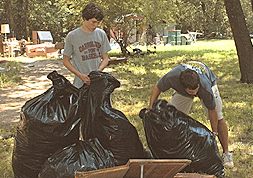
Emily Jackson, 14, sorts through a box of compact discs to see if they were damaged by floodwaters. Jackson's youth group from Cliff Temple Baptist Church in Dallas were among the Texas Baptist volunteers who helped clean out flooded homes in the south Dallas suburbs.

Christner's home was one of the many houses Texas Baptist Men clean-out units worked on in southern Dallas suburbs. The Collin, Lubbock and Amarillo associational units primarily served in Lancaster, where flooding damaged nearly 200 homes.

By Aug. 4, TBM had 70 houses on a list to clean out.

Volunteers removed furniture and helped residents pack their belongings for storage. Workers also tore out water-soaked wood and sheetrock.

The Texas Baptist Men Dallas Baptist Association feeding unit prepared 600 meals a day for the Red Cross to deliver to those in need. Victim Relief Ministries counseled people who were affected by the flooding.

“I just feel so sorry for these people,” said Barbara Erwin, a TBM volunteer from Shady Oaks Baptist Church in Hurst. “This is such a devastation. It affects everything.”

The clean-out and feeding units got a boost from area Baptist churches that sent groups of volunteers to help.

Members of First Baptist Church in Lancaster and Hampton Road Baptist in DeSoto helped the feeding unit. Individuals from The Oaks Baptist Church in Grand Prairie helped the clean-out crews.

Reed Harris (left) and Ryan Harris put bags of collectibles in storage after floodwaters filled several feet of a Balch Springs home. Their youth group from Cliff Temple Baptist Church in Dallas helped several families pack and store their belongings following late July floods. (John Hall Photo)

Members of the youth group from Cliff Temple Baptist Church in Dallas helped Christner and other neighbors clean their homes.

Kenny Cheshire, the church's youth minister, said the group saw the damage on the way back from the Houston Astros game and felt a desire to help.

When a member of Cliff Temple–Beverly Phillips, ministry assistant in the Baptist General Convention of Texas bivocational and small church development office–sent an e-mail asking for volunteers in the area, the youth responded.

“Where there's a need, we need to do it,” Cheshire said.

Reed Harris, 14, said he decided to help flood victims because it would have a lasting impact in people's lives.

Rebuilding the homes can be a several-month process. Many will need to be reconstructed completely, replacing the walls, floors and all furniture. But it all starts with the cleaning process. In this case, it started with a little help from Texas Baptist Men and members of the Texas Baptist family.

“We're just here to serve the Lord and help the people,” said Bill Gresso of Northlake Baptist Church in Garland, coordinator for the TBM emgergency food service effort.

Disaster relief ministry meets the needs of people, but it also raises churches' profiles in the community as residents see church members are people who want to help their neighbors in need, Gresso added.

TBM needs additional workers to help residents through the recovery process, shoveling mud out of homes and moving furniture.

To volunteer, call Jeanette Nichols at (214) 828-5357.

News of religion, faith, missions, Bible study and Christian ministry among Texas Baptist churches, in the BGCT, the Southern Baptist Convention ( SBC ) and around the world.


Casino impact studies ignore social costs, researchers say_80904

Posted: 8/06/04

Casino impact studies ignore
social costs, researchers say

By Ken Camp

Managing Editor

Independent researchers maintain a recently released study on the economic impact of casinos in Texas trumpets casinos' benefits without fully considering costs to taxpayers.

And they claim a companion study on the social impact of casinos ignores overwhelming evidence of a correlation between easy access to gambling and prevalence of problem gambling.

The Texas Enhancement Group–made up of wealthy potential casino investors–financed the economic study by the Perryman Group of Waco and the social impact study by William Kelly, professor of sociology and director of the Center for Criminology and Criminal Justice Research at the University of Texas at Austin.

Barry Keenan, a casino developer who is working as a consultant with the Texas Enhancement Group, told the Austin Business Journal the group paid $163,000 for the study and will pay an additional $40,000 for follow-up analysis.

Keenan–who wants to build a $440 million casino in Austin–served more than four years in prison for the kidnapping of Frank Sinatra Jr. in 1963.

The Perryman study projected casinos would create up to 271,000 permanent jobs and generate from $2 billion to $2.88 billion in state and local tax receipts.

The study presented a series of possible scenarios, one of which predicted casinos could increase total spending in Texas by $30.6 billion a year and state tax receipts by $2.1 billion annually.

The Perryman report was “the wrong study with the wrong numbers that reached the wrong conclusion,” said John Kindt, professor of business and legal policy at the University of Illinois.

Instead of an economic impact study, Texans should look at cost/benefit studies of legalized gambling, he insisted, adding that lost sales tax revenues and other taxes would exceed any tax benefits from legalized betting.

In addition to regulatory costs, these include infrastructure, law enforcement and social-welfare costs, he noted.

For instance, a 1995 study in Wisconsin revealed 37 percent of the citizens in an area near a casino said their savings had been reduced since the casino opened. In that same study, 10 percent of the local residents said they would spend more on groceries, and about one-fourth said they would spend more on clothes if not for the casino.

“Cost/benefit studies for over a decade consistently have shown $3 in costs to taxpayers for every $1 in benefits. That debate is over,” Kindt said.

Ray Perryman disputed Kindt's assertions, saying his study examined net benefits after considering costs, including diversion of money from retail sales. He maintained Texas differs from some other states because it already has accessible gambling in neighboring states, and it is losing revenue to those venues.

But Kindt insisted Perryman's study failed to take into account either research or recommendations of the 1990 National Gambling Impact Study.

That federal panel called for a moratorium on gambling expansion and urged jurisdictions considering legalized gambling to examine independent cost/benefit analyses.

Kindt also cited research by another Waco-based economist–Earl Grinols of Baylor University–who takes to task many of the economic impact studies touted by the gambling industry.

Grinols and fellow economist David Mustard from the University of Georgia wrote in December 2000: “Some research that purports to evaluate costs or benefits actually examines local and not total social costs or benefits. Another concern is that much of the research has been conducted by organizations with a vested interest in the outcome of the research, institutes with industry ties or state agencies. Relatively little research is in peer-reviewed journals.”

Perryman took exception to any suggestion his research was unduly influenced by the group that commissioned it, saying: “Never in 25 years have we cooked the numbers.”

Robert Goodman, a professor at Hampshire College in Amherst, Mass., said he had not read the Perryman and Kelly studies.

But in general, Goodman characterized studies funded by gambling interests as “bogus” and “promotional” rather than scientific.

“Typically, these studies project job increases and make revenue projections without seriously looking at the cost of getting there,” he said, pointing particularly to the economic impact on communities as problem gambling increases.

Kelly did not return calls from the Baptist Standard offering him an opportunity to respond.

Goodman, the former director of the Center for Economic Development at the University of Massachusetts-Amherst, wrote “The Luck Business” about the economic and social impact of legalized gambling. That book detailed his research as director of the United States Gambling Study, a two-year project in the early 1990s funded by the Ford Foundation and the Aspen Institute.

His research at that time set the annual cost to society per problem gambler at $13,200.

Both he and Kelly set the incidence of problem gamblers at about 3 percent of the general population.

But Goodman estimated the percentage could increase by anywhere from 1 percent to 4 percent if legalized gambling became more accessible, while Kelly pointed to no increase.

In an executive summary of his social impact study, Kelly stated: “There is no consistent, scientifically reliable research that supports the argument that the proliferation of casino gambling in the U.S. has led to increases in the prevalence of problem and pathological gambling.”

Goodman countered: “That argument just doesn't hold water.”

At least eight independent studies point to a correlation between easy access to legalized gambling and increased prevalence of problem gambling, he asserted.

Raw data from a casino-funded study in 1997 conducted by the Harvard Medical School division of addiction studies demonstrated that same correlation, he added.

“Even studies funded by the gambling industry show that the more convenient it is, the more people will gamble,” Goodman said.

“And the more they gamble, the more likely there will be an increase in the prevalence of problem gambling. It just makes sense that there's a direct correlation.”

Kindt agreed, pointing to the National Gambling Impact Study Commission's findings that problem or pathological gambling doubles within a 50-mile “feeder market” around gambling facilities.

Rather than arguing cause and effect, the issue is correlation, Kindt said. And there is a clear correlation between the accessibility of legalized gambling opportunities and incidents of pathological or problem gambling, he stressed.

Bob Breen, director of the Rhode Island Gambling Treatment Program, said Kelly's assertion that no clear evidence proves a cause-and-effect relationships between legalized gambling and problem gambling is true. But, he added: “That doesn't mean there isn't such a relationship.”

If it could be proven, it probably would take 10 to 20 years and be incredibly expensive, he noted.

But he can point to anecdotal evidence indicating a link.

“In my career, I've treated over 500 pathological gamblers. This experience leads me to believe that many–maybe about 50 percent–only developed the disorder after some form of casino gambling was introduced to their geographic area,” Breen said.

“That's not empirical evidence, and it won't hold up in the court of scientific opinion. But I know what I know.”

News of religion, faith, missions, Bible study and Christian ministry among Texas Baptist churches, in the BGCT, the Southern Baptist Convention ( SBC ) and around the world.


Gambling industry has money, but opponents insist they have hope_80904

Posted: 8/06/04

Gambling industry has money,
but opponents insist they have hope

By Kirsten Pasha & Greg Warner

Associated Baptist Press

JACKSONVILLE, Fla. (ABP)–In the Bible, casting lots–which many consider gambling–was a way for God's sovereignty to reign through randomness. Now gambling is drawing lots–lots of people, that is.

A survey released by the American Gaming Association claims 2 million more Americans visited a casino in 2003 than in 2002. Consumers spent more than $27 million at commercial casinos in 2003, more than twice as much as the $11 million spent 10 years before.

But even those numbers–from the gambling industry itself–vastly understate the extent and impact of gambling, according to John Kindt of the University of Illinois, a professor, researcher and outspoken critic of the gambling industry.

While the American Gaming Association says 26 percent of the public gambles regularly, Kindt notes 80 percent of Americans gamble in some form or another.

And while gambling opponents can claim some recent victories, the popularity of gambling remains strong. Nonetheless, some Christians say they are fighting the gambling urge with a hope based on more than luck.

“The whole culture of building our hope for our future on something so random as winning the lottery … or a roll of the dice … is an underlying spiritual value–a form of nihilism that we don't have anything to hope for,” said Suzii Paynter, director of public policy with the Texas Baptist Christian Life Commission. “We (Christians) believe in hope grounded in our faith, not on sheer luck.”

More than 80 percent of people surveyed by the gaming association–regardless of age, income, U.S. region or religious participation–believe casino gaming is acceptable for themselves or for others.

The North American Association of State and Provincial Lotteries reports 40 states and the District of Columbia have lotteries. Only Utah and Hawaii prohibit all forms of gambling.

“There's so much gambling in America, no one can wake up and say they've got an itch they can't scratch,” said Thomas Grey, executive director of the National Council Against Legalized Gambling and a Methodist minister.

Although gambling is now pervasive, Grey said the tide is turning.

“In 2003, gambling tried to expand in 46 ways in 30 states,” he said. “We won 43 and lost three in 2003.”

While gambling interests always will outspend opponents, he said, opposition has the advantage of popular support.

“We're beating them with our people against all their money,” said Grey, whose organization has an annual budget of $120,000.

“As long as the opposition organizes, they can beat gambling anywhere,” he said.

The gambling industry's most prominent victory this year came in Pennsylvania, where state lawmakers enacted legislation July 4 to bring 61,000 slot machines–second in number only to Nevada–into horse tracks, resorts and slot parlors.

New York and Maine authorized slot machines at racetracks one year ago. And as of June 21, five American Indian tribes in California can add an unlimited number of slot machines to their casinos.

Michael Geer, chairman of Pennsylvanians Against Gambling Expansion, said the organization is “very troubled” that the years of working with church groups, grassroots groups and within the legislature have failed to stop the expansion of gambling.

“It's an odd irony that on Independence Day, the Pennsylvanian government … chooses to become dependent on gambling revenues,” said Geer, also president of the Pennsylvania Family Institute.

“The bottom line is that many Americans and many church-going Americans believe (gambling) provides free money to the government. They're happy to see poor and elderly lose lots of money just so they don't have to pay more taxes.”

Kindt, who teaches business and legal policy at the University of Illinois, said gambling opponents are successful in defeating gambling proposals more than 90 percent of the time. But the gambling interests will accept a low success rate, he said, because they gain so much financially from their occasional victory.

Although Pennsylvanians against gambling suffered a substantial blow, gambling opponents in other states triumphed.

“The picture is not altogether bleak,” said Weston Ware of Dallas, a board member of the National Council Against Legalized Gambling and legislative director for Texans Against Gambling.

Ware said many states haven't passed proposals for video slot machines and gambling expansion.

Kentucky has been an “ongoing victory site” against the expansion of gambling, according to Nancy Jo Kemper, media spokesperson for Kentucky Citizens Against Gambling Expansion.

Kentucky has a lottery and a thriving thoroughbred horseracing industry, but attempts to bring free-standing casinos and slots have failed. The latest attempt failed, Kemper said, because of squabbling among gambling advocates.

In Texas, gambling opponents recently made headway during a special legislative session with the denial of a proposal to fund Texas schools with a percentage of proceeds from video slot machines–a victory Paynter attributed to the activism of church members.

“Gambling corporations are huge, with very deep pockets. … And they do not fight fair,” Paynter said.

“They don't like opposition, and it takes courage from our church communities to stand. But we stopped it here–a hard-fought fight.”

Cy Fletcher, a layman at First Baptist Church in Baytown, was one of those activists.

“I find it strange that this is supposed to be the most family values-oriented administration in Austin in years … and they want to fund education on the backs of (gambling) victims,” Fletcher said. “It's a moral issue.”

But Judy Patterson, senior vice president and executive director for the American Gaming Association, compared gambling to golfing or seeing a movie. She said gambling is a form of entertainment, which is not moral or immoral. “Gambling is a way to spend our leisure time, essential to our health and well being, that makes it easier to get up and go to work Monday morning.”

Gambling opponents, however, say comparing gambling to the entertainment industry is unfair and misleading.

“Movies and Disney World don't create addicts,” said Kindt, the University of Illinois professor, who has testified about gambling before Congress.

While gambling supporters–including many legislators–tout the increase in tax revenue from gambling, Kindt cited studies that indicate each tax dollar generated by gambling will cost governments $3–in industry regulation, increased social services and criminal-justice expenses.

In fact, Kindt said, the socio-economic impact of gambling addiction is comparable to drug and alcohol addiction. When governments legalize and encourage gambling, they are “creating addictions among their citizens,” he said.

Ware said about 70 percent of all revenue to casinos comes from slot machines, which rely on consumers' addiction to play.

Video slot machines, known as the “crack cocaine of gambling,” have the potential to double the number of compulsive gamblers in a state in one year, he added.

In addition to increasing addiction, Ware said, gambling produces more bankruptcy, crime and corruption. Most studies don't measure gambling's social and economic costs, like embezzlement, borrowed money and broken homes, he said.

Karen H., international executive secretary for Gamblers Anonymous, said the nationwide organization had to increase the number and locations of meetings for addicted gamblers. However, they don't keep statistics on the increased need or know the reason for it.

Patterson, the gambling spokesperson, said Gamblers Anonymous is an “incredible tool” for addicted gamblers. However, she said research suggests new support groups don't reflect an increase in addicted gamblers, rather more public education on gambling problems and resources made available.

A new threat to increase compulsive gambling, opponents say, is online gambling–devastating because it is available to anyone with Internet access. Congress has yet to come to a consensus on how to handle it.

Grey of the National Council Against Legalized Gambling said he gets frustrated with the apathy of many Christians. But the David-vs.-Goliath successes of grassroots opposition should invigorate Christians and scare the gambling industry, he said.

“It makes us look like we're players. We hold the winning hand,” he said.

“I think we're at a tipping point. We're going to lose a few more (battles), but the real story here is the wins.”

News of religion, faith, missions, Bible study and Christian ministry among Texas Baptist churches, in the BGCT, the Southern Baptist Convention ( SBC ) and around the world.


God’s Man in Texas_80904

Posted: 8/06/04

God's Man in Texas

Hugh Feagin (Phillip Gottschall) and Bill Jenkins (Jeremiah Mears) appear in “God's Man in Texas,” a play by David Rambo chronicling the challenges faced by a young mega-church pastor when he is named heir-apparent to the largest Baptist church in the Southwest. Directed by Rene Moreno, the play will be performed at Circle Theatre in Fort Worth through Sept. 11. For more information, call (817) 877-3040.

News of religion, faith, missions, Bible study and Christian ministry among Texas Baptist churches, in the BGCT, the Southern Baptist Convention ( SBC ) and around the world.


No second term for Hall as BGCT president; cites need for diversity_80904

Posted: 8/06/04

No second term for Hall as BGCT
president; cites need for diversity

By Marv Knox

Editor

DALLAS–Ken Hall has announced he will not seek a second one-year term as president of the Baptist General Convention of Texas.

He will preside at the BGCT annual session Nov. 8-9 in San Antonio and then step down from the convention's highest elected position.

Hall hopes his precedent-defying move will help the BGCT rotate its top leadership more rapidly and embrace greater diversity of leaders, he explained.

The last time a president did not seek re-election was 1963. K. Owen White, who had been elected president of the Southern Baptist Convention that year, declined a second term.

Ken Hall

“I'm going to try to encourage our Baptist family to think in terms of one-year presidencies instead of the traditional two one-year terms,” said Hall, who is president of Buckner Baptist Benevolences, a statewide child-care, aging-care and family-ministry agency affiliated with the BGCT.

Although the convention's constitution allows a president to serve three consecutive one-year terms, most presidents serve two years.

For more than 50 years, the tradition of presidential re-election has limited the BGCT to five presidents per decade, half the number that would have been possible if presidents served only one year, Hall said.

The convention has too many people and too much talent to restrict the leadership to a few people, he added.

“It's time to enlarge the tent,” he said. “In this era of fast-paced growth of our culture, we need to make space for more diversity in our highest office.

“Hispanics, African Americans, other ethnic groups, women and laypersons need the opportunity to have the honor to serve and to exert leadership.”

The BGCT never has had a non-Anglo or female president; they all have been white males. The last time a layperson served as president was 1964-65, when Abner McCall, then president of Baylor University, led the convention.

The rumor that Hall might not seek a second term circulated in mid-summer, and he acknowledged that some Texas Baptists who heard those rumors twisted his arm.

“I've had a lot of people asking me to continue to serve, to reconsider my position,” he said.

“But I think we need a different kind of leader: Someone who sees things from a different perspective than the white Baptist who's tied to traditions that sometimes limit our ability to read other groups and make them feel included.”

Hall's plan to step down means he will leave office midway through a major convention reorganization process.

He has been a primary promoter of reorganization and has worked alongside BGCT Executive Director Charles Wade to guide the endeavor.

"I've enjoyed helping us focus on our priorities, and I hope the leadership I've exerted has benefited the convention," he said. "But if our walk is going to match our call, then our leadership (through the transition) can't look like the stereotype of Baptist leadership.

“Hopefully, by our leadership being more diverse, this will enable us to recruit more diverse denominational employees and strengthen the depth and breadth of our convention.”

That will have a profound impact upon Texas Baptists, he predicted.

“We need to discover ways to invite other Baptists and ethnic communities to join the BGCT in reaching this state for Christ,” he explained. “It can be better done if led by someone who represents the best of our inclusiveness.”

Hall's decision about a second term does not reflect disappointment or negative feelings regarding his term as president, he stressed.

“This year has been an unbelievably all-consuming experience–as energy-depleting as I've ever had,” he conceded. “But it's also been rewarding. I've seen a future for Texas Baptists I'm not sure I knew existed.

“There's an energy for reaching this world for Christ. Our churches, our institutions desperately want to honor the Lord and extend his kingdom.”

Hall has enjoyed experiencing such spiritual passion firsthand.

“I've loved the year. It's been energizing for me spiritually, energizing to me as a churchman,” he said. “But it's time for someone else to lead. I can influence that more by stepping aside early rather than later.”

Prior to becoming Buckner's president in 1994, Hall was pastor of First Baptist Church in Longview. Previous pastorates included Crestview Baptist Church in Midland, Eastwood Baptist Church in Gatesville and Riverside Baptist Church in Stephenville.

He has been a director of the Baptist Standard, chairman of the BGCT Committee on Committees, and member of the BGCT Executive Board and Resolutions Committee. He is a deacon and Sunday school teacher at Park Cities Baptist Church in Dallas.

He is a graduate of the University of Texas at Tyler, earned master's and doctor's degrees from Southwestern Baptist Theological Seminary, and is an honorary alumnus of Baylor University's George W. Truett Seminary.

He and his wife, Linda, have two adult children and two grandchildren.

News of religion, faith, missions, Bible study and Christian ministry among Texas Baptist churches, in the BGCT, the Southern Baptist Convention ( SBC ) and around the world.


Volunteers are ‘hands and feet of Jesus’ to Valley families_80904

Posted: 8/06/04

Local children make a mad dash at the start of a ballgame during Vacation Bible School recreation time at theProgreso Community Center. The Buckner/Cooperative Baptist Fellowship KidsHeart teams often worked closely with community centers and schools to provide activities for children. (Russ Dilday Photo)

Volunteers are 'hands and feet
of Jesus' to Valley families

By Scott Collins

Buckner News Service

PROGRESO–A pile of discarded shingles lay in the summer sun outside Alicia Pena's home. The roof had been stripped down to its rotted plywood.

Delroy Collins, drenched in sweat, straddled the center beam of the roof surveying the work that needed to be done and giving directions to the crews from First Baptist Church in College Station and First Baptist Church in Copperas Cove.

On the ground, youth from the two churches played with Pena's children while taking a break from the scorching Texas sun.

The single mother of 10 lives in a dilapidated house where the only sewer drain is a plastic pipe that empties into the ground outside, leaving a stifling odor that grows worse as the day heats up.

In less than a week, crews from the two churches replaced the roof and sidewalls of the house as part of the second annual KidsHeart mission project sponsored by Cooperative Baptist Fellowship of Texas, Buckner Children and Family Services and CBF Global Missions.

Nearly 320 people from 19 churches descended on the Lower Rio Grande Valley counties of Hidalgo, Willacy and Cameron. The one-week intensive mission effort–which nearly doubled in size this year–is in conjunction with CBF Global Mission's Partners in Hope initiative, a long-term commitment to transformational development in 20 of the poorest counties in the United States.

Barry Love and Sandy Bailey, members of Second Baptist Church in Lubbock, place sheetrock on the ceiling of a home.

The Fellowship and Buckner have formed a partnership to address the needs of residents living in low-income communities–known as colonias–along the Texas-Mexico border.

In addition to eight construction projects, mission volunteers who participated in the KidsHeart project this summer also led Vacation Bible School at nine sites each morning and sponsored five sports camps during the evening.

They led sewing and quilting classes and computer classes, provided dental and medical clinics, led a basketball clinic for junior high girls, sorted more than 300,000 items of clothing for distribution by Buckner to low-income families, and handed out 525 backpacks for elementary school children.

Debbie Ferrier, missions pastor at Trinity Baptist Church in San Antonio, and moderator of CBF Texas, said the purpose of the KidsHeart missions project is “to reach these people for Christ. They're right here in our backyard. We're hoping to change the lives of the people who live here in the Valley, and we're hoping to bring them the message that we love them and that we want to build relationships with them.”

Felipe Garza, vice president of Buckner Children and Family Services, said the CBF partnership is making a difference for residents of the Lower Rio Grande Valley while sharing the love of Jesus at the same time.

“It shows the compassion Christ has for us, and it gives us the opportunity to be compassionate with others while helping to meet human needs,” Garza said.

“I think if Jesus were here among us, he would be here with a hammer and nails putting on the roof, putting in a bathroom, meeting people and sharing with them physically while sharing the gospel.”

Garza said the partnership is helping Buckner fulfill its mission of building strong families and “helping to keep families intact. That's part of our mission, and KidsHeart is helping us do that.”

Tommy Speed, administrator of Buckner Border Ministries, agreed. “It couldn't be done without the partnership. We can do some little things, but together, we're able to form a strong union that's able to do many more things together.”

Collins, the volunteer roofer from College Station, said he was motivated to participate in the missions project to “help people who are less fortunate who need better homes to live in. As Christians, we should be helping others in Christ's name,” he said.

“We should sacrifice our time and our sweat to help out others. It's important for us to come here and to show Christ's love toward them by helping them and by sharing Christ and talking about his salvation.”

Collins' pastor, Rodney McGlothlin, served as coordinator for this year's project for CBF Texas and is moderator-elect of the organization. He said the weeklong event helped volunteers “collectively to make a difference in the lives of individuals and to begin to make systemic changes here.”

The mission project helps fulfill the vision of being the presence of Christ, he noted. “That means living out what Jesus would do, not just saying what Jesus might say, but doing what Jesus would do. If he came here, he would get involved in the lives of these people. Sometimes I think what we need to do are deeds of hope, and I think that's what this all about.”

McGlothlin said the partnership between Buckner, the Fellowship and local churches enables everyone involved to do more together than they could separately.

“But more important is how we challenge one another to stay the course and not just be a once-a-year endeavor where we come down, do something and then forget about them,” McGlothlin said.

“We've said we're here for the long haul. We're here to make a difference.”

James Cotten, minister of youth at First Baptist Church in Copperas Cove, said his church got involved in the project because it teaches members to “always be prepared to give an answer. We're learning to be flexible and looking for God to put us in situations where we can share our faith.”

Cotten said involving youth from his church in the missions project provided training for the young people.

“It's a great opportunity for them to love on kids and to take back home the things they've learned here and have that kind of love for the kids in Copperas Cove and do missions there. … We're being the hands and the feet of Jesus in the Valley.”

One of the youth from Cotten's church, Phillip Welden, said he joined the group because he wanted to “help bring kids to Christ and teach them that Jesus loves them.”

Welden, 15, accepted Christ just two weeks before taking part in the KidsHeart project. “I know how important it is to come to Christ, and I want other people to know that and to be joyful.”

CBF Texas Coordinator Rick McClatchy said the week is designed to enable churches to use skills and gifts within their congregations.

“A lot of our program is set up to allow a church to do just about anything they would want to do. We give some structure, but there's still a lot of flexibility.”

McClatchy added that another benefit for churches is that Buckner and CBF handle the logistics for the week. “We have some small churches that can't handle that, and if they couldn't partner with us, they might not even make a missions trip.”

The hands-on experience volunteers have during the week develops a vision for further involvement with missions, McClatchy said.

“I don't think you can ever capture a person's heart entirely unless you get some hands-on experience, and they see the people and the needs.”

Joe Garcia, a migrant worker whose home received much-needed attention from KidsHeart volunteers, has lived in his house 22 years.

“I never figured people would come and help somebody without me giving something to them. It feels really, really great to have somebody care for someone like me who doesn't have that much money.

“They actually took their time to come and help me for free, and I don't know how to repay them,” Garcia added. “I'm grateful they're here helping me out, because I couldn't afford this. I don't know how to repay them, but my heart goes out to them. I don't have the words to describe how grateful I am.”

Kerry Horn, pastor of First Baptist Church in Covington, brought 31 members from his church for the week. One of his goals is for those members to return home “with new eyes to see and new ears to hear so they'll be ready to see opportunities around for us to minister to in our area,” he said.

He worked on the Zamora family home, and he noted how they took pride in what they had.

“We didn't want to diminish that pride, we just wanted to make what he had better,” Horn said. “Everybody embraced them and loved them. They know us through our smiles, and they know us through the hard work and through our sweat.”

News of religion, faith, missions, Bible study and Christian ministry among Texas Baptist churches, in the BGCT, the Southern Baptist Convention ( SBC ) and around the world.


Texas Baptist Forum_80904

Posted: 8/06/04

Texas Baptist Forum

Gambling battle

The battle to keep our schools free from funding through gambling and other sin taxes is not over!

The Perryman Report claims casino gambling, with 34 licenses issued, would generate $2.3 billion, with 15 percent going to the state. Can you just imagine the detrimental effects of increased criminal activity, loss of income, needed dollars drained to Las Vegas crime lords and rise in gambling addiction with 34 full-time casinos in Texas? They do not build those things so people can be entertained and win money.

E-mail the editor at marvknox@baptiststandard.com

Of course, casinos must be OK if the members of the Texas Enhancement Group “are not casino owners but are potential investors in projects if gambling is legalized,” which is what group member Barry Keenan told the Baytown Sun. The last time I looked, investors are owners!

State Sen. Rodney Ellis of Houston has promised to introduce a bill asking for a constitutional amendment legalizing casino gambling in next year's legislative session.

This is not going to go away. Those of us who want our state and our schools funded on something besides gambling and addiction must prepare for another intense and lengthy battle.

Attention! Stand in the ranks! Ready! March!

Cyrus B. Fletcher

Baytown

Sinful attitude

Of all the barriers that hinder the church's ability to impact a fallen world, one of the most substantial is the prevalent, sinful attitude of anti-intellectualism.

Jesus teaches that the most fundamental aspect of a lifestyle obedient to God is the ability to love the Creator with all the heart, soul and mind. Sadly, many Christians have ignored Jesus' call for the development of the mind as a means of worshipping God. A breakdown of the educational vision of the local church may be largely responsible for the problem of anti-intellectualism that plagues the entire church, especially Southern Baptists.

Sunday school has become a time for enjoying refreshments and scheduling social events instead of significant study of the Scriptures. As a result, sound theological training and meaningful Bible study have been ostracized from the classrooms of the local church and can be found only in the classrooms of Christian seminaries and universities.

Renowned Christian author Os Guiness, in “Fit Bodies, Fat Minds: Why Evangelicals Don't Think and What to Do About It,” appropriately labels evangelical anti-intellectualism both scandalous and sinful. Certainly theological study alone does not fulfill Christ's commission to love God with the mind. Yet the leadership of the local church must set the pace for comprehensive Christian intellectual growth by showing that it embraces the task of providing sound theological education.

Lance Patrick Higginbotham

Arlington

Presidential actions

I read with interest the article on Jimmy Carter (July 26).

While it is admirable that he has been a Sunday school teacher all these years and draws a large following, many of his actions as president did not support what we as Baptists believe. His support for human rights is important, but his pro-abortion and pro-gay rights stances are opposite of what the Bible teaches.

Also, probably the most overlooked aspect of his presidency was his judicial appointments and the anti-family decisions these judges have taken in the past 20 years. Most of them are liberal activists who have undermined the Constitution by taking positions that the majority of Christians are against.

He is someone who may be a good and honest person, but when he was president, his political actions, as a whole, were not friendly to Christians.

Steve Kent

Dallas

Foul language

Recently, Vice President Dick Cheney raised eyebrows when he hurled an obscenity at a U.S. senator with whom he disagreed. Not just any obscenity, but the infamous “f” word.

One would think he and his party would be embarrassed for 10 generations.

Not so. Cheney and his party are busy justifying the comment and saying he was “provoked.” I suppose this sets a new standard of conduct. When a fifth-grader is “provoked” by his teacher, he would be justified with any obscenity in response.

What has been the response of President Bush to this offense? U.S. News & World Report (July 12) says Bush told Cheney, “Don't back away from it.” In fact, the article indicates Bush himself frequently uses this type of language. An “insider” says it's “like guys talk.”

We have never had a president who mentioned his religion more than has George W. Bush. How can an individual tell us what a great Christian he is and how God put him in the White House and at the same time pour this filth from his mouth and try to justify it?

When I was 21 and working in a factory, one of my co-workers told me I had the most filthy mouth he had heard. Initially, I was angry but then realized he spoke the truth. Filthy language simply means one is lacking in vocabulary.

We need to take responsibility for our words and actions, not blame others.

Carl L. Hess

Ozark, Ala.

Pastoral attributes

Two characteristics so needed of a pastor are the love for people and the love for peace. Our pastor at Travis Avenue Baptist Church in Fort Worth, Michael Dean, is an exemplary personification in these areas as well as being an inspiring pulpiteer.

May I cite two examples: Our church has the distinction of having numerous family members of former staff personnel. Several former staff members themselves still are members, including myself. This is a rare situation in most churches. We all feel as welcome and as loved as any other Travis member.

Also, he has kept our church focused on a vision higher and nobler than church disagreements. A peaceful fellowship prevails, even though there are strong opinions on both sides of the Southern Baptist Convention controversy. We as members were given the opportunity privately and individually of choosing how our tithes and offerings should be directed. This called for additional financial records staff, but he felt the results were worth it.

I thank the Lord for Michael Dean and pray for him daily. We so desperately need more pastors like him.

James E. Coggin

Fort Worth

Departed giant

He was a scholar and a gentleman. I would have taken his courses just to hear him pray before his lecture. But the prayer was just a prelude to the opening of the Old Testament to a classroom full of want-to-be ministers.

D. David Garland, a role model for many a Southwestern Seminary student, was one of my heroes. In recent years, we met at the same barbershop and swapped past and present seminary stories.

I will miss him, and so will many a grateful Southwesterner. Another giant has departed our midst.

“Well done, good and faithful servant. … Enter into the joy of your Lord.”

Dan R. Crawford

Fort Worth

Courageous stand

I see absolutely no similarities between Rebecca St. James and Michael Jackson (June 28)!

Rebecca St. James has beautifully devoted her talents to take the message of purity, abstinence and modesty to mainstream teens. We should be applauding her courage, her stand!

She is living proof that it is possible to combine fashion savvy and modesty. Her look, her book, her public testimonies all encourage our youth to wait for God's best.

In addition, I think her hairstyle is “dahling”!

Linda Kovach

The Woodlands

We must do more

A Disciples of Christ minister recently wrote a wonderful article in the Austin American-Statesman about his church’s summer camp for children and youth. The camp features the usual church-camp things, but for eigth-graders, the entire camp is about sex.

Since l988, the Disciples of Christ camps have done this. They teach covering about human anatomy, the reproductive process, sexually transmitted infections, teenage pregnancy, contraceptives, dating and sexual abuse. The underlying idea is that sexuality and the human body are wonderful gifts from God that should be treated with respect and care, and failure to do so can and will create big problems and even death.

They stress that abstinence is the only 100 percent effective way to prevent these problems. This camp is affirming; it is also biblical.

For 20 years I was an educator in this area—a Mission Service Corps volunteer, doing AIDS ministry. I can tell you few Baptist churches are doing enough, and often parents do nothing at all about sex education. Sadly, I was called in to clean up after the mess was made.

Teen pregnancy has declined, but sexually transmitted infections, including those from which you can die, are on the rise. Oral sex is common among youth, and they often think it is not sex and not dangerous.

We owe our kids. We can and must do more.

Betty B. Arrell

Austin

Politics has drained evangelistic zeal

Jimmy Draper, president of the Southern Baptist Convention’s LifeWay Christian Resources has complained about the decline of baptisms in the SBC and avowed the reason, “we have lost our focus.” His proposed panacea was for Southern Baptists to focus on increasing the number of baptisms to fill the void, a totally worthy objective to be applauded by every true believer.

However, relating to this loss, he and other SBC conservatives are overlooking another reason for the decline. In their misguided enthusiasm for orthodoxy, they have shredded the once beautiful unity experienced and cherished within the pre-1970s convention.

In short order, the New Right leaders upended cherished Baptist distinctives, issued creedal directives to be followed as a test of loyalty, and published standards for accountability. Then came the exit of creedal-leery, freedom-loving Baptist churches and members, resulting in a diminished number of significant churches and capable leaders.

A simple calculation will tell “the rest of the story.” With such serious losses, the SBC could no longer maintain a bold evangelistic thrust to sustain old levels of baptisms and accessions to the churches as experienced in the past.

Their preoccupation with convention politics—which was totally a control issue,—drained a once-effective evangelism force of its effectiveness and left a weakened remnant, a shadow of its former glory.

Dwight Baker

Duncanville

Southern Baptists becoming isolated

Southern Baptists, by majority rule, have established the fact that there are no Baptists left on earth who are worthy of association (June 28).

One can feel the “holy” usurpation of the Baptist World Alliance, now seen as liberal, nonjudgmental and unfit to walk with the emerging, narrowly defined and politically motivated steamroller of insensitive machinations.

In grasping the import of this latest vote, to withdraw from those who are perceived to be found derelict in their support of anything mandated by Southern Baptists, the echo of the publican, standing on the corner proclaiming his self righteous virtue, can be heard across the land.

The denomination, by recent survey tabulation, is failing. The argument that most mainline denominations are in the same boat does not help.

We have been listening, for 25 years, to those who have hidden the agenda of political control behind the “sky is falling” subterfuge that liberalism was eroding the denomination. In their hands, we were told, we would be made whole again and the work of God would take precedence in our daily walk with God.

After all this time, we have made no forward movement in those things that we say are important and have listened to one of the leaders of this contrived takeover as he cautioned us to wait at least another 20 years before concluding they were wrong.

We are not regenerated; we are isolated.

Edward Clark

Danville, Ky.

Thanks for support of public education

Thank you for your support of public education.

The Establishment Clause prohibits government funding of religion (Everson v. Board). The constitutional prohibition against taxation for religion institutions is not discrimination, because the prohibition applies to all of them.

James Madison, in his 1785 “Memorial and Remonstrance,” objected to taxation for religion institutions and for teachers of the Christian religion.

In two February 1811 veto messages, President Madison objected to congressionally passed faith-based initiative bills.

On February 21: “The Bill exceeds the rightful authority, to which governments are limited by the essential distinction between civil and religious functions, and … vests in the said incorporated (Episcopal) church, an authority to provide for the support of the poor, and the education of poor children of the same; an authority which … would be a precedent for giving to religious societies … a legal agency in carrying into effect a public and civil duty.”

On February 28: “The bill, in reserving a certain parcel of land of the United States for the use of said Baptist church, comprises a principle and precedent for the appropriation of funds of the United States, for the use and support of religious societies; contrary to the article of the Constitution which declares that Congress shall make no law respecting. …”

The principle of separation between religion and government is voluntarism. Government is coercion. Public tax funds are for public institutions.

Gene Garman

Pittsburg, Kan.

Holman translation errors

LifeWay Sunday school material provides an excellent theological study. Unfortunately the printed Holman Scripture translation departs from God’s word. “Explore the Bible” on May 23 has a flagrant error in Titus 2. Verse 6 has the first phrase from verse 7 added to the sentence. I have reviewed 17 other translations. All 17 other translations kept “all things” applying to church leaders—not to encouraging young men.

I can understand why the translation error was placed in Titus 2:6-7. Church leaders who persecute dedicated missionaries and now urge Baptist parents to remove their children from public schools would be uncomfortable when God’s Word (NIV) says: “In everything set them an example by doing what is good. In your teaching show integrity, seriousness and soundness of speech that cannot be condemned, so that those who oppose you may be ashamed because they have nothing bad to say about us.”

A less serious error is in verse 15, where God tells leaders to work with Christians in a way that “no man despise” them. Holman chooses to use the word “disregard” which I find in some less-popular translations. ”Disregard” does not carry the implied meaning that we should live in community with fellow believers who do not completely agree on secondary theological issues.

We must always use an accurate Bible translation when we are studying Scripture. Else we will possibly be teaching incorrect doctrine.

Bill Osborne

Houston

The gospel is confrontational

I differ with Steve Pruett’s suggestion that one sermon at the Areopagus is “the New Testament model for effective evangelism” (July 12). Consider Peter’s sermon and resulting events (Acts 3:11-4:22); Stephen’s defense and stoning (7:1-60); Paul and Barnabas (13:1-52) also the apostles in Iconium and Lystra (Acts 14), Philippi (Acts 16), Thessalonica (Acts 17:1-9) and Corinth (Acts 18:1-22).

The model for evangelism was to announce the good news. This was by its nature confrontational, causing the enemy to rise up. Our friends in Bangladesh and Indonesia and many other parts of the world preach the gospel, and the cost is not a passive darkness. They give up their lives, their homes are burned, they are ostracized by family and friends.

Has Pruett accepted the postmodern god of “tolerance-for-every-view”? When will he stand up and say to the public, “You are wrong!” The gospel speaks to all of life! Evangelism is the public confrontation of the pluralistic, tolerant worldview of non-believers with the glorious Christian world view.

I agree with Pruett, we believers must live consistent lives, but let’s not announce the gospel in such a way that hides the hard stuff until after they believe. That is like the car dealer telling you, “Buy this car, and then I will tell you what it costs.”

We are faced with cultural wars and must battle spiritual wickedness with love, wisdom, courage, boldness and patience. Confronting culture as well as the individual is part and parcel of the gospel we preach!

Jerry Perrill

Irving

News of religion, faith, missions, Bible study and Christian ministry among Texas Baptist churches, in the BGCT, the Southern Baptist Convention ( SBC ) and around the world.



On the Move_80904

Posted: 8/06/04

On the Move

Steve Bowen has resigned as pastor at First Church in Bloomburg.

bluebull Donnie Brown to First Church in Olton as interim pastor.

bluebull Paul Carter has resigned as pastor of First Church in Lucas.

bluebull David Compton to Mount Sylvan Church in Mount Sylvan as minister of music, where he had been interim.

bluebull Justin Cook to Georgetown Church in Pottsboro as youth minister.

bluebull Harold Davis has resigned as pastor at First Church in Whitehouse. He is available for supply, interims, Bible conferences and revivals at (903) 839-4665.

bluebull Candelario Espinosa to Primera Iglesia in Chilton as pastor.

bluebull David Estevens has resigned as pastor of Primera Iglesia in Royse City.

bluebull Jon Floyd has resigned as pastor of Fellowship Church in The Colony.

bluebull Leo Gomez has resigned as minister of music at Rosanky Church in Rosanky to move to the Spring area, where he will be available for interim music ministry.

bluebull Starkey Gunn to Zion Hill Church in Linden as pastor.

bluebull Charles Higgs has resigned as pastor of First Church in Portland to become the founding pastor of the Cowboy Church of Erath County in Stephenville.

bluebull Debbie Hudspeth to Forestburg Church in Forestburg as children's minister.

bluebull Bryan Hutchinson to First Church in Argyle as pastor.

bluebull Richard Ivy to Avenue D Church in Brownwood as pastor.

bluebull Gerre Joiner to Forestburg Church in Forestburg as minister of music.

bluebull Shaun Lynch to Temple Church in Hereford as pastor.

bluebull Mark Markle to New Prospect Church in Jefferson as pastor.

bluebull Christopher Martin to First Church in Hart as youth director.

bluebull Manuel Martinez to Iglesia Nueva Vida in Gonzales as pastor.

bluebull Mark Mohler to First Church in Slidell as pastor.

bluebull Mike Mowery to First Church in Grapevine as pastor.

bluebull Jonathan Murdock has resigned as youth minister at School Creek Church in Lampasas.

bluebull Daniel Norton to University Church in Arlington as minister of music and youth.

bluebull Butch Perkins to First Church in Lometa as pastor.

bluebull Glen Pipes to First Church in Eunice, N.M., as pastor from Meadowbrook Church in Rockdale.

bluebull Heath Powers to First Church in Runge as pastor.

bluebull Gerald Ray to Memorial Drive Church in Houston as interim minister of music.

bluebull Chris Rice to First Church in Beeville as minister to youth.

bluebull Ricky Roman to First Church in Skidmore as youth minister from First Church in Mathis.

bluebull Louis Rush to Trinity Church in Palacios as pastor from First Church in Palacios, where he was youth minister.

bluebull Taylor Sandlin to First Church in Marlin as pastor.

bluebull Michael Smith has resigned as associate pastor/music minister at Lakeway Church in The Colony.

bluebull John Sorrell to Great Hills Church in Austin as children's minister.

bluebull Angie Stevens to Georgetown Church in Pottsboro as children's minister.

bluebull Vic Taylor to First Church in Alpine as interim pastor.

bluebull Chandler Thompson to College Avenue Church in McGregor as interim youth minister.

bluebull Justin Tollison to First Church in Queen City as youth director.

bluebull Cory Veuleman has resigned as youth minister at Lakeside Church in Roanoke.

bluebull Darrell Wallace to Live Oak Church in Gatesville as youth minister.

bluebull Suzy Wallace to Live Oak Church in Gatesville as children's minister.

bluebull Brent Warren to Northway Church in Dallas as pastor from First Church in Lewisville, where he was minister to youth.

bluebull Bob Webb has resigned as pastor at Northside Church in Corsicana.

bluebull John Wheat to First Church in Kenedy as pastor from Columbus Avenue Church in Waco, where he was college minister.

bluebull David Williams has resigned as pastor of First Church in Rising Star.

bluebull Clay Wooten to Fairy Church in Hico as minister of youth.

News of religion, faith, missions, Bible study and Christian ministry among Texas Baptist churches, in the BGCT, the Southern Baptist Convention ( SBC ) and around the world.


Operation Multiplication strategy builds on Jesus’ discipleship model_80905

Posted: 8/06/04

Operation Multiplication strategy
builds on Jesus' discipleship model

By Mary Crouch

BGCT Summer Intern

SAN ANTONIO–Jesus made disciples one at a time. If it was his technique, San Antonio-area Baptist leaders feel it's the best for them as well.

San Antonio is the pilot site for Operation Multiplication, an evangelism strategy devised by the International Evangelism Association in Salado and San Antonio Baptist Association. The method stresses the importance of one-to-one discipleship, based on the model presented in 2 Timothy.

The association has sponsored several training events in conjunction with Operation Multiplication and is encouraging churches to get involved. Representatives from 59 churches already have shown interest in the effort.

The method also is endorsed by the Baptist General Convention of Texas' Center for Strategic Evangelism. The Baptist World Alliance recently has partnered with the International Evangelism Association as well.

Doyle Pennington, director of the men's department of the Baptist World Alliance, said this strategy will strengthen the work of Baptist churches.

“It is a process of one-on-one mentorship,” Pennington said. “We have a whole generation of people who have never been discipled.” Jesus told believers to go out and “make disciples, not converts,” he said. And “we've not done a very good job of disciple-making” in Baptist churches, he added.

By training new believers and church members, Pennington, said churches can help to “close the back door” and keep new members in the church.

University Baptist Church in San Antonio has tailored the technique to its congregation with a program director and specialized teams. Each team is divided according to age group, including adult, youth and senior teams.

The strategy of Operation Multiplication is to create discipling partnerships between current church members, then to spread out in the community and establish relationships. Pennington believes training within the church will help those who want to go and disciple outside the church.

Operation Multiplication is designed to have a chain effect, starting with a Christian mentoring a non-Christian or new believer in the gospel. Once the relationship between the mentor and protégé is established, and the protégé understands enough to put ideas into practice, he or she can go out and find someone new to connect with.

Church members who choose to start the process must attend a training session given by the church, which comes with books that guide them through discipleship training.

University Baptist Church has averaged 35 to 40 at the training sessions. The church's goal is to have at least one trained disciple in every Sunday school class.

Although the church is early in the process, it already has ideas for joining Operation Multiplication with its Sunday school program to create a “faith and discipleship” model, Pastor Randall Bales said.

The goal is to strengthen Sunday school itself and to have a more organized structure for implementing Operation Multiplication, he explained.

Although the program is new, Bales said his church members are “very excited” because Operation Multiplication “involves the church in purposeful discipleship and creates connections between individuals.”

For more information about Operation Multiplication, call the BGCT Center for Strategic Evangelism at (888) 269-3826.

News of religion, faith, missions, Bible study and Christian ministry among Texas Baptist churches, in the BGCT, the Southern Baptist Convention ( SBC ) and around the world.


Three Russian orphans still need parents_80904

Posted: 8/06/04

Three Russian orphans still need parents

Anastasya, 13

Nicknamed "Nastya," she was born in October 1990 in Leningrad. A talented performer, singer and dancer, she likes fruits, potatoes, spaghetti, cheese and beef. During the Angels from Abroad trip, she said she enjoyed her host family and their children, learning how to operate a washer and dryer, and swimming.

Galina, 10

Born in St. Petersburg, "Galya" also is a talented performer who likes cheese, bananas, apples, chicken and potatoes. Her orphanage caregivers describe her as "merry and sociable" and her favorite things about her Angels visit were her host family, their children and dog and "playing outside."

Sergey, 13

A St. Petersburg native, Sergey has an "amazing voice" and his caregivers describe him as a "happy, social and responsible" boy who likes fruits, cheese and sweets. He especially enjoyed seeing all the tall buildings in Dallas and going to a Texas Rangers baseball game.

DALLAS–Nearly two months following their visit to North Texas, three Buckner “angels from abroad”–orphan children from St. Petersburg, Russia–have yet to be matched with prospective parents in the United States.

The three were among 18 orphans who traveled to the United States for a two-week stay sponsored by Buckner Orphan Care International as part of its Angels from Abroad initiative. The children stayed with volunteer host families in North Texas.

The Angels from Abroad trip was planned to “raise awareness about the needs of older children living in Russian orphanages and Buckner Orphan Care International's programs to improve their lives,” said Tiffany Taylor of Buckner.

The program was so successful that many families committed to adopt internationally through Buckner International Adoption.

Many of the orphans were matched to prospective parents since the trip, but three remain on referral and are in “urgent need of adoption,” said Mary Ann Hamby of Buckner International Adoption.

Galina, 10, and Anastasya, 13, both girls, and Sergey, a 13-year-old boy (see below), are available immediately for adoption to families through Buckner, said Hamby. “Galina, Anastasya and Sergey represent the urgent need to find families for older children ages 7 and above and for sibling groups. There are many more children in Russia and Guatemala who need a home and family in addition to these three.”

The urgent nature of the adoption need is both physical and emotional, said Hamby, who also is an adoptive parent.

“Every day these children live in an orphanage, they are deprived of the resources, love and nurture a family provides.”

For more information about international adoption, Buckner hosts several international adoption orientations throughout the year for interested families. The orientation, held at the Buckner International Adoption offices at 4830 Samuell Blvd. in Dallas, is an opportunity for families to learn about the international adoption process.

Upcoming orientations are scheduled in Dallas on Aug. 31, Sept. 24, Oct. 26, Nov. 12 and Dec. 14. For more information about orientations or the three "angels," contact Sharon Hedrick at shedrick@buckner.org or toll-free at (866) 236-7823. Information also may obtained at www.bucknerinternationaladoption.org.

News of religion, faith, missions, Bible study and Christian ministry among Texas Baptist churches, in the BGCT, the Southern Baptist Convention ( SBC ) and around the world.