LifeWay Explore the Bible Series for July 25: Conforming to world’s standards is dangerous_71204

Posted: 7/09/04

LifeWay Explore the Bible Series for July 25

Conforming to world's standards is dangerous

2 Kings 14:1­15:38

By David Morgan

Trinity Baptist Church, Harker Heights

Society promotes behavior unacceptable for Christians. Believers are to be in the world but not of the world. Jesus said disciples are to “let their light shine before men, that they may see your good deeds and praise your father in heaven” (Matthew 5:16). Paul warned Christians against conforming to this world's standards (Romans 12:2). The examples of Israel's and Judah's kings demonstrate that what the world deems appropriate may be unfitting for God's people.

2 Kings 14 and 15 continue to alternate between the affairs of Israel and Judah. Confusion sometimes results from this intermingling of their histories. Sorting out the names of the kings can be hard.

This week's text evaluates each king individually. Some receive mixed reviews, but most are considered evil in God's sight. We do well to remember that the narrator appraised them from a spiritual and not a worldly perspective.

For example, two of the most successful kings from a worldly viewpoint, Israel's Jeroboam II and Judah's Azariah, receive scant attention in the 2 Kings's narrative.

Destructive pride

Amaziah generally merited good marks for his reign. However, the writer noted his righteousness did not equal King David's, the standard by which all kings were judged. He followed the godly policies of his father, Joash, but failed to cleanse the nation of high places used for worship. Once he had solidified his hold on the throne by killing those who had assassinated his father, he attacked the Edomites. His decisive victory there encouraged him to challenge Israel. This victory and subsequent attack on the Northern Kingdom show how a good person can go wrong.

Amaziah enlisted 100,000 mercenaries from Israel to join him in his invasion of Edom. When an unnamed prophet warned God would withhold divine favor if these warriors were allowed to remain, Amaziah sent them home. Upset at losing the possibility of pillaging conquered Edomites, they plundered some of Judah's cities as they returned home. Amaziah forged ahead, and Judah took Sela (modern-day Petra). The prophet chastised him for carrying back and worshipping some of the Edomite gods (2 Chronicles 25:5-15).

study3

The king was determined to seek other conquests despite being chastised by the prophet. Buoyed by easy triumph and overcome with pride, Amaziah challenged Jehoash of Israel to battle.

Jehoash sought to discourage Amaziah. He replied with a story of a thorn bush that sent a message to a cedar tree requesting the tree's daughter in marriage. A wild beast responded by trampling the bush. The message likened Amaziah to the bush. He had become proud because of his victory of Edom. Jehoash warned him to stay home, relish that victory and not provoke additional trouble. Nonetheless, Amaziah attacked Israel's army at Beth-Shemesh, about 15 miles west of Jerusalem.

God's predetermined outcome became obvious. Israel humbled Judah. Judah's soldiers fled in disarray and defeat. Jehoash captured Amaziah. The southern king may have been freed soon afterward or imprisoned for as long as 15 years. His own bodyguard later assassinated him.

The northern armies counterattacked Jerusalem, where they razed about 600 feet of the city's wall. They added insult to injury by plundering both the temple and palace of their gold and silver. They took other hostages besides Amaziah and then returned home.

God's evaluation

Jehoash's son, Jeroboam, ascended the throne and expanded Israel's territory to the boundaries of Solomon's kingdom. Perhaps no northern king was as politically successful. However, 2 Kings devotes only two paragraphs to his 41-year reign. He maintained the idolatrous policies of his predecessors. Note God's sovereignty as the Lord used an ungodly king to accomplish divine purposes. Because God had promised not to blot out the name of Israel, the Lord saved them (2 Kings 13:5-7).

We see the magnitude of God's grace in these verses. Amos and Hosea were active during this time. Spiritual malaise accompanied the prosperity that had returned to the land. Worship became a formality and could be used to further oppress the powerless. Still, God offered the nation another chance to repent.

Sinful ambition and brutality

Israel's finest days quickly deteriorated into a death spiral. Zechariah succeeded Jerobaom, but his reign lasted only six months before he was killed by Shallum. Future kings' reigns would be tenuous and beset with difficulties. Shallum may have contributed to the rapid decline when he usurped the throne. He was neither called nor appointed as king but seized power without divine approval.

Shallum led the nation only a month before he too was assassinated. The author stressed Menahem's wickedness by noting he cut open pregnant women. This atrocity was associated with ungodly nations such as Ammon (Amos 1:13) and Syria (2 Kings 8:12).

Israel repeatedly rejected God and warnings from prophets. Disobeying God leads to destruction. We cannot live apart from God without reaping consequences of our actions. God may delay the effects of sinful actions, but eventually the time will come when we face divine judgment. We cannot indefinitely presume on God's grace.

Question for discussion

bluebull What are the benefits of obedience?

News of religion, faith, missions, Bible study and Christian ministry among Texas Baptist churches, in the BGCT, the Southern Baptist Convention ( SBC ) and around the world.


LifeWay Family Bible Series for July 18: Nehemiah was God’s servant in Jerusalem_71204

Posted: 7/09/04

LifeWay Family Bible Series for July 18

Nehemiah was God's servant in Jerusalem

Nehemiah 1:2-7, 10-11; 2:4-8, 17-18

By Rodney McGlothlin

First Baptist Church, College Station

The book of Nehemiah tells the story of a man who helped to rebuild Jerusalem. Like many of the heroes of Scripture, he was not a professional spiritual man. He was a government worker attached to a foreign king's domestic service. It was not a particularly Baptist sort of job. He served wine in the royal household. He did so with a cheerful presence and winsome attitude.

The king took notice of his enthusiastic servant and questioned his hangdog appearance on one occasion. Nehemiah let him know he was depressed over the ruin of his homeland. The king asked what he would like to do about it. Nehemiah asked for a promotion of responsibilities. He wanted to be elevated from cupbearer to building contractor.

Nehemiah became a building contractor working under orders of the king to rebuild his ancestral city. It may have been a secular work to spend a life with bricks and mortar, labor negotiations, building permits and political intrigue. Yet nothing is secular when it is done to the glory of God. God used this man and his gifts to accomplish things religious leaders could not envision. You can be similarly useful in God's kingdom. How?

Be faithful where you are

I doubt you will find an ad in any paper in America seeking a building contractor with prior experience in cup bearing. To my knowledge, they do not teach cup bearing as a course in the school of construction management at Texas A&M. But King Artaxerxes was not looking for a contractor at the time. He was not looking for someone to rebuild the walls of a potential enemy state. His servant caught his eye for other reasons. He was faithful.

study3

Jesus would teach a parable about servants who were faithful in little things being entrusted with greater things. Nehemiah began the journey of faithfulness with an entry-level position. He rose to greater responsibility, not only to King Artaxerxes, but to the King of Kings. He was like Joseph in Egypt, faithfully serving the needs of his prison guards until the opportunity for a higher call came along. When it did, he was ready. Be faithful where you are.

Be sensitive to suffering

When Nehemiah heard the plight of the surviving exiles in Jerusalem, he wept, mourned, fasted and prayed (Nehemiah 1:4). His attitude toward the remnant in Jerusalem was vastly different than Jonah's toward the Ninevites.

Jonah ran from God's call because he was afraid God would forgive the hated gentile city and heal them. Nehemiah ran toward God's call because he feared Jerusalem would never again reflect God's glory. He was seeking the blessing of Jerusalem, not resume enhancement. He wanted to see the suffering of God's people relieved, their usefulness restored and the glory of God returned to his ancestral home.

Be confident in God's word

Why should anyone hope for a future for Jerusalem under the circumstances? They were a laughingstock among the nations. Their only hope? God had made them a promise. Nehemiah dared to believe the promise was still valid. God would yet stand by his marker. The city would be delivered, not by the cleverness of Artaxerxes' faithful servant, but by the will of a sovereign and promising God.

Paul says we are “more than conquerors through him who loved us” (Romans 8:37). We often feel like less than conquerors. We feel more like “sheep to be slaughtered” (Romans 8:36).

Jerusalem was full of folks in Nehemiah's day who were sheepish in their faith. They were ready for the slaughter, resigned to their fate. A nation away, they had a countryman who still had more confidence in the promises of God than in the fickleness of history and circumstance. What could earthly kings do to thwart the promises of the God of kings?

Be open to the call of God

Nehemiah was open to the call of God. He did more than pray for deliverance. Like Moses before him, he was willing to be a deliverer in the hands of God. It would take all God's working through him to accomplish the task.

Read the story of Nehemiah. You may find the path there to your own service. He has a place for you.

I love Vacation Bible School. It does more than serve the needs of the children. It also builds the church. Every year, some parent drops a child off at our Bible school and then hangs around to keep an eye on their precious little one. We put them to work, preferably not in the room with their child. By the end of the week, they have met some adult friends, participated in something worthwhile for their children and found a place where their service is needed in a church. When these folks formally join the church, they are ready to work. They came in working.

I long for the day when our churches are filled with people like Nehemiah, people who will grieve over the downfall of the church. People who will pray, repent and seek the fulfillment of God's promises.

Questions for discussion

bluebull What has God burdened your heart about? What are you doing about it?

News of religion, faith, missions, Bible study and Christian ministry among Texas Baptist churches, in the BGCT, the Southern Baptist Convention ( SBC ) and around the world.


LifeWay Family Bible Series for July 25: Be faithful even when times are tough–God is_71204

Posted: 7/09/04

LifeWay Family Bible Series for July 25

Be faithful even when times are tough–God is

Habakkuk 1:2-6, 12-13; 2:2-4, 18-20; 3:17-19

By Rodney McGlothlin

First Baptist Church, College Station

Can you quote a passage from Habakkuk? I bet you can. Paul used one in his letter to the Romans. He quoted Habakkuk 2:4 in Romans 1:17. It was the text for his letter to the Romans. It was a sermon on faith. He said, “For in the gospel a righteousness from God is revealed, a righteousness that is by faith from first to last, just as it is written: 'The righteous will live by faith.'”

Habakkuk saw a problem. What he saw was a nation, his own nation, which seemed to have turned its back on God. They had made justice a joke. Good folks could not get a fair shake in life. Citizens were not acting like God's chosen people.

He took his complaint to the right spot. He took it to God. God told Habakkuk he was doing something about the problem. He was raising up the Babylonians to punish his own errant folks. Already, the Babylonians were gobbling up nations faster than Baptists can finish off a pot luck dinner.

study3

This seemed to Habakkuk like God was using a sorrier nation to punish a more just people. He again complained to God. “Your eyes are too pure to look on evil; you cannot tolerate wrong. Why then do you tolerate the treacherous? Why are you silent while the wicked swallow up those more righteous than themselves?” (Habakuk 1:13).

Habakkuk was playing a dangerous game. His two-prong strategy to win this match with God was to deny him sovereignty and to play comparative ethics with the Babylonians. God can't choose to use a people who aren't as good as us! God can! And he did!

God also told Habakkuk he was well aware of the shortcomings of the Babylonians. They would not escape his judgment. The time would come for them as well. It was not Habakkuk's place to condemn his Chaldean neighbors. God alone is the judge of the earth.

It was not Habakkuk's place to question God's actions. It was not his place to judge the nations. The only thing God asked of the prophet and his people was their faithfulness. “If you live by faith, you will really live.”

God sees the bigger picture. He chose a people to be his people. He asked them to be faithful to him alone. They turned their backs on their promise to serve him. When they did, God did not give up on them. He still reached out to them in love. It is the story of the Old Testament prophets. God sent them to his wounded people with a healing word. Babylon would yet be judged. God would return in his time, and his people would again be blessed.

In the meantime, God has a word for Habakkuk. He has a word for us, too. “The righteous will live by faith.” God's instructions have not changed.

What do modern-day Ha-bakkuks do when the world seems to spin off its moral axis? What do they do when good people are oppressed by evil empires? What do they do when the unrighteous swallow up the righteous? They stay faithful. They keep on believing God.

What does it mean to have faith in God? It means to take him at his word. It means we can count on him to keep his promises. We can trust him. It means to remember that he is God and we are not.

What does it mean to have faith in God? It means we can wait on him and know he will answer us with his presence. The God of all the earth will indeed do what is right. His grace is not slow. It is on time. God's time!

What does it mean to have faith in God? It means we not only believe his word, we do his word. Whether we feel like it or not, we obey what God has said. Habakkuk needs to stop complaining about what God will do and start obeying what God has already said. He does not stand alone in this. Modern-day Christians need to stop filling up some mythical complaint box and start looking for areas of ministry God already has provided.

Habakkuk got the message. Listen to his words. He said, “Though the fig tree does not bud and there are no grapes on the vines, though the olive crop fails and the fields produce no food, though there are no sheep in the pen and no cattle in the stalls, yet I will rejoice in the Lord, I will be joyful in God my Savior” (Habakkuk 3:17-18).

This sounds to me like a man who has learned to trust God. He will believe God's word. He will do God' word. He will wait on God's deliverance. Sounds like a good plan of action. May we do the same until Jesus comes again.

Questions for discussion

bluebull Does anything in Habakkuk's time sound familiar with today's world?

bluebull What alternative do we have to complaining to God and telling him what needs to be fixed?

bluebull What does it mean to have faith in God?

bluebull Is there an area of ministry that God keeps bringing back to your mind that you have repeatedly put off?

News of religion, faith, missions, Bible study and Christian ministry among Texas Baptist churches, in the BGCT, the Southern Baptist Convention ( SBC ) and around the world.


Hispanic Texas Baptist president issues call for cooperation_71204

Posted: 7/09/04

Hispanic Baptist Convention President Alcides Guajardo introduces his wife, Frances, and officers Silva Aké of Primera Iglesia Bautista in Edinburg, third vice president; Joel Aké of Iglesia Bautista El Mesias in Dallas, secretary; Robert Rodriguez of Primera Iglesia Bautista in Harlingen, second vice president; and Martin Ortega of Iglesia Bautista Emanuel in Midland, first vice president, pictured with his wife, Francisca.

Hispanic Texas Baptist president
issues call for cooperation

By John Hall

Texas Baptist Communications

SOUTH PADRE ISLAND–The Hispanic Baptist Convention of Texas needs to cooperate with other Baptist groups and institutions to accomplish God's will in Texas and around the world, the group's president told its annual meeting.

Alcides Guajardo called the convention to emulate the Trinity and cooperate with other conventions and institutions to expand God's kingdom on earth. The biblical model of cooperation is needed to “accomplish God's plan.”

He pointed to several groups looking for help from the Hispanic convention. Texas needs 3,000 Hispanic Baptist churches, but there are just a few more than 1,200. Spain needs more churches. Central and South America have “urgent needs.” The Baptist University of the Americas needs support.

“We cannot do it ourselves,” he said. “No one can do it alone. There are millions in our state that need to be evangelized.”

Guajardo lauded Hispanics for increasing their giving through the Baptist General Convention of Texas Cooperative Program budget, which sends money to ministries in Texas and throughout the world. But he noted many churches still need to give.

That money leads to saved souls and transformed lives, the president said. Some of the people in the convention center converted because of ministries supported by the Cooperative Program budget or the Mary Hill Davis Offering for Texas Missions.

Hispanics see the results of the giving. They also must give, Guajardo stressed.

“You know the needs and how many people ask us for help,” he said.

Guajardo called the convention to pray, asking God to help them see where ministry is needed. “We need to communicate to him and ask him to open our hearts,” he said.

In other business, the convention honored Buckner Baptist Benevolences for 125 years of ministry.

The convention also recognized three students who were awarded college scholarships: Sara Aké of Iglesia Bautista El Mesias in Dallas, Clara Ann Herrera of Primera Iglesia Bautista in Eldorado and Stacey Melendez of Iglesia Bautista Amistad in Waco.

News of religion, faith, missions, Bible study and Christian ministry among Texas Baptist churches, in the BGCT, the Southern Baptist Convention ( SBC ) and around the world.


Hispanic Baptist missions giving up 12 percent in first quarter of 2004_71204

Posted: 7/09/04

Hispanic Baptist missions giving
increased 12 percent in first quarter of 2004

By John Hall

Texas Baptist Communications

SOUTH PADRE ISLAND–Texas Hispanic Baptist gifts to Baptist mission work increased significantly during the first quarter of the year.

Hispanic churches contributed $263,168 to the Baptist General Convention of Texas budget and various mission offerings through March 2004, an increase of about 12 percent over the first quarter of last year.

This follows a 14.6 percent increase in Hispanic church giving through the BGCT from 2002 to 2003.

The increase is the result of leaders of the Hispanic Baptist Convention of Texas and the BGCT stressing the importance of giving to the BGCT budget, said Richard Faling, consultant for BGCT Cooperative Program promotion.

Hispanic Baptist Convention of Texas President Alcides Guajardo sent a letter to each Hispanic church that was not giving through the BGCT Cooperative Program and explained the need to give. Leaders from both conventions spoke with congregations about the far-reaching aspects of the Cooperative Program.

Guajardo again stressed the importance of giving during his presidential message.

These efforts have helped educate many Hispanic congregations that did not understand where the funds are used, Faling said. This work also helps church staff members know they are eligible for health benefits through GuideStone Financial Resources–formerly the Annuity Board of the Southern Baptist Convention–if they give enough through the BGCT Cooperative Program.

Rudy Camacho, who has promoted the Cooperative Program in Hispanic churches, said the increase in funds also is closely linked to the higher profile Hispanic Baptists have been given in recent years by the BGCT.

“We feel like we are an integral part of the BGCT,” Camacho said. “We have been included by the BGCT in all areas of work.”

Camacho and Faling agreed giving will continue growing as the number of Hispanic Baptist churches and Hispanic Baptists increases. “I see the curve continuing to go up,” Camacho said.

News of religion, faith, missions, Bible study and Christian ministry among Texas Baptist churches, in the BGCT, the Southern Baptist Convention ( SBC ) and around the world.


FAMILY REUNION: Hispanic Baptist Convention of Texas_71204

Posted: 7/09/04

FAMILY REUNION:
Hispanic Baptist Convention of Texas

By John Hall

Texas Baptist Communications

SOUTH PADRE ISLAND–The Hispanic Baptist Convention of Texas annual meeting is called “convencion,” but leaders and participants say it's more aptly called a family reunion.

Participants typically bring their families to convencion for a vacation. A strong tradition of attending the meeting is carried on from generation to generation.

Intergenerational worship is typical at the Hispanic Baptist Convention of Texas.

Resolutions and controversial decisions that have become commonplace in many Baptist meetings are replaced with smiles, hugs and stories between people who have been friends since seemingly before they were born.

Families bond with other families. Participants share stories about past generations of other families as if they were their own.

Anastacia Molina of Las Milpas Baptist Church in Las Milpas, a 96-year-old former missionary, said the family atmosphere has kept her coming to convencion more than 50 years.

“I have always liked it because I always see old friends I know from the ministry,” she said.

Eddie Sanchez, pastor of Ross Avenue Baptist Church in Dallas, told his children convencion enables them to reap blessings they have not sown. Just like when he grew up going to convencion, older generations will care for and encourage them because of connections made by their parents.

“It's a wonderful experience,” he said.

The meeting is the primary place for Hispanics, especially first-generation immigrants, to network and discuss ways to meet their challenges, said Rudy Camacho, a longtime Hispanic Baptist leader.

“It is an opportunity for Hispanics, with our language and culture, to come together and worship together just as the BGCT does once a year,” Camacho said.

Worship, praise and fellowship take center stage at the Hispanic Baptist Convention of Texas.

The Hispanic Baptist family enjoys a unique status between independent convention and BGCT-supported fellowship.

The name Hispanic Baptist Convention of Texas is largely tied to history, explained Dexton Shores, director of the Baptist General Convention of Texas River Ministry, who has attended the Hispanic gathering 30 years.

The Mexican Baptist Convention existed long before coming under the wing of the BGCT in 1960, and it has retained the convention title even though it functions more like an ethnic fellowship, Shores said. The name later was changed to Hispanic Baptist Convention of Texas.

The Hispanic convention is largely funded through the BGCT Cooperative Program. More than $100,000 was sent from the BGCT for the Hispanic convention through the Texas Cooperative Program this year.

Mateo Rendon, consultant for BGCT Hispanic ministries, noted the Hispanic convencion always has retained its own identity. Many of the people who attend convencion refer to it as “our convention” and do not attend BGCT annual meetings, he noted.

The Hispanic Baptist Convention has its own officers and constitution. It also has formed its own partnership with the Cooperative Baptist Fellowship.

“This is their convention,” Rendon said. “It's tailored to meet a specific niche, and those needs are met.”

Cooperation between the BGCT and the Hispanic convencion has strengthened and focused the work of the Hispanic convention, Camacho said.

“We have been more productive,” he said. “We have been more purpose-driven. But at the same time, we have kept our identity.”

News of religion, faith, missions, Bible study and Christian ministry among Texas Baptist churches, in the BGCT, the Southern Baptist Convention ( SBC ) and around the world.


Scholarship recipient moves beyond past, looks ahead to life of ministry_71204

Posted: 7/09/04

Scholarship recipient moves beyond
past, looks ahead to life of ministry

By Janelle Bagci

BGCT Summer Intern

ABILENE–Tighe Marie Watkins left a haze of alcohol, drug addictions and abusive relationships for the hope she found in Jesus one summer day in Lubbock.

Now, a life of ministry opens before her. Watkins, 21, plans to graduate from Hardin-Simmons University in May 2005 with a major in youth ministry and a minor in music.

Her education has been paid for, in part, through an African American Scholarship funded through the Mary Hill Davis Offering for Texas Missions and administered by the Baptist General Convention of Texas' office of African American ministries.

African American Scholarship recipient Tighe Marie Watkins wants to work with teenagers, helping them to avoid making some of the bad choices she made before coming to faith in Christ.

Watkins grew up in Lubbock “with rich parents–rich in education, money and love.” She played soccer and the violin and ran track.

But from an early age, she learned to fit in with peers through partying–from the time she was 13 until she was 19.

Watkins became addicted to cocaine and alcohol in high school, and she became entangled in a destructive relationship that ended with her boyfriend going to jail for selling drugs. But this relationship shed some light on her dark situation.

“I believe God allowed me to step outside myself to see what we were doing,” she said.

During a summer camp in August 2001, she became friends with two Christian men, and they eventually invited her to a special service at Indiana Avenue Baptist Church in Lubbock.

The preacher gave an altar call offering salvation through Jesus to anyone who would accept. Watkins listened to him explain the way of salvation, thinking, “But you don't know what I've done.”

After the pastor emphasized the forgiveness of Jesus, Watkins prayed to her newfound Savior.

“How did I not know something so simple, so sweet?” Watkins said of her salvation. She kept telling friends, “Everything makes sense now.”

She experienced a radical transformation that involved completely quitting drugs and alcohol.

“I started reading the Bible. I was so excited,” Watkins said.

Watkins remembers going home one weekend and picking up the violin she had quit during her “rebellious years.”

“Amazing Grace” seemed to come from somewhere within her. She hadn't played in years, and she played the song straight through.

Watkins remembers her dad saying, “wow” because there's no way she could have done it. God did it, she said.

Remembering her earlier years playing, she said, “When I first started playing, I now know it wasn't for anything except to glorify God.”

Eventually, Watkins felt God calling her to youth ministry, and she transferred from Angelo State University to Hardin-Simmons.

“I didn't even know you could go to school and study the Bible,” she said. “I was so excited … that was exactly what I wanted to do.”

Watkins sees herself as a far cry from the broken woman she once was. She has found purpose through empowering young women and underprivileged youth.

“One day I was different. … I had peace, and I respected myself,” she said. Now, she wants to share that with others.

Watkins will get married to a young man she calls her “soul mate” after graduation from Hardin-Simmons.

“We have the same visions and passions,” Watkins said. Both Watkins and her fiancé plan to work with underprivileged youth in the inner city.

“I just can't even believe I would be graduating, … playing violin. I have so much joy. I'm marrying a godly man, and the relationships in my family are restored,” she said.

“It's nothing I could have done. I'm just so thankful.”

News of religion, faith, missions, Bible study and Christian ministry among Texas Baptist churches, in the BGCT, the Southern Baptist Convention ( SBC ) and around the world.


Hardin-Simmons volunteers show neighbors ‘we care’ about the community_71204

Posted: 7/09/04

Hardin-Simmons volunteers show
neighbors 'we care' about the community

ABILENE–Hardin-Simmons University faculty, staff and students recently put on their work clothes and walked across the street from the Abilene campus to paint a neighbor's house.

The “Good Samaritan” project developed from a relationship the university's Neighborhood Enhancement Program Coordinator Linda Carleton developed with Rebecca Deatherage, a retired social worker who owns the house.

In conjunction with Abilene's Connecting Caring Communities Program, Deatherage is the first Caring Partner to be identified in the HSU neighborhood.

Robert Hamner, senior professor of English and humanities at Hardin-Simmons University, prepares window trim for painting a Hardin-Simmons University neighbor's house as part of the university's Neighborhood Enhancement Program and as a way of saying "we care" to neighborhood residents. (Brenda Harris Photo)

Caring Partners volunteer one hour per week to build relationships with people on their block. A “We Care” sign is posted in their yards to identify them as Caring Partners. The Caring Partners also wear “We Care” pins to identify them in the community in order to raise awareness of the program.

The house is being painted this summer as a one-time community project in appreciation for Deatherage's work with the HSU Neighborhood Enhancement Program. She is working to take oral histories from residents in the neighborhood surrounding Hardin-Simmons for a newsletter.

The Neighborhood Enhancement Program has been established at HSU as part of President Craig Turner's initiative to involve the university family in community outreach.

Dan Cooper, professor of sociology and social work and director of international studies, is master carpenter for the project. The first two days of work consisted of scraping off old paint and caulk. Paint crews began next, and others provided minor repairs to trim and windows.

News of religion, faith, missions, Bible study and Christian ministry among Texas Baptist churches, in the BGCT, the Southern Baptist Convention ( SBC ) and around the world.


Immersion Spanish class equips Texas Baptists for missions_71204

Posted: 7/09/04

Immersion Spanish class equips Texas Baptists for missions

By Craig Bird

Texas Baptist Communications

SAN ANTONIO–Norma Griffith probably will lose some of the Spanish-language proficiency she worked so hard to gain. But the image of a little girl sitting on the bare ground at an orphanage in Piedras Negras, Mexico, has taken up permanent residence in her memory.

“I just keep wondering what will happen to her,” the 72-year-old explained as she completed a two-week intensive Spanish immersion class at the Baptist University of the Americas.

Griffith's concern for children extends from Piedras Negras to east Dallas, where she works as a volunteer with young children at the White Rock Center of Hope. And those same young children will motivate Griffith to use her Spanish skills as she talks with them–and their parents.

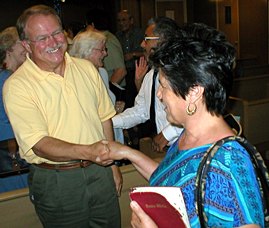
Mike Massar, pastor of First Baptist Church in Tyler, is greeted by a member of Primera Iglesia Bautista Mexicana in San Antonio when the intensive Spanish immersion class he is taking visits the church for Wednesday night prayer meeting.

That one-two payoff–a bonding with the Hispanic people and culture, as well as improved grammar and vocabulary knowledge–is exactly the intent of immersion classes at BUA. Scholarships are provided to members of Baptist General Convention of Texas churches by the Mary Hill Davis Offering for Texas Missions.

“The new frontiers for our Baptist witness have shifted from merely a focus on geography to a focus on culture,” BUA President Albert Reyes told class members. “By 2015, every-other Texan will be Hispanic. … I am convinced we will not have a Baptist voice or witness that will be heard in the future if we fail to prepare leaders who understand and communicate effectively to the non-Western or Hispanic worldview.”

Julie O'Teter couldn't agree more.

“In our society today, we need to be able to communicate at basic levels with everyone, and that starts with a respect for different cultures,” the mother of three teenagers said. “It also says that we Anglo Texas Baptists are serious about being co-laborers with Hispanic Baptists, equal partners in sharing Christ with our state.”

O'Teter, who studied Spanish 20 years ago at Baylor University, said the class jump-started her confidence so she can “struggle through” becoming proficient.

“I really am grateful my boss (E.B. Brooks, who leads the BGCT church missions and evangelism section) saw the importance of me investing the time in this. I'm hosting a singles mission trip to Nuevo Laredo in July, and what I've learned will really get some use then,” she said.

This was the ninth class at BUA in 11 years for Jody Hornback, Mission Service Corps outreach director at First Baptist Church in Hull. “Everybody wants to know why I keep coming back–I guess it's because I can't learn Spanish,” she joked.

“Actually, I got frustrated years ago on a bird-watching trip to Costa Rica because I couldn't read the signs, so I started studying Spanish. I tried several things and even went to a language school in Mexico before I came to the Mary Hill Davis course.

“And what a difference to be in a Christian environment! Along the way, I just fell in love with the people and the culture, so I've just kept coming back to improve my knowledge.”

People in her small East Texas town know about that love and contact her when they need a Spanish speaker.

“I've even been able to translate in court for a young girl who couldn't speak English and help her,” she said. “For a while, I even drove 25 miles each way, two round trips every Sunday to play the piano for a Spanish church.”

Jack and Carol Hodges of First Baptist Church in Duncanville also came to BUA because of a sign–at least his desire to be able to read them. “Jack didn't know 'hola' for 'adios,' so we came to San Antonio last February for the class before we took a trip to Argentina and Chile,” she said. “It was a marvelous experience, so we came back this summer for the longer course.”

Her brother, Gordon Moore, told them about the class–by e-mail from the Canary Islands, where he is a missionary.

“He read something about it in the Baptist Standard and called it to our attention,” she explained. “We came wanting language skills, but we left with so much more–more than we ever bargained for. Yes, we know a lot more Spanish, but we also carry away a tremendous appreciation for the integrity, knowledge, goals and visions of Dr. Reyes and BUA. …

“It is not enough to know the language; we must also learn the history, culture and religion. We realize we must change our approach and methodology of telling people about Jesus by understanding and adjusting to a changing world.”

This was the second time Guillermo and Ana Chavez have taught the class.

“This experience is a good first step toward a linguistic partnership for people who like to be exposed to Hispanic culture and the language,” he said. “It encourages them to go back to their own reality, ponder on the experience and come back next time with more questions. BUA presents a more holistic approach, and the church will benefit as it is equipped to render better service in a difficult and complex landscape like Texas.”

The next intensive Spanish immersion class at BUA will be Oct. 18-22. Applications include the form for receiving the Mary Hill Davis Offering scholarship. RV hook-ups are available.

Information is available by contacting Mary Ranjel by e-mail at mranjel@bua.edu or by phone at (800) 721-1396.

News of religion, faith, missions, Bible study and Christian ministry among Texas Baptist churches, in the BGCT, the Southern Baptist Convention ( SBC ) and around the world.


Texas Baptist Forum_71204

Posted: 7/09/04

TEXAS BAPTIST FORUM:
Confessional questions

Lee R. Scarborough, the second president of Southwestern Baptist Theological Seminary, was one of the most trusted and respected leaders among Texas and Southern Baptists during the first half of the 20th century.

E-mail the editor at marvknox@baptiststandard.com

At a time of crisis in the Northern Baptist Convention, he wrote: “I join Paul, Spurgeon, Wayland, Mabie, Broadus, Carroll and the heavenly hosts of other departed leaders, Mullins, Truett, Gray, Love, DeMent, Cree, Groner, Porter, McDaniel, Strong, Laws, Massee, and the host of others like them in the South and in the North in a wholehearted subscription to a Baptist confession of faith and want my life, time, talent and money to count alone for the propagation of these truths.”

His statement is further evidence that Baptists have normally held that it is proper for them to frame, publish and adhere to confessions of faith. That question should be settled.

Two important questions do remain: What should be the contents of any particular Baptist confession of faith? How should such a confession, once adopted, be utilized? On these questions Baptists are not now agreed, and to them serious attention should be given.

James Leo Garrett Jr.

Fort Worth

Housing problem

It has been great to see that religious leaders seek to make poverty an electoral issue. They want to ensure that the American Dream still exists–that a man by hard work can provide a comfortable living for his family.

The facts are that this is no longer true when it comes to housing. The minimum wage (or way beyond, to $12.50 an hour) will not provide an adequate dwelling for a man's family. In many large cities, rentals are so high that a clean, secure two-bedroom apartment is beyond the reach of many, many working-class families.

For so long, the political issues have focused on more money for education, while a secure, warm, draft- and rain-free, vermin-free environment to return to will be more conducive for children to learn.

Baptists are supporting Habitat for Humanity, which is making great strides in providing homes for people in dire need, and many people, especially young college students, are actively working on these homes.

But the need is so great; Habitat is only a drop in the proverbial bucket. The greed also is so great. The rich get richer, while the middle and lower classes get poorer.

Why don't our political candidates address this housing problem?

Margaret McDaniel

El Paso

Musical suggestion

Concerning the ongoing controversy in church music, a suggestion: Why not sing modern music in youth programs, at camp and in children's church? They seem to have originated with today's youth in Christian entertainment.

Many of us do not worship moving to catchy rhythms and hand-clapping. Worship is in the heart, and traditional hymns contain the heart of God and the “meat” of his word.

“Oh, for a thousand tongues to sing my great Redeemer's praise! The glories of my God and King; the triumph of his grace!”

Are hymns like that included in the “spiritual songs” preferred by today's ministers of music? They don't seem to be. We wish they were, even if there were only 50 singing them.

If the important thing is to worship, why have our wonderful old hymns been virtually discarded? Beats me.

Cecile Landon

Justin

'So what' attitude

I read Marilyn Green's letter (June 28), and I am somewhat concerned at her “so what” attitude.

We are Americans, and we should fly our flag under much higher standards than those practiced by others around the world. As Christians, what we do may determine whether others come to faith or not.

Our history teacher taught us if you go too far to the left, you go toward communism, and if you go too far to the right, you go toward Nazism.

Communism seems to be no real threat today, but Nazism is alive and well on planet Earth.

There is one major element of Nazism I would like for you to explore–authoritarian egotism. When people dare not question authority, then the one in authority has complete authority.

Aren't we glad we live in the United States, where one can disagree with authority and still be alive to disagree another day? Yet Green says we should not question Gen. Boykin's authority.

We are losing our democracy because of people like that, and I am here to tell you that Jesus Christ is coming back for a pure and holy church, not a renegade, rogue and prostituted church.

Bonnie Parvino

Avinger

Baptists' 3 R's

I'm glad you mentioned both the Southern Baptist Convention and the Baptist General Convention of Texas in your assessment of the 2004 SBC annual meeting (June 28).

Politics, not prayer, has driven both entities–and 80 percent of the rest of the state conventions–for the past two decades. Everyone's more concerned about being in control of “things”–the entities and the property–than they've been concerned about the lost going to hell. We're paying for it now and will for years to come.

Think about it: For the past two conventions, only 2 percent of the body have been showing up for the meeting. Folks are tired of playing politics. Politics solves nothing; prayer solves everything.

We've wasted money and people for two decades: States with two convention organizations; associations with two organizations; pastors and churches taking “sides.” I always thought you were either on the Lord's side, or not.

The younger generations will have none of it. They've showed us that “Southern Baptist” is a pejorative word and deleted or omitted that from the names of the new churches they're building across the land. There used to be pride in that name–no more.

The answer is the same biblical formula we've known for years: Repent–“you've lost your first love.” Return. Be restored.

Until there's weeping and mourning for the way we've been, there won't be a Spirit-filled revival and blessing from God.

Bob Gillchrest

National City, Calif.

Weary boxers

Your analysis of the SBC annual meeting drew a mental image in my mind of two weary boxers sprawled out in the ring at the end of the 15th round, totally expended with no desire for a rematch.

I look forward to where the BGCT is headed.

Barry Chinn

Austin

Convention control

Your SBC editorial reports what some have known for 30 years: The struggle for control of the convention(s) has been about power, politics and personal ego rather than evangelism, encouragement and enveloping unity within believers.

Your closing statement says what we've been trying to say: “The world doesn't care that we've resisted the rise of fundamentalism. It's tired of hearing what we're against and wants to know what we're for–and why that matters.”

The people in the pew, the neighbors in the street, the missions around the world don't care what the convention politicians fight about. They want to know we are for Christ, his message of salvation, his church's unity and his eternal peace.

Dale Lovett

Olney

Ridiculous resolution

The recently proposed resolution by T.C. Pinckney for all Southern Baptists to take their children out of the public school system is ridiculous.

Obviously, he has not been in the same public schools I have had the honor to be in as an instructor at Texas Tech University. I have supervised some of the strongest Christian educators in our public school system.

I wonder if he read the recent article in the Baptist Standard that ranked education majors right at the top in several different spiritual categories. Parents reading this will agree that teachers in the public school system are some of the most dedicated Christians in the world, willing to give over and beyond what they're expected to do to fulfill the role of being a teacher. Teachers would be in some other profession if they were not in education as part of their ministry.

I wonder if Pinckney ever had a 5th grade teacher like my children had, whose only classroom rule was: “Do everything in love.” She had a special board by her desk for the children to write their concerns. They all knew that they would be prayed over by Mrs. White every night.

In regards to Bruce Shortt's comment, “The belief that children will positively influence schools as 'salt and light' is 'misapplied theology,'” I'm afraid I need a tutoring session on this theory as it is in complete contrast to what Jesus Christ taught us about reaching out to others.

Sheri Sowder

Shallowater

Jesus' passion

I cringe during SBC week every year, because I know at least one bone-headed statement will be front-page news and make my job as pastor more difficult. I also cringed when I heard Bobby Welch's comment about why he was going to make evangelism a top priority (June 28).

Why? Basically, his reason was because the Baptist kingdom is declining. His focus is a bit off.

We should be concerned that people are missing God and his purpose for their lives, they are winding up in all kinds of harmful life situations and living in pain and suffering, and they are headed for an eternity of separation from God that is horrific beyond description.

Those are the reasons evangelism should be the top priority–genuine care and concern for the well-being of others.

I'm weary of the “me focus” that abounds in so much of church and convention life, and I don't think I'm alone. It isn't “all about us.” It should be all about Jesus, and that means our passion should be his passion–reaching the lost.

Drew Wilson

Waco

Culture casualty

Outgoing SBC President Jack Graham's recent call for Baptists to engage more actively in the culture war could cause more harm than good (June 28).

This war is in direct conflict with the New Testament model for effective evangelism. The Apostle Paul did not express disdain for Greek culture; he found a way to preach Christ to the Greeks without disrespecting them (Acts 17:22-34). The leaders of the church in New Testament times did not criticize the morals of non-Christians. The focus then, as it should be now, was first reaching people for Christ then explaining God's laws to them and encouraging obedience.

People will not generally adopt biblical morals until they become Christians.

By fighting them, we will not convince them they are wrong, and we will lose our chance to convert them. Furthermore, why should our culture listen to Baptists about biblical values, when our divorce rate is similar to theirs.

Light does not need to fight darkness to prevail; it only needs to be light.

Steve Pruett

Bossier City, La.

News of religion, faith, missions, Bible study and Christian ministry among Texas Baptist churches, in the BGCT, the Southern Baptist Convention ( SBC ) and around the world.


Mission Waco offers Christian hope to poor, marginalized_71204

Posted: 7/09/04

Mission Waco offers Christian hope to poor, marginalized

By Janelle Bagci

BGCT Summer Intern

WACO–Mission Waco–founded nine years ago in the abandoned remains of a pornography theater and four bars–has become a light in the darkness for the many underprivileged people living in Waco.

Mission Waco offers hope to poor, marginalized and unchurched people, said Executive Director Jimmy Dorrell. Programs for youth, adults and the elderly address social and educational needs hindering people from being self-sufficient.

It's a holistic program that deals with the root causes and development issues of life, Dorrell said. Mission Waco's main focuses are being compassionately relationship based, mobilizing middle-class Christians and fighting social injustice.

A volunteer serves at a Friday morning breakfast sponsored by Mission Waco.

“We at Mission Waco are some of the only healthy role models these guys have ever seen,” Treatment Programs Director Pam Stelk said.

Dorrell believes middle-class Christians have withdrawn from inner cities and retreated to the suburbs because they think it is the best for their children and families, but the majority of needy people are in the inner cities.

Mission Waco wants to take people where they are and stretch them by helping them apply Christian values in relating to the poor, he explained.

“To follow Jesus is to risk. A crisis of faith is where development happens,” Dorrell said.

Baylor University enables Mission Waco to more easily mobilize middle-class Christians, he noted. Through volunteer opportunities, students with high income and Christian backgrounds are opening their eyes to the plight of the poor.

Waco ranked 19 in the nation for cities containing people below the poverty line in 1990. “That means 20 percent of the kids are below the poverty line,” Dorrell said. “Many people can only work 29 hours a week because the company doesn't want to pay for benefits. That means they're making $10,080 per year, which is $7,000 below the poverty level. …

“As a middle-class white guy, I would have said the legal justice system is fair. Now I see it's not.

“We've been called to move in and work among the people.”

From that call, Mission Waco has launched 15 programs designed to bring hope and empowerment to the poor.

Children's programs for 6- to 11-year-olds during the school year include after-school tutoring and King's Club–a Saturday morning Bible class and play time in eight low-income neighborhoods. During the summer, kids attend various camps.

In the youth program, which includes students from 6th through 12th grade, activities range from art, cooking and dance to discussions on abstinence and hygiene. During the school year, there is an after-school development program. Young people can attend camps and programs throughout the summer.

The program has “brought the youth off the streets,” Youth Program Director Nikkea Fisher said.

Most participants in the youth program are low-income and do not have a father living at home, Fisher said. Some have been abused verbally, physically or sexually. Mission Waco provides a support system for spiritual, social and educational growth.

“All of them have progressed in some way, whether in school or spiritually or just respect,” Fisher noted.

Mission Waco's “M-Powerment” program educates teens and adults who lack the skills needed to get or keep a job. Within six weeks, the program provides reading, math and computer skills and appearance and attitude training.

Adults can take GED and job skill classes through the program. A computer lab is open Monday through Friday and provides free Internet access for job searches and self-paced tutorials for a variety of computer programs.

Attitude is a common deterrent to companies looking to hire. With “a lot of people that don't have experience working … they're going to have an attitude because that's the only way they know how to communicate,” said Carlton Willis, director of the M-Powerment program,.

“I always ask them, 'What is going on in your life that is preventing you from getting and keeping a job?'”

All graduates of the program have obtained jobs, and more than two dozen have gone to college, Willis said.

M-Powerment also trains low-income senior adults with interview and re-certification skills. McLennan and Hill counties allow 49 job openings for low-income seniors. Seniors apply for the jobs and go through a training process to learn the trade. Soon after, they are able to become permanent workers.

In addition to general assistance for the under-educated, Mission Waco offers specialized programs to address more specific needs.

Manna House, a Christian-based residential treatment facility for men struggling with alcohol or drug abuse, provides a safe and structured program to eliminate chemical dependency. Counselors address all known issues, not just alcohol or drug abuse. “Chemical dependency is just a symptom of what's wrong,” Stelk said. “I've been doing this for 20 years, and this is the most healthy and holistic program I've ever been a part of.”

The program is more structured than other Waco rehabilitation facilities, with benchmarks to strive for and rules to follow.

“Our guys embrace them because they know rules keep them safe, clean and sober,” Stelk continued. “Last time I checked, we have 11 times the success rate of the national average.”

From Manna House, graduates of the program apply for transitional housing and eventually housing at the ARK, a safe, affordable apartment-style housing unit designed to facilitate Christian community.

Most Manna House men know where to find community and a good meal. Although it is not limited to Mission Waco's participants, Friday Morning Breakfast provides people with a free breakfast and entertainment.

At First Lutheran Church, a few people congregate at 6:30 a.m. for Bible study and prayer time before breakfast to the sound of two men playing accordions. Many more seeking solace from their hunger stream in at 7 a.m.

Local churches sponsor meals consisting of eggs, biscuits, orange juice and fruit.

People meet from different races, cultures, and economic statuses. There are lots of “different races and we come together as one,” said Jackie Adams, a regular participant in Friday breakfast. “Oh, I love it, it starts my weekend off right. I love it. I love the Bible study part. That's my food.”

“I used to donate plasma,” Adams continued, describing how she found out about Friday Morning Breakfast. She told the man drawing her blood: “I need some fuel.”

“He said, 'You need to get you some food.' And then he told me about Friday morning breakfast. I said, 'Where's that at? ' He told me where to come, and I've been coming ever since. … When I miss, I feel a sense of loss.”

In addition to Mission Waco's numerous programs for children, youth, adults, senior citizens and people dealing with specific needs, yearly mission trips take volunteers to Mexico City, Haiti and India.

A weekly women's program is available for spiritual and social community.

The Clothesline, a Mission Waco clothing store, sells gently worn name-brand clothing. “I get a lot of my clothes from the Clothesline, they have a some really great stuff,” Stelk said. The Clothesline receives donations of clothes and uses profits to help support Mission Waco substance abuse recovery programs.

Mission Waco's Poverty Simulation also gives participants the opportunity to experience poverty for a weekend.

For more information about Mission Waco, call (254) 753-4900.

“These are the representation of the least of these,” Dorrell said of the people whose lives Mission Waco touches. “And we are privileged and blessed to be able to serve.”

News of religion, faith, missions, Bible study and Christian ministry among Texas Baptist churches, in the BGCT, the Southern Baptist Convention ( SBC ) and around the world.


On the Move_71204

Posted: 7/09/04

On the Move

Jerry Bivins has resigned as pastor of Ardis Heights Church in Greenville.

bluebull Paul Blake to Center City Church in Goldthwaite as pastor.

bluebull Travis Burleson to First Church in Gonzales as pastor from Sunset Canyon Church in Dripping Springs, where he was associate pastor and student minister.

bluebull Danny Martin has resigned as pastor of Calvary Church in Cisco.

bluebull Joey Maxey to First Church in Seguin as youth minister.

bluebull Jason Morgan to First Church in Halfway as music minister.

bluebull Rick Perkins to New Beginnings Church in Cedar Creek as interim pastor.

bluebull Julee Rachels has resigned as recreation director at First Church in Longview.

bluebull David Roach to Rocky Creek Church in Victoria as youth pastor.

bluebull Ross Shelton to First Church in Castroville as pastor.

bluebull Matt Smith to First Church in Temple as minister of youth, where he had been interim.

bluebull Jennifer Sullivan to First Church in Halfway as children's director.

bluebull Jonathan Sullivan to First Church in Halfway as youth minister.

bluebull Drew Super to Direct Church in Direct as pastor.

bluebull Josh Tylich to Flatonia Church in Flatonia as summer youth and children's pastor.

bluebull Nissa Walker to First Church in Temple as minister of childhood education, where she had been interim.

bluebull Joe Walts has completed an intentional interim pastorate at First Church in Castroville.

News of religion, faith, missions, Bible study and Christian ministry among Texas Baptist churches, in the BGCT, the Southern Baptist Convention ( SBC ) and around the world.