ANOTHER VIEW: Watch your step in political march_53104
Posted: 5/28/04
ANOTHER VIEW:
Watch your step in political march
By Michael Clingenpeel
There's a presidential election this November. Maybe you haven't noticed it yet, seeing as how you're probably in the midst of “Forty Days of Purpose” or Dr. Adkins, in which case your mind has been on God or food. But if you read the newspaper or watch the news, you may notice that the Republicans and Democrats have a little contest going.
Even if you haven't sniffed a whiff of the campaign, the Internal Revenue Service has. The IRS has issued an advisory to inform churches and clergy that they cannot engage in any partisan politics without jeopardizing the tax-exempt status of their church.
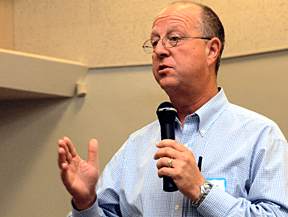
| Michael Clingenpeel |
Every four years, the routine advisory is issued. Every four years, some overzealous or uninformed minister or church violates the rule.
If you want to know the IRS guidelines, they are available in IRS Publication 1828, “Tax Guide for Churches and Religious Organizations” (www.irs.gov).
Here's the operative paragraph:
“Under the Internal Revenue Code, all section 501(c)(3) organizations are absolutely prohibited from directly or indirectly participating in, or intervening in, any political campaign on behalf of (or in opposition to) any candidate for elective public office. Contributions to political campaign funds or public statements of position (verbal or written) made on behalf of the organization in favor of or in opposition to any candidate for public office clearly violate the prohibition against political campaign activity. Violation of this prohibition may result in denial or revocation of tax-exempt status and the imposition of certain excise tax.”
The IRS guidelines are very specific. Pastors may endorse a candidate as long as they speak for themselves and make it clear that their views do not represent those of the church. They cannot make partisan political comments in official church publications or at official church functions.
Churches do not violate IRS guidelines when they distribute voters' guides, as long as the guides are designed to educate voters about candidates' stands on issues and are not for the purpose of favoring or opposing a specific candidate. Churches also are permitted to hold voter-registration or get-out-the-vote drives, as long as they are nonpartisan.
| We misunder-stand the nature of the church and misuse the pastoral role when we make political affiliation a test of fellowship. |
Your church also may invite a candidate to speak if you grant an equal opportunity for other candidates seeking the same office, if you communicate clearly that the candidate's appearance is not an endorsement and if no fund raising occurs.
Some Americans consider the IRS code, adopted originally in 1954, to be a violation of religious free exercise and free speech, two guarantees of the First Amendment to the U.S. Constitution. A North Carolina congressman, in fact, offered a legislative remedy to the IRS code called the Houses of Worship Political Speech Protection Act.
Wisely, in 2002, the House of Representatives defeated this ill-conceived bill 239-178. Two years before, the federal courts upheld the constitutionality of the prohibition of political campaign activity by tax-exempt organizations.
The IRS guidelines against partisan political activity by churches do not rob any individual or congregation of free speech or free exercise. They allow clergy to address moral and public issues from their pulpits and to participate in political campaigns as private citizens. They allow churches freedom to learn about public issues or, if they feel deeply enough about a specific candidate, to forgo their tax exemption in order to champion an individual candidate for public office.
Pastors and churches demonstrate the restraint of Esau when they barter their prophetic role for bumper stickers and campaign buttons. God is not the mascot of the Republicans or Democrats. Nor is God the campaign manager for George W. Bush or John Kerry. The United States is not the kingdom of God on Earth.
Read Luke's account of the early church in Acts for an example of apostles who understood that they did not follow Jesus in order to sign on as Pharisees, Sadducees, emperor-worshippers or empire-builders. Their allegiance was to a Lord before whom every knee eventually would bow. Their living was shaped by rules that defied the lifestyle of their contemporaries. Their community was as much eternal as temporal.
We misunderstand the nature of the church and misuse the pastoral role when we make political affiliation a test of fellowship.
Your vote is important. It is a precious responsibility for people fortunate enough to live in a healthy democracy. Issues of faith are involved in public debates on war, abortion, sexual orientation and behavior, the environment, gender, jobs, health care, taxes and corporate practices. Christians should be involved in the political process.
Be wise, however, in the way you march into the public square. Your efforts to claim the right to speak could cost you your voice.
Michael Clingenpeel is editor of the Religious Herald, newspaper of the Baptist General Association of Virginia
 Approved charter changes for East Texas Baptist University, Hardin-Simmons University and Howard Payne University. The technical changes concerned matters such as board sizes, eliminating archaic language and bringing charters into compliance with state and federal laws.
  Affirmed an amended relationship agreement between the BGCT and Baptist Health Services, a foundation created from the proceeds of the sale of Baptist Health Systems in San Antonio.