Buckner explores needs in Mexico
Posted: 1/25/08
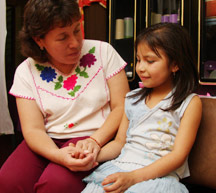
| A girl at a Zapoteco village in a Oaxaca mountain makes corn tortillas by hand. The people in this community live in one-bedroom aluminum homes with dirt floors. (Photos by Russ Dilday/Buckner) |
Buckner explores needs in Mexico
By Analiz González
Buckner International
MEXICO CITY—Observers of Mexico say it’s hard to speak of the country in absolute terms. Its needs are as varied as the multiple versions of “Mexican food” people eat in the United States.
Mexico has hundreds of people-groups with dozens of languages, lifestyles and dialects. In the cities, adults often crowd into forsaken rooms in overpopulated barrios.
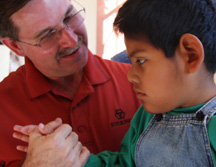 |
| Dexton Shores, director of ministry development in Mexico and the Border, speaks with a child in Oaxaca. Shores is identifying needs in Mexico for future church missions and ministry opportunities. |
At least 1 million homeless children live in Mexico City, often raising each other on the streets. Mexico City is the largest city in the Americas—15 million people accounted for, and probably many more.
Dexton Shores, Buckner International’s director of ministry development in Mexico and the border, recently returned from an exploratory trip to discover mission opportunities in the country. One of the biggest problems he discovered is hunger.
Twenty-year-old Saul Martinez from Iglesia Bautista Horeb in Mexico City has coordinated a ministry to feed children the past three years. He hands them a bowl with rice or soup—something simple. As a boy, he went there to get food himself.
“Most of the people who live in this area are not originally from Mexico City,” Martinez said. “They don’t have steady salaries, and sometimes they have to go away to find work, and they leave their kids alone and with no food.”
Some women trek 30 minutes for the free meal with babies tied around their backs in pieces of cloth and other children walking by their side. Some children go alone.
Yanina Briseño de Gutiérrez, wife of Pastor Gilberto Gutiérrez, is the driving force behind Iglesia Bautista Horeb’s efforts to serve the women and children in Mexico City. She and her husband have dreams of one day creating a school to educate the street children and stop the cycle of early death, HIV and crime.
Many of the street kids are children of inmates. Mothers in prison can raise their children behind bars until their babies turn 6. After that, either they go to live with a relative or are left to find their own means of survival.
 |
| Children participate in an after-school program in a community center by the Oaxaca landfill. Most children attending the center come from families that live off the city dump by picking out cardboard and aluminum from the trash, anything that they can sell. |
In Mexico, people accused of crimes are guilty until proven innocent, explained Jorge Quezada, who leads a ministry through Horeb to teach rondallas, or ethnic music, to prison inmates. Suspects are thrown into prison, often for as long as a year, while they await their trials.
The first Mexican ministry Buckner has supported is a gothic church plant and counseling center called Comunidad Subterránea, or “Subterranean Community.” This ministry has pulled drug users and satanic worshipers out of occults and addictions and into lives of freedom.
Leticia Hernandez and Laura Chavez, two young women who were raised in traditional Baptist churches, launched the ministry. They were part of an evangelism team, and as they went out and shared the gospel with teens clad in black and smelling of narcotics, they found their words rejected. So, they changed their approach.
They live by 1 Corinthians 9:22, which says, “I have become all things to all men so that by all possible means I might save some.” So they’ve taken on black garb and tuned into Christian rock.
In the process, they’ve grown in number, enlisting drug addicts and witches to the army of God through Christian heavy metal and testimonies they can identify with. They’re also providing counseling to get them on their feet and away from their old habits.
“We accept anyone who is rejected by the churches,” Hernandez said. “We tell them to come as they are and that God will clean them up after they decide to follow him.”
Buckner helps support this ministry by paying the rent of the building used for counseling and worship.
 |
| A young boy from a Zapoteco community plays outside his home. The infant mortality rate among the Zapoteco community is 25 percent. |
Buckner plans to expand its ministry into another part of Mexico—the outskirts of Oaxaca City, where an indigenous group lives in a community called Cumbre, which means “peak of the mountain,” because they’re closer to the sun than the surrounding villages.
These people make tortillas by hand, grinding, mixing and cooking inside smoke-filled aluminum huts that are also their bedroom and living room, and everything. They die at an early age, and their children often don’t live to age 2 because of poor living conditions.
They are called Zapotecos—one of the many indigenous groups in the state of Oaxaca. Although the Zapotecos knows Spanish, there are dozens of languages and dialects spoken in the state of Oaxaca alone.
The Zapotecos have been abandoned by the government and often are denied basic voting rights, said Jaime García-Merino of Iglesia Bautista Esperanza. “They have little to no say in politics and are poorly educated. And for this group, there is no church in the area.”
Buckner plans to send volunteer mission groups to work with the Zapotecos and help build water filters that would stop the parasite problem among the children. Missionaries also would provide job-skill training and build green houses.
Mission groups also will have opportunities to work in other ministries in Mexico, such as the Mefiboset Shelter in Oaxaca. Mefiboset was started by Alfredo and Nidia Lopez, who live in a small apartment by a child rehabilitation center where infants and babies are treated for birth defects.
The Lopez family has a disabled child of their own—Pablito. Due to the treatments Pablito underwent at the center, they realized a lot of the people taking their children in for therapy have no place to stay.
So, the Lopez couple and their two boys began renting an apartment where they take in guests free of charge. While they stay in their home, Nidia works with the guests at putting together meals. And she sells handmade jewelry so she can buy food for her guests.
Another ministry Buckner wants to help is a community center by the Oaxaca landfill in the Guillermo Guardado Colonia. Most of the children attending the community center come from families that live off of the city dump. They pick out cardboard and aluminum from the trash—anything that they can sell.
The community center serves 100 and 120 children through a collaboration between Misión Maranata and Compassion International. Compassion International provides financial support for physical, spiritual and social needs. But the group doesn’t aid in construction, so the children are crammed into a tight, uncomfortable space.
They have only one restroom available, and children sometimes soil themselves when they have to wait in line for too long. The ministry’s only vehicle is more than 20 years old and barely fits the 10-12 church volunteers who ride into the center together. Buckner missionaries will be needed to provide parenting classes, teach Vacation Bible School and help improve living conditions with house repair projects.
For information about missions opportunities in Mexico, visit www.ItsYourMission.com or call (877) 7ORPHAN.