DOWNHOME: Not-so-patiently learning to wait

Posted: 1/04/08

DOWNHOME:
Not-so-patiently learning to wait

If you pray for patience, God might move you to a Texas neighborhood with plenty of trees.

(By the way, never pray for patience or wisdom unless you really mean it. Those are wonderful virtues, but their acquisition comes with a steep, steep price.)

Joanna and I moved to our home in Coppell, in far northwest Dallas County, not quite a year and a half ago. Our girls both had graduated from high school, and Jo and I realized we could trim our commute time without uprooting our progeny. So, we moved.

From a practical standpoint, we were thrilled with the shorter driving times each day. From an emotional standpoint, we reveled in the homey-ness of our house. And from an almost spiritual standpoint, we adored all the trees.

I grew up in a part of the Texas Panhandle where trees were about as common as Church of Christ preachers at the citywide revival. Then, when we moved back to Texas a dozen years ago, we bought a new house in a subdivision where the builder scraped mesquite off the prairie and planted two sticks in the front yard.

So, when we decided to move, we fell in love with this “older” neighborhood. (OK, it’s been here only 20 years, but in this part of Dallas-Fort Worth, that’s old.) The developer managed to build houses without removing old-growth trees. And homeowners supplemented them with plenty of oaks, maples and native elm. The centerpiece of our front yard is a small stand of bald cypress that wave bright green in the spring and summer and turn rusty-crimson in autumn.

A year ago last fall, flush with zeal to keep a “clean” yard, I wound up blowing/raking leaves out of our yard at least three times.

This fall, Jo convinced me I’d be a lunatic to maintain that pace. Considering she knows a lunatic when she looks at one over breakfast, I took her advice. We decided to wait until all the leaves fell off our trees before bagging them.

We bided our time. Actually, Jo bided her time and calmed me down when I complained about our “embarrassing” yard. Finally, the Saturday after Christmas, we looked up at bare trees, and I trekked down to the local hardware store to rent a backpack leaf blower. A few hours later, we had a beautiful, neat yard and a couple dozen huge paper bags of leaves in the alley.

I was so proud.

Sunday morning, the wind blew out of the north. By the time we got home from church, 73 percent of the leaves from our neighbor across the street littered our yard. It looked like Saturday never happened.

Now, we’re waiting for every leaf to drop from every tree within a three-block radius. That’s when Jo will allow me to go back to the hardware store for the leaf blower.

We’re waiting, all right.

But we’re not praying for patience.

–Marv Knox

News of religion, faith, missions, Bible study and Christian ministry among Baptist churches, in Texas, the BGCT, the nation and around the world.


Storylist for 1/07/08 issue

Storylist for week of 1/07/08

TAKE ME TO: Top Story |  Texas |  Opinion |  Baptists |  Faith & Culture |  Book Reviews |  Classifieds  |  Departments  |  Bible Study


Kenya violence affects Wayland students

Christians killed, churches burned in India


Time to revamp discipleship methods?


Families needed to adopt Ethiopian orphans

Habitual Sin: Pastor's experience shows Christians can find freedom

On the move

Around the State

Texas Tidbits


Time to Revamp Discipleship Methods?
Study finds limits to Willow Creek's success model

Raising the bar for membership

Time to revamp discipleship methods?


Volunteer teachers needed in China

Baptist Briefs


College students' spiritual interests increase; worship attendance drops

Mayors' report says cities seeing more emergency food requests

Religion writers name evangelicals in election as last year's top story

2007 a quiet year, but signs of change in the air

Prayer heals honest Brit's legs but cannot cure bureaucracy with no ‘miracle' button

High-tech audio Bibles bring Scriptures to life, users say

Faith Digest


Book reviews


Classified Ads

Cartoon

On the move

Around the State


EDITORIAL: BGCT in '08: Purpose over pander

DOWNHOME: Not-so-patiently learning to wait

TOGETHER: Gospel means evangelism & ministry

RIGHT or WRONG? A spouse's etiquette

Texas Baptist Forum


BaptistWay Bible Series for January 6: When cleanliness is not next to godliness

Bible Studies for Life Series for January 6: Breakthrough in focus

Bible Studies for Life Series for January 13: Breakthrough in Forgiveness

Explore the Bible Series forJanuary 13: God allows us to choose


Previously posted
Christians killed, churches burned in India

Kenya violence affects Wayland students

Former Valley Baptist Missions/Education Center president arrested

Buckner postpones Kenya trips due to political unrest

New Baptist Covenant, Huckabee rank as top stories in ‘07, journalists say

Bird-eye view of Valley left indelible impression on long-tenured pastor

ETBU dormitory furnishings find new home, meet multiple needs

Hispanic social conservatives may leave GOP over immigration stance

Florida sanctuary gutted by early-morning fire before Christmas

Daehnert elected interim BGCT executive director

Agency gives party for foster families who give year-round

Foster youth create own Christmas traditions

Novelist Grisham joins New Baptist Covenant speakers lineup

Missouri leader who warned of Islamic takeover hired to aid world-mission effort

CBF to lease building from Mercer

Baptist outreach defuses Ebola fear in western Uganda

Blogging pastor lauded for defending fired female seminary professor

Board voting on Daehnert as interim executive director

Board to vote on interim executive director

TBM seeks coats for children in North Korea

Board to vote on interim executive director

Missouri Baptist rift widens when leaders restrict funding for church starts

Huckabee's surge in polls brings new media attention, scrutiny

Seven tips for the 2007 tax-filing season

End of CBF/ABC partnership leaves future of medical/retirement benefits in doubt

Former atheist shapes God-centered program in Moldova

Executive Board may vote on short-term interim executive director


See articles from the previous 12/17/07 issue here.


RIGHT or WRONG? A spouse’s etiquette

Posted: 1/04/08

RIGHT or WRONG? A spouse's etiquette

My husband and I said the traditional vows in our wedding a few months ago. The richer/poorer and sickness/health parts have been easy enough to deal with. However, my husband’s table manners and social etiquette have deteriorated since we dated. I don’t want these things to become a wedge. What can I do?


During the first few months of marriage, we often come face-to-face with the realities of our own expectations about what a spouse is supposed to look like. Our expectations can be reinforced by the especially nice version of one another we see while dating. The major difficulty often arises because these expectations are unexpressed, unwritten, unspoken and even unidentified until our spouse fails to meet them.

Then you’re faced with a dilemma. On the one hand, you love and care for this person. You say to yourself, “This is such a small, insignificant, little part of our lives. I really should not be bothered by ______ (insert spouse’s current faux pas).” You begin repeating to yourself Scriptures like 1 Corinthians 13:7, “Love bears all things, believes all things, hopes all things, endures all things.” You tell yourself you do not want to be that nagging wife of Proverbs 19:13, who is like a constantly dripping faucet.

On the other hand, you say to yourself—usually after a few days of trying to ignore the spousal blunder, “Hey, I thought husbands were supposed to love their wives as their own body, and I thought we vowed to respect and honor one another.” You say to yourself, “It’s not nagging; I’m just protecting him.”

Sound familiar? What do you do? Reassess your own attitude. Ask yourself if you are being unrealistic or unmoving in your own expectations. Consider your own motives. Why does this matter to you? I am a table etiquette fanatic and a neat-freak, but I have realized my husband is not trying to spite me when his etiquette slips or he leaves his socks on the floor. Sometimes, we have to choose to love, even when things are not exactly as we expected. Remind yourself there are greater issues at stake in a great marriage than whether or not he opens your door, or even—as much as it may pain you—burps at the table.

If you really must bring up this particular issue, talk to your spouse when you are not angry. Rather than beginning the conversation with all the things you want him to change, try to express how you feel. Don’t necessarily expect anything to change. Express to your husband that you want to feel heard, and when you have been, let it go.

Little things often become wedges when we are not honest or when we expect others to be just like us. Frequently, I find that reassessing my own expectations and purifying my own heart are much more effective at removing the wedge than trying to “fix” my husband.

Emily Row-Prevost, team leader/coordinator leader

Communications/spiritual formation specialist

Baptist General Convention of Texas, Dallas


Right or Wrong? is sponsored by the T.B. Maston Chair of Christian Ethics at Hardin-Simmons University's Logsdon School of Theology. Send your questions about how to apply your faith to btillman@hsutx.edu.

News of religion, faith, missions, Bible study and Christian ministry among Baptist churches, in Texas, the BGCT, the nation and around the world.


Valley Funds Scandal coverage

Posted 11/17/06

Valley Funds Scandal coverage


The full investigation report is available here as a pdf document.

Most recent articles:
Former Valley Baptist Missions/Education Center president arrested
Former pastor returns money to congregation; church agrees to give funds to BGCT
BGCT launches internal audit regarding more alleged improprieties in the Valley
Official confirms church-starting fund probe in U.S. Attorney's Office
No lawsuits planned; too costly & complex, lawyer suggests
BGCT implements responses to church-starting scandal
Executive Board to BGCT messengers: You're in charge
Former BGCT church-starting leader asserts race a factor in Valley probe
Bloggers to ask Executive Board to protect voting rights of messengers
Federal authorities receive Valley report
Pieces coming together for McAllen church
Wade to release Valley probe to law-enforcement officials
Wade still has support despite anger, sadness at scandal

Convention action on the funds scandal
Moving On: Board pre-empted' BGCT by recommending reforms
Trust in God in turbulent times, president tells BGCT
Church starting policies designed to ensure accountability
Steps already taken to implement recommendations
Restoration of trust is vital, BGCT leaders agree
EDITORIAL: Churches next to 'vote' on BGCT future
Executive Board votes to explore criminal charges, recovery of Valley funds


Previous related articles:
Pattern of exaggeration repeated in Mexico, observers say
Executive Board sets second called meeting to respond to investigation
Evidence found of misuse of Valley funds
Investigation team outlines preventative steps
Brief excerpts from the report
Otto Arango's earnings claims disputed by directors of missions
BGCT faces challenges leaders say
EDITORIAL: Executive Board must rise to the occasion

• Charles Wade posted an early response to the report here.

Early progress of the Valley funds probe
Valley investigation could cost $150,000
Called board meeting focuses on Valley
Executive Board endorses ongoing probe in Rio Grande Valley
Attorney hired to guide church-starting fund investigation
BGCT launches probe of church-planting funds in the Valley

News of religion, faith, missions, Bible study and Christian ministry among Texas Baptist churches, in the BGCT, the Southern Baptist Convention ( SBC ) and around the world.


Former Valley Baptist Missions/Education Center president arrested

Posted: 1/03/07

Former Valley Baptist
Missions/Education Center president arrested

By John Hall

Texas Baptist Communications

HARLINGEN – Former Valley Baptist Missions/Education Center president Pat Graham was arrested Dec. 21 on theft of property charges.

Valley Baptist Missions/Education Center discovered financial irregularities in its regular financial audit shortly before Graham resigned in June, said Othal Brand, chairman of the center’s board of trustees.

An internal investigation that delved further into the situation revealed more money was missing than previously thought, bringing the total up to $69,000.


See complete list
of Valley funds scandal articles

The missing funds are being reimbursed by insurance, and the board has taken steps to make sure future financial improprieties do not happen, Brand said.

“We are saddened by this situation, particularly for Pat and his family,” he said. “The situation has been turned over to legal authorities, and they will handle it.”

Valley Baptist Missions/Educations Center is one of 23 institutions affiliated with the Baptist General Convention of Texas. Trustees who oversee the operation of institutions are elected by messengers to the BGCT annual meeting.

Keith Bruce, director of the BGCT Institutional Ministries team, said he is saddened by the apparent situation at the center and encouraged Texas Baptists to pray for all involved.

“The Valley Baptist Missions/Education Center board has been diligent and thorough in its efforts to uncover the reasons behind these financial irregularities,” he said. “We pledge to pray for the staff, Pat and everyone that this affects as this situation progresses.”

News of religion, faith, missions, Bible study and Christian ministry among Baptist churches, in Texas, the BGCT, the nation and around the world.


Buckner postpones Kenya trips due to political unrest

Posted: 1/03/07

Buckner postpones Kenya
trips due to political unrest

By John Hall

Texas Baptist Communications

DALLAS—Buckner International has postponed two mission trips to Kenya in light of political unrest, but the agency has no plans to “back out” of ministry there.

In the wake of a disputed presidential election, violence has broken out in parts of the country. Tens of thousands of people have fled their homes. About 300 people have been killed, including 35 people who were burned to death in an Eldoret church.

Nairobi police have placed barricades around the capital city, making travel in the central district of the city nearly impossible. Gangs of young adults with machetes are patrolling the streets, according to Randy Daniels, Buckner vice president for global initiatives. The gangs are asking people their names in efforts to identify which tribe a person belongs to and assaulting them if they are of a rival tribe.

Buckner staff members throughout the country are safe, and most of the children in the Baptist Children’s Center in Nairobi were safely with relatives during the Christmas holiday, Daniels reported. The 10 who remain in the center have no living relatives and currently are safe.

At this point, Daniels said, Buckner does not plan to pull the Nairobi orphans or staff out of the area. Travel is difficult at best and treacherous at worst. He noted that much of the violence has been attributed to one Nairobi slum, highlighting the need for continued ministry among Kenya’s poor.

“The ministry will continue in Kenya,” he said. “We’re not going to back out.”

On his blog, Buckner President Ken Hall encouraged people to pray for Buckner’s ministry in Kenya and the situation in the country.

“The events in Kenya are a reminder that our world can be a dangerous place, and when you serve in it, you face uncertainty and even danger,” he wrote. “Please join me as we begin 2008 praying for peace in Kenya and around the world.”

News of religion, faith, missions, Bible study and Christian ministry among Baptist churches, in Texas, the BGCT, the nation and around the world.


Bird-eye view of Valley left indelible impression on long-tenured pastor

Posted: 12/28/07

Bird-eye view of Valley left indelible
impression on long-tenured pastor

RIO HONDO—Considering the median tenure for Southern Baptist pastors at any given church is 4.2 years, Gene Horton’s 40-years-and-counting at First Baptist Church in Rio Hondo places him among the ranks of less than one percent of his peers.

Horton, who has been in the ministry 55 years, credits his lengthy of service to “God’s keeping power.”

Gene Horton

Frances Knight, who has been a Sunday school teacher at the Rio Hondo church for 38 years, believes the secret of her pastor’s success is simple.

“God has kept him steady because he is a man of prayer, and he faithfully preaches the gospel of salvation,” she said.

“Almost every morning, his small plane can be seen flying over the area of surrounding towns as he is alone with God and praying for not only his church, but also for all pastors of all denominations in the Rio Grande Valley.”

Horton’s experiences at a private pilot led to his initial call to serve in Rio Hondo. After Hurricane Beulah hit the Valley in 1967, he flew his plane from Victoria to the tip of Texas to survey damage.

Tears streamed down his face as he saw the devastation in the area. He later told his wife, “I think God is calling me to the Rio Grande Valley.”

Not long after that, a pastor search committee from First Baptist Church in Rio Hondo heard Horton preach. At the committee’s recommendation, the church in Rio Hondo extended an invitation for him to preach in view of a call.

He and his family began their ministry in Rio Hondo the first Sunday of the new year in 1968.

Although Rio Hondo officially has a population of only 1,800, the town becomes a seasonal home to many “Winter Texans” who move to the Valley for a few months each year. During the winter, the sanctuary at First Baptist Church often is filled to capacity with more than 800 worshippers.

For 38 of his 40 years in Rio Hondo, Horton also has extended his ministry to the region through a television program carried on the local ABC affiliate, whose signal reaches from Corpus Christi to northern Mexico.

“What makes this even more remarkable than the long tenure is the fact that Bro. Gene has never asked the television audience for any money. The debt-free local church has funded the telecast,” Knight noted.

“This, too, is evidence of answered prayer,” she added. “Our church is so grateful to have Brother Gene—a true man of god—continuing as our pastor.”


News of religion, faith, missions, Bible study and Christian ministry among Baptist churches, in Texas, the BGCT, the nation and around the world.


Explore the Bible Series forJanuary 13: God allows us to choose

Posted:1/02/07

Explore the Bible Series for January 13

God allows us to choose

• Genesis 12:1-9; 13:8-13

By Donald Raney

First Baptist Church, Petersburg

Choices. We all make hundreds of them every day. Many concern trivial issues and almost are made unconsciously. Others involve decisions that affect the course of our life as well as that of our family.

What concerns us the most about making choices is knowing every choice has consequences and that each choice means saying “no” to something. As Christians, we all want to make choices that are in line with God’s plan for our lives.

At times when the decision seems especially significant, many have expressed a desire that God would simply make the decision for them. The Bible clearly teaches that God does have a divine plan for each life, but because of God’s infinite love for us, he refuses to impose that plan on those to whom he has given free will. God is continually calling us to make a choice, and the question is what will guide our decision.

As we look at the life of Abraham, we find three decisions that lay a solid foundation for a life of making choices that are pleasing to God.


Abraham chose to obey (Genesis 12:1-4)

Prior to God’s call to Abraham, we read that Abraham’s father, Terah, had gathered the family and began a move toward Canaan, but had settled in Haran (Genesis 11:31). It is there that Abraham hears God call him to leave his father’s house and journey to a land God would show him.

It often is easy to idolize the great heroes of the Bible so that we forget that following God was as difficult for them as it is for us.

Consider Abraham’s situation. As far as we know, this was the first time he had heard God speak. How could he be sure it was the voice of God? Also, he had many reasonable excuses for not beginning a journey, especially when he did not know where it would lead or how long it would take. He was old himself and would feel some obligation to care for his aging parents who had just settled in a new home.

Yet somehow Abraham believed it was God calling and quickly chose to obey. Perhaps it was the promises God made that motivated Abraham’s obedience. Perhaps it was Terah’s failure to complete his planned journey to Canaan. Whatever his motivation might have been, Abraham understood that in order to receive God’s promises, he needed to obediently follow wherever God led.

The same is true for believers today. God’s leading in our lives does not always make sense or fit with our plans. We usually can find numerous excuses for not obeying, all of which seem perfectly logical and reasonable. But God desires to bless us in ways we cannot imagine. He calls us to follow him as he leads us to those blessings. But the choice is ours, and to experience the blessings God has for each of us, we each must choose to obey.


Abraham chose to worship (Genesis 12:5-9)

Mention the word “worship” and the first thought in the minds of many people includes a picture of a sanctuary full of people singing hymns and listening to a sermon.

Corporate worship with fellow believers is indeed a vital part of the Christian life. It is important that believers take the opportunity to gather together for worship, fellowship and mutual support. But throughout the Bible, we see worship is more than an occasional event we attend. It is a lifestyle. We were created to live in continual worship of our Creator.

As Abraham followed God to a new land, he did so continually aware of God’s presence with him and took every opportunity to express his awareness and appreciation of that in a tangible way. Twice in these verses, Abraham is said to have built an altar to God. Before God had fulfilled any of the promises he had made, Abraham thanked God.

It is not surprising that Abraham was later referred to as a friend of God (James 2:23). He walked in continual fellowship and in an overriding attitude of worship before God. Worship was not something confined to a specific place or time. And the altars he built would stand as a testimony to this lifestyle of worship to all who passed by long after Abraham had moved on. Many churches today are exploring various styles of worship. Most often this involves questions over types of music or changes in the bulletin. While each person should seek the style of corporate worship that is most meaningful to them, we should never forget to make the choice to live every moment in worship of our Creator.


Abraham chose to avoid sinful influences (Genesis 13:8-13)

The Bible tells us that when Abraham left his father’s house, he took his nephew Lot. No explanation is given as to why Lot accompanied his uncle. Perhaps he felt an obligation to help care for his aging relatives since they did not have children.

Whatever the reason, at some point, the hired hands of Abraham and Lot began to argue over access to the available grazing land. In an attempt to maintain peace within the family, Abraham and Lot decided to separate.

Lot chose what appeared to be the more exciting life of the nearby cities while Abraham settled in the more open countryside. Those who know the rest of the story know the cities Lot chose, Sodom and Gommorah, proved to be exceedingly wicked and ultimately were destroyed by God.

Abraham’s choice to move in order to maintain peace, as well as his choice to settle away from the cities, teaches us an important lesson about choices we make. If we wish to live a life that pleases God, we need to choose to avoid places and activities that may lead us astray. Sometimes, those are easy to identify. At other times, they may appear attractive or even harmless.

Most people today would identify the sin of Sodom and Gommorah as homosexuality and decide that particular sin, or similar transgressions, would be easy to spot and avoid. Yet according to Ezekiel 16:48-58, the sins for which God destroyed the cities were pride, idleness and mistreatment of the poor—sins that may be somewhat more difficult to avoid.

My father’s favorite saying has always been, “it is hard to soar with eagles when you normally run with turkeys.” We can avoid a lot of difficulty in our spiritual lives if we are constantly alert and choose to avoid sinful influences.

News of religion, faith, missions, Bible study and Christian ministry among Baptist churches, in Texas, the BGCT, the nation and around the world.


ETBU dormitory furnishings find new home, meet multiple needs

Posted: 12/28/07

East Texas Baptist University, making preparation for the renovation of Fry Hall, donated all the furnishings from the residence hall to Ebenezer Ministries of Clayton. The furniture was loaded onto three semi-trailers, two 16-foot cargo trailers and two 16-foot flat bed trailers, which involved three different ministry organizations to get the donation to its destination in Quemado. (Photo by Mike Midkiff/ETBU)

ETBU dormitory furnishings find
new home, meet multiple needs

By Mike Midkiff

East Texas Baptist University

MARSHALL—As a dormitory at East Texas Baptist University gets a major facelift, some of its furnishings are finding a new home in Mexican orphanages, and others will meet needs throughout the Southwest, thanks to a cooperative venture involving several ministries.

After students left campus at the end of the fall semester, ETBU physical facilities employees started to work moving furniture out of dorm rooms in preparation for an extensive renovation of Charles Fry Hall, a one-story men’s residence hall built in 1977.

East Texas Baptist University Utility Technician Michael Welch loads the final piece of furniture onto a truck from the Rick Caywood Ministries of Crawford. ETBU donated all the furnishings from Fry Hall to help needy people in Mexico.  (Photo by Mike Midkiff/ETBU)

But rather than discard, sell or store the furnishings, the school gave them to three organizations that will deliver them to several orphanages in Mexico and to other ministries throughout the Southwest. It’s not the first such donation by the school, but it certainly is the largest.

“About four years ago, Harold Long of Central Baptist Church and the volunteer director of the Soda Lake Baptist Association Ministry Center, helped ETBU coordinate with a ministry that could use our old furniture and mattresses from our residence halls,” said Bob Hogberg, ETBU maintenance manager. But this marks the first time an entire residence hall’s furnishings have been donated.

Eric Wilburn, director of physical facilities at ETBU, contacted Ken Stone, founder and president of Ebenezer Ministries International of Clayton. Stone, who also is pastor of First Baptist Church in Clayton, and Wilburn became friends years ago when Wilburn was pastor of a church in Rusk Panola Baptist Association.

Ebenezer Ministries is a nonprofit charitable organization established for religious purposes and humanitarian aid. Ebenezer receives, processes and delivers food, clothing, medical supplies and equipment to locations worldwide.

“Over the past couple of years, ETBU has called on us to receive and ship mattresses and bed frames from the university,” said Stone. “When this dorm remodeling began to take shape, Eric called to see if we wanted to handle the furnishings.”

In partnership with Central Baptist Church in Marshall, ETBU also helped the ministry with fuel costs for delivery.

“We are just thrilled that we are not going to have to destroy this furniture or try to find a buyer for it,” said Ned Calvert, ETBU vice president for administration and finance. “We understand the high cost of fuel required for the trucks, and we are blessed to help out this ministry to meet needs in Mexico and other areas.”

Stone contacted two other ministries to help with the delivery of such a large donation.

“I called Rick Caywood of Crawford who has a trucking ministry that delivers food along the Mexico Border and Mark Cole of Ministry OPS in Gladewater,” he said.

The entire physical facilities department staff worked to load the furnishings.

“We thought the process of loading the trucks and trailers would take three to four days,” Wilburn said. “Ken shared a short devotion with our department Monday morning before we began to load the furniture. He shared how the furniture would be used to be a blessing in South Texas, Mexico, and possibly a Navajo reservation in New Mexico. This helped the physical facilities staff understand the importance of the project.”

Workers loaded three semi-trailers, two 16-foot cargo trailers and two 16-foot flatbed trailers in one and a half days, Wilburn noted.

“With Ken’s direction, we have delivered two semi-loads of furniture to Steve and Lori Mercer’s Cornerstone Children’s Ranch on the border in Quemado, Texas, near the Mexican border,” Caywood said.

Cornerstone Children’s Ranch meets the physical and spiritual needs of people on both sides of the Mexican border. The ministry has a warehouse, mission quarters and a residence located on 10 acres at Quemado, between Del Rio and Eagle Pass.

“Steve and Lori have already begun to place the gift of surplus furniture in the hands of needy missions in their area,” Caywood said after returning from Quemado.

“It was a blessing that Ebenezer Ministries was willing to take all the furniture and fixtures from Fry Hall,” Wilburn said, reflecting on what was accomplished. “This furniture which would have had to be disposed of in other ways is now a blessing to people in great need.”

“When Christians partner together to further the kingdom of God, the exponential power of God’s blessings is discovered,” Stone added.


News of religion, faith, missions, Bible study and Christian ministry among Baptist churches, in Texas, the BGCT, the nation and around the world.


Bible Studies for Life Series for January 6: Breakthrough in focus

Posted: 12/28/07

Bible Studies for Life Series for January 6

Breakthrough in focus

• Psalm 145

By Steve Dominy

First Baptist Church, Gatesville

With this psalm, we begin the new year in the manner that we closed the last—in praise of God. Psalm 145 is purely a psalm of praise to God for who he is and all he has done. There is no hidden agenda in this psalm, David is enamored with God and cannot contain himself.

This Christmas, I took the kids to shop for their mother’s Christmas present. My daughter hasn’t quite figured out presents are supposed to be kept secret until Christmas. She was so excited about the gift, she couldn’t contain herself. She ran into the house and joyfully declared, “Mama, we got you a watch!”

David’s excitement mirrors my daughter’s. He cannot contain himself, and he cannot remain silent; he bursts out in song proclaiming the greatness and goodness of God.

The first line of the psalm reveals the basis of David’s praise, “I will exalt you my God … .” David does not work from an abstract understanding of God but from personal knowledge of God. God is not a distant and impersonal God for David but one who is “near to all who call on him in truth.” David stands firmly in the Old Testament tradition of a God who reveals himself to his people and is present with his people.

Feelings are by no means the best barometer for our worship. Our feelings easily can betray us. We may or may not feel any guilt over sin, but we stand before God guilty of sin whether we feel that way or not. Feelings and experience often are difficult to interpret and can hamper our worship if they are not grounded in something beyond themselves.

David begins his worship and praise from his experience of God, but he does not end there. His worship includes much more and ultimately is based in the nature and character of God. David bases his worship of God on God’s graciousness, compassion, faithfulness and righteousness.

It is important that David noted goodness and compassion together, one helps to define the other. It is the same with grace and truth. John’s Gospel says Jesus came full of “grace and truth.” Truth not tempered with grace can become a tool of manipulation and revenge. On the other hand, grace that is not tempered with the truth can quickly become a spineless sentimentality that does not beckon us to be transformed but the mercy of God.

In the same way, goodness without compassion is sorely lacking and falls short of who God is and the manner in which God desires us to live. Goodness without compassion can let us do what is right but still have all the wrong motivation. But God’s compassionate goodness is seen in that he is slow to anger and rich in love. These are characteristics of God. They are based in his very nature and form the foundation of David’s praise.

David further lays the foundation for his praise in God’s faithfulness. God’s faithfulness is not only the basis of David’s praise, it is the foundation of our hope. As I write this, we are in the peak of the Christmas season. Hope seems abundant this time of year. Hope has been called the “Spirit of the Season,” but real hope is not to be found in visions of sugar plum fairies, but in the bedrock faithfulness of the God who acts in history. It is the hope that comes because the God who is faithful is the same God who sent his son to die for us. It is the hope that the Christ who overcame death will do the same for his people.

David testifies of God’s faithfulness in the way he cares for people. God upholds those who fall and lifts up all who are bowed down. David says in this psalm that God is faithful to his promises but those promises are made to people. We see in this section God’s great faithfulness to his people.

These promises again speak to the personal nature of God, that God will not abandon his people. What great reason to celebrate! God’s goodness and faithfulness are not dependent on the circumstances of life, but God is faithfully with us through every circumstance of life. It is no wonder David could readily sing the praises of God.

David concludes his foundation of praise by singing of God’s righteousness. Notice in this section and in the previous section, faithfulness and righteousness are coupled with God’s love. All of the attributes of God are tempered by his love.

It is no different with righteousness. God’s righteous love in no way makes room for those who would take advantage of his goodness. Because God is righteous there are consequences to disobedience whereas those who love him will obey. In every line following the statement of God’s righteousness, David speaks of God’s obedient people and his loving response to him. It is not the story of those who act out of fear toward God but respond to the great and loving God with lives that desire to please him.

David’s foundation of praise holds firm for us as well. January is for many the most difficult month of the year. It follows a time of great excitement with days that are short and often dreary.

In keeping with the theme of this week’s lesson, breaking through that involves a focus on the nature and character of God. These are the bases of all of our praise and adoration of God.

News of religion, faith, missions, Bible study and Christian ministry among Baptist churches, in Texas, the BGCT, the nation and around the world.


BaptistWay Bible Series for January 6: When cleanliness is not next to godliness

Posted: 12/28/07

BaptistWay Bible Series for January 6

When cleanliness is not next to godliness

• Mark 7:1-23

By Andrew Daugherty

Christ Church, Rockwall

If we read through the Gospels, after a while, it is easy to wag our finger or roll our eyes at the attitudes and antics of the scribes and Pharisees. The scribes were the Ph.D’s of Mosaic Law while the Pharisees were a religious group within Judaism that sought to preserve and protect God’s will as expressed in the law. They sometimes are caricatured as “nose in the air” moralists who go sniffing around for people actually enjoying their lives in order to make them miserable. In popular parlance, they are the proverbial “party poopers” in the kingdom of God. And in the Gospels, it is usually Jesus’ party they are seeking to spoil.

But, of course, this caricature is not totally fair. After all, they are dealing with the religious tectonic shift happening between the Judaism they have known and the emerging way of Jesus. Questions arose about what practices and ways of thinking would transfer to the people’s trust in Jesus as Messiah.

Practically speaking, if Jesus indeed came to fulfill the law and not to abolish it, then how were they supposed to pick and choose what customs and rituals to keep? These were important matters not easily negotiated among the religious leaders wanting to be faithful to the law and the people wanting to be faithful to the law while following Jesus.

What made these decisions difficult was the sheer volume of Jewish rituals and customs. By some estimates, there were 613 mizvot (commandments) in the Torah (the five books of Moses). Leviticus (chapters 11-26) outlines the purity laws that specify foods considered clean or unclean.

The Leviticus holiness code includes purity rituals for after childbirth or menstruation, regulations for wearing clothing made of two different materials (no cotton/poly blends), sanctions against coming in contact with a dead body or a dead animal, and pronouncements about sexual behaviors, keeping the Sabbath and getting tattoos. The purity laws laid out in Leviticus address almost every conceivable aspect of human life: birth, death, sex, ethnicity, gender, marriage, health and hygiene.

These matters were of utmost importance for at least two reasons—one, Israel needed to maintain its distinct identity from people of other nations in order preserve its faith in God as creator and ruler of the earth; and two, Israel was called by God to be holy, because the God who called Israel was holy (Leviticus 19:2).

Throughout the Gospel of Mark, however, Jesus repeatedly violates laws about ritual purity. In Mark alone, Jesus touches a leper (1:41), his disciples do not fast (2:18), he disregards Sabbath laws (2:23), he touches a woman who had been bleeding 12 years and then handles a dead corpse (5:21-43). In every instance, Jesus is healing and ministering to the people involved. The presence and power of God are being revealed. At the same time, Jesus directly violates Levitical laws about ritual purity.

In this passage, however, Jesus is asked why his disciples don’t wash their hands before eating. Curiously, washing hands before a meal is not specifically required by Old Testament law. Ritual washing is mentioned, but specifically, nothing is mentioned about hand washing before meals. Washing one’s hands before a meal is a “tradition of the elders,” an oral tradition of legal teachings that emerged alongside the written law of Moses.

This explains Jesus’ response to the scribes and Pharisees. He beats them at their own game regarding “the tradition of the elders.” He chastises them for being willing to uphold their tradition at the expense of the commandments.

For example, in the ancient world, mothers and fathers (or the aged) often were financially and socially dependent on their children (or younger caretakers). But according to the “tradition of the elders,” a child could decide to make a financial donation to the temple and give nothing to the parent. Making a financial commitment to God (the temple), they would be “off the hook” from having to take care of the parents (thus in violation of the more important commandment of God to honor father and mother).

Jesus thus exposes their spiritual hypocrisy. Jesus explains it is not what goes into a person that defiles the person. Rather, it is what comes out of the person that defiles the person. A man is not morally affected by what he eats, since the body naturally eliminates the waste. However, whatever comes out of a person’s mouth comes from the heart. And when a person’s heart is evil, Jesus says the whole body is defiled.

Whether or not someone washes his hands before a meal is not the point. What is most important is whether a person loves God with his whole heart and loves his neighbor as himself. This is the more noble aim of the law and the prophets, but it is not accomplished by a lifeless set of rituals and practices that doesn’t lead a person to deeper love and compassion.

The laws of ritual purity failed to express the holiness of God. Jesus became the living, breathing embodiment of the real will of God that was at the heart of the law. It was Jesus who revealed the heart of the law teaching his followers to understand that only by being among the so-called unclean that true holiness could be seen.


Discussion questions

• What groups or persons do you consider unclean, impure or otherwise outside the circle of God’s holiness and love?

• What are ways we distort the true nature of God’s unconditional love into excuses to exclude people Jesus cares about?

• What boundaries have we wrongly built to keep the so-called “unclean” far away from us; from God? What can we do to tear down such walls?

News of religion, faith, missions, Bible study and Christian ministry among Baptist churches, in Texas, the BGCT, the nation and around the world.


New Baptist Covenant, Huckabee rank as top stories in ‘07, journalists say

Posted: 12/28/07

New Baptist Covenant, Huckabee rank
as top stories in ‘07, journalists say

By Robert Marus

Associated Baptist Press

WASHINGTON (ABP)—The biggest news story among Baptists in 2007 was about an event that has not even happened yet—the announcement of an unprecedented meeting of Baptists from across North America—according to an informal survey of journalists in the Baptist media world.

The Celebration of a New Baptist Covenant, announced in January by former presidents Jimmy Carter and Bill Clinton—and the ensuing controversy stirred by its critics—was the top vote-getter in 2007’s Associated Baptist Press survey. The historic pan-Baptist meeting will be held in Atlanta Jan. 30-Feb. 1.

Mike Huckabee speaks at Prestonwood Baptist Church in Dallas.

Coming in a distant second was Mike Huckabee's long-shot-turned-front-runner campaign for the Republican presidential nomination. The former Arkansas governor served as a pastor and president of the Arkansas Baptist State Convention before entering secular politics.

Following closely on the Huckabee story’s heels to round out the top five were a fired professor’s gender-discrimination lawsuit against Southwestern Baptist Theological Seminary and its powerful president, continued strife over trustee Wade Burleson of the Southern Baptist Convention’s International Mission Board, and SBC messengers’ decision that the denomination’s confessional document is a “sufficient” guideline for its agencies’ policies.

Here’s the top-10 list, according to Baptist editors, journalists, bloggers and public-relations professionals who responded to ABP’s call for voting:

1. Carter, Clinton announce New Baptist Covenant gathering. Two Baptist ex-presidents hope the Celebration of a New Baptist Covenant draws as many as 20,000 Baptists from a broad array of racial, theological and political backgrounds to the gathering to hear from high-profile Baptist ministers and laypeople. They will discuss ways to cooperate in areas on which they all agree, such as promoting social justice and evangelism.
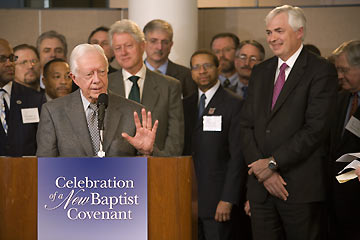
Former Presidents Jimmy Carter and Bill Clinton announce the New Baptist Covenant gathering.

But some SBC leaders—including President Frank Page—criticized the event, complaining that the SBC had not been invited to participate on an official level. Some of them, as well as conservative political commentators, said the event had a left-leaning political bias, with some claiming it was aimed at shoring up the presidential candidacy of Clinton’s wife, Sen. Hillary Rodham Clinton (D-N.Y.).

Organizers countered that many Southern Baptists were involved with the planning and that the denomination wasn’t involved on an official level because it dropped out of the North American Baptist Fellowship of the Baptist World Alliance. They also noted prominent Baptist Republicans had been invited to speak, including Huckabee—who later dropped out in protest over remarks that Carter made about President Bush's policy toward Israel. But organizers later secured two GOP senators as speakers—Lindsay Graham of South Carolina, who belongs to an SBC congregation; and Charles Grassley of Iowa, a member of a congregation affiliated with the Baptist General Conference.

2. Former pastor Huckabee runs for White House. Huckabee was considered by most pundits to be at best a second-tier candidate until support from disgruntled rank-and-file GOP evangelicals fueled a surge in the critical early voting state of Iowa late in the year. He is now leading former Massachusetts Gov. Mitt Romney, former New York Mayor Rudy Giuliani, former Tennessee Sen. Fred Thompson and Arizona Sen. John McCain, who have far better-funded campaigns. However, Huckabee’s new attention has led to new scrutiny, including of his record as Arkansas governor as well as what some critics consider blatant pandering to evangelical voters.

3. Klouda sues SWBTS, Patterson. Sheri Klouda, who was hired to teach Hebrew in Southwestern’s School of Theology in 2002, was fired in 2006. Prominent SBC pastor and blogger Wade Burleson called attention to her plight in January, precipitating a firestorm in the denomination’s blogosphere. She sued in March, claiming gender discrimination and breach of contract. Southwestern officials—including powerful seminary president Paige Patterson, an architect of the fundamentalist takeover of the SBC—said having a woman training male pastors in the theology school was unbiblical and counter to seminary policy. But many younger SBCers disagreed, noting that the denomination’s faith statement says only that women cannot be pastors.

4. Strife on IMB board continues as trustees censure Burleson. A long-simmering dispute between Wade Burleson, an Oklahoma pastor, and many of his fellow IMB trustees boiled over again in November. The board voted to censure Burleson and bar him from official participation in board activities. They claimed his blogging in opposition to two controversial IMB policies violated trustee rules. Burleson countered that the rules themselves were un-Baptistic.

5. SBC messengers declare BF&M “sufficient.” One of Burleson’s arguments is that the IMB policies in question—regarding the baptisms of missionary candidates and their beliefs about speaking in tongues—went beyond the parameters of the Baptist Faith & Message statement. At the denomination’s annual meeting in June, he and like-minded bloggers encouraged the successful passage of a motion declaring the document the “sufficient” doctrinal guide for convention agencies. However, some SBC agency heads quickly noted they will continue to use other doctrinal restrictions in addition to the document.

Joy Fenner

6. Texas Baptists elect first female president. At their annual meeting, the Baptist General Convention of Texas elected retired Texas Woman’s Missionary Union Executive Director Joy Fenner as its president in a contested election. Fenner became the first woman to head the largest Baptist state convention.

7. (tie) Geoff Hammond elected NAMB president. After a tumultuous year at the SBC’s domestic-missions agency, in which a previous president was dismissed after an investigation into his management and financial dealings, Hammond was recruited from his position as an executive with the Southern Baptist Conservatives of Virginia convention.

7. (tie) Turmoil in Missouri Baptist Convention. Disputes between rival conservative Baptist groups in Missouri led to the ouster of the state convention’s executive director. Later, messengers to the Missouri Baptist Convention annual meeting registered their disapproval of the political faction that had forced David Clippard out, rejecting all of the candidates endorsed by the Missouri Baptist Layman’s Association.

9. Jerry Falwell dies at 73. Legendary Southern Baptist pastor and media impresario Falwell died suddenly in May, the first of an aging generation of conservative Christian leaders to pass away. Falwell was beloved by his followers and reviled by his critics, including many Baptists and other Christians, for his controversial statements about church-state separation and various groups he disfavored. However, he built both a massive church and an evangelical university from nothing.

10. North Carolina convention in turmoil. Years of pro-SBC fundamentalists consolidating their grip on the Baptist State Convention of North Carolina’s leadership led most of the state convention’s affiliated agencies—including three colleges and the state’s Woman’s Missionary Union—to distance themselves from the convention. In response, messengers to the annual meeting voted to defund WMU. They also expelled a prominent and historic Charlotte congregation, Myers Park Baptist Church, for its stance on accepting gays and lesbians, prompting national headlines in the secular press.

Other stories that captured Baptists’ attention in 2007, according to the survey, included:

• An ongoing dispute between Southwestern Seminary trustees and their colleague, Texas pastor Dwight McKissic. He resigned from the board after being censured for expressing his views on the topic of charismatic practices.

• The increasing emphasis among many moderate and progressive evangelicals on combating global warming as a moral issue.

• A recently announced breakthrough in stem-cell research that may help calm the ethical debate over the practice.

• The prevalence of discussions about candidates’ faith among contenders for both parties’ presidential nominations.


Readers are invited to give their own rankings of top Baptist news stories through an online survey on the Associated Baptist Press website at www.abpnews.com.


News of religion, faith, missions, Bible study and Christian ministry among Baptist churches, in Texas, the BGCT, the nation and around the world.