Persecution’s blessing: church growth in India

Posted: 11/30/07

Persecution’s blessing:
church growth in India

By Lance Wallace

Cooperative Baptist Fellowship

HYDERABAD, India (ABP)—Sam Bandela has worked five years in the mountainous central region of India. Even as tsunami relief and personal challenges intervened, he continued to find local partners, train indigenous church planters and fund development projects in the largely Hindu region.

Finally, he is seeing results.

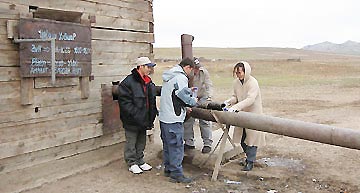
Sam Bandela (right) works with local pastors in India such as Narayan Paul (left). (Randy Durham photo/CBF)

Among three tribal groups—Sora, Jathava and Kui—in the area between the Andhra Pradesh and Orissa states, 50 new churches have been planted. Some were in spite of active resistance by other religious groups.

In this region, anti-Christian militants often threaten new converts. In recent years, several foreign missions workers have been killed.

“The persecution is causing the church to grow,” Bandela said. “The church in India has not grown much in the last 50 years, but it has grown tremendously in the last two years because of the persecution.”

Narayan Paul, a 78-year-old pastor and evangelist, and his ministry partners have started more than 120 churches after leading 12,000 people to faith in Christ. Their methods are simple. They travel to the remote hill villages building relationships and sharing the gospel.

“In March, Brother Paul baptized 80 people and another 70 people in May. The people are responding,” Bandela said.

In April, more than 3,000 Christians from the hill tribes staged a silent prayer walk as a demonstration against religious persecution. The event solidified the new believers and was not marred by violence.

As Paul and his partners travel, they identify physical needs that Bandela—a Co-operative Baptist Fellowship field worker—is able to channel CBF Global Missions resources toward addressing. As a result, some villages have built new water systems, saving people a two-mile hike down a mountain at a nearly 45-degree angle to retrieve water.

Bandela also schedules medical clinics in the remote areas, bringing physicians from the United States to treat the villagers who have little access to health care.

In some areas, they have helped complete church buildings, which usually begin as four walls with thatched roofs or no roofs at all. So far, Bandela has worked with five churches to build new roofs, with five more in progress. The plan is for 50 more.

Plus, Bandela has channeled aid and supplies to help more than 400 families after floods hit the area in August of 2006.

“Our focus, our end result is church planting,” Bandela said. “Medical clinics, sewing center projects, supplying food, flood relief, water projects—they are all means and methods for evangelism. All that we do is helping people come to know the Lord, giving birth to a new church.”

Bandela and his wife, Latha, live in the United States because of the special needs of their youngest son, Paul. Bandela travels to India several times a year for a month or longer at a time to network, develop partnerships, facilitate church groups, conduct medical clinics, train new church planters, execute building projects and participate in evangelistic meetings.

Often, pastors from the United States participate by teaching in the church-planting seminars and training in Hyderabad. The program, established by Bandela with gifts from CBF churches, now is led entirely by indigenous Christian leaders and produces cohorts of 10 to 20 church planters several times a year.

At the graduation ceremony, each church planter is given a new Bible and a bicycle. The newly trained evangelists are then sent out into the remotest areas to be the presence of Christ in word and deed.

“Giving a bicycle to them is like giving a car,” he said. “The roads are cow paths. It’s only $50 for a bicycle. When you and I go to eat, we’ll spend about $50. For us, it is just a meal and fellowship, but for them, $50 for a new bicycle is a lifetime investment.”

Bandela works with local leaders, empowering and equipping them to build upon the foundation he has laid and start new work in areas he couldn’t possibly get to.

“American Christians have a part—prayer, encouragement, giving—but they are not the front runners,” he said. “Times have changed. We need to stand behind our Indian brothers and sisters as they lead the way.”

News of religion, faith, missions, Bible study and Christian ministry among Baptist churches, in Texas, the BGCT, the nation and around the world.


Texas Baptist Forum

Posted: 11/30/07

Texas Baptist Forum

Ominous trend

What a commentary on American Christians! We gave more during the Great Depression to win the world to Jesus than we are giving now. 

Jump to online-only letters below
Letters are welcomed. Send them to marvknox@baptiststandard.com; 250 words maximum.

“This election, the candidates are talking so much about faith that one would think they wanted to be in the College of Cardinals rather than the Hall of Presidents.”
Jonathan Turley
George Washington University professor (USA Today/RNS)

“We are not preaching any type of civil disobedience. We’re just simply saying if someone comes to us and they’re in need of food, they’re in need of going to the doctor, we’re not going to take the time to look for a green card. We’re going to minister and show them Christ’s love.”
Robert Wilson
Ardmore, Okla., pastor, explaining an Oklahoma Baptist resolution that vowed to continue working with immigrants despite a state law that makes it illegal to aid or assist undocumented immigrants (Daily Oklahoman/RNS)

“Everything she does and says reflects on her husband’s ministry, and I don't think the men understand the stress that places on a woman. Their whole identity can be wrapped up in being the pastor’s wife, and they begin to lose themselves.”
Ginger Kolbaba
Co-author of a novel about four pastors’ wives (Leadership/RNS)

We have been warned repeatedly that God will move on and find others more obedient to his command to take the gospel. But we continue to turn inward and become more and more self-absorbed with meeting our own needs and those of our churches than with sacrificing to take the good news to those who have yet to hear.

No wonder, according to world-watchers, the center of the Christian faith has now moved to the Southern Hemisphere.

How sad in some ways!  And how ominous for us!

Helen Jean Parks

Richardson


Blogging & dissent

Your words about the tone of disagreement in Baptist life are appreciated (Nov. 19), as were your warnings prior to the Baptist General Convention of Texas meeting in Amarillo encouraging messengers to “behave” (Oct. 29). We always need those kind of reminders.

I am a little bit disturbed, however, by the fact bloggers always seem to get lumped together as a bunch of angry, disgruntled individuals who seem to have nothing better to do than to use cyberspace to be critical. Some bloggers do make that choice, as do some editors of Baptist-related newspapers, but it is a far cry from all, or even a majority, of us. It isn’t fair to paint everyone with the same broad brush. Many bloggers, myself included, are governed by scriptural principles when writing.

The ability to disagree and dissent is a cherished Baptist principle. Blogging now opens a door for those of us who are not “insiders” but who care about our denomination and its agencies and institutions to have our voices heard and to contribute to a decision-making process that for many Baptists has seemed cliquish and exclusive for a long time.

Lee Saunders

Sugar Land


‘Winning’ letter

I have yet to read a nicer, more unselfish letter from a presidential “runner-up” as the one written by David Lowrie (Nov. 5).

With his history as a dedicated Christian leader, he could in no way be called a “loser.” I really appreciated his attitude in this very important election.

Sybil McClendon

Sulphur Springs


Name fits

Micah Meurer objects to the BGCT staff and the Baptist Standard referring to people affiliated with our state convention as “Texas Baptists” (Nov. 5). 

It would be interesting to see what he feels would be the appropriate term of reference.  Are members of BGCT-aligned churches less than Texans or less than Baptists? With all due respect, it has appeared to me over the past few years that the other Texas Baptist convention has adopted the attitude of exclusion. 

Charles Alexander

Benbrook


Control illustrated

The action of the International Mission Board trustees to censure Wade Burleson (Nov. 19) is one more demonstration of the controlling nature of the group that has taken over the Southern Baptists-in-Name-Only Convention. 

They have forgotten the things that made Baptists distinctive and successful. They tolerate no (soul) freedom, no priesthood of any believer that doesn’t kiss their ring or drink their Kool-Aid, no expression of dissent of any kind.

We must pray for our brothers and sisters in the Southern Baptists-in-Name-Only Convention, that they will repent and return to being the SBC that existed from World War II through the adoption of Bold Mission Thrust, another casualty of the Baptists-in-Name-Only, who took control beginning in 1979. 

We must pray that God will forgive them for the unloving and unlovely way they conduct denominational business.

Ralph E. Cooper

Waco


Committed Texas Baptists

Texas Baptists have been trying to process the events of recent months in our state convention. We are dealing with Charles Wade’s departure, the search process for a new executive director, scandals and the close presidential vote in Amarillo.

A part of that conversation has involved the future of Texas Baptists Committed. There are those who feel TBC should go away or cease to have influence. I think that would be a mistake. I look back at 20 years of work and am proud of what we have accomplished. The BGCT is a better place because of TBC.

TBC has had influence in Texas because we are what our name implies—“committed.” I read where critics are considering cutting BGCT funding. Churches like mine are here for the short term and the long term. We are committed to helping like-minded Baptists reach this state for Christ.

Critics have also hinted that TBC no longer represents the “center.” We still are right at the center of Texas Baptist life.

We are liberal enough to think that blacks, Hispanics and women can lead. We are conservative enough to believe that the Bible is truth and worthy of all authority in churches and in personal life.

We at TBC have not hand-picked the next executive director. That is God’s business.

I can only speak for myself, but the new executive director will have my prayers and dollars.

I am still a Texas Baptist who is committed.

Ed Hogan

Houston


Future shudder

As I read Ken Williams’ reasons for remaining a Baptist (Nov. 19), I was reminded of my reasons for joining the Southern Baptist Convention nearly 24 years ago.

I left a group that promoted women pastors for the SBC. I wanted to be in a group that stood up for the Scriptures and did not change with every social movement in America. I am glad the SBC has stood for the tenets or dogma of the faith.

People like this remind me of the words of B.H. Carroll, who wrote over 75 years ago: “The modern cry, ‘Less creed and more liberty’ is a degeneration from the vertebrate to the jellyfish and means less unity and less morality, and it means more heresy. … It is a positive and very hurtful sin to magnify liberty at the expense of doctrine.” 

When I read a letter such as this one, I shudder to think where the SBC will be in another 20 to 30 years.

Michael L. Simons

Cleburne


Right thing

As a longtime Baptist, I would like to see in print something I have never seen.  I would like to read where some spokesperson from a Baptist committee, convention or business meeting said, “We did the right thing.”

The right thing as opposed to the “almost” right thing, the “nearly” right thing, the “practical” right thing or the “popular” right thing. The right thing regardless of what people may (or may not) think. The right thing regardless of what it costs. The right thing regardless of “setting a precedent.”

How could it be wrong to “set a precedent” of doing the right thing?

What would Jesus do? 

He would do what he always did—the right thing.

Jack Newton

Azle


Do not stoop

No matter what “hot war” America might be fighting, we must not stoop to terror and torture. The Golden Rule says, “Treat others as you want to be treated.” Individuals or nations that break the God-given rule suffer consequences, lose any moral authority they might have, and give up the ability to win friends and influence people. 

It is a huge mistake for America to get caught up in the tit-for-tat, eye-for-an-eye violation of the Golden Rule, which has plagued Israel and the Palestinians for decades. 

It is a waste of time for politicians and preachers to ask God to bless America if we intentionally break the most basic human relations principle that is revealed in the scriptures of most world religions.

The Golden Rule is simple, difficult for mortals to obey, but if abided by guarantees peace and God’s blessing. America must not stoop to terror and torture if it is to be a world leader among the nations.

Paul L. Whiteley Sr.

Louisville, Ky.


What do you think?

Because the Baptist Standard affirms the historic Baptist doctrine of the priesthood of all believers, we particularly value feedback from readers.

Send letters to Editor Marv Knox by mail: P.O. Box 660267, Dallas 75266-0267; or by e-mail: marvknox@baptiststandard.com.

Key guidelines:

• Due to space considerations, we limit letters to 250 words.

• In order to present a variety of voices, we publish only one letter per writer per quarter.


News of religion, faith, missions, Bible study and Christian ministry among Baptist churches, in Texas, the BGCT, the nation and around the world.


Baylor and Texas Baptist Men bring clean water to Mongolian town

Posted: 11/30/07

A Baylor University team partnered with Texas Baptist Men to bring water filtration systems and water testing to a rural village in northern Mongolia. Pictured are (left to right)  Dick Talley, Ron Mathis, and Leo Smith, all from Texas Baptist Men; Governor Khayankhirvaa of Darkhan, Mongolia; and Rene Massengale, Michelle Nemec, and Stacy Pfluger from Baylor University.

Baylor and Texas Baptist Men bring
clean water to Mongolian town

By Matt Pene

Baylor University

KHONGOR, Mongolia—A village in central Mongolia that suffers from extensive water and environmental contamination soon may see better days ahead, thanks to the work of Baylor University researchers and Texas Baptist Men.

Researchers have completed one phase of the Baylor in Mongolia project. They identified about 1,000 people in Khongor who have been become sick due to environmental contamination from industrial mining. About 70 percent of the households in that town have at least one sick person—a crisis that has drawn attention from the World Health Organization.

“It is significant because Khongor is the first of perhaps many in this region with this same problem,” said Rene Massengale, an assistant professor of biology at Baylor, who is leading the project.

A project by Baylor Univerisy is alleviating extensive water and environmental contamination in the Mongolian town of Khongor.

“This is a clear human rights and human health issue, because these people were knowingly exposed but never told about it.”

Massengale’s study marked the first comprehensive independent environmental look at the problem in Mongolia, a northern Asian country between China and Russia. The Baylor study found residents had been exposed for more than a year to toxic levels of cyanide, mercury and heavy metals like arsenic due to multiple environmental spills by legal and illegal mining companies searching for gold in the soil. Symptoms include skin rashes, severe headaches, seizures and liver problems among many others.

The Baylor study was commissioned by Khayankhirvaa, the state governor of Darkhan, a region in northern Mongolia; Gunchin Luvsandorj, the presidium president of the Darkhan Aimag; and Batdulam Jambadoo, the foreign affairs officer for the Darkhan Aimag and special assistant to the state governor of Darkhan, after they toured Baylor in 2006.

Massengale acted as one of their Baylor tour guides during the visit. And, after learning of her line of research work, the dignitaries formally asked Massengale to lead a water-quality study in Khongor.

Massengale and her team now are partnering with local government leaders in Mongolia, Lifeqwest Mongolia and Texas Baptist Men to bring medical supplies and individual home water purifying equipment to Khongor. Massengale said those supplies should provide a short-term fix to the problem. Phase two of the project, which should begin in the summer, is a long-term environmental clean-up.

A few weeks ago, Massengale ran more than 2,400 tests on soil and water samples in the village. Tests indicated levels of cyanide and mercury have improved in many wells, but there still were a few wells with elevated levels of contaminants. There also was significant contamination of the soil and the building where the illegal mining took place. The contaminated soil is leaching toxic chemicals into the surrounding area and remains a health hazard to the community, Massengale said.

As the second phase gets under way, Massengale also hopes to set up a permanent Baylor in Mongolia program for students at Baylor and at the National University of Mongolia. The program would establish a permanent water-quality laboratory in Khongor, where students could conduct applied research to identify the needs of area towns and then work to meet those needs by training local Mongolian students about water quality, health and sanitation. 


News of religion, faith, missions, Bible study and Christian ministry among Baptist churches, in Texas, the BGCT, the nation and around the world.


Diverse group of Christians seeks better relationship with Muslims

Posted: 11/30/07

Diverse group of Christians seeks
better relationship with Muslims

By Adelle M. Banks

Religion News Service

WASHINGTON (RNS)—A wide range of Christian theologians and leaders have endorsed a document calling for increased efforts to work with Muslims for peace and justice. The move responds to an earlier call from Muslim leaders seeking common ground.

The new document, “Loving God and Neighbor Together: A Christian Response to ‘A Common Word Between Us and You,’” was signed by about 300 Christians and published in a Nov. 18 advertisement in the New York Times.

“Given the deep fissures in the relations between Christians and Muslims today, the task before us is daunting. And the stakes are great,” the statement reads. “The future of the world depends on our ability as Christians and Muslims to live together in peace.”

Four scholars at Yale Divinity School initially released the document in mid-October, responding to an open letter by 138 Islamic clerics and scholars to Pope Benedict XVI about the need for partnerships aimed at peace.

The Yale document has expanded to include endorsements from such varied Christian voices as Rick Warren, author and pastor of Saddleback Church in Lake Forest, Calif.; William A. Graham, dean of Harvard Divinity School; Richard Mouw, president of Fuller Theological Seminary; Robert Schuller, founder of the Crystal Cathedral in Garden Grove, Calif.; Richard Cizik, vice president of the National Association of Evangelicals; David Neff, editor in chief of the evangelical magazine Christianity Today; and John M. Buchanan, editor of the mainline Protestant magazine The Christian Century.

The Christian leaders acknowledge that people of their faith “have been guilty of sinning against our Muslim neighbors” and ask for forgiveness.

Organizers of the document hope it will lead to conferences and workshops involving some of the signatories as well as other Christian, Muslim and Jewish leaders.


News of religion, faith, missions, Bible study and Christian ministry among Baptist churches, in Texas, the BGCT, the nation and around the world.


Oklahoma Baptists vow to continue ministering to illegal immigrants

Posted: 11/30/07

Oklahoma Baptists vow to continue
ministering to illegal immigrants

By Hannah Elliott

Associated Baptist Press

MOORE, Okla. (ABP)—Messengers to the annual meeting of the Baptist General Convention of Oklahoma passed a resolution emphasizing nondiscriminating ministry to illegal immigrants and adopted a record $24.6 million budget.

“Finishing the Task” was the theme of the convention, which brought almost 900 messengers to First Baptist Church in Moore.

The resolution dealt with a new state law making it a felony to associate with undocumented immigrants. Messengers, in approving the resolution, said they don’t “necessarily agree (with) or oppose the new law,” but will continue to minister to anyone.

Convention spokeswoman Heidi Wilburn said Christians should place their “No. 1 focus” on God and look to government as a second priority, according to news reports.

The resolution states: “Christians are under biblical mandate to respect the divine institution of government and its laws. Let it be known that House Bill 1804 related to illegal immigration will not change their ministry to any people.”

Bruce Prescott, the executive director of Mainstream Oklahoma Baptists, called the resolution a move in the right direction.

“More often than not, I am a critic of the resolutions adopted by the BGCO,” Prescott wrote on his blog, mainstreambaptists.blogspot.com. “I commend them for passing this resolution—timid, as it is, in opposing an unjust law.”

The local Catholic archdiocese and the Muslim community of Oklahoma City have also sent letters of protest to Democratic Gov. Brad Henry.

Oklahoma messengers also adopted a record-setting budget for 2008, anticipating $24.6 million in Cooperative Pro-gram gifts from convention churches. That’s an increase of $1.1 million from last year’s budget. The convention uses 60 percent of the budget for in-state ministries, while the remaining 40 percent goes to the Southern Baptist Conven-tion for national and international ministries.

Alton Fannin, pastor of First Baptist Church in Ardmore, was elected president by a 292-208 vote over Ernie Perkins, a retired director of missions. Doug Passmore, pastor of First Baptist Church in Lawton, was elected as first vice president. Aaron Summers, pastor of First Baptist Church in Perry, became second vice president. Pat Wagstaff, a member of First Baptist Church in Maysville, was elected recording secretary.

The messengers adopted 10 other resolutions, including ones opposing “any hate-crimes legislation that potentially criminalizes speech and belief”; opposing the sale of alcohol in Oklahoma grocery and convenience stores; and affirming the so-called conservative resurgence in the SBC, which “returned us to our historic roots of commitment to the Bible as the infallible and inerrant word of God.”


News of religion, faith, missions, Bible study and Christian ministry among Baptist churches, in Texas, the BGCT, the nation and around the world.


Lectionary helps some Baptist preachers feed their flocks a ‘balanced diet’

Posted: 11/30/07

Lectionary helps some Baptist preachers
feed their flocks a ‘balanced diet’

By Robert Dilday

Virginia Religious Herald

RICHMOND, Va.—It’s Saturday night. Do you know where your pastor is? A pretty safe guess might be “in a study, frantically developing the next day’s sermon.”

But how does a preacher decide on the Scripture text? Some free-church Baptist pastors find their answer in the liturgical toolbox. They preach from the lectionary, a centuries-old cycle of Scripture readings assigned to each Sunday of the year.

In general, a lectionary is a collection of Scripture readings appointed for worship on a given day. Today, most Protestant churches use the Revised Common Lectionary, which includes readings each Sunday from the Psalms, the Old Testament, the Epistles and the Gospels, organized into a three-year cycle.

“I preach from texts I would never preach from if I did not follow the lectionary,” said Chuck Warnock, pastor of Chatham (Va.) Baptist Church. “Sometimes that poses a challenge. Sometimes I think the texts are not that great. But I dig into them and have been blessed by that discipline.”

See Related Articles:
Preaching: Stand and Deliver
Integrity demands preachers avoid pulpit plagiarism
• Lectionary helps some Baptist preachers feed their flocks a 'balanced diet'

Mike Clingenpeel, pastor of River Road Church, Baptist, in Richmond, Va., and David Washburn, pastor of First Baptist Church in Waynesboro, Va., echoed that rationale for using the lectionary.

“It guarantees I don’t preach my pet themes,” said Clingenpeel. “The lectionary sort of channels me away from my own subjective feelings. Besides, it balances what the congregation hears.”

Washburn said tackling difficult texts “makes me cultivate a different style of preaching.” Following the lectionary “helps me grow as a preacher and teacher, and we certainly hope that will spill over into the congregation,” he said.

Retaining flexibility to respond to events in the congregation or community keeps some pastors from rigidly adhering to the appointed readings.

Kyle Reese, pastor of Hendricks Avenue Baptist Church in Jacksonville, Fla., typically follows the lectionary in preaching, but he noted “the ebb and flow of life” dictates times when he needs to depart from the prescribed texts.

Even so, he noted many times when he initially thought circumstances would require him to find a text to address a specific situation, but he was surprised to discover the lectionary reading fit perfectly.

Bill Shiell, pastor of First Baptist Church in Knoxville, Tenn., agreed. Even on the Sunday after the Sept. 11 terrorist attacks in New York and Washington, he discovered the lectionary Scriptures provided an appropriate text for the occasion.

Other reasons cited for using the lectionary:

It connects local churches with the global Christian community. “Millions of churches around the world read the same passages each Sunday,” Warnock said. “I like being a part of the global church as it gathers for worship in thousands of different expressions, united by common Scripture.”

It unites the Christian family at-large by providing a common focus, Reese added.

“Entering into the broader community of the church is invaluable,” he said. “That particularly resonates with the 20-something and younger crowd who want to be a part of something bigger than themselves.”

It can immerse worship services in Scripture. “Often I adapt the Psalm as a call to worship or call to prayer or as some other liturgical element in the service, to which the people respond. We try to use the texts pretty extensively, so that there’s more than just a nominal reading of Scripture in worship,” Clingenpeel said.

The variety of Old Testament and New Testament texts “work together and weave a tapestry of witness and story that is majestic,” Warnock observed.

It makes selection of texts easier each Sunday, while offering almost unlimited texts over the long haul. Since the lectionary covers the entire Bible in a three-year cycle, “if you want to preach through the Bible, use the lectionary as your guide,” Warnock said. “Somebody else figured it out for you. Saves you a lot of time, plus a lot of thought, prayer and study was invested in choosing these texts.”

Because there are four readings appointed for each Sunday over three years, “theoretically you could preach for 12 years without ever repeating a text,” said Clingenpeel, who, after serving his current church four years, has preached through the cycle once.

A flock fed from the lectionary should benefit from a “balanced diet,” said Joel Gregory, professor of preaching at Baylor University’s Truett Theological Seminary.

“The up side of the lectionary is that if a preacher follows it, the congregation will get a balanced diet of Scripture over three years,” Gregory said.


With additional reporting by Managing Editor Ken Camp


News of religion, faith, missions, Bible study and Christian ministry among Baptist churches, in Texas, the BGCT, the nation and around the world.


Integrity demands preachers avoid pulpit plagiarism

Posted: 11/30/07

Integrity demands preachers
avoid pulpit plagiarism

By Ken Camp

Managing Editor

If preachers pass off other people’s work as their own, they automatically limit themselves to preaching about only eight commandments. “Thou shalt not steal” and “thou shalt not bear false witness” become off-limits.

But preachers can avoid plagiarism by beginning at the right place—giving time and attention to the biblical text before reading or listening to other people’s sermons about the text, said Joel Gregory, professor of preaching at Baylor University’s Truett Theological Seminary.

“To be sure you’re not plagiarizing, do your own exegetical work,” Gregory said. “Take the text into yourself, and let the text speak through your personality. Once we as preachers stop doing our own exegetical work, that’s when we start putting somebody else’s stuff in the meditative microwave.”

Authentic preaching remains true to the text and true to the experience of the preacher, he added.

Years ago, Gregory asked Ray Summers—longtime seminary professor and religion department chair at Baylor University—how he listened to sermons. Summers told him the first thing he wanted to hear was the element of testimony.

See Related Articles:
Preaching: Stand and Deliver
• Integrity demands preachers avoid pulpit plagiarism
Lectionary helps some Baptist preachers feed their flocks a 'balanced diet'

“I believe that is a hallmark of effective preaching,” Gregory said, noting the importance of “truth as testimony” in preaching.

“I want to know what the preacher has experienced of the truth being preached.”

Naturally, that means it is “always out of bounds” for a preacher to use another speaker’s first-person stories, he said.

But that doesn’t mean every sermon must be a totally original creation for which the preacher owes no debt to anyone who has preached from the same text before.

“As one friend has said, ‘Originality is an oversold idea,’” said Beth Newman, ethics professor at Baptist Theological Seminary at Richmond.

When it comes to the use of source material, intent matters, Newman noted. “I think a key distinction (between plagiarism and honest research) involves the use of other’s work with the intent to deceive,” she said.

Faithfulness to the Scripture—rather than originality—should take priority, she insisted.

Gregory agreed—at least up to a point—that preachers benefit from listening to or reading sermons by other preachers. He draws a distinction between originality and creativity.

“Creativity stimulates creativity,” he said.

“Listening to someone else’s sermon can give a preacher a different angle of view on a text. A lot of landscape painters can paint the same landscape in different ways. … Creativity means taking the same stuff and making different connections.”

Faithfulness to the listeners in a particular place rules out the option of the preacher who “simply goes online, prints out a sermon and preaches it,” Newman added.

Sermons are messages “to a particular body and should reflect the pastor’s knowledge and relationship with a particular congregation,” she said.

“The sermon is an ‘occasional’ event—like a conversation, in some ways—not to be preserved for the ages.”


With additional reporting by Jim White of the Virginia Religious Herald


News of religion, faith, missions, Bible study and Christian ministry among Baptist churches, in Texas, the BGCT, the nation and around the world.


Preaching: Stand and Deliver

Posted: 11/30/07

Preaching: Stand and Deliver

By Ken Camp

Managing Editor

God chose “the foolishness of preaching” as the preferred instrument for communicating the message of salvation, the Apostle Paul wrote.

But when the time arrives to stand and deliver that message, how does a preacher measure whether it’s an exercise in effectiveness or just plain foolishness?

We don’t always know,” Doyle Sager acknowledged.

How does a preacher measure whether his preaching is an exercise in effectiveness or just plain foolishness?

Preachers can learn a lot by watching body language and facial expressions, as well as listening to honest critiques by trusted friends, said Sager, pastor of First Baptist Church in Jefferson City, Mo.

But ultimately, he added, it comes down to “the witness of the Spirit.”

Something mysterious and wonderful happens when a preacher connects with his listeners—when God uses the words of the preacher to make his word come alive in the hearts of worshippers, several pastors noted.

But sometimes, even the most diligently prepared, best-delivered sermons fall flat—particularly if the preacher doesn’t keep in mind who is sitting in the pews on a given Sunday.

When Bill Shiell moved from Southland Baptist Church in San Angelo to become pastor at First Baptist Church in Knoxville, Tenn., he was introduced to an important lesson early. In one of his first messages, as a way of engaging his listeners, he asked for a show of hands from anyone who had worked on a farm.

“In San Angelo, nearly everyone would have responded. Here (in Knoxville), only one hand went up,” he said.

See Related Articles:
• Preaching: Stand and Deliver
Integrity demands preachers avoid pulpit plagiarism
Lectionary helps some Baptist preachers feed their flocks a 'balanced diet'

Context matters, and it takes time for a preacher to learn about the people in a particular congregation and how to communicate with them, Shiell noted.

“I preached a lot of great San Angelo sermons here that didn’t connect,” he acknowledged, pointing out cultural differences between church members in a small city in rural West Texas and a larger university city in eastern Tennessee. “It takes awhile to preach effectively in a particular place.”

Listeners intuitively will respond to a message that is “in their ZIP code” and tune out one that is not, Shiell said. “It has to resonate with the people who are in that room at that time.”

Joel Gregory, professor of preaching at Baylor University’s Truett Theological Seminary, affirmed that sentiment.

“All preaching is venue-specific,” he said.

Great preachers most often invest their lives in a “specific community of faith,” Gregory added.

Listeners recognize the authority of the message when they realize the authenticity of the messenger, several preachers noted.

Preaching involves more than communicating information; it involves an invitation into relationship, said Kyle Reese, pastor of Hendricks Avenue Baptist Church in Jacksonville, Fla.

“I believe one cannot be an effective preacher without being active in pastoral care,” said Reese, former pastor of First Baptist Church in San Angelo. “We are preaching a gospel that is always incarnational.”

A pastor who spends all his time cloistered in a study will find it hard to connect with listeners on Sunday morning, but the pastor who walks through life alongside church members typically will find a receptive audience, said Gary Long, pastor of Willow Meadows Baptist Church in Houston.

“Be a pastor first. Focus on knowing the people,” Long said, when asked what advice he would give to other young pastors.

“Spend more than half your time living with the people and less than half the time working on a message to deliver to them. … The authority to be heard comes when people know you love them and care for them.”

As he composes his sermons, Long said, he keeps in mind they are intended for “a particular community in a particular season of life.”

When the preacher is an attentive pastor who knows the congregation and the culture of the community in which they live, sermons become relevant to the listeners. But cultural relevance should not be seen as an end in itself, Long noted, pointing out the gospel carries a counter-cultural message.

“Relevance is not our goal. It is just a tool,” he said. “Our goal is not to be relevant to culture. We want to be distinct from culture.”

Effective preaching involves an ongoing conversation between a pastor and a congregation, characterized by mutual love and respect, Sager observed.

“All preaching is dialogical,” he said. “It is a conversation, even if the people are not speaking out loud.”

Sager, Reese and Shiell all noted the value in a preacher being able to make eye contact with listeners and read their body language to know if worshippers are connecting to the sermon. For that reason, they preach without notes or manuscript in hand.

“I find that speaking from memory gives me access to the listener’s world,” Shiell said.

But preaching without notes does not mean preaching without preparation.

Shiell looks at themes about four months in advance and begins planning “the basic plot” of the message two to three months before he delivers it. About two weeks before he preaches a message, he spends serious time studying, and then he typically writes a manuscript, which he memorizes.

“Most people can deal with only one main idea. Sometimes as preachers we try to say too much.”

Reese follows a fairly similar routine, planning in six-week blocks following the lectionary and the Christian calendar. Typically, he likes to preach in a narrative style, developing a plotline that leaves listeners with one main idea they can take from the text.

“Most people can deal with only one main idea,” he explained. “Sometimes as preachers we try to say too much.”

Although Reese and Shiell both prefer a storytelling approach in preaching, they stressed the literary style of the biblical passage—narrative, poetic, didactic or whatever—should shape the sermon. Some Scriptures lend themselves to retelling in narrative, and others demand a verse-by-verse exposition.

“Every sermon has a scaffolding—a framework. Some lend themselves to an exposed skeleton. Most of mine are hidden,” Shiell said. “I believe all of my sermons are expository, but they are not all expositional.”

Every preaching style has both strengths and weaknesses, Gregory observed. A very linear, deductive, expository approach may work best in preaching from the Apostle Paul’s writings and if the listeners are age 35 or older, he noted.

“If done wrong, it can become dull and predictable,” he said. “Done right, it can sustain a longtime pulpit ministry.”

The parables or stories from the Old Testament books of history naturally lend themselves to narrative preaching in its varied forms, he observed.

Young listeners particularly relate well to a well-told story, and they are more open than older worshippers to an inductive style that raises a question, offers a “slice of life” situation and compels listeners to “connect the dots.”

“Done right, it may be the best way to preach to people where there is a high resistance to authority. … Done right, it sneaks up on people and draws them in,” he said. “The weakness is that it requires a gift of creativity. … It takes a rare creative gift to do good inductive preaching.”

When the preacher begins by doing serious exegetical work—digging into the biblical text either in the original languages or in several English translations—and then relates the text to a specific people at a particular place, the end result is a biblical sermon, style not withstanding, Gregory observed. That’s true regardless of the tendency of some preachers to elevate one preaching style over all others.

“We all like to baptize our preferences,” he said.


News of religion, faith, missions, Bible study and Christian ministry among Baptist churches, in Texas, the BGCT, the nation and around the world.


Baptist volunteers spread cheer by ‘Serving Irving’

Posted: 11/30/07

Baptist volunteers spread
cheer by ‘Serving Irving’

By Leann Callaway

Special to the Baptist Standard

IRVING—For more than a decade, members of Oak View Baptist Church in Irving have spent Thanksgiving “Serving Irving.” Willow Bend Baptist Church in Plano also helped this year to provide more than 2,000 traditional Thanksgiving meals to apartment complexes throughout the city.   

Sergio Matassa, Oak View’s minister of missions, coordinated the outreach ministry. Six teams of volunteers helped with the project.

Volunteer Alyssa Raley serves meals to a family on Thanksgiving at The Raible Place Apartments in Irving. (Photos/Leann Callaway)

The promotion team hung flyers on doorknobs throughout the area around each serving site to let people know of the event. The pie-baking team baked more than 200 pies of assorted flavors. The packaging team gathered for each serving location.

The cooking team began food preparation on Wednesday evening and finished Thanksgiving morning. After Angelo’s Restaurant in Irving closed Wednesday night, the cooking team was allowed to use its facility to prepare meals.  

A serving team of 150 volunteers served the food, and a set-up team loaded tables and chairs and distributed them to the various sites.

All ages volunteer to help with Serving Irving, and many make it a tradition. Many young couples said this project has taught their children valuable lessons about helping others. 

“We try to set an example for our children and teach them to appreciate what we have and to see what the rest of the world is like,” said John Woodard, who volunteered with his wife Randi and two sons, Corey, 8, and Caleb, 5.

“I’m excited because we got to help people who needed food for Thanksgiving, and they got to hear about God,” 6-year-old Kamryn Bingham said.

Along with providing Thanksgiving meals, the ministry also provides food for the soul.  Volunteers had opportunities to tell people about Jesus Christ while passing out Bibles and gospel tracts. 

“We just feel incredibly blessed in our life, and we feel like it’s our responsibility as Christians to share Christ’s love with the world,” said Joy Hale, who volunteered with her husband Charlie and two daughters, Bailee, 8, and Ellie, 6.

“I help with Serving Irving so people will know that God loves them,” Bailee Hale said. 


News of religion, faith, missions, Bible study and Christian ministry among Baptist churches, in Texas, the BGCT, the nation and around the world.


Thanksgiving feast serves nearly 2,000

Posted: 11/30/07

Approximately 560 members of the Brownwood community enjoyed the 24th annual Community Thanksgiving Feast held at HPU. Additionally, 1,305 individuals had the meal delivered to their home that day.

Thanksgiving feast serves nearly 2,000

BROWNWOOD—More than 130 volunteers served 1,976 meals to friends and family in Brownwood area at the 24th annual Community Thanksgiving Feast on Thanksgiving Day at the Howard Payne University Mabee Center.

“Howard Payne University’s Mabee Center was filled, as 560 guests enjoyed the traditional Thanksgiving meal prepared by the university’s Sodexho Food Service,” said Bill Fishback, coordinator of the event for the past 15 years and assistant vice president for business and human resources at HPU. Last year, 620 people were served at the Mabee Center and 1,305 meals were delivered to families in the community.

The staff of HPU’s Sodexho Food Service donated their time preparing the food so others can enjoy the Thanksgiving meal.  

“We have the best university food service anywhere,” said Fishback. “Don Green and his staff did another outstanding job preparing the food for our friends and neighbors. And then, many of them go home and do the same thing for their own families.”

“It’s great fun to see so many people visiting, hugging and laughing, whether they were standing in line with their family to get meals to deliver or gathered at a table enjoying being together for Thanksgiving.”

Meanwhile, 1,416 meals were delivered by volunteers or taken by friends to homes in the area, Fishback said.

The annual tradition has been supported throughout the years by numerous individuals and organizations.


News of religion, faith, missions, Bible study and Christian ministry among Baptist churches, in Texas, the BGCT, the nation and around the world.


Texas Tidbits

Posted: 11/30/07

Texas Tidbits

Couple gives $5 million to Baylor. Baylor University received a $5 million gift from Clifton and Betsy Robinson of Waco. The gift will establish the C. Clifton Robinson and Betsy Sharp Robinson Endowed Scholarship Fund in the Honors College at Baylor. The scholarships will provide need-based financial assistance for academically gifted incoming freshmen, as well as some current Baylor students, who will be known as Clifton and Betsy Robinson Scholars. Scholarship recipients will study in any of the four Honors College programs—Baylor Interdisciplinary Core, the Honors Program, University Scholars and the Great Texts Program —established when the Honors College was created in 2002.


Music scholarship established at HSU. Francis McBeth recently established an endowed scholarship at Hardin-Simmons University to benefit sophomore, junior or senior theory composition majors in the School of Music. McBeth, a former Cowboy Band member and 1954 Hardin-Simmons graduate, served 40 years on the faculty at Ouachita Baptist University, and he was the conductor of the Arkansas Symphony Orchestra in Little Rock from 1968 to 1972. He received the John Philip Sousa Foundation’s Sudler Medal of Honor in 1999, and he was appointed the Composer Laureate of the State of Arkansas.


Baptist Health Foundation grants $4 million. Baptist Health Foundation of San Antonio granted more than $4 million to 74 local and area organizations this year. Recipients included San Antonio Baptist Association, which was granted $250,000 for health ministries. During its first three years, Baptist Health Foundation in conjunction with 2005 grants from the former Baptist Health Services Foundation has awarded more than $11 million in healthcare related grants to 162 organizations in the San Antonio area.


Valley Baptist Medical Center receives international honors. Nurses, physicians and staff at Valley Baptist Health System were honored with three international awards. The awards include the highest honor bestowed by the Worldwide Conventions and Business Forums’ Global Six Sigma Summit. The Platinum Award for the Most Outstanding Organizational Achievement is presented for achievement in improving quality by an organization from any industry, not just health care. In addition, Valley Baptist and its employees received two other awards—Best Achievement of Six Sigma in Healthcare and Six Sigma Vice President of the Year, presented to Tomas Gonzalez. Six Sigma is a quality improvement program that focuses on improving processes in business, industry and organizations.


Convocation honors Borrego. The Hispanic Convocation of the Laity named Baldemar Borrego, president of the Hispanic Baptist Convention of Texas, to its hall of fame during a recent gathering at Highland Lakes Encampment. A letter of commendation from President Bush stated, in part: “The celebration of faith continues to be central to the lives of Americans, offering strength, hope and guidance to people across the country. By sharing God’s teachings, you have helped to enrich lives and have served as an inspiration to your church and your community.”


News of religion, faith, missions, Bible study and Christian ministry among Baptist churches, in Texas, the BGCT, the nation and around the world.


TOGETHER: Gratitude to God prompts giving

Posted: 11/30/07

TOGETHER:
Gratitude to God prompts giving

In this wonderful time between Thanksgiving and Christmas, our hearts are filled with gratitude for our families and friends, for our churches and the gospel, for our work and time to rest, for our country and our world.

Counting your blessings always is a good thing to do.

wademug
Executive Director
BGCT Executive Board

In my life, this has been the time that I have thought more carefully about giving than at any other time of the year. Perhaps you are the same way. I have no doubt that much of that has to do with Christmas and the giving of gifts to family and friends. But it also has to do with giving mission offerings so that the “best gift I give is to Jesus.” After all, it is his birthday that I celebrate. So making sure the most expensive gift I give is to advance his name and the good news of the Redeemer’s kingdom always has seemed to me to be the right thing to do.

The best motivation for giving always is gratitude. We give because God first gave to us. He gave us life and bountiful provisions in creation. He has given us new life and a sense of significance in salvation. We celebrate creation and redemption, earth and heaven, new life now and eternally. We marvel at the fullness and richness of God’s bountiful love. We find courage to press on in life’s most difficult trials. And we have learned in years of giving that we never have out-given God.

Our people give so generously. One dear family has for some years given several thousand dollars through the Texas Baptist Missions Foundation to distribute among Texas Baptist camps because they rejoice in how many children and young people make life-changing decisions in the camp services each year.

Money from the Berry Fund for missions blesses struggling Baptists around the world in places such as Laos, Guatemala, Spain, Liberia and the northeastern United States.

Texas Baptists have sent a giant generator to the Nicaraguan Baptist Hospital in Managua. That gift will help save lives and lead many to our Lord.

I have in my files remarkable stories and expressions of gratitude from the disaster areas of South Texas and New Orleans. Your generosity when Katrina and Rita struck the Gulf regions continues to make a difference in lives.

I have a letter from the president of the Baptist seminary in Ogbomoso, Nigeria, thanking our Texas Baptist partnership missions leaders and the leaders of several of our Baptist schools for hosting three Nigerian teachers who came to visit us, share their lives and carry back to their classrooms the experience of spending three weeks in Texas.

With all the opportunities to give through your church and to many of our Baptist institutions, I encourage you to be generous in your support. If you would like to help our BGCT work in a specific area, you can contact Bill Arnold at the Texas Baptist Missions Foundation by calling (800) 558-8263. He can help you make sure your gift is used according to your wishes in making a difference for Christ in the world.

We are loved.

Charles Wade is executive director of the Baptist General Convention of Texas Executive Board.


News of religion, faith, missions, Bible study and Christian ministry among Baptist churches, in Texas, the BGCT, the nation and around the world.