Obituary: Carroll O. Prewitt Jr.

Carroll O. Prewitt Jr., a longtime volunteer in Texas Baptist Men disaster relief and prison ministry, died Oct. 31. He was 80. He was born Aug. 1, 1945, in Fort Worth to Carroll Ordie Prewitt Sr. and Mary Edmonia Knowles Prewitt. His family moved to Irving, where he grew up and graduated from high school in 1963. He attended North Texas State University before he married his high school sweetheart Tina. He joined the Dallas Police Department in 1966, serving in various roles including detective, sergeant and divisional supervisor until he retired in 2000. He completed his Business Administration degree from NTSU in 1972. After a few years of being part-owner of a plant nursery near Lindale, he retired a second time. He taught Sunday school more than 40 years, and he served as a deacon and sang in the choir at churches in Lewisville, Garland, Dallas and Lindale. He loved using part of his vacation time to help build churches in the Rio Grande Valley. He was active in the Bill Glass Prison Ministry, spending many weekends in prisons across Texas. He also taught Bible study classes in the Hutchins State Prison and the Winnsboro unit of the Texas Department of Criminal Justice. After retirement, he became active in the disaster relief ministry of Texas Baptist Men, now Texans on Mission. In addition to working on disaster relief in Texas and throughout the United States, he served in Iran, Sri Lanka, Thailand, Grenada and Haiti following major disasters in those countries. He and his wife served two years with the Southern Baptist Convention International Mission Board as missionaries in South Asia after she retired. In his senior years, he was diagnosed with a terminal lung disease but received two lung transplants at age 68. After he recovered from surgery, he shared his testimony and journey with patients, encouraging others who were waiting for transplants. He was also present to support families while a transplant was taking place. He is survived by his wife Mary Ernestine King Prewitt, better known as Tina; daughter Diane Derebery and her husband Jason; daughter Denise New and her husband Russell; daughter Donna Cornell and her husband Michael; eight grandchildren; and one great-grandson, as well as a sister, Susan Whaley. In lieu of flowers, memorial gifts can be made to Texans on Mission, designated for disaster relief. Give online here, call (214) 275-1100 or mail a check to Texans on Mission, 5351 Catron Dr., Dallas, TX 75227.


Trump denounces Nigeria, points to possible military action

President Donald Trump announced on social media the United States is designating Nigeria a Country of Particular Concern due to the “mass slaughter” of Christians at the hands of “Radical Islamists.”

In a subsequent post, Trump indicated he instructed the Department of War to prepare for possible military intervention, going into Nigeria with “guns-a-blazing.”

“Christianity is facing an existential threat in Nigeria,” Trump wrote. “Thousands of Christians are being killed. Radical Islamists are responsible for this mass slaughter.”

The Country of Particular Concern designation is reserved for nations guilty of “systemic, ongoing, egregious violations of religious freedom.” The U.S. Secretary of State typically announces the designation, acting under the president’s delegated authority.

“The United States cannot stand by while such atrocities are happening in Nigeria, and numerous other Countries,” Trump posted on social media. “We stand ready, willing, and able to save our Great Christian population around the world!”

Sanctions likely, military action possible

In his post—first released on his personal account and later on the official White House account—Trump suggested he would pursue economic sanctions against Nigeria.

Trump stated he was asking Rep. Riley Moore, R-W.Va., a member of the House Committee on Appropriations Committee, and Rep. Tom Cole, R-Okla., committee chair “to immediately look into this matter, and report back to me.”

In a later post first appearing on Truth Social, Trump raised the possibility of direct military intervention.

“If the Nigerian Government continues to allow the killing of Christians, the U.S.A. will immediately stop all aid and assistance to Nigeria, and may very well go into that now disgraced country, ‘guns-a-blazing,’ to completely wipe out the Islamic Terrorists who are committing these horrible atrocities,” Trump wrote.

“I am hereby instructing our Department of War to prepare for possible action. If we attack, it will be fast, vicious, and sweet, just like the terrorist thugs attack our CHERISHED Christians! WARNING: THE NIGERIAN GOVERNMENT BETTER MOVE FAST!”

Call to ‘strengthen peace efforts’

International religious freedom advocates applauded the decision to designate Nigeria as a Country of Particular Concern, without endorsing Trump’s threat of military action.

“The crisis in Nigeria is indeed worthy of the urgency and moral imperative that the Trump administration is conveying. However, U.S. military intervention would not only escalate the violence; it would undermine those most capable of bringing peace—the Nigerian people themselves,” said Wissam al-Saliby, president of 21Wilberforce.

“True and lasting security cannot be imposed by force,” al-Saliby asserted.

“Government corruption and fecklessness are among the roots of the failure to protect citizens, and this cannot be bombed away,” he said.

“The most effective way to protect lives, steward resources wisely, and prevent deepening anti-American sentiment is through sustained investment in conflict prevention, peacebuilding, and support for local initiatives that promote reconciliation, justice and accountable governance.

“As Christians, we believe every person is made in the image of God, and that peace rooted in justice is both a moral calling and a practical necessity. We urge U.S. policymakers to pursue strategies that expand and strengthen local peace efforts rather than replace them with military might.”

‘Engage positively’

Christian Solidarity Worldwide noted “particularly acute” violence in Nigeria’s Plateau State, including the raiding of a hospital that led to the repeated gang-rape of two Christian girls who were abducted.

The Country of Particular Concern designation “should be regarded by the Nigerian government as an encouragement to address grave violations of freedom of religion or belief that have persisted for decades with greater urgency,” said Scot Bower, CSW chief executive officer.

“We urge Nigeria to engage positively, and to view this designation as an opportunity to secure the assistance needed to trace and hold funders, facilitators and perpetrators of religion-related violations to account, and to close the protection gap by tackling every source of security definitively.”

Vicky Hartzler, chair of the U.S. Commission on International Religious Freedom, affirmed the CPC designation for Nigeria and applauded Trump “for speaking out on the religious freedom crisis in Nigeria.”

“The U.S. government can now develop a tough plan with Nigeria to ensure that perpetrators of violence are held to account, people of faith are protected, and those held hostage are released.”

Asif Mahmood, vice chair of the commission, also called on the U.S. to “hold the Nigerian government accountable for allowing the enforcement of blasphemy laws in 12 states.”

Official denies Christians are targeted

Last month, a high-ranking Nigerian official told the Baptist Standard the presence of violence in his country is perpetrated by “some extremists,” but he rejected the assertion Christians are targeted.

Mohammed Idris Malagi, minister of information and national orientation for Nigeria, insisted: “It is sad that this has been characterized as a religious conflict. We don’t believe that it is. It never has been a religious conflict. It actually is an extremist conflict.”

Malagi asserted both Muslims and Christians are victims of extremist violence, and disputed statistics about the scope of the violence reported by multiple international human rights groups as “not supported by the facts on the ground.”

“Nigeria will continue to fight extremists that perpetrate violence toward both Christians and Muslims,” he said.

Nigeria is “a country governed by laws,” where religious freedom for all its people is guaranteed in the constitution, Malagi insisted. Islamic Sharia law in 12 northern Nigerian states applies only to the Muslim population, he asserted.

‘Religious conflict … reached a critical juncture’

Dapo Ipaddeola, senior network coordinator for the Global Freedom Network, offered a significantly different perspective.

“The ongoing religious conflicts and violence in Nigeria, particularly in the Middle Belt and Northern regions, have reached a critical juncture,” he said in a prepared public statement.

“Attacks on Christian communities, widespread killings, kidnappings, and destruction of properties have sparked widespread concern.”

Attacks on entire communities—including non-Christians—represent a “new dimension” to the violence in Nigeria, Ipaddeola stated.

“Reports from human rights organizations, eyewitness accounts, and church bodies indicate that Christian communities in Nigeria’s Middle Belt and Northern regions are facing unprecedented levels of violence and persecution,” he stated.

In his statement—issued prior to Trump’s social media posts—Ipaddeola called on the international community to condemn violence in Nigeria, support humanitarian efforts, ensure accountability and urge the Nigerian government “to address root causes, such as poverty, inequality, and religious extremism.”

“The international community should support dialogue and reconciliation efforts, ensuring the rights and concerns of all parties are respected,” he stated. “By working together, we can prevent further violence and promote peace and stability in Nigeria.”


Initial disaster response team in Jamaica, others on alert

A Texans on Mission emergency response team is in Jamaica to help coordinate relief efforts by churches after Hurricane Melissa devastated the island, and all other Texans on Mission disaster relief volunteers are on alert for possible deployment.

The emergency response team left Texas on Nov. 1 to help organize and maximize the relief ministries of Jamaican churches.

The highly trained volunteers are working with regional church leaders “to assess immediate needs, develop structured recovery plans and implement actionable strategies for long-term community resilience,” Texans on Mission officials announced on social media.

“Their extensive experience in disaster relief, church mobilization and logistics will empower church members to live out their faith by meeting needs and sharing God’s love in these difficult days,” said Mickey Lenamon, chief executive officer of Texans on Mission.

All Texans on Mission disaster relief units—including food service workers, chainsaw crews and heavy equipment operators—were placed on alert status on Nov. 3, meaning volunteers need to prepare for deployment on short notice.

Hurricane Melissa made landfall in Jamaica as a Category 5 storm on Oct. 28, packing sustained 185 mph winds with heavy rainfall.

“Homes and churches have been demolished, and communities have no power or running water,” Texans on Mission posted on social media. “Many have lost everything.”

‘A disaster unlike anything we’ve had before’

Texans on Mission personnel participated in a Nov. 3 Baptist World Alliance call with Marilyn Hide Riley, general secretary of Jamaica Baptist Union.

“We experienced a disaster unlike anything we’ve had before. We are used to hurricanes, but nothing like this,” Riley said.

While damage was concentrated in the western part of Jamaica, 70 percent of the country still lacked electricity, water was unavailable in some regions, and some areas remained inaccessible, she reported. Communication is limited due to lack of cell phones and internet access.

“I do not think I can find the words to describe what has happened,” Riley said. “We have never seen this extent of damage to churches.”

In Jamaica, the average pastor leads three congregations, and communities depend on service churches provide, she noted. They need food and water, generators, tents for temporary housing and tarps to cover damaged roofs.

To support Texans on Mission disaster relief financially, give online here, call (214) 275-1100 or mail a check to Texans on Mission, 5351 Catron Dr., Dallas, TX 75227.

John Hall of Texans on Mission contributed to this report. 


Florida pastor Willy Rice nominee for SBC president

CLEARWATER, Fla. (BP)—Florida pastor Willy Rice announced his intentions to be nominated for Southern Baptist Convention president at the 2026 SBC annual meeting in Orlando.

In a video released Oct. 31, Rice said he is allowing the nomination based on his hope for renewal in the SBC.

Rice, 62, has served 21 years as senior pastor at Calvary Church in Clearwater.

“Can you honestly look back over the last few years and conclude we are more united and more on mission? Or do you feel like I do? And like so many I hear from that there are real concerns that call for serious reflection, humble correction and a new day of renewal,” Rice said in the video.

He said his focus would be on renewing the message and the mission of the convention.

“In this hour of apostasy and idolatry, we need to reaffirm and restate our convictions. Such a time calls not for fuzzy lines in a mushy middle, it calls for clarity and courage. We don’t need to look for something new. We need to stand on what we know is true,” he said.

In 2022, now-SBC President Clint Pressley announced he would nominate Rice for president at that year’s annual meeting in Anaheim, Calif., but Rice later decided not to seek the nomination.

Emphasis on the Great Commission

In the Oct. 31 video, Rice talked about the 2,000th anniversary of the Great Commission, which he said will occur “somewhere around May of 2033.”

“What if as we approach that once-in-a-lifetime moment, Southern Baptists were to unite as never before to make sure every person in our nation heard the message of Jesus and was urged to respond in repentance and faith, and imagine Southern Baptists embracing a historic generational goal to get the gospel into every tongue, every nation and every tribe across the globe,” he said.

More than any other generation of Christians, “we have all we need” for the mission, Rice said.

“What we have lacked is the resolve, the vision, the unity, the focus and the commitment to see it through. We have allowed other pursuits to distract us and tainted ideologies to divide us,” he said.

Rice plans to hold “conversations” with Southern Baptists over the coming months to work through potential differences.

“I pray those conversations will be without unnecessary acrimony, that they will glorify our Savior and edify the church,” he said in the video.

“Regardless of your views, I hope you’ll join me in praying for a Baptist renewal in our time and praying specifically that our gathering next summer can be a time of reaffirming our convictions and recommitting to our shared mission.”

Giving record and denominational involvement

According to its 2025 Annual Church Profile statistics and the church’s financial office, Calvary Church gave $343,549 through the Cooperative Program, approximately 3 percent of its undesignated contributions; $52,222 to the Annie Armstrong Easter Offering giving; and $76,351 to the Lottie Moon Christmas Offering.

Calvary Church reported 409 baptisms in 2024 and 3,055 people in average worship attendance.

Rice previously pastored churches in Florida and Alabama. He is a graduate of Samford University in Birmingham, Ala., and has a Master of Divinity degree and a Doctor of Ministry degree from New Orleans Baptist Theological Seminary.

He and his wife Cheryl have three children and six grandchildren.

Rice served as president of the Florida Baptist Convention from 2006 to 2008, and he served as president of the SBC Pastors’ Conference in 2015.

He has also served as chairman of the SBC Committee on Committees in 2010, chair of the SBC Committee on Nominations in 2016 and president of the Florida Baptist Convention Pastors’ Conference in 2004, along with other local, state and national positions.

Rice also served as a trustee for the North American Mission Board from 2018 to 2022, including stints as second and first vice chairman.


Study looks at religious repression by Axis of Upheaval

China, Russia, Iran and North Korea form an “Axis of Upheaval” whose members collude to repress religious freedom both within—and often outside—their borders, a new study says.

“As societies around the world become less free, religious freedom is under global assault, which is also being increasingly coordinated among autocrats, who share their playbooks,” a 74-page report from the McCain Institute of Arizona State University states.

The State of Religious Freedom Worldwide” focuses on four authoritarian governments—China, Russia, Iran and North Korea—that “collude to advance their agenda on the world stage—discriminating against religious practices and attacking those who participate ‘illegally,’” the institute’s report states.

‘League of tyrants’ engage in persecution

International human rights lawyer Knox Thames and Alexis Mrachek of the McCain Institute respond to questions about a new study focused on religious repression by China, Russia, Iran and North Korea. (Screen capture image from Zoom call)

In writing the foreword to the study, international human rights lawyer Knox Thames refers to China’s Chairman Xi Jinping, Russian President Vladimir Putin, Iranian President Masoud Pezeshkian and North Korea’s Supreme Leader Kim Jong Un as a “league of tyrants” whose regimes are “world-class religious persecution machines.”

“Not without reason, these four authoritarian regimes are globally renowned for their oppression: they brook no dissent and relentlessly crack down on any political opposition,” Thames writes.

He expanded on that idea in a Zoom interview with the Baptist Standard.

“The commonality is fear of some type of idea that would lead individuals to pursue something beyond what the regime wants them to think,” Thames said. “They are afraid of religion. They are afraid of faith. … They are afraid of their own people.”

The four authoritarian regimes “are able to bring to bear the power of the state to crush any religious activity that they deem illegal or unorthodox,” he said.

‘Industrial-scale persecution’

Thames noted the “industrial-scale persecution” in China of Uyghur Muslims and Christian churches that “don’t play by the Chinese Communist Party’s rules.”

He also cited Iran’s theocratic repression of women who refuse to wear hijabs and persecution of the Baha’i faith and the country’s Sufi and Sunni communities. In North Korea, the government requires worship of the nation’s “Supreme Leader.”

Russian Orthodox Patriarch Kirill in the Christ the Saviour Cathedral in Moscow, on Jan. 7, 2021. (AP Photo/Alexander Zemlianichenko)

Alexis Mrachek, senior program manager of the human rights and freedom program at the McCain Institute, wrote the chapter in the study on religious repression in Russia and the territories it controls, including occupied areas of Ukraine.

Mrachek pointed to the relationship between the Russian Orthodox Church and the Putin regime as an example of the distinction between religious nationalism and freely practiced faith.

“Of course, Russia calls itself a Christian nation. They are officially Orthodox Christian. But really, that is the state’s religion, and it’s all tied into the politics and power that Putin holds, together with Patriarch Kirill, who is Putin’s crony” Mrachek told the Baptist Standard.

In Russia, religious identity and national identity are promoted by the state as “one and the same,” she noted.

Recommendations for action

The McCain Institute report includes multiple recommendations for the U.S. government, including:

  • Integrate international religious freedom and human rights into foreign policy and diplomatic engagements.
  • Expand designations, sanctions and legal measures against nations and leaders of governments that perpetrate severe religious persecution and repression.
  • Enforce corporate responsibility and apply economic pressure on countries that violate international standards of protection for freedom of religion and belief.
  • Strengthen congressional oversight of actions promoting international religious freedom.
  • Amplify support for civil society, religious minorities and freedom of information.
  • Counter authoritarian propaganda and influence.

The McCain Institute issued the report on the 27th anniversary of the International Religious Freedom Act of 1998, legislation that established freedom of religion or belief as a core objective of U.S. foreign policy.


Obituary: Donald E. Lewis

Donald E. Lewis, Texas Baptist pastor and denominational worker, died Oct. 27. He was 91. He was born on July 7, 1934, to Lowell Vaden Lewis Sr. and Lillie Wartzick, on a farm near Neches in East Texas. After he graduated from high school in Palestine, he went on to attend the University of Texas in Austin. After one year at UT, he felt God’s call to ministry and transferred to East Texas Baptist College in Marshall, where he earned his undergraduate degree. At ETBC, he met classmate Olivia Faye Todd from the Houston area, who was instrumental in the daily devotional gathering students participated in each morning. They married in June 1957, the same year he was ordained to the gospel ministry. Don served several churches in East Texas before serving churches in Nashville, Tenn., Beaumont and Fort Worth. He studied at Southwestern Baptist Theological Seminary in Fort Worth, earning his doctorate in 1968. He was pastor of Connell Baptist Church, now Citylight Fort Worth, from 1972 to 1981. He was a church extension consultant with the Baptist General Convention of Texas before joining the staff of Tarrant Baptist Association, where he served 17 years as director of church/mission development and director of church starting until his retirement in 1999. He was preceded in death by a brother, Lowell. He is survived by his wife Olivia; son Keith Lewis and his wife Mary Lewis of Keller; son Vaden Todd Lewis and his wife Rachel Stas; three grandchildren; and two great-grandchildren. Memorial gifts can be made to Citylight Fort Worth by clicking here.


Obituary: Robert Lewis Newman

Robert Lewis Newman, minister of pastoral care at Baptist Temple Church in San Antonio, died Oct. 24. He was 79. He was born June 24, 1946, to Elaine Blanchard Newman and Prentice Arthur Newman. He earned a degree in Germanic linguistics from the University of Texas, but he chose to pursue his interest in photography rather than translating or teaching. He spent his career at Havel Camera Services as a camera repair technician. In 1958, he joined Baptist Temple Church. He sang in the church choir and ensemble from his early teens until his death. He served as a deacon in the church for 40 years. After he retired from Havel, he became minister of pastoral care at Baptist Temple, and he served in that role until his death. He is survived by his wife of 40 years, Karen Clemmons Newman. Visitation is scheduled from 6 p.m. to 8 p.m. on Nov. 6 at the Southside Funeral Home chapel in San Antonio. A memorial service will be held at 10 a.m. on Nov. 7 at Baptist Temple. In lieu of flowers, memorial gifts can be made to Baptist Temple Church, 901 E. Drexel Ave., San Antonio, TX 78210.


Ministries prepare to serve families losing SNAP benefits

EDITOR’S NOTE: A federal judge in Rhode Island on Oct. 31 ordered the U.S. Department of Agriculture to make SNAP payments. The Trump Administration announced Nov. 3 it would use contingency funds to provide partial SNAP benefits that will cover about half of each eligible household’s benefits in November.

Community ministries and Texas Baptist churches with food pantries prepared for a sharp rise in needs after Nov. 1, when 3.5 million Texans—including 1.7 million children—expect to lose food assistance benefits due to the ongoing government shutdown.

Barring some stopgap measure by Congress, up to 42 million Americans will lose access to benefits from the Supplemental Nutrition Assistance Program, previously known as food stamps.

“When those benefits disappear, families will face impossible choices—between food and rent, groceries and medicine,” said Jeremy Everett, executive director of the Baylor Collaborative on Hunger and Poverty. “Small businesses, grocery stores and local food pantries will all feel the strain.

“If loving our neighbor is the standard by which we demonstrate our faith, then our response in moments like these reveals where our faith truly lies.”

In addition to the loss of SNAP benefits to low-income families, some government employees have been furloughed or temporarily are working without pay.

Churches seek to ‘reflect the kindness of Christ’

Churches in Midland are working cooperatively to “reflect the kindness of Christ and our calling to care for people,” said Pastor Darin Wood of First Baptist Church.

“With the government shutdown and the end of SNAP benefits looming, we—the pastors and shepherds of our city—want to say we’re in it for those who are affected,” Wood wrote in a social media post.

Beginning Nov. 1 and continuing “until the shutdown ends and benefits are restored,” churches are working together to meet as many needs as possible daily on a rotating basis, he wrote.

For its part, First Baptist Church will provide a free hot meal from 4:30 p.m. to 6:30 p.m. on Tuesday, Nov. 4. Fannin Terrace Baptist Church will provide a meal from 5 p.m to 6:30 p.m. on Thursday, Nov. 6.

Other churches involved in the Midland effort include Greater Ideal Church, Mount Moriah Disciples of Christ Church, Golf Course Road Church of Christ, First Presbyterian Church, First Methodist Church and First Christian Church, along with several local ministries.

“Here’s our plan. No ID required and no costs,” Wood announced on social media. “Just come eat and know that Jesus loves you and sent us to do the same.”

Texas Baptists offer grants

The Baptist General Convention of Texas wants to help churches meet the increased needs of their neighbors, Executive Director Julio Guarneri announced in an Oct. 30 email.

“We are thankful for churches that have food pantries and hunger ministries. Many of these, we know, are stretched as they seek to serve clients who have a greater need due to not receiving government pay or benefits,” Guarneri stated.

In response, the BGCT is allocating a $100,000 grant to be distributed by the Texas Baptist Hunger Offering office.

Grants range from $1,000 to $10,000, said Irene Gallegos, director of hunger care ministries with Texas Baptists’ Christian Life Commission.

Churches with food pantries and hunger ministries can inquire about a grant by clicking here, and they will be provided more information about how to apply.

About 20 churches and ministries responded within the first 12 hours after Guarneri sent his email, Gallegos noted.

How to help

To contribute to the Texas Baptist Hunger Offering, click here.

When giving—whether to a local ministry, a regional food bank or through another avenue—Everett suggested contributing what a family in Texas will lose in SNAP benefits: an average household benefit of $356 a month or $12 a day.

He also encouraged concerned Christians to volunteer.

“Local pantries and meal programs will be stretched thin in the weeks ahead as they consider how to meet an influx of community needs,” he stated.

“They cannot extend their hours, serve more neighbors or manage donations without help. Offer your time, your hands and your presence.”


Proper view of Trinity offers insights into human nature

A proper understanding of God’s Triune nature offers insights into the nature of humanity created in God’s image, theologian Rowan Williams told a gathering at First Baptist Church in Waco.

The ancient Nicaean Creed not only affirmed the Christian doctrine of the Trinity, but also influenced the Western understanding of politics and power in varying degrees over the next 1,700 years, the former head of the worldwide Anglican communion said.

Williams, who served as the archbishop of Canterbury from 2002 to 2012, delivered the Parchman Lectures, sponsored by Baylor University’s Truett Theological Seminary on Oct. 28-29 in Waco.

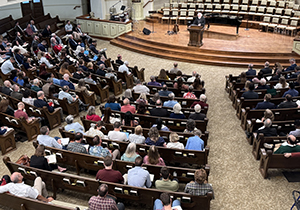
Rowan Williams delivered the Parchman Lectures, sponsored by Baylor University’s Truett Theological Seminary. The lectures were held at First Baptist Church in Waco to accommodate the exceptionally large crowd. (Photo / Ken Camp)

Truett Seminary moved the lectures from Powell Chapel on the Baylor campus to the sanctuary of nearby First Baptist Church to accommodate the exceptionally large crowd, Dean Todd Still said.

Williams’ lectures focused on “The Word Was with God: Trinitarian Reflections on the Anniversary of the Council of Nicaea.”

The Council of Nicaea in 325 A.D. affirmed the Christian doctrines of belief in “one God, the Father Almighty;” in “one Lord, Jesus Christ, the only Son of God,” who is “eternally begotten of the Father;” and in “the Holy Spirit … who proceeds from the Father and the Son.”

The council rejected the Arian heresy that Christ was a created being altogether distinct from God the Father, insisting instead that God the Son and God the Father are “of the same substance.”

‘Theological tension at work’

Williams acknowledged the “theological tension at work” in affirming one God in three Persons who is both giver and receiver—unchanging in some sense and yet fully identifying with suffering humanity in his incarnation.

In part, the unity of the Triune God is the unity of action, he suggested.

“We can’t talk about God without talking about creation and redemption” involving God as Father, Son and Holy Spirit, he said.

Jesus is both the heavenly High Priest and the sacrifice itself offered on the heavenly altar, Williams said.

In describing the Trinity, Williams used the analogy of a musical chord in perfect harmony rather than an isolated note.

“The unity, the indivisibility, of God is an indivisible interaction—symphonic or harmonic, not a single line of music,” he said.

No ‘trickling down’ of divine power

The divine power exercised by the Triune God is inherent, not delegated or hierarchical, he said.

“There is no trickling down from the Father to the Son or from the Son to the Spirit,” he said.

Jesus declared himself to be one with God, while at the same time, he called upon God as “Father” and taught his disciples to do the same, emphasizing the relational aspect of the Trinity.

The unity of the Triune God is eternally familial, interactive and relational, Williams asserted.

“There is no way to speak about God without speaking of God’s relatedness,” he said.

While God the Father is the Creator of life and the Sustainer of life, the same can be said of God the Son and God the Spirit. Giving life is “the same family habit,” Williams said.

Image of God means giving and receiving life

So, as adopted children of God created in the image of God, redeemed humans live out their role as image-bearers most fully through giving life and giving of themselves within the body of Christ, he said.

“To be in the divine image is for us to be so constituted that the life given to us is a life we share with and receive from one another. The pattern of creation itself is a pattern of life giving,” Williams said. “In the new creation, the pattern of life giving is renewed and intensified.”

Humans are part of the larger web of creation, and they are not created to be alone or to live in opposition to the created order, he asserted.

“Violence against the world is a kind of violence against ourselves,” Williams said.

The “radical mutuality” evident in the Triune God should be reflected in humans who bear his image and in the church as the body of Christ, he said.

Politics and power

In what he described as “a slight digression,” Williams explored the political implications of how Western Christianity has understood the Trinity, particularly how power is understood.

He pointed to an early 20th century debate in Germany between Carl Schmitt and Erik Peterson over political theology—specifically the relationship between the doctrine of the Trinity and monarchical authority.

Schmitt emphasized the “sovereign will” of God. He believed the sovereignty of God meant God can do whatever God chooses, including intervening in the created world and suspending the laws of nature, Williams explained.

By the same principle, the earthly monarch—or other authoritarian ruler of a nation—had the right to suspend the rule of law in the event of an emergency, Schmitt asserted.

Furthermore, the sovereign ruler alone possessed the right to declare a state of emergency in Schmitt’s view. That belief provided theological justification for the National Socialist Party in Germany and Hitler’s rise to power.

‘Unity of agency’

Peterson, on the other hand, saw absolute divine monarchism as incompatible with a Nicaean view of the Trinity, Williams explained.

“Monarchy belongs to the entirety of the divine life. Monarchy belongs to the Trinity in its full relatedness,” he said.

Peterson saw the sovereign will of God exercised in the “unity of agency” by the Father, Son and Spirit working in concert. He rejected any view that considered the power of God the Son or God the Holy Spirit as delegated or subordinate to God the Father.

So, Peterson rejected any political theology that granted absolute sovereignty to any single earthly ruler—including the German Führer.

Drawing on lessons learned from that debate, Williams drew applications both for secular politics and the church.

“We need to know where sovereignty resides,” he said.

No single individual or political system can “embody the sovereignty of God,” but the church embodies it through kingdom actions, Williams suggested.

Politics effectively tells people “who the enemy is,” because “the other” is seen as “a threat to be contained,” Williams said. The Trinity, on the other hand, may offer a model in which difference does not mean enmity.

“What if, in the divine life, we have a vision of otherness which is wholly interdependent and in no sense a threat to be resolved?” he asked.


Americans skeptical about paranormal phenomena

Many homes in the United States may be decorated with images of ghosts and witches for Halloween, but most U.S. adults doubt they actually exist.

Surveys from Gallup and Pew find broad skepticism for psychics, ghosts, astrology and witches.

Ghosts and Gallup

No paranormal phenomena were believed by a majority of Americans, Gallup reports.

U.S. adults were most divided over the existence of some type of physical healing ability, either psychic, spiritual or the power of the human mind. Almost half (48 percent) say they believe in that, while 32 percent don’t believe and 19 percent aren’t sure.

In every other phenomenon, those who don’t believe outnumber those who do.

Almost 2 in 5 (39 percent) believe ghosts or spirits of dead people can come back in certain places and situations, but 42 percent disagree.

Around 3 in 10 (29 percent) accept telepathy or communication between minds without using the traditional five senses. Almost half (48 percent) don’t believe.

About a quarter of Americans accept other beliefs about the paranormal: communicating mentally with someone who has died (27 percent), clairvoyance or the power of the mind to know the past and predict the future (26 percent), astrology or the position of stars and planets can affect people’s lives (25 percent), reincarnation or the rebirth of the soul into a new body after death (24 percent), and witches (24 percent).

Gallup found two distinct groups among Americans—34 percent who generally are open to paranormal, believing in at least three and an average of five phenomena, and 66 percent who are generally skeptical, only believing in one on average.

People who infrequently attend religious services (40 percent) are more likely than weekly churchgoers (22 percent) to be among those open to the paranormal.

Those who attend religious services weekly or almost weekly (78 percent) are the most likely to be among the skeptical group.

Among general skeptics, psychic or spiritual healing has the highest levels of belief (33 percent), which may stem from more Christians and churchgoers being open to the possibility of miraculous healings. No other phenomenon draws acceptance from more than 13 percent of the skeptics.

Paranormal and Pew

Pew Research asked Americans specifically about astrology, tarot cards and fortune tellers. Few U.S. adults consult those. Even among those who do, most see it as entertainment and not legitimate insights.

More than a quarter of Americans (28 percent) consult astrology or a horoscope at least once a year, including 5 percent who do so at least weekly and 7 percent who do so once or twice a month.

Around 1 in 10 (11 percent) use tarot cards at least once a year, including 4 percent who do so at least monthly. Fewer (6 percent) speak with a fortune teller, including 2 percent who do so at least once a month.

Grouping them together, 30 percent of Americans consult at least one of the three at least once a year. Most of that group (17 percent of U.S. adults as a whole) do so once or twice a year, fewer seek them out once or twice a month (8 percent) or at least weekly (6 percent).

Overall, 70 percent of Americans say they do not consult any of them. Even those who use them at least occasionally are twice as likely to say they are doing so just for fun (20 percent) than for helpful insights (10 percent).

Fewer than 1 in 10 U.S. adults (7 percent) say they make major life decisions relying on what they learned from these practices, including 1 percent who do so a lot.

Two groups are outliers in their use of these practices. More than half of Americans who identify as LGBT (54 percent) consult them at least yearly, which is roughly twice the share among U.S. adults overall.

Additionally, around 2 in 5 women under 50 (43 percent) say they believe in astrology, compared to 27 percent of women 50 and older, 20 percent of men under 50 and 16 percent of men 50 and older.

Among religious demographics, around a third of those who are nothing in particular (36 percent), Hispanic Catholics (35 percent) and Black Protestants (34 percent) believe the position of the stars and planets can affect people’s lives.

Meanwhile, atheists (13 percent), Jewish Americans (18 percent), white evangelical Protestants (19 percent) and agnostics (20 percent) are the religious groups least likely to accept astrology.

A rejection of the paranormal brings together two religious groups often at odds. White evangelicals and atheists are the most likely to never consult a horoscope (83 percent and 83 percent), tarot cards (96 percent and 93 percent), or a fortune teller (99 percent and 98 percent).


New York man fired for insisting on Billy Graham Rule

(RNS)—Paul Ostapa, a Southern Baptist, was on the job in 2022 as a heating and air conditioning technician in upstate New York with a couple of colleagues when one of them left, leaving him alone with a female co-worker.

For years, he’d abided by the so-called Billy Graham Rule—vowing never to be alone with a woman who was not his wife.

Not wanting to make a fuss, Ostapa finished his work and left as soon as he could.

When it happened again, Ostapa complained to a dispatcher, saying his bosses previously had agreed to accommodate his beliefs after hiring a female technician.

That led to a report being filed with human resources by the dispatcher—and eventually to Ostapa being fired.

Now he’s suing, alleging his employer, the air-conditioning giant Trane U.S. Inc., violated his civil rights by failing to accommodate his religious beliefs and then fired him because of those beliefs.

Alleged violations of Title VII of the Civil Rights Act

Both the failure to accommodate and his firing, which Ostapa’s attorney described as retaliation, were violations of Title VII of the Civil Rights Act, the complaint alleges.

“There is a direct and causal connection between Paul’s sincerely held religious beliefs, his request for those religious beliefs to be accommodated, and Defendant’s adverse employment actions against Paul,” Ostapa’s lawyer wrote in a mid-October complaint filed in U.S. District Court for the Northern District of New York.

In an email, a spokesperson for Trane said the company was aware of the lawsuit but could not comment about ongoing litigation. According to the complaint, the company has claimed Ostapa was fired for insubordination, rather than religion.

The complaint alleges that for most of the 15 years he’d worked for Trane, he’d had mostly male colleagues as technicians. When he learned a female technician had been hired, he went to his boss, identified as a Mr. Audette in the complaint, and detailed his beliefs and asked for an accommodation.

Avoiding ‘the appearance of evil’

At first, according to the complaint, Mr. Audette allegedly laughed off Ostapa’s concerns, saying the new staffer was a lesbian, and so there would be no worries.

“Paul quickly retorted that his sincerely held religious beliefs based on Scripture must be obeyed irrespective of the woman’s looks or sexual preferences and that they were not contingent on the potential for sinful conduct,” the complaint alleges.

“As Scripture compels Paul to believe, his presence alone with a woman carries with it the appearance of evil from which he is to abstain.”

Kristina Heuser, an attorney for Liberty Counsel, a Christian legal group, said Ostapa worked mainly on commercial projects, rather than residential ones, and his beliefs never had caused a conflict with clients. Heuser said her client had made a verbal arrangement with his supervisor, but nothing had been put in writing.

She also alleged the company jumped the gun in firing Ostapa and should have taken time to learn more about his accommodation request, a claim also made in the complaint.

“They didn’t even engage in the interactive process that they were required to,” Heuer said in a phone interview. “They just said: ‘We don’t want to hear it. We’re not discussing that. And you’re fired.’”

‘Provide reasonable accommodations’

 The Civil Rights Act requires employers to provide reasonable accommodations, but not if doing so creates an undue hardship.

Most legal disputes over religious accommodations, such as the case of a postal worker who objected to working on Sundays for religious reasons, hinge on determining the line between a reasonable accommodation and a hardship. In 2023, the Supreme Court ruled in the postal worker’s favor.

According to the complaint, Ostapa came to the United States from Ukraine in 2001, in part because of concerns about religious liberty.

“His family were devout Christians and fled their home country in pursuit of religious freedom, which they thought they would find here in the United States,” according to the complaint.

The complaint alleges when Ostapa first heard his company had hired a female technician, he went to his supervisor to ask for an accommodation, which initially was granted.

“Paul was one of sixteen technicians in his unit, and the location where he worked employed approximately 25-30 technicians, so assigning another technician to work with the new female technician in his place would not have caused Defendant undue hardship,” according to the complaint.

Seeking to avoid scandal

Named for the famed evangelist who died in 2018, the Billy Graham Rule was part of a code of ethics called the “Modesto Manifesto” designed to avoid scandal. Other rules included being transparent and meticulous when handling money, avoiding criticism of other pastors and refusing to inflate crowd sizes or other details about his ministry.

Though common in evangelical circles and beyond—former Vice President Mike Pence is an adherent—the Billy Graham Rule rarely has been tested in the courts.

In 2019, a sheriff’s deputy in North Carolina sued after being fired for refusing on religious grounds to ride alone with a female colleague, but that suit eventually was settled before going to trial.

In 2013, the Iowa Supreme Court ruled a male dentist had not violated discrimination laws when he fired a female assistant at the urging of his wife. The dentist and his assistant had been texting, which his wife saw as a threat to their marriage, according to the ruling.

As part of their ruling, the Iowa justices said the friendship between the two—and not the gender of the hygienist—was at issue. They also noted the dentist may have treated his assistant badly by firing her, but had not discriminated.

A 2017 poll, taken in the aftermath of a controversy over Pence’s adherence to the Billy Graham Rule, found a quarter of Americans said it was inappropriate to have a work meeting alone with someone of the opposite sex, with more frowning on having meals or drinks together.

The complaint cites the example of Pence and the biblical story of Joseph and Potiphar’s wife, as well as one of the letters of Paul, in detailing Ostapa’s religious belief.

Before filing suit, Ostapa had filed a complaint with the Equal Employment Opportunity Commission, which ended its investigation without ruling on the merits of Ostapa’s claim.

The EEOC did issue Ostapa a right-to-sue letter. Heuser said the delay between Ostapa’s firing and the lawsuit was due to delays in the EEOC process.


Study examines ‘Belonging Under the Bridge’

A yearlong study of Waco’s Church Under the Bridge reveals lessons about how to create a welcoming community where people who never felt accepted in church can find a place where they belong.

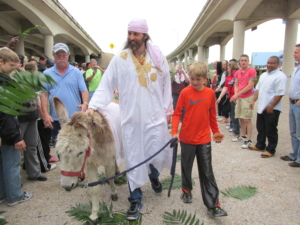
Worshippers from all walks of life participate in a Palm Sunday service at Church Under the Bridge in Waco. (Photo courtesy of Jimmy Dorrell)

When Melody Escobar arrived at Baylor University, she asked a colleague where individuals in Waco with mental, physical or developmental disabilities liked to worship.

Her co-worker pointed her to the congregation that has met regularly for three decades beneath the Interstate 35 overpass at South Fourth St.

After she attended the 2024 Palm Sunday service at Church Under the Bridge and became acquainted with Pastor Jimmy Dorrell, she realized “something really special was going on at the Church Under the Bridge” that deserved serious examination.

Escobar, associate research scientist at the Baylor Collaborative on Faith and Disability, and research assistant Caroline Reed conducted the “Belonging Under the Bridge” study, funded by the Calvin Institute of Christian Worship.

Worshipping community ‘united in diversity’

“For me, the key dimension that emerged in the study was how they are so united in diversity,” Escobar said.

The unhoused, the economically impoverished and people with a variety of disabilities find a sense of belonging at Waco’s Church Under the Bridge. (Photo courtesy of Jimmy Dorrell)

Of the 33 individuals interviewed by researchers, more than 20 percent are unhoused. More than half—55 percent—reported a disability, and more than one-fourth reported a history of substance abuse disorders.

Many members live in extreme poverty and some previously have been incarcerated. However, Church Under the Bridge also counts among its members Baylor students, teachers, medical professionals, ministers and nonprofit workers.

“People spoke of discovering a sanctuary under the bridge—this place where diversity isn’t an obstacle but a driving force of the community,” Escobar said. “And so, there’s this palpable and powerful sense of belonging.”

Worshippers reported an “immediate felt sense that each person is indispensable to their life together,” she said.

“They described a powerful sense of belonging fostered by the embodied presence and celebration of diverse backgrounds, identities and spiritual gifts,” a summary report of the study states.

“United in diversity reflects the church’s theological commitment to honor each person’s inherent dignity and to actualize the compassionate discipleship Jesus prescribes in Matthew 25—frequently referenced by the senior pastor and members alike as a guiding ethos for ministry—encountering Christ in all people.”

Church Under the Bridge’s open-air setting—“worshipping without walls”—contributes to fostering an environment where everyone is welcome, and worshippers encounter God outside conventional spaces, she noted.

Engaged in using spiritual gifts

Dorrell’s approachable “relationship-first style of leadership” creates an atmosphere of genuine acceptance and a sense everyone is “seen and valued,” she said.

“I witnessed him every Sunday welcome people warmly, ask them their name and stop to hear their story,” Escobar said.

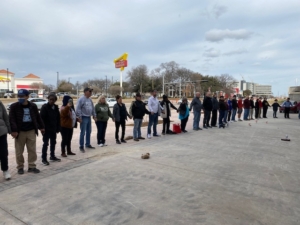
Worshippers at Waco’s Church Under the Bridge join hands. (Photo courtesy of Jimmy Dorrell)

Individuals interviewed said they not only felt welcomed to worship, but also to serve and engage meaningfully in the life of the faith community, she reported.

“The spirit of welcome naturally flowed into the church’s commitment to the sense of ministry by all,” Escobar said.

“Everyone is seen as having a gift to contribute. They devote a lot of time to holding sessions on spiritual gifts, nurturing those gifts and getting people connected to meaningful roles.

“The conviction that every person is needed for this ministry is a conviction that shapes all aspects of their life together.”

The study revealed worshippers not only received acceptance and friendship at Church Under the Bridge, but found “family” there through small-group gatherings and shared meals, she said.

Found family, experienced transformation

Members told interviewers “they felt cared for,” were missed when they were absent, and discovered “a sense of stability that many had not experienced before,” Escobar said.

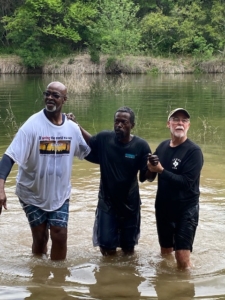
Worshippers at Church Under the Bridge report personal transformation and spiritual rebirth, as symbolized in baptism. (Photo courtesy of Jimmy Dorrell)

“Belonging reflects something biblical—an understanding of community and mutual care,” Escobar said. “Belonging is a desire placed in our heart by God. It’s a reflection of our need for relationship.

“When we turn away from that life together, we lose that sacred opportunity to be shaped by others, to know ourselves more fully, and to experience the transformation God intends for us in our communities.”

The yearlong study revealed participants not only reported spiritual transformation and holistic well-being, but also shifts in their worldview about people different from themselves.

The study concludes with recommendations for the wider church, based on suggestions by participants who were interviewed:

  • Remove physical and social barriers to worship.

“Listening is a real gift,” Escobar said, encouraging church leaders to pay attention to the “lived experience” of people who have felt excluded.

In addition to making practical accommodations for individuals with disabilities, church leaders can remove barriers by raising awareness, educating members and “sharing stories that open people to different ways of thinking about community,” Escobar said.

  • Embrace freedom and flexibility in worship.

Escobar emphasized the importance of “making room for every voice and people of all abilities to participate.”

  • Prioritize authenticity.

“Belonging grows when communities prioritize that genuine connection … putting community over image or presentation so that you have spaces for people to show up as they are,” Escobar said.

“It’s found in simple things—learning names, valuing each person’s story.”

  • Welcome and empower historically excluded people.

“Make every member feel invited and equipped to take part in the life of the church,” Escobar said.

“Church Under the Bridge does that really well—helping people to see that they are gifted and have something to contribute for the vitality of the congregation.

“When those who have been left out are invited into discipleship and given visible and meaningful roles, I think we truly see what it means to be the body of Christ where every person’s presence and contribution matters.”