Christ calls his followers to missional lives, not lives of comfort and ease, speakers emphasized at the “Beyond Us … From Neighborhoods to Nations” Missions Conference at First Baptist Church in Waco.
Waco-area churches sponsored the conference in collaboration with Baylor University’s Truett Theological Seminary and Baylor Spiritual Life.
“There’s no easy way to be about the Father’s business,” said Christine Caine, author, evangelist and founder of the A21 campaign to fight human trafficking.
“To me, there is nothing more important than taking the gospel of Jesus Christ into all the world.”
Too many Christians suffer from “passion deficit disorder,” she said, offering her prayer that God will ignite a passion within the church “for the thing that God’s heart beats for, which is a lost and a broken world.”
“Passion is the fuel that keeps us going,” she said.
Caine grew up in poverty as the adopted child of a Greek immigrant couple in Australia. As a survivor of long-term sexual abuse, she spoke about how God redeemed her when she came to faith in Christ.
“When I learned to make what Jesus did for me at Calvary bigger than what anyone had done to me who had abused me, it changed my whole life,” she said. “Why would I not want a lost and broken world to know that?”
‘Willing to be interrupted and inconvenienced’
In 2008, she and her husband Nick founded A21 with a goal of abolishing modern-day slavery—human trafficking—in the 21st century. The organization works in 19 locations in 14 countries, seeking to reach, rescue, recover and restore trafficking victims.
Like the priest and the Levite in the parable of the Good Samaritan, many Christians too often pass by the wounded because they are busy and preoccupied, Caine said.
Instead, followers of Jesus are to be like the Samaritan who was “willing to be interrupted and inconvenienced” to care for someone who was broken and hurting, she said.
“The church is not about the Father’s business because we are not willing to be interrupted or inconvenienced,” she said.
When God’s people move beyond “little Christian ‘bless me’ clubs” and commit to be his witnesses to a lost and broken world, God will “do something unlike anything we’ve ever seen,” Caine said.
Reawakened love for the lost
“We need a reawakening in the church of what our mission is—a love for the lost,” she said.
While Jesus told his followers to be “in the world but not of it,” too many Christians today are “of the world but not in it,” Caine said.
Jesus called on his disciples to be salt and light—catalytic agents that bring about change, she emphasized.
“You can’t change a world you’re not in, and you can’t reach lost people who you don’t have close proximity to. And if you’re of it—the same substance as it—you won’t bring about change,” she said.
Christians need God to help them see the world as he sees it, Caine asserted.
“It’s so easy to ignore suffering when it is nameless and faceless and it’s just a statistic. God doesn’t make numbers. He makes people. … God sees people as people,” she said.
“We talk about the poor, the lost, the marginalized and the disenfranchised as if they are just statistics. They are people created in the image of God, and they are the ones to whom we’re sent to be salt and light.”
‘God doesn’t give comfortable callings’
Tom Lin, president and CEO of InterVarsity Christian Fellowship, described how responding to God’s call meant abandoning the dreams his parents had for him.
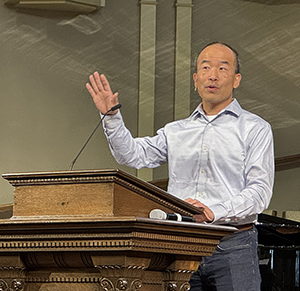 “God doesn’t give comfortable callings,” Lin said.
As the child of immigrants, Lin said he was raised to pursue the American dream of comfort and security.
After Lin earned his undergraduate degree in economics from Harvard University, his parents were devastated when he told them he was following God’s call to pioneer missions in Mongolia.
“My parents came from poverty in Asia so I wouldn’t have to live in poverty in Asia,” he said.
From Genesis to Revelation, God’s plan has been for his people to “put feet to their faith” and be a blessing to all nations, Lin asserted.
“Each of us has a purpose, and it is to be bless the nations. This is not an optional activity,” he said. “I often tell college students, ‘This is not like extra credit.’”
In a time of unprecedented need in the world, Christians have unprecedented opportunities to bless the nations, but obedience to God’s call demands defying the dominant culture, Lin insisted.
“Culture teaches us to do everything we can to bless ourselves—to bless our own Christian bubble, our own Christian churches, and to avoid suffering,” he said.
“God’s purpose for his people is to bless the nations, and it often requires leaving comfort, he said. But when God’s people obey his call, he added, “We see God’s faithfulness.”
Christ gave the Great Commission to the whole church
Obedience to God’s call means recognizing Jesus gave his Great Commission—making disciples of all nations—to the whole church, not the select few, said Bob Roberts, founder of GlocalNet and co-founder of the Multi-Faith Neighbors Network.
 While God calls some Christians to vocational service as cross-cultural missionaries, God also calls every follower of Jesus to use his or her skills, talents, gifts and areas of expertise for kingdom purposes, Roberts said.
Christians earn the right to spread the gospel by going through “the front door,” as welcomed guests in other countries who contribute to society rather than operating secretively or deceptively, he said.
Countries that may be closed to traditional missionaries eagerly welcome Christians who are “bringing value” to their people through their vocations and contributing to “human flourishing,” he said.
Christians with experience in education, health care, business and agriculture can use those abilities to advance the kingdom of God and bring wholeness as God desires, Roberts said.
“You don’t have to take the culture over. You just have to be salt and light in the culture,” he said. “I don’t want Christian nationalism. I want Holy Spirit presence.”
For example, when Roberts was pastor of Northwood Church in Keller, the congregation established a relationship with Hanoi about 30 years ago.
That ongoing relationship led to the opportunity for educators in the church to develop a special-education curriculum for the entire nation of Vietnam.
“We tend to do missions to people. We need to do missions with people,” Roberts said.
‘God always pushes us beyond our boundaries’
Love for God, love for others and Christ’s command to make disciples motivates Christians to move outside the narrow confines of what is comfortable and familiar, said Julio Guarneri, executive director of the Baptist General Convention of Texas.
“God always pushes us beyond our own boundaries. If you have been transformed by the gospel, you cannot stay in the same place. … He always invites us to go beyond ourselves,” Guarneri said.
Christians find their motivation for missional living in the cross of Christ, he said.
“We are not motivated by need or by guilt,” Guarneri said. “We are motivated by the love we see at the cross.”
The call of God compels his people to go beyond their preconceived ideas and gain a new perspective, he said. Even after Christ’s resurrection, his disciples still did not understand what Jesus had been teaching about the kingdom of God. Before his ascension, they asked Christ when he would “restore the kingdom to Israel.”
“They thought the kingdom was about making Israel great again. It’s not about national greatness but about a global witness,” Guarneri said.
Christ called the provincial disciples is to become “cross-cultural ambassadors of God’s love,” he said.
God calls his people to the ministry of reconciliation, Guarneri said. Sin alienates people from God and each other, but God’s grace reconciles.
“We have been deputized as agents of reconciliation,” Guarneri said.
 As the subtitle suggests, each poem invites the reader to take in a character’s perspective deliberately and contemplatively.