Commentary: Six white men shouldn’t decide Southern Baptist position on race

(RNS)—I remember the first time I walked into my first Southern Baptist church. I was 8 years old, a Black child living in the South, when my mother escorted me into the unreal vastness of First Baptist Church of Orlando.

I had grown up to that point in the Greek Orthodox Church, so I was used to majority race culture that was not my own. But I could tell this was different—the sheer magnitude of the sanctuary alone was astonishing. I was not too young to notice, too, the church had no ministerial staff of color, among almost 20 pastors, despite the diverse central Florida community I knew outside its doors. (The church still has no Black pastors on its staff now.)

People of color were welcomed, and the Rev. Jim Henry, the pastor at the time, had helped pass the denomination’s 1995 resolution to apologize for slavery. But it was clear, issues that affected people of color weren’t talked about in the daily life of the church.

First Orlando, as I call it, is still my home church, and I’m grateful for many warm memories. I attended a Southern Baptist university and seminary. I’ve served at several Southern Baptist churches and worked for them as an outside contractor. I now write for Southern Baptist publications. Suffice it to say, I’m pretty embedded within SBC culture.

Yet I wrestle with the racial underpinnings of the SBC I first glimpsed at First Orlando—the same tendencies I see in last week’s announcement by the presidents of six SBC seminaries on the ideas about race and culture called critical race theory.

Critical race theory

There are many versions and definitions of critical race theory. However, at its core, critical race theory analyzes how different social categories—not just race, but class and gender—often work together to advance or stymie the progress of individuals and society as a whole. It began at Harvard Law School in the early 1980s, but since has become accepted widely in many levels of Black culture, and many leaders and people of color accept the theory’s conclusions.

I don’t intend to get into the specifics of critical race theory here, but to share an experience of a Black man when I heard about the perspective of prominent thinkers in the SBC, a denomination founded upon slavery.

I asked Southeastern Baptist Theological Seminary’s president, the Rev. Danny Akin, about the meeting where the statement on critical race theory was devised. He shared the six—all of them white men—talked on a Zoom call. He said the Rev. Albert Mohler, president of Southern Baptist Theological Seminary, was the principal architect of the statement, but they all were on the same page when it comes to issues of race.

Problematic proclamation

I don’t think Akin and Mohler, both of whom I know, understand how problematic it is to have six white men meeting to discuss race without having anyone of color in the room to represent their experience.

I find it deeply offensive that people would speak for the SBC on race when they themselves have never worn Black skin; never dealt with its historical and cultural inequities; nor had any firsthand experience of navigating the tensions of race in today’s world.

This problem isn’t only one of misunderstanding academic theories. As America’s demographics shift, the SBC’s attitudes toward race will begin to cost the SBC souls.

In 2020, the SBC is led solely by white men. The denomination’s president and the heads of every one of the SBC’s denominational entities are white. (EDITOR’S NOTE: Rolland Slade was elected the first Black chair of the SBC Executive Committee on June 16.)

White male leadership has been ingrained within the denomination since its founding in 1845, when it broke with the Northern churches over slavery.

Decline and demographics

This year, the denomination came up with a new slogan: “Who’s Your One?” The idea is for every Southern Baptist to find one person to pray for and share the gospel with. “Imagine the impact,” the campaign website says, if every Christian did so.

One impact, of course, would be to double the size of the denomination, which has been losing members steadily for nearly 15 years. “Who’s Your One” seems to be a strategy to turn attendance and membership around.

But the numbers don’t add up—or they won’t add up unless the SBC takes an inclusive approach to evangelism. If the racial composition of the United States is changing rapidly, the attitudes of Americans, especially younger Americans, is changing even faster. It’s no mystery why, while our country has become more diverse, the denomination hasn’t grown.

The decline will only get worse as small groups of white men sit in rooms and make blanket statements regarding racial theories and programs regarding diversity. Rather than “who’s your one,” the SBC might as well build a campaign around “White people are the ones.”

Time to reckon with identity and history

It’s time for the SBC to reckon with itself and its history. It’s time for it to come to the realization it has a race issue and to stop pretending it doesn’t. It’s time for the SBC to include Black and other minority believers in any formative conversation.

Though the denomination only has a limited number of seminary professors of color, its first thought should be to consult them before taking a position, in hopes of avoiding statements so unattractively skewed.

Christians inside and outside of the SBC should consider who is influencing their thinking on race. It’s folly to search for strategies and slogans to help grow the faith in an echo chamber of whiteness.

Akin and I had an enjoyable talk, which ended with prayer. But since our conversation, I can’t stop thinking about the story of the Apostle Paul and Barnabas. The New Testament’s Book of Acts describes how the apostle and his fellow teacher disagreed over another disciple who had abandoned them, and how the two friends separated and went their ways.

I’m a Southern Baptist. I’ve sometimes had reason to question whether the white men who run my denomination have my best interests in mind, as a follower of Jesus and as a person.

But when six men sequester themselves to draw conclusions about people who look like me, the verdict is no longer out.

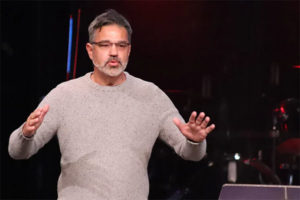
Maina Mwaura is a writer and a speaker. The views expressed are those solely of the author.


Black pastor explains why he gave up on Southern Baptists

ATLANTA (RNS)—For years, John Onwuchekwa was a rising star in the Southern Baptist Convention.

He attended a Southern Baptist seminary, spoke at the convention’s national pastors conference, was befriended by SBC leaders, started a new SBC church in the west end of Atlanta and helped recruit other Black pastors to do likewise.

Onwuchekwa was part of the family and appeared destined for great things. Then he wasn’t.

Concerned about support for President Donald Trump among Southern Baptists and a lack of urgency in dealing with racial inequality, the pastor and his congregation decided it was time to leave the SBC.

“The SBC liked me,” he wrote, in announcing his decision to leave. “But I feel like they’ve failed people like me.”

Planted church in 2015

In recent years, evangelical groups have invested heavily in helping start congregations among communities of color, hoping to reach new people at a time when the United States is becoming more ethnically diverse.

Pastor John Onwuchekwa

The nation’s current political climate and national divides on matters of race may make it difficult for pastors like Onwuchekwa ever to feel truly at home. Yet financial ties to their denominations make it complicated to leave.

Onwuchekwa, who grew up in Houston, the son of Nigerian immigrants, said the SBC tried to make him feel welcome. But from the beginning, he had concerns.

“We got on the bus with skepticism, nine years ago,” he said.

In 2015, with help from several other churches, including an SBC congregation, and $18,000 of his own money, Onwuchekwa founded Cornerstone Church, a church plant in a predominantly Black community on the west end of Atlanta.

The church is in a part of Atlanta that has made national news recently involving the police shooting death of Rayshard Brooks.

From the beginning, the congregation hoped to meet the spiritual needs of the community but also physical, emotional and mental needs.

“The church was started with three families who had a burden for the community, and now runs around 350 members before COVID-19 hit,” he said.

When Cornerstone ­­­­Church needed a building, the SBC helped the church get a loan. Last year, when the church wanted to renovate the building, it got a $175,000 grant from the SBC’s North American Mission Board to assist with that. The grant was distributed through Blueprint Church, another local congregation that partnered with Cornerstone as a “sending church.” Blueprint’s pastor, Dhati Lewis, serves as one of the vice presidents at NAMB.

‘Lack of urgency’ in SBC regarding injustice

While things went well at Cornerstone Church, Onwuchekwa had concerns about what was happening in the denomination. When he brought up concerns about race or social justice, he said, they were downplayed.

“The roadblock for me was that the urgency that I had for issues, others in the group didn’t seem to have the same urgency,” he said.

Onwuchekwa also pointed to SBC leaders who had close ties to Trump, as well as a controversy over a resolution to denounce the alt-right at the SBC 2017 annual meeting. At first, the SBC committee in charge of resolutions decided not to put the resolution to a vote. A revised version of the resolution was later approved.

Onwuchekwa also was concerned when critics of the SBC’s Ethics and Religious Liberty Commission and its leader, Russell Moore, tried to defund the group.

More recently, Onwuchekwa, who is also a council member of The Gospel Coalition, an evangelical group with Calvinist leanings, found himself having to defend his congregation’s ties to the SBC. Eventually, he felt those ties began to interfere with Cornerstone’s ministry.

“It’s kind of like the saying of the phrase ‘the straw that broke the camel’s back,’” he said. “One piece of straw isn’t heavy. It’s one added piece of straw that’s the problem.”

Diversity is not optional

Mark DeYmaz, president of Mosaix, a network of multiethnic churches, said that as the United States becomes more diverse, so must congregations. That’s going to lead to challenges when people from different backgrounds are part of the same congregations.

Still, he said, churches have no choice but to become more diverse.

Mark DeYmaz speaks at the Mosaix Global Network’s Multiethnic Church Conference last November in Keller. (RNS photo by Adelle M. Banks)

“An increasingly diverse, polarized and cynical society no longer finds credible a message of God’s love for all people as preached from segregated pulpits and pews,” said DeYmaz.

Mike Ebert, a spokesman for NAMB, said the agency is committed to planting a diverse range of churches.

“The diversity of our denomination means a diversity of perspectives, and for that, we are grateful,” he said. “We see the need for the SBC to become more diverse so we can continue to grow in areas in which we are still lacking.”

NAMB President Kevin Ezell expressed disappointment that Onwuchekwa and Cornerstone were leaving the denomination. Ezell said he loved them and would pray for them in the future. He said there is a long history of ministry leaders working together for a time and then going their separate ways.

“The Apostle Paul and Mark did some great work together, but then they chose to part,” he said. “They both were still proclaiming the gospel and working to expand God’s kingdom, and that is what is happening here.”

Repay the grant or not?

Cornerstone’s departure may have financial complications. Ezell and Onwuchekwa have disagreed over whether Cornerstone should repay any of the grant it received for building renovations.

A few days after Onwuchekwa announced the church’s decision on Twitter, he and Ezell texted each other about the fallout from the announcement. That conversation led to Ezell bringing up the topic of money.

“The SBC has been very generous in their investment in Cornerstone and you,” Ezell told the pastor.

Ebert told Religion News Service that there was no written agreement saying Cornerstone would have to return grant funds if it left the SBC. But NAMB expected the church would remain Southern Baptist.

“We wouldn’t invest in a church if we thought the commitment to the SBC was not there,” he said.

Onwuchekwa initially told Ezell he was open to repaying part of the grant. He said that, however, without first talking with church members and getting their approval. The pastor also began to feel his integrity was being questioned if the church didn’t return the funds.

“If I ever felt like anyone would feel betrayed or undermined by me speaking my mind and following my conscience I never would’ve taken a dime,” he said.

The pastor said he was also taken aback when Ezell suggested he had a moral obligation to repay the grant. Onwuchekwa said the denomination itself, which was founded by slaveholders, has obligations of its own, especially when it comes to race.

He pointed to a recent report from the Southern Baptist Theological Seminary that detailed the school’s founders’ ties to slavery and white supremacy and said the denomination has not done enough to reckon with the long-term consequences of that history.

“I think there’s a different conversation surrounding moral obligations that needs to be had by the SBC,” Onwuchekwa said.

In the end, he said, the church could not in good faith remain part of the SBC.

“Have I become the enemy because I’m telling the truth?” he said. “I thought the mark of a good friendship was telling the truth.”