Book Review: The Triumph of Faith
The Triumph of Faith by Rodney Stark (ISI Books)
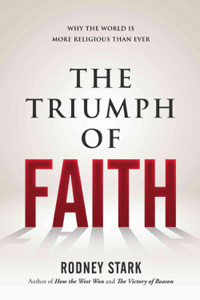 Reports about the death of religion in the United States are greatly exaggerated, sociologist Rodney Stark insists in a book to be published Nov 16. And researchers who report the inevitable global triumph of secularism over supernaturalism need to check their facts, he asserts.
Stark, distinguished professor of social sciences at Baylor University and co-director of the school’s Institute for Studies of Religion, uses the Gallup World Polls, census data and other evidence to bolster his contrarian view that says the world is more religious than ever before. Citing surveys of more than 1 million people in 163 nations, he points to massive worldwide religious awakening. He notes 80 percent of the world’s population belong to an organized religion. Furthermore, predictions Islam will overtake Christianity numerically appear unfounded, at least in most parts of the globe. He specifically references the growth of Christianity in sub-Saharan Africa, as well as increasingly strong Christian churches—both evangelical and Catholic—in Latin America.
In a particularly provocative section, Stark takes issue with the much-reported rise of the “nones” in the United States. He cites data indicating the percentage of people who do not attend houses of worship remains steady, and the increase in nonaffiliated Americans appears to be drawn from that subset of the total population. Also, he disputes the assertion that young adults are less religious than in previous decades. Rather, he notes young adults attend church less often than older adults—but so did their parents at their age.
Baptists and others in the Free Church tradition will be encouraged particularly by Stark’s conclusion that “the more religious competition there is in a society, the higher the overall level of individual participation.” Where a state church receives tax subsidies and a virtual monopoly, churches grow lazy and church members grow lax in their commitment. Where people freely choose whether to associate with a church, and churches depend on the voluntary contributions of the members they are able to attract, religion thrives.
Stark stands on solid footing when he draws conclusions based on social science research. Readers may want to place less faith in him when he makes suppositions about theology, such as the broad caricatures he draws of liberation theology in Latin America and the so-called “liberal” mainline Protestant denominations in the United States. Even so, readers will benefit from reading Stark’s findings and conclusions that defy conventional wisdom.
Ken Camp, managing editor
Baptist Standard
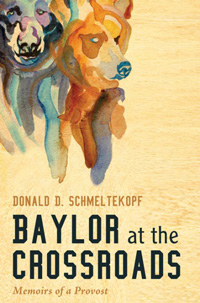 Still, considering the controversy generated during those years, Schmeltekopf presents strong opinions in the most gracious manner imaginable. He shoulders responsibility, and he shows respect for both presidents with whom he served—Herbert Reynolds and Robert Sloan—even when he acknowledges points of disagreement.
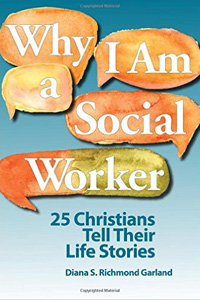 Diana Garland’s latest book is a rare commodity in publishing: It is designed and intended primarily as a textbook for social work classes. But it should be read and quoted by all kinds of Christians who believe in ministry and in serving others in Jesus’ name.
 Particularly in the first three-quarters of the book, the writers do a good job telling the story of Baptist insistence of religious liberty for all. They recognize Baptists’ spiritual kinship with Dutch Anabaptists but do not trace direct lineage, focusing instead on Baptists’ emergence from English Separatists. The book sometimes seems a bit too heavy in recording the history of Calvinist Baptists, occasionally delving into minute detail about the varying shades of Calvinist belief, but the authors do not neglect Baptists of Arminian or mediating views.
 Zondervan has produced a massive study Bible emphasizing biblical theology and highlighting themes that develop throughout Scripture. Writers particularly emphasize the centrality of Christ and Scripture as the unfolding of salvation history. D.A. Carson, New Testament professor at Trinity Evangelical Divinity School, served as general editor and contributed several articles.
  Spiritual giants who pray without ceasing, pray without doubt and pray without fail in all circumstances don’t need to read this book. The rest of us do.
  “Redemption is God’s movement in history to rescue individuals from the dominion of darkness into the realm of the kingdom of Jesus, his Son,” Albert Reyes asserts in his new book. Christians are called to be agents of redemption, the “hands and feet of Jesus,” who does the work of redemption.
 Readers may not expect a review of a book subtitled “Guns, Girls & Gambling in East Texas” in the Baptist Standard. Granted, it’s a rough story filled with barroom brawls, shady deals and shadier characters. But in the end, it’s a tale of redemption and God’s grace.
 Too often, when some Christians speak of “my Jesus,” it’s more than a term of endearment. Often, it means “my personal Jesus,” based on Hollywood images, fashioned according to a partial reading of selected Scriptures or—worst of all—made in our own image. David Capes, professor of New Testament at Houston Baptist University, and his collaborators challenge readers to consider two key questions Jesus asked his disciples: “Who do people say that I am?” and “Who do you say that I am?”
  Across more than three decades of journalism, Amarillo Globe-News columnist Jon Mark Beilue has built a sterling reputation as a truth-teller. But he fibs a little in the title of his book, This Might be a Good Story …. No “might” to it; the book is chock-full of great stories. And it also might be a surefire medical diagnostic test. If you can read this book and not laugh out loud and cry—often at the same time—then you must not have a heart.
 In his heartbreakingly personal and honest book, Pastor Levi Lusko tells the story of his daughter Lenya, a loving and fiery 5-year-old who went to heaven just days before Christmas.
 You don’t have to love the Pecos Wilderness of New Mexico to enjoy Pilgrim at Baldy Mountain. But readers who fondly remember exploring the area bordering Glorieta Conference Center particularly will appreciate the way Wayne Grant—pediatrician and longtime medical director for Texas Baptists’ River Ministry—relates lessons he learned hiking mountain trails to a spiritual pilgrimage.
 Do not read this book unless you want to laugh, weep, think and consider what Kirk Lewis reveals—an honest look at what it takes to walk with the living, loving Lord, complete with all the questions, confusions and ultimate confessions.
  This relatively brief book provides an excellent introduction to worship involving the biblical understanding of the task, the importance of planning the event and practical steps in leading the worship experience. Written jointly by a ministerial team of pastor and worship leader, the discussion offers not only sound theory, but also practical suggestions based on years of experience.
  Speaker, Bible study teacher and retreat leader Brenda Poinsett distills and dissects Jesus’ dialogues with women in her latest title, subtitled Jesus’ Amazing Words to Women. Poinsett, the author of more than a dozen books, selects Scripture passages that carry maximum surprise and, therefore, maximum impact.
 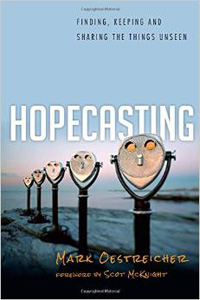 In Hopecasting, Mark Oestreicher gives readers a new perspective on biblical hope. First, he lays great groundwork for hope as so much more than wishful thinking. Then he carefully guides readers through the steps we need to follow to position ourselves for true biblical hope. His diagram of how hope enters our lives particularly is helpful. We move from exile to dissatisfaction, to honest cries before a holy God, then confront a semi-permeable wall of fear. When we push through the wall of fear, we find hope in our transformed longings. Through lively storytelling, Oestreicher makes it real and applicable to our daily lives.