Book Reviews: Dethroning Male Headship
Dethroning Male Headship by Shirley Taylor (One Way Press)
 Much has been written about the role of women in the church, especially since the Southern Baptist Convention adopted the Baptist Faith & Message 2000. In Dethroning Male Headship, Shirley Taylor outlines the history of such teachings and notes the 1988 publication of the Danvers Statement on Biblical Manhood and Womanhood as key to understanding the issue.
She defines two primary views on woman’s position in the church and at home—egalitarianism and complementarianism. Taylor explains egalitarianism means women and men are created “equal—no buts” and have no pre-assigned “roles of authority or submission based on gender.” She indicates writers of the Danvers Statement coined the term complementarianism, meaning men and women have specific, complementary roles which “define manhood and womanhood.” For the male, that translates into authority. For the woman, it involves submission. She is declared “equal—but” and is to hold lesser positions at church and at home. Some have expanded complementarianism outside of religion and teach that men have authority over women in all situations all of the time.
Dethroning Male Headship offers a well-documented look at the results of male headship in the home, the church and society. Taylor provides numerous scriptural references, including passages not only to specific women but also to the Ten Commandments and the Apostle Paul’s teachings. Although the co-founder of the Freedom for Christian Women Coalition strongly favors egalitarianism, she challenges readers to study the issue and formulate their own views.
Kathy Robinson Hillman, first vice president
Baptist General Convention of Texas
Waco
The Reason for My Hope: Salvation by Billy Graham (Thomas Nelson)
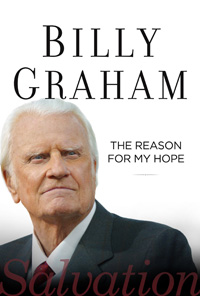 Released to coincide with the Billy Graham Evangelistic Association’s “My Hope” campaign, the renowned evangelist begins what may be his final book by asking readers not to give up hope. The consummate evangelist of the 20th century uses the first five chapters to lay out the gospel message methodically.
The remaining chapters deal with the unique faith—or lack of faith—of people in the 21st century. He uses the example of Facebook as proof that people regard belonging more than believing. He also talks about “faith blending,” pointing to the example of Chrislam, which mixes aspects of Christianity and Islam. He follows with the chapter “No Happy Hour in Hell,” speaking directly to a generation that generally rejects belief in a literal hell.
This book is full of personal, contemporary and historical stories to illustrate its message, and it challenges readers to think about their spiritual condition and relationship to God.
The book closes with the chapter called “My Hope.” Graham finds hope in Christ’s Second Coming. He expresses his hope that reading this book will drive readers to God’s book, where they can find eternal hope in heaven. This is a must read.
Skip Holman, minister of discipleship
Northeast Baptist Church
San Antonio
 Eve Marryat narrates the story of Sweet Mercy as she and grandson Sean retrieve keepsakes from the attic of Marryat Island Ballroom and Lodge before the wrecking ball begins its work. Had she understood what waited them in Mercy, Ohio, she explains, she might not have been so excited about escaping St. Paul, Minn., a city of lawless gangsters, when she was a high school student.
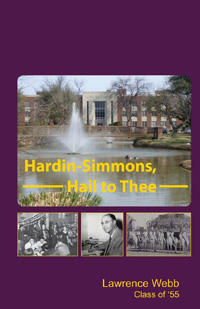 Lawrence Webb has penned a paean to his alma mater, Hardin-Simmons University, a Baptist school on the plains of West Texas. Webb attended HSU 60 years ago, and his book provides a tidy collection of stories about events, lessons and people—mostly people—who expanded his worldview and strengthened his faith. It’s not so much a history of the school as a memoir of “an education enlightened by faith,” the university’s motto.
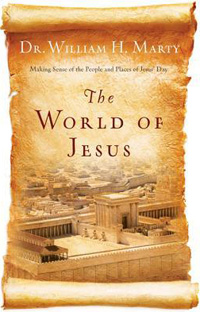 What happened during the misnamed “400 silent years” between the Old Testament and New Testament that paved the way for the arrival of Jesus Christ on the earth? Why did most Jews dislike the Samaritans? What impact did Alexander the Great have on the biblical world? What are the origins of Hanukkah? What is the difference between a Pharisee, Sadducee and an Essene? Who were the Herodian kings, and what part did they play in the story of Jesus and the early church?
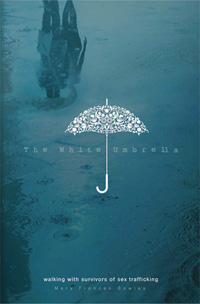 Mary Frances Bowley understands most Americans remain unaware of sexual slave trade, or at most consider it a remote Third World problem. Twenty years ago, she similarly enjoyed a comfortable life sheltered from the reality of sexual exploitation in the United States. However, contact with one young woman in a desperate situation gave her a desire to shelter others in similar straits—offer a “white umbrella” to provide cover for sexually abused women and help them recover their purity and innocence.
 Two leaders of the Jewish Sanhedrin defied both conventional wisdom and political expediency to remove Jesus’ body from the cross. Nicodemus and Joseph of Arimathea were prominent members of the high court that sentenced Jesus to death. Why would they risk their careers—and possibly their necks—to provide Jesus a decent burial, when even his closest followers scattered and hid? That question drives Bill Kincaid’s moving novel.
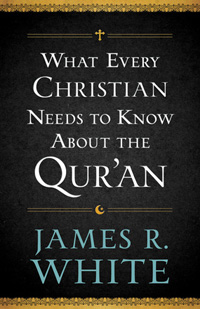 Even as the Bible provides the basis for doctrine and beliefs in the truth of Christianity, the Quran is the single uniting book for the Muslim faith. In contemporary society, Christians should become more informed about the beliefs and practices of Islam, especially about Muslims’ concept of Allah as God and his prophet/messenger Mohammad.
 In the author’s note, Ted Kluck observes, “Everybody hurts.” Kluck and recording artist Ronnie Martin wrote Finding God in the Dark to help those who, because of their circumstances, wonder where God is. Kluck and Martin alternate writing chapters, which Martin calls “everyday stories.” Kluck insists that even when life is falling apart, “You gotta have faith.”
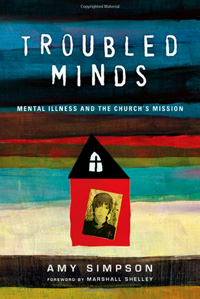
 A startling statistic might grab a church leader’s serious attention—about 25 percent of any community suffers from mental illness. Amy Simpson writes a powerful book from her personal experience, her study of the meaning of mental illness, and her belief churches need to rethink their care or lack of care to the mentally ill and their families.
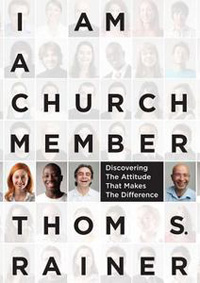 The president and chief executive officer of
 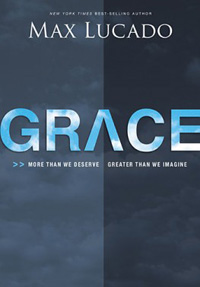 When familiar authors continue to produce book after book, it is easy to convince yourself they can be ignored for up-and-coming writers. In our search for biblical teaching, however, it would be a mistake to ignore the writings of a familiar author just because he or she is a known quantity.
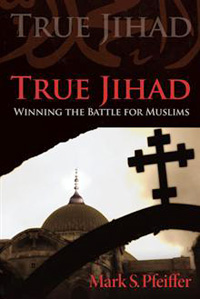 Make no mistake. Mark Pfeiffer firmly believes Christians have a responsibility to fulfill the Great Commission—Christ’s command to make disciples of all people groups, including Muslims. But he also believes in Jesus’ Great Commandment—love for neighbor, including a Muslim neighbor. Despite the book’s militant-sounding title, its tone reflects the latter belief, along with Pfeiffer’s conviction that love compels Christians to understand people who hold different beliefs.
 Remodeled: Stories From a Changed Heart is the third book by Berry Simpson, author of Running with God and Retreating with God. Simpson is a deacon at First Baptist Church in Midland, and his books provide a series of stories that illustrae how to grow in Christ by seeing God in daily life.

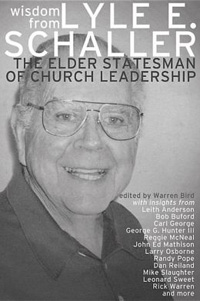 Since 1965, Lyle Schaller has written 55 books, with more than 2 million copies printed. Wisdom serves as a “Best of Schaller” compilation that will please fans who have not been able to read all his works, and it will introduce others to a truly phenomenal leader of leaders.
 Vicki Courtney’s books focus on the real-world situations women face as they care for their sons and daughters. Filled with examples from her life experience, the books offer clear encouragement and insight for parents.
 Readers who practice journaling as a spiritual discipline will discover this notebook offers far more than a series of blank pages. Skip Holman, minister of discipleship at
  Broocks, co-founder the Every Nation family of churches and senior minister of Bethel World Outreach Church in Nashville, Tenn., shares stories of skeptics who became believers in Christ, beginning with the conversion of his own brother—and it’s a great way to start the book.
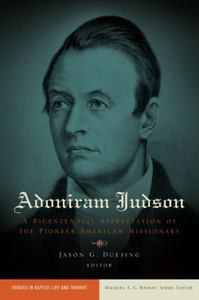 Last year marked the bicentennial of Ann and Adoniram Judson’s voyage to India as America’s first Protestant missionaries. Although the newlyweds sailed as Congregationalists, their Bible study at sea caused them to embrace Baptist beliefs, and a colleague of William Carey’s baptized them in Calcutta. However, the War of 1812 made U.S. citizens unwelcome by the British East India Company, and in 1813, they reached Burma (Myanmar), where Adoniram Judson served the next 37 years under American Baptists.
 The subtitle says it all: “101 Inspiring Personal Stories from Presidents, Pastors, Performers and Other People Who Know Him Well.” It collects stories about how people met Billy Graham and got to know him. However, this book is much more than just a listing of notable characteristics of the well-known evangelist by a variety of people. Larry Ross, the primary spokesperson for Graham, has led out in making a valuable contribution to the life and history of this widely known preacher.
 Michael Catt, executive producer of the films Courageous, Facing the Giants and Fireproof, has teamed with Amy Parker to write Courageous Teens. The book encourages students to develop “hearts of warriors” as they follow Christ.
 Texas Baptist Virginia Kreimeyer bases her second novel, Let Justice Roll, on a true story. The author writes from personal experience covering significant events as a public relations professional. She also provides the book’s beautiful cover painting.
 Prolific author Kevin Leman’s new book is based on Proverbs 3:1-6. The introduction is key to understanding the rest of the book, and his personal testimony and the story of his early years—along with the Scripture—form the basis for its chapters.
 Any Baptist who tells another Baptist what to do treads on dangerous ground. So, just consider this a friendly suggestion: Read this book, and put it into the hands of other Baptists.
 Vivian Conrad provides a personal reflection of her journey with God as she comes to know and understand God’s sovereignty in the midst of life’s joys and sorrows. A family tragedy, a son’s deployment to Iraq and other experiences invite the reader to share in a deeper understanding of God’s grace as he stretches Conrad’s faith and challenges the author and the reader to know God on a deeper level.
 Al Mohler, president of Southern Baptist Theological Seminary, believes, “Christian leadership cannot be separated from passionately held beliefs.” The true leader leads and is driven by conviction, Mohler insists. This book provides a broad overview of leadership from start to finish and its components.