Soul Culture: Stewarding the Five Ingredients of Our Common Life
By Matt Snowden & Joshua Hays (Smyth & Helwys)
Every preacher likes a good metaphor. Soul Culture doesn’t disappoint. But being a pastor is more than preaching—much more. It involves the rest of Soul Culture, the Stewarding the Five Ingredients of Our Common Life part.
Forming the culture of a church is like preparing pizza dough. At least, that’s how Matt Snowden and Joshua Hays describe it, with inspiration from J.B. Gambrell, a Southern Baptist and Texas Baptist leader at the turn of the 20th century. Just as dough requires a set of ingredients worked and kneaded together, so does the culture of a church.
Dough is a combination of basic ingredients worked together in a deliberate way. Snowden and Hays say the same of the church. Beliefs are as foundational to a church’s culture as flour is to dough. Water, salt, soda and yeast are the other basic ingredients of dough—like attitudes, values, goals and practices together form church culture.
Each of the five ingredients of church culture gets its own chapter, each one a worthy study all its own. These and the other chapters of Soul Culture conclude with questions for individual and group reflection.
The ingredients are essential but not sufficient to make good dough. They also require the right technique, temperature and time. These are explained in the last chapter.
In the last chapter, Snowden and Hays finish Soul Culture in conversation with three pastors demonstrating their own soul culture work within their respective congregations—Steve Bezner at Houston Northwest Baptist Church, Maddie Rarick at Meadow Oaks Baptist Church in Temple and Ralph West at The Church Without Walls in Houston.
Pastors can chew on Soul Culture together with the authors, Bezner, Rarick and West during the Truett Pastors Conference at First Baptist Church in Waco, April 18-19, 2024.
Ministry resources often fall into one of two categories—practical or smart. Here is one that is practical and smart. And refreshing. Wit, wisdom and humor are scattered throughout like chocolate chips in cookie dough. Perhaps chocolate chip cookies will be the metaphor guiding Snowden’s and Hays’ next book.
Eric Black, executive director/publisher/editor
Baptist Standard
Review: Tommy Bowman: Answering the Call
March 13, 2024
Tommy Bowman: Answering the Call
By Chad S. Conine (Big Bear Books /Baylor University Press)
The cover of Tommy Bowman: Answering the Call contains a black and white action photo of a tall Black player in mid-jump shot surrounded by a sea of white faces on the court and off. The picture could have been taken at many colleges in the late 1960s. Only the green and gold title hints at the place where fans from 1966-1970 found Bowman answering the call as Baylor’s first Black scholarship athlete.
Chad Conine’s biography records the facts, but the real story is Bowman’s profound faith, deep friendships and sacrificial service. Basketball simply provides the backdrop and the era the context.
The tale begins “once upon a time” when only God could orchestrate a chance conversation between Baylor’s assistant basketball coach Carroll Dawson and a gas station attendant in Athens. Granville Crayton informed the recruiter the best high school player in Texas lived in Athens—Tommy Bowman. Dawson’s copious files held no such name, not a surprise since the star played at Fisher until Athens High integrated his senior year.
A divine urge led the young coach to drive to Tommy’s house, where he shelled peas with the boy’s mom waiting for him to come home. SMU and TCU had both signed their first Black athletes—Jerry LeVias in football for the Mustangs and basketball player James Cash for the Horned Frogs. Although John Westbrook had walked onto the football team, Baylor was ready to sign its first Black scholarship athlete. Dawson quickly knew it should be Bowman in basketball. Head coach Bill Menefee agreed.
Life at Baylor wasn’t easy for any freshman from a small East Texas town, especially one who didn’t see faces like his in class. However, Tommy held his own on the court, and he, along with others on the freshman team, answered God’s call to lifelong friendships. At home, Bowman went to church with his grandmother whenever the doors were open. He amazed his teammates by attending services every Sunday and displaying unwavering faith. One of those Sundays, he met his future wife, Jackie.
Conine intersperses anecdotes, accounts from newspaper articles, quotes from interviews and photographs. Also included are game-by-game tables and facts from Bowman’s four years playing for the Bears—the first as a freshman before freshmen could play varsity—when the “Cubs” won the Southwest Conference. Sophomore of the Year, First Team All-Conference and an Honorable Mention followed in an era when two second and one third-place finish in the Southwest Conference meant no post-season play. The athlete earned his business degree in 1971. Later, he entered both the Baylor and Southwest Conference Halls of Fame.
Not only did Tommy Bowman answer God’s call to integrate Baylor basketball. The Lord also called him to a life of faith and service in his profession, in the community and in his church. He spent most of his career with two companies, treating others with dignity and respect. Bowman held positions on numerous boards and committees and served nine years as a Baylor regent but always found time for Jackie, Tommy II and Krystal. Known widely as Deacon Bowman, he continues to chair the deacons at Toliver Chapel Missionary Baptist Church where his prayers are legendary.
Chad Conine’s Tommy Bowman: Answering the Call is a great read for anyone of any age—sports fan or not. The only thing better is meeting Tommy Bowman in person. At a recent book-signing, Chad commented that every conversation with “the Deacon” returns to God. That evening Bowman told the audience: “You know, God has a perfect plan for each and every one of you. And I’ve been comfortable, very comfortable walking according to his plan for my life ’cause he knows what’s best for me.” Amen.
Kathy Robinson Hillman, former president
Texas WMU and Baptist General Convention of Texas
Waco
Review: Fire in Her Bones
March 13, 2024
Fire in Her Bones: A Biblical Defense of Women as Preachers and Pastors
By Ellis Orozco (Austin Brothers Publishing)
I move “that the BGCT ‘uphold the autonomy of the local church to affirm a cooperating church’s authority to call women to congregational and vocational ministry as they, under the lordship of Jesus Christ and the guidance of sacred Scripture, deem fit.’”
When Ellis Orozco made this motion during the 2023 Baptist General Convention of Texas annual meeting, he did so from a studied and measured position. What most didn’t know was he was about to publish a book on the subject of women in ministry—a book bound to become a defining contribution to the discussion.
Into the heated debate over whether women can serve as pastors and be called “pastor,” Orozco brings a calm and studied voice of reason. His presence at the microphone that day is the same as his presence in Fire in Her Bones—calm, considerate, deliberate, direct and committed to his fellow Baptists.
There’s no hidden agenda, no bait-and-switch, in this book. Orozco advocates for the egalitarian position, and does so using a conservative hermeneutic.
Orozco was a mechanical engineer before becoming a pastor, and he brings that same precision and thoroughness to his analysis of the Bible’s teachings on women in leadership. He begins with the creation accounts in Genesis, examining the nature of woman and her relationship to man, and responding to six arguments made in opposition to egalitarianism.
He devotes a chapter to women in the Old Testament, a chapter to women in the New Testament, and five chapters to Paul’s writings. Paul’s statements and how to interpret them are at the center of the debate about women in ministry. Orozco rightly focuses his energies on these passages—Romans 16; 1 Corinthians 11:2-16 and 14:34-37; 1 Timothy 2:11-15; and Galatians 3:28.
From the start and throughout his examination, Orozco tells his readers exactly where he is going and how he will get there. He engages key scholars and voices opposed to egalitarianism with respect and civility, acknowledging when their positions make a certain amount of sense, however incorrect he deems them to be.
Fire in Her Bones is not exhaustive, but it is complete. Orozco’s style leans academic, while remaining accessible to a more general audience. Whether a person is a proponent for or opponent of egalitarianism—or undecided—this is a book to have read or have at the ready when questions arise about women in ministry.
Eric Black, executive director/publisher/editor
Baptist Standard
Review: Forgiveness after Trauma
March 13, 2024
Forgiveness after Trauma: A Path to Find Healing and Empowerment
By Suzannah Griffith (BrazosPress)
In her upcoming book Forgiveness after Trauma, Suzannah Griffith handles this painful topic with honesty and grace. She recounts the abuse she experienced in her marriage with enough detail for the reader to understand her story without becoming immersed in it.
Her domestic violence story is not the point of the book. Rather, it provides a reference to challenge the way forgiveness often is taught and applied within the church.
Using sound Bible scholarship, Griffith builds a more trauma-informed interpretation of forgiveness than she found in the Mennonite church where she served as a pastor during the worst of her abuse. She shows a clear love for Scripture as she effectively weaves passages on anger, lament and accountability into her own journey toward forgiveness and empowerment.
Griffith’s study of forgiveness began at the suggestion of two friends who stood by her and her husband during the abuse. When Christians regularly handle care for abuse victims poorly, this positive example of support is encouraging and a key takeaway from the book.
While I would stop short of calling this book a must read, Griffith does provide a survivor’s view on a timely topic. It is a useful read for pastors and laypeople alike. We are all tasked to minister to the hurting. Forgiveness after Trauma will help us do just that.
Calli Keener, news writer Baptist Standard
Review: From the Model T to Mars
March 13, 2024
From the Model T to Mars
By Bill Sherman (1845 Books)
In writing to Christ-followers in Thessalonica, Paul maintains they had become a “model” (Greek typos, from which we derive our English word “type”) to all the believers in Macedonia and Achaia—that is, throughout the whole of Greece (1 Thessalonians 1:7).
In his beloved letter to the Philippians, the apostle reminds his Christian brothers and sisters in Philippi they have an example in Paul, Timothy and other Pauline coworkers (Philippians 3:17; compare 2 Thessalonians 3:9).
My vocation is theological education. As I approach my 30th year in seeking to carry out this call, I am altogether mindful of both how necessary and rare trustworthy ministerial models actually are.
Over the course of the past decade, therefore, it has been my pleasure and privilege to get to know better a minister I regard and respect as a model for ministers—Billy Don “Bill” Sherman.
A Fort Worth native educated at Baylor University, where he also played football, and Southwestern Baptist Theological Seminary, Rev. Dr. Sherman—who simply goes by “Bill”—served churches in Texas, Oklahoma and Tennessee for 66 years before deciding to hang up his spurs.
Bill Sherman was pastor of Woodmont Baptist Church in Nashville more than three decades.
Bill is arguably best known for his 30-year tenure as pastor at Woodmont Baptist Church in Nashville and for advocating over the years, along with—among many others—his brother Dr. Cecil Sherman, for a moderate way of being (Southern) Baptist, not least during the 1970s and 1980s when the Southern Baptist Convention was experiencing a seismic shift to the right.
During his lengthy, impactful ministry as pastor of Woodmont Baptist Church, Sherman may well have been the most well-known Christian—not just Baptist—voice in middle Tennessee, as the church’s services were broadcast on live television across the state.
During his tenure as pastor of Woodmont, he courageously led out on racial equality. He also guided the church to historic giving to and involvement in missions and tirelessly advocated for women being able to serve in any and all pastoral ministry roles in Baptist life.
As it happens, Ned McWherter, who once served as Tennessee’s governor, perceptively spoke of Bill Sherman as “the conscience of middle Tennessee.”
Given all he is and all he has done, it is no small gift that Sherman has written a “ministerial memoir” titled From the Model T to Mars, which Baylor University Press recently has published under its 1845 Books imprint.
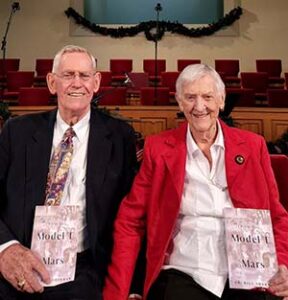
Bill and Veta Sherman participate in a book signing at Woodmont Baptist Church.
I not only was able to endorse this volume, but also was asked to write the “Foreword” to a book I have read backward and forward. I conclude my “Foreword” to this valuable volume with these words: “What one discovers in From the Model T to Mars is a role model for ministry in the words of one who was unflinchingly and indefatigably committed to ministry for life.”
As it happens, the now nearly 92-year-old Sherman, still brimming with warmth and wit, recently has held book signings at Woodmont Baptist Church and Baylor’s Truett Seminary. Accompanied by his wife Veta, his erstwhile companion in life and ministry, these events have been warmly received and well attended by friends and family who have supported and appreciated his nearly seven-decade long ministry. Those in attendance not only have left with a signed book, but they also have departed with an awareness of how uncommon a common man and committed minister like Bill Sherman actually is.
On the writing of From the Model T to Mars, Sherman states: “It has been a redemptive experience to revisit our [i.e., my] 91 years of life, remembering the faces and voices that made a difference in our lives. It is my hope that future believers will benefit from what we learned in our 66 years of ministry. It sure has been a fun ride from the Model T to Mars!”
Dean Todd Still (right) and Jon Sisk (left), director of development, welcome Bill Sherman to a book signing at Truett Seminary in Waco.
Concerning the book signings at Woodmont and Truett, the model minister remarked: “Woodmont Baptist Church and Truett Seminary mean the world to Veta and me. Over the years, Woodmont and Truett have been stalwart Baptist institutions, standing for true Baptist principles, such as priesthood of the believer, autonomy of the local church, cooperative missions, racial reconciliation, and supporting women in all ministry roles. Such commitments remain important to me, our family, and many in the congregation at Woodmont Baptist as well as the students, faculty, and administration at Truett Seminary. It is an honor to have had book signings at two of our most cherished places.”
To journey with Bill Sherman from the Model T to Mars, his insightful and autobiographical volume on life and ministry is available from Baylor University Press and Amazon.
Todd Still, Charles J. and Eleanor McLerran DeLancey Dean & William M. Hinson Professor of Christian Scriptures
Baylor University’s Truett Theological Seminary
Review: Reckoning with Power
March 13, 2024
Reckoning with Power: Why the Church Fails When It’s on the Wrong Side of Power
By David E. Fitch (Brazos Press)
Readers expecting to find a critique of the church’s complicity in covering up abuse, yielding to the temptations of Christian nationalism, or perpetuating systemic racism and patriarchy will find a dose of it in Reckoning with Power, but that’s not all. Author David Fitch, chair of evangelical theology at Northern Seminary, offers a thought-provoking examination of the nature of power itself.
Operating from a solid biblical foundation, Fitch asserts two kinds of power are at work: worldly power and God’s power. He describes worldly power as “power over” at its worst and “power with” at its best. Worldly power relies on coercion, manipulation and force. God’s power—which he refers to as “power under”—depends upon the Holy Spirit and is characterized by love and grace.
Worldly power has its limited role in a fallen world, Fitch acknowledges. Like a traffic light that keeps cars from crashing into each other, it provides some degree of order in a chaotic society, but it lacks the ability to redeem. God’s power, on the other hand, can bring about reconciliation, healing and transformation.
Fitch not only diagnoses the problem, but also offers the remedy by providing examples of what it looks like when the church lives under the power of Christ. He points to mutual submission, consensus-building through conversation, truth-telling and acknowledgement of the plurality of gifts within the body of Christ as characteristics of churches on the “right side of power.”
Readers of Reckoning with Power should prepare to be challenged.
Ken Camp, managing editor
Baptist Standard
Review: Sentenced Before the Womb
March 13, 2024
Sentenced Before the Womb
By Adrian Fajardo (Self-published)
Inmates aren’t the only prisoners in Texas. The families of the more than 2 million incarcerated men and women are locked up, too. Adrian Fajardo gives voice to this reality in a gritty first-person account of what it was like to grow up with a father in prison.
As a young boy in Waco, Adrian and his family were comfortable and happy. They seemed to have everything they needed. Then, agents stormed their home and took his dad, and everything changed.
Losing their home, sleeping on the floor at a relative’s house, going hungry, diving into addiction, seeking security in bad company—the entire family was swept along by his father’s choices.
Adrian relays the trauma and consequences in frank terms, connecting with his reader by laying his heart and mind bare. He is honest about his anger, depression, uncertainty and confusion.
Sentenced Before the Womb is written for those who are or may find themselves in the same situation. The narrative is fast-paced, the chapters are bite-size and the book is short.
Prison, as large as it looms for Adrian and his family, isn’t their whole story. Redemption came for Adrian’s dad, Adrian’s older brother and for Adrian, too. This part of their story is still in progress and still being told.
Eric Black, executive director/publisher/editor
Baptist Standard
Review: Liturgies for Hope
March 13, 2024
Liturgies for Hope: Sixty Prayers for the Highs, the Lows, and Everything in Between
By Audrey Elledge and Elizabeth Moore (Waterbrook)
Life moves at a breakneck speed. In Liturgies for Hope, writers Audrey Elledge and Elizabeth Moore bring the timeless truths of Scripture to the chaos of modern life. When the pace of our days leaves us breathless, this collection of liturgies offers rich words that resonate and ring with beauty.
Liturgical prayers make space for readers to encounter God. Marked by honesty, peace and spiritual depth, the prayers in Liturgies for Hope feed the soul and encourage the spirit. This Evangelical Christian Publishers Association bestseller transforms moments—mundane and monumental—into invitations for spiritual reflection. From “A Liturgy for Paying Bills When There’s Not Enough Money” to “A Liturgy for Gardening,” Elledge and Moore demonstrate God’s presence and comfort remains ever accessible.
Liturgies for Hope contains seven sections, each with a different focus area including faith, vocation, health, relationships, wonder, mystery and confession. Each prayer contains Scripture references for further study. Both deep and accessible, the prayers offer hope, foster faith and catalyze spiritual growth.
I appreciated the authenticity that spans each page. The authors confront the darkness of our present moment head on, naming and honoring experiences of suffering. The pain of fractured friendships, the numbness from social media fatigue, and the pangs of homesickness all show up in the prayers. However, the book presents just as honestly the unshakable hope available for all through Jesus Christ.
Liturgies for Hope provides an antidote to the hurry, loneliness and anxiety of our day by reorienting the soul through prayer.
Bonnie Patterson, student
Dallas Theological Seminary
Review: A Concise Guide to Islam
March 13, 2024
A Concise Guide to Islam: Defining Key Concepts and Terms
By Ayman S. Ibrahim (Baker Academic)
Words matter. When we assign meaning to words contrary to what speakers intend them to mean, it leads to misunderstanding.
Ayman S. Ibrahim, a professor of Islamic studies at Southern Baptist Theological Seminary, believes Christians need to know the definitions of basic Islamic terms as they are understood by their Muslim neighbors. For example, Arabic-speaking Muslims, Jews and Christians all refer to the deity they worship as “Allah,” but they describe his nature and characteristics quite differently, he noted.
This concise-but-thorough book provides definitions of more than 100 words and phrases related to Islamic texts, history, belief, practices, jurisprudence and sectarian movements. The author handles both primary sources and secondary sources responsibly.
Ibrahim treats his subject with respect, while not downplaying the key differences between Islam and other faiths—or the differences between different branches of Islam. He helpfully differentiates between cultural (nominal) Muslims, practicing (devout) Muslims and radical (political) Muslims.
As Ibrahim explores the origins of Islam, he honestly acknowledges ways in which Islam appropriated aspects of pre-Islamic Arab folk religion, along with altered versions of stories from Jewish and Christian Scriptures. He does not shy away from documenting the violence and intrigue that accompanied some of the historical sectarian differences within Islam, but he avoids painting all Muslims with a broad brush.
Nobody’s Mother: Artemis of the Ephesians in Antiquity and the New Testament
By Sandra Glahn (IVP Academic)
In Nobody’s Mother: Artemis of the Ephesians in Antiquity and the New Testament, author Sandra Glahn persuasively argues that an understanding of Artemis, the first-century goddess of the Ephesians, unlocks the meaning of the phrase “saved through childbearing” found in 1 Timothy 2:15. Her masterful work dispels the prevailing myths about Artemis and sheds new light on the biblical interpretation of this confusing verse and those verses which precede it.
Glahn’s incorporation of autobiographical elements in the introduction adds a personal and relatable dimension to the book. She describes her struggle with infertility and her desire to teach the Bible, even though she had received teaching that women should adhere strictly to the God-ordained domestic role of mother.
For this reason, she states her primary goal as discerning whether Paul had the local situation in Ephesus on his mind when he wrote to Timothy about women, especially in the context of childbearing. She also delves into whether a woman can apply her teaching gift only in childbearing. Readers, especially women who have faced similar challenges, will resonate with Glahn’s avid pursuit of a biblical understanding of her role and calling.
Glahn’s extensive research and eloquent writing style take the reader on a journey through Scripture, ancient literature, epigraphic records, architecture and art toward a comprehensive understanding of Artemis and her cultural significance in the first century. The book consolidates information not previously available in one place, making it an invaluable resource for anyone seeking a fresh perspective on the interpretation of 1 Timothy 2:15.
Comprehending Artemis’s role in the first century not only reframes the historical context of Paul’s words, but also liberates the application of a woman’s teaching gift from the act of childbearing, Glahn asserts. This interpretation provides a life-giving view for all women, especially single or childless women.
While the book’s detailed presentation and discussion of scholarly research could overwhelm the lay reader, it offers a treasure trove of fascinating facts for those diligently seeking an in-depth study of New Testament Scripture, especially books and passages involving the city of Ephesus. The book serves to educate but also proves engaging and thought-provoking. While readers may encounter various interpretations of this verse, Glahn’s scholarly work challenges readers to grapple with her authoritative research and its implications.
Sandra Glahn’s dedication to studying first-century Artemis culminates in a book that enlightens readers about history and inspires a reevaluation of traditional scriptural interpretations. Nobody’s Mother merits the attention of anyone seeking a deeper understanding of biblical passages and the cultural context that shaped them.
Sandi Arenburg, student
Dallas Theological Seminary
Review: The Gifts of Christmas
March 13, 2024
The Gifts of Christmas: 25 Joy-Filled Devotions for Advent
By Sheila Walsh (Baker)
Finding a fresh Christmas devotional book each December can be challenging, but Sheila Walsh has met that challenge in The Gifts of Christmas: 25 Joy-filled Devotions for Advent as she offers new ways of sensing the joy and seeing God’s gracious gifts of the season. With an introduction that sets the stage, the recording artist and television host travels from her childhood in Scotland to her adopted home in Dallas and various places in-between, evoking memories and encouraging readers “to exchange weariness for wonder and heartache for hope.”
The volume naturally divides into six parts describing God’s gifts of expectancy, wonder, joy, grace, peace and hope. The sections contain devotionals built around familiar images of that first Christmas or meaningful aspects of celebrations today such as angels, Bethlehem, the manger, Christmas crackers, candy canes and family photos. Most begin with Scripture, though others start with carols.
The best-selling author fleshes out the devotionals with biblical truths, illustrations and commentary, historical notes and personal stories ranging from humorous to bittersweet. Of particular note are gleanings from Old Testament history by Rabbi Jason Sobel and Alfred Edersheim. Each of the daily readings offers opportunities to remember past Christmases while reflecting on the present and anticipating the future. The 25 days close with “The Real Gift of Christmas,” the author’s recollection of reading C.S. Lewis’ The Lion, the Witch and the Wardrobe for the first time, the story of Zacchaeus and the carol “Joy to the World.”
Available as an audiobook and in hardcover, each has advantages. Listening to Sheila Walsh read brings Scottish flavor while the print contains lovely illustrations of kraft-paper-wrapped packages, red striped string and gold ornaments with subtle changes in each section’s art to reinforce the theme. Consider purchasing both—one to enjoy and one to joyfully gift a friend. That’s what I did.
Kathy Robinson Hillman, former president
Texas WMU and Baptist General Convention of Texas
Waco
Review: Christian Philosophy as a Way of Life
March 13, 2024
Christian Philosophy as a Way of Life: An Invitation to Wonder
By Ross D. Inman (Baker Academic)
Ross D. Inman teaches philosophy of religion at Southeastern Baptist Theological Seminary, but he rejects any suggestion the subject belongs only to the ivory towers of academia. Instead, Inman views Christian philosophy as good for what ails us—individually and as a society. It offers remedies for moral sickness, metaphysical vertigo and distorted vision.
At one level, Christian Philosophy as a Way of Life serves as a solid introduction to the philosophy of religion. Certainly, Inman provides a good overview of how Christian philosophy relates to the classical disciplines of ethics, logic, metaphysics, aesthetics and epistemology. He helps connect the dots linking Socrates, Plato and Aristotle to Augustine, Anselm and Aquinas.
However, Inman believes Christian philosophy should not be limited to classroom study. He asserts it provides a map to help Christians find meaning and follow truth-directed practices. He insists the Christian disciplines of a philosophical life—solitude, silence, meditation, self-examination, spiritual friendships and existential rest—have therapeutic value.
Furthermore, Inman believes philosophy possesses value in and of itself, because it helps us fulfill our God-given nature as meaning-seekers. Christian philosophy provides a framework to help believers discover—or recapture—a sense of wonder. It helps Christ-followers understand and focus upon what is good, true and beautiful in light of the revelation of God in Jesus.
Inman invites readers to rekindle that sense of awe and wonder. It’s an invitation worth accepting.
 Forming the culture of a church is like preparing pizza dough. At least, that’s how Matt Snowden and Joshua Hays describe it, with inspiration from J.B. Gambrell, a Southern Baptist and Texas Baptist leader at the turn of the 20th century. Just as dough requires a set of ingredients worked and kneaded together, so does the culture of a church.
 Chad Conine’s biography records the facts, but the real story is Bowman’s profound faith, deep friendships and sacrificial service. Basketball simply provides the backdrop and the era the context.
 Into the heated debate over whether women can serve as pastors and be called “pastor,” Orozco brings a calm and studied voice of reason. His presence at the microphone that day is the same as his presence in Fire in Her Bones—calm, considerate, deliberate, direct and committed to his fellow Baptists.
 In her upcoming book Forgiveness after Trauma, Suzannah Griffith handles this painful topic with honesty and grace. She recounts the abuse she experienced in her marriage with enough detail for the reader to understand her story without becoming immersed in it.
 In his beloved letter to the Philippians, the apostle reminds his Christian brothers and sisters in Philippi they have an example in Paul, Timothy and other Pauline coworkers (Philippians 3:17; compare 2 Thessalonians 3:9).

 Operating from a solid biblical foundation, Fitch asserts two kinds of power are at work: worldly power and God’s power. He describes worldly power as “power over” at its worst and “power with” at its best. Worldly power relies on coercion, manipulation and force. God’s power—which he refers to as “power under”—depends upon the Holy Spirit and is characterized by love and grace.
 As a young boy in Waco, Adrian and his family were comfortable and happy. They seemed to have everything they needed. Then, agents stormed their home and took his dad, and everything changed.
 Liturgical prayers make space for readers to encounter God. Marked by honesty, peace and spiritual depth, the prayers in Liturgies for Hope feed the soul and encourage the spirit. This Evangelical Christian Publishers Association bestseller transforms moments—mundane and monumental—into invitations for spiritual reflection. From “A Liturgy for Paying Bills When There’s Not Enough Money” to “A Liturgy for Gardening,” Elledge and Moore demonstrate God’s presence and comfort remains ever accessible.
 Ayman S. Ibrahim, a professor of Islamic studies at Southern Baptist Theological Seminary, believes Christians need to know the definitions of basic Islamic terms as they are understood by their Muslim neighbors. For example, Arabic-speaking Muslims, Jews and Christians all refer to the deity they worship as “Allah,” but they describe his nature and characteristics quite differently, he noted.
 Glahn’s incorporation of autobiographical elements in the introduction adds a personal and relatable dimension to the book. She describes her struggle with infertility and her desire to teach the Bible, even though she had received teaching that women should adhere strictly to the God-ordained domestic role of mother.
 Finding a fresh Christmas devotional book each December can be challenging, but Sheila Walsh has met that challenge in The Gifts of Christmas: 25 Joy-filled Devotions for Advent as she offers new ways of sensing the joy and seeing God’s gracious gifts of the season. With an introduction that sets the stage, the recording artist and television host travels from her childhood in Scotland to her adopted home in Dallas and various places in-between, evoking memories and encouraging readers “to exchange weariness for wonder and heartache for hope.”
 At one level, Christian Philosophy as a Way of Life serves as a solid introduction to the philosophy of religion. Certainly, Inman provides a good overview of how Christian philosophy relates to the classical disciplines of ethics, logic, metaphysics, aesthetics and epistemology. He helps connect the dots linking Socrates, Plato and Aristotle to Augustine, Anselm and Aquinas.