Rwandan peacemaker given human rights award

DURBAN, South Africa (BNG)—The son of Rwandan refugees who became a catalyst for reconciliation among ethnic rivals in his African nation was recognized at the Baptist World Congress for his vision of “the church as a home of peace.”

Corneille Gato Munyamasoko, general secretary of the Association of Baptist Churches in Rwanda, received the Baptist World Congress’ Human Rights Award, conferred every five years since 1995.

Ethnic violence

Munyamasoko was born in the Democratic Republic of Congo to Rwandan parents who fled ethnic violence in their home country in the 1950s. In 1994, as many as 1 million Rwandans were killed in tribal violence, primarily by Hutus against Tutsis. In the wake of the genocide, Munyamasoko moved to Rwanda to help rebuild the nation.

He worked to help Rwandans “to understand the causes of the genocide, to seek and to extend forgiveness and to build relationships based on the principles of justice, mercy and faith, emphasizing the need for reconciliation with God, self and others,” BWA General Secretary Neville Callam said in presenting the award.

Peace camp movement

Munyamasoko launched a peace camp movement, bringing together young survivors of the genocide with those who parents were imprisoned for acts of genocide. He has been a peacemaker, encouraging Rwandans “to overcome national rivalries and ethnic differences,” Callam said. He led pastors who had condoned acts of genocide to seek forgiveness from the survivors.

Munyamasoko also led his association of Baptist churches to combat stigma associated with HIV and AIDS, training pastors to care for victims infected by the virus.

“This award is recognition of the resilience of all Rwandans,” Munyamasoko said. “The award is a great encouragement to me to continue to strive for the well-being of my brothers and sisters. I feel re-energized in the calling to work for peace.”


New BWA president aims to be transformative agent

DURBAN, South Africa (BNG)—Living in apartheid-era South Africa, Paul Msiza found both his race and his religion objects of scorn. The country’s legal and social systems discriminated against blacks, while the close association between the nation’s state church and those oppressive structures left the black community deeply skeptical of Christianity there.

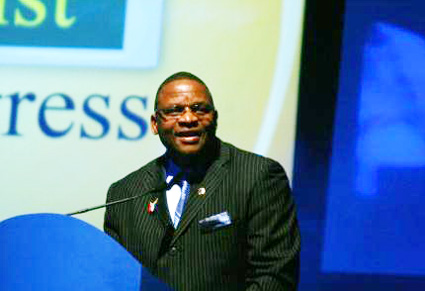
paul msiza340Paul Msiza, the incoming president of the Baptist World Alliance, addresses the Baptist World Congress.But the incoming president of the Baptist World Alliance is among a generation of South Africans who worked with great care and perseverance to change both the face of their country and the face of Christianity.

“The old South Africa was a most difficult place to live in for us black people,” the Baptist pastor said in an interview three days before he assumed the top elected position in the global fellowship that represents about 43 million baptized believers. “And it was very difficult for Christians.

“Christians were seen as the ones who actually maintained the system of oppression,” Msiza said.

 “Whenever you said, ‘I’m a Christian,’ you were associated with the oppressors,” he explained. “And I can tell you it was very difficult to witness among people who were politically enlightened. They would tell you that Christianity was a means to take land from the people.”

It is understandable why people would define Christianity in those terms, he said, because “that’s how Christians behaved.”

“The laws of apartheid were founded upon the doctrines of the state church,” Msiza said.

Those realities meant “our commitment to Christ was tested almost every day,” he recalled.

“When you would talk to schoolchildren they would say, ‘Don’t bring us the religion of the oppressors.’ And we had to be very clear that it was not only going to be a preaching of the word, it had to be accomplished by action and with power.”

paul msiza ethicsdaily425New BWA president Paul Msiza previously served as general secretary of the South Africa Baptist Convention. (Ethics Daily Photo)Msiza and others were largely successful. Christianity, he said, is embraced broadly in South Africa, where almost 84 percent of population identifies themselves as believers.

There were few Baptists in the township east of Pretoria where Msiza, now 54, was born or in the rural Winterveld region northwest of the city where he grew up.

That changed in 1980 when as a young adult he was converted by a visiting Baptist pastor and joined a small group to start a Baptist congregation in Winterveld. It was the beginning of a lifelong commitment to ministry.

“Almost immediately (after making a profession of faith), I felt the urge to serve the Lord,” Msiza said. “At first, I thought I could do that as a school teacher.”

With a college degree in hand, he began teaching in public schools, finding time to minister to students he met there. But soon the “calling became too strong,” he said, and that led him to seminary and eventually to became a bivocational pastor, teaching in schools and being pastor of three churches at a time—some of which he planted—in Pretoria’s rural surroundings.

paul msiza smiling425New BWA president Paul Msiza (center) welcomes participants at the Baptist World Congress in Durban, South Africa. 
Meanwhile, South Africa was dismantling apartheid and transforming the country’s political structures. Msiza joined a growing number of Christians who supported the movement, which eventually led to the first multi-racial democratic elections in 1994.

“God raised Christians like Archbishop Tutu and many others who were the stalwarts in preaching a gospel that was liberating,” he said. “And who stood for social justice and freedom and preached that from the pulpit. That helped to make people aware that there is a church that preaches the true gospel. It was in the 1980s that the church raised its voice and started to condemn injustice.”

In 1995, the Baptist Convention of South Africa was looking for someone to head a college it was developing to train Baptist leaders, and it turned to Msiza. Again the calling was irresistible, he said, and with a budget of about $500 and seven students, the Baptist Convention College opened its doors in the Soweto section of Johannesburg. Today, the school has educated hundreds of pastors serving around the country.

That leadership role made him a natural choice to be selected general secretary of the Baptist Convention of South Africa and later president of the All Africa Baptist Fellowship, one of six regional fellowships of the BWA.

In 2011 Msiza became pastor of Peniel-Salem Baptist Church in Pretoria, realizing a dream to be a full-time pastor. “I was looking forward to being a full-time pastor for years, but the Lord had to take me through some detours,” he said.

paul msiza timothy george425Timothy George, dean of Samford University’s Beeson Divinity School, with Paul Msiza visiting the Library of Celsus in ancient Ephesus. George serves as the chair of the BWA Doctrine and Christian Unity Commission. (Beeson Divinity School Photo)Sanna Mapula, who he married in 1986—the couple now has three sons—has been an essential supporter through those years, he said.

“My wife is very devoted believer, a strong Christian, a strong preacher and teacher of the word. She is the preacher of the church when I travel. And I can say the people remember her sermons more than the ones I preach,” he quipped.

As he takes on his five-year role as BWA president, he aims to be guided by the organization’s theme for 2015-20: “Jesus Christ, the Door.”

“The door speaks about freedom, emphasizes the issue of liberty—freedom of religion, freedom of worship, freedom for justice. The people need to be set free from all sorts of shackles.”

It’s an essential task, he said.

“We’re living in a world that is full of suffering. We need a message of hope, a message of the door. Whenever you see the door, there’s hope. At the Baptist World Alliance, our goal is to see more people coming into the fellowship, to see the emphasis on the issues of justice, without abandoning preaching the gospel of conversion. But the gospel of conversion cannot leave out these matters, because as we are converted, we are people who now see things in a different way.

“We trust the Lord will use us to become agents of transformation.”


South African culture featured in BWA congress opening

DURBAN, South Africa (BNG)—A celebration of South African culture—and the country’s remarkable transformation into “the rainbow nation”—highlighted the opening session of the Baptist World Congress in a colorful display of music and dance.

korean pastor250South Korean pastor Peter Chin at the opening session of the Baptist World Congress. (BNG Photo by Brian Kaylor)The five-day Congress in Durban, the first time the meeting has been held in Africa, has drawn more than 2,500 people from about 80 countries to Indian Ocean coast.

“We welcome you to the rainbow nation,” said Michael Mabuyakhulu, an official of KwaZulu-Natal province, referring to the country’s adopted nickname that reflects its diversity of ethnicities and languages.

African dancers, a Korean children’s choir and contemporary Christian praise bands joined keynote speaker Peter Chin, a South Korean pastor, to interpret the Congress theme, “Jesus Christ, the Door.”

Earlier, BWA leaders said South African’s recent history—its transformation from an oppressive apartheid regime to a multicultural democracy, with forgiveness and reconciliation as key drivers of the largely peaceful change—set an appropriate context for the congress.

The southern African concept of Ubuntu—often translated as “human-ness” or “humanity toward others” and described as a belief in a “universal bond of sharing which connects humanity”—was especially meaningful, they said.

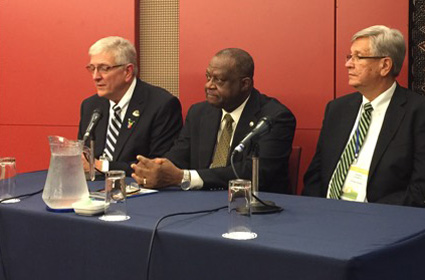
upton callam everettb425Outgoing BWA president John Upton, BWA General Secretary Neville Callam and Congress Committee Chair Randall Everett, president of the 21st Century Wilberforce Initiative and former BGCT president, speak to the press at the start of the Baptist World Congress in Durban, South Africa. (Baptist General Association of Virginia Photo)The congress theme is “being received in the perspective of Ubuntu,” BWA General Secretary Neville Callam said. 

“We have come to see this spirit manifested in Ubuntu,” he noted. “In seeking to probe the depths of the riches of Jesus, we are going beyond our own narrow ecclesiological confines and thinking of the world in which God placed us, a world of many different religions and ideologies.”

Meeting in South Africa is “so absolutely enthralling and inspiring,” Callam said. “It will fill our conference with … a feeling that we should concern ourselves with the welfare of others, seek ways we can be for others what we want others to be for us, that the welfare of one is a concern of all, that the destiny of one is bound up in the destiny of all.”

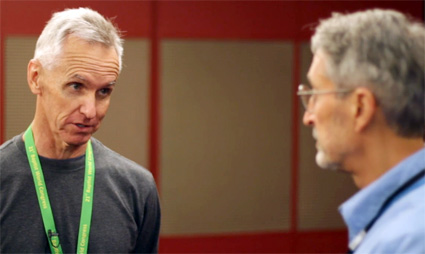
hardage parham425Texas Baptist Executive Director David Hardage (left) talks to Robert Parham of Ethics Daily during the Baptist World Congress. (Ethics Daily Image)Outgoing BWA President John Upton noted, “Humans are experts at building walls,” but added, “Jesus Christ knocks down the dividing walls, and he does it with the cross. “

“As we (the BWA) live into the next five years, what does it mean that Jesus knocks down dividing walls?” he said. “I look forward to seeing what that could possibly mean. It’s going to be an exciting five years. And that conversation could only begin here in South Africa.”


LifeWay offer for new Nashville site accepted

NASHVILLE (BP)—LifeWay Christian Resources’ offer to purchase 1.5 acres in downtown Nashville for a new office building has been accepted, the Southern Baptist publishing house announced July 21.

The city’s Metro Development and Housing Agency, which owns the property, unanimously approved sale of the site for $12.7 million, with a tax incentive of $4.9 million that can fund specific aspects of the construction, effectively reducing the purchase cost to less than $8 million.

thom rainer130Thom RainerMeanwhile, LifeWay is moving toward completing the sale of its current 14.5-acre campus, with more than 1 million square feet of office space, to a consortium of local and national developers later this summer. Buyers have not released the sales price of LifeWay’s present facilities.

New building still being designed

LifeWay’s new building, located one mile across downtown Nashville from the present campus, will encompass 216,000 square feet. The number of stories of the facility is in the design process.

The new location is a few blocks south of Nashville’s Broadway District—a popular shopping and entertainment area—and across the river from Nissan Stadium, home of the NFL’s Tennessee Titans football team.

The new location “will be exciting for our employees and visitors and will provide us opportunities to serve the millions of people who work, live and visit Nashville’s central business district each year,” LifeWay President Thom Rainer said in a letter to employees.

Plans to break ground this year

The project’s construction contractor and architects already have started engineering and environmental studies on the property, Rainer said. If all goes well, he anticipates closing on the new location early this fall. LifeWay plans to break ground this year on the new facility slated for completion by late 2017.

Last August, LifeWay began a preliminary feasibility study last for selling its campus to relocate to facilities better suited to the agency’s future. 

Much of LifeWay’s current campus is outdated, Rainer said, noting many of the buildings were built in the early 20th century and are not designed for modern technology or collaborative work.

About 1,100 LifeWay employees are based in the downtown offices and will move into the new building. LifeWay also operates 184 LifeWay Christian Stores in 29 states and a national conference center in Ridgecrest, N.C., with more than 4,000 total employees.

LifeWay has contracted with Gresham, Smith and Partners in Nashville to design the new building, with Bell & Associates Construction in Brentwood, Tenn., managing construction. Compass Partners in Brentwood will help LifeWay manage the project, serving as the owner’s representative.

LifeWay was founded in 1891 in Nashville as the Sunday School Board of the Southern Baptist Convention.


African influence felt at Baptist World Congress

DURBAN, South Africa—The Baptist World Congress in Durban, South Africa, marked one key first and a significant second—the first world congress held in Africa and the second led by an African president since the Baptist World Alliance’s founding in 1905.

Paul Msiza, pastor of Peniel-Salem Baptist Church in Pretoria, South Africa, presided for the first time at the BWA’s General Council meeting just prior to the five-day Baptist World Congress.

paul msiza welcome congress425Paul Msiza, pastor of Peniel-Salem Baptist Church in Pretoria, South Africa, and new BWA president, welcomes participants to the Baptist World Congress meeting. (BWA Photo)The congress, held every five years in cities around the world, was expected to draw about 2,500 participants from many of the BWA’s 200-plus member unions and conventions.

The 53-year-old Msiza was elected last summer at the General Council’s meeting in Izmir, Turkey. He succeeds John Upton, executive director of the Baptist General Association of Virginia, who was elected to the five-year term as president in 2010.

“I stand here today with all humility and being humbled before the Lord to serve,” Msiza told council members gathered in Durban’s International Conference Center. “God has put a special calling on us to serve our international fellowship. From a human viewpoint, we have anxiety and questions. But if we rely on those, there is nothing we can do. All we can do is trust in the presence of the Lord as we move forward, as we begin a new journey together.”

Msiza, who will work closely with BWA General Secretary Neville Callam, is the second African to be elected president. The first was Liberian William Tolbert, who held the office from 1971 to 1980.

bwa congress koreans425The Sharon Children’s Choir & Hosanna Children’s Orchestra from South Korea performed at the Baptist World Congress in Durban, South Africa. (Central Baptist Theological Seminary Photo)A former bivocational pastor and school teacher, Msiza has been principal of a Baptist college in South Africa, general secretary of the Baptist Convention of South Africa, president of the All Africa Baptist Fellowship—one of six BWA regional groups—and a BWA vice president.

Upton noted over his five-year tenure, the BWA had “faced challenges together as a family” in a world that “is very different from what it was” in 2010.

“One thing that has been most helpful to me recently is to remember that leadership is not an identity,” Upton told the council, many of whose members are rotating off. “We’ve each been entrusted with leadership roles, but the seduction is to take on leadership as an identity. It’s never an identity. It’s always a function. My identity is that I’m a child of God. I live that out all the time, and occasionally I lead. For some of us now, we’ll take on a new function—a supportive role.”

BWA unions and conventions comprise nearly 50 million Baptists around the world, representing wide cultural and social differences—a diversity the group’s general secretary said must be acknowledged.

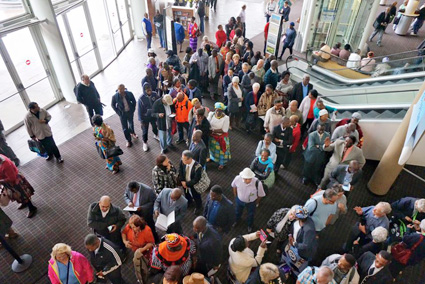
bwa congress registration crowd425About 2,500 participants from many of the Baptist World Alliance’s 200-plus member unions and conventions gathered in Durbin’s International Convention Centre. (Central Baptist Theological Seminary Photo)“I come from a certain place, we have a certain way of doing things, and sometimes it is easy not to recognize our formation in the specificity of our own cultures which influence the way we act, the way we live,” Callam said. 

“We deceive ourselves that the traditions we practice are traditions founded in the word of God. Truly listening to one another and seeking to hear the voice of God in each other, we can put aside our own fears and our weaknesses. The glorious opportunity is that we can influence one another.”

Callam urged the council—and the churches they represent—to study the “Covenant on Intra-Baptist Relationships,” adopted two years ago as an expression of “our ideals as we seek to serve together in the fellowship of the BWA in its organized life.”

The covenant notes the BWA’s diversity “includes various cultures, languages, customs, histories, racial identities, ways of expressing theological conviction, and personal and communal encounters with Christ in different cultural contexts. By God’s grace, the BWA reflects, in a visible way, the rich diversity of the one body of Christ.”

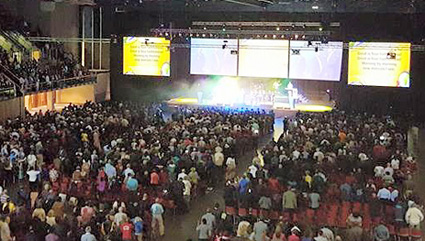
bwa congress crowd425Worship, preaching and cultural presentations from around the world marked the 21st Baptist World Congress in Durbin, South Africa.But, it acknowledges, “the BWA commitment to open dialogue and honest communication in the midst of our profound diversity also presents the BWA with perhaps the greatest challenge to the unity we are called to maintain.”

“We acknowledge that Baptists are known to have a wide range of opinions and perspectives on many issues, including what constitutes ‘truth,’” the covenant asserts. “Yet, we love and accept one another. When we believe an opinion or perspective is seriously flawed, we challenge each other as beloved family members rather than as strangers and enemies. Even the correction of perceived errors must be done in love.”

During its meeting, the council agreed to admit an additional union—the Evangelical Baptist Churches of Zimbabwe, a network of congregations primarily near Zimbabwe’s border with Zambia.

The council also:

• Approved a set of guidelines for adopting resolutions at annual council meetings, including criteria for determining what constitutes relevant topics and appropriate language, and a process to follow.

• Received notice of a proposed motion to give the council’s executive committee authority to employ staff members other than the general secretary. That change in the bylaws will be considered at the council meeting next summer in Vancouver, British Columbia.

• Unveiled a budget for 2016 of $2,253,390, just slightly below the current $2,258,100 budget. Next year’s financial plan anticipates $670,000 in contributions from member bodies, the same amount as the current budget. In 2014, those contributions totaled $441,676, but leaders said they were confident member bodies would “step up and contribute.”


SBC leader calls for probe into Planned Parenthood video

NASHVILLE, Tenn. (BNG)—After viewing an undercover video that appears to show a Planned Parenthood official discussing the sale of fetal organs, the Southern Baptist Convention’s top spokesman for public policy concerns said “it is time for the reborn to stand up for the unborn.”

russell moore130Russell MooreRussell Moore, president of the SBC Ethics & Religious Liberty Commission, said in a blog July 14 he was shocked by a video released by The Center for Medical Progress. 

The video, which Planned Parenthood maintains was manipulated, shows discussions between Deborah Nucatola, senior director of medical services for Planned Parenthood Federation of America, and actors posing as buyers for a human biologics company about how fetal tissue is harvested and the costs associated with its procurement.

Moore called the video an “atrocity” and said the government should investigate.

Planned Parenthood issued a statement saying some of its centers help women who want to donate aborted tissue to medical research. There is no financial benefit to either the patient or Planned Parenthood, the organization claimed, but sometimes the cost of transporting tissue to research centers is reimbursed, a standard practice in the medical field.

“A well-funded group established for the purpose of damaging Planned Parenthood’s mission and services has promoted a heavily edited, secretly recorded videotape that falsely portrays Planned Parenthood’s participation in tissue donation programs that support lifesaving scientific research,” said Eric Ferrero, vice president of communications for Planned Parenthood Federation of America. 

“Similar false accusations have been put forth by opponents of abortion services for decades. These groups have been widely discredited and their claims fall apart on closer examination, just as they do in this case.”

Moore termed Planned Parenthood’s response to the video “as chilling as it is unconvincing.”

“The horror of this story should be shocking to the consciences of all Americans,” Moore said in a statement on the ERLC website. “Let’s be clear about what is going on. It is not only that infants, in their mother’s wombs, are deprived of their lives, but also that their corpses are desecrated for profit.

“This is not only murderous; it is murderous in the most ghoulish way imaginable. Is it not clear at this point that these are not health care providers but pirates and grave robbers of those who have no graves? The Department of Justice and the United States Congress should undertake a thorough investigation of this.”

Call for investigation

Moore wrote Speaker of the House John Boehner calling for an investigation into “profiteering in violence on the part of Planned Parenthood.” He also called on presidential candidates to address the video.

Earlier, the ERLC announced it would join Focus on the Family in an effort to get more evangelicals to participate in the annual March for Life event in the nation’s capital held each January marking the anniversary of the 1973 Roe v. Wade Supreme Court decision legalizing abortion on demand.

Billed as “a major pro-life conference,” the Evangelicals for Life event is scheduled Jan. 21-22, 2016, at the Hyatt Regency Washington on Capitol Hill. Scheduled speakers include Moore, Jim Daly of Focus on the Family, Samuel Rodriguez of the National Hispanic Christian Leadership Conference, authors Ron Sider and Eric Metaxas and David Platt, president of the SBC International Mission Board.


Baptist Briefs: Appeals court denies GuideStone’s Obamacare challenge

A federal appeals court has determined requiring a religious nonprofit to opt out of mandated contraceptive coverage under Obamacare is not a substantial burden on religious exercise. The 10th U.S. Circuit Court of Appeals said religious organizations including GuideStone Financial Services of the Southern Baptist Convention either must cover FDA-approved contraceptives in employee insurance plans or follow the government’s rules for opting out of the contraceptive mandate. Plaintiffs in three cases combined before the appellate court objected not only to paying for methods of birth control they believe can cause an abortion, but also to the government’s plan for accommodating religious objection to the requirement. The Denver-based court is the fifth appellate court to turn back challenges by faith-based nonprofits to the HHS accommodation. GuideStone, its co-plaintiffs Reaching Souls International and Truett-McConnell College, and attorneys from the Becket Fund for Religious Liberty and Locke Lord are studying the opinion to determine next steps, including possible appeals. “This is a disappointing decision, for both religious liberty and for the sanctity of life,” GuideStone President O.S. Hawkins said. “This is a day for all of us to bombard the throne of grace with petitions for a favorable outcome on appeal, for strength of resolve, for the unborn in this country and for all of our leaders, so many of whom have turned their back on the founding principles of this country. We are working already with our legal advisors to determine our next steps. Today was a setback. It is not the final outcome.”

LifeWay Research partners with Wheaton evangelism center. LifeWay Research and the Billy Graham Center for Evangelism at Wheaton College in Wheaton, Ill., have partnered to “facilitate the advancement of biblically faithful evangelism.” Ed Stetzer, the executive director of Nashville-based LifeWay Research, will serve as senior fellow for the evangelism center. During the year-long partnership, Stetzer will consult and lead the center’s Wheaton-based staff and oversee a national survey about the state of evangelism in America. The findings of this research project are slated for release at a 2016 multidenominational conference, jointly hosted by the center and LifeWay Research. Rick Richardson, professor of evangelism and leadership at Wheaton College, will work with Stetzer and LifeWay Research staff to develop the collaborative study that will examine the unchurched and churches most effectively reaching them.


Networking two continents means bridge-building

DELTONA, Fla. (BNG)—Ruben Ortiz experiences deep fulfillment from his calling as a bridge builder between the church in Latin America and the United States. But it comes at a price.

“Sometimes it’s difficult. All of the driving is causing me back problems,” Ortiz, 42, said with a laugh.
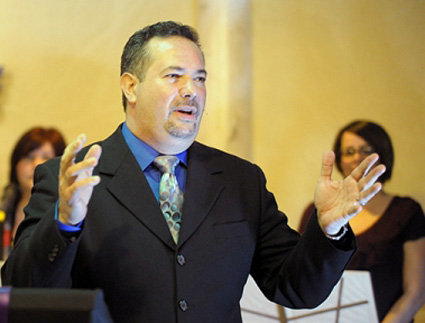
rubin ortiz425By all accounts the Cuban-born Ruben Ortiz has the energy and personality to match the passion he has for church and relationship building. (BNG PHOTO/Dede Smith) Stepping down recently as moderator of the Cooperative Baptist Fellowship of Florida isn’t likely to reduce the 20,000 miles a year Ortiz puts on his car. He works as CBF Florida’s Hispanic liaison, and he serves both on the national CBF missions council and with an organization coordinating the work of Hispanic churches from various denominations.

As if the relentless pace of domestic and international outreach weren’t enough, Ortiz is the full-time pastor of a Hispanic church in Deltona, Fla.

His congregation has him pegged.

“One of my members said to me, ‘There’s my Superman pastor,’” Ortiz recalled.

Neither the Superman comment nor the sore back would surprise anyone at CBF, American Baptist Churches USA or elsewhere who knows Ortiz and has seen him at work. By all accounts, the Cuban-born Ortiz has the energy and personality to match the passion he has for church and relationship building.

People who have worked in a wide range of ministries with Ortiz describe him as possessing the skills and calling needed most by churches in an increasingly diverse culture. And it doesn’t hurt that he seems to know everyone, no matter where he goes.

A ‘Catalytic leader’

“He is the most catalytic leader that I’ve met in a while,” said Ray Johnson, coordinator of CBF Florida.

Johnson and Ortiz met in 2007 at the annual meeting of the Puerto Rico Baptist Convention. Since then, Ortiz has helped Johnson and CBF Florida connect with church leaders throughout Latin America and the Caribbean.

“He was networking me with significant leaders,” Johnson said. “He knew Cuba, and he was known to Puerto Rico Baptists and (Hispanic Baptists) here in Florida.”

In part through Ortiz’s connections, CBF enjoys an array of missions and disaster-relief opportunities with Hispanic communities in the United States and abroad. 
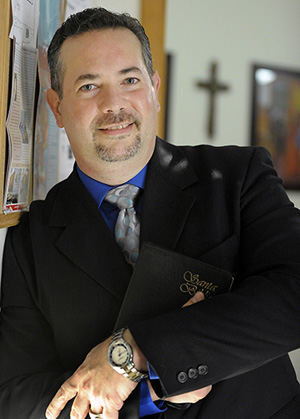
ruben ortiz closeup300Ruben Ortiz was born in Santiago, Cuba.As Hispanic liaison, Ortiz is helping CBF Florida explore the possibility of planting a Hispanic church in South Florida.

“Our work with Hispanics in the state of Florida wouldn’t be where it is without Ruben,” Johnson said.

Ortiz also has been invaluable to Johnson, personally.

“He has been very willing to help me as an American to understand Hispanics,” he said. “My goal is to build a relationship with the broader CBF family. CBF Florida cannot do Latin American missions alone.”

The intense pace at which Ortiz conducts his ministry has its roots in a calling he describes as “reaching as many people as possible.”

It began in Santiago, Cuba, where Ortiz was born to deeply religious parents.

His father was a pastor and, for 20 years, leader of the Eastern Baptist Convention of Cuba, which is affiliated with the American Baptist Churches USA.

First drawn to journalism

Growing up, he was drawn to a career in journalism. In 1993, his education took him to Ecuador. While there, he felt a tug into some kind of ministry and expanded his studies to include theology.

In 2000, he took a job with a radio production company that catered to Hispanics living in the United States. But even his work in radio had a missional quality to it, Ortiz said.

“I always saw the U.S. as a possibility to reach more people,” he said. “For me, it was first about serving the Lord.”

Ortiz never forgot his Baptist identity, whether in Cuba, Ecuador or the United States.

“When I left Cuba, I was always looking for a Baptist church,” he said.

ruben ortiz suzii paynter425Ruben Ortiz sings beside Suzii Paynter, Executive Coordinator of the Cooperative Baptist Convention, during a worship service in 2013. (BNG Photo provided by Ruben Ortiz)Traveling abroad, he found his denominational affiliation opened doors to homes and friendships he wouldn’t have experienced otherwise.

“It’s like a family. For me,bsp;being Baptist is to have an open passport and open visa to the whole world,” he said.

But it’s Ortiz who is the passport to Latin America and Hispanics in the United States, others insist.

“He is a great leader for us at this particular time,” CBF Executive Coordinator Suzii Paynter said, noting Ortiz is helping guide CBF into its value of embracing diversity and establishing partnerships “of respect and empowerment.”

Relationship-building ministry

Ortiz’s style fits perfectly with that effort, because he avoids the “liberal-versus-conservative,” “us-versus-them” approach in his bridge- and relationship-building ministry, she noted. He also avoids the patriarchy and pride that dominated Western culture and missions, she said.

“He has a heart for the greater kingdom of God, and he has been equipped with the gifts of reaching out and reaching across and having ideas and positive energy,” she said. “He is the kind of leader people trust and follow.”

Ortiz was raised in an American Baptist Churches USA home and church. Venturing abroad, he encountered Southern Baptist churches, including a Hispanic SBC megachurch in the Miami area.

When work took him to Deltona, he joined La Primera Iglesia Bautista de Deltona. In 2002, the American Baptist Churches USA-affiliated congregation called him to be its pastor. But he found the church geographically isolated from its denomination.

ruben ortiz baptism425Ruben Ortiz performing a baptism. (BNG Photo provided by Ruben Ortiz)By then, he had heard of CBF and contacted Bernie Moraga, leader of CBF’s Hispanic initiative. Moraga put him in touch with Tommy Deal, who was associate coordinator of CBF Florida. From there, the relationships began expanding. CBF national and Florida leaders helped him through a period of burnout and a divorce and nurtured his new sense of calling.

“CBF for me is personal, face-to-face,” he said. “They are people you can touch, and you can laugh with them. It’s a community and a family.”

Deal remembers that 2004 meeting with Ortiz in College Park, Fla., which also included Carlos Peralta and his wife, Miriam, both of Ecuentro Ministries.

“They were looking for community and family,” said Deal, now the disaster response director for CBF.

Ortiz and the Peraltas also made a presentation about Ortiz’s church and the couple’s ministry and how those could help CBF tap into their Latino connections, Deal said.

More meetings followed, and eventually Ortiz invited Deal to Puerto Rico for a meeting of Baptist churches there. That’s when Deal said he knew he was with the right guy.

‘A ball of energy’

“He works a room,” Deal said. “He’s just a ball of energy. He just strikes up conversations with anyone.”

Since then, Deal has watched Ortiz’s personality draw in pastors and lay people from across the Baptist spectrum.

“I have been in his worship services, and the preaching is dynamic, energetic and engaging,” Deal said.

Ortiz devotes all that energy to CBF because, he said, “It is a great way for us to get connected.”

Hispanics in the United States often fall prey to isolation and misunderstanding, especially concerning whether or not they are in the country legally, he noted. While their churches provide them with the comfort of community, those congregations often live and serve in isolation, as well. Plus, they are under-resourced because they are small and cannot afford full-time pastors or adequate facilities, Ortiz said.

Immigration challenges

Another challenge, regardless of budgets, is hardship faced by undocumented immigrants. Ortiz noted his church in Deltona is made up mostly of Puerto Ricans who are in Florida legally. But they have had a couple of members over the years who weren’t and ran afoul of authorities.

It’s a painful situation, and stronger Hispanic churches can be a greater resource for immigrants in those situations, he said.

Baptists in Latin America are united, even across denominational lines. In the United States, they aren’t, but Ortiz wants to see that change.

So, he drives thousands of miles a year to connect Hispanic people and churches with CBF and other Baptist leaders.

“I see the richness of the message, that holistic mission of God” by pursuing that calling, Ortiz said. “I see this as something I will fight for, because this is my family.”




Baptist Briefs: Carter believes Jesus OK with gay marriage

In a Huffington Post interview promoting his new memoir, Jimmy Carter said he thinks Jesus would approve of same-sex marriage. “I believe Jesus would approve gay marriage, but that’s just my own personal belief,” the 90-year-old former president said in an interview webcast. “I think Jesus would encourage any kind of love affair if it was honest and sincere and was not damaging to anyone else, and I don’t see that gay marriages damage anyone else.” Carter, who on Sundays when he is in town teaches Sunday school at Maranatha Baptist Church in Plains, Ga., says he doesn’t “have any verse in Scripture” to back up his opinion, but as a born-again Christian, he has no problem with gay marriage. “I think everybody should have a right to get married, regardless of their sex,” Carter said. “The only thing I would draw a line on, I wouldn’t be in favor of the government being able to force a local church congregation to perform gay marriages if they didn’t want to. But those two partners should be able to go a local courthouse or to a different church and get married.”

Pastor emphasizes God over government. Pastor Rit Varriale wants to see churches fly the Christian flag above the American flag as a biblical statement, reversing flag etiquette that calls for the American flag to be flown in the prominent position. rit varriale130Rit VarrialeVarriale, senior pastor of Elizabeth Baptist Church in Shelby, N.C., said the church installed its first-ever flagpole in order to raise the two flags in a special ceremony after morning worship July 5, in which the Christian flag was raised in the higher position. “If you stop and think about it, (flag etiquette) is inconsistent with what the Bible teaches us,” said Varriale, a U.S. Army veteran who served as a Ranger and officer with the 82nd Airborne Division. “We are first and foremost Christians who are called to serve the living God. … Before our accountability to government is our accountability to God.” He called for flying the Christian flag above the American flag as a demonstration Christians will respect and obey the federal government up to the point the government asks something inconsistent with what God has called his people to do.

Pastor’s killer ruled not guilty due to insanity. An Illinois man who six years ago shot and killed a Southern Baptist minister in a Sunday morning worship service has been found not guilty by reason of insanity and likely will spend the rest of his life in a mental institution. Terry Sedlacek, 33, faced charges of first-degree murder and aggravated battery for killing Fred Winters, pastor of First Baptist Church in Maryville, Ill., and past president of the Illinois Baptist State Association, on March 8, 2009. The key legal issue in the case from the beginning has been Sedlacek’s fitness to stand trial. It was finally resolved July 2, when Circuit Judge Richard Tognarelli issued a court order finding Sedlacek was insane on the day of the shooting and stabbings and therefore not guilty by reason of insanity. Sedlacek, who has been receiving psychiatric treatment since age 17, tried during an early court appearance to plead guilty, but the public defender entered a plea of not guilty by reason of insanity on his behalf. He was not present for the July 2 hearing. Sedlacek will remain at the Alton Mental Health Center near St. Louis, where he can be held for a maximum 85 years. Any future attempt for his release, even if temporary, will require approval from a judge with input from prosecutors and the victim’s family.


James Dunn, robust advocate for religious liberty, dies July 4

James M. Dunn, one of Baptists’ most well-known advocates for religious liberty and separation of church and state, died July 4 a few weeks after his 83rd birthday in Winston-Salem, N.C.

During his nearly two decades as executive director of the Baptist Joint Committee for Religious Liberty, and for 12 years prior to that as executive director of the Texas Baptist Christian Life Commission, Dunn’s colorful rhetoric and take-no-prisoners approach in defense of liberty earned him the reverence and fury of Baptists across the theological spectrum.

james dunn200James M. DunnIn retirement his commitments remained undiminished while teaching in the Wake Forest University School of Divinity and in innumerable speaking engagements around the country.

As head of the BJC from 1981 to 1999, Dunn strongly opposed state-sponsored prayer in public schools and federal vouchers for religious schools. That position put him at odds with the Southern Baptist Convention, then one of several Baptist denominations which funded the Washington-based advocacy group.

Eventually the SBC withdrew its support. But Dunn’s robust leadership positioned the BJC to become one of the most respected voices on religious liberty in the nation’s capital. It was a key player in the passage of the Equal Access Act in 1984 and the Religious Freedom Restoration Act in 1993.

A ‘Texas-bred, Spirit-led, Bible-teaching,
revival-preaching, recovering Southern Baptist’

“Words fail to describe his contribution to life, learning and gospel,” said Wake Forest Divinity School professor and close colleague Bill Leonard on his Facebook page. “James called himself a ‘Texas-bred, Spirit-led, Bible-teaching, revival-preaching, recovering Southern Baptist.’”

A native of Texas, Dunn was born June 17, 1932, in Fort Worth. After graduating from Texas Wesleyan College there, he earned bachelor of divinity and doctor of theology degrees from Southwestern Baptist Theological Seminary, also in Fort Worth.

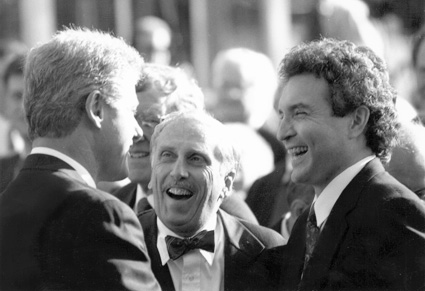
dunn clinton thomas425James Dunn and former Baptist Joint Committee General Counsel Oliver “Buzz” Thomas talk with President Bill CLinton. (BJC Photo)His wife, the former Marilyn McNeely, was the daughter of professors at the seminary. But Dunn had known her since he was 8 and Marilyn was 6. In high school, the two played in the same symphony orchestra — Marilyn on the violin and Dunn on the clarinet. They began dating in 1954 when Marilyn was a student at Baylor University in Waco, Texas, and eventually married. Marilyn became an accomplished vocalist.

After graduating from Southwestern and stints as a pastor, a campus minister and college teacher, Dunn became executive director of the Christian Life Commission, the social action agency of the Baptist General Convention of Texas. In that role he tackled issues ranging from juvenile justice reform to environmental protection to equal rights for women and minorities.

When Dunn was named executive director of the Baptist Joint Committee in 1980, the Southern Baptist Convention — then the largest contributor to the BJC — was beginning a decade-long shift to the theological right, just as the country was moving in the same direction with the election of Ronald Reagan as president.

Unfazed, Dunn aggressively opposed projects endorsed by the Religious Right, including state-sponsored prayer in public schools, at one point famously charging President Reagan with “demagoguery” and playing “petty politics with prayer.”

Beginning in the mid-1980s Southern Baptist leaders repeatedly criticized Dunn’s positions, but he refused to compromise his principles for what he called “a mess of politically tainted pottage.” By 1991 the SBC had withdrawn all funding for the Baptist Joint Committee.

A letter to Al Gore

But Dunn’s targets were bipartisan. When Vice President Al Gore backed federal funding for faith-based groups during his presidential campaign in 1999, Dunn penned an open letter to his long-time friend, said Aaron Weaver, a Baptist journalist and author of James Dunn and Soul Freedom, in a 2011 introduction of Dunn at an awards ceremony.

“Dear Mr. Vice President,” wrote Dunn. “I know you. I like you. You mean well. But this time, as we say in Tennessee and Texas, you’ve ripped your britches.”

After retiring from the BJC in 1999, the Dunns moved to Winston-Salem, where he became professor of Christianity and public policy at Wake Forest’s Divinity School. He also served as president of the Baptist Joint Committee Endowment.

In 2011 Wake Forest established the James and Marilyn Dunn Chair of Baptist Studies in the Divinity School. A collection of Dunn’s papers from 1949 to 2010 is housed at the Z. Smith Reynolds Library at Wake Forest. It includes articles and essays written by Dunn, as well as personal letters addressed to Dunn from U.S. presidents Jimmy Carter and Bill Clinton.

Dunn is survived by his wife. Funeral arrangements are pending.


NAMB establishes fund to assist burned black churches

ALPHARETTA, Ga. (BP)—Southern Baptists’ North American Mission Board has established a fund to help African-American churches damaged or destroyed by fire in recent weeks.

Fires at seven black churches have fueled discussions of racial hatred, as the first occurred within a week of the June 17 massacre of nine black Christians by a 21-year-old white supremacist at a Charleston church.

kevin ezell130Kevin EzellAs investigations into the fires continue, two of the blazes have been confirmed as arson and a third has been ruled suspicious. While none have been deemed hate crimes at this point, NAMB is offering assistance.

“Southern Baptists should be the first to condemn acts of hatred toward African- Americans,” NAMB President Kevin Ezell said. “Regardless of the causes of these fires, as brothers and sisters in Christ, we need to come alongside and offer whatever assistance we can.”

NAMB is starting the fund with $50,000 to be available immediately to churches needing assistance.

 “It has been heartbreaking to hear of these fires,” Ezell said. “We wanted to provide an easy, centralized way to help.”

Fred Luter, senior pastor of Franklin Avenue Baptist Church in New Orleans and new national mobilizer for NAMB, said, “What is happening today could happen to any of our churches in any of our states.”

Call to prayer

“We are living in a crazy day and time when there is no respect for God, no respect for the Bible or for houses of God. So these kinds of things could happen anywhere,” he said. “I would encourage all Southern Baptists around the nation to pray for those churches in South Carolina and elsewhere that have been impacted.”

Luter appealed to Southern Baptist pastors to lead their churches in a response.

“I would encourage pastors to put themselves in the place of these pastors whose buildings are destroyed,” he said. “Pray for them, yes, but do all you can to contribute to this fund so we can help our brothers and sisters in Christ.”

To contribute to the NAMB fund for the churches, visit namb.net/givenow or call toll-free (866) 407-6262. Checks should be made out to NAMB with “Church Fire Fund” on the memo line and mailed to NAMB, P.O. Box 116543, Atlanta, Ga. 30368-6543. One hundred percent of donations will go to help churches—regardless of denominational affiliation—affected by the fires.

One Southern Baptist church damaged

Arson was confirmed in a June 24 fire that caused $250,000 in damage at Briar Creek Road Baptist Church in Charlotte, N.C., a predominantly black Southern Baptist church that also hosts services for two Nepali congregations. It is the only African-American Southern Baptist church damaged to date.

Arsonists torched College Hills Seventh-day Adventist Church in Knoxville, Tenn., June 22. A fire the following day at God’s Power Church of Christ in Macon, Ga., was suspected to be arson but had not been confirmed. Other fires occurred in Greeleyville, S.C.; Jackson, Miss.; Tallahassee, Fla.; and Warrenville, S.C.

Frank Page, president of the SBC Executive Committee, said he is brokenhearted “at the burning of a house of prayer or God’s house, and it disturbs me greatly because of the cowardice of such acts and the hatred of such acts of violence.”

“I am deeply disturbed that people would act so cowardly and hatefully, especially toward a building where people gather for worship of our Lord, and it is a heinous act of violence that I pray will be mediated somewhat by the apprehension and the prosecution of these persons who are responsible,” Page said.

Previous arson in 1995-96 

Southern Baptists have helped churches recover from fires in previous years, including numerous African-American and multicultural churches set fire by arsonists in 1995 and 1996. 

At the 1996 SBC Annual Meeting in New Orleans, messengers approved a resolution deploring the crimes, and pledged to “pray for, support, encourage, stand with, and assist our sister churches and fellow believers in the African-American community who have been victims of these criminal acts.”

Southern Baptists contributed at least $724,000 to an arson fund initiated in 1996 by then-SBC President Jim Henry. The funds helped 98 African-American congregations in 17 states rebuild after arson attacks.


Baptist Briefs: Baptist colleges lose Obamacare challenge

A federal appeals court ruled June 22 the religious exercise of two Texas Baptist colleges isn’t substantially burdened by a requirement they opt out of contraceptive coverage required under Obamacare. The 5th U.S. Circuit Court of Appeals in New Orleans overturned a lower court’s decision in 2013 barring the federal government from enforcing regulations requiring East Texas Baptist University and Houston Baptist University to provide or execute “self-certification” forms requiring a third-party administrator for FDA-approved emergency contraceptives. In a case combined with similar complaints by Catholic Charities in Fort Worth and Southeast Texas and Westminster Theological Seminary, the two Baptist General Convention of Texas-affiliated schools argued the self-certification process makes them a party to allowing their employees to receive cost-free particular forms of birth control they believe are morally equivalent to abortion. The appellate court said self-certification does not burden the universities but instead shifts the burden to a third-party administrator who, in turn, is reimbursed by the government.

SACS extends Louisiana College probation. Louisiana College’s accrediting agency is keeping the private Christian school in Pineville, La., on probation, giving officials more time to address concerns about undue external influence by the Louisiana Baptist Convention. The accrediting commission for the Southern Association of Colleges and Schools announced it was extending probation as “an indication of the gravity of non-compliance” with member-approved standards expected from an institution of higher learning. The next review by the SACS Commission on Colleges is due Dec. 15. At that point, Louisiana College will have been on probation 18 months stemming from “unsolicited information alleging noncompliance with the principle of integrity, governance, personnel and finances.” Once placed on probation, the most serious sanction short of loss of membership, a school has a maximum two years to comply with or demonstrate progress toward meeting standards for accreditation.

Rob Nash named interim dean at McAfee. Mercer University Provost Scott Davis appointed missions professor Rob Nash as interim dean of the James and Carolyn McAfee School of Theology, effective July 1. Nash, a professor of missions and world religions and former global missions coordinator for the Cooperative Baptist Fellowship, will assume the reins from Alan Culpepper, who accepted the dean position in 1995 and hired the first three faculty members before the school opened in 1996. Nash, who holds a Ph.D. in church history from Southern Baptist Theological Seminary in Louisville, Ky., joined the faculty at McAfee in 2012. Before that, he worked six years for the CBF and taught at Shorter College in Rome, Ga., and Judson College in Marion, Ala.