Baptist Briefs: Ergun Caner steps down from college post

Ergun Caner, the controversial president of Georgia Baptist Convention-affiliated Brewton-Parker College, resigned Jan. 20, saying his son’s suicide six months ago has left him emotionally unequipped to provide the kind of leadership the institution needs. Caner opened the fall meeting of the school’s board of trustees by telling a packed room he was stepping down as president. Caner explained that when his older son, 15-year-old Braxton Caner, committed suicide July 29, “a part of me died” with him. “Brewton-Parker College cannot become a healthy, growing and stable college under the leadership of a man who is broken,” Caner said. “And I am admitting to you that I am broken. I can’t get over his death, and I am not sure I want to. I do know that I cannot muster the fight needed to be the leader of our college. My family and my heart need healing, and you deserve better.” The board responded by unanimously passing a resolution expressing appreciation for Caner and pledging to pray for him and his family.

LifeWay Christian Resources has agreed to stop selling the book boy cameback130book The Boy Who Came Back from Heaven. The book purports to tell the story of the aftermath of an auto accident in 2004 that left Alex Malarkey paralyzed and his father, Kevin, injured. Alex Malarkey now says he did not die and did not visit heaven. “I said I went to heaven because I thought it would get me attention,” he wrote. “When I made the claims that I did, I had never read the Bible. People have profited from lies and continue to. They should read the Bible, which is enough. The Bible is the only source of truth. Anything written by man cannot be infallible.” The book’s publisher, Tyndale House, also announced it was taking the book out of print.

National WMU adds three employees. Jennifer Dodd has been named senior marketing strategist for national Woman’s Missionary Union. In addition, Amy Boone and Lena Plunk join the staff as ministry consultants on WMU’s adult resource team.


WMU board focuses on missions discipleship in postmodern culture

BIRMINGHAM, Ala.—Woman’s Missionary Union will focus on three strategic objectives during the coming four years, WMU Executive Director Wanda Lee told the organization’s national and state leaders during its winter board meeting.

postmodern300From 2015 through 2018, the Southern Baptist Convention’s missions organization will highlight equipping leaders, preparing children and youth for missional living in a postmodern culture, and focusing on small churches, Lee said.

WMU “will focus on equipping for missional living in as many different formats and avenues as possible,” she pledged.

As a result of a visioning trip to secularized Scandinavia in partnership with the SBC International Mission Board, Lee said WMU “must take the lead in preparing our children and youth for living in a postmodern culture … for knowing what they believe and how to share their faith in this culture and for determining the truths of Scripture that never change when everything around them is changing.”

“We believe WMU can reshape the way we develop curriculum and guide teachers in their experiences with children and youth to help shape a stronger generation for faith and service,” she said. “During 2016-18, this will be at the forefront of our curriculum planning and training.”

Post-traumatic Stress Disorder

Addressing faith issues in the midst of trauma also will be addressed through WMU’s Project HELP: Post-traumatic Stress Disorder, or PTSD, she said.

wmu ptsd285“We will continue to seek ways to address the issues of post-traumatic stress our children are now faced with, from violence in our schools, to effects of war on families, to the response needed in our churches,” she said.

WMU also will focus on assisting smaller churches with developing missions discipleship programs for all ages, Lee said. About 90 percent of SBC churches have 250 members or less.

WMU President Debby Akerman recounted increased attendance at six state WMU events she attended in the past year compared to previous years. “It has been wonderful to pray with a number of state WMU leaders in specifically asking the Lord to increase attendance,” she said.

She also encouraged state WMU leaders to assist churches in starting new WMU missions organizations.

In other business, the national WMU Executive Board of national WMU:

• Awarded about $230,000 in endowments, grants and scholarships in partnership with the WMU Foundation.

• Approved a $175 million goal for the 2015 Lottie Moon Christmas Offering for international missions.

• Approved a $70 million goal for the 2016 Annie Armstrong Easter Offering for home missions.

• Adopted plans for WMU work in the churches for 2016-18, including an extension of PTSD as the critical issue to be addressed through Project HELP. It is the current issue for 2014-16.

• Adopted new name for Women on Mission Planner. Effective September 2015, this leader resource for Women on Mission facilitators will be titled Women on Mission Leader.


LifeWay moves forward with possible property sale

NASHVILLE (BP)—Based on the positive results of a feasibility study, LifeWay Christian Resources is moving forward with the possible sale of its Nashville headquarters property.

thom rainer130Thom RainerFive months ago, LifeWay announced a preliminary study of the feasibility of selling the ministry’s 14.5-acre campus in downtown Nashville that would allow the organization to relocate.

“The results of the study confirmed there was interest favorable enough for us to take another step,” LifeWay President Thom Rainer said.

LifeWay has talked with local, regional and national organizations about selling the property and accepted offers through mid-January.

LifeWay’s campus includes nine buildings, with more than 1 million square feet of office, warehouse and parking space.

Reasons to sell

Rainer said reasons to consider selling the property include:

• Changes over the last 50 years in how LifeWay does ministry have created a need for workspaces that support LifeWay’s technologies, strategies and culture now and in the future.

• LifeWay uses only one-third of its current space.

• The opportunity to build a new facility designed specifically for the ministries LifeWay provides now and in the future.

“Most of our current space was designed and built in the middle of the last century and for a much different work environment,” Rainer said. “We need a workplace designed to support the technologies, collaboration and culture needed for today’s and tomorrow’s successful national and international ministry.”

Hope to stay in downtown Nashville

If the property does sell, Rainer said, his “very strong preference is for the ministry to stay in downtown Nashville.” LifeWay is looking at several pieces of property in the downtown area as potential sites to construct a new building.

Rainer said planners estimate construction of a new building would take at least two years.


Baptist church finds downtown niche in shower ministry

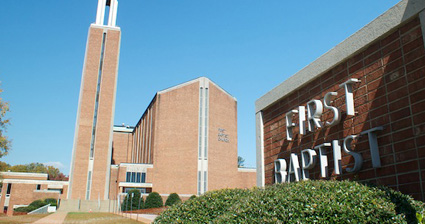
Downtown churches struggling to find their niche in ministry may want to try what First Baptist Church in Chattanooga, Tenn., has done—look and listen.

mustardtree fbc425Besides dinner and Bible study (above), First Baptist Church in Chattanooga, Tenn., offers the homeless showers, laundry facilities and even occasional massages.Paying attention to young voices within its membership and to underserved needs downtown, the congregation launched a shower ministry in October 2013 that has surprised and inspired the members of the congregation.

Since then, the ministry has become the launching point for a number of other services the downtownchurch never dreamed of, Pastor Thomas Quisenberry said.

“It just continues to blossom as we’re shown new ways to help, and thankfully, the congregation is responding,” he said.

‘We weren’t even sure’

It all started four or five years ago in Colorado and Arizona, where First Baptist college students on a mission trip saw shower ministries in action.

Back home, they met with life deacon Herb Hooper and suggested the idea as ideal for the Tennessee Cooperative Baptist Fellowship congregation and the homeless people around it. The church is located just blocks from a homeless shelter and other services for that population in Chattanooga.

thomas quisenberry130Thomas Quisenberry“They pitched it, and I said, ‘OK, but what kind of interest is there?’” Hooper said.

They soon found out.

A fund-raising campaign paid for the installation of showers just off the church gymnasium. The goal was $104,000, but $107,000 was raised in 12 months for eight showers. However, enough money was raised by July 2013 to start the work then, Hooper said.

Hitting those fund-raising marks so soon was a surprise, he said.

“We weren’t even sure that we could raise it in two years, much less in one,” Hooper said.

Expanding ministries

The surprises just kept on coming, and right from the beginning.

Three college students committed to volunteer at the shower each Thursday, when it’s open from 2 p.m. to 5 p.m.

“Then the church just sort of caught on to it,” he said.

“The college students are no longer with us, … but members of the church and the college and youth ministries assist with that,” Hooper said.

More than a year later, some workers in the shower ministry are homeless people who have availed themselves of the service.

fbc chattanooga425First Baptist Church in Chattanooga, Tenn., found a unique way to minister to the homeless in it’s city.The ministry expanded when a local politician donated two washing machines and two dryers to the ministry, which were added to the units the church already had. This enables someone to shower and have laundry done at First Baptist.

Six months ago, the church started offering haircuts by volunteers from a local cosmetology school.

“And we have one guy who comes in to provide massages,” Hooper said. “Last Thursday, we had 18 haircuts, 12 showers, 13 who did laundry and three to four who got massages.”

‘It’s given me a respect’

The church has found its shower and laundry ministry dovetails with another program held at the church on Thursday nights.

It’s an ecumenical ministry called Mustard Tree, which uses the First Baptist gym to serve dinner and hold a Bible study for homeless people Thursday evenings. Different churches serve as the host each night, with First Baptist taking responsibility once a month.

“And it’s all in our gym,” Hooper said.

Hooper, a member of the church 52 years, said his involvement with the shower ministry has inspired him in numerous ways.

The college students who originally pitched the shower idea taught him to think big about projects.

“They wanted to do more than go to Bible studies,” Hooper said. “They wanted to be the hands and feet of Jesus wherever they could.”

mustardtree serving meals425The homeless are fed in the gym at First Baptist Church in Chattanooga, Tenn.They set an example of how a church can look around it to find opportunities to serve.

“Since we are an inner-city church, it lent itself to helping people who just don’t have much,” he said.

Hooper took that approach with a truck ministry he and others from the church began within the past year. Participants use their trucks to move furniture for those who cannot afford to do so themselves.

“It’s allowed me to identify with a population that I knew very little about,” Hooper said of the shower ministry. “It’s given me a respect in many cases for people in that circumstance.”

It’s a good feeling to see someone be able to shower for a job interview.

“Spiritually, it’s something I felt led to do,” he said. “It wasn’t something I sought out in anyway.”

‘The best way is listening’

Nor was it something the church sought out, Quisenberry said.

The congregation already had an openness to reaching out to those in need, especially through its annual Christmas brunch.

The event features more than 150 volunteers serving holiday meals to more than 300. Guests have an opportunity to get their photo with Santa, and each receives a goody bag.

“The showers are just the latest step working with the folks downtown,” he said.

It was from its working relationships with other churches and nonprofits downtown that First Baptist came to learn of the need for a shower ministry.

Knowing many other downtown churches are struggling to find their niches, Quisenberry said he doesn’t recommend shower ministries as the answer.

It’s the paying attention to their surroundings that matters, he said.

“I don’t know what we’re doing has to be mimicked,” he said. “But I do think congregations can find ways to be a positive influence on their community, and maybe the best way is having contact and listening.”


SBC leader sees ‘chasm’ between liberals, evangelicals

Rather than representing two points on a spectrum of Christianity, evangelical Christianity and liberal Protestantism are different and competing religions, Albert Mohler, president of Southern Baptist Theological Seminary in Louisville, Ky., asserted in a podcast.

He said two recent scandals demonstrate “the depth of the chasm that separates evangelical Christianity from more liberal Protestant denominations, in particular the Episcopal Church.”

j gresham machen425In a recent podcast, Albert Mohler referenced early 20th century Presbyterian theologian J. Gresham Machen (above), whose book Christianity and Liberalism argued that liberalism was essentially a different religion than Christianity.One involves Suffragan Bishop Heather Cook, one of the highest-ranking officials in the Episcopal Diocese of Maryland, charged with manslaughter and drunk driving following a hit-and-run crash that killed a bicyclist in December.

A Jan. 9 New York Times story raised the question of whether in a rush to name a female bishop, church leaders failed to properly vet Cook, who pleaded guilty to drunk driving in 2010.

Mohler acknowledged evangelical Christians have their own share of moral scandals but said the two groups hold to a “different moral code,” further evident in a Religion News Service story about an openly lesbian and pro-choice seminary dean stepping down over conflicts with faculty and financial challenges.

“What is really scandalous in this situation is that this president didn’t lose her job because of her very prominent homosexuality advocacy nor her very open and ardent advocacy for abortion,” Mohler said. “Indeed, she didn’t lose her job because of those things. She probably got her job because of those causes.”

‘Different types of thought and life’

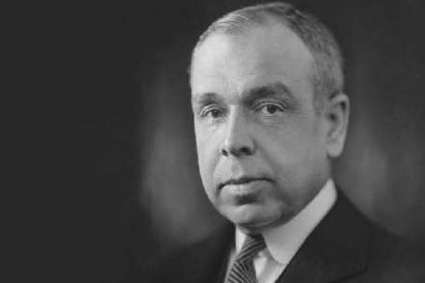
Mohler said he drew attention to the stories “not particularly to dwell upon the Episcopal Church” but rather to repeat a point made in the early 20th century by Presbyterian theologian and Bible scholar J. Gresham Machen.

Machen was a professor at Princeton Seminary who led a conservative revolt against modernist theology that resulted in formation of the Orthodox Presbyterian Church and Westminster Theological Seminary. In 1923, Machen wrote a book titled Christianity and Liberalism arguing that controversies of the day were not between two varieties of the same religion but two essentially different types of thought and life.

Machen is regarded among the last of the great leaders of Princeton theology, a Calvinist form of evangelical Christianity with followers including James P. Boyce, a Southern Baptist pastor, theologian and founder and first president of the Southern Baptist Theological Seminary in 1859.

In the 20th century, some observers believed the flagship seminary of the Southern Baptist Convention drifted into more modern theologies until a course correction in the 1980s and 1990s called the “conservative resurgence” required all seminary professors teach the Bible is without error and literally true.

That prompted massive turnover in the faculties of SBC seminaries, which in turn led to formation of a number of alternative theology schools aligned with the Cooperative Baptist Fellowship, an SBC breakaway group formed in 1991.

‘Two rival religions’

Mohler, elected as the ninth president of Southern Seminary in 1993, is a high-profile leader of a movement seeking return to the denomination’s Calvinist roots that goes by names including Neo-Calvinism and Young, Restless and Reformed.

“When you’re dealing with orthodox Christianity and Protestant liberalism, we are not dealing with two variants of the same religion,” Mohler said. “As Machen correctly said, judged by orthodox Christianity, we’re actually looking in this case at two rival religions, and these headlines, not to mention the stories behind them, make that point all too evident.”


Retired Texas teacher plants church, baptizes 60 in 2 years

AURORA, Colo. (BP)—Mike Alexander never attended seminary. He never had served as pastor of a church. He didn’t even know what a church planter did—that is, until he became one.

mike alexander hug425Mike Alexander welcomes guests to Living Hope Fellowship, a church he started after seeing the need while on a mission trip. The Aurora, Colo., church plant is a part of Send North America: Denver, the North American Mission Board’s strategy to help Southern Baptists plant churches in metro Denver. (Photo by Erik Stenbakken/NAMB)About two years after arriving in Aurora, Colo., and about 23 months after he began learning what church planters do, the church Alexander started has baptized more than 60 people.

The retired Texas teacher visited Aurora on a mission trip in the summer of 2012. During the trip, 16 children began a relationship with Christ. As exciting as that was, Alexander couldn’t help but wonder where those children—all from one mobile home community in the town—would be discipled through a local church.

“There wasn’t anyone out here to disciple them, to move them along,” Alexander said. “That really touched my heart. I overheard the manager of the (community) talking to someone else on our team, saying ‘What we need is an older couple to come here and live here and minister to the people.’

“My wife and I are ex-schoolteachers, and we could do that,” Alexander told the manager.

“Well, come on,” the manager told Alexander with a smile.

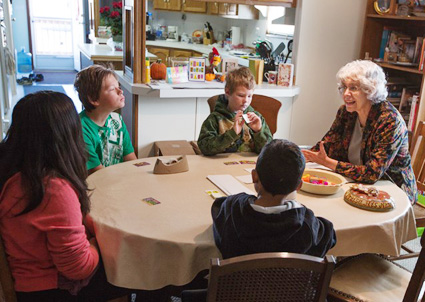
rosemary alexander table425Rosemary Alexander (right) teaches children as part of the ministry of Living Hope Fellowship, a new church plant in the Denver suburb of Aurora, Colo. Rosemary’s husband, Mike, started the church after retiring as a school teacher and administrator in Texas. On most weekends 35 to 40 people attend the worship service. (Photo by Erik Stenbakken/NAMB)What started with God gently tugging Alexander’s heart and a short exchange with the mobile home community manager soon became a full-fledged missionary call. In the next few days, he told his wife, Rosemary, who had stayed behind in Texas, what he believed God was telling him about moving to Colorado. He looked at the house he’d one day purchase. He also found his first ministry partner in the state.

“As I left the house, the first person I met was a guy named Jimmy,” Alexander said. “He’s a Native American with tattoos all over him.”

“What are you doing?” Jimmy asked Alexander.

“Well, Jimmy, I think God wants us to move here to minister to this community,” Alexander said.

“If you do that, I’ll help you,” Jimmy said.

Eight weeks later, the Alexanders moved to Colorado. It wasn’t until he went to church planters’ training through the Colorado Baptist General Convention a few days after arriving in Aurora that he began to understand what it meant to be a church planter.

“I moved here to knock on doors and tell people about Jesus,” Alexander said.

mike alexander turkey425Mike Alexander, who started Living Hope Fellowship in Aurora, Colo., hands out a turkey to a local resident during a Thanksgiving outreach. The Southern Baptist Global Hunger Relief Fund has helped Alexander provide food for needy neighbors as part of his outreach efforts. Alexander, a former Texas school teacher and administrator, started Living Hope to minister to the people of Foxridge Farm Mobile Home Park. (Photo by Erik Stenbakken/NAMB)Soon Alexander had a vision for building a church among the 481 units in the community. Six people—one family—attended the church’s first worship service in the couple’s home. Today, Living Hope Fellowship has 35 to 40 people in a typical worship service. Alexander says if everyone came at one time, the church’s attendance would be around 100.

“I never know who is going to be there,” Alexander said. “Most of the work happens one on one. It’s visitation. It’s talking to people. It’s taking the opportunity to visit. And then, you can’t just lead people to the Lord and leave them alone. There’s discipleship. There’s Bible study.”

Alexander has learned ministry never stops. Sometimes that means giving people rides to work. Sometimes that means buying a bag of groceries for a friend.

“Physical needs are really important here,” Alexander said. “This is not a rich community. This is a pretty low-income place. It’s hard to find a job, and if they find a job, they don’t have transportation.”

During the past two years, Alexander has become so identified with the community, even people not connected to his church come to him for pastoral needs, such as weddings. When one young couple wanted to get married last year, someone recommended they visit Alexander. As he sat down with them for premarital counseling before the first wedding he ever performed, he discovered the prospective groom never had committed his life to Christ.

“I’m not a Christian,” the young man told Alexander. “I’ve done terrible, terrible things. God doesn’t like me.”

“That’s not true. God does love you,” Alexander said before opening up his Bible and taking him through the gospel. The young man became a follower of Christ and, for a couple of months before moving to San Diego, he and his wife were active members of the church.

Two years after answering God’s call to Aurora, Alexander knows what a church planter does—because he is doing it.


‘Holy irritant’ can move Baptists beyond comfort zones, Warnock says

ATLANTA (BNG)—The pastor of Martin Luther King Jr.’s spiritual home challenged the New Baptist Covenant to move beyond comfort zones of race and theology toward a “covenant community” characterized by “creative and redemptive agitation” necessary for substantive change.

nbc logo 300Raphael Warnock, senior pastor of Atlanta’s historic Ebenezer Baptist Church, closed the opening worship session of the Jan. 14-15 New Baptist Covenant Summit in Atlanta with a sermon using the analogy of an oyster, irritated by a grain of sand, ending in the production of a precious pearl.

“There are no pearls without agitation, without irritation, without aggravation,” Warnock said. “As we gather these couple of days, my prayer is that God grant us the courage to get under each other’s skin, to have honest dialogue, holy irritation, to push and be pushed until the Pearl of Great Price that’s genuine transformative community — not tokenism but real community — emerges among us.”

Religious people enjoy their comfort zones more than anything, Warnock said. But he reminded his audience, “Jesus comes to comfort the afflicted and to afflict the comfortable.”

God’s plan is bigger than we think

“God’s plan is bigger than our clan, bigger than our nation, bigger than our tradition, bigger than our church,” he said. “The things that matter so much to us mean very little to God.”

Warnock described the New Baptist Covenant, an initiative former President Jimmy Carter started in 2007 to find common ground for Baptists in the United States divided by race, theology and geography, as a “harbinger of hope” that “bears witness to God’s kingdom and view of love and justice that portends the realization of what Dr. King called the beloved community.”

Among many problems facing the nation, Warnock said, racism is still “America’s original sin and its most intractable social evil.”

“Dr. King used to say that 11 a.m. Sunday morning is the most segregated hour in America, and the degree to which that is still true suggests that despite our anthems, our preachments, our creeds, I have a sneaking suspicion that our sociology is far more important than our theology,” he said.

“Our sociology is far more instructive and far more determinative about what we actually do than our theology. When we gather on Sunday, we ought to at least ask ourselves, particularly if the gathering is utterly homogeneous, we ought to ask ourselves, ‘What brought us here, sociology or theology?’”

Getting under each other’s skin

One test of whether the church is a “comfort zone” or a “covenant of community,” Warnock said, is “Do we have the courage and do we love one another to get under each other’s skin?”

“That is not an easy question,” he said, “because addressing the issue of race is about far more than standing together on a Sunday morning, or even a Wednesday afternoon, and singing Kum Ba Yah” but also asking hard questions that penetrate beneath the surface.

“Race still matters in America,” Warnock said. “It doesn’t just matter when black folk raise the question.”

That truth is most evident in America’s criminal justice system, Warnok said.

“When we consider the meaning of our commitment and our covenant to one another, surely we must ask ourselves: What does that witness look like and sound like—what ought we to be doing right now—in an American moment when the racial contradictions in our criminal justice system are deeper and wider in their impact than they were before the civil rights movement?” he said.

Warnock said during Dr. King’s lifetime and ministry, no one could have imagined a “burgeoning and bulging prison industrial complex that continues unabated regardless of actual crime rates, across Republican and Democratic administrations, over the last 30 years.”

Incarceration capital of the world

“America has a greater percentage of its black population in prison than in South Africa at the height of apartheid,” he said. “We warehouse more people than anybody, including the regimes whose human rights records we love to hate. We’ve got North Korea beat. The land of the free has become the incarceration capital of the world. What does it mean for Baptists to come together in that context?”

Warnock said that is the reason young people are wearing T-shirts with the last words of an African-American man who died in police custody repeating the phrase, “I can’t breathe.”

“Wall Street bankers come to destroy the wealth of millions of American families, almost caused our entire economy to sink into the abyss, and not one banker went to prison,” he said. “Eric Garner was accused of selling a few loose cigarettes on a street corner, and had his life choked out of him. God is not pleased.”

“If we do not stand with him, our Christian witness has no real credibility, no matter how harmonious our anthems,” Warnock said.


Brad Creed elected Campbell University president

BUIES CREEK, N.C. (BNG)—Trustees of Campbell University unanimously elected Brad Creed president of the Baptist-affiliated school in Buies Creek, N.C.

brad creed130Brad CreedCreed, 57, will take office July 1, succeeding Jerry Wallace, who retires June 30 after 12 years as president.

A historian of religion and former pastor, Creed has been an administrator and professor of religion at Samford University in Birmingham, Ala., 13 years—since 2006, as provost and executive vice president. From 1996 to 2000, he was dean of Baylor University’s Truett Theological Seminary in Waco.

“Dr. Creed is the embodiment of all we hoped to find in Campbell’s next president,” trustee Chair Benjamin Thompson said. “He brings the breadth of vision and depth of experience required to lead Campbell to even greater levels of regional and national prominence. He is a man of strong personal faith and deep integrity. I am confident that Campbell has found the right leader at the right time.”

Campbell is “blessed with a strong foundation and is unusually poised for additional growth and remarkable accomplishments in the days ahead,” said Creed, noting he is enthusiastic about the future of the 127-year-old university, about 30 miles south of Raleigh.

A Texas native, Creed graduated from Baylor with a bachelor of arts in religion and received master of divinity and doctor of philosophy degrees from Southwestern Baptist Theological Seminary in Fort Worth. He also studied at Harvard University’s Management Development Program and in the Spanish-language program at Academia Hispano Americano in Mexico.

He and his wife, Kathy, have two grown children. A third child died in 2007 at age 20.


Glorieta lawsuit reassigned to new judge

ALBUQUERQUE, N.M. (BNG)—A lawsuit challenging LifeWay Christian Resources’ sale of Glorieta Conference Center in 2013 has been reassigned to a new judge.

In September, U.S. District Judge James Browning in Albuquerque, N.M., upheld most but not all recommendations by U.S. Magistrate Judge Robert Hayes Scott to dismiss the lawsuit filed by Kirk and Susie Tompkins of Little Rock, Ark. The couple owns a vacation home on property formerly leased from the Southern Baptist Convention publisher.

They claim LifeWay officials weren’t authorized to dispose of the 2,400-acre retreat center near Santa Fe, N.M., without SBC approval and that lessees weren’t offered a fair market value for homes that owners believed were secured with perpetually renewable short-term leases in place for their protection against undesirable neighbors.

Case reassigned

A docket entry for Jan. 2 gave notice the case has been reassigned to Magistrate Judge Carmen Garza in Las Cruces, N.M., appointed to the bench in 2006, who will serve as the pretrial judge. Scott, previously assigned to make recommendations to the federal district judge, no longer is involved in the case.

Scott issued a 79-page report Sept. 5 finding the couple lacks standing to assert LifeWay was not authorized to sell the conference center and secular courts do not have jurisdiction to involve themselves in a dispute involving the interpretation of ecclesiastical rules within a religious body.

Requiring LifeWay to resume ownership of the property would cause “significant financial harm” to LifeWay, Scott said. LifeWay officials claim Glorieta was losing more than $1 million a year before they found a privately owned Christian camping ministry willing to take the property off their hands for a token sale price of $1.

Procedural errors

The judge also faulted Kirk Tompkins, who filed suit without the aid of a lawyer, for numerous procedural errors. Tompkins responded Sept. 18 with a document listing exceptions to Scott’s recommendations and a petition Sept. 26 requesting a new magistrate hearing so he can present recently received new evidence he says bolsters his charge that LifeWay officials acted improperly.

Tompkins claims since he and his wife are not legally trained, they are entitled to be held to less stringent standards than a lawyer. He asserted he doubts Glorieta was losing money, but the financial records he needs to prove it are not accessible to him without a court order.

The previous magistrate said he found no evidence LifeWay lacked authority to sell the property and that an “implied contract” alleged by Tompkins appeared to him to be a “vague impression, general feeling or hope” rather than a “reasonable expectation” based on conversations that are “definite, specific or explicit.”

LifeWay President Thom Rainer said Scott’s recommendations “could not be more positive” and left “no doubt of LifeWay’s integrity throughout this entire process.”


Baptist chaplains wage offensive for military care

LEAVENWORTH, Kansas (BNG)—American military personnel and their families have gone all-out during more than 10 years of continuous war, enduring unprecedented spikes in the tempo and duration of deployments.

chaplains military families425Huge amounts of spiritual and emotional care are needed by military members and their families after a deployment ends. (BNG / U.S. Army photo)That’s why it takes an equally all-out effort by ministers and others to provide spiritual, emotional and material help to warriors and their loved ones when reunited back home, current and former military chaplains assert.

“We can’t provide too much support and care for our military families,” said Gerald Hutchinson, a retired Navy captain and chaplain who now serves as chaplaincy and pastoral care services manager for the Cooperative Baptist Fellowship.

The wars in Iraq and Afghanistan, plus operations in other parts of the world, resulted in longer deployments with shorter periods of rest in between, Hutchinson said. That, in turn, generated increased cases of post-traumatic stress disorder, depression, amputation and suicide.

“That ripples and impacts the families and the caregivers in the community,” Hutchinson said.

The military has some resources to deal with those conditions and needs, especially for service members and veterans who live on or near bases, he said.

Current and former Army chaplains in Kansas are modeling that assistance. They have stepped up with multilevel support and ministries to military personnel and their families.

chaplains gerald hutchinson130Gerald HutchinsonGary “Sam” Sanford retired as a U.S. Army chaplain in 2000. But he didn’t leave behind ministry—or his compassion for soldiers. Today, he ministers directly to servicemen and women and their families and encourages nearly everyone he meets to do so as well.

“I try to get involved in as many places as I can,” he said.

The longtime chaplain understands military personnel from two sides—six years as an Army Reserve medic, followed by 30 years as an Army chaplain, retiring as a colonel.

He concentrates specifically on ways to help those with post-traumatic stress disorder.

Currently, he works part-time as a chaplain at the Dwight D. Eisenhower Veterans Administration Medical Center in Leavenworth, Kan., and is pastor of the nearby Rock of Ages Church.

In addition, he is a volunteer chaplain at the Lansing Correctional Facility and at the U.S. Penitentiary at Leavenworth, concentrating on veterans. He serves as chaplain for Veterans of Foreign Wars Post 56, the largest in the state, and leads a men’s prayer group on the Fort Leavenworth post early each Thursday morning. Sanford also serves as vice president of the Leavenworth Ministerial Association.

Rock of Ages Church has become a “rock” for veterans, partly because most members are veterans or family members of veterans. The congregation hosts monthly dinners for veterans suffering from PTSD. Sanford usually invites a guest speaker, often a veteran who has overcome specific problems.

chaplains amputees250Helping military amputees is another challenge for ministries seeking to serve those currently or formerly in uniform. (BNG / VA photo)Sanford’s ministry bridges the gap between the church and the military. Active-duty chaplains also find ways to bridge soldiers’ military and civilian needs.

For Col. Gary Gilmore, service to military personnel takes a broader approach. As Missouri National Guard Joint Forces chaplain and chief of the Spiritual and Emotional Resiliency section, he focuses his mission on enlisting congregations as a statewide support network.

When he discovered the Partners in Care program, created by fellow chaplain Col. William Sean Lee of the Maryland National Guard, Gilmore saw its potential in Missouri.

The program developed from the idea that congregations could support National Guardsmen and women and their families in their own communities. Chaplains and other leaders could refer soldiers to churches with the services and resources servicemen and women need.

Gilmore continues to seek congregations willing to be partners.

“The network is growing, but the program still needs area coverage. The only way we can cover Missouri is by working through the churches across the state,” he said.

The chaplain sees four issues he considers most pressing for Guard personnel—relationships in their marriage and as parents, substance abuse, medical problems and financial concerns.

Gilmore also wants to see more churches involved for the spiritual support they provide. “Moral injury”—when a soldier violates his or her moral code—wreaks havoc on relationships. Help for these individuals falls in the “pastoral care lane” because ministers “deal with redemption and hope,” he said.

Suicide intervention efforts among National Guardsmen and women have risen in Missouri, which has contributed to the decline in the suicide rate. Gilmore believes church involvement is partly responsible.

“We usually look for a pastor with a master’s degree and who is connected to the community,” he said.


Missions leader Carolyn Weatherford Crumpler dies

CINCINNATI, Ohio (BNG)—Carolyn Weatherford Crumpler, who promoted Southern Baptist Convention missions 31 years as head of Woman’s Missionary Union before helping form the Cooperative Baptist Fellowship in 1991, died Jan. 2 in Cincinnati.

Crumpler, 84, was executive director of the national Woman’s Missionary Union from 1974 until 1989. She retired at age 59 to become a pastor’s wife, marrying Cincinnati pastor Joe Crumpler, who survives.

carolyn weatherford crumplersm200Carolyn Weatherford CrumplerIn 1990, she ran unsuccessfully for first vice president of the SBC alongside Daniel Vestal, the moderate candidate who also lost, setting the stage for the formation of the Cooperative Baptist Fellowship a year later.

Helped lay groundwork for CBF

She was a member of the interim steering committee that laid the groundwork for the new organization, a member of the first CBF Coordinating Council and fourth CBF moderator, serving 1995-1996.

Crumpler remained active in public service until complications from heart bypass surgery in July 2013 put her in a skilled nursing facility.

Crumpler grew up in Florida. She graduated from Florida State University and worked as a high school librarian before enrolling at New Orleans Baptist Theological Seminary to pursue a calling to be a missionary. She wanted to take classes in the School of Theology, but at the time, it was closed to women.

She enrolled in the School of Religious Education, taking all her electives in the theology school. She later remarked it’s a shame she didn’t take homiletics, “because I have been preaching ever since.”

Disqualified from missionary service because of health reasons—high blood pressure—she channeled her energies into Woman’s Missionary Union, an auxiliary to the SBC formed in 1888 to inspire women to support missionaries before the SBC allowed women to attend its annual meeting as messengers.

Sole female member of interagency council

As the sole female member of an interagency council composed of SBC agency heads, Crumpler fit in well until the 1980s, when the nation’s second-largest faith group behind Roman Catholics became less willing to support women in ministry.

She recalled one state evangelism meeting where she followed a preacher who said the Bible commands women to keep silent in the church, and if they have questions they should ask their husbands. She began her message by saying, “Brother, my Bible says the same thing, but I don’t have a husband.” After laughter and applause subsided from the congregation, she continued her sermon.

Crumpler served on the boards of several moderate Baptist organizations started after the SBC controversy, including the Baptist Center for Ethics, Baptist Women in Ministry, the Baptist Peace Fellowship of North America, Baptist Seminary of Kentucky, Baptists Today, Global Women and the CBF Foundation.

Other denominational service

She also was active in the Baptist World Alliance, serving as president of the North American Baptist Fellowship from 1979 to 1981. She also served on boards of the Baptist Joint Committee for Religious Liberty and the American Bible Society.

She received numerous honors, including the Southern Baptist Christian Life Commission Distinguished Service Award in 1987, the E.Y. Mullins Denominational Service Award from Southern Baptist Theological Seminary in 1988 and the Courage Award from the William H. Whitsitt Baptist Heritage Society in 2010.

She wrote or contributed to 11 books and numerous articles in Baptist publications.


State engineer orders Glorieta to cease pumping water

After a site visit to Glorieta Conference Center, New Mexico’s state engineer ordered the camp—which Southern Baptists’ LifeWay Christian Resources sold to an independent Christian camping organization—to cease pumping water into its pond and the overflow into Glorieta Creek.

gloriate paddlers425Campers paddle around the lake at Glorieta Conference Center.In a Dec. 5 letter, Ramona Martinez, Upper Pecos Basin supervisor in the state water rights division, reported a representative from the state engineer’s office met with Glorieta management regarding the issue after a November field-check of the pond and eight wells.

The state official verbally informed Glorieta “all pumping into the pond and overflow of water into Glorieta Creek must cease until all issues pertaining to their water rights, current use and administrative matters have been addressed and resolved,” Martinez wrote.

The letter noted the state engineer’s office was informed Dec. 3 the camp had hired Glorieta Geoscience Inc. “to assist them in rectifying the operational and administrative problems within the compound.”

The state engineer’s office requested copies of all documents related to the wells and was “in the process of verifying all meters, serial numbers, and meter reading and use,” Martinez wrote.

The state office also informed the camp administrators of “their responsibility to act within the limitations of their permits, as well as maintain compliance with our office in terms of administrative paperwork,” the letter stated.

Neighbors had complained, alleging the conference center was wasting water and draining the aquifer basin that fed their wells—an assertion Glorieta officials denied.

“Glorieta has not wasted water. We have pumped more than in recent years because we have had greater occupancy and activities,” said Anthony Scott, Glorieta executive director.

‘No proof and only supposition’

“Not only have we chosen to be good stewards in our usage, we have responded positively to our neighbors. Although there is no proof and only supposition that our use of a (re-energized) particular well has affected the level of water in wells more than a mile from our property, as soon as I heard that suggestion, I had that well turned off and have not used it for anything other than testing purposes. Unfortunately, that hasn’t been appreciated nor has it stopped the unproved allegations and complaints.”

Anita Nugent, who filed the complaint, sees a direct cause-and-effect relationship between Glorieta’s increased water usage and serious issues she and her neighbors have faced this year.

gloriata ropesCampers take advantage of the ropes course at Glorieta.For most of the 31 years Nugent has lived near Glorieta Conference Center, she experienced no serious water problems, apart from any common to other residents of drought-plagued northeast New Mexico. That changed seven months ago, when water pressure from her well began to drop, eventually slowing to a trickle, she said.

“With no water running outside, it is to the point now where if I try to run water for a bath, I can only get about two inches in the bathtub, and then the water shuts off,” she said.

Reported problems with nearby water wells

About a half-dozen neighbors in a straight line extending from Glorieta Conference Center reported similar problems, she noted. One, who installed a new well and pump just two years ago, saw pressure drop from 100 gallons per minute to less than 10 gallons per minute, she said. However, homeowners across the road, whose wells pump from a different aquifer basin, experienced no problems, she observed.

Nugent—a 70-year-old physics teacher—asserted the camp was wasting water to inflate its recorded water usage for 2014, so it could launch a water park in the future. New Mexico bases legal water rights on historic usage, looking at how much was used the previous year, she explained.

Scott disputed her assertions, saying appropriate agencies monitored the camp’s water usage throughout the year, and Glorieta complied with their instructions.
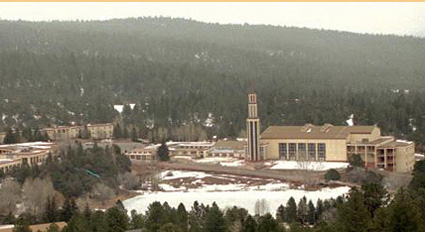
glorieta snow425Southern Baptists’ LifeWay Christian Resources sold Glorieta Conference Center to an independent Christian camping organization.“We don’t have any plans to expand our water-recreation facilities at this point. As with all our plans, we will study our programs and needs each year to determine where we will expand.”

Before she complained to the state engineer’s office, Nugent contacted Glorieta. She asserted a staff member responsible for well maintenance told her the camp had “redone” its pond and needed to refill it, pumping 24 hours a day, seven days a week at a rate of 200 gallons per minute.

“He stated that they had the pumps running at 200 gallons per minute 24/7 since early April—when we started seeing some well problems,” Nugent said.

Charges of wasteful water usage

When she asked how long it would take to fill the pond, he allegedly acknowledged it already had filled two weeks earlier, and the camp was pumping overflow into Glorieta Creek, so the camp could prove its water usage rights. If pumping continued for a full year, Nugent calculated the total amount at 105 million gallons.

“The fiscally and environmentally responsible thing to do would be to line the pond and install a circulating pump,” she said. “It is raping the environment to pump water directly into the pond and let it flow uselessly into Glorieta Creek.”
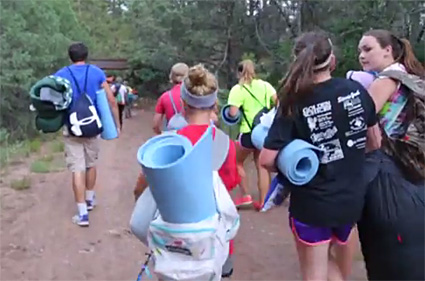
glorieta campers425Campers arrive for an event at Glorieta.Scott insisted Glorieta has not expanded its lake or wasted water, and he denied allegations Glorieta had pumped dry one of its own wells.

“The lake at Glorieta has the same footprint along its shore that it has had for 60 years,” he said. “It is shallower than before, and it now contains an island. Therefore, it has less surface space and less volume than before.”

The field-visit by the state engineer’s office “did not reveal any evidence of the pond referenced in your letter being enlarged or recent construction other than the addition of recreational amenities,” Martinez wrote to Nugent.

The pond at the conference center was built in the drainage of Glorieta Creek, Scott noted.

“It is a natural creek that flows with spring runoff and rains that occur in the mountains,” he said.

“Whenever the lake is full and water continues into it from an upstream source, it continues to flow out of the lake into Glorieta Creek. Our downstream neighbors love it when this happens—and incorrectly blame us when it doesn’t. We have a re-circulation system that takes water from the lake, pumps it upstream and back into the hardened creek bed so that it will flow back into the lake, circulating and re-oxidizing the water.”

Nugent insists she and others in the area had a good relationship with the historically Baptist conference center many years. Three family members worked at the camp in the past, and her daughter was married in Glorieta’s prayer garden.

“I have known many of the past employees as good friends, and our children grew up together, as well as going to church together at First Baptist in Santa Fe,” she said.

Digging  new wells could be costly

But that relationship changed. Several of her neighbors already have spent thousands of dollars on their water systems, often with disappointing results, she noted. If Nugent has to dig a new deeper well, it will cost $20,000.

“I feel that if we don’t stay on top of this, all may be lost,” she said. “If they use groundwater the way they did last summer, all our wells are in further jeopardy.”

Based on what some people in the area have reported, she wonders how long Glorieta has been pumping water in what she considers a wasteful manner.

“I am getting phone calls all the time from people in the area who are upset at the waste of water that has taken place,” she wrote in a Dec. 30 email.

“About two to three weeks ago, I heard from a lady who personally witnessed and photographed the same huge stream of water coming from large pipes in Glorieta and pumping directly onto the ground. She thought it so odd that she took photographs of this and sent me one. This occurred, not this year, but in September of 2013. This makes me wonder just how long this wasteful water use has been occurring.”