Campus ministry leaders prepare at Collegiate Week
August 21, 2024
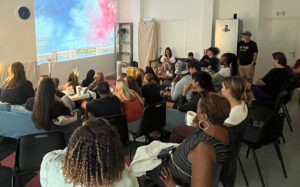
Days before the start of a new school year, more than 1,730 college students and leaders gathered at Falls Creek Conference Center in Oklahoma to learn how to live on mission and become passionate followers of Jesus.
Groups from across North America—including Alaska, Hawaii and Canada—met with International Mission Board and North American Mission Board personnel for the five-day event that included worship, teaching and fellowship.
State convention collegiate ministry leaders partnered to plan and produce the event, which saw its largest post-COVID attendance this year.
Pastor Arjay Gruspe of Pawa’a Community Church in Honolulu, who also is director of Next Generation Ministries for the Hawaii Pacific Baptist Convention, served on the event planning team.
This year he brought eight others from Hawaii, including four students, to “challenge them to be countercultural in the way they live and approach life on their campuses.”
He celebrated the report that more than 50 individuals prayed to receive Christ as Savior and more than 200 responded to a call to ministry during Collegiate Week.
“It was great to see so many campus and church-based campus ministries interacting and planning ways to partner and pray for one another this fall,” Gruspe said. “IMB always has a strong presence and did a great job in having students consider mission involvement.”
Gruspe added he was glad to see increased numbers of seminaries engaging with students this year.
‘College years are pivotal’
Collegiate Week partners with Southern Baptist seminaries, Woman’s Missionary Union, NAMB and IMB to introduce students and leaders to a wide spectrum of available missions, vocational and educational opportunities.
Registration Coordinator Carissa Jones of the Oklahoma Baptist Convention noted the event also seeks to help participants take their next steps in ministry leadership.
“The college years are pivotal. Students are often on their own for the first time and making decisions that will impact them for the rest of their lives,” Jones said. “The world is there waiting for them, and the body of Christ needs to be as well.”
H.B. Charles, Shane Pruitt and Tommy Woodard were featured speakers during the 2024 Collegiate Week, with worship sessions led by Cody Dunbar and Matt Roberson.
Participants recorded decisions and requested follow-up contact through a QR code, and others responded during worship services, which saw hundreds of participants gather throughout the altar area.
Denton minister brought 35 students
Jared Gregory, college pastor at First Baptist Church in Denton, has brought students from his church’s ministry to Collegiate Week since 2018 and has served in several planning capacities for the event over the years.
He characterized it as a time for students to “connect with God, each other, and our mission agencies” before the back-to-school rush sets in.
This year, Gregory brought 35 students from the University of North Texas, Texas Woman’s University and North Central Texas College.
“It’s such a good week to see students get right in their relationship with God before they start ministry to others,” Gregory said. “This year, we had a number of students come forward to confess sin in their lives that is holding them back from God, and three students declared a call to ministry.”
Stacy Murphree, campus minister at Austin Peay State University in Clarksville, Tenn., said the timing of Collegiate Week is a bonus, right before the beginning of fall semester. This year, she brought about 100 Baptist Collegiate Ministry students from six campuses, and she said student and leaders benefitted from networking and sharing ideas.
The experience also “jumpstarts” her leaders, who had about one week before campus ministries officially started, she added.
“I love that our students can hear about campuses in emerging areas. Maybe they could feel personally led to serve in those areas, but this also broadens their perspective of campus ministry that’s not just about what we do on our campuses,” Murphree said. “It’s about what God is doing throughout the United States.
“Nowhere else could they be with other students from other BCMs across the country and now be able to better pray for those campuses, too. This is such a valuable time.”
Health care paves the way for gospel in Indonesia
August 21, 2024
EAST JAVA, Indonesia (BP)—A health care triad—including a Baptist hospital, a rural clinic and a nursing college—in East Java is reaching far beyond the island’s, and even the country’s, borders.
The history of Southern Baptist work in Indonesia is long, dating back to 1951, when missionaries first went to the island nation. Medical work wasn’t far behind, and it soon became a key strategy for gospel access.
From its beginning in 1955, the Kediri Baptist Hospital has focused on excellent medical care with the vision of the Great Commission. (IMB Photo)
By 1955, nurses Ruth Ford and Everly Hayes and Dr. Kathleen Jones had started the Kediri Baptist Hospital. For decades medical doctors sent through the International Mission Board—formerly Foreign Mission Board—remained in leadership and service.
To provide trained nurses to serve at the hospital, IMB missionary nurse Virginia Miles founded Kediri Baptist Hospital Health College in 1961.
Today, the medical facilities are led by Indonesian medical professionals committed to the gospel and the vision to use health care to make the gospel known to all nations.
Indonesian Baptists work closely with the International Mission Board to maximize the reach of the gospel and lead other Christian health care professionals to meet physical and spiritual needs.
Emphasis on the Great Commission
IMB missionary Jacob Stanley serves as a liaison between the medical facilities in Kediri, Indonesian Baptists and health care professionals in the United States. He explained how an emphasis on the Great Commission was woven into the history of the medical work in this area.
“More than 60 churches, still in existence today, can trace their roots to the evangelistic work of the Kediri Baptist Hospital,” Stanley said. “Evangelism was part of the founding.”
On a typical day at the Kediri Baptist Hospital, all beds are full, and expectant mothers eagerly wait for their turn in the newly renovated maternity ward.
As is common in Indonesia, family members of patients wait at the hospital, sometimes days, resting on blankets laid out in hallways. Not all rooms are air conditioned, but the Indonesians do not seem bothered by the constant heat and humidity.
The hospital’s director, Dr. Iva Yuana, takes time to greet family members warmly, as she steps around them moving through the halls. She doesn’t stay in her office for long, because she continues to practice pediatric medicine.
Yuana considers the facility to be behind the times, according to world medical standards. Still, the hospital thrives as a trusted source for excellent health care.
Approximately 500 students attend the health college, all with a goal to receive a degree in nursing. The college is open to men and women and students of all faiths. Half of the students are Muslim. All students participate in Bible study and chapel services.
Safe place for spiritual inquiry
The college has become a safe place to ask questions and read the Bible, even for those who would be forbidden from these activities in their homes. Indonesia remains the country with the largest concentration of Muslims in the world.
The college is also intentional to train Christian nurses as missionaries, who will be presented with opportunities to practice medicine in unreached areas. The nursing college intentionally presents requests from other countries to students who are willing to be trained in evangelism, in addition to their medical training.
Six students who passed a Japanese-language course are preparing for work in Japan. They will serve in health care facilities and will also be connected with IMB missionaries and Japanese churches to increase the reach of the gospel in East Asia.
Opportunities to serve in countries closed to the gospel or missionary presence also are increasing, as health care needs around the world continue to grow.
Clinic meets needs in rural area
The most recent addition to Baptist health care facilities is the Eternal Peace Clinic. In 2020, the clinic opened its doors to rural community residents who can receive both medical and dental care. The clinic includes a pharmacy, so those without transportation or without the funds to travel to the city can get the care and the medicines they need.
Staff at Eternal Peace Clinic are trained to pray with patients and engage them in gospel conversations while they wait to see the doctor or stand in line for prescriptions to be filled. Home visits provide opportunities for follow-up to physical and spiritual conditions.
Stanley said he has great respect for the work of Indonesian leaders and wants to increase opportunities for health care professionals and churches in the United States to partner with the work being done through the facilities in Indonesia.
Walking through the facilities, Stanley points out equipment donated by churches, even a CPR dummy that he himself carried through immigration on a return trip from the United States. In fact, the Eternal Peace Clinic was built through contributions to IMB’s health care ministries.
Historically, this key work with the Indonesian Baptists has led to “churches planting churches that plant churches,” Stanley said. “We just need more people to join the vision of how health care strategies are reaching the lost with the gospel.”
BGCT and NAMB leaders discuss bridging gaps
August 21, 2024
Baptist General Convention of Texas and North American Mission Board representatives met at the Texas Baptists’ offices Aug. 15.
The meeting followed-up the exchange between Dustin Slaton, senior pastor of First Baptist Church in Round Rock, and North American Mission Board President Kevin Ezell at the Southern Baptist Convention meeting in Indianapolis.
At the June meeting, Slaton posed a question from the floor to Ezell regarding BGCT churches receiving NAMB funding for church starts in Texas.
In his answer, Ezell expressed a willingness to discuss the relationship between NAMB and the BGCT, while also stating an unwillingness to deviate from NAMB’s longstanding commitment to start churches in partnership with state conventions that affirm the 2000 Baptist Faith & Message.
The who
BGCT pastors who attended the meeting between the two entities included Slaton; Chad Edgington, pastor of First Baptist Church in Olney; Pete Pawelek, senior pastor of Cowboy Fellowship in Jourdanton; and Jeff Williams, senior pastor of First Baptist Church in Denton—who also are current BGCT Executive Board directors—and Dan Newburg, senior pastor of First Baptist Church in Devine.
BGCT Executive Director Julio Guarneri, Associate Executive Director Craig Christina and Treasurer/Chief Financial Officer Ward Hayes also participated, along with BGCT Executive Board Chair Bobby Contreras, pastor of Alamo Heights Baptist Church in San Antonio.
Ezell and Rusty Shuler, church relations mobilizer, represented the North American Mission Board. Williams, while not an official liaison, holds leadership roles with the BGCT and NAMB until he concludes BGCT executive board trustee duties in a few months.
Guarneri stated he “genuinely appreciate(s) Kevin’s willingness to come this way and meet with a handful of our Texas Baptists pastors, some of whom also serve with our BGCT Executive Board.
“These pastors have such a strong heart and passion for seeing God’s kingdom advanced in Texas and beyond. I am grateful for their time and attention in this matter. As I’ve said before, there is too much lostness for any one group to think they can do it alone. We all know we are better when we work and minister together.
“I look forward to the continuation of this dialogue as we seek to fill in the gaps and resource our Texas Baptists churches to live out the Great Commission.”
Ezell commented: “It was really a meeting that grew out of Dustin Slaton’s question to me from the floor of the [SBC] annual meeting. We talked by phone a few times and planned to get together in person and then more pastors wanted to join in.
“I appreciated Julio hosting us and being able to spend time with him and the pastors. We are grateful for the generosity of BGCT churches and look forward to continuing to serve them and partner with them,” Ezell said in an email.
Slaton echoed that sense of collegiality stating: “The conversation between those in the room was honest, cordial and hopeful for a good relationship between the BGCT and NAMB.”
The what
He explained when he asked his question at the SBC annual meeting, he hoped to initiate a dialogue that would improve the partnership between the BGCT and NAMB.
“Thursday’s conversation was a great step in that direction,” Slaton said.
Slaton stated he was “encouraged to find that BGCT churches do have access to NAMB resources, training, personnel and assistance through the church planting process.
“Basically, aside from funding, we have access to anything anyone else has access to, and the funding can possibly come through the $300,000 NAMB grants to the BGCT, annually.”
He said the meeting gave him hope “we may find ways in the future to see an increase in funding to the BGCT through a re-evaluation of the process.”
Counting giving through the Annie Armstrong Easter Offering and Cooperative Program contributions to the SBC, Texas Baptists estimate BGCT churches give about $5.5 million annually to NAMB.
Slaton hopes BGCT churches hear they have access to church planting tools and guidance from both BGCT and NAMB, should they wish to utilize either or both organizations’ resources.
Edgington credits Pawelek with connecting all the parties to ensure the meeting suggested in the Indianapolis exchange actually came to pass.
Pawelek demurred credit, deferring it instead to NAMB and BGCT leaders who made time to come together with concerned pastors. He wanted the meeting to “get some clarity” and make sure the history of cooperation between NAMB and BGCT continues, he said.
Edgington said everybody in the meeting was kind, and they heard and cleared up misconceptions about the relationship between NAMB and the BGCT, which is complicated by differing statements of faith.
Edgington said Ezell came to listen to the BGCT side, and it was good to hear everything “from the horses’ mouths” on both sides, in an atmosphere of cooperation.
He noted the tendency in Baptist life for the things that get “drummed up” to distract from recognizing what Baptists have in common.
The Why
“Sometimes it’s good to realize that we’re all on the same team,” he continued. “And that there’s massive agreement and a real desire to plant churches and reach people for the gospel on both sides.”
Williams noted in his role as pastor ambassador for the North American Mission Board, he’d had questions come his way from pastors about the relationship between NAMB and the BGCT.
So, he welcomed the opportunity the meeting provided to allay misconceptions about boundaries to cooperation between the two organizations.
Slaton said he expressed appreciation to both Guarneri and Ezell for firmly but graciously expressing the positions and concerns of their respective organizations.
He did not sense pressure to achieve certain changes from either of the represented organizations, stating: “If every issue between differing views and different groups was handled as well as this meeting, the SBC would be a much better environment. I was proud of both the BGCT and NAMB.”
As the intent of the meeting was dialogue, not action, no actions were taken, and no further conversations have been scheduled—though the pastors and organizational leaders expressed hope dialogue will continue.
Editor’s note: paragraph three was edited and paragraph 19 was added after the article initially was posted to provide clarification and additional information.
Black Baptist group gets $1 million to aid African girls
August 21, 2024
MEMPHIS, Tenn. (RNS)—A Baptist missions organization has received a $1 million donation from a Virginia megachurch, boosting its efforts to help girls in Africa.
Lott Carey, a predominantly Black organization long known as the Lott Carey Baptist Foreign Mission Society, traditionally as held fundraisers as part of its annual gathering, which this year occurred Aug. 12-15 in Memphis, Tenn.
Lott Carey President Gina Stewart had announced beforehand she hoped to raise $1 million on the last night of the convention. But Alfred Street Baptist Church, a historic Black church in Alexandria, Va., decided to raise money ahead of that occasion.
Alfred Street Pastor Howard-John Wesley told Religion News Service he learned during a church trip to Ghana arranged by Lott Carey Executive Secretary-Treasurer Emmett Dunn about the plight of girls caught up in the Trokosi tradition in that country.
Girls are turned over to priests at religious shrines for forced labor and ritual, sexual servitude as payment for the sins of their relatives. Although Ghana criminalized forced labor in 1998, Trokosi priests have continued to practice their servitude system “unchallenged” by law enforcement, according to child rights experts.
“It was our trip to Ghana that exposed us to the slave trade industry that you wouldn’t believe still existed in 2024,” Wesley said. “We really felt like God gave us an opportunity to make a difference in freeing some of these young ladies.”
Support ministry of Ghana Baptists
The money will be used to support the ministry of the Ghana Baptist Convention, one of the largest denominations in Ghana, to rescue young girls whose families have sold them into the long-established system, opposed by the United Nations Committee on the Rights of the Child.
The ministry works to rehabilitate the girls, teaching them at a vocational training center that aims to give them skills to allow them to reintegrate into society.
Stewart, the senior pastor of Christ Missionary Baptist Church in Memphis, said she too learned about Trokosi’s mistreatment of the girls during a trip to Africa.
“My journey to Liberia and Ghana with Lott Carey in 2022 was life-changing,” Stewart said in a statement. “Shortly thereafter, Rev. Dunn led a trip to Ghana with 100 Alfred Street members, and they too were blessed by the beauty of Ghana and shaken by the horrors of the dehumanizing indentured servitude known as the Trokosi tradition and vowed to make a difference.”
The $1 million donation is rare for Lott Carey, which has an operational budget of $2.5 million. It received an equal sum from Fountain Baptist Church in Summit, N.J., for relief efforts related to Hurricane Katrina.
Congregational raised funds through fasting
The donation sum also is not the first for Alfred Street, which gave $1 million to the National Museum of African American History and Culture in 2015 and donated the same amount to Jackson State University, a historically Black institution in Mississippi, to help students and officials as they dealt with a crisis in 2022 after high levels of lead were found in its water.
About 950 people attended the Lott Carey meeting, including about 20 people from the Virginia church whose trips to the Memphis gathering were subsidized by the church. Alfred Street has about 2,000 people in attendance in person on Sundays and another 20,000 who watch online each week.
Wesley said his church raised the money through a 40-day fast in 2023 when members and supporters were asked to set aside daily devotional time and give up favorite foods, drinks and habits and use the money they would have spent on them for a donation.
“For me it was all wine, all caffeine, it was all sugar, all fried products—and all spending from Amazon,” he said.
In all, Wesley said, about 14,000 people participated, and some fasters gave more than the amount equivalent to their change in spending habits.
“They actually gave about $870,000, and the church leadership said that’s too close to a million not to raise a million,” so the church used its Tithe-the-Tithe Initiative, which gives 10 percent of weekly donations it receives to help community groups.
The infusion of money to support the girls in Africa comes as Stewart concludes her historic leadership of Lott Carey. In 2021, she became its first woman president, marking the first time a Black Baptist organization had chosen a female leader.
Stewart, a former Lott Carey first vice president, was succeeded as president by First Vice President Jesse T. Williams Jr., senior pastor of Convent Avenue Baptist Church in Harlem.
Lott Carey, named for a former slave who gained his freedom and was a pioneer missionary in Africa, was founded in 1897.
IMB partners with French believers for Olympics follow-up
August 21, 2024
PARIS (BP)—As a French pastor was setting up for a community outreach event during the Olympics, he recalled a conversation he had overheard years before and had never been able to forget. A mother and child were walking along the street in front of his church.
“What is this place, this building?” the child asked.
“It’s a museum,” his mother responded.
The 2024 Olympic Games in Paris offered an opportunity for the International Mission Board’s team in Paris to strengthen partnerships with French churches, mobilize local believers and fuel future church planting efforts. (IMB Photo)
During the outreach, the church was packed with people as they opened their doors to the community for a children’s festival. An unprecedented number—more than 100 people—attended the outreach event.
The church, located in an area where many Muslims live, set up play stations around its courtyard, as well as inside the building. Some mothers told their children they could only play outside, but suddenly it began to rain.
As everyone rushed to move the games inside, the children begged their mothers to go inside the church and keep playing. For some, it was their first time to ever enter an evangelical church.
Several people who came to the event returned for Sunday church services and asked the pastor if they could meet to discuss their questions about faith. He was thrilled.
“I don’t think anyone is ever going to see this place as a museum again,” the French pastor told Jason Harris, Paris team leader with the Southern Baptist Convention’s International Mission Board.
Small evangelical presence in France
French people are one of the largest unreached people groups in the world. Large pockets in France of 200,000 to 300,000 people have no evangelical churches at all. Ninety-five percent of French churches have fewer than 100 people, and most are fewer than 50.
“There’s usually one pastor on staff, and he’s the custodian, the secretary. He does everything,” Harris explained. “He has a lot on his plate.”
A local church in Paris hosted “The Living Room,” an open seating area with coffee, water, air conditioning and live streaming of the Olympics. (BP / Submitted Photo)
Not only does evangelical presence in France remain small, but Christianity confronts a hostile spiritual climate. One Southern Baptist volunteer met many Parisians this summer, and he noticed they were often uninterested and even resistant to the gospel of Jesus Christ.
Local churches have struggled to make significant progress in church planting and missions among the French.
“We’re often asked why we’re in France, a western country that maybe doesn’t seem like a mission field to some. But the worldview that France unveiled before the entire globe at the opening ceremonies of the Olympic Games is a very clear answer to why we’re here,” Harris said.
His team envisions planting five churches in Paris within the next five years. But they know church planting in a post-Christian environment like France is a long and rigorous marathon, often lonely and isolating. Harris said one of his team’s greatest needs is strong partnership with existing churches.
“Ultimately, we’re here to serve the French church, and we want to equip and strengthen them as much as possible,” Harris said.
He expressed his hope that working alongside local churches for Olympics outreach will help strengthen these partnerships, mobilize local believers and fuel future church planting efforts in Paris and beyond.
“I pray this is an opportunity for Christians in France to really step up and to take seriously the responsibility to reach the nations that are in their own backyard,” Harris said.
Local pastors encouraged
Several local pastors have reached out to Harris and expressed how encouraged they’ve been by opportunities the Olympics have created for the gospel. Churches that initially were wary or overwhelmed by the prospect of partnering to host outreach events are now jumping in to fill needs as they hear stories of God moving among their communities.
A team from North Carolina distributed hundreds of Bibles on the streets of Paris during the 2024 Olympics.
After one local French believer participated in IMB’s Olympic outreach for a day, she messaged Harris to say how amazing the outreach was and told him she wanted her church to be more involved. He encouraged her to talk to her pastor, and she did. The pastor made an announcement to his congregation, encouraging members to participate.
Later, Harris contacted her pastor for help when they had hundreds of digital engagement contacts reaching out to them from social media ads and QR codes, but not enough French speakers available to respond to messages. The pastor sent a group text to his church members, and soon they doubled the number of digital engagement responders available for conversations with French speakers.
Another local church in a Paris suburb hosted a talent show to make connections in its community. The event, which included line dancing, jokes, music, skits and games, provided an open place for nonbelievers to come and see believers having fun and to hear the Gospel in a relational way. Harris said it was simple but fun, and they were encouraged to see so many people come into the church—a big step for a lot of people in France.
A pastor’s wife from another church went with some members of the Paris team to do street evangelism. She shared the gospel using custom-designed Olympic pins as an evangelistic tool and prayed with five people who made professions of faith.
These glimmers of growth in a nearly lifeless spiritual landscape bring hope and encouragement to Harris, his team and local French believers as they labor for the spread of the gospel among the French.
“We pray this summer leads to a fruitful season of church planting in Paris, alongside the French church,” Harris said. “Pray for endurance, partnership and a harvest across France.”
BWA names director of Global NxtGen Leadership Initiative
August 21, 2024
The Baptist World Alliance named Tim McCoy, former executive minister of Canadian Baptists of Ontario and Québec, as director of its new Global NxtGen Leadership Initiative.
BWA created the position to develop and implement a strategic new BWA initiative for leaders ages 18 to 35. The aim of this initiative is to enhance existing programs with BWA member partners around the world and provide an additional global opportunity to strengthen the skills and experience of next-generation leaders.
McCoy also will serve as team leader for the NxtGen Leadership Summit, where the initiative will be launched in July 2025. The summit will be offered July 7-8 next year as a pre-conference leading up to the 23rd Baptist World Congress in Brisbane, Australia, convening July 9-12.
“We are blessed to welcome a seasoned leader like Tim to our BWA team and anticipate how the Lord will use his gifts to engage young leaders and further God’s global mission,” BWA General Secretary Elijah Brown said.
“As a participant myself in the BWA’s first emerging leaders initiative 20 years ago, I am excited to see next-generation leaders from around the world experience the joys of learning, serving, and growing with our global family and us with them.”
McCoy has served in various church and denominational ministry roles since 1994. He was ordained in 1995 and served more than a decade as the associate pastor for youth ministry and leadership at Independence Hill Baptist Church in Mecklenburg County, N.C.
He relocated to Canada in 2006 to serve as the director of youth ministries for Canadian Baptists of Ontario and Québec. During his four years in the role, he coached and mentored 65 full-time and part-time youth ministry leaders and managed conferences for youth and youth workers.
From 2010 to 2023, he led Canadian Baptists of Ontario and Québec as executive minister, serving 320 churches by providing resources, leadership development and spiritual guidance.
“I am deeply grateful for the opportunity to serve God by serving the BWA family. It is an exciting venture to work with global leaders to find and make known the high-capacity young leaders in our Baptist family,” McCoy said.
He also has held international leadership roles with North American Baptist Fellowship, one of the six regional fellowships of the Baptist World Alliance, as well as serving as a member of the BWA Youth Committee, its Executive Committee and the BWA Commission on Transformational Leadership.
McCoy holds a Master of Arts degree in Christian education, organizational leadership and structural change from Pfeiffer University in North Carolina and a Bachelor of Arts degree in religion, communications and journalism from Mars Hill University.
In addition to his role with the BWA, McCoy serves as interim director of the Mentored Ministry program and an adjunct lecturer at Acadia Divinity College in Wolfville, Nova Scotia. Canada. He and his wife Julie live in Nova Scotia.
Southern Baptists in NC participate in week of service
August 21, 2024
RALEIGH, N.C. (RNS)—About 100 mostly homeless men lined up outside Oak City Cares, a multi-service nonprofit on the downtown’s edge, by 9 a.m. on Aug. 9. Anne Bazemore was there by the door to offer them a hot cup of coffee.
Bazemore, 25, was one of a handful of volunteers from Imago Dei Church who spent the week of Aug. 3-10 volunteering with various civic organizations as part of ServeNC, a statewide project launched this year by the Baptist State Convention of North Carolina.
A total of 1,169 mostly Southern Baptist churches in 92 of North Carolina’s 100 counties participated in the effort, fielding volunteers for a week of service helping vulnerable populations, including homeless people, orphans, prisoners, refugees and the elderly.
By Friday, Bazemore knew the names of some of the regulars and how they liked their coffee—black, with cream and sugar, or extra sugar. On a counter just beside the door were two insulated 5-gallon coffee urns. Bazemore poured out coffee until there was no more.
She had spent two hours each morning this past week at Oak City Cares, an organization that offers the unhoused a place to shower, do laundry and get medical and case management services.
“Just as I was once far off and have been saved and given a family and given hope by the grace of God, I love getting to love and serve the marginalized in my city,” Bazemore said. “And I count it a great gift that I get to do it.”
Nearly half of SBC churches in NC participated
Summers are often a time when congregations send out people to far-off mission work. This year, Southern Baptists in North Carolina envisioned something closer to home.
“In my almost 20 years of being a Christian, I can’t remember a time that a group of churches this large was doing something like this together,” said Todd Unzicker, executive director-treasurer of the Baptist State Convention.
There are approximately 2,800 congregations that partner with the state convention. Nearly 45 percent participated.
Despite a tropical storm that scuttled some outdoor projects, the churches managed a range of aid initiatives.
In Winston-Salem, Calvary Baptist Church packed 750 school backpacks. First Baptist Church of Raeford built a wheelchair ramp for a couple in the community. Friendship Southern Baptist Church in Concord put on a “Senior Prom Night” at a local nursing home. Salem Baptist Church in Dobson stocked shelves and bagged groceries at a local food pantry.
The Southern Baptist Convention has faced a series of challenges in recent years: declining membership, a sexual abuse crisis, a crackdown on women pastors, a condemnation of in vitro fertilization, an embrace of Trump and MAGA politics.
ServeNC was a local effort to get out from under those challenges and serve the communities.
As Baptists who have taken strong anti-abortion stands, many congregations enlisted their members to volunteer at unlicensed anti-abortion centers that counsel women against terminating their pregnancies. The North Carolina legislature has spent about $49 million since 2013 to support anti-abortion centers.
Projects focused on communities in need
But mainly, the ServeNC projects were intended to help communities in need.
Wesley Knapp and his wife, Conner Waldrop, volunteered at a weeklong Vacation Bible School in a Raleigh apartment complex that houses refugee families from several different countries.
The young couple—he is 25, she is 24—are members of Imago Dei Church and said the experience of playing with the children, many of whom were just learning English, was fun and eye-opening. On Saturday, they planned to take the children to a trampoline park.
“I think we both left this experience with more of a pull toward fostering and adopting down the road,” Knapp said. “It was just so cool to interact with those kids and again, just the humility that that brought into our lives during that week was super impactful.”
For Zac Lyons, the pastor for missions and evangelism at Imago Dei, the weeklong service project was a way to cultivate a deeper commitment to helping others.
“The real focus is to have people regularly serving in the community,” Lyons said. “It’s a catalytic tool to see they can do this on a regular basis.”
Scholarships help CWJC graduates take next steps
August 21, 2024
Marie Beam said she’s always liked working on cars. She found out early on that she didn’t like being stranded. She’d rather be able to do something about it when her car had problems.
“I started learning how to do it myself,” she said.
Then she started helping the women in her apartment complex, who frequently had car trouble.
“It’s something I love to do,” Beam said. “So, I started thinking maybe I could do it as a career too.”
Through Christian Women’s Job Corps of Tyler, she’s had the support to enroll in college and start making that happen.
“I’ve got six classes left,” she said.
And thanks to the Faye Dove Scholarship, a gift provided by the WMU Foundation to help a CWJC graduate further her education, Beam now has money to buy the tools to finish her associate’s degree in automotive mechanics at Northeast Texas Community College.
The scholarship also will help her continue to provide support for her four children, who range in age from 2 to 12.
“Everything I learn, I get out there and show my kids what I learn,” she said. “Hopefully, it’s the gift that keeps on giving.”
Beam was one of two recipients of the Faye Dove Scholarship this year—Evelyn Ribeiro, a graduate of Begin Anew Nashville, Tenn., also received funds to put toward tuition at Middle Tennessee State University.
Ribeiro got connected with Begin Anew after coming to the United States from Brazil just as the COVID-19 pandemic hit. Through the program there, she earned her GED and began pursuing a career in nursing.
“Every opportunity that comes my way, I can see that God is behind it,” Ribeiro said.
Additional recipients
Two other CWJC graduates—Laurien Assis of Begin Anew Nashville, Tenn., and Jacklyn Powell of Heart & Hands of East Texas in Lindale—also received a CWJC Academic Scholarship.
Assis will use the funds to continue to pursue her degree in business administration and management at Williamson College in Franklin, Tenn.
Studying there “aligns with my desire to fulfill God’s mission for my life, and I am confident that the college’s educators and resources, combined with the support from Begin Anew, will continue to guide me toward realizing this purpose,” she said.
Powell’s scholarship will help her pay for tuition and books at Tyler Junior College. After losing her husband, she walked through some dark times, including a night in jail and a journey to sobriety. At Heart & Hands of East Texas, she gained skills and confidence and surrendered her life to Jesus.
Currently, Powell lives with her parents while raising her two children, one of whom has special needs. Her goal is to become a counselor who can help others experience the love and hope of Jesus no matter what they’re walking through.
“My journey is not done yet, and I still have some things to do, but God is showing up and showing out daily,” Powell said. “I am blessed and have been born again through Christ.”
Peggy Darby, president of the WMU Foundation, said the gifts that fund the scholarships for Powell and the three other recipients make a difference.
“Your gifts to the Sybil Bentley Dove endowment help to support Christian Women’s Job Corps by providing scholarships to participants, program development grants for sites and a grant for Dove award recipients,” she said. “Whether you make a one-time gift or become a monthly donor, your support will help to change lives forever.”
Christian Women’s and Men’s Job Corps are compassion ministries of Woman’s Missionary Union. Through more than 100 sites across the country, CWJC/CMJC seeks to equip women and men for life and employment in a Christian context.
Forty-three of those sites are in Texas, where lives are impacted through high school equivalency diploma preparation classes, English as a second language classes, computer training, Bible study, mentoring and job readiness skills. These ministries are supported through gifts to the Mary Hill Davis Offering.
With additional reporting by Calli Keener, news writer for Baptist Standard.
Medical team serving migrants, refugees in Mexico
August 21, 2024
A medical team member asked a patient about his diet. The patient responded, “I eat when I can, when somebody can give me some food. I ate today because they gave me breakfast.”
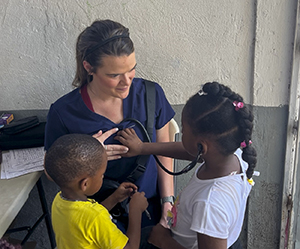
A nurse helps children not to be scared by letting them listen to her heartbeat. (IMB Photo)
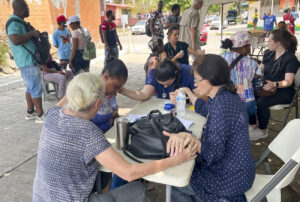
This wasn’t a typical doctor’s appointment. This happened last year on the southern border of Mexico, near Guatemala and the Pacific Ocean. A medical mission team of eight went to offer care to migrants, refugees and displaced peoples.
Another team member treated a young man who injured his knee. The young man said he was running from a gunman who killed his mother in front of him. He fell into a hole which caused his injury. After his treatment, the young man made a profession of faith in Christ.
International Mission Board missionaries Charlie and Robin Janney, who focus on human needs in Mexico, coordinated this team, knowing how great the medical needs are in this area.
“God gave them medical abilities and the intelligence to help others,” Robin Janney said of the team made up of doctors, nurses, physician assistants and physical therapists. “There are people in serious need and have no one else. They are desperate.”
She explained how grateful people were for this medical team to offer them care, considering how difficult it can be to afford treatment. She said it was a “huge honor” for them to receive medical attention and not be charged.
Over five days, the team met with more than 300 patients. For many of the medical professionals, this was the start of their involvement in mission work.
Robin Janney said one of the team members is heading for training to be a Journeyman, a two-year missions program for young adults.
“Another feels called to Africa,” she said. “So, we put her in contact with a missionary there who also uses medical personnel.”
A doctor on the team is close to retiring. He and his wife may consider taking advantage of IMB’s Master’s program, a missions pathway for singles and couples 55 years of age and older who want to give the first two-to-three years of their retirement to the nations.
Visiting medical team makes an impact
The Janneys met most of the members of the medical team last year at MedAdvance, a medical missions conference that allows hundreds of medical professionals, students and church leaders to connect with IMB missionaries and leaders. This year’s MedAdvance will meet September 12-14 at Houston’s First Baptist Church.
Attendees discover how God is at work through medical missionaries and how they can pair their healthcare training with a love for international missions.
“We went in not sure what to expect, and God decided to show us a lot of things at MedAdvance,” Charlie Janney said. “It exceeded our expectations.”
Missionary Robin Janney (in foreground) and members of the medical team pray with a woman who made a profession of faith in Christ. The medical team examined 80 patients this day at a shelter. (IMB Photo)
The Janneys participated in MedAdvance’s Affinity Marathon, as part of the Americas affinity group. This activity allows attendees to connect with missionaries on the field and hear about different IMB health strategies around the globe.
“We had many seek us out,” Robin Janney said. She explained that six of the eight medical professionals on last year’s trip had been at MedAdvance.
“The team did not know each other beforehand, but they worked as if they had worked together for years. It was one of the best teams that we have had.”
Not only did the medical team impact patients, but they had great fellowship with the host church.
Robin Janney said a woman from the church came up to her.
“She told me, ‘Our ladies of the church want to take them out for coffee.’ [The medical team] connected with the host church. They went out for coffee at least three times,” she said.
She also shared a story of a retired IMB missionary who served in the Middle East as a medical doctor and now serves in Mexico. The doctor was a great encouragement to the medical team, and she and a team member led another woman to Christ.
Team members helped both the church and patients learn about different health topics. One led a session on dehydration.
“A nurse talked to a group of Haitian refugees about dehydration, what were the symptoms and how to prevent it,” Robin Janney said. “We now have a recipe of how to rehydrate someone quicker.”
A physical therapist on the team taught patients different stretching exercises that gave them some relief and helped them sleep better.
The Janneys experienced how God used MedAdvance to strengthen their field ministry. They plan to return this year.
“There are so many medical needs all over the world,” Charlie Janney said. “MedAdvance helps connect those in the medical field with those on the mission field.
“They can make an impact in so many ways. It may not be medically. It might be through encouragement. They might inspire a church.”
After controversies, SBC turns to a low-key leader
August 21, 2024
CHARLOTTE, N.C. (RNS)—As he stepped up into the old-fashioned wooden pulpit on a recent Sunday, Pastor Clint Pressley wasted no time.
After quickly thanking the student discipleship minister who had brought many of the church’s Camp Paradise teens to the 11 a.m. service at his church, Hickory Grove Baptist, Pressley turned to the task at hand.
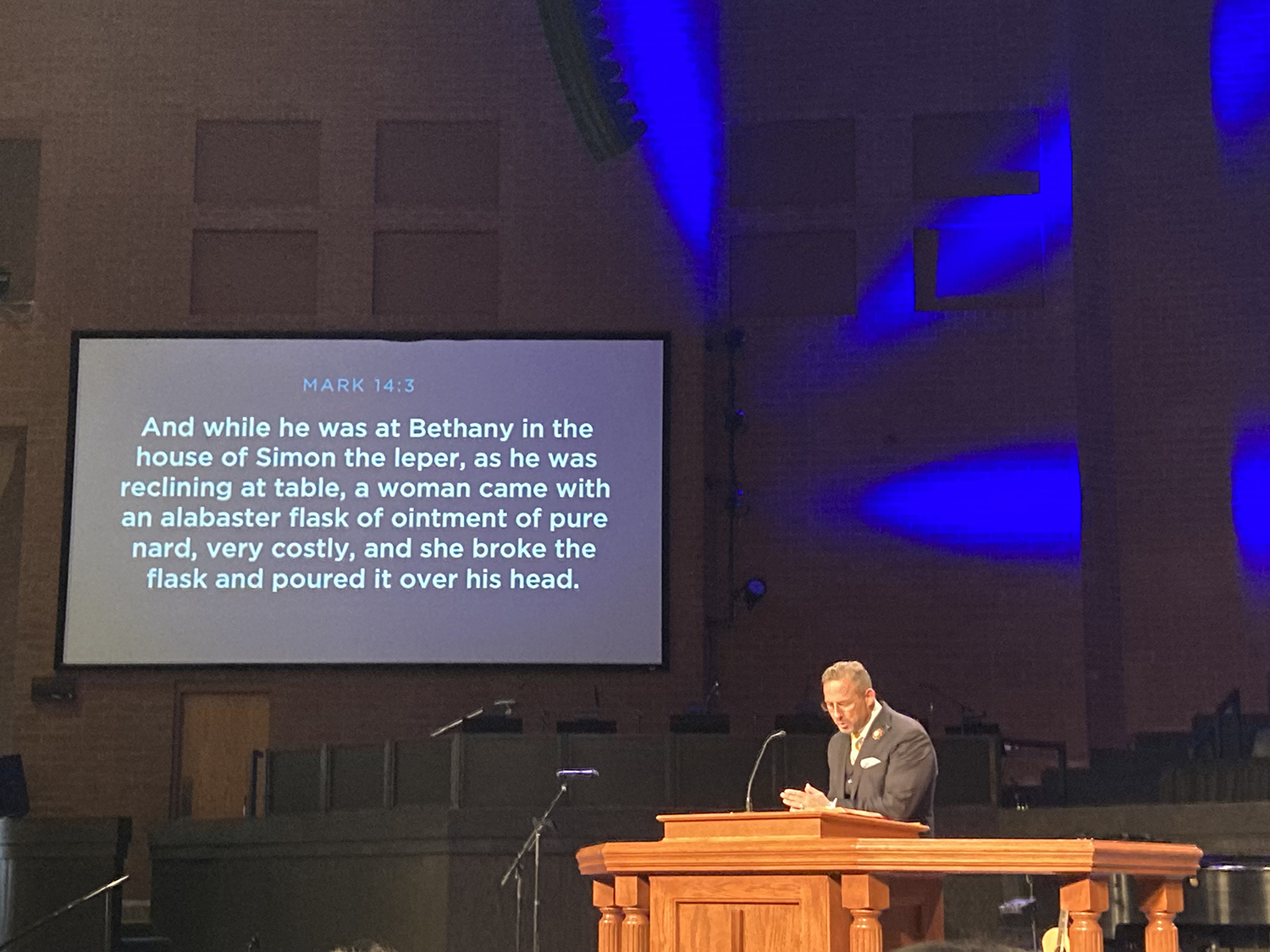
“Mark chapter 14,” he intoned in his Southern drawl. “If you’re a guest with us, we read the Bible, and then we just talk about the Bible. You’re going to find it feels a lot like a Bible study. Mark 14 starting in verse one …”
After relating the first 10 verses that tell the story of the woman who anoints Jesus with a bottle of expensive perfume, he drives home the passage’s lesson with a series of questions.
“You have one life to live,” he said. “Pour it out. Have you done what you could? What’s holding you back? I want your life to be all-out devotion to God.”
This was Pressley’s third sermon of the day. He preached the 8 a.m. service, drove 13 miles to the church’s second campus to preach the 10 a.m. service, and then drove back to the main campus for the 11 a.m. service.
When he concluded 40 minutes later, he shed his jacket and stood outside the doors of the cavernous chocolate-brick sanctuary, greeting worshippers on their way out—among them, his parents.
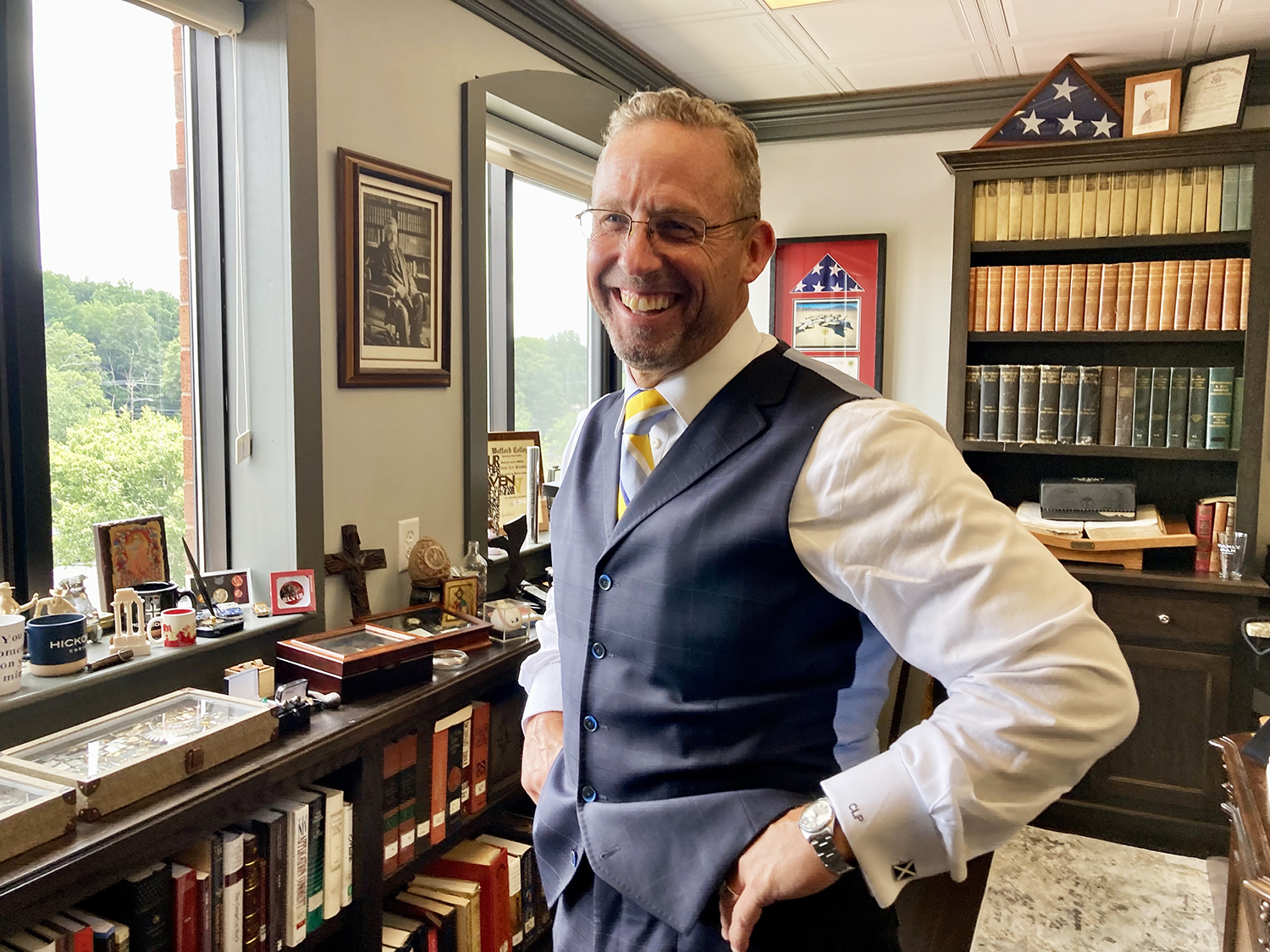
Pressley, 55, the newly elected president of the Southern Baptist Convention, is a hard-working pastor of North Carolina’s fifth-largest Baptist church—whose main campus lies on a busy commercial corner of a modest suburban neighborhood of 1950s ranch homes. A K-12 private Christian school is part of the main 56-acre campus.
Pastoring a church is what he’s wanted to do since he was a kid growing up in the state’s Queen City. He’s been devoted to the task ever since, building a multiracial, multigenerational megachurch that draws some 3,000 people each Sunday.
Pastor Clint Pressley likes to preach from a Colonial-style pulpit at Hickory Grove Baptist Church in Charlotte, N.C., on July 21. (RNS photos/Yonat Shimron)
Yet at its last meeting in June, its members elected a traditional preacher who wears three-piece suits, a tie and monogrammed cuffs—and mostly stays out of the limelight.
“In a time where we have so much cultural chaos, Clint’s steadiness and his reputation for integrity really impress a majority of Southern Baptists,” said Nathan Finn, a professor of faith and culture at North Greenville University in South Carolina and the recording secretary for the SBC.
Pressley does not have a national following or a big social media presence. Though he is a trustee of Southern Baptist Theological Seminary and has served in various other denominational roles, he is not trying to use the presidency—which he may serve for a maximum of two consecutive one-year terms—as a platform for influence.
“Really, my hope is to clear some of the fog of negativity and get us back on those two things we have: our confession and our mission,” he said of his mostly symbolic new role.
Pressley is the second North Carolina pastor to lead the SBC in less than a decade.
J.D. Greear, who served as SBC president from 2018-2021, has a national following and leads the largest SBC congregation in North Carolina, the Summit Church—with an average attendance of more than 12,000 people spread out across 13 campuses.
Bart Barber, Pressley’s immediate predecessor—who led a small, rural Texas church but was known for his expertise on denominational governance—had a large social media following and an opinion about everything.
Pressley, by comparison, is low-key. His church does not hold voter drives, and he will only refer to current events if it relates directly to the Bible passages he is preaching on.
“He has said publicly, his goal is not to embarrass the convention,” said Chris Justice, pastor of Lee Park Church in Monroe, N.C., who nominated Pressley in June.
“His answer to things will be short, biblical and delivered in such a way so as not to generate a fight. He’s looking to guide carefully and steward the convention with humility.”
Pressley wants to tone down the acrimony.
Pastor Clint Pressley stands for a portrait in his office at Hickory Grove Baptist Church in Charlotte, N.C., on July 21. (RNS photos/Yonat Shimron)
Family and religious background
The new Southern Baptist president became a Christian in the liberal Presbyterian Church (U.S.A.), where his parents belonged, when he was 11.
But on a vacation to Roanoke, Va., a few years later, a friend the Pressley family met at the beach invited them to their Baptist church. The preacher spoke with conviction. He was authoritative and passionate.
“I’d never heard anything like that, and I thought, ‘That’s what I wanted to do,’” Pressley said.
When the family returned home to Charlotte, he encouraged his parents to seek out a Baptist church. They tried Hickory Grove and, after attending for two weeks, became members.
Pressley kept his ties to Hickory Grove while he was at Wofford College in Spartanburg, S.C., where he also played football. After graduating, Pressley’s Hickory Grove pastor suggested he go to Southwestern Baptist Theological Seminary in Fort Worth.
There he met Connie, the daughter of a Mississippi Baptist pastor, who was in her last year studying for a Master of Divinity degree with the hope of becoming a missionary. After a nine-month courtship, they were married.
“I told the Lord I was not going to marry a pastor,” Connie Pressley said. “But I was well prepared. My mom was a great pastor’s wife and was a good example for me.”
Even before they married, Connie told Clint she probably couldn’t have children. She suffered from endometriosis, a condition in which tissue similar to the uterine lining grows outside the uterus, making it difficult to conceive.
The couple considered in vitro fertilization but felt like adoption was a more biblical choice. The New Testament uses adoption as a metaphor for becoming rooted in the family of God.
Pressley completed his Master of Divinity degree at New Orleans Baptist Theological Seminary, which was closer to Mississippi where he was pastoring two small churches and where he and Connie adopted two boys, brothers ages 2 and 6 months, Mack and Nate.
In 1999, he came back to Hickory Grove in Charlotte as associate pastor. Five years later he became senior pastor of a midsize church in Mobile, Ala., before returning to Hickory Grove as senior pastor in 2011.
Once he became its top leader, Pressley streamlined many of the church’s offerings and cut out some of the trendier, seeker-friendly outreach programs—such as cookouts and guest appearances from professional athletes.
He also sorted through the church’s long list of members to winnow out hundreds of members who were no longer active.
“We kind of pared back on trying to get more people in and really tried to get the people that were there more rooted in the word” of God, said Mark Foster, a deacon and Sunday school teacher.
Pastor Clint Pressley has worked with a handful of different churches throughout the South but returned for the second time to Hickory Grove Baptist Church in 2011. (RNS photos/Yonat Shimron)
He bucks trends
Services at Hickory Grove, like most contemporary Baptist services, feature a modern band that performs praise songs with drums and a synthesizer.
But unlike those pastors who stand in front of the stage, beside a stool or a chair, Pressley has kept the traditional Colonial-style wooden pulpit.
He also has bucked the recent trend of pastors dressed in khakis or jeans and a T-shirt.
He may prefer the buttoned-up look, but Pressley is warm and outgoing—a people person.
“He’s an incredibly encouraging person and incredibly authentic,” said Al Mohler, the president of Southern Seminary and a prominent conservative voice in the SBC.
“The public Clint Pressley and the private Clint Pressley are exactly the same man.”
Last August, Pressley’s 24-year-old son, Nate, who had been estranged from the family and living in the Washington, D.C., area, died of an apparent drug overdose. Church members said the Pressleys grieved with dignity and grace.
This year, a volunteer was arrested after church leaders learned he had been accused of sexual abuse by a student at the church’s Christian school.
The church reported the disclosure to Child Protective Services and the city’s police. Pressley notified the entire congregation by letter.
“We do not tolerate abusive behavior of any kind,” said Pressley in his letter.
Pressley is a creature of habit, and he sticks to a routine. He said he rises at 5 a.m. most days, reads the Bible, prays and then works out—lifting weights with a group of men, mostly from the church, in his backyard shed.
He doesn’t watch much TV and prefers reading books about history. He and his wife vacation—typically at a beach—with other pastor friends.
That commitment to routine serves him well and keeps him focused, said Eric Little, a member of his church with whom he also lifts weights.
“I think the reason I am drawn to pastor Clint is just his model of consistency—of what it means to be a leader, not just in the church, but in the home, in the community,” said Little.
Pressley keeps his eye trained on the long view. His favorite Bible passage is from the prophet Isaiah.
He has it engraved on the pulpit as well as painted on the wall of his office: “The grass withers, the flower fades, but the word of our God stands forever.”
Spiritual encounters occur in Olympics hospitality spaces
August 21, 2024
PARIS (BP)—At first, Adam Moore was a little skeptical about one of the Olympics outreach strategies in which his mission team was participating.
Eighteen members of Peninsula Baptist Church in Mooresville, N.C., spent the week in Paris, engaging people in gospel conversations. (BP Submitted photo)
Moore, the teaching and sending pastor at Peninsula Baptist Church in Mooresville, N.C., led a team of 18 members of his church to minister in Paris for a week.
One of the places they served was called “The Living Room,” an open-seating area hosted by a local church with coffee, water, air conditioning and livestreaming of the Olympics.
“Is anybody going to stop into that?” Moore wondered.
He was quickly proven wrong, as the venue welcomed several visitors during Moore’s time in Paris.
“That has led to probably at least 10 long, lengthy gospel conversations through individuals just showing up,” Moore said.
“The Living Room” is an example of how Baptists in Paris, in partnership with the Southern Baptist Convention’s International Mission Board, are creating attractive spaces to show hospitality to residents and tourists, and then engaging those visitors with conversations about Jesus Christ.
Using art and culture to share the gospel
Another project in Paris is the work of French artist Estienne Rylle, who has launched a contemporary gallery called “Hymnal: Humanity Gathered” at La Baptisse in the first Baptist church in Paris, Rylle said.
“It’s what we want to propose to visitors, ‘Come and enjoy the place of solace we created with art,’” Rylle said.
The exhibit also offers a coffee shop and place of refreshment for visitors, inspired by Jesus’ request of the Samaritan woman, “Give me a drink.”
“There is something very powerful for me in this sentence,” Rylle said.
Rylle pitched the project, with contributions from several French artists, as a “monastery of the third millennium,” a place of prayer and contemplation—a cultural experience.
He hopes visitors will be prompted to consider spiritual matters as they contemplate the art, and Christians then can provide answers that may spark further reflection.
Distributing Scripture, issuing invitations
A team from North Carolina distributed hundreds of Bibles on the streets of Paris during the 2024 Olympics.
While some of Moore’s team staffed “The Living Room” each day, others went out into the city handing out flyers and inviting people to the location. They also distributed hundreds of Bibles with an Olympic-themed cover.
Moore said two of the high school students on his team encountered an “ardent atheist,” but one who admitted he had a lot of questions about Christianity’s truth claims. The man acknowledged being bothered by concepts like eternity and judgment, wondering what that meant if such matters were true.
“They were able to spend a long time talking with him, sharing the entirety of the gospel with him, answering questions, pointing him to Christ,” Moore said.
He said his team also saw a number of visitors from China profess faith in Christ during their stay.
The Paris trip for Peninsula Baptist Church was part of an ongoing partnership the congregation has with IMB staff in the city. The Olympics, Moore said, brought a lot of different people to Paris and made it more normal for Americans and other international visitors to be present and engaging with people.
He said his team was pleased with how receptive many people were to having spiritual conversations.
“As they talk through life and other things, it’s been good to be able to move that toward the gospel,” Moore said. “We’ve seen that be pretty fruitful so far.”
Tim Ellsworth is associate vice president for university communications at Union University in Jackson, Tenn.
Short-term trips meet long-term strategies at Olympics
August 21, 2024
The Southern Baptist Convention’s International Mission Board mobilized more than 300 short-term volunteers who are hitting the streets of Paris, sharing the gospel during the 2024 Summer Olympic Games.
“We can’t control the results, but we can measure our faithfulness,” said Jason Harris, team leader for the IMB Paris team, explaining their strategy for gospel outreach during the Games.
Part of that strategy includes facilitating and mobilizing more than 300 short-term volunteers. The team Harris leads in Paris is young and growing. No team members have been there longer than a few years. They are united around a common vision to make Christ known among Europeans and a long-term goal to plant five churches in Paris over the next five years.
‘A launching point for church planting’
Harris explained that short-term volunteers are vital to sharing the gospel broadly and making connections that will catalyze their local church-planting strategy and lead to longevity.
Each week of Olympics outreach, volunteers are focused on sharing the gospel within specific geographical and cultural segments of Paris. They are using a number of creative strategies as entry points for evangelism and have invited local French churches to work alongside them.
“My prayer has been that the outreach for the Olympics would be a launching point for church planting in the city,” Harris said.
Ultimately, the harvest is in God’s hands, the team recognizes. They already have witnessed God drawing people to himself through volunteer efforts this summer.
Zach Beasley, campus minister at Alabama State University and Tuskegee University—two historically black colleges in Alabama—led a team of six students to join a week of pre-Olympic outreach to Paris in May.
One thing the students didn’t expect was the spiritual darkness they felt almost immediately on arrival in the “City of Light.” Beasley said more than anything, this trip has motivated them to pray for missionaries and their long-term presence on the mission field.
“We realized to really make a lasting impact, you have to be there for years,” Beasley said. “It takes years for boundaries to be broken down and relationships built.”
The team from Alabama spent eight days passing out water bottles, prayer walking, distributing flyers, and doing spiritual surveys.
“The work we did with the local church was very familiar to our students. It’s the same thing we do on campus, going out and sharing the gospel,” Beasley said. “We collaborate and build the local church, and I loved seeing that reiterated here for our students.”
At the end of the week, Beasley and his team were excited to see many people they had given flyers to show up for an outreach event at a local church.
“We were praying they would come, and they actually did,” Beasley said.
Divine appointments to share the gospel
IMB missionary Diane In came to Paris from a nearby country where she lives to help with the Olympic outreach. She joined a group of 90 volunteers partnering with local Chinese-French churches.
On their first day, they handed out more than 1,000 portions of Scripture in French, had 300 gospel conversations, and saw several professions of faith in Christ.
The missionary shared how she has seen God provide divine appointments for the gospel. At the end of one day, In and one volunteer—a Chinese pastor from the United States—sat next to some members of the Chinese press on their way back to the hotel. The pastor gave one of the men a custom-designed trading pin and shared the gospel with him.
On their way out of the station, they ran into two more members of the Chinese press—a man and a woman—who were lost and asked for directions. As the pastor gave directions to the woman, In pulled out another pin and shared the gospel with the man.
Brant Bauman, a digital engagement strategist for the IMB, gave an exciting update on the first round of virtual volunteers and their strategy to extend on-the-ground evangelism.
Bauman said digital responders around the world are getting exactly the kind of interaction they have been hoping and praying for. Volunteers are serving on a week-long virtual mission trip where they’ll be on call to answer chat requests.
“It’s a strange thing to say, but the volume on my computer is turned up and there is a little chime that goes off roughly every 30 seconds,” Bauman said.
“Normally that would drive anyone mad, but not tonight, because that is the sound of new people responding to our online ads and reaching out to us. Better yet, it’s the sound of doors being opened and the gospel being proclaimed by so many digital responders scattered all over the world.”
Bauman added that despite challenging discussions, team members are excited and bold in their interactions.
“We have already seen countless prayers responded to, quite a few spiritual conversations and gospel shares, and some that have expressed a desire to meet up face-to-face and find a church.”
Harris asked for prayer as their team begins to follow up with new contacts in Paris.
“The number of connections made could be really challenging to follow up with effectively,” he said. “Pray that, ultimately, people become disciples of Jesus and don’t just hear the gospel once.”