CBF commissions new field personnel, church starters

FORT WORTH—The Cooperative Baptist Fellowship commissioned eight field personnel and church starters at the group's annual general assembly.

"We stand with you tonight to give our blessing, our support and our commitment to pray for you, love you and walk alongside you through this awesome journey on which you are about to depart," CBF Executive Coordinator Daniel Vestal told the individuals who were commissioned.

Phil Christopher, pastor of First Baptist Church in Abilene, delivered a missions challenge to the Cooperative Baptist Fellowship general assembly in Fort Worth. (CBF PHOTO/ J.V. McKinney)

"You do not travel alone, as the Lord goes before you, behind you, and beside you, and as we—through our prayers, our financial gifts, emails, phone calls, letters, care packages, visits, volunteer trips and advocacy for the most neglected—take this journey with you, as well."

John Norwood, a church starter in Houston, was among the group commissioned, along with other church starters Andy Hale of Clayton, N.C., and Brickson Sam of Charlotte, N.C.

Field personnel commissioned were Andy and Jutta Cowie, Haiti; Jessica and Joshua Hearne, Danville, Va.; and Missy Ward, Uganda.

In a challenge to the CBF, Phil Christopher, pastor of First Baptist Church in Abilene, talked about his church's $5 million capital campaign for missions, which began in 2010.

In addition to local ministries, the funds pledged through the campaign have enabled the church to partner with CBF field personnel, including Anjani and Jimmy Cole in Spain, Jeff and Alicia Lee in Macedonia and Caroline and Josh Smith in South Africa.

"Jimmy Cole grew up in First Baptist Abilene, and when we started talking about what it means to be a missional church, he took what we were saying seriously," Christopher said. "He resigned as a successful pharmaceutical salesperson, sold his home and said, 'Here am I, send me.' Can you imagine?

"If we are going to talk missions in our churches, if we are going to commission field personnel, if we are going to tell the 'old, old story,' our churches have a responsibility to make sure the resources are available when people like the Coles, the Smiths the Lees are called to go and tell the story of Jesus and his love."


19 motions presented at New Orleans SBC

19 motions presented at New Orleans SBC

NEW ORLEANS (BP)—Messengers offered 19 motions during the opening day of the Southern Baptist Convention's annual meeting in New Orleans June 1. All but one were referred to SBC entities or ruled out of order.


A motion by Richard Tribble of Emmanuel Southern Baptist Church in Decatur, Ill., to prohibit messengers from using a platform microphone when debating motions or making nominations was defeated on a show of ballots June 20.


During debate on his motion, Tribble said that requiring all speakers to use floor microphones would increase the fairness of convention deliberations.


"The implication comes that everything that's said from the platform carries with it great authority and the implication that this is what the leaders want to present," he said.


Stan Buckley, chairman of the Committee on Order of Business, argued that the convention's rules for debate and nominations were already fair. Requiring all speakers to use floor microphones would "waste the convention's time," he said, adding that nominations already could be made from a platform microphone.


"Think just a moment about the consequences if the convention were to adopt the Tribble motion," Buckley said. "If a messenger were to offer an amendment to a resolution offered by the Resolutions Committee chairman during the resolutions report, the chairman would then have to leave the platform, run around to find somewhere an empty floor microphone and then wait for the president to find him before being able to give the Resolutions Committee's response to the amendment."


Motions referred to the Executive Committee included:


• The SBC Executive Committee "be instructed to schedule future annual meetings during the last week of June so as not to conflict with Father's Day" and that it attempt to change the dates of annual meetings already scheduled that conflict with Father's Day, submitted by Tribble.


• SBC meetings be held every two years rather than annually, submitted by Daniel Palmer of Wake Cross Roads Baptist Church in Raleigh, N.C.


• SBC bylaws be amended to require that nominating speeches for convention officers include at minimum the nominee's name, the office for which he is being nominated, the name of his church and the percentage of undesignated receipts given by that church to the Cooperative Program, submitted by Tribble.


• The convention "establish a process and curriculum for properly training and equipping" entity trustees "that is preliminary to and separate from the individual agencies' processes of orientation," submitted by David Atchison of Grace Community Church in Nashville, Tenn.


• Move the 2015 SBC annual meeting to Memphis, Tenn., to celebrate the 90th anniversary of the Cooperative Program, which was established in Memphis, submitted by Gary Griffis of New Church Memphis in Memphis, Tenn.


• The Executive Committee develop a policy and procedures manual for convention officers, including procedures to investigate allegations of misconduct by officers and remove them from office if necessary, submitted by Tribble.


A motion by Brad Atkins of Powdersville First Baptist Church in Easley, S.C., that SBC seminaries consider allowing their portion of the CP Allocation Budget to be reduced from 21.92 percent to 21 percent and request that the EC allocate the remaining .92 percent to the International Mission Board was referred to the EC and all six seminaries.


A motion by Tim Overton of Halteman Village Baptist Church in Muncie, Ind., that LifeWay Christian Resources reconsider its decision to sell the 2011 New International Version of the Bible in its stores was referred to LifeWay.

The motion asked trustees to allow Paige Patterson and Louis Markos to address trustees on the matter, and it said Patterson and Markos have agreed to speak.


A motion by Richard Sandberg of New Zion Baptist Church in Kentwood, La., that the convention ask the North American Mission Board "to reconsider their decision to scale back disaster relief funding" was referred to NAMB.

A motion by Channing Kilgore of South Whitwell Baptist Church in Whitwell, Tenn., that the convention establish a "historical research committee" to study the views of SBC founders "regarding predestination and election and how they understood these terms" was referred to the six seminaries.


The Committee on Order of Business considered a motion from the 2011 annual meeting calling for future meetings to include at least one evening session and reported that attendance data from the New Orleans meeting will "yield more feedback upon which to base plans for future annual meeting programs."


Seven motions were ruled out of order by SBC president Bryant Wright, acting on the recommendation of the Cmittee on Order of Business. Among them:


• That the convention "seek God for mercy corporately" in light of the moral decline in America, submitted by Dan Biser of Zoar Baptist Church in Augusta, W.Va. Buckley explained that messengers had already adopted the convention's agenda, "which includes time for prayer."


• That the convention agree with Richard Land, president of the Ethics & Religious Liberty Commission, that statements he made regarding the Trayvon Martin killing were harmful and that the convention "publicly affirm the reprimands" of Land by ERLC trustees, submitted by Todd Littleton of Snow Hill Baptist Church in Tuttle, Okla. Littleton appealed the chair's ruling, but messengers sustained the chair.


• That the convention ask its newly elected president to study imprecatory prayer in the Bible and report his findings at the 2013 annual meeting, submitted by Wiley Drake of First Southern Baptist Church in Buena Park, Calif.


• That the referral of a motion concerning biennial SBC meetings be reconsidered, submitted by Palmer.


• That salary packages of all SBC entity and state convention employees be disclosed to Southern Baptists and that annual salaries be capped at $150,000, submitted by Luke Johnson of Highland Baptist Church in Laurel, Miss.


• That the SBC president appoint a committee to audit NAMB's "Mega-Focus Cities: San Diego" program, submitted by Ron Wilson of Wynnbrook Baptist Church in Columbus, Ga.


• That "no entity of the SBC be allowed to use the name Great Commission," submitted by Steve Bailey of Earle (Ark.) Baptist Church.


• That the convention commend Billy Graham "for his continued burden for evangelism and his love for Jesus Christ" and pray for the success of his "My Hope with Billy Graham" outreach campaign, submitted by Jim Wood of Covenant Community Church in Sevierville, Tenn.


Next CBF leader must keep focus on missions, Texas Baptists counsel

FORT WORTH—To retain the support of Baptists west of the Mississippi River, the Cooperative Baptist Fellowship must focus on missions, not become distracted by divisive hot-button issues such as gay rights, some Texas Baptist pastors attending the CBF general assembly noted. And they see the selection of the organization’s next executive staff leader as pivotal.

Daniel Vestal delivered his final address to the CBF at its general assembly in Fort Worth June 22, just about a week before his retirement after 15 years as CBF executive coordinator.

Dan Vestal

In the final session of the 2012 General Assembly, Daniel Vestal gave his final sermon as CBF executive coordinator, speaking to a crowd of 1,625 Fellowship Baptists about the Assembly’s theme of “Infinitely More” and Ephesians 3:20-21.

The search committee named to nominate his successor has talked with 171 pastors of churches deeply involved in CBF life to ask their “hopes and ambitions for the future” of Cooperative Baptists, Chairman George Mason, pastor of Wilshire Baptist Church in Dallas, reported to the general assembly in Fort Worth.

The next executive coordinator not only must recognize the regional differences between East Coast CBF Baptists and Texas Baptists, but also find common ideals and vision that can unite them, said Jerry Carlisle, president of the Baptist General Convention of Texas.

“It’s huge to be able to straddle the (Mississippi) River,” said Carlisle, pastor of First Baptist Church in Plano. “It will be important to build that bridge in every way possible.”

The first two CBF executive coordinators each had Texas Baptist roots and pastoral experience in the Southeast. Both Cecil Sherman and Daniel Vestal grew up in Texas and were educated at Baylor University and Southwestern Baptist Theological Seminary. Each served as pastor of churches in Texas—Sherman at Broadway Baptist in Fort Worth and Vestal at Southcliff Baptist in Fort Worth, Tallowood Baptist in Houston and First Baptist in Midland.

But Sherman also served a long pastorate at First Baptist Church in Asheville, N.C., and Vestal was pastor of Dunwoody Baptist Church in suburban Atlanta, Ga.

A Texas birth certificate—or certificate of ordination from a Texas Baptist church—need not be a prerequisite for the next CBF executive coordinator, but he or she does need to be in touch with Texas Baptist beliefs and priorities, several pastors noted.

“I don’t know if the executive coordinator needs to come from Texas, but the leader needs to understand Texas,” said Charlie Brown, pastor of The Crossing Baptist Church in Mesquite and outgoing moderator of Texas CBF. “If CBF will focus on missions 100 percent, that will resonate with Texas Baptists.”

Bobby Broyles, a newly elected Texas Baptist representative to the CBF Coordinating Council, agreed.

“I’m not sure it’s going to matter where the next executive coordinator comes from. What matters is where he leads us,” he said.

Broyles, pastor of First Baptist Church in Ballinger, cited involvement in a recent CBF-initiated mission trip building homes from rubble in Haiti and underscored that “the needs are too great and the task is too critical” for CBF to become distracted by side issues.

“If the CBF stays focused on missions and evangelism, we’ll be able to draw people who want to be associated with like-minded Baptists. But if lightning rod-issues drive us, then we won’t be a viable missions organization,” he said.

Dedication to missions and commitment to Baptist distinctives such as soul competency, the priesthood of all believers and separation of church and state attracted some Texas Baptists to CBF initially. But any significant movement toward embracing “unbiblical practices” would drive them away, said Michael Evans, president of the African-American Fellowship of Texas.

“Texas is a huge supporter of the original ideals of CBF. My prayer is that we retain that focus,” said Evans, pastor Bethlehem Baptist Church in Mansfield.

Evans acknowledged a perceived movement among some segments of CBF life toward a welcoming-and-affirming attitude toward homosexuals has made him “skittish about the direction” of the national organization.

In February, when she was still moderator, Colleen Burroughs told the CBF Coordinating Council that once the organization completes its reorganization and finds a new executive coordinator, it should revisit its policy that prohibits funding for organizations that affirm homosexual behavior and bars the hiring of staff members or missionaries who are practicing homosexuals.

Vestal promptly responded with a statement affirming the CBF hiring and funding policy. He also stated his personal belief “that the foundation of a Christian sexual ethic is faithfulness in marriage between a man and a woman and celibacy in singleness,” while acknowledging some in the CBF hold differing views.

BGCT Executive Director David Hardage likewise responded by pointing out the Texas Baptist convention “has a very strong biblical policy” regarding homosexual behavior. In 1996, messengers to the BGCT annual approved a report stating the Bible teaches that “the ideal for sexual behavior is the marital union between husband and wife and that all other sexual relations—whether premarital, extramarital or homosexual—are contrary to God’s purpose and thus sinful.” Texas Baptists subsequently reaffirmed that statement—most recently in 2007, he noted.

In April, the CBF and Mercer University’s Center for Theology and Public Life sponsored a Baptist Conference on Sexuality and Covenant, which included discussions about gay and lesbian issues. Program planners noted that the conference grew out of discussion at a breakout session during the 2010 general assembly, and they insisted it was unrelated to Burroughs’ comments.

Even so, some Baptists who hold to a traditional understanding that views homosexual behavior as sinful are troubled by the call by some segments in the CBF for greater openness toward gay, lesbian, bisexual and transgendered people.
 
“That’s a deal-breaker for our church and for many of the churches I know here in Tarrant Baptist Association. The next CBF leader needs to have an ear to the ground about who we are as Texas Baptists,” Evans said.

“We already have to fight off the false perception that we are accepting of unbiblical practices. It would break the back of CBF in Texas if the national organization is not sensitive to our churches.”


CBF enters year of transition

FORT WORTH (ABP)—The Cooperative Baptist Fellowship looks forward to an “in-between year” characterized by implementation of a new identity statement and a search for a successor to retiring CBF Executive Coordinator Daniel Vestal, the group’s incoming moderator said.

Keith Herron

CBF Moderator Keith Herron, pastor of Holmeswood Baptist Church in Kansas City, Mo.

“In this coming year, we’ll lay down the foundations for a new organizational structure and we’ll welcome a new leader who will give direction to our shared calling, who will partner with us and who will lead,” said Moderator Keith Herron, pastor of Holmeswood Baptist Church in Kansas City, Mo.

With final approval June 22 of a new model for identity, governance and financial support intended to guide the moderate Baptist group formed in 1991 for the next 20 years, Herron, who assumed the gavel from outgoing moderator Colleen Burroughs at the close of the June 21-22 general assembly in Forth Worth, now turns to implementation of the plan.

Herron reported he and interim Coordinator Pat Anderson will assemble a group of strategic thinkers and leaders to sort through the report and “develop a playbook that outlines how we think we can best put this plan into action.”

Herron hopes to have a first draft of the implementation plan for the CBF Coordinating Council to consider and review when they meet in October and again in February before presentation to next year’s general assembly in Greensboro, N.C.

“There are several alignments we can begin to lean into this fall, while other steps will take some time to put into practice,” Herron said. “This work won’t happen in a corner, and its implications are wide-ranging and important.”

“We see this next year as being very transitional, organizing Coordinating Council members as we have done, but transitioning toward the new model,” Herron said.

The new identity plan is the result of a two-year study that included more than 100 listening sessions conducted by a blue-ribbon 2012 Task Force chaired by Alabama pastor David Hull.

“You have spoken. We have listened,” Hull, pastor of First Baptist Church of Huntsville, Ala., said June 21 in a presentation during the opening business session of the group’s 22nd annual General Assembly. “Together we have tried to imagine a future of life and vitality for Cooperative Baptists.”

The new plan seeks to pull together a myriad of national, state and regional CBF organizations into “a seamless cooperating community,” while doing a better job of sharing resources that already exist and reducing duplication of effort among CBF and partner organizations.
“Our future lives in our ability to live into our name,” Hull said. “We are cooperative Baptists.”

It also for the first time suggests a way for churches desiring to identify publicly with CBF mission and values to do so beyond financial contributions.

“Congregations may embrace their identity by sending a letter that outlines the details of their partnership with CBF,” the report recommends. Such a letter might list or describe ways the congregation participates in CBF, including but not limited to affirming its identity, values and mission; praying for CBF; including CBF ministries – state/regional and/or national – in church budgets; promoting and collecting the Global Missions Offering; participating in regional or national CBF ministries and attending their state or national General Assembly.

That section of the report was amended during the general assembly to clarify grammatically the intent is not to force the issue of CBF affiliation within churches where it might be divisive.

Hull said the task force heard from many churches requesting a way to highlight their CBF identity above and beyond giving money.

“There is nothing required by this at all,” Hull said. “Some churches said, ‘Give us a way to identify with CBF apart from just sending money to you.’ Many churches will choose not to do this. That’s fine. This is for churches who want to say in a public sense, ‘This is who we are.’”

The new plan also calls for more communication in the process of developing budgets for state/regional and national CBF organizations.
Currently the budgets for various CBF entities are developed separately, sometimes with little or no communication between the two. The new plan recommends that regional and national bodies negotiate cooperative agreements about not only division of funds but also responsibilities for ministry resources.

“We heard a desire that the CBF be more seamless,” said task force member Ray Higgins. Higgins, coordinator for Arkansas CBF.

Connie McNeill, task force member and coordinator of administration for the CBF Atlanta staff, said the plan affirms both the national organization’s role in missionary and resource work and the geographical proximity offered in the state and regional CBFs.

The plan will “create a process for national, state and regional organizations to work together more closely, while respecting the autonomy and uniqueness of each,” she said.

Ruth Perkins Lee, vice chair of the 2012 Task Force, said while much attention the last few years has been on budget shortfalls at the national level, the listening sessions actually revealed an abundance of resources that aren’t being fully tapped.

She called for “a paradigm shift that recognizes we are the best resources CBF has.”

“We have done great things together, and we can do infinitely more,” said Lee, minister of students at Auburn First Baptist Church in Auburn, Ala.


SBC resolutions address sinner’s prayer, gay marriage

NEW ORLEANS (BP) — Messengers to the Southern Baptist Convention approved resolutions reaffirming their convictions regarding the means of salvation and a literal Adam and Eve, while stating their opposition to rhetoric that equates gay rights with the civil rights of racial and ethnic minorities.

Among the nine resolutions passed in two sessions were ones:

• Identifying what is frequently described as a "sinner's prayer" as a biblical way of expressing repentance and faith while providing some careful descriptions of what that means;

• Reaffirming the belief the Bible is without error and attesting to the direct creation of and historicity of Adam and Eve;

• Agreeing to continue to work together to spread the Gospel with an understanding that the Baptist Faith & Message, the convention's confession of faith, sets "sufficient parameters for understanding the doctrine of salvation" among Southern Baptists.

The resolution on cooperation addressed some pre-convention "verbal sparring" between non-Calvinists and Calvinists, Resolutions Committee Chairman Jimmy Scroggins acknowledged afterward.

Messengers also approved resolutions:

• Opposing efforts to use the rhetoric of the African-American civil rights movement in the attempt to legalize same-sex marriage;

• Protesting what a majority of messengers viewed as the Obama administration's attempts to subvert religious freedom in such arenas as health care, marriage and the military;

• Acknowledging and expressing gratitude for the role of African-Americans in Baptist work in the United States;

• Affirming community and human needs ministries by churches;

• Celebrating the 200th anniversary this year of Baptist ministry in Louisiana;

• Expressing appreciation to God and all those who helped with this year's annual meeting.

Messengers approved the resolution on a "sinner's prayer" with what appeared to be at least an 80 percent majority. The other measures gained passage in unanimous or nearly unanimous votes.

The committee sought to emphasize cooperation, said Scroggins, senior pastor of First Baptist Church in West Palm Beach, Fla. That seemed obvious in the resolutions on a "sinner's prayer" and cooperation between Calvinists and non-Calvinists. The explicit intention "from the time our committee started meeting was to try to present resolutions in a way that we could be winsome, that we could say strong things in a winsome way and do it in a way that promoted unity among Southern Baptists," Scroggins said at a news conference after the completion of the resolutions reports.

The way the committee put it was it "wanted to 'demilitarize' the resolutions process," he told reporters."We just felt like we wanted to affirm our commitment to the Baptist Faith & Message as our unifying confession of faith," he told reporters.

"Southern Baptists are going to have to agree on the essentials. We're going to have to disagree on certain things, but what we really want to do is lock arms and fight the darkness. We want to lock arms and cooperate to win the nations to Christ, to win our communities, to make a difference for Jesus, to push back the darkness with the light of Jesus. And that's really what we think most Southern Baptists would like to focus on."

The resolution on cooperation and the doctrine of salvation gained approval without any verbal opposition expressed from the floor, but debate on the measure on a "sinner's prayer" consumed much of the 30 minutes allotted for the morning report, necessitating an afternoon report. The resolution, which survived two amendment efforts, affirmed the concept of a "sinner's prayer" while reiterating the belief that "repentance from sin and personal faith in the Lord Jesus Christ are necessary for salvation."

It said such a "crying out for mercy and a calling on the Lord," which constitute what is often described as a "sinner's prayer," are a "biblical expression of repentance and faith."

The resolution also said "a 'sinner's prayer' is not an incantation that results in salvation merely by its recitation and should never be manipulatively employed or utilized apart from a clear articulation of the Gospel." It also urged Southern Baptists to continue to take the Gospel to sinners of "every tribe, tongue, and language."

Two African-American pastors — Dwight McKissic of Cornerstone Baptist Church in Arlington  and Eric Redmond of Reformation Alive Baptist Church in Temple Hills, Md. — submitted the resolution objecting to applying civil rights language to the cause of legalizing same-sex marriage.

The resolution provides encouragement to black pastors, said Kevin Smith, an African-American who was a member of the committee. Smith is pastor of Watson Memorial Baptist Church in Louisville, Ky., and assistant professor of Christian preaching at Southern Baptist Theological Seminary.

"During this season, black pastors will have to speak about this issue in a way that white pastors won't," Smith said at the news conference. Referring to President Obama's recently announced support for gay marriage, Smith said, "They'll speak against the first black president and his personal views on marriage while affirming biblical authority."

Black pastors already are taking a clear stand on the issue, but "it's just good to have the affirmation of your brothers and sisters" in the denomination, Smith said.

The resolution on the use of civil rights rhetoric on the same-sex marriage issue was "beautifully crafted," Southern Baptist ethicist Richard Land told reporters. "I think it's important that the largest Protestant denomination in the country made it clear where they stand on this issue."

Part of the resolution on religious freedom urged Obama to tell his administration to back down from its requirement that health plans cover contraceptives, including ones that can cause abortions, and sterilizations. It also called for a sufficient exemption for all people and organizations with a religious objection.

It "is so important that our people understand and that the country understand that this debate is not about reproductive freedom. This is about religious freedom," said Land, president of the Ethics & Religious Liberty Commission. "It's about all people of faith and whether or not the government can coerce them to pay for that which they find unconscionable."


CBF chaplains see gains

(ABP)–Last year, Cooperative Baptist Fellowship chaplains arose at the General Assembly in Tampa to demand a more prominent seat at the table of denominational life.

In a Thursday workshop at this year's assembly, some of those leaders said that goal has largely been accomplished, but still complained about the perception of chaplains among other pastors and Christians as a whole.

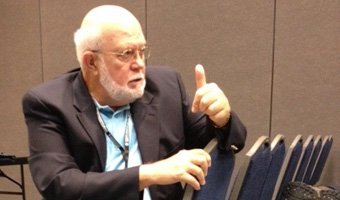
James Pope discusses chaplaincy during a workshop at the CBF General Assembly in Fort Worth.

Many have to be reminded that "we are not 'clergy lite,'" said James Pope, associate for military ministry for CBF, and a retired Navy captain and chaplain.

Addressing about 30 chaplains, including 10 in military uniforms, Pope and Randy Gardner said chaplains are in the best position ever in CBF.

They are being featured more often in denominational communications and are growing in numbers.

Pope estimated there are more than 600 endorsed CBF chaplains today compared to about half that number a decade ago.

Gardner, the outgoing chairman of the CBF council on chaplain endorsement, said the group is also enjoying more recognition since last year's assembly.

"We're being noticed, and that's as it should be," Gardner said.

But that isn't always the case among other ministers, either in Baptist or wider Christian circles, Pope said. Many see chaplains as ministers who couldn't cut it as pulpit pastors.

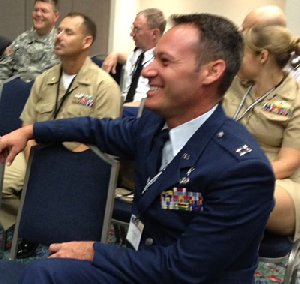
Air Force Capt. Charles Seligman participates in a discussion about military chaplaincy at the CBF General Assembly in Fort Worth.

Those comments hit home for Tim Hunter, a prison chaplain for 11 years with the Texas Department of Corrections. When Hunter left church ministry for chaplaincy, he recalls, "it was 'Oh, you left the ministry.'"

A balm for the resulting frustration is getting together with other chaplains at events like the chaplaincy workshops at assembly, Hunter said.

The workshop addressed practical issues for the participants. Gardner held a break-out with hospice, hospital and law enforcement chaplains while Pope held a listening session with the Air Force, Army and Navy chaplains.

Air Force Capt. Charles Seligman said Pope functions as his pastor through regular phone and email communication. He also can confide in other chaplains. Being at Thursday's workshop was also a big stress reliever, he said.

"Chaplains — we chaplain each other," he said.


CBF to vote on identity plan

The Cooperative Baptist Fellowship votes June 22 on a new model for identity, governance and financial support intended to guide the moderate Baptist group formed in 1991 for the next 20 years.

2012 Task Force report seeks to make Cooperative Baptist Fellowship live up to its name.

The recommendations are result of a two-year study that included more than 100 listening sessions conducted by a blue-ribbon 2012 Task Force chaired by Alabama pastor David Hull.

“You have spoken. We have listened,” Hull, pastor of First Baptist Church of Huntsville, Ala., said in a presentation Thursday morning. “Together we have tried to imagine a future of life and vitality for Cooperative Baptists.”

The new plan seeks to pull together a myriad of national, state and regional CBF organizations into “a seamless cooperating community,” while doing a better job of sharing resources that already exist and reducing duplication of effort among CBF and partner organizations.

“Our future lives in our ability to live into our name,” Hull said. “We are cooperative Baptists.”

It also for the first time suggests a way for churches desiring to identify publicly with CBF mission and values to do so beyond financial contributions.

“Congregations may embrace their identity by sending a letter that outlines the details of their partnership with CBF,” the report recommends. Such a letter might list or describe ways the congregation participates in CBF, including but not limited to affirming its identity, values and mission; praying for CBF; including CBF ministries – state/regional and/or national – in church budgets; promoting and collecting the Global Missions Offering; participating in regional or national CBF ministries and attending their state or national General Assembly.

During a business breakout session, that section of the report was amended to clarify grammatically the intent is not to force the issue of CBF affiliation within churches where it might be divisive.

Hull said the task force heard from many churches requesting a way to highlight their CBF identity above and beyond giving money.

“There is nothing required by this at all,” Hull said. “Some churches said, ‘Give us a way to identify with CBF apart from just sending money to you.’ Many churches will choose not to do this. That’s fine. This is for churches who want to say in a public sense, ‘This is who we are.’”

The new plan also calls for more communication in the process of developing budgets for state/regional and national CBF organizations. Currently the budgets for various CBF entities are developed separately, sometimes with little or no communication between the two. The new plan recommends that regional and national bodies negotiate cooperative agreements about not only division of funds but also responsibilities for ministry resources.

“We heard a desire that the CBF be more seamless,” said task force member Ray Higgins. Higgins, coordinator for Arkansas CBF, said one supportive pastor put it this way: “Should I give my offering to Daniel or Ray?’ referring to national CBF executive coordinator Daniel Vestal.

Connie McNeill, task force member and coordinator of administration for the CBF Atlanta staff, said the plan affirms both the national organization’s role in missionary and resource work and the geographical proximity offered in the state and regional CBFs.

The plan will “create a process for national, state and regional organizations to work together more closely, while respecting the autonomy and uniqueness of each,” she said.

Ruth Perkins Lee, vice chair of the 2012 Task Force, said while much attention the last few years has been on budget shortfalls at the national level, the listening sessions actually revealed an abundance of resources that aren’t being fully tapped.

She called for “a paradigm shift that recognizes we are the best resources CBF has.”

“We have done great things together, and we can do infinitely more,” said Lee, minister of students at Auburn First Baptist Church in Auburn, Ala.

Many questions raised in the breakout session about the proposal won’t be answered until a separate implementation phase. Governance changes including reducing the size of and renaming the Coordinating Council and creating new and more task-focused bodies for missions and church resources will require constitutional changes that must be approved by due process.

Keith Herron, the incoming CBF moderator who assumes the gavel at the end of this week’s General Assembly, said nothing will change dramatically when the clock strikes midnight if the document is approved Friday, but he would work within the current system in anticipation of changes that would take effect in the future.

“We see this next year as being very transitional, organizing Coordinating Council members as we have done, but transitioning toward the new model,” said Herron, pastor of Holmeswood Baptist Church in Kansas City, Mo.


Interfaith relations focus on friendship, pastors say

JACKSONVILLE, Fla. (ABP)—Interfaith dialogue is on the rise—not just in formal conversations led by religious leaders, but also in local communities where friendships form as ministers of various faiths work together for common goals amid increasing religious diversity in the Bible belt.

Imam Joe Bradford (left) and Pastor Kyle Reese share a light moment at Hendricks Avenue Baptist Church in Jacksonville, Fla. Reese counts Bradford–along with a local rabbi and Greek Orthodox priest–among his best friends. (ABP PHOTO/Jeff Brumley)

Kyle Reese, pastor at Hendricks Avenue Baptist Church in Jacksonville, Fla., has been front-and-center in community interfaith efforts, especially in his dialogue with Muslim and Jewish spiritual leaders. He refers to Imam Joe Bradford as "best friend"—as he does a rabbi and an Orthodox Christian priest.

Steve Jones, who worked with Jews and Muslims to tackle social injustice in Birmingham, Ala., said the same about Rabbi Jonathan Miller. "I am closer to these guys than I am with many other Baptist ministers," said Jones, pastor of Southside Baptist Church.

The emergence of a more grassroots, relational interfaith movement can be attributed to 9/11 and its aftermath, said Antonios Kireopoulos, who oversees interfaith issues for the New York-based National Council of Churches.

The attacks generated both suspicion and curiosity about Islam that raised interest in dialogue "10, 20 and 100 fold," he said. He noted a growing "Baptist-Muslim dialogue" in the form of pulpit swaps and practical alliances on local issues.

Mitch Randall, pastor of NorthHaven Church, a Baptist General Convention of Texas-affiliated congregation in Norman, Okla., is among the participants. Randall noted he once had little use for the historic interfaith model and its focus mostly on annual prayer breakfasts or worship services. All that changed shortly after 9/11, when a motorist gave him a rude gesture.

"I'm a quarter Native American and fairly dark-skinned, and he probably mistook me for a Middle Eastern individual," Randall reported. "I thought, 'What must that feel like for people who truly are Muslims?'"

The result was "a quest to befriend people who are Muslim … to break down those barriers and stereotypes." He since has developed friendships with Muslim religious leaders in Oklahoma.

"We began doing things together," Randall said, "like feeding the poor or working on immigration issues."

But the interfaith movement isn't out of the woods yet.

"That word still scares a lot of people," said Paul Chaffee, founder and editor of TheInterfaithObserver.org, based in California. Many Christian conservatives see interreligious communication as an effort to blend all faiths into one.

However, Chaffee said, even some conservative evangelicals have seen the value of working with conservatives of other denominations and faiths on social issues like same-sex marriage and abortion opposition.

Meanwhile, the progress being made in interfaith work slowly is spilling over into ecumenical outreach, which experts say is a more difficult field.

"The closer you get in the family, the more the temperature goes up in the room," said Chaffee, who also serves on the board of the North American Interfaith Network.

Steven Harmon, adjunct professor of Christian theology at Gardner-Webb University, said he's seen that phenomenon first-hand. Ecumenical dialogue "does not have the kind of excitement or urgency there was a few decades ago," he said.

Harmon, who served on a Baptist World Alliance team that held exploratory talks with leaders of the Orthodox Church, said dialogue must focus on more than symbolic and theological meanings.

"Whether it's ecumenical or interfaith, ultimately there needs to be more emphasis on what happens on the grassroots level," he said.

As Chaffee put it: "As soon as you start making friends, it changes everything."

In Jacksonville, Reese said his relationships with Bradford, Rabbi Joshua Lief and Greek Orthodox Priest Nicholas Louh have provided him spiritual and emotional solace.

The four hang out together, gather with their wives for dinner and speak to each others' congregations.

Their friendship became so well known, they were invited to speak on local public radio monthly as "the God Squad."

"We just have such a strong rapport and we can kind of rib each other," Bradford said of the foursome's behavior on and off the air.

Reese often jokes with Bradford about growing up in a Baptist home until he became a Muslim as a teenager.

Reese noted getting to know Bradford and his community has deepened his appreciation for the persecuted, minority origins of the Baptist tradition.

"I would argue that I am a better Christian because I know Joe," said Reese, former pastor of First Baptist Church in San Angelo.

In Birmingham, Jones received complaints about his relationship with the Jewish community and its rabbi. "We were really criticized because we weren't preaching the gospel to them or trying to win them to Christ," he recalled.

For him, however, participation is simply a way of being a good Christian.

"As a Baptist, my idea of evangelism isn't 'winning anyone to Jesus' but being a good neighbor and showing respect," Jones said. "And you can't do that if you don't get together."


Seminary archaeology team makes key find

KARME YOSEF, Israel (BP)—A recent archaeological discovery by a New Orleans Baptist Theological Seminary team never will be displayed in a museum, but it is as significant as many from the Holy Land that fill the finest antiquity halls around the world. And it is much, much larger.

Jim Parker (left) and Dan Warner of New Orleans Baptist Theological Seminary talk to Tsvika Tsuk (right), chief archaeologist at the Israel Nature and Parks Authority, discussing features of the natural cavern at the end of the Gezer Water System in Israel. (BP PHOTO/Gary D. Myers)

The team, under the direction of the seminary's Center for Archaeological Research, located a large open section in a cave at the eastern end of the ancient water system at Tel Gezer in Israel.

The discovery marks a major milestone in the seminary's three-year exploration at Gezer and sets the stage for future research, helping scholars understand the cultural context in which the Bible was written.

The team still plans to locate the water source for the system and explore the entire cave, seeking a possible rear exit and pottery evidence to help date its construction in future digs.

The dig leaders believe the rock-hewn water tunnel was cut by the Canaanite occupants of Gezer between 2000 and 1800 B.C.—around the time of Abraham. Other scholars date the system to the time of the Divided Kingdom after Solomon.

The site is mentioned numerous times in the Bible, including in 1 Kings 9, when the city was given to Solomon by the Egyptian pharaoh. Solomon rebuilt and fortified the city with a massive wall and unique gate system.

The latest discovery could help archeologists date the Tel Gezer water system and understand how it works, which would offer valuable information to students of the Bible.


SBC pastors concerned about Calvinism, embrace some of its tenets

NASHVILLE, Tenn. — Nearly equal numbers of pastors in the Southern Baptist Convention consider their churches as Calvinist/Reformed as do Arminian/Wesleyan, although more than 60 percent are concerned about the affect of Calvinism on the denomination, according to a new survey from LifeWay Research.

Calvinism chartLifeWay Research presented a slate of statements about Calvinism to a randomly selected sample of senior pastors in the SBC to gauge their theological inclination and whether they are concerned about the impact of Calvinism in the convention.

Sixty-six percent of pastors do not consider their church a Reformed theology congregation, while 30 percent agree (somewhat or strongly) with the statement “My church is theologically Reformed or Calvinist.” Four percent did not know. This compares to 29 percent who agreed to this statement in an earlier survey of 1,000 Protestant pastors in 2011.

By the same token, 64 percent of SBC pastors also disagree (15 percent somewhat; 49 percent strongly) that “My church is theologically Arminian or Wesleyan.” Thirty percent of respondents classify their church as Arminian or Wesleyan, with 6 percent selecting “Don’t know.” This compares to 37 percent of Protestant pastors who agreed on the 2011 survey.

“It is fascinating how much debate is occurring right now on this topic when most pastors indicate that neither end of the spectrum correctly identifies their church,” said Ed Stetzer, president of LifeWay Research.

“However, historically, many Baptists have considered themselves neither Calvinist nor Arminian, but holding a unique theological approach not framed well by either category.”

Stetzer also explained, “We used the terms ‘Reformed or Calvinist,’ as that is generally self-explanatory.  However, the terms ‘Arminian or Wesleyan’ are less common as Wesleyans are often seen as another denomination, and many are uncomfortable with the term ‘Arminian.’

“However, to compare it to Protestant pastors, we wanted to use consistent terms—and, I imagine, many will be surprised that language did not keep respondents away—with an equal number claiming Reformed or Calvinist as claimed Arminian or Wesleyan.”

The survey revealed more than 60 percent of SBC pastors agree (35 percent strongly; 26 percent somewhat) they are “concerned about the impact of Calvinism in our convention.” Thirty percent disagree (16 percent strongly, 14 percent somewhat) with the statement. Nine percent chose “Don’t know.”

The survey showed pastors of Midwestern churches are more likely than pastors in the South (20 percent vs. 13 percent) to somewhat disagree and less likely to strongly agree (27 percent vs. 37 percent) they are concerned about the impact of Calvinism in the SBC.

Pastors age 18-44 are most likely to strongly disagree (26 percent) that they are concerned (4 percent selected “Don’t know”) and are more likely (20 percent) to somewhat disagree than pastors age 55-64 (10 percent) and 65 and older (9 percent).

Seventy-eight percent of pastors responded they personally are not five-point Calvinists, while 16 percent agreed (8 percent somewhat and 8 percent strongly) with the statement, “I am a five-point Calvinist.” This compares to 32 percent of pastors who agreed with the statement in last year’s survey of Protestant pastors.

The majority is reflected in every age bracket, although SBC pastors age 55-64 (77 percent) and 65 and older (77 percent) are more likely to “strongly disagree” with the statement than pastors age 18-44 (60 percent) and 45-54 (66 percent). Pastors age 18-44 (18 percent) and 45-54 (10 percent) are more likely to strongly agree with the statement than pastors age 55-64 (3 percent) and 65 and over (1 percent).

The survey also showed SBC pastors of churches with less than 50 in attendance are most likely to select “Don’t know” (14 percent) and the least likely to strongly disagree (62 percent) with the statement, “I am a five-point Calvinist.”

LifeWay Research asked a similar question in a 2006 SBC survey, which revealed 85 percent did not consider themselves five-point Calvinists and 10 percent affirmed that they were five-point Calvinists.

“Rather than ask a single question of yes or no, the new survey was intended to capture some of the complexity of the debate by covering several specific theological points and bringing clarity to how strongly pastors hold each position,” Stetzer explained.

Ten percent of respondents strongly agree with the statement, “Christ died only for the elect, not for everyone in the world,” and another 6 percent somewhat agree. More than 80 percent somewhat disagree (6 percent) and strongly disagree (77 percent) with the statement. This compares to 91 percent of Protestant pastors who disagreed in the earlier survey.

Half of SBC pastors agree with a statement related to irresistible grace—31 percent strongly agree and 19 percent somewhat agree with the statement “God is the true evangelist, and when he calls someone to himself, his grace is irresistible.” Forty-eight percent (29 percent strongly, 19 percent somewhat) disagree with the statement. This matches the agreement Protestant pastors showed (50 percent) in the 2011 survey.

Two-thirds of SBC pastors strongly disagree with a statement on double predestination: “Before the foundation of the world, God predestined some people to salvation and some to damnation.” Eleven percent strongly agree with the statement, while 10 percent somewhat agree and 9 percent somewhat disagree. A similar question was asked of Protestant pastors and 13 percent agreed.

More than 90 percent strongly disagree that “it diminishes God’s sovereignty to invite all persons to repent and believe.” An additional 5 percent somewhat disagree, leaving 4 percent who strongly or somewhat agree. This compares to 87 percent of Protestant pastors who disagreed.

Ninety-four percent of respondents believe in the security of the believer, that “a person can, after becoming a Christian, reject Christ and lose their salvation.” Five percent agree a person can lose their salvation.

“There appears to be a lot of concern among Southern Baptist pastors on the impact of Calvinism, but the beliefs in these doctrines, at least measured by these questions, show quite a mix of beliefs,” Stetzer said.

Stetzer summarized: “Most Baptists are not Calvinists, though many are, and most Baptists are not Arminians, though many are comfortable with that distinction.  However, there is a sizeable minority that see themselves as Calvinist and holds to such doctrines, and a sizeable majority that is concerned about their presence.  That points to challenging days to come.”


Southern Baptists elect Luter first African-American president

NEW ORLEANS (ABP)—One hundred sixty-seven years after forming over the right to appoint slaveholders as missionaries and 17 years after apologizing for the denomination's racist past, the Southern Baptist Convention elected its first African-American president.

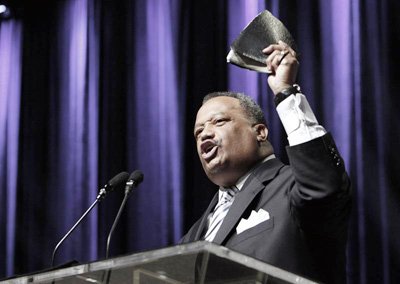
Fred Luter Jr., pastor of Franklin Avenue Baptist Church in New Orleans, preaches at the Southern Baptist Convention Pastors' Conference. When messengers to the SBC annual meeting elected Luter as convention president, he became the first African-American to hold the office. (BP PHOTO/Bill Bangham)

Messengers to the SBC annual meeting elected New Orleans pastor Fred Luter by acclamation to lead the nation's second-largest faith group behind Roman Catholics. Luter, pastor of Franklin Avenue Baptist Church in New Orleans, was nominated to the office by David Crosby, pastor of First Baptist Church in New Orleans.

"He is qualified in every way to hold this office," Crosby said. "We have an opportunity to make history, to show the watching world the truth about our Savior and ourselves and to affirm again the mission that undergirds everything we do."

Wiping away tears, Luter came to the platform to thank messengers for his election. "To God be the glory for the things that he has done," Luter said. "God bless you. I love you."

Luter's election comes at a time when Southern Baptists are seeking to turn around a numerical decline and to elect leadership more representative of the ethnic diversity that exists in the convention's 40,000 churches.

Ed Stetzer of LifeWay Research says the percent of non-Anglo churches has moved from one in 20 to one in five just during the last two decades.

It also adds credibility to efforts by the denomination to shed its past image as defenders of Jim Crow in the South during the Civil Rights Movement championed by black Baptists like Martin Luther King Jr.

Emmanuel McCall, longtime director of black church relations for the Southern Baptist Home Mission Board, dates real progress toward racial reconciliation in the SBC to 1957, when the HMB—since reorganized into the North American Mission Board—hired Victor Glass as liaison with the National Baptist Convention.

McCall, an adjunct faculty member at Southern Baptist Theological Seminary from 1970 until 1996 and past moderator of the Cooperative Baptist Fellowship, said in his 2007 memoir of race and Baptists, When All God's Children Come Together, that the founders of the Southern Baptist Convention found theological justification for white supremacy in the Curse of Ham theory, which came into use in defense against abolitionists between 1800 and 1865.

The myth that black people were made dark by a curse that God put upon one of the sons of Noah was largely regarded as the "inspired" word of God until scholarship of the 1960s refuted it, McCall said. Questions around the theme were raised regularly at race relations conferences until the 1970s, and that the notion still exists on the fringes, he noted.

Denominational leaders' views on race evolved with the rest of white America, McCall observed. After President Truman desegregated the armed forces, Southern Baptists in 1947 passed a resolution opposing racial prejudice and pledging to "cooperate with Negro Baptists in building up of their churches, the education of their ministers, and the promotion of their missions and evangelistic programs."

In 1954, the Christian Life Commission supported Brown v. Board of Education by encouraging the SBC to affirm civil authority. As SBC president in 1958-1959 and as a member of the CLC's board of trustees, Arkansas Congressman Brooks Hays pushed progressive racial views in the denomination that wound up costing him his political career.

In 1960, Foy Valentine, a protégé of Southwestern Baptist Theological Seminary professor T.B. Maston, took over as director of the Christian Life Commission—lobbying for ethical issues including race. After a seminar in Washington where President Johnson invited participants to the White House and solicited their help in passing the Civil Rights Act of 1964, a member of the SBC Executive Committee suggested the agency be abolished.

In 1968, the commission worked with SBC President Franklin Paschall for adoption of A Statement Concerning the Crisis in Our Nation that confessed Southern Baptists' shortcomings in advocating racial justice. About one-fourth of voting messengers opposed the statement, described by newspaper editors as the denomination's strongest statement ever on race.

Another catalyst for racial reconciliation was the Home Mission Board under leadership of Arthur B. Rutledge from 1965 until 1976. Rutledge gave Home Mission Magazine editor Walker Knight and staff freedom to write about churches and missionaries on the cutting edge of community action and change.

Rutledge also expanded work with National Baptists to department status, in 1968 hiring McCall as the first African-American to serve on the national staff of an SBC agency. Headlines read, "Southern Baptists elect a Negro executive."

Sailing wasn't always smooth for progressives in the SBC. In 1971 the Sunday School Board recalled 140,000 copies of a publication that featured a front-cover photo of a black male student talking to two white female students on a college campus. McCall says public backlash to the incident was a major embarrassment that nudged the denomination toward a healthier attitude about race.

In the early 1990s, a number of Baptist state conventions passed resolutions apologizing for past racism to clear the air in anticipation of the SBC's 150th anniversary in 1995. One in the Georgia Baptist Convention was sponsored by current SBC president Bryant Wright, who had encountered animosity from black religious leaders while trying to coordinate an area-wide evangelistic crusade in preparation for the 1996 Summer Olympics in Atlanta.

For the first time, historians began discussing frankly the role slavery played in the SBC's founding. In 1995, the Christian Life Commission, under direction of Richard Land, held a Racial Reconciliation Consultation of 16 Baptist leaders, equally divided between black and white, who drafted what became the SBC resolution apologizing for the denomination's historic support for slavery and acceptance of past racial injustice including segregation.

The statement went on to "genuinely repent of racism of which we have been guilty, whether consciously or unconsciously" and "ask forgiveness from our African-American brothers and sisters, acknowledging that our own healing is at stake."

Land's work for racial reconciliation was tarnished recently when his trustees reprimanded him for comments about racial profiling—related to the Trayvon Martin shooting—that the board deemed harmful to black-white relations.


WMU celebrates Jesus’ story in New Orleans

NEW ORLEANS (BP)—Woman's Missionary Union's theme for this year, "The Story Lives On," came to life through the words of a New Orleans pastor, a missionary and others during the WMU annual meeting in New Orleans.

National Acteen Panelist, Mary Virginia Harper of Montgomery, Ala., addresses the Woman's Missionary Union missions celebration and annual meeting in New Orleans. (BP PHOTO/Matt Miller)

WMU President Debbie Akerman noted "The Story Lives On" focuses on the gospel's ability to transcend generations and transform individuals, churches, communities and nations.

David Crosby, pastor of First Baptist Church in New Orleans, described the lasting impact of Jesus' story on New Orleans following Hurricane Katrina.

"It turned our city into a lake," Crosby said. "Eighty percent of the footprint of the city of New Orleans was covered with water. Our church was an island in a flood for three weeks. And when I came in by helicopter 11 days after the storm, I wondered, 'God, will it ever come back together again?'

"And then, there was a rush of wonderful love. A flood of people, thousands and hundreds of thousands, who came to help in this city that care forgot."

But love for one's neighbor doesn't come easy, Crosby said. Referencing the story of the Pharisee who tested Jesus in Matthew 22 by asking Christ which commandment was greatest, Crosby said it wasn't the first commandment the religious leader struggled with but the second.

"Love the Lord your God with all you heart, soul, strength and mind. He felt he had that down. He was a devoted Jew," Crosby said. "He went to synagogue, he said his prayers and gave his tithe. … What troubled his conscience, why he wanted to justify himself, was the second: Love your neighbor as yourself. You might be a little like him. I think I am."

David Crosby, pastor of First Baptist Church in New Orleans, was a featured speaker during the Woman's Missionary Union missions celebration and annual meeting in New Orleans. (BP PHOTO/Matt Miller)

That's why Jesus gave believers the story of the Good Samaritan in Luke 10, Crosby explained, "to help you and me understand what it means to love your neighbor." And love, he said, walks into a trial.

"Love is so complicated and so difficult, it's such a mess. It's just easier to walk by the other side of the road. I mean, you got church work to do, meetings to attend—we're busy people.

"Talk about washing feet? A beautiful rendition of that story—it's going into a stranger's house and cleaning up after the flood, and helping that poor soul deal with the fact that he brought a truck to take what he wanted to save, and (instead) he can fit it all in a 13-gallon trashcan."

Participants at the WMU annual meeting also heard about the power of Jesus' story from Annette Hall, an International Mission Board worker who spoke about the impact of chronological Bible storying. Hall has worked nearly 40 years with North African and Middle Eastern peoples, and ranks among IMB's top oral evangelism experts.

"Two-thirds of the world's people are oral communicators," Hall said. "That means that they learn through stories or music, drama or poetry. … If you hand them a book to read, they either can't read it or they won't read it."

The process behind chronological Bible storying is simple, Hall said, often using a set of 20 individual stories that move listeners through the Bible from Genesis to the second coming of Christ.

"We tell them the story, and then we have them learn the story, and then we process the story by asking some very simple questions," Hall said. "Because they've learned the story, and because we use the same simple questions every time, they can reproduce this and go out to tell other people.

"We don't teach. We want people to get the point of the story from the story. They need to discover it for themselves. If I tell them the answer, it goes into their heads, but it doesn't go into their hearts."

Hall related a recent success story from a Bible storying training event she led in southern Asia last year. One of Hall's colleagues, who helped with the training, met a young woman whose family had been radically changed.

"The woman said: 'There were some people from my village who went to a training and they learned how to tell Bible stories. And they came and they told the story for me and my family. Now I am a believer and so is my family. All of us believe in Jesus,'" Hall recounted. More than 20 people in that village have been baptized as a result of chronological Bible storying, she added.

"Chronological Bible storying is a powerful tool," she said. "God gave it to us. He gave us a book full of stories. And all we have to do is learn to use them."

Participants at the WMU meeting also were introduced to this year's National Acteen Panelists, young women in grades 7 through 12 chosen from across the United States based on their commitment to missions and participation and leadership in their Acteens group, church, school and community.

Mary Harper, from First Baptist Church Prattville, Ala., told WMU she learned boldness in sharing her faith through interactions with a Korean student she met in a high school chemistry class. Harper described him as a confirmed atheist who often worked "page after page of physics problems that he claimed proved God did not exist."

"He was so much smarter than me, but I knew that my God, the God who gave Daniel the courage to face the lion's den, and the God who gave David the strength to overcome Goliath, would give me the words to say to persevere," Harper said.

She continued to share her faith with her friend over the past two years, and although he has not yet made a commitment to Christ, Harper said he's begun reading his Bible daily and attending church.

"I know that God will continue to work in his life, Harper said. "Through this experience I have learned that God calls all Christians to be missionaries, even if this simply means being willing to share his love with the people we meet in our everyday lives."

Each of the six Acteen panelists will receive $1,000 from the Jessica Powell Loftis Scholarship for Acteens from the WMU Foundation.