Seminary president resigns ahead of confrontation with trustees

KANSAS CITY, Mo. (ABP) — Phil Roberts, the embattled president of Midwestern Baptist Theological Seminary, resigned Feb. 10. No reason was stated, and trustees gave no details about their called five-and-a-half hour meeting at a Kansas City hotel that prompted the 61-year-old to step down.

Robin Hadaway (left), associate professor of missions at Midwestern Seminary, was named acting president of Feb. 10 after embattled President Phil Roberts resigned. Kevin Shrum (right), new chair of the Midwestern Seminary trustees, meets with reporters after the meeting. (ABP photo by Greg Warner)

Trustees met behind closed doors in a meeting called specifically to consider Roberts’ job performance, trustees said in a statement released afterward. The start of that meeting was delayed when trustees supportive of Roberts tried to save his job by voting out the trustee officers and committee chairs instead.

That voted failed, the trustees’ three-sentence statement said. Roberts then submitted his resignation, effective Feb. 29. Trustees then “suspended” the special meeting.

The board’s executive committee — the officers and committee chairs – reportedly had called the special meeting in part to present a summary of a recent forensic audit that several trustees said uncovered serious financial irregularities.

Roberts is the second president in a row to leave Midwestern Seminary involuntarily. His predecessor, Mark Coppenger, was fired in 1999 for reasons including low employee morale. Sources said Friday’s meeting was the third attempt to terminate Roberts during his 11-year tenure. The most recent, in 2007, was led by the chairman of the trustees at the time.

Trustees named Robin Hadaway, associate professor of missions at Midwestern, acting president.

Despite failure of the attempt to remove the officers, board chairman Wayne Lee of Southlake, Texas, resigned at some point in the meeting. At Lee’s suggestion, trustees elected Kevin Shrum, pastor of Inglewood Baptist Church in Nashville, Tenn., as trustee chair until the board’s next meeting.

The designated trustee spokesperson, Shrum declined to say if trustees took any action on issues raised in the audit or other financial issues. “We’re like any institution with an ongoing need to take care of matters,” he said. Shrum said the seminary “is in a good place” but “always looking to improve our processes.”

Although some of the criticism of Roberts is similar to that surfaced in 2007, the forensic audit added a level of seriousness not seen in previous confrontations. A forensic audit is a detailed inspection of financial records by an outside consultant conducted to the standards of a court of law. Because it must meet judicial-level standards, it raised the possibility of legal ramifications for the administration and/or trustees, who both have fiduciary responsibility for the school under the law.

Before the Feb. 10 meeting, several trustees told Associated Baptist Press that Roberts misled trustees and auditors about the improper use of designated accounts, government grants and other funds at the seminary, which has struggled financially for years.

Trustee leaders said Roberts shuffled money between seminary accounts and misused designated funds in order to mislead trustees, auditors and SBC officials about the school’s true financial status.

Trustee Gene Downing, the chair in 2007, said Roberts has always had a problem misleading the trustees, particularly about finances. “That’s been going on since the day he got there,” he said. “That’s always been the case.”

Improper use of government Pell grants could prove costly if the U.S. Department of Education insists the money be paid back or imposes fines, which could reach $500,000. The DOE reportedly said the seminary’s Fusion program for prospective missionaries should not have qualified for the grants, because too many students dropped out without completing a bachelor’s degree.

The seminary also is reportedly in violation of Southern Baptist Convention regulations that require the school to keep in reserve enough money to cover operating expenses for three month. For Midwestern that would be about $2.5 million.

Additionally, Roberts used seminary funds for trips that some trustees say were personal. He took two trips to Pakistan during which he visited his son. He and his wife went to Africa, trustees said, and he arranged just one opportunity to preach. It was reportedly during that trip that he informed the staff of a 20 percent across-the-board spending cut and one mandatory day off a week without pay.

Not all the problems with Roberts’ leadership are financial, trustees said. The former president was described as a “micromanager” who intimidated or fired employees who disagree with him. The seminary has had 11 chief financial officers during Roberts’ 11 years as president — three in the last 12 months.

Rich Hastings, one of the trustees supportive of Roberts, said he did not believe allegations of intimidation. “I do believe that he has fired people,” Hastings said Feb. 5.” People who have been fired frequently say things that are not true.”

Roberts, who did not attend the meeting, told the Kansas City Star he was “incredibly honored and pleased to serve this long” and could walk away feeling he did his best. With some trustees supporting him and some wanting him fired, Roberts said, he decided to resign because he “wanted to leave the seminary united in spirit and purpose.”
http://www.kansascity.com/2012/02/10/3422042/leader-is-out-after-11-years-at.html

Roberts was elected in 2001 as the fourth president of the Kansas City-based Southern Baptist seminary founded in 1957. He came to Midwestern after seven years at the SBC North American Mission Board and its forerunner, the Home Mission Board, first as director of the interfaith evangelism department and later as vice president.

Roberts taught missions and evangelism at Southern Baptist Theological Seminary and Southeastern Baptist Theological Seminary. He was acting dean of at the Emmanuel Baptist Seminary and University in Oradea, Romania, 1992-1994, and a pastor in England, Germany and Belgium.

Roberts is a graduate of Georgetown College in Kentucky and Southern Baptist Theological Seminary. He earned his doctorate from the Free University of Amsterdam. His father, Ray Roberts, was a church planter and the first executive director of the State Convention of Baptists in Ohio.

Roberts is the author of books including Mormonism Unmasked and The Counterfeit Gospel of Mormonism.


–Greg Warner is former executive editor of Associated Baptist Press.

Previous story:

Seminary trustees to confront president over audit, management issues


Retiring CBF head to lead new center for Baptist leadership

ATLANTA (ABP) – Retiring Cooperative Baptist Fellowship Executive Coordinator Daniel Vestal has been tapped to lead Mercer University’s new Eula Mae and John Baugh Center for Baptist Leadership . Vestal will assume his new role July 1, the day after he retires as head of the Atlanta-based CBF, where he has served since 1996.

The new center is endowed by a $2.5 million grant from the Eula Mae and John Baugh Foundation. Sysco food corporation founder John Baugh, a Baptist layman and generous donor of moderate Baptist causes, died in 2007 at age 91.

Daniel Vestal

“I can think of no two names more synonymous with Baptist leadership than John Baugh and Daniel Vestal,” Mercer University President William Underwood said in announcing Vestal’s appointment Feb. 8. “John Baugh for many decades provided courageous and principled leadership as a Baptist layperson, and Daniel Vestal for more than 15 years has provided courageous and principled leadership for the Cooperative Baptist Fellowship.”

The Baugh Center will foster research and learning in Baptist history, theology, ethics and missions, partnering with Mercer’s James and Carolyn McAfee School of Theology, the Cooperative Baptist Fellowship, the American Baptist Historical Society, as well as Mercer’s Center for Theology and Public Life and other organizations and programs. It will initiate a doctoral program in religion focused on Baptist studies.

The center will be interdepartmental in nature, engaging faculty from across the university and visiting scholars. Vestal will teach as a distinguished university professor.

“I am honored by this appointment as well as the generosity of the Baugh Foundation and anticipate being a part of such an historic institution as Mercer University,” Vestal said. “Eula Mae and John Baugh embodied integrity and Christian character.”

Prior to being named CBF coordinator, Vestal served five years as pastor of Tallowood Baptist Church in Houston. He also was pastor of Dunwoody Baptist Church in Atlanta; First Baptist Church of Midland, Texas; Southcliff Baptist Church in Fort Worth, Texas; and Meadow Lane Baptist Church in Arlington, Texas.

After a failed run for president of the Southern Baptist Convention in 1990, Vestal convened a gathering of moderates frustrated with a decade of denominational politics in the nation’s second-largest faith group. That led to formation of the Cooperative Baptist Fellowship to uphold values like academic freedom in seminaries, women in ministry, local-church autonomy and the separation of church and state.

John Baugh was founder of Sysco Corporation in 1969, now North America's leading foodservice marketer and distributor, with $30.3 billion in annual sales and 47,500 employees. His philanthropic organization has aided numerous moderate Baptist causes, including Associated Baptist Press.

Recent major gifts include $2 million for the Baugh-Marshall Chapel at Central Baptist Theological Seminary dedicated in 2011. A matching-gift challenge in 2007 helped the Baptist Joint Committee for Religious Liberty raise nearly $1.2 million in a couple of weeks, reviving a flagging $5 million capital campaign. Baugh Foundation funds helped make possible the new Celebrating Grace hymnal unveiled in March 2010.

The foundation also sponsored an April 2010 retreat for leaders of more than 20 CBF-affiliated organizations to imagine a future for the network of moderate Baptist churches and individuals on the occasion of its 20th anniversary. An outcome was a CBF 2012 Task Force led by Alabama pastor David Hull, which gathered input in more than 100  listening sessions in a two-year study and is expected to bring a final report at the CBF General Assembly  scheduled June 20-23 in Fort Worth, Texas.
http://www.thefellowship.info/General-Assembly/special-events

Underwood voiced deep gratitude to the Baugh’s daughter, Babs Baugh, and granddaughters Jackie and Julie, who serve as the family foundation’s directors, for the Mercer gift.


–Bob Allen is managing editor of Associated Baptist Press.


New Orleans pastor may become first African-American SBC president

NEW ORLEANS (RNS)—After months of urging from other Baptists around the country, Fred Luter told his African-American congregation he will seek to become the first black man to lead the predominantly white Southern Baptist Convention.

Several Baptist leaders said Luter becomes the prohibitive favorite for the post, to be filled in a potentially historic election at the Southern Baptists' annual meeting in June.

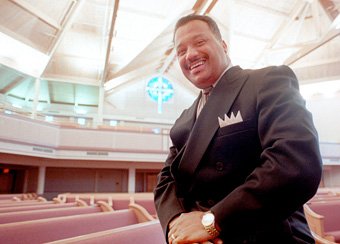
Fred Luter Jr. of New Orleans is the highest ranking African-American in the Southern Baptist Convention and is widely seen as the denomination's next president. (RNS file photo by Ric Francis/The Times-Picayune)

The SBC presidency will become vacant when Bryant Wright of Marietta, Ga., finishes his second one-year term.

Many began openly promoting Luter for the top job last summer, moments after he was elected the convention's first African-American first vice president.

"If he runs, he'll get elected overwhelmingly. He may be unopposed," said Daniel Akin, president of Southeastern Baptist Seminary in Wake Forest, N.C.

No other candidates have announced so far. Other potential candidates were judging their chances on whether Luter decided to run, Akin said.

"I'd be very surprised if there were any other substantial candidates," said Russell Moore of Southern Baptist Theological Seminary in Louisville, Ky.

Akin, Moore and others say they are eager to elect Luter, both for his leadership gifts and to demonstrate Southern Baptist acceptance of the changing face of their work.

Luter's church once was a predominantly white Southern Baptist congregation dying on the vine after its neighborhood became increasingly black in the 1970s. Luter, a black street-corner preacher with no previous pastoral experience, became pastor of Franklin Avenue Baptist Church in New Orleans in 1986. The church kept its Southern Baptist affiliation while Luter built it into a major success as a predominantly African-American congregation, and then he led his church in rebuilding after Hurricane Katrina.

Several Baptist congregations around the country tried to recruit Luter as a pastor or co-pastor, Akin said, believing he might be available after Katrina. "He was like Peyton Manning as a free agent."

Luter's stature grew in his decision to remain in New Orleans, Akin added. "You have to have unbelievable respect for a man who made that kind of commitment," he said. "Look at what he did."

Growth in traditional white congregations in the 16-million-member Southern Baptist Convention has plateaued. In recent years the denomination has actively sought to reach out to nonwhites, typically Hispanics, African-Americans and Asians. In 1990, 95 percent of Southern Baptist congregations were white; now the figure is 80 percent, said Scott McConnell of LifeWay Research, a church-related institute.

"Some critic said of us that the Southern Baptist Convention is as white as a tractor pull," Moore said. "If that remains the case, the Southern Baptist Convention has no future. I think Fred Luter's election will be pioneering; I pray it will not be an anomaly."

Meeting in Phoenix last summer, Southern Baptists adopted a plan requiring its organizations to nourish minority leadership for the future. That's a turnabout for a convention that was formed in 1845 by Southern slaveholding Baptists who broke away from anti-slavery Baptists in the North.

For much of the 20th century, many Southern Baptist pastors and rank-and-file church members across the South supported white supremacy and resisted the civil rights movement. But in 1995, the convention formally apologized for its past and committed itself to racial reconciliation.

"We need to live up to what we said in 1995," said David Dockery, president of Union University in Jackson, Tenn. "This would be a positive step, but only a first one."


Veteran Baptist communicator Lloyd Householder dies

BRENTWOOD, Tenn. (ABP) – Lloyd Householder, 82, a veteran Southern Baptist denominational worker and communicator, died Jan. 30.

Householder worked 32 years for the Southern Baptist Sunday School Board, now called LifeWay Christian Resources, before retiring in 1992 as assistant vice president for the office of communications. After retirement he served as first coordinator of the Tennessee Cooperative Baptist Fellowship in 1994-1995.

Householder graduated from Carson-Newman College and the Southern Baptist Theological Seminary. He is survived by his wife, Rose Marie; son, Thom Householder (Jennifer Beltz) and daughter, Ashley Householder (Michael Campbell).

In lieu of flowers, memorials may be made to the Associated Baptist Press, P.O. Box 23769, Jacksonville, FL 32241 or the Baptist Theological Seminary at Richmond, 3400 Brook Road, Richmond, VA 23227.


Pro-life, pro-choice speakers urge common ground on abortion

ATLANTA (ABP) – After nearly 40 years of polarization over abortion, two speakers at a Mercer University event said Jan. 24 it is time for people who are pro-choice and pro-life to seek common ground to reduce the current number of 1.2 million abortions a year.

Rachel Laser

Rachel Laser, former senior counsel to the National Women’s Law Center and currently senior vice president for message development at Hattaway Communications, said at a Mercer Lyceum initiative titled “Can We Find Common Ground on Abortion?” that she favors legal abortion and opposes efforts to criminalize it or coerce women against having an abortion.

“My pro-choice views do not prevent me from having common ground on the issue,” said Laser, who formerly worked at the think tank Third Way. “Without differing views there would be no need for common ground.”

While at Third Way, Laser launched the Come Let Us Reason Together initiative, which mobilized evangelical Christians and progressive activists to work together on social issues. She also helped draft and build support for the first-of-its-kind pro-life/pro-choice abortion bill in Congress.

David Gushee, a professor of Christian ethics and director of Mercer’s Center for Theology and Public Life, said he resists abortion not for political reasons but because of a “bias in favor of life.”

Whether one views a fetus as having full personhood or as a stage of development in human life, Gushee said, a decision to terminate a pregnancy is a form of killing.

“Death is the great enemy, and a broken world gives us many deaths we cannot prevent, but we should prevent the deaths that we can,” Gushee said.

Gushee, co-founder and board chair of the New Evangelical Partnership for the Common Good and contributing columnist to media outlets including Associated Baptist Press, said terms describing social issues including abortion as “liberal” or “conservative” are “an accident of history that are not particularly helpful to us.”

David Gushee

So, he said, are ideas such as when life begins. For some, he said, “after birth we have a human being, before birth we have something else.” Gushee said not everyone is convinced that “having made it through the birth canal” merits such a major distinction. He said the “trimester” rule originally adopted but later abandoned in the 1973 abortion case Roe v. Wade, was used because at least some fetuses back then could survive at 28 weeks. Today that has been pushed back to 22 weeks.

Laser said that in an ideal world “every pregnancy would be celebrated,” but in the real world there are good reasons to keep abortions legal. Women may not be able to afford to become a parent. A woman’s health or life could be in jeopardy if she is medically advised not to become pregnant. An unwanted pregnancy can interrupt educational or career paths, destroy relationships with parents or be the result of abusive, damaging or unstable relationships. In a “small but devastating number” of cases, it is due to rape or incest.

While women are “uniquely advantaged” to be able to bear children, Laser said, “They are also uniquely disadvantaged when it comes to an unintended pregnancy, because only women’s bodies are intertwined with the pregnancy.”

At the same time, she said she believes that abortion is “morally complex” because “it involves not just the pregnant woman but also the developing life inside her.”

While not everyone in the pro-choice movement agrees, Laser thinks there is “common ground on abortion” for those who oppose it on moral grounds and those who view unwanted pregnancies as harmful to women.

“My idea of common ground on this issue is working together to reduce the need for abortion,” she said. “It recognizes the moral complexity of the issue without taking away the legal right to abortion.”

Laser advocated policies to prevent unplanned pregnancies, such as comprehensive sex education, teen pregnancy prevention programs, helping parents to communicate with teens about sex and healthy relationships and increased access to contraception for low-income women. She also supports programs that support pregnant women who want to have their babies by expanding Medicaid and SCHIP coverage to pregnant women, support for pregnant students and adoption services.

“Half of all pregnancies in this country are unintended, and roughly half of those end in abortion,” she said. “Attacking the problem of unintended pregnancy would reduce abortion.”

Gushee faulted religious conservatives for “fixating on legal change” in the 39 years since Roe v. Wade.

“People have narrowed their vision to one issue,” Gushee said. “If we can get Roe v. Wade overturned everything will be OK.” But Gushee said if Roe v. Wade were to be overturned without an increased safety net, the result would be more misery for poor women and children.

Gushee said four years ago it looked like there was going to be “an open space” for a common-ground approach to abortion but efforts were stymied by “clusters of powers and interest groups that live to advance their agenda as they see it.”

“I think 40 years of fighting about this issue has made everybody crazy on the extremes,” Gushee said. “Right now I don’t’ think there is a common ground conversation.”


–Bob Allen is managing editor of Associated Baptist Press.


CBF search committee seeks input

DALLAS (ABP) – A 10-member committee seeking a successor to Daniel Vestal as the Cooperative Baptist Fellowship executive coordinator met for the first time in Dallas in early January.

The initial meeting focused on members of the group getting acquainted, building consensus on a process and describing a timeline in liturgical terms.

“I’d say where we are right now is prayerful discernment,” said George Mason, chair of the search committee and pastor of Wilshire Baptist Church in Dallas. “This is really the Lenten season of our journey together as a committee. We are praying, we are reflecting and we are listening for direction from God.”

Mason said the committee is receiving nominations and applications through the secure e-mail address, CBFsearchcommittee@gmail.com, and encouraged the Fellowship community to respond with names. The committee also created an online questionnaire to survey the Fellowship on qualities needed in the next executive coordinator.

Mason said it is unlikely the committee will have a candidate by the time Vestal officially retires on June 30.

“We are not going to rush through this,” Mason said. “This is a crucial time for the Fellowship, and we are going to take this task seriously and follow a deliberate and Spirit-led process.”


Baptist Briefs

Compensation survey available online. Ministers and staff serving in Southern Baptist churches have the opportunity to take the 2012 Compensation Survey at www.guidestone.org/compensationsurvey . A printed version of the survey may be obtained by contacting GuideStone Financial Resources at (888) 984-8433 between 7 a.m. and 6 p.m. Monday-Friday. The deadline for completion is May 31. The survey provides an accurate baseline of compensation among similar-sized churches in each state convention. Because of the surveys, administrators, personnel/finance committees and minister-search teams are able to receive customized reports that allow them to better determine adequate compensation for ministers and staff. All information is kept confidential, and no individual answers will be reported. The compensation survey is provided through the joint efforts of Baptist state conventions, LifeWay Christian Resources and GuideStone. Survey results will be released this summer.

Baptist journalist Newton dies at 75. Longtime Baptist journalist Jim Newton died Jan. 16 at Baptist Hospital hospice care in Clinton, Miss., after a battle with leukemia. Newton, 75, was born in Kingsville, into the third generation of a family of weekly newspaper editors. After graduating from Baylor University in 1958, he worked as associate editor of The Bishop News until he became press representative of the Baptist General Convention of Texas in 1959. He was assistant director of Baptist Press in Nashville, Tenn., from 1965 to 1973. After that, he worked eight years as editor of World Mission Journal, published by the SBC Brotherhood Commission in Memphis, Tenn. In 1980, he joined the staff of the Home Mission Board in Atlanta, retiring in 1992 as public relations director to accept a communications position with the U.S.-based office of World Vision International in California. After retiring to Clinton, Newton worked with the Cooperative Baptist Fellowship of Mississippi and was a member of Trace Ridge Baptist Church in Ridgeland, Miss. He also served as a news and media consultant for the Billy Graham Evangelistic Association. He is survived by his wife of 50 years, Patricia Tullos Newton, two daughters and five grandchildren.

Haitian school and orphanage dedicated. Two years after an earthquake killed thousands in Haiti, Baptists on the island nation and their international partners dedicated a school and orphanage for children affected by the disaster. Representatives of the Baptist General Association of Virginia, the Baptist World Alliance and Hungarian Baptist Aid participated in the dedication of the Source of Light complex in the Delmas 19 neighborhood of Port-au-Prince. The school for about 200 preschool, kindergarten and primary students has begun classes, and the orphanage, which will house about 50 children, will begin operations in early February. The Baptist World Alliance provided the majority of the funds through BWAid, its relief and development arm. The Virginia Baptist Mission Board contributed about $200,000. Hungarian Baptist Aid supervised construction in association with the Haiti Baptist Convention.

Compiled from wire services


Pressler denies Santorum endorsement was rigged

HOUSTON (ABP) – The host of a weekend gathering of religious conservatives seeking consensus on an alternative presidential candidate to GOP front-runner Mitt Romney denied charges that balloting was rigged to give Rick Santorum the nod over rivals Newt Gingrich and Rick Perry.

Paul Pressler, a former judge and architect of the “conservative resurgence” movement in the Southern Baptist Convention in the 1980s, disputed a Washington Times article about a weekend gathering at Pressler’s ranch near Houston claiming that organizers manipulated votes to guarantee that Santorum, a former senator and Roman Catholic, would come away with the group’s endorsement.

Paul Pressler

Paul Pressler

“It is people that did not have the meeting go the way they wanted to that are spinning it and lying about it,” Pressler said on The Michael Berry Show on KTRH news radio in Houston.

The newspaper article said Santorum won a first ballot over Gingrich but the margin was too close for organizers to claim consensus. A final ballot with more than 70 percent in favor of Santorum was said to have been taken after many backers of other candidates had left to catch flights home.

The article quoted Doug Wead, former President George H.W. Bush’s one-time liaison to evangelicals, saying by the end of the weekend “it was clear that this had been definitely planned all along as a Rick Santorum event.”

Another evangelical political organizer said he witnessed a possible incident of ballot-box stuffing when a participant was seen writing Santorum’s name on four separate ballots and casting all four.

Pressler said the allegation of stuffing the ballot box was traced to a young man who worked for a couple who had to leave early and asked him to cast ballots for them when the time for voting came.

“So he filled out three, not four, ballots,” Pressler said. “He did it on the first ballot but not on the second and the third, because he thought it was not correct.”

Pressler agreed the couple’s request for the young man to vote in their place was “questionable.”

“It shouldn’t have been done, but it was not stuffing the ballot box,” Pressler said. “It was a mistake, but it didn’t affect the ultimate outcome.

Pressler said he voted for Texas Gov. Rick Perry on the first of three ballots taken during the event but switched to Santorum “since it was obvious that Rick Perry would not prevail.”

Pressler said the purpose of the balloting was “to come to a consensus and let the consensus be known” and not a binding pledge about how to vote in the primary.

“It was informational,” Pressler said of the invitation-only gathering of about 160 social conservatives. “People heard what other people were doing and why. I think that it will have some influence on what people do hereafter, but it was not an implication that if you come you must support anybody. It’s just perhaps you will get enough information in this meeting that will cause you to change your thinking or adapt or something.”

“It was not a forced meeting,” he said. “It was an open forum, and one of the things we did most was pray. We had an hour of prayer there on Friday night. It was open for everybody praying, and we started every meeting and closed every meeting with prayer and prayed in between, and it was not partisan prayers.”

Pressler said he thinks the group’s dissatisfaction with Romney, who is a Mormon, is not due to a “religious problem” but rather about his record as a governor and the fact “he is a Northeasterner and really does not identify with people of the forks of the creek.”

“I think this group was much more concerned about his health plan in Massachusetts and other things like that,” Pressler said. “I think Romney has come a long way, and I will support him enthusiastically if he gets the Republican nomination. And I think everybody or almost everybody there will do the same thing.”

Pressler said the gathering was more diverse than just a group of evangelicals. “We had a Roman Catholic priest pray, opening or closing one of the sessions,” he said. “Some of my closest Catholic friends were there. I’m sure there were some Mormons there. I don’t know.”

Pressler said he has “never seen evangelicals so aroused” in an election season and predicted greater involvement by that bloc than ever before.

“Here I am, a person who spent 25 years in elective office — always elected as a Democrat — and for the first time in my life I don’t know one single person that supports the Democratic Party and Obama,” Pressler said.

“I personally believe that this group is destroying the nation economically and morally, and if it is allowed to continue we have a very bleak future as a country.” Pressler said of the current administration. “I travel a great deal and I see what’s going on in the world, and I shudder to think what is coming to America if we don’t stop this right now.”


–Bob Allen is managing editor of Associated Baptist Press.


Remembering Baptists who died in 2012

(ABP) –Baptist journalists, pioneers in racial reconciliation and beloved leaders in the Southern Baptist Convention and Cooperative Baptist Fellowship were among deaths reported by ABPnews in 2012.

Francis McBeth, an internationally acclaimed composer and conductor and longtime professor of music at Ouachita Baptist University, died Friday, Jan. 6, at age 78.

Mourners attend the January 2012 funeral of Harold T. Branch at St. John Baptist Church in Corpus Christi (Photo by Michael Zamora/Corpus Christi Caller-Times)

Longtime Baptist journalist Jim Newton, 75, died Jan. 16 in Clinton, Miss., after a battle with leukemia. He was assistant director of the Baptist Press in Nashville, Tenn., from 1965 to 1973. After that he worked eight years as editor of World Mission Journal, published by the SBC Brotherhood Commission in Memphis, Tenn. In 1980 he joined the staff of the Home Mission Board in Atlanta, retiring in 1992 as public relations director to accept a communications position with the U.S. based-office of World Vision International in California. After retiring to Clinton, Miss., Newton worked with the Cooperative Baptist Fellowship of Mississippi.

Harold Branch, 92, the first African-American officer of the Baptist General Convention of Texas, died Jan. 20 in Corpus Christi, Texas, a community he had served in various capacities since 1956.

Lloyd Householder, 82, a veteran Southern Baptist denominational worker and communicator, died Jan. 30. Householder worked 32 years for the Southern Baptist Sunday School Board, now called LifeWay Christian Resources, before retiring in 1992 as assistant vice president for the office of communications. After retirement he served as first coordinator of the Tennessee Cooperative Baptist Fellowship in 1994-1995.

Melissa Cheliras, 33, Baptist campus minister at the University of Richmond, died Feb. 10, following a four-month battle with esophageal cancer.

Helen Fling, 97, a longtime leader in Woman’s Missionary Union, died March 1. The wife of Pastor Robert Fling, she was president of the women’s auxiliary to the Southern Baptist Convention from 1963 until 1969.

Lee Porter, 83, a retired editor at LifeWay Christian Resources who served 25 years as SBC recording secretary, an annually elected post responsible for casting, collecting and tabulating ballots during business sessions of the convention annual meeting, died May 17.

Julian Pentecost, longtime editor of the Religious Herald and a founding director of Associated Baptist Press, died May 31 at 87.

John Roberts, 85, the longest-serving editor in the history of The Baptist Courier, died Aug. 15. He joined the Courier staff in 1965 as associate editor and business manager. The following year he became editor, a job he kept until his retirement in 1996. He held leadership positions which included serving on the board of directors of Associated Baptist Press.

Jeff Trussell, 45, and Courteney Kaliszewski, 16, members of Cedar Grove Baptist Church in Maryville, Tenn., died Sept. 16 in a church van accident while returning from a weekend retreat. Tyler Schaeffer, 21, of Sevierville, Tenn., was charged with vehicular homicide and drug possession in the crash that also injured 12.

Henry V. Langford, a white Baptist preacher whose support for racial equality caused him to be blackballed by churches in the 1950s, died Oct. 7 at age 93. Langford served as pastor of small churches in Virginia before he used a weekly column he wrote for the local newspaper to voice support for the 1954 Brown v. Board of Education Supreme Court ruling that declared the “separate but equal” doctrine used to support school segregation unconstitutional. Langford was eventually forced to resign as minister at Shockoe Baptist Church in Chatham, Va., and could not find another congregation that would call him as pastor. He found a new calling in the Alcohol and Drug Education Council of Virginia Churches, where he served eight years as associate director and 13 as executive director, speaking to hundreds of school, church and community groups across Virginia about the signs and dangers of substance abuse during the 1960s and 1970s. Langford finally received long-overdue recognition in 2007 when the Virginia General Assembly passed a joint resolution honoring “his commitment to justice and equality for all citizens.”

John Dunaway, 79, a longtime Kentucky pastor who helped name the Cooperative Baptist Fellowship, died Oct. 18 at his home in Huntsville, Ala., following a long illness. The Constitution offered at the inaugural CBF gathering proposed the group of disenfranchised Southern Baptists call itself the “United Baptist Coalition.” Dunaway, at the time pastor of First Baptist Church in Corbin, Ky., pointed out that an existing United Baptist group espoused “extreme Calvinist views” and “the identification with the United Baptists would be in conflict with who we are and what we are.” Ed Vick, a layman from Raleigh, N.C., said Baptists, in the truest sense of the word, are not united but rather cooperative. And so the group instead named itself the Cooperative Baptist Fellowship — today an 1,800-church organization with headquarters in Atlanta.

Salem Boulos Sweilem, who attended the Gaza Baptist Church in Gaza City, died Nov. 19 of an apparent heart attack triggered by stress during a nearby bombing that shook his home. More than 160 Palestinians were killed during eight days leading up to a ceasefire announced Nov. 21. Palestinian sources said half were civilians, and about 30 were children. More than 1,200 people were wounded.

K.H. Ting, an Anglican bishop prior to China’s Cultural Revolution who led a “post-denominational” re-emergence of Chinese Christianity in the 1970s and 1980s, died Nov. 22 after several years of poor health. In 1985, Ting and others set up the Amity Foundation, a Christian faith-based organization that promotes education, social services, health and rural development across China. Its work includes Nanjing Amity Printing Company, Ltd., a joint venture with the United Bible Societies launched in 1988 that recently celebrated the printing of its 100 millionth Bible.


Wiley Drake’s ‘Birther’ lawsuit has setback

WASHINGTON (ABP) – California pastor Wiley Drake’s three-year legal battle challenging President Obama’s eligibility received a setback Dec. 22, when the U.S. 9th Circuit Court of Appeals said he and other plaintiffs lacked legal standing to file their complaint.

A three-judge panel of the federal court based in Washington upheld a central California district court’s October 2009 dismissal of the lawsuit filed Jan. 20, 2009, the day Barack Obama was sworn in as president, but for slightly different reasons.

Wiley Drake, pastor of First Southern Baptist Church in Buena Park, Calif., was second vice president of the Southern Baptist Convention in 2006-2007.

U.S. District Judge David Carter had said the plaintiffs lacked standing because Congress – not federal courts – has authority to remove a sitting president. The appellate court didn’t dispute the “redressability” issue cited by the lower court but added that in order to have standing the plaintiffs should have filed the lawsuit prior to the November 2008 election.

Drake, pastor of First Southern Baptist Church in Buena Park, Calif., ran as Alan Keyes' running mate on the American Independent Party's ticket in 2008. Along with party officials, they argued in the complaint that the race wasn’t fair because the winning candidate shouldn’t have been allowed to run. Claiming Obama does not meet the constitutional requirement that the president must be a “natural born citizen,” Drake and Keyes claimed an interest in having a fair competition for the positions they sought to obtain.

The appellate court said that once the 2008 general election was over, Drake and Keyes were no longer “candidates” who could claim they would be injured by the “potential loss of an election.”

“The political candidates failed to establish redressability sufficient to establish standing,” the judges ruled. “They cannot claim competitive standing because they were no longer candidates when they filed their complaint.”

Orly Taitz, one of the plaintiffs' lawyers, told reporters outside the courthouse she would ask the appeals court to convene a full 11-judge panel to review the case and if denied she would appeal to the Supreme Court. 

The lawsuit is one of a number of so-called "birther" lawsuits against Obama's election filed by individuals or groups who disbelieve the president's claim that he was born in Hawaii to an American mother, thus establishing his citizenship. So far none has succeeded.

Drake, 69, who served as second vice president of the Southern Baptist Convention in 2007-2008, has been a fixture at floor microphones during business sessions at the SBC annual meeting since the 1990s. He was a driving force behind the convention’s 1997 boycott of the Disney Company because of its gay-friendly corporate policies. In 2005 the convention called off the boycott, declaring it a success.

Once celebrated as a symbol of the small-church pastor who sacrificed to travel to SBC annual meetings to cast ballots for conservative candidates during a leadership change known to the winners as the “conservative resurgence” and to the losers as a “fundamentalist takeover, Drake’s reputation became tarnished after he said on the Alan Colmes Show on June 2, 2009, that he was praying for President Obama to die.

SBC leaders distanced themselves from the comment, describing Drake’s views as outside the mainstream. At the 2011 SBC annual meeting in Phoenix, the convention passed a resolution on “civil discourse” that denounced unspecified groups and individuals who have gained publicity by tactics including “calling for prayers for the deaths of public officials.” 

On Jan. 3 Drake sent out an e-mail announcing he is the official presidential candidate of the American Independent Party, a conservative alternative to the Republican Party established in 1967 by former San Diego Republican William Shearer.


Bob Allen is managing editor of Associated Baptist Press.

Previous stories:

Court accepts Wiley Drake's 'birther' appeal

Court rejects 'birther' challenge by former SBC officer

Court rejects 'birther' challenge by former SBC officer

California appeals court strikes down Wiley Drake's 'birther' case

Drake's lawyer claims legal precedent for courts to remove a head of state

Judge delays ruling on dismissal of Wiley Drake's 'birther' case

Judge sets court date in 'birther' case filed by Wiley Drake

Wiley Drake wins round in legal battle challenging Obama's presidency


2011 notable deaths

JACKSONVILLE, Fla. (ABP) – Here is a list of notable deaths in 2011 that were reported by Associated Baptist Press.

Morris Ashcraft, 88, who taught at three Southern Baptist Convention seminaries before serving as acting president at the launch of Baptist Theological Seminary at Richmond in 1991, died Jan. 29 after a long illness.

Richard "Dick" Brogan, 73, a white Baptist who spent a career as a teacher and missionary to African-American Baptists in the Deep South, died of a heart attack April 25 at Baptist Hospital in Jackson, Miss.

Ardelle Clemons, 93, a founding board member of Associated Baptist Press, died Nov. 26 after a long illness. She joined the first ABP board in 1990 and was the longest-serving board member when she rotated off in 2004.

Ross Coggins, 83, author of the missionary hymn “Send Me, O Lord, Send Me,” died Aug. 1 at his home in Annapolis, Md., after an illness.

Alan Day, 62, pastor of First Baptist Church in Edmond, Okla., for more than 25 years, died Feb. 16 from injuries sustained in a motorcycle accident.

Benjamin Easler, 6, was killed March 19 when a miniature train at Cleveland Park in Spartanburg, S.C., left the track and tipped over while carrying 15 children and adults from Corinth Baptist Church in Gaffney, S.C. His father, Dwight Easler, is the church’s pastor.

Edwin Gaustad, 87, died March 25, in Santa Fe, N.M. A Baptist historian, he was one of America's leading experts on America's colonial period, particularly in areas of religious liberty, pluralism and dissent.

Former Sen. Mark Hatfield, 89, an Oregon Republican whose Baptist faith helped shape his political views during nearly half a century in public office, died Aug. 7 after several years of declining health. The five-term senator and former Oregon governor was a long-time supporter of the Baptist Joint Committee for Religious Liberty.

John Jonsson, 86, an emeritus professor of religion and former director of the African Studies program at Baylor University, died May 26 at his home in South Africa after an extended illness. A native South African, Baptist pastor and scholar, Jonsson openly protested the South African system of apartheid from the pulpit, the classroom and in other public forums, including a run as an anti-apartheid candidate for the South African parliament.

Bill Junker, 83, longtime Baptist journalist who worked at the Southern Baptist Convention Home Mission Board until he retired in 1992, died June 8 after a long illness.

Jack McEwen, 84, pastor emeritus of First Baptist Church of Chattanooga, Tenn.,  and academic dean at Southern Seminary in Louisville, Ky., from 1980 until 1983, died Dec. 5.

Eugene Nida, 96, a Bible translator who pioneered a groundbreaking approach that led to most Bible translations in the 20th century, died Aug. 25 in a Brussels hospital. Rather than translating Hebrew and Greek biblical languages literally word for word, Nida’s “dynamic equivalence” or “functional equivalence” method seeks to convey the thoughts the biblical writers intended to convey.

Gustavo Parajón, a medical doctor and pastor who was a leading voice for peace and justice ministry in Nicaragua for more than 40 years, died unexpectedly at his home March 13. He was an active supporter and participant in the Baptist Peace Fellowship of North America and a former American Baptist missionary.

James Pleitz, 82, pastor of prominent churches including Park Cities Baptist Church in Dallas and First Baptist Church in Pensacola, Fla., and active in denominational leadership, died May 15 after an illness.

Cecil Ray, 88, a long-time denominational worker who directed Planned Growth in Giving, a 15-year challenge for Southern Baptists to dramatically increase their financial support for world missions, died Aug. 23.

Fred Shuttlesworth, 89, the last of the "Big Three" of the civil rights movement with Ralph Abernathy and Martin Luther King, died Oct. 5.

Evelyn Stagg, 96, a trailblazer for Southern Baptist Women in Ministry, died Feb. 28. She co-authored the book Woman in the World of Jesus with her husband, longtime Southern Seminary professor Frank Stagg, and in 1983 was one of 33 women to help found what is today known as Baptist Women in Ministry.

Oeita Theunissen, 87, known professionally and in church leadership as Oeita Bottorff, died Feb. 25 after a long battle with Alzheimer’s disease. She was a key organizer of the Cooperative Baptist Fellowship, which celebrated its 20th anniversary in 2011.

Ed Vick, 76, a prominent Baptist layman and supporter of moderate causes including Associated Baptist Press, died May 13, seven weeks after being diagnosed with Stage 4 cancer. He served as a director of ABP from 1994 until he resigned May 3 due to his illness, and was a former board chair.

Bob Allen is managing editor of Associated Baptist Press.


2011 in the rearview mirror

JACKSONVILLE, Fla. (ABP) – Between headlines of “Church backing pastor jailed on molestation charges” on Jan. 3 and “Scholar says Christmas as celebration of domesticity a modern invention” on Dec. 22, Associated Baptist Press published 586 news and feature stories in 2011. Some were more memorable than others. Here is our review of some of the year’s top newsmakers.

Rob Bell

Rob Bell

Rob Bell: The Michigan mega-church pastor’s book Love Wins sparked new debate about what the Bible really has to say about hell. Bell caught heck from fellow evangelicals including Southern Seminary President Albert Mohler, who convened a panel March 17 to warn students about the book’s “not just getting a doctrine wrong, but the loss of the gospel.” In June the Southern Baptist Convention responded with a resolution affirming “belief in the biblical teaching on eternal, conscious punishment of the unregenerate in Hell.”

God (as in “acts of”): If 2010 is remembered as the year of the earthquake in Haiti, 2011 brought a whole smorgasbord of natural disasters.

Japan quake

John LaNoue (2nd from right) and Gary Smith (right) of Texas Baptist Men pray with rescue workers in Japan.

A March 11 earthquake and tsunami in Japan prompted one Baptist leader there to predict the country will remember 3/11 the same way Americans do 9/11. Baptists and others were also called upon to respond to suffering caused by spring tornadoes in the East, South and Joplin, Mo.; summer floods along the Mississippi River; wildfires in Texas; Hurricane Irene in August, drought in East Africa and even a rare east-coast earthquake that damaged buildings including two Baptist churches near the epicenter in Virginia.

The Bible: 2011 marked the 400th anniversary of the King James Version, commonly known as the “book that changed the world,” but it also included introduction of some newer translations.

King James Bible

400th anniversary of the King James Bible.

The Southern Baptist Convention panned the latest New International Version in a rare resolution that came not from a committee but a messenger at a microphone on the floor. About the same time, five mainline denominations unveiled a new Common English Bible, a common-ground translation intended as a “denomination neutral” Bible for the 21st century.

Trouble in Mayberry: Mount Airy, N.C., the place that inspired the fictional small town of Mayberry in the long-running “Andy Griffith Show,” made news July 26 when Surry Baptist Association voted to expel Flat Rock Baptist Church for calling a woman to be its pastor. Two other churches resigned their membership in protest. The pastor of First Baptist Church of Mt. Airy, a former association moderator, lamented that controversies that used to divide the Southern Baptist Convention were trickling down to local associations.

Not to be outdone, Daviess-McLean Baptist Association in Owensboro, Ky., kicked out two churches – one for allowing a gay-parent support group to use its building and another for being too Calvinistic, a doctrine admittedly “not heresy” but nonetheless “vastly different” from what a majority of the association’s churches believe.

gay rights meeting

Bryant Wright, president of the Southern Baptist Convention, center front, meets with members of a coalition of lesbian, gay, bisexual and transgender groups including GetEQUAL and Truth Wins Out, who hand delivered a petition to Wright asking the Southern Baptist Convention for an apology for its beliefs regarding the lifestyle of LGBT people. (BP PHOTO/Kent Harville.)

Sex and the Southern Baptist: Six gay-rights groups traveled to Phoenix in June to hand deliver a petition calling for the Southern Baptist Convention to apologize for its treatment of gays. That didn’t happen, but SBC President Bryant Wright agreed to meet with representatives in a conversation that was open to members of the press. They didn’t agree on much, but in past years, Soulforce protesters were arrested for trespassing if they set foot on grounds of a convention center where Southern Baptists were meeting.

Meanwhile, over at the Cooperative Baptist Fellowship, leaders began planning a [Baptist] Conversation on Sexuality and Covenant next April to clear the air about different ways that churches respond to challenges like gay marriage and heterosexual couples who live together but do not marry.

In North Carolina, Pullen Memorial Baptist Church in Raleigh voted Nov. 20 to cease performing civil marriage ceremonies until gay marriages in the state are legal.

Finally, a couple of prominent Southern Baptist congregations got mixed up in scandals involving sexual abuse by clergy.

After the arrest of a former minister of music in Mississippi Sept. 7 for sex charges involving young boys from incidents alleged to have occurred in the early 1980s, it became known that similar accusations had been made against the minister, John Langworthy, in 1989 while he was on staff of Prestonwood Baptist Church in Dallas. Church leaders, including future SBC President Jack Graham, fired Langworthy but did not notify the police.

Then after the Dec. 14 arrest of former youth minister Chad Foster, authorities wanted to interview seven girls Foster might have abused at Second Baptist Church in Houston, where he worked before moving to another church. That church’s pastor, Ed Young, is also a former SBC president.

SBC leaders Al Mohler and Richard Land both admonished Southern Baptists about their legal and moral obligation to report suspected child abuse in wake of the Penn State sex abuse scandal.

A member of Mohler’s board of trustees, meanwhile, faced questions about his handling of an internal investigation of allegations against Langworthy at Morrison Heights Baptist Church in Clinton, Miss., which elders refused to discuss with police citing clergy-penitent privilege.

The end of the world as we know it: Radio Bible teacher Harold Camping’s doomsday prediction of May 21 did not materialize. Neither did a revised Rapture forecast of Oct. 21. ABP didn’t carry a story about the 2011 breakup of REM, known for the 1987 hit “It’s the End of the World as We Know It.” But we were there in June when the Southern Baptist Convention, usually known for values closer to the Tea Party than the Democratic Party, passed a resolution calling for “a just and compassionate path to legal status” for undocumented immigrants. Critics of the statement called it “Southern Baptist amnesty.”

–Bob Allen is managing editor of Associated Baptist Press.