SBC Cooperation Group releases recommendations

NASHVILLE (BP)—Four recommendations released May 1 are designed to “prioritize and emphasize the authority of messengers in defining the boundaries of our cooperation while clarifying and refining our structure,” the Southern Baptist Convention Cooperation Group stated.

The group was tasked at last summer’s annual meeting to study the issue of what makes a church “to be in friendly cooperation of faith and practice” with the SBC.

Published 41 days ahead of the 2024 SBC annual meeting June 11-12 in Indianapolis, the recommendations are to be considered a draft, said Chairman Jared Wellman, pastor of Tate Springs Baptist Church in Arlington. They are “subject to necessary edits” he added.

The first three recommendations are directed at the SBC Executive Committee to propose changes to SBC governing documents for consideration at the 2025 annual meeting.

They concern steps for making changes to the Baptist Faith & Message 2000, who should have authority for seating messengers at an annual meeting, and strengthening the tie between entity trustees and the Baptist Faith & Message.

The fourth recommendation is for the Executive Committee to “evaluate” the usefulness, not to mention accuracy, of a public list of Southern Baptist churches and report their findings at the 2025 annual meeting.

Recommendation 1

The first recommendation addresses how edits or amendments may be made to the Baptist Faith and Message. Last summer in New Orleans, an amendment to the Baptist Faith & Message basically rolled through to a vote with little discussion, prompting concerns about how that came to be.

That would not be able to happen under the first recommendation, which asks that such amendments require the same ratification as amendments to the SBC Constitution—a two-thirds vote in two consecutive years.

The Baptist Faith & Message is “significant” in drawing a picture of what it means to be in friendly cooperation, the group said. “The process of amending ‘The Baptist Faith & Message’ should be robust.”

Recommendation 2

The second recommendation is similar to a process already in place, but with a distinct difference. As it is, the Credentials Committee recommends to the Executive Committee churches it considers no longer to be in friendly cooperation. If the Executive Committee agrees, those churches no longer are part of the SBC, but they may appeal the decision at the annual meeting.

“The sole authority for seating messengers” comes from the messenger body, Wellman said in a Spaces discussion on X May 1, co-hosted by SBC President Bart Barber and South Carolina pastor David Sons.

As such, the Credentials Committee, in collaboration with the Executive Committee “as needed,” will present cases that will go before the messengers for a vote.

“We trust the messengers. We champion the messengers,” Wellman said in the discussion. “And we feel like messengers are the ones who ought to have this sole right to make this decision.”

The SBC Cooperation Group also recommended churches seating messengers for the first time be recognized and celebrated at the annual meeting.

“… [T]he health of our convention’s culture would be improved” by that step, the group said in its report.

Recommendation 3

The third recommendation calls for a requirement by the Committee on Nominations to nominate “only those candidates who affirm the convention’s adopted statement of faith” to seats as entity trustees or as standing committee members.

Wellman pointed to the Baptist State Convention of North Carolina as an example when it came to trustee fidelity.

“We were impressed by that model in such a way where we felt like we could mimic it,” he said.

In functionality, he and Barber noted, the current Committee on Nominations followed this model. “In fact, I think it’s fair to say that in recent memory, the Committee on Nominations has already been doing this.”

Wellman agreed, comparing it to Recommendation 1 and the ease with which the Baptist Faith & Message was amended in New Orleans. As it is, a trustee can “theoretically” not affirm the Baptist Faith & Message. A step to strengthen that step can only strengthen the trust between churches and Southern Baptist entities.

Recommendation 4

The fourth recommendation urges steps “to clarify our cooperative unity” by evaluating “the usefulness and accuracy” of a public list of Southern Baptist churches.

In the Spaces discussion, previous cases were brought up where churches were recommended to no longer be in friendly cooperation and, when contacted, were surprised they had any connection to the SBC. The result was confusion that often played out publicly.

Southern Baptists could gain “a clearer picture” of which churches are part of the SBC, whether that is through seating messengers, completing an Annual Church Profile and/or giving through the Cooperative Program.

No more ‘disfellowship’

The report included an addendum as a point of clarification. The language of “disfellowshipping” a church is inaccurate, the group said, because from a biblical standpoint, it suggests that those churches are no longer Christian.

Article XIV of the Baptist Faith and Message encourages cooperation with like-minded churches, even if they aren’t Southern Baptist, the group pointed out.

With regard to Southern Baptist matters, the suggested terminology is “not in friendly cooperation.”

Early in the Cooperation Group’s meetings, the phrase “closely identifies with” received a lot of scrutiny.

Wellman admitted he was “lukewarm” to it and the “ambiguity” it brought. But by December, he had “come to love this phrase,” calling it “not perfect” but “sufficient.”

Women with the title ‘pastor’

There is no mention of the Law Amendment in the recommendations, although Wellman and Barber said it was brought up to them often by others.

That constitutional amendment, up for a second and final vote by messengers this June, pertains to churches giving women the title of pastor.

As it wasn’t mentioned in the motion that messengers approved, Barber said, addressing it directly was deemed to be outside the scope of the group’s assignment.

“That amendment lies directly in the hands of the messengers,” he said.

The report included a statement on Article III of the SBC Constitution, which outlines the composition of the SBC.

The constitution’s language of “closely identifies with” regarding the Baptist Faith and Message “is sufficient,” the group said.

“Overall, our committee is in unanimity in trusting and championing the convention’s messengers,” Wellman wrote in a chairman’s note preceding the report that also called for Southern Baptists to pray and fast with the recommendations’ release.

In addition to Wellman, members of the Cooperation Group are Victor Chayasirisobhon, Jerome Coleman, Tara Dew, Donna Gaines, Matt Henslee, Travis Kerns, Richard Land, Jonathan Leeman, Jason Paredes, Greg Perkins, Jim Richards, Juan Sanchez, Andrew Walker, Trevin Wax and Tony Wolfe.

SBC officers serving in ex officio roles are Bart Barber, president; Kason Branch, second vice president; Don Currence, registration secretary; and Nathan Finn, recording secretary.


Longtime international missions leader Clyde Meador dies

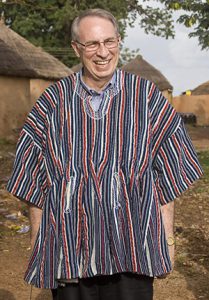
RICHMOND (BP)—Longtime International Mission Board leader Clyde D. Meador died April 26. He was 79.

Clyde Meador 300
Clyde Meador

Meador worked closely with four IMB presidents as a top advisor and executive vice president, and as the mission organization’s interim president from August 2010 to March 2011 and again briefly in 2018 before the election of current President Paul Chitwood.

“I thank God for the life and friendship of Clyde Meador,” Chitwood said. “I first met Clyde when I began serving as an IMB trustee in 2002. Over the following years, I saw Clyde was a leader who had earned the trust of everyone—trustees, administrators and missionaries.”

When Chitwood was elected IMB president in November 2018, he asked trustees’ approval for Meador to remain in the president’s office as interim executive vice president during the transition.

In February 2019, at the election of Todd Lafferty as IMB’s executive vice president, Meador agreed to remain as an executive adviser. In the subsequent months, he filled several key interim roles as the organization’s new executive team was solidified.

“When I began serving in my current role, Clyde’s willingness to walk alongside me as I built out our leadership team was a wonderful blessing,” Chitwood said. “Humble, gifted servants like Clyde are evidence of God’s favor upon the IMB.”

Meador retired in May 2016 but returned in 2018 to serve as IMB’s interim president. When he retired a second time on June 12, 2020, after more than 45 years of service to Southern Baptists, John Brady, the IMB’s vice president for global engagement, called Meador “the glue” holding the IMB together.

“Clyde has inspired leaders at all levels across the IMB to abide in Christ as we face the burdens and challenges of leadership,” Brady said. “He kept our eyes focused on doing our part to complete the Great Commission with the wonderful end vision from Revelation 7:9.”

‘Step-by-step obedience in the same direction’

Meador was known—along with his wife, Elaine—among missionary teams and staff for steady, unflappable leadership. Yet, long years of service appear to testify to the Meadors’ simple steps of obedience even more than to their strategic insights and leadership.

Long walk of obedience to God characterizes Meadors’ missionary service
Clyde and Elaine Meador pause to pray with Indonesian believers in the late 1970s. (IMB PHOTO)

“When you look at Clyde’s and Elaine’s lives, it’s step-by-step obedience in the same direction towards the Father’s will for their lives,” Brady said.

The Meadors began their careers with IMB in 1974 when they were appointed as missionaries to Indonesia. For the next 14 years, the couple served in a range of roles, with Clyde starting as a church planter in Medan, then training pastors and lay leaders in Semarang and later Purwokerto. In 1987, he became the mission administrator in Jakarta.

After the couple had spent almost 14 years in Indonesia, the government began refusing visa renewals for missionaries who had served more than 10 years and kicked the Meadors out.

“We were grief-stricken,” Clyde Meador later recalled. “[Elaine] fell apart immediately when we left Indonesia. I fell apart about six months later … a delayed grief … until I realized what it was and took it to the Lord, and there was healing.”

There was also a new ministry. Later that year, Meador took on leadership of the Southern Asia and Pacific Itinerant Mission. Former IMB President Jerry Rankin, who served as the Meadors’ area director at the time, noted that he saw in Clyde Meador’s leadership of these teams that he “had sound theology and was a strategic thinker.”

More than a decade before mission strategists had introduced concepts like creative access, Rankin said, the Meadors were leading roving teams of missionaries who moved in and out of South Asian countries on training circuits for local pastors and lay leaders.

The couple moved in the early ’90s to leading missionary teams across the South Asia, Pacific and Oceania regions as an associate director and then an area director—and eventually moved to serving as a steady right hand to four presidents.

Honored commitments

Former IMB President Tom Elliff, who led the organization from 2011 to 2014, said there is an easy, trusting way about Clyde and Elaine Meador.

“It is the authentic nature of Clyde’s and Elaine’s hearts that stands out most clearly to me,” Elliff said. “You can trust they will do what they say they will do. If they say that they are going to pray for you, they will. … They remember their commitments. They don’t take these things lightly.”

Rankin, who worked with Clyde and Elaine Meador for much of their mission careers, said the couple’s success as leaders also resided in their willingness to follow.

“You cannot be an effective leader without being an effective follower,” noted Rankin, whose 17-year presidency ended with retirement in 2010. “Clyde … can enjoy fulfillment and joy in knowing that he is contributing to making things happen. He didn’t seek the credit. He doesn’t need that.”

In 1998, Rankin asked Meador to lead a massive new area which included all IMB missionary teams working in Central and Southern Asia. This followed Rankin’s decision in 1997 to rework the IMB’s structure and focus, an initiative called New Directions.

“New Directions launched a redeployment of our mission force to focus on engagement, to change our ethos to one of church planting, and to understand people groups,” Rankin said. “Clyde’s fingerprints are all over that.”

Meador later called it perhaps the most significant missiology change in modern IMB history.

‘Humble leadership … made it happen’

In 2001, Rankin asked the Meadors to move to Richmond and join the office of the president as part of Rankin’s leadership team.

“I had a vision for where I knew we needed to go,” he said. “But it was people like Clyde and Elaine, with their humble leadership, that helped make it happen.”

Elliff, who followed Rankin as president, also noted Meador’s humility: “Clyde was so good in working with me. He would humbly come along behind and say: ‘You have the plan. Let’s talk about how I can help implement that plan.’ Not everybody is willing to do that, but Clyde could always see the big picture because, for him, it’s about the kingdom.”

Meador was born in Arkadelphia, Ark., and considered Albuquerque, N.M., his hometown. He received a Bachelor of Arts from Grand Canyon College in Phoenix; a Master of Divinity from Midwestern Baptist Theological Seminary in Kansas City, Mo.; and the Doctor of Ministry from Southwestern Baptist Theological Seminary in Fort Worth.

Before his missionary appointment, Meador worked in the information technology field in New Mexico, Colorado and Arizona. He also was pastor of Tracy (Mo.) Baptist Chapel and First Baptist Church, Weston, Mo.

Meador is survived by his wife, Elaine; two grown children; and four grandchildren.


SBC Cooperation Group to release recommendations May 1

INDIANAPOLIS (BP)—The Southern Baptist Convention’s Cooperation Group announced April 19 it would release its recommendations May 1.

In a release on its website, Chairman Jared Wellman of Arlington said the release date should allow for ample discussion of the recommendations before the 2024 SBC annual meeting.

The group, appointed by SBC president Bart Barber, held its first meeting last fall. It was formed in response to a motion from a messenger to the 2023 SBC annual meeting in New Orleans calling for the study of what it means for churches to be “in friendly cooperation on questions of faith and practice.”

Jared Wellman, lead pastor of Tate Springs Baptist Church in Arlington, chairs a group tasked with defining “friendly cooperation” in the Southern Baptist Convention. (BP File Photo by Adam Covington)

“We are thankful for the prayers and support for us as we studied and developed these recommendations,” said Wellman, pastor of Tate Springs Baptist Church in Arlington.

He noted scheduling conflicts and the busy Easter season prevented the group from having an in-person meeting for several weeks, which caused their work to be delayed.

“Though this release comes later than we initially planned, we are grateful that it still provides over 40 days for messengers to engage with, understand, and respond to the recommendations,” he said.

The recommendations will be the culmination of Stage 2 of the group’s announced 4-stage process. Stage 3 will be the refinement stage, followed by the resolution stage in June.

Finally, Wellman announced the group will release a series of articles on its website May 6.

“These articles will offer deeper insights that we have been able to glean into the nature of cooperation within our community,” he said.

Group members also will appear in online discussions to help messengers process the recommendations before attending the annual meeting in June, he added.


Seminary cites Establishment Clause in filing for dismissal

FORT WORTH (BP)—Attorneys for Southwestern Baptist Theological Seminary and past board chair Danny Roberts have filed for dismissal in a case brought by former president Adam Greenway.

Both say Greenway’s lawsuit violates the First Amendment’s Establishment Clause and ecclesiastical abstention doctrine, which precludes courts from deciding matters related to church governance and other ecclesiastical matters.

The former president filed his lawsuit in March, claiming he was defamed by seminary leaders in such a way that resulted in “severe damage to his reputation and rendering him unemployable in the professional capacity for which he is qualified.”

Those claims stem from placing the seminary’s dire financial situation in the fall of 2022 at Greenway’s feet as well as disagreements Greenway had with key seminary leaders and alumni.

“Accordingly … [defendants] move to dismiss Plaintiff’s Complaint on the basis that the First Amendment, ecclesiastical abstention doctrine, and ministerial exception prohibit this Court from exercising subject-matter jurisdiction over Plaintiff’s claims,” reads the filing on behalf of the seminary and Roberts.

Greenway’s lawsuit discloses he resigned Sept. 23, 2022, accepting stipulations including “the promise of mutual non-disparagement as terms of separation.” An eventual settlement agreement in February 2023 included a provision that both parties would issue a joint statement.

The first point of the settlement agreement states Southwestern agreed to pay Greenway “a one-time lump sum payment in the amount of $229,500.00 on or before February 28, 2023.”

The second point addresses the joint statement, stipulating, “Southwestern will take responsibility for issuing the joint statement on or before February 28, 2023.”

No specifics are given as to the manner in which the joint statement will be delivered, nor other parties to be involved.

Southwestern Seminary asserts it fulfilled its responsibility by issuing a statement to Baptist Press on Feb. 28, 2023, that was ultimately not published because both sides declined to offer further “context and comment,” said Brandon Porter, associate vice president for convention news at the SBC Executive Committee.

Greenway’s position is Southwestern Seminary and not a third party was responsible for the public display of the statement.

“Apparently, compliance with the Settlement Agreement was not enough,” the filing stated. “Instead, Plaintiff wants to re-write the Settlement Agreement to include an obligation for the Seminary to have posted the joint statement on the Seminary’s website. The Court, however, should not re-write the Settlement Agreement or include terms that were not agreed to.

“… [T]he allegations and evidence show that the Seminary issued the joint statement. Nothing more is required.”

In regard to disparaging comments, the motion for dismissal says those provisions “do not prohibit the Seminary from disparaging Plaintiff (in any event, it did not). Instead, that provision only prohibited certain individuals from disparaging Plaintiff. Those individuals signed the Settlement Agreement in their individual capacities to evidence their agreement to that provision. Plaintiff, therefore, has failed to state a claim for breach of contract against the Seminary.”

The motion also disputes claims of defamation attributed to Roberts.

“[T]o be actionable, the complained-of statement must be one that can be objectively verified as false; statements of opinion are not actionable,” it said.


Gateway Seminary trustees elect Adam Groza president

ONTARIO, Calif.—In a unanimous vote April 15, Gateway Seminary trustees elected Adam Groza as the seminary’s eighth president during their spring 2024 meeting. His term begins May 13.

“I came back to California in 2010 to be part of Gateway Seminary because I believe raising ministry leaders in the western United States is a necessity for Southern Baptists,” Groza said.

“I still believe in this mission, and I am humbled to be entrusted with this responsibility.”

Groza, 48, was born in Pasadena, Calif., about 30 miles west of the seminary’s campus in Ontario. He grew up in Arizona and graduated from Northern Arizona University with a bachelor’s in political science. Then he earned a master of divinity from The Master’s Seminary in northern Los Angeles.

Product of SBC investment in the western U.S.

“Dr. Groza is a product of Southern Baptists’ investment in the western United States, and we are extraordinarily blessed to have a new leader who will continue Gateway’s mission of developing leaders in the West for the world,” said Phil Kell, Gateway trustee and retired president of the Baptist Foundation of California.

“With nearly two decades of leadership in academia and a deep commitment to serve Southern Baptist churches, Dr. Groza is poised to further shape the seminary into a leading training center for the next generation of pastors and ministers.”

Groza earned a Ph.D. and a Master of Theology degree in philosophy of religion at Southwestern Baptist Theological Seminary. While in seminary, he was ordained for ministry at Fairview Baptist Church in Rhome.

Before joining Gateway in 2010 as vice president for enrollment and student services, Groza served Southwestern Seminary and Scarborough College as director of admissions.

Groza was announced as the official nominee April 2 by the chair of the search committee, J. Robert White, who served 26 years as executive director of the Georgia Baptist Mission Board.

“It was clear from our first interview with Dr. Groza that he possesses the integrity, godly character and academic experience to lead Gateway Seminary into the future,” White said.

In addition to serving as vice president at Gateway, Groza is also an associate professor of philosophy of religion. He also serves as a research fellow at the SBC’s Ethics & Religious Liberty Commission, a teaching fellow at the Agricola Theological Institute in Finland and teaches regularly at California Baptist University.

Groza and his wife of 23 years, Holly, who is also a southern California native, have four children, Cosette, 19; Charlie, 17; Christian, 15; and Cate, 13.

Trustees also approved Groza’s nomination of Kristen Ferguson as vice president of enrollment and student services.

Ferguson joined Gateway in 2016 as director of online education and associate professor of educational leadership. In 2022, she was appointed associate dean of educational effectiveness.

Ferguson serves as chair of the SBC’s Committee on Resolutions and is a research fellow for the Ethics & Religious Liberty Commission.

Trustees also approved the 2024-2025 academic budget of $12.9 million, an increase of 3 percent over the previous year.


Tennessee pastor Spencer nominee for SBC president

SEYMOUR, Tenn. (BP)—Dan Spencer, senior pastor of First Baptist Church, Sevierville, Tenn., has become the sixth nominee for president of the Southern Baptist Convention at the 2024 SBC annual meeting June 11-12 in Indianapolis.

Chris Kendall, senior pastor of Oak City Baptist Church in Seymour, Tenn., informed the Baptist and Reflector April 11 of his intention to nominate Spencer, who has been the pastor at First Baptist in Sevierville since 2011.

Kendall said he is a Southern Baptist by choice, and he loves the SBC for two primary reasons—the autonomy of the local church and the spirit of cooperation.

“Over the past several years, our Southern Baptist network has been marked by controversy and contention. I believe that Dan Spencer is the unifier that would benefit our collective to refocus on what matters most. It’s the people that God has put before us to reach with the gospel and make disciples,” he said.

“His love for God and people has positioned him to make the necessary biblical decisions (as a leader) when it comes to faith and practice. … Dan is competent to lead at the denominational level. He also has what’s most essential—the character to back it up.”

Spencer has a long Southern Baptist heritage. He is the great-great nephew of M.E. Dodd, “the father of the Cooperative Program” and the great-great grandson of George Martin Savage, who was president of Union University and Dodd’s father-in-law.

His father, Jerry Spencer, has been a Southern Baptist evangelist and pastor since 1957.

Spencer was called to ministry in 1986 while on a youth choir tour/mission trip to Toronto, Canada, from his home church of Brownsville Baptist Church in Brownsville, Tenn.

Spencer has been involved in Southern Baptist life more than two decades. He preached at the SBC Pastors’ Conference in 2001 and was a member of the SBC Committee on Committees in 2005. Spencer served as president of the Georgia Baptist Convention from 2009 to 2011 and served as a director of the Tennessee Baptist Mission Board from 2015 to 2019.

During his tenure at First Baptist in Sevierville, the church has been one of Tennessee’s leaders in baptisms and in giving through the Cooperative Program.

In 2023, the church gave $542,915 through the Cooperative Program, or 9.09 percent of $5,972,068 in undesignated gifts. Also last year, the church reported 64 baptisms and $659,425 in gifts to the Lottie Moon Christmas Offering.

Kendall believes Spencer has the ability to “rally the diverse collective of churches and pastors together to master and major on the main thing—the Great Commission.”

Kendall added he believes Spencer would complement the work of Jeff Iorg, the new president / CEO of the SBC Executive Committee.

“He would be the right fit for Dr. Iorg in this inaugural annual meeting for our new EC president,” he said.

Spencer joins fellow Tennessee pastor Jared Moore of Cumberland Homesteads Baptist Church in Crossville as a nominee, as well as Bruce Frank, pastor of Biltmore Baptist Church, Asheville, N.C.; Clint Pressley, Hickory Grove Baptist Church, Charlotte, N.C.; Mike Keahbone, First Baptist Church, Lawton, Okla.; and David Allen, professor and dean at Mid-America Baptist Theological Seminary in Cordova, Tenn.


David Crowther nominee for SBC first vice president

LENEXA, Kansas (BP)—David Crowther, pastor of Immanuel Baptist Church in Wichita, Kan., will be nominated for Southern Baptist Convention first vice president.

Steve Dighton, pastor emeritus of Lenexa Baptist Church in Lenexa, Kan., announced he will nominate Crowther at the 2024 SBC annual meeting June 11-12 in Indianapolis.

“David Crowther is a young dynamic leader and one who would thrive in this position of leadership,” Dighton said.

“He is humble, a servant leader, a gifted preacher and a loving shepherd. He is a consensus builder and desires to see us flourish in the years to come.”

Crowther became Immanuel’s senior pastor in November 2019. He previously served churches in North Carolina, South Carolina and Kentucky.

He currently is first vice president of the Kansas-Nebraska Convention of Southern Baptists.

Dighton says Immanuel Church “has grown numerically, increasing baptisms, mission offerings and mission giving,” under Crowther’s leadership.

Crowther has also helped the church to increase Cooperative Program giving, Dighton added.

In 2023, the church reported 557 people in average worship attendance and 41 baptisms, according to the SBC Annual Church Profile. The church gave $72,636 (5 percent) of $1,455,921 in undesignated offerings to the Cooperative Program; $25,833 to the Lottie Moon Christmas Offering and $992 to the Annie Armstrong Easter Offering.

Crowther holds a bachelor’s degree from Anderson University, a Master of Divinity degree from the Southern Baptist Theological Seminary and a doctorate in philosophy from Southeastern Baptist Theological Seminary.

He and his wife Laura have three children.

He joins Michael Clary as an announced candidate to be nominated for SBC first vice president.


Task force meets with state abuse reform leaders

DALLAS (BP)—The Southern Baptist Convention’s Abuse Reform Implementation Task Force met with state leaders to preview the report it will present to the 2024 SBC annual meeting in June.

The group met in Dallas April 9 for a day that included presentations, roundtable discussions and question-and-answer times.

“I’m really grateful for the positive spirit of collaboration and mutual commitment to abuse reform in the room during our meeting today,” Chairman Josh Wester said after the meeting.

“It was encouraging to see leaders from across our convention come together, eager to share and learn from each other as we work to become an abuse-free family of churches. This gives me a lot of hope for the future.”

Kelley Lammers, a therapist and a layperson at a small church in northeast Arkansas, told BP her experience on the implementation task force has been life changing.

“I guess I just always thought the church was immune to major secular issues,” she said. “I’ve had to just do some research and see, oh my goodness, evil is everywhere.

“I had to do an about face, even within my own church and say, ‘You know, we haven’t done these things to protect our church and to care for members who may be around us and may have experienced these things.’ … I’m a therapist and I don’t take that into my church setting like that—the idea that individuals can be revictimized simply by coming into a church setting that isn’t sensitive,” she continued.

“We don’t alter our message or necessarily even alter our ways, but sometimes we just need to alter our heart.”

Step in the right direction

Lammers said the April 9 meeting was another step in the right direction.

“As a therapist, I’m deeply invested in making real change for abuse reform in our convention,” she said. “Witnessing leaders from different corners of the SBC engage in open dialogue, eager to pool our collective wisdom on building a safer environment for our churches, fills me with immense optimism. I think we’re laying the groundwork for a future where churches are proactive in preventing abuse and serious about caring well for survivors.”

Lammers said roughly half of the Baptist state conventions were represented at the meeting, adding that involvement at the state level and ultimately the church level is key.

“Everything important happens at the church level,” she said. “So we wanted to talk to them and invite them in and open the floor for questions. And we wanted to just be transparent and share where we are.”

Progress on goals noted

Task force members shared with state leaders three specific goals they have worked toward in the past year: an online database of convicted abusers; a sexual abuse prevention and care curriculum for churches; and a permanent home for abuse reform within the SBC.

The first goal is nearing the finish line, Lammers said, adding the task force has worked hard to solve the logistical challenges of a database of convicted abusers.

The second goal was realized in the form of the Essentials Sexual Abuse Prevention and Response Training curriculum, unveiled at the SBC Executive Committee’s meeting in February and ready to be launched for all Southern Baptists at the annual meeting.

Lammers said state leaders gave positive feedback about the curriculum at the Dallas meeting.

The curriculum is based on five major pillars for churches regarding sexual abuse—train, protect, screen, respond and care.

Lammers said the curriculum was written with churches like hers in mind—small churches with few full-time staff. It leads churches through the five pillars in a very practical way.

“And it’s not only like ‘this is what you should do,’ but literal examples of phone calls you can make [and] a flow chart a pastor can take,” she said.

“If an allegation occurs, if someone in your church calls the pastor, here’s the first thing you do. Here’s the second thing you do. Here’s the conversation. … Let’s say someone comes into your church who is on a sex offender registry, what do you do?”

The third goal—finding a permanent home for abuse reform—has presented the biggest challenge, Lammers said, and it remains unfinished, though the task force hopes to have “definitive answers” before the annual meeting in June.

‘Came away encouraged and equipped’

Greg Teel, president of the Colorado Baptist Convention and chair of that convention’s Sexual Abuse Prevention and Response Task Force, was at the Dallas meeting. He said he is “grateful to God for the fine work” of the implementation task force.

“I felt we all came away encouraged and equipped to serve our SBC churches and God’s kingdom better,” said Teel, pastor of Calvary Baptist Church in Delta, Colo.

Teel said the implementation task force “is doing a remarkable job addressing the issues they have been tasked with.”

“In addition, I personally feel certain that I am better equipped to serve Colorado Baptists,” he said. “I know that I have more colleagues in ministry to network and consult with to address Colorado Baptists’ needs.”

The day before the meeting, implementation task force members met on their own as a total solar eclipse made its way over the Dallas area. The group took a break to go up on the roof of a parking garage to witness it.

Lammers said the moment was a reminder of who is ultimately in control.

“Down to the second, the NASA scientists knew when we would see it,” she said. “[God] is in control, but he gives us brains and brilliant people around that can solve problems.

“We can do this,” she said of sexual abuse reform. “We can do this. And not just us, but the SBC, we can do this. … I left the eclipse feeling really optimistic.”


Southwestern Seminary trustees hear encouraging reports

FORT WORTH (BP)—Southwestern Baptist Theological Seminary trustees heard reports of renewed financial stability and enrollment growth during their April 9-10 meeting.

“Southwestern Seminary is in a very different place than in September 2022,” said President David Dockery. “All this has happened because of God’s providential kindness to us.”

Board Chair Jonathan Richard said the seminary’s current financial situation is “stronger than it has been in years, and I know that with continued hard work and sacrifice, the financial future is hopeful.”

The board approved a $35.6 million budget for the 2025 fiscal year, a decrease of $300,000 from the originally approved budget for the current year.

Dockery told trustees the seminary is “very hopeful” about ongoing giving to the institution. He noted unrestricted giving is “steady” and temporarily unrestricted giving is “ahead of the last three years.”

The seminary’s operational budget is “in a good place,” more than $1.5 million ahead of the same time last year, he said. Currently, the seminary has $8.4 million in cash “which no one would have imagined this time last year,” he added.

‘From crisis to challenge to stability’

Dockery also mentioned the $3.4 million that was placed in a “quasi-endowment fund” overseen by the board.

“We have moved from crisis to challenge to stability,” Dockery observed.

He added: “We’re not yet at a place where we can call institutional health. We still have work to do to get there.”

The seminary will “continue to work as hard and as wisely and as carefully as we can, but we must not fail to give thanks to God for answering our prayer,” Dockery said.

Dockery noted one-third of the objectives of the Advance Southwestern 2030 institutional plan, which trustees adopted in the spring 2023 meeting, have been completed.

During the meeting, Dockery publicly thanked the board officers for their decision to give him a raise and bonus, which he declined, explaining he wanted all employees to be rewarded while the president should be last.

Richard said Dockery’s actions were “the Lord affirming to me that we have the right man in the president’s office.”

Increased enrollment reported

Dockery reported an increase in enrollment and hours taught. He reported 34,836 credit hours taught in the 2022-2023 academic year, representing an increase of 1,583 credit hours from the previous academic year. Enrollment also showed an increase of 171 students in the 2022-2023 academic year from the prior year.

Dockery noted an increase of 479 credit hours taught in the fall of 2023 compared to the fall 2022 semester, and the 15,821 credit hours taught in fall 2023 also reflected an increase of 1,066 credit hours taught compared to fall 2021.

The spring 2024 academic semester includes 2,711 students, an increase of 71 students enrolled in spring 2023, which was up from 2,561 the year prior, he said.

Dockery said that “uptick in credit hours is the key to our stable tuition revenue line, which is so important for our overall budget.”

He noted the total hours taught for spring 2024 has increased by almost 600 hours over spring 2023—14,709 credit hours taught in the current semester compared to 14,152 credit hours taught in spring 2023. The credit hours taught in spring 2024 represent an increase of more than 1,350 credit hours taught compared to spring 2022.

Citing data from the Association of Theological Schools annual enrollment report, which includes 274 divinity schools and seminaries, Dockery said in the fall 2023 semester, Southwestern moved to 5th in total enrollment and 6th in total credit hours taught.

The increases in enrollment and total credit hours taught make Southwestern 3rd and 4th, respectively, among Southern Baptist seminaries.

Dockery also noted Southwestern was 3rd among all of the ATS institutions regarding the total number of graduates in the past year and 9th concerning the size of the total endowment.

He added no other Southern Baptist school finished in the top 10 in all four categories of number of graduates, enrollment, credit hours taught and endowment. He said the ranking “distinguishes Southwestern in a meaningful way” for which he gave “thanks to God.”

Providing a breakdown of the current student body, Dockery said 23 percent of students are women, while international students make up 26 percent of students. Additionally, 58 percent are online students. He reported 40 percent of students are white, 28 percent are Asian, 21 percent are Hispanic, 5 percent are Black, and 6 percent of unknown ethnicity.

Carl J. Bradford, assistant professor of evangelism, was appointed as dean of Texas Baptist College, the undergraduate school of Southwestern Seminary. His appointment is effective May 6.

Trustees named O.S. Hawkins, chancellor and senior professor of pastoral ministry and evangelism, to the L.R. Scarborough Chair of Evangelism (“Chair of Fire”); Lilly H. Park, associate professor of biblical counseling, to The Hultgren Chair of Ministerial Counseling; Okinaga to the Hope for the Heart Chair of Biblical Counseling; and Joseph R. Crider, dean of the School of Church Music and Worship, to the McKinney Chair of Church Music.

Richard of New Mexico, Robert Brown of Tennessee and Angela Duncan, an at-large trustee, who have served as chairman, vice chairman, and secretary, respectively, were re-elected to one-year terms as officers of the board.

The next board meeting is scheduled Oct. 21-23.


Merits of Patterson case argued before appeals court panel

NEW ORLEANS (BP)—Nearly a year after its original dismissal, attorneys argued the merits of a lawsuit against Southwestern Baptist Theological Seminary and Paige Patterson, the school’s former president, before a three-judge appeals court panel April 3.

Plaintiff “Jane Roe” filed suit against Patterson and the seminary in 2019, claiming negligence, violation of privacy and defamation. She alleges she was sexually assaulted at gunpoint on at least three occasions in late 2014 and early 2015 by “John Doe,” a student with a criminal history, who also was employed as a plumber by the school.

Claims against both parties were dismissed April 6 of last year by the U.S. District Court for the Eastern District of Texas, but Roe appealed.

Ultimately, she seeks a jury trial on the facts of the case. Due to the sensitive nature of her allegations, many of the case’s documents have been sealed.

Focus on claims of defamation and negligence

In the April 3 hearing, Roe’s attorney, Sheila Haddock, focused her argument on two of her client’s claims—a defamation claim against Patterson and a negligence claim against Southwestern Seminary.

The defamation allegation comes from statements made in defense of Patterson after Roe’s sexual assault claims came to light. Patterson’s handling of the incident was one of the issues considered by Southwestern Seminary trustees prior to his termination in 2018.

In the weeks following Patterson’s departure, his supporters released and distributed information attempting to explain and/or defend his actions.

Roe maintains that some of the claims in those documents—including allegations she made false statements and had consensual sex outside of marriage—are defamatory toward her.

In court, Haddock argued some of the documents’ authors, including Sharaya Colter, wife of longtime Patterson aide Scott Colter, were acting as “agents” of Patterson in writing and disseminating the articles.

In his rebuttal, Patterson’s attorney, Travis Jones, said there was no evidence Patterson authorized any parties to make public statements on his behalf. He also asserted most of the assertions in the documents do not constitute “defamation per se.”

“The record evidence is that there’s no evidence tying Dr. Patterson to any of these alleged defamatory statements,” Jones said. “Nothing occurred within the scope of the agency relationship.”

With regard to the negligence charge against the seminary, attorney Brian Rutherford said none of the evidence submitted shows seminary officials could have foreseen Doe would commit sexual assault against Roe. He also argued the school followed its normal admission and hiring procedures with regard to Doe.

Finally, Rutherford said, since Patterson’s employment at Southwestern Seminary had ended prior to the dissemination of the alleged defamatory material, his client, the seminary, should be dismissed from those claims.

In her closing arguments, Haddock urged the judges to allow the case to proceed to trial.

“There are disputed fact issues even within just the testimony that was offered in support of a defendant’s motions for summary judgment,” she said. “And this court has told us that in cases like that, summary judgment is simply not appropriate.”


SBC lost more than 1,200 congregations in 2022

BRENTWOOD, Tenn.—The Southern Baptist Convention not only faces declining membership, but also fewer churches to attract potential new members.

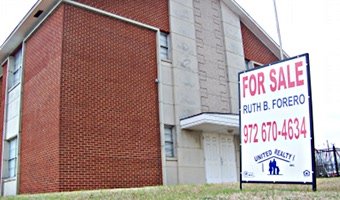
According to Lifeway Research’s analysis of the 2022 Annual Church Profile of the Southern Baptist Convention, 1,253 congregations that were part of the convention in 2021 no longer were connected to the SBC in 2022.

The analysis is based on the most recent Annual Church Profile data available. The 2023 report will be released soon.

Among the 50,423 active congregations in the Southern Baptist Convention in 2021, 2 percent disbanded or closed and 0.5 percent left or were disaffiliated from the convention by the time the 2022 data was compiled.
Some churches were planted to offset that number, but the SBC saw 416 fewer churches and 165 fewer church-type missions associated with the convention in 2022 than in 2021.

The lack of new churches to replace the number of churches closing is a broader issue within U.S. Protestantism. Previous Lifeway Research analysis found about 4,500 Protestant churches were closed in the United States in 2019, while only around 3,000 were started.

“Every week, the national network of Southern Baptist congregations changes,” said Scott McConnell, executive director of Lifeway Research. “New churches are added. Relationships are updated. Churches move, merge, change names and vote to disband.

“Once each year, we take a snapshot of the current Southern Baptist congregations to report national statistics. Later, analysis between annual lists of congregations reveals more details of these constant changes.”

The primary reason congregations no longer are considered active Southern Baptist congregations is they cease to exist. Around 4 in 5 of the missing congregations (79 percent) disbanded/closed, leaving Southern Baptists with 984 fewer congregations.
Within that group, 813 (83 percent) closed. Another 136 (14 percent) merged into another Southern Baptist congregation. Fewer became part of a non-Southern Baptist church (17 or 2 percent), never got started (8 or 1 percent) or are now a campus of another church (10 or 1 percent).

Aside from the congregations that disbanded/closed with a reason given, most other previously Southern Baptist congregations either left the convention or were disaffiliated (228 or 18 percent).

Fewer were updated to be classified as a new church work or not yet a church (29 or 2 percent) or existed as a ministry, not a congregation (2 or less than 1 percent). Another 10 (1 percent) disbanded/closed and no reason is known.

“The count of congregations that either left or were disaffiliated is based on whether they were affiliated when the annual dataset was compiled,” McConnell said. “The affiliation is removed if either the congregation or the Southern Baptist Convention informs administrators that it has ended.

“The goal is to make updates to affiliation as they happen, not to assign responsibility to anyone for the separation.”

The number of congregations that disbanded or closed and left or disaffiliated from 2021 to 2022 is higher than the previous two years when 1,003 and 1,002 congregations ceased being part of the SBC.

“Many expected the number of church closings to spike because of the pandemic,” McConnell said. “While temporary closures were widespread, permanent closures did not immediately surge. It was not until 2022 that an increase in disbanded congregations was measured in the SBC.”
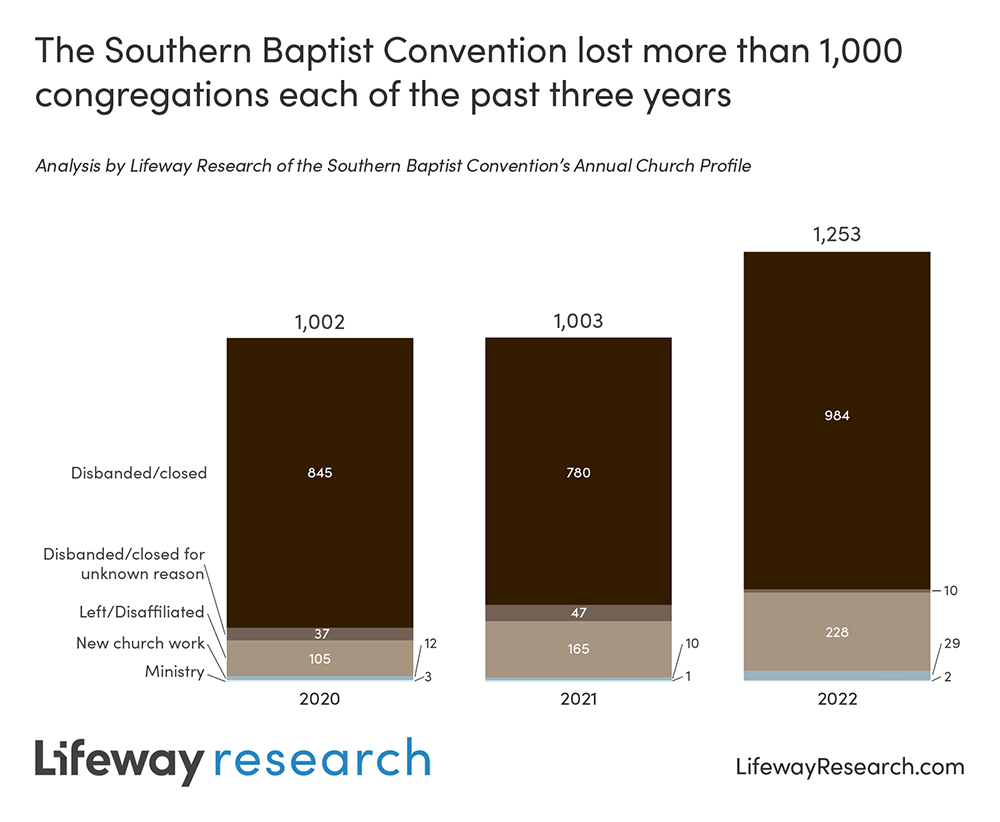
In the 2021 analysis of 2020 data, 1,003 churches were considered no longer active Southern Baptist congregations. Among those were 780 that closed or disbanded with a known reason (78 percent), 47 where the reason was unknown (5 percent), 165 that left or were disaffiliated (16 percent), 10 were new church works or not yet a church (1 percent), and one existed as a ministry, not a congregation (less than 1 percent).

Of the 780 with a reason recorded for closing or disbanding, 654 closed (84 percent), 82 merged into another Southern Baptist church (11 percent), 27 became part of a non-Southern Baptist church (3 percent), 11 became a campus of another church (1 percent) and six never got started (1 percent).

Examination of the 2019 data in 2020 revealed 1,002 churches ceased being part of the SBC, including 845 with a reason recorded for disbanding or closing (84 percent), 37 without a reason (4 percent), 105 that left or were disaffiliated (10 percent), 12 were a new church work (1 percent) and three existed as a ministry, not a congregation (less than 1 percent).

Among those from 2019 to 2020 that disbanded with a given reason, 684 closed (81 percent), 104 merged into another Southern Baptist church (12 percent), 32 merged into a non-Southern Baptist church (4 percent), 15 never got started (2 percent) and 10 became a campus of a new church (1 percent).

“It can be painful for all involved when an active congregation and the convention separate,” McConnell said. “While the number of congregations who left or were disaffiliated doubled in 2022, more than four times as many were removed from the Southern Baptist Convention’s congregation list because the last few remaining members voted to cease to be a congregation.”


NC pastor Bruce Frank nominee for SBC president

KNOXVILLE, Tenn. (BP)—North Carolina pastor Bruce Frank will be nominated for Southern Baptist Convention president at the 2024 SBC annual meeting by Tennessee pastor John Mark Harrison.

“I have known Bruce personally for many years. When I led student ministry at Biltmore Church, Bruce became the pastor, and our plateaued church began to grow,” said Harrison, now lead pastor of First Baptist Concord in Knoxville, Tenn. “His relentless passion for evangelism and disciple-making changed the direction of our church.”

Chaired SBC Sexual Abuse Task Force

Frank has been the lead pastor at Biltmore Baptist Church, which has several campuses in and around Asheville, N.C., since 2008. In 2021 and 2022, he served as the chair of the SBC’s Sexual Abuse Task Force overseeing the independent investigation of the SBC Executive Committee for the alleged mishandling of sexual abuse claims.

The task force’s recommendations led to the creation of the Abuse Reform Implementation Task Force.

Frank previously was pastor of First Baptist Church in Humble before coming to North Carolina.

“Bruce has provided faithful pastoral leadership for three decades,” Harrison said in written comments. “He has served both the church and convention with sacrificial leadership. He’s theologically conservative, strategically minded and missionally focused. He will clearly and effectively focus our denomination on the Great Commission.”

Biltmore Church recorded 384 baptisms in 2023 and averaged 7,331 people across eight multisite locations, according to SBC Workspace. The church reported $14,476,412 in total undesignated receipts, giving $235,000 (1.62 percent) through the Cooperative Program, $15,000 to the Annie Armstrong Easter Offering and $30,000 to the Lottie Moon Christmas Offering.

The church gave $40,000 to local associations in 2023, according to SBC Workspace.

“The Lord has used Biltmore Church and Pastor Bruce to make a tremendous impact in Western North Carolina and beyond,” Harrison said.

Frank holds a bachelor’s degree from Texas Tech University, a Master of Divinity degree from Southwestern Baptist Theological Seminary and a Doctor of Ministry degree from Luther Rice Seminary.

He and his wife Lori have two grown sons.

‘Coach, friend, mentor and encouragement’

“For the last decade, Bruce has been a coach, friend, mentor, and encouragement to me in my journey as a senior pastor,” Harrison said. “God has uniquely equipped Bruce to connect, encourage and coach pastors. He regularly makes time for me and many other pastors to grow us as Christian men and pastors.”

Frank joins Jared Moore, pastor of Homesteads Baptist Church in Crossville, Tenn.; Clint Pressley, pastor of Hickory Grove Baptist Church in Charlotte; Mike Keahbone, pastor of First Baptist in Lawton, Okla.; and David Allen, professor and dean at Mid-America Baptist Theological Seminary, who all have been announced as potential candidates for SBC president.

The 2024 SBC annual meeting is set for June 11-12 at the Indiana Convention Center in Indianapolis.