Baptist leaders among speakers at Ascent Summit 2026
September 8, 2025
Several Baptist leaders will be among the keynote speakers at the inaugural Ascent Summit, March 10-12 at Columbia Church in Falls Church, Va.
Ascent Summit 2026 marks the formal public launch of Ascent—an emerging mission connection point for churches in North America committed to the shared goal of living out the Great Commission locally, regionally and globally.
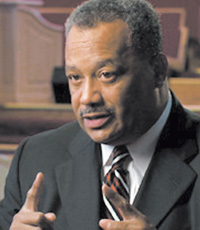
Julio Guarneri
“A Hopeful Witness for a Joyful Church” is the theme of the summit, featuring presentations by Texas Baptists Executive Director Julio Guarneri, Baptist General Association of Virginia Executive Director Wayne Faison, Chicago pastor Charles E. Dates and Raphael Anzenberger, executive director of the French-speaking Baptist Union of Canada.
Other featured speakers include author and Bible teacher Beth Moore; Ed Stetzer, dean at Biola University’s Talbot School of Theology; Mia Chang, lead pastor and planter of NextGen Church in Princeton Junction West Windsor, N.J.; leadership coach Jorge Acevedo; Jason Persaud, national director of church engagement with Alpha Canada; and Joy Moore, president of Northern Seminary.
‘A new missional movement’
Summit organizers note the Ascent movement has developed over the past nine years.
“In June of 2016, I, along with seven other Baptist leaders from Texas, Virginia and Oklahoma, met at Belmont University to discuss how we might find our way forward in a significant and synergistic missional endeavor that honored our ecclesiology and our theology,” Pastor Dennis Wiles of First Baptist Church in Arlington wrote in an email.
“We immediately recognized that many others were interested in this conversation as well, so we expanded our circle to include several new voices. Over time, we gained momentum and found common bonds across the denominational spectrum in North America.
“We discovered many pastors, denominational leaders, mission organization leaders, seminary presidents/deans, and fellow believers who longed to be a part of a new missional movement that could galvanize our efforts and result in the re-engagement of gospel witness to North America for the glory of God.”
‘Deep fellowship as centrist, orthodox Christians’
Todd Still (Baylor Photo)
Todd Still, dean of Baylor University’s Truett Theological Seminary, has been part of the group that has met, prayed and envisioned “what a missional, multi-denominational movement centered upon the proclamation and incarnation of the gospel of Jesus Christ through local churches might look and be like in our day.”
“The answer toward which we have been led is Ascent,” Still said.
The initial 2016 gathering in Nashville has “grown to include a myriad of churches, numerous missional organizations, several theological institutions, and denominational judicatories across North America,” Wiles said.
“We have found deep fellowship as centrist, orthodox Christians who can affirm the Lausanne Cape Town Commitment and who desire to partner together in gospel witness, church planting, theological education, and various other missional endeavors,” he said.
The initial group has hosted two “invitation-only” gatherings—including an event last year in Virginia—“where leaders from across our continent have met to worship, plan, pray, learn and partner together in ministry,” Wiles noted.
‘A historic gathering’
Wiles called the Ascent Summit next March a “historic gathering of fellow believers.”
“There will be inspiring worship, informative workshops, opportunities to learn about the ongoing work of Ascent, and the chance to discover new connections in mission and ministry,” Wiles said. “Numerous Texas Baptist churches and leaders are already a part of this movement.”
“I look very much forward to seeing a goodly number of Texas Baptists, as well as Truett alumni and friends, there and to witnessing what the Lord will continue to do through Ascent in the days and years to come,” Still said.
Wiles similarly encouraged Texas Baptists to consider attending the Ascent Summit.
“It promises to a signal event, where we turn the page in the witness of the church in North America,” he said.
Early registration for the event is open online. For more information, click here. To register, click here. In addition to discounts for early registration, the tiered pricing structure offers further discounts to registrants who incur the additional expense of air travel.
Katrina reshaped New Orleans churches, leaders say
September 8, 2025
NEW ORLEANS (BP)—The church doors would remain open, Pastor David Crosby decided after the levees failed New Orleans in Hurricane Katrina.
David Crosby
Someone from the Midwest sent a huge generator to First Baptist Church of New Orleans, Crosby’s pastorate at the time, enabling the church to reopen as soon as the law allowed.
Near constant news coverage flashed scenes of bodies floating atop floodwaters, hungry babies crying, families handling the dead bodies of their loved ones with whatever dignity the chaos allowed.
Water still lingered in whole neighborhoods as First Baptist began helping with relief efforts in October 2005, aided by the generator and thousands of volunteers who rushed to help.
“All the churches had to turn outward, toward the community, during the recovery,” Crosby told Baptist Press 20 years after the storm.
“Katrina washed us out of our pews and into our communities. Nobody locked any doors for four months in all of the flood zone. What was the point?”
More diverse, more united
As Southern Baptist churches in Metro New Orleans commemorate Katrina, they’ll do so with a New Orleans Baptist Association of churches that is more diverse and more united than it was when the waters dirtied the city, leaders told Baptist Press.
Churches outside the levee protection system were washed away and never reopened, but other churches were planted in areas where population returned, and several churches that were not Southern Baptist have joined the fellowship, said Jack Hunter, executive director of New Orleans Baptist Association.
“The aftermath of Katrina had a way of reshaping the association, not just in terms of its composition, though that’s true,” said Hunter, a member of First Baptist Church of New Orleans who began leading the local assocation five years after the storm.
“Our association is more African American now than it was pre-Katrina. It’s more Hispanic now than it was pre-Katrina. And it’s that way because our embrace has widened and our community has become richer.
“And I think in many ways, we look more like the church. And there’s a high appreciation for that among our churches. We’re a diverse association. But we feel a great unity in our diversity.”
Working across denominational lines
Southern Baptists embraced multidenominational cooperation in recovery, Dennis Watson, senior pastor of Celebration Church said.
“Two months after Katrina, I called together the pastors of our city. A lot of pastors still had not returned because their homes have been destroyed, campuses have been destroyed.” Watson said.
“But we had 120 pastors return, and we formed the Greater New Orleans Pastors Coalition and we began to work together across denomination lines, racial lines, community lines. … For those first five years after Katrina, we had sometimes close to 300 pastors and churches working together to serve the people in the communities around us in some capacity.”
During recovery in 2005, Watson distributed loads of goods to those in need, spending the millions of dollars he received in donations on relief efforts because he thought he wouldn’t be able to rebuild Celebration. The $1.5 million the church had in flood insurance wouldn’t cover the $16.5 million repair bill.
“And so we really just started giving away the monies that were coming in,” Watson said. “We were feeding about 5,000 people a day hot meals. And a thousand people a day were coming to receive food, water, medical supplies, baby supplies. … Whatever people sent us from the nation, we gave out and distributed.”
A smaller, second Metairie location the church acquired only weeks before the storm—the former Crescent City Baptist Church—had less flooding, accommodating worship for the quarter of Celebration’s members who were able to return in the months following Katrina.
Shepherding a scattered flock
Franklin Avenue Baptist Church sat under 9 feet of water before Pastor Fred Luter was able to survey the damage. The campus was damaged beyond occupation.
Fred Luter
Luter called his friend Crosby for a meeting venue to accommodate worship for Franklin Avenue members who began returning to the city in October. Luter held worship at First Baptist for nearly three years after the storm, while also shepherding members who scattered across the U.S. for safety under the mandatory evacuation.
Remembering Katrina is always difficult for Luter. Days before this year’s anniversary, he was praying with a local business owner who had an entire wall of photos of his business destroyed under Katrina’s waters.
“When you see things like that, your mind just goes back and reflects on how bad that really was. So, you always think about all the things that you went through, how you had to evacuate and lost so many people, so many people who relocated to other cities and they’re now there and not ever coming back,” Luter said. “They come back to visit, but that’s about it.”
But Luter appreciates the city’s resilience.
“To be able to build back—what we’ve done, that’s been a blessing,” he said.
Marking the 20th anniversary
The three pastors—Luter, Crosby and Watson—planned to gather with the greater Southern Baptist family in a Hurricane Katrina 20th anniversary service Aug. 29 at First Baptist New Orleans, hosted by Senior Pastor Chad Gilbert.
Crosby retired from the church in 2018. In retirement, he serves First Baptist Church of Goldthwaite as pastor on a part-time basis.
Hunter and other New Orleans Baptist pastors will attend the service, including many pastors of the 18 Hispanic churches and 41 African American churches that are now among the local association’s approximately 130 congregations.
By the numbers, the association has just as many congregations as it had before Katrina, according to then-Director of Missions Joe McKeever, who tallied 135 churches and missions, or 140 including the Plaquemines Baptist Association that merged with New Orleans Baptist Association after the storm.
Just two years after Katrina, New Orleans Baptist congregations had dropped to 82 churches and missions, McKeever wrote in the association’s 2005-2007 annual directory.
“The fellowship between our ministers has been forever changed,” McKeever wrote in the annual.
“Pre-Katrina, we had a Spanish fellowship of pastors, the African American pastors pretty much did their own thing, the Anglos tried unsuccessfully to involve everyone, and the Asian pastors were fairly well isolated.
“No more,” McKeever wrote. “These days, our weekly ministers’ meetings welcome everyone. … Pastors have learned each other’s names and lasting bonds of friendship have been formed.”
Embraced the Honduran community
Those relationships have endured and grown, said Hunter, who gives much credit to Luter, Crosby and Watson for helping rebuild the church community after the storm.
He credits in part Luter’s graciousness for the association’s success in drawing African American pastors, and notes the association embraced the Honduran community that swelled in helping Metro New Orleans rebuild after the storm. Of the 18 Hispanic churches in the association, 15 are majority Honduran.
Metro New Orleans became a hub for Hondurans after the storm. As recently as 2023, Hondurans comprised 29 percent of Hispanics in Metro New Orleans, the U.S. Census Bureau reported, compared to 2 percent of Hispanics nationwide, the Data Research Center reported, based on U.S. Census numbers.
Churches in the New Orleans Baptist Association shared the gospel with the new population.
“We want to be strategic, planting the churches where the need is,” said Geovany Gomez, pastor of Iglesia Bautista La Viña in the New Orleans suburb of Kenner, the association’s church health strategist, who is of Honduran descent.
When Katrina struck, Gomez’s pastorate was one of two dozen language mission congregations in the association embracing not only Spanish but Asian Indian, Haitian, Indian, Korean, Middle Eastern, Filipino and Deaf groups.
Many of the language missions were discontinued after Katrina but others are now churches, including Gomez’s pastorate that has since planted two majority-Honduran churches of its own, namely Iglesia Bautista Bethel in Kenner and Iglesia Bautista La Viña in Westwego.
Going where the people are
New Orleans Baptist churches have followed the population, Hunter said, serving people where redevelopment has given them opportunity to live. Many former home lots are now green spaces, and much of the Lower Ninth Ward remains undeveloped, leaving no need for churches in parts of the city. Dozens of churches no longer exist.
“There are a few churches we have that were maybe stronger pre-Katrina than they are now, but we have a lot of churches that are stronger now than they were pre-Katrina,” he said. “But there are 50 congregations that we have, by my count, that we did not have pre-Katrina.”
Some of the 50 new congregations are church plants, but Hunter estimates most are pre-existing churches that joined the local assocation, or churches that began after the storm.
Celebration Church, for instance, not only rebuilt at its Airline Drive location, but has seven additional locations that are thriving. In the past two months, the Celebration network has baptized about 300 people, Watson said.
“We actually gave away the first several million dollars that came to us, because we didn’t think we could rebuild our Airline campus. So, we just invested it in helping the people of communities around us,” Watson said.
“But the more we gave away, the more the Lord blessed us with. And so at five years after Katrina, we were able to rebuild our campus on Airline Drive and to continue launching campuses.”
‘Discovered the joy and value of helping each other’
First Baptist continues as a majority Anglo yet ethnically diverse congregation, enriched by the relationships forged during the time Franklin Avenue worshiped there, Crosby told Baptist Press.
“When you have a flood, you have a fire that affects the community and people work together. They set aside their differences, prejudices and preconceptions about others and they work together,” Crosby said. “And that happened in our community.
“The world seemed chaotic, unmanageable, in the aftermath of the storm. Thousands of people left in great waves of depopulation, many of them simply unable to see a way forward,” Crosby said. “We were forced into awareness of one another. We rediscovered the value and joy of helping each other. We experienced the loss of all things, so to speak, and found true joy and riches in our relationships with one another and with God.”
Crosby nominated Luter for SBC president in 2012, a position Luter held two terms. He remains the only African American to have held the post.
Major changes for Franklin Avenue
Luter’s church renovated its campus at 2515 Franklin Ave. before rebuilding and relocating to New Orleans East in December 2018.
A location launched in Baton Rouge to serve more than 600 Franklin Avenue members who moved there after Katrina continues as United Believers Baptist Church, averaging 122 in Sunday worship, according to the 2024 Annual Church Profile.
Houston’s Franklin Avenue Baptist Church, launched to serve members who relocated to Houston, also continues, Luter said. The congregation averaged 425 members in Sunday morning worship when it last completed an ACP in 2017.
The original Franklin Avenue location now houses Rock of Ages Baptist Church, a non-Southern Baptist congregation acquiring the property on a lease-to-buy agreement. So many churches lost members, Luter said, the property sat vacant for years, with no one able to purchase it.
Luter helped plan a month of activities commemorating Katrina as a member of New Orleans Mayor LaToya Cantrell’s K20 Advisory Commission. On the calendar are various interfaith events among others embracing the New Orleans community.
“One of the things I’ve learned is that we no longer can be complacent if a hurricane is in the Gulf coming towards New Orleans, or Mississippi or Alabama,” Luter said. “We did it for years, just knowing that the hurricane would pass and we might be without electricity or lights for a while. But we’d never flooded like it did with Katrina.”
The National Weather Service attributed 1,833 deaths to Katrina, as well as $108 billion in damage, amounting to $200 billion when adjusted for inflation.
“So one of the lessons we’ve learned, and I’ve learned, is don’t take hurricanes lightly,” Luter said. “If it comes near us, if it gets up to a Category 3, then you do need to seriously consider evacuating—because so many people lost their lives.”
Baptist missions leader Keith Parks dies at 97
September 8, 2025
R. Keith Parks, international missions leader of both the Southern Baptist Convention and the Cooperative Baptist Fellowship, died Aug. 26. He was 97.
Parks spent 45 years in international missions, serving as ninth president of the SBC Foreign Mission Board—now International Mission Board—from 1980 to 1992.
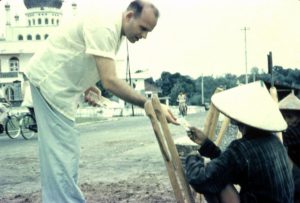
Keith Parks is pictured on the mission field in Indonesia. (IMB File Photo)
He and his wife, Helen Jean, were missionaries to Indonesia for 14 years before he joined the Foreign Mission Board home office staff, where he served in several administrative roles.
He went on to become the first coordinator of CBF Global Missions, serving in that role from 1993 to 1999.
When asked by the Baptist Standard in 2018 his favorite aspect of ministry, Parks responded: “Relating to and working with missionaries and local Christians all around the world. ‘Missionary’ is still my dominant DNA.”
Remembering the legacy of Keith Parks
IMB President Paul Chitwood expressed his gratitude for Parks’ legacy.
“We celebrate that Keith Parks and his wife gave decades of their lives to serving Southern Baptists in our cooperative mission work to get the gospel to the nations,” Chitwood said.
“While Keith served as president during a complicated time in Southern Baptist life, his intentional focus on taking the gospel to the unengaged is a lasting legacy that still marks IMB strategy to this day. I am grateful for that legacy.”
Todd Lafferty, IMB executive vice president and chief operating officer, also served on the mission field in Indonesia, in addition to other countries, before joining the U.S. staff. Lafferty said: “Keith Parks’ visionary and strategic leadership led us from familiar mission stations to unmarked roads in the missionary task to reach the least reached. His legacy lives on as we continue to seek to reach the remaining unengaged, unreached peoples in the world today.”
CBF Executive Director Paul Baxley similarly reflected on Parks’ legacy and contributions to the CBF Global Missions.
“Dr. Keith Parks was deeply committed to the global mission of Jesus Christ throughout his life,” Baxley said. “He provided visionary and transformational leadership in the establishment of CBF Global Missions. His experience, missiology and strategic clarity laid a strong foundation for our Fellowship’s participation in Global Missions.”
“Dr. Parks was deeply respected not only by our Fellowship at large, but also by our first generation of field personnel who were touched by his leadership, integrity and vision
“Our Cooperative Baptist Fellowship family joins me in offering prayers of gratitude for his life, leadership and personal participation in inviting people to faith in Jesus Christ and his mission of transforming love in the world.”
Field personnel recall Parks’ personal care
Jim Smith, retired field personnel and CBF Global Missions staff leader, remembered Parks as “sharp, friendly and unafraid to operate from the edges.”
“His vision for reaching the most unreached and most neglected around the globe made a difference in global missions. He visited works in a multitude of circumstances where he spoke very little and listened a lot,” he said.
Smith also fondly recalled Parks’ ministry at a person level.
“He called my mother just before she was operated on for spinal surgery. They actually waited to take her into the operation so he could pray for her. He never stopped learning and loving others,” Smith said.
Nell Green, retired CBF field personnel, likewise appreciated Parks’ care for the families of missions personnel.
“Dr. Keith Parks was our mentor, an inspiring leader, but simply ‘Uncle Keith’ to our children. He said once, ‘God does not call without a knowledge of your children.’ That helped us through some difficult times as we raised children overseas,” Green said.
Both Keith and Helen Jean Parks considered field personnel as family, she added.
“Keith was always ready to think through a problem with you. Helen Jean would drop everything and take time to pray with you,” Green said. “They were caring, thoughtful leaders ready to invest themselves personally in the lives of those sent out.”
‘Passionate about reaching the unreached’
Karen Morrow, retired CBF field personnel, called Parks “one of my heroes of the faith, who embodied the Christian mission to reach the nations with the gospel message.”
“He was passionate about reaching the unreached and those with limited access to the gospel and established CBF Global Missions to that end,” she said.
Keith and Helen Jane Parks’ participation in a prayerwalk she led in Turkey was “one of the highlights of my ministry,” Morrow said. She recalled Parks overlooking the city of Antioch “with tears in his eyes,” reflecting on how Christians there sent out Paul and Barnabas as the first gospel missionaries and praying “with gratitude for all God had done.”
“Because of Keith’s life, service and leadership, countless people around the globe have come to have a personal relationship with Christ,” Morrow said.
Parks, a native of Memphis in the Texas Panhandle, got his first taste of international missions as a student summer missionary to Colombia’s San Andrés Island.
Thirty years later, when Toby Druin of the Baptist Standard asked the newly named president of the Foreign Mission Board to describe himself, Parks responded, “I am a missionary.” That remained his identity until the end.
An era of new dangers and opportunities
“Parks’ leadership thrust the IMB into an unprecedented era of effectiveness toward fulfilling the Great Commission,” said Jerry Rankin, who succeeded Parks as the mission board president.
Keith Parks addresses Foreign Mission Board trustees at one of their meetings during his time as the agency’s president. (IMB File Photo)
“Missionary deployment around the world exploded under Parks’ predecessor, Dr. Baker James Cauthen,” Rankin said. “But Parks looked beyond successful growth to see that part of the world still unreached and closed to missionary presence.”
Parks’ time as Foreign Mission Board president coincided with world-changing events that brought new dangers—and opportunities—for Christian missionaries: the rapid spread of HIV/AIDS, growing numbers of terrorist attacks and assassinations, the end of apartheid in South Africa, the fall of the Berlin Wall, the Tiananmen Square protests, the dissolution of the Soviet Union and the proliferation of new technologies and birth of the internet.
Parks’ leadership was a match for the times. Southern Baptists in 1976 had adopted a goal of preaching the gospel to everyone in the world by the end of the century. It fell to Parks to determine what it would take to reach that goal.
The goal has yet to be reached, but research into what it would take yielded “crushing statistical evidence that without an enlarged vision of the world, Southern Baptists would never contribute their full share to global evangelization,” wrote Leland Webb, editor of the FMB’s TheCommission magazine at Parks’ retirement.
What the research revealed was more than 6,000 unreached peoples, ethnolinguistic groups who lived with few, if any, Christians among them, had little or no access to Scripture and did not welcome missionaries. The 1.9 billion people in those groups likely never would hear the name of Jesus.
‘New strategies to reach the unreached’
“Keith Parks was a missiologist par excellence,” Clyde Meador—who worked with four mission board presidents—once said of Parks. “He would do what he saw as right whether it was popular or not.”
Meador filled several key roles, including executive vice president, at the IMB before his death in 2024.
What Parks did was urge missionaries to develop daring new strategies to reach the unreached. This gave birth in 1985 to Cooperative Services International, which assigned teachers, doctors, businessmen and humanitarian workers to countries closed to traditional missionaries.
Later, the nonresidential missionary program was born for missionaries to develop creative ways to reach unreached people they could not live among.
“Parks’ vision positioned Southern Baptists to respond to the fall of the Soviet Union and laid the groundwork for changes that followed his tenure to focus on people groups instead of countries and engaging the unreached,” Rankin said.
Parks also challenged Southern Baptists to consider countries where missionaries had long worked as partners in reaching the world. On his last overseas trip as FMB president, to participate in a meeting of Baptist leaders from across the Americas, Parks challenged participants to begin sending their own missionaries as partners in God’s mission.
“Too many Christians in this world are convinced their responsibility is only to the people of their culture and language,” Parks said.
“We’ll never reach the world for Christ if we restrict ourselves to our own language and culture. Local interest always wins when culture dominates Christianity. Global interest wins when Christianity dominates culture.”
Native Texan and faithful missionary
After serving as pastor of Red Springs Baptist Church in Seymour, and as an instructor in Bible at Hardin-Simmons University in Abilene, Parks and his wife, the former Helen Jean Bond, were appointed in 1954 as career missionaries to Indonesia, where they served until 1968.
There he served at the Baptist Theological Seminary of Indonesia in Semarang, Java. He also did evangelistic work in Semarang, was mission treasurer in Jakarta and spent a furlough as an associate secretary in the missionary personnel department at the FMB’s home office in Richmond, Va.
Parks joined the home office staff in 1968, leading work in Southeast Asia from 1968 to 1975; directing the mission support division from 1975 to 1979; serving as executive director-elect, September through December 1979; and executive director (title changed to president in May 1980) from Jan. 1, 1980, to Oct. 31, 1992.
Parks earned the Bachelor of Arts degree from North Texas State College (now University of North Texas) in Denton, and the Bachelor of Divinity and Doctor of Theology degrees from Southwestern Baptist Theological Seminary in Fort Worth.
The Parks joined First Baptist Church in Richardson in 2000, where they taught the International Bible Class.
His wife of 69 years, Helen Jean, and their daughter, Eloise, both died in 2021.
He survived by: son Randall and his wife Nancy; son Kent and his wife Erika; son Stanley and his wife Kay; grandchildren and great-grandchildren.
Parks was the author of Crosscurrents (Convention Press, 1966), World in View, A.D. 2000 Series (New Hope Press, 1987) and numerous articles and columns. He is the subject of Keith Parks: Breaking Barriers & Opening Frontiers, a biography by Gary Baldridge.
Compiled by Managing Editor Ken Camp from information provided byMary Jane Welch of the International Mission Board and Aaron Weaver of the Cooperative Baptist Fellowship.
MedAdvance highlights importance of health care missions
September 8, 2025
RALEIGH, N.C.—Health care missions provide access to millions of people who’ve never heard of the Great Physician, and health care professionals play a crucial role in prescribing treatment for both physical and spiritual needs.
These were some of the messages attendees of MedAdvance heard. The conference was designed to inform, mobilize and connect health care professionals and students with International Mission Board missionaries serving in medical missions roles.
Held yearly since 2007, MedAdvance 2025 met in Raleigh, N.C., from Aug. 21-23 at Providence Church.
More than 300 people, including 47 health care students, attended. Participants included an endodontist, nurses, physician assistants, an OBGYN, general practitioners, nurses who are members of a chapter of the Filipino Woman’s Missionary Union and a church volunteer coordinator.
Some MedAdvance participants, like a physician assistant and her family who are preparing to move to West Africa and a nurse who is pursuing work among the Deaf, are currently in the process of serving with the IMB. Others, like the group of Filipino nurses, were exploring ways to serve. Others were looking to get involved through prayer and giving.
Dr. Tom Hicks speaks with a health care professional at MedAdvance 2025, which met in Raleigh, N.C. Hicks said many people come to MedAdvance because the Lord is calling them in some way, whether it is short-term, mid-term, long-term. “We’re always looking for ways that we can help fill those requests,” he said. (IMB Photo)
Tom Hicks, IMB director of global health strategies, said he’s seeing a movement of greater understanding among Southern Baptists of how the IMB is involved in health care missions.
Hicks’ prayer was that attendees would see how they can participate in healthcare missions, whether that’s praying more effectively, giving specifically and strategically or going. The many commitment cards placed on two maps of the world at the end of MedAdvance were evidence this prayer was answered.
IMB President Paul Chitwood told participants via video that 12 percent of the IMB’s missionary workforce have a medical background. IMB missionaries are touching the lives of 50,000 people through healthcare ministries every year.
MedAdvance attendees participated in an affinity marathon, where they heard about the health care ministries of missionaries from the IMB’s eight regions of service, including global Deaf ministry.
Health care ministries included art therapy for trauma survivors in Europe, training national medical workers in Sub-Saharan Africa, disease prevention in the Americas and pre- and post-natal care in the Asia-Pacific Rim.
The affinity marathon allowed conference attendees to learn about short- and long-term opportunities to serve.
Health care professionals attended breakout sessions on topics such as how to be a health care volunteer, engaging Hinduism and Islam, fitness and wellness strategies and how to address human needs in your community.
Veteran missionary doctor discusses strategies
In two packed sessions, Dr. Rebekah Naylor spoke on the core missionary task as it relates to health care missions. Naylor served 50 years with the IMB at Bangalore Baptist Hospital in India as a surgeon, chief of medical staff, administrator and medical superintendent.
Naylor walked MedAdvance participants through the ABCs (and DEs) of health care strategies: access, behind closed doors, caring for needs, disciple-making and empowering the church. Each of these connects with components of the core missionary task: entry, evangelism, disciple-making, leadership development, church formation and exit to partnership.
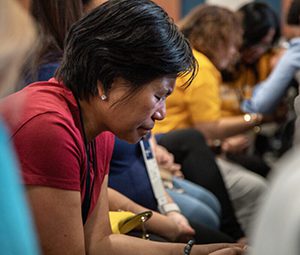
Rowena Mante prays during a guided prayer time during MedAdvance 2025. Mante is a nurse originally from the Philippines. She partnered with IMB missionaries in the Philippines while she lived there. She lives in Winston-Salem, N.C., and is a member of the Triad Journey Church, which is a predominantly Filipino church. She is a member of the Filipino Woman’s Missionary Union and the Baptist Nursing Fellowship. (IMB Photo)
MedAdvance participants also learned about the Dr. Naylor Preach and Heal fund, which provides money for the health care ministries of IMB missionaries. Donations provide resources and services like ultrasound machines in the Asia-Pacific Rim, repairs for a gym in Thailand where IMB missionaries started a church and trauma-informed coloring books for refugee children.
Victor Hou, IMB associate vice president of global advance, reported from 2000 to 2100, the global population is projected to exceed the number of people who lived in the previous 600 years. An estimated 24.9 billion people will live, breathe and die in 100 years.
“Much of the credit goes to those of you who are health care professionals,” Hou said. “Because of your skills, because of the advances of medical technologies, because of the training and what you’re able to bring, we’ve seen lives extended. We’ve seen longevity in lifespan, and we are better at treating diseases and keeping people healthier.”
However, there is no earthly cure for the diagnosis every human receives at birth.
“Why has God placed us in this generation, in this era, in this time when we see the greatest number of people on earth and unprecedented human growth?” Hou asked.
“God has given all of us and the church this opportunity to steward his gospel to the greatest number of people who have ever walked the face of the earth.”
‘We are going to make disciples’
April Bunn, the IMB’s prayer office director, led participants through three prayer sessions. She reported 166,338 people die daily having never heard the name of Jesus.
Dr. Joel Vaughan spoke during two sessions. Vaughan is an internal medicine and pediatrics physician and served for 10 years with the IMB. He now practices medicine for a Duke Health primary care clinic in Raleigh.
Dr. Joel Vaughan speaks to gathered medical professionals, students and IMB personnel as part of MedAdvance 2025. Twenty-two years ago, sitting in this same sanctuary, the trajectory of Vaughan’s life changed. Vaughan, an internal medicine and pediatrics physician, served with the IMB for 10 years. He now practices medicine for a Duke Health primary care clinic in Raleigh, N.C. (IMB Photo)
“When we go, we’re not going principally to treat diabetes or rehab a bad contracture or remove a gallbladder. We’re going to make disciples,” Vaughan said.
Vaughan’s journey to the mission field began at Providence, just a few feet from where he stood.
As a 22-year-old, he sat in the sanctuary and petitioned the Lord to show him what he should do after graduating. After pleading for weeks, God answered through someone who read John 14:6, “I am the Way, and the Truth and the Life, no one comes to the Father except through me.”
Vaughan suggested that some in the room were in a similar situation this weekend.
“Jesus shows the way as we walk with him, as we follow him, as we’re willing to do whatever he asks us to do,” Vaughan said. “He’s going to use who you are, what you have and your skills.”
Todd Lafferty, the IMB’s executive vice president, was the key speaker during the evening sessions.
“Some of you might be sensing [God] wants you to go full time,” Lafferty said. “Now is the time to use your health care skills and combine that with the need on the field to reach people that wouldn’t otherwise be reached.
“You have a unique opportunity in the mission in our day to get to the places where most people can’t because of the skills that you have.”
Dr. Nora Chiu, an OBGYN from Houston, attended MedAdvance last year and felt the Lord leading her to use her medical skills on the mission field. She began the application process with the IMB and came to this year’s MedAdvance to confirm her calling.
“I would have never imagined using medicine to do missions,” Chiu said. “There are so many needs I didn’t realize.”
Attending this year’s MedAdvance helped confirm her call.
During the closing session, attendees were encouraged to make a commitment to partner by marking a commitment card. According to early reports, 70 committed to pray, 49 were interested in short-term trips, 12 indicated interest in mobilizing for health care missions and 35 committed to pursuing mid- or long-term service.
Water Impact ministry sees God move in Peru
September 8, 2025
Texans on Mission is not only bringing fresh water and good hygiene practices to people in the Andes Mountains of Peru, but also bringing the gospel, with 46 professions of faith recorded during an August mission trip.
“We have moved our efforts in Peru from the Amazon River basin to the mountains because of various logistical challenges that surfaced along the river,” said Mitch Chapman, director of Texans on Mission Water Impact. “Now we are seeing God really move through our work.”
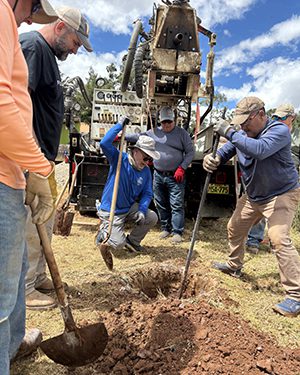
Texans on Mission volunteers serve on a Water Impact trip to Peru, where they brought fresh water, good hygiene practices and the gospel to people in the Andes Mountains. (Texans on Mission Photo)
Texans on Mission drilling efforts in Peru have produced one successful well in the Andes, and the August team began work on a second well for another community with residents scattered throughout the mountainside.
The dry season lasts six to eight months in the Andes. Springs dry up, and pond water becomes “nasty,” said Julio Campos of Gateway Church in Justin, one of the Texas leaders in the work in Peru.
“The pond water is all they have to drink unless they walk or get to other water sources, in some cases two to four hours down the mountain and back during the dry season.”
Water Impact identified increasing opportunities in the area and began working in the region in January, but the mountains create challenges.
The mountain faces are, in places, “sheer straight up and very close to each other,” requiring multiple roadway “switchbacks all the way up the mountains,” Campos said.
Still, the first Texans on Mission well struck water at 80 meters in Capulipampa.
The August mission team divided into two groups—one to drill a new well in Llimbe and the other heading to Capulipampa to do evangelistic work.
Women receptive to the gospel
The evangelism team had planned to work with children—telling Bible stories, distributing Gold-to-Gold gospel bracelets, playing games and singing. It turned out the women of the community were open to learning through Bible study, which diverted some of the team’s efforts.
Delia Lozuk of Alice, former missionary to Venezuela, teaches a Bible study to women in the Andes Mountains of Peru during a Texans on Mission Water Impact trip. (Texans on Mission Photo)
Team member Delia Lozuk of Alice “ministers like no one I’ve ever seen,” Campos said. “Ministry to women is her forte.”
On the first day, 10 to 15 mothers brought their children to be part of the activities, Campos said. By the end of the day, Lozuk “got a Bible study going on” with even more women.
Team member Rhonda Dodson said about 40 women ended up participating in the two days of Bible study led by Lozuk, and 30 of them eventually made professions of faith in Christ.
Paul Lozuk of Alice, a former missionary to Venezuela, uses a Gold-to-Gold gospel bracelet to present the Christian plan of salvation to a young man in Peru during a Texans on Mission Water Impact trip. (Texans on Mission Photo)
She and her husband Paul are former missionaries to Venezuela, and both speak Spanish.
“My wife Delia has an extraordinary anointing with women,” and especially with “these people that are descendants of the Inca,” Paul Lozuk said.
He explained people living in the Andes are a distinctive group.
“They are short of stature and extremely strong,” walking long distances at high altitude, he said. They also dress in traditional clothing, and “the women don’t talk too much to the men, especially foreigners,” he added.
The cultural preference for women to communicate with other women opened the door for ministry in the Andes.
Making Bibles available
“One thing I understand,” Delia Lozuk said. “There is no doubt that these people from Peru really do need Jesus as their Lord and Savior, and most do not have a Bible.”
Local pastor Alex Miranda had boxes of New Testaments, so the team handed them out. “He had enough for every single person, every woman,” she said, and copies of the complete Bible were ordered for distribution.
“The people were very hungry for the word” of God, said Dodson, a Texans on Mission Water Impact employee who was on her first mission trip. “When we were in Capulipampa, the ladies’ request was for Bibles. So, of course, we’re going to get them Bibles.”
The Bible studies took on the form of a conversation, Delia Lozuk said. The women living in the Andes were “hungry for something, and I asked them, in the middle of just having small conversations, about the Bible, about the word of God. I was trying to put everything I could in there so they could get a little bit of a taste of what I was trying to say.”
A ‘God-appointed time’
She saw the trip to Peru as being a “God-appointed time for me. … I didn’t know I was going to minister to women.” She went only as an interpreter, but “something happened the first day” as more and more women gathered.
“Women are very hungry, but we don’t know, because they don’t speak with the men for some reason,” she said. “They’ve heard about a Savior, but they don’t know the Bible.
“I’m thinking, ‘What the heck are you doing, Delia?’ But it’s not my show; it’s God’s show.” So she did another unexpected thing; she gave the women homework—Scripture to read so they can discuss it together sometime in the future.
With an expectation of a return trip, Lozuk promised to “literally give them a little nugget about every single book in the Bible” to whet their appetite for additional Bible study.
Six of the women attending the meetings stood up with excitement when asked if anyone had given their lives to Christ. By the end of the two days, all of the others had professed faith in Christ.
‘God just took control’
“It was my impression that God set all this up,” and the team “just walked into it,” Delia Lozuk said. “God just took control, and that’s really what happened. … God did this through us.”
The drilling of the second well and the evangelistic outreach did not occur in a vacuum of ease. Campos said he asked in his daily devotionals with the team for “God to show up.”
When luggage and a passport were lost, the group prayed. No matter the difficulty, Campos said the theme of the trip became, “just ask”—ask God for help. And each time, the prayers were answered.
With the success of the well drilling and the women’s ministry, Campos said the mission trip “went fantastic.”
Chapman said: “The well we drilled in Capulipampa laid the foundation for all that happened evangelistically on the trip. And now, with the second well in Llimbe, we are continuing to pursue our vision of bringing clean, sustainable water to as many people as possible while sharing the gospel of Jesus Christ to people in need of both.”
SBC launches revamped sexual abuse helpline
September 8, 2025
NASHVILLE (BP)—The Southern Baptist Convention’s office for abuse prevention and response has launched a revamped helpline for those needing assistance with matters related to sexual abuse.
The initiative, a partnership with the Evangelical Council for Abuse Prevention, is designed to deliver support for survivors, ministry leaders and others needing advice on preventing sexual abuse or responding to abuse allegations.
The office for abuse prevention and response, a department of the SBC Executive Committee created last September, announced the new helpline Aug. 18.
“Our new helpline suite of services enhances our efforts at providing Southern Baptist churches and ministries the resources they need to prevent sexual abuse or respond to sexual abuse allegations,” SBC Executive Committee President Jeff Iorg said.
“The new helpline will provide competent assistance to those seeking assistance—for survivors as well as services for ministry leaders who are responding on these issues. We are putting in place long-term strategies for confronting this pernicious evil because even one instance of sexual abuse is too many.”
Help for survivors and ministry leaders
The establishment of the helpline begins the transition away from a hotline hosted by Guidepost Solutions since May 2022. Jeff Dalrymple, director of the SBC’s abuse prevention office and a founding member and former executive director of the Evangelical Council for Abuse Prevention, told Baptist Press the council shares Southern Baptists’ convictions and values.
There are currently three call takers and four coaches, Dalrymple said. The coaches have been approved by the Evangelical Council for Abuse Prevention, and the call takers have completed specially designed training in addressing crisis situations.
“Christian experts lent their expertise to create the training from scratch,” he said. “It didn’t exist before.”
Call takers will receive calls and walk through each unique situation with the caller, then refer a caller to a coach as needed.
“In addition to the functionality of the Guidepost tip line, we felt compelled to provide help to survivors that are calling that need access to counseling and for ministry leaders that find themselves in the middle of an abuse allegation and don’t know what to do,” Dalrymple said.
The Guidepost-operated hotline, which averages 15 to 20 calls per month, will remain active through at least the end of this year, Dalrymple told BP.
“We don’t want to miss any calls,” he said.
Dalrymple called sexual abuse “a scourge on our society.”
“We aim to prevent sexual abuse from occurring in the first place, but when it does occur, we will use our resources to respond in a healing manner following the teachings of Jesus Christ,” he said.
How the helpline works
The helpline will respond to the following four areas of service:
Reporting abuse to the SBC Credentials Committee and to the appropriate authorities
Coaching for appropriate church-related response to abuse claims, within ministry programs or external.
Trauma-informed Christian counseling referrals for victim/survivors, family and caregiver
Guidance regarding abuse prevention in ministry
Call takers will be available Monday through Friday, 9 a.m.-5 p.m. Central, with after-hours options available also. One of the call takers is fluent in Spanish, and translation services for other languages, including American Sign Language, are available.
“Calls will be triaged to determine what assistance would be most helpful to the caller,” Dalrymple said. “This could mean guiding a caller through legal reporting requirements, seeking a referral for survivor care, and/or providing support for a ministry leader navigating an allegation or incident of abuse.”
Matt Espenshade is a former FBI agent who now serves as executive pastor of Journey Church in Lebanon, Tenn. He also is a member of the SBC Abuse Prevention & Response Advisory Committee and gave input for the helpline.
“The collaborative effort between the SBC and the Evangelical Council for Abuse Prevention demonstrates how to lead with integrity and humility in providing a resource for timely, accessible, transparent and biblically grounded expertise to ensure this problem is not ignored or mishandled,” Espenshade said.
“The helpline is more than a resource; it is a statement of commitment to pursue justice, extend grace, and ensure that the church remains a place of safety, hope and healing.”
Dockery notes seminary’s ‘new place of stability’
September 8, 2025
FORT WORTH (BP)— Southwestern Baptist Theological Seminary President David S. Dockery told faculty and staff the seminary has experienced a “turnaround” and is in “a place of stability and health” at the start of a new academic year.
Dockery voiced gratitude for God’s faithfulness over recent years and expressed reliance on God’s blessings in the future.
“I am incredibly excited as we enter this new year,” Dockery said of the measurable improvements made over the past three years.
“We have a new place of stability in terms of continuity of people, financial stability, enrollment markers, faithfulness from our donor base. … God has blessed us during these three years.”
Third straight year of measurable improvement
Dockery said the 2024-25 academic year was the third straight year of increases in both the nonduplicating annual headcount enrollment and credit hours taught.
Enrollment increased from 3,403 to 3,656 while credit hours increased from 33,253 to 36,284. This was the first time since 2014-2016 to have three consecutive years of increases in those areas, he said.
Southwestern also continued to make measurable steps toward institutional and financial stability. This past year, Dockery observed the seminary has seen additional improvements to its operational and financial positions, noting a $9 million operational turnaround over three years and a third year of reaching the institution’s goals for unrestricted giving.
“These three years have strong markers in enrollment and financial management and unrestricted giving, and in that sense, I think these things point to a genuine turnaround, particularly financial,” Dockery said.
“We are at a place of stability and health as we enter this new year that Southwestern has not seen in a long time. We haven’t arrived, we still have work to do, but we’re in such a different place than was the case in 2022. … God has been so good to us, and I hope that you will not let it go by without thanking the Lord for his providential care for us.”
Dockery said the institution will continue to address the sanctions from the Southern Association of Colleges and Schools Commission on Colleges, which this summer noted the seminary had made considerable progress but still needed to focus on three particular areas.
‘A renewed sense of hopefulness’
He also pointed out other achievements including the revised Master of Divinity degree program, the recently launched Equip the Called platform, and the publishing of Shapers of the Southwestern Theological Tradition and other faculty publications.
Dockery also spotlighted national and international mission trips, as well as new partnerships with the Prestonwood Pregnancy Center, Logos Bible Software and a gap-year program with Turning Point Academy.
“We enter this new year with a renewed hopefulness, a lot of good things happening,” Dockery said.
When he voiced commitment to pursue the seminary’s core values of being grace filled, Christ centered, scripturally grounded, confessionally guided, student focused and globally engaged, faculty and staff joined in reciting the seminary’s mission statement.
He underscored the previously announced theme verse for the 2024-2025 academic year, Matthew 6:33: “But seek first the kingdom of God and his righteousness, and all these things will be provided for you.”
During the annual gathering, the seminary also recognized faculty and staff celebrating significant service anniversaries this past year, including 15 years for Adam Dodd and Brian Rolfe, and 25 years for Jamie Knight.
Jimbob Brown, director of audio-visual productions, Stephanie Litton, director of Student Success and International Student Services, and Brian Rolfe, data architect in Campus Technology, were named the three staff members of the year.
Leatherwood resigns as president of the ERLC
September 8, 2025
Brent Leatherwood, who spent nearly four years dealing with critics from the most conservative wing of the Southern Baptist Convention, resigned as head of the SBC’s Ethics and Religious Liberty Commission.
The commission’s board announced Leatherwood’s resignation July 31. Miles Mullin, vice president and chief of staff, will serve as acting president.
Leatherwood—a former executive director of the Tennessee Republican Party—played a key role in advocating for the federal defunding of Planned Parenthood.
The ERLC under his direction also placed 40 ultrasound machines in pregnancy resource centers around the country through its Psalm 139 Project.
However, Leatherwood resisted the efforts of some abortion abolitionists to seek criminal penalties for women who pursue abortions. That position proved unpopular with a vocal segment of Southern Baptists.
Other Southern Baptists criticized the ERLC under Leatherwood’s direction for participating in the Evangelical Immigration Roundtable.
Agency survived vote at SBC in Dallas
At the SBC annual meeting in Dallas in June, Southern Baptists voted to reject a motion to do away with the ERLC.
However, the motion to abolish the agency received support from about 43 percent of the voting messengers at the annual meeting. It marked the fourth attempt in recent years to disband or defund the ERLC.
Seven weeks after the ERLC survived the floor vote at the SBC, its board issued a statement from Leatherwood announcing his departure from the moral concerns and public policy agency.
“After nearly four years leading this institution, it is time to close this chapter of my life,” he stated. “It has been an honor to guide this Baptist organization in a way that has honored the Lord, served the churches of our convention, and made this fallen world a little better.”
He applauded the ERLC and its staff, saying the commission “never wavered in serving as a light on Capitol Hill, before the courts, and in the culture.”
‘A balance between conviction and kindness’
“In all of our advocacy work, we have sought to strike a balance of conviction and kindness, one that is rooted in Scripture and reflective of our Baptist beliefs,” Leatherwood stated. “That has meant standing for truth, without equivocation, yet never failing to honor the God-given dignity of each person we engage.”
The ERLC “has helped the world clearly understand that Jesus Christ reveals a better way to live rather than the angry, self-absorbed, and cruel model that is so often served up by our modern culture, and, more importantly, he freely offers the gift of eternal salvation—selflessly purchased with his own blood,” Leatherwood continued.
“That hope has powered our work these last several years, and has shaped my own conscience. It will continue to do so as I move forward to render service where the Lord is calling me next.”
Led in the face of ‘polarizing culture’
Scott Foshie, chair of the ERLC board of trustees, expressed gratitude to Leatherwood for his leadership and service.
“Brent has led the commission well and demonstrated loving courage in the face of a divisive and increasingly polarizing culture in America,” Foshie said. “While biblical values have been under attack, Brent has been a consistent and faithful missionary to the public square. We are thankful for his commitment to the Lord and to this commission.”
That “polarizing culture in America” plagued Leatherwood for much of his tenure since the time he was elected president in 2022, after serving one year as acting president. Previously, he served the ERLC as chief of staff and director of strategic partnerships.
Leatherwood, the father of three children who survived the shooting at Covenant School in Nashville, angered some in the SBC when he supported a proposal by Tennessee Gov. Bill Lee to allow authorities temporarily to keep guns out of the hands of people at risk of hurting themselves or others.
He also alienated some supporters of President Donald Trump when he praised President Joe Biden’s decision to withdraw from the 2024 presidential race, calling it a “selfless act.”
Kevin Smith, who was chair of the ERLC board at that time, initially announced Leatherwood was fired as ERLC president. Less than 12 hours later, the ERLC executive committee issued a statement saying Leatherwood was not fired, Smith acted without board approval, and Leatherwood had the board’s support “moving forward.”
BWA leaders note ‘What women these Christians have!’
September 8, 2025
BRISBANE—J. Merritt Johnston, executive director of Baptist World Alliance Women, urged women to live Jesus-shaped lives so the world will note, as a 4th century pagan intellectual did, “What women these Christians have!”
Delivering the final keynote address of the BWA Women’s Summit in Brisbane, Johnston explained Libanius made the comment after hearing a story of John Chrysostom’s mother, Anthusa, who was renowned for her dedication to Christ.
After summarizing who makes up the BWA sisterhood, Johnston noted as she has traveled around the world to meet with BWA Women in their home countries, “It’s overwhelming to me, the good that I see you doing.”
While people often feel overwhelmed by all the challenges happening in the world, she asserted, “There is good happening. And as I travel it is often, very often, the women that are leading that charge.”
Johnston said if the world could see what she sees and hears about the work of BWA Women, the world would be saying, “What women these Christians have!”
The evidence
As evidence, Johnston spoke of the work BWA Women have done with the United Nations promoting equality for women worldwide, a goal experts have suggested is at least 300 years away from being achieved.
Johnston said it’s not only equality the BWA Women U.N. participants are fighting for.
“We’re fighting not for equality, but eternity,” she said, noting she sees BWA Women standing strong in the worst situations.
Before the full-scale Russian invasion of Ukraine, for example, BWA assembled a group of Baptist women in Ukraine to pray. Johnston sent a message to check on the women to find out if they were OK when the situation worsened.
“Yes,” came the reply. “We’re in the basement of the church, and we can feel the walls shaking.”
Yet with bombs as the background accompaniment, the Ukrainian women sang “Count Your Blessings,” Johnston recalled, saying, “What women these Christian have.”
She spoke of “sisters in Manipur” who were stripped naked and paraded through the streets and whose churches and homes were under attack.
One “sister just had her home burned down,” but she wouldn’t be homeless because her Baptist sisters would stand with her, Johnston said.
She pointed to Scripture for the answer to the question: “How am I supposed to live the good news where I am?”
The world sees limitations—a 300-year timeline to equality. Yet, Johnston said, “time and time again women” like Jesus’ mother Mary, Mary Magdeline and the other Mary bore witness—to the birth, death and resurrection of Jesus.
The world may “see through the lens of limitation, but the Lord sees through the lens of love,” Johnston observed.
“Jesus loves you,” she said. “Jesus loves me,” but sometimes “we forget what it is to feel loved.”
Because Jesus loves “you, we have the best news,” that needs to be shared with those who do not know Jesus yet.
She urged women to live into the charge in Luke 4:18-19, to proclaim the good news, so that the world would note, not only “What women these Christians have,” but even more, “What a God these women have!”
General secretary’s address
Elijah Brown offers the opening address of the BWA Women’s Summit in Brisbane. (Photo / Calli Keener)
BWA Women is a fully integrated ministry arm of the Baptist World Alliance. In BWA General Secretary and CEO Elijah Brown’s opening address to the BWA Women’s Summit, he affirmed women’s equality and disavowed limitations upon how God uses them.
“BWA Women,” Brown began. “You are at the heart of the Baptist World Alliance, just as you are at the heart of the biblical narrative.”
Providing a list from Scripture, he backed up his claim, noting, Shiprah and Puah were the midwives fighting for justice and stood against government oppression to bring forth life.
Rahab provided refuge to strangers. Ruth “embraced isolation and risk … to provide for her family,” and Hannah’s “prayer and sacrifice sets in motion the search for a king … and gives rise to a deepened worship and understanding of God,” Brown said.
“It was Huldah, who was trusted to provide theological reflection and insight into the ways of the Lord.”
And he noted, Esther bravely prevented a genocide. Elizabeth sensed the Spirit in ways her husband, a priest, did not, and she bore and reared “the voice of one calling in the wilderness.”
Mary the mother of Jesus changed history. Mary Magdelene and the other Mary were “commissioned as the first evangelists with a transformative declaration that ‘Jesus is risen,’” Brown said.
He said Mary the mother of Mark likely owned the home where the Last Supper was hosted and where Jesus gathered with his disciples after the resurrection, the home where the disciples reflected on the Holy Spirit’s outpouring at Pentecost and perhaps where the first church in the world was organized.
Lydia was the first Christian in what is today, Europe. Priscilla, with her husband planted a church. Junia was well known to the apostles and imprisoned for her faith, Brown reminded the women.
“We could go on,” Brown said, because the Scriptures are clear: “women are equal custodians of faith leadership.”
Brown noted, “the BWA continues to affirm the calling God places on the lives of women to serve him fully and completely.”
Yet, Brown observed, women continue to face “disproportionate levels of gender discrimination,” forced marriages and higher levels of violence—including “sinful domestic abuse.”
Women “often face religious persecution in ways less visible than men,” including “house arrest, abduction and loss of custody.”
Brown noted, women “even within the church, are too often discounted and dismissed.”
“I am sorry,” he said. “And BWA affirms every woman, equally alongside men,” to be created in God’s image and filled with the same Holy Spirit as the resurrected Jesus when they accept him.
“You are equally called to join Jesus in his redeeming mission in the world today,” Brown said, whether as ordained pastors or in other equally important ways.
Brown pointed to the first sermon given in the church by Peter: “In the last days, God says, I will pour out my Spirit on all people. Your sons and daughters will prophesy. Your young men will see visions. Your old men will dream dreams and even on my servants, both men and women, I will pour out my Spirit in those last days.”
Brown noted his prayer is for everyone in the world to have an opportunity to know Jesus and affirmed the important role BWA Women play in helping to accomplish that mission.
He prayed for God to “do it again”—send a global revival and pour out his Spirit as he had at Pentecost—“and Lord, let it begin right now, and right here, with BWA Women.”
Lifeway’s Ben Mandrell called as Bellevue pastor
September 8, 2025
CORDOVA, Tenn. (BP)—Bellevue Baptist Church in Cordova, Tenn., called Ben Mandrell as senior pastor. Mandrell has served as president and CEO of Lifeway Christian Resources since 2019.
“I cannot tell you how thankful we are for this moment,” Mandrell, 48, said in a statement from the church. “This big hurricane of Bellevue love has just swallowed us up.”
The July 13 vote came as the entire church met in an overflow worship service followed by a special-called business session. His first Sunday as pastor is scheduled for Aug. 10, according to church staff.
Bellevue has played a key role in the Memphis area and across the Southern Baptist Convention over the last century with pastoral leadership from R.G. Lee, Adrian Rogers and Steve Gaines, all former SBC presidents.
Gaines, 67, announced last September his desire for a pastoral transition process to begin at the church. He has served as Bellevue’s senior pastor since 2005.
The pastor search committee began its work in November 2024, according to the release.
“In our first meeting, we spent most of our time in prayer,” said Chad Hall, chairman of the pastor search committee, in the statement. “From that very first night, we began praying for our pastor. We prayed for his wife, his kids—his whole family. We didn’t know who he was, and we didn’t know where he was, but we knew God did.”
According to 2024 Annual Church Profile data, Bellevue reported 7,382 people for in-person and online worship attendance, 329 total baptisms and $26,276,186 in total undesignated receipts.
Earlier this week, Mandrell met with Lifeway staff to inform them of the potential call.
“Our entire family is deeply grateful for these years in Nashville with Lifeway,” he said. “This ministry is filled with salt-of-the-earth people, and it’s truly heartbreaking to think we won’t see their faces as often in the years to come. Even so, the Lord has made it crystal clear that it’s time for us to return to the pastorate and to join the Bellevue family.”
Lifeway trustees met July 15 and selected Joe Walker, Lifeway’s executive vice president and chief operating officer to serve as interim president and CEO until a new president is named, in accordance with Lifeway’s bylaws.
Mandrell has roots in West Tennessee, having served as pastor of Englewood Baptist Church in Jackson, Tenn., from 2006-2013. He also served as the church’s college pastor and as director of discipleship ministries at Union University in Jackson.
The Mandrells left Jackson in 2014 to help launch Storyline Fellowship in Denver, Colo. The church, planted through a partnership with the North American Mission Board and First Baptist Church in Orlando, Fla., grew to nearly 1,000 in weekly worship attendance prior to Mandrell’s departure for Lifeway in 2019.
A native of Tampico, Ill., Mandrell is a 1998 graduate of Anderson (Ind.) University. He also holds a master of divinity degree from Southern Baptist Theological Seminary and a doctor of ministry degree from Union University.
Mandrell and his wife Lynley have four children.
Bible study leaders challenge Baptist World Congress
September 8, 2025
BRISBANE—Ralph West, founding pastor of The Church Without Walls in Houston, challenged global Baptists to embrace a “theology of reconciliation.”
He was among more than 50 speakers representing about 30 countries who presented Bible studies in 10 languages—with each presenter teaching the same passage each day—during the Baptist World Congress, July 10-12.
In a study of 2 Corinthians 5:18-21, West encouraged Baptists to recognize they worship a God who is reconciling his creation to himself.
“God’s ultimate act of reconciliation was to send his only Son,” he said. “All reconciliation comes through Christ.”
Through the incarnation, God reconciled himself to humanity by taking on humanity, he noted.
“People need a Jesus who they can identify with and a Jesus who can identify with them,” West said.
Baptists and other Christians need to answer the call to be “ambassadors for Christ,” he said, recognizing an ambassador’s role is not to make policy but to represent faithfully the policy of the one who is sovereign.
“We are not given authority to change the message,” West said.
Rather, Christians are to proclaim “a message of peace and a message of freedom” as presented in Scripture and to “set the message loose in the world,” he said.
Disruptive good news
Julio Guarneri teaches on 2 Corinthians 5:17-6:2 at the Baptist World Congress in Brisbane. (Photo / Calli Keener)
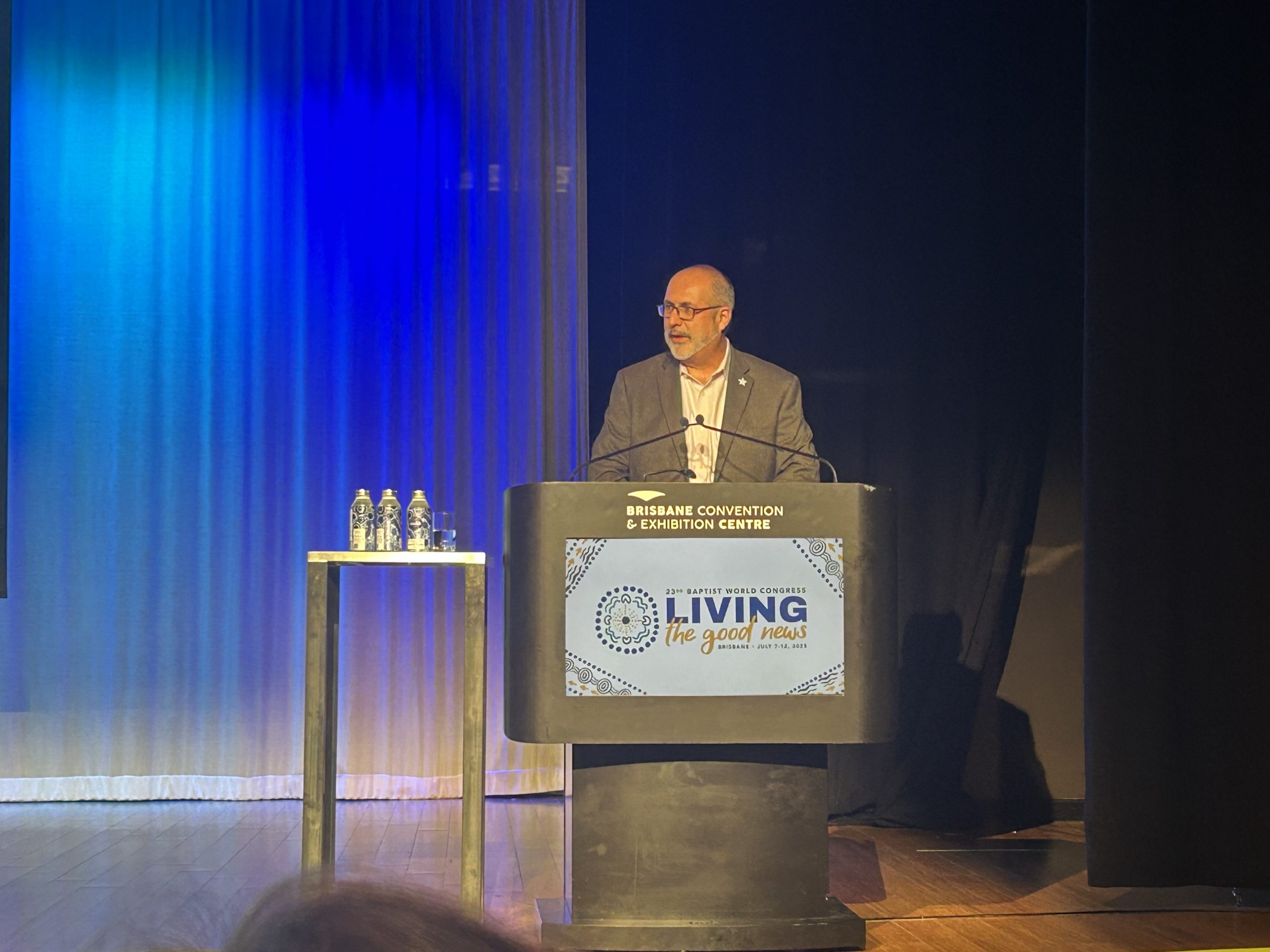
Julio Guarneri, executive director of Texas Baptists also taught on 2 Corinthians 5:17-6:2. He focused on the disruptive nature of the good news.
Recalling a series of disruptive events from his own history—beginning with his parents’ coming to Texas from Mexico as missionaries to Spanish-speaking people in his teen years—Guarneri asserted surrender to God’s direction moved him to a deeper plane, no matter how imperfect his surrender may have been.
In the passage, Jesus sets his kingdom agenda of reconciliation—an agenda that is clear: “through his perfect work on the cross, he proclaims good news to the poor, freedom for the captive,” sight to the blind, healing for the sick and the beginning a new era of the Lord’s favor.
“Our agenda ought to reflect Jesus’… the metric for success ought to be the same as that of Jesus,” Guarneri noted.
Jesus’ agenda is comprehensive, including proclamation, healing and liberation. “It is physical, it is spiritual, and it’s emotional,” he said.
“The nature of the gospel requires us to be holistic in our approach,” Guarneri noted, continuing, “Our ministry is about words and about works … It is about loving, and it’s about living the good news.”
Paul reminded the Corinthian Christians they are partners with God, he said.
God’s coworkers cannot be mere recipients of God’s redemption, but also must be reconcilers, Guarneri asserted.
God’s heart has always been for the nations, but the Holy Spirit’s power took an ethnocentric understanding of God and “reframed it to be inclusive of all people.”
When God sends the disciples, it starts a global movement that extends to the ends of the earth.
Guarneri noted 60 percent of the world’s Christians today can be found in the Global South where Christianity is growing rapidly.
So, “the church, the academy and the mission” are at a pivotal moment.
“To be disruptible disciples in the rest of the world is to change our paradigm from simply thinking that we send from the West to the rest of the world, to coming alongside the Global South to send from everywhere to everywhere.”
Godly fasting
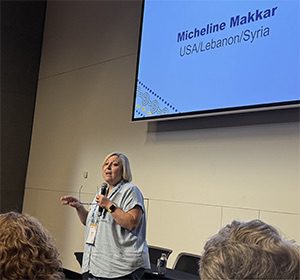
Micheline Makkar from the Baptist Church of Damascus, Syria, leads a Bible study at the Baptist World Congress. (Photo / Ken Camp)
God wants his people to fast—not to deprive themselves of needed nourishment but to meet the needs of others, said Micheline Makkar from Damascus, Syria.
“True fasting is doing good and loving justice,” Makkar said, focusing on Isaiah 58:6-12. “A godly fast is not about afflicting oneself but about liberating others.”
When a devastating 7.8 magnitude earthquake rocked Aleppo in 2023, no international humanitarian aid was able to reach the affected people because of sanctions imposed on Syria, she recalled.
Many members of the Baptist Church of Damascus struggled to feed their own families and had experienced deprivation themselves due to war.
However, leaders of the congregation encouraged church members to share what little food and other resources they had with the people of Aleppo.
“Our church gave 1,000 bags of blessing to Aleppo—from the poor to the poor,” Makkar said. “Our church learned fasting.”
God honors acts of “costly compassion” as expressions of worship, she said.
“God answers those who answer the needs of others,” Makkar said. “God responds to human mercy with divine favor.”
Acts of kindness and pursuit of justice are never in vain, even if their results are not immediately apparent, because they plant “the seeds for generational renewal,” she said.
Makkar urged global Baptists to ask: “What legacy of justice am I leaving?”
With additional reporting by Calli Keener.
Persecution and violence addressed at BWA Congress
September 8, 2025
BRISBANE—Bruce Webb, pastor of The Woodlands First Baptist Church, recounted the history of Baptist advocacy for freedom of religion during a breakout session at the Baptist World Congress focused on the persecution of Christians.
Webb started with Thomas Helwys and John Smyth becoming the first Baptists in direct response to the lack of complete religious freedom in England.
He traced Baptist championing of religious freedom through the American colonies, noting persecution of dissenting Christians by the official state churches—during that period.
“Using political power to achieve spiritual gains … is always short-sighted,” Webb said, alluding to Christian nationalism.
“If we give Congress or any political leader the power to give Christianity an advantage, then we also give them the power to remove it and grant that advantage to another ideology we oppose.”
“Baptist Christians have historically believed, if put on equal footing, Christianity will win because it is true,” Webb continued.
“We have never asked for an advantage, have never supported coercion, but have passionately advocated for the freedom to worship, serve God and share the good news of Jesus Christ with everyone everywhere.”
Samson Aderinto Adedokun, pastor of New Dawn Baptist Church in Lagos, Nigeria, described the situation for Christians in his country. He and his family have experienced religious persecution firsthand by what he called “Islamic fundamentalists.”
Adedokun described the positive results of persecution. Persecution scatters the church, but for a purpose.
“When you cannot escape the fire, carry the flame where you land,” he said.
Persecutors also need God’s love, Adedokun said. So, persecuted Christians need to act in love. This love can be demonstrated in kindness toward persecutors. “Your kindness may be someone’s miracle,” he said.
“Persecution is temporary. Kingdom joy is permanent,” Adedokun concluded. “Joy flows from obedience [to God], not comfort.”
Lessons for churches from areas of conflict
Igor Bandura participated in a breakout session focused on lessons learned from churches facing war, violence and terror. (Photo / Eric Black)
Igor Bandura, vice president for international affairs with the Union of Ukrainian Baptists, participated in a breakout session focused on lessons learned from churches facing war, violence and terror.
Bandura began by pointing to Psalm 46:1—“God is our refuge and strength, an ever-present help in trouble.”
“This promise anchors us,” he said.
Bandura shared four lessons—“practical wisdom for any church facing trials”—Ukrainian Baptists have learned in the current war.
“Plan for the worst. Act in faith.”
Even though their prayers expecting God to stop the war were not answered, “not one pastor said God failed us,” Bandura said. “War became our call to serve.”
“Pace yourselves for the long haul.”
Likening war to a marathon, Bandura said: “The finish line is unknown. … Be sure you’re not alone. … Never face trials alone.”
“Adapt your theology to war’s challenges.”
Bandura made clear he was not speaking of core theology, but theology of concepts like peace and evil.
“Peace-time theology often crumbles in war. … Theology written in a soft chair does not work because life is bloody,” he said.
“Evil is very intentional,” Bandura added. “Propaganda deceives even good Christians. … War demands sober realism. … A deceived church cannot stand.”
“Community preserves mental and spiritual health.”
Knowing their No. 1 plan would be to serve their community when Russia launched its full-scale invasion of Ukraine, Ukrainian Baptists provided water, generated electricity and offered church basements as bomb shelters.
To maintain their mental and spiritual health and build resilience, “we laugh a lot,” cry together and pray together, Bandura said.






 The initiative, a partnership with the Evangelical Council for Abuse Prevention, is designed to deliver support for survivors, ministry leaders and others needing advice on preventing sexual abuse or responding to abuse allegations.